Research Article
Using Popular Films to Enhance
Classroom Learning
The Good, the Bad, and the Interesting
Andrew C. Butler,
1Franklin M. Zaromb,
1Keith B. Lyle,
2and Henry L. Roediger, III
1 1Washington University in St. Louis and
2University of Louisville
ABSTRACT—Popular history films sometimes contain major historical inaccuracies. Two experiments investigated how watching such films influences people’s ability to remember associated texts. Subjects watched film clips and studied texts about various historical topics. Whereas the texts contained only correct information, the film clips con-tained both correct information (consistent with the text) and misinformation (contradicted by the text). Before watching each clip, subjects received a specific warning, a general warning, or no warning about the misinformation. One week later, they returned for a cued-recall test about the texts. Watching a film clip increased correct recall of consistent information relative to recall of the same in-formation when subjects did not see the clip. However, when the information in the film contradicted the text, subjects often (falsely) recalled misinformation from the film. The specific warning substantially reduced this mis-information effect. Teachers should use popular history films with caution and should warn students about major inaccuracies in the films.
Soon after motion pictures emerged as a medium for mass-market entertainment in the early 20th century, educators began to explore how film could be used to promote learning in the classroom (e.g., Hansen, 1933; Sumstine, 1918; Wood & Free-man, 1929). Although showing films was initially derided as lazy teaching, today films are commonly used as an instructional aid in the classroom, especially in history courses. Of the subjects who participated in the present research (N5108), 93% re-ported taking a course in which the instructor used a film to il-lustrate material, and history was the most commonly listed such
course (English and psychology were also frequently listed). Indeed, there are books offering expert advice on how to teach history with film (e.g., Marcus, 2007; O’Connor, 1987) and a multitude of films from which to choose: Almost a third of the Oscar-nominated films in the Best Picture category from 1981 through 2005 were about historical events (Niemi, 2006).
Many educators assume that films increase students’ interest in and, consequently, learning of course material. To appeal to students, educators most commonly select big-budget studio productions featuring well-known actors and actresses (e.g., Stoddard & Marcus, 2006). Although these popular films gen-erally contain much historically accurate information, the pro-ducers often take liberties with facts to tell a more entertaining story (e.g., Carnes, 1995; Toplin, 1996). Many of the inaccura-cies in these films are trivial, but occasionally major distortions are committed. For example, the filmGlorydepicted soldiers in the 54th Massachusetts Infantry as recently freed slaves from the South, but in reality most were Northern freemen.
In the research we report here, we investigated the effect of watching clips from popular history films on the learning and retention of material from associated texts. We specifically chose films that contained both accurate and inaccurate information. The inaccurate information in these films represented major distortions, which were explicitly contradicted in the texts. Of interest was how watching a film clip would influence memory for the text when the information in the clip was consistent with the text and when it was inconsistent with the text. In the classroom, students sometimes watch a film before studying a history text, but other times the order is reversed. Thus, we also examined whether the order in which the film and text were presented affected memory for the text. Finally, educators are frequently aware of the inaccurate information in films and warn students about it. To examine the effects of this behavior, we tested whether warnings reduce learning of inaccurate infor-mation from films. Before describing our study, we briefly dis-cuss relevant psychological research.
Address correspondence to Andrew C. Butler, Washington Univer-sity, Department of Psychology, Campus Box 1125, St. Louis, MO 63130-4899, e-mail: [email protected].
BACKGROUND
There are many reasons to expect that viewing films will improve learning and retention of associated textual material. To the extent that the material depicted in a film overlaps with an as-sociated text, two presentations of the same information should lead to better retention than a single presentation. In addition, viewing a film clip and reading an associated text represent distinct contexts in which the same information is studied. Thus, there should be considerable variability in the information en-coded, which should enhance retention (Bower, 1972; Estes, 1955; Martin, 1968). Moreover, the visual depiction of the ma-terial in films may facilitate dual coding of the information— visual information from the film and verbal information from the text—which should lead to better retention (Paivio, 1969, 1986). Finally, the entertainment value of a film may increase interest in the topic, which can boost people’s motivation to learn (Silvia, 2008).
If films contain misinformation, there are reasons to predict that viewing them may hinder learning and retention of asso-ciated textual material, as a result of retroactive or proactive interference. Exposure to incorrect information about previ-ously encoded events can lead people to misremember those events, such as in the eyewitness misinformation paradigm (Loftus, 1979a; Loftus, Miller, & Burns, 1978). This effect may be due to source-monitoring confusion (Johnson, Hashtroudi, & Lindsay, 1993; Lindsay & Johnson, 1989a). Interestingly, ex-posure to misinformation can influence subsequent memory even if the misinformation is presented before the to-be-remembered event. This is referred to as the reversed misin-formation effect (or proactive interference; e.g., Lindsay & Johnson, 1989b; Rantzen & Markham, 1992). Most misinfor-mation research has involved target informisinfor-mation and verbal misinformation that are historically irrelevant (but see Sacchi, Agnoli, & Loftus, 2007), leaving open the question of whether dramatized films can distort memory for historical facts. Al-though people are probably aware that popular history films are partially fictionalized, previous research indicates that infor-mation from fiction is often integrated with real-world knowl-edge, which leads to learning and subsequent production of misinformation (Marsh & Fazio, 2006; Marsh, Meade, & Roe-diger, 2003).
Nevertheless, there are also reasons to predict that viewing popular films with misinformation will not affect the learning and retention of associated textual material. People tend to re-ject misinformation that blatantly contradicts the original event (e.g., Loftus, 1979b). Thus, people may notice and discount the major misrepresentations in a film clip, especially if the film and text are presented in quick succession. Also, people’s knowl-edge that popular films are fictional may undermine the films’ credibility, which would be expected to reduce viewers’ pro-duction of misinformation from the films (e.g., Hoffman, Gran-hag, See, & Loftus, 2001). Finally, presentations of information
in film and text should be distinctive enough to allow people to discriminate between the two sources. When sources are highly distinguishable and people know that one source contained misinformation, the misinformation effect is substantially re-duced (e.g., Lindsay, 1990).
EXPERIMENT 1
During an initial session in Experiment 1, subjects studied nine texts about various historical topics and watched six clips from popular films, each of which was associated with a text. Three film clips were not shown, to create a read-only control condi-tion. Each film clip contained one piece of correct information and one piece of misinformation, which were consistent and inconsistent with the associated text, respectively. A given text and its associated film clip were always presented back-to-back, but the order of presentation was manipulated (i.e., film before text in the view-read condition and text before film in the read-view condition). In addition, subjects received a general warn-ing, a specific warnwarn-ing, or no warning about possible misinfor-mation immediately before watching each film clip. One week later, subjects returned for a cued-recall test on the texts, which was followed by a similar test on the film clips. Finally, subjects completed a questionnaire about their prior knowledge of and interest in the films and topics used in the experiment, as well as their experiences with films in the classroom.
Method
Subjects and Design
Fifty-four undergraduate psychology students at Washington University participated for course credit. The design was a 3 (warning: no warning, general warning, specific warning)3 (presentation condition: read-view, view-read, read-only) mixed factorial design. Warning was manipulated between subjects, and presentation condition was manipulated within subjects. Materials
We identified nine popular films that contained at least one major historical inaccuracy (see Table 1). For example,The Last
Samuraitells the story of an American military advisor
sum-moned to Imperial Japan in the 1870s to help put down a re-bellion. In reality, the military advisors hired by the Emperor Meiji were French, not American. A short clip, which depicted the inaccuracy and lasted approximately 5 min, was selected from each film.
To accompany each film clip, we created a text of approxi-mately 800 words on the same topic (see Table 1). Each text contained some information that overlapped with the film clip. Critically, the text contained only veridical information and contradicted the inaccuracy depicted in the film clip. In addi-tion, nine brief orienting passages (approximately 100 words each) were created to introduce the film clips. Finally, one
general warning and nine specific warnings were created for the film clips. The general warning stated that filmmakers often take liberties with historical facts in order to create an entertaining story and that, therefore, the film clip might contain inaccura-cies. The specific warning always began with the general warning and then both described and corrected the misinfor-mation.
For the cued-recall test, we created 54 questions of four types (see Table 2 for examples). Text-film-consistent questions were about information that was presented accurately in both the text and the film clip. Text-film-inconsistent questions asked about information that was presented accurately in the text, but in-accurately in the film clip. Text-only and film-only questions were filler items that probed information that was presented in only the text and only the film, respectively. For each topic, there was one text-film-consistent question, one text-film-inconsistent question, two text-only questions, and two film-only questions. Procedure
In the first session, subjects were randomly assigned to a warning condition upon arrival. They were told that their goal was to learn the material in the texts for a subsequent test, and
that the film clips were intended only to illustrate the material. The texts and film clips were presented on a computer using PsyScope X software (Cohen, MacWhinney, Flatt, & Provost, 1993). The assignment of topics to the three presentation con-ditions and the sequence in which the topics were presented were counterbalanced. Reading was self-paced, but each text was presented for a minimum of 5 min. Subjects seldom needed additional study time. Film clips were always preceded by an orienting passage. For the specific- and general-warning con-ditions, the warning was presented after the orienting passage but before the film clip. After completing the program, subjects were reminded to return in 1 week and were dismissed.
In the second session, subjects took a cued-recall test that was presented on a computer using E-Prime software (Schneider, Eschman, & Zuccolotto, 2002). The first phase of the test con-tained questions about information in the texts (i.e., the text-film-consistent, text-film-inconsistent, and text-only questions). Subjects were instructed to answer these questions using only their memory of the texts. The second phase contained questions about the film clips (i.e., the film-only questions) and was a surprise because subjects did not expect to be tested on the films. In both phases, subjects were required to produce a re-sponse for every question, and they typed in their answers using the keyboard. After each question, they rated their confidence in the correctness of their response using a scale from 0 to 100 (100 represented full confidence).
Finally, subjects completed a brief questionnaire that asked them about (a) their experiences with films in the classroom, (b) whether they had previously seen any of the films, (c) whether they had any prior knowledge about the topics, and (d) how in-teresting they found the texts and films (on a scale from 1 to 5).
Results
All results reported, unless otherwise stated, were significant at the .05 level. The main analysis for each question type consisted of a 3 (warning)3 (presentation condition) repeated measures analysis of variance. Results for the text-only and film-only filler TABLE 2
Examples of the Questions Presented on the Final Cued-Recall Test
Question type Question Answer
Text-film-consistent Who were the soldiers in the Imperial Japanese army that was
being trained to put down the Satsuma Rebellion?
The Imperial Japanese army was made up of peasants who had been conscripted into service and had little experience with fighting.
Text-film-inconsistent
From what country did Emperor Meiji hire military advisors to help the Imperial Japanese army put down the Satsuma Rebellion?
He hired French military advisors to instruct his soldiers on the art of Western warfare.
(Misinformation: He hired American military advisors.)
Text-only What was the legacy of Saigo Takamori, the leader of the
Satsuma Rebellion?
He was later viewed as a tragic hero and pardoned posthumously.
Film-only Why did General Hasagawa of the Imperial Japanese army
know so much about the Satsuma samurais?
General Hasagawa was a samurai, too.
Note.The examples in this table are taken from the film clip and text forThe Last Samurai.
TABLE 1
Films and Topics Used as Materials for Both Experiments
Film Topic
Amadeus(1984) Wolfgang Amadeus Mozart
Amistad(1997) Mutiny on the Spanish shipAmistad Eight Men Out(1988) The Chicago Black Sox scandal
Elizabeth(1998) Queen Elizabeth I
Glory(1989) 54th Massachusetts Volunteer Infantry
Marie Antoinette(2006) The French Revolution
The Last Samurai(2003) The Satsuma Rebellion
Tombstone(2000) Wyatt Earp and the shoot-out at the O.K. Corral
questions are not reported, but analysis of these data yielded no significant effects (allFs<1).
Text-Film-Consistent Questions
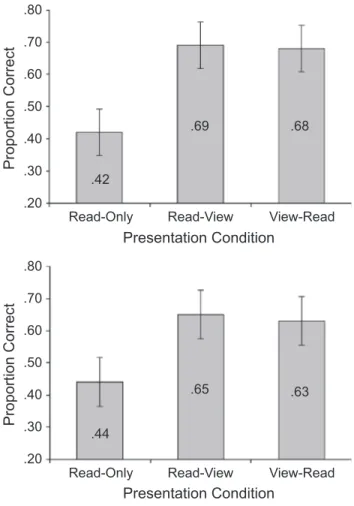
The top panel of Figure 1 shows the proportion of correct re-sponses to the text-film-consistent questions as a function of presentation condition (data are collapsed across the warning factor). Presentation condition affected recall, F(2, 102) 5 17.11,MSE50.07,Zp2¼:25, but neither the main effect of
warning nor the interaction of presentation condition and warning were significant (Fs <1). Follow-up pair-wise com-parisons indicated that both the read-view condition (.69) and the view-read condition (.68) produced significantly greater proportions of correct responses than the read-only condition (42),t(53)55.76,d50.80,prep51.00, andt(53)54.45,d5 0.61,prep51.00, respectively.
Text-Film-Inconsistent Questions
In answering the text-film-inconsistent questions, subjects could produce the correct response from the text, the
misinfor-mation from the film clip, or some other incorrect response. We report the analyses of misinformation and correct responses only because the three response outcomes are mutually exclusive (i.e., the proportion of the third type of response is necessarily determined by the other proportions).
The top panel of Figure 2 shows the proportion of misinfor-mation responses as a function of warning and presentation condition. Production of misinformation was quite high for both the no-warning and the general-warning conditions when the film clip was viewed. There were significant main effects of warning,F(2, 51)514.75,MSE50.04,Zp2 ¼:37, and pre-sentation condition,F(2, 102)56.88,MSE50.06,Zp2¼:12,
as well as a significant interaction,F(4, 102)52.87,MSE5 0.06,Zp2¼:10. No misinformation effect occurred with the
specific warning (i.e., production of misinformation was not significantly greater in the read-view or view-read condition than in the read-only condition).
The proportion of correct responses to the text-film-incon-sistent questions was generally quite low, except when subjects .80 .70 .60 .50 .40 .30 .20 Read-Only .42 .44 .69 .65 .68 .63 Read-View Presentation Condition View-Read Read-Only Read-View Presentation Condition View-Read Proportion Correct Proportion Correct .80 .70 .60 .50 .40 .30 .20
Fig. 1.Proportion of correct responses on text-film-consistent questions as a function of presentation condition (data are collapsed across the warning factor) in Experiment 1 (top panel) and Experiment 2 (bottom panel). Error bars indicate 95% confidence intervals.
.70 .60 .50 .40 .30 .20 .11 .37 .37 .49 .14.18.12 .35 .20 .10 .00 .09 .09 .54 .43 .06 .13 .22 .37 .31 Read-Only Read-View View-Read Read-Only Read-View View-Read No Warning General Warning Warning Condition Specific Warning No Warning General Warning Warning Condition Specific Warning Proportion Misinformation Proportion Misinformation .70 .60 .50 .40 .30 .20 .10 .00
Fig. 2.Proportion of misinformation responses on text-film-inconsistent questions as a function of warning and presentation condition in Exper-iment 1 (top panel) and ExperExper-iment 2 (bottom panel). Error bars indicate 95% confidence intervals.
received the specific warning in the read-view (M5.78) and view-read (M5.67) conditions. (These results are not depicted because they are essentially the inverse of the misinformation responses.) The proportion of correct responses showed a sig-nificant main effect of warning,F(2, 51)59.45,MSE50.10, Zp2¼:27, and a significant interaction, F(4, 102) 5 3.80, MSE50.06,Zp2¼:13, which was driven by the high levels of
performance when the specific warning was given in the read-view and read-view-read conditions. The main effect of presentation condition was not significant,F(2, 102)51.58,MSE50.06,
p5.21.
Confidence
Confidence ratings for the text-film-inconsistent questions were analyzed to assess whether subjects believed that the misin-formation they produced was correct. Subjects were more con-fident in the accuracy of their misinformation responses than in the accuracy of their other incorrect responses (77 vs. 69), t(41)54.00,d50.46,prep51.00. Furthermore, subjects were at least as confident in their misinformation responses as in their correct responses; a (nonsignificant) trend showed greater con-fidence in the misinformation responses (77 vs. 72), t(41) 5 1.43,p5.16.
Interest
One reason educators use films is to increase students’ interest in the course material. If films do increase interest in the topic covered, then subjects should have rated texts as more inter-esting when a film clip about the same topic was shown than when a clip was not shown. We calculated the mean interest rating given to the three texts in each presentation condition. Compared with interest ratings for the read-only texts (2.7), interest ratings were significantly higher for texts in the read-view condition (3.1),t(52)52.79,d50.46,prep5.96, and the view-read condition (3.0),t(52)52.01,d50.34,prep5.90.
Discussion
In Experiment 1, watching film clips increased correct recall for consistent information relative to reading a text alone. This ef-fect occurred whether or not there was a warning. However, when information in the film contradicted the text, subjects often (falsely) recalled the misinformation from the film. This misin-formation effect occurred when either no warning or a general warning was given prior to presentation of the film clips, but it was eliminated with a specific warning. Subjects’ confidence ratings indicated that they believed their misinformation re-sponses to be correct. In addition, they rated the texts as more interesting when they had seen related film clips than when they had only read the texts.
EXPERIMENT 2
Experiment 2 was designed to replicate and extend the findings of Experiment 1. To further examine the processes underlying the production of misinformation, we collected source-memory judgments after the cued-recall test. Of interest was whether subjects would misattribute the misinformation they produced to the text.
Method
Subjects and Design
Fifty-four undergraduate psychology students at Washington University participated for course credit. The design was the same as in Experiment 1.
Materials
The materials from Experiment 1 were used except for the modification of three of the text-film-inconsistent questions, which were reworded to reduce the baseline production of misinformation in the read-only condition.
Procedure
The procedure was the same as in Experiment 1, except for two changes. First, the presentation sequence was changed so that a text and its associated film clip were no longer back-to-back. Instead, a mix of other texts and films lasting approximately 35 min intervened between the reading of a text and the viewing of the associated film clip. Second, a source-memory judgment task was given after the cued-recall test. Subjects were re-pre-sented with each question and their response and asked to identify the source of the information.
Results
Text-Film-Consistent Questions
The bottom panel of Figure 1 shows the proportion of correct responses to the text-film-consistent questions as a function of presentation condition (data are collapsed across the warning factor). As before, the main effect of presentation condition,F(2, 102) 5 9.79, MSE 5 0.08, Zp2¼:16, indicated that facts
presented twice were better remembered than those presented once. Neither the main effect of warning (F<1) nor the inter-action,F(4, 102)51.53,MSE50.08,p5.20, was significant. Both the read-view condition (.65) and the view-read condition (.63) produced a significantly greater proportion of correct re-sponses than the read-only condition (.44),t(53)54.39,d5 0.58,prep51.00, andt(53)53.18,d50.43,prep5.98, re-spectively.
Text-Film-Inconsistent Questions
The bottom panel of Figure 2 shows the proportion of misinfor-mation responses to the text-film-inconsistent questions as a
function of warning and presentation condition. As in Experi-ment 1, subjects produced a high proportion of misinforma-tion in both the no-warning and the general-warning condimisinforma-tions when the film clip was viewed. There were significant main effects of warning,F(2, 51)515.16,MSE50.04,Zp2¼:37, and presentation condition,F(2, 102)5 15.81,MSE5 0.07, Zp2¼:23. However, the interaction was only marginally
sig-nificant,F(4, 102)52.15,MSE50.07,p5.08,Zp2¼:08.
The proportion of correct responses to the text-film-incon-sistent questions was quite low, except in the read-view (M5 .48) and view-read (M5.57) conditions when subjects received the specific warning, as well as in the read-only conditions (grand mean 5.45). The proportion of correct responses also showed a significant interaction of warning and presentation condition,F(4, 102)52.58,MSE50.07,Zp2¼:09. However,
neither the main effect of warning, F(2, 51)5 1.45,MSE 5 0.12,p5.24, nor the main effect of presentation condition (F< 1) was significant.
Confidence and Source Monitoring
The source judgment task was added to Experiment 2 in order to explore whether source-monitoring errors contributed to the production of misinformation on the final test. Table 3 shows the proportion of correct and misinformation responses on the text-film-inconsistent questions as a function of source judgment. For most of the correct responses, subjects identified the text as the only source of their response, but about a quarter of all correct responses were judged to be from the text and film. Correct responses were generally given high confidence ratings when they were labeled as from the text only (M583) or from the text and film (M584), but not when they were labeled as a guess (M528).
When subjects produced misinformation, they tended to identify the film as a source of the information in their response (i.e., in addition to the text as a possible source). The two most common source judgments for misinformation responses were ‘‘text and film’’ and ‘‘film, perhaps text.’’ Subjects were slightly less confident when the misinformation response was given a ‘‘film, perhaps text’’ judgment (M569) than when it was given a ‘‘text and film’’ judgment (M577). Nevertheless, confidence in misinformation responses was still quite high overall, except for
those labeled as a guess (M534), and was almost as high as confidence in correct responses.
Interest
As in Experiment 1, texts were rated as more interesting in the view-read condition than in the read-only condition (3.2 vs. 2.9), t(52)53.06,d50.24,prep5.98. They were also rated as more interesting in the read-view condition than in the read-only condition (3.1 vs. 2.9), although this difference was only mar-ginally significant,t(52)51.93,p5.057.
GENERAL DISCUSSION
These two experiments demonstrate the potential benefits and costs of using popular films to enhance learning and retention of associated texts. When the information in the film was consistent with the information in the text, watching the film clip increased correct recall by about 50% relative to reading the text alone. This facilitative effect occurred in all three warning conditions. Although it may seem obvious that two presentations should lead to better retention than a single presentation, repeatedly presenting information does not always boost retention. For example, repeatedly reading prose passages confers limited improvements over retention levels achieved after a single reading (e.g., Callender & McDaniel, 2009). The use of films in the present study increased retention substantially, presumably because the films introduced encoding variability (Bower, 1972; Estes, 1955; Martin, 1968) and promoted dual coding of the information (Paivio, 1969, 1986). Coupled with preliminary evidence that watching the film clips increased interest in the associated texts, these results support the idea that popular films can enhance learning in the classroom.
However, when the information in the film contradicted the text, subjects often (falsely) recalled the misinformation from the film. This misinformation effect occurred when no warning or a general warning was given prior to presentation of the film clip. Moreover, the misinformation effects obtained were quite large: Approximately half of all responses to the text-film-inconsistent questions consisted of misinformation in some conditions. In addition, subjects were highly confident in the accuracy of the misinformation they produced and sometimes misattributed it to the text when asked to make a source judgment. Thus, the TABLE 3
Proportion of Correct and Misinformation Responses to Text-Film-Inconsistent Questions as a Function of Source-Memory Judgment in Experiment 2
Response type
Source judgment
Text only Text, perhaps film Text and film Film, perhaps text Guess
Correct .59 .05 .26 .05 .05
Misinformation .05 .03 .34 .42 .16
Note.The data are collapsed across the warning factor, and items in the read-only condition were not included in the calculations.
present research demonstrates how both proactive and retro-active interference can powerfully undermine correct knowl-edge and promulgate false memories.
Our finding of such dramatic misinformation effects is sur-prising for several reasons. First, the misinformation in each film clip was central to events and individuals portrayed and bla-tantly contradicted information in the corresponding text. Rath-er than rejecting such misinformation (e.g., Loftus, 1979b), subjects tended to falsely recall it and endorse its accuracy. Second, the effect occurred despite subjects’ knowledge that the film clips were fictional. Such knowledge would normally be expected to undermine a source’s credibility, thereby reducing the production of misinformation on a recall test (e.g., Hoffman et al., 2001). Third, the misinformation effect occurred even though the two sources of information were highly distinctive (i.e., text vs. film), which should have supported accurate source monitoring (Lindsay, 1990). These considerations all point to the power of the effects we report.
Nevertheless, the specific warning succeeded in substantially reducing false recall of misinformation from the film. When subjects were informed about the specific piece of misinfor-mation in the film clip, they were able to learn the correct re-sponse and retain it until the test. Interestingly, the rere-sponses of many subjects in the specific-warning condition indicated that they remembered the misinformation too, but had tagged it as incorrect (e.g., ‘‘The film presented it this way, but it was really like this. . .’’). Presumably, the specific warning was effective because it enabled subjects to identify the misinformation (i.e., better than the general warning did) and also because it was given before the misinformation was presented, a factor that other studies have shown to be critical (Eakin, Schreiber, & Sergent-Marshall, 2003; Greene, Flynn, & Loftus, 1982). However, if retention were tested after a longer delay, tags about incorrectness might be forgotten, and the vivid misinformation from a film might be recalled as correct. Similar effects occur in other realms; for example, in the sleeper effect in attitude change, information from an unreliable source is discredited immediately after presentation but has an effect when assess-ment occurs much later (Kumkale & Albarracı´n, 2004).
The current study clearly shows that watching popular history films has both positive and negative effects on the learning of associated texts. Our findings suggest that popular films can increase learning and interest in the classroom. However, edu-cators should also be aware that popular films often contain historical inaccuracies and should recognize the detrimental effects that can result from exposing students to such misin-formation. One potential solution is for educators to provide students with specific warnings regarding the misinformation present in popular films prior to showing them in the classroom.
Acknowledgments—The authors thank Deena Moskowitz and Larissa D’Abreu for their assistance in data collection. The
re-search reported here was supported by a Collaborative Activity Award from the James S. McDonnell Foundation’s 21st Century Science Initiative in Bridging Brain, Mind and Behavior.
REFERENCES
Bower, G.H. (1972). Stimulus sampling theory of encoding variability.
In A.W. Melton & E. Martin (Eds.),Coding processes in human
memory(pp. 85–123). New York: Wiley.
Callender, A.A., & McDaniel, M.A. (2009). The limited benefits of
rereading educational texts. Contemporary Educational
Psy-chology,34, 30–41.
Carnes, M.C. (1995).Past imperfect: History according to the movies. New York: Henry Holt.
Cohen, J.D., MacWhinney, B., Flatt, M., & Provost, J. (1993). Psy-Scope: A new graphic interactive environment for designing
psychology experiments.Behavior Research Methods, Instruments,
& Computers,25, 257–271.
Eakin, D., Schreiber, T., & Sergent-Marshall, S. (2003). Misinforma-tion effects in eyewitness memory: The presence and absence of memory impairment as a function of warning and misinformation
accessibility. Journal of Experimental Psychology: Learning,
Memory, and Cognition,29, 813–825.
Estes, W.K. (1955). Statistical theory of distributional phenomena in learning.Psychological Review,62, 369–377.
Greene, E., Flynn, M., & Loftus, E. (1982). Inducing resistance to
misleading information. Journal of Verbal Learning and Verbal
Behavior,21, 207–219.
Hansen, J.E. (1933). The effect of educational motion pictures upon
the retention of informational learning.Journal of Experimental
Education,2, 1–4.
Hoffman, H., Granhag, P., See, S., & Loftus, E. (2001). Social influ-ences on reality-monitoring decisions.Memory & Cognition,29, 394–404.
Johnson, M.K., Hashtroudi, S., & Lindsay, D.S. (1993). Source moni-toring.Psychological Bulletin,114, 3–28.
Kumkale, G.T., & Albarracı´n, D. (2004). The sleeper effect in
per-suasion: A meta-analytic review. Psychological Bulletin, 130,
143–172.
Lindsay, D. (1990). Misleading suggestions can impair eyewitnesses’
ability to remember event details.Journal of Experimental
Psy-chology: Learning, Memory, and Cognition,16, 1077–1083. Lindsay, D., & Johnson, M. (1989a). The eyewitness suggestibility
effect and memory for source.Memory & Cognition,17, 349–358. Lindsay, D., & Johnson, M. (1989b). The reversed eyewitness sug-gestibility effect.Bulletin of the Psychonomic Society,27, 111– 113.
Loftus, E. (1979a). The malleability of human memory. American
Scientist,67, 312–320.
Loftus, E. (1979b). Reactions to blatantly contradictory information.
Memory & Cognition,7, 368–374.
Loftus, E., Miller, D., & Burns, H. (1978). Semantic integration of
verbal information into a visual memory.Journal of Experimental
Psychology: Human Learning and Memory,4, 19–31.
Marcus, A.S. (2007).Celluloid blackboard: Teaching history with film. Charlotte, NC: Information Age.
Marsh, E.J., & Fazio, L.K. (2006). Learning errors from fiction: Diffi-culties in reducing reliance on fictional stories.Memory & Cog-nition,34, 1140–1149.
Marsh, E.J., Meade, M.L., & Roediger, H.L., III. (2003). Learning facts
Martin, E. (1968). Stimulus meaningfulness and paired-associate
transfer: An encoding variability hypothesis. Psychological
Re-view,75, 421–441.
Niemi, R. (2006). History in the media: Film and television. Santa
Barbara, CA: ABC-CLIO.
O’Connor, J.E. (1987). Teaching history with film and television.
Washington, DC: American Historical Association.
Paivio, A. (1969). Mental imagery in associative learning and memory.
Psychological Review,76, 241–263.
Paivio, A. (1986). Mental representations: A dual coding approach.
Oxford, England: Oxford University Press.
Rantzen, A., & Markham, R. (1992). The reversed eyewitness
testi-mony design: More evidence for source monitoring. Journal of
General Psychology,119, 37–43.
Sacchi, D.L.M., Agnoli, F., & Loftus, E.F. (2007). Changing history:
Doctored photographs affect memory for past events. Applied
Cognitive Psychology,21, 1005–1022.
Schneider, W., Eschman, A., & Zuccolotto, A. (2002).E-Prime refer-ence guide. Pittsburgh, PA: Psychology Software Tools.
Silvia, P.J. (2008). Interest—the curious emotion.Current Directions in Psychological Science,17, 57–60.
Stoddard, J.D., & Marcus, A.S. (2006). The burden of historical rep-resentation: Race, freedom, and ‘‘educational’’ Hollywood film.
Film & History,36, 26–35.
Sumstine, D.R. (1918). A comparative study of visual instruction in the high school.School and Society,7, 235–238.
Toplin, R.B. (1996).History by Hollywood. Urbana: University of
Il-linois Press.
Wood, B.D., & Freeman, F.N. (1929).Motion pictures in the classroom: An experiment to measure the value of motion pictures as supple-mentary aids in regular classroom instruction. Boston: Houghton Mifflin.