Author(s) Yu, Wai-kwok.; 余偉國.
Citation
Issued Date 2011
URL http://hdl.handle.net/10722/144200
Current Progress and Future Development
of Wind Energy in Hong Kong
by
Yu Wai Kwok, Ringo
Supervisor: Prof. Dennis Y.C. Leung
September 2011
Master of Science in Environmental Management
The University of Hong Kong
Abstract
Wind energy technology is one of the most widely used renewable energies over the world. To investigate its prospect in Hong Kong, the present thesis provides an overview on the current progress of wind energy and analyzes the potential of future wind energy’s development in Hong Kong. Currently, a commercial-scale 800 kW wind turbine and a numbers of small wind turbines ranging from 100 to tens of kW are operating, while two large offshore wind farms were proposed by the two local power companies respectively and will be constructed in near future.
For future development of wind energy, the technology can be economically competitive with other energy sources and is economically feasible to be developed in Hong Kong. Political support is crucial for developing wind energy, adopting policy instruments such as Carbon Taxes and Renewable Energy Feed-in Tariffs (REFITS) are very useful, whereas cooperation with China is also a potential option. In meteorological aspects, sufficient wind resources are present locally, but due to geographical constraints, offshore wind farms are predicted to have largest potential for development. In addition, installing Building Augmented Wind Turbines (BAWT) is another direction of development having potential, because wind resource can be enriched in certain dense built environments of Hong Kong due to concentrator effects, and the wind resources can be utilized by BAWTs.
It is concluded that currently wind energy development is immature in Hong Kong due to lack of lands and inadequate political support, but it is the most feasible kind of renewable energy in long term and have potential for development. Government’s role is vital, more supports and efforts should be paid by the government especially in economical and political aspects. Further researches should also be done to investigate effective ways to utilize wind energy in Hong Kong.
l-t;
l;
1".,l:
t:
Ilr
l;
t-,
ll
rf
t-,
rl
rl
rj
rl
rl
lt
Declaration
This
dissertation representsthe
author's
own work
conductedfor
the purposesof
this MSc
in
Environmental Management programme.All
significant data or analysis usedin
this dissertationfrom
other sources-including
work
the author may have carried outfor
purposes other thanfor this programme
-
has clearly been identified as such.Signed:
Acknowledgements
I wish to express my sincere gratitude to Professor Dennis Y.C. Leung
for his kind support and guidance in this study.
I would also like to thank the “China Light & Power Hong Kong
Limited” (CLP) and the “Hongkong Electric Company Limited” (HEC)
for giving out their opinions that contribute to this study.
Yu Wai Kwok, Ringo
September, 2011
Contents
Declaration ………... i Acknowledgement ………... ii Contents ……… iii List of Figures ……….. v Lists of Abbreviations ……….. vi Chapter 1 Introduction ……….. 1 1.1 Background ……… 11.2 Objectives and methodology ………. 2
1.3 Structure of the thesis ……… 2
Chapter 2 Literature Review ………. 4
2.1 Wind energy as a renewable energy ……….. 4
2.2 Wind energy development in the world ………. 5
2.3 Wind energy development in Hong Kong ………. 8
Chapter 3 Energy Overview and Current Status of Wind Energy usage in Hong Kong ……….. 10
3.1 Energy overview in Hong Kong ……… 10
3.1.1 Energy consumption in Hong Kong ………. 10
3.1.2 Energy market structure in Hong Kong ……… 13
3.1.3 Energy policy in Hong Kong ……… 14
3.2 Current Status of Wind Energy usage in Hong Kong………. 16
3.2.1 Background ………... 16
3.2.2 Lamma Winds ………... 17
3.2.3 Southwest Lamma (SWL) Offshore Wind Farm ……….. 19
3.2.4 Southeastern Waters (SEW) Offshore Wind Farm ………... 21
3.2.5 Small wind turbines ………...………... 23
Chapter 4 Future Development of Wind Energy in Hong Kong ………... 27
4.1 Economics aspects ……… 27
4.1.1 Background ………... 27
4.1.3 Promoting economical development of wind energy …….…….. 30
4.1.4 Conclusion of wind energy’s economical development ………... 33
4.2 Political aspects …….……… 34
4.2.1 Background ………... 34
4.2.2 Collaboration with China ………...………... 34
4.2.3 Changing the energy market structure ……….. 37
4.2.4 Political instruments to promote wind energy development …… 39
4.2.5 Setting up a specific authority for renewable energy ……… 43
4.2.6 Conclusion of wind energy’s political development ………. 44
4.3 Meteorological and geographical aspects ……….. 45
4.3.1 Background ………... 45
4.3.2 Development of wind energy on islands ………... 45
4.3.3 Development of wind energy on land ………... 48
4.3.4 Development of wind energy in offshore areas ……… 50
4.3.5 Offshore wind farms as the most feasible option in Hong Kong .. 51
4.3.6 Conclusion of meteorological and geographical development .... 54
4.4 Comments from power companies ……… 54
Chapter 5 Applicability of wind turbines in Hong Kong’s built environment…... 56
5.1 Background ……… 56
5.2 Considerations in Hong Kong ………... 58
5.3 Suggestions ……… 59
5.4 Conclusion of applicability of wind turbines in Hong Kong’s built environment ……… 62
Chapter 6 Conclusions ………... 64
Lists of Figures
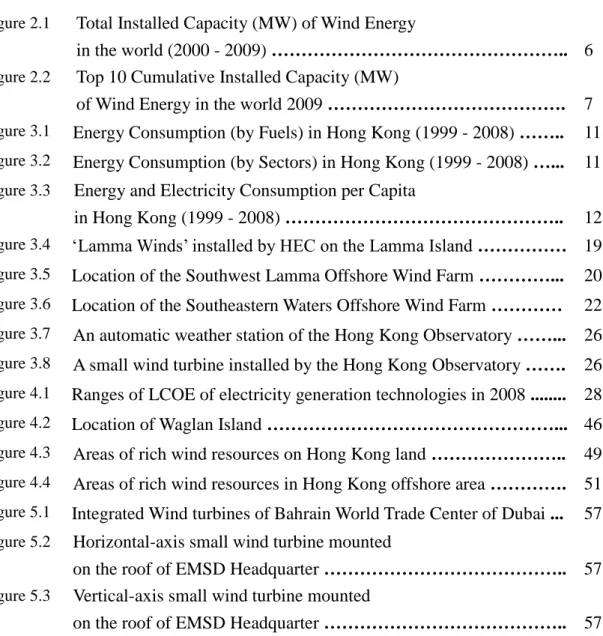
Figure 2.1 Total Installed Capacity (MW) of Wind Energy
in the world (2000 - 2009) ……….. 6
Figure 2.2 Top 10 Cumulative Installed Capacity (MW)
of Wind Energy in the world 2009 ………. 7
Figure 3.1 Energy Consumption (by Fuels) in Hong Kong (1999 - 2008) …….. 11
Figure 3.2 Energy Consumption (by Sectors) in Hong Kong (1999 - 2008) …... 11
Figure 3.3 Energy and Electricity Consumption per Capita
in Hong Kong (1999 - 2008) ……….. 12
Figure 3.4 ‘Lamma Winds’ installed by HEC on the Lamma Island ……… 19
Figure 3.5 Location of the Southwest Lamma Offshore Wind Farm …………... 20
Figure 3.6 Location of the Southeastern Waters Offshore Wind Farm ………… 22
Figure 3.7 An automatic weather station of the Hong Kong Observatory ……... 26
Figure 3.8 A small wind turbine installed by the Hong Kong Observatory ……. 26
Figure 4.1 Ranges of LCOE of electricity generation technologies in 2008 ... 28
Figure 4.2 Location of Waglan Island ………... 46
Figure 4.3 Areas of rich wind resources on Hong Kong land ……….. 49
Figure 4.4 Areas of rich wind resources in Hong Kong offshore area …………. 51
Figure 5.1 Integrated Wind turbines of Bahrain World Trade Center of Dubai ... 57
Figure 5.2 Horizontal-axis small wind turbine mounted
on the roof of EMSD Headquarter ……….. 57
Figure 5.3 Vertical-axis small wind turbine mounted
Lists of Abbreviations
BAWT Building Augmented Wind Turbine
CLP China Light & Power Hong Kong Limited
EIA Environmental Impact Assessment
EMSD Electrical & Mechanical Services Department
GHG Greenhouse Gas
GWEC Global Wind Energy Council
HEC Hongkong Electric Company Limited
HKO Hong Kong Observatory
HKOWL Hong Kong Offshore Wind Limited LCOE Levelized Cost of Electricity REFITS Renewable Energy Feed-in Tariffs
RES Renewable Energy System
RPS Renewable Portfolio Standard
SEW Offshore Wind Farm Southeastern Waters Offshore Wind Farm SWL Offshore Wind Farm Southwest Lamma Offshore Wind Farm WWEA World Wind Energy Association
Chapter 1 Introduction
1.1
Background
Electricity is crucial to Hong Kong for supporting various kinds of activities everyday, and electricity is mainly generated by combustion of coal in Hong Kong (Chan, 2003). Burning of coal, which is a kind of fossil fuels, will cause air pollution problem and lead to global warming. Fossil fuels are also non-renewable that will be depleted in near centuries. In order to mitigate these adverse effects and solve the imminent energy crisis issue, each country bears the responsibility to seek new energy sources and improve their present energy sources’ quality, one of the ways is to replace fossil fuels with renewable energy.
Renewable energy is energy source that is renewable and will not be depleted, and usually produces no pollution, therefore it is regarded as one of the best solutions to cease global warming and energy crisis caused by fossil fuels. While renewable energy has to compete with conventional energy sources inevitably, those renewable energies that have huge and renewable raw materials will have advantages in the long run (Sahin, 2004). Among different kinds of renewable energies, wind energy is one of the most promising energy sources, that is becoming widely used around the world. For example, wind power has taken up to 20%, 8% and 7% respectively of total power consumption in Denmark, Spain and Germany (GWEC, 2009).
It is imminent for Hong Kong to develop wind energy and increase its proportion in electricity generation. Not only it can contribute to a greener
environment and combat global warming, but also to support increasing population size, secure energy supply and mitigate boosting of fuel prices. However, due to limited land, hilly topography and other obstacles, current development of wind energy in Hong Kong is limited and mainly serve as educational and demonstration purposes. In order to reduce reliability on fossil fuels and to combat climate change, Hong Kong should explore its potential in developing wind energy.
1.2
Objectives and methodology
The objectives of this project are to investigate current progress of wind energy in Hong Kong, study wind energy’s future development in Hong Kong and to explore the potential of wider wind energy applications in Hong Kong.
The methodology adopted in this project includes information collection through internet, textbooks, journals and government publications. Comments and data were also collected from power companies and government departments.
1.3
Structure of the thesis
Seven chapters will be included in this thesis. Chapter 1 briefly describes the necessity of developing renewable energy, gives an brief overview of wind energy in Hong Kong and in the world. Objectives and structure of the report of the project are highlighted.
Chapter 2 is a literature review, summarizing other researches and statistics done previously on wind energy development in the world and in Hong Kong.
Chapter 3 describes current progress of wind energy development in Hong Kong. Energy market and energy policy in Hong Kong are also investigated.
Chapter 4 is a detailed study on future development of wind energy in Hong Kong. Development in four aspects: economical, political, meteorological and geographical are described. Suggestions are proposed for each aspect to assist wind energy development. Comments from local power companies were also collected and evaluated.
Chapter 5 is an assessment of another potential application of wind power in Hong Kong, i.e. wind turbines in the built environment.
Chapter 6 is a conclusion of this project with recommendations on wind energy development in Hong Kong.
Chapter 2 Literature Review
2.1
Wind energy as a renewable energy
When solar radiation is absorbed by the earth, land surfaces are heated up unevenly. Water and lands under clouds are heat up slowly, while lands exposed directly to sunlight heat more quickly. The air above hotter land surfaces will be heated up and rise, creating a low pressure area. The pressure gradient causes air to move from high pressure area to low pressure area, and this horizontal movement of air is called wind. Wind speeds at a given location always vary, and the variation is affected by meteorological, geographical and environmental factors (Walker, 1997).
Wind turbines are devices necessary to convert kinetic energy of wind into electrical power. Blades of wind turbines are rotated due to wind forces, and the rotational motion is transmitted to electrical power through a generator. The wind turbines can be connected to a premise or even grid connected to the electricity network of a region, therefore, not only can it provide electricity for separate premises, but also even supply electricity for cities , provinces or states. The kinetic energy of a wind mass is proportional to the cube of the wind speed, so wind speed at the location of wind turbine is critical to the power output and cost-effectiveness of the turbine (EMSD, 2002).
As a commonly adopted renewable energy, wind energy possesses many advantages. It is clean, indigenous and free, produces no air pollution and greenhouse gas (GHG) so can combat climate change. It acts as a substitute of fossil fuels and
can slow down the depletion rate of fossil fuels thus mitigating energy crisis. Prices volatility of fossil fuels can be hedged, and conflict over natural resources can be prevented (Saidur et al. 2010). These advantages stimulated rapid development of wind energy all over the world in recent decades, making wind energy to become an important solution to tackle climate change.
However, some disadvantages of wind energy should be taken into consideration in practical operation. For example, a major consideration is that wind speeds at a location always vary, therefore the power output of wind energy is not constant, which is different from stable energy supply from conventional fossil fuel (Sahin, 2004). In order to minimize the power intermittent problem, determination of wind energy potential is necessary before wind energy projects, which includes detailed and comprehensive measurement on meteorological conditions, wind direction, velocity, and solar irradiation, etc. But in many parts of the world, it is difficult to obtain such data. Redlinger et al. (2002) also listed several conditions to be considered, such as the need of additional electricity production capacity, economic competitiveness compared to conventional fossil fuels, incentives for development and application of renewable energy, etc. It is necessary to maximize benefits of using wind energy while minimizing its costs and drawbacks, to increase its application all over the world.
2.2
Wind energy development in the world
Wind energy technology first appeared in the world 3000 years ago. In 5000BC, it was first used for boat navigation on the Nile River. Since then wind power technology developed gradually, being widely used to provide mechanical power to
pump water or to grind grain. The first wind turbine for electricity generation was developed at the beginning of the 20th century, and the technology has been improving rapidly until now, making wind energy being more competitive with other energy sources (Ackermann & Soder, 2000).
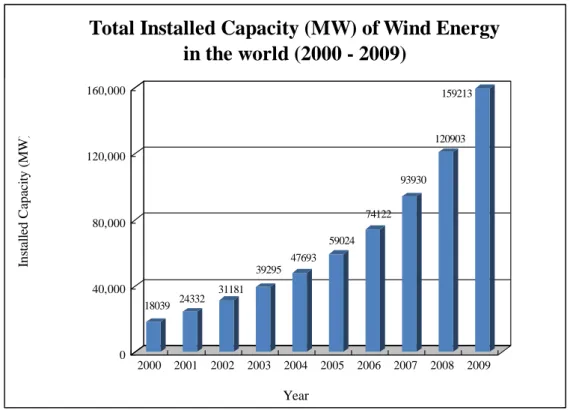
According to World Wind Energy Association (WWEA), worldwide wind energy capacity grew substantially in past ten years, as shown in Figure 2.1. Wind capacity doubles every three years and has reached 159, 213 Megawatt (MW) in 2009. All wind turbines worldwide are generating 340 TWh per annum, an amount equal to the total electricity demand of Italy, and equivalent to 2 % of global electricity consumption. Wind energy also contribute significantly to the world economy, the sector in 2009 had a turnover of 50 billion, and employed 550,000 people worldwide (WWEA, 2009).
18039 24332 31181 39295 47693 59024 74122 93930 120903 159213 0 40,000 80,000 120,000 160,000 Ins ta ll ed C apa ci ty ( M W ) 2000 2001 2002 2003 2004 2005 2006 2007 2008 2009 Year
Total Installed Capacity (MW) of Wind Energy
in the world (2000 - 2009)
Figure 2.1 Total Installed Capacity (MW) of Wind Energy in the world (2000 - 2009) Source: World Wind Energy Association (WWEA), 2009
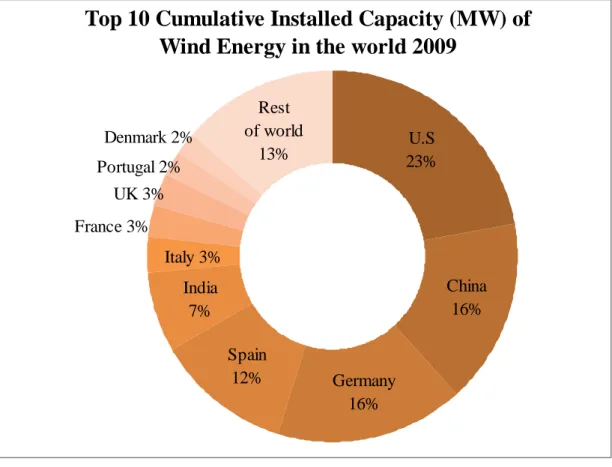
Figure 2.2 is the statistics of Global Wind Energy Council (GWEC), which shows the cumulative installed capacity of wind energy in different countries in 2009. It can be seen that USA, China and Germany are the three countries with highest installed wind capacities, which make up 22%, 16% and 16% of the total world installed capacity. More than seventy countries have adopted wind energy, and the number is believed to increase gradually. Development of wind energy is optimistic and it is predicted that the global capacity may reach 1,900,000 MW in 2020 (GWEC, 2009).
Top 10 Cumulative Installed Capacity (MW) of
Wind Energy in the world 2009
U.S 23% Germany 16% Spain 12% India 7% Rest of world 13% China 16% Italy 3% France 3% UK 3% Portugal 2% Denmark 2%
Figure 2.2 Top 10 Cumulative Installed Capacity (MW) of Wind Energy in the world 2009 Source: Global Wind Energy Council (GWEC), 2009
2.3
Wind energy development in Hong Kong
In 2002, the Electrical & Mechanical Services Department (EMSD) issued the report “Study on the Potential Applications of Renewable Energy in Hong Kong - Stage 1 Study Report”, which is the first official detailed study to analyze wind energy application in Hong Kong. The report showed that Hong Kong possesses satisfactory wind resource in both urban and rural areas, the resources potential is significant that minimum 2 TWh and 7.6 GWh can be generated per year respectively. However, practical application of wind energy is not easy in Hong Kong, mainly due to lack of undeveloped flatland for wind farms. Other barriers should be overcome, such as noise, safety, vibration impact, etc. (EMSD, 2002).
Wind resource in Hong Kong is also studied by some other researchers. Lu et al. (2002) established a simulation model to analysis local weather data and typical wind turbine characteristics, and showed the great potential for wind power generation on the islands surrounding Hong Kong. Li (2000) also performed a preliminary study on the potential and the feasibility of offshore wind energy in Hong Kong. A hypothetical wind farm is sited on the east side of the waters, and it is found that the moderate wind resource provide enough energy for the wind farm to generate 6% of annual electricity demand in Hong Kong.
Although these studies have proved that wind resource in Hong Kong is satisfactory, wind energy development in Hong Kong is immature. The first development of wind energy in Hong Kong can be said to start in February 2006, when the first commercial-scale wind turbine, installed by the Hongkong Electric Company Limited (HEC), was inaugurated on the Lamma Island in Hong Kong.
(HEC, 2010b). Besides, some small wind turbines with rated power about 1 kW to 3 kW, were installed in different locations, such as automatic weather stations of Hong Kong Observatory, EMSD Headquarters, etc. These small wind turbines also serve as promotional purpose to educate public on renewable energy, the electricity they produce is insignificant (EMSD, 2007).
Chapter 3 Energy Overview and Current Status of Wind
Energy usage in Hong Kong
3.1
Energy overview in Hong Kong
3.1.1 Energy consumption in Hong Kong
Hong Kong has an area of 1098 km2 with population about 7 millions. Nearly 80% of the land is hilly and not suitable for residential use, therefore population density in Hong Kong is very high (Hui, 2003).
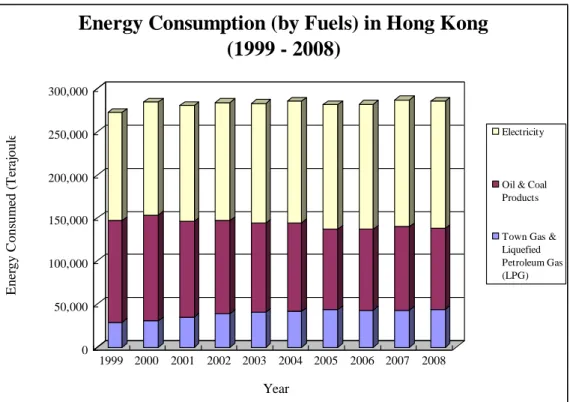
Enormous amount of energy is required to support the large population in Hong Kong. As shown in Figure 3.1, the total amount of energy used in Hong Kong in 2008 is 285,430 TJ, which is produced from three types of fuels: town gas and liquefied petroleum gas, oil and coal products, and electricity. Among these fuels, electricity took up the largest proportion and produced about 52%, i.e. 147,345 TJ of the energy. Also, during the past ten years from 1999 to 2008, proportion of electricity keeped increasing, its proportion in energy consumption increased from 47% to 52%, while consumption of oil and coal gradually decreased from 43% to 33%. (EMSD, 2010).
Figure 3.2 shows the energy consumption of different sectors from 1999 to 2008. Among the four sectors in Hong Kong, energy consumption by commercial sector increased every year steadily, and is now the sector that consumes most energy, taking about 39% of total energy consumption. Although residential sector consume less energy than transport sector, its consumption is increasing gradually as like the commercial sector, and now is taking 19% of the total energy consumption (EMSD,
2010). 0 50,000 100,000 150,000 200,000 250,000 300,000 E ne rgy C ons um ed ( T er aj oul e) 1999 2000 2001 2002 2003 2004 2005 2006 2007 2008 Year
Energy Consumption (by Fuels) in Hong Kong
(1999 - 2008)
Electricity
Oil & Coal Products
Town Gas & Liquefied Petroleum Gas (LPG)
Figure 3.1 Energy Consumption (by Fuels) in Hong Kong (1999 - 2008) Source: Electrical & Mechanical Services Department (EMSD), 2010
0 50,000 100,000 150,000 200,000 250,000 300,000 E ne rgy C ons um ed ( T J) 1999 2000 2001 2002 2003 2004 2005 2006 2007 2008 Year
Energy Consumption (by Sectors) in Hong Kong
(1999 - 2008)
Transport
Industrial
Commercial
Residential
Figure 3.2 Energy Consumption (by Fuels) in Hong Kong (1999 - 2008) Source: Electrical & Mechanical Services Department (EMSD), 2010
Figure 3.3 shows the energy and electricity consumed per capita in Hong Kong from 1999 to 2008. In this period, the population in Hong Kong has risen by 6.6%, energy consumption per capita keeps almost unchanged, but electricity consumption per capita has increased by 11.3%. (EMSD, 2010).
Energy and Electricity Consumption per Capita in
Hong Kong (1999 - 2008)
41.9 40.91 18.96 21.12 0 10 20 30 40 50 1999 2000 2001 2002 2003 2004 2005 2006 2007 2008 Year E ne rgy / E le ct ri ci ty C ons um ed ( G J/ C api ta ) Energy consumption per capita Electricity consumption per capitaFigure 3.3 Energy and Electricity Consumption per Capita in Hong Kong (1999 - 2008) Source: Electrical & Mechanical Services Department (EMSD), 2010
From Figure 3.1, it can be seen that both energy and electricity consumption are steadily increasing in the past ten years, and demand on electricity is particularly strong. The total amount of energy and electricity consumed is increased by 6.3% and 17.5% respectively. While in Figure 3.2, commercial sector and residential sector totally take up about 58% of energy consumption in Hong Kong, and their consumption are both increasing. It is concluded that the increasing energy consumption in Hong Kong is mainly due to increasing populations and growing
economy, and energy is mainly used in buildings and premises for commercial and residential purposes.
The above figures provide evidence that electricity demand in Hong Kong continue to rise. In order to catch up with the demand and at the same time prevent further pollution to the environment, it is necessary to develop renewable energy as soon as possible. Wind energy produce no GHG during operation, it is clean and free. Also, since wind turbines can be grid-connected to the electricity networks in Hong Kong, electricity produced from wind energy can be distributed efficiently to all over Hong Kong, as like the conventional energy. Therefore wind energy is one of the mostly preferred renewable energy in Hong Kong and worth consideration.
3.1.2 Energy market structure in Hong Kong
Hong Kong has no indigenous energy resources, and all energy sources are imported from overseas. Currently, electricity in Hong Kong is supplied by two investor-owned companies, namely the “China Light & Power Hong Kong Limited” (CLP) and the “Hongkong Electric Company Limited” (HEC). Their electricity networks cover different areas which do not overlap with each other. CLP supplies electricity to Kowloon, the New Territories, Lantau Island and most outlying islands, covering about 80% of the population in Hong Kong. HEC serves the Hong Kong Island, Lamma Island and several surrounding Island. Both power companies use coals as the main fuels which make up about half of the total fuels consumption, but have gradually increased the proportion of natural gases in recent years (ENB, 2011b).
3.1.3 Energy policy in Hong Kong
Policy Objective
Energy policy in Hong Kong aims to ensure that the energy needs of the community are met safely, reliably, efficiently and at reasonable prices, and to minimize the environmental impacts of energy production, to use and promote the efficient use and conservation of energy (ENB, 2011b).
Policies supporting Renewable Energy
The government’s first policy initiative to promote renewable energy in Hong Kong is the promulgation of the “First Sustainable Development Strategy for Hong Kong” in May 2005. In the strategy a target is set of having 1-2% of Hong Kong’s total electricity supply met by renewable energy by 2012 (Sustainable Development Unit, 2005).
Another policy instruments to support renewable energy in Hong Kong is the Scheme of Control Agreements (SCA) 2009-2018. It was an agreement signed by the government and the two local power companies, and through SCA the government can monitor the performance of the power companies. Its objectives are to ensure that the power companies provide a reliable, safe and efficient electricity supply to the consuming public at a reasonable price, and that the shareholders of the companies can obtain a reasonable return on their investment (ENB, 2011a).
In the previous SCA that have already expired on 2008, there was no any environmental related clause included, so it was commonly criticized for being ineffective towards environmental protection (Chan, 2003). In regard to this, the
government seems to have absorbed public comments and have incorporated environmental incentives in existing SCA (2009-2018) to encourage power companies for adopting renewable energy. The permitted rate of return for the power companies includes 11% of the average renewables net fixed assets, while the company's average net fixed assets, which is also included in the permitted rate of return, was dropped from 13% in previous SCA to 9.99% in the existing SCA (ENB, 2011a).
Evaluation on current policy in Hong Kong
As an economic incentive, the existing SCA encourage power companies to develop renewable energy, because they can have a higher permitted rate of return if they increase their generation capacity from renewable energy facilities. Decrease of permitted rate of return from average renewables net fixed assets further encourage them to switch to renewable energy in order to get higher profit.
The existing SCA is theoretically effective, as a “win-win” situation can be achieved: power companies and investors can get a higher permitted rate of return, while the government can fulfill its target of having 1-2% of Hong Kong’s total electricity supply met by renewable by 2012. Furthermore, after the existing SCA was signed in 2008, the two power companies are developing large scale offshore wind farms in Hong Kong as substantial support to the renewable target, which will be discussed in Chapter 3.2.
But to a certain extent, the existing may not be not effective enough to encourage renewable energy developments. The permitted rate of return for average renewables net fixed assets is 11%, which is only 1% higher than the return for
average net fixed assets. Since renewable energy is comparatively immature in Hong Kong, its development requires much human, technical resources and capital investments, and this relatively small amount of increased return may not be attractive enough to power companies to invest vast amount of efforts.
Furthermore, benefits of renewable energy investment usually evolve in long term. The payback period of investment is an important factor affecting companies’ willingness in developing renewable energy, they may take more serious considerations on capital-intensive technology such as wind power, but this issue seems have not been mentioned in the SCA.
There is no specific policy in Hong Kong assisting wind energy development. Moreover, Hong Kong’s policy supporting renewable energy is quite insufficient, which SCA can be said to be the only policy instrument supporting renewable energy development. In foreign countries which renewable energy is developing satisfactorily, such as Denmark, U.S.A., Germany, etc., adequate policy instruments are implemented effectively (Saidur et al., 2010; Sharman, 2005; Lee, 1998). Therefore lack of policy supports may be one of the reasons of immature development of wind energy in Hong Kong. Government’s effort on political support of wind energy is crucial for development.
3.2
Current status of wind energy usage in Hong Kong
3.2.1 Background
It is mentioned in Chapter 2 that, wind energy is one of the best renewable energy applied all over the world. In Hong Kong, wind energy also has more advantages than other renewable energy technologies. There is no water resources
capable of running a hydro-electric station, using solar energy by solar photovoltaic panels is too expensive, and ocean power technology is still under development. So wind energy is comparatively more suitable to be developed in Hong Kong (CLP, 2007).
However, limited land in Hong Kong is one of the major obstacles for wide-scale application of wind energy, and attribute to limited development at present. Urban area is so densely populated and packed with tall buildings, while rural areas and county parks are important to the community that land use change is not possible. Therefore, large scale wind development in term of onshore wind farm in Hong Kong is extremely difficult (CLP, 2007).
In order to evaluate current progress of wind energy development in Hong Kong, some important wind projects at present and in the future are discussed below.
3.2.2 The wind turbine installed on Lamma Island – “Lamma Winds”
‘Lamma Winds’ is the first commercial-scale wind power station in Hong Kong, which is a single wind turbine installed by Hongkong Electric (HEC) on the Lamma Island. HEC started to explore the feasibility of utilizing wind as renewable energy in 2000, and commenced wind monitoring programme at Po Toi and Lamma Island in April, 2001 to study the wind resources is these places. The Environmental Impact Assessment (EIA) Report for ‘Lamma Winds’ was approved by the Environmental Protection Department (EPD) in October 2004, and after one year of construction, ‘Lamma Winds’ started commission in February 2006 (HEC, 2010b).
Figure 3.4 gives an outlook of ‘Lamma Winds’. It is an individual wind turbine, having a typical configuration of “horizontal axis” design, three rotor blades and is stall-regulated, mounted up-wind, with rotor diameter of 50m and total tower height
of 46m. Its rated power is 800 kW which is a standard capacity, reliable and is widely used in the world. By the end of February 2010, ‘Lamma Winds’ has generated more than 3.6 million kWh of electricity, meaning that 1,250 tonnes of coal consumption and more than 3,000 tonnes of carbon dioxide emissions have been avoided (HEC, 2011).
‘Lamma Winds’ is connected to the electricity network and can provide electricity to Hong Kong, but its output is insignificant. It only provides approximately 0.002% of total electricity per year in Hong Kong. However, one of its main objectives is not producing power only, but acts as a pilot project to acquire knowledge in the design, construction and operation of wind turbine, and educate the public on the benefits and limitations of using wind energy for power generation in the context of Hong Kong’s special situations.
‘Lamma Winds’ act as an important milestone of renewable energy development in Hong Kong. Not only was it the first commercial-scale wind power station in Hong Kong, but it also sparked public concerns and interests on renewable energy. It serves quite well on the educational and promotional purposes, featuring an Exhibition Centre which introduces the station as well as major types of renewable energy and their applications in Hong Kong and other parts of the world (HEC, 2010b).
Besides, after ‘Lamma Winds’ commission, field data and practical issues on wind energy technology, which is insufficient in Hong Kong, can be collected and play an important role in later offshore wind farms development in Hong Kong.
Figure 3.4 ‘Lamma Winds’ installed by HEC on the Lamma Island
Source: Hongkong Electric Company Limited (HEC), 2010b
3.2.3 Southwest Lamma (SWL) Offshore Wind Farm
After the commissioning of ‘Lamma Winds’, HEC started to determine the feasibility of developing an offshore wind farm in Hong Kong, in order to increase the generation capacity of renewable energy in Hong Kong. A site selection study was carried out in 2008 to select a preferred site for development. The EIA study has reviewed the environmental efficiency of eight potential sites, and then an area at southwest Lamma waters is considered to be the best location for the offshore wind farm. Figure 3.5 shows the location of the SWL Offshore Wind Farm and the wind turbines distribution. The SWL Offshore Wind Farm is located in the waters between Lamma Island and Cheung Chau, with closest distance from the site to Lamma Island approximately 3.5 km (HEC, 2010a).
The EIA report of the SWL Offshore Wind Farm was approved in May 2010. Now HEC is carrying out wind monitoring work at the site to collect wind resources data, and the offshore wind farm is scheduled for completion by 2015 (HEC, 2010c).
Figure 3.5 Location of the Southwest Lamma Offshore Wind Farm Source: Hongkong Electric Company Limited (HEC), 2010a
Around 28 to 35 wind turbines with rated power 2.3 to 3.6 MW will be constructed in the proposed SWL Offshore Wind Farm. Number of wind turbines will depend on the rated power chosen, for example, about 28 wind turbines will be constructed if turbines with higher rate power of 3.6 MW is chosen, so that the wind farm capacity will be maintained at around 100 MW. The 100 MW capacity can generate about 170 million kWh per year, which is roughly about 1.6% of HEC’s total electricity generated in 2008, and 0.4% of total electricity consumption of Hong Kong in the same year. About 62,000 tonnes of coal and 150,000 tonnes of carbon dioxide emission can also be offset (HEC, 2010a).
HEC stressed that after considering different factors, the site is analyzed to be the best locations, and all environmental impacts related to the construction will also be minimized or negligible (HEC, 2010c). As the construction of SWL Offshore Wind Farm will be the first massive project carried out on the sea, it is suggested that
careful and rigorous auditing and monitoring works must be conducted, to ensure environmental compliance of the construction project.
HEC’s construction of the SWL Offshore Wind Farm aims to support government’s policy on renewable energy, its capacity is able to supply electricity equivalent to half of the renewable energy target, i.e. 0.5%, set by the government. Besides, commission of the ‘Lamma Winds’ provides important experience on practical implementation and possible improvements of commercial-scale wind energy, which is very insufficient in Hong Kong. These experiences, together with wind data collected currently, can optimize operational efficiency and energy output of the wind farm. Therefore, with careful monitoring works in construction and minimization of ecological impacts, the SWL Offshore Wind Farm is believed to be beneficial to Hong Kong in the long run.
3.2.4 Southeastern Waters (SEW) Offshore Wind Farm
Wind Prospect is an integrated international wind energy company, its 100% subsidiary, the HK Offshore Wind Limited (HKOWL), has started a feasibility study of building an offshore wind farm in Hong Kong since 2005, and CLP joined the study as a partner in 2006 (CLP, 2009).
In the site selection process which was mentioned by CLP as the most important part of the study, a Geographic Information System (GIS) was used to identify preferred site for the offshore wind farm. After different factors, such as ecological constraints, wind resources, shipping lanes, etc. were taken into consideration, it was shown by the GIS that an area in the southeastern region is comparatively constraint-free and is the best site for development. Figure 3.6 illustrate the project location, the proposed SEW Offshore Wind Farm is
approximately 9 km and 5 km east of the Clearwater Bay Peninsula and East Ninepin Island respectively (HKOWL, 2010).
The EIA report of the SEW Offshore Wind Farm was approved in August 2009. As like the SWL Offshore Wind Farm proposed by HEC, currently CLP and HKOWL is collecting field wind and wave data using a wind mast installed at the proposed site, and a full business case may be available for assessment by 2011.
Figure 3.6 Location of the Southeastern Waters Offshore Wind Farm Source: HK Offshore Wind Limited (HKOWL), 2010
The proposed SEW Offshore Wind Farm occupies an area of 16 km2 and has a capacity of 200 MW. Up to 67 wind turbines, each with rated power 3 MW, will be erected in the proposed offshore wind farm. It was suggested in the EIA report that 40 wind turbines each with 5 MW can also be an option, which both scenario will generate approximately the same power and occupy same total sea area. The total capacity of the wind farm will be approximately 200 MW, which can produce about
1% of total Hong Kong electricity needs in 2008, supporting 80,000 households, and roughly 343,000 tonnes of carbon dioxide emission can be avoided (HKOWL, 2010). The SEW Offshore Wind Farm’s capacity is a double of the SWL Offshore Wind Farm’s. It will produce electricity about 1 % of total electricity demand in Hong Kong, therefore it can be a substantial contributor to the renewable energy target set by the government. It is mentioned in the EIA report that the turbine substructure can offer the opportunity for artificial reef development, restriction of maritime traveling around the SEW Offshore Wind Farm can also contributes to sustainable fisheries management in Hong Kong (HKOWL, 2010). The SEW offshore wind farm may also act as a new landmark in Hong Kong, promoting ecotourism and renewable energy education.
However, the project was criticized by some parties. For example, the proposed site is only 3km away from the Geopark, so the scenic and ecological value of the Geopark may be damaged by those giant wind turbines. Furthermore, the expected life span of the wind turbines is about 20 years, which is accused to be too short. It is suggested that comprehensive public engagement should be involved in all phases of the project and transparency of the project should also be increased, enabling the public to understand the pros and cons, and the necessity of the project. Consultations and further studies are required before the construction, to ensure that Geopark will not be negatively affected.
3.2.5 Small wind turbines
Small wind turbines refer to those turbines with rated power from 100 W to tens of kW. In contrast to large wind turbines such as the ‘Lamma Winds’, small wind turbines may not be grid-connected to the electricity networks, their main application
is for charging batteries to function as a stand-alone power supply system. When used in conjunction with PV panels, it can provide electricity to small premises or devices, which require small amount of energy for functioning. Some small wind turbines may be installed on rooftop, which are grid-connected to the electricity network to provide electricity to the building or a whole region (EMSD, 2007). One advantage of these grid-connected wind turbines is the stable energy supply, wind energy in this case act as a supplementary electricity source to reduce overall fossil fuels consumption.
A good example of small wind turbines usage in Hong Kong is the Hong Kong Observatory (HKO), which takes up a large share in small wind turbines applications in Hong Kong. Wind energy has been used by HKO since 2000 to operate a number of automatic weather stations in various locations. These stations provide real-time weather information to support weather monitoring and forecasting, they operate 24 hours and require stable electricity supply. However, some of these stations are located in remote areas or islands that grid-electricity is not available, while rely on solar energy solely may lead to failures of stations due to insufficient power when sunshine is not adequate for a prolonged period. So HKO has installed some small wind turbines to make up hybrid wind-photovoltaic DC power supply. In hilly and exposed places where those stations are located, the small wind turbines can generate 50W of electrical power which is sufficient to support the stations. Nowadays, small wind turbines have been deployed at eight automatic weather stations, and their performance is very satisfactory. Figure 3.7 and 3.8 show the automatic weather stations and the small wind turbines used by HKO respectively (HKO, 2009). Other examples of small wind turbines application can be shown on the roof of EMSD Headquarters building and Marsh Road Station Building of HEC, where 1kW and 2.5kW small wind turbines are installed and grid-connected to the electricity
network respectively. A 760kW small wind turbine is also installed at Queen's College Old Boys' Association Secondary School to provide power for irrigation and lighting equipment (EMSD, 2007).
Small wind turbines technology is still immature in Hong Kong, currently they serve mainly as research and demonstration purposes. Consideration for their application is different from large wind turbines. For example, they have small size and sometimes installed in urban area, so their ecological impact is usually negligible, but they produce power at a higher unit cost than that electricity from large wind turbines due to small scale application. They also turn faster and hence produce more noise than large turbines.
Another consideration is the difficulty to decide whether a site is suitable for installing a small wind turbine. Due to the complex topography in Hong Kong, actual wind measurement for a long period is quite difficult, therefore an accurate energy yield prediction cannot be easily obtained. Deciding whether a location is suitable for small wind turbines usually depends on some informed judgments, and the actual energy yield may turn out to be much lower or higher than expected (EMSD, 2007). On the other hand, due to their smaller sizes, small wind turbines are not limited by geographical constraints in Hong Kong. They have potential in wide-scale application and their penetration can be deep in an urban city. More experience in Hong Kong and overseas needs to be gathered for the technology to boost its development..
Figure 3.7 An automatic weather station of the Hong Kong Observatory
Source: Electrical & Mechanical Services Department (EMSD), 2010
Figure 3.8 A small wind turbine installed by the Hong Kong Observatory
Source: Electrical & Mechanical Services Department (EMSD), 2010
Chapter 4 Future Development of Wind Energy in
Hong Kong
4.1
Economical aspects
4.1.1 Background
There are four parameters governing wind power costs, which are capital costs, operation and maintenance (O&M) costs, the electricity produced and the discount rate, and also the economic lifetime of the project investment (Blanco, 2009). Wind power is usually regarded as ‘capital-intensive investment’, because capital costs at the starting time can be as much as 80% of the total cost of the project over its entire lifetime.
It is important to know that the cost of wind power per kWh produced does not only include the capital costs and variable costs, but also takes into account the wind resources which determine the electricity produced, therefore comparisons can be made between wind energy and other electricity generating technologies.
In studying economical development of wind energy, it may be helpful to have a glance on the trend of wind energy costs. As there are many components included in wind energy costs, the costs keep changing with time. For example, it is shown in a study that onshore wind energy costs have decreased by 75% from 1999 to 2005, but then increased by 10% from 2005 to 2007 (Snyder & Kaiser, 2009). It is predicted that the increased costs are due to suddenly boosted number of wind farms and wind turbines, which cause increased price of raw materials of wind turbines.
4.1.2 Economical competitiveness of wind energy
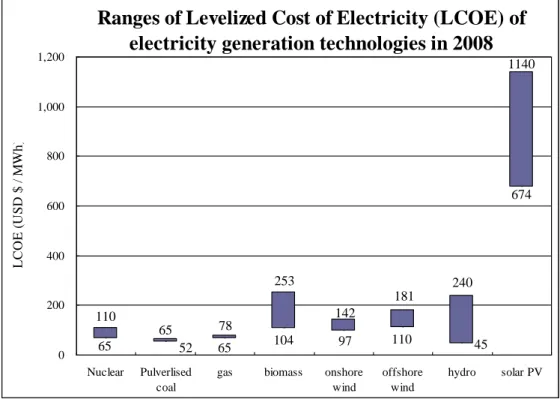
The levelized cost of electricity (LCOE) has been used to compare the unit costs of different electricity generating technologies over their economic lives. Its calculation comprises life cycle cost approach and uses net present value calculations, therefore it differs significantly between capital and O&M costs, but it better represent the generation costs of different technologies.
European Commission (EC) has done a study in 2008 to investigate the production costs of various electricity generating technologies, the result is summarized in Figure 4.1. Considering lower bound of costs, it is shown that costs of both onshore and offshore wind energy are both higher than conventional energy sources such as coal and gas by about 80%. When compared with other renewable energies, wind energy cost is higher than hydropower by about 100%, but much lower than solar photovoltaic by 550%.
Ranges of Levelized Cost of Electricity (LCOE) of
electricity generation technologies in 2008
674 45 110 97 104 65 52 65 1140 240 181 142 253 78 65 110 0 200 400 600 800 1,000 1,200 Nuclear Pulverlised coal
gas biomass onshore wind offshore wind hydro solar PV L C O E ( U S D $ / M W h)
Figure 4.1 Ranges of LCOE of electricity generation technologies in 2008 Source: European Commission (EC), 2008
The above figure showed that wind energy costs are higher than conventional energy sources and some renewable energies, but with consideration of some other factors, wind energy can be economically competitive with other technologies in the future.
Firstly, it should be noted that the LCOE should be used as a reference, as costs of electricity vary in many aspects and actual prices of each technologies can hardly be found. A major determining factor is the location concerned, as different locations with different policies and resources can greatly affect the prices of electricity generating technologies. In locations with sufficient wind resources, wind energy generated is higher and the costs thus decrease, and the costs difference can be very high. Because Hong Kong’s wind resource can be sufficient for cost-effectiveness utilization of wind energy (which will be discussed in Chapter 4.3), with appropriate site selection of wind farm, detailed wind resources studies and choosing wind turbines which are most effective in the available wind resources, etc. wind energy is economically competitive with other technologies.
Secondly, a distinct advantage of wind energy is that it has obviously no fuel cost, which is also its fundamental difference with most conventional electricity generation technologies. Not only long term fuel costs are avoided, but also various effects caused by fluctuating fossil fuel prices can be prevented. For instances, in a natural gas power plant as much as 60% of the costs are related to fuel and O&M costs, whereas the costs are about 10% for an onshore wind farm (Blanco, 2009). It is no doubt that the rising price of global fossil fuel in recent years may imply an increasing competitive advantage of wind energy in the future.
Thirdly, when compared to other technologies, wind energy possesses low external costs which are costs of impacts caused to the environment due to the pollutants emitted from the specified technology. The costs are proportional to the
electricity generated and can be long term, which appear gradually and may not be easily noticed now, but they may have great impacts in the future. Although the costs cannot be quantified easily, it can be enormous and should not be overlooked. A study has shown that wind energy is the cheapest among all kinds of electricity generation technologies when considering externalities, since it does not require fuel and emit no pollutant (El-Kordy et al. 2002). As global warming is an imminent problem, this advantage will definitely become more outstanding.
Although it is mentioned before that wind energy costs have increased in previous few years, the costs are predicted to fall in the near future. Based on the experience curve which states that lower costs can be attained when more tasks are performed, it is projected that wind energy unit costs may reduce by 9% to 17% when the total installed capacity doubles, due to improved technology, standardization, labour efficiency and competitions between wind turbines manufacturers etc. Also, once the supply chain bottlenecks are resolved, raw materials price is believed to drop so wind energy cost is expected to decrease (Blanco, 2009). This decrease of wind energy costs is worldwide and wind energy development in Hong Kong can take the advantages.
Therefore, with consideration of different factors and with appropriate supportive measures, wind energy is economically competitive with other technologies in the future.
4.1.3 Promoting economical development of wind energy
Although wind energy can be economically competitive in the future, its generation costs are currently higher than other conventional technologies. Certain measures are helpful for boosting economical developments of wind energy.
Research and Development (R&D)
Analyses have shown that the level of R&D for both public and private aspects can affect future wind energy costs significantly (Blanco, 2009), because the level of capital cost largely depends on the availability and quality of raw materials. For R&D in global scale, countries and wind turbines manufacturers can develop more cost-effective technologies and explore better, cheaper raw materials. For Hong Kong, it may be impossible to influence the raw materials, but efforts in R&D can be in terms of putting resources on wind data collection and analyzes, wind studies, etc. For example, the government can provide funding for wind study projects and cooperate with universities to develop a comprehensive and updated wind resources map, potential wind utilization locations can also be explored through feasibility studies. These studies can explore locations in Hong Kong that is cost-effective for wind power application thus increasing its economic competitiveness.
Besides, offshore wind technology is newer thus the rate of learning and advancement is relatively high. As there are enormous rooms for offshore wind technology improvements and offshore wind is becoming more popular worldwide, R&D is important to stimulate economic improvement of offshore wind, especially for Hong Kong where offshore wind is one of the most feasible applications of wind energy.
Promoting economical advantages of wind energy
Economies of scale can also decrease the level of capital costs of wind energy, so lower unit costs of wind energy can be achieved by larger-scale facilities or production process. Measures to support installations of large-scale facilities can be
done in Hong Kong, one of these is to promote wind energy to financial sectors. Since 80% of total cost is necessary at start, financial loans are usually required for developers to begin the project, and some projects may be halted due to lack of capital. Some awareness-raising campaigns or seminars can be held to explain to financial sectors the benefits of wind energy investments, and encourage them to fund more wind energy projects at lower interest rates. For example, one economical advantage of wind energy is that after the installation process, the wind energy generation cost can be predicted accurately if wind measurements are correctly calculated (Blanco, 2009). Therefore good repayment conditions can be achieved with higher certainty and risk to investors is low. Many successful overseas cases such as Denmark, Germany, China and U.S. can also be taken as examples to increase their confidence.
Why Wind Power? Advantages of wind energy over other renewable energies
The comparative advantages of wind energy over other renewable technologies can also be promoted in Hong Kong, so as to attract investments and boost up wind energy. Solar energy, as mentioned above or in other studies (DeCarolis & Keith, 2006; Kennedy, 2005; Sims et al. 2003), is usually the most expensive option, due to its complicated technologies and raw materials. Its generation costs are higher than other renewable energy technologies by several times, and the costs are expected to maintain at high level in near future, the expensiveness has greatly limited its development.
Nuclear power, although can be cost-competitive with wind energy, possess serious safety issues and always raise local opposition. Especially after the outbreak of Fukushima nuclear hazard in Japan recently, the safety concern is too large and
development of local nuclear plant in Hong Kong is impossible in the near future. Although Hong Kong can invest in developing nuclear power in PRD which the power can be transported back to Hong Kong, nuclear power requires fuels and special treatment is required to dispose the fuels properly. This cost should not be overlooked and the long term costs can be much higher than wind energy.
Energy-from-waste is an option that can generate considerable amount of energy, but waste is required as fuels and costs are necessary to dispose the product after combustion of waste. Hydropower and geothermal technology are not applicable in Hong Kong because of local geographical condition.
Once suitable sites with sufficient wind resources are selected, wind turbines can be installed quickly and start commission in short time. For Hong Kong, it is the kind of renewable technology most feasible for large scale operation, having low total long term costs and the repayment period can be guaranteed by accuracy. With proper encouragement measures by the government, it has larger economical advantages than other renewable technologies and has greater potential to attract investments.
4.1.4 Conclusion of wind energy’s economical development
At present, wind energy is still more expensive than conventional fossil fuels. But when external environmental and social costs are considered, wind energy costs drop a lot and in some cases become cheaper than fossil fuels. Various factors has proved that wind energy costs will drop in the future, and with proper supportive measures in place, comparative advantages of wind energy will increase and make it become competitive with fossil fuels.
factors to drive down wind energy costs. Since wind energy is the type of renewable energy most feasible for local large scale operation, Hong Kong should seek developments in these areas to give wind energy a stronger position in long term.
4.2
Political aspects
4.2.1 Background
Although there is necessity for use of clean and renewable energies, wind energy application is now immature in Hong Kong. One of the reasons, as raised by some critics, is that the government has not put in enough resources and efforts to develop wind energy. Political support is vital for renewable energy development in every locations, but supportive strategies or policies related to RE is deficient in Hong Kong. While wind resources can generate considerable amount of energy even in a small place like Hong Kong, the government should devote to the development of wind energy. Some political measures and directions of development are suggested below.
4.2.2 Collaboration with China
Wind energy is now growing rapidly in China. In 2009, wind energy installed capacity in China has reached 25,805 MW, which is about 16% of the world’s total capacity (GWEC, 2009). In Guangdong, the installed capacity is 569 MW, which is about 2.2% of China’s total capacity (Shi, 2009), and some regions such as offshore area possess rich wind resources and have potential for development. As wind energy development is one of the main foci in energy policy in China and different
supportive measures have been put forward, the installed capacity is expected to grow continuously in the future, making wind energy become more competitive with conventional fossil fuels (Liu & Kokko, 2010; Yu & Qub, 2010). With enormous wind energy potential in China, Hong Kong can seize the chances for cross-border cooperation with China in different ways.
Integration of wind energy from Guangdong Province into Hong Kong grid
Hong Kong can integrate wind energy from Guangdong or other provinces into Hong Kong’s electricity network, or buy their wind energy (FOE, 2002). It can meet local demand of electricity and increase proportion of renewable energy in Hong Kong electricity. This is a complicated political issue requiring negotiation and cooperation between two places, but some experience can be learnt from importation of nuclear-generated electricity from Daya Bay Power Station. For instance, the Hong Kong government, local power companies or wind energy developers can form a joint-venture with Guangdong province to construct and operate wind farms located in Guangdong. Sharing of capital costs can stimulate more wind projects development and decrease risks of each parties, whereas monitoring by a joint-venture can ensure stable electricity supplied to both locations. This can also act as an incentive to stimulate further wind energy development in Guangdong Province because more funds are now available.
The CLP has been involving in some wind projects development in China currently, but the energy generated is not supplied to Hong Kong. Further cross-border collaboration can be encouraged for integration of wind energy into Hong Kong grid.
Roles of Hong Kong in wind energy development of China
Electricity shortages occur occasionally in some parts of Guangdong, so skeptics may doubt the possibility of electricity grid integration when Guangdong cannot even produce enough electricity for herself. Hence the most important step is to further increase the wind installed capacity. Hong Kong can participate as different roles in assisting wind energy growth in China.
Hong Kong as an international metropolis, owns a healthier financial structure and efficient communication network, therefore it is more attractive to and provide more confidence for foreign investments and technologies. Hong Kong can act as a coordinator and bridge to channel foreign funds into China effectively in order to support various wind energy development projects (Hui & Cheung, 1998).
Hong Kong with its unique multi-cultural background, can also act as an intermediary for foreign investors, to facilitate understanding and cooperation between foreign and mainland parties, also to overcome language, customs and cultural barriers. It may be particularly useful when a cross-border joint-venture is formed.
In promoting international cooperation in China, Hong Kong can in turn benefit from enriched technological expertise and experience, paving the road for local wind energy development in the future. Economy can also be boosted by increased flow of investments.
4.2.3 Changing the energy market structure
Modifications of the Scheme of Control Agreements (SCA)
As mentioned in chapter 3.1.3, Scheme of Control Agreements (SCA) is the major instrument for Hong Kong government to monitor the performance of power companies. Although renewable energy terms have been incorporated in the new SCA starting from 2009, some may criticized that they are not effective enough to encourage renewable energy developments. The permitted rate of return for average renewables net fixed assets is 11%, while the return is 9.99% for average net fixed assets. Among conventional and renewable energy technologies, power companies can only earn 1% more for developing renewable energy technologies but need to invest many human and technical resources; also the Renewable Energy Incentive Factor is only 0.05% at maximum, therefore it may not be attractive enough to the power companies.
Some terms in the SCA may be improved to increase the incentives of power companies. The difference of permitted rate of return between conventional and renewable energies can be increased, such as increasing the return for renewables assets and also the Renewable Energy Incentive Factor.
Currently the two power companies provided charged grid-connecting services for private parties with embedded Renewable Energy Systems (RES). In the future SCA, bonus can be offered to power companies depending on the grid-connection services they provided. It provides incentives for the power companies to proactively promote RES in the society to earn more bonuses, and in turn provoke more applications of RES. When the bonus can cover part of the grid-connection costs, the charges of the service can be lower to encourage installation of RES by private
sectors.
In the SCA, it may also seek the possibility to limit the extent of growth for average fixed assets. In order to meet the increasing electricity demand, it may be necessary for power companies to build power plants or new facilities to increase the generation capacities in the future. Terms can be set to allocate the percentage of new assets for renewable and conventional technologies, e.g. a minimum of 5% of electricity generated from new assets should come from renewable technologies.
Grid-interconnection between CLP and HEC electricity network
As mentioned before, integrating wind energy from Guangdong into Hong Kong electricity grid can be a possible option to boost up wind energy, and electricity then will be transmitted to the Hong Kong Island inevitably. However, this transmission may be hampered by the unconnected electricity grids of CLP and HEC. Without a connected network HEC may become isolated and cannot reach the renewable energy from Guangdong.
Currently the electricity grids of CLP and HEC are unconnected, sharing of power will occur under very special circumstances. Separation of electricity grids has been blamed for long time as being the main reason for electricity price difference between CLP and HEC networks. Although the government has seen the necessity of grid interconnection in 2000 (FOE 2002), this is a complicated issue and no decision has been taken until now for adopting interconnection. The government should carry out detailed discussion with two companies and may also employ professional consultants to study the feasibility of interconnection. Not only all Hong Kong citizens can enjoy wind energy from Guangdong, the gap of electricity price between the two power companies can also be reduced.
Considerations of changing the energy market structure
The most important principle of energy policy is a stable electricity supply, so suggestions listed above for transformation of energy market structure must be first carefully assessed in details. In particular, the two local power companies will be affected. Their interests and perspectives must be taken into considerations, negotiation must be made with power companies to ensure smooth cooperation, and consultation can be held to collect comments or ideas from various parties and the public. For example, projected electricity consumption of Hong Kong in the future should be as accurate as possible so the percentage of new assets can be correctly allocated and a stable electricity supply can be maintained. The permitted rate of return should also be carefully set so the power companies still can have reasonable returns, while a large burden of electricity bills will not be shifted to consumers.
4.2.4 Political Instruments to promote wind energy development
Situations of many European countries have shown the fact that it is difficult to achieve the targets for electricity from renewable energy and develop renewable technologies without additional policy measures or instruments (Haas et al. 2004). Various kinds of political instruments can be dramatically useful in boosting wind energy developments, some examples that may be potential in Hong Kong are suggested.
Carbon Tax