In-Situ Calibration
Methods & Pitfalls Of Thermal Mass Flow
Meter Sensor Field Validation
By Matthew J. Olin, President & CEO, Sierra Instruments, Inc.
A S I E R R A W H I T E P A P E R
www.sierrainstruments.com N O R T H A M E R I C A
5 Harris Court, Building L / Monterey, CA 93940 / USA 800.866.0200 / 831.373.0200 / fx 831.373.4402
E U R O P E
Bijlmansweid 2 / 1934 RE Egmond aan den hoef / The Netherlands +31 72 5071400 / fx +31 72 5071401
A S I A - P A C I F I C
Second Floor Building 5 / Senpu Industrial Park 25 Hangdu Road Hangtou Town / Pu Dong New District Shanghai, P.R. China Post Code 201316
2
INTRODUCTION
Mid-to-large size facilities and campuses inevitably have
hundreds of fl ow instruments to monitor, maintain, and repair.
For a reliability engineer, ensuring that all instrumentation
meets ISO 9000 or similar standards is a time-consuming
responsibility. These standards mandate that precision
instrumentation needs to be checked (validated) or
recalibrated as often as once a year. Sensor elements can
become dirty, plugged, or drift over time. The resistance and
capacitance of electronic components also degrades, leading
to changes in sensitivity or drift.
Once an instrument drifts out of specifi cation, it must be
recalibrated to maintain its original accuracy. Thermal mass
fl ow meters are not immune to these factors. As a precision
instrument designed to measure the molecular mass fl ow
rate of gases in ducts and pipes, these types of instruments
can require cleaning, verifi cation, and recalibration. Many
fl ow meter manufacturers falsely claim that situ (or
in-place) calibration is an easy and inexpensive method for both
verifying the meters’ original factory calibrated accuracy to
verify the meter is in calibration. However, when evaluating
thermal mass fl ow meters for in-situ calibration or validation
capability, be aware that sensor drift will create false positives
that reduce the reliability of the validation.
3
This white paper not only explores the role of stable no-drift
sensor design, but examines fi ve methods of fi eld calibration
validation to help end users choose the most accurate, stable,
and cost-effective in-situ calibration solution.
Background: Wet Sensor Design
The stability of all thermal mass fl ow meter sensors starts with mechanical design. The basic physics of thermal mass fl ow meters is attributed to Louie V. King, who published his famous King’s Law in 1914 mathematically describing heat transfer between a heated wire and the fl uid fl ow it is immersed into. King called his original instrument a “hot-wire anemometer” which measured the mass velocity at a point in the fl ow. The usage of hot wire anemometers grew, in particular, in research environments. This technology was not widely used in industry because of the fragile nature of the hot wires.
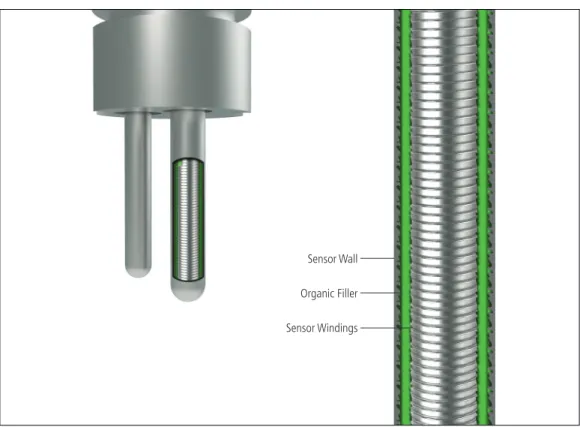
To solve this fragility problem, Sierra Instruments pioneered the development of an industrial strength sensor in the 80s that could be used in a broad spectrum of industrial process control applications. The solution was to coil the platinum wire around a ceramic mandrel and mold the wire in place with a glass coating. This assembly was then placed inside of a thermo-well. However, the gap or boundary layer between the thermo-well and the platinum wound mandrel needed to be fi lled with something other than air to assure heat transfer from the sensor to the fl ow. This was the key to assuring an accurate and stable thermal mass fl ow meter. The air gap was fi lled with a potting compound—a conductive epoxy called thermal grease or cement. This type of sensor is known today as a wet sensor and is used by virtually all manufacturers of thermal meters (See Figure 1).
The Problem: Wet Sensor Drift
This wet sensor design proved workable, but it had an inherent weakness. The sensor would drift over time affecting the accuracy of fl ow measurement readings. As a function of its very principal of operation, the sensor is heated and cooled over time, expanding and contracting the cement inside the sensor, making it crack, settle, and shift from its original state. This phenomenon is analogous to freshly poured cement on a sidewalk. Eventually, the cement hardens and often cracks, shifts, and settles as it is repeatedly heated by the sun and cooled at night.
4
Since thermal sensors are precisely calibrated to determine the heat transfer versus fl ow characteristics, any change in the physical makeup of the sensor layers will invalidate this calibration, resulting in drift or outright failure. Excessive drift means users must send the meter back to the factory for recalibration.
Dry Sensor: No Drift Thermal Dispersion Sensor
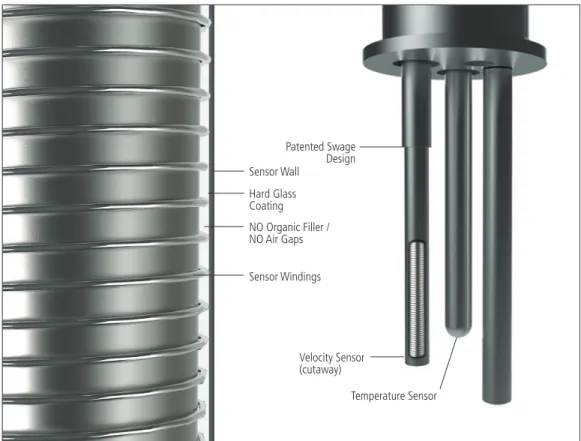
The best way to minimize drift in a thermal sensor is to remove the root cause—the epoxies, cements, and thermal greases that make up the wet sensor. In March of 1999, Sierra Instruments introduced a new patented sensor design. Through a proprietary, highly-controlled manufacturing process, the metal thermowell sheath is tightly formed on the mandrel and platinum-wire assembly. The sensor is designed to form such close contact that little or no air gap exists and no organic fi ller cements are needed
(See Figure 2).
Figure 1. A Typical Wet Thermal Dispersion Sensor.
Sensor Wall Organic Filler Sensor Windings
5
Figure 2. Patented Dry Thermal Dispersion Sensor.
This innovative new cement-free sensor, known as a dry sensor, was patented by Sierra as DrySense™ Sensor Technology. All materials used to make the sensor are selected to assure that the coeffi cients of thermal expansion are approximately the same. As a result, they expand and contract at the same rate, limiting the stress and cracking. Sierra determined that using a dry sensor was the only way a manufacturer could claim stability over the sensor’s lifetime.
In-Situ Calibration Verifi cation
Despite wet sensor design weaknesses, to this day, all manufacturers of thermal mass fl ow meters, except for Sierra, use the wet sensor design because they are easy and economical to build. In addition, all thermal meter manufacturers have generally the same method of using in-situ validation.
As expected, in-situ calibration verifi cation of thermal fl ow meters is a highly marketed feature that claims to validate the sensor’s accuracy on location. In-situ verifi cation does not replace calibration. If substantial drift is found, the fl ow meter must be sent back to the factory for recalibration.
Sensor Wall NO Organic Filler / NO Air Gaps Sensor Windings Patented Swage Design Velocity Sensor (cutaway) Temperature Sensor
Figure 1. A Typical Wet Thermal Dispersion Sensor.
Hard Glass Coating
6
The following section details fi ve principles of thermal mass fl ow meter sensor validation to assess which in-situ verifi cation method will result in the most accurate results, thereby saving time and lowering costs. These fi ve approaches are: Resistance, Zero-Flow, K-Factor, Full-Flow, and Flow-Audit.
Validation Using Resistance
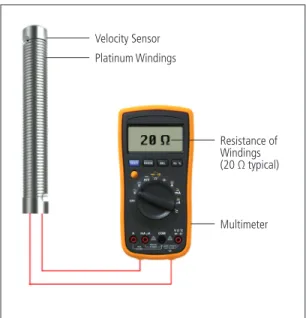
The simplest method measures the resistance across the velocity sensor. Since the velocity sensor is normally a platinum resistance temperature detector (PRTD), the measured resistance is directly related to the temperature of the sensor. This temperature should be equal to the space surrounding the velocity sensor once everything has come to equilibrium (See Figure 3).
Figure 3. Validation Using Resistance.
This method only measures the resistance of the platinum wire that is wrapped around the platinum mandrel. As the dry versus wet sensor discussion illustrates, there is much more to a thermal dispersion sensor. Resistance measurement makes this a good troubleshooting tool in determining whether the wire has an open or short circuit and thus the sensor has totally failed.
Power must be removed from the velocity sensor, and it must be allowed to come into thermal equilibrium with its surroundings. Further, these surroundings must be at a constant temperature. In some cases, the meter can take as long as 30 minutes to reach thermal equilibrium and, for that period of time, it is not capable of measuring fl ow. If the temperature of the process fl uid is fl uctuating, this check cannot be done in-situ.
However, this method does nothing to measure drift since the test doesn’t measure factors related to heat transfer from the wire through the epoxies and sheath into the fl owing fl uid. Therefore, this method can only be confi dently used with dry sensor design which doesn’t drift.
Velocity Sensor Platinum Windings Resistance of Windings (20 Ω typical) Multimeter
7
Validation Using Zero Flow
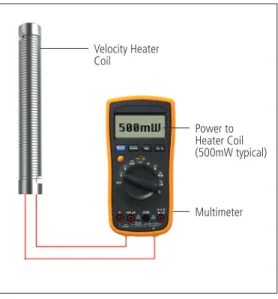
Most manufacturers have realized the limitations of validation using resistance and have various methods of checking the sensor’s electrical output (either power or raw sensor output voltage) at a zero-fl ow condition (See Figure 4). Zero fl ow is the only truly reproducible point between the factory calibration and the site where the meter is being used.
To understand how this process works, it is necessary to review the factors that infl uence a thermal dispersion fl ow meter’s calibration:
nGas being measured
nTemperature and pressure of the gas
nThe pipe the gas is fl owing inside and the maximum fl ow rate the meter is expected to measure
If a meter is in the same gas at the same temperature and pressure as factory calibration and the fl ow is zero, it should read the same sensor output voltage or dissipate the same power as it did at the factory. If it does not, it is because the sensor, or the electronics that drive the sensor, have drifted over time. There are a variety of reasons why this measurement can be problematic:
nAs stated, this measurement is only valid at zero fl ow, meaning the fl ow in the pipe must be either shut off or the fl ow meter partially removed from the pipe with a hot-tap.
nEven if the meter is at zero fl ow, it still must be in the same gas at the same temperature and pressure as factory calibration.
Figure 4. Validation Using Zero Flow Calibration
Velocity Heater Coil Power to Heater Coil (500mW typical) Multimeter
For these reasons, many manufacturers provide data for checking zero at another set of more reproducible conditions: zero fl ow at atmospheric pressure and temperature. This requires the meter to be completely removed from the process and allowed to come to equilibrium at ambient conditions. At best, this stretches the defi nition of in-situ verifi cation, as it is not “in place”.
The key drawback of validation using zero fl ow is that it is only valid at a single fl ow point. While this is a good indicator of the type of offset that can be caused by drift, it does nothing to validate the accuracy of the fl ow meter through its calibrated range.
8
Field Adjustment Using K-Factors
As an interim step, many manufactures enable the application of a global k-factor that works as a multiplier to the observed fl ow value. This is simply a linear offset most often employed to make the meter reading agree with another device. The problem with k-factors is that the inherent response curve of a thermal sensor to fl ow is non-linear and is best represented by a complex polynomial function, typically at least to the fi fth order (See Figure 5).
0 10 30 40 50 60 20 0 0.5 1 1.5 2 2.5 3 Electrical power, Watts (W)
Mass velocity
, Standard m/s (
Vs
)
Figure 5. Sensor Output Versus Increasing Flow Rate
In other cases, the manufacturer may allow several points on the calibration curve to be adjusted. This is typically done for large ducts and pipes as part of a fl ow transit. This is sometimes erroneously called an in-situ calibration.
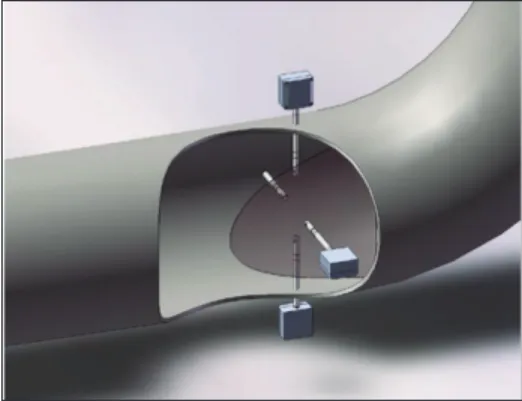
In this procedure, the fl ow profi le inside a large duct or pipe is characterized by measuring the velocities at various points, generally along horizontal and vertical lines. Since an thermal fl ow meter is a point velocity device, it can only measure the velocity at a single point in the total fl ow and is affected by fl ow profi le disturbances. A fl ow traverse can determine the best placement of the fl ow meter, and may suggest that multiple points are needed. Some manufacturers offer multipoint thermal fl ow meter averaging systems for this purpose (See Figure 6). A fl ow traverse is not an in-situ calibration. It simply refi nes the placement of the meter, or determines a gross correction k-factor to bring the existing calibration in line with observed results.
9
As with the other techniques discussed, this method has its drawbacks:
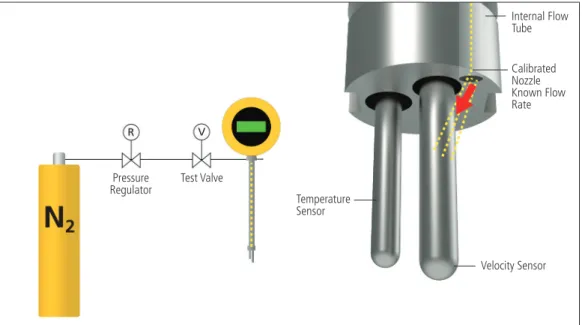
nIt depends on the nozzle not becoming plugged or dirty (and thus changing the size of the nozzle from when it was calibrated) and requires precision pressure gages, which themselves need periodic recalibration.
nThe meter must be removed from the process (although not necessarily the pipe), so a hot tap system is required.
nThis is a rather complex and expensive technique, requiring a source of pressurized air or nitrogen, a variable pressure regulator, tubing, and the nozzle. Such a system cannot be back-fi tted and the nozzle is a permanent fi xture of the probe assembly.
Validation Using Full-Flow
One complex and expensive technique that validates beyond a zero fl ow condition checks the full-fl ow range by generating a series of known fl ow rates, from zero to full scale (See Figure 7). The system uses a small sonic nozzle opening that directs a known fl ow past the velocity sensor. The diameter of the nozzle is fi xed, and by applying a known differential pressure across the nozzle, the fl ow through the nozzle can be calculated.
Figure 7. Validation Using Sonic Nozzles
Pressure
Regulator Test Valve
Temperature Sensor Velocity Sensor Internal Flow Tube Calibrated Nozzle Known Flow Rate
10
Validation Using Actual Flow-Audit Method
The fl ow-audit method is perhaps the very best in-situ calibration verifi cation. This method uses a high- accuracy fl ow standard to prove the accuracy of the fl ow device under test (DUT). A fl ow-audit is performed with a similarly calibrated meter that is installed into the pipe via hot-tap near the DUT, or even at the same measurement point if the meter under test can be removed. The key words above are “similarly calibrated”; a meter calibrated for natural gas cannot be used to check a meter on compressed air for instance. Likewise, the temperature and pressure as well as pipe size must be matched.
The ideal meter for the fl ow audit method has the application fl exibility to work on different gases and pipe sizes and dynamically compensate for temperature and pressure differences. Many companies buy thermal insertion mass fl ow meters as audit meters because of their ability to insert the sensor into the fl ow via hot tap. This adds convenience and avoids costly process shutdowns. However, traditionally, a thermal meter needs to be purchased for each specifi c application at the facility. For the majority of users, this is cost prohibitive.
For gas fl ow auditing, a solution now exists that allows a single thermal fl ow meter to be used across multiple pipe sizes and gases. Released to market in 2011, Sierra’s QuadraTherm® 640i insertion thermal
mass fl ow meter has been rapidly adopted as a fl ow-audit meter to check other thermal meters at a facility. Due to its high accuracy of 0.75% of reading, it is also commonly used to check many different gas mass and volumetric fl ow technologies.
Coupled with a hot-tap insertion point located near the DUT, the 640i is a “universal” fl ow meter that can be reconfi gured in the fi eld to match nearly any fl ow measurement point in a facility. The 640i has Sierra’s patented no-drift dry sensor as discussed earlier in this whitepaper. The result is a stable reliable measurement. As seen in Figure 8, the user programs the instrument to the exact gas and pipe size of the device under test and inserts the 3/4” (19mm) sensor probe into the pipe near the DUT. Engineering units can even be programmed to match the DUT.
The 640i fl ow-audit meter will immediately start reading fl ow. Compare this fl ow to the DUT. If the two units read close to each other, the DUT can be signed off as validated and reading properly.
Figure 8. Audit-Meter with Hot-Tap
Device Under Test Flow Flow Audit Meter Low Pressure Hot Tap
In-Situ Validation Isn’t Calibration
For four of the calibration validation methods, if the meter does not pass the validation, it generally must be returned to the factory for recalibration. However, using the fl ow–audit method does allow the end user to adjust a DUT using the K-Factor method discussed earlier in the whitepaper to adjust the DUT to match the exact fl ow reading of the audit meter.
Precise thermal fl ow meter calibration occurs under tightly controlled temperature and pressure conditions using the same gas and the same size pipe section or fl ow body that the meter will be used in.
As you can imagine, such a facility is a large and expensive asset and certainly not portable. Consequently, if you fi nd your meter is out of calibration, it is highly recommended to send it back to the factory or accredited fl ow calibration service center for recalibration.
Validate, Don’t Calibrate
How can you validate a sensor that will drift out of spec due to the very nature of its mechanical design? You can’t. All validation methods assume that there is no drift. As described earlier in this white paper, wet sensors are prone to drift and dry sensors do not drift.
Dry no-drift sensors have a big advantage during in-situ calibration validation. The all metal, epoxy free mechanical design provides the confi dence that the in-situ calibration validation is actually valid. Dry sensors are validated in the same way as a wet sensor, but in this case, it is not drift that is expected, but rather dirt or mechanical damage. For this reason, Sierra offers a lifetime warranty on its patented dry sensor and guarantees that there will be no drift.
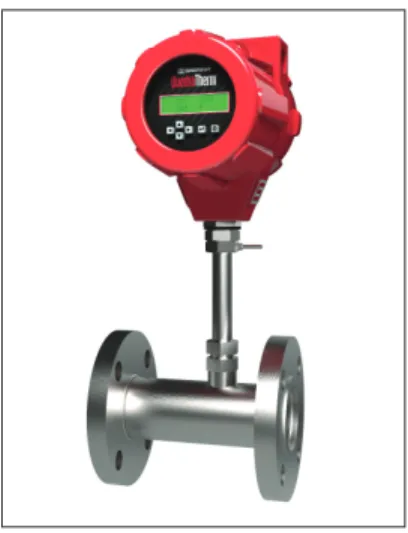
As a result, there is no need to buy expensive in-situ calibration instruments. Sierra offers a free in-situ calibration validation software package called ValidCal™ Diagnostics. Unlike other validation methods, the ValidCal™ Diagnostics program provides a complete check of all meter components including the velocity and temperature sensors, the sensor drive circuitry, the accuracy of the pressure transducer (if applicable), and all digital and analog outputs and alarm relays. This capability is included free with each meter and provides a printed calibration certifi cate and diagnostics report. All of this can be accomplished without removing the meter from the process piping. This capability can be found in all Sierra thermal meters, including the latest high accuracy QuadraTherm meter (See Figure 9 which is multivariable and has 0.5% of reading accuracy).
When evaluating thermal mass fl ow meters for in-situ calibration validation capability, be aware that sensor drift will create false positives that reduce the reliability of the validation resulting in reduced measurement quality. Assure that the instrument has a dry sensor and that the manufacturer backs up their sensor with a no-drift guarantee before you run an in-situ calibration validation procedure.
11
12
Summary and Conclusion
In-situ calibration validation is one of the great benefi ts of thermal mass fl ow technology. This whitepaper reviews fi ve in-situ calibration validation approaches. These are: Resistance, Zero-Flow, K-Factor, Full-Flow, and Flow-Audit. Each method has varying cost and complexity, but does offer the end user the advantage of proving some aspect of fl ow meter performance in the fi eld to fulfi ll quality requirements.
When evaluating thermal mass fl ow meters for in-situ calibration validation capability, beware that sensor drift will create false positives that reduce the reliability of the validation. The assumption by all manufacturers, including Sierra, is that their sensor does not drift. Only with sensor stability, can users truly validate a sensor’s factory-calibrated accuracy in the fi eld. Assure that your thermal mass fl ow meter has a drift-free, dry sensor, which has no organics and cements that drift over time.
Finally, it is highly recommended to use the fl ow–audit method for the highest quality calibration validation. All forms of in-situ calibration validation discussed in this whitepaper give the end user information about the thermal meters operating performance, but only the fl ow-audit method actually validates the calibration at actual fl owing conditions.
Acknowledgements
I would like to thank Scott Rouse, Erica Giannini and Charlotte Chapman for their contributions to the white paper.