Vol.10 (2020) No. 1
ISSN: 2088-5334
Development and Validation of Enterprise Architecture (EA)
Readiness Assessment Model
Surya Sumarni Hussein
#1, Mohd Naz’ri Mahrin
#2, Nurazean Maarop
#3, Nur Azaliah Abu Bakar
#4 #Razak Faculty of Technology and Informatics, Universiti Teknologi Malaysia, Kuala Lumpur, Malaysia Email: [email protected]; [email protected]; [email protected]; [email protected]
Abstract— Enterprise architecture (EA) proves to be a holistic strategy in aligning business and information technology. An
increasing number of organizations, especially in the public sector, have adopted EA in order to take advantage of the opportunities that it offers. Through EA, the efficiency of the organization is improved, with the optimization of resources and the elimination of duplication and redundancy. However, the successful establishment of EA relies on the organization’s readiness and ability to adopt EA practices because without proper readiness, the practices will probably fail. EA readiness refers to the assessment of how ready an organization is to adopt and to establish EA practices. EA readiness helps the organization to measure their stage of readiness, to identify any gaps, and then to redesign its strategy in order to adopt EA practices. EA is a merger between business and IT. Thus, the important elements of EA readiness should comprise of people, process, technology, and catalyst enabler. There is a lack of readiness for an assessment model that shapes these four elements towards EA; hence, a clear gap has been identified. Therefore, the objective of this study is to validate the EA Readiness Assessment Model (EARAM) by performing the Delphi technique. The study adopts a three-round Delphi Technique to verify the identified elements and factors and this is followed by developing and validating the proposed model. Results from the Delphi analysis have validated four (4) major elements of EARAM, namely people, process, technology, and catalyst enabler. The number of factors that contributes towards the readiness of the EA establishment is fourteen (14). It is anticipated that this model (EARAM) can help the Malaysian Public Sector (MPS) organization to identify and understand the elements and factors that must be considered when assessing the readiness to practice EA.
Keywords—Enterprise Architecture; readiness; assessment; public sector; Delphi technique.
I. INTRODUCTION
The emergence of e-government theories and practices of the public sector has made another phase of inclination in a new digital era. However, according to Witarsyah [1], much money has been spent by the government to improve e-government services, but the return of investment is difficult to justify. Enterprise architecture (EA) has become an influential agenda of e-government to strategized business with an information technology plan to overcome the issue. EA is a strategic approach to manage the complexity of an organization [2]–[5]. This includes the public sector that recently has an interest in EA; thus, the attention to this approach is evolving.
An increasing number of public sector organizations have adopted EA in order to take advantage of the opportunities that it offers. Through EA, the efficiency of the organization is improved, with the optimization of resources and the elimination of duplication and redundancy. However, the successful establishment of EA relies on the organization’s readiness and ability to adopt EA practices because without proper readiness, the practices will probably fail [4], [6].
EA readiness refers to the assessment of how ready an organization is to adopt and establish EA practices. EA readiness helps the organization to measure their stage of readiness, to identify any gaps, and then to redesign its strategy in order to adopt EA practices [2], [7]–[9].
Several studies have been conducted on the importance of the organization’s readiness towards EA establishment. Jahani, Javadein, and Jafari [8] pointed out that any organization that plans to establish EA must measure its readiness as the first step in preparation for an EA implementation process [9], [10]. According to statistics by MAMPU, the lack of readiness in agencies to embrace EA is one of the critical problems that lead to slow EA establishment [11].
In Malaysia, the EA readiness studies have begun to grow since 2007, which covers most of the factors in EA readiness. However, not many studies focus on the EA readiness assessment model itself [4], [12]. It is found that a comprehensive assessment model for readiness has not been established despite the extensive discussion on EA readiness factors [13]–[15]. Though other scholars have proposed other EA Readiness Models, none of them can fit into the
Malaysian Public Sector’s (MPS) EA implementation approach due to the MPS’s governance structure and project management. Realizing this gap, this study proposes an EA readiness assessment model to measure the Malaysian Public Sector organization’s readiness in EA establishment.
This paper will explain the validation process of the proposed EA Readiness Assessment Model (EARAM) through the Delphi technique. A three-round Delphi Technique is adopted, firstly, to verify the identified elements and factors, secondly to develop the model and thirdly to validate the model (EARAM) that is built base on the elements and factors verified. It is anticipated that this model (EARAM) will bring great assistance to the MPS in identifying and assessing the EA readiness factors before embarking on an EA implementation practice.
Previous studies have shown that early experiences have appeared to be tedious and have complicated the process of establishing EA in the public sector [12], [16]–[18]. This is because the organization needs to prepare themselves before embarking on such a project. Therefore, a major concern that needs to be addressed is the readiness of the organization itself. The lack of readiness in agencies to embrace EA is one of the critical problems that is leading to the slow establishment of EA in organizations [11], [12].
In Malaysia, the interest in EA began to grow since 2007 from both the public and private sectors. However, most of the studies in EA readiness that have been conducted in western countries do not suffice to address the EA readiness in a Malaysian context. Notably, only two studies that are related to EA readiness have been conducted in a Malaysian context. The studies were conducted in 2014 and 2016 to assess the readiness of agencies in EA establishment in the public sector. The study has revealed that the MPS is moving towards a partial readiness to embark on EA practices [19], [20]. According to the results, the lack of readiness in agencies to embrace EA is one of the critical problems that lead to slow EA establishment [11]. Nevertheless, these studies have merely been based on the industries’ consultant perspective, and there is no assurance on the rigorousness of the readiness assessment instrument that is used.
Moreover, the readiness assessment studies that have been conducted by industries’ consultants are based on their own readiness assessment model which lacks people, process, technology, and the EA catalyst perspective, as suggested by many EA scholars [4], [21], [22].
It has been found that the assessment model that is used in 2014 has solely been based on nine maturity areas from Togaf 9.1 EA maturity study framework[19]. The result from this assessment shows that MPS is still very much in its infancy stage. This is because most of the agencies do not possess knowledge in EA, and the assessment conducted has used an EA that has been constructed as a basis to formulate EA questions. However, based on the preliminary interview with one of the respondents, the questions from the assessment are difficult to understand even though a guide
has been given. Hence, the model itself can be disputable and the result may not represent the actual scenario of EA establishment in MPS.
Another study has been conducted by a team of consultants appointed by MAMPU in 2016 [20]. These consultants have also deployed their own EA readiness assessment model, which covers only four main factors, namely commitment, team capability, business case, and stakeholder. Again, the readiness assessment model being used does not depict the holistic view of EA readiness as discussed by EA scholars [4], [8], [21], [23], [24]. Thus, the result is not accurate enough to provide the overall picture of EA readiness in MPS. Based on these issues being discussed, this study proposes an EA Readiness Assessment Model (EARAM) to overcome the weaknesses of previous readiness assessment by taking into account all the important elements that have become the pillars of MPS agencies namely the people, the process, the technology, and the catalyst enabler elements, as suggested by previous studies [4], [21], [22]. Hence, the EA readiness will be assessed based on factors that are related to these four elements and EA domain respectively.
Thereafter, an identification of the EA readiness factor is completed through a developed conceptual model (EARAM). This study model is based on identified factors from the systematic literature review (SLR) and interview sessions with the experts. From the SR four existing readiness assessment models in the IS field have been identified [25]. From this, the IT/IS Maturity Model [26] has been selected as a based theory for the development of a proposed model (EARAM). Also, additional factors that are related to EA readiness have been identified from the SR [25] and are consolidated together with the based theory. Table 1 depicts the elements and factors of EARAM based on studies that are mentioned earlier.
TABLE I
ELEMENTS AND FACTORS OF EARAM
Element Factor
EE-Catalyst Enabler EE1-EA Vision
EE2-EA Culture
EE3-EAChange management EE4-EA Resources
EE5-EA Governance
PP-People PP1-Stakeholder support
PP2-Competency and skills PP3-Management commitment
PP-Process PS1-Business Motivation
PS2-Communication PS3-Policy and rules
TC-Technology TC1-EA repository
TC2-Security TC3-EA tools
These elements and factors are developed into EARAM. The proposed conceptual model of EARAM to be validated in this study is depicted in Figure 1.
Fig 1. Proposed EA readiness assessment conceptual model for MPS
II. MATERIALS AND METHOD
In order to resolve the issues that are highlighted in the previous section, this study develops a new EA readiness assessment model (EARAM) by using the Delphi technique. The Delphi experiment was performed in 1948 as the first application of the method. After the first article describing it was published in 1963, the method became popular [27]. Numerous Delphi experiments were conducted between 1950 and 1963 by Rand as an effort to reduce the negative effects of group interactions in decision making. Most of these experiments were defence-related, thus, they were kept confidential [28]. This study organizes the Delphi technique into three phases, they are (i) Planning and Preparation for Delphi, (ii) Execution of Delphi Technique, and (iii) Finalisation and Closure of Delphi.
A. Planning and preparation for the Delphi Technique
The first phase involved the planning and preparation of the Delphi technique execution. Experts need to be identified in the first place. Experts are defined as people who are very knowledgeable in a particular area, who are experienced and can influence policy [29]. Since expert opinion was obtained, purposive sampling was necessary where the sample was selected not to represent the general population but rather their expert ability to answer the research questions [30]. There were four requirements for expertise: (i) knowledge and experience pertaining to the issues under investigation; (ii) capacity and willingness to participate, (iii) sufficient time to participate in the three rounds of Delphi, and (iv) effective communication skills [31]. Thirteen experts based in Malaysia, United Kingdom and India, from various professions such as academicians, policy-makers, consultants and practitioners were invited to take part in the process.
Before the study was conducted, fifteen experts had been contacted via email to request for their participation in the study. The communication channel via email was to ensure the anonymity and confidentiality of the feedback so as to prevent biases or influence by other experts. Thirteen experts replied, giving their agreement to participate. This was almost similar to two doctoral types of research done by Adams [32] and Choong [33] respectively, which involved ten experts and Al-araibi [34] which involved eleven experts.
B. Execution of Delphi Technique
The second phase was the execution of the Delphi technique. Questionnaires were used for data collection. The duration was four months for data collection processes, which commenced from Oct 2017 to Feb 2018. The reason for this rather long period was due to the fact that the process involved the conceptualization of the EARAM, which required an in-depth analysis of the elements that were to be included in the model. Furthermore, many of the experts’ feedbacks that were received from the beginning of the first round were valuable, hence they needed to be analyzed accordingly. Round 1 was intended to get as many inputs as possible regarding the factors and items identified, based on the SR and interviews. Before the questionnaire was distributed, it needs to be validated. Content validity is a crucial aspect in the questionnaire development. The content validity results revealed that this questionnaire had an appropriate level of content validity.
Each expert received the questionnaire via email together with a formal invitation letter for participation. A brief description of the Delphi procedure, instructions on completing the questionnaire, and a request to send the completed questionnaire back to the researcher within two weeks via email were all indicated. Each expert was assigned with a code name (i.e. E1=Expert One; E2=Expert
Two etc.) to allow for tracking of the returned responses and individual feedback. All tracking information and code name were separated from the data collected to protect the anonymity of the participants' responses.
1) Delphi Round One (R1): As mentioned earlier, the
questionnaires were emailed to all experts together with an official letter of invitation and a feedback form. This questionnaire was constructed with a list of factors and items which we rated using a 5-point Likert-type scale. This questionnaire was categorised based on three sections namely: ‘Respondent profile’, ‘Factors that Influence Readiness of EA Establishment in MPS’, and lastly ‘The proposed EARAM for EA Establishment in MPS’. There were altogether 14 factors with descriptions and 42 new items derived from the SR and input of experts in the interview session. The summary of items is shown in Table II.
TABLE II
SUMMARY OF FACTORS AND ITEMS FOR EA READINESS FOR ROUND 1
Factors No. of items
Element: EE-Catalyst Enabler
EE1-EA Vision 6
EE2-EA Culture 4
EE3-EA Change Management 4
EE4-EA Resources 3
EE5-EA Governance 3
Element: PP-People
PP1-Stakeholder support 3
PP2-Competency and skills 3
PP3-Management commitment 4
Element: PS-Process
PS1-Business motivation 2
PS2-Communication 3
PS3-Policy and rules 2
Element: TC- Technology
TC1-EA repository 2
TC2-EA tools 1
TC3-Security 2
TOTAL 42
The experts were given two weeks to verify the items and factors of EA readiness and to comment on the proposed EARAM for EA establishment in MPS [35]. A follow up email was sent one week after the first email to remind them of the task. The follow-up emails proved to be effective because after the reminder six experts replied to inform about their commitments (outstation, busy or will reply soon). All thirteen experts successfully responded with their feedback, even though some of them had exceeded the dateline. The expert was also allowed to give comments in the blank spaces given in the tables on the proposed factors, items, and model. The panel members were required to rate the items based on the five-point Likert-type scale of relevance [36] as shown in Table III.
TABLE III SCALE OF RELEVANCE
Scale Definition
1 Extremely irrelevant
Not important at all to the readiness factors that affect readiness in MPS
2 Irrelevant Not significantly important to the readiness factors that affect readiness in MPS
3 Uncertain It may or may not be important to the readiness factors that affect readiness in MPS
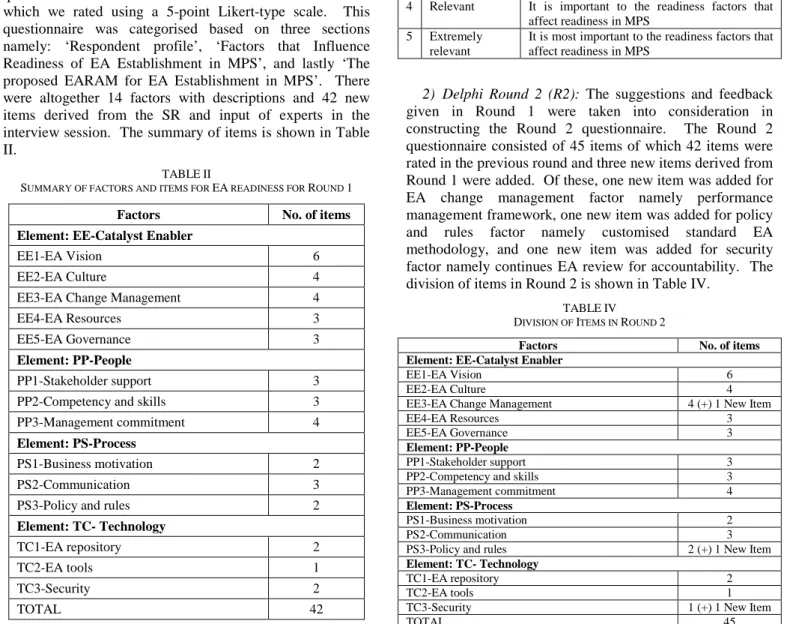
4 Relevant It is important to the readiness factors that affect readiness in MPS
5 Extremely relevant
It is most important to the readiness factors that affect readiness in MPS
2) Delphi Round 2 (R2): The suggestions and feedback
given in Round 1 were taken into consideration in constructing the Round 2 questionnaire. The Round 2 questionnaire consisted of 45 items of which 42 items were rated in the previous round and three new items derived from Round 1 were added. Of these, one new item was added for EA change management factor namely performance management framework, one new item was added for policy and rules factor namely customised standard EA methodology, and one new item was added for security factor namely continues EA review for accountability. The division of items in Round 2 is shown in Table IV.
TABLE IV DIVISION OF ITEMS IN ROUND 2
Factors No. of items
Element: EE-Catalyst Enabler
EE1-EA Vision 6
EE2-EA Culture 4
EE3-EA Change Management 4 (+) 1 New Item
EE4-EA Resources 3
EE5-EA Governance 3
Element: PP-People
PP1-Stakeholder support 3
PP2-Competency and skills 3
PP3-Management commitment 4
Element: PS-Process
PS1-Business motivation 2
PS2-Communication 3
PS3-Policy and rules 2 (+) 1 New Item Element: TC- Technology
TC1-EA repository 2
TC2-EA tools 1
TC3-Security 1 (+) 1 New Item
TOTAL 45
The experts were requested to rate the importance of the factors and items using a 5-point Likert scale (1=Extremely irrelevant and 5= Extremely relevant). For round 2, two weeks were given to the experts to respond as in Round 1. After a given date, a few follow-up emails, messages via SMS and/or telephone calls, all the thirteen experts responded with their answers.
Participants were requested to provide their underlying comments or reasons for any statement(s) where they might have taken exception from the converging group view; for example, where the group median is 5 but the expert’s rate is 1, then he or she was required to provide a justification or a comment for the difference. An open-ended column was provided next to each item in the Round 2 questionnaire for
the participants to provide their comments or reasons for any exceptions.
3) Delphi Round 3 (R3): Delphi Round 3 was employed
to confirm the ratings of experts for three new items derived in Round 1 and were first rated in Round 2. The questionnaire consisted of two parts. Part one consisted of the results of new items for the panel members to re-rate the items, and part two is for the validation of the final EARAM for MPS. Part two consisted of options for the panel to validate the model without comments and with comments in the open-ended space given. Two weeks were given to the panel to respond. After the stipulated duration, thirteen experts replied. The most successful studies were the results of the three rounds of data collection as “three rounds proved sufficient to attain stability in the responses; further rounds tended to show very little change and excessive repetition was unacceptable to participants” [37]. Thus, the three-round conducted in this research were sufficient to achieve the objective and also to enrich the data.
C. Finalisation and Closure of Delphi
The final phases involved data analysis and report. The returns of the Delphi Round 1 to Round 3 questionnaires were analysed and evaluated qualitatively and quantitatively since it involved the level of agreement of the experts pertaining to factors of readiness, their justifications on the chosen level of agreement and suggestions of elements to be added. The following are the related analysis conducted.
1) Quantitative Analysis: The feedback from the
questionnaires of Delphi Rounds 1, 2 and 3 were analysed using the Frequency of Central Tendency to calculate its median and Inter Quartile Range (IQR). Median was used to investigate the majority of experts (experts’ consensus) while IQR was conducted to identify the relationships between each of the items or experts [38]. The stages of consensus were fixed based on IQR as follows: 1) High consensus = IQR is 0 to 1; 2) Moderate consensus = IQR is 1.01 to 1.99, and 3) Without consensus = IQR is 2.0 and above.
2) Qualitative Analysis: Questionnaire for each round of
Delphi had included a column for comments that allow any feedback from the experts. Each of the comments was analysed qualitatively using thematic analysis [32].
3) Final Report: The final report consisted of preparation, process, and results that had been achieved in the Delphi Technique. The initial model was improved based on feedback from the Delphi members. The result of the final round of Delphi (Round 3) was the validated EA readiness assessment model by the experts.
III.RESULTS AND DISCUSSION
The results consist of a statistical analysis of factors that affect the readiness of EA establishment and EARAM. The detail explanations are given in the following sub-sections.
A. Statistical Analysis: Factors that affect readiness of EA establishment
For Delphi R1, all items had a median value of 4 and 5. Therefore, the levels of agreement among the panelists for
all items were at ‘agree’ and ‘strongly agree’. In terms of stage of consensus among the experts, all factors and items had an IQR value of 0 to 1 which interpreted that a high consensus was achieved.
Based on the feedbacks from the experts in Delphi R1, three new items were suggested to be added as stated below:
• EE3-5 Item: Performance Management framework under EE3-Change Management factor
• 3 Item: Standard EA Methodology under PS3-Policy and Rules factor
• TC2-2 Item: Consistent review of EA to ensure accountability (i.e. integrity and accuracy of outcome) under TC2- Security factor.
Expert 3 also suggest to revise term PS1-business case factor to business motivation and purpose. There are 14 factors and 45 items were proposed and analysed to formulate Delphi R2 questionnaire. In order to confirm these findings, the questionnaires together with the summation of Delphi R1 data analysis was circulated again among the panel of experts at Delphi R2.
For Delphi R2 and R3, all 14 items and 45 items including the new items suggested had a median value of 4 and 5, with the levels of agreement among the experts at ‘agree’ and ‘strongly agree’. For stage of consensus, all items had a high degree of consensus (IQR value of 0 to 1). The Delphi technique ended when the results reached the saturation points, which is the convergences of the consensus criteria.
Based on the findings from 13 expert panels of all three rounds of the Delphi technique, there was no item that achieved an IQR of more than one or a value of median which was less than four. In other words, no item was rated as not important or no consensus. Eventually, the experts reached the consensus to accept all 14 factors and 45 items in the final round of the Delphi technique (Delphi R3). From statistical analysis, through the median score and IQR values in Round 1 until Round 3, the findings showed that all proposed factors could affect the readiness of the EA establishment. Detailed analysis of Round 1 until Round 3 of the Delphi techniques that is based on the proposed factors are:
B. EE1-EA Vision
Based on the generic items, all the experts agree that the EA vision is an important factor in the readiness of EA establishment. Before EA is established in an organization, a consensus of definition and vision must be derived from all affected parties. EA vision must also clearly address the scope that is intended to be accomplished with the measurable business value. However, the critical element of having an EA vision is that the vision should be understandable and shared among people in an organization because the vision acts as a driver and guidance for EA practices.
C. EE2-EA Culture
Based on the generic items, all the experts agree that an EA culture is important in readiness for an EA establishment. A culture of EA within an organization will increase the chances of a successful EA initiative.
D. EE3-EA Change Management
In the public sector, change management must be driven from top and middle management through directives, policies and work instructions. This will provide immediate change effects, and gradually work on the soft skills to promote positive attitudes and beliefs in EA.
E. EE4-EA Resources
EA resources are important towards readiness of EA establishment. Sufficient EA resources include finance, people and assets that are needed to be reallocate accordingly to make the best used of them. Thus, resources directly affect the readiness of an organization in the public sector to successfully embark on EA practice.
F. EE5-EA Governance
It is important to define the roles of people who are involved before the establishment of EA practices. This is an early part of setting up an EA governance for the organization, to be prepared or equipped for EA establishment. Setting up an EA governance does not mean that the organisation needs to set up a new EA governance board or body or committee. It can be embraced into the existing Governance body with a suitable stakeholder who is EA savvy, and by adding an additional role and responsibility to govern the EA.
G. PP1-Stakeholder support
All experts agree that the stakeholder support is an important factor of readiness in EA establishment. However, it is crucial for the stakeholder to have good knowledge and understanding on how to govern EA. The stakeholder must also constantly engage with the EA practitioner to ensure that he or she is able to play his or her role in order to support the EA practices
H. PP2-Competency and Skills
All the experts agree that competency and skill are important factors in EA establishment. Having a competent EA architect is crucial as the organization must have a person who is well versed with the core business to be the lead architect. Thus, organizations need to equip their EA team with suitable architecture skill to ensure smooth adoption of EA in MPS.
I. PP3- Management Commitment
All experts agree that management commitment plays a major role towards readiness of EA establishment. However, although this factor is necessary, it is not a sufficient condition for readiness. The key is to enable and ensure direct and active management involvement.
J. PS1- Business Motivation and purpose
In Delphi R1, terms “business case” is suggested by one of the experts to be revised into “business motivation and
purpose”, which is more understandable by employees in
the organisation. This revision of terms is agreed by all experts in Delphi R2 and R3. Business motivation and purpose factor is critical for EA establishment that acts as a contract to be referred and as a consent for the start and review of the EA programs and activities. It helps EA
practitioner to communicate at the same “language’ with business stakeholder.
K. PS2-Communication
Ensuring a common understanding of the architecture, methodology and artefacts is crucial in executing a successful EA initiative. Thus, all the experts agree that communication is an important factor in avoiding misunderstanding of the EA general terms and acronyms across the organization. The use of standard notations and standard EA language at the earlier stage of EA establishment is to ensure everyone understands the architecture description and models that are being used to represent the enterprise and the roadmap towards achieving the target architecture or business vision.
L. PS3-Policy and rules
Policy and rules factor were agreed upon by all the experts as one of the important factors towards EA readiness. In MPS or almost all of the other countries public sectors, the policy and rules are effective ways to implement certain initiatives and programs. Therefore, policies and rules need to be formulated to ensure EA practices are in place and being adhered.
M.TC1-EA Repository
All experts agreed EA repository is important towards readiness of an EA establishment. EA repository helps to store the EA artefact in a manageable way and acts as a centralised repository. EA repository should be defined up from with the creation of an EA board so that exactitude is placed early in terms of documenting and storing EA artefacts.
N. TC2-EA Tools
EA tools are important and should be decided at the creation of an EA Governance board or committee, however, EA artefacts can be documented without specific EA tools. Appropriateness of the tool and tool selection to the needs of the organisation is the most important, and training on the use of tools is a must.
O. TC3-Security
All experts agree that security is an important factor of the readiness towards EA establishment. EA often documents the Intellectual Property of the organization – keeping all of the EA content secured is vital in ensuring the direction and reputation of the organization. Thus, security is to ensure that the artefacts are intact, reliable and accessible. This part discusses the readiness factors and items that are validated from the Delphi technique. In R1, 14 factors and 42 items are proposed. From the experts’ feedback in R1, the items that have emerged total to 45 items and are allocated to the factors accordingly. The result from R2 shows that all 14 factors and 45 items have received high consensus from the experts. Thus, the results lead to the development of EA readiness model and are validated by an expert in R3. The result concluded that towards three rounds of Delphi, all factors and items had generated a high consensus among the experts and are therefore considered for the development of the EA Readiness Assessment Model (EARAM).
IV.CONCLUSION
Enterprise architecture (EA) has been proven to be a holistic strategy in aligning business and information technology. An increasing number of organisations, especially in the public sector, have adopted EA in order to take advantage of the opportunities that it offers. Through EA, the efficiency of the organisation is improved with optimisation of resources and the elimination of duplication and redundancy.
The Delphi technique is used to verify the identified elements and factors, this is followed by developing and validating the proposed model. It consists of 14 factors and 45 items that have received high consensus from experts.
This EARAM incorporates all suggested elements with the aim to provide managers with a model to assess the EA readiness of their organizations, prior to the EA establishment, by highlighting the areas that are likely to require improvements. It can also help the decision makers to set a vision and a strategic statement action plan for the establishment of EA in their agencies.
ACKNOWLEDGMENT
This research is financially supported by a Fundamental Research Grant Scheme (Vote No. 5F072) awarded by Ministry of Higher Education of Malaysia and University Teknologi Malaysia.
REFERENCES
[1] D. Witarsyah, T. Sjafrizal, M. F. MD Fudzee, and M. A. Salamat, “The Critical Factors Affecting e-Government Adoption in Indonesia: A Conceptual Framework,” Int. J. Adv. Sci. Eng. Inf. Technol., vol. 7, no. 1, p. 160, 2017.
[2] D. Simon, K. Fischbach, and D. Schoder, “Enterprise architecture management and its role in corporate strategic management,” Inf. Syst. E-bus. Manag., vol. 12, no. 1, pp. 5–42, 2014.
[3] N. Banaeianjahromi and K. Smolander, “Understanding Obstacles in Enterprise Architecture Development,” in European Conference on Information Systems (ECIS), 2011, vol. 7, no. 3.
[4] D. D. Dang and S. Pekkola, “Root Causes of Enterprise Architecture Problems,” Pacific Asia Conf. Inf. Syst., 2016.
[5] F. Rahimi, J. Gøtze, and C. Møller, “Enterprise Architecture Management : Toward a Taxonomy of Applications,” vol. 40, 2017. [6] P. Desfray and G. Raymond, “Togaf®,” Model. Enterp. Archit. with
TOGAF, pp. 1–24, 2014.
[7] N. M. Aziz and H. Salleh, “Managing Organisation / Business Readiness towards IT / IS Implementation : A Model Comparison,” Aust. J. Basic Appl. Sci., vol. 5, no. 2, pp. 215–221, 2011.
[8] B. Jahani, S. R. S. Javadein, and H. A. Jafari, “Measurement of enterprise architecture readiness within organizations,” Bus. Strateg. Ser., vol. 11, no. 3, pp. 177–191, 2010.
[9] D. D. Dang and S. Pekkola, “Institutionalising Enterprise Architecture in,” in The 2016 European Conference on Information Systems (ECIS). İstanbul, Turkey., 2016.
[10] D. A. Purnawan and K. Surendro, “Building enterprise architecture for hospital information system,” 2016 4th Int. Conf. Inf. Commun. Technol. ICoICT 2016, vol. 4, no. c, pp. 1–6, 2016.
[11] M. Yusoff, “Steering commitee meeting for development of ea in malaysian public sector (1GovEA) phase 1 NO. 2/2017,” 2017. [12] V. Seppänen, K. Penttinen, and M. Pulkkinen, “Key Issues in
Enterprise Architecture Adoption in the Public Sector,” vol. 16, no. 1, pp. 46–58, 2018.
[13] H. Al-Kharusi, S. Miskon, and M. Bahari, “Factors Influencing the Engagement Between Enterprise Architects and Stakeholders in Enterprise Architecture Development,” p. paper 262, 2016.
[14] M. Ylinen and S. Pekkola, “Enterprise Architecture as a Scapegoat for Difficulties in Public Sector Organizational Transformation,” pp. 1–13, 2018.
[15] N. Banaeianjahromi, “Where Enterprise Architecture Development Fails,” 2018 12th Int. Conf. Res. Challenges Inf. Sci., pp. 1–9, 2018. [16] T. Hope, E. Chew, and R. Sharma, “The failure of success factors:
Lessons from success and failure cases of enterprise architecture implementation,” SIGMIS-CPR 2017 - Proc. 2017 ACM SIGMIS Conf. Comput. People Res., pp. 21–27, 2017.
[17] T. Hope, “The Critical Success Factors of Enterprise Architecture,” University of Technology, Sydney, 2015.
[18] D. Dang, “Enterprise Architecture and Organizational Reform : A Project Debrief,” 2017.
[19] MAMPU, “Kajian Pembangunan Enterprise Architecture Sektor Awam : Current Assessment Report,” no. March, 2014.
[20] MAMPU, “Readiness of government agencies for Enterprise Architecture,” 2016.
[21] N. A. A. Bakar, N. Kama, and S. Harihodin, “Enterprise architecture development and implementation in public sector: The Malaysian perspective,” J. Theor. Appl. Inf. Technol., vol. 88, no. 1, pp. 176-188i, 2016.
[22] A. Ojo, T. Janowski, and E. Estevez, “Improving Government Enterprise Architecture practice - Maturity factor analysis,” Proc. Annu. Hawaii Int. Conf. Syst. Sci., pp. 4260–4269, 2011.
[23] A. Sobczak, “Methods of the assessment of enterprise architecture practice maturity in an organization,” Lect. Notes Bus. Inf. Process., vol. 158 LNBIP, pp. 104–111, 2013.
[24] B. Van Der Raadt, M. Bonnet, S. Schouten, and H. Van Vliet, “The relation between EA effectiveness and stakeholder satisfaction,” J. Syst. Softw., vol. 83, no. 10, pp. 1954–1969, 2010.
[25] S. S. Hussein et al., “Towards designing an EA readiness instrument: A systematic review,” in Colloquium in Information Science and Technology, CIST, 2017.
[26] M. Alshawi and H. Salleh, “IT/IS Readiness Maturity Model,” Cases Perform. Meas. Product. Improv., pp. 23–37, 2011.
[27] U. G. Gupta and R. E. Clarke, “Theory and applications of the Delphi technique: A bibliography (1975–1994),” Technol. Forecast. Soc. Change, vol. 53, no. 2, pp. 185–211, 1996.
[28] N. Dalkey and O. Helmer, “An experimental application of the Delphi method to the use of experts,” Manage. Sci., vol. 9, no. 3, pp. 458–467, 1963.
[29] J. Baker, K. Lovell, and N. Harris, “How expert are the experts? An exploration of the concept of ‘expert’ within Delphi panel techniques.,” Nurse Res., vol. 14, no. 1, pp. 59–70, 2006.
[30] J. Kosecoff et al., “General medical care and the education of internists in university hospitals: an evaluation of the teaching hospital general medicine group practice program,” Ann. Intern. Med., vol. 102, no. 2, pp. 250–257, 1985.
[31] M. Adler and E. Ziglio, Gazing into the oracle: The Delphi method and its application to social policy and public health. Jessica Kingsley Publishers, 1996.
[32] M. K. Adams, “Defining creative scholarship and identifying criteria for evaluating creative scholarship using a modified delphi technique.,” 2004.
[33] Y. C. Choong, “A mapping approach to investigating Information and Communication Technology (ICT) implementation during the building design process,” Dr. Philos. Sch. Prop. Constr. Proj. Manag. RMIT Univ., 2006.
[34] A. A. M. Al-araibi, M. Naz, M. Naz’ri bin Mahrin, and R. C. M. Yusoff, “Technological aspect factors of E-learning readiness in higher education institutions: Delphi technique,” Educ. Inf. Technol., pp. 1–24, 2018.
[35] A. L. Delbecq, H. Van de Ven, David H. Gustafson, A. H. de Ven, and D. H. Gustafson, Group techniques for program planning: A guide to nominal group and Delphi processes, vol. 12. Scott Foresman, 1975.
[36] I. A. Jillson, “The national drug-abuse policy delphi: progress report and findings to date,” Delphi Method Tech. Appl., pp. 124–158, 1975. [37] H. A. Linstone, M. Turoff, and others, The Delphi method:
Techniques and applications, vol. 29. Addison-Wesley Reading, MA, 1975.
[38] S. Siraj, A. R. Zakaria, N. Alias, D. Dewitt, P. Kannan, and J. Ganapathy, “Future Projection on Patriotism among School Students Using Delphi Technique,” Creat. Educ., vol. 03, no. 06, pp. 1053– 1059, 2012.