P
olicy
R
eseaRch
W
oRking
P
aPeR
4299
Balancing Expenditures on Mitigation of
and Adaptation to Climate Change:
An Exploration of Issues Relevant to Developing
Countries
Franck Lecocq
Zmarak Shalizi
The World Bank
Development Research Group
Sustainable Rural and Urban Development Team
August 2007
WPS4299
Public Disclosure Authorized
Public Disclosure Authorized
Public Disclosure Authorized
Abstract
The Policy Research Working Paper Series disseminates the findings of work in progress to encourage the exchange of ideas about development issues. An objective of the series is to get the findings out quickly, even if the presentations are less than fully polished. The papers carry the names of the authors and should be cited accordingly. The findings, interpretations, and conclusions expressed in this paper are entirely those of the authors. They do not necessarily represent the views of the International Bank for Reconstruction and Development/World Bank and
Policy ReseaRch WoRking PaPeR 4299
Although climate policies have been so far mostly focused on mitigation, adaptation to climate change is a growing concern in developed and developing countries. This paper discusses how adaptation fits into the global climate strategy, at the global and national levels. To do so, a partial equilibrium optimization model of climate policies—which includes mitigation, proactive adaptation (ex ante), and reactive adaptation (ex post)—is solved without and with uncertainty. Mitigation, proactive adaptation, and reactive adaptation are found to be generally jointly determined. Uncertainty on the location
This paper—a product of the Sustainable Rural and Urban Development Team, Development Research Group—is part of a larger effort in the group to mainstream climate change research. Copies of the paper are available free from the World Bank, 1818 H Street NW, Washington, DC 20433. Please contact Pauline Kokila, room MC3-446, telephone 202-473-3716, fax 202-522-1151, email address [email protected]. Policy Research Working Papers are also posted on the Web at http://econ.worldbank.org.. The author may be contacted at [email protected] or zmarakshalizi@yahoo. com. August 2007. (42 pages)
of damages reduces the benefits of “targeted” proactive adaptation with regard to mitigation and reactive adaptation. However, no single country controls global mitigation policies, and budget constraints might make it difficult for developing countries to finance reactive adaptation, especially if climate shocks affect the fiscal base. Rainy-day funds are identified as a supplemental instrument that can alleviate future budget constraints while avoiding the risk of misallocating resources when the location of damages is uncertain.
Balancing Expenditures on Mitigation of and Adaptation to Climate
Change:
An Exploration of Issues Relevant to Developing Countries
* a
Zmarak Shalizi b Franck Lecocq,
a Laboratory of Forestry Economics, Nancy, FRANCE b Washington D.C., USA
JEL Classification: H41, O13, Q25
Keywords: Climate Change, Mitigation, Adaptation, Uncertainty, Budget Constraints,
Rainy-Day Fund
* Corresponding Author: [email protected]. Laboratory of Forestry Economics – Joint research unit of
AgroParisTech (ENGREF) and INRA. 14, Rue Girardet, F-54042 NANCY CEDEX, FRANCE. Tel: +33 3 83 39 68 96. Fax: +33 3 83 37 06 45. The authors thank two anonymous reviewers for their comments on the paper. Remaining errors are entirely ours.
1. Introduction
Climate policies have been so far mostly focused on mitigation. But adaptation—long a concern of developing countries—is slowly getting more attention worldwide. This is in part due to growing recognition that the climate is already changing in some areas of the globe,1 and that— regardless of the success or failure of mitigation policies—further changes will occur, thus making some degree of adaptation inevitable in both developed and developing countries.
The new emphasis on adaptation, however, also raises difficult questions: How does adaptation differ from regular development expenditures and what should be funded by resources dedicated to adaptation? What is the role of the public sector (globally, nationally, and locally) in supporting adaptation? Given that funds also need to be set aside for mitigation, how should resources be balanced between mitigation and adaptation (globally and nationally)? Of the funds set aside for adaptation, what is the best allocation between ex ante and ex post expenditures (globally and nationally)? Since the damages of climate change are likely to be sector- and/or region-specific, how does one allocate resources in the presence of uncertainties and budget constraints (locally, nationally, and globally)?
The present paper aims to address these questions in a partial equilibrium framework. Section 2 briefly outlines developing country and international concerns about the link between adaptation and development; and describes a few important characteristics that differentiate the adaptation problem from the mitigation problem, as well as, various rationales for public support for adaptation, within and across countries. Section 3 discusses the relationship between mitigation, ex ante adaptation, and ex post adaptation in a model without uncertainty and without budget constraints. Section 4 discusses how uncertainty affects the balance between mitigation and adaptation, as well as between proactive and reactive adaptation options. And Section 5 discusses how budget constraints modify the results. Section 6 pulls together key points and concludes.
1 There is consensus on the fact that global warming is occurring and that some degree of adaptation is necessary—
even though there is still some discussion about how much of the observed warming is due to anthropogenic causes, and how much of it should be mitigated through collective action.
2. Adaptation and development
2.1. Development strategies have to be re-assessed in light of the climate risk
Development involves moving from a low physical, human and institutional asset base to a high asset base within a set of constraints including, inter alia, geography, endowments in natural resources, climate, history, regional and global economic environment, etc. From a developing country perspective, climate change is a new constraint within which development takes place. How this new constraint might modify allocation of resources in development strategies requires disposing of two concerns.
First, climate change impacts on development strategies can no longer be discarded on the ground that damages of climate change are too uncertain or too far off in the future. In fact, the IPCC (Alley et al., 2007) projects an increase in temperature of 0.2 degrees Celsius per decade independent of the emissions scenario over the next three decades. It also projects a very likely increase in the frequency of heat waves, hot extremes, and extreme weather events over the same time frame—following observed increases over the past decades. There is already an emerging consensus that climate change will generate additional tensions on freshwater availability in the coming decades in areas where water availability is already an issue.
Second, the fact that adaptation to current climate variability is already part of a country’s development strategy does not mean that the strategy is also adapted to climate change. This point is important because a lot of the literature on adaptation emphasizes so-called ‘win-win’ opportunities in which improving adaptation to current climate variability is aligned with adaptation to future climate change.
For example, a key development goal for a small, very poor country with a high share of GDP in climate-sensitive agriculture might be to improve smallholders’ agricultural productivity and their integration into agro-processing. A necessary condition for this purpose is to reduce the high vulnerability of smallholders to historic weather-related shocks. This requires implementing projects such as irrigation, micro-level weather insurance, improved management of key watersheds, or agriculture development programs including weather risk mitigation. If these measures are adopted, it would seem at first glance, that the current development strategy already goes in the right direction with regard to climate change, since it targets vulnerable rural communities with the objective of reducing the impacts of weather-related risks. However, these
projects and programs may not be sufficient to cope with increased variability in climate, or with sustained patterns in climate for which there is no precedent—for example hundred year floods occurring every decade, etc.2
In general, climate change will require that most development expenditures that are climate sensitive—such as, inter alia, investments in almost all types of infrastructure (transportation, telecom, utilities, etc.), housing programs, agriculture development policies, policies regarding tourism, etc.—be upgraded and designed to withstand higher tolerances/peak loads or that the development strategy shifts to sectors that are less climate sensitive.
At a minimum, it is therefore necessary that countries review their development strategies, their policies and their projects in light of the emerging risk of climate change. Such a review should be conducted for all investment projects that take place within the country, be they funded by corporations, communities, households, or individuals—not only for investment programs and projects funded by the government.
Similarly, the design of long-lasting institutional arrangements may have to be revised to take climate change into account. For example, when water runoffs are expected to diminish, it is all the more important for long-term water rights arrangements to include strong provisions for resolving tensions.
To the extent that the benefits of adaptation are local, adaptation should be financed locally whether in developed or in developing countries. However, the population exposed to climate change damages is likely to be larger in developing countries, where damages are likely to be more important and where ability to pay is lower. Hence the need for some transfer/international financing mechanism from developed to developing countries. In some cases, however, the benefits of adaptation are regional or even global, and should be financed accordingly.
Adaptation is already a key issue in the upcoming discussions on the second commitment period and the post-Kyoto international climate regime, in part because most Parties to the UNFCCC have comparatively low emissions, and adaptation, much more than mitigation, is the critical challenge they face in developing policies to address climate change.
2 The problem can be compounded by the loss of local knowledge and capacity to cope/adapt–whether due to AIDS
and premature deaths of knowledgeable adults (particularly in rural areas) (e.g., Suarez et al., 2007) or due to rural outmigration associated with the modernization and urbanization of the economy.
2.2. How does adaptation differ from mitigation?
Scientists have established a causal chain between anthropogenic emissions of greenhouse gases (GHGs), to increases in concentration of GHGs in the atmosphere, to changes in global temperature, to changes in sea level and other manifestations of climate change, to economic impacts of those changes and implications for welfare.
Mitigation consists of reducing emissions (or removing GHGs out of the atmosphere) at the beginning of the chain to avoid or minimize climate change in the first place, whereas adaptation consists of responding to the anticipated or actual economic damages of climate change at the end of the chain.
This section outlines three additional important characteristics that differentiate adaptation from mitigation and that complicate the analysis in setting up priorities: the large uncertainty on the benefits of adaptation; the lack of a common performance indicator; and the need to differentiate between proactive and reactive adaptation.
The uncertainty on the benefits of adaptation is usually larger than the uncertainty on the benefits of mitigation
In economic terms, the benefits of mitigation (or social value of carbon) are defined as the discounted sum of the (future) damages avoided by reducing emissions (now). However, the social value of carbon remains controversial (see e.g., Stern 2007 for a discussion) because of (i) remaining uncertainties on the causal chain between emissions and impacts, and on the implications of these changes for natural systems, biological systems and societies (Adger et al., 2007); (ii) uncertainties on large-scale non-linearities, such as thermohaline circulation slowdown or West Antarctic Ice Sheet collapse; (iii) uncertainties on business-as-usual emissions in the next century, and thus on how much damages would occur in the absence of climate mitigation; and (iv) methodological and policy differences over the treatment of small probability/large impact risks and the value of the discount rate.
Similarly, the economic benefits of adaptation can be defined as the discounted sum of the damages avoided by the adaptation measure considered relative to what would have happened in the absence of this measure. The key difference is that adaptation measures usually reduce damages in a single sector, a single region, or a single sector/activity within a specific region. As a result, both the counter-factual against which the benefits of adaptation are estimated and the
direct effects of the adaptation measure on damages have to be estimated at the local level. But the existence of impacts, the sign of these impacts, their magnitude, their time horizon, and their frequency are all uncertain at the local level. As the IPCC notes, uncertainties are much larger at the local/sectoral level than at the global level.
Unlike mitigation, there is no Common Performance Indicator for adaptation
Mitigation encompasses a wide range of activities, from fuel-switching to sequestration of carbon in biomass. Yet there is a unique metric for measuring the performance of mitigation measures, namely the amount of emissions reduction they generate.
Adaptation also encompasses a wide range of activities in all sectors. And for each class of activity, it is possible to define performance indicators, e.g., the maximum wind-speed a construction can withstand, or the water stress tolerance of new varieties of plants. But there is, to our knowledge, no common metric to compare performance across classes of adaptation activities.3
A policy implication of the absence of a common metric is that resources devoted to adaptation will probably be more difficult to allocate via global market mechanisms than resources devoted to mitigation.
As a result, resources devoted to adaptation both at the national level and at the international level are more likely to be allocated via policy processes. This is by no means a unique feature of adaptation—in fact, only a small share of public resources devoted to mitigation is currently allocated via markets.4 But it does raise the question of ensuring the efficient allocation of resources devoted to adaptation
3 It is possible in principle to compare the performance of adaptation measures by evaluating their ‘net benefits in
terms of avoided damages’. This solution is not practical yet in the current state of knowledge about damages and adaptation measures. The benefits of adaptation activities are often highly uncertain and thus very difficult to estimates reliably ex ante. Evaluating avoided damages relative to normal patterns/baselines ex post is, conceptually at least, relatively easy for single extreme weather events—for example, by comparing areas where adaptation measures were implemented with areas where they were not, or by analyzing historic records of damages associated with comparable climate events. However, ex post evaluation becomes more difficult for gradual changes in climate, especially if these changes do not have historical precedents locally.
4 For example, Capoor and Ambrosi (2007) estimate that market mechanisms will account for 20% to 35% of total
The distinction between proactive or anticipative adaptation ex ante and reactive adaptation or coping ex post
It is important to distinguish between two forms of adaptation, as proposed in the Third Assessment Report of the Intergovernmental Panel on Climate Change (McCarthy et al., 2001). Anticipative adaptation (or proactive adaptation) focuses on lowering the costs of coping ex ante. Coping5 (or reactive adaptation), focuses on coping with the adverse impacts of climate change
ex-post.
As noted by Fankhauser et al. (1998), the distinction between anticipative and reactive adaptation is intuitively clear, but difficult to delineate with precision in a dynamic setting. For example, after the heat wave of August 2003, which is estimated to have caused in excess of 11,000 deaths over historical averages, the French government prepared a “Heat Wave National Action Plan” that includes inter alia the creation of a national alert system, a strong effort for prevention and information, and a clearer division of tasks among public agencies (latest version, République Française, 2006). Clearly, this plan was adopted in reaction to the 2003 heat wave (reactive adaptation ex post). But it has been adopted in anticipation of repeat events (proactive adaptation ex ante). Interestingly, the plan explicitly mentions climate change as a rationale.
However, the distinction between anticipative and reactive adaptation is important from a policy point of view because the rationale for the two actions are very different. Prevention uses resources now to prevent possible crisis in the future, while reactive adaptation uses resources to cope with events at the time they occur.6 The crux of the problem is that, in practice, behavioral changes and policy decisions are often easier to implement once a crisis has occurred than in anticipation of a crisis. But from an economic point of view, the often lower costs of preventive action (anticipative adaptation)7 are likely to dominate the higher costs of deferred action
5 Coping can be defined as a combination of survival expenditures and rebuilding/restoration expenditures.
However, coping may not be sufficient to fully restore the status quo ante because of irreversibilities – i.e., losses that are technically impossible to restore (such as sceneries, irreversible biodiversity losses or disappearance of unique cultural artifacts) or economically too costly to restore. These losses can be referred to as “remaining ultimate damages”. The full climate bill will thus consist of four components: mitigation, proactive adaptation, reactive adaptation and ultimate damages (see discussion of model in section 3).
6 Creating or reinforcing in advance a coping mechanism, such as a setting up and training emergency response
teams is anticipative adaptation, whereas using these units to reduce damages when they occur is reactive adaptation.
7 Reactive adaptation encompasses measures under taken at the time climate change occurs that alleviate the
ultimate damages (e.g., moving people out of harm’s way after the fact, rebuilding structures, etc.) however, lump sum transfers of resources to victims of climate change are not included in reactive adaptation because as transfers they do not affect this size or efficiency of the economy.
(reactive adaptation) appropriately discounted, thereby making anticipative adaptation the priority for action today.
There is another difference between mitigation and adaptation which is picked up in the next subsection—namely the difference in the extent to which the two types of interventions generate public goods and the justification for public action.
2.3. Is there a public sector role in adaptation?
Adaptation provides Mostly Private or Local Public Benefits
Mitigation reduces all climate-related risks—both known and unknown—everywhere. Adaptation, on the other hand, reduces specific classes of risks, often in specific areas or types of locations. Thus, adaptation can be site-specific (land-use planning), risk-specific (R&D on heat-tolerant crops), or both (hardening of infrastructure).
In other words, mitigation provides a clear global public good requiring international collective action, whereas adaptation mostly provides a private good (e.g., a more resistant building benefiting its inhabitants only), a club good (e.g., a weather alert system restricted by a fee or other form of barrier), or a local public good (e.g., a dyke).8
Economic theory suggests that such goods should be self-supplied by the individuals, firms or local communities that benefit from them and not by national governments. Similarly, from an international point of view, economic theory suggests that adaptation measures that benefit individual countries should be self-financed by the countries themselves and not by the international community.9
The rationale for public provision of resources for adaptation is thus less obvious than in the mitigation case. The circumstances under which public intervention may still be justified are
8 Adaptation also provides genuine global public goods in some cases, such as for, example, R&D on new
heat-tolerant crops. Even then, however, the service provided by these public goods is only a fraction of the service provided by the public goods ‘quality of the atmosphere’. For example, heat-tolerant crops will help farmers mitigate the impacts of climate change, but will make no difference for the impact of sea-level rise, or of increased frequency of extreme weather events. Whereas reducing GHG emissions provides all these services at the same time.
9 The categories used above may have different manifestations if ‘private good’ refers to a country rather than to a
household or a firm. Similarly, ‘club goods’ may differ depending on whether they refer to a group of households or firms, versus to a group of countries; and ‘local public goods’ may be different at sub-national level vs. at the trans-national (but still not global) level.
discussed below, successively from the point of view of a developing country, and from the point of view of the international community and developed countries.10
Rationale for some public intervention with regard to adaptation within countries
Public intervention may be justified for efficiency and equity reasons, since there are many instances in which the private supply of adaptation response by households, firms or local communities could be insufficient, e.g. due to:
Imperfect information: The existing information about the costs and benefits of adaptation—
particularly proactive adaptation—is often not available to households and firms in developing countries. Hence the need for publicly provided R&D programs to create/improve knowledge about adaptation in the first place, and for information disclosure and education programs to disseminate information as widely as possible. These programs also serve indirectly to coordinate expectations (see point on externalities below).
Barriers to collective action (local public goods): In some cases, proactive adaptation requires
the provision of local public goods such as irrigation networks or seawalls. Yet the households, firms or local communities involved may not be able to agree on cooperative action to provide the public good even if it is within their collective interest and financial ability to do so. Public action11 is then needed to facilitate and/or force the adoption of the cooperative equilibrium through such interventions as, inter alia, setting standards or other forms of regulations, creating organizing fora, or mediating negotiations.
Moral hazard/free rider problems: Private decisions regarding adaptation measures might be
biased if households, firms or local communities, expecting the government or international relief agencies to provide for part or all of reactive adaptation costs, respond by adopting behaviors that are more risk-prone than they would otherwise have.
Externalities: Some adaptation decisions involve negative externalities that create a wedge
between individual and collective optima. For example, power outages have demonstrated
10 Another policy implication of the fact that the benefits of adaptation are local is that the distribution of adaptation
expenditures across sectors and regions—and not only their aggregate level—matters for global efficiency. This contrasts with mitigation in which, provided there exists a mechanism to equalize marginal abatement costs across regions (i.e., cap-and-trade or uniform tax on emissions), the location of mitigation actions does not matter for global efficiency in a first-order approximation(see Chichilnisky et al., 2000 and Chao and Peck, 2000 for a discussion on the separability between equity and efficiency in the context of mitigation).
11 In the case of the private sector, and public action at a higher level of government in the case of local
negative impacts on economic growth that go well beyond the private losses incurred by the energy company. Similarly, high private/local discount rates might make it cost-efficient for some private project developers to build infrastructure in areas that are likely to be flooded, though public costs of flooding (e.g., temporary housing of refugees, medical costs of diseases and deaths, economic disruptions induced by the flood, etc.) might be much higher—hence the need for public action to address the spillovers ex ante.
Network / public good aspects of high-fixed cost assets: Among the assets to be protected from
climate change are assets that have a network effects / public good quality (as well as high fixed costs), such as transport infrastructure, telecom networks, power plants or energy transportation infrastructure (i.e., pipelines or power grids).12 The protection of these assets from the impacts of climate change is all the more important since they generate important returns for society by providing essential services, such as energy, transportation or telecommunication, which need to continue functioning in emergency periods such as during storms, floods, or heat waves.
Poverty and budget constraints: Some individuals, firms or local communities—especially the
poorest—may be unable to afford anticipative adaptation even though it would be cost-effective for them to do so.
To sum up, despite the fact that adaptation yields mostly private or local public benefits, economic theory suggests that there is a wide range of reasons why national governments (whether in developed or developing countries) should intervene with regard to adaptation, and a wide range of instruments that governments can use ranging from indirect action such as information provision, standard setting, etc. to direct actions such as financing and direct provision of adaptation resources and institutions.
In any case, the cost-benefit criterion applies for government action, as well as, for private actions. The government should thus only support anticipative adaptation measures to the extent that the benefits to society outweigh the public costs of implementation. Public cost-benefit analysis provides a framework for making such evaluations.
12 There is a controversy among economists as to whether the Government should provide some of the
aforementioned assets. Even if they are privately provided, Government intervention remains necessary to make sure that adaptation considerations are adequately factored into the design and management of these assets by the private sector.
Rationale for public intervention by the international community with regard to adaptation
There are an analogous set of rationale at the global level for public intervention by developed countries and international development agencies to support adaptation in developing countries, despite the fact that most of the benefits may be local.
Regional/transnational public goods: Some adaptation measures require the provision of
regional/transnational public goods that member countries either cannot afford or have difficulties agreeing upon.
Moral hazard/free rider problems: Governments / countries may adopt more risky behaviors if
they expect international agencies/donor countries to provide funds should climate-related crisis occur—hence the need for all countries and development agencies to create and adopt mechanisms to discourage such behavior.
Regional/global externalities/spillovers: Some of the adverse effects of climate change can
spill over into neighboring countries even though the level of anticipative or reactive adaptation might be optimal from the individual country’s point of view. On this basis, the international community might provide support, in the form of e.g., financial or technological transfers or of capacity building, to improve anticipative and reactive adaptation and thus limit the externality.13
Poverty/budget constraints: Developing countries may be unable, budget-wise, to finance all
the anticipative adaptation measures that are cost-effective for them.
Adaptation related to development aid: Some investments in developing countries are already
supported in part by foreign governments through bilateral or multilateral development assistance. Analyzing the vulnerability of internationally supported projects and programs —both existing and planned ones, and especially those involving long-lived, fixed capital stock—to climate change, and providing corrections whenever appropriate is critical for multilateral, bilateral and non-governmental aid providers (e.g., AfD, 2005).
Compensation for past emissions by developed countries: An argument is often made that
industrialized countries should provide financing for adaptation as a compensation for the damages that they impose on developing countries through their past emissions. This is a very controversial issue that would warrant a full analysis by itself. We simply note here that compensations for past emissions are difficult to assess in an economic analysis because the
13 The presence of regional/global externalities or spillovers also affects the global level of mitigation that should be
existence and value of the compensations depend on the starting point of the analysis, which is a policy parameter.14
To sum up, there is also at the international level a large set of rationale for public intervention to support developing countries with regard to adaptation.
Based on the preceding discussion, the total climate bill consists of four different components: mitigation, anticipative or proactive adaptation, coping or reactive adaptation, and ultimate damages. In the presence of climate change a laisser-faire (no action) policy will result in
high ultimate damages. These ultimate damages can adversely affect growth and development
strategies (Lecocq and Shalizi 2007). Policy actions associated with mitigation, proactive adaptation and reactive adaptation can reduce ultimate damages and the total climate bill— mitigation and proactive adaptation being incurred before damages materialize and reactive adaptation after climate change events. However, there may still be some ultimate damages that cannot be removed (‘remaining ultimate damages’) because they are technically or economically irreversible.
The partial equilibrium model developed in the following section incorporates mitigation, proactive adaptation, reactive adaptation, and ultimate damages at the global and national levels. Incorporating adaptation concerns increases the relevance of this framework, particularly for developing countries—including those that have limited opportunities for mitigation but face potentially significant impacts from the changing climate. However, given the increasing interconnections of economies globally, even adaptation concerns will exhibit global ramifications. The model is used to explore optimal resource allocation between mitigation, proactive adaptation, reactive adaptation and ultimate damages. By using the benevolent planner metaphor, we explore the cooperative equilibrium among countries, and we leave issues related to cooperation and strategic behavior aside.
3. Balance between mitigation, proactive adaptation and reactive adaptation in a model
without uncertainty and without budget constraint
In this section, we build a partial equilibrium model of climate policies including mitigation, proactive adaptation and reactive adaptation. The first-order conditions derived in this section are
14 International transfers to compensate for ‘excess damages’ suffered by some countries do appear naturally in
similar to those obtained by Kane and Shogren (2000). Our framework, however, extends Kane and Shogren’s in four ways. First, both anticipative and reactive adaptation are considered. Second, our model considers multiple regions/sectors and not one. Third, our model is dynamic and not static. And fourth, uncertainty and learning on both the magnitude and the distribution of impacts are introduced, as well as, budget constraints. (Only risk on the magnitude of impacts was included in Kane and Shogren’s model.)
3.1. Structure of the model
Time is indexed by t = 1,2, … ,T. Economic sectors are indexed by i = 1,2, … ,I—thus allowing to differentiate sectors by their degree of climate sensitiveness. Regions are indexed by
j = 1,2, … ,J—thus allowing to differentiate regions by their degree of vulnerability to climate change. A subscript pair (i,j) thus represents sector i in region j. At this stage, the scope of the model is global, so the set of sectors and regions is large enough to encompass all major sectors/regions in the World.
To discuss resource allocation at the country level or transfers of resources across countries, it is necessary to know which regions and sectors are within each country. Let countries be indexed by k = 1,2, … ,K. We denote Ck as the subset of all pairs (i,j) that are in country k. Though areas
that are similar in terms of climate impacts may extend over multiple countries, we assume here that regions i are fine enough to fit within national borders.15
There are three control variables in the model: mitigation, proactive adaptation, and reactive adaptation.
We denote Pijt the amount of money spent on proactive adaptation in sector i within region j
during period t, and Rijt the amount of money spent on reactive adaptation in the same sector,
place, and time period. In the absence of a common performance indicator for adaptation activities across sectors and regions, the policy variable for both anticipative and reactive adaptation must be the amount of money spent on adaptation.
By contrast, a physical indicator is selected as the policy variable for mitigation. We denote
Aijt as the amount of greenhouse gases abated relative to business-as-usual in sector i within
damages of pollution are differentiated across countries (Lecocq and Hourcade, 2003).
15 Small countries may have only one region, whereas large countries will have several. Similarly, small economies
may have only one sector, whereas large economies will typically have many sectors, some of which are climate-sensitive, some of which are not.
region j during period t, and Cijt(Aijt) as the costs of mitigation. Cost functions are assumed
three-times differentiable, and we make the standard assumptions that marginal abatement costs are positive (Cijt′ >0) and concave (Cijt′′ >0 and Cijt′′′>0).
Impacts of climate change in sector i, region j and period t are denoted as Dijt. Because climate
change is a stock externality, damages depend on the chronicle of past emissions—and therefore on the chronicle of past abatement decisions. Let At be the total amount of emission reductions
relative to business-as-usual over all sectors and regions at period t. We make the standard assumptions that Dijt decreases with past abatement ⎟⎟
⎠ ⎞ ⎜⎜ ⎝ ⎛ > ′ ∀ < ∂ ∂ t t A D t
ijt' 0, with diminishing returns
to abatement ⎟⎟ ⎠ ⎞ ⎜ ⎜ ⎝ ⎛ > ∂ ∂ 0 2 ' 2 t ijt A D
. Finally, we assume that marginal damages tend to infinity when At
tends to 0 to ensure that the problem has an interior solution.16
Proactive adaptation in sector i and region j at period t reduces future damages in that particular region and sector (targeted measures) and, possibly, in others as well (non-targeted measures). Targeted proactive adaptation includes most measures involving fixed capital, such as building seawalls, insulating buildings or reinforcing roads and bridges. Non-targeted proactive adaptation includes mostly “soft” adaptation measures, such as developing insurance mechanisms, reinforcing emergency networks, or improving weather information systems.
⎟ ⎟ ⎠ ⎞ ⎜ ⎜ ⎝ ⎛ < ∂ ∂ ′′ 0 ' ijt t j i P D
We assume that proactive adaptation reduces damages , but with diminishing
returns to proactive adaptation ⎟⎟
⎠ ⎞ ⎜ ⎜ ⎝ ⎛ < ∂ ∂ ′′ 0 2 ' 2 ijt t j i P D
.We also assume that marginal damages tend to infinity when Pt tends to 0 to ensure that the problem has an interior solution.
Last, damages at period t in sector/region i,j depend on reactive adaptation expenses Rijt in that
particular sector and region. The difference between proactive adaptation (and, for that matter, mitigation) and reactive adaptation is that the former reduces impacts at future periods, whereas the latter reduces impacts occurring now. In other words, reactive adaptation is the only control variable remaining to somehow limit the impacts/negative consequences of climate change when
16 This condition is not strictly necessary for the purpose of the model, but it simplifies the solution by avoiding the
⎟ ⎟ ⎠ ⎞ ⎜ ⎜ ⎝ ⎛ < ∂ ∂ 0 ijt ijt R D
they occur. We also assume that reactive damages reduce damages but with
diminishing returns ⎟⎟ ⎠ ⎞ ⎜ ⎜ ⎝ ⎛ < ∂ ∂ 0 2 2 ijt ijt R D
. We also assume that marginal damages tend to –infinity when R tends to 0 to ensure interior solutions. 17
Proper resource allocation would require a complete set of welfare functions aggregating the utility levels of individuals in each region. To simplify, a cost-minimization approach is used, in which monetary costs and benefits are aggregated. For the approximation to remain valid, (i) the weights attached to each individual’s utility function must be assumed proportional to the individual’s income (Negishi weighting);18 and (ii) the national climate bill (the costs of mitigation, proactive adaptation, reactive adaptation and remaining ultimate damages combined) must remain limited relative to national income—say less than 10%—so that utility can be considered linear in expenditures. Countries with a very low asset base and where climate damages are potentially very high are under-weighted in the model below.
3.2. The resource allocation problem and its solution
We assume a central planner that seeks to minimize the world climate bill. If r is the discount rate, the cost-minimization program is as follows:
( )
(
)
(
)
∑
⎟ + + + − − ⎠ ⎞ ⎜ ⎝ ⎛ + ijt ijt ijt ij t ijt ijt ijt ijt ijt t R P A C A P R D A A P P R rMin ijt ijt ijt , , , ,..., ,
1 1 1 1 1 1 , , K (1) Where:
∑
= ij ijt t A A (2)17 Damages in one sector / region might also depend on damages in others if spillovers such as trade effects,
migrations or conflicts occur. To keep the model simple, we do not take negative spillovers from damages into account explicitly, though positive spillovers on proactive adaptation capture some of the same dynamics.
In this benchmark case, full certainty is assumed about the impacts of climate change. A model with uncertainty will be developed in section 3. It is also assumed that there are enough resources available worldwide to finance mitigation, proactive adaptation and reactive adaptation, and that the planner can allocate these resources wherever necessary. National budget constraints and international transfers will be discussed in section 4.
Finally, this model cannot pick up whether mitigation and adaptation expenditures listed here should be financed by the private sector or by the public sector—since no distinction is made between the two. Disentangling the two, particularly for adaptation expenses, would require an explicit representation of the local public goods and externalities associated with some adaptation expenditures. This extension is beyond the scope of the present paper, and is left for future research.
With the assumptions made on the mitigation cost and damage functions, there is a unique interior solution to problem (1)-(2). Simple algebra yields the following first-order conditions (see Appendix 1 for derivation):
( )
{ } { } { }∑
+ ∈∈ ∈ − ⎟ ⎠ ⎞ ⎜ ⎝ ⎛ + ∂ ∂ − = ′ T t tj I I i t t t t j i ijt ijt r A D A C , , 1 '' 1, , , , 1 ' ' ' ' ' 1 1 K K K (3) 1 − = ∂ ∂ ijt ijt R D (4) { } ( ) ( ) { } 1 1 1 1 1 , ' ', ' , , 1 ' ' ' ' ' , , 1 ' ' =− ⎟ ⎠ ⎞ ⎜ ⎝ ⎛ + ∂ ∂ + ⎟ ⎠ ⎞ ⎜ ⎝ ⎛ + ∂ ∂∑
∑
∑
≠ − + ∈ − + ∈ i j ij t t T t t ijt t j i t t T t t ijt ijt r P D r P D K K (5)Equations (3)-(5) are standard first-order optimal conditions for pollution control problems. Equations (3) states that mitigation should be undertaken up to the point where the marginal costs of abatement are equal to the discounted sum of the marginal benefits of abatement in terms of avoided damages in the future. Equations (3) also imply that overall costs are minimized when abatement costs are equalized across regions and sectors—another standard result.
Equation (4) states that reactive adaptation should be financed up to the point where the last dollar spent on reactive adaptation reduces residual damages by one dollar.
Equation (5) states that anticipative adaptation in sector i, region j and period t should be financed up to the point where the sum of marginal reductions in future damages, properly discounted, exactly matches the marginal amount spent on proactive adaptation. This standard optimality condition allows for distinguishing between ‘targeted’ and ‘non-targeted’ proactive adaptation. All things equal, the more regions and sectors are affected by a proactive adaptation measure, the higher are its marginal benefits, and thus the more it should be financed.
3.3. Implications for the balance between mitigation and adaptation
As first noted by Shibata and Winrich (1983) in examining the general problem of optimal environmental taxation when both the polluter and the affected parties have ways to reduce pollution, the optimal levels of emission reduction and of defensive measures (adaptation in our framework) are typically interdependent, i.e., the optimal level of adaptation depends on the level of mitigation and vice-versa.
In our model, the optimal levels of mitigation deriving from equation (3) and the optimal levels of adaptation deriving from equations (4) and (5) are not independent. They would if the cross-derivatives t ij t t ij R A D ′ ′ ∂ ∂ ∂2 ijt t t ij P A D ∂ ∂ ∂2 ′
and were zero, that is if the sensitivity of damages to abatement did not depend on the amount of proactive or reactive adaptation. But many proactive adaptation measures operate precisely by reducing the sensitivity of particular sectors and regions to climate, so that activity can continue in that particular sector at that particular place under a wider range of climatic conditions.
For example, elevating a seawall protects the coast from some sea-surges, thereby allowing coastal activities to persist under higher climate change scenarios—and thus under scenarios with lower abatement. Similarly, building dams and irrigation systems allow farmers to maintain agricultural output under lower precipitation levels (up to a certain limit, of course)—thereby making agriculture in that particular region less prone to climate change; and mitigation less
beneficial in that particular sector/region, to the extent it is high enough to allow for the minimal precipitation required.19
A
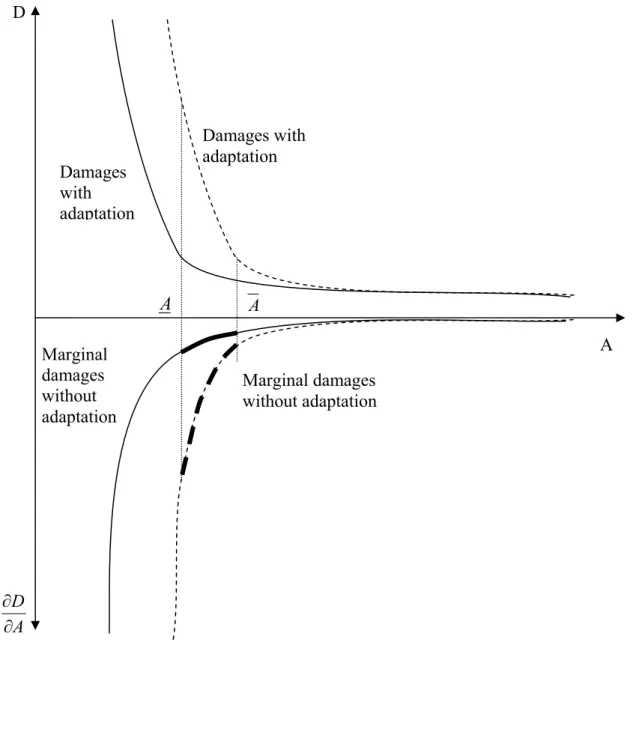
To illustrate this point, let be the minimum level of abatement under which activity in section/region (i,j) can continue in the absence of adaptation, and A be the minimum level of abatement under which this activity can continue with adaptation (Figure 1, upper part). By construction A< A, and for abatement levels between and , marginal damages are flat with A A adaptation but decreasing without it (Figure 1, lower part). In other words, the cross-derivative
ijt t t ij P A D ∂ ∂ ∂2 ′ A A
is non-zero, and potentially large, between and .
The interdependence between mitigation and adaptation has three implications. First, it reinforces the importance of increasing knowledge about the costs and benefits of adaptation—an area currently underdeveloped relative to mitigation. Second, it suggests that introducing adaptation in numerical models that assess the costs and benefits of climate policies is very important—not as an add-on, but as a potentially important factor in shaping mitigation decisions.20 Third, from a policy perspective, it suggests that mitigation policies and adaptation policies should be negotiated jointly, and not separately as is essentially the case today.
3.4. Implications for the balance between proactive and reactive adaptation
Similarly, the optimal levels of proactive adaptation and reactive adaptation are not likely to be independent. Technically, the optimal level of reactive adaptation deriving from equation (4) and the optimal level of proactive adaptation deriving from equation (5) are independent if and only if the cross-derivative of damages with regard to proactive and reactive adaptation
ijt ijt t ij R P D ∂ ∂ ∂2 ′ is zero. But in many instances, proactive adaptation and reactive adaptation are substitutes. For example,
19 This is an argument about the substitutability between mitigation and adaptation. It differs from the observation
often made that, in certain sectors such as forestry or hydropower generation, mitigation and adaptation are joint products. For example, building a hydroelectric dam reduces emissions in the energy sector, but also makes the energy sector more climate-sensitive. This is already a major issue for countries like Colombia, where increasing the share of hydro in power generation is a way for the country to capture international flows of resources from the Clean Development Mechanism of the Kyoto Protocol, yet where adapting to lower snow precipitation in the Andes may require, on the contrary, diversifying away from hydro.
20 Similar exercises are already conducted when additional mitigation opportunities are taken into account. For
example, Gitz et al. (2006) show that accounting for the possibility of setting up large-scale plantations worldwide changes the magnitude and time-path of the optimal abatement trajectory.
when zoning laws prevent households and firms from locating in flood-prone areas, the need for reactive adaptation (e.g., emergency evacuation) is significantly lower than in the case where the flood occurs in the absence of adopting or enforcing a zoning policy. As a result, there is a range of proactive adaptation levels in which the sensitivity of ultimate damages to reactive adaptation is lower than without proactive adaptation.
Though substitutability appears commonplace, the relationship between proactive and reactive adaptation is more ambiguous than the relationship between mitigation and adaptation. In fact, proactive adaptation and reactive adaptation may also be complements—for example, rapid response teams need to be constituted, trained and set up in advance (proactive adaptation) so that they can be deployed when an extreme weather event occurs (reactive adaptation)—or even independent of one another—for example when damages (e.g., to agriculture) depend only on water deficit, in which case impacts and opportunities for reactive adaptation are the same if there is no dam and climate change reduces water availability by x, or if there is a dam of capacity y
and climate change reduces water availability by x+y.21
21 The model without uncertainty without budget constraint can also be applied at the country level. To do so, only
mitigation, proactive adaptation and reactive adaptation in sectors/regions within Ck are policy variables. Mitigation,
proactive adaptation and reactive adaptation in other countries are exogenous. In this context, the optimal solution for the national planner may differ from the global optimum if other countries make 'mistakes' in their mitigation and—provided it has spillovers in country k—proactive adaptation decisions. This raises an issue of gaming across countries, which is beyond the scope of the present paper.
Figure 1: Damage and marginal damage curves with and without proactive adaptation A D Damages with adaptation A D ∂ ∂ Marginal damages without adaptation A Damages with adaptation Marginal damages without adaptation A
4. Balance between mitigation, proactive adaptation and reactive adaptation in a model with uncertainty and learning, but without budget constraint
Despite great scientific progress about climate change, Lester Lave’s remark that policy decisions with regard to climate change are taken “in a sea of uncertainty” (1991) remains valid. And it is well-known that taking uncertainties and learning into account strongly affect optimal mitigation policies, especially in the presence of inertia (e.g., Arrow et al., 1996).
Here we extend this reasoning to mitigation, proactive adaptation and reactive adaptation by introducing uncertainty on damage functions.22 There are s∈{1,2, … ,S} states of the world, to which the planner attaches an ex ante distribution of probability ps. Each state of the world is
characterized by a different set of damage functions {Dijt}, indexed by s. There is also a period τ
at the beginning of which uncertainty is resolved, i.e., at the beginning of which the real state of the world is revealed. To simplify the model, damages before the date of resolution of uncertainty are assumed to be known with certainty from the start.23
24
Assuming risk-neutrality, the planner’s decision problem with uncertainty is as follows:
( )
(
)
(
)
∑
⎟ + + + − − ⎠ ⎞ ⎜ ⎝ ⎛ + ijts ijts s ijt s ij s t s ijts ijts ijts ijts ijt t s R P A C A P R D A A P P R r p Min ijts ijts ijts 1 , , , ,..., , 1 1 1 1 1 , , K (6) s.t. { } { }∑
∈ ∈ = I j I i ijts ts A A , , 1, , 1 K K (7)Aijt1 = … = Aijts ∀t∈{1, … ,τ-1} ∀(i,j)∈{1, … ,I}× {1, … ,J} (8)
Pijt1 = … = Pijts ∀t∈{1, … ,τ-1} ∀(i,j)∈{1, … ,I}× {1, … ,J} (9)
Rijt1 = … = Rijts ∀t∈{1, … ,τ-1} ∀(i,j)∈{1, … ,I}× {1, … ,J} (10)
Dijt1 = … = Dijts ∀t∈{1, … ,τ-1} ∀(i,j)∈{1, … ,I}× {1, … ,J} (11)
22 To limit the complexity of the model, uncertainties on abatement cost functions or on the discount rate are not
taken into account.
23 In fact, there is no reason why the date at which controversies regarding future damage functions are expected to
be resolved should be identical to the date at which damage functions, as seen from today, start to become uncertain. Adding this feature, however, does not modify the results of the paper, but adds to the complexity of the model.
Since uncertainty is not resolved before period τ, the planner must make contingent plans before that point—hence conditions (8) and (9). Conditions (10) and (11) derive from the assumption made above that damages before resolution of uncertainty are known with certainty.
In this model, it is again assumed that there is no budget constraint at the global level in all the scenarios, and that resources are pooled and used to finance mitigation, proactive adaptation and reactive adaptation wherever necessary.
The central policy question raised by model (6)-(11) is how to allocate resources prior to resolution of uncertainty. We thus present the first-order optimality conditions for mitigation and proactive adaptation decisions to be taken prior to period τ (see Appendix 1):
( )
(
)
{ } { } { } { }∑
∈∈ + ∈ ∈ ∂ + − ∂ − = ′ S s t T tj I I i t t t s t j i s ijt ijt r A D p A C , , 1 1, , '' 1, , , , 1 ' ' ' ' ' 1 1 KK K K ∀t < τ (12) 1 − = ∂ ∂ ijts ijts R D (13) { } { } { } { } 1 1 1 1 1 , , 11, , ', )' (,) ( ' ' ' ' ' , , 1 1, , ' ' =− ⎟ ⎠ ⎞ ⎜ ⎝ ⎛ + ∂ ∂ + ⎟ ⎠ ⎞ ⎜ ⎝ ⎛ + ∂ ∂∑
∑
∈∈ + ≠ − − ∈∈ + S s t T tij ij t t ijt s t j i s t t S s t T t ijt s ijt s r P D p r P D p KK KK (14)Equations (12)-(14) are standard first-order optimal conditions for pollution control problems under uncertainty. Equation (12) states that mitigation should be undertaken up to the point where the marginal costs of abatement are equal to the discounted sum of the marginal benefits of abatement in terms of avoided damages in the future over all scenarios, weighted by probability of occurrence. The policy implications of equation (12) for mitigation have been extensively discussed elsewhere (e.g., Ha-Duong et al., 1997), and the only point worth mentioning for the
24 Other assumptions about risk aversion would lead to different numerical results, but with no change to the
purpose of the present paper is that the optimal level of mitigation is sensitive only to the aggregate damages in each scenario, not to individual regional or sectoral damage functions.
Equation (13) states that reactive adaptation should be financed up to the point where the last dollar spent on reactive adaptation reduces residual damages by one dollar. It is unchanged relative to the certainty case (equation 4) because reactive adaptation takes place at the time damages occur, thus at a time when the uncertainty on damages has already been lifted.
Equation (14) states that anticipative adaptation in sector i, region j and period t should be financed up to the point where the sum of marginal reductions in expected future damages, properly discounted and weighted by probability of occurrence, exactly matches the marginal amount spent on proactive adaptation.
We had already noted in section 3 that all things equal, ‘non-targeted’ proactive adaptation measures had higher benefits than ‘targeted’ ones because they reduced damages in a wider range of sectors/regions. Equation (14) reveals a supplemental benefit of ‘non-targeted’ measures, in that the wider their scope, the lower the risks of misallocation of funds associated with the uncertainty on the geographical and sectoral distribution of damages.
To make this point explicit, let us assume that there are two periods and that scenarios 1 to S
represent S possible locations of a single extreme weather event with expected probability 1/S in the second period. When the event hits one region, damages in other regions are assumed negligible. For ‘targeted’ adaptation measure, equation (14) becomes:25
S r P D t t jt jt =− ⎟ ⎠ ⎞ ⎜ ⎝ ⎛ + ∂ ∂ '− ' 1 1 ∀ j ∈ {1, … ,J} (15)
Whereas if one knew where the extreme weather event would hit—say in region 1 without loss of generality—the optimal program derived from equation 5 would be:
1 1 1 ' 1 ' 1 ⎟ =− ⎠ ⎞ ⎜ ⎝ ⎛ + ∂ ∂ t−t t t r P D (16) P2t = P3t = … = PJt = 0 (17)
Equation (15) states that, when the location of an extreme weather event is uncertain, it is optimal to engage in proactive adaptation in all the regions that have a chance of being hit, even though all but one of these expenditures will be lost.26 Less adaptation is undertaken in each region (adaptation expenditures are stopped when their marginal benefits is S dollar to one) than would be in the region that is going to be hit in the certainty case (equation 16, adaptation expenditures are stopped when their marginal benefits is 1 dollar to one). But in aggregate it is not clear whether more or less resources are devoted to proactive adaptation in the uncertainty case relative to the certainty case. This depends on the shape of the damage functions.
In this framework, ‘non-targeted’ proactive adaptation measures fare better than ‘targeted’ ones. Assuming that they reduce damages in n out of the S regions that might be hit by the extreme weather event, and assuming further—to simplify notations—that when a region is hit, the damage function is the same, then the marginal benefits of ‘non-targeted’ proactive adaptation in region j are given by:27
n S r P D t t jt t ⎟ =− ⎠ ⎞ ⎜ ⎝ ⎛ + ∂ ∂ '− ' 1 1 (18)
What are the implications for mitigation? As noted above, the optimal level of mitigation depends only on the sum of marginal damages across regions and sectors. Thus, if there is certainty that the extreme weather event will hit once, and if damages are the same regardless of where it hits, then the optimal level of mitigation with uncertainty on location is governed by the same equation as in the certainty case. Precisely,
( )
(
)
{ } { }(
)
t t t t S sj J t t t t jt jt r A D r A D S A C − ∈∈ − ∂ + ∂ − = + ∂ ∂ − = ′∑
' ' , , 11, , ' ' ' 1 1 1 1 1 KK (19)25 Subscripts i are dropped for convenience.
26 It is assumed in the model that proactive adaptation expenditures are divisible. What happens when proactive
adaptation expenditures are not divisible could be an interesting topic for future research.
27 Subscript j is dropped from the damage function because damages are assumed identical when the extreme
Since mitigation reduces damages regardless of where they occur, its marginal benefits are not affected by uncertainty over the distribution of impacts. (They are of course affected by the uncertainty over the magnitude of impacts.) And since less proactive adaptation is undertaken in each region than would be in the certainty case, more mitigation may be necessary to meet condition (19) when mitigation and proactive adaptation are substitutes (cf. section 3.3).
The optimal level of reactive adaptation in the region that is effectively hit by the extreme weather event is also likely to vary relative to the certainty case. Following the discussion of section 3.4, however, the variation may go in either direction. If proactive adaptation and reactive adaptation are substitutes, more reactive adaptation will be necessary at the optimum to compensate for the lower proactive adaptation. But if proactive adaptation and reactive adaptation are complements, reactive adaptation will decrease—which will trigger both a supplemental increase in the optimal level of mitigation, and a higher level of ultimate damages.
The policy implication at the global level of the model with uncertainty on location is that the benefits of mitigation and reactive adaptation are more important relative to the benefits of ‘targeted’ proactive adaptation—relative to the certainty case—because the benefits of ‘targeted’ measures are lost. The optimal level of mitigation is likely to be higher than in the certainty case, and the optimal level of reactive adaptation might also be higher or lower depending on the relationships between proactive and reactive adaptation in the damage function.
The policy implication of the model with uncertainty is more complex at the local level. Let us assume that country k has only one region that might be hit by the extreme weather event. In this case, equation (15) tells us that fewer resources should be devoted to proactive adaptation. Yet since the aggregate level of mitigation is outside the control of any single country, there is no assurance that the aggregate level of mitigation will increase to take uncertainty on location into account. If this is the case, a higher level of reactive adaptation will be needed to compensate for the non-optimal level of mitigation.
5. Balance between mitigation, proactive adaptation and reactive adaptation in a model
with uncertainty, learning, and budget constraints
In the previous two models, it was assumed that there were enough resources available worldwide to finance mitigation, proactive adaptation and reactive adaptation, and that the planner could allocate these resources freely as necessary. But this may not be so globally if the
need for adaptation grows due to further delays in adopting and implementing mitigation measures. In addition, some countries may be unable, budget-wise, to finance all the mitigation, proactive adaptation and reactive adaptation that are cost-effective for them—let alone all the mitigation, proactive adaptation and reactive adaptation that are beneficial to the whole World given externalities. And transfers from current resources in rich countries to countries in need of adaptation might be constrained or unfeasible for political reasons.28
In this section, we add budget constraints to the model (5.1) and discuss implications for the balance between mitigation, proactive adaptation and reactive adaptation (5.2). Since neither reactive nor proactive adaptation provide a satisfactory answer to the constraints imposed by uncertainty on location and risks of future budget constraints, a third instrument—rainy-day funds—is explored in subsection (5.3). We start the discussion with a national budget constraint, move to a national rainy-day fund, and then conclude with a global rainy-day fund.
5.1. The model with national budget constraints
We introduce national budget constraints to the model. Technically, let be the maximum available resources to finance mitigation, proactive adaptation and reactive adaptation at period t
in country k and in scenario s. National budget constraints are then written:
k ts B
( )
(
)
kts C j i ijts ijts ijts ijt A P R B C k ≤ + +∑
∈ ) , ( (20)With equations (20), it is assumed that there is no barrier to transfer of resources across sectors and regions within each country.29 But at this stage in the analysis the transfer of resources both across countries and across time are also not allowed.
In addition, a technical condition must be added to ensure that there is uncertainty only after period τ. = … = ∀t∈{1, … ,τ-1} ∀k (21) k t B1 k tS B
28 The difficulties the international community is having to increase aid budgets in developed countries is one
example of such policy constraints on transfers.
29 Subnational regional budget constraints might also be relevant, especially in large, decentralized countries. A
When equations (20)-(21) are added to the resource allocation problem under uncertainty (6)-(11),30 the optimal solution is modified as follows (Appendix 1):
( )
(
)
{ } { } { } { }∑
∈∈ + ∈ ∈ ∂ + − ∂ + − = ′ S s t T tj I I i t t t s t j i j i k t s ijt ijt r A D p A C , , 1 1, , '' 1, , , , 1 ' ' ' ' ' ) , ( 1 1 1 KK K K π ∀t < τ (22) ) 1 ( k(i,j) ts ijts ijts R D π + − = ∂ ∂ (23) { } { } { } { } ) 1 ( 1 1 1 1 (, ) , , 1 1, , ', )' (, ) ( ' ' ' ' ' , , 1 1, , ' ' kij t S s t T tij i j t t ijt s t j i s t t S s t T t ijt s ijt s r P D p r P D p ⎟ =− +π ⎠ ⎞ ⎜ ⎝ ⎛ + ∂ ∂ + ⎟ ⎠ ⎞ ⎜ ⎝ ⎛ + ∂ ∂∑
∑
∈∈ + ≠ − − ∈∈ + KK KK (24)In equations (22)-(24), k(i,j) denotes the country to which the sector/region (i,j) belongs, and is the Lagrange multiplier associated with budget constraint (20) in country k, at period t
and in scenario s. ) , (ij k ts π
31 The Lagrange multipliers measure how strongly each budget constraint is
binding.
Interpreting equations (22)-(24) is straightforward. To do so, it is useful to distinguish between early and late budget constraints. Early budget constraints restrict the financing of mitigation and proactive adaptation. In our model, those are budget constraints occurring before uncertainty is resolved. Late budget constraints restrict the financing of reactive adaptation. In our model, those are budget constraints occurring after uncertainty is resolved.
Equations (22) states that with binding early national budget constraints and no transfers, marginal abatement costs cannot be equalized. It is easy to verify that allowing for international transfers would equalize marginal abatement costs across countries and increase efficiency. If in addition there is no budget constraint at the global level, then marginal costs and marginal benefits of adaptation can be equalized.
30 In this model, countries cooperate to find a solution—hence the global planner—, but they are not necessarily
willing or able to make the necessary payments or transfers—hence the budget constraints and absence of transfers.
31 Subscripts s disappear from Lagrange multipliers prior to period τ because the budget constraints are not
Similarly, equation (23) and (24) state that reactive (resp. proactive) adaptation cannot be funded at the optimum in countries where the budget constraint is binding. Again allowing for international transfers in the future (now) would allow for an equalization of marginal benefits of reactive (proactive) adaptation across countries.
5.2. Implications for the balance between mitigation, proactive adaptation and reactive
adaptation
With early budget constraint, but no late budget constraint expected because of economic growth
In this case, proactive adaptation and mitigation cannot be funded sufficiently, and reactive adaptation remains the only policy solution to reduce damages.
At the global level, the model suggests that international transfer of resources should be concentrated in countries where budget constraints are the most binding. Mitigation and adaptation measures with major spillovers, or where reactive adaptation will not help cope in the future (i.e., where reactive adaptation and proactive adaptation are complements or independent from one another) are priority targets.
At the national level, the model suggests the priority of targeting scarce resources now to proactive adaptation in the regions/sectors where spillovers are the most important and where reactive adaptation cannot help cope because proactive adaptation and reactive adaptation are
complementary.
Without early budget constraint, but with risks of late budget constraint because of revenue cyclicality, random shocks (e.g., monetary crisis) or climate-change induced shocks.
At the global level, the model suggests one of two things: If international transfers from resource-rich to resource-starved countries are expected to be feasible in the future—both financially (no constraint on resources at the global level) and politically, no increase in mitigation or reactive adaptation is necessary now: future transfers will correct the future budget constraints when and where they occur.
However, if international transfers from resource-rich to resource-starved countries are expected to be difficult in the future, e.g. because climate impacts might trigger financial constraints throughout the World, or because political barriers to transfers might be as acute as they are now. In this case, more proactive adaptation and more mitigation should be financed (to