Narrative Texts using Event Alignment
Algorithms
Dissertation zur Erlangung der Doktorwürde im Fach Computerlinguistik
der Neuphilologischen Fakultät der Ruprecht-Karls-Universität Heidelberg
vorgelegt von
Commission chair Prof. Dr. Ekkehard Felder Germanistisches Seminar Universität Heidelberg Supervisor and first reviewer Prof. Dr. Anette Frank
Institut für Computerlinguistik Universität Heidelberg
Secondary reviewer Prof. Dr. Sebastian Padó
Institut für Maschinelle Sprachverarbeitung Universität Stuttgart
I would like to thank my supervisor, Anette Frank, for supervising and guiding this thesis. In particular, I am thankful for the opportunity to delve into details, for the continuous support, the engaging discussions and the critical yet fruitful feedback. It was a pleasure to work in and with her entire group. In particular, I would like to thank my year-long office mate Eva Sourjiková for the pleasant office atmosphere, my friend and colleague Michael Roth for all the fun we had and Matthias Hartung for . . . I don’t know where to start.
Furthermore, I thank “my” ritual experts, Oliver Hellwig and Christof Zotter, for an-swering questions and doing annotation work. I also thank Thomas Bögel, Irina Goss-mann, Mareike HartGoss-mann, Borayin Larios, Julio Cezar Rodrigues and Britta Zeller for working in this ritual research project and doing implementation and annotation. All this would not have been possible without the Sonderforschungsbereich 619 and the funding by the German Research Foundation, for which I am equally thankful.
Following Propp, folktales have magical helper agents, and so does the tale of working on this thesis. I am very thankful to my helper agents and for the encouragement they gave me.
This thesis is about the discovery of structural similarities across narrative texts. We will describe a method that is based on event alignments created automatically on au-tomatically preprocessed texts. This opens up a path to large-scale empirical research on structural similarities across texts.
Structural similarities are of interest for many areas in the humanities and social sci-ences. We will focus on folkloristics and research of rituals as application scenarios. Folkloristics researchesfolktales, i.e., tales that have been passed down orally for a long time. Similarities across different folktales have been observed, both at the level of indi-vidual events (being abandoned in the woods) or participants (the gingerbread house) and structurally: Events do not happen at random, but in a certain order.Ritualsare an omnipresent part of human behavior and are studied in ethnology, social sciences and history. Similarities across types of rituals have been observed and sparked a discussion about structural principles that govern the combination of individual ritual elements to rituals.
As descriptions of rituals feature a lot of uncommon language constructions, we will also discuss methods of domain adaptation in order to adapt existing NLP components to the domain of rituals. We will mainly use supervised methods and employ retrain-ing as a means for adaptation. This presupposes annotatretrain-ing small amounts of domain data. We will be discussing the following linguistic levels: Part of speech, chunking, dependency parsing, word sense disambiguation, semantic role labeling and corefer-ence resolution. On all levels, we have achieved improvements. We will also describe how these annotation levels are brought together in a single, integrated discourse rep-resentation that is the basis for further experiments.
In order to discover structural similarities, we employ three different alignment algo-rithms and use them to align semantically similar events. Sequence alignment (Needle-man-Wunsch) is a classic algorithm with limited capabilities. A graph-based event alignment system that has been developed for newspaper texts will be used in com-parison. As a third algorithm, we employ Bayesian model merging, which induces a hidden Markov model, from which we extract an alignment. We will evaluate the algo-rithms in two experiments. In the first experiment, we evaluate against a gold standard of aligned descriptions of rituals. Bayesian model merging and predicate alignment achieve the best results, measured using the Blanc metric. Due to difficulties in creating an event alignment gold standard, the second experiment is based on cluster induction. Although this is not a strict evaluation of structural similarities, it gives some insight into the behavior of the algorithms.
We induce a document similarity measure from the generated alignments and use this measure to cluster the documents. The clustering is then compared against a
lemma alignment baseline achieves the best numerical performance on folktales (but as it aligns lemmas instead of event representations, its expressiveness is limited), fol-lowed by predicate alignment, Needleman-Wunsch and Bayesian model merging. On descriptions of rituals, the predicate alignment algorithm outperforms all baselines and the other algorithms. Shallow measures of semantic similarities of texts outperform the alignment-based algorithms on folktales, but they do not allow the exact localization of similarities.
Finally, we present a graph-based algorithm that ranks events according to their par-ticipation in structurally similar regions across documents. This allows us to direct researchers from humanities to interesting cases, which are worth manual inspection. Because in digital humanities scenarios, the accessibility of results to researchers from humanities is of utmost importance, we close the thesis with a showcase scenario in which we analyze descriptions of rituals using the alignment, clustering and event ranking algorithms we have described before. We will show in this showcase how results can be visualized and interpreted by researchers of rituals.
1 Introduction 1
2 Digital Humanities 4
2.1 Existing Computational Linguistics Research within Digital Humanities 6
2.2 Challenges for Computational Linguistics . . . 7
2.3 Summary . . . 9
3 Related Work 10 3.1 Domain Adaptation . . . 10
3.2 Computational Narrative Analysis . . . 16
4 Application Scenarios 33 4.1 Folktales . . . 33
4.2 Rituals . . . 39
4.3 Discussion . . . 45
5 Automatic Semantic Annotation and Domain Adaptation 47 5.1 System Architecture . . . 47
5.2 Adaptation to the Ritual Domain . . . 50
5.3 Summary . . . 61
6 Discovering Structural Similarities 63 6.1 Discovering Story Similarities through Event Alignments . . . 63
6.2 Event Alignment Algorithms . . . 65
6.3 Gold Standard and Evaluation . . . 74
6.4 Experiment 1: Comparison against an Alignment Gold Standard . . . 78
6.5 Experiment 2: Alignment-based Clustering Evaluation . . . 83
6.6 Graph-based Detection of Structural Similarities . . . 88
6.7 Summary . . . 90
7 Analyzing and Exploiting Structural Similarities in Digital Humanities 91 7.1 Inspecting Story Similarities Globally . . . 91
7.2 Uncovering Structural Similarities . . . 92
7.3 Fine-grained Analysis of Structural Similarities . . . 96
8 Conclusions 98 8.1 Challenges for Computational Linguistics . . . 98
8.2 Contributions . . . 99
8.3 Outlook and Future Work . . . 100
Appendix 103 1 Folktale: Bearskin . . . 103
2 Proppian Event Functions . . . 104
3 Description of a C ¯ud.¯akaran.a Ritual . . . 104
4 Mathematical Notation Overview . . . 107
2.1 Past digital humanities research in computational linguistics . . . 5
3.1 Approaches for statistical domain adaptation . . . 13
3.2 Collections with annotated story intention graphs . . . 22
3.3 Story modeling approaches . . . 29
3.4 Story aggregation approaches . . . 31
4.1 Overview of some key characteristics of the folktale corpus . . . 37
4.2 Coverage of resources on the folktale corpus . . . 38
4.3 Key characteristics of the corpus of descriptions of rituals corpus . . . 43
5.1 Preprocessing components . . . 48
5.2 Package versions and URLs . . . 48
5.3 Ritual domain phenomena and how they are addressed . . . 50
5.4 Data sets for part of speech tagging and chunking . . . 51
5.5 Training sets for part of speech tagging and chunking . . . 52
5.6 Results for adaptation of part of speech tagging . . . 53
5.7 Results for adaptation of chunking . . . 53
5.8 Results for adaptation of dependency parsing . . . 55
5.9 Results for adaptation of word sense disambiguation . . . 56
5.10 Results for adaptation of frame labeling . . . 58
5.11 Results for adaptation of frame element labeling . . . 59
5.12 Results for coreference resolution with adapted preprocessing . . . 60
5.13 Results for adaptation of coreference resolution . . . 61
5.14 Overview of adaptation improvements . . . 62
6.1 Overview of experiments . . . 65
6.2 Algorithm overview . . . 72
6.3 Alignment gold standard . . . 75
6.4 Overview of clustering data sets . . . 75
6.5 Results for Experiment 1: Comparison with a gold standard . . . 80
6.6 Quantified error analysis of precision errors in Experiment 1 . . . 83
6.7 Results for Experiment 2: Cluster induction on descriptions of rituals . . 85
6.8 Results for Experiment 2: Cluster induction on folktales . . . 87
3.1 Primitive and complex units (Lehnert, 1981) . . . 19
3.2 Game tree for the engagement story (Mani, 2012) . . . 20
3.3 Narrative chains and schema (Chambers, 2011) . . . 23
3.4 An example glob for dynamic analogy detection (Elson, 2012b) . . . 26
4.1 Top-level categories in the Aarne-Thompson-Uther index . . . 34
4.2 (Sub-) structure of a fire ritual according to Staal (1989) . . . 40
5.1 Class diagram for discourse representation . . . 49
6.1 Example for structurally similar sequences . . . 64
6.2 Alignment produced by Needleman-Wunsch . . . 67
6.3 Running predicate alignment on the sequences⟨a, b, a⟩and⟨b, a⟩ . . . 68
6.4 Alignment produced by predicate alignment . . . 69
6.5 Running Bayesian model merging on the sequences⟨a, b, a⟩and⟨b, a⟩ . . 71
6.6 Alignment produced by Bayesian model merging . . . 71
6.7 Undirected graphgcreated from an alignment . . . 89
6.8 Visualisation of connectivity scores for alignment in Figure 6.7 . . . 90
7.1 Heat map with document similarities . . . 92
Narrative texts are important textual sources in the humanities and social sciences. In particular, many research questions revolve around similarities, parallels or overlaps across narrative texts, e.g., discovery of intersections in biographies or similar develop-ments of characters in fictional tales. Within the emerging paradigm of digital humani-ties, we develop methods and a system for the automatic discovery of story similarities in narrative texts. The system uses advanced computational linguistics techniques and is designed for the specific needs and premisses of digital humanities.
We study two application scenarios in detail: Research of folktales and of rituals. In both areas, the detection of similarities across stories plays a major role. For folktales, the classification of tales from different eras and cultures based on common elements in their story lines has been studied since the early twentieth century. The discovery of re-occurring elements in rituals has sparked a discussion about the existence of structural principles that rule the combination of these elements. For these principles, the term “ritual grammar” has been coined1.
Both application scenarios suggest quantitative-empirical research approaches as they aim at analyzing more than a single textual source. In addition, the expressiveness of the analysis increases the more sources have been studied. However, traditional re-search approaches prevalent in the humanities do not scale easily, as they rely on hu-man scholars (close-)reading texts. A system that automatically detects similarities in narratives is a key component for enabling large-scale empirical research in this direc-tion2.
The system we describe detects story similarities using event alignment algorithms. The alignment algorithms work on densely connected discourse representations, which contain representations for events, characters and the linguistically analyzed textual source data. Using measures of semantic similarity for events, the alignment methods detect story similarities across discourses that can be visualized and thus made acces-sible to humanities researchers.
The discourse representations themselves are created fully automatically using state of the art techniques on a variety of different linguistic analysis levels. Given the pe-culiar text characteristics of the descriptions of rituals, the linguistic processing tools are adapted to the domain of rituals. Not all processing tools for the different linguis-tic annotation levels employ the same basic methodology. Consequently, the adapta-tion of these tools must employ different adaptaadapta-tion strategies. Supervised linguistic
1This thesis was written within the context of the research project “Ontology modeling for ritual structure
research”, in the collaborative research center “Ritual Dynamics”, funded by the German Research Foundation (Sonderforschungsbereich 619, Ritualdynamik).
the adaptation of both the word sense disambiguation and the coreference resolution system we employed ways of incorporating domain knowledge. The unsupervised, knowledge-based word sense disambiguation system was adapted by enhancing the knowledge-base directly. In order to adapt a coreference resolution system, we employ multiple ways of integrating domain knowledge into the process.
For the detection of story similarities, we use three different alignment algorithms. The algorithms use a similar set of features for measuring the semantic similarity of events. We evaluate the three algorithms on a gold standard of descriptions of rituals and in a clustering-based evaluation. In the latter, the density of produced alignments is used as a measure for document similarity, which is in turn used by a clustering algorithm. In order to provide researchers from the humanities a means for targeted inspection, we also describe an algorithm for the discovery of dense alignment regions between narratives.
As a showcase scenario, we show how a researcher of rituals can inspect and interpret the data structures that we produce. This includes the induced document similarity, the underlying alignment links and individual densely connected regions. We describe how these can be interpreted and show possible visualizations for them.
Structure of the Thesis
The structure of this thesis is as follows. We will first give an introduction into the field of digital humanities in general (Chapter 2). We will discuss the role of compu-tational linguistics in digital humanities, highlight the main challenges compucompu-tational linguistics faces and discuss how they affect our work.
We will discuss related work to this thesis in Chapter 3. As the two main parts the thesis will be concerned with are on domain adaptation and narrative analysis, Chap-ter 3 is structured accordingly: Section 3.1 describes related work on domain adaptation for supervised NLP components. As word sense disambiguation is often performed using unsupervised methods, we will also investigate domain adaptation methods for unsupervised word sense disambiguation algorithms. Existing work on computational narrative analysis is discussed in Section 3.2, which also gives a background on narra-tives in general.
In Chapter 4 we will describe the two application scenarios in detail: Section 4.1 on folktales and Section 4.2 on rituals. For each scenario, we will give a short overview of the state of research and describe why similarities across narratives are important. We will also discuss how they can benefit from the computational analysis methods we employ. Finally, we will introduce the corpora we collected in order to conduct experiments.
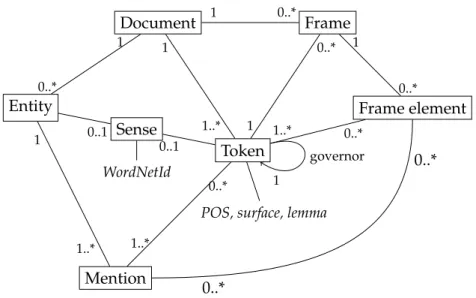
Chapter 5 first describes the processing architecture, its in- and output and key char-acteristics. The major part of the chapter describes the domain adaptation strategies we employed for processing the descriptions of rituals on the following linguistic levels: part of speech tagging, chunking, dependency parsing, word sense disambiguation,
the discourse representation.
Our methodology for the automatic discovery of story similarities is described in Chapter 6. We will first give a general overview of the methodology and the specific experiments we are conducting. The algorithms will be evaluated in two experiments using data from both application scenarios. We will also describe an algorithm for identifying the most dense alignment regions that are worth investigating.
In Chapter 7, we will describe how a researcher from humanities can make use of the analysis tools we can provide. We will also describe how alignment-based story similarity, the alignments themselves and dense alignment regions can be visualized and interpreted. Chapter 7 shows visualizations and analyses that can be performed on descriptions of rituals as a showcase. The analysis starts globally, by inspecting document similarities as a whole, and delves deeper in a stepwise fashion, from finding densely connected regions to analyzing individual structural similarities.
We will conclude the thesis in Chapter 8 with a summary of our solutions to the challenges computational linguistics faces within digital humanities and our scientific contributions. Finally, we will give an outlook on future work and other potential ap-plication scenarios.
Digital humanitiesis no clearly defined research area. In contrast, the term is used as an “umbrella term” (Presner and Johanson, 2009) that encompasses a wide variety of areas employing computational methods to answer or address research questions from vari-ous humanities disciplines. The umbrella covers not only classical humanities, but also social sciences, history, archeology and many others. Consequently, the computational methods employed cover a wide variety, and computational analysis of language and texts is but one of many. Other computational fields are image recognition, visualiza-tion and 3D modeling, in fields such as archeology or art history.
The work that is often reported to be the first in digital humanities (e.g. in Mc-Carty, 2003), however, has a linguistic background: In 1946, Roberto Busa started creat-ing theIndex Thomisticus, a concordance of the writings of Thomas Aquinas, with some support of IBM (Busa, 1980). In its final stage, the corpus contained 11 million tagged and lemmatized tokens. A detailed description of the history of digital humanities can be found in McCarty (2003) and Raben (1991).
Given the fact that linguistics has a long tradition in the humanities, computational linguistics (CL) can (in part) be seen as a prototypical digital humanities discipline: Sci-entific study of language (linguistics) is carried out using computational methods and from a computational perspective. This led not only to novel theories about language (e.g. formal grammar theories), but also to novel computational methods specific for (or mainly used in) computational linguistics (e.g. parsing techniques) and illustrates how both the humanities and the computational discipline can benefit from such inter-disciplinary work1.
Apart from linguistics, many more humanities disciplines are using natural language and in particular texts as their main research object: Newspaper articles are studied in social and political sciences, poetry and prose is studied in literary science and old records, charters and documents are studied in history (to name a few). Language anysis methods are therefore of interest in many digital humanities disciplines, as they al-low analyzing texts on a large scale or support uncovering quantitative text properties that are not directly accessible. Computational linguistics can play a central role in the language-oriented digital humanities areas and in fact, a number of research projects have been carried out that use methods, techniques or representations from computa-tional linguistics.
Refer ence Linguistic levels T ext genr e # tokens Goal Literaryscience Inaki and Okita (2006) surface novel 28 , 019 Analysis of dif fer ent roles of a char acter in dif fer ent novels Clement (2008) surface novel 517 , 207 V isualization for discovering str uc-tur e in repetitions Elson et al. (2010) NE, flat syntax novel ∼ 170 , 000 Cr eating a social network of charac-ters in narrative fiction Br ooke et al. (2013) lemmas, POS poetry 3 , 533 Clustering voices in a poem History Jockers et al. (2008) surface religious book 266 , 963 Author attribution Camp and Bosch (2012) lemmas, POS, NE biography 887 , 404 Extracting social rel ations fr om ographies Cybulska and V ossen (2011) lemmas, POS, wor d senses newspaper , en-cyclopedic texts 16 , 932 Extracting historic events fr om texts T able 2.1 : Existing digital humanities resear ch using methods fr om computational linguistics
2.1 Existing Computational Linguistics Research within
Digital Humanities
Table 2.1 shows an overview of several research works from literary sciences and his-tory. This is not a comprehensive list, but illustrates the wide variety and some of the challenges computational linguistics faces in digital humanities research. The table shows the linguistic representation levels used, the text genre, the average number of tokens2and a short description of the task.
A first observation is that the texts under study play different roles. In some projects, the text itself is the research object, while in others the text serves as a medium and the research object is the information contained in the text. In the former, researchers are often interested in stylistic aspects (e.g. beauty of poems, Kao and Jurafsky, 2012) or properties of the text as a whole (e.g. the author, Jockers et al., 2008). The latter can be seen as information extraction tasks, but with a humanities application scenario (e.g. social network extraction, Camp and Bosch, 2012). It also has to be noted that there is a gray area in between these two poles. In history, for instance, the interpretation of extracted information may depend on meta data of the source document (why it was written, by whom, etc.).
As a second observation, we note that the data set sizes are relatively small, in com-parison to corpus sizes in general computational linguistics3. Given the fact the main benefit of using computational methods is being able to process large data sets, this is somewhat surprising. In some cases, this can be explained by a very focused ap-plication goal. There is no point in “using more data” if the goal is an analysis of a specific literary piece (e.g. in Clement, 2008; Inaki and Okita, 2006; Jockers et al., 2008). In other cases, analyzing more data makes sense on a conceptual level, but more data is not available currently and also will not be available in the future (e.g. Camp and Bosch, 2012).
Thirdly, most of the existing work in computational linguistics for digital humanities makes use of rather shallow linguistic representations, even in the information extrac-tion tasks. Although approaches using shallow linguistic representaextrac-tions are popular in general computational linguistics as well, the lack of approaches using deep linguis-tic structures is striking. On the first sight, this is surprising, in parlinguis-ticular given the small data set sizes. Deeper linguistic representations would allow more fine-grained and meaningful analyses. However, the automatic creation of deep linguistic represen-tations is technically difficult, and in particular for texts from non standard domains also error-prone.
2The number shown in the table refers to the average number of tokens analyzed. In Elson et al. (2010),
for instance, the total number of tokens is much higher, as the entire corpus contains 60 novels. As the analysis is done per novel, we show the average number of tokens per novel in the table. In Cybulska and Vossen (2011) and Inaki and Okita (2006), different parts of a larger corpus have been studied in comparison.
3The Wall Street Journal part of the Penn Treebank (Marcus et al., 1999) contains one million tokens , the
2.2 Challenges for Computational Linguistics
To synthesize, there are a number of challenges for the application of computational linguistic techniques to textual data from the humanities:
Corpus sizes Modern computational linguistic approaches often rely on huge text corpora and use sophisticated methods to train statistical models on the corpora. These approaches are difficult to apply directly, because most text corpora in humanities are relatively small and focused. Literary analyses, for instance, need to be based on a cer-tain fixed data set, that also can not be expected to grow in time. Although corpus-based analyses of literary pieces have been made (e.g. Inaki and Okita, 2006), the relatively small data size imposes restrictions on the methodology.
Text characteristics The text corpora used in computational linguistics are often news-paper corpora. Owing to different text characteristics on a number of linguistic levels (e.g. lexicon, style, syntax), reusing existing models that have been trained on newspa-per corpora often leads to unsatisfactory results. Existing models need to be adapted to the characteristics of the texts found in humanities. As there is not a single text genre in humanities (or even within literary analysis), it is doubtful whether a single allround-adaptation will suffice. Instead, allround-adaptations need to be done specifically for genres and texts at hand. This adaptation is not only required for (computational) analysis tools, but for annotation guidelines (and subsequently linguistic theory) as well, be-cause most guidelines make assumptions that may not be met by the domain at hand.
The computational analysis of historical texts, for instance, is severely challenged by the fact that spelling and grammar are very heterogeneous in historical documents (Dipper, 2011). Poetry texts, on the other hand, often feature a unified spelling, but a rather loose syntax. In addition, poetry uses verse as a level of information that is not even present in newspaper texts but still very relevant for the interpretation in liter-ary science and thus needs to be represented computationally (Kao and Jurafsky, 2012). Corpora containing computer-mediated language (e.g. chat logs) again differ from his-torical texts and poetry, eg by the use of colloquial forms or emoticons (Beißwenger and Storrer, 2009).
Category definitions Many tasks and research questions in humanities are extremely complex and so are the categories that computational methods should reproduce. For-mal definitions for these categories often do not exist. Similarly, systematic annotations using guidelines and measuring annotator agreement are very rare in humanities. This in turn makes evaluation and supervised statistical approaches difficult to apply, as there is no data to evaluate against or train on4. Evaluating quantitatively, however, is
4What poses a challenge for computational approaches can be seen as a chance for humanities. McCarty
(2003) points out that the “inevitable” mismatch between informal categories existing in humanities and their formalizations “forces ontological questions that lead back to [. . . ] fundamental problems” in the humanities discipline. Humanities disciplines are forced to rethink their category system, which
a key advantage of computational methods (and goes together with processing large(r) data sets).
As an example, consider the literary discussion about clichés in the “Eumaeus”-episode of James Joyce’sUlysses. It has been argued in literary science that clichés are used a lot in order to reproduce the everyday language of uneducated people of Dublin in 1904 (Byrnes, 2010). The number of clichés in this episode has beenestimatedto be high, but was never quantified exactly (and thus was not systematically comparable to other literary pieces). Byrnes (2010) published a study in which he manuallycounted the number of clichés, based on his language intuition as a native speaker, Google and dictionaries of idiom and cliché. However, a sound definition of the concept of a cliché and what distinguishes clichés from other kinds of idioms is lacking. In consequence, computational linguistics approaches in this direction (e.g. Cook and Hirst, 2013) are either forced to establish a new definition or circumvent this issue by not using training material and/or devising other ways of evaluation.
Accessibility Results produced with computational linguistics methods need to be accessible to (digital) humanities researchers. Results, in this case, do not only include tables with numerical performance measures. Instead, automatically induced annota-tions need to be presented along with the original source texts, such that the results are traceable (to a certain extent) and humanities researchers can base their interpretations on them. Original source texts may also need to be cited as evidence in publications.
Making results accessible to humanities researchers is a challenge that goes beyond pure engineering, though. Although some visualizations may be rather obvious (e.g. showing social networks as graphs), others highly depend on the research question at hand. Clement (2008), for instance, shows how visualizations of repetitions in Gertrude Stein’sThe Making of Americanscan support certain interpretations in literary science. While the computational linguistics part of the work is straightforward, the concrete vi-sualization is pertained to the specific question and a result of a collaboration of literary scholars with technicians and designers in the project.
Sculley and Pasanek (2008) go even further and state that assumptions, implicit bi-ases and limitations made in computational (in this case: machine-learning) methods need to beunderstoodby the humanities researchers. Computed results should not be seen as a proof or determinate answer and methods should not be treated as a black box. This requires close collaboration between computational experts and humanities researchers and goes beyond visualization of results. Instead, Sculley and Pasanek re-quire scientists from humanities to acre-quire at least a basic understanding of statistical and computational methods.
2.2.1 Challenges for the Detection of Structural Similarities
The challenges discussed above also affect this work on various levels. The number of descriptions of rituals is, compared to corpus sizes in computational linguistics, rather
small. Although a huge amount of folktales do exist in principal, a well structured, machine-readable corpus is not available directly. Therefore, we have to cope with rel-atively small data set sizes. As we will see, the uncommon text characteristics of the descriptions of rituals play a major role and cause us to develop various domain adap-tation techniques. Category definitions (structural similarities across rituals or folk-tales) do not exist in a formal, controlled fashion. This makes the annotation of a gold standard difficult. In order to have an additional evaluation that is not dependent on these annotations, we performed the second experiment that makes use of a classifica-tion of rituals and folktales. This classificaclassifica-tion is sufficiently formal (and consensual in the respective fields) to be used in our setting. Finally, in order to produce results that are usable and accessible to researchers from folkloristics and research of rituals, we de-veloped a number of tools to allow visualization, targeted inspection and fine-grained analysis of the structural similarities we detect automatically.
2.3 Summary
Digital humanities is a growing field of research and encompasses many different dis-ciplines. It is unclear whether a clearly defined set of methods will ever emerge as “digital humanities methods”.
Many humanities areas are using texts as either research objects or medium. There-fore, methods from computational linguistics may be of great use in these disciplines. However, the application of computational linguistics methods in digital humanities scenarios poses a number of challenges. Solutions to these challenges need to be fo-cused on the specific tasks and data at hand.
The related work to this thesis falls into two general areas: Domain adaptation and computational narrative analysis. In Section 3.1, we will discuss approaches on domain adaptation that have been used for various linguistic levels of annotation. As most of the linguistic processing methods are probabilistic, supervised methods, most of the adaptation approaches that we will discuss focuses on these methods. In addition, we will discuss approaches for the adaptation of unsupervised knowledge-based word sense disambiguation. The related work to computational narrative analysis can also be separated in two general areas: Approaches for representing and modeling single narratives and approaches for the comparison and aggregation of multiple narratives. Section 3.2 is structured accordingly.
3.1 Domain Adaptation
This section discusses existing work in the area of domain adaptation in the follow-ing way: Domain adaptation techniques that are applicable to supervised approaches are discussed in Section 3.1.1. Approaches for domain adaptation of knowledge-based word sense disambiguation will be discussed in Section 3.1.2.
3.1.1 Domain Adaptation for Supervised Approaches
Supervised techniques work by inducing statistical models on training data and apply-ing them to test or application data, which should be a different data set. It is assumed that both data sets are samples drawn from the same underlying distribution. If, how-ever, the data sets come from different domains, this assumption does not hold.
In the following discussion, we will assume that there are two domains under study. The source domain is one for which large annotated data sets (Ds) are available. For
the target domain, only a few or no instances at all have been annotated, thus the data setDtis comparably small. Formally, we can distinguish two distributionsps andpt,
drawn from the respective data sets. Further, x⃗i = ⟨xi,0, xi,1, . . . xi,F⟩ ∈ X will be the
feature vector of instancei∈Ds/t. We assume the feature values to be mapped to real
valuesX =RF, whereF represents the number of features. A functiono∶ X → {Ds, Dt}
maps an instance to its origin data set. y ∈ Y represents the class label. pt(⃗x, y) is the
distribution we are interested in.
The General Distribution In addition to the two distributions from source and target domain, Daumé III (2007) introduces a third distribution, representing the “general”
domain. The union of the two data setsDg=Ds∪Dtis drawn from this distributionpg.
The intuition behind this general distribution is that not all predictions of a (linguistic) classifier are domain-dependent: The token “the”, for instance, would be tagged as a determiner in most domains.
In Daumé III (2007), a single model is trained, but on an augmented feature space. The augmented feature vector is created using Φ∶ RF → R3F as shown in (3.1). This
way, the feature vector of each instance has a general and a domain-specific part. The classifier then can learn whether to use the general domain feature set (for which it has massive training data) or the domain-specific feature set (with small training data).
Φ(⃗xi) = { ⟨⃗xi,x⃗i,
⃗
0⟩ ifo(i) =Ds
⟨⃗xi,⃗0,x⃗i⟩ ifo(i) =Dt
(3.1) Formally, a training algorithm then learns a linear hypothesish˘ ∈ R3F that contains
a common, source and target specific component: ˘h= ⟨gc, gs, gt⟩. In the un-augmented
feature space, this corresponds to learning to hypotheseshs= (gc+gs)andht= (gc+gt).
The application ofh˘to the augmented target sampleΦ(⃗x)is then equivalent to applying (gc+gt)to the un-augmented samplex⃗(Kumar et al., 2010).
Daumé III (2007) reports significant reductions in error rate for part of speech tagging, named entity resolution and chunking, compared to non-augmented ways of combin-ing the data sets.
Harvesting Unlabeled Data An extension (Kumar et al., 2010) to the feature space augmentation approach makes use of additional, unlabeled dataUtfrom the target
do-main. In regular space, the sourcehsand targeththypotheses are required to agree on
the unlabeled data. This requirement (hsx⃗≈htx) can be transformed into the following⃗
augmentation operation:
Φ(⃗xi) = ⟨⃗0,x⃗i,−⃗xi⟩ (3.2)
As these instances are unlabeled they are added once for each class labely ∈ Y. Ku-mar et al. (2010) report results on sentiment classification using the data sets provided by Blitzer et al. (2007). Compared to the original feature space augmentation approach, they achieve a reduction in error rate between 4.3 and 39.3%.
Structural Correspondence Learning (SCL) Blitzer et al. (2006) propose a technique called structural correspondence learning. In this setting, the assumption is that un-labeled data from source and target domain are available, while un-labeled data is only available for the source domain. Central to SCL is the concept ofpivot features. Pivot features behave similarly in source and target domain and occur frequently (enough). They capture the commonalities of the two domains. The technique introduces a map-pingΦ∶RF →RF+hinto a feature space that also containshpivot features.
Using the pivot features, a number of binary pivot predictors are trained on the (un-labeled) source and target data. A pivot predictor predicts for an instance if the pivot
feature is present in this instance or not. The weight vectorsw⃗l(from training the pivot
predictors) are then joined into a matrixW. After doing singular value decomposition (W =U DVT),U[T1∶h,∶]=θcontains the top left singular vectors ofW. θis then seen as a parameter that encodes the mapping to the shared feature space. The training data is then mapped usingθinto this shared feature space and appended to the original fea-ture vector. Finally, the classifier is trained on the labeled and enhanced data. Test data can also be mapped into the feature space usingΦas defined in 3.3.
Φ(⃗xi) = ⟨⃗xi, θx⃗i⟩ (3.3)
Structural correspondence learning has been applied to a number of tasks: part of speech tagging (Blitzer et al., 2006), dependency parsing (Shimizu and Nakagawa, 2007), sentiment classification (Blitzer et al., 2007), parse disambiguation (Plank, 2009) e-mail summarization (Sandu et al., 2010) and dialog utterance classification (Margolis et al., 2010).
Instance Weighting J. Jiang and Zhai (2007) analyze the problem of domain adapta-tion by identifying two independent factors that need to be adapted. The distribuadapta-tion we are interested in,pt(⃗x, y), can be factored into p(⃗x, y) =p(y∣⃗x)p(⃗x). Differences
be-tweenps andpt can be caused by both factors: pt(y∣⃗x) may be different fromps(y∣⃗x)
and/orpt(⃗x)may be different fromps(⃗x).
Consequently, J. Jiang and Zhai propose an adaptation that addresses both factors individually. In order to dolabeling adaptation(adaptingps(y∣⃗x)), a model is trained on
target domain dataDtand then applied to the source domain dataDs. Then, the top
kwrongly classified instances are removed from the source data set, as ptapparently
differs fromps in these cases. A classifier is trained on the remaining data setD′s. For
instance adaptation(adaptingps(⃗x)), a bootstrapping method has been used. A model
is trained on the source domain dataDs and applied to the target domain. The top
kconfidently predicted instances are then added to the training set and the process is reiterated. Instances from the target data set can be weighted higher. Obviously, both methods can be combined.
The results reported by J. Jiang and Zhai (2007) support the initial idea partially: Accuracy on three tasks (part of speech tagging, entity type classification and spam filtering) improves in many cases when doing labeling adaptation. However, in entity type classification, the accuracy drops when source instances are removed. Adding confidently classified target instances (instance adaptation) improves the results.
Instance preselection The system by Sagae and Tsujii (2007) achieved the highest score in the domain adaptation track of the CoNLL2007 shared task on dependency parsing. They train two different models (a maximum entropy and a support vector machine) on source domain training data Ds. Then, both models are used to parse
the entire in-domain data setDt. Sentences for which both models produce identical
parses are assumed to be parsed correctly and collected in data setDc. The maximum
entropy model is then retrained on the training setDs∪Dcand used to parse the
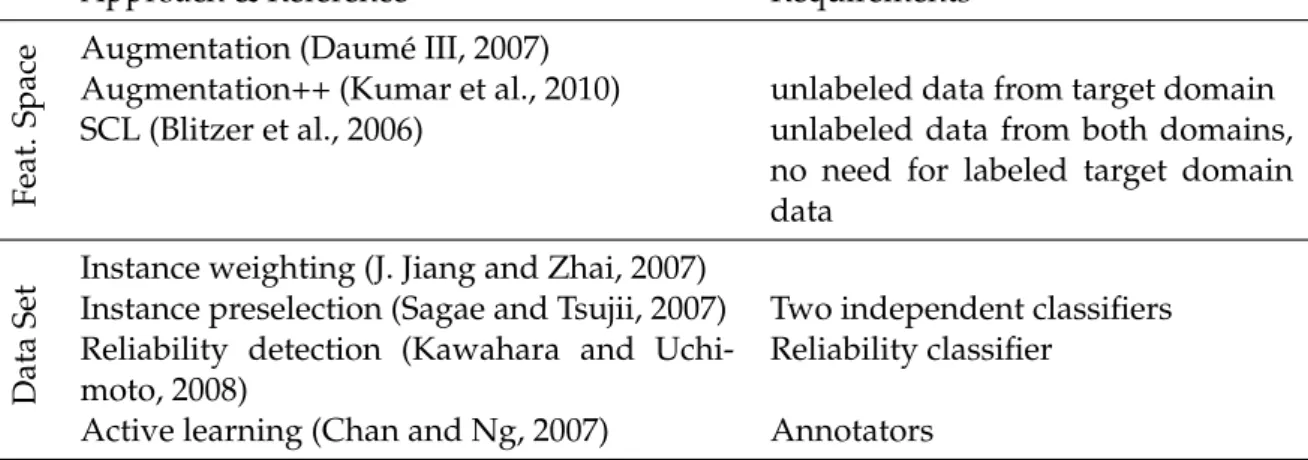
Approach & Reference Requirements
Feat.
Space
Augmentation (Daumé III, 2007)
Augmentation++ (Kumar et al., 2010) unlabeled data from target domain SCL (Blitzer et al., 2006) unlabeled data from both domains,
no need for labeled target domain data
Data
Set
Instance weighting (J. Jiang and Zhai, 2007)
Instance preselection (Sagae and Tsujii, 2007) Two independent classifiers Reliability detection (Kawahara and
Uchi-moto, 2008)
Reliability classifier Active learning (Chan and Ng, 2007) Annotators
Table 3.1: Approaches for statistical domain adaptation
attachment score of 81.06 (unlabeled: 83.42; next best system: 80.4 LAS; both parsers individually achieve below 79 LAS on the development set).
Reliability detection Kawahara and Uchimoto (2008) improve on that by adding a component that selects reliable dependency parses. First, they split the source domain data setDsinto two parts: A training set for the parser and a training set for a reliability
detector. A parser is trained on the parsing training set and an SVM model to detect reliable parses is trained on the second training set. The reliability detector uses features that indicate parse difficulty, like sentence length or number of commas. The target domain data setDtis parsed and the SVM used to detect reliable parses. Kawahara and
Uchimoto report precision 73.7% and recall 38.9% for the detection of reliable parses. Reliable parses forksentences are then added to the source domain dataDs, the parser
is retrained andDtlabeled. Using a first source domain data set, they experimentally
optimize k to be 18,000, which is slightly more than the size of Ds. This way, they
achieve an accuracy of 84.12 (UAS), compared to an unadapted performance of 83.58.
Active learning Chan and Ng (2007) discuss experiments employing active learning for word sense disambiguation. Using a sense annotated corpus from different news-paper genres (DSO, Ng and Lee, 1996), they iteratively train a classifier on the source domain data and apply it to the target domain data. The prediction with the lowest confidence then gets replaced with the true class, simulating actual annotation. Anno-tated items are weighted higher in the training procedure. The evaluation results show that (using weighting and active learning) only 4% of the target domain examples need to be annotated in order to achieve the same result as the most frequent sense baseline (61.1% accuracy).
Summary In sum, there are two groups of statistical domain adaptation approaches. The first group employs various techniques to capture commonalities in the two
do-mains. This is done by modifying the feature space (e.g., augmenting it or adding pivot features). In the other group, the focus is on optimizing the data set and training with a regular feature space. This data set modification can be done by weighting, preselecting or removing instances.
In order to modify the feature space used by a certain NLP tool, one often needs access to the source code of the tool. The effort to integrate these feature space modifi-cations depends on the software quality of the NLP tools involved. The manipulation of data sets is more robust in the sense that this technique can be employed without access to internals of tools.
Table 3.1 shows an overview of the approaches discussed. All approaches make the basic assumption that there is a large data set from the source domain and a small or nonexistent one from the target domain. The third column shows additional assump-tions made with respect to the data sets.
Approaches on domain adaptation are hard to compare in terms of results, because there are no standard data sets. In addition, it is questionable how well an adaptation strategy that achieves improvements on one set of domains transfers to other domains. On a more fundamental level, boundaries between domains or between the notion of domain and genre seem to be vague. Nonetheless, it is clear that NLP systems need to be adapted when used on domains featuring uncommon language characteristics.
3.1.2 Word Sense Disambiguation
Because word sense disambiguation is often done in an unsupervised manner, we will discuss domain adaptation of knowledge-based unsupervised approaches to word sense disambiguation in the following. Most approaches discussed below use UKB as a base application and either adapt (i) its knowledge base or (ii) the algorithm itself. We will give a brief introduction into UKB and then discuss (i) and (ii).
UKB UKB (Agirre and Soroa, 2009) uses the PageRank algorithm in order to deter-mine weights for candidate synsets of a given sentence. Applying the PageRank al-gorithm directly to the entire WordNet graph would produce a context-independent ranking of all synsets. This is due to the initialization of the vectorv, which represents the probability of the i-th vertex to be hit by a random walk. In traditional PageR-ank, every vertex gets the same probability. In order to let the context influence the disambiguation, Agirre and Soroa add the context words as vertices to the graph and distribute the probability mass only to the context words. This way, the context words receive high initial weight.
Adapting the knowledge base The sense inventory can be adapted in a number of ways.
Adding new concepts Navigli and Velardi (2002) propose to add new senses that rep-resent domain-relevant multi word expressions. Initially, multi word candidates are
extracted from a domain corpus and filtered using the information-theory based mea-sures domain relevance and domain consensus (Velardi et al., 2001). The assumption is then that a wordxsubsumes the multi wordwx, i.e., that longer multi word expressions are more special than shorter ones. Therefore, a new sensewxis added to the hierarchy as a hyponym of the sense representingx. The system was put to use in order to speed up the process of ontology creation for the tourism domain. Navigli and Velardi report a precision of 85% for the semantic disambiguation of multi word expressions.
Reranking concepts WordNet senses are ranked according to their frequency in a cor-pus. Navigli (2009, p. 10:45) reports an accuracy of 57% on a mixed-genre corpus (Senseval-1) for a word sense disambiguation system that always assigns the most fre-quent sense. It is reasonable to assume that the ranking of senses is highly domain-dependent. Therefore, McCarthy et al. (2004) employ ways of computing the most fre-quent sense from a new domain corpus (“predominant sense”) and rerank the senses accordingly. First, a thesaurus is created from an automatically parsed domain cor-pus (Lin, 1998). From this thesaurus, thek nearest neighbors for each target word w and distributional similarity scores between w and its neighbors are extracted. Let Nw = {n1, n2, . . . , nk} be the list of neighbors, {dss(w, n1),dss(w, n2), . . . ,dss(w, nk)}
be the set of distributional similarity scores andsenses(w)be the set of senses of word w. Theprevalence scorepsfor a specific word sensesw,i is then calculated as shown in
Equations 3.4 and 3.5. ps(sw,i) = ∑ nj∈Nw dss(w, nj) wnss(sw,i, nj) ∑s′ w∈senses(w)wnss(s ′ w, nj) (3.4) wnss(sw,i, nj) = max s′ nj∈senses(nj) ⎧⎪⎪⎪ ⎨⎪⎪⎪ ⎩ lesk(si, s′nj) or jcn(si, s′nj) (3.5)
McCarthy et al. (2004) experiment with usinglesk(Banerjee and Pedersen, 2002) and
jcn(J. J. Jiang and Conrath, 1997) as similarity measures between WordNet senses (3.5). Reddy et al. (2010) conduct a series of experiments in which prevalence scores ex-tracted on domain-specific corpora are used to initialize the link weight between con-text words and candidate synsets. This leads to an improvement of about 10% precision and recall (compared to using default link weight).
Removing and aggregating concepts There are several approaches that focus on spe-cific parts of WordNet (Core WordNet) or merge multiple existing senses into one (OntoNotes). Core WordNet (Boyd-Graber et al., 2006) contains the most salient and basic synsets for the most frequent lemmas in the BNC. The creation of the OntoNotes (Hovy et al., 2006) resource is guided by the inter-annotator agreement: As long as the inter-annotator agreement is less than 90%, the sense definitions are revised (i.e., senses are merged). Having fewer choices for a given lexeme makes the task easier. To our
knowledge, removing and aggregating senses has to not been used for the purpose of domain adaptation, but merging or removing domain-irrelevant senses would be a form of domain adaptation.
Adapting the word sense disambiguation algorithm
Initialization Reddy et al. (2010) propose several alternatives to the initialization of the weight vectorv in the page rank algorithm and use UKB for their experiments. First, they introduce the keyword ranking scorekrsthat represents the “keyness” of a word for a specific domain. The keyword ranking score is calculated as shown in (3.6), where
LLrepresents the log-likelihood ratio as described in Rayson and Garside (2000).
krs(w) = LL(w) ∑wi∈words(d)LL(wi)
(3.6) The context words are then initialized with krs instead of uniformly. Reddy et al. report a minor improvement in precision and recall (+ ∼1%).
Context choice Stevenson et al. (2012) propose to change the set of context words that is used as input to UKB. The approach assumes that the domain of the target text is known and that a domain corpus is available (in this case, a domain is described by the so-called medical subject heading, MeSH). Several methods are used to extract key terms for the domain from the domain corpus. These key terms are then added as contexts for UKB. Overall, they achieve an improvement in accuracy of 3.3 percentage points when using relevance feedback (Rocchio, 1971) and inverse document frequency for the extraction of key terms.
Summary Again, comparing different approaches on domain adaptation for word sense disambiguation is difficult, even when they are all using the same word sense disambiguation system, because the data sets and underlying assumptions are differ-ent. Deciding on a specific approach on word sense disambiguation adaptation should take into account what the actual aim is and what resources are available. Calculating prevalence scores, for instance, requires a large corpus, which is not always available. If structured domain knowledge is available in some form, the manipulation of the knowledge base to incorporate this domain knowledge may be feasible. In any case, UKB makes these kinds of manipulation straightforward to implement.
3.2 Computational Narrative Analysis
In this section, we describe the related work in the area of computational narrative analysis. We will first give some background information (Section 3.2.1) on narratives and narratology. The remainder of the section is split into three parts: Section 3.2.2 de-scribes work which focuses on modeling individual narratives in a deep, fine-grained
way. As we are ultimately interested in comparing and aggregating narratives, we will discuss approaches towards this aim in Section 3.2.3. The story intention graph frame-work includes a modeling as well as an aggregation part and is therefore described in two parts. We will give an overview of the discussed approaches in a schematic form at the end, in Section 3.2.4.
3.2.1 Narratological Background
Story telling and narratives have been researched in the discipline of narratology. Mani (2012) describes narratology as the theory of narrative structure and narrative structure as “representations of different phenomena that are relevant to making sense of nar-rative as story” (Mani, 2012, p. 4). In order to understand a narnar-rative, humans have a certain understanding of several aspects of the narrative. In order to “computationally understand” a narrative, these aspects need to be represented. Mani mentions five as-pects in particular: The narrator, narrative levels (embedded narratives), audience, time and fabula. This work focuses on the aspect of fabula. A narrative fabula is a “chain of events (actions, happenings), along with existents (characters, items of setting)” (Chat-man, 1980). The notion of a chain implies connections of some sort between the events. Forster (1927) distinguishes between story(“a narrative of events arranged in their time sequence”) andplot: “Also a narrative of events, the emphasis falling on causality” (both are fabulas, cit. Mani (2012)). This notion of causality is worth explaining, because it employs a rather loose sense of causality.
(1) a. The king died and then the queen died.
b. The king died and then the queen died of grief.
A simple “list” of events, as in Example 1a would be a story, but not a plot according to Forster. If, however, the events are connected so that a causal connection between the events is expressed, they form a plot. Example 1b shows a plot, because the second event is causally related to the first. In this thesis, we will use the termstoryin Forster’s sense.
3.2.2 Story and Plot Models
Story Grammars
The story grammar approach, as implemented by Correira (1980), represents events in a story as propositions. Initially, temporal relations are added to represent the temporal ordering of events. By employing a collection of rules, a set of propositions is then connected to a more abstract representation of the events. E.g., the events described in Example 2 are connected to the meta proposition in Example 3 (“xmakes a trading voyage toy”).
(3) tradingvoyage(x,with:goods,in:ship,to:y)
Such a rule does not only contain a concrete list of events and an abstract description, but may also contain pre- and postconditions.
The requirement of a rule base limits the applicability of this approach. Manual cre-ation of knowledge bases is labor-intensive and expensive and rules as fine-grained as in 3 can be expected to be heavily domain-dependent. Although existing knowledge bases such as SUMO (Niles and Pease, 2001), Cyc (Lenat, 1995) or FrameNet (Fillmore et al., 2003) contain such script-like knowledge to a certain extent, their coverage is severely limited. In particular with respect to domains from the humanities, many rules would need to be written. First attempts on semi-automatic acquiring of scripts have been made (e.g., Regneri et al. (2010)) that could presumably be extended towards specific domains.
Plot Units
Plot units are described and introduced by Lehnert (1981). A plot unit consists of affect states and links between affect states. An affect state is always bound to a specific participant and may be an event with a positive (+) or negative (-) effect or a mental state (M) without effect. Lehnert distinguishes four different link types that are used to connect affect states:
Motivation (m) A causal relation between mental states
Actualization (a) A mental state gets realized and has positive or negative effect Termination (t) The affective impact of an event ends
Equivalence (e) If multiple perspectives are separated, this relation represents that the same event has both positive and negative effects
There are 15 different ways of linking two states with a link, because not all links are compatible with all node types. These 15 pairwise configurations are called primitive plot units and represent typical situations like resolution, success, etc. More complex plots can be put together by combining primitive plot units.
(4) a. Mary got fired and needs a job. b. She successfully applies for a job.
Both sentences in Example 4 describe two states: 4a describes a state with a negative effect (the firing event) and a mental state (Mary needing a job). In 4b, the need for a job (implied by the application) is a mental state. The fact that she successfully applies for a job introduces a state with a positive effect.
The story thus contains the three primitive plot units problem(in 4a),success(in 4b) andresolution(in both, surpassing the mental state and directly linking the firing to the
-M m (a) Problem M + a (b) Success − + t (c) Resolution − M + m a t
(d) Complex Plot Unit: Problem Resolution Figure 3.1: Primitive and complex units (Lehnert, 1981)
hiring event). Figure 3.1a, b and c show them in a graphical form. Figure 3.1d shows how they are combined into the complex plot unitintentional problem resolution.
Most narratives involve multiple characters. Therefore, plot units can include cross-character links, i.e., links between states of different cross-characters. Lehnert also describes a number of typical configurations involving cross-character links, likerequestorthreat.
Automatic plot unit recognition A system that automatically detects plot units in narratives has been proposed by Goyal et al. (2010). To our knowledge, this is the only system for automatic plot unit recognition.
The algorithm works in four steps: (i) A dictionary is used to identify verbs that rep-resent an affect state. Goyal et al. (2010) experiment with various dictionary sources, including FrameNet (Fillmore et al., 2003) and sentiment-based resources. (ii) The char-acters are identified and their coreferences resolved by use of a simple, rule-based coref-erence resolution system. The system assumes that each story only contains two differ-ent characters and that both characters are mdiffer-entioned in the title of the story. (iii) For the mapping of affect states to characters, the Sundance parser (Riloff and Phillips, 2004) is used to obtain a shallow syntactic parse of each sentence. Then a number of rules is used to determine the characters for which the affect state holds. (iv) If two characters have affect states induced by the same word, a (cross-character) link between the events is created. Links for a single character are created between pairs of consecutive affect states.
For evaluation, a gold standard was created that consists of 34 fables of Aesop, an-notated by two authors and adjudicated by the third. Inter-annotator agreement is not reported for the annotation of links. Goyal et al. (2010) report results for a number of configurations in terms of precision, recall and f-score. The best performance they achieve for the detection of affect states is an f-score of 45. The heuristics for identifying links achieves between 72 and 92 f-score on gold affect states, depending on the link type. On system affect states, the performance is between 5 and 25 f-score.
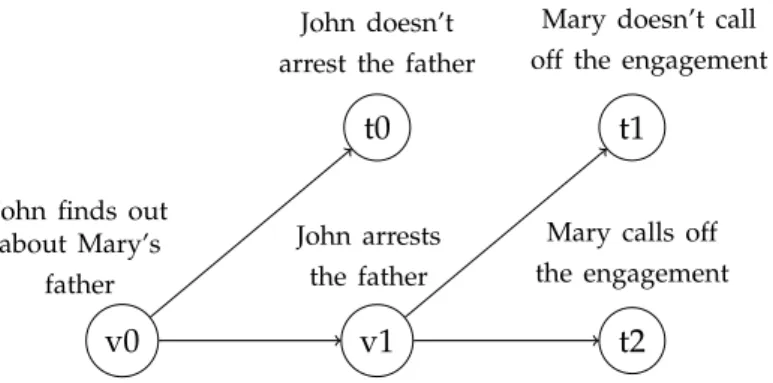
v0 v1
t0 t1
t2 John finds out
about Mary’s father
John arrests the father John doesn’t arrest the father
Mary doesn’t call off the engagement
Mary calls off the engagement
Figure 3.2: Game tree for the engagement story (Mani, 2012)
Doxastic Preference Framework
Having roots in game theory, the Doxastic Preference Framework (DPF) (Löwe and Pacuit, 2008) can be used to model the beliefs of characters in a story. Central to the DPF is a tree, in which each node represents a decision point for a character (game tree). Based on his or her beliefs about the preferences of him- or herself and other characters, he or she makes a decision. Depending on the outcome of the decision, other characters are forced to change their beliefs and make decisions on their own.
(5) John was thrilled when Mary accepted his engagement ring. But when he found out about her father’s illegal mail-order business, he felt torn between his love for Mary and his responsibility as a police officer. When John finally arrested her father, Mary called off their engagement.
Figure 3.2 shows a game tree for the engagement story (5, example and figure taken from Mani (2012)). The first decision point is for John, when he found out about the criminal activities of Mary’s father. Either he arrests the father (node v1) or he does not (node t0). Depending on the outcome of John’s decision, Mary has to decide whether she calls off the engagement or not (node t1 vs. t2). The DPF defines various event types, such asexpected event,unexpected event,Betrayal etc. In addition to the “decision structure” of the story, the tree is used to formally represent beliefs and preferences for each character, e.g., in the form of a function ordering possible situations by preference for a character (see Löwe and Pacuit (2008) for the formalization).
To our knowledge, a single annotation of a narrative has been performed. Andel (2010) formalized seven different episode fragments of a TV crime series, but gives neither annotation guidelines nor inter-annotator agreement. He does, however, men-tion that the framework does not offer any means to represent ambiguities or under-specifications in the story. In his case, one episode offers two possible perpetrators for a kidnapping. The formalization forces to decide on one of the two, as the following parts of the story need to be encoded differently depending on who did the kidnapping.
Story Intention Graphs
Story intention graphs (Elson, 2012b) are graph-based representations of textual nar-ratives that focus on the intentions of characters. The graphs are multi-layered and model the text itself as well as its story timeline and intentions, plans and goals of the participants.
The textual layer contains the original text, broken down into fragments (clauses or sentences). Thetimeline layercontains an abstract representation of events and statives appearing in the story as proposition nodes. Proposition nodes not only model events happening in the story reality, but also modal propositions like uncertain, imagined or believed concepts. Each proposition node is related to state nodes which represent points in (story) time by use of the temporal relationsBEGINS AT andENDS AT. Propo-sition nodes are related to the text nodes they interpret with the relationINTERPRETED AS(IA).
Theinterpretative layerserves as a place for interpretations of the story: It contains the understanding the reader or listener gets while comprehending the story. Thus, it does not only include content stated explicitly in the story, but also content inferred by the annotator, reader or listener. The nodes in the interpretative layer can be of the types Belief,Goal,Interpretative propositionorAffect. Nodes can also be distinguished according to the actualization statuses they are in at points in story time: Some nodes are true with respect to the story world and time, others are false and some are hypothetical (their actualization status has not been determined). The interpretative layer is connected with the timeline layer by adding relations between nodes in the layers. A relation can be of one of 13 different types, some of which have impact on the actualization status of the nodes they connect.
Encoding For three collections of stories, intention graph encodings have been col-lected. Collections A and B contain a selection of stories by Aesop. The criterion for the selection was a clear timeline and story events that are causally connected. Collection A contains two encodings for each of 20 fables, but covers only the textual and timeline layers. Collection B contains 6 additional fables and also the interpretative layer for all 26 fables. More than two encodings for most of the stories are available in B. Col-lection C contains encodings of the timeline and interpretative layer for eight stories of very different lengths and genres, indicating that the formalism is applicable to not only fables. Table 3.2 shows an overview of the different collections with several key properties.
Elson (2012b) gives a detailed report on the manual labor invested, which is an im-portant aspect for any kind of annotation project. For the collection A (without inter-pretative layer), the time to encode a fable dropped from several hours to 30-45 minutes due to the training effect. The median time spent on encoding a fable in collection B (with interpretative layer) or a story in collection C was one respectively two hours. In addition, 2-3 hours of training were invested for each collection.
For collection A, which only contains the textual and timeline layers, Elson (2012b) reports that 10% of the proposition pairs (from two annotators) are fully identical
(El-A B C
Number of texts 20 26 8
Annotators per text 2 1-3 1 Text sources Aesop Various
Text length 125words 1,149−25,649
Table 3.2: Overview of collections with annotated stories
son, 2012b, p. 201). For measuring agreement in the collections B and C (that include the interpretative layer), a set of 80 patterns encoding typical situations is used (El-son, 2012a). A vector is constructed for each graph by setting a value of1if a pattern occurs in the encoding and0otherwise. This way, agreement is quantified by measur-ing the cosine similarity for different encodmeasur-ings. Encodmeasur-ings of the same source texts made by different encoders have a significantly higher cosine similarity between their feature vectors than encodings of different source texts. In terms of Cohen (1960)’s kappa, the agreement isκ=0.55.
We will discuss the use of story intention graphs for comparison of narratives in the next section.
Narrative Schemas
Narrative schemas have been proposed by Chambers (2011) as a script-like structure that can be extracted automatically from texts. A narrative schema describes situations consisting of multiple events and participants, similarly to complex plot units or meta propositions.
A narrative schema consists of multiple narrative chains. A narrative chain repre-sents a (partially ordered) set of events involving a single protagonist in specific (gram-matical) roles. Such a chain is called typed, if the protagonist is of a certain (semantic) type. The formalism does not restrict itself to a specific type system or hierarchy, but uses lexemes extracted from the texts in order to represent the type.
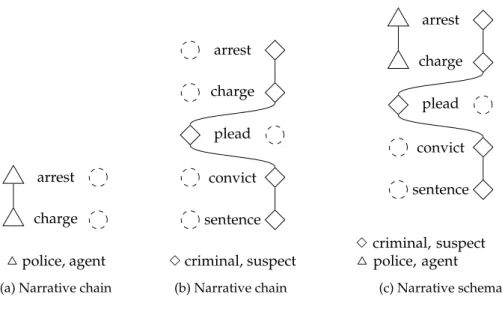
Figure 3.3 shows two typed narrative chains (a and b). The chain in 3.3a shows an entity of the type police or agent participating in arrest- and charge-events, and in both cases as subjects. Similarly, in 3.3b, we see a number of events in which an entity of the type criminal or suspect participate – in plead-events as subject, in all others as objects. A narrative schema that is constructed by merging a and b is shown in 3.3c.
Chambers (2011) describes an unsupervised algorithm to extract chains and schemas from texts. The algorithm relies on coreference chains and dependency parses to detect possible event chains. For each coreference chain (i.e., each entity), a list of pairs(v, d)is extracted, one for each mention of the chain.vrepresents the verb of which the mention is an argument anddthe syntactic dependency of the mention. Then, the point-wise mutual information (pmi) between two event/role pairs can be approximated by count-ing the number of times two verbs share a coreferrcount-ing entity in specific syntactic roles in a large corpus.
arrest charge
△police, agent (a) Narrative chain
arrest charge plead convict sentence 3criminal, suspect (b) Narrative chain arrest charge plead convict sentence 3criminal, suspect △police, agent (c) Narrative schema Figure 3.3: Narrative chains and schema (Chambers, 2011)
The most probable next event in a chain can be predicted by maximizing thepmifor verbs in a specific document. In order to extract a (semantic) type for an entity, the most salient (i.e., most often used) head words of the coreferring mentions are used to represent the type of the entity. Prediction of the next most probable event can then be extended to include similarity of the type.
As an evaluation, Chambers introduces the narrative cloze task: A single event is removed from a known event chain (or schema). Ideally, the missing event is among predicted events. In order to compare the outcome, Chambers reports the rank of the missing events within the list. The NYT portion of the Gigaword corpus has been used for the experiments. When using typed narrative schemas, The average ranked position of the removed event is at approximately 72% of the result list: If the system proposes a (ranked) list of 100 events, the correct one will be at the 72th position. This is an improvement over using untyped schemas or chains.
3.2.3 Comparison and Aggregation
We will now focus on approaches for the automatic comparison and aggregation of narratives. We will discuss the non-technical work by Propp (1958) in Section 4.1. Sequence Alignment
An important aspect of comparing and aggregating multiple narratives is the identi-fication of similar events in similar contexts. This is highly related to the notion of sequence alignment, which has been researched intensively in the area of bio informat-ics for aligning protein sequences. A classic algorithm for pairwise sequence alignment is the Needleman-Wunsch algorithm (Needleman and Wunsch, 1970) . We will discuss
it in detail in Section 6.2.1. The algorithm generates a global alignment (i.e., every ele-ment in both sequences is processed and evaluated) and an alignele-ment score. The global alignment does not include crossing links, but may contain gaps and mismatches.
Applications for Alignment of Narratives One very recent use of the Needleman-Wunsch algorithm in the context of story comparison has been published by Fay (2012). One of the issues of the Needleman-Wunsch algorithm is that sequence elements are atomic to the algorithm. Any internal structure that the sequence elements may have are ignored by the algorithm, if it is not captured with a similarity function. In addition, each (possible) link is processed in isolation. Its similarity score only depends on the two elements to be compared and is ignorant about other linked sequence elements.
Fay’s sequence elements are predicate argument structures. The goal of the algorithm is not only to link the events of two stories, but also to link the participants (persons or objects) of the stories to their counterparts. To this end, Fay uses two algorithms simul-taneously: Sequence alignment according to Needleman-Wunsch and the construction of a match tree. The latter makes sure that role fillers of the events to be linked are also matched in a consistent manner. A node in the match tree consists of two sets of unbound role fillers from both stories and a list of bindings with pairs of role fillers. A binding represents role fillers that are considered to be corresponding. At the be-ginning, the binding list of the root node is empty. In each step, nodes are added for possible pairings of objects until both lists of unbound objects are empty.
The similarity function that is employed by the Needleman-Wunsch algorithm takes the binding list into account and can reject alignments that contradict the existing bind-ing list. The important idea is that not all possible pairbind-ings of objects are added, but only the one for which the sequence alignment algorithm produces the highest score. The similarity for two predicate argument structures is0, if one of the objects used in the same role in both events is already bound. Otherwise, a similarity score based on WordNet is used.
Obviously, this technique greatly reduces the computational complexity of finding the optimal binding list, compared to brute force methods. An evaluation of the qual-itative performance of the technique has not been reported, the evaluation focuses on technical aspects like reduced running time.
Detection of Analogous Story Intention Graphs
Elson (2012b) describes three different algorithms to detect similarities and analogies based on story intention graphs (see previous section). The first one is a relatively simple alignment algorithm that works on the timeline layer. The second one calculates the overlap of previously defined situation patterns. The third algorithm is based on the analogical constraint mapping engine (Holyoak and Thagard, 1989) and tries to find correspondences in the story intention graphs without predefined patterns. All algorithms assume that at least partial SIG encodings for the stories have been created.