PROBLEMATIC USE OF MASSIVELY MULTIPLAYER ONLINE
GAMES: SCALE DEVELOPMENT AND VALIDATION
Zach W. Y. Lee, Department of Finance and Decision Sciences, Hong Kong Baptist
University, [email protected]
Christy M. K. Cheung, Department of Finance and Decision Sciences, Hong Kong Baptist
University, [email protected]
Abstract
With the rise of the Internet, the new phenomenon of problematic use of online games has emerged, particularly with the popular genre of massively multiplayer online games (MMOGs). Currently, there are a growing number of reported cases of problematic MMOGs use and related negative outcomes. Though the concept of problematic MMOGs use has received considerable attention in the psychology community, there is still a lack of general consensus regarding its dimensionality, operationalization, and development, as well as a paucity of theory-guided empirical research. Thus, this study attempts to bridge research gaps by operationalizing and empirically validating a scale to measure problematic MMOGs use. In this research-in-progress paper, we propose a rigorous approach in developing and validating a problematic MMOGs use scale. The authors believe that this research will contribute to an understanding of the phenomenon and development of problematic MMOGs use in IS research, and add to the repository of rigorous research instruments for researchers to use. Keywords: Problematic MMOGs Use, Massively Multiplayer Online Games, Online Games, Scale Development, Internet Addiction
1
INTRODUCTION
Massively multiplayer online games (MMOGs) constitute the largest segment of the online gaming industry. The MMOGs business was valued at $6.5 billion in 2009, and is expected to grow to $11 billion by 2014 (Internap, 2012). Games are better than ever: they contain art at a world-class stage of design, and integrate social good and efforts to make the world a better place (ESA, 2012). Uncontrolled or problematic gaming, however, can result in negative consequences of different forms. Some recent examples: more parents have turned to court for help with their children’s uncontrollable online gaming (Ng, 2012); there were descriptions of teenage gamers attacking others to cure online gaming addiction (Zhao, 2010); and even a rare reported case of death from playing online games excessively (Sun, 2011).
Problematic or addictive online gaming has now become a phenomenon of imperative importance today, and is receiving considerable attention from the public. However, research is hindered by the present relative lack of consensus on both definitions and validated measurement instruments of problematic MMOGs use. We conducted an comprehensive review of prior literature and revealed that prior definitions of problematic MMOGs use centered around several major components of behavioral addiction, including salience, tolerance, withdrawal, loss of control, relief, relapse and reinstatement, and negative outcomes (Brown, 1997; Griffiths, 2010). Though scholars have adopted various measurement instruments to study problematic MMOGs use, the instruments are basically derived from DSM-based (Diagnostic and Statistical Manual of Mental Disorders) diagnostic criteria (e.g., substance dependency, and pathological gambling) which share great similarity with the above-mentioned components of behavioral addiction. Despite the widespread adoption of DSM-based diagnostic criteria in describing problematic MMOGs use, little theory-guided research has been undertaken to examine its nature and development. More importantly, the study of problematic MMOGs use has been hampered by a lack of validated and consistent scales. There have been very few prior studies developing scales to assess problematic MMOGs or online games use, and the existing scales were not subjected to vigorous scale development processes, validation with representative samples, and identification of major components (e.g., loss of control, and the various aspect of mood modification and negative outcomes) (Demetrovics et al., 2012; King et al., 2011). As a step towards bringing this gap, this study will explore the major components or dimensions of problematic MMOGs use, and propose a rigorous approach for the scale development and validation.
2
PROBLEMATIC MMOGS USE CONCEPTUALIZATION
Problematic MMOGs use is an emerging phenomenon; consequently, existing literature on the topic is still culturally diverse, and terminology has varied from online game addiction, to pathological online game use, excessive online gaming, and problematic online gaming (Kim & Kim, 2010). Most of the prior studies on problematic MMOGs use tended to concentrate on examining risk factors for excessive online gaming (e.g., Hsu et al., 2009), and on understanding diagnoses, symptom management and treatment strategies (e.g., Young, 2009). There are only a limited number of studies identifying dimensions and instruments (e.g., Charlton & Danforth, 2010; Demetrovics et al., 2012). Assessing multiple dimensions concerning problematic MMOGs use is important in the sense that a definition or an instrument structure is a prerequisite to the subsequent instrument refinement, and failure in identifying the dimensionality of a scale may lead to inappropriate or inaccurate specifications of constructs or theories (Smith & McCarthy, 1995). Moreover, the dimension scores can provide information beyond a global score of a unidimensional scale can (Floyd & Widaman, 1995). Pioneers in the psychology or addiction disciplines (Brown, 1997; Griffiths, 2010) treated addictive (here, considered as problematic) behavior as a multidimensional construct that tapped the core components (e.g., salience, tolerance, withdrawal, loss of control, relief, relapse and conflict).
We conducted a comprehensive review on prior scales used to measure the phenomena, and found that a major of studies measured problematic or addictive MMOGs use as unidimensional construct (e.g., Billieux et al., 2013; Snodgrass et al., 2011). However, it is interesting to reveal that the predominant unidimensional scales used, such as Young’s Internet Addiction Scale, are in fact tapping major dimensions of behavioral addictions. Prior study of online gaming indicated that the multidimensional view of problematic use best capture the breadth and complexity of the phenomenon than the unidimensional one (Charlton & Danforth, 2010). We thus argue here that problematic MMOGs use also features most or all the seven dimensions of behavioural addiction. Following the frameworks behavioural addictions (Brown, 1997; Griffiths, 2010), the seven major dimensions or components of problematic MMOGs use identified from prior literature are summarized as follows:
Salience: The state when MMOGs use becomes the most important activity in the person’s life and dominates gamers’ thinking (i.e., Cognitive Salience) and behavior (i.e., Behavioral Salience).
Tolerance: The state whereby increasing amounts of gaming are required to achieve the former experience, i.e., gamers gradually build up the amount of the time spent playing MMOGs.
Withdrawal: The unpleasant feeling states, emotions, and/or physical effects (e.g., moodiness, irritability, and shakes) that occur when MMOGs use is discontinued or suddenly reduced.
Loss of Control: The state featuring an inability to limit the time or resources given to MMOGs use, even when a decision appears to have previously been made to do so.
Relief: Subjective experiences derived from playing MMOGs for mood modification, consisting of two components: to experience an arousing “buzz” or a “high” (i.e., Mood Enhancement); and to experience a tranquilizing feel of “escape” or “numbing” (i.e., Emotional Relief).
Relapse and Reinstatement: The tendencies for repeated reversions of earlier patterns of (excessive) MMOGs use to recur after periods of abstinence or control.
Negative Outcomes: Conflicts resulting from problematic (excessive) MMOGs use, such as missing real life social engagements (i.e., Interpersonal Problems), personal problems the gamer experiences within themselves even including physical illness (i.e., Intrapersonal Problems), and missing work or classes (i.e., Professional & Academic Problems).
3
SCALE DEVELOPMENT AND VALIDATION PROCESS
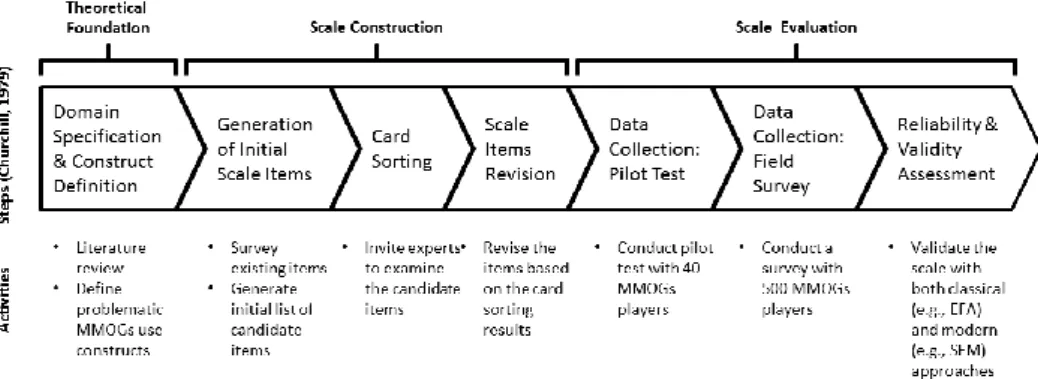
Constructs with a strong theoretical justification, and measures with strong reliability and validity, are the foundation to the accumulation of knowledge in social science research. IS scholars have been advocating a systematic and rigorous approach in developing scales (Boudreau et al., 2001; Moore & Benbasat, 1991; Segars, 1997). The primary objective of the current study is to systematically and rigorously develop and validate a scale for problematic MMOGs use. Following the robust paradigm for scale development and validation, we went through longitudinal processes starting with domain specification, followed by item creation, scale construction, and systematic assessments of the scale’s reliability and validity (Moore & Benbasat, 1991; Segars, 1997). This approach has been widely adopted by IS scholars and has worked well in developing measures with desirable psychometric properties. Figure 1 summarizes the major steps in the scale development and validation process.
3.1 Specifying the Domain and Defining the Constructs
The first step in scale development is to delineate the domain of the related concepts. Here, we operationalize the problematic use of MMOGs as online game play that results in negative outcomes in different aspects of gamers’ lives, and may also feature other major components of traditional problematic or addictive behaviors (e.g., salience, tolerance, withdrawal, loss of control, relief, and relapse and reinstatement). We believe that despite being developed particularly in the context of MMOGs, the final scale will provide references for future examination of other problematic technology use.
3.2 Scale Construction
Churchill (1979) recommended the use of extensive literature review and experts’ opinions to form the initial list of candidate scale items. The use of these methods is believed to generate a set of candidate scale items with a relatively high degree of content validity (Moore & Benbasat, 1991). We conducted a thorough literature review to survey the existing problematic MMOGs use scales, and generated an initial pool of 43 scale items intended to capture the seven dimensions of problematic MMOGs use.
Figure 1. Overview of the Scale Development and Validation Process
Five experienced researchers, in each round of card sorting, were invited to evaluate the content validity of each item with respect to our definitions of the seven dimensions of the problematic MMOGs use. The judges were requested to carefully read each item and classify it to the corresponding dimension of problematic MMOGs use. We used two measurements, Cohen’s (1960) Kappa and item placement ratio to assess the reliability of the card sorting procedures and the content validity of the scale (Moore & Benbasat, 1991). The results for Cohen’s Kappa and item placement ration are shown in Table 1 and Table 2 respectively. An acceptable score of Cohen’s Kappa should be greater than 0.65 (Todd & Benbasat, 1991; Vessey, 1984), and a higher item placement ratio is considered to demonstrate a higher degree of construct validity. The results suggested an adequate reliability and validity of our scale (see Table 1 and 2). Two items were dropped according to the results and judges’ evaluations, with a 41-item scale left for the subsequent pilot test.
C ar d So rt in g 1 Judges 1 2 3 4 5 Car d S or tin g 2 1 0.92 0.95 0.89 0.89 2 0.72 0.95 0.87 0.89 3 0.79 0.77 0.89 0.95 4 0.82 0.74 0.85 0.87 5 0.74 0.74 0.74 0.74
Table 1. Results of Card Sorting – Cohen’s Kappa
Table 2. Results of Card Sorting – Item Placement Ratio
Note: Results inside bracket are from card sorting 1; others are from card sorting 2.
Actual Categories
CS BS LC TO NIE NPA NIA WI ER ME RR
Total Items Hit Ratio% T ar ge t C at eg or ie s CS 13(15) 1 1 15(15) 87(100) BS (1) 24(9) (2) (2) 1 (6) 25(20) 96(45) LC 19(18) 1 (2) 20(20) 95(90) TO 2(5) 12(13) 1(2) 15(20) 80(65) NIE 20(20) 20(20) 100(100) NPA 15(15) 15(15) 100(100) NIA 15(15) 15(15) 100(100) WI (5) (1) 1(3) 18(16) 1 20(25) 90(64) ER (1) (1) 20(16) (2) 20(20) 100(80) ME (1) (3) 20(16) 20(20) 100(80) RR (3) 4(2) (1) 16(19) 20(25) 80(76)
3.3 Scale Evaluation
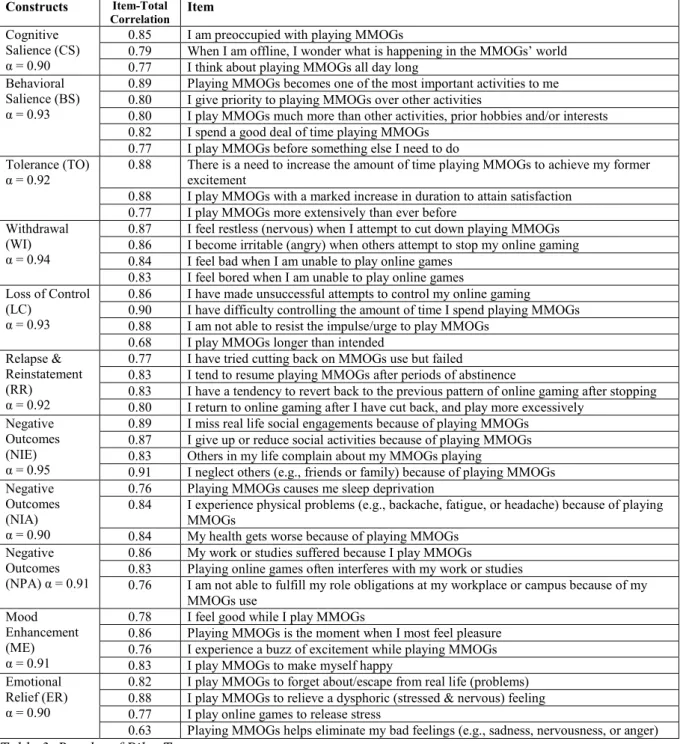
We conducted a pilot test with 43 frequent MMOGs players for scale revision and refinement. A self-administered questionnaire containing 41 revised scale items and other relevant variables was distributed to MMOGs players. To increase the response rate, entry in a lottery for shopping vouchers was offered as an incentive for participation. Cronbach’s alpha and item-total correlation were calculated to access the scale reliability and validity (see Table 3). Scale reliability met the conventional standard of internal consistency (Hair et al., 1998), with Cronbach’s alpha greater than 0.70. Based upon the results and participants’ feedback of the pilot test, we have refined wordings of the scale items (see Table 3) and prepared a refined online questionnaire for full-scale field validation.
Constructs Item-Total
Correlation Item Cognitive
Salience (CS) α = 0.90
0.85 I am preoccupied with playing MMOGs
0.79 When I am offline, I wonder what is happening in the MMOGs’ world 0.77 I think about playing MMOGs all day long
Behavioral Salience (BS) α = 0.93
0.89 Playing MMOGs becomes one of the most important activities to me 0.80 I give priority to playing MMOGs over other activities
0.80 I play MMOGs much more than other activities, prior hobbies and/or interests 0.82 I spend a good deal of time playing MMOGs
0.77 I play MMOGs before something else I need to do Tolerance (TO)
α = 0.92
0.88 There is a need to increase the amount of time playing MMOGs to achieve my former excitement
0.88 I play MMOGs with a marked increase in duration to attain satisfaction 0.77 I play MMOGs more extensively than ever before
Withdrawal (WI) α = 0.94
0.87 I feel restless (nervous) when I attempt to cut down playing MMOGs 0.86 I become irritable (angry) when others attempt to stop my online gaming 0.84 I feel bad when I am unable to play online games
0.83 I feel bored when I am unable to play online games Loss of Control
(LC) α = 0.93
0.86 I have made unsuccessful attempts to control my online gaming 0.90 I have difficulty controlling the amount of time I spend playing MMOGs 0.88 I am not able to resist the impulse/urge to play MMOGs
0.68 I play MMOGs longer than intended Relapse &
Reinstatement (RR)
α = 0.92
0.77 I have tried cutting back on MMOGs use but failed
0.83 I tend to resume playing MMOGs after periods of abstinence
0.83 I have a tendency to revert back to the previous pattern of online gaming after stopping 0.80 I return to online gaming after I have cut back, and play more excessively
Negative Outcomes (NIE) α = 0.95
0.89 I miss real life social engagements because of playing MMOGs 0.87 I give up or reduce social activities because of playing MMOGs 0.83 Others in my life complain about my MMOGs playing
0.91 I neglect others (e.g., friends or family) because of playing MMOGs Negative
Outcomes (NIA) α = 0.90
0.76 Playing MMOGs causes me sleep deprivation
0.84 I experience physical problems (e.g., backache, fatigue, or headache) because of playing MMOGs
0.84 My health gets worse because of playing MMOGs Negative
Outcomes (NPA) α = 0.91
0.86 My work or studies suffered because I play MMOGs
0.83 Playing online games often interferes with my work or studies
0.76 I am not able to fulfill my role obligations at my workplace or campus because of my MMOGs use
Mood Enhancement (ME) α = 0.91
0.78 I feel good while I play MMOGs
0.86 Playing MMOGs is the moment when I most feel pleasure 0.76 I experience a buzz of excitement while playing MMOGs 0.83 I play MMOGs to make myself happy
Emotional Relief (ER) α = 0.90
0.82 I play MMOGs to forget about/escape from real life (problems) 0.88 I play MMOGs to relieve a dysphoric (stressed & nervous) feeling 0.77 I play online games to release stress
0.63 Playing MMOGs helps eliminate my bad feelings (e.g., sadness, nervousness, or anger)
MMOGs players will be used in the current research project to empirically validate the measures. We will target a sample of 500 players who have actively participated in MMOGs. We will first ask them to provide details related the MMOGs they play, followed by obtaining gaming statistics such as the frequency and duration of the gaming. We will then ask them to recall their gaming experiences with the mentioned MMOGs, and answer the remaining questions accordingly. The online questionnaire will contain all problematic MMOGs use scale items, personality traits, and demographic variables (owing to the space limitation, we list only the items related to problematic MMOGs constructs). We will recruit active gamers from various popular online gaming forums in the region (e.g., http://www.2000fun.com/portal.php or http://www.gamer.com.tw/). This recruitment approach has been found to be effective in prior problematic MMOGs use research (Billieux et al., 2013; Hussain & Griffiths, 2009; Utz et al., 2012). Both classical approaches (e.g., item-to-total correlation, Cronbach’s alpha, and exploratory factor analysis) and contemporary approaches (e.g., structural equation modeling) will be used to validate the scale in the current study (Bagozzi et al., 1991). The aim of using these approaches is to ensure the development of a rigor scale with method triangulation.
4
CONCLUSION AND EXPECTED CONTRIBUTIONS
The purpose of this study is to develop and validate a scale for measuring problematic use in massively multiplayer online games. Building upon prior literature, problematic MMOGs use is conceptualized as MMOGs use that has resulted in negative outcomes in different aspects of gamers’ lives. The gaming may also characterized with the other dimensions of problematic use, including salience, tolerance, withdrawal, loss of control, relief, and relapse and reinstatement. A pool of 41 items of problematic MMOGs use tapping the major components was obtained. We will continue the scale development and validation process, finalize the scale, and propose a theoretical model explaining the mechanism of how problematic MMOGs use is developed. Numerous definitions of problematic MMOGs or Internet uses can be found from practice and research driven literature. There is, however, a lack of consensus regarding its dimensionality, operationalization, and development, particularly in the context of MMOGs use. We believe that the current work enriches the existing work on the problematic use of MMOGs. In addition, the validated scale will be added to the repository of rigorous research instruments for IS survey researchers’ future applications, helping to develop a cumulative tradition for IS research in problematic MMOGs use discipline. The current study is timely, as it will enhance our understanding of a phenomenon that grows increasingly important. We believe that the findings of this study will also provide industry and practitioners with the knowledge of the importance of creating attractive, yet healthy and sustainable online gaming environments.
Acknowledgment
The authors acknowledge with gratitude the generous support of the Hong Kong Baptist University for the project (FRG2/10-11/047) without which the timely production of the current report/publication would not have been feasible.
Reference
Bagozzi, R.P., Yi, Y. and Phillips, L.W. (1991). Assessing Construct Validity in Organizational Research. Administrative Science Quarterly, 36(3), 421-458.
Billieux, J., van der Linden, M., Achab, S., Khazaal, Y., Paraskevopoulos, L., Zullino, D. and Thorens, G. (2013). Why do you play world of warcraft? An in-depth exploration of self-reported motivations to play online and in-game behaviours in the virtual world of azeroth. Computers in Human Behavior, 29(1), 103-109.
Boudreau, M.-C., Gefen, D. and Straub, D.W. (2001). Validation in Information Systems Research: A State-of-the-Art Assessment. MIS Quarterly, 25(1), 1-16.
Brown, I. (1997). A Theoretical Model of the Behavioural Addictions - Applied to Offending. In J. Hodge, M. McMurran and C.R. Hollin (Eds.), Addicted to crime? (Vol. The Wiley series in offender rehabilitation, pp. 16-63). Chichester: Wiley.
Charlton, J.P. and Danforth, I.D.W. (2010). Validating the distinction between computer addiction and engagement: Online game playing and personality. Behaviour & Information Technology, 29(6), 601-613.
Churchill, G.A., Jr. (1979). A Paradigm for Developing Better Measures of Marketing Constructs. JMR, Journal of Marketing Research, 16(1), 64.
Cohen, J.A. (1960). A Coefficient of Agreement for Nominal Scales. Educational and Psychological Measurement, 20, 37-46.
Demetrovics, Z., Urbán, R., Nagygyörgy, K., Farkas, J., Griffiths, M.D., Pápay, O., Kökönyei, G., Felvinczi, K. and Oláh, A. (2012). The development of the Problematic Online Gaming Questionnaire (POGQ). PLoS ONE, 7(5).
ESA. (2012). Essential Facts about the Computer and Video Game Industry: Entertainment Software Association.
Floyd, F.J. and Widaman, K.F. (1995). Factor analysis in the development and refinement of clinical assessment instrutments. Psychological Assessment, 7(3), 286-299.
Griffiths, M.D. (2010). The role of context in online gaming excess and addiction: Some case study evidence. International Journal of Mental Health and Addiction, 8(1), 119-125.
Hair, J.F., Anderson, R.E., Tatham, R.L. and Black, W.C. (1998). Multivariate Data Analysis, 5th Ed. Upper Saddle River: NJ: Prentice-Hall International.
Hsu, S.H., Wen, M.-H. and Wu, M.-C. (2009). Exploring user experiences as predictors of MMORPG addiction. Computers & Education, 53(3), 990-999.
Hussain, Z. and Griffiths, M.D. (2009). The attitudes, feelings, and experiences on online gamers: A qualititative analysis. CyberPsychology & Behavior, 12(6), 747-753.
Internap. (2012). Online Gaming Industry Handbook Retrieved from
http://www.internap.com/wp-content/uploads/onlinegamingindustryhandbook.pdf
Kim, M.G. and Kim, J. (2010). Cross-validation of reliability, convergent and discriminant validity for the problematic online game use scale. Computers in Human Behavior, 26(3), 389-398.
King, D.L., Delfabbro, P.H. and Zajac, I.T. (2011). Preliminary Validation of a New Clinical Tool for Identifying Problem Video Game Playing. International Journal of Mental Health & Addiction, 9, 72-87.
Moore, G.C. and Benbasat, I. (1991). Development of an Instrument to Measure the Perceptions of Adopting an Information Technology Innovation. Information Systems Research, 2(3), 192-222. Ng, J. (2012). Juvenile Courts sees more game addiction cases, the Straits Times.
Segars, A.H. (1997). Assessing the unidimensionality of measurement: a paradigm and illustration within the context of information systems research. Omega, 25(1), 107-121.
Smith, G.T. and McCarthy, D.M. (1995). Methodological considerations in the refinement of clinical assessment instruments. Psychological Assessment, 7(3), 300-308.
Snodgrass, J.G., Lacy, M.G., Dengah, H.J.F. and Fagan, J. (2011). Enhancing one life rather than living two: Playing MMOs with offline friends. Computers in Human Behavior, 27(3), 1211-1222. Sun, C. (2011). South Korea is the most-wired country in the world - and online games are the new
drug of choice for its youth. Newsweek.
Todd, P. and Benbasat, I. (1991). An experimental investigation of the impact of computer based decision aids on decision making strategies. Information Systems Research, 2(2), 87-115. Utz, S., Jonas, K.J. and Tonkens, E. (2012). Effects of passion for massively multiplayer online
role-playing games on interpersonal relationships. Journal of Media Psychology: Theories, Methods, and Applications, 24(2), 77-86.
Vessey, I. (1984). An investigation of the psychological processes underlying the debugging of computer programs. PhD Thesis, The University of Queensland.
Young, K. (2009). Understanding online gaming addiction and treatment issues for adolescents. American Journal of Family Therapy, 37(5), 355-372.