Gender and Computer
Science Education
Vashti Galpin
[email protected] http://www.cs.wits.ac.za/~vashtiTechnical Report: 1992-05
April 1992
Department of Computer Science
University of the Witwatersrand
Private Bag 3
Wits 2050
South Africa
This report was written as the exam requirement for the Computer Science Education course that was presented as part of the MSc in Computer Science by Coursework and Research Report in 1991.
1. IN T R O D U C T I O N
In this report, I will investigate the research that has been done into gender and computer science education. My main focus will be computer science education at university level and the suggestions that have been made to rectify gender imbalances among computer science graduates, and I will evaluate the suggestions that relate specifically to the teaching of computer science at tertiary level. I will also present statistics that describe the situation in the Department of Computer Science at the University of the Witwatersrand (Wits) and discuss how the suggestions presented could be applied to rectify gender imbalances in computer science in South Africa. I will also evaluate the new Computer Science I curriculum that has been established at Wits in terms of the suggestions for teaching.
The structure of the report is as follows; in section 2, I will justify the focus of the report and its aims. In section 3, I will detail the reasons given in the literature for the fact that women are not graduating with degrees in computer science. Then in section 4, I will describe suggestions for rectifying gender imbalances and evaluate those suggestions that relate to the teaching of computer science at tertiary level. In section 5, I will present statistics about gender at Wits, and attempt to explain these data. In section 6, I will investigate the application of the suggestions described in section 4 to the South African situation and present the evaluation of the first year curriculum.
2. FOCUS AND AIMS OF THE REPORT
The November 1990 issue of the Communications of the ACM was a special issue on women and computing. It was reported that in 1988, 32.5% of bachelor’s degree and 26.9% of master’s degrees in the United States of America were awarded to women. The number of PhD’s awarded was lower, at 10.9% [Frenkel 1990]. This is cause for concern; in Frenkel’s words: ‘..American society cannot ignore or dismiss [women’s] experience; there is an indisputable brain drain from this leading-edge discipline.’ [Frenkel 1990]. As rank in academia increases, so the percentage of women decreases - only 7% of computer science academics in the United States are women and a third of the computer science departments have no female academics [Gries and Marsh 1990]. The situation in Europe is worse - the percentage of women in computer science is dropping [Borchers 1990]. From 1985 to 1989, in Britain, the percentage of women entrants into computer science courses at universities was less than 15%, although in the early ’80’s the figure was above 20% [Lovegrove and Hall 1991].
The two questions that I want to ask are: why do women form such a low percentage of computer science graduates and what can be done about this?
The main focus of this report will be on undergraduate computer science education, however, this is influenced by school and social issues, so I will discuss these as well. I will also deal with Honours and Masters degrees when presenting the statistics from Wits, however PhD degrees will be outside the scope of this study.
I will concentrate mainly on research from the USA and Britain, and some from Australia and New Zealand. I will concentrate on the empirical research done in the area of gender and computer science. There are some approaches that have been excluded from this study for reasons of space. They are the psychological approach taken by Turkle and the approach of feminist scientists who are critical of the association of objectivity and the scientific method with male values, and argue for a reconceptualisation of science [Turkle 1984, Rosser 1986, Weinrich-Haste 1986].
A few definitions are required at this point to clarify issues which arise later.
_ By the term computer science, I refer to the definition given in the Report of the ACM Task Force on the Core of Computer Science [Denning et al 1988] and to the Computing Curricula ’91 which investigated undergraduate curricula in computer science and was based on the ACM report [Tucker and Barnes 1991]. There is room for debate about this definition. Dunlop and Kling felt that the definition given in this report omitted social issues, however these issues were subsequently addressed in the Computing Curricula ’91. However, for reasons of space, I will not discuss this any further.
_ The BSc degree at South African universities is three years long, followed by an optional Honours degree of one year (or two years part-time). An undergraduate major in computer science consists of three years of computer science and two years of mathematics. After an Honours is completed, an MSc can be done in a minimum of one year, and afterwards a PhD in minimum of two years.
_ By the term black, I refer to South Africans who were not classified White in terms of the Population Registration Act, namely those that were classified Black, Indian and Coloured.
3. WHY IS THERE A GENDER IMBALANCE IN COMPUTER SCIENCE?
This first question can be split into two sub-questions: why are women not choosing to do computer science degrees and why are women not succeeding when doing such degrees? These questions will be answered with reference to the literature in the field. Some of the research is contradictory and it is sometimes difficult to get a clear picture of the situation.
In the first part of this section I will attempt to answer the questions about why women choose not to do computer science degrees. It seems that there are a number of reasons that could account for this phenomenon: lack of ability, socialisation issues, sex-stereotyping, gender bias of educational software, lack of female role models, negative feelings of self-efficacy, lack of access to computers and negative attitudes towards computers.
A b i l i t y
The first issue to be discussed is the possibility that females do not have the ability to do computing and therefore they decide not to do computer science majors. A number of studies show that women are not successful in a computing environment [Fetler 1985, Campbell and McCabe 1984, Taylor and Mounfield 1989]. There are other studies that show that women do as well as men [Werth 1986, Clarke and Chambers 1989]. A third study, the Minnesota Computer Literacy Assessment, showed that female high school students had performed better at problem analysis and algorithmic application, although the male students performed better at program reading tasks [Anderson 1987]. Linn reports that although 40% of the students taking middle school programming courses are female, their performance is better than or equivalent to that of males and they form 60% of the most talented students [Linn 1985].
However when examining actual underlying cognitive abilities, there seem to be minimal gender differences. Linn and Hyde have used meta-analysis, a technique that allows synthesis of results from studies of gender difference, to show that gender differences in cognitive abilities such as verbal, spatial and mathematical skills, are declining and that some of these differences can be reduced by training, which would indicate that they are social constructs [Linn and Hyde 1989]. They conclude that gender differences are ‘not general but are specific to cultural and situational contexts’ [Linn and Hyde 1989].
If gender imbalances are not the result of differences in ability, then they must be socially constructed, and therefore relate to attitudes, perceptions and expectations about computers and computing. In the following paragraphs I will detail possible ways in which gender differences could be socially constructed.
Socialisation issues
Clarke and Chambers describe the category-based explanation for gender differences in computing. They deal with the expectations of members of a particular social category, in this case, a gender based category. They argue that girls choose not to do computing because other girls have chosen not to do it and because boys have chosen computing [Clarke and Chambers 1989]. This phenomenon is reflected by the sex-stereotyping of computers and computing.
Women encounter subtle discrimination that causes them to reject science. An example of this is the fact that teachers at school reward female students for the appearance of their work not its content [Gruman 1990]. Other examples are the fact that boys tend to dominate the classroom, which teachers permit [Milner 1991], there is more parental support and encouragement for boys, and teachers show unconscious discrimination in favour of boys in computing classes [Lockheed 1985].
Kiesler et al detail how the computer culture is predominantly male. The players in video game arcades are male, young children perceive computers and computer games as more suitable for boys, software designers are male, educational software is male-biased, and computer stores are a predominantly male domain. They argue that to have true competence in computing, both social and technological knowledge is required. However because of the male dominance of computer culture, it is difficult for women to gain this social knowledge and therefore they are excluded [Kiesler et al 1985, Kiesler et al 1983].
Lockheed approaches computer use by function, and notes that sex differences occur for some uses and not others. Programming and playing games are done mainly by men, but there is equal usage for other functions. This could be related to the context that programming and games occur in, namely, computer centres and video game arcades. Tool usage does not show sex difference because girls are more interested in tool use, activities supported by tools are not sex-stereotyped and tool use is relevant to girls’ future objectives [Lockheed 1985].
Sex-stereotyping
Sex-stereotyping of computers also gives social cues as to the suitability of computers for women. By age seven, many children associate computers with boys and perceive that boys will be more successful with them [McLeod and Hughes 1984 cited in Lovegrove and Hall 1991]. Wilder et al did a survey of sex-stereotyping of computers from kindergarten to the final year of school and also of first year college students. The results show that children in kindergarten perceive computer games as being for boys, and computers as being slightly more male. There is also a gender difference in attitude with male students being more positive. The sex-stereotyping diminishes with age; however, the difference in attitude persists [Wilder et al 1985]. Sex-stereotyping was also displayed in other surveys, where it was shown that males have more sex-stereotyped beliefs than females [Smith 1987, Levin and Gordon 1989]. This sex-stereotyping can be related to the portrayal of women in computer literature. Ware and Stuck investigated popular computer magazines where they found that men were featured twice as often as women and women were often portrayed in a
passive role with respect to the computer. Only women were shown as sex objects or as rejecting computers [Ware and Stuck 1985].
Gender bias in educational software
Educational software is often game-oriented and this can cause girls to lose interest in computers since games are more likely to appeal to boys [Lockheed 1985]. Huff and Cooper show that when educational software designers were asked to design software for students and boys, they designed game-oriented programs, however, when designing for girls they designed tool-oriented programs. The main issue raised by this research is that designers seem to take the default value of ‘student’ to be ‘boy’, which leads to bias in educational software and could be a factor in alienating girls from computing [Huff and Cooper 1987].
Role models
Another reason for women not choosing computer science is a lack of female role models. If students see few women succeeding at computing or as computer scientists, they are likely to believe that they too cannot succeed [Pearl et al 1990]. Research has shown that there is a link between the sex of the role model chosen by female students and perceptions of competence [Gilbert et al 1983]. In school computer clubs, it was found that the gender of the teacher affected the attendance of girls. In the case of a male teacher, there was a low percentage of girls, however with a female teacher, about half of the students attending were female [Becker 1985].
S e l f - e f f i c a c y
Another problem that can cause women to decide not to do computer science is lack of self-confidence. Clarke and Chamber describe how beliefs about gender differences in ability leads to differences between female students’ perceived and actual ability [Clarke and Chambers 1989]. Collis reported that women perceive women in general to be competent computer users, however, when questioned about their own abilities, they are less confident. This leads to the ‘We can, but I can’t’ paradox [Collis 1985 cited in Goodness 1990]. Bernstein notes that feelings of self-efficacy are a major predictor of success in computer science courses [Bernstein 1990]. Miura defines self-efficacy as ‘the belief that one can successfully execute a certain course of behaviour’ [Miura 1987]. She conducted a study that showed that men had higher self-efficacy scores than women with respect to computing and that there was a correlation between self-efficacy score and plans to take a computer science course. Other studies have shown that women are less confident of their ability than men [Ogozalek 1989], that feelings of self-efficacy had an influence on the decision to use computers [Hill et al 1987] and that positive feelings of self-efficacy are gained by experience [Kersteen et al 1988].
A c c e s s
Another stumbling block for women is access to computers, and therefore the opportunity to gain experience and self-confidence. Both American and British studies have shown that boys have more access to computers both at school and at home [Fetler 1985, Glissov 1991]. Hess and Miura studied enrolments in summer camps and classes that teach programming for microcomputers in the United States and found that there was a higher percentage of male students and this percentage increased with an increase in cost of the camp or classes, level at school and level of difficulty of material presented [Hess and Miura 1985]. Male students have access to more opportunities for self-initiated exploration outside the classroom [Bernstein 1991] and more computer classes than female students.
A t t i t u d e s
The social learning approach which emphasises previous computing experience, encouragement from significant others such as peers, parents and teachers, role models and generalisation of existing attitudes to mathematics and science, suggests that girls and boys acquire different attitudes towards computing [Clarke and Chambers 1989]. Studies have shown that even if boys and girls both have positive attitudes towards computers, boys are generally more positive [Fetler 1985, Siann et al 1990, Glissov 1991]. Glissov reports, however, that these positive attitudes decline during the school years, especially for girls in mixed-sex schools compared to girls in single-sex schools and boys in mixed-sex schools [Glissov 1991]. This would correlate with the fact that a third of all female computer scientists in Germany come from single-sex schools [Borchers 1990]. These two studies would seem to indicate that there is less sex-stereotyping of computer science in all-girls schools.
Siann et al performed experiments with primary school pupils and found that with experience the gender differences in attitudes diminished, although attitudes were positive before. However girls’ anxiety levels compared to boys increased. The type of activity - graphics or list processing -, and pairing - mixed-sex or single-sex - did not affect the results, however in mixed-sex pairs, the boys did dominate [Siann et al 1990]. Levin and Gordon note that prior exposure to computers is a more important influence on computer attitudes than gender [Levin and Gordon 1989]. Both Levin and Gordon and Ogozalek note that women’s attitudes become less positive with increased experience [Levin and Gordon 1989, Ogozalek 1989]. Bernstein showed in a study of management science students learning to use spreadsheets that comfort with computing was significantly correlated with achievement for female students and suggests that the quality of women’s first computing experience could affect future achievement [Bernstein 1991]. These three results together could indicate that the quality of initial computing experiences is an important factor for women both in terms of attitudes and achievement.
Milner observed children in primary school classrooms with computers and discovered that girls perceived writing, reading, mathematics and drawing (compulsory tasks) as work, and using the computer and model making (optional tasks) as play, and felt that they required specific permission from the teacher to play [Milner 1991].
Durndell has reported different attitudes, namely ‘We can, I do not want to’, where both boys and girls, but more predominantly the latter, perceive computing careers as lacking in human orientation and contact, and he argues that a new image is required for computing [Durndell 1991].
A c h i e v e m e n t
In the next section I will examine the research about how women do at computer science at university level.
There are a number of studies which have investigated gender as a predictor of success for computer science. Werth found that sex was not a predictor of performance in an introductory computer science class [Werth 1986]. Clarke and Chambers found that gender did not predict performance although a larger percentage of male students expected high marks for themselves than did the female students. However in terms of actual final marks there were no significant gender differences [Clarke and Chambers 1989]. Campbell and McCabe show that sex is a predictor of success of first year students in a computer science major [Campbell and McCabe 1984]. Taylor and Mounfield showed a significantly larger percentage of males were successful than females and also that female students either did very well or badly [Taylor and Mounfield 1989].
P e r s i s t e n c e
Jagacinski et al did a survey of persistence in computer-related fields and found that there was a significant difference in the percentage of male and female persisters. They suggest that women leave computer science when their marks do not meet their expectations or because of limited understanding of what computer science is [Jagacinski et al 1988]. Campbell and McCabe also noted the difference in percentages of men and women persisters [Campbell and McCabe 1984].
To summarise, it would seem that there is little difference in cognitive ability between men and women, so the gender imbalances found in computer science are a result of a society that views computing and computer science as a male activity. This affects the attitudes women have about computers, their perceptions of their ability to succeed with computing and their
opportunities for access to computer resources. It is not clear from the literature whether women studying computer science at university are less likely to succeed than men.
4. HOW CAN THESE GENDER IMBALANCES BE RECTIFIED?
In this section I will list the suggestions that have been advanced to help overcome these gender imbalances. There seem to be three main areas where these suggestions apply. First, at schools there are a number of recommendations to ensure that girls are not excluded and alienated from computing. Some of these suggestions overlap with those that apply to society, the second area, for example removal of sex-stereotyping of computers and other social pressures that deter women from choosing computer science. The third area relates to universities and colleges, namely how these institutions can ensure that more women doing computer science majors persist and achieve.
S o c i a l i s s u e s
In the previous section, it was argued that gender differences in computer science are socially constructed. This means that to remove those biases, the attitude of people in general must be changed. Linn and Hyde argue that gender differences are ‘not general but are specific to cultural and situational contexts’ [Linn and Hyde 1989] and therefore educational and work environments need to be changed for gender equity. This does not relate only to computer science, but to all spheres of life to ensure that women can contribute to the society in which they live. There are specific suggestions that have been advanced to change the current view of computing and computer science as a male activity.
A number of suggestions have been made for education to change people’s perceptions of computing and education to make parents aware of stereotyping [Frenkel 1990]. Durndell suggests that the image of computing needs to be changed as both male and female see it as lacking in human interaction [Durndell 1991]. Another suggestion is to make software companies aware of the large female market that is currently being excluded [Frenkel 1990].
In Britain, a number of local Women into Computing groups have been founded to introduce women and school girls to computing. Their activities include general distribution of information about computing, offering a discussion and support network [Goble and Moss 1991] and providing workshops for girls at high school [Wilson et al 1991, Welch and Michaelson 1991, Lovegrove 1991b, Hughes and Maybrey 1991]. Some of the European countries have programmes that are aimed at making women of all ages aware of computing [Lovegrove 1991a, McShane 1991]. An interesting program in Denmark makes available open computer workshops which are aimed at unemployed women over 25. The workshops are free, and women can walk in and participate without any obligation. They aim to remove
barriers between women and new technology by providing a secure and friendly environment [Lovegrove 1991a].
S c h o o l
The decision not to do computer science can be influenced by experiences at school. I will first look at general suggestions for school girls and then more specifically at suggestions for primary school and high school.
Kahle has general suggestions about women and science, and these can be applied to computer science. For schools, she suggests textbooks containing more than token inclusion of women, special workshops to counter sex-stereotyping in science aimed at both girls and boys as often boys demonstrate more stereotyped opinions, and continuing educational support for teachers which includes topics about girls and science [Kahle 1985]. Science for Girls? [Kelly 1987] and Women and Minorities in Science [Humphreys 1982] give some general comments on encouraging school girls and university students to choose careers in science. Linn and Hyde suggest the deemphasis of gender differences in cognitive abilities as they are small, and employment of teaching methods that minimise gender differences. Examples of such methods are cultivating problem solving as opposed to memorised work, creating environments where all students can contribute, not just aggressive ones, designing curricula that make mathematics and science relevant, and rewarding both individual accomplishment and cooperative behaviour [Linn and Hyde 1989]. Other recommendations for teachers are that young girls should be encouraged in activities that they enjoy, there should be no sex-stereotyping of games or activities at home or at school and the provision of female role models at schools, especially for the teaching of mathematics and science [Goodness 1990].
Hawkins notes that often at schools, computers become included in the mathematics and science curriculum and therefore usage is influenced by existing gender differences [Hawkins 1985]. This can be countered by using computers as tools for many different aims, for example word processing, and thereby making them relevant to the interests of students. Another suggestion along similar lines is to encourage children to use computers for communication and to take part in computer networks [Kiesler et al 1985]. Huff and Cooper suggest that the ‘game-tool’ distinction should be removed from educational software by making it both game and tool, however they note that more research is needed to learn how to design educational software [Huff and Cooper 1987]. Anderson suggests that as female students have better verbal skills, the emphasis at school when teaching computing should be shifted from mathematics to language and logic skills [Anderson 1987].
Another issues is that of access. Pearl et al point out that educators need to ensure that boys and girls have equal access to computers [Pearl et al 1990] and also that extra-mural activities such as computer clubs do not become male dominated [Becker 1985]. Linn gives an example of a limited-place programming course at school where the teacher insisted that half of the class were girls and half boys [Linn 1985].
Some suggestions for primary school teachers are to find out what girls’ feelings are about technology and their participation in it, encourage children to work in mixed-sex pairs to help counter sex-stereotyping, presenting new technology as both work and play, and choosing projects that are interesting to both boys and girls [Milner 1991]. Another suggestion is to design computer programs that allow young female students to become accustomed to technology, for example a computer-based design tool that allows girls to create machines and write stories about them [Bank Street College of Education 1991].
Goodness suggests that women in high school should be encouraged to take optional mathematics, science and computer science courses [Goodness 1990]. Other suggestions include female speakers from industry especially those who were not A students, research opportunities for female high school students and programmes aimed to stimulate interest in computer science aimed at female high school students [Frenkel 1990, Leveson 1989]. In Britain, Women into Computing groups present workshops for girls at high school to give career information and to encourage girls to consider computer science degrees. The feedback from the workshops was very positive [Wilson et al 1991, Welch and Michaelson 1991, Lovegrove 1991b, Hughes and Maybrey 1991].
U n i v e r s i t y
This section will be divided into two subsections; suggestions that relate to the university environment, and suggestions that relate to the teaching of computer science - it is the second group of suggestions that I have chosen to evaluate.
E n v i r o n m e n t
A number of authors emphasise the need for female role models and suggest that more female academics are needed [Goodness 1990, Gruman 1990, Pearl et al 1990]. Other authors take this idea further and suggest mentoring schemes [Leveson 1989, Gruman 1990, Kahle 1985, Goodness 1990]. Leveson notes there are problems with the small numbers of female computer science academics available for mentoring and role models. She suggests that male academics could take part in mentoring schemes, and that regional workshops for college and university students that would enable maximum exposure for the small number of female role models that do exist [Leveson 1989]. Another suggestion to deal with the small number of role models is peer advising programs for female students [Kahle 1985].
Another important facet is networking activities among women [Goodness 1990, Leveson 1989]. Goodness also suggests women’s centres on campuses [Goodness 1990].
Activities that could be undertaken by computer science departments are women-speakers series, research opportunities for female students and reentry programs to encourage women to return to college. Another important area is funding of female students and faculty [Leveson 1989]. Jagacinski et al argue that the reason that there was a gender imbalance in persistence in computer science and not engineering at a large midwestern university, is because there were better programs aimed at supporting and encouraging women in engineering, whereas this does not happen for computer science students [Jagacinski et al 1988].
Pearl et al raise the issue of physical safety, as most computer science students and staff are required to work late hours, and that campus administrators need to be aware of these issues [Pearl et al 1990]. Gender discrimination is another problem; this ranges from subtle discrimination and exclusion to overt sexual harassment. The former can be addressed by making people aware of their attitudes and programs to help lecturers become aware of any stereotyping behaviour and strategies to avoid such behaviour [Gruman 1990], and the latter by a formal grievance procedure [Pearl et al 1990].
Leveson also suggested a national (American) committee on the status of women in computer science which would be able to gather and distribute information on women in computer science [Leveson 1989].
T e a c h i n g
There are a number of approaches to changing the teaching of computer science to rectify gender imbalances. Often authors discuss introductory computer science courses that are gateways to majors in computer science and there is still the possibility of attracting more women into computer science, so the suggestions here relate both to persistence and attraction.
I will outline and evaluate each suggestion in turn.
• A change of emphasis away from science and mathematics [Beardon 1991, Buckner 1991].
Beardon suggests that there should be a shift away from mathematics and science towards practical computing and Buckner suggests that information science should be taught as an art and not as a science.
I find this view difficult to support because of the scientific and mathematical nature of computer science as emphasised in the Report of the ACM Task Force on the Core of Computer Science, where the scientific, mathematical and engineering facets of computer science are used as a basis for defining the discipline [Denning et al 1988]. It is noted in Computing Curriculum ’91 that ‘mathematical maturity, as commonly obtained through logically rigorous mathematics courses, is essential to successful mastery of several fundamental topics in computing’ [Tucker and Barnes 1991]. The authors suggest that students require both calculus and discrete mathematics topics. This is problematic, as women are often discouraged and alienated from mathematics during their school careers. Some of the suggestions presented earlier in this section can also be applied to school mathematics.
It is essential to distinguish between programming and computer science [Denning et al 1988]. Whereas it could be argued that to learn programming, minimal mathematics and science is required, I do not think that this true of computer science for the reasons given above. I also think it is unlikely that it would have been suggested that to attract more women to physics or engineering that the mathematical and scientific content of these disciplines should be reduced.
• Make computer science more human-oriented [Durndell 1991]
Durndell suggested a change of image for computing as women are put off by the perceived lack of human interaction or orientation.
If there is social pressure on women to choose careers that relate to humans, then it is essential to stress the fact that computer science is human-oriented to attract more women to computer science. There was criticism of the ACM definition of computer science as noted earlier, because of the fact that social issues of computer science were omitted from the definition [Dunlop and Kling 1991]. However Computing Curricula ’91 emphasised these aspects: ‘[u]ndergraduate programs should prepare graduates to understand the field of computing, both as an academic discipline and as a profession within the context of a larger society. Thus graduates should be aware of the history of computing, including those major developments and trends economic, scientific, legal, political and cultural -that have combined to shape the discipline during its relatively short life.’ [Tucker and Barnes 1991]. They emphasise that students need to be able to ask and answer questions dealing with the social impact of computing. Therefore, these issues are crucial and should be raised in the undergraduate curriculum and it is necessary also for the general public to be aware of this facet of computer science.
• Remove gender biases from courses, put in examples to counter sex-stereotyping, and avoid male hobbies and sports and financial matters for assignments and examples [Beardon 1991, Shipp and Sutton 1991].
Shipp and Sutton detail the creation of an Open University home computing course and they conclude that language issues are important as it is possible to counter sex-stereotyping by presenting women in positions that people might expect men to fill. They recommend that the content of programming examples and assignments should be carefully selected. Abstract mathematics, male hobbies and leisure, and financial examples should be avoided and more emphasis should be placed on real-life situations. Beardon suggests that gender bias could be removed from the course in terms of examples and analogies.
I feel that this is an important area in any field where women are underrepresented and universities need to provide courses to make lecturers aware of these issues - it is not merely a departmental issue. This would benefit all students as female students would feel less alienated and research has shown that male students hold more sex-stereotyped views than women, so this would also counter prejudices held by male students. This could also be applied to ensuring that examples and assignments are not culturally biased.
• Present a foundation course for students with no experience [Beardon 1991].
Beardon suggests that a foundation course could be presented for students with no experience in computing.
This would enable students with no experience to gain experience and as Kersteen et al have shown, experience leads to positive feelings of self-efficacy [Kersteen et al 1988].
• Ensure positive first experiences, and present technology in a non-threatening way [Bernstein 1991, Beardon 1991, Gruman 1990].
Beardon suggests that the initial introduction to technology should be done in a non-threatening way, for example with cooperative work and a large number of demonstrators. Gruman suggests that students should be encouraged to work cooperatively. Bernstein notes that women’s achievement with computing could be related to having positive initial experiences with computers and as women are unlikely to have informal computer experience, introductory computer courses are likely to be their first contact with computers.
This can be related to the provision and teaching of a foundation course. If the foundation course is to help students without experience, and positive experience is a predictor of success for female students, then it is essential that such a course is presented in the best environment possible. This can be achieved by many sympathetic demonstrators and lecturers, as well as an environment that allows for group work and that is not pressurised. A disadvantage of this approach is that it is resource intensive.
• Structured labs similar to those in other sciences [Frenkel 1990].
Women and disadvantaged students find computing courses more time-consuming for a number of reasons, for example lack of experience, and structured labs have been suggested as a solution to this problem. A structured lab consists of exercises that can be completed in the lab. This could also reduce bragging about amount of hours spent in front of the computer.
The idea of a structured lab or closed lab is raised in Computing Curricula ’91 [Tucker and Barnes 1991] which noted that they are important where there is a need for student-instructor interaction or group work. Another benefit of the structured lab would be that students from poorer backgrounds will not be at a disadvantage because they cannot afford their own computer. This concept can be related to a schedule or timing outline for students to help them plan their time. I think that students often find it difficult to know how much work is required of them outside of lectures, especially in computer science. If this time can be quantified, it will make it easier for students who are not managing to get help. While university is about independent study and self-discipline, students do still need guidance.
• Emphasise tools and applications not programming, use software packages to teach computer science [Gilroy and Desai 1986, Bernstein 1990 cited in Frenkel 1990].
Gilroy and Desai argue that tools and applications should be emphasised when introducing computers. Bernstein suggests that to give women positive feelings of self-efficacy, application packages should be used as an introduction to computer science at university level, and students will then be able to transfer these concepts to procedural programming. She argues for this approach on the grounds that women perceive computers as tools. Using software applications would bring fast results which would gratify students and engender feelings of self-efficacy. Exploration would be more natural, group work would be easier to introduce and ties to the mathematics curriculum would be reduced. Computer science concepts would be introduced without the overhead of syntax problems or extensive program planning.
As part of a foundation course to give students background and experience with computers, I think that this suggestion is appropriate. However, as a basis for undergraduate coursework, it is problematic. A move away from programming at introductory level seems necessary especially if there are gender differences with respect to programming. Denning et al note that although programming is a necessary area of competence for computer scientists, computer science is not programming, and curricula do not need to be based on programming [Denning et al 1988]. Using application packages is not the only approach for de-emphasising programming, for example Mueller et al present an algorithmic approach (see section 6) [Mueller et al 1990].
A problem that I foresee with the applications package approach is that students will perceive that computer science is the use of application packages. I also think that there is a substantial overhead in using applications; first the concepts behind the application have to be understood and second the details of the package itself. Although applications packages allow the presentation of computer science concepts such as files, records, fields, memory, secondary storage, Boolean operations and format versus content of variables, these concepts relate primarily to data structures, and the algorithmic concepts that are also central to computer science would be more difficult to present. Also, as mentioned above, I do not believe that removing ties to mathematics curriculum is a solution to gender imbalances in computer science.
C o n c l u s i o n s
I disagree with the idea of moving way from mathematics and science, or using software packages to teach computer science, as I believe that they conflict with the basic definition of computer science. However I support the idea of a foundation course to enable female students that have not had access to computers, and therefore lack experience, to gain positive experiences. Such a foundation course could also be used to counter negative experiences and attitudes amongst female students. The idea of removing gender bias from examples is essential and I think that it would be difficult to disagree with this point. Structured labs that enable students to make effective use of their time and the timing outline suggested will also contribute to success amongst female students. These suggestions could also help male students that come from disadvantaged backgrounds.
Another point that needs to be raised is whether first year computer science courses should be treated as service courses for students who wish to gain computing skills that will benefit them in other majors. If this is the case, it could be beneficial, as such a course could attract more women to computer science majors. However I feel that the computer science
curriculum is not about basic computer skills or learning to program in a specific language. The foundation course suggested above could be a service course, or a separate course could be offered with an emphasis on programming for non-computer science majors.
In summary, there are a number of suggestions that have been put forward to correct gender imbalances. They relate to society in general, schools and universities. The suggestions for universities fall into two main categories - those that relate to the academic environment and those that relate to the teaching of computer science especially at first year level. The suggestions for teaching that I consider to be appropriate in terms of gender imbalances are removal of gender biases, an emphasis on the human orientation of computer science, a foundation course for female students to gain positive experience, structured laboratories and timing outlines that will enable students to successfully plan their time.
However, I would like to note that applying these suggestions at university level cannot alone rectify these imbalances. The imbalances are a result of social factors, and until there is full equity of men and women in society, it is unlikely that there will be an equal number of male and female computer scientists.
5 . WHAT IS THE SITUATION IN COMPUTER SCIENCE AT WI T S?
I obtained data from the Science Faculty about students in the Department of Computer Science. This data is not complete as there are some students from the Commerce Faculty registered with the department. For the years 1986 to 1990, I obtained the number of students that registered for the courses Computer Science I (CS I), Computer Science II (CS II), Computer Science III (CS III) and Computer Science Honours (CS Hons), the number that cancelled during the year and the number that passed and failed for each course. These numbers exclude the students that cancelled within the first few weeks of the course. I also obtained figures for the Master of Science in Computer Science (MSc) students that completed or did not complete during the period 1986 to 1990.
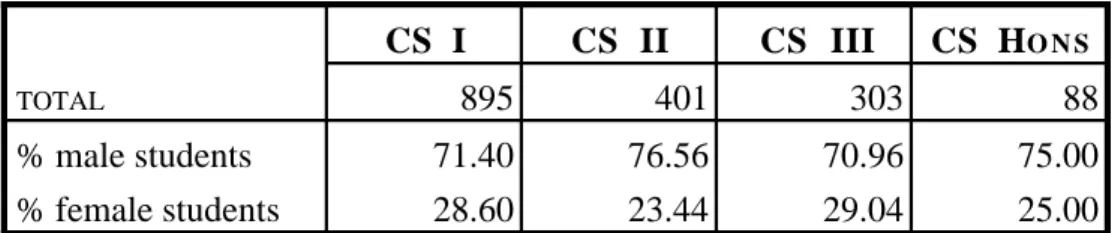
The percentage of women in the various courses have fluctuated over the years ranging from 6.25% (CS Hons 1986) to 50.98% (CS III 1986). In Table 1, I give the percentage of women in each year of study across the five year period. As can be seen, this ranges from 23.44% to 29.04%. It is interesting that the drop from third year to Honours is not substantial (4%). The figures also indicate that the persistence rates for men and women are similar.
CS I CS II CS III CS HO N S
TOTAL 895 401 303 88
% male students 71.40 76.56 70.96 75.00
% female students 28.60 23.44 29.04 25.00
TABLE 1: Registrations 1986-1990.
In table 2, the percentage of men passing (as a percentage of the total number of men registered) and the percentage of women passing (as a percentage of the total number of women registered) are compared. For each course, except CS I, the pass rate for women is higher than that for men, although the difference is not large. This table gives only the percentage passing - I was unable to get exact marks, so these tables do not compare how well men and women did. In both tables 1 and 2, the percentages for CS I should be viewed with caution as the content of the course has changed during this time.
C S I C S I I C S I I I C S HO N S
Base % Base % Base % Base %
% male passes 618 76.54 300 87.33 214 88.32 60 95.00 % f e m a l e
passes
243 72.43 91 89.01 88 96.59 22 100.00
TABLE 2: Passes 1986-1990.
Table 3 gives the percentage of men and women gaining majors in computer science in the Faculty of Science. The percentages vary and there is no clear trend over the years.
1 9 8 6 1 9 8 7 1 9 8 8 1 9 8 9 1 9 9 0
TOTAL 50 52 48 56 66
% male students 48.00 75.00 75.00 82.14 64.71 % female students 52.00 25.00 25.00 17.86 35.29 TABLE 3: Passes CS III.
The deregistration rates are small and become smaller through the years of study and there are no substantial gender differences in the undergraduate courses. However, a number of male part-time Honours students over the five year period (6 out of 66 or 9%) did not return to complete their second year of Honours. This could be explained by the lure of industry, however it does not explain why there are not similar figures for women. All women doing part-time studies completed their Honours. Again it should be noted that the sample is small.
MA L E FE M A L E TOTAL 20 4 Passed MSc 8 3 Didn’t complete MSc 12 1 TABLE 4: MSc 1986-1990
The percentage of women in Honours is 25%, and this drops to 16.6% for Masters, although the MSc figures should be treated with caution as they are small. Although few women have done an MSc as can be seen in table 4, three out of four completed. However the completion rate for men is very low; only eight out of twenty (40%) passed. A possible explanation for this poor completion rate is conscription, where white male students register for an MSc to postpone the South African Defense Force calling them up for military service, but do not intend or do not have the motivation to complete their degrees.
In conclusion, the percentage of female undergraduate students is less than the 32.5% that occurs in the United States, but much better than the 15% in Britain. There do not seem to be gender differences in persistence for undergraduates and the pass rates for men and women are similar. There seem to be no substantial trends over the years. The same can be said for Honours students, except that it seems that male part-time students are less likely to finish their degrees. The percentage of women drops sharply to 17% for Masters degrees, although women have a much better completion rate than men.
6. WHAT CAN BE DONE ABOUT GENDER IMBALANCES IN COMPUTER SCIENCE IN SOUTH AFRICA?
In the previous section, it was shown that women represent just over a quarter of the students doing a computer science major in a BSc degree at Wits. What can be done to improve the percentage of women in computer science in South Africa? There seem to be two areas that need to be addressed - South Africa in general and South African universities, specifically Wits. In the first section I will see how the possible suggestions given in section 4 could be applied to the South African situation and in the second part I will discuss application of suggestions for universities to the University of the Witwatersrand. I will evaluate the new Computer Science I curriculum in terms of my conclusions for teaching from section 4.
Often the comments in the section will refer to disadvantaged students - this could relate to issues of both race and gender. I have shown how issues such as access and experience are important for women to succeed at computer science. I believe that some of these issues can
be generalised to all students, and therefore these comments are also of relevance to black students.
South Africa
As has been reported in the news recently and over the past few years, South Africa has slowly been moving away from a system of minority rule called apartheid toward truly democratic government. One of the effects of apartheid has been a number of racially segregated education systems with black students receiving inferior schooling [Julie and van den Berg 1989]. There are large discrepancies between the amount of money spent per white child and per black child in terms of education. These inequities still exist and it will take time to remove them. Issues of democratisation with respect to technology and computers are currently being discussed and the African National Congress (ANC) are establishing an African Institute of Technology in Cape Town and Johannesburg that will train members of the black community in computer skills [ComputerWeek 1991]. General gender issues are also currently a topic for discussion [Weekly Mail 1991b]. However, there is currently no overlap between these two areas.
There has been little research into computer science and gender in South Africa. The main emphasis in the literature on computers and education seems to be on Computer Aided Instruction in schools [Julie and van den Berg 1989, Stoker and Robertson 1989, Benn 1989]. In most of the studies presented earlier in the report, it was assumed that most primary and high schools will have computers. This is not the situation in South Africa and there is debate about whether money should be spent on providing computers for schools or on upgrading teacher skills, buildings and equipment. It could be argued that the quality of education depends on the quality of the teacher, not the technological aids available [Stoker and Robertson 1989]. An opposing point of view argues that it is becoming necessary for all to become computer literate and those that don’t will live in a state of ‘information poverty’ and will be excluded from power [Zimmerman 1981]. In the South African situation, this could mean that the existing inequities would be exacerbated if the opportunity to become computer literate is denied to sections of the population. Jacobs expresses concern about the possibility that inadequately prepared teachers will react negatively to computers and therefore computer use in their classrooms will not be successful [Jacobs 1989]. This could lead to negative attitudes towards computers amongst students. Julie and van den Berg describe how computers have been used in black schools by the state to combat the shortage of qualified teachers and defuse criticisms of the education system. Most educational software used is of the drill-and-practice type of which Julie and van den Berg are critical as they argue that the environment is authoritarian [Julie and van den Berg 1989]. If students
perceive computer use as an extension of government oppression, then this could also result in negative attitudes towards computers.
The literature presented here indicates that more research is required, both into general attitudes to and expectations about computers as well as women’s attitudes and expectations. If technology is to be democratised in the future, such research will be invaluable for this process as it is not sufficient to assume that the same conditions exist here as in countries such as Britain and the United States. Another important area to research is that of the interaction of sex and race. At Wits in the Faculty of Science over the period 1986-1990, there were 21 black women obtaining majors in computer science, and four black women passing CS Hons. If these figures are representative of other universities, then the national total is very low when compared to the number of black women in South Africa.
Assuming that the conditions in South Africa are similar to those detailed in section 3, I can examine applying the suggestions presented in section 4 to the situation in South Africa. I will discuss these suggestions within the general framework of gender and science, as I think that this is a more general issue that has not yet been addressed. The first problem is that many of these suggestions require some sort of funding, for example special workshops for school girls and public education about women and technology. In the near future, there are likely to be funds available for removing inequalities that occur with respect to race and science. I feel that these funds can simultaneously be used to deal with gender inequities in science. It is important that such inequalities are not dealt with in a piecemeal fashion, as this would be more costly.
Other suggestions such as equitable learning environments, or removal of sex-stereotyping require a change of attitude amongst educators. As it seems likely that there will be changes within the current educational systems and a move toward the creation of a single national education system, again it is important to deal with different inequities at the same time.
This raises the question of who should be lobbying for these changes. At present, I believe that there are individuals who are interested in questions of gender and science, but no organisation that can effectively bring together these ideas. This is an issue that needs to be raised.
University of the Witwatersrand
In this section I will examine what can be done at Wits in terms of environment and what can be done in terms of teaching. My focus on teaching will be the new first year curriculum as most of the suggestions for teaching relate to introductory and first year courses.
E n v i r o n m e n t
Currently the number of female role models is very low. The Department of Computer Science at Wits enters 1992 with only one female academic member of staff. At South African universities, there is only one female full professor of computer science [Bishop 1991]. This would indicate that mentoring schemes that also involve male mentors, or peer advising schemes for female students would be more suitable in the current situation. Funding of women computer scientists is currently not even a recognised issue and seems that it could be a long time before it becomes one.
There is an awareness of physical safety issues at Wits and there are facilities to phone for escorts on campus at night. However I do not know whether this existing system is what female staff and students actually want, and it is essential that administrators survey students and staff to enable the university to establish the most effective security system. Sexual harassment on campus has also come into the spotlight recently and a Committee on Sexism and Sexual Harassment has been set up at Wits to monitor and suggest changes to university policy [Weekly Mail 1991a].
T e a c h i n g
In the conclusions of section 4, I detailed the suggestions that I felt would be suitable for teaching computer science at university so that women will succeed. I will now investigate applying these suggestions at Wits. I will deal first with general suggestions and then with those that relate specifically to the first year course.
The general suggestions were a removal of gender-biased examples and assignments, structured laboratories and a timing outline for students. I am sure that there are individual lecturers who deal with the issue of gender bias, however as mentioned earlier, this issue needs to be raised at a higher level. The second two points are more difficult to implement and a full discussion of them is beyond the scope of this report. Currently, structured laboratories are part of the computer science curriculum, however students are required to do other work in open laboratories. This extra work can contribute to the gap between students who have a computer at home and those that don’t, and can also lead to the type of boasting mentioned earlier. Solutions to this problem are resource intensive. A document that gives students an outline of the time that should be spent on aspects of a specific course, could be difficult to draw up, but it would mean that both staff and students would know what is expected. To make this successful, members of staff are needed to help and refer students that discover that they are not working efficiently.
In this final section, I would like to investigate the new Computer Science I curriculum that was introduced in 1990. This curriculum was introduced for specific reasons described below, and although none of these reasons related to gender, I would like to investigate whether it could contribute toward rectifying gender imbalances.
1 9 8 6 CSAM 1 9 8 7 CSAM 1 9 8 8 CSAM 1 9 8 9 CS I 1 9 9 0 CS I
Base % Base % Base % Base % Base %
% male passes 142 76.06 157 68.15 144 73.61 92 92.39 83 84.62 % f e m a l e
passes
57 66.67 55 50.91 62 77.42 43 93.02 20 80.72
TABLE 5: Passes CS I/CSAM I
I will first detail the history of Computer Science I. Table 5 gives the percentage of men passing (as a percentage of the total number of men registered) and the percentage of women passing (as a percentage of the total number of women registered) for the course CS I over the years 1986 to 1990. In the years 1986, 1987 and 1988, first year computer science and applied mathematics (CSAM) were combined, so these figures are not reflective of women entering computer science. Since 1989, first year computer science has been a separate and full year course. The figures for 1986 and 1987 show substantial differences in male and female pass rates, but from 1988 onwards these differences seemed to decrease. As the new curriculum was introduced in 1990, it is not possible to ascribe this change to it.
Computer Science I is a restricted course - there are a limited number of places. The policy over the past few years is only to admit students who are likely to major in computer science into CS I, because of limited resources. Therefore CS I does not fulfil the role of a service course for students wishing to learn computer skills, and currently Wits does not provide such a course. The first year that CS I was a full course, the lecturers found that students perceived computer science to be programming, and did not see the relevance of the theoretical parts of the course. Another problem was disadvantaged students who have had no exposure to computers, this resulted in a class composition where a third had no experience and were lost, a third knew how to program and were bored, and only the remaining third of the class was being catered for. It was also found that students did not have the principles required for second year - they knew how to program, but were not aware of the underlying fundamentals. It was decided that it was undesirable for disadvantaged students to have special tutorials and it was also difficult to give a bridging program before the university year started [Mueller et al 1990].
A new course was designed with the following four components [Mueller et al 1990]: basic computer organisation, fundamental algorithmic concepts, data and data structures and limits of computer science. Lab sessions were designed to emphasise principles and concepts using experiments. I will not discuss the descriptions of these courses in detail, but will only describe the sections relevant to my discussion. The full details are described in the technical report by Mueller et al [Mueller et al 1990].
An emphasis was given to algorithms as opposed to programming in the fundamental algorithmic concepts topic. This topic involves specification and design of algorithms, analysis and correctness of algorithms, program proving, efficiency, modularity, recursion, searching, sorting and related algorithms, and an outline of programming. The reason for this was to address the problems of a non-homogeneous class as these concepts are new to all students. In the labs students used existing programs and therefore did not have to write their own. This reduced the overhead of learning the syntax and semantics of a high-level language to understand the examples in the course. The labs are presented in a structured format so it is possible for students to complete the work in the labs. The course designers argue that this approach allows students to be introduced to computers without stress and since there is no demand for computer equipment before an assignment is due, it reduces the gap between those students that have access to a computer at home and those that don’t. They note however that some students find the format of labs very difficult to cope with. Another effect of this course is the requirement for a programming bridging course to take students with no programming background from first year to second year where students are required to have a basic knowledge of programming before embarking on the Advanced Programming course. Another part of the CS I curriculum is a section on social and ethical issues that is part of the limits of computer science component.
I will now give my comments on the suitability of this course to rectify gender imbalances. I note that the original course was designed to fit within the constraints of equipment and staff, whereas my suggestions may go outside of these limits.
In terms of the suggestions made earlier, the course seems to meet with Bernstein’s recommendation that there should be a shift away from programming [Bernstein 1990], however it takes a different approach by emphasising the algorithmic nature of computer science. However, I feel from my own experience as a tutor in 1991, that some students really struggle with the labs and that this is not the right environment to introduce the students to computers. Some students become very anxious because not only are they required to deal with computers, but they are also required to apply the concepts learnt in class, although they do not have to write programs. This could lead to negative feelings with respect to computers, and a subsequent decrease in achievement. I feel that some other
context is required for students to gain those basic feelings of self-efficacy and I feel that a foundation course would be effective to achieve this aim, for all disadvantaged students. I think that introducing social and ethical issues in CS I is a positive step, however I feel that there should be more emphasis on these issues during the three year degree.
To summarise, my feelings are that steps to correct gender imbalances in South Africa should be taken when racial imbalances in science and technology are addressed, although there is currently no body to lobby for this. In terms of the academic environment at Wits, there is a definite shortage of role models and funding specifically for women. However there is an awareness of security and sexual harassment issues, although there is room for improvement. In terms of teaching computer science, removal of gender biases needs a more formal approach while structured laboratories and timing outlines require more attention. The new Computer Science I curriculum compares favourably with suggestions made about gender issues in the teaching of computer science, however, the introduction to computers can be a stumbling block for female and other disadvantaged students.
7. CO N C L U S I O N S
The first part of this report investigated questions about why women are not getting computer science degrees. Two problems were identified: women are not choosing to study computer science and women are not succeeding at computer science. The reasons for women not choosing computer science seem to be linked to the social perception of computing as a male activity and this impacts on women’s access to computers, experience, and self-efficacy. There seemed to be conflicting result in the literature about whether women succeed at computing. The figures at Wits show that the pass rates for men and women are similar and this would indicate that the women who choose computer science are as likely to succeed as men.
In the next section, I examined solutions to the problems mentioned above. These solutions were divided into three areas; social, school and university. The social and school suggestions encompass public awareness, ensuring access to computers for girls and women and encouraging women and girls to use computers. The suggestions for university level could be divided into those that relate to the academic environment and those that relate to teaching issues. I examined suggestions for teaching and found that a shift away from mathematics and science, or using applications packages to teach introductory computer science were not appropriate for removing gender imbalances in computer science. The removal of gender bias in examples and assignments, the provision of a foundation course for women to gain positive experiences, structured laboratories and a timing outline, would help women studying computer science and would therefore address gender imbalances.
I then presented figures for Wits Department of Computer Science. These figures indicated that at undergraduate level about a quarter of students were female, male and female pass rates were similar, and there did not seem to be differences in male and female persistence rates. The figures for Honours students were similar. The percentage of women doing Masters of Science
in Computer Science dropped sharply to under twenty percent, however it appeared that women were more likely to finish their Masters than men. It should be noted that these figures should be treated with caution as some of the sample sizes were small.
In the final section, I examined the application of these solutions to the situation in South Africa. In general, there seems to be little awareness of gender imbalances in science and I argued for these problems to be addressed simultaneously with racial imbalances in science. I also noted that there was no organisation to campaign around these issues. There is a general need for research to find out about female attitudes to and perceptions of computing and computer science.
I also examined the new Computer Science I curriculum in terms of the suggestion for teaching computer science at university level; it compared favourably with the suggestions. The emphasis has moved away from programming, towards emphasising fundamental issues in computer science. I have reservations, however, about the way that students are introduced to computers and I believe that it is stressful and causes anxiety which could result in negative experiences. To rectify this, I suggested a foundation course to present this introduction to computers in a non-threatening manner and environment.
Although I believe that investigating the area of teaching computer science at university level in terms of gender issues is very important, I believe that unless certain social conditions that relate to gender are altered, women will remain underrepresented in computer science.
ACKNOWLEDGEMENTS
I would like to thank Dr Danielle Bernstein and Dr Jeanne Goodness for the references they sent me, and Julie Donelly for the reports from which I collated the statistics.
8. R EFERENCES
ANDERSON, R.E., 1987, Females surpass males in computer problem solving: findings from the Minnesota computer literacy assessment., Journal of Educational Computing
Research, 3(1), 1987, 39-51.
BANK STREET COLLEGE OF EDUCATION, 1991, Women and technology: a new basis for understanding., News from CCT & CTE, 1(2), October 1991, 1-5.
BEARDON, C., 1991, Women into Computing: some experiences from New Zealand., in LOVEGROVE, G. AND SEGAL, B., (Eds), 1991, Women into computing: selected papers,
1988-1990., Springer-Verlag, 401-406.
BECKER, H.J., 1985, Men and women as computer-using teachers., Sex Roles, 13(3/4), 1985, 137-148.
BERNSTEIN, D.R., 1990, In search of gender-free paradigms for computer science education: a new introduction to computer science., presented at a pre-conference workshop at the
National Educational Computing Conference, June 1990.
BERNSTEIN, D.R., 1991, Comfort and experience with computing: Are they the same for men and women?, SIGCSE Bulletin, 23(3), September 1991, 57-60,64.
BENN, K.R.A., 1989, Computer-assisted learning in South African schools: mistakes of the past and hopes for the future., South African Journal of Education, 9(4), 1989, 613-616.
BISHOP, J.M., 1991, Personal communication.
BORCHERS, D., 1990, Europe sees decline in women computer scientists., IEEE Software, September 1990, 97.
BUCKNER, K., 1991, Information technology - art or science., in LOVEGROVE, G. AND SEGAL, B., (Eds), 1991, Women into computing: selected papers, 1988-1990., Springer-Verlag, 221-226.
CAMPBELL, P.F. AND MCCABE, G.P., 1984, Predicting the success of freshmen in a computer science major., Communications of the ACM, 27(11), November 1984, 1108-1113. CLARKE, V.A. AND CHAMBERS, S.M., 1989, Gender-based factors in computing enrollments
and achievement: evidence from a study of tertiary students., Journal of Educational
Computing Research, 5(4), 1989, 409-429.
COMPUTERWEEK, 1991, ANC proposes a democratic IT strategy., 1 4 ( 4 8 ), 2 December 1991, 1.
CO L L I S, B., 1985, Psychosocial implications of sex differences in attitudes toward computers: results of a survey., International Journal of Women’s Studies, 8 ( 3 ), 207-213.
DENNING, P.J., COMER, D.E., GRIES, D., MULDER, M.C., TUCKER, A., TURNER, A.J., YOUNG, P.R., 1988, Report of the ACM Task Force on the Core of Computer Science., ACM Press.
DUNLOP, C. AND KLING, R., 1991, Computerization and Controversy., Academic Press. DURNDELL, A., 1991, Choice and image: gender and computer studies in higher education.,
in LOVEGROVE, G. AND SEGAL, B., (Eds), 1991, Women into computing: selected papers,
1988-1990., Springer-Verlag, 152-160.
FETLER, M., 1985, Difference in the California statewide assessment of computer literacy,
Sex Roles, 13(3/4), 1985, 181-191.
FRENKEL, K.A., 1990, Women and computing., Communications of the ACM, 3 3 ( 1 1 ), November 1990, 34-46.
GILBERT, L.A., GALLESSICH, J.M. AND EVANS, S.L., 1983, Sex of faculty role model and students’ self-perceptions of competency., Sex Roles, 9(5), 1983, 597-607.
GILROY, F.D. AND DESAI, H.B., 1986, Computer anxiety: sex, race and age., International
Journal of Man-Machine Studies, 25, 1986, 711-719.
GLISSOV, P., 1991, The gender gap in secondary school computer use., in LOVEGROVE, G. AND SEGAL, B., (Eds), 1991, Women into computing: selected papers, 1988-1990., Springer-Verlag, 130-144.
GOBLE, C. AND MOSS, C., 1991, Grassroot groups - experiences in horticultural cultivation., in LOVEGROVE, G. AND SEGAL, B., (Eds), 1991, Women into computing: selected papers,
1988-1990., Springer-Verlag, 310-316
GOODNESS, J.M., 1990, Factors which influence women’s decisions to major in computer
science., PhD Dissertation, George Peabody College for Teachers, Vanderbilt
University.
GRIES, D. AND MARSH, D., 1990, The 1988-89 Taulbee survey report, Computer, October 1990, 65-71.
GRUMAN, G., 1990, Getting women and minorities into computer science., IEEE Software, July 1990, 87-89,92.
HAWKINS, J., 1985, Computers and girls: rethinking the issues., Sex Roles, 13(3/4), 1985, 165-180.
HESS, R.D. AND MIURA, I.T., 1985, Gender differences in enrollment in computer camps and classes., Sex Roles, 13(3/4), 1985, 195-203.
HILL, T., SMITH, N.D. AND MANN, M.F., 1987, Role of efficacy expectations in predicting the decision to use advanced technologies: the case of computers., Journal of Applied
Psychology, 72(2), 1987, 307-313.
HUFF, C. AND COOPER, J., 1987, Sex bias in educational software:the effect of designers’ stereotypes on the software they design., Journal of Applied Social Psychology, 17(6), 1987, 519-532.
HUGHES, S. AND MAYBREY, A., 1991, No previous experience necessary., in LOVEGROVE, G. AND SEGAL, B., (Eds), 1991, Women into computing: selected papers, 1988-1990., Springer-Verlag, 345-351.
HUMPHREYS, S.M., (Ed), 1982, Women and minorities in science: strategies for increasing
participation., Westview Press.
JA C O B S, M., 1989, Framework for the creation of positive teacher attitudes towards computers and computing strategies., South African Journal of Education, 9 ( 3 ), 1989, 488-495.
JAGACINSKI, C.M., LEBO L D, W.K. AND SA L V E N D Y, G., 1988, Gender differences in persistence in computer related fields., Journal of Educational Computing Research,
4 ( 2 ), 1988, 185-202.
JULIE, C, AND VAN DEN BERG, O., 1989, Computers in education in South Africa: the state of the art., SIGCUE Outlook, 20(2), Summer 1989, 32-36.
KAHLE, J.B., 1985, A view and a vision: women in science today and tomorrow., in KAHLE J.B.,(Ed), 1985, Women in science: a report from the field., Falmer Press, 193-231. KELLY, A.,(Ed), 1987, Science for girls? Open University Press.
KERSTEEN, Z.A., LINN, M.C., CLANCY, M. AND HARDYCK, C., 1988, Previous experience and the learning of computer programming: the computer helps those who help themselves.,
Journal of Educational Computing Research, 4(3), 1988, 321-333.
KIESLER, S., SPROULL, L. AND ECCLES, J.S., 1983, Second class citizens? Psychology Today, March 1983, 40-48.
KIESLER, S., SPROULL, L., AND ECCLES, J.S., 1985, Pool halls, chips and war games: women in the culture of computing, Psychology of Women Quarterly, 9, 1985, 451-462.
LEVESON, N., 1989, Women in computer science., A report for the NSF CISE Cross Directorate Activities Advisory Committee.
LEVIN, T. AND GORDON, C., 1989, Effect of gender and computer experiences on attitudes toward computers., Journal of Educational Computing Research, 5(1), 1989, 69-88. LINN, M.C., 1985, Fostering equitable consequences from computer learning environments.
Sex Roles, 13(3/4), 1985, 229-240.
LINN, M.C. AND HY D E, J.S., 1989, Gender, mathematics, and science., Educational
Researcher, 18(8), November 1989, 17-19,22-27.
LOCKHEED, M.E., 1985, Women, girls, and computers: a first look at the evidence, Sex Roles,
13(3/4), 1985, 115-122.
LOVEGROVE, G., 1991a, Scenes from Europe., in LOVEGROVE, G. AND SEGAL, B., (Eds), 1991,
Women into computing: selected papers, 1988-1990., Springer-Verlag, 367-376.
LOVEGROVE, G., 1991b, Southampton WiC Workshops., in LOVEGROVE, G. AND SEGAL, B., (Eds), 1991, Women into computing: selected papers, 1988-1990., Springer-Verlag, 353-358.