ISSN(Online): 2319-8753 ISSN (Print): 2347-6710
I
nternational
J
ournal of
I
nnovative
R
esearch in
S
cience,
E
ngineering and
T
echnology
(An ISO 3297: 2007 Certified Organization)
Website: www.ijirset.com
Vol. 6, Issue 7, July 2017
A Review on Comparative Analysis of
Optimization Techniques in Blind
Decomposition
Shaveta
1, Dr. Matreyee Dutta
2P.G. Student, Department of Electronic and communication, NITTTR, Chandigarh, India1 Associate Professor, Department of Computer Engineering, NITTTR, Chandigarh, India2
ABSTRACT: The blur images are not clearly viewed as there is problem of illumination, but by using the different algorithm the problem can be resolved to a much greater extent. As the blind decomposition algorithm varies in the application, so the task is to identify the particular enhancement technique that will not only increase the visibility of the image but also reduce the error rates, particularly the peak signal to noise ratio and mean square error. The objective underlines the task to reduce the error as minimum as possible to obtain an image with greater visibility.
KEYWORDS:Image capture, Image quality, Accuracy, Optimization.
I. INTRODUCTION
A comparative analysis of optimization technique‟s in blind decomposition to improvement of image processing for solving nonlinear, global optimization problems is proposed. Earlier for solving the problems, Heuristic Techniques were being utilized. But they are not able to provide the solution which we can say a optimal one. The nature of Heuristic approaches were impatient, so it gives local optimum solutions and unable to provide global ones. In proposed work we use Metaheuristic technique. Metaheuristic technique is just reverse of above mentioned technique due to its special nature being independent of problems. Metaheuristic technique gives both global as well as local best solution. It provides a subtle equilibrium, among local and global solutions and moreover, improves the algorithm‟s convergence. In order to discover the estimations of parameters limit or more objective functions almost all computer applications are being utilized. For large quantity of parameters, or of entangled targeted work, the ideal arrangement might be elusive. On observing the natural phenomenon to find food and to avoid obstacles and noxious areas, the nature-inspired metaheuristics provided the probability of getting a near to optimal solution which is useful particularly in higher dimensional problems and real time applications. This paper studied the behavior of 3 comparatively new approaches, Bat Algorithm (BAT), Cuckoo Search Algorithm (CSA), Particle Swarm Optimization (PSO) [1], when applied for image registration (IR).
NATURE INSPIRED ALGORITHMS
All algorithms are inspired from the nature in the sense of how to find the solution of problem in the shortest time and track possible. [2]
BAT Algorithm
In BAT Algorithm all micro bats reverse their practices a form of sonar, called echo location to encounter their target and obstacles. Micro bats emit a special sonorous sound pulse and receive the reply bounces back from the neighboring objects [3]. Each pulse lasts for only about 8 to 10 MS. However, it has a consistent oscillation in the expanse of 25 kHz to 150kHz [30]. The life-span for every ultrasonic burst might curtain for 5 to 20 ms, & micro bats excludes around 10-20 aforesaid sound bursts without exception in a second. The emitted pulse gets a drastic increase when they are searching for preys and found it very nearby. The emitted pulse may accelerate to the level of about 200 pulses/sec. The bat ear‟s integral time is approx 300 -400 microseconds. With a constant frequency f, the wavelength λ is as follows [4]
ISSN(Online): 2319-8753 ISSN (Print): 2347-6710
I
nternational
J
ournal of
I
nnovative
R
esearch in
S
cience,
E
ngineering and
T
echnology
(An ISO 3297: 2007 Certified Organization)
Website: www.ijirset.com
Vol. 6, Issue 7, July 2017
Where v is the speed of sound in air having value 340 m/s. λ is spectrum with value 2mm to 14mm in consideration of quintessential frequency scope from 25 kHz to 150 kHz. The values of the wavelengths depend on their prey sizes. For simulation, virtual bats are allowed to behave naturally. A set of rules are delineated to refurbish its locations zi and velocities pi for an n-dimensional considered space. The advanced values of zi t and pi, step time t is as follows [5]
Where β [0, 1] is a arbitrary course marked from a orderly distribution. And z* is the present universal finest point (solution) which is placed after correlating all the results encompassed by the complete set of the n bats[29]. Since the velocity increment is a product function of λi and fi, either λi (fi) can be used to tailor the velocity
modifications[6].While securing the other components, contingent on the category of the problem under concern. For the current problem, minimum value of „f‟ is considered as „0‟ and maximum as „100‟. All bats are initially appointed by a random frequency from [fmin, fmax][7].
Here ε [-1, 1] = arbitrary statistic and At = <A It> = bat loudness at moderate level. The emitted pulse rate ri and Ai
needs to be restore after every progressive iteration. While the loudness customarily downturns formerly a bat has discovered its dupe, the percentage of pulse radiation escalates [28]. Considering A0 = 1 and Amin = 0, where Amin = 0 indicates bat has located recently its prey and blocked emanating all sound momentarily. At the start of the process every bat should assign distinct weights of loudness and pulse emission rate; to achieve this task randomization is used. Their emission rates and loudness will only renovate if improved results are found. The raised results validate that the bats are approaching close to the optimal solution [8].
A.CUCKOO SEARCH
The CSA is a technique which is made by metaheuristic algorithm. It‟s main founders were Xin-She Yang and Suash Deb. This CSA technique is inspired from cuckoo bird‟s natural breeding method, which helps in the development of the optimization algorithm. This algorithm has two important types which are[10]:
Intensification, and Diversification.
Intensification explains the algorithm‟s ability to give the best solution outcomes for every major phase and Diverseness is the algorithm‟s capability to take into loop the entire breadth of its objective function immediately [11]. After every phase the best results which survived, will be created by replicating the model of cuckoo bird‟s natural breeding method[12]. Levy flight disburse method (LFDM) is used for creating an improved image for the next iteration for the possible range of optimization. The key patterns of its breeding method and LFDM and its analogy to algorithm explained as follows [13]:-
• Every cuckoo bird pony up single egg for a particular point of time, & depot the same in an arbitrarily selected nest. • The eggs will take forward to the back to back iteration from the uppermost nest having best quality.
• The number of host nests which are vacant are fixed & host bird may find the egg laid down by cuckoo with some possibility[14].
This algorithm is declivity free optimization technique, where some Gauss division version are utilized to optimization. CSA is mapping behavior of birds that everyone has heard of, cuckoos. The cuckoo birds, obtain for popular sounds, have specially nature of breeding. It is very interesting how they do it. A cuckoo is flying & searching for nest to drop her egg[15]. They try to choose the host in a peculiar way. Cuckoos are choose nest, where there are eggs already in the nest. However, these eggs must look familiar to cuckoo [28]. They lay an egg and fly off. When the host bird came to nest they either get rid of interlope egg or just adjust with the current situation. We modeled this process & applied it as EC algorithm, where we assume [16]:-
1. Cuckoo, egg or host nest is similar to the CSA algorithm (it will be explained in this section).
fi = fmin + (fmax ,fmin)β, (2)
pi t = pi t-1 + (zi t - z*) fi, (3)
zi t = zi t-1 + pi t (4)
ISSN(Online): 2319-8753 ISSN (Print): 2347-6710
I
nternational
J
ournal of
I
nnovative
R
esearch in
S
cience,
E
ngineering and
T
echnology
(An ISO 3297: 2007 Certified Organization)
Website: www.ijirset.com
Vol. 6, Issue 7, July 2017
2. Points in the image (all pixels) are probable host nests, which are mainly used by cuckoo birds for flying purposes.
3. Every bird is with single egg to laydown. 4. Total no. Of flying cuckoos are constant.
5. Best nests holding an egg (pixels of finest quality) are shifted to further generations. 6. Remaining population will be considered randomly within all given image pixels.
7. Hosts might find the hosted burglar egg with 1− p α∈⟨0, 1⟩ probability and get rid of it [15].
In CSA, a new propagation of cuckoo is located in the image and we are start the algorithm from the beginning[17]. Presented method seems to be complicated, however it is not. It utilizes random walks phenomenon, which helped for doing a non local search in the different type solution spaces. Virtual cuckoo movement is formed with formula are given below [18]:-
In which, Xt+1 = (xt+1 i , xt+1 j ) next best solution in CSA (potential key-point), µ – Random walk step length on the basis of Normal distribution of N ( γ /cuckoos;0,1 ) , L(β,γ,δ) Levy flight (LF) for a given step length β, δ –random walk min step length & γ –Levy flight scaling parameter[26]. Moreover, LF can be known as random walk, in which Special probability distribution is used for finding the length of particular step. LF are made isotropic in random directions, according to formula[19]
L (β, γ, δ) = γ 2𝜆
exp [− γ 2(β−δ)
β−δ 1/2 ,0 < β < δ < ∞
0 , otherwise (7)
These simple equations map flying cuckoos while searching for best nest. Finally, for each image point we only have to decide if it is “found” by the hosts. This decision is modelled with equations [20]
H (Xt+1) = 1, pα drop the egg
0,pα the egg stays (8)
Whereas: H (Xt+1) – decision made by hosts for intruder egg Xt+1, pα ∈ ⟨0, 1⟩ – probability for every cuckoo's egg to Remain [21].
B.PARTICLE SWARM OPTIMIZATION
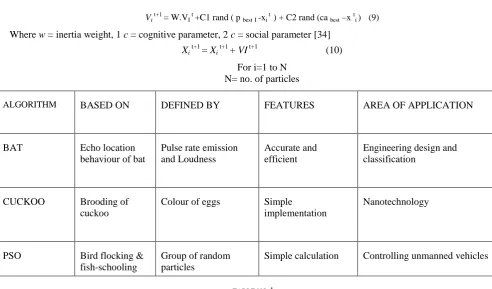
This algorithm is mainly inspired from bird flocking & fish-schooling introduce by James Kennedy and Russell C. Eberhart in 1995. In this technique, potentiality solutions, namely corpuscles fly wounded up the problem place by the present optimum solutions[30].PSO be designed and made for detached adaptation of PSO & the algorithm has been advanced. PSO is a Denizens-based problematic optimization algorithmic program. The major motive of developing about algorithm is founded on the pretence of interpreting animal group behaviours like bird flocking & fish schooling[31]. The obstacle is explained with N variably, then every particle represents an n-dimensional position in the search place. A value (fitness) function is used in the research blank space to calculate the fitness of speck[25]. The particles are at random refined in the solution search space, having its perspective remodel according to its own individual best experience & best particle position of the swarm. In case of PSO, every result of optimization problem is considered as a bird in a particular search space which is known as particle. Each particle has its individual velocity and distance according to which they will find the food and the fitness is predetermine by the optimized function[32]. The PSO helps in describing the solution in d-dimensional space by its each particle. The best value of each particle so far will be termed as pbest and similarly in case of group the best value will be termed as gbest which is surrounded by pbests. This information is analogous to how the performance of other particles. By utilizing the following information
each particle tries to improve its position [24]:
• The distance between recent position and pbest • The distance between recent position and gbest
This represent by the conception of velocity. Velocity of each agent can be modified by the equation (9) in inertia weight approach [33]
ISSN(Online): 2319-8753 ISSN (Print): 2347-6710
I
nternational
J
ournal of
I
nnovative
R
esearch in
S
cience,
E
ngineering and
T
echnology
(An ISO 3297: 2007 Certified Organization)
Website: www.ijirset.com
Vol. 6, Issue 7, July 2017
Where
w = inertia weight, 1 c = cognitive parameter, 2 c = social parameter [34]ALGORITHM BASED ON DEFINED BY FEATURES AREA OF APPLICATION
BAT Echo location behaviour of bat
Pulse rate emission and Loudness
Accurate and efficient
Engineering design and classification
CUCKOO Brooding of cuckoo
Colour of eggs Simple
implementation
Nanotechnology
PSO Bird flocking & fish-schooling
Group of random particles
Simple calculation Controlling unmanned vehicles
TABLE NO.1
II.RELATEDWORK
The related work or literature of the research helps to determine the areas which might be improved in the near future. In order to identify the information that can be extracted from the digital image, optimization techniques are considered the best option. The optimization technique to explore a finite subset the possible value to obtain the parameters that minimize the generalization signal to noise ratio and mean square error by improving the visual of the image and to extract that information only which is a primary source for any vision and image processing applications that are used in different areas as computer vision, biomedical image analysis etc. Zhiwei et al.[19] proposed that surface was the indispensable component for remote detecting picture grouping, notwithstanding, this was difficult to be portrayed and perceived by PC vision, because of which, bunches of methodologies had been displayed to recognize surface picture. Among these strategies, bolster vector machine (SVM) could be considered as the best one, which took focal points of evading neighbourhood ideal, vanquishing After applying all these 4 steps, we get a filtered image that contains only text regions. Measurement fiasco with few examples. In any case, the determination of the part work parameter and mistake punishment figure had affect on the exactness of SVM prominently. For learning the various parameters of SVM few strategies have been developed. Silviu-Ioan et al. [20] discussed the need of optimization algorithms to be applied to image processing problems. In this paper some aspects related to the behaviour of the BAT and CSO algorithms were presented. The results obtained related to accuracy and the dispensation time depend on the characteristics of input images, selected optimization criterion, search space dimension and, parameters of the chosen optimized algorithm. The 2 nature inspired optimization algorithms were studied first, in case of some mathematical function criticism and then biomedical image. This paper proceeds with the examination of other nature propelled metaheuristic calculation clarified in. M. Wozniak, D.polap[21] studied the application of CSA which helped to find basic in examining 2D images. The position of Human face appearance, detailed objects like mechanisms or some nature elements (trees or shades) could be efficiently searched for. High contrast of each pixel in relation to surroundings increases CSA efficiency. If the algorithm must find points among many pixels of similar kind it might be complicated. For example, if photos were taken during the night, all objects of dark properties were darkened, therefore these areas might be not so easy to find. All these made processes more complicated. R. Dwivedi et al.[22] studied the
Vi t+1 = W.VI t +C1 rand ( p bestI -xi t ) + C2 rand (ca best –x ti ) (9)
Xi t+1 = Xi t+1 + VIt+1 (10) For i=1 to N
ISSN(Online): 2319-8753 ISSN (Print): 2347-6710
I
nternational
J
ournal of
I
nnovative
R
esearch in
S
cience,
E
ngineering and
T
echnology
(An ISO 3297: 2007 Certified Organization)
Website: www.ijirset.com
Vol. 6, Issue 7, July 2017
bio-propelled Bat Calculation which was utilized for the picture location in a two dimensional picture. The approach had been effectively created. The proposed the approach utilized nearby varieties of picture power to distinguish edges. The development of the specialists was according to the metaheuristic Bat Calculation. The proposed approach was quicker and memory productive as a result of the negligible information informational collection preparing amid the execution. S. Induja, Dr. V.P. eswaramurth[23] discussed the benefit of ease and additionally flexibility associated with BAT algorithm. When BAT algorithm was applied the vast variety of problems, as were earlier, was solved and a clear solution was achieved. However, it is very difficult to make any changes to the running BAT algorithm. This research recognized the use of theoretical information of metaheuristic algorithms along with some big issues in real-global packages.
III.METHODOLOGY
Every research is supported by the different procedures and methods. The methodology is the sequence of steps in which the whole process is laid down. It is the way in which the desired result or output is achieved by following the defined procedure.
Fig.no.1
In this paper, the methodology is initiated by the taking the blur satellite images and making a database of that images. The image are converted into the gray scale. Now, the image in gray scale is easy to analysis as it is represented into only two colors i.e. black and white. The next step is to apply the noise in the image to remove the blurriness. The gray scale image is ready for the preprocessing techniques like the transformation analysis. The transformation that is used for the method is the DCT. The DCT is added to reduce the noise and to obtain the noise free image. The filtration is followed by the application of the various image contrast enhancement techniques. The comparison of BAT,Cuckoo Search and Practice Swarm Optimization techniques are done by the same set of instructions followed by the sample image taken from the dataset.
IV.CONCLUSION
A BAT, CUCKOO and PSO optimization techniques are applied on the datasets of the blur images conditions. The comparison of the different images contrast technique depicts the research being conducted for the improvement of visibility.
REFERENCES
[1] J. R Jensen, Introductory Digital Image Processing: A Remote Sensing Perspective, 3rd revised ed., Prentice Hall, 2004.
[2] X.-W Liu, Wang L., “Texture classification using spectral histograms‟‟,IEEE Transactions on Image Processing, vol. 12, no. 6, pp. 661-670,2003,.
[3] M. Crosier, L. D Griffin.,“Using basic image features for texture classification”,International Journal of Computer Vision, vol. 88, pp. 447-460, 2010.
Convert the blur image to gray scale image
Apply DCT to reduce the noise
Apply the BAT, Cuckoo Search, and Particle Swarm Algorithm
ISSN(Online): 2319-8753 ISSN (Print): 2347-6710
I
nternational
J
ournal of
I
nnovative
R
esearch in
S
cience,
E
ngineering and
T
echnology
(An ISO 3297: 2007 Certified Organization)
Website: www.ijirset.com
Vol. 6, Issue 7, July 2017
[4] J. B. Florindo, O. M. Bruno,“Texture analysis by multiresolution fractal descriptors”,Expert Systems with Applications, vol. 40, issue 10, pp. 4022-4028 ,2013.
[5] Y. Du, “Texture image classification using Gabor and LBP feature,” Intelligent Data Analysis and its Applications, Advances in Intelligent Systems and Computing, vol. 297,Springer International Publishing, Switzerland, , vol. 1, pp. 329-339, 2014.
[6] L. Nanni, A. Lumini, S. Brahnam, “Survey on LBP based texture descriptors for image classification,” Expert Systems with Applications, vol. 39, issue 3 , pp. 3634-3641, 2012.
[7] O. Regniers, L. Bombrun, et al., “Wavelet-based texture features for the classification of age classes in a maritime pine forest”IEEE Geoscience and Remote Sensing Letters, vol. 12, no. 3, pp. 61-66,2015.
[8] M. Varma, A. Zisserman, “A statistical approach to material classification using image patch exemplars,” IEEE Transactions on Pattern Analysis and Machine Intelligence, vol. 31, issue 11, pp. 2032-2047,2009.
[9] U. Maulik, D. Chakraborty, “A novel semisupervised SVM for pixel classification of remote sensing imagery,” International Journal of Machine Learning & Cybernetics, vol. 3, issue 3, pp. 247-258, 2012.
[10] Z.-Y. Jia,J.-W. Ma, F.-J W. Liu, Wang , “Hybrid of simulated annealing and SVM for hydraulic valve characteristics prediction,” Expert Systems with Applications, vol. 38, issue 7, pp. 8030-8036, 2011.
[11] N. Macek, B. Dordevic, V. Timcenko, M. Bojovic,M. Milosavljevic, “Improving intrusion detection with adaptive support vector machines,” Elektronika Ir Elektrotechnika, vol. 20,no. 7, pp. 57-60, 2014.
[12] Q. Zhang, G. Shan, X. Duan, Z. Zhang, “Parameters optimization of support vector machine based on simulated annealing and genetic algorithm,” in Proceedings of the IEEE International Conference on Future Computer and Communication ,pp. 282-284, 2009.
[13] S. Zhai, T. Jiang, “A novel particle swarm optimization trained support vector machine for automatic sense-through-foliage target recognition system,” Knowledge-Based Systems, vol. 65,pp. 50-59, 2014.
[14] X. S. Yang, “A new metaheuristic bat-inspired algorithm,” in Nature Inspired Cooperative Strategies for Optimization(NISCO‟2010) (Eds. J. R. Gonzalez et al.), Studies in 314 Computational Intelligence, Springer, Berlin, vol. 284,pp. 65-74, 2010.
[15] O. Hasancebi,T. Teke, O. Pekcan, “A bat-inspired algorithm for structural optimization,” Computers and Structures, vol. 128, 2013, pp. 77-90. [16] T. C. Bora, L. S. Coelho, L. Lebensztajn, “Bat-inspired optimization approach for the brushless DC wheel motor problem,” IEEE Transactions on Magnetics, vol. 48, NO. 2, pp. 947-950,2012.
[17] W. Tsai, J. S. Pan, B. Y. Liao, M. J. Tsai, V. Istanda, “Bat algorithm inspired algorithm for solving numerical optimization problems,” Applied Mechanics and Materials, vol. 148-149, pp. 134-137, 2012.
[18] K. Khan and A. Sahai, “A comparison of BA, GA, PSO, BP and LM for training feed forward neural networks in e-learning context,” International Journal of Intelligent Systems and Applications, vol. 4, no. 7, pp. 23-29, 2012.
[19] Z. Ye , L. Ma, M. Wang, H. Chen ,W. Zhao ,“ Texture Image Classification Based on Support Vector Machine and Bat Algorithm”, 8th IEEE International Conference on Intelligent Data Acquisition and Advanced Computing Systems: Technology and Applications, pp.24-26, 2015. [20] S. Bejinariu, H. Costin, F. Rotaru, R. Luca, “ Image Processing by means of Some Bio-Inspired Optimization Algorithms”, 5th IEEE International Conference on E-Health and Bioengineering - EHB ,2015.
[21] M. Wozniak , D. Połap, “Concept of Cuckoo Search Algorithm for 2D Images Processing with Some Research Results - An Idea to Apply Cuckoo Search Algorithm in 2D Images Key-points Search”, 11th International Conference on Signal Processing and Multimedia Applications, Vol. 1 , pp. 157-164,2014.
[22] R. Dwivedi , H .Kaur Sethi , M. Rohilla, “Edge Detection Using BAT ALGORITHM”, Instituted of Electrical & Electronic engineer. Vol-16 ,pp-978-9-3805-4421-2, 2016.
[23] S. Induja, Dr. V.P. Eswaramurthy ,“Bat Algorithm: An Overview and its Applications Bat Algorithm”, International Journal of Advanced Research in Computer and Communication Engineering , Vol. 5, Issue 1, January 2016.
[24] S. Agrawal , R. Panda, “An Efficient Algorithm for Gray Level Image Enhancement Using Cuckoo Search”, Springer-Verlag Berlin Heidelberg (SEMCCO) , LNCS 7677, pp. 82–89,2012.
[25] S. Ghosh, S. Roy, U. Kumar, A. Mallick ,“Gray Level Image Enhancement Using Cuckoo Search Algorithm”, Advances in Signal Processing and Intelligent Recognition Systems, Advances in Intelligent Systems and Computing 264, DOI: 10.1007/978-3-319-04960-1_25, 2014.
[26] M. U. Aneesh, A K Masand , K. Manikanta, “Optimal Feature Selection based on Image Pre-processing using Accelerated Binary Particle Swarm Optimization for Enhanced Face Recognition” ,International Conference on Communication Technology and System Design, pp. 1877-7058, 2012.
[27] B. Biswas, P. Royb, R. Choudhuria and B. Kanti, “Microscopic image contrast and brightness enhancement using multi-scale retinex and cuckoo search algorithm”, 4th International Conference on Eco-friendly Computing and Communication Systems (ICECCS) , pp. 348 – 354, 2015. [28] Dawid Połap, Marcin Wo´zniak, Christian Napoli and Emiliano Tramontana, “Real-Time Cloud-based Game Management System via Cuckoo Search Algorithm”, International JournaL of Electronics and Telecommunications, Vol. 61, No. 4, pp. 333–338,2015.
[29] X. Yang , A. H. Gandomi ,“Engineering Optimisation by Cuckoo Search”, International Journal Mathematical Modelling and Numerical Optimisation, Vol. 1, No. 4, pp.330–343, 2010.
[30] C. Karri, U. Jena, “Fast vector quantization using a Bat algorithm for image compression” , Engineering Science and Technology International Journal , pp.769–781, 2015.
[31] V. Rajinikanth , J.P. Aashiha, A. Atchaya, “Gray-Level Histogram based Multilevel Threshold Selection with Bat Algorithm”, International Journal of Computer Applications (0975 – 8887). Vol. 93, pp1-8, 2014.
[32] Z. Ye, M. Wang, Z. Hu, Wei Liu ,“An Adaptive Image Enhancement Technique by Combining Cuckoo Search and Particle Swarm Optimization Algorithm”, Hindawi Publishing Corporation Computational Intelligence and Neuroscience ,Vol. 24, Article ID 825398, pp.12-19,2015.
ISSN(Online): 2319-8753 ISSN (Print): 2347-6710
I
nternational
J
ournal of
I
nnovative
R
esearch in
S
cience,
E
ngineering and
T
echnology
(An ISO 3297: 2007 Certified Organization)
Website: www.ijirset.com
Vol. 6, Issue 7, July 2017
[34] Y. Gigras, k.Gupta, Vandana, K.Choudhary ,“A Comparison between Bat Algorithm and Cuckoo Search for Path Planning‟‟, International Journal of Innovative Research in Computer and Communication Engineering , Vol. 3, Issue 5, 2015 .
[35] D. Połap, M. Wo´zniak, C. Napoli, E. Tramontana, “Real-Time Cloud-based Game Management System via Cuckoo Search Algorithm‟‟, international journal of electronics and telecommunications, Vol. 61, pp. 333–338 , 2015.