Environmental
Policy Toolkit
for
Greening SMEs
in the EU Eastern
Partnership countries
About the OECD
The OECD is a unique forum where governments work together to address the economic, social and environmental challenges of globalisation. The OECD is also at the forefront of efforts to understand and to help governments respond to new developments and concerns, such as corporate governance, the information economy and the challenges of an ageing population. The Organisation provides a setting where governments can compare policy experiences, seek answers to common problems, identify good practice and work to co-ordinate domestic and international policies.
The OECD member countries are: Australia, Austria, Belgium, Canada, Chile, the Czech Republic, Denmark, Estonia, Finland, France, Germany, Greece, Hungary, Iceland, Ireland, Israel, Italy, Japan, Korea, Luxembourg, Mexico, the Netherlands, New Zealand, Norway, Poland, Portugal, the Slovak Republic, Slovenia, Spain, Sweden, Switzerland, Turkey, the United Kingdom and the United States. The European Union takes part in the work of the OECD.
Since the 1990s, the OECD Task Force for the Implementation of the Environmental Action Programme (the EAP Task Force) has been supporting countries of Eastern Europe, Caucasus and Central Asia to reconcile their environment and economic goals.
About the EaP GREEN programme
The “Greening Economies in the European Union’s Eastern Neighbourhood” (EaP GREEN) programme aims to support the six Eastern Partnership countries to move towards green economy by decoupling economic growth from environmental degradation and resource depletion. The six EaP countries are: Armenia, Azerbaijan, Belarus, Georgia, Republic of Moldova and Ukraine. The programme is structured around three components: (1) Governance and financing tools for sustainable consumption and production (SCP) and green economy; (2) Strategic Environmental Assessment and Environmental Impact Assessment accompanying SCP policy implementation; and (3) demonstration projects. Governments and the private sector are the key target groups of EaP GREEN.
The programme is financially supported by the European Union and other donors, and is jointly implemented by four international organisations – OECD, UNECE, UNEP, and UNIDO. The total EaP GREEN budget for a period of implementation of 48 months is 12.5 million Euros. Although the programme is regional, many of its activities will be implemented nationally and the results shared in various regional forums.
Foreword
Reducing the environmental impact of small and medium-sized enterprises (SMEs) in both manufacturing and services is a key success factor in greening the economy. Improving the environmental performance is also a significant business opportunity for SMEs themselves as important suppliers of goods and services.
However, the willingness and capability of SMEs to adopt sustainable practices and seize green business opportunities generally face size-related resource constraints, skill deficit and knowledge limitations. SMEs are often unaware of many financially attractive opportunities for environmental improvement. There is a widespread misperception that protecting the environment is associated with technical complexity, burdens and costs. Even when they are aware of the potential of better environmental performance to improve a firm’s competitiveness, a lack of appropriate skills and expertise commonly prevents firms from acting upon win-win opportunities. At the same time, the lack of resources often leads to SMEs being risk-averse and less willing to invest in new technologies, partly because of the uncertainly about the payback period.
The objective of this Environmental Policy Toolkit for SME Greening is to help governments in the European Union’s Eastern Partnership (EaP) countries (Armenia, Azerbaijan, Belarus, Georgia, Moldova and Ukraine) to design and implement key instruments to promote environmental compliance and green business practices among SMEs using the existing good practices in EU and other OECD countries. It has been developed within the framework of the initiative “Greening Economies in the Eastern Neighbourhood” (EaP GREEN) funded primarily by the European Commission (EC) and implemented by the OECD in partnership with the UNEP, UNIDO and UNECE. Besides key government stakeholders (first of all, ministries of environment and economy), the target audience of this document includes business associations as well as non-governmental and academic institutions in EaP countries.
The Toolkit focuses predominantly on environmental policy instruments to promote green behaviour of SMEs. It covers three categories of instruments: regulatory simplification and incentives, information-based tools (which comprise both providing advice and guidance to businesses and providing their customers and the public at large with information about their green practices), as well as financial and economic incentives. These instruments should be complemented by appropriate industrial development, regional development and science and technology policies that lie outside the scope of this Guide. The Guide draws on the past OECD analysis on SME-related policies, the extensive work that the EC has done to implement the 2008 Small Business Act for Europe, as well as other relevant literature.
The interim draft of the Environmental Policy Toolkit for SME Greening was discussed by EaP country experts at a regional meeting in Kiev, Ukraine on 12 February 2015.
4 – TABLE OF CONTENTS
Table of contents
Foreword ... 3
Acronyms ... 6
Executive summary ... 9
Improving regulation of SMEs with low environmental risk ... 9
Providing information, advice and guidance ... 10
Recognising green practices ... 11
Offering financial incentives... 12
Sending right market signals ... 12
Building institutional partnerships ... 12
1. SME greening: Opportunities and challenges ... 15
1.1 Definition of SMEs ... 15
1.2 Role of SMEs in greening the economy ... 16
1.3 Obstacles to improving environmental performance of SMEs ... 17
2. Current environmental policies targeting SMEs in EaP countries ... 21
2.1 Regulatory regimes ... 21
2.2 Existing policy incentives ... 22
2.3 Technical and financial support for green practices ... 23
2.4 Institutional challenges ... 24
3. Regulatory tools ... 27
3.1 Simplified permitting and general rules ... 27
3.2 Better regulation initiatives for small businesses ... 29
3.3 Incentives for environmental management certification ... 30
3.4 Sectoral approach to compliance assurance ... 31
4. Information-based instruments ... 33
4.1 Advice and guidance ... 33
4.1.1 Designing effective messages ... 33
4.1.2 Proactive information dissemination ... 36
4.1.3 Web-based guidance tools ... 37
4.1.4 Direct capacity building ... 40
4.2 Recognition of green practices ... 42
4.2.1 Simplified environmental management systems ... 42
4.2.2 Sector-specific green certifications ... 44
4.2.3 Eco-labels ... 45
4.2.4 Environmental recognition awards ... 47
5. Economic incentives ... 48
5.1 Tax privileges ... 48
5.2 Soft loans ... 49
5.3 Grants and free consultancy services ... 50
5.4 Role of supply chain management and public procurement ... 51
6. Institutional aspects of greening small businesses ... 55
6.1 Building capacity of government actors in environmental outreach to SMEs ... 55
6.2 Involvement of trade associations and other business groups ... 57
6.3 Enhancing the role of banks, accounting and insurance companies ... 59
Bibliography... 61
Tables Table 1. Internal barriers in SMEs that prevent the adoption of environmental improvements ... 19
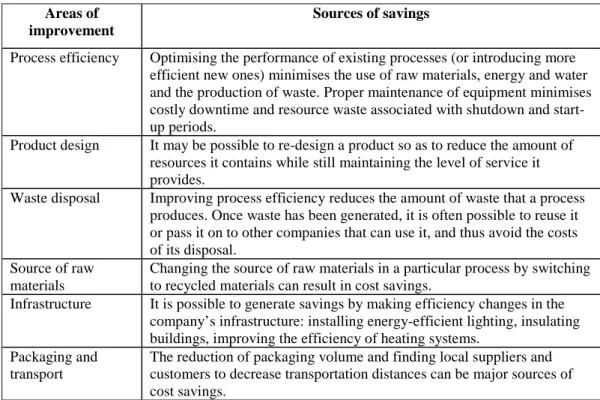
Table 2. Cost savings from environmental improvements in SMEs ... 34
Figures Figure 1. Percentage of SMEs receiving support for resource efficiency actions ... 23
Figure 2. Manufacturing of certified green products in Korea ... 46
Figure 3. Size of the green product market and public procurement in Korea ... 54
Boxes Box 1. Policy initiatives for SME greening in the EU ... 17
Box 2. Examples of financing sources for energy efficiency and renewable energy in Armenia ... 24
Box 3. General binding rules in the Netherlands ... 28
Box 4. NetRegs – an internet-based compliance assistance tool in the UK ... 39
Box 5. GreenEcoNet: The first pan-European website for SME greening ... 40
Box 6. Green Offer by Enterprise Ireland ... 41
Box 7. Environmental certification of SMEs in Norway ... 43
Box 8. Financial incentives for environmental investments in the Netherlands ... 48
Box 9. Low-interest loans for green investments: Examples from selected countries ... 49
Box 10. Subsidies for environmental technology investments in Belgium ... 50
Box 11. OECD Recommendation on the Environmental Performance in Public Procurement ... 53
Box 12. Institutional network for SME environmental compliance assistance in the United States... 56
Box 13. Benefits of trade associations to SMEs ... 58
6 – ACRONYMS
Acronyms
ACFCI Association of French Chambers of Commerce and Industry
ADB Asian Development Bank
ADEME Environment and Energy Management Agency (France) CSR Corporate social responsibility
Defra Department of Environment, Food and Rural Affairs (UK)
DG Directorate-General
EA Environment Agency (UK)
EaP European Union’s Eastern Partnership
EaP GREEN Greening Economies in the Eastern Neighbourhood initiative EBRD European Bank for Reconstruction and Development
EC European Commission
ECAP Environmental Compliance Assistance Programme EDTP Enterprise Development and Training Programme
EEN Enterprise Europe Network
EIA Environmental impact assessment
EIB European Investment Bank
EMAS Eco-Management and Audit Scheme
EMS Environmental management system
EPA Environmental Protection Agency
EPD Environmental product declarations
EPs Equator Principles
EU European Union
FI Finance institution
GBR General binding rule
GPP Green public procurement
IFC International Finance Corporation IFI International finance institution
KfW German public bank “Kreditanstalt für Wiederaufbau”
KRW South Korean won
MIA Environmental Investment Allowance, the Netherlands
NGO Non-governmental organisation
NIEA Northern Ireland Environment Agency
ODIMM Organisation for Small and Medium Enterprises Sector Development (Moldova)
OECD Organisation for Economic Co-operation and Development SEPA Scottish Environment Protection Agency
SME Small and medium-sized enterprise
SME DNC SME Development National Center (Armenia)
UK United Kingdom
UNECE United Nations Economic Commission for Europe
UNEP United Nations Environment Programme
UNIDO United Nations Industrial Development Organization
VAMIL Arbitrary Depreciation of Environmental Investments, the Netherlands VIBES Vision in Business for the Environment of Scotland initiative
Executive summary
Although the individual environmental footprint of small and medium-sized enterprises (SMEs) may be low, they constitute a vast majority of businesses, and their aggregate impact is considerable. At the time when a growing number of large companies worldwide recognise the advantages of cleaner production in terms of reduced costs of resources, environmental compliance, and customer relations, most SMEs lack the understanding that higher environmental performance can be a competitive advantage. Most importantly, they have limited capacity to interpret and respond to relevant regulatory requirements and policy incentives.
Many EU and other OECD countries have addressed this challenge by implementing information-based tools and regulatory and economic incentives to encourage SMEs to improve their environmental performance, to comply with regulatory requirements and adopt broader green practices that are not mandated by the law (i.e. go beyond compliance). However, EU Eastern Partnership (EaP) countries (Armenia, Azerbaijan, Belarus, Georgia, Moldova and Ukraine) have so far given little consideration to the greening of small businesses, and lack the legal, policy and institutional means to enhance the environmental performance of SMEs.
There is a great variety of strategies and instruments that should be used as part of a policy mix to promote environmental compliance and green business practices, including:
• Regulatory tools: simplification of regulatory requirements for SMEs through standardised permits or general binding rules as well as other better regulation initiatives; offering regulatory incentives for the establishment of environmental management systems; moving towards sector-specific strategies for compliance assurance;
• Information-based instruments: advising individual businesses directly or disseminating guidance on environmental compliance and good practices to a wide audience in the printed and, increasingly, electronic form; introducing sector-specific certifications and eco-labels as well as other environmental recognition awards;
• Economic incentives: grants, low-interest loans and tax incentives for businesses willing to go beyond compliance and invest in greener technologies; encouraging supply chain pressure from larger companies and exerting it through green public procurement.
Based on the analysis of OECD countries’ good practices, this SME Greening Toolkit
suggests several ways to effectively design and implement these tools with respect to the SME community.
Improving regulation of SMEs with low environmental risk
There is a marked trend in OECD countries to simplify environmental regulatory requirements for SMEs that are characterised by a low level of environmental risk. This
10 – EXECUTIVE SUMMARY
simplification generally involves replacing bespoke environmental permitting with standardised requirements (e.g. general binding rules) for specific activities with low environmental risk that are practiced by a large number of operators and employ similar technologies. Rules that require operators to notify, or register with, the competent environmental authority before engaging in an activity are preferable in terms of the regulator’s knowledge of the regulated community and control over its potential environmental impacts.
Another way to reduce the administrative burden on SMEs is to ensure collaboration between environmental and non-environmental regulators to identify opportunities to reduce duplication in paperwork and conduct through joint or delegated inspections in selected sectors. Introducing elements of compliance self-assessment by operators of low-risk facilities (e.g. as part of an environmental management system) would not only contribute to the reduction of the administrative burden but also improve the efficiency of compliance monitoring.
While environmental regulations tend to refer to activities (which may or may not correspond to a specific economic sector), efforts to promote compliance with them should generally be sector-based because businesses (particularly SMEs) respond primarily to messages adapted to their sector. The sectoral approach to outreach is part of a larger customer service perspective that environmental regulators should adopt in their relationship with small businesses. Environmental enforcement authorities should work to strengthen their own staff’s capacity to regulate and advise small businesses in specific sectors.
Providing information, advice and guidance
The government’s environmental outreach to SMEs includes compliance promotion and larger efforts to encourage green business practices. The rapid expansion of web-based guidance, an undoubtedly modern and cost-effective communication tool, does not yet dominate to the preferences of SMEs: only a minority of small businesses has rated the internet as their favourite way of receiving environmental information. While in the long term web-based guidance is likely to become the primary source of support for SMEs, in the short and medium term online tools need to be complemented by other, more traditional instruments such as paper and electronic mailings, brochures and workshops.
Packaging the information and formulating the right message is crucial for the effectiveness of communication tools. Business benefits of improved environmental performance (in terms of increased efficiency and competitiveness) should be the main “selling point” of environmental outreach to SMEs. In making the “business case”, it may be particularly useful to present examples of other similar companies receiving commercial benefits as a result of the environmental management improvements in question.
The instruments of environmental outreach should be carefully tailored to the nature and needs of small businesses. Guidance should be concise and clearly distinguish between legal requirements and good practices in order to avoid excessive efforts by small businesses to achieve compliance. It should contain a simple message about the problem, its solution (step-by-step guidance) and where to go for more information. The most appropriate communication channels are likely to be sector-specific, reflecting the different business models and activities within different sectors. Government bodies,
including ministries of economy and environment, should work in partnership with trade associations and business support organisations to elaborate and disseminate environmental guidance, which would add to its credibility.
Non-government actors (including business associations and consulting companies) can provide direct capacity building support to businesses through audits of different aspects of their environmental management, demonstration projects and their follow-up. Capacity building and support for enterprises may also cover activities such as development and dissemination of methodological materials and case studies, as well as the implementation of training programmes. Key success factors of capacity building activities include:
• Involving multiple public sector organisations and industry associations in programme design, implementation and strategic oversight;
• Affordability of the support services, which has a major influence on their uptake by SMEs;
• Consideration of economic impacts of green practices (on companies’ profitability, employment, competitiveness, etc.);
• Promoting the programme’s achievements, including through publicising success as case studies;
• Using local delivery partners to enable capacity building programmes to gain local knowledge, credibility and accountability; and
• Regular, independent and impartial evaluation.
Recognising green practices
Small businesses face serious obstacles in implementing environmental management systems (EMSs), including a lack of resources, knowledge and technical capacity, high upfront costs, and low public visibility. The challenge is to tailor EMSs, both in terms of their content and delivery, to the particularities of SMEs. With regard to SMEs, it is important to focus on simple, accessible improvements in management practices. EMSs with varying degrees of complexity and low on paperwork as well as sectoral green label schemes are more likely to be attractive to small businesses than formal ISO 14001 certification, which is relatively complex and costly.
Sector-specific green certification (of business practices) and eco-label schemes (for products) also contribute to an increased demand for green business practices. Green certification and eco-labelling schemes should be designed in a way that the business benefits to SMEs outweigh both the direct costs in terms of fees that must be paid to obtain certification and the indirect costs of staff time to be spent complying with their requirements. It is important to communicate to a broad audience to raise the recognition of the certification or eco-label, starting at a very early stage of the scheme’s development. Trade associations should design marketing and promotional materials which a business could use to display to its customers its “green credentials”.
12 – EXECUTIVE SUMMARY
Offering financial incentives
Governments may introduce tax privileges (accelerated amortisation, reduced property or corporate taxes) and favourable loan policies through public financial institutions to SMEs willing to invest in green technologies. As a matter of principle, governments should not provide subsidies to businesses for achieving compliance with environmental requirements.
Government authorities should encourage private banks and insurance companies to provide incentives for good environmental performance of small businesses. Banks may require an environmental checklist for loan approval, and insurers may demand a statement of environmental risk identification and control. Banks and insurers can also offer better loan or insurance policy conditions to businesses with green credentials.
Direct subsidies and free technical assistance to SMEs help to increase their awareness and secure their initial engagement in green practices. However, given the limited availability of public funding for promoting compliance and green business practices, a gradual transition toward a fee-based system for technical assistance would improve its long-term sustainability.
Sending right market signals
Governments should exert direct supply chain pressure by developing and implementing green public procurement policies as a way to encourage potential SME suppliers to offer environmentally friendly goods and services. To reach SMEs, government agencies responsible for public procurement should communicate their green purchasing policy to a wide range of stakeholders, including present and future suppliers, service providers or contractors, so that they can take account of the new requirements. Governments should encourage larger firms to form partnerships with smaller suppliers on improving their environmental performance and provide public recognition to those who do so.
Building institutional partnerships
Environmental authorities have regulatory competency over only part of the SME community, and they are not the primary interlocutors of small businesses. However, in OECD countries they often coordinate the efforts of other public and private actors to promote green behaviour of SMEs. In EaP countries, this role is increasingly being assumed by ministries of economy. It is important that a national government body take the lead in establishing a network of actors engaged in helping SMEs improve their environmental performance. Once such a network has been created, its member institutions should perform the crucial “signposting” function of providing businesses with references to direct operators of multiple governmental and non-governmental programmes promoting different aspects of green business. The government (ministry of economy or industry) may also provide assistance with the creation of eco-industrial and similar business networks promoting green business behaviour.
Working in partnership with business groups can be particularly useful as many SMEs do not respond to outreach activities conducted by regulatory government agencies due to suspicion and fear. Feedback from businesses groups is extremely useful in developing and improving compliance assistance programmes. Business associations can help small businesses to improve profitability through environmental management, e.g.
by developing marketing and promotional materials which a business could use to display to its customers its “green credentials” and practices. Business organisations can also have a role in providing sector-specific technical assistance to companies introducing green practices.
1. SME greening: Opportunities and challenges
1.1 Definition of SMEs
The legal definition of SMEs varies by country and by industry. In addition to the number of employees, methods used to classify small companies include annual sales (turnover), value of assets and net profit (balance sheet), alone or in a mixed definition. The definition in the European Union (EU) is that an SME is an enterprise of less than 250 employees, with a turnover below EUR 50 million or balance sheet total not exceeding EUR 43 million. A small business is defined as having less than 50 employees with a less than EUR 10 million balance sheet, and a micro-business would have less than 10 employees and less than EUR 2 million balance sheet.
Among EaP countries, the definition of an SME in terms of the number of employees is identical to that of the EU in Armenia, Moldova and Ukraine (in the former two countries the turnover thresholds have been adjusted to the average income levels, which are much lower than in the EU). Belarus defines micro-enterprises as having up to 15 employees, small companies have up to 100 employees, and medium-sized firms up to 250 (there is no turnover criterion). Georgia has set lower thresholds: 20 employees for small enterprises and 100 for medium-sized ones. In Azerbaijan, the thresholds for “small enterprises” (a single category) vary depending on the economic sector: 50 employees in industry, 25 in agriculture, 10 in services, etc.
At the same time, environmental regulatory regimes are designed around environmental risk and not to address any particular company size. No environmental regulation specifically targets SMEs, instead distinguishing low-risk activities and installations, although regulatory guidance usually keeps in mind particular features of small businesses. Environmental enforcement authorities are not systematically aware of the number of SMEs they regulate and do not collect this information.
It is not easy to define low risk to human health and the environment. Environmental regulators in different countries have very different risk tolerances, driven in part by their mandate and the institutional context. In practice, low-risk installations are usually defined “by exclusion”, i.e. as those that are not considered high-risk. Risk assessment criteria typically relate to the environmental hazard of a regulated facility (its complexity in terms of impacts on different environmental media, location with respect to urban and environmentally sensitive areas, volume of pollution releases and potential for accidents) and to its operator’s performance (compliance record and environmental management practices). Low-risk installations are generally eligible for a simplified regulatory regime.
The environmental legislation of EaP countries defines an enterprise as having low, medium or high environmental risk depending on their economic activity and potential environmental impact. For example, in Georgia and Belarus economic activities with high environmental impact are defined in relation to the requirement to undergo an environmental impact assessment (EIA). Low environmental impact may also be defined
16 – SME GREENING: OPPORTUNITIES AND CHALLENGES
with respect to certain environmental media: in Belarus, no air emission limits are set for low-impact facilities.
This Guide uses the term ‘SMEs’ as a more widely accepted term, particularly in the context of greening the economy and in recognition of the specific regulation and compliance challenges related to small businesses. However, it focuses on those SMEs that are considered by relevant environmental regulators to be low-risk installations.
1.2 Role of SMEs in greening the economy
SMEs account for approximately 99% of all enterprises (of which over 90% of enterprises are micro-enterprises) and two-thirds of employment across the OECD area. Although small businesses’ individual environmental footprint may be low, their aggregate impact can, in some respects, exceed that of large businesses. For example, SMEs account for 60-70% of industrial pollution in Europe (Miller, 2011). The key sectors where SMEs have a significant environment impact include livestock farming, construction, metal finishing, waste treatment, food and drink industry, textile and leather manufacturing, etc.
Reducing the environmental impact of SMEs through achieving and going beyond environmental compliance in both manufacturing and services is a key success factor in greening the economy. SMEs are important for green growth as key drivers of eco-innovation and key players in emerging green industries. Growing opportunities exist in the services associated with greener manufacturing. Highly creative and innovative SMEs in the service industry, such as design and architecture firms or bio-energy solution providers, contribute increasingly to eco-innovation across a broad range of industries. New and young firms are particularly important for radical green innovations, as they often exploit technological or commercial opportunities which have been neglected by more established companies or even challenge the business models of existing firms.
The “green transformation” is also a significant business opportunity for SMEs themselves as important suppliers of goods and services. Indeed, the principal drivers for SMEs to adopt green practices are non-regulatory and include:
• The rising price of commodities and key raw materials;
• Potential cost savings and competitive advantage; and
• Market pressure from customers.
However, the willingness and capability of SMEs to adopt sustainable practices and seize green business opportunities generally face size-related resource constraints, skill deficit and knowledge limitations. SMEs are often unaware of many financially attractive opportunities for environmental improvement. There is a widespread misperception that protecting the environment is associated with technical complexity, burdens and costs. Even when they are aware of the potential of better environmental performance to improve a firm’s competitiveness, a lack of appropriate skills and expertise commonly prevents firms from acting upon win-win opportunities. At the same time, the lack of resources often leads to SMEs being risk-averse and less willing to invest in new technologies, partly because of the uncertainly about the payback period.
The UK Carbon Trust poll found that 65% of consumers want to purchase products from environmentally responsible companies. Yet more than half of SMEs see a greener
economy as a threat, about half of small businesses believe that benefitting from the green economy requires a lot of investment capital, and only 22% think that investing in green products and services will lead to higher profits (Carbon Trust, 2011).
For SMEs, going green is largely a voluntary action dependent upon the vision and conviction of one or a few individuals. Many SMEs are willing to invest in more energy-efficient and environmentally friendly processes, but they require reliable partners in financing their investments and the right regulatory framework. However, they often face obstacles in getting access to finance, with banks being reluctant to fund such investments and lacking the specialised staff needed to evaluate SME projects.
The increasing number of business associations in OECD countries (for example, the UK Forum of Private Businesses1) are asking their governments to provide support to SMEs in the transition to the green economy by making sure that regulations are easy to understand and take account of the needs of small businesses; providing clearer information on the range of green choices available and their practical and financial aspects; and using financial incentives to give small businesses confidence to invest in green technologies and management systems. In order to address these needs, the EU has undertaken a number of policy initiatives to support the green transformation of SMEs (Box 1).
Box 1. Policy initiatives for SME greening in the EU
The concerns of small businesses have become a priority as governments across the EU introduce better regulation initiatives. The Small Business Act for Europe (2008) was developed to establish the “Think Small First” approach to policy making and regulation and to promote SMEs’ growth. One of its ten high-profile principles is “enable SMEs to turn environmental challenges into opportunities” – a paradigm which lies at the heart of the transition to green growth. The European Commission has committed itself to “rigorously assessing the impact of forthcoming legislation and administrative initiatives on SMEs (“SME test”) and taking relevant results into account when designing proposals”.
The European Commission has recently prepared a Green Action Plan for SMEs, which aims to:
• Improve resource efficiency of European SMEs;
• Support green entrepreneurship;
• Exploit the opportunities of greener value (supply) chains; and
• Facilitate market access for green SMEs. Source: EC, 2008; EC, 2014b
1.3 Obstacles to improving environmental performance of SMEs
Recent research has shown that while SMEs account for approximately 64% of the industrial pollution in the EU, only very few of them proactively engage in actions to reduce their environmental impact: 3-4% of micro-businesses, 7-8% of small companies and 6-7% of medium-sized companies (Calogirou et al., 2010).
For the government, the environmental regulation of SMEs represents a major challenge due to the diversity of SMEs’ activities and respective environmental issues,
18 – SME GREENING: OPPORTUNITIES AND CHALLENGES
the substantial number of operators, and the lack of information available to the regulator about their levels of compliance. The majority of SMEs are “vulnerably compliant” (EC, 2002), in the sense that they do not know enough about environmental requirements to ensure that they always comply with all of them.
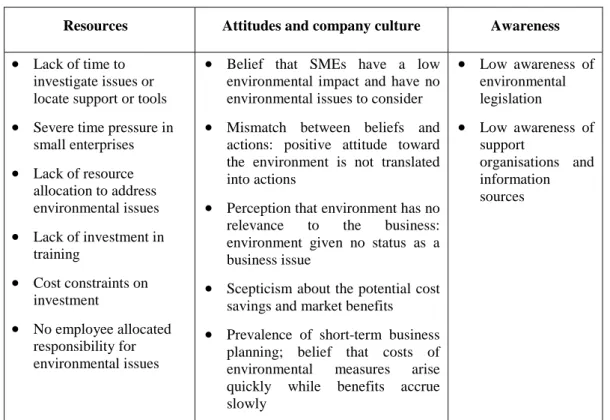
What motivates SMEs and their owners is likely to be very different from what motivates large corporations. Despite their heterogeneity, SMEs have many common characteristics that influence their approach to environmental issues and the implementation of green practices; both in achieving and going beyond compliance (see also Table 1):
• Ownership and management are concentrated on the same hands. The entrepreneur plays a key role in the enterprise and his personal preference is usually the most influential factor when deciding about investments and business strategies.
• This entrepreneur is very likely to suffer from important time and task pressure, which leaves him with little time to reflect strategically on future activities beyond the core business of the company. This could imply that investments that are not related to core business are regarded as secondary and suffer from the lack of attention.
• SMEs have a limited capacity (lack of resources, time and expertise) to absorb environmental requirements and to comply with them, as well as a low awareness of the need to address their environmental impacts.
• The entrepreneur himself usually is not well informed about opportunities of the relevant green practices, their costs and benefits. Given this time and task pressure, SMEs usually rely heavily on the opinion of their professional surrounding (trade associations, suppliers, clients, accountants, etc.), which often have the same lack of information.
• The entrepreneur is often risk-averse given the relatively small economic size of the enterprise. Uncertainty may be associated with operational issues within companies, such as the capacity to absorb and implement the change required to improve environmental performance. These include uncertainty about the most appropriate technology to be used and the lack of knowledge on how to incorporate green practices into the core business planning.
• The required pay-back for new investments is often as short as two-three years (it is also a function of the cost of capital). Generally, environmental technologies encompass higher costs in the short term whereas the extra benefits are realised in the longer term, which hinders their adoption by SMEs. Limited access to finance is also a key limitation. The most common environmental issues for SMEs, such as resource and energy savings, which usually are not related to the core business of the company, are only addressed if actions are likely to result in a substantial cost reduction in the short term.
• SMEs experience little external pressure to behave in a more environmentally friendly manner. It is difficult for NGOs or customers to assign specific negative environmental consequences to one or more SMEs, while it is much easier to
target large well known enterprises. Furthermore, governments in general avoid increasing external pressure on SMEs by environmental legislation.
Table 1. Internal barriers in SMEs that prevent the adoption of environmental improvements
Resources Attitudes and company culture Awareness
• Lack of time to investigate issues or locate support or tools
• Severe time pressure in small enterprises • Lack of resource allocation to address environmental issues • Lack of investment in training • Cost constraints on investment • No employee allocated responsibility for environmental issues
• Belief that SMEs have a low environmental impact and have no environmental issues to consider
• Mismatch between beliefs and actions: positive attitude toward the environment is not translated into actions
• Perception that environment has no relevance to the business: environment given no status as a business issue
• Scepticism about the potential cost savings and market benefits
• Prevalence of short-term business planning; belief that costs of environmental measures arise quickly while benefits accrue slowly • Low awareness of environmental legislation • Low awareness of support organisations and information sources Source: EC, 2002
The latest Eurobarometer survey of EU SMEs (EC, 2013) looked at reasons for inaction on resource efficiency. Approximately 26% of European SMEs said that administrative or legal procedures were complex, and 24% said that the cost of environmental actions was a barrier. In addition, 20% indicated that they were hampered by a lack of specific environmental expertise, and 17% experienced problems in choosing the right actions for the company.
Half of SMEs in the EU (51%) do not wish to go beyond compliance with applicable regulatory requirements, while 22% are contemplating doing more than required by the legislation, and 19% are doing so already (for 11% of respondents, environmental concerns are part of the company’s priority objectives). The larger the SMEs, the more likely it is to define environmental concerns as a priority. Still, over 90% of SMEs in the EU are taking at least some actions to be more resource-efficient for purely economic reasons. Most common actions relate to minimising waste, saving energy and raw materials.
2. Current environmental policies targeting SMEs in EaP countries
2.1 Regulatory regimes
In all EaP countries, the same regime for setting environmental requirements applies regardless of the facility’s level of environmental risk, which creates a heavy administrative burden for SMEs as well as for regulators. The regulatory system is heavily dominated by single-medium permitting (for air emissions, wastewater discharges and waste disposal) which applies to every enterprise which has respective environmental impacts. Where general binding rules (“technical regulations”) with environmental norms exist, they are not sector-specific and do not distinguish between facilities with different levels of impact.
However, the situation is starting to change as environmental regulators are starting to focus their efforts on enterprises with represent the highest risk. For example, Armenia is taking a first step in the diversification of environmental regulatory regimes: the draft law “On environmental impact assessment and expertise” envisages the classification of regulated entities into three categories (A, B and C) with different assessment procedures for each category. Armenia is also developing a law on environmental self-monitoring which would differentiate self-monitoring and self-reporting requirements based on the operator’s environmental impact. Likewise, in Ukraine only operators with higher environmental impact are subject to air emissions self-monitoring and self-reporting.
In Azerbaijan, the draft new Law on Environmental Impact Assessment the differentiation of permitting requirements for enterprises based on their environmental impact, sector and type of economic activity. In Georgia, the regulatory reforms made during 2004-2007 significantly simplified the administrative procedures for all enterprises, including SMEs, by drastically cutting the number of licences and permits, reducing the licence determination period to less than a month, and introducing “one-stop shopping” for all permits and licences.
Other EaP countries are also planning to take similar measures. Moldova’s Small and Medium Enterprise Sector Development Strategy for 2012-2020 envisages adjusting the regulatory framework to match SME needs. Belarus’s National Strategy on Environmental Permitting for 2009-2020 provides for the simplification of the administrative procedures related to environmental permitting of enterprises with low environmental impact by 2015.
The differentiation of regulatory regimes also concerns compliance monitoring. In some EaP countries, the frequency of environmental inspections has been differentiated between broad risk categories. For instance, Armenia is implementing a risk-based system of compliance monitoring. The 2011 amendments to the Law on “Organising and carrying out inspections in the Republic of Armenia” (No. 60 of 2000) and Government Decree No. 1562-N of 2012 stipulated that the frequency of inspections should be based on the assessed level of the enterprise’s environmental risk. The level of risk is determined through a scoring system taking into account the enterprise’s sector-specific
22 – CURRENT ENVIRONMENTAL POLICIES TARGETING SMEs IN EaP COUNTRIES
and individual risks. The inspection frequency for low-risk facilities is set at once every five years.
2.2 Existing policy incentives
EaP countries have generally given little consideration to the greening of small businesses, and lack the legal, policy and institutional means to enhance the environmental performance of SMEs.
The environment ministries and their associate institutions provide regulatory information to the regulated community. Specialised environmental information centres, usually associated with environment ministries, provide assistance in understanding environmental requirements through telephone advice, workshops, and guidelines. For example, in Georgia, the Ministry of Environment and Natural Resources Protection has set up an Environmental Information and Education Centre in 2010 to provide compliance advisory services to companies and individuals. A similar Environmental Information Centre exists within Moldova’s Ministry of Environment. However, these information services rarely reach smaller businesses.
There are a few examples of regulatory incentives for getting certified to an environmental management system (e.g. in Azerbaijan and Belarus). In Belarus, companies deploying an EMS certified in accordance ISO 14001, benefit from financial incentives when calculating environmental tax on air emissions, wastewater discharges and waste disposal. Overall, however, compliance promotion activities are underdeveloped in EaP countries.
At the same time, governments in EaP countries increasingly realise the importance of SME support policies in the context of greening the economy. Ministries of Economy in both Moldova and Armenia are planning to introduce environmental considerations into their strategic documents on SME support activities, but have not yet started the development of specific policy measures.
When a strategy does not have institutional ownership, it is likely to remain a dead letter. In Georgia, a “Green Business Support Strategy for Georgian Private Business Organizations” was developed in 2011 by the Georgian Entrepreneurs Confederation with support from the German government. It recommended establishing an “Information centre for green business”, promoting environmental management systems, disseminating of best practices, developing appropriate financing instruments, etc., but has been implemented only partly. The Georgian Green Business Award was announced by the Ministry of Environment and Natural Resources Protection in October 2013. The award is made in the green company, green product and green building categories and seeks to raise motivation of entrepreneurs in environment protection and social responsibility. However, many other policy tools are still lacking.
All EaP countries except Georgia have extensive pollution tax/charge schemes covering dozens of pollutants. These taxes are payable by all enterprises with respective pollution releases, but the tax rates are too low to provide desired incentives for environmental improvements. All EaP countries impose taxes on environmentally harmful products (such as motor fuels and vehicles), but only several of them (notably Armenia and Moldova) have product taxes mandated by environmental legislation. The environmental incentive impact of these product taxes is equally negligible.
2.3 Technical and financial support for green practices
The situation with government support for SMEs in EaP countries is still very patchy. Governments most often play a passive role in promoting environmental sustainability and best practices and their involvement is generally limited to hosting international donor-funded projects.
Ministries of economy in several EaP countries implement various information and training programmes for small businesses, but they rarely get institutionalised. A positive example can be found in Georgia, where the Ministry of Economy and Sustainable Development has been providing private companies with reliable and actionable industry data and analysis, and making them aware of opportunities, among others, related to the implementation of sustainable business practices2.
According to 2014 SME surveys in Armenia and Moldova (OECD, 2015a; 2015b), only 12% and 23.5% of the companies that undertake resource efficiency measures in the respective countries receive some technical or financial support (Figure 1). The larger the enterprise, the more likely it is to receive some support, which almost never reaches micro-businesses. The lack of government support appears to represent the biggest gap, in stark contrast with the extent of public support activities in the EU (EC, 2013).
Figure 1. Percentage of SMEs receiving support for resource efficiency actions
Source: OECD, 2015a; OECD, 2015b; EC, 2013
Compared to public grants and loan guarantees private financing plays a somewhat bigger role in supporting resource efficiency and in the production of green goods and services in EaP countries. However, the existing private financing mechanisms are generally limited to credit lines provided by international finance institutions (IFIs) (Box 2). Almost all IFIs active in EaP countries have opened such credit lines. These include the European Bank for Reconstruction and Development (EBRD), the International Finance Corporation (IFC), the European Investment Bank (EIB), the Asian Development Bank (ADB), the German public bank Kreditanstalt für Wiederaufbau (KfW), and the Development Bank of Austria. EBRD is by large the most significant financier in the region. A number of IFIs finance relevant environmental activities through credit lines primarily dedicated to SMEs, such as EIB and ADB. In addition, there are a number of
0 5 10 15 20 25 30 35 40 45 50 Public grants or guarantees
Funding from banks or investment companies
Private funding from friends and relatives
Technical assistance from the government
Technical assistance from private consultants Technical assistance from business associations
or customers
Armenia Moldova EU
24 – CURRENT ENVIRONMENTAL POLICIES TARGETING SMEs IN EaP COUNTRIES
multilateral facilities and donor financed platforms that have also issued environmental credit lines to local financial institutions in the region that target SMEs (e.g. the Green for Growth Fund and the Global Climate Partnership Fund). In the Lviv region of Ukraine, the regional government subsidises interest rates of commercial loans for energy efficiency projects in partnership with five private banks.
Box 2. Examples of financing sources for energy efficiency and renewable energy in Armenia
• Inecobank and Araratbank are providing “green loans” for energy saving projects, including energy-efficient lighting, heat insulation, installation of thermal solar systems, etc. These loans are provided with the support of the Green for Growth Fund for Southeast Europe.
• Ameriabank (since 2012) and Anelik bank (since 2010) are providing “renewable energy loans” under the Armenian Sustainable Energy Financing Facility initiated by the EBRD, aiming to support financing of energy efficiency and renewable energy projects of private business in Armenia.
• IFC provided $15 million financing to HSBC Bank Armenia to help the bank support sustainable energy projects and provide loans to SMEs interested in investing in energy efficient technologies and promoting the efficient use of resources.
Source: SME DNC, 2013
International donor-sponsored initiatives to promote SME green development play a substantial role in improving access to finance and know-how for SMEs in the region. While they are not sustainable in the long term, they contribute to building social and environmental responsibility in private banks. In Georgia, a few banks have established environmental management units, and the Bank of Georgia has formally adopted an environmental and social policy and respective procedures.
The positive role of the private sector also manifests itself through greening the supply chain initiatives. Azerbaijan is a good example of how larger companies can assist smaller companies to improve their environmental performance. In 2007, the Enterprise Development and Training Programme (EDTP) was launched with funding from British Petroleum (BP) and its co-ventures. EDTP helps companies to develop their business and become a more competitive and environmentally friendly supplier to BP, its partners and the oil and gas industry as a whole.
2.4 Institutional challenges
The lack of capacity in environmental authorities to develop and implement sector-specific policies, the neglect of environmental compliance promotion activities, the weakness of the “green” component of SME support policies and institutions, and the shortage of resources (besides the limited donor funding) for the support of green business practices constitute the principal institutional challenges in this domain in the EaP region.
Environmental authorities in EaP countries do not have a specialised unit which would be in charge of promoting environmental compliance. The inspectorate is generally
not responsible for compliance promotion activities. These functions are sometimes performed by an information centre within the environment ministry, which elaborates and disseminates environmental literature, educational guides, newsletters, digests and other informational materials.
Ministries of economy are the leading actors in the region in working with SMEs. Specialised SME support organisations under the auspices of the ministry of economy have been established in several EaP countries. The SME Development National Center of Armenia (SME DNC) was created in 2002 to provide state support to SMEs as well as to implement projects on SME sector development using state budgetary resources as well as contributions from international donor organisations. The SME DNC has a well-developed network of regional branches and representative offices covering all regions of Armenia and is coordinated by the central office in Yerevan. The SME DNC provides businesses with information, consulting services and training sessions. It also runs export promotion programmes, supports innovation and effective business models as well as administers financial loan guarantees to start-ups and operating businesses. However, it is only starting to develop activities to promote resource efficiency among SMEs.
In Moldova, the Organisation for Small and Medium Enterprises Sector Development (ODIMM) was created in 2007 as a special office with the main objective of fostering sustainable development of the SME sector. Enterprise Georgia was established in 2014 with a similar mandate.
Local governments can also stimulate SMEs to improve their environmental performance. Thanks to their local knowledge, they are often better placed than central governments to offer tailored measures for local SME development. However, due to financial constraints and other priorities, local governments of EaP countries are not always in a position to use this potential to the fullest. In Armenia and Moldova, local governments have statutory responsibilities in the field of environmental protection and the use of natural resources, but they are not implementing any specific programmes focused on improving SME environmental performance and compliance.
Another major institutional challenge in the region is the weakness of business associations. The existing business organisations, such as chambers of commerce and industry and employers’ associations, are dominated by larger companies, do not give priority to serving the needs of small businesses, and have little knowledge of sustainable production issues. There are very few sector-specific trade associations (especially compared with their abundance in most OECD countries), and their SME membership is quite limited. Small businesses do not see the benefit of collaborating with their competitors and do not receive enough practical support from business associations in exchange for membership fees that they are asked to pay. This makes it much harder for the government to reach out to individual SMEs.
3. Regulatory tools
3.1 Simplified permitting and general rules
Regulators do not usually have strategies that apply only to low-risk facilities – they simply have fewer resources to spend on them than on high-risk sites. However, an increasing number of environmental regulators in OECD countries establish special regimes for low-risk installations, the vast majority of which are SMEs.
While permitting remains a dominant regulatory regime in most OECD countries, there is a rapid expansion of standard rules, from simplified permitting to activity-based requirements without mandatory notification of the regulator, to a large number of SME sectors. Smaller businesses, usually having few or no in-house regulatory resources, usually welcome a standardised, rules-based approach to setting environmental requirements, which gives them more certainty about the most effective way to achieve compliance than do individual, bespoke permits. Most SMEs prefer to be told what they need to do clearly and concisely. Rule-based regimes also have other benefits, including reduced bureaucracy and costs to the regulator and the absence of impact on the level playing field within an industrial sector.
The trend to simplify regulatory requirements for SMEs is well illustrated by the introduction in 2009 in France of a new environmental regulatory regime – registration – for installations that present risk significant enough to justify its prior evaluation but that can be addressed through standardised regulatory requirements3. By the end of 2014, 35% of installations previously covered by permitting requirements are planned to be transferred to the registration regime. This is done for specific activity sectors (e.g.
warehouses, petrol stations, drycleaners, small distilleries), activity volume thresholds being applied where necessary. The introduction of this new regime was the result of a gap between the administrative formality of a declaration and the extremely rigorous process of authorisation (permitting). The registration still requires the submission of an application and a simplified public consultation, but it has increased the predictability of the requirements and reduced the application processing time.
Another example of simplified permits is found in England and Wales, where local authorities issue air pollution permits to small businesses. The Department of Environment, Food and Rural Affairs (Defra) produces guidance notes for each of the 80 sectors regulated by local authorities. Developed in collaboration with business organisations by technical working groups, these guidance notes contain the descriptions of relevant best available techniques and emission limit values. They are generally quite prescriptive so as to maintain a level playing field between local authorities across the country.
Regulatory regimes for setting environmental requirements are usually organised in tiers, depending on the level of a facility’s risk. In Scotland, SMEs that are not subject to integrated permitting can be regulated by simple licences/permits (with template conditions), a registration regime (involving a notification with information on who is
28 – REGULATORY TOOLS
engaging in relevant activities), or general binding rules (GBRs) where lower-risk activities (discharge into a surface water drainage system, storage and application of manure and fertilisers, etc.) do not need to be notified to the environmental regulator.
While the simplified permitting procedure always involves a formal application from the operator, which is approved by the regulatory authority at the sub-national or local level (although agencies in many countries increasingly use straightforward online application forms tailored to individual sectors), rules-based regimes may or may not require notification of, or registration with, the competent authority. Rules that require operators to notify, or register with, the competent environmental authority before engaging in an activity are preferable in terms of the regulator’s knowledge of the regulated community and control over its potential environmental impacts.
There is no standard terminology to describe rules-based regulatory regimes across OECD countries. Terms such as ‘registration’ and ‘general binding rules’ mean different things in different systems. For example, in some countries (in the Netherlands for Type B installations, Box 3) GBRs are defined as standard conditions specific to a type of activity or a sector with obligatory notification of environmental authorities before engaging in an activity, whereas in others (e.g. in the UK) they do not impose such a requirement. In the latter case, the system is similar to that of exemption from permitting, where the regulator does not know who is engaging in an activity to which the rules apply and how much low-risk activity is being conducted overall.
Box 3. General binding rules in the Netherlands
In the Netherlands, there are different requirements for three categories of installations (defined in a 2008 government decree):
• Type A facilities, characterised by minimal environmental impact, are regulated by general, not activity-specific provisions; they do not need to notify the competent authority of their operations;
• Type B installations have a moderate environmental impact, are covered by activity-specific GBRs and are required to notify the competent (local or provincial) authority of the nature and size of its activities four weeks before starting operations;
• Type C installations have a potentially important impact and require an environmental licence which they have to comply with along with applicable activity-specific GBRs (this category includes large installations which are subject to the EU Industrial Emissions Directive and need an integrated permit/licence).
GBRs establish “quantitative target-based provisions” (i.e. emission limit values) that can be achieved by any “recognised” measure without prior consent from the competent authority as well as “qualitative” provisions that require certain specific techniques or management practices that can be modified only with the competent authority’s consent.
GBRs have been developed for activities related to hazardous substances, plastics, metals, paper and textiles, food products, vehicles and other motorised equipment, etc. The range of activities subject to GBRs is expanding every year until 2016.
Source : Ministry of Infrastructure and the Environment, responses to the OECD questionnaire, January 2012
The following principal criteria should be applied when the use of GBRs or other rules-based regimes is considered for a segment of the regulated community:
• Rules must cover a sufficiently large number of regulated entities in a particular sector to make this regulatory regime effective;
• The state of technology and techniques in that sector must not be fast moving, as rules cannot be updated frequently; and
• The facilities must have a similar, low-risk environmental impact.
Even a GBR regime with mandatory notification does not always give enough information to the regulator. Installations under the “declaration” regime in France are subject to GBRs that are laid out in standardised ministerial orders (arrêtés-types). These requirements are attached to the formal acknowledgement of receipt of a declaration which is sent by the prefect to the operator. In some cases, they may be made more stringent by an order of the prefect to reflect local conditions. However, the inspection services do not usually have an opportunity to review a declaration or recommend rejecting it. There is a consequent problem of the lack of knowledge of low-risk SMEs by environmental regulatory authorities.
The notification issue can be addressed by requiring operators to regularly assess their own compliance with the rules and submit a respective statement to the competent environmental authority. For example, the Small Quantity Hazardous Waste Generator Education and Self-Certification Program in the US state of New Hampshire (in place since 2003) requires the state’s approximately 3,700 enterprises to conduct a facility assessment every three years and provide a declaration to the New Hampshire Department of Environmental Services that the company is in compliance with the applicable rules.
3.2 Better regulation initiatives for small businesses
Small businesses often complain that keeping up to date with environmental requirements is burdensome, particularly in relation to understanding which requirements apply in their individual context. Finding guidance and advice explaining what they have to do to comply with given regulations is difficult. SMEs often feel that they are not supported enough and are unreasonably expected to cope with the same levels of paperwork and obligations as larger companies. Businesses generally express support for a customer-focused relationship between regulators and the regulated with the primary goal of compliance rather than enforcement. Improved information for regulated entities has been consistently identified as the most important factor for reducing the administrative burden on businesses (EA, 2011).
A recent UK survey (Defra, 2011b) suggests that micro-businesses spend more time on activities associated with demonstrating compliance (preparing for inspections, completing paperwork, record-keeping) than actual activities to comply with regulations. Despite efforts to reduce unnecessary duplication of inspections, business are still often required to provide the same information more than once in demonstrating compliance with regulations.
Similarly, the first of the UK Government’s five principles of better regulation4 is the proportionality of regulation, which presumes regulating small businesses only where
30 – REGULATORY TOOLS
necessary and with practical exemptions. For rules that will have a significant impact on small businesses, soliciting their input at the drafting stage reduces eventual adverse effects. The US Small Business Regulatory Enforcement Fairness Act (1996) provides SMEs with an expanded opportunity to participate in the development of certain regulations. Some European countries require regulatory agencies to prepare special statements on the potential impact of proposed regulations on small businesses.
Listing the full range of regulations that have an impact on small businesses in selected sectors helps to identify opportunities to reduce duplication in paperwork and/or processes among regulatory authorities. Among different ways to simplify the administrative requirements for reporting on environmental issues and avoid duplication of requested information are the creation of nationwide information registration systems accessible by all competent government authorities, the introduction of e-government to replace paperwork documentation, and the implementation of the “one-window” approach for issuing appropriate permits and licences to businesses (e.g. through local authorities). Offering compliance-related information to businesses (Section 4.1) also contributes to better regulation by reducing their transaction cost of compliance.
3.3 Incentives for environmental management certification
While the main driver for businesses to have a certified environmental management system (EMS) is market demand from customers and clients (the adaptation of EMSs to the specifics of small businesses is addressed in Section 4.2.1), environmental authorities may offer additional regulatory incentives:
• The adoption of an ISO 14 001 EMS or a similar standard may entitle operators to certain privileges in the permitting process. In the Netherlands, EMS-certified operators can apply for licences that are less detailed and prescriptive. Several EU countries (e.g. Italy, Slovakia) issue permits with longer validity periods and with reduced reporting requirements to EMAS-certified companies (EC, 2004b).
• The US EPA’s Small Business Compliance Policy allows small businesses to obtain reductions in monetary penalties if violations are discovered by any voluntary means, including government-sponsored on-site compliance assistance activities or environmental audits5, EMSs, use of online compliance assistance tools, etc. In Austria, administrative fines are waived for businesses with a certified EMS if they detect non-compliance during an internal audit.
• The inspection frequency may also be directly or indirectly linked to the presence and quality of the operator’s EMS. Companies with a certified EMS enjoy reduced inspection frequency in Norway, and in France installations registered with EMAS (there were only 17 such installations in April 2011) are exempted from routine compliance inspections. In Korea, “green companies” designated by the Ministry of Environment are exempted from routine environmental reporting, and their inspection frequency is reduced.
Still, while there is some reliance on EMSs to facilitate compliance, the experience of many regulators (e.g. in the UK and the US) is that an EMS is far from being a guarantee of compliance (especially since ISO 14 001 does not account for compliance). Therefore, there may not be sufficient reason for special treatment of EMS-certified businesses in compliance monitoring.
3.4 Sectoral approach to compliance assurance
Regulatory requirements (such as GBRs) are usually driven by the type of environmental impact, although they tend to affect specific sectors. However, compliance assurance in general and particularly compliance promotion are predominantly sector-based. Small businesses typically respond only to messages adapted to their activity sector, as is further discussed in Section 4.1.1, which makes the sectoral approach crucial in promoting compliance and green practices among SMEs.
A growing number of environmental enforcement authorities produce sectoral strategies that seek to optimise the balance between the three pillars of compliance assurance – compliance promotion, monitoring/assessment and enforcement – in relation to the needs and challenges of a specific segment of the regulated community. As a result, a significant share of compliance monitoring/assessment activities is becoming sector-based, although it continues to rely on impact-based regulations.
In many sectors, themed and special inspections (inspection campaigns) have been increasingly used to monitor low-risk sites or activities. Rotating sector-specific campaigns could be a strategy for maximising the impact of limited agency resources. Such campaigns can create the impression of a substantial regulatory capability and threat of enforcement, with a very limited regulatory resource commitment. It is advisable to link awareness campaigns and inspection campaigns: the former give businesses information to comply while the latter, after a certain period, seek to establish a level playing field through compliance monitoring and enforcement. However, inspectors taking part in such an inspection campaign should not focus exclusively on thematic risks but also pay attention to site-specific risks and requirements.
Reliance on complaints and reports from the public remains a necessary and even, given the resource constraints, inevitable part of compliance monitoring of SMEs. However, while complaints have the potential to uncover new risks and risk-posing businesses, they are often driven by immediate concerns that may not be related to the regulators priorities or even fall under its mandate, thus dissipating agency resources.
In order to optimise compliance monitoring of non-complex, low-risk installations, it is advisable for environmental enforcement authorities to cooperate with non-environmental regulators and private sector organisations in their inspection activities. For example, Scotland’s Environmental and Rural Services (SEARS) partnership of eight Scottish regulators with competencies over the farming and forestry sectors ensures coordinated inspections and streamlined reporting procedures. SEARS partners arrange joint visits or entrust one or two of the partners to inspect the aspects that are normally under the other organisations’ jurisdiction. They also share information provided by the farmers and other relevant businesses, thereby reducing the administrative burden on the regulated community, and coordinate the handling of customer enquiries. The Scottish Environment Protection Agency (SEPA), the environmental regulator, trains staff of other partner agencies that conduct regular site visits according to their own mandates but also perform certain environmental regulatory responsibilities delegated by SEPA.
Outsourcing of compliance monitoring to non-government bodies may be more appropriate at the local level, where competent authorities often lack capacity to properly exercise this function. In Ireland, Dublin City Council has appointed a contractor to implement its Fats, Oils and Grease programme to reduce grease discharges from food service establishments (pubs, restaurants, hotels, etc.), thereby preventing blockages in the public drainage network. The contractor’s role is to identify premises that require an