Integrated Process Control and Data Management in RASSP Enterprise Systems
John Welsh, Biju Kalathil and Bipin Chadha
Mary Catherine Tuck and William Selvidge
Lockheed Martin Advanced Technology Laboratories
Intergraph Corporation
Camden, NJ
Huntsville, AL
[email protected], [email protected],
[email protected], [email protected]
[email protected]
Elisa Finnie
Arne Bard
Aspect Development
Army Research Laboratory
Mountain View, CA
Ft. Monmouth, NJ
[email protected]
[email protected]
Abstract
The RASSP Enterprise System provides key automation support for teams of signal processing/electrical design en-gineers in the execution of complex development projects. As a result, the system facilitates greatly improved produc-tivity, as well as efficient program control and orderly man-agement of design configurations. Core concepts of the RASSP Enterprise System include integration of tools and tool frameworks into an enterprise environment; program execution control through workflows; integrated data man-agement functions; concurrent engineering team support; and integration of design engineering and manufacturing. This paper presents a strategy for the use of the RASSP en-vironment, methodology/workflows, and information mod-els to improve efficiency in task execution and information management on signal processor development projects.
Enterprise System Overview
The RASSP Enterprise System architecture is hierarchi-cal, integrating individual design tools, as well as collec-tions of tools, which are themselves integrated into special-ized frameworks. This architecture includes provisions for purchasing systems and product data management systems [1]. The architecture also provides a distributed reuse sys-tem with an object-oriented repository at the enterprise level and coordinated local framework/tool libraries.
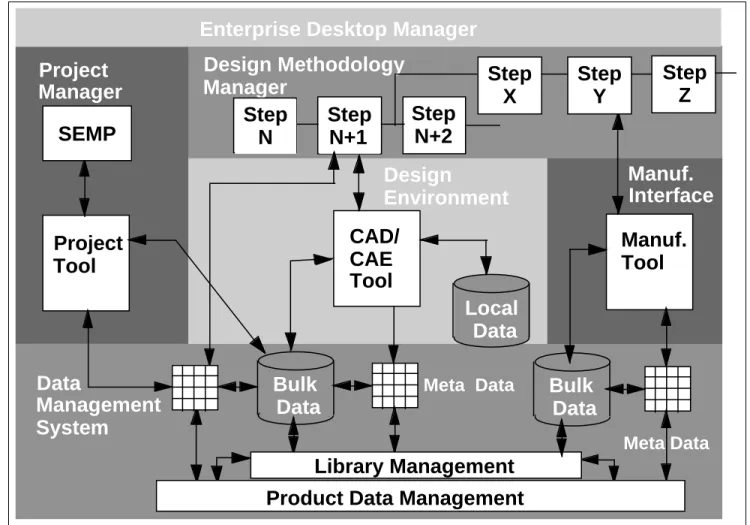
The concept of operation for the enterprise framework includes the ability to execute project plans, expressed as workflows, by teams of engineers. Execution of a workflow by a member of a design team, as indicated in Figure 1, initiates control commands to a CAD/CAE tool as relevant
for the particular workflow step. This execution also ini-tiates data transactions with the enterprise product data management system; local data management systems; and library systems, as relevant for the particular workflow step. In addition, project management tools are coupled with the enterprise environment, which receives regular status up-dates as workflow steps are executed. This process facili-tates effective, non-interfering project management.
Execution of the workflows is performed using enterprise methodology management tools, which provide links to tools, data access mechanisms, and other services. This process re-moves these functions as required responsibilities for the de-sign engineer, allowing increased focus on the real dede-sign tasks and significantly improving productivity. Using this process, project engineers or supervisors would no longer be responsible for design and implementation of project plans based on workflows using the system.
In addition, the enterprise framework provides multiple workspace views for the design environment to support for workflow usage. These views include:
• Tool and application workspace,
• A data workspace for product and reuse information • Project/workflow workspaces.
The resources, data objects, and applications available to a particular engineer are defined by his or her identity and role in an authorization hierarchy implemented in the En-terprise System.
Workflow Management
Design
Environment
Design Methodology
Manager
CAD/
CAE
Tool
Step
N
Step
N+2
Step
N+1
Data
Management
System
Meta Data
Bulk
Data
Manuf.
Tool
Manuf.
Interface
Step
X
Step
Y
Step
Z
Meta Data
Enterprise Desktop Manager
Project
Manager
Project
Tool
Product Data Management
SEMP
Library Management
Local
Data
Bulk
Data
Figure 1. Enterprise system organization.
of methods and tools to provide the project team with an en-vironment that facilitates day-to-day work. We have adopted a process-model-driven philosophy for workflow manage-ment. The RASSP methodology leverages process models for electronic design that were developed by Lockheed Martin’s Engineering Process Improvement program. These models are being augmented with new RASSP process mod-els that specifically address signal processing issues and pro-vide many enhancements to electronics engineering processes. The RASSP methodology also provides approaches for con-current engineering; evaluation of multiple alternative solu-tions; failback paths; and iterations.
The detailed representation of the RASSP methodology and related methodologies are modeled using extensions to IDEF3 [2]. The workflow model captures:
• Process steps
• Their precedence relationships;
• The personnel roles authorized/required to perform work • The information objects involved (created, used,
modi-fied, destroyed, etc.) in the process step
• The tools to be launched or controlled at each step.
The information objects represent place holders for in-stances of objects that will flow through the workflow. A neutral, process information exchange language (PML) has been developed to facilitate exchange of process data among process-modeling and process-enactment tools. A parser to convert process model data from TopDown Flowcharter to PML format has been developed. The parsed information is stored in a PML repository, which Rockwell is developing. Some implementation details can be found in Lockheed Martin Advanced Technology Laboratories’ paper, entitled “Workflow Modeling for Implementing Complex, CAD-Based Design Methodologies” [3].
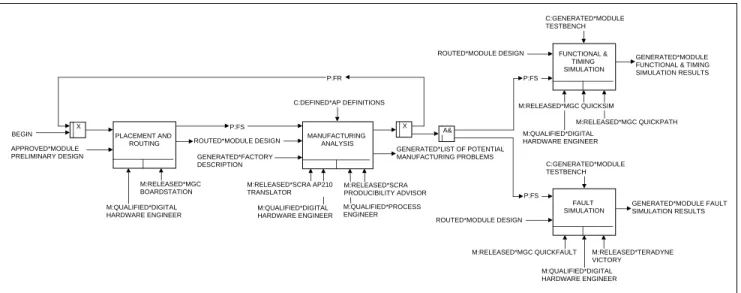
The workflows are hierarchical in nature — represent-ing the various disciplines associated with electronic de-sign. The workflows consist of reusable workflow segments, which can be combined in various configurations to address specific project needs. Figure 2 represents a module final design segment. These segments consist of multiple pro-cess steps, each of which are also reusable. Thus, options available to a user organization are either to make use of the RASSP workflows in current form or to develop process
System Architecture Detailed Design Support Workflows System Requirements Functional Design Chassis Design Reusable Design Element
Analysis and Refinement Generation
Functional Analysis Architecture Selection Backplane Design Process Plan Generation System Partitioning Architecture Verification Module Design Conduct Design Review
ASIC Design Reuse Workflow Generation FPGA Design Mentor Part Generation
Release to Manufacturing Table 1. RASSP workflows.
plans based on a combination of reuse of RASSP workflow segments, individual process steps, and possible custom user steps.
The RASSP team is producing workflows that will rep-resent the design disciplines and support activities repre-sented in Table 1. To date, the team has implemented de-tailed hardware design and multiple architecture design cesses. Development of systems and software design pro-cesses, as well as enhanced supporting propro-cesses, are cur-rently underway.
To support implementation, the detailed workflow in-formation captured in IDEF3X is represented using a workflow-tool-independent language form, the Process Modeling Language (PML). This information can then be transferred to an enterprise workflow tool. Utilization of processes in the enterprise workflow tool involves conver-sion to an executable form that is compatible with the
spe-cific workflow tools being used in the enterprise environ-ment. The Design Methodology Manager (DMM), devel-oped by Intergraph, is the workflow management tool that the Lockheed Martin RASSP system is using for this pur-pose [4]. In addition to the PML workflow, tool-encapsula-tion files provide specific tool control informatool-encapsula-tion neces-sary for control of the tool-using workflows in the enter-prise environment. This information includes path and name of executables; argument variables; files and data required; pre- and post-processing required; and so on.
Information Management
Enterprise information is a key corporate asset and will require a well planned management strategy. The RASSP team developed an enterprise data model, which specifies the metadata that the design engineers and project/system administrators need to track the product and reuse informa-tion in the system. In development of the RASSP
Enter-PLACEMENT AND ROUTING FUNCTIONAL & TIMING SIMULATION FAULT SIMULATION MANUFACTURING ANALYSIS X P:FS X A& P:FR APPROVED*MODULE PRELIMINARY DESIGN BEGIN GENERATED*LIST OF POTENTIAL MANUFACTURING PROBLEMS ROUTED*MODULE DESIGN ROUTED*MODULE DESIGN P:FS P:FS M:RELEASED*MGC BOARDSTATION M:QUALIFIED*DIGITAL HARDWARE ENGINEER ROUTED*MODULE DESIGN GENERATED*FACTORY DESCRIPTION C:DEFINED*AP DEFINITIONS M:RELEASED*SCRA AP210 TRANSLATOR M:RELEASED*SCRA PRODUCIBILITY ADVISOR M:QUALIFIED*DIGITAL HARDWARE ENGINEER M:QUALIFIED*PROCESS ENGINEER C:GENERATED*MODULE TESTBENCH GENERATED*MODULE FAULT SIMULATION RESULTS C:GENERATED*MODULE TESTBENCH GENERATED*MODULE FUNCTIONAL & TIMING SIMULATION RESULTS
M:RELEASED*MGC QUICKSIM
M:RELEASED*MGC QUICKPATH M:QUALIFIED*DIGITAL
HARDWARE ENGINEER
M:RELEASED*MGC QUICKFAULT M:RELEASED*TERADYNE VICTORY
M:QUALIFIED*DIGITAL HARDWARE ENGINEER
prise Data Model, several standard models were analyzed relative to RASSP-specific requirements. Models analyzed include the Product Data Control Model (which Rockwell developed on the USAF Integrated Data Strategy program), the STEP parts and protocols AP203 [5], and Part 44 [6]. The Enterprise Data Model was therefore developed based on multiple sources of product data requirements.
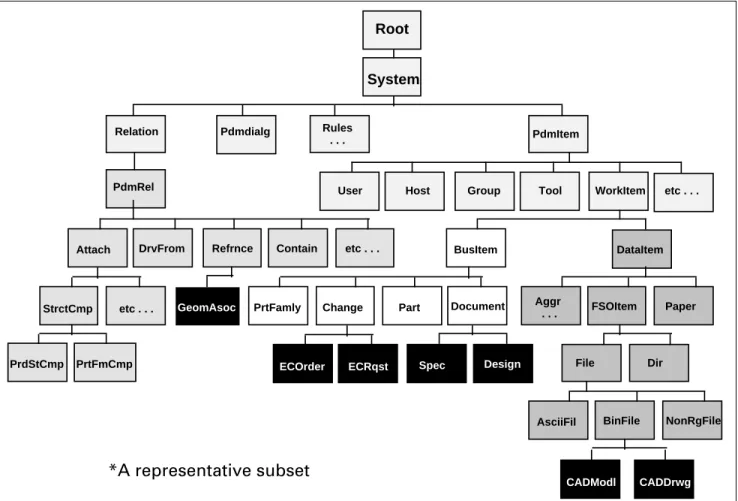
The RASSP team is implementing the enterprise data management system using the Intergraph DM2.0 distrib-uted product data management product [7]. As a result, the team is mapping the RASSP enterprise data model to the core model of the DM2.0 product (Figure 3) and is imple-menting extensions that make practical and commercial sense. Some of the new classes being added to DM2.0 are:
security classification, anomoly, productconcept, and soft-wareconfigurationitem.
The DM2.0 product manages the enterprise documents and their metadata; product structure and configurations; user roles and authorizations; storage locations and vaults; and related data in a distributed environment. It also inter-faces with the reuse libraries to facilitate reuse of the
enter-prise information. DM2.0 provides these services either directly or under the control of a workflow manager, based on the needs of particular projects. This enables the workflow manager to access and store information (such as design documents, bills of material, and test procedures) by a process step, as needed.
For configuration management [8] and authorization, RASSP-developed models define specific requirements for these capabilities. Support for implementation of these mod-els is provided using the rules subsystem of DM2.0. A com-bination of DM2.0 and secure internet services will provide distributed product data management capability for a multi-organization, multi-site environment.
Reuse Management
Library management in the RASSP system involves the release, cataloging, and searching of reusable design ob-jects. The RASSP Reuse Data Manager (RRDM) supports this library management. Sources for reusable design ob-jects in the RASSP system include:
Figure 3. DM2.0 object-oriented data model.
*A representative subset
Root System PdmItem Rules . . . Pdmdialg RelationPdmRel User Host Group Tool WorkItem etc . . .
Attach DrvFrom Refrnce Contain etc . . . BusItem DataItem
StrctCmp etc . . . GeomAsoc PrtFamly Change Part Document
PrdStCmp PrtFmCmp ECOrder ECRqst Spec Design
Aggr
. . . FSOItem Paper File Dir
AsciiFil BinFile NonRgFile
• CAD tool libraries
• CAD-tool-independent libraries • Component vendor data books
• Design objects created within a design organization. In today’s design environments, the ability of the design engineer to maximize reuse is impaired because there is no efficient way of searching for reusable design objects across multiple sources, and the various sources of reusable data are not coupled with the design environment. In addition, mechanisms and processes for organizing reusable design objects created within a design organization are lacking. Also lacking is the effective sharing the reusable design objects within the organization, as well as with other cooperating organizations.
The RASSP Enterprise System will include tools and methods for integrating the various sources of reusable de-sign objects to provide a single source for searching for re-usable design data and will enable enterprise-wide sharing of reuse data. The approach consists of:
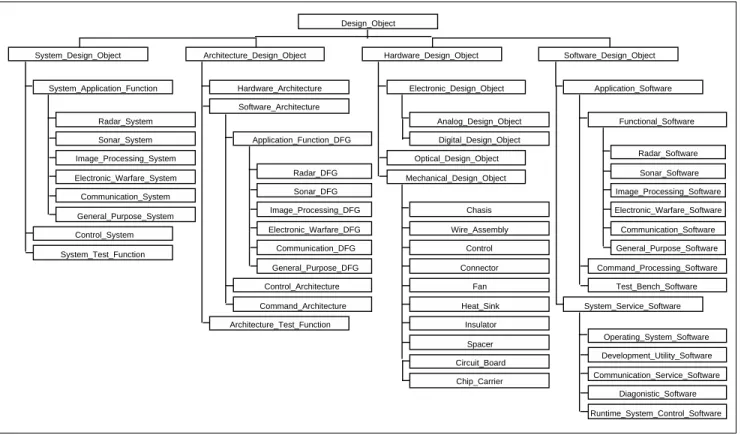
1) Developing a design object class hierarchy, which clas-sifies the various types of design objects in the RASSP domain and models the descriptive data associated with the design objects
2) Developing a commercial library management system, which will implement the design object class hierarchy and provide mechanisms for searching for design objects across multiple libraries and across a virtual enterprise. A support workflow is also provided by the RASSP sys-tem for addition of new reuse elements and/or classes in the system. This process includes certification of the new ele-ments, possibly to the classification hierarchy, and genera-tion of documentagenera-tion updates.
Additionally, the RASSP reuse management system will support loosely-coupled and tightly-coupled federations of cooperating organizations in sharing library data. The core library management search and browse function, which sup-ports the RASSP design object class hierarchy, was imple-mented by Aspect Development. This function was released as a commercial product in May 1995. Extensions for inte-gration of reuse library systems are currently in develop-ment. An initial version of the reuse class hierarchy is shown in Figure 4. The RRDM extensions being developed sup-port: capabilities to manage default and template objects, manage parametric searches, modify existing objects, modify class hierarchy, and so on.
Figure 4. RASSP design object class hierarchy.
Radar_System Sonar_System Image_Processing_System Electronic_Warfare_System Communication_System General_Purpose_System System_Application_Function Control_System System_Test_Function System_Design_Object Hardware_Architecture Radar_DFG Sonar_DFG Image_Processing_DFG Electronic_Warfare_DFG Communication_DFG General_Purpose_DFG Application_Function_DFG Control_Architecture Command_Architecture Software_Architecture Architecture_Test_Function Architecture_Design_Object Analog_Design_Object Digital_Design_Object Electronic_Design_Object Optical_Design_Object Chasis Wire_Assembly Control Connector Fan Heat_Sink Insulator Spacer Circuit_Board Chip_Carrier Mechanical_Design_Object Hardware_Design_Object Radar_Software Sonar_Software Image_Processing_Software Electronic_Warfare_Software Communication_Software General_Purpose_Software Functional_Software Command_Processing_Software Test_Bench_Software Application_Software Operating_System_Software Development_Utility_Software Communication_Service_Software Diagonistic_Software Runtime_System_Control_Software System_Service_Software Software_Design_Object Design_Object
Figure 5. Use of RASSP advanced processes.
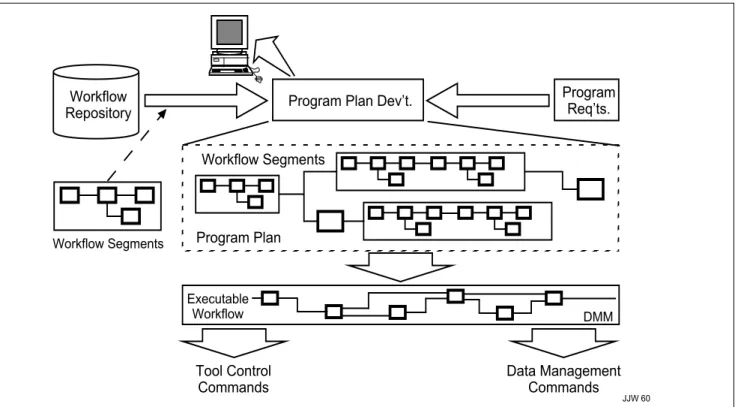
Project Planning
A project plan is a specific collection of workflows that have been customized to meet the specific requirements of the project and the performing organization. The RASSP Enterprise System includes tools to enable construction of these project plans using workflow segments or other project plans that are maintained in the workflow reuse system (Fig-ure 5). These tools enable selection of the workflow ments, customization of the workflows, linkage of the seg-ments, and definition of totally new workflows. Because the workflows also include the data object definitions, the process of combining workflows into projects produces data object templates. These data object templates specify the detailed information associated with, or produced on, the projects.
Within the RASSP enterprise environment, a project builder toolset that is being developed as an extension of DMM provides capabilities for construction of project plans using the workflow segments or activities, as well as previ-ously developed program plans. These capabilities will in-clude the ability to:
• Cut and paste workflow models (shallow and deep-copy-ing)
• Browse multiple models • Interface with reuse repositories
• Capture metadata about models, such as where used, ra-tionale, metrics, author, etc.
• Analyze newly created models for consistency.
The RASSP team anticipates that user organizations will use these tools to create new instances of these workflow models (or even design new workflow models), which are tailored to particular project needs. These models can also be added to the workflow library and made available for use on future projects.
The data object set for a given project represents a set of place holders, or data templates, for management of the project data. These are mapped onto the RASSP informa-tion model, which specifies the requirements for manage-ment tracking of the data objects. Execution of the workflow steps produces more detailed design information within design objects, such as additional product structure infor-mation and/or documentation inforinfor-mation.
In execution of the project plan constructed from the workflows, the activities and data object specifications are instantiated for the particular project. As part of this pro-cess, users are assigned to the roles in the project plan, and actual object instances are associated with their place hold-ers. The information manager generates the appropriate objects, work locations, and so on to facilitate the workflow. The information models and information manager are there-fore closely coupled to the process models and the workflow
JJW 60 Workflow Segments
Executable Workflow
Tool Control
Commands Data ManagementCommands
DMM
Program Plan Workflow Segments
Program Plan Dev’t. ProgramReq’ts.
AAAAAAAAAAAAA
AAAAAAAAAAAAA
AAAAAAAAAAAAA
AAAAAAAAAAAAA
Workflow Repositorymanager. The harmony between the two enables the users to perform the right tasks using the right information in a transparent fashion.
Summary/Status
Through integration of workflow/process technology and data management of product and reuse information, the RASSP Enterprise System, provides significant capability for enabling large productivity gains for signal processing/ electronics engineering teams. The development plan for the RASSP Enterprise System includes four prototype build cycles. The team demonstrated the initial prototype system, which focuses on electronic hardware design, in February 1995. The implementation of the functional design and ar-chitecture design processes — which are the focus of the Build 2 system — will be demonstrated in February 1996. Prototype demonstrations of these processes are also avail-able at this conference.
Key benefits include a practical approach to apply workflow technology in an engineering environment; capa-bility for planning and management of complex products involving CAD environment; and improvements in reuse implementation through an integrated, distributed strategy. Accomplishments to date include definitions of four RASSP workflows; an initial definition of PML; prototypes of a PML parser and PML repository; an initial definition of a reuse hierarchy; extensions to DM2.0 classes; and ex-tensions to RRDM functionality.
References
1. Martin Marietta, “RASSP First Annual Interim Technical Re-port”, Moorestown, NJ, 1994.
2. Armstrong Laboratory, IDEF3 Process Description Capture Method Report, AL-TR-1992-0057, Wright Patterson Air Force Base, OH, 1992.
3. Lockheed Martin Advanced Technology Laboratories, “Workflow Modeling for Implementing Complex, CAD-Based Design Methodologies”, Camden, NJ, 1995.
4. Intergraph Corporation, Design Methodology Manager — Us-ers Guide, Huntsville, AL, 1993.
5. International Standards Organization, Configuration Controlled 3D Designs of Mechanical Parts and Assemblies, ISO 10303-203, Fairfax, VA: U.S. Product Data Association, 1993. 6. International Standards Organization, Product Structure
Con-figuration, ISO 10303-044, Fairfax, VA: U.S. Product Data Association, 1994.
7. Intergraph Corporation, DM/Manager — Users Guide, Hunts-ville, AL, 1995.
8. Martin Marietta, “The Configuration Management Model for the RASSP System”, Moorestown, NJ, 1994.