International Journal of Lean Six Sigma
A Lean Six Sigma framework for continuous and incremental improvement in the oil and gas sector
Journal: International Journal of Lean Six Sigma
Manuscript ID IJLSS-02-2019-0011.R1 Manuscript Type: Research Paper
International Journal of Lean Six Sigma
Sensitivity: Internal
A Lean Six Sigma framework for continuous and incremental
improvement in the oil and gas sector
Abstract
Purpose - This article aims to explore synergies between Lean Production (LP) and Six Sigma principles in order to propose a Lean Six Sigma (LSS) framework for continuous and incremental improvement in the oil and gas sector. The Three-Dimensional LSS Framework seeks to provide various combinations about the integration between LP principles, DMAIC cycle and PDCA cycle to support operations management needs.
Design/methodology/approach - The research method is composed of two main steps: (i) diagnostic of current problems and proposition of a conceptual framework that qualitatively integrates synergistic aspects of LP and Six Sigma; and (ii) analysis of the application of the construct through semi-structured interviews with leaders from oil and gas companies to assess and validate the proposed framework.
Findings - As a result, a conceptual framework of LSS is developed contemplating the integration of LP and Six Sigma and providing a systemic and holistic approach to problem-solving through continuous and incremental improvement in the oil and gas sector.
Originality/value - This research is different from previous studies because it integrates LP principles, DMAIC and PDCA cycles into a unique framework that fulfils a specific need of oil and gas sector. It presents a customized LSS framework that guides wastes and costs reduction, while enhances quality and reduces process variability to elevate efficiency in operations management of this sector. The paper type is an original research that present new and original scientific findings.
Keywords: Lean Six Sigma, Lean Production, Six Sigma, Oil and Gas sector, Continuous improvement.
1. Introduction
Since the oil crisis in 1973, the high cost and scarcity of petroleum products have generated a number of challenging side effects, especially in industries inserted in this supply chain (Ang, 2001; Newiadomsky and Seeliger, 2016). This fact has led organizations to seek political and economic solutions, whether by lobbying the Organization of the Petroleum Exporting Countries (OPEC), monitoring oil companies for energy-conscious consumption or making governments adjust their taxes, tariffs, and quotas. In this sense, the development of practices for waste reduction, such as just-in-time (JIT) production, was reinforced, increasing their adoption level across oil and gas sector (Schonberger, 1982; Näslund, 2013; Deithorn and Kovach, 2018).
Currently, the oil and gas sector faces major challenges, such as shrinking conventional oil reserves, environmental challenges, stricter regulations, higher production costs and a drop in the price of the barrel (Reboredo, 2010; Reboredo and Rivera-Castro, 2014). These challenges motivated these companies to seek ways to optimize their operations, improve their cash flow and avoid waste. Among the management approaches applied to continuously improve their processes, Lean Production (LP) and Six Sigma stands out (Mustapha et al., 2015). Both approaches have been widely used in other industry sectors; however, literature still lacks evidence of their application in the oil and gas sector (Nascimento et al., 2017; Ivson et al., 2018). 3 4 5 6 7 8 9 10 11 12 13 14 15 16 17 18 19 20 21 22 23 24 25 26 27 28 29 30 31 32 33 34 35 36 37 38 39 40 41 42 43 44 45 46 47 48 49 50 51 52 53 54 55 56 57 58 59 60
International Journal of Lean Six Sigma
According to Maleyeff et al. (2012), LP aims to systemically reduce waste through the engagement and empowerment of employees, suppliers and customers. In addition, LP promotes continuous improvement efforts through a structured problem-solving methodology (Tortorella et al., 2018). Analogously, Six Sigma is a data-driven approach that seeks to reduce errors and defects by applying the DMAIC (Define-Measure-Analyze-Improve-Control) methodology (Buell and Turnipseed, 2003). Therefore, both approaches highlight the importance of reducing costs and maximizing value in organizations by developing quality products, processes or services (Sunder and Antony, 2015). However, the inherent contextual specificities of the oil and gas sector entail the need of significant adaptations of both LP and Six Sigma approaches to allow their successful implementation (Bubsha and Al-Dosa, 2014; Ratnaya and Chaudry, 2016; AL-Riyami and Jabri, 2017; Deitho and Kovach, 2018). However, there is a lack in the literature of integration between Lean principles, PDCA cycle and DMAIC methodology to implement a Lean Six Sigma production system in the oil and gas sector (Ali, 2016; Oakland & Marosszeky, 2017). In fact, Quelhas et al. (2017) have emphasized the scarcity of empirical studies that combine LP and Six Sigma within this industrial context.The objective of this paper is to explore the synergies between LP and Six Sigma in order to propose an integrated LSS framework for continuous and incremental improvement in the oil and gas sector. To achieve that, it has been applied qualitative research methods in order to deeply analyze the perceptions of oil and gas companies’ stakeholders (such as managers, coordinators, consultants and engineers) and enable the proposition of the referenced framework. The contribution of this framework is two-fold. First, it analyzes the integration between LP and Six Sigma from an Oil and Gas sector perspective, which is a gap in the literature. Second, the proposed LSS framework provides guidance for both practitioners and academicians on the benefits of integrating both approaches towards greater operational performance. Besides this section, the rest of this article is structured as follows. Section two presents a literature review about LP, Six Sigma and LSS. Section three describes the proposed methodology, whose results are presented in section four. Finally, section five concludes the study, highlighting the practical and theoretical implications, limitations and future work opportunities.
2. Literature Review
2.1 Lean Production and Six Sigma
According to Maleyeff et al. (2012), LP has its roots on the Toyota Production System, which began in the 1950s and aims to reduce waste through extensive employee involvement, and a collaborative relationship with suppliers and customers in problem-solving activities. For Aziz and Hafes (2013), LP comprises two main pillars: (i) JIT flow, which consists of producing according to demand; and (ii) Jidoka, which consists of man-machine separation in which an operator manages multiple machines. Complementarily, Taj and Morosan (2011) affirm that LP is a multidimensional approach based on the following practices: JIT, cellular layout, total preventive maintenance, total quality, and human resources management. For Chaurasia et al. (2016) the factors that characterize a lean environment are: reduced delivery times, accelerated time-to-market, reduced operating costs, exceeded customer expectations, streamlined outsourcing processes, improved visibility of business performance and use of more productive forms of energy, equipment, and people.
Furthermore, LP has been associated with a mindset that must be adopted by employees at all organizational levels in order to produce truly sustainable results (Voehl et al., 2010). According to Chaurasia et al. (2016), "LP is an endless journey to reach the most innovative,
3 4 5 6 7 8 9 10 11 12 13 14 15 16 17 18 19 20 21 22 23 24 25 26 27 28 29 30 31 32 33 34 35 36 37 38 39 40 41 42 43 44 45 46 47 48 49 50 51 52 53 54 55 56 57 58 59 60
International Journal of Lean Six Sigma
Sensitivity: Internal
effective and efficient way in an organization". Organizations that seek LP implementation, should have the following characteristics (Mathaisel, 2006; Voehl et al., 2010; Sacks et al., 2010): focus on business, development of managers, support for employees, customer orientation, sharing success, improvement opportunities analysis, multifunctional teams, sense of community, customer-focused processes, flexible equipment’s, quick tool change over, learning environment, alliance with suppliers, information sharing, problem prevention, organization, cooperation and simplicity.
With regards to Six Sigma approach, created by Bill Smith at the Motorola Corporation in the 1980s, it seeks to reduce variability in order to reduce errors and defects by applying the DMAIC cycle (Maleyeff et al., 2012). Popa et al. (2005) argue that Six Sigma is a highly disciplined process that helps organizations focus on delivering lower cost products with improved quality and reduced cycle time. The term "Sigma" represents a statistical measure that verifies the extent to which a given process deviates from perfection. According to Franchetti (2015), Six Sigma can help developing skills, improving knowledge and employees’ morale and the ability to use a wide range of tools and techniques. In addition, it has the following advantages over Total Quality Management: setting zero defaults targets and intensive use of statistics, data to make managerial decisions and reduce process variation. Overall, the main difference between LP and Six Sigma is that lean projects can use qualitative and quantitative analysis processes, such as the five-whys, cause and effect diagrams, failure mode and effect analysis (FMEA) (Voehl et al., 2010). Also, by focusing on process improvement and reduced variability, Six Sigma improves organizational processes, considering radical changes and the formation of new markets and/or customers (Parast, 2011). George (2002) states that integrating both approaches to reduce cost and complexity is essential. Just as LP cannot statistically control a process and Six Sigma alone cannot dramatically improve process speed or reduce invested capital (George, 2003). Six Sigma helps to connect business leaders and key project teams in a potent two-way fact-based dialogue, which is considered a blind spot to LP. For Voehl et al. (2010), in the appropriate situation, both approaches to process improvement can be integrated to form a more comprehensive methodology regardless of size or scope, and root cause analysis is the common cross-point between these approaches.
Thus, there are several related works that explore the use of Lean Principles in the PDCA cycle (Motwani, 2003; Simon & Canacari, 2012; Reis et al. 2016), as well as, research that addresses the DMAIC methodology for isolated Six Sigma projects (Furterer, 2016; Ansar et al. 2018).
It is worth noting that a Lean system contemplates several principles for operations management (Dombrowski & Mielke, 2014), and Six Sigma focuses on reducing process variability and incremental improvement of key performance indicators (Kumar et al., 2011).
Therefore, the need and potential of applying the Lean principles in an integrated way within the PDCA cycle and the DMAIC methodology in favor of operational excellence are highlighted as a critical success factor.
2.2 Lean Six Sigma
LSS is “a methodology that maximizes shareholder value by achieving the fastest rate or bringing improvements in customer satisfaction, cost, quality, process speed, and invested capital” (George, 2002; Muraliraj et al., 2018). Furthermore, it is a holistic methodology that is based on systems approach and considers the entire supply chain (Cauchick Miguel & Andrietta, 2010; Franchetti, 2015), which is used by organizations of international recognition to eliminate waste in processes and deliver products and services with extreme quality to their
3 4 5 6 7 8 9 10 11 12 13 14 15 16 17 18 19 20 21 22 23 24 25 26 27 28 29 30 31 32 33 34 35 36 37 38 39 40 41 42 43 44 45 46 47 48 49 50 51 52 53 54 55 56 57 58 59 60
International Journal of Lean Six Sigma
customers (Popa et al., 2005; Assarlind & Aaboen, 2014). LSS has expanded the seven original wastes from Ohno (1997) into nine: defects, overproduction, transport, waiting, inventory, movement, over processing, underutilized employees and behaviour (Voehl et al., 2010;Alkunsol et al., 2019). According to George (2003), LSS incorporates the principles of speed and immediate action of LP with the defect-free vision from Six Sigma with a reduced variation in the queue time. From this, LSS attacks the hidden costs of complexity and is a mechanism that seeks the engagement of all employees for improving quality, lead time and cost (Yadav & Desai, 2016;Elias, 2016;Raval & Kant, 2017).
The intense pressure for the efficient utilization of resources has generated a global expansion of knowledge with respect to LSS methodology in the oil and gas sector. Such dissemination has been guided through training and specialized programs with employees (Bufalo et al., 2015;
Moya et al., 2019). Recently, there are promising cases that show the adequacy of the LSS methodology in the energy sector. Alqahtani and Nour Eldin (2011), for instance, conducted in Saudi Arabia an energy assessment study following the LSS methodology to identify, quantify and classify, technically and economically, possible energy conservation opportunities in an oil and gas sector. It is also verified the utilization of LSS in oil and gas’ supply chain (AL-Riyami et al., 2017), Operations (Buell & Turnipseed, 2003; Buell & Turnipseed, 2004; Bubshait & Al-Dosary, 2014; Mustapha et al., 2015), and engineering, procurement, and construction projects (Villanueva and Kovach, 2013). Moreover, there are several conceptual models presented in the literature for the implantation of LSS, integrating their concepts with benefits for manufacturing (Dombrowski & Mielke, 2014; Tortorella et al. 2016; Tortorella et al, 2018), sustainability (Garza-Reyes et al. 2014; Rocha-Lona et al. 2015; Chugani et al. 2017; Antony, Rodgers & Cudney, 2017; Garza-Reyes et al. 2018), lean healthcare (De Koning et al. 2006; De Mast, 2011; Cheng & Chang, 2012; Robbins et al. 2012; Wiegel & Brouwer-Hadzialic, 2015; Al Khamisi et al. 2017; Shokri, 2017), supply chain and logistics (Found & Harrison, 2012; Gutierrez-Gutierrez, De Leeuw & Dubbers, 2016; Shaaban & Darwish, 2016; Kumar & Gandhi, 2017), and construction projects (Al-Aomar, 2012).
3. Methodology
The proposed research is eminently exploratory and is comprised of two steps: (i) proposal of a conceptual framework that qualitatively integrates the synergistic aspects of LP and Six Sigma; and (ii) an empirical study for the assessment and validation of the proposed framework through Focus Group Interviews (FGIs) with leaders from oil and gas companies to assess and validate the proposed framework. These steps expand upon previous research developed by Blindheim (2015), Garza-Reyes (2015), Nascimento et al. (2017) and Saieg et al. (2018). First, there was a narrative literature review of lean philosophy principles, the PDCA continuous improvement cycle, and the DMAIC problem-solving methodology in order to build a preliminary framework.
Regarding the FGIs, analysis of design for the refining, exploration, and production of petroleum, serial interviews were conducted in September of 2017 through workshops discussions for the collection, treatment and presentation of the main problems, identification of the causes and effects perceived (Tortorella et al., 2008). According to Kvale (1994) and Bell et al. (2018), the utilization of interviews as a research method allows the collection of detailed information about the investigated topic. Moreover, in in this type of primary data collection, researchers have direct control over the flow of process and have a chance to clarify certain issues during the process if needed. The focus group discussions were held on a regular basis between October 2017 and March 2018 and in parallel with the literature background analysed, complementing with a proposed framework that provides a guide to implement LSS
3 4 5 6 7 8 9 10 11 12 13 14 15 16 17 18 19 20 21 22 23 24 25 26 27 28 29 30 31 32 33 34 35 36 37 38 39 40 41 42 43 44 45 46 47 48 49 50 51 52 53 54 55 56 57 58 59 60
International Journal of Lean Six Sigma
Sensitivity: Internal
in the oil and gas sector. Besides permit that these methodological approaches can occur in different contexts to adjust the interactions between LP, PDCA and Six Sigma (DMAIC) in some specific area.
The number of participants in each discussion ranged from 5 to 9 in relation to the presence of collaborators rate in each event. A total of 12 collaborators with 10 years of minimum experience, 4 engineering management who were responsible for leadership activities, 3 process engineers, 2 chemical engineers and 3 mechanical engineers from a petrochemical complex in the Brazilian context. These collaborators were assigned in two groups for discussion synergisms between LP principles according to Sacks et al. (2010), PDCA and DMAIC to achieve kaizen stability. In this context, the criterion of selection of the focus group sample is presented: (i) objective: analyze LP and Six Sigma in order to develop a framework that combines the principles of LP, PDCA with Six Sigma (DMAIC) via focal groups and discuss their implications for theory and practice; (ii) reference units: processes, materials, technologies and people; (iii) informing unit: managers, coordinators, consultants and engineers that working in the oil and gas; (iv) unit of analysis: three-dimensional LSS framework in the oil and gas context; (v) sample unit: people who had greater knowledge on the central theme of the investigation and held leadership positions. The groups were carried out through collaborators who have had some experience or previous study on LP, considering the 10 years of minimum experience in oil and gas.
In the interviews, recordings and annotations were made, as well as modifications on the proposed model to implement LSS and transcription of the results through tables, graphs, and diagrams. Each focus group discussion took about an hour and a half. Participants were confronted with a list of lean principles described and sent earlier. This list (accompanied by a meaningful explanation from the moderator) was presented at the initial workshop as input to the focus group discussion. The central question was “which Lean principles are preferentially applicable at each stage of PDCA cycle in the DMAIC for guide an LSS implementation in the oil and gas sector?”.
4. Results
This section aims to report the results of the literature review, focus groups, and direct observation. As in Kumar et al. (2011), a triangulation is carried out with the objective of developing a framework for the implantation and training of LSS professionals in the oil and gas sector. In this sense, this new framework was constructed based on primary data collected from theory and practice and the experts’ perception was very useful in understanding the true picture of LSS continuous improvement journey. Strategic planning for a sustainable LSS implementation should utilize principles, practices, and lessons learned from related works. In this context, this research develops a conceptual model that relates the LP principles to the PDCA and DMAIC cycles to provide an implementation guide of LSS. This model aims to provide a methodology that integrates the LP principles between stages of the PDCA and DMAIC to reach the continuous and incremental improvement of the processes, technologies, materials, and people in the oil and gas sector.
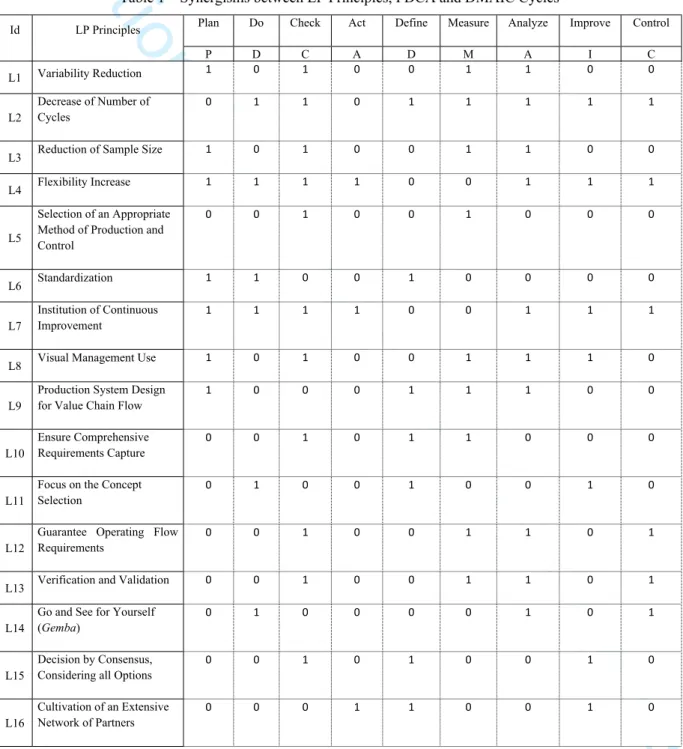
As a result from focus groups, literature and constructivist theory, a conceptual framework of LSS is proposed, contemplating the integration of LP principles, DMAIC (from Six Sigma) and PDCA (Kaizen) methodologies. This framework provides guidance on the use of LP principles by clearly indicating steps and targets that support the achievement of a greater asset life cycle efficiency, cost reduction, and continuous process improvement. In this context, Table 1 presents an inherent framework for the model that assesses the synergisms between LP
3 4 5 6 7 8 9 10 11 12 13 14 15 16 17 18 19 20 21 22 23 24 25 26 27 28 29 30 31 32 33 34 35 36 37 38 39 40 41 42 43 44 45 46 47 48 49 50 51 52 53 54 55 56 57 58 59 60
International Journal of Lean Six Sigma
principles and Six Sigma within the PDCA cycle in favour of engineering continuous flow in industrial plants in the oil and gas sector. The result of Table 1 presents the LP principles in the lines, meanwhile, PDCA and DMAIC cycles in the columns, participants pointed out which LP principles are predominantly applicable (1 – true) or neutral (0 – false) to PDCA and DMAIC cycles. In the instrument of data collection, a questionnaire is carried out separating the LP principles, regarding the PDCA and, later, related to the DMAIC to analyse each concept.Table 1 – Synergisms between LP Principles, PDCA and DMAIC Cycles
Plan Do Check Act Define Measure Analyze Improve Control Id LP Principles P D C A D M A I C L1 Variability Reduction 1 0 1 0 0 1 1 0 0 L2 Decrease of Number of Cycles 0 1 1 0 1 1 1 1 1
L3 Reduction of Sample Size 1 0 1 0 0 1 1 0 0
L4 Flexibility Increase 1 1 1 1 0 0 1 1 1
L5
Selection of an Appropriate Method of Production and Control 0 0 1 0 0 1 0 0 0 L6 Standardization 1 1 0 0 1 0 0 0 0 L7 Institution of Continuous Improvement 1 1 1 1 0 0 1 1 1
L8 Visual Management Use 1 0 1 0 0 1 1 1 0
L9
Production System Design for Value Chain Flow
1 0 0 0 1 1 1 0 0 L10 Ensure Comprehensive Requirements Capture 0 0 1 0 1 1 0 0 0 L11
Focus on the Concept Selection
0 1 0 0 1 0 0 1 0
L12
Guarantee Operating Flow Requirements
0 0 1 0 0 1 1 0 1
L13 Verification and Validation 0 0 1 0 0 1 1 0 1
L14
Go and See for Yourself (Gemba)
0 1 0 0 0 0 1 0 1
L15
Decision by Consensus, Considering all Options
0 0 1 0 1 0 0 1 0
L16
Cultivation of an Extensive Network of Partners
0 0 0 1 1 0 0 1 0
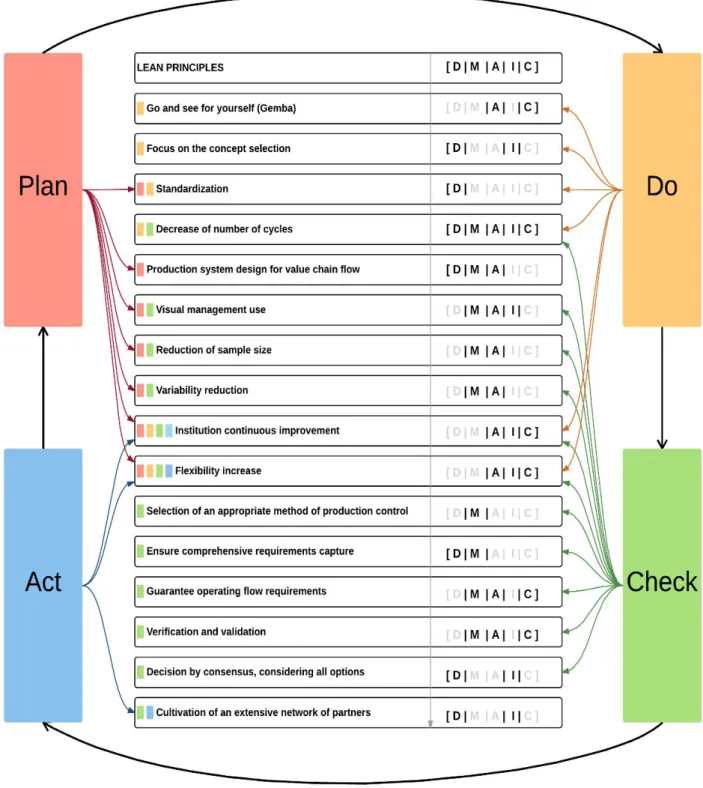
According to the synergies between LP, Six Sigma (DMAIC) and PDCA presented in Table 1, the Strategic Three-dimensional LSS Framework was developed, shown in Figure 1, which
3 4 5 6 7 8 9 10 11 12 13 14 15 16 17 18 19 20 21 22 23 24 25 26 27 28 29 30 31 32 33 34 35 36 37 38 39 40 41 42 43 44 45 46 47 48 49 50 51 52 53 54 55 56 57 58 59 60
International Journal of Lean Six Sigma
Sensitivity: Internal
integrates the LP principles from Sacks et al. (2010) into the PDCA and DMAIC cycles, respectively. This model seeks to highlight the most relevant and/or prominent steps for applying the concepts of LP principles and Six Sigma (DMAIC) in the PDCA cycle of industrial plants throughout their life-cycle.
Figure 1: Visual representation of the integration between Lean, Six Sigma and PDCA
Figure 1 demonstrates a connection between a Lean-driven Performance Measurement System (PMS) and operations management methodology centred on the PDCA cycle. Configuring a sociotechnical system that integrates the Lean principles into the PDCA cycle and the DMAIC
3 4 5 6 7 8 9 10 11 12 13 14 15 16 17 18 19 20 21 22 23 24 25 26 27 28 29 30 31 32 33 34 35 36 37 38 39 40 41 42 43 44 45 46 47 48 49 50 51 52 53 54 55 56 57 58 59 60
International Journal of Lean Six Sigma
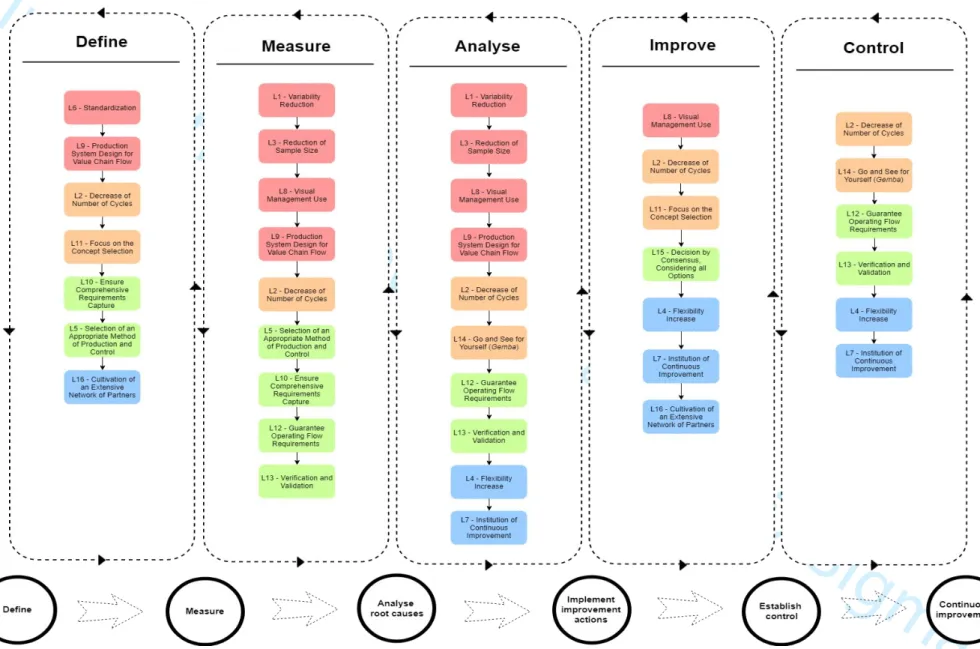
methodology to implement Lean operations management for continuous and incremental improvement. Thus, Figure 2 details the use of the DMAIC methodology to create a socio-technical PMS centred on the PDCA cycle, considering the appropriate moment of consumption of Lean principles in the management of operations.3 4 5 6 7 8 9 10 11 12 13 14 15 16 17 18 19 20 21 22 23 24 25 26 27 28 29 30 31 32 33 34 35 36 37 38 39 40 41 42 43 44 45 46 47 48 49 50 51 52 53 54 55 56 57 58 59 60
International Journal of Lean Six Sigma
Sensitivity: Internal
Figure 2: Strategic Three-dimensional LSS Framework to Continuous Improvement
3 4 5 6 7 8 9 10 11 12 13 14 15 16 17 18 19 20 21 22 23 24 25 26 27 28 29 30 31 32 33 34 35 36 37 38 39 40 41 42 43 44 45 46 47 48 49 50 51 52 53 54 55 56 57 58 59 60
International Journal of Lean Six Sigma
After the presentation of the LSS visual model, considering the integration between the Lean principles, PDCA cycle and DMAIC methodology, a three-dimensional strategic implementation framework of the LSS in the oil and gas sector, shown in Figure 2 is presented, thus, the deployment steps are:(i) Define: standardization and push-pull production system design for value chain flow; staff training to decrease the number of cycles and focus on the concept selection; ensure a comprehensive list of requirements and the selection of an appropriate production and control method; and cultivate an extensive network of partnership, completing the phases of PDCA cycle;
(ii) Measure: variability reduction, reduction of sample size, visual management use and production system design for value chain flow, decrease of the number of cycles, select of an appropriate method of production and control, ensure comprehensive requirements capture, guarantee operating flow requirements and verification and validation;
(iii) Analyse: variability reduction, reduction of sample size, visual management use, production system design for value chain flow, decrease of number of cycles and go and see for yourself (gemba), guarantee operating flow requirements and verification and validation; flexibility increase, and institution of continuous improvement;
(iv) Improve: visual management use, decrease of number of cycles and focus on the concept section, decision by consensus considering all options, cultivate an extensive network of partnership, flexibility increase and institution of continuous improvement;
(v) Control: decrease the number of cycles and go and see for yourself (gemba), guarantee operating flow requirements and verification and validation, flexibility increase, and institution of continuous improvement;
From the foregoing, it can be stated that the Lean principles are consumed both at the methodological approach of operations management through the PDCA cycle and in the tooling provided by the DMAIC to provide a management system with key indicators necessary for the continuous and incremental improvement of the processes, technologies, and people. The Performance Measurement System (PMS) becomes a consumer of knowledge through metrics and indicators for operations management in the oil and gas sector. Thus, the integration between PDCA and DMAIC through the Lean principles, aim to guide the management systems by guiding Lean principles in the sociotechnical context of operations management.
5. Discussion of Results
During the implementation of the proposed framework the most important stages of DMAIC in the PDCA cycle are highlighted. After presenting the Strategic Three-dimensional LSS Framework, a discussion is held on each interaction between LP principles, PDCA and DMAIC cycles. These synergies generated through focus groups seek to establish a classification and
3 4 5 6 7 8 9 10 11 12 13 14 15 16 17 18 19 20 21 22 23 24 25 26 27 28 29 30 31 32 33 34 35 36 37 38 39 40 41 42 43 44 45 46 47 48 49 50 51 52 53 54 55 56 57 58 59 60
International Journal of Lean Six Sigma
Sensitivity: Internal
methodology for the use of LP principles in the implementation of LSS in the Oil and Gas sector.
The production system design for value chain flow in the perception of the participants has direct link only with the planning stage of PDCA, since it should be used in the production system design, considering uncertainties, demand forecasting, industrial plant layout, production, workflows, among others. In this phase, the Define, Measure and Analyse steps of the DMAIC are used to parallel design a Performance Measurement System (PMS) that promotes the continuous and incremental improvement of the indicators inherent in the production system. Therefore, aiming at the best combination between pushed and pulled production of the value chain in favour of waste minimization. Several authors in the literature use this principle to plan the implementation of a Lean journey (Kakehi et al. 2005; Resende et al. 2014; Che-Ani, Kamaruddin & Azid, 2018; Hailu, Mengstu & Hailu, 2018; Moumen & Elaoufir, 2018). Others report using this principle to implement Six Sigma (Bunce, Wang & Bidanda, 2008; El Haouzi, Petin & Thomas, 2009; Patti & Watson, 2010; Shaaban & Darwish, 2016).
The principle of standardization has been allocated in the planning stage to organize what can be standardized and do stage to implement the standard operating procedure (Matsui, 2005; Suárez-Barraza & Rodríguez-González, 2015). Moreover, to implement DMAIC cycle inherent to Plan and Do stages, it must be used the Define step to create measures, metrics, and indicators that can analyse the variability reduction in relation to the standard process, as well as the performance indicators of the organization. From long discussions about the steps that apply the principle and practice of visual management use, it was agreed to apply this principle in the steps of Plan and Check of the PDCA, in addition, in the steps of Measure, Analyse and
Improve the DMAIC. With the objective of using the 3D model as a central element for effective management that uses the visual management tied to a robust and lean system of key performance indicators. For this, a parametric 3D modelling maturity level must be achieved that allows the issuance of material list, 4D analysis, information visualization, production, construction and commissioning simulations, as reported by several authors in this area (Sacks et al. 2010; Nascimento et al. 2017; Ivson et al. 2018).
The need for reduction of sample size is necessary to apply methods and practices of continuous and incremental improvement, because, with the reduction of a representative sample from large sample, one can try out new methods and tools that constantly seek to reduce waste, as well as to optimize workflows (Lay, 2003; Sacks & Goldin, 2007; Sacks et al. 2010). According to the participant's perception of the focus group rounds, the reduction of the size of the sample and batch is due to the need for experimentation, besides, considering logistical constraints to supply unequivocally to get accessibility to the operation, maintenance, and inspection in industrial plants facilities. This principle can be applied into Plan and Check stages of PDCA, meanwhile, can be used in the Measure and Analyse of DMAIC cycle to create a monitoring and control of new procedures, methodologies, technologies, and tools.
The variability reduction can be achieved if there is a Plan and Check. Once you have the fundamental causes defined at Measure and Analyse, clear goals should be established and the future scenario evaluated with cause-and-effect analysis. Subsequently, key performance indicators must be used to report the obtained gains in relation to the previous process (Garza-Reyes et al. 2014; Chugani et al. 2017; Garza-(Garza-Reyes et al. 2018). The establishment of an environment and dedicated staff for the institution of continuous improvement was assessed by the focus group as one of the most important principles. According to the results of the focus groups, this principle should be applied in all stages of the PDCA, inherent in the Analyze,
3 4 5 6 7 8 9 10 11 12 13 14 15 16 17 18 19 20 21 22 23 24 25 26 27 28 29 30 31 32 33 34 35 36 37 38 39 40 41 42 43 44 45 46 47 48 49 50 51 52 53 54 55 56 57 58 59 60
International Journal of Lean Six Sigma
Improve and Control stages of DMAIC, proposing continuous and incremental improvements in the production systems.The principle of flexibility increase was pointed out in the discussions as a critical success factor to dilute the risk of uncertainties in sales, as well as increase the efficiency of industrial facilities (Mathaisel, 2006; Sacks et al., 2010). According to the results of the focus groups, this principle should be applied in all stages of the PDCA, inherent in the Analyze, Improve and
Control stages of DMAIC, proposing new PDCA-DMAIC approaches to provide flexible production systems for continuous improvement. The pursuit of increased flexibility applies to all stages of the management process and the performance measurement system to analyze, improve and control flexibility. Several authors point out that increasing flexibility in production systems is a competitive factor (McDonald et al. 2009; Fang, Li & Lu, 2016; Buer, Strandhagen & Chan, 2018).
The principle that recommends going and seeing for yourself (Gemba) is a critical success factor to identify problem statement and their root causes. In addition, the empirical analysis of shop floor, construction site or industrial plant can provide clearly “broader picture” (Glover, Farris & Van Aken, 2015) of current scenario from the inspected site, one of Gemba’s main concept. Thus, improve to analyse by facts or data and identify bottlenecks, work movements, points of attention and anomalies in machines or equipment. In the empirical results from focus group, this principle is predominantly applied in the Do stage of PDCA, besides, the Analysis
and Control of DMAIC stages. The focus on the concept selection is a principle that should be applied on some stages of Lean Implementation and many authors in the literature (Roemeling et al. 2017; Cannas et al. 2018; Garza-Reyes et al. 2018) relate this fact. However, in the current practices according to the focus group in the oil and gas context, it is predominantly applied for Do stage of PDCA, as well as Define and Improve stages of DMAIC. Since these two cycles stages are used to select the appropriated methods and tools to problem-solving.
To reduce the number of cycles it is necessary the utilization of continuous flow and Jidoka, so that process is simplified, rework and waste minimized, and lead time and cost reduced (Modarress, Ansari & Lockwood, 2005; Roemeling et al. 2017; Cannas et al. 2018). Thus, the participants of the focus group were allocated the Do and Check epoxies of the PDCA, as well as all stages of the DMAIC. It should be noted that the reduction in the number of cycles is seen as a way to rationalize the execution. It must be systematically verified in the stages of
Do and Check. The principle of flexibility increase was pointed out in the discussions as a critical success factor to dilute the risk of uncertainties in sales, as well as increase the efficiency of industrial facilities. Focus group participants have allocated this principle at all stages of PDCA and in the Analyze, Improve and Control of DMAIC steps, since the pursuit of increased flexibility applies to all stages of the management process and the performance measurement system to analyze, improve and control flexibility.
Several authors point out that increasing flexibility in production systems is a competitive factor (McDonald et al. 2009; Fang, Li & Lu, 2016; Buer, Strandhagen & Chan, 2018). The selection of an appropriate method of production and control is necessary to monitor the PDCA cycle through the DMAIC. In this context, the participants designated the Check of PDCA and
Measure of DMAIC as steps that determine a suitable method for controlling the planning and operational performance measures. The methods should be validated in a pilot sample to assess their suitability for the intended context (Belekoukias, Garza-Reyes & Kumar, 2014).
Operating flow requirements promote a systematic verification and ensure a continuous and unequivocal operational flow. It is worth emphasizing the necessity of these requirements, which allow a qualitative and quantitative analysis and ensure the achievement of a continuous flow (Sacks et. al., 2009). One of the main concepts of LP is the decision by consensus, since
3 4 5 6 7 8 9 10 11 12 13 14 15 16 17 18 19 20 21 22 23 24 25 26 27 28 29 30 31 32 33 34 35 36 37 38 39 40 41 42 43 44 45 46 47 48 49 50 51 52 53 54 55 56 57 58 59 60
International Journal of Lean Six Sigma
Sensitivity: Internal
it rationalizes the decision-making process. Focus group participants reported that in the Check
stage, as well as in the Define and Improve stages of the DMAIC, they are applicable to the lean management process. Several authors advocate a good practice of lean management (Glover, Farris & Van Aken, 2015; Garza-Reyes et al. 2018).
The cultivation of an extensive network is a critical success factor to increase the productive capacity, number of contracts, and improve operational and managerial competencies.
Participants pointed to the stage of Act, inherent to Define and Improve stages of DMAIC by promoting a crowded sourcing and/or founding environment (Perdana, Suzianti & Ardi, 2017). The validation and verification principle, according to the focus group participants, is directly related to the Check stage of the PDCA, as well as the Stages of Measure, Analyse and Control of DMAIC. It can be noticed that the benefits of the union between the PDCA and DMAIC cycles indicated a percentage of 20.83% relative to the total LP principles to check, analyse and measure workflows. However, the PDCA concept of acting comprises only 2.08% of the total. Above all, the median or indifferent concepts in the perception of these participants, accounting for 22.22% in empirical research, were: define, improve, control, plan and do. These results denote the high applicability of these methodologies and tools for total quality management. It is worth noting that the overall applicability index of these LP principles in the cycles was 45.13% over the total possible synergy capacity.
6. Conclusions
Our study indicated that the LP principles contribute to quality improvement and waste reduction in production systems. According to the focus group, few LP principles were applicable in production planning and control, and human aspects are little explored and/or benefited from these principles, becoming a research opportunity for future works. This paper systematically reviewed the literature on LP principles, Six Sigma and LSS in the oil and gas sector. This framework grouped current principles and practices in terms of their literature background and use empirical methods for collecting and data analysis by focus group interviews for adjustment of the construct.
The results were integrated into a three-dimensional LSS framework for sustainable operations management in the oil and gas sector to reduce waste, lead-time and cost in the life cycle of industrial plants facilities. This framework consists of three steps: (i) consolidate literature evidence on LP principles, Six Sigma and LSS; (ii) propose a preliminary three-dimensional LSS framework; and (iii) adjust this framework and assess results. Different LP principles are evaluated in relation to DMAIC and PDCA for effective operations management.
Compared to traditional approaches of LSS implementation, such as LP principles, Six Sigma (DMAIC) and Kaizen (under PDCA) separately, the developed method combines LP principles, DMAIC, and PDCA cycles. The integration results in the three-dimensional LSS framework and the assessment and aggregation method can address general sustainable management systems issues, such as reduce waste, increase flexibility from materials recycling and institution of continuous improvement topics along a life-cycle of facilities. It, therefore, has the potential to foster monitoring and decision-making in sustainable operations management.
5.1. Implications to theory
The proposed approach offers several advantages. Firstly, related works from literature show that LP principles, DMAIC and PDCA are explored separately (Azadeh et al. 2017). Secondly,
3 4 5 6 7 8 9 10 11 12 13 14 15 16 17 18 19 20 21 22 23 24 25 26 27 28 29 30 31 32 33 34 35 36 37 38 39 40 41 42 43 44 45 46 47 48 49 50 51 52 53 54 55 56 57 58 59 60
International Journal of Lean Six Sigma
some authors narrowly indicate the relevance of the integration of these approaches in certain processes, such as healthcare quality and safety (Atanelov, 2016), manufacturing processes (Jin & Zhao, 2010), production planning (Jovanović et al. 2013), make-to-order environments (Man, Zain & Mohd Nawawi, 2015), and basic quality tools implementation (Soković et al. 2009). Thirdly, the empirical study is applied in oil and gas context, however, the replicability method of the framework allows to adapt and apply in different contexts. In this way, the contribution to theory takes place in an integrated three-dimensional LSS framework from which the results of their interconnections depend on the analyzed context, highlighting their dependent causality in the relationship between PDCA and DMAIC cycles with LP principles by focus group perceptions.5.2. Implications to practice
A key practical contribution of the proposed model is to rationalize the process of implementation and stabilization of a Kaizen-LSS environment. The three-dimensional LSS framework focuses on industry collaborators, academics, and governments who intend to adopt this model and train stakeholders to deploy sustainable management systems. In addition, according to the results of the focus groups, it was noticed that human factors are little influenced by the model; i.e., the LSS has low dependence with the stage Act of PDCA. Thus, within the context of processes, people, materials and technology in organizations, the most important is the effective commitment to change, considering attitudes, ideal working conditions and external factors to stabilize a Kaizen environment. Therefore, human factors stand out as a critical success factor in sustainable management systems, however, the methodology proposed in this paper has little influence in the people management to achieve success in the implementation of LSS.
5.3. Limitations and future research
A limitation of the present paper derives from the composition of the focus groups. These consisted mainly of experts from the Brazilian academics or oil and gas industry. It is likely that a wider approach would uncover possibilities of three-dimensional LSS framework assessment that remained undetected in the focus group interviews. The three-dimensional LSS framework, together with the associated method and indicators, needs to be empirically validated and tested in other industrial sectors. Finally, there is no reason why the method proposed above cannot also be adapted, incremented with improvements from Industry 4.0 technologies, and applied to provide aggregation at the regional or global level.
References
Antony, J., Rodgers, B., & Cudney, E. A. (2017). Lean six sigma in policing services: Case examples, lessons learnt and directions for future research. Total Quality Management and Business Excellence, 1-13. doi:10.1080/14783363.2017.1327319
Ansar, A. R., Shaju, S. U. C., Sarkar, S. K., Hashem, M. Z., Hasan, S. K., & Islam, U. (2018). Application of Six Sigma using Define Measure Analyze Improve Control (DMAIC) methodology in Garment Sector. Independent Journal of Management & Production, 9(3), 810-826.
Al Khamisi, Y. N., Khan, M. K., & Hernandez, E. M. (2017). A conceptual model for a hybrid knowledge-based system for quality management at healthcare environment. Paper presented at the Proceedings of the International Conference on Industrial Engineering and Operations Management, 24-32.
Ang, S. H. (2001). Crisis marketing: A comparison across economic scenarios. International Business Review, 10(3), 263-284. doi:10.1016/S0969-5931(01)00016-6 3 4 5 6 7 8 9 10 11 12 13 14 15 16 17 18 19 20 21 22 23 24 25 26 27 28 29 30 31 32 33 34 35 36 37 38 39 40 41 42 43 44 45 46 47 48 49 50 51 52 53 54 55 56 57 58 59 60
International Journal of Lean Six Sigma
Sensitivity: Internal
Ali, A. (2016, November). Re Engineering of Training to Success. In Abu Dhabi International Petroleum Exhibition & Conference. Society of Petroleum Engineers.
Alyson Deithorn & Jamison V. Kovach (2018) Achieving aggressive goals through Lean Six Sigma: A case study to improve revenue collection, Quality Engineering, DOI: 10.1080/08982112.2018.1437448
Alqahtani, B.J. and Nour Eldin, M.B. (2011), "Optimizing energy consumption in gas oil separation plant using lean six sigma methodology". AIChE Annu. Meet. 11AIChE p. 13–17.
Alkunsol, W. H., Sharabati, A. A. A., AlSalhi, N. A., & El-Tamimi, H. S. (2019). Lean Six Sigma effect on Jordanian pharmaceutical industry’s performance. International Journal of Lean Six Sigma, 10(1), 23-43.
AL-Riyami, A., Jabri, B. A. L., AL-Jashmi, J., Al-Kindi, M., & Summad, E. (2017). Lean six sigma to improve supply chain management in oil and gas industry. Paper presented at the Proceedings of the International Conference on Industrial Engineering and Operations Management, 5755.
Assarlind, M., & Aaboen, L. (2014). Forces affecting one Lean Six Sigma adoption process. International Journal of Lean Six Sigma, 5(3), 324-340.
Atanelov, L. L. (2016). Resident's handbook of medical quality and safety. Resident's handbook of medical quality and safety (pp. 1-396) doi:10.1007/978-3-319-24190-6
Azadeh, A., Yazdanparast, R., Zadeh, S. A., & Zadeh, A. E. (2017). Performance optimization of integrated resilience engineering and lean production principles. Expert Systems with Applications, 84, 155-170. doi: 10.1016/j.eswa.2017.05.012
Aziz, R.F. and Hafez, S.M. (2013), "Applying lean thinking in construction and performance improvement". Alexandria Engineering Journal, Vol.52(4), p.679-695.
Baker, T., Jayaraman, V. (2012), “Managing information and supplies inventory operations in a manufacturing environment. Part 1: An action research study”, International Journal of Production Research, Vol. 50, No. 6, pp. 1666-1681.
Bell, E., Bryman, A., & Harley, B. (2018). Business research methods. Oxford university press.
Belekoukias, I., Garza-Reyes, J. A., & Kumar, V. (2014). The impact of lean methods and tools on the operational performance of manufacturing organisations. International Journal of Production Research, 52(18), 5346-5366. doi:10.1080/00207543.2014.903348
Bufalo, G. Del, Torsello, A., Akinmade, A., and Masi, S. (2015), "Innovative Instruments and Techniques for Measurement System Operation Management". p.1–12.
Buell, R. S., & Turnipseed, S. P. (2003). Application of lean six sigma in oilfield operations. Paper presented at the Proceedings - SPE Annual Technical Conference and Exhibition, p. 3343-3351.
Bubshait, A. A., & Al-Dosary, A. A. (2014). Application of lean six-sigma methodology to reduce the failure rate of valves at oil field. Paper presented at the Lecture Notes in Engineering and Computer Science, 2 1010-1015. Buer, S. -., Strandhagen, J. O., & Chan, F. T. S. (2018). The link between industry 4.0 and lean manufacturing: Mapping current research and establishing a research agenda. International Journal of Production Research, 1-17. doi:10.1080/00207543.2018.1442945
Blindheim, B. T. (2015). Institutional models of corporate social responsibility: A proposed refinement of the explicit-implicit framework. Business & society, 54(1), 52-88.
Cagliano, R., Caniato, F., Corso, M., Spina, G. (2005), “Collaborative improvement in the extended manufacturing enterprise: lessons from an action research process”, Production, Planning & Control, Vol. 16, No. 4, pp. 345-355.
Cannas, V. G., Pero, M., Pozzi, R., & Rossi, T. (2018). Complexity reduction and kaizen events to balance manual assembly lines: An application in the field. International Journal of Production Research, , 1-18. doi:10.1080/00207543.2018.1427898
Cauchick Miguel, P., & Andrietta, J. (2010). Outcomes from a descriptive survey of Six Sigma management practices in Brazil. International Journal of Lean Six Sigma, 1(4), 358-377.
Chen, M.N., Lyu, J.J. (2009), “A Lean Six-Sigma approach to touch panel quality improvement”, Production, Planning & Control, Vol. 20, No. 5, pp. 445-454.
3 4 5 6 7 8 9 10 11 12 13 14 15 16 17 18 19 20 21 22 23 24 25 26 27 28 29 30 31 32 33 34 35 36 37 38 39 40 41 42 43 44 45 46 47 48 49 50 51 52 53 54 55 56 57 58 59 60
International Journal of Lean Six Sigma
Chaurasia, B.; Garg, D., and Agarwal, A (2016), "Framework to improve performance through implementing Lean Six Sigma strategies to oil exporting countries during recession or depression". Int. J. Product. Perform. Manag. Vol. 65, p.422–432. doi:10.1108/IJPPM-01-2015-0011Chugani, N., Kumar, V., Garza-Reyes, J. A., Rocha-Lona, L., & Upadhyay, A. (2017). Investigating the green impact of lean, six sigma and lean six sigma: A systematic literature review. International Journal of Lean Six Sigma, 8(1), 7-32. doi:10.1108/IJLSS-11-2015-0043
Cheng, C. -., & Chang, P. -. (2012). Implementation of the lean six sigma framework in non-profit organisations: A case study. Total Quality Management and Business Excellence, 23(3-4), 431-447.
Che-Ani, M. N., Kamaruddin, S., & Azid, I. A. (2018). Towards just-in-time (JIT) production system through enhancing part preparation process. Paper presented at the IEEE International Conference on Industrial Engineering and Engineering Management, 2017-December 669-673. doi:10.1109/IEEM.2017.8289975
Comm, C.L. and Mathaisel, D.F.X. (2005), "A case study in applying lean sustainability concepts to universities". International Journal of Sustainability in Higher Education, Vol. 6(2), p.134-146.
Dombrowski, U. and Mielke, T. (2014), "Lean Leadership – 15 Rules for a sustainable Lean Implementation". Variety Management in Manufacturing, In Proceedings of the 47th CIRP Conference on Manufacturing Systems (pp. 565-570). Ontario, Canada: Elsevier.
De Mast, J., Lokkerbol, J. (2012), “An analysis of the Six Sigma DMAIC method from the perspective of problem solving”, International Journal or Production Economics, Vol. 139, pp. 604-614.
De Koning, H., Verver, J. P., van den Heuvel, J., Bisgaard, S., & Does, R. J. (2006). Lean six sigma in healthcare. Journal for Healthcare Quality: Official Publication of the National Association for Healthcare Quality, 28(2), 4-11. doi:10.1111/j.1945-1474. 2006.tb00596.x
De Mast, J., Kemper, B., Does, R. J. M. M., Mandjes, M., & Van Der Bijl, Y. (2011). Process improvement in healthcare: Overall resource efficiency. Quality and Reliability Engineering International, 27(8), 1095-1106. doi:10.1002/qre.1198
Elias, A. A. (2016). Stakeholder analysis for Lean Six Sigma project management. International Journal of Lean Six Sigma, 7(4), 394-405.
Fang, E. A., Li, X., & Lu, J. (2016). Effects of organizational learning on process technology and operations performance in mass customizers. International Journal of Production Economics, 174, 68-75. doi: 10.1016/j.ijpe.2016.01.019.
Franchetti, M.J. (2015), Lean Six Sigma for Engineers and Managers.
Furterer, S. L. (2016). Lean Six Sigma in service: applications and case studies. CRC press.
Garza-Reyes, J. A. (2015). Lean and green–a systematic review of the state of the art literature. Journal of Cleaner Production, 102, 18-29.
Garza-Reyes, J. A., Winck Jacques, G., Lim, M. K., Kumar, V., & Rocha-Lona, L. (2014). Lean and green - synergies, differences, limitations, and the need for six sigma doi:10.1007/978-3-662-44736-9_9
Garza-Reyes, J. A., Yu, M., Kumar, V., & Upadhyay, A. (2018). Total quality environmental management: Adoption status in the chinese manufacturing sector. TQM Journal, 30(1), 2-19. doi:10.1108/TQM-05-2017-0052 George, M.L. (2002), Lean Six Sigma: Combining Six Sigma Quality with Lean Production speed, McGraw Hill. George, M.L. (2003), Lean Six Sigma for service: how to use Lean speed and Six Sigma quality to improve services and transactions. New York, McGraw-Hill.
Greenhalgh, Trisha & Taylor, Rod. (1997). Greenhalgh T, Taylor R. Papers that go beyond numbers (qualitative research). BMJ 1997; 315: 740-743. BMJ. 315. 740 - 743. 10.1136/bmj.315.7110.740.
Gowen III, C.R., Stock, N.G., Mcfadden, K.L. (2008), “Simultaneous implementation of Six Sigma and knowledge management in hospitals”, International Journal of Production Research, Vol. 46, No. 23, pp. 6781-6795.
Ghosh, S., Maiti, J. (2014), “Data mining driven DMAIC framework for improving foundry quality – a case study”, Production, Planning & Control, Vol. 26, No. 6, pp. 478-493.
3 4 5 6 7 8 9 10 11 12 13 14 15 16 17 18 19 20 21 22 23 24 25 26 27 28 29 30 31 32 33 34 35 36 37 38 39 40 41 42 43 44 45 46 47 48 49 50 51 52 53 54 55 56 57 58 59 60
International Journal of Lean Six Sigma
Sensitivity: Internal
Glover, W. J., Farris, J. A., & Van Aken, E. M. (2015). The relationship between continuous improvement and rapid improvement sustainability. International Journal of Production Research, 53(13), 4068-4086. doi:10.1080/00207543.2014.991841
Hailu, H., Mengstu, S., & Hailu, T. (2018). An integrated continuous improvement model of TPM, TPS and TQM for boosting profitability of manufacturing industries: An innovative model & guideline. Management Science Letters, 8(1), 33-50. doi: 10.5267/j.msl.2017.11.002.
Ivson, P., Nascimento, D., Celes, W., & Barbosa, S. D. J. (2018). CasCADe: A novel 4D visualization system for virtual construction planning. IEEE Transactions on Visualization and Computer Graphics, 24(1), 687-697. doi:10.1109/TVCG.2017.2745105.
Jayamaha, N. P., Wagner, J. P., Grigg, N. P., Campbell-Allen, N. M., & Harvie, W. (2014). Testing a theoretical model underlying the 'toyota way' - an empirical study involving a large global sample of toyota facilities. International Journal of Production Research, 52(14), 4332-4350. doi:10.1080/00207543.2014.883467
Jin, M., & Zhao, Z. (2010). Combining six sigma with kaizen blitz for enhancing process interaction doi:10.4028/www.scientific.net/AMM.26-28.1220
Jovanović, R., Delić, M., Kamberović, B., Vulanović, S., & Radlovački, V. (2013). Planning the use of lean six sigma as a framework for blood bank management improvements. International Journal of Industrial Engineering and Management, 4(4), 237-244.
Kakehi, M., Takahashi, M., Watanabe, I., & Yamada, T. (2005). e-learning in production systems design. IEEJ Transactions on Electronics, Information and Systems, 125(4), 653-659. doi:10.1541/ieejeiss.125.653.
Keyte, B., & Locher, D. A. (2016). The complete lean enterprise: Value stream mapping for administrative and office processes. Productivity Press.
Kumar, M., Antony, J., & Tiwari, M. K. (2011). Six Sigma implementation framework for SMEs – a roadmap to manage and sustain the change. International Journal of Production Research, 49(18), 5449–5467. doi:10.1080/00207543.2011.563836
Kvale, S. (1994). Interviews: An introduction to qualitative research interviewing. Sage Publications, Inc.
Lay, John. (2003). The effects of natural aggregates on the properties of concrete. 1-16. 10.1016/B978-075065686-3/50284-6.
Lacerda, A. P., Xambre, A. R., & Alvelos, H. M. (2016). Applying value stream mapping to eliminate waste: A case study of an original equipment manufacturer for the automotive industry. International Journal of Production Research, 54(6), 1708-1720. doi:10.1080/00207543.2015.1055349
Lans, T., Van Galen, M. A., Verstegen, J. A. A. M., Biemans, H. J. A., & Mulder, M. (2014). Searching for entrepreneurs among small business owner managers in agriculture. NJAS - Wageningen Journal of Life Sciences, 68, 41-51. doi: 10.1016/j.njas.2013.12.001
Matsui, M. (2005). A management cycle model: Switching control under lot processing and time span. Journal of Japan Industrial Management Association, 56(4), 256-264.
Machikita, T., Tsuji, M., and Ueki, Y. (2016), Does Kaizen create backward Knowledge transfer to Southeast Asian firms? Journal of Business Research, 69, 1556–1561.
Man, S. M., Zain, Z., & Mohd Nawawi, M. K. (2015). Cycle time reduction using lean six sigma in make-to-order (MTO) environment: Conceptual framework. Paper presented at the AIP Conference Proceedings, 1691 doi:10.1063/1.4937098
McDonald, T., Ellis, K. P., Van Aken, E. M., & Patrick Koelling, C. (2009). Development and application of a worker assignment model to evaluate a lean manufacturing cell. International Journal of Production Research, 47(9), 2427-2447. doi:10.1080/00207540701570174
Maleyeff, J., Arnheiter, E.A., and Venkateswaran, V. (2012), "The continuing evolution of Lean Six Sigma". TQM J. 24, 542–555. doi:10.1108/17542731211270106
Moumen, M., & Elaoufir, H. (2018). An integrated management system: From various aspects of the literature to a maturity model based on the process approach. International Journal of Productivity and Quality Management, 23(2), 218-246. doi:10.1504/IJPQM.2018.089157
Modarress, B., Ansari, A., & Lockwood, D. L. (2005). Kaizen costing for lean manufacturing: A case study. International Journal of Production Research, 43(9), 1751-1760. doi:10.1080/00207540500034174
3 4 5 6 7 8 9 10 11 12 13 14 15 16 17 18 19 20 21 22 23 24 25 26 27 28 29 30 31 32 33 34 35 36 37 38 39 40 41 42 43 44 45 46 47 48 49 50 51 52 53 54 55 56 57 58 59 60
International Journal of Lean Six Sigma
Motwani, J. (2003). A business process change framework for examining lean manufacturing: a case study. Industrial Management & Data Systems, 103(5), 339-346.Moya, C. A., Galvez, D., Muller, L., & Camargo, M. (2019). A new framework to support Lean Six Sigma deployment in SMEs. International Journal of Lean Six Sigma, 10(1), 58-80.
Muraliraj, J., Zailani, S., Kuppusamy, S., & Santha, C. (2018). Annotated methodological review of lean six sigma. International Journal of Lean Six Sigma, 9(1), 2-49.
Mustapha, A., Umeh, N., and Adepoju, A. (2015), "Deploying Continuous Improvement Methodologies to Improve Efficiency: A Way of Responding to Emerging Industry Challenges". Soc. Pet. Eng. - Niger. Annu. Int. Conf. Exhib.
Nascimento, D. L. D. M., Sotelino, E. D., Lara, T. P. S., Caiado, R. G. G., & Ivson, P. (2017). Constructability in industrial plants construction: A BIM-lean approach using the digital obeya room framework. Journal of Civil Engineering and Management, 23(8), 1100-1108. doi:10.3846/13923730.2017.1385521
Näslund, D. (2013), "Lean and six sigma - critical success factors revisited". Int. J. Qual. Serv. Sci. 5, 86–100. doi:http://dx.doi.org.ezp.waldenulibrary.org/10.1108/17566691311316266
Newiadomsky, C. & Seeliger, A. Electr Eng (2016) 98: 385. https://doi.org/10.1007/s00202-016-0439-5 Ohno, T. (1997), O Sistema Toyota de Produção: além da produção em larga escala. Porto Alegre: Bokmann. Oakland, J., & Marosszeky, M. (2017). Total construction management: Lean quality in construction project delivery. Routledge.
Parast, M.M. (2011), "The effect of Six Sigma projects on innovation and firm performance". Int. J. Proj. Manag. 29, 45–55. 2011. doi: 10.1016/j.ijproman.2010.01.006
Popa, A., Ramos, R., Cover, A., and Popa, C. (2005), "Integration of Artificial Intelligence and Lean Sigma for Large-Field Production Optimization: Application to Kern River Field". Proc. SPE Annu. Tech. Conf. Exhib.doi:10.2523/97247-MS
Pyzdek, T. and Keller, P. (2009), The Six Sigma Handbook, Third Edition. New York: McGraw- Hill Professional. 2009.
Raval, S. J., & Kant, R. (2017). Study on lean six sigma frameworks: a critical literature review. International Journal of Lean Six Sigma, 8(3), 275-334.
Reboredo, J. C. (2010). Nonlinear effects of oil shocks on stock returns: A Markov switching approach. Applied Economics, 42, 3735–3744.
Reboredo, J. C., & Rivero-Castro, M. (2014). Wavelet-based evidence of the impact of oil prices on stock returns. International Review of Economics and Finance, 29, 145–176.
Resende, V., Alves, A. C., Batista, A., & Silva, A. (2014). Financial and human benefits of lean production in the plastic injection industry: An action research study. International Journal of Industrial Engineering and Management, 5(2), 61-75. Retrieved from www.scopus.com.
Reis, L., Varela, M. L. R., Machado, J., & Trojanowska, J. (2016). Application of lean approaches and techniques in an automotive company. The Romanian Review Precision Mechanics, Optics & Mechatronics, 50(1), 112–118. Rocha-Lona, L., Garza-Reyes, J. A., Lim, M. K., & Kumar, V. (2015). Corporate sustainability and business excellence. Paper presented at the IEOM 2015 - 5th International Conference on Industrial Engineering and Operations Management, Proceeding, doi:10.1109/IEOM.2015.7093844
Robbins, J., Garman, A. N., Song, P. H., & McAlearney, A. S. (2012). How high-performance work systems drive health care value: An examination of leading process improvement strategies. Quality Management in Health Care, 21(3), 188-202. doi:10.1097/QMH.0b013e31825e88f6
Roth, N., & Franchetti, M. (2010). Process improvement for printing operations through the DMAIC Lean Six Sigma approach: A case study from Northwest Ohio, USA. International Journal of Lean Six Sigma, 1(2), 119-133.
Sacks, Rafael & Goldin, M. (2007). Lean Management Model for Construction of High-Rise Apartment Buildings. Journal of Construction Engineering and Management-asce - J CONSTR ENG MANAGE-ASCE. 133. 10.1061/(ASCE)0733-9364(2007)133:5(374). 3 4 5 6 7 8 9 10 11 12 13 14 15 16 17 18 19 20 21 22 23 24 25 26 27 28 29 30 31 32 33 34 35 36 37 38 39 40 41 42 43 44 45 46 47 48 49 50 51 52 53 54 55 56 57 58 59 60
International Journal of Lean Six Sigma
Sensitivity: Internal
Sacks, R.; Radosavljevic, M., and Barak, R. (2010), "Requirements for building information modeling based lean production management systems for construction". Automation in Construction, Vol. 19(5), p.641-655.
Saieg, P., Sotelino, E. D., Nascimento, D., & Caiado, R. G. G. (2018). Interactions of building information modeling, lean and sustainability on the architectural, engineering and construction industry: a systematic review. Journal of Cleaner Production, 174, 788-806.
Sin, A.B., Zailani, S., Iranmanesh, M., Ramayah, T. (2015), “Structural equation modelling on knowledge creation in Six Sigma DMAIC project and its impact on organizational performance”, International Journal of Production Economics, Vol. 168, pp. 105-117.
Simon, R. W., & Canacari, E. G. (2012). A practical guide to applying lean tools and management principles to health care improvement projects. AORN journal, 95(1), 85-103.
Sokovic, M; Jovanovic, J; Krivokapic, Z & Vujovic, A. (2009). Basic Quality Tools in Continuous Improvement Process. Strojniski Vestnik. 55. 333-341.
Sunder, V., Antony, J. (2015), “Six-sigma for improving Top-Box Customer Satisfaction score for a banking call centre”, Production, Planning & Control, Vol. 26, No. 16, pp. 1291-1305.
Schonberger, R.J. (1982), Japanese Manufacturing Techniques: Nine Hidden Lessons in Simplicity, The Free Press, New York, NY.
Shokri, A. (2017). Quantitative analysis of six sigma, lean and lean six sigma research publications in last two decades. International Journal of Quality and Reliability Management, 34(5), 598-625. doi:10.1108/IJQRM-07-2015-0096
Taj, S. and Morosan, C. (2011), "The impact of lean operations on the Chinese manufacturing performance". Journal of Manufacturing Technology Management, Vol. 22 No. 2, p. 223-240.
Tortorella, G.L. Fettermann, D.C. Frank, A. Marodin, G. (2018) "Lean manufacturing implementation: leadership styles and contextual variables", International Journal of Operations & Production Management, Vol. 38 Issue: 5, pp.1205-1227, https://doi.org/10.1108/IJOPM-08-2016-0453
Tortorella, G.L. Vergara, L. & Ferreira, E. (2016). Lean manufacturing implementation: an assessment method with regards to socio-technical and ergonomics practices adoption. The International Journal of Advanced Manufacturing Technology. 10.1007/s00170-016-9227-7.
Voehl, F., Harrington, H.J., Mignosa, C., and Charron, R. (2010), "The Lean Six Sigma Black Belt Handbook - Tools and Methods for Process Acceleration". Taylor and Francis Group.
Voss, C., Tsikriktsis, N. and Frohlich, M. (2002), “Case research in operations management”, International Journal of Operations and Production Management, Vol. 22, No. 2, pp. 100-128.
Xenarios, Stefanos & Tziritis, I. (2007). Improving pluralism in Multi Criteria Decision Aid approach through Focus Group technique and Content Analysis. Ecological Economics. 62. 692-703. 10.1016/j.ecolecon.2006.08.017.
Wiegel, V., & Brouwer-Hadzialic, L. (2015). Lessons from higher education: Adapting lean six sigma to account for structural differences in application domains. International Journal of Six Sigma and Competitive Advantage, 9(1), 72-85. doi:10.1504/IJSSCA.2015.070104.
Yadav, G., & Desai, T. N. (2016). Lean Six Sigma: a categorized review of the literature. International Journal of Lean Six Sigma, 7(1), 2-24.
Yin, R. K. (2013). Validity and generalization in future case study evaluations. Evaluation, 19(3), 321-332. Zhang, M., Wang, W., Goh, T.N., He, T. (2015), “Comprehensive Six Sigma application: a case study”,
Production, Planning & Control, Vol. 26, No. 3, pp. 219-234.
3 4 5 6 7 8 9 10 11 12 13 14 15 16 17 18 19 20 21 22 23 24 25 26 27 28 29 30 31 32 33 34 35 36 37 38 39 40 41 42 43 44 45 46 47 48 49 50 51 52 53 54 55 56 57 58 59 60