READING IDENTITIES: A CASE STUDY OF GRADE 8 LEARNERS’ INTERACTIONS IN A READING CLUB
A thesis submitted in fulfilment of the requirements for the degree of
DOCTOR OF PHILOSOPHY of RHODES UNIVERSITY By EILEEN SCHECKLE February 2014
ABSTRACT
This study offers an account of reading clubs as a literacy intervention in a grade 8 English class at a former ‘Coloured’ high school in South Africa. Using Margaret
Archer’s social realist methodology, it examines different practices of ‘reading’ used
by learners in talking and writing about text.
Archer’s analytical dualism and morphogenetic model provided an explanatory
framework for this study. Analytical dualism allows for the separation of the parts (structural and cultural elements) from the people (the grade 8 learners) so as to analyse the interplay between structure and culture. The morphogenetic model recognises that antecedent structures predate this, and any study but that through the exercise of agency, morphogenesis, in the form of structural elaboration or morphostasis in the form of continuity, may occur.
This study used a New Literacies perspective based on an ideological model of literacy which recognises many different literacies, in addition to dominant school literacies. Learners’ talk about books as well as personal journal writing provided an insight into what cultural mechanisms and powers children bring to the reading of novels. Understandings of discourses as well as of Gee’s (1990; 2008) construct of Discourse provided a framework for examining learners’ identities and shifts as readers.
The data in this study, which is presented through a series of vignettes, found that grade 8 learners use many different experiences and draw on different discourses when making sense of texts. Through the separation of the structural and cultural components, this research could explore how reading clubs as structures enabled learners to access different discourses from the domain of culture. Through the process and engagement in the reading clubs, following Gee (2000b), learners were attributed affinity, discoursal and institutional identities as readers.
It was found, in the course of the study, that providing a safe space, scaffolding, multiple opportunities to practice and a variety of reading material, helped learners to access and appropriate dominant literacies. In addition, learners need a repertoire of
literacy practices to draw from as successful reading needs flexibility and adaptability. Reading and writing inform each other and through gradual induction into literary writing, learners began to appropriate and approximate dominant literacy practices.
Following others who have contributed to the field of New Literacy Studies (Heath, 1983; Street, 1984; Gee 1990; Prinsloo & Breier, 1996), this study would suggest that literacies of traditionally underserved communities should not be considered in deficit terms. Instead these need to be understood as resources for negotiating meaning making and as tools or mechanisms to access dominant discourse practices. In addition the resilience and competition from Discourses of popular culture need to be recognised and developed as tools to access school literacies.
ACKNOWLEDGEMENTS
I could not have undertaken this PhD journey without support from family and friends so I would like to thank the following people specifically for their help along the way:
Chrissie Boughey and Monica Hendricks who challenged my thinking and writing and for their patience in the final stages;
the Principal and grade 8 English teacher of ‘Bay High School’ who invited me into their school welcomed me into the class and library and thus made this study possible; and to the grade 8 learners for whose enthusiasm for reading and willingness to participate in reading clubs I am very grateful; all those involved in the stimulating Rhodes PhD weeks where I first dipped
my feet in the waters of the D;
the NRF and colleagues in the Education Faculty for support and ‘time out’ to finish this study;
colleagues and friends of the ‘Dream Team’ who walked parts of the way with me and were constant in their faith and encouragement, especially Jacqui D & Toni for writing escapes; to Sally, Renee, Sandra, John, Sharon, Natalie, Berit , Marcelle and Jacqui L, my friend along the way;
My parents who modelled and treasured books in the home; my sisters and brothers for family literacy experiences and ongoing care and love;
On the home front, Connor, Liesel and Tara, from whom I learnt so much about reading practices; to Tara and Craig for their ongoing support, willingness to help and listen to my ramblings, and to Liesel who didn’t
understand;
Finally to Craig, my partner and support in many ways on this rocky road. Thanks for your patience, and understanding, as always
TABLE OF CONTENTS
ABSTRACT ... I ACKNOWLEDGEMENTS ... III
LIST OF TABLES ... X LIST OF FIGURES ... XI LIST OF ABBREVIATIONS ... XII
CHAPTER 1 INTRODUCTION ... 1
1.1 Background ... 1
1.2 New Literacy Studies ... 2
1.3 Context of the study ... 3
1.4 Research question ... 5
1.5 Participants ... 5
1.6 Research orientation ... 6
1.6.1 A note on writing ... 8
1.7 Significance of the study ... 9
1.8 Overview of the research ... 9
CHAPTER 2 THEORETICAL FRAMEWORK ... 11
2.1 Introduction ... 11
2.2 Critical Realism ... 12
2.2.1 Positivism & empiricism ... 13
2.2.2 A stratified ontology ... 14
2.2.3 Transitive and intransitive domains ... 18
2.2.4 Emergence ... 21
2.2.5 Causation ... 21
2.2.6 Understandings of knowledge within critical realism ... 22
2.2.7 Critical realism and society ... 23
2.2.8 Critical realism and language ... 27
2.2.9 Bhaskar to Archer ... 28
2.3 Archer’s theories ... 28
2.3.1 Analytical dualism ... 29
2.3.1.1 The Role of Structure ... 29
2.3.1.2 Agency ... 30
2.3.1.3 Culture... 32
2.3.1.4 Analytical dualism and reading clubs ... 33
2.3.2 Morphogenesis ... 34
2.3.3 Reflexivity ... 37
2.3.3.1 Identity ... 38
2.4 Conclusions ... 39
CHAPTER 3 READING THEORIES ... 40
3.1 INTRODUCTION ... 40
3.2 Concepts of literacy ... 41
3.2.1 Autonomous versus ideological models ... 42
3.2.2 Situated literacy ... 44
3.2.2.1 Heath ... 44
3.2.2.2 Scribner and Cole ... 46
3.3 Gee and Literacy ... 48
3.3.1 Discourse ... 49
3.4 Understandings of Identity ... 50
3.4.1 Language, Schooling and Identity ... 52
3.5 Literacy in Schools ... 54
3.5.1 Reading trajectories ... 54
3.5.1.1 Skills and practices in the early grades ... 55
3.5.1.2 Intermediate phase reading ... 56
3.5.1.4 ‘Dialogism’ as a reading practice ... 58
3.5.1.5 Reading Assessments ... 59
3.5.2 Patterns of talk ... 61
3.5.3 Understanding the reader ... 63
3.6 Reading Clubs... 65
3.6.1 Varieties of reading clubs ... 67
3.6.2 Texts in reading clubs ... 69
3.6.3 ‘Booktalk’ ... 70
3.6.4 Journal writing in reading clubs ... 71
3.7 Conclusions ... 72
CHAPTER 4 RESEARCH DESIGN ... 74
4.1 Introduction ... 74
4.2 Case study ... 75
4.2.1 The case for this case ... 76
4.2.2 The Case of Reading Clubs ... 77
4.2.3 My Case ... 80
4.3 Critical Realism ... 82
4.3.1 Separation of structure, culture and agency ... 83
4.3.2 Morphogenesis ... 85
4.3.3 Reflexivity ... 86
4.3.4 Conceptualization of reading clubs ... 90
4.3.5 Identity ... 91
4.4 Reading club data collection ... 92
4.4.1 Establishment of reading clubs ... 92
4.4.1.1 Reading club practices: structure and agency... 93
4.4.1.2 Reading club culture ... 94
4.4.2 Introduction of journals ... 98
4.4.2.2 Journal writing practices ... 100
4.4.3 Library use ... 101
4.4.4 Final discussions ... 102
4.5 Conclusions ... 103
CHAPTER 5 STRUCTURE, CULTURE AND AGENCY AT T1 ... 104
5.1 Introduction ... 104 5.2 Structure at T1 ... 105 5.2.1 National structures ... 106 5.2.1.1 Political structures ... 106 5.2.1.2 School structures ... 106 5.2.1.3 Educational structures ... 109
5.2.2 Information and communication technologies ... 111
5.2.3 How structures condition learners ... 112
5.3 Culture at T1 ... 113
5.3.1 The discourse of the ‘poorreader’ ... 113
5.3.2 The discourse of ‘poor reading teaching’ ... 114
5.3.3 The discourse of ‘reading as a foundation for advancement’ ... 116
5.3.4 The discourse of the ‘non-reader’ ... 117
5.4 Agency at T1 ... 118
5.4.1 School and teacher agency ... 118
5.4.2 Learner agency ... 119
5.5 Conclusions ... 120
CHAPTER 6 READING CLUBS FROM T2 TO T3 ... 121
6.1 Introduction ... 121
6.1.1 Structure culture and agency in reading clubs ... 123
6.1.1.1 Structure... 123
6.1.1.2 Culture... 123
6.1.2 Organisation of data ... 124
6.2 Formation of reading clubs ... 126
6.2.1 Agency in reading club formation ... 127
6.2.2 Reading club material ... 127
6.2.3 Formation of reading clubs: structure, culture and agency ... 130
6.3 Agential positions in discussions about books ... 132
6.3.1 Reading ‘face’ and ‘mushfaking’Great Expectations with Linda ... 134
6.3.2 Discussion as performance, or not: the Tigers talk about Don’t tell me what to do ... 139
6.3.3 Discussion as effort: the Contagious Kids on The boy who was afraid ... 144
6.3.4 Discussion as engagement: the Cool Cats on Seedfolks ... 147
6.3.5 Discussion as radio broadcast – presented by the Five Conceited Kids ... 158
CHAPTER 7 READING AS WRITING: WRITING AS READING ... 176
7.1 Introduction ... 176
7.2 Journal writing context ... 178
7.3 Writing as skimming the surface ... 179
7.3.1 Writing vignette: Jackie ... 180
7.3.2 Lilla ... 185
7.3.3 Adam ... 190
7.3.4 Wading in the shallows or plumbing the depths? Jackie in detail... 194
7.3.5 Conclusions ……… 209
CHAPTER 8 CONCLUSIONS ... 210
8.1 Introduction ... 210
8.2 Reading clubs as structures ... 212
8.2.1 Groups ... 213
8.2.2 Journal writing ... 215
8.2.3 Library ... 217
8.3 Reading clubs and the domain of culture ... 218
LIST OF REFERENCES ... 225
APPENDIX A: Consent forms ... 245
APPENDIX A1: Consent form for learners ... 246
APPENDIX A2: Consent form to teacher ... 248
APPENDIX A3: Consent form to principal ... 250
LIST OF TABLES
Table 2.1 Bhaskar’s levels of the Real, the Actual and the Empirical (Bhaskar,
2008: 2) ... 14
Table 2.2 The Real, the Actual and the Empirical in Critical Realism ... 17
Table 2.3 A critical realist perspective on research in the natural and social sciences (Mingers, 2000: 1263; Sayer, 2000; Danermark et al., 2002) ... 23
Table 2.4 Interplay between structure, agency and culture in reading clubs ... 34
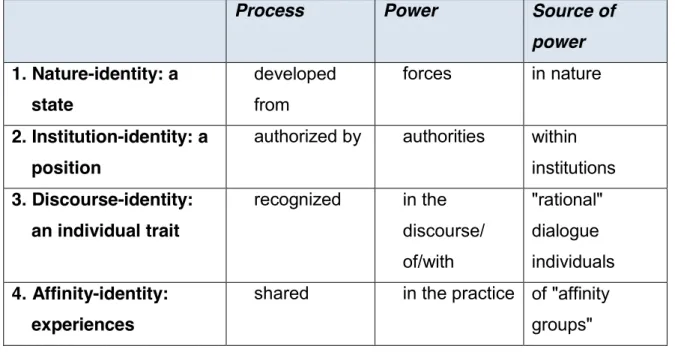
Table 3.1 Gee’s Four Ways to view Identity (2000b: 100) ... 51
Table 4.1 Examples of structure, culture and agency at Bay High School ... 85
Table 4.2 Reading Club and Library Recordings (showing month, title & length of recording) ... 97
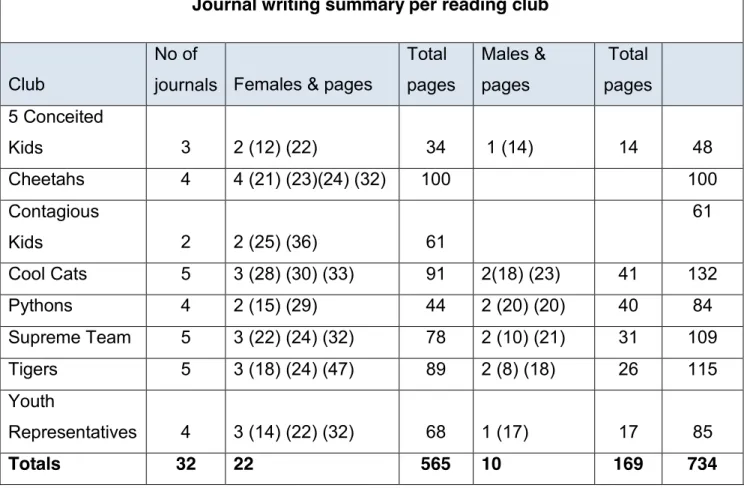
Table 4.3 Journal pages written per reading club ... 101
Table 6.1 Titles used in Reading Clubs ... 129
LIST OF FIGURES
Figure 2.1 Interactions between intransitive and transitive domains of knowledge,
adapted from Bhaskar, 1978 ... 18
Figure 2.2 The Real, the Actual and the Empirical and reading clubs ... 20
Figure 2.3 The morphogenesis of structure (from Archer, 1995: 193) ... 36
Figure 2.4 The morphogenesis of culture (from Archer, 1995: 193) ... 37
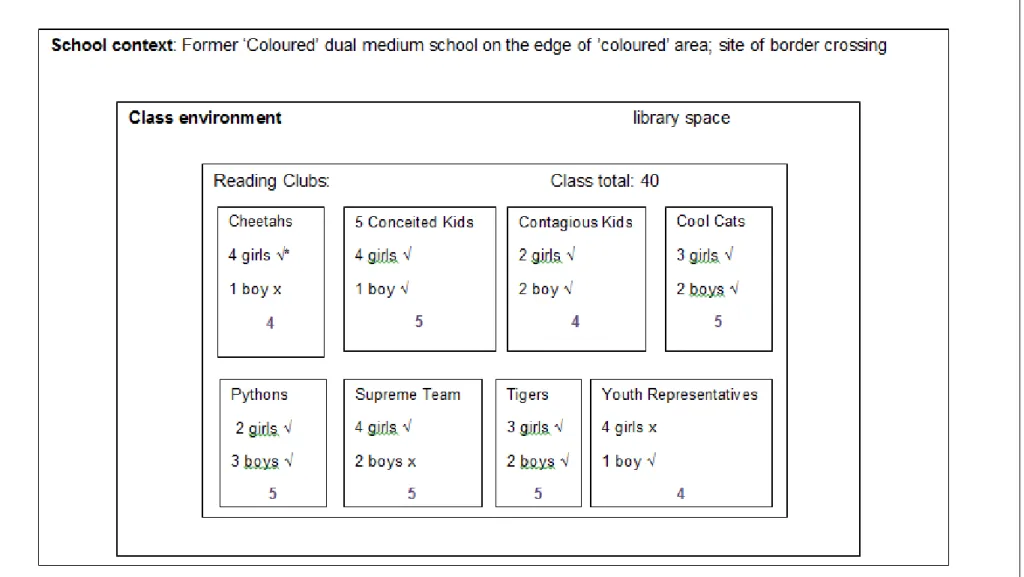
Figure 4.1 Nested context of reading clubs ... 79
Figure 4.2 Archer’s morphogenetic approach (2010: 275) ... 88
Figure 6.1 Vignettes of Reading Club process from T2 to T3 ... 126
Figure 7.1 Jackie’s first journal entry ... 181
Figure 7.2 Jackie’s second and third journal entries: Reading History and comments on The Runaways ... 182
Figure 7.3 Lilla’s first journal entry: her reading history ... 186
Figure 7.4 Lilla’s second and third journal entries, Prince Caspian and Mpho’s Search ... 187
Figure 7.5 Lilla’s fourth journal entry, Seedfolks ... 189
Figure 7.6 Adam’s reading history ... 190
Figure 7.7 Adam’s second journal entry: Seedfolks ... 192
Figure 7.8 Adam’s third entry: Mpho’s Search ... 193
Figure 7.9 Jackie’s second entry on My father and I ... 197
Figure 7.10 Jackie’s comments on David Copperfield and Mpho’s Search ... 199
Figure 7.11 Jackie’s entries on Mpho’s search and The boy who was afraid ... 200
Figure 7.12 Jackie’s comments on reading ... 201
Figure 7.13 Jackie’s first pages on Rainman ... 204
Figure 7.14 Jackie’s further comments on Rainman ... 205
Figure 7.15 Jackie’s initial response to Seedfolks ... 206
LIST OF ABBREVIATIONS
ANAs Annual National Assessments
BICS Basic Interpersonal Communication Strategies (Cummins)
CALP Cognitive Academic Language Proficiency
CAPS Curriculum and Policy Statement
CEPs Cultural Emergent Properties (Archer, 1995)
DoE Department Of Education
L1 First Language
L2 Second Language
LoLT Language of Learning and Teaching
NBTs National Benchmark Tests
RNCS Revised National Curriculum Statement
OBE Outcomes Based Education
PIRLS Progress in International Reading Literacy Study
SGBs School Governing Bodies
CHAPTER 1 INTRODUCTION
“The establishment of a successful social practice is dependent upon adaptive ingenuity of reflexive subjects”
(Archer, 2007c: 10). 1.1 Background
This study focuses on reading in a grade 8 English classroom which forms part of a school and community located in a former “Coloured” area of a South African coastal city. It is a study of an educational intervention underpinned by critical and social realism. It developed from many concerns. Teachers at this school were concerned that their grade 8 learners ‘couldn’t read’. This was followed by an invitation to me –
a language lecturer, at a local university and former high school English teacher – to work more closely with grade 8 learners over successive years in the hope that I would achieve a deeper, more nuanced understanding of what ‘reading’ was for the learners in their school contexts. The grade 8 learners came from between seven and twelve different feeder schools and so brought an array of primary school
‘reading’ practices with them to high school. I was aware that school practices value
certain literacies above others (Street, 1984; Scollon & Scollon, 1981; Scribner and Cole, 1981; Heath, 1983) and while these school practices may be challenged as elitist or exclusionary, which they are, denying learners access to these practices further excludes them. I was concerned about the prospects for learners who ‘can’t
read’ or, who are perceived to be unable to cope with the reading practices in high
schools. I was also concerned that learners did not have access to the print literacies valued in schools or a supportive environment in which to respond to these or sufficient opportunities to engage with a range of print. And so I went to school.
Claims that learners entering high school ‘couldn’t read’ should not be surprising considering the larger educational backdrop. National and international tests like Annual National Assessments, (ANAs) and Progress in International Reading Literacy Study, (PIRLS), have shown that our learners do not do well on their measures of academic performance. Janks (2011) shows how the misalignment
between PIRLS and school reading practices are compounded by changes in the language of instruction, known as LoLT. In the report on the PIRLS 2006 tests, Howie, Venter, Van Staden, Zimmerman, Long, Du Toit, Scherman and Archer (2008) show how particular strategies for reading are only taught towards the end of Foundation Phase, or not at all, so that in writing the test, South African learners had not practiced some of the reading strategies which PIRLS drew on. Within the Foundation Phase it would seem that decoding is the main focus but still, after four years of schooling, the test found that “almost half of the learners tested in English and Afrikaans and more than 80% of learners tested in African languages, have not attained ‘basic reading skills and strategies’” (Ibid: 27). The learners in the grade 8 class, that was the focus of this study in 2011, were not part of the cohort tested in PIRLS 2006 (who would have been in grades 9 and 10 in 2011), but they would have had similar experiences of reading and literacy at primary school.
Within our current education dispensation, reading texts is used as a gatekeeping device, marking transitions between secondary and tertiary educational contexts in the form of National Benchmark Tests1 (NBTs) or entrance tests, as well as within
schools with comprehension tests and other assessments leading to the final Matriculation examinations. In fact much of what happens in education is driven by assessment and while this may serve a developmental or diagnostic role, for many teachers, and student teachers, assessment is about marks. It is summative. More importantly school assessments draw on specific, school-based literacy practices. Matriculation results, as well as those in ANAs and PIRLS, are seen often as evidence of education failure. These results have added to the media portrayal of a
‘literacy crisis’ – similar to Gee’s (2008) concern with portrayals of deteriorating
literacy levels in the United States.
1.2 New Literacy Studies
In exploring these literacy crises, Gee (2008) questions the origins, and in fact the truth, of this ‘crisis’ by elaborating on what is meant by literacy. For Gee, literacy is more than ‘the ability to read and write’ which implies a decontextualized skill: instead it is a way of reading which one acquires by being immersed or apprenticed 1 NBTs are National Benchmark Tests which many universities require prospective first year students
as a member of a social practice wherein people not only read texts of this type in this way, but also talk about such texts in certain ways, hold certain attitudes and values about them, and socially interact over them in certain ways (Gee: 44).
Thus it is interwoven into the setting in which it occurs, whether it be churches, homes, banks or schools. This is a sociocultural approach to literacy which recognises that literacy is practised in different ways, resulting in multiple literacies, or ways of using understanding and interacting with texts. The recognition that literacy is used for different purposes within communities has been termed the
ideological model (Street, 1984). Street challenges the view that literacy will
automatically confer advantages for its proponents, and instead, draws on a range of research to illustrate how practices of reading and writing are used for different purposes within communities. This recognition that literacies are linked to ideologies, or belief systems, together with social values, presents an alternative to the
autonomous model. New literacy theorists, including Heath (1983) Scollon and
Scollon (1981) Street (1984; 1995) and Gee (2008) base their understanding of literacy on how it is used and conclude that there are multiple practices of literacy, both inside and outside school , each with multiple effects.
The ideological model thus offers an alternative understanding of why ‘our grade 8 learners can’t read’ as what learners were doing with texts in grade 8 was drawing on an array of approaches to text, with particular “patterns of language” (Cazden, 2001). Learners had mastered many literacies but maybe not schooled literacies. If learners were to shift to what was required in high school, they needed many opportunities to engage with print and see themselves as successful learners. In particular, I was concerned, as a former high school English teacher, that the grade 8 learners would get many opportunities to read extended texts like novels. Literature forms a large component of the English curriculum in the higher grades which justified my concern for the practice of reading books.
1.3 Context of the study
As mentioned earlier this study grew from an authentic response to challenges faced by grade 8 readers at a local high school. I was familiar with the PIRLS reports on the state of reading at grades 4 and 5 and knew how our learners compared with
those in other countries and how reading levels in the Eastern Cape compared with those in other South African provinces. While PIRLS provided a broad picture of reading problems, I wanted to develop a more in-depth understanding of learners’
experiences of reading. Like Cliff Hodges (2012: 9), I have found that case studies which offered “finely grained accounts of different young people as readers” provided different understandings of the literacy experience. While young South African readers were being presented in such bad light, I wanted their voices to be heard and to better understand their experiences of reading books. So the research gaze narrows its focus on to a particular grade 8 class in a traditionally less-advantaged school. What ‘less-advantaged‘ meant as far as reading novels was concerned, was a dearth of books. But there was a library that had been locked for many years that contained five to six copies of different graded readers, or simplified stories, which were sufficient in total for the grade 8 class. Case studies can address “matters of value, power and local detail” (Erickson, 2011: 53) and can be sites of what Flyvberg (2001) calls ‘phronesis’ which is “action-orientated knowledge of a local social ecosystem” (Erickson, 2011: 53). So this study became a case study of reading within a specific class and school.
Informed by the ideological model I was interested in the practice of reading novels, and the particular discourses that might underpin this, rather than the teaching of novels. I was also interested in the grade 8s’ experiences of reading at primary school as surfacing these understandings might go some in way to addressing the perceived gap between different primary and high school ‘ways of reading’ as well as those in the community. As I wanted to work particularly with the grade 8s themselves, I wanted an intervention that would be enjoyable and rewarding so that in itself it would encourage learners in reading novels. In describing family literacy practices, Heath characterises them as offering “social intimacy, laughter, fulfillment of curiosity, and contemplation of real and imagined worlds” (Heath, 2010: 38). As a specific literacy, reading novels could offer similar rewards, especially if the context was smaller groups, which offered safe spaces in which to share a reading experience. The concept of a reading club, similar to the book clubs described by McMahon and Raphael (1997) would offer sites for independent reading as well as opportunities to read multiple books as sets of readers circulated through the class.
1.4 Research question
If, as Bhaskar (1998) asserts, reasons can be causes, then my interest in how grade 8 learners would respond to discussing books in reading clubs, was the reason for this research. The following research question became central to my thinking and working with the learners and to my understanding of the data:
How can a reading club contribute to shifts in reading identities among grade 8 learners?
In answering this question I was interested in:
1. What discourses did learners draw on in the reading clubs?
2. How did the structure of the reading clubs contribute to shifts in reading identity?
As I will show later, these questions were informed by a methodological framework developed for the research which drew on Bhaskar’s (1978; 1998) critical realism
and Archer’s (1995, 2000) social realism.
1.5 Participants
The grade 8 learners were participants in my research. As participants they worked together with me in developing reading clubs and sharing their thinking along the way. Therefore this study does not position the learners as fixed subjects of research who are knowable, but rather as shifting and unknowable (Pillow, 2003), whose identities are constructed through actions and interactions (McMahon & Raphael, 1997) and who, in response to different contexts and conditions, engage with secondary Discourses (Gee, 2008). As such the learners were actively engaged in this study, so change in their thinking and knowing and ‘being’ was part of the process. As participants, their voices are critical to understanding how the reading clubs were experienced. Viewing them as participants in the study served to value their contributions and equalized the research process (Pillow, 2003) which involved reciprocal hearing, listening and speaking. I have tried to avoid what Sayer (2011: 15) terms “bloodless descriptions of people” as rational actors or subjects, but instead have named them, albeit anonymously. In so doing I hope they will live on the page as they did in the class as active co-constructors of knowledge and as
young people getting what they can from the education offered to them while demanding little. They are eager to learn and they believe that education will open doors and that there is a lesson to be learnt from books. This is an important starting point for an educational endeavour - and for high schools to recognise and build on with their grade 8 learners.
While I valued the learners’ participation I must also acknowledge the role of the class teacher and other staff members at ‘Bay High School’. Having worked with a number of grade 8 English teachers, I was very sensitive to the classroom as the
teacher’s space as well as to her authority in her subject area. In developing an
alternative ‘practice’ which would allow learners more opportunities to read and engage with books, I worked closely with ‘Ms Loti’, the grade 8 English teacher. Together we found titles in the library and she organised the class into groups and distributed sets of readers to each to launch what became our reading clubs.
1.6 Research orientation
The humanizing work of Hoppers and Richards (2011) seemed relevant when considering a rationale for research, i.e. that it needs to make a difference in human lives as, “the dignity of human beings lies in her or his capacity to join with others in building better relationships and a better world” (Ibid. 2011: 29). Critical realism, associated with Roy Bhaskar (1978, 1989, 2008), as one of the key theorists, has an
‘emancipatory social practice’ orientation predicated on the need for society to
change. This change can only come about if we have an in-depth understanding of society and of social structures at play. Critical realism is based on a depth ontology, which, for my study, meant that learners participating in reading clubs’ events were understood to be drawing on structures and mechanisms from a layer of reality, inaccessible to the senses, termed ‘the Real’. Carter and New (2004: 16) explain the three layers of the depth ontology in the following way:
The ‘actual’ comprises events, happenings, phenomena, whether or not these
are observed. The ‘empirical’ is a subset of the actual. The ‘real’ includes both the actual and empirical, as well as structures and mechanisms which may or may not be observed or indeed observable, but which are known by their effects.
I will explore this ontological position in more depth in Chapter 2 of this thesis, but, at this point, it is sufficient to say that what this layered ontology offered was an awareness that any research claims would be theoretical and could not claim to be complete understandings of the underlying layer of the Real. But by studying the effects of the Real, I could try to understand the underlying tendencies which might have been activated in the initiation of the reading clubs.
Margaret Archer’s (1995, 2000, 2007c) social realism is based on Bhaskar’s depth ontology. In trying to access the underlying causes of what we experience at the Actual and the Empirical, she separates structure, culture and agency so as to be better able to explain their interplay. This separation is called analytical dualism and allows the researcher to explore the interaction of the ‘people’ with the 'parts’ (i.e. structure and culture). The use of Archer’s‘morphogeneticframework’ then allows us to explore this interaction over time in order to explain change or non-change (stasis). The starting point of a study involving the use of the morphogenetic framework is referred to as ‘T1’ or Time 1. Archer marks progress over time, as ‘T2 to T3’, which corresponds to the reading club process in my study. The end of the investigation is labelled ‘T4’ and it is there that I draw conclusions regarding how reading clubs, may or may not, have contributed to shifts in learners’ reading identities. So, theories of social and critical realism provide explanatory power to understand and explain interactions in reading clubs at different levels. The basis for emancipatory social practice is an understanding of the structures at work or “the
reality of the mechanisms themselves” (Corson, 1991: 232) in applied social science, and in this case, education.
In the research continuum, the position of the researcher has moved contingent with existing research paradigms and critiques. Within qualitative ethnographic research, authoritative objective standpoints have been questioned and more reflexive collaborative approaches advocated to avoid ‘essentialising’ the ‘other’ as the object of research. As I will explain in Chapter 2, since critical realists acknowledge the fallibility of researchers attempting to excavate the level of the Real, such authoritative standpoints are also unacceptable in research underpinned by this philosophy. Regardless of such theoretical considerations, it would have been difficult, in any case, to take up an outsider position as I had invested so heavily in
this research and maintained links with participants: therefore a more participatory understanding of research was needed. As an older ‘teacherfigure’ in relation to the young learners, there was a clear power differential. Nonetheless, in the main this study was “mutually constructed in the interaction that takes place between the observer and observed” (Erickson, 2011: 50). Erickson also shows how re- evaluations of research can illustrate how powerfully the researcher’s perspective, politics and ideology can influence what is seen. This raises the concern that researchers only see what they expect to see, “ignoring disconfirming evidence”
(Erickson, 2011: 51). In setting up reading clubs with learners I expected to see learners taking up reading practices, so this comment is valid up to a point. What I will be discussing in this thesis is what else emerged and how it emerged - and how different literacy experiences were mobilized in response to the books. So I am aware of my responsibility to my participants in sharing our reading journey with insights into their experience of reading clubs. This is not Behar’s ‘break your heart’
research (as cited in Foley, 2002): instead it is a presentation of reading clubs filtered through my limited, and sometimes incomplete, understanding.
1.6.1 A note on writing
Pelias’s evocative piece on Writing into Position draws attention to many of the
challenges of doing just that. He points to writing as claiming a space and taking up a position to be heard as “research lives in possibility and promise” (Pelias, 2011: 659). In addition he suggests that understanding comes in the process of writing so that the writing itself is a method of inquiry. As such it allows a working through of attenuating scales of clarification and nuance which strives to shake into order an experiential mass. Through this ‘shake-down’ of writing a clearer, less disheveled quilt may appear, maybe still patchy but with some squares that resonate with the heart, others that could be stitched together more clearly and sections that complement each other seamlessly. In some ways we write what we read: Pelias (2011), unlike other theorists, encourages a more poetic voice. The act of writing allows the writer to organize thinking, and in this process of ‘writing into’, the writer crystalizes her thinking and ‘languages’ herself into position. So, for Pelias, the writing involves both a realization of clearer thinking and a record in the form of a completed text. This resonates both with the writing of this study and also with the
learners who wrote themselves into positions in journal writing, which became for them too, a ‘realization and a record’ of their own thinking.
1.7 Significance of the study
Within the context of the so-called literacy crises in South Africa, this study attempts to present a different perspective. Through working with learners in a reading club I explore the resources learners draw on to make sense of their reading. In this process learners have multiple opportunities to read and write around books, which is in itself a specific literacy. This then is a view beyond the national tests and media reports. It is an attempt to do things differently, as “[T]o do the same thing over and over again and [to] expect a different result is the definition of insanity” (Steinbach, as cited in Janks, 2011). What this research offers then is the learners’ experiences and understandings of the literacy practices associated with the reading clubs introduced into their class. Their voices then allow me and, I hope, my readers to gain a better understanding of the way the reading clubs contributed to those lived experiences.
1.8 Overview of the research
In Chapter 2, I explore the theoretical framework of this study by explaining critical realism as a ‘depth ontology’ and exploring how this informs our understandings of what knowledge is, as well as how causation and emergence contribute to our understanding of social events. As I used Archer’s (1995) ‘morphogenetic
morphostatic’ model to frame this study over time, I explain how structure, culture
and agency provide a way of understanding learners’ interactions in reading clubs.
In Chapter 3 I focus on literacy with particular attention to New Literacies, socio- cultural understandings of literacies as ‘situated’ and Street’s (1984) ideological model. As this study occurs within a school context I explore how understandings of reading practices follow a trajectory over the learners’ years at school and I locate reading clubs as a particular practice of reading within the school setting.
In Chapter 4, I explain the methodology and methods used in this study. I try to show how critical realism and social realism provide explanatory power in this case study. I
also outline how talk and journal writing functioned within the reading club process to provide the data for this study.
Chapter 5 is located at T1 or the beginning of the study. As such it aims to explore
the way learners were socially and culturally conditioned to engage with text as a result of the positions they occupy in South African society.
In Chapters 6 and 7, I present my analysis of the data generated as a result of the study in the form of a series of vignettes. Drawing on Archer’s morphogenetic framework, these vignettes are understood to illustrate T2 to T3.
Chapter 8 concludes the study at T4 and here I consider to what extent
morphogenesis occurred and I suggest future considerations for reading clubs in school settings.
CHAPTER 2
THEORETICAL FRAMEWORK
“[A]lthough structure and agency are at work continuously in society, the analytical element consists in breaking up these flows into intervals determined by the problem in hand,”
(Archer, 1995: 168).
2.1 Introduction
As indicated in the previous chapter, the aim of this study was to examine how a reading club could contribute to shifts in the reading identities of learners at Bay High School, hereafter referred to as BHS. Because I was interested in moving from a description of what was observed to trying to understand underlying reasons, I needed a meta-theory that would allow for depth. In addition, as my engagement with learners in reading clubs took place over a six-month period and decisions about the clubs needed to be made on the basis of learners’ responses to them, I needed theories that would accommodate this form of open research. Sayer (2000: 19) observes that “social systems are always open and usually complex and messy”
as was the case here.
As a theoretical framework I have used the critical realist philosophy of Bhaskar (1978, 2008) and also Archer’s (1995, 2000, 2007c) social realism which together offer the use of a ‘depth’ ontology to probe beneath the reality which is made apparent to us through the senses. Critical realism recognises the contribution of hidden causal mechanisms underlying this apparent reality. As Danermark, Ekström, Jakobsen and Karlsson (2002: 5) note “to switch from events to mechanisms means switching the attention to what produces the events” - and it is what produces events related to shifts in learners’ reading identities that is of interest in this study. Because the social world is pre-structured and we are born into society, by participating in that society we contribute to its reproduction as “society is both the condition and outcome of human agency and human agency both reproduces and transforms
society” (Archer, Bhaskar, Collier, Lawson & Norrie, 1998: xvi). Understanding what
case of this study, I wanted to intervene in the repeated construction of learners as
‘poor readers’.
This chapter will therefore discuss critical realist concepts, more specifically how a stratified ontology can add to our understanding of phenomena and how knowledge is understood within critical realism. Thereafter I discuss how Archer’s concepts of analytical dualism, her morphogenetic framework and her understanding of reflexivity could be used to better explore the changes that occurred among participants in the reading clubs within the context of BHS.
2.2 Critical Realism
Critical realism is a theory which differentiates between ‘reality’ or ‘truth’ (or ‘alethic
truth’ in Bhaskar’s terms), about the world we live in and our experiences of living in
the world. Knowledge about the world is not the same as our experience of it so these cannot be equated as some theories attempt to do. Our experiences are always limited and relative and can never give us a full picture of what we seek to explore. Thus critical realism draws a clear distinction between ontology – or knowledge – and epistemology – or how we can come to know.
The term ‘critical realism’ came from Bhaskar’s interest in a philosophy of science termed ‘transcendental realism’ combined with ‘critical naturalism’, which is a philosophy of social science. These two positions were combined to form a new philosophy, termed critical realism, which he explains in A Realist Theory of Science
(1978). This was his attempt to offer an alternative to positivism and to undemanding moves within the history of scientific research (Bhaskar, 2008). Bhaskar was concerned with emancipatory social justice, which could not be achieved without a clearer understanding of the workings of both the natural and social world. This understanding of the world has, at its heart, the concept of emergence from a deeper strata of reality, for, as Bhaskar (1986: 103) contends, “[I]t is only if social phenomena are genuinely emergent that realist explanations in the human sciences
are justified”. The explanation of social phenomena in realist terms, for Bhaskar,
implies emancipatory possibilities. For emancipatory practice we need to identify the structures at work to be able to change the social world (Corson, 1991).
When critical realist ontology is extended to the social sciences, non-human properties like reasons and explanations offered to direct human behaviour are regarded as real entities, according to Corson, who goes on to assert
[I]f reasons or accounts of one kind or another constitute the hypothetical generative mechanisms in our social science theories or models, then the twin tasks of research, in the sociology of education for example, are firstly to identify the existence and secondly to detail the operation of these mechanisms: to show the hypothetical reasons or accounts to be real (Corson, 1991: 233).
Sayer (2000) suggests that theory should be used in the service of understanding the world, which exists independently of our theorising about it. Following Bhaskar, Sayer distinguishes between the real, which exists whether we can perceive it or not, described as “the realm of objects, their structures and powers” (2000: 6), and our experiences and observations of this realm. The role of theory is to assist in moving from the world we can know through the senses to that which is not directly observable or perceivable.
The value of critical realism is that it offers an alternative to empiricism and positivism on the one hand and relativism on the other:
There is more to the world than patterns of events. It has ontological depth: events rise from the workings of mechanisms which derive from the structures of objects, and they take place within geo-historical contexts (Sayer 2000: 15). 2.2.1 Positivism & empiricism
From a critical realist perspective, positivism mistakenly conflates the empirical with its underlying laws, resulting in epistemic fallacy (Bhaskar, 2008). The real, which exists outside of our knowing it, cannot be equated with the processes or procedures used to know it. Empirical knowledge, which derives from our everyday sensory experience of the world, cannot fully account for reality, and attempts to do so throughout history exemplify our limited understanding of the world. For example, the perception and belief that the earth was the centre of the universe held sway for centuries as supported by everyday perceptions: new insight into celestial movements via Copernicus’ theories and Galileo’s telescope challenged this strongly-held empirical view which was so dominant that the latter was ‘encouraged’
to recant his views. Because what we know changes, critical realism’s focus is not on knowing; instead it is a theory of being or ontology (Corson, 1991). Bhaskar says that we can only make sense of our experiences at the empirical level if we acknowledge other layers that feed into it. Empiricism reduces the world to our experiences of it, which denies the existence of the underlying causal mechanisms and generative powers at the level of the real. Neither empiricism, nor its twin, positivism, account for the causes of experiences, thus both ignore the need to understand causal mechanisms. Bhaskar addresses this problem by distinguishing between different levels of reality. This distinction between the Real, the Actual and the Empirical is the basis of his stratified ontology.
2.2.2 A stratified ontology
As mentioned earlier, recognition of a stratified ontology is central to critical realism. What Bhaskar means by this is that there are three levels, or, domains, of reality i.e. the Real, the Actual and the Empirical as illustrated in Table 2.1.
Domain of Real Domain of Actual Domain of
Empirical
Mechanisms √
Events √ √
Experiences √ √ √
Table 2.1 Bhaskar’s levels of the Real, the Actual and the Empirical (Bhaskar, 2008: 2)
What this shows is that at the level of the Empirical, we only have access to experiences (though we may be able to discern aspects of the Actual and the Real) and that these experiences are derived from other activities at the level of the Actual and the Real. It is activity in the form of mechanisms and structures in the domain of the Real that underlie what we see and experience in the Empirical domain. What Bhaskar argues here is that “real structures exist independently of and are often out of phase with the actual pattern of events” (2008: 3) and that we cannot fully account for our experiences because we do not always know the generative mechanisms operating at the level of the Real. This is the purpose of research: to understand and explain the generative mechanisms, together with their tendencies which might give
rise to the phenomena we observe and experience at the level of the Empirical. The level of the Real can include physical objects, such as minerals or social objects like bureaucracies but all have capacities and powers which may, or may not, be exercised (Sayer, 2000). The level of the Actual, often referred to as the level of events, relates to what happens when powers are activated such as when a previously idle person does work (Sayer, 2000) or when, in the case of this study, readers start to read in different ways. It presupposes that the capacity was always there but had not been galvanised for whatever reasons. As Bhaskar’s table indicates, the domain of the Empirical includes experiences and at this level we try to make claims from what is observable to what we can infer about causal structures. The claims that might follow do not change the Real, as in the example of a ‘flat’
earth. Whether the current belief is that the earth is flat or round does not alter the earth – it does not change according to what people believe (Sayer, 2000).
Any theory of science can be considered an epistemology as it is our understanding of the real world and is not the real. This is what Bhaskar considers an epistemic fallacy – equating our theories of the real with altheic truth. Our beliefs about knowledge are socially produced so that all knowledge is in fact transient (Corson, 1991). For example, in a scientific experiment the scientist may be a causal agent who initiates a chain of events. The scientist, however, is not the cause of the law which she identifies from the sequence of events. (Bhaskar, 2008). So we need to acknowledge our contributory role as causal agents in the theorization of science or social science.
The levels of the Real, the Actual and the Empirical have been tabulated, with elements of the reading clubs, in Table 2.2 to show how the Real can include objects, together with their powers and properties, as well as events and experiences. As the ‘base stratum’ it must contain all of the aspects of the other layers (Shipway, 2011). The Actual consists of the events that do, or do not occur, depending on the activation of the powers at the level of the Real, together with empirical experiences. The Empirical consists only of that which can be empirically observed and measured, which may be, metaphorically speaking, the tip of the ice- berg.
The challenge of the Real is that it exists outside our ability to know it directly, i.e. is not transparent, but its powers and mechanisms can be experienced indirectly (Danermark et al., 2002). Scientists and philosophers through the centuries have tried to account for individual experiences at the Empirical level, thus recognising the existence of forces beyond their perception. So, this third level of the Empirical or observable, is recognised as a valuable level of experience but realists acknowledge the underlying causal criteria too (Collier, 1994; Sayer, 2010), and warn that sometimes the observable only yields products of unobservable entities.
Domain of Real Domain of Actual Domain of Empirical Mechanisms Objects (with inherent properties),their
structures and powers, or “capacities to behave in particular ways” (Sayer, 2000:11)
Learners as agents with inherent capacities to read
Structures such as social class, race, gender, the education system with the potential to condition reading in certain ways
Events Events that do or do not occur, activation or
exercise of powers Events that do or do not occur, activation or exercise of powers
Literacy events related to reading clubs
Cake sales Library clean-ups Experiences Events that are experienced & observed,
based on causal mechanisms at the level of the real
Events that are experienced & observed, based on causal mechanisms at the level of the real
Events that are experienced & observed based on causal mechanisms at the level of the real
Learners’ experiences and observations related to their participation in reading clubs.
Table 2.2 The Real, the Actual and the Empirical in Critical Realism
2.2.3 Transitive and intransitive domains
For Bhaskar (1978), objects of knowledge at the level of the Real exist irrespective of human knowledge of them and are therefore referred to as ‘intransitive’ (see Fig 2.1). He distinguishes between two types of ‘objects’ of knowledge, a transitive and an intransitive dimension. In the transitive dimension there is “antecedently established
knowledge” or existing knowledge, which is the starting point for the examination of
new knowledge. The intransitive domain consists of the structures and mechanisms that exist independently of human thought and action (Bhaskar, 2008). Structures and mechanisms in the intransitive domain are enduring and ahistorical, whereas theories that try to account for this domain have changed throughout history. So our knowledge of the intransitive domain “will always be framed and articulated in the transitive domain” (Shipway, 2011: 60). Theories of science in the transitive domain are therefore critiqued and replaced with new theories but these do not change what happens at the level of the Real. This can be understood from the critical realist position of ‘epistemological relativism and ontological realism’ (Bhaskar, 2008; Shipway, 2011).
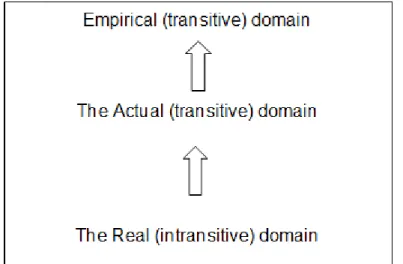
Figure 2.1 Interactions between intransitive and transitive domains of knowledge, adapted from Bhaskar, 1978
While the Empirical and Actual Emerge from the real (Bhaskar, 1978; Sayer, 2000; Mingers, 2000) (indicated in the diagram above by the upward arrows), the cycles of explanation and theory in the transitive domain continually try to account for the Empirical and to perceive the Real. Hartwig suggests that analysis is divided
19 between “[E]xperiences, events and causal mechanisms (the overlapping domains of the empirical, the actual and the real)” (2008:xv) and transitive and intransitive dimensions. He argues that “the transitive dimension is the creative, praxis-driven process of production of scientific knowledge or epistemological process” (2008: xvi).
To apply Bhaskar’s model of a stratified reality to my study: my concern relates to observations concerning learners’ lack of reading (i.e. a failure to observe literacy events) at the levels of the Actual and the Empirical. These observations are also manifested in tests such as PIRLS. This concern has then resulted in attempts to trigger unexercised powers at the Real through the introduction of reading clubs. Journal writing and reading club talk, conceptualised as events at the Actual, became ways of capturing learners’ experiences of reading (conceptualised at the level of the Empirical) and, thus, ways of accessing the Real. So central to this research was an investigation into causal mechanisms that came into play as a result of the introduction of reading clubs and the literacies they promoted. If this is mapped on to Bhaskar’s transitive and intransitive domains, together with relative positionings within a stratified ontology, a two-way effect as represented in Figure 2.2 results (see below). The Empirical level consists both of the general reading scores as evidenced by national assessment on a large scale and by how reading clubs were experienced within the school system by both learners and the teachers involved. At the Actual level are the events of the reading clubs specifically and within the larger school context in the form of book displays and library events. At the Real are the “generative mechanisms whose powers may exist unexercised or be exercised unrealised” (Archer, 1998: 190), in the form of unexercised reading abilities, selection of reading material, or reflexivity.
Figure 2.2 The Real, the Actual and the Empirical and reading clubs
Bhaskar reminds us that the objects of knowledge in the social arena are not separate from the process of production of knowledge about them as is the case in the natural world. Studying minerals has no impact on the minerals but studying
learners’ behaviour does (as even the fact of being observed can impact on
behaviour). So production of knowledge in the social sciences “may be causally, and internally, related to the process of production of the objects concerned” (Bhaskar, 1998: 227). What is important for Bhaskar is that once an object of study exists, no matter how it was produced, it still constitutes an object of research. So the categorical properties of objects in human studies differ from those in the sciences
as “they are an aspect of, and causal agent in, what they seek to explain” (Ibid). The
reading clubs which are the focus of the research, became weekly events in which learners may or may not, have drawn on prior experiences of reading or reading ability. They might have engaged in discussions which motivated them to read and discuss more, or not. Through writing in journals about their reading they may or may not have developed a reflexive stance. The objects at the Real exist as the focus of the study but are flexible and mutable in the course of the study because of interdependency of the various causal factors.
21 2.2.4 Emergence
Because critical realism has shown ontology “to be bivalent, and indeed polyvalent”
(Price, 2005: 88) the importance of an explanation to account adequately for evidence increases. A stratified ontology avoids conflating how we know with what we know and recognises that what emerges can be quite different from its constituents. Sayer illustrates this with the example of water, which has very different properties from those of the elements of hydrogen and oxygen which comprise it (Sayer, 2000: 12). From the combination of these elements, which exist at a foundational stratum of reality, a new compound, water, with its own unique properties, results. This is a useful illustration of the concept of emergence where
two or more elements or aspects in conjunction give rise to new phenomena with new properties or powers. For example, a new phenomenon, like water, is not reducible to the constituents which contributed to its formation, though the new emergent entity is dependent on these constituents.
In relation to this study, the concept of emergence offers the potential of accounting for literacy events and participants’ experiences of reading as a result of the activation of latent, unexercised powers and properties located at the level of the Real. It is this process of activation and the resulting emergence, that this study seeks to explore.
2.2.5 Causation
Because we entertain a stratified understanding of the world, we accept that there are structures at the level of the Real that have certain generative powers and properties. As noted earlier, the configuration of different mechanisms or elements can result in the emergence of a new phenomenon. Causal powers are inherent in the various structures and mechanisms at the level of the Real, whether these powers are activated or not. In the open systems of social science studies, the activation of causal powers is contingent and explanations involve identifying causal mechanisms and their powers - and when and how they may have been activated (Sayer, 2000). Social science research seeks explanatory power not predictive power (Collier, 1994; Bhaskar, 1998; Sayer, 2000) so what causes something to happen cannot be linked to regularity (in how often something happens), nor to a single ‘first’ cause. Causes can be linked to the physical attributes of human beings –
that they have certain powers that they might exercise or not – and to social structures and mechanisms which may invoke certain attributes contingently. Understanding this concept of causation means that in the reading clubs, regularity cannot be seen as causal, which makes identifying possible causal mechanisms in learners taking up reading and developing reader identities, even more tenuous.
2.2.6 Understandings of knowledge within critical realism
Many of the commonplace understandings of the world are based on empirical evidence. In fact society seems to set great store on the validity of factual information often presented in the media in the form of statistics. I felt a positivist approach would not be adequate to describe the changes experienced through involvement in the reading clubs. However I needed to understand the different orientations of critical realism when used to understand natural sciences as opposed to social sciences. Mingers’ (2000) exploration of the application of critical realism in research teases out the different foci, as do Sayer (2000) and Danermark et al.
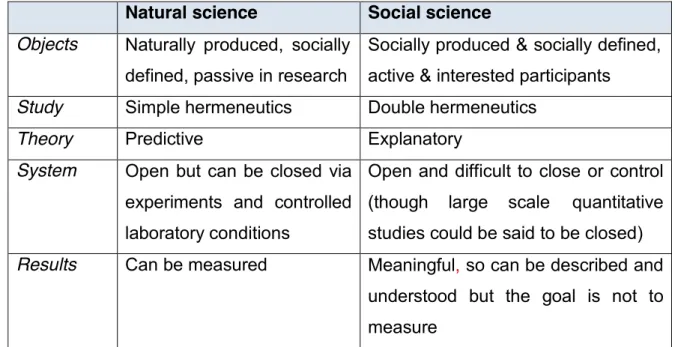
(2002). A tabulated comparison between a critical realist approach using the examples of science experiments on the one hand, and an educational study on the other, is presented in Table 2.3. Mingers’ study helped to elucidate how critical realist ontology could be applied to these different epistemological approaches. While setting up a comparative table might seem to establish binaries, this is not the purpose here. The table is a useful heuristic and starting point for a qualitative, small-scale research study in a largely positivist world.
This table is also useful in establishing a framework of how to talk about research in the social sciences. Research with people necessitates an awareness of their variability both within groups in the same context and within the individual, hence the need to recognise this as an open, sometimes messy system that cannot be controlled as in a science experiment. Danermark et al. (2002) suggest that open systems are challenging as “generative mechanisms operate in combination with each other; the more mechanisms involved, the more difficult to anticipate the
outcome” (Ibid: 206). From a Baktinian perspective this is articulated as a focus on
‘objects of knowledge’ in natural science, which is therefore monologic, whereas “the
human sciences are necessarily dialogic because they are concerned with other
23
Natural science Social science
Objects Naturally produced, socially defined, passive in research
Socially produced & socially defined, active & interested participants
Study Simple hermeneutics Double hermeneutics
Theory Predictive Explanatory
System Open but can be closed via
experiments and controlled laboratory conditions
Open and difficult to close or control (though large scale quantitative studies could be said to be closed)
Results Can be measured Meaningful, so can be described and
understood but the goal is not to measure
Table 2.3 A critical realist perspective on research in the natural and social sciences (Mingers, 2000: 1263; Sayer, 2000; Danermark et al., 2002) In both natural and social science research, critical realism suggests that knowledge is fallible and therefore open to refutation, especially if these knowledge claims derive from the most accessible level of the Empirical. These warnings about the tentative nature of knowledge claims encourage a search for a deeper understanding of what lies outside the Empirical or observable. From a critical realist viewpoint, reality consists of more than the observable events but is “about objects, entities and structures that exist (even though perhaps unobservable) and generate the events
we observe” (Mingers, 2000: 1260). A realist ontology accepts that entities exist
independently of our knowledge of them. While this may seem self-evident in that human beings cannot claim to know or understand all the events that occur, it also recognises that even when we claim some knowledge or understanding of events or practices, from a critical realist perspective, it will be limited and incomplete. What knowledge we have may seem true for now but could change.
2.2.7 Critical realism and society
In examining society, critical realism avoids reducing knowledge of society to the knowledge of individual people, or social atomism (Bhaskar, 1998) and instead recognises that society, or social groups, have powers that are different from the powers of their constituent parts. Individuals’ positions are relational and reflective of
education, a ‘teacher’ suggests some learners; a ‘principal’ suggests a staff of teachers so “[O]ur social being is constituted by relations and our social acts presuppose them” (Collier, 1994: 140). Bhaskar’s critical realism, as an
‘underlabouring’ philosophy, lays the foundation for Archer’s separation of structure
and agency with the Transformational Model of Social Activity (TMSA). Bhaskar suggests that “[S]ociety is both the ever-present condition (material cause) and the continually reproduced outcome of human agency” (1998: 215). This recognises that people are born into certain social situations, as in a language group or period in history, and by speaking the language perpetuate its use, or change it.
In a simplistic ‘natural science’ versus ‘social science’ binary, quantitative research is often associated with natural sciences and qualitative with social sciences. While this is clearly an artificial divide, and a gross generalisation, there have been some tendencies to support this perception of research. What I find more useful is the concept of an intensive study which “is concerned with what makes things happen in specific cases” (Sayer, 2000: 20) and often uses ethnographic methods. An intensive study takes more cognizance of context, which is importance in understanding what Bakhtin (1981) terms, the ‘living utterance’. Using a critical realist perspective
“[I]ntensive research seeks out substantial relations of connection and situates
practices within wider contexts, thereby illuminating part-whole relationships”,
(Sayer, Ibid: 2). This, then leads to understandings of knowing and how this knowing
will be achieved.
2.2.7.1 Inference and Knowing
Critical realism recognises the importance of reflection or second-order monitoring where people make a "retrospective commentary" (Corson, 1991:227) on earlier actions. Corson claims that this retrospection "gives special status to people's accounts of their own behaviour" and that this surpasses accounts established through the third person, or researcher's observations (Corson, 1991: 227). Thus retrospection by participants can be used as a mechanism to understand experiences at the level of the Real. So journal writing could be examined as a form of retrospection, thereby according learners’ own experiences this special status. Through examining learners’ journals, we can come to see their experiences, as well as thoughts on their experiences, of reading clubs.
25 Critical realism offers inference tools, such as abstraction2, abduction and retroduction3 to make knowledge claims. What abstraction offers is a way to
separate different mechanisms which together produce certain events or phenomena. An aim of abstraction is to isolate certain aspects of thought and thereby clarify concepts, or abstractions, more precisely (Danermark et al., 2002).
Retroduction, like induction, is a type of inference from observed to unobserved things. Price suggests that “induction is the inference from past to future while retroduction is the inference from actual phenomena to structural causes.” (2005: 93). Danermark et al. suggest that retroductive inference, or transfactual arguments, involve reasoning from the concrete to a reconstruction of conditions so we can know the constituents and mechanisms needed for a phenomenon to occur. Abduction involves the use of theory to recontextualise or ‘re-see’ a phenomenon.
Clearly, thinking and reasoning are critical to any research but Danermark et al.
claim
that the concept of inference or thought operation refers to different ways of arguing and drawing conclusions – moving from something and arriving at something else – having in common that we thereby link observations of different phenomena to general concepts. Inference is a way of reasoning towards an answer to questions such as: What does this mean? What follows from this? What must exist for this to be possible (2002: 79)
Danermark et al. suggest four complementary modes of inference for critical realist research, namely: deduction, induction, abduction and retroduction. Although all are valuable, all also have limitations. For example, deduction is a logical analytical mode of reasoning that does not tell us anything new about reality, while inductions
“are restricted to conclusions at the empirical level” (Ibid: 81). All have their own strengths and applicability too. Danermark et al. show how abduction has resulted in new configurations of knowledge. That is connections or relations are made which help to explain known phenomena in novel ways. An example cited by Danermark et al., is Giddens’ recontextualization of anorexia as denoting reflexive identity and the
2 Danermark et al. (2002) refer to abstraction as a process for conceptualization rather than inferring
new meaning: however I have chosen to group it together with abduction and retroduction as all can be understood as ‘thought operations’ in pursuit of the underlying real layer.
3 Price uses these terms interchangeably but Danermark et al. suggest a nuanced progression from