http://researchcommons.waikato.ac.nz/
Research Commons at the University of Waikato
Copyright Statement:
The digital copy of this thesis is protected by the Copyright Act 1994 (New Zealand).
The thesis may be consulted by you, provided you comply with the provisions of the Act and the following conditions of use:
Any use you make of these documents or images must be for research or private study purposes only, and you may not make them available to any other person. Authors control the copyright of their thesis. You will recognise the author’s right
to be identified as the author of the thesis, and due acknowledgement will be made to the author where appropriate.
You will obtain the author’s permission before publishing any material from the thesis.
for Cloud Computing
A thesissubmitted in fulfilment of the requirements for the degree
of
Doctor of Philosophy
atThe University of Waikato
byMark A. Will
Department of Computer Science Hamilton, New Zealand
Information in the cloud is under constant attack from cyber criminals as profitability increases; user privacy is also at risk with data being mined for monetary value – the new gold. A single leak could have devastating conse-quences for a person or organisation, yet users have limited control over their privacy. It is becoming clear that the current model for public cloud computing is flawed, where cloud vendors and their employees can no longer be trusted to protect user data. Privacy-preserving computation in the cloud keeps data private at all times but still remains functional, thus returning control of data back to users. The cloud could then perform operations using data that it cannot comprehend. The end-user would then be able to retrieve the results from the cloud and unlock the real answers.
Homomorphic encryption is a solution for privacy-preserving processing, al-lowing computation over cipher text. At the time of writing, a fully homo-morphic system allows arbitrary operations but requires minutes to compute an operation, whereas partially homomorphic encryption can only support a single operation, meaning it cannot be a generic solution to privacy-preserving computing. Another solution is multi-party computation, which uses a dis-tributed approach built upon homomorphic encryption but currently suffers other limitations like reusability and lacks the ability to be truly dynamic.
The primary objective of this research is to design a solution for the cloud that offers privacy-preserving data computation but provides performance and flexibility. A novel approach for multi-party computation is developed, where the combination of encoding and distribution helps provide the balance be-tween security, performance and utility. Privacy is maintained by each dis-tributed entity only receiving a small portion of the actual data through en-coding, where attempting to brute-force the data results in a vast number of
computational but network latency. A cloud voting application was used for analysis between existing solutions and the novel approach taken by this re-search, which is able to add thousands of votes per minute, giving practical privacy-preserving processing in the cloud.
This has been the biggest challenge of my life thus far; at times the end seemed impossible, the fear of failure ever looming, with those words of “why did I do this” getting stronger. However, the love and support of friends, family and colleagues has pushed me through to this point. I feel as though I have grown as a researcher, but also as a person and I have everyone to thank for that.
Throughout my studies, I have been lucky enough to receive the following scholarships: University of Waikato Doctoral Scholarship, Top Achiever Doc-toral Scholarship, a STRATUS Research Scholarship and the Prime Minister’s Scholarship for Asia, which all made a big difference and I am very grateful. I have also had support from the STRATUS project, and was able to work as a Doctoral Assistant for four years, which I cannot thank the department enough for. On that note, the computer science department has been amazing throughout my eight years studying at Waikato, and I can safely say I would not be where I am today without that unique environment.
There have been many positives during my studies, including traveling around the world, experiencing other cultures, and many other opportuni-ties. The biggest of which, was having the chance to work at INTERPOL in Singapore for three months. It was a true privilege, and there are many peo-ple to thank for making that possible. Toshinobu Yasuhira, Margaret Samuel, Silvino Schlickmann and the rest of the team, thank you for making my time there so memorable. However, there is one man who was responsible for all my amazing opportunities and experiences; thank you Ryan, I know you probably did not hear that enough, but I have always been grateful for your hard work and determination to push us to be the best we can.
Finally, I would like to single out a few people who have helped me along the way. Ian and Jim, my thesis would be useless without you guys, I owe
Raja, Mohammad and Brad. It is actually quite emotional just seeing your names here, and I think that really signifies the relationship we all had. Alan and Jeff, we sure had some fun together, I really cannot thank the two of you enough, which is why you got mentioned twice. Finally, I would like to thank my wife, for getting me through this final stage, for putting up with me during what has been stressful times, and for making everything better again, mahal kita.
I am sorry if I have missed anyone, you have all helped me get through this, salamat!
2017
• Secure FPGA as a Service – Towards Secure Data Processing by
Phys-icalizing the Cloud, Mark A. Will and Ryan K. L. Ko, The 16th IEEE
International Conference on Trust, Security and Privacy in Computing and Communications (TrustCom), Sydney, NSW, 2017 (CORE Rank A)
• Anonymous Data Sharing Between Organisations with Elliptic Curve
Cryptography,Mark A. Will, Ryan K. L. Ko and Silvino J. Schlickmann,
The 3rd IEEE International Workshop on Trust and Security in Wireless Sensor Networks (TrustWSN) at TrustCom, Sydney, NSW, 2017
• Visualizing the New Zealand Cyber Security Challenge for Attack
Be-haviours, Jeffery Garae, Ryan K. L. Ko, Janice Kho, Saidah Suwadi,
Mark A. Will and Mark Apperley, The 3rd IEEE International
Work-shop on Cloud Security and Forensics (WCSF) at TrustCom, Sydney, NSW, 2017
• Returning Control of Data to Users with a Personal Information Crunch
– A Position Paper,Mark A. Will, Jeffery Garae, Yu Shyang Tan, Craig
Scoon and Ryan K. L. Ko, International Conference on Cloud Computing Research and Innovation (ICCCRI), Singapore, 2017, Best Paper Award
• Chapter 5 - Distributing Encoded Data for Private Processing in the
Cloud, Mark A. Will and Ryan K. L. Ko, Data Security in Cloud
• Privacy Preserving Computation by Fragmenting Individual Bits and
Distributing Gates, Mark A. Will, Ryan K. L. Ko and Ian H. Witten,
The 15th IEEE International Conference on Trust, Security and Privacy in Computing and Communications (TrustCom), Tianjin, 2016 (CORE Rank A)
• Computing Mod with a Variable Lookup Table,Mark A. Willand Ryan
K. L. Ko, International Symposium on Security in Computing and Com-munication (SSCC 2016), ComCom-munications in Computer and Information Science, vol 625. Springer, Singapore
2015
• Secure Voting in the Cloud using Homomorphic Encryption and
Mo-bile Agents,Mark A. Will, Brandon Nicholson, Marc Tiehuis and Ryan
K. L. Ko, International Conference on Cloud Computing Research and Innovation (ICCCRI 2015), Singapore, 2015,Best Paper Award
• Bin Encoding: A User-Centric Secure Full-Text Searching Scheme for
the Cloud, Mark A. Will, Ryan K. L. Ko and Ian H. Witten, The 14th
IEEE International Conference on Trust, Security and Privacy in Com-puting and Communications (TrustCom), Helsinki, 2015 (CORE Rank A)
• Chapter 5 – A Guide to Homomorphic Encryption, Mark A. Will and
Ryan K. L. Ko, The Cloud Security Ecosystem, 1st Edition, Technical, Legal, Business and Management Issues, Syngress, an Imprint of Elsevier, 2015
• Progger: An Efficient, Tamper-Evident Kernel-Space Logger for Cloud
Data Provenance Tracking, Ryan K. L. Ko andMark A. Will, The 7th
IEEE International Conference on Cloud Computing (CLOUD), Anchor-age, AK, 2014
Abstract iii
Acknowledgements v
List of Publications vii
List of Figures xx
List of Tables xxii
List of Listings xxiv
List of Acronyms xxvi
1 Introduction 1 1.1 Background . . . 1 1.2 Hypothesis . . . 3 1.3 Scope . . . 4 1.3.1 Use Cases . . . 4 1.3.2 Privacy-Preserving Encoding . . . 4
1.3.3 Data Security and Privacy . . . 6
1.4 Contributions . . . 7
1.4.1 Secure Survey Platform . . . 7
1.4.2 A Private Encoding Search Scheme . . . 8
1.4.3 FRIBs: An Arbitrary Privacy-Preserving Scheme . . . 8
1.5 Organisation . . . 8
2.1 Homomorphic Encryption . . . 11
2.1.1 Historic Overview . . . 13
2.1.2 Overview of Partially Homomorphic Encryption Cryptosystems 14 2.1.3 Lattice Based Cryptography . . . 17
2.1.4 Learning With Errors . . . 17
2.1.5 Approximate Eigenvector Algorithm . . . 19
2.1.6 Practicality of Fully Homomorphic Encryption Schemes . . . 20
2.2 Secure Multiparty Computation . . . 21
2.2.1 History . . . 21
2.2.2 Garbled Circuits . . . 22
2.2.3 Secret Sharing . . . 24
2.2.4 Combining Multi-Party Computation and Homomorphic En-cryption . . . 25
2.2.5 Current Libraries and Implementations . . . 26
2.3 Secure Hardware Processors . . . 28
2.3.1 Physical Unclonable Function . . . 29
2.3.2 Programmed Decryption Key . . . 30
2.3.3 Attack Vectors . . . 32
2.4 Secure String Searching . . . 33
2.5 Privacy . . . 34
2.6 Summary . . . 35
I Practicality of Privacy-Preserving Encoding 37 3 Defining Practicality 39 3.1 Introduction . . . 39
3.2 Comparing Schemes . . . 40
3.2.1 Plain Text . . . 40
3.2.2 Partially Homomorphic Encryption . . . 41
3.2.3 Fully Homomorphic Encryption . . . 43
3.2.4 Multi-Party Computation . . . 45
3.2.5 Summary . . . 47
3.3 Extending to Survey System . . . 48
3.3.2 Completing a Survey . . . 48
3.3.3 Reviewing a Survey . . . 51
3.3.4 One Answer Only . . . 53
3.3.5 Linking Questions . . . 55
3.3.6 Other Trust and Privacy Issues . . . 56
3.3.7 Real versus Virtual World Practicality . . . 57
3.4 Summary . . . 58
4 Privacy-Preserving Encoding 59 4.1 Bin Encoding . . . 59
4.1.1 System Model . . . 60
4.1.2 Removing Special Characters . . . 61
4.1.3 Approximate String Searching . . . 61
4.1.4 False Positives . . . 62
4.1.5 Building the Index . . . 62
4.1.6 Generating the Bin Mapping . . . 62
4.2 Privacy with Bin Encoding . . . 63
4.2.1 Frequency Attack . . . 63
4.2.2 Brute Force . . . 65
4.3 Bin Encoding Results . . . 66
4.3.1 Searching over a Document . . . 68
4.3.2 English Collision Rates . . . 69
4.3.3 Mandarin Collision Rates . . . 70
4.3.4 M¯aori Collision Rates . . . 71
4.4 Distributed Bin Encoding . . . 72
4.4.1 System Model . . . 72
4.4.2 Results . . . 74
4.5 Limitations of Bin Encoding . . . 74
4.5.1 Results Known . . . 74 4.5.2 Randomness . . . 74 4.5.3 Light Obfuscation . . . 75 4.5.4 Padding . . . 75 4.5.5 Preview Results . . . 76 4.6 Summary . . . 77
II FRIBs: Fragmenting Individual Bits 79 5 Scheme Model 81 5.1 Mathematical Definitions . . . 81 5.2 Overview . . . 82 5.3 System Model . . . 85 5.3.1 Fragmentation . . . 85 5.3.2 Fragment Servers . . . 86 5.3.3 Reduction Server . . . 87
5.3.4 Current Mathematical Models . . . 88
5.4 Removing the Reduction Server . . . 92
5.4.1 Performance Orientated Model . . . 92
5.4.2 Privacy Orientated . . . 97
5.4.3 Enhanced Privacy Model . . . 99
5.5 Data Flow . . . 104
5.5.1 Reduction . . . 104
5.5.2 Securing Uploading and Downloading . . . 107
5.5.3 Fragment Data Channels . . . 108
5.6 Summary . . . 109
6 Lookup Table Design 111 6.1 Obfuscating States . . . 111
6.2 NAND Logic . . . 113
6.2.1 Sample Tables . . . 114
6.2.2 Using the Lookup Table (LUT)s . . . 117
6.2.3 Network Data Transferred . . . 118
6.3 Simple Operations . . . 119
6.3.1 Addition . . . 119
6.3.2 Multiplication . . . 121
6.3.3 Free Operations . . . 123
6.4 Other LUT Operations and Functions . . . 124
6.4.1 Addition . . . 124
6.4.2 Multiplication . . . 124
6.4.3 Conditional Statements . . . 125
6.4.5 Hidden Operations . . . 127
6.5 Randomisation . . . 128
6.5.1 Randomising Result Values . . . 128
6.5.2 Randomising Fragment Values . . . 129
6.6 Redundancy and Malicious Fragment Servers . . . 129
6.6.1 Parity Bit . . . 129
6.6.2 Linear Block Codes . . . 130
6.6.3 Corrupting Fragments . . . 136
6.7 Linking Tables . . . 136
6.8 Summary . . . 137
7 Experiments and Analysis 139 7.1 Prerequisites . . . 139
7.1.1 Fragment Scheduler . . . 139
7.1.2 Table Generation . . . 143
7.2 Proof-of-Concept Voting Implementation . . . 146
7.2.1 Addition . . . 147
7.2.2 Verification . . . 148
7.2.3 Enhanced Privacy Model . . . 150
7.2.4 Performance . . . 155
7.3 Proof-of-Concept Search Implementation . . . 158
7.3.1 Secure Searching Use Case . . . 159
7.3.2 Building FRIBs Functions in Lisp . . . 159
7.3.3 Matching Operation . . . 162
7.3.4 Search Implementation Example . . . 164
7.4 Advanced Security Analysis . . . 166
7.4.1 Frequency Analysis Attacks on Repeating States . . . 166
7.4.2 Analysis for Voting Implementation . . . 168
7.4.3 Two Fragment States . . . 173
7.4.4 Many Fragment States . . . 174
7.4.5 Remarks on the Privacy Provided by FRIBs . . . 175
7.5 Other Areas of Analysis . . . 176
7.5.1 Latency . . . 177
7.5.3 Threading Mismatches . . . 178
7.5.4 Pseudo-Random Number Generators . . . 178
7.6 Summary . . . 179
8 Conclusions and Future Work 181 8.1 Revisiting the Hypotheses . . . 181
8.2 Revisiting the Use Cases . . . 182
8.3 Future Work . . . 184
8.4 Final Remarks . . . 185
References 187 III Appendices 209 Appendix A Custom Modulo Algorithm 211 A.1 Description . . . 213
A.2 Theorems and Proofs . . . 214
A.2.1 Example . . . 218
A.3 Lookup Table . . . 219
A.4 Concluding Remarks . . . 220
Appendix B A Simple Fully Homomorphic Encryption Algorithm 221 B.1 General Concept . . . 221
B.2 Outcome . . . 224
Appendix C Screenshots 227 Appendix D Source Code 237 Appendix E Data Privacy Law Examples 239 E.1 Country Law . . . 239
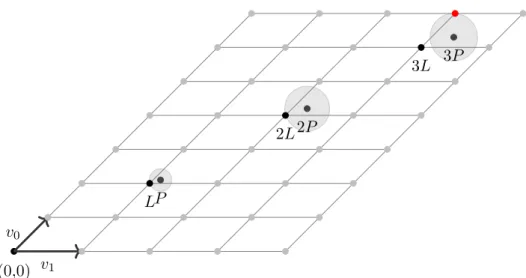
2.1 Finding the nearest lattice point for a point P in 2-dimensions 17
2.2 Combinations of errors or noise can lead to invalid results . . . 19
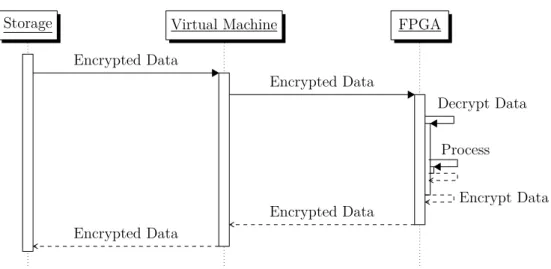
2.3 SFaaS data flow for secure processing . . . 29
3.1 NAND gate full adder . . . 43
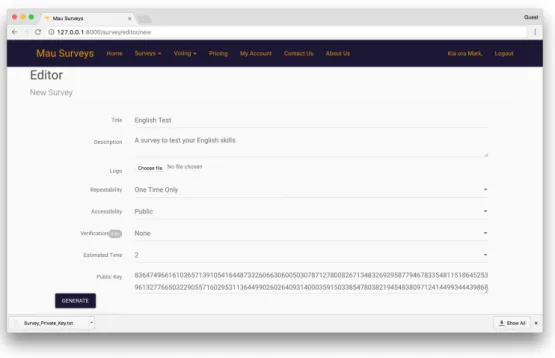
3.2 NAND gate half adder . . . 44
3.3 Generating the public and private key for a new survey . . . . 49
3.4 Interface for creating a survey . . . 49
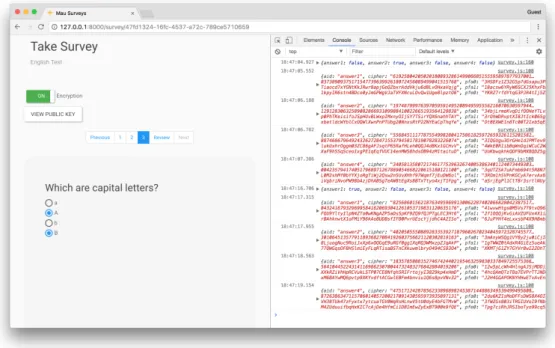
3.5 Example of a user taking a survey, with the encryption occur-ring in the background . . . 51
3.6 Example of a user reviewing the results of their survey . . . 52
3.7 Example of how the cipher and plain-text results for a survey are presented to the user . . . 52
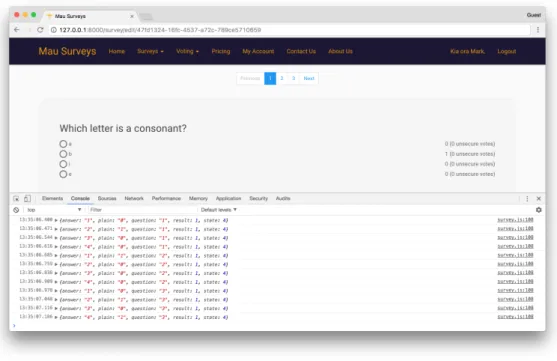
3.8 Example of the performance for decrypting each answer of a survey . . . 53
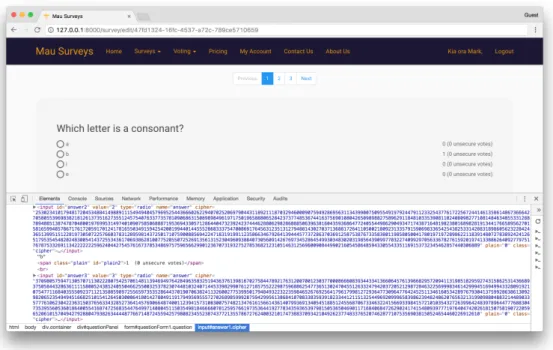
3.9 Mobile voting performance on an iPhone 5 . . . 57
4.1 Personal user system model for Bin Encoding . . . 60
4.2 Difference in calculated and actual bin frequencies . . . 64
4.3 Letter frequencies in 300 million randomly generated bins . . . 65
4.4 Average word collisions rates for English using modulo bin al-location . . . 69
4.5 Word collisions rates for Pinyin using modulo bin allocation . . 70
4.6 Word collisions rates for M¯aori using modulo bin allocation . . 71
4.7 Word collisions rates for M¯aori using random bin allocation . . 72
5.1 Petri Net definition . . . 81
5.2 A bit can be seen as a puzzle, where all the pieces are needed to reconstruct the bit. In this example some information about the puzzle (bit) can be obtained from some of the pieces (fragments) 83 5.3 In this example the lights are turned out, so the pieces are not visible, meaning no information can be obtained from them . . 83
5.4 System model with three fragment servers and a reduction server 84 5.5 System model with three fragment servers and two reduction servers . . . 89
5.6 Two fragment servers and a reduction server Petri Net model . 90 5.7 Reduction server model, where fragment servers wait for the response . . . 93
5.8 System model with three fragment servers and no reduction servers . . . 93
5.9 No reduction server model; the fragment servers send all at once 94 5.10 Variable server Petri Net for the FRIBs performance model . . 94
5.11 Three server Petri Net for the FRIBs performance model . . . 95
5.12 System model with three fragment servers, where the LUTs are rotated . . . 98
5.13 Three server Petri Net for the FRIBs enhanced privacy model . 101 5.14 Reduction flow example for fragment server A . . . 106
5.15 Splitting a public key across three fragment servers . . . 108
6.1 NAND gate full adder . . . 119
6.2 NAND and XOR gate full adder . . . 123
6.3 Reduction flow for fragment server A with built-in redundancy support . . . 135
6.4 Linked LUT flow diagram . . . 136
7.1 Flow for the scheduler to get the next fragment pool . . . 142
7.2 Scheduler subthread flow for receiving fragments from clients. . 143
7.3 Scheduler subthread flow for receiving new indexes a pool . . . 143
7.4 Reduction pipeline for adding votes to a 24-bit tally . . . 148
7.6 Votes added per second, for a six-server model with built-in
redundancy . . . 157 7.7 A proof-of-concept screenshot of searching for tagged wallet ID 165 7.8 Occurrences of 32 states in a vector where the server is in
ob-fuscated state 0 for 100 times in a row . . . 167 7.9 Occurrences of states in a vector when the server state has two
obfuscated states, in this case 0 and 1 are the same state and
repeated 100 times in a row . . . 167 7.10 Occurrences of states in vector when the server in obfuscated
state 0 for 100 times in a row, where obfuscated states are in
groups . . . 168 7.11 Occurrences of states in 1/2 vector when the server is in the
obfuscated state 0, 1, 2, or 3 for 100 times in a row . . . 169 7.12 Occurrences of states in 1/2 vector when the server in
obfus-cated state 0−7 for 100 times in a row . . . 169 7.13 Occurrences of states in 1/2 vector when the server in
obfus-cated state 0−15 for 100 times in a row . . . 169 7.14 Percentage for each state reached with all votes cast as no (zero) 170 7.15 Percentage of states reached after state 1 for all no votes . . . . 170 7.16 Percentage for each state reached where all votes cast are random 170 7.17 Percentage of states reached after state 1 with random votes . 171 7.18 Percentage of states received in the vector when the fragment
server is in state 1 for all no votes . . . 172 7.19 Percentage of states received in the vector when the fragment
server is in state 1 for all random votes . . . 172 7.20 Network latency experienced across nine Amazon Web Services
(AWS) datacenter locations . . . 176 7.21 Thread scheduling across two fragment servers for fifty
ran-domly started user jobs . . . 178 B.1 Visual representation of adding two waves together (w0+w1 =w2) 222
C.1 Generating the public and private key for a new survey . . . . 228 C.2 Interface for creating a survey . . . 229
C.3 Example of a user taking a survey, with the encryption
occur-ring in the background . . . 230 C.4 Example of a user reviewing the results of their survey . . . 231 C.5 Example of how the cipher and plain-text results for a survey
are presented to the user . . . 232 C.6 Example of the performance for decrypting each answer of a
survey . . . 233 C.7 A proof-of-concept screenshot of searching for tagged wallet ID
(top two sessions) . . . 234 C.8 A proof-of-concept screenshot of searching for tagged wallet ID
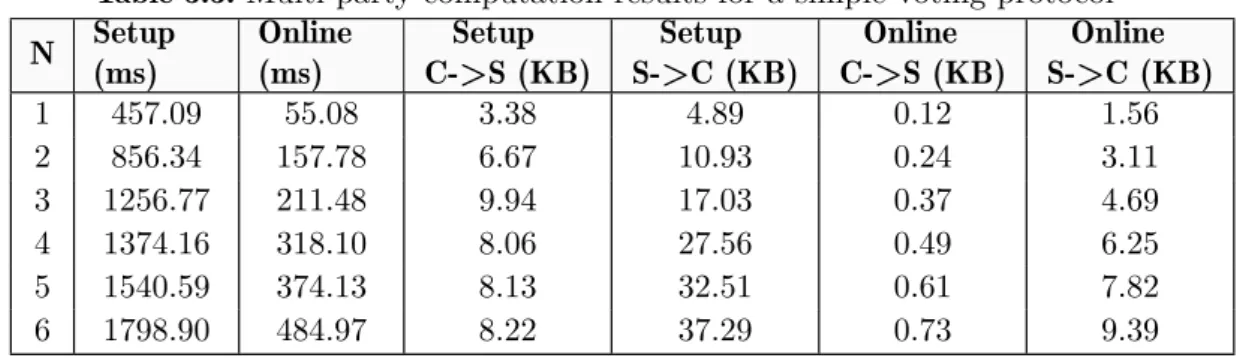
2.1 Historic overview of homomorphic encryption . . . 12 2.2 Historic overview of multi-party computation . . . 23 2.3 Garbled circuit truth table for a NAND gate . . . 24 3.1 Libhcs function execution times . . . 42 3.2 FHEW function execution times . . . 44 3.3 Multi-party computation results for a simple voting protocol . 47 4.1 English letter frequencies . . . 64 4.2 Collisions between five letter words . . . 67 4.3 Five letter word queries . . . 67 4.4 Ten letter word queries . . . 68 4.5 Exact matching in a document . . . 68 4.6 Approximate matching in a document . . . 68 5.1 Pi-Calculus definitions . . . 82 5.2 All options for fragment values. . . 86 5.3 Reduced options for fragment values. . . 86 6.1 Obfuscated states, mapping to the index. . . 112 6.2 Obfuscated states, mapping to multiple values. . . 112 6.3 Random mappings for fragment server A’s result LUT . . . . . 114 6.4 Random mappings for fragment server B’s result LUT . . . . . 114 6.5 Random mappings for fragment server C’s result LUT . . . . . 114 6.6 Obfuscation LUT sent to fragment server A . . . 115 6.7 Step towards the obfuscated result LUT for fragment server A 115 6.8 Step towards the obfuscated result LUT for fragment server C 116
6.9 A sample result LUT for fragment server A . . . 116 6.10 Parity bit examples with three initial fragments and two parity
bits . . . 130 6.11 Parity bit example showing a corrupt fragment . . . 130 6.12 Erasure encoding for three sets of fragments . . . 131 6.13 Erasure encoding example after three concatenations . . . 131 7.1 Fragment options for three servers using Exclusive-OR (XOR) 167 A.1 Simple modulo LUT for a single bit . . . 219 A.2 Simple modulo LUT for two bits . . . 219
3.1 Simple Python voting example . . . 40 3.2 Simple partially homomorphic encryption voting example . . . 42 3.3 Python multiplying large numbers example . . . 43 3.4 Sample FHEW program for evaluation . . . 44 3.5 Simple TASTY voting design . . . 46 3.6 Simple TASTY voting design for multiple votes . . . 46 7.1 Function to get the result of fragments for addition . . . 144 7.2 Function to get the result of fragments for addition with redundancy 144 7.3 Function to split each fragment by NAND operation . . . 145 7.4 Function to join the fragments by the fragmentation algorithm . . 145 7.5 Function to split each fragment by NAND operation . . . 145 7.6 Function to get result fragments for variable NAND operations . . 146 7.7 Stage 1 for adding a new vote by getting it from the queue . . . . 151 7.8 Stage 2 for adding a new vote is to obfuscate the state . . . 151 7.9 Stage 3 for adding a new vote is to process the obfuscated LUT
with the received index and flip bit . . . 152 7.10 The final stage for adding a new vote is to set up the windows for
the next vote . . . 152 7.11 Loop which generates the obfuscated result LUT . . . 153 7.12 Loop which generates the obfuscated index . . . 154 7.13 Redefining the addition function in Lisp . . . 160 7.14 Fragment structure . . . 160 7.15 Lisp NAND function definition . . . 160 7.16 Lisp optimised NAND function definition . . . 161 7.17 Lisp functions for NOT and AND gates . . . 161
7.18 A reduction function for the performance model . . . 161 7.19 An OR function in Lisp for FRIBs that process an array of bits,
returning a single bit . . . 162 7.20 An AND function in Lisp for FRIBs that includes the reduction
step . . . 163 7.21 An AND function in Lisp for FRIBs where a single bit is ANDed
against an array . . . 163 7.22 Searching for the 32-bit integera in a list of stored values . . . 164
AES Advanced Encryption Standard
AWS Amazon Web Services
CVP Closest Vector Problem
ECC Elliptic Curve Cryptography
FHEW Fastest Homomorphic Encryption in the West
FPGA Field-Programmable Gate Array
FRIBs Fragmenting Individual Bits
GCD Greatest Common Divisor
IoT Internet of Things
LUT Lookup Table
LWE Learning With Errors
MTU Maximum Transmission Unit
NAND Negative-AND
PPE Privacy-Preserving Encoding
PUF Physical Unclonable Function
RSA Rivest-Shamir-Adleman cryptosystem
SVP Shortest Vector Problem
TCP Transmission Control Protocol
1
Introduction
Placing responsibility for keeping data private entirely within the hands of a cloud vendor is not a sustainable solution to the general problem of data privacy [1][2]. This is supported by 88% of the 3,000 people surveyed being worried about who has access to their data, and 84% worrying about where this data is stored [3]. Furthermore, 91% would like a system which enables them to have control over their data [3]. Combined with the increasing profitability of data breaches for malicious entities, there is a need to protect data for its entire duration in the cloud. However, systems that protect data privacy today either have limited functionality [4][5][6] or are impractical [7][8][9][10][11].1 The research presented in this thesis addresses this issue, by studying the problem from an implementation and practicality point-of-view.
1.1 Background
Encryption is a common approach to protecting data in the cloud. How-ever, most cryptosystems preclude any computation over the data unless it is decrypted. In contrast, homomorphic encryption allows operations to be com-puted over cipher text [4]. Therefore, data can be protected while maintaining some functionality.
The term homomorphic originates from ancient Greek, wherehomos means same and morphe means shape. There are two types of homomorphic
en-1This thesis addresses privacy at the same level as encryption, where data should not be
cryption: partial and full. Partially homomorphic encryption can only sup-port a single operation over cipher text, for example addition [6] or multi-plication [4][5], where fully homomorphic encryption, also known as the“holy
grail” of encryption, can support multipliable operations [9], allowing more ad-vanced computation to be performed over encrypted data. However, currently no fully homomorphic encryption scheme is efficient enough to be used in the real world [14], and partially homomorphic encryption can be too limited for many applications.
The other state-of-the-art concept for privately processing data in the cloud is secure multi-party computation [15][16][17]. Instead of the data being pro-tected on a single entity, the data is distributed across multiple parties, al-lowing them to jointly compute a function while keeping their inputs private from the other parties. Where fully homomorphic encryption is a computably intensive operation, multi-party computation suffers from large network trans-fers and implementation issues including reusability of garbled circuits, which is also discussed in Chapter 3. Many secure multi-party computation schemes make use of homomorphic encryption [18][19][20]; thus, in cases, the perfor-mance is also limited by that of the homomorphic scheme it is built upon.
Protecting data in the cloud faces other risks aside from practicality. Some governments today are looking at the possible ban on encryption or forcing the inclusion of backdoors. This is because encryption schemes are designed to protect the data they obfuscate, no matter who encrypted it. These political challenges could significantly weaken the security levels we have today. A different approach to encryption for protecting data should be considered to address this possible issue.
The research reported in this thesis removes the need for data to be en-crypted (using a traditional scheme) for processing while still remaining pro-tected. A custom secure processor [4][21] would also achieve this but is not widely deployable in the cloud, and again it still reveals the plain text inside the processor. One technique to keep the data private is with lossy encod-ing, where even when half the data is broken, the other half still needs to be cracked [22]. Another is by one entity not possessing the necessary data to view the plain-text [23].
1.2 Hypothesis
The operation limitations of partially homomorphic encryption, and computa-tional intensity of fully homomorphic encryption, currently prevent homomor-phic encryption from being usable for most cloud applications. The issues arise from the complexity of the encryption schemes and underlying mathematics, which we discuss in Chapter 2, leading to the primary research question for this thesis:
“Can fully homomorphic encryption be practical in the cloud?”
There were three steps taken to answer this question, and are given as the following questions, leading to the following hypotheses:
Hypothesis 1 The underlying large number operations for homomorphic
en-cryption can be optimised for better performance.
Did not lead to major breakthroughs within the time of the PhD – see Ap-pendix A.
Hypothesis 2 A simpler fully homomorphic scheme can provide practical
per-formance while remaining secure.
This was unsuccessful due to security weaknesses of using simultaneous equa-tions – see Appendix B.
Hypothesis 3 Data need not be encrypted for practical privacy-preserving
com-putation; instead, keyless obfuscation and distribution can protect privacy by a single entity not possessing enough information to decode the data, while supporting arbitrary computation.
This hypothesis was formulated after 1 and 2 had been investigated and de-veloped into the main hypothesis of this thesis.
1.3 Scope
1.3.1 Use Cases
Four use cases were considered in this thesis:
1. An entity would like to have a secure ballot, where votes must be pri-vate and only the final tally should be revealed in plain text. Therefore, information about how someone voted should not be obtainable.
2. A personal user would like to store their health/home data (heartbeat, sleep patterns, or room temperatures) collected from activity trackers and other Internet of Things (IoT) devices in the cloud. This data should remain private, but it needs to be processed to find alerts or information such as irregular heartbeats.
3. An organisation or company wants to store and process their confidential data in the cloud, where it needs to be kept private at all times, even from the cloud hosting company and its employees.
4. Multiple organisations would like to share data between them in the cloud but control the operations computed over them and be able to control access to their shared data (for example deleting data).
The primary use case was cloud voting because it allowed for comparison between state-of-the-art works. Use cases 2 and 3 are essentially the same as use case 1 in that operations need to be computed over private data. The difference is that use case 1 has many clients and requires high performance. The last use case targets controlling data in the cloud: who has access and what operations they can perform.
1.3.2 Privacy-Preserving Encoding
The schemes presented in this thesis do not claim to be encryption techniques; instead, they provide privacy through encoding. The termPrivacy-Preserving
Encodingis used to differentiate encoding from encryption, while still protect-ing data. The difference between encodprotect-ing and encryption is minuscule [24].
Both transform data, but encryption keeps some parts of the process a secret. Without this secret value (the key), it should be computationally intensive to break. Therefore, if only the intended parties have the secret, then the data should remain hidden from everyone else. Note that hashing is usually for integrity, it takes an arbitrary input and returns a fixed-length “unique” out-put [24]; whereas obfuscation is very similar to encoding and for the purpose of this thesis, we will say they are the same.
Traditional cryptography follows the principle given below, by the Dutch cryptographer Auguste Kerckhoffs [25].
Principle A cryptosystem must not depend on keeping the algorithm safe, only
the secret key [25].
However, encoding a value b into 3 values using Exclusive-OR (XOR) logic gates does not have a secret key. For example, with b= 0, an encoding could be 1⊕0⊕1. If two of the values are known, b is still hidden. But this is not achieved with a secret key like traditional encryption.
One of the oldest encryption techniques known is the Caesar cipher, named after Julius Caesar who used it to protect messages of high importance, such as military instructions. This is a type of substitution cipher, which maps plain-text values to their cipher-plain-text counterparts at a shifted index in the same alphabet. Decoding requires the shift number, which is the secret key. Mary, Queen of Scots, used a simple substitution cipher to try and plan the assassi-nation of Queen Elizabeth I. This cipher mapped the alphabet and common words to another alphabet. For this scheme, the mapping table is classified as the secret. By today’s standards, both these old techniques are weak, making it hard to classify them as encryption schemes. The nature of the algorithms are a shift index or a simple mapping, where most encryption schemes in-volve some hard mathematical problem, but they can still be categorised as encoding.
In legalisation and regulations, encryption is also often defined as something that uses a key. For example, in a letter from the New Zealand Ministry of Foreign Affairs and Trade in February 1997 states “The export of code in
any form is regulated in New Zealand in terms of the guidelines below: They contain encryption limited to (i) 40-bit key lengths for symmetric algorithms;
(ii) 512 bits for asymmetric algorithms; (iii) 56-bit DES for dedicated financial algorithms” [26][27]. Therefore, for this thesis, the term Privacy-Preserving
Encoding will be used to define a mapping-based cryptosystem, where the map is secret or defines a scheme that does not technically have a secret key but still provides data privacy.
1.3.3 Data Security and Privacy
Achieving perfect security for data storage and processing in the cloud does not guarantee the protection of data. It remains at risk because at some point the user will need to access the plain-text data. Even if the service requires authentication, a malicious user or a piece of malware can wait until access is granted. Mobile malware is a growing threat [28] and gives attackers the ability to steal data from the device. However data can also be stolen from services the device has access, for example a cloud service. This is a current open problem for applications like cloud voting with mobile agents [29], because currently security cannot be guaranteed on the mobile device. Similarly, the cloud is under threat from new attacks and vulnerabilities found each day (zero-day attacks) [30][31].
This thesis attempts to mitigate the risk of zero-days by spreading data across different cloud services. Meaning any scheme presented should be easy to implement on current cloud infrastructure, for example Amazon Web Ser-vices (AWS) [32] or Microsoft Azure [33], and not require any special hardware or equipment. Thus allowing it to be distributed across varying operating systems, applications and companies (to prevent a malicious employee from accessing data).
Data is considered to be private in the cloud when no single hosting entity can see the corresponding plain text. For example, if some data is hosted on cloudA, then if cloudAis compromised, the data is still obfuscated. However, if all hosts of some distributed data are compromised, the data could be lost. This is still considered private data for the purpose of this thesis. Note that this thesis investigates protecting data in the cloud, not necessary the operations being computed over it.
Similarly, this thesis assumes all parties perform the operations currently. No tampering, corrupting of the data or program being computed. We aim to
protect privacy from entities able to observe and copy data (eyes only). Some work was done to address this issue, but it is not the primary focus of this thesis. Our focus was instead on performance while keeping the data private. Finally, for the purpose of this thesis data privacy is for computing nodes, where data outside of the computing node still requires the same protection mechanisms seen today. Even though Hypothesis 3 states that data will not be encrypted, this only targets the processing of the data. Data transfers across the network still need to be encrypted using current cryptography schemes, and data storage should still use encryption to provide an extra layer of security.
1.4 Contributions
The first contribution is purely as an implementation to see how existing works can create a practical privacy-preserving cloud application. This thesis has two main contributions, the schemes Bin Encoding [22] and Fragmenting Individual Bits (FRIBs) [23]. These use encoding techniques instead of encryption to provide data privacy in the cloud. They both protect data by “hiding in the
masses” where there exist a large number of combinations and it is difficult to know when a correct solution is found.
1.4.1 Secure Survey Platform
In order to answer the research question, a definition and understanding of practicality for privacy-preserving cloud computation was required. This was accomplished by designing and implementing a secure survey platform using partially homomorphic encryption, presented in Section 3.3. Initially this was published as a voting scheme [29], before being converted to a survey sys-tem. In addressing some of the challenges faced, a fully secure cloud survey application is possible today, however with missing functionality and security concerns. The main contribution of this application was it shows the practi-cality of using privacy-preserving schemes in the real-world, from limitations with JavaScript and mobile devices on the client-side, to reduced functionality in the cloud which results in more processing by the survey creator.
1.4.2 A Private Encoding Search Scheme
Bin Encoding was initially designed as an attempt to help answer Hypothe-sis 3, where encoded data can provide some form of private functionality [22]. The private search functionality achieved is near that of plain text, as is per-formance, including client-side. Related work focuses on encryption and cryp-tographic trapdoor functions [34][35], where this thesis will show how a simple lossy encoding scheme can protect privacy for approximate string searching. However, Bin Encoding highlighted a few challenges with encoding data using a static mapping, one of which is the lack of randomness. Even so, Hypothesis 3 showed merit as even with knowledge of the mapping, it can still be difficult to recreate the plain-text values. A distributed model for Bin Encoding was also presented, where greater privacy was achieved by distributing the search across multiple cloud providers or services. The model for Bin Encoding was published [22], where Chapter 4 also gives some additional results.
1.4.3 FRIBs: An Arbitrary Privacy-Preserving Scheme
Bin Encoding showed the potential for using encoding for privacy-preserving processing. But a new scheme was needed to provide arbitrary computation in order to fully meet the requirements of the research question. Fragment-ing Individual Bits (FRIBs) is presented in this thesis as a potential solu-tion for a practical privacy-preserving processing scheme. It was designed to meet the hypotheses, but more importantly to try and answer the research question. The first model given in Chapter 5 was published (the reduction server model) [23], where the main models–the performance and enhanced pri-vacy models–are the main contribution of this thesis. The design resembles multi-party computation but handles data sharing and garbled circuits using encoding. One advantage over other multi-party computation designs is that Fragmenting Individual Bits (FRIBs) can reuse its Lookup Table (LUT)s.
1.5 Organisation
The presentation of this thesis will start with current works. A review and discussion are given in Chapter 2, highlighting the problem of practicality. This
chapter identities that the idea of secure computation was proposed since early encryption schemes like the Rivest-Shamir-Adleman cryptosystem. The state-of-the-art work from Chapter 2 is implemented and compared in Chapter 3 for the use case of cloud voting. This helped create a definition for “practical”; a requirement when researching towards a practical solution. To summarise, practicality is a balance between performance, and flexibility or utility.
In researching Hypothesis 2, a discovery was made for appropriate privacy-preserving string searching using “bins”. Chapter 4 describes this research and gives analysis on the privacy achieved. The scheme uses a lossy random-mapping between an alphabet and a smaller alphabet. There are a large number of combinations for decoding, where knowing the correct answer is difficult. Even when successfully decoding half of the data, there are still a large number of combinations for the remaining half. Chapter 4 not only introduces Privacy-Preserving Encoding (PPE), but also the use of distribution to improve privacy as each server has less information.
The three Chapters 5, 6 and 7 present the main contribution of this thesis– the Fragmenting Individual Bits (FRIBs) scheme–addressing all four use cases and Hypothesis 3. The two core FRIBs models are described in Chapter 5: the performance model and enhanced privacy model. Both build off earlier work published on FRIBs [23], distributing single bits across multiple servers, while also managing to distribute the computation table (similar to a garbled circuit), such that no information is leaked during execution. Functions are de-fined like garbled circuits for multi-party computation, except that they can be reused as Chapter 6 demonstrates. The data can only be decoded by retrieving all the distributed bits, thus privacy and security is obtained by the multiple servers spread over different entities. Chapter 7 gives two proof-of-concept implementations: cloud voting and exact string searching; before evaluating their practicality. Privacy is then analysed in Chapter 7, proving that no in-formation is leaked during processing when using the enhanced privacy model. The hypotheses and use cases are revisited in Chapter 8, concluding that PPE, in particular FRIBs, can provide an alternative to computationally intensive encryption schemes. Chapter 8 also mentions future work, providing a few re-search directions for FRIBs; however, ultimately the target for FRIBs is being deployed in real-world implementations.
2
Literature Review
In this chapter, literature is reviewed related to privacy-preserving processing: in particular, works focused on cloud implementations. Chapter 1 briefly in-troduced homomorphic encryption and secure multiparty computation, which will be expanded further in Sections 2.1 and 2.2 respectively. Another popular method of privacy-preserving processing is with custom hardware processors, discussed in Section 2.3. However, it is worth noting that their effectiveness for cloud deployments is yet to be discovered [36].
2.1 Homomorphic Encryption
Homomorphic encryption is the current state-of-the-art solution to privacy-preserving processing in the cloud. As previously mentioned in Chapter 1 there are two types: partially and fully homomorphic encryption. Partially homomorphic encryption has faster computation but only supports a single operation, while fully homomorphic encryption is currently impractical but supports arbitrary computation [37]. Note that there is a third variate called somewhat homomorphic encryption, where only a limited number of operations can be applied before the scheme produces invalid results [38][39]. Many fully homomorphic encryption schemes actually have this limitation, but are able to re-encrypt (known as bootstrapping [39]) the cipher values, resetting the number of operations applied [8][9][39]. Given the use cases in Section 1.3.1, especially voting which requires millions of operations, somewhat homomor-phic encryption will not be detailed in this thesis.
Table 2.1: Historic overview of homomorphic encryption
2013 • Homomorphic Encryption from Learning with Errors:
Conceptually-Simpler, Asymptotically-Faster, Attribute-Based [9] 2010 • Fully Homomorphic Encryption over the Integers [8]
2009 • A Fully Homomorphic Encryption Scheme [39]
• Fully Homomorphic Encryption using Ideal Lattices [7]
2008 • A New Approach for Algebraically Homomorphic Encryption [40] 2002 • A Provably Secure Additive and Multiplicative Privacy
Homomorphism [41]
1999 • Public-Key Cryptosystems Based on Composite Degree Residuosity Classes [6]
1996 • A New Privacy Homomorphism and Applications [42] 1988 • On Privacy Homomorphisms [43]
1987 • Processing Encrypted Data [44]
1985 • A Database Encryption Scheme Which Allows the Computation of Statistics using Encrypted Data [45]
• A Public Key Cryptosystem and a Signature Scheme Based on Discrete Logarithms [5]
1982 • Signature Protocols for RSA and Other Public-Key Cryptosystems [46]
• Probabilistic Encryption & How To Play Mental Poker Keeping Secret All Partial Information [47]
1978 • On Data Banks and Privacy Homomorphisms [4]
• A Method for Obtaining Digital Signatures and Public-Key cryptosystems [34]
2.1.1 Historic Overview
The notation of homomorphic encryption has existed for decades, as Table 2.1 shows. Rivestet al. first proposed special encryption functions called“privacy
homomorphisms” in 1978 [4]. They initially discussed the use of hardware to process data securely, where the data is only decrypted on a physically secure processor (discussed further in Section 2.3). Next, they describe a solution where data is encrypted while still allowing standard hardware to compute operations over it – the first notion of concept of homomorphic encryption. Proof-of-concept examples were given by Rivest et al. , showing that the concept of processing encrypted data could be possible, concluding with two open questions [4]:
Question 1 Does this approach have enough utility to make it worthwhile in
practice?
Question 2 For what algebraic systems does a useful privacy homomorphism
exist?
Later in 1978, the Rivest-Shamir-Adleman cryptosystem (RSA) was made public. The original paper had no mention of homomorphic encryption; how-ever, it was later proved to support multiplication over encrypted data [46]. This is due to the mathematical properties of RSA, where raising a message toein modulo n allows the two encrypted messages to be multiplied correctly since me0×me1 modn ≡ (m0×m1)e modn. Therefore, partially
phic encryption has been conceptually supported since the idea of homomor-phic encryption was conceived, though it was only realised years later [46].
Similar to work by Davida et al. [48] in 1981, Blakley et al. proposed a database encryption scheme, which supported computing statistical opera-tions over the encrypted data [45]. Even though the paper did not specifically mention homomorphism, this was another step in proving that processing en-crypted data could be made worthwhile in practice. The terminology used by Blakley et al. for protecting data was hiding needles in a haystack [45], where a large number of possible options exist, but only one is correct. The example provided required finding the Greatest Common Divisor (GCD) of approximately 2162 pairs [45]. It would be infeasible to try each pair, even
when performing millions of checks per second. This concept of hiding in the
masses is one of the security properties that the work in this thesis builds upon.
In 1987, Ahituv et al. provides some example algorithms that can support homomorphic operations [44]; however these have very weak security. The following year, Brickell et al. evaluated the first known proposal of homo-morphic algorithms by Rivest et al. [4], proposing an additive homomorphic algorithm where there was a maximum number of additions that could occur before it would break [43]. However, it was not until 1996 that the first homo-morphic encryption scheme to support both addition and multiplication was proposed [42]. Ferrer provided a needed breakthrough in the field, and later showed in 2002 that the proposed scheme was secure against known clear-text attacks; however, the scheme was broken a year later by Wagner [49]. Armknecht et al. proposed a solution that supported an arbitrary number of addition operations, but only a fixed number of multiplications, while remain-ing secure under a known decodremain-ing problem [40].
Until this point, challenges that proposed schemes encountered were either: (1) not secure, (2) not able to maintain homomorphic properties, (3) not able to support repeated operations, or (4) incredibly inefficient. The breakthrough occurred in 2009 when Gentry proposed a scheme that could support an ar-bitrary number of additions and multiplications, and the security was based on the hardness of lattice problems [39]. Since then, Gentry et al. have been involved in proposing many schemes [7][8][9] for fully homomorphic encryp-tion, gradually improving the schemes; however, a practical solution is yet to be discovered.
2.1.2 Overview of Partially Homomorphic Encryption Cryptosystems
This section will describe a few common partially homomorphic encryption cryptosystems: RSA, El Gamal, Paillier and Goldwasser–Micali. The encryp-tion and decrypencryp-tion algorithms are given to prove their homomorphic prop-erties. A similarity between the schemes is that each multiply cipher values within a large modulo to compute their homomorphic function. Hence this operation was the first to be analysed in this thesis for making homomorphic encryption practical, leading to Hypothesis 1 (discussed in Appendix A).
Rivest-Shamir-Adleman Cryptosystem
The encryption and decryption algorithms for Rivest-Shamir-Adleman cryp-tosystem (RSA) are now given: E(m) = me mod n and D(c) = cd mod n. Both raise a message (plain or cipher) to an exponent inside a modulon. The proof of RSA supporting a homomorphic multiplication operation is given be-low. The two messages are multiplied together because their exponents are the same; therefore, two cipher values can compute a multiplication operation.
E(m0)×E(m1) =me0 ×m e 1 modn = (m0×m1)e mod n ∴m0 ×m1 modn El Gamal
The security strength of El Gamal is based on the NP-hardness of solving discrete logarithms, which was first proposed in 1985 by Taher Elgamal [5]. There is no publicly known algorithm to solve (break) it quickly (assuming a large key size, for example 2048 bits). The encryption algorithm E(m) = [αk mod p, βk × m mod p], where k is random and the remaining are public knowledge, is unique in that the cipher is made up of two parts. The decryption algorithm joins these parts together with the secret d, D(c) = (βk×m)× (αk)−d modp. The important aspect for this thesis is that El Gamal supports homomorphic multiplication operations on encrypted data, proven below. The two β values can be seen as the encryption of a single value because theks are random, so they can just be combined into another random value.
E(m0)×E(m1) = [αk0 ×αk1 modp, βk0 ×m0×βk1 ×m1 modp]
= [αk0+k1 modp, βk0+k1 ×m
0×m1 mod p]
= [αk mod p, βk×m0×m1 modp]
Paillier
Proposed in 1999 by Pascal Paillier [6], the Paillier cryptosystem is based on the fact that computing nth residue classes is hard. The encryption algorithm is E(m) = gm×rn mod n2, where r is random, and decryption is achieved throughD(c) =L(cλ modn2)×u mod n. The homomorphic operation
sup-ported by the Paillier cryptosystem is addition. This is achieved by multiplying two cipher values together and is proven below. Addition is achieved because the message m is now the exponent, unlike RSA. The random values (r0 and
r1) can just be combined as a single random valuer.
E(m0)×E(m1) = (gm0 ×r0n)(gm1 ×r1n) modn2 =gm0+m1 ×rn 0 ×r n 1 mod n 2 =gm0+m1 ×rn modn2 ∴m0+m1 modn Goldwasser–Micali
The previous partially homomorphic encryption cryptosystems have encrypted integers, whereas the cryptosystem presented by Shafi Goldwasser and Silvio Micali in 1982 only encrypts individual bits [47]. This is because it is based on the quadratic residuosity problem, where a cipher value is either a quadratic residue or not for some modulo (only two possible results). The encryption algorithm, E(m) = y2×xm mod n where m ∈ {0,1} and y is random, such that gcd(y, n) = 1 or y is in the group of units modulo n. The decryption algorithm just performs the test to see if the cipher value is a quadratic residue in modulo n, resulting in two possible values {0,1}. This cryptosystem is unique in that it supports a homomorphic XOR operation, as proven below. Technically, it is still an addition operation; however, the result can only be {0,1}. Therefore, two bits of value 1 will makex2, which is equivalent to x0.
E(m0)×E(m1) = y02×y 2 1×x m0 ×xm1 mod n =y02×y21×xm0+m1 modn ∴m0+m1 mod 2 ∴m0⊕m1
(0,0)
v0
v1
L P
Figure 2.1:Finding the nearest lattice point for a pointP in 2-dimensions
2.1.3 Lattice Based Cryptography
Fully homomorphic encryption schemes are primarily based on the hardness of lattice-based problems. Two lattice problems which cryptography can be built upon are the Closest Vector Problem (CVP) and Shortest Vector Problem (SVP) [50].
Definition Given a point P and the latticeM, the Closest Vector Problem asks
us to find the nearest lattice point L in M.
In Figure 2.1, it is easy to see the closest lattice point in pictorial form, but because a computer is only given a matrix, and the dimensions are much larger, it makes finding the closest lattice point more computationally intensive.
Definition Given the lattice M, the Shortest Vector Problem asks us to find
the smallest non-zero vector V in M.
Non-zero is important because every lattice technically has a zero vector. In Figure 2.1, this is simply v0, because the example lattice is only showing the
basis vectors. However, if larger vectors are given, there may exist a smaller vector which can make up the fundamental region. Note that CVP is actually a generalization of SVP, because if you are given an oracle (function) for CVP, it is possible to find the shortest vector by querying the oracle [51][52]. Therefore, because CVP is a NP-Hard problem, so is SVP [53][54].
2.1.4 Learning With Errors
The Learning With Errors (LWE) problem was introduced by Regev [55] and is widely used for a range of cryptographic functions, such as public key en-cryption [56]. This is because it claims to be as hard as worst-case lattice
problems [55], implying that any functions built upon LWE are secure. It is also currently assumed that worst-case lattice problems are even secure against the likes of quantum computers [57].
Definition The Learning With Errors problem asks us to recover a secret x∈
Znq given a sequence of “approximate” random linear equations on x [55]. Relating this back to lattices, the definition requires that distinguishing vectors are created from a set of noisy (contains some error) linear equations between uniformly random vectors. Looking at an example from Regev [55], we are given the set of linear equations shown below where in this case each equation has an error of approximately ±1, and all we have to do is solve for x. However, by introducing the error it makes solving x more difficult. If we were to try and solve the set of equations using Gaussian elimination (row reduction) for example, the errors would accumulate, making the result invalid. 14x1+ 15x2+ 5x3+ 2x4 ≈8(mod17) 13x1+ 14x2+ 14x3+ 6x4 ≈16(mod17) 6x1+ 10x2+ 13x3+ 1x4 ≈3(mod17) 10x1+ 4x2+ 12x3+ 16x4 ≈12(mod17) 9x1+ 5x2+ 9x3+ 6x4 ≈9(mod17) 3x1+ 6x2+ 4x3+ 5x4 ≈16(mod17) ... 6x1+ 7x2+ 16x3+ 2x4 ≈3(mod17)
Given 2O(nlogn) equations, we can deduce the secret x in 2O(nlogn) time but
this approach is based more around luck than sense. A simpler technique is the Maximum Likelihood algorithm, which only requires O(n) equations and computes the only value forx that can satisfy the equations. This is achieved with brute force by computing all possible values, resulting in a runtime of 2O(nlogn) [55]. Currently, the best-known algorithm for solving LWE is by Blumet al. and requires 2O(n)equations and time [58], which relates to the fact
(0,0) v0 v1 LP 2L2P 3L 3P
Figure 2.2:Combinations of errors or noise can lead to invalid results
Therefore, homomorphic schemes built on the LWE problem need to keep the errors relatively small, otherwise results can become invalid. For example, Figure 2.2 shows a lattice point L, and the point P which has some error added, so that by solving CVP,Lwill be the result. If P is doubled, 2Lis still the closest lattice point; however, by adding P again giving 3P, the closest lattice point is not 3L, but instead 3L+v0, therefore the result is now invalid.
Managing this error is one of the key challenges to homomorphic encryption in general and is a contributing factor to the performance limitations of current fully homomorphic encryption schemes, such as the Approximate Eigenvector algorithm.
2.1.5 Approximate Eigenvector Algorithm
The Approximate Eigenvector scheme for fully homomorphic encryption was proposed by Gentry et al. [9] in 2013, which uses the learning with errors problem described in the previous section (Section 2.1.4). This scheme allows for addition and multiplication homomorphic operations to be computed the same as matrix addition and multiplication operations, for most cases. Gen-try et al. claim this makes the scheme asymptotically faster and easier to understand [9]. The formal definition of an eigenvector is given below, where T is a square matrix, and λ is a scale. Essentially for−→v to be classified as an eigenvector for the matrix T, the result must be equivalent to multiplying −→v
by some scale factor. In this scheme −→v is an approximate eigenvector, not a perfect one.
Definition A vector−→v is an eigenvector (also known as a characteristic vector,
proper vector, or latent vector) if T(−→v) = λ−→v for some scale λ [61].
To make this a levelled scheme (i.e. it will work up to a certain depth), the error must be controlled. As seen in Figure 2.2, controlling the size of the error is extremely important, so that the decrypted value will be correct. This is achieved by flattening the cipher matrix so that it contains values in {0,1}. Flattening uses bit decomposition operations, which does not affect dot product operations on the matrices. This allows homomorphic operations to still be computed correctly while keeping the errors small.
2.1.6 Practicality of Fully Homomorphic Encryption Schemes
Recent work is concluding that fully homomorphic encryption is still not effi-cient or practical [14]. For example, Gentryet al. showed in 2012 the perfor-mance for an Advanced Encryption Standard (AES) 128-bit circuit, which took 40 minutes per AES block [62]. Wanget al. [10] showed performance results of a revised fully homomorphic encryption scheme by Gentry and Halevi [63] in 2015 for the recrypt function. Central processing unit and graphics processing unit implementations took 17.8 seconds and 1.32 seconds respectively, using a small dimension size of 2048 [10]. A medium dimension size of 8192 took 96.3 seconds and 8.4 seconds for the same function [10]. With operations taking seconds, cloud implementations can become unusable. For example, adding millions of votes for a ballot requires weeks instead of hours. This is the chal-lenge for current fully homomorphic encryption schemes, where recrypting the data to manage the error is computationally intensive.
Designed for Negative-AND (NAND) gates, while providing XOR gates for
“almost free” – similar to functionality proposed in Part II – Ducas et al. present the Fastest Homomorphic Encryption in the West (FHEW) scheme which can bootstrap much faster than any other fully homomorphic encryp-tion schemes [11]. This was based on work by Alperin-Sheriff et al. [64][65], while the performance was achieved with the fast Fourier transform and the highly optimised library: Fastest Fourier Transform in the West. Results given
showed the homomorphic NAND and bootstrap operation took 0.69 seconds, using 2.2 gigabytes of memory. Ducas et al. note that the scheme needs to be further optimised and generalised to reach its full potential. The cur-rent limitation of the scheme is the large cipher-text sizes for single bits and constructing an operation (addition, for example) from the NAND logic will require many bootstrap operations. FHEW is discussed further in Chapter 3, where it is practicality is compared to other schemes.
2.2 Secure Multiparty Computation
2.2.1 History
First proposed by Yao in 1982 as secure two-party computation, it aimed to answer the following question [15]:
Question Two millionaires wish to know who is richer; however, they do not
want to find out inadvertently any additional information about each other’s wealth. How can they carry out such a conversation?
The idea is such that two parties have an input they want to keep private from the other while computing some function. Yao demonstrated in 1986 how to generate a random integer using two-party computation, such that it remained secret from both parties [16], particularly useful for distributed key generation. It was later generalised in 1987 to m-Party cases, such as voting between m committee members where their vote is their private input [17]. This lead the way for work on fault tolerance and verifiability with majority parties being honest [66][67][68]. A brief overall history can be found in Table 2.2, with improvements for performance, and the addition of homomorphic encryption appearing, before focus on cloud implementations started to be published.
With the data being computed across different parties with frequent com-munication, there is a latency overhead penalty similar to the computational overhead of fully homomorphic encryption. This is why multi-party computa-tion, even though has been around since 1982, still has not realised practical performance for the general use case. Improvements are occurring rapidly, where the performance of a circuit with thousands of logic gates went from minutes to seconds within a few years [69][70] using two-party computation.
However, at least three parties are desirable to handle malicious parties and improved sharing security. Given circuits often contain logic that is indepen-dent of one another during stages of computation, parallelisation is one tech-nique for improving performance [71]. A techtech-nique called “cut-and-choose” (a two-party protocol) was used to provide greater security against malicious parties, by creating multiple garbled circuits [72][73], and is faster than using zero-knowledge proofs for verification. Given most schemes offer a free XOR function – no network transfer – practicality can be improved by reducing the number of non-XOR gates in a circuit [74]. This is a technique that can be used with the work presented in this thesis.
The reason circuits, or simply the LUTs cannot be reused is they allow pat-terns to be monitored, where the occurrences for the matching row can start to reveal what the input and output are. Work around reusing circuits in the cloud was presented by Wang et al. [75], using an all-or-nothing privacy ap-proach. The client stores partial data in the cloud (single server), and submits some garbled inputs for processing, where if one garbled input is leaked, the other inputs are also leaked. The inputs could be encrypted, where the func-tion first needs to decrypt the inputs before the actual funcfunc-tion is computed. They state that if the cloud does not learn the result of the function, then it is the same as traditional semantic security. The limitations are that only some of the client data is stored in the cloud and that a single server evaluates the garbled circuit used for processing.
2.2.2 Garbled Circuits
In order to hide a party’s input, obfuscation is used in the form of garbled circuits: defining logical circuits by creating LUTs with each input and output combination. An example is given in Table 2.3 for a NAND function. A party first generates the table and gives the inputs and outputs random labels (X), thus obfuscating them. Then the inputs are encrypted before the rows are shuffled, making the table seem garbled. Because of the shuffling, knowing the resulting row or output value does not reveal the input. The necessary labels and garbled circuit are then sent to the other party. This party uses its input to try and decrypt each row, where only one will decrypt giving the result,
Table 2.2:Historic overview of multi-party computation
2016 • Garbled Computation In Cloud [75]
2013 • Minilego: Efficient Secure Two-Party Computation from General Assumptions [73]
2012 • A New Approach to Practical Active-Secure Two-Party Computation [70]
• On-the-Fly Multiparty Computation on the Cloud via Multikey Fully Homomorphic Encryption [20]
2009 • Secure Two-Party Computation Is Practical [69]
2001 • Multiparty Computation from Threshold Homomorphic Encryption [76]
1998 • Efficient Multiparty Computations with Dishonest Minority [77] 1992 • Communication Complexity of Secure Computation [78]
1989 • Verifiable Secret Sharing and Multiparty Protocols with Honest Majority [68]
1988 • Cryptographic Computation: Secure Fault-Tolerant Protocols and the Public-Key Model [66]
• Multiparty Unconditionally Secure Protocols [67] 1987 • How to Play any Mental Game [17]
1986 • How to Generate and Exchange Secrets [16] 1982 • Protocols for Secure Computations [15]
Table 2.3: Garbled circuit truth table for a NAND gate a b c 0 0 1 0 1 1 1 0 1 1 1 0 → a b c X0a X0b X1c X0a X1b X1c X1a X0b X1c X1a X1b X0c → c EncXa 0X0b(X c 1) EncXa 0X1b(X c 1) EncXa 1X b 0(X c 1) EncXa 1X1b(X c 0) → c EncXa 1X0b(X c 1) EncXa 0X1b(X c 1) EncXa 1X b 1(X c 0) EncXa 0X0b(X c 1)
which is then shared. A few challenges faced by multi-party computation are highlighted in this example, which this thesis aims to solve:
• Because the output is typically known to all parties, this could be seen as problematic when the result must remain private from the cloud providers (the output should only be visible to the client or end-user).
• Clients are transferring garbled circuits, which is a large amount of data for a simple logic gate.
• The circuit cannot be reused, as this will reveal patterns. Recent work has started to address this [79][80][81].
• Each row must be tried to find the result, slowing down the lookup times. • The circuit is generally evaluated on one server.
2.2.3 Secret Sharing
Widely used in multi-party computation schemes, secret sharing is the act of distributing a piece of information across many parties, where k ≤ n pieces are then required to recover the original value. Therefore, < k pieces cannot reveal the value, keeping it secret [82]. If k < n, then the scheme is known as a threshold scheme; these were first proposed in 1979 by Blakley [83] and Shamir [84]. Threshold cryptography is an example of secret sharing where several parties or servers are needed to decrypt the value. The security strength of this approach comes from the fact that k servers need to be compromised. The same approach is used in this thesis, where multiple servers protect data privacy.