Preserving Privacy and Utility in RFID Data
Publishing
Noman Mohammed, Benjamin C. M. Fung, and Mourad Debbabi
Abstract—Radio Frequency IDentification (RFID) is a technology that helps machines identify objects remotely. The RFID technology has been extensively used in many domains, such as mass transportation and healthcare management systems. The collected RFID data capture the detailed movement information of the tagged objects, offering tremendous opportunities for mining useful knowledge. Yet, publishing the raw RFID data for data mining would reveal the specific locations, time, and some other potentially sensitive information of the tagged objects or individuals. In this paper, we study the privacy threats in RFID data publishing and show that traditional anonymization methods are not applicable for RFID data due to its challenging properties: high-dimensional, sparse, and sequential. Our primary contributions are (1) to adopt a new privacy model calledLKC-privacy that overcomes these challenges, and (2) to develop an efficient anonymization algorithm to achieveLKC-privacy while preserving the information utility for data mining.
Index Terms—Privacy, security, data mining
F
1
INTRODUCTION
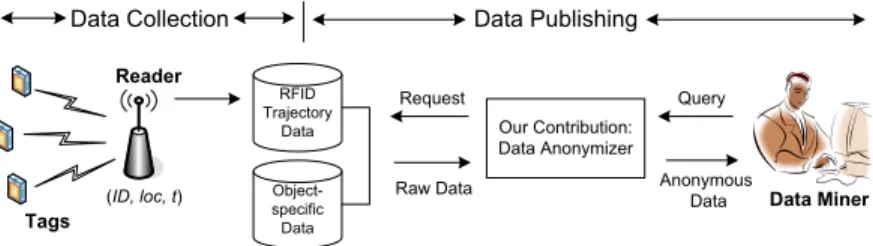
Radio Frequency IDentification (RFID) is a technology for objects automatic identification. Figure 1 depicts an overview of a RFID system, which typically consists of a large number of tags and readers, and a database server. A tag is a small device attached to a moving object. A reader broadcasts a radio signal to the tag, which then transmits its unique identifier back to the reader. Streams of RFID data entries, in the format of(ID, loc, t), are then stored in a RFID database, where ID is the unique identifer of a RFID tag, loc is the location of the reader, and t is the time of detection. The database system answers queries by joining the trajectory data with some object-specific data that describes the object.
Initial applications of RFID focus on tracking items in supply-chain management or baggage in airports. Recently, it has been used to track individuals. Publi-cation of these RFID data threatens individuals’ privacy since these raw data provide location information that identifies individuals and, potentially, their sensitive in-formation. Below, we present some real-life applications of publishing RFID data.
Transit company: Transit companies have started to use contactless smart cards or RFID cards, such as the Octopus card in Hong Kong, the OPUS card in Montreal, and the Oyster Travel card in London. In some transit systems, passengers register personal information when they first purchase their cards, so that appropriate fare is charged based on their status. The personal journey data together with the passengers’ personal
informa-• N. Mohammed, B. C. M. Fung and M. Debbabi are with the Concordia Institute for Information Systems Engineering, Concordia University, Montreal, Quebec, Canada.
E-mail:{no moham, fung, debbabi}@ciise.concordia.ca
tion provide a valuable source of information for data mining with the goal of improving the transportation services. For example, the IT department of STM (Transit Company of Montreal) owns the journey data. They want to share the data internally with their marketing department and externally with other transit companies for analysis purposes.
Hospital:Some hospitals have adopted RFID sensory system to track the positions of patients, doctors, and medical equipment inside the hospital with the goals of minimizing life-threatening medical errors and im-proving the management of patients and resources [35], [19]. Analyzing RFID data, however, is a non-trivial task. Hospitals often do not have the expertise to perform the analysis themselves but outsource this process and, therefore, require granting a third party access to the patient-specific location and health data.
Most previous work on privacy-preserving RFID tech-nology addressed the threats caused by the physical RFID tags in the data collection phase [19], [30]. These techniques do not address the privacy threats in thedata publishing phase, when a large volume of RFID data is released to a third party for data mining.
In this paper, we study the privacy threats in the data publishing phase and define a practical privacy model to accommodate the special challenges of RFID data. We propose an anonymization algorithm (the data anonymizer in Figure 1) to transform the underlying raw RFID data into a version that is immunized against privacy attacks but still supports effective data mining. Data “publishing” includes sharing the data with specific recipients and releasing the data for public download; the recipient could be an ordinary user who wants to perform legitimate data analysis, or could potentially be an adversary who attempts to associate sensitive information in the published data with a target victim.
Data Miner Reader
Tags
Query Request
Raw Data Anonymous
Data Data Publishing Data Collection
(ID, loc, t)
Object-specific Data RFID Trajectory
Data Our Contribution:
Data Anonymizer
Database Server
Fig. 1. Data flow in RFID system TABLE 1
Raw passenger-specific trajectory data
ID Trajectory Status ... 1 ⟨b2→d3→c4→f6→c7⟩ On-welfare ... 2 ⟨f6→c7→e8⟩ Student ... 3 ⟨d3→c4→f6→e8⟩ Retired ... 4 ⟨b2→c5→c7→e8⟩ Student ... 5 ⟨d3→c7→e8⟩ Retired ... 6 ⟨c5→f6→e8⟩ Full-time ... 7 ⟨b2→f6→c7→e8⟩ Full-time ... 8 ⟨b2→c5→f6→c7⟩ On-welfare ... 1.1 Motivating Example
We illustrate the privacy threats of publishing raw RFID data by an example.
Example 1: A transit company wants to release the passenger-specific trajectory data (Table 1) to a data miner for research purposes. Each record contains a tra-jectory and some passenger-specific information, where thetrajectoryis a sequence ofpairs(lociti)indicating the
passenger’s visited location loci at timeti. For example, ID#2has a trajectory⟨f6→c7→e8⟩, meaning that the passenger has visited locations f, c, and e at time 6, 7, and 8, respectively. Without loss of generality, we assume that each record contains only one sensitive attribute, namely,status, in this example. We address two types of privacy threats:
Identity linkage: If a trajectory in the table is so specific that not many passengers match it, releasing the data may lead to linking the victim’s record and, therefore, her status. Suppose the adversary knows that the data record of a target victim, Alice, is in Table 1, and Alice has visited b2 and d3. Alice’s record, together with her sensitive value (On-welfare in this case), can be uniquely identified becauseID#1is theonlyrecord that contains
b2andd3. Besides, the adversary can also determine the other visited locations of Alice, such as c4,f6, and c7.
Attribute linkage: If a sensitive value occurs frequently together with some sequence of pairs, then the sensi-tive information can be inferred from such sequence even though the exact record of the victim cannot be identified. Suppose the adversary knows that Bob has visited b2 and f6. Since two out of the three records (ID#1,7,8) containing b2 and f6 have sensitive value On-welfare, the adversary can infer that Bob is on welfare with 2/3 = 67%confidence.
Many privacy models, such as K-anonymity [29][31] and its extensions [21][25][36][37], have been proposed to thwart privacy threats caused by identity and at-tribute linkages in the context of relational databases. These models are based on the notion ofquasi-identifier (QID), which is a set of attributes that may be used for linkages. The basic idea is to disorient potential linkages by generalizing the records into equivalent groups that share the same values on QID. These privacy models are effective for anonymizing relational data, but they are not applicable to RFID data due to the following challenges.
(1) High dimensionality: Consider a transit system having 50 stations that operate 24 hours per day. There are 50×24 = 1200 possible combinations (dimensions) of locations and timestamps. Each dimension could be a potential QID attribute used for identity and attribute linkages. TraditionalK-anonymity would require every trajectory to be shared by at least K records. Due to the curse of high dimensionality[2], most of the data have to be suppressed in order to achieve K-anonymity. For example, to achieve 2-anonymity on the trajectory data in Table 1, all instances of {b2, d3, c4, c5} have to be suppressed even thoughK is small.
(2) Data sparseness:Consider passengers in a public transit system or patients in a hospital. They usually visit only a few locations compared to all available lo-cations, so each trajectory is relatively short. Anonymiz-ing these short, little-overlappAnonymiz-ing trajectories in a high-dimensional space poses a significant challenge for tra-ditional anonymization techniques because it is difficult to identify and group the trajectories together. Enforc-ing traditional K-anonymity on high-dimensional and sparse data would render the data useless.
(3) Sequential:Time is an essential factor of RFID data, which may incur unique privacy threats. Consider two trajectories b3 → e6 and e3 → b6. Both the trajectories have same locations but different timestamps; and thus, they are different from each other. Furthermore, the same location when associated with different timestamps should be considered different in the context of RFID data. For example, b2 → e8 and b3 → e6 are different due to different timestamps. These differences may pro-vide an adversary more opportunities to succeed in a privacy attack, and therefore require more efforts in the anonymization algorithm.
TABLE 2
Anonymous data withL= 2,K= 2,C= 50%
ID Trajectory Status ... 1 ⟨d3→f6→c7⟩ On-welfare ... 2 ⟨f6→c7→e8⟩ Student ... 3 ⟨d3→f6→e8⟩ Retired ... 4 ⟨c5→c7→e8⟩ Student ... 5 ⟨d3→c7→e8⟩ Retired ... 6 ⟨c5→f6→e8⟩ Full-time ... 7 ⟨f6→c7→e8⟩ Full-time ... 8 ⟨c5→f6→c7⟩ On-welfare ...
1.2 Privacy and Utility
TraditionalK-anonymity and its extended privacy mod-els assume that an adversary could potentially use any or even all of the QID attributes as background knowledge to perform identity or attribute linkages. However, in real-life privacy attacks, it is very difficult for an adver-sary to acquire all the visited locations and timestamps of a victim because it requires non-trivial effort to gather each piece of background knowledge from so many pos-sible locations at different times. Thus, it is reasonable to assume that the adversary’s background knowledge is bounded by at mostLpairs of(lociti)that the victim
has visited.
Based on this reasonable assumption, we adopt a new privacy model called LKC-privacy [27] for anonymiz-ing high-dimensional and sparse RFID trajectory data. The general idea of LKC-privacy has been previously applied on relational data [27], but this paper modifies the model to address the high-dimensional, sparse, and sequential RFID data. Although the intuition of LKC -privacy is applied here, the -privacy model, the algo-rithm, and the data structures are completely different. The general intuition is to ensure that every sequence q
with maximum lengthLof any trajectory in a data table
T is shared by at leastKrecords inT, and the confidence of inferring any sensitive value inSfromqis not greater than C, where L andK are positive integer thresholds,
C is a positive real number threshold, and S is a set of sensitive values specified by the data holder. LKC -privacy bounds the probability of a successful identity linkage to be ≤1/K and the probability of a successful attribute linkage to be ≤C. Table 2 shows an example of an anonymous table that satisfies (2,2,50%)-privacy by suppressing b2 and c4 from Table 1. Every possible sequenceqwith maximum length 2 in Table 2 is shared by at least 2 records and the confidence of inferring the sensitive valueOn-welfarefromqis not greater than 50%. While protecting privacy is a critical element in data publishing, it is equally important to preserve the utility of the published data because this is the primary reason for publication. In this paper, we aim at preserving the maximal frequent sequences(MFS) because MFS often serves as the information basis for different primitive data mining tasks on trajectory data. MFS represents the set of longest sequences of visited locations by some minimum number of moving objects within a particular
time interval. In the context of RFID data, frequent sequences can capture the major trajectories of moving objects [4]. MFS is also useful for trajectory pattern mining [15] and workflow mining [16].
One frequently raised question is: Given that the fre-quent sequence mining task is known in advance, why not publish the frequent sequences instead of the data records? The goal is to allow data sharing for frequent sequence mining in the presence of privacy concern. This problem is very different from secure multiparty computation [23], which allows “result sharing”(e.g., the frequent sequences in our case) but completely prohibits data sharing. In many applications, data sharing gives greater flexibility than result sharing because data re-cipients can perform their required analysis and data exploration, such as, mine patterns in a specific group of records, and try different modeling methods and parameters.
1.3 Contributions
Our contributions can be summarized as follows. First, based on the practical assumption that adversary has limited knowledge, we adopt LKC-privacy model to address the special challenges of anonymizing high-dimensional, sparse, and sequential RFID data. We fur-ther show that LKC-privacy is a generalized model of
K-anonymity [29][31], confidence bounding [34], and (α, k)-anonymity [36] (Section 2). Second, we present an efficient anonymization algorithm to achieve LKC -privacy while preserving maximal frequent sequences in the anonymous RFID data (Section 3). Finally, extensive experimental results support that our proposed privacy model and anonymization method outperform the tra-ditional approaches in terms of data quality, efficiency, and scalability (Section 4). To the best of our knowledge, this is the first work addressing the anonymization problem for RFID data and preserving maximal frequent sequences for data mining.
2
PROBLEM
DEFINITION
We first describe the format of RFID data and then formally define the problem based on the privacy and utility requirements.
2.1 RFID Data Table
RFID data is generated in the form of(ID, loc, t), where
ID is the unique identifier of a tag, loc is the location of the reader that reads the tag, and t is the time of reading. We assume that the RFID tags are carried by or attached to some moving persons or objects, such as patients in the hospitals or passengers in the public transit systems. A reader reads a tag either continuously or in a fix interval basis. Thus, the database may have duplicate entries showing the same location if the object has not moved. Gonzalez et al. [16] suggested some preprocessing methods to compress RFID data.
A pair (lociti) represents the visited location loci of
an object at time ti. The trajectory of an object, denoted
by ⟨(loc1t1) → . . . → (locntn)⟩, is a sequence of pairs
that can be obtained by first grouping the RFID entries by ID and then sorting the entries in each group by their timestamps. A timestamp is the entry time to a location, so the object is assumed to be staying in the same location until it has been detected again. An object may revisit the same locations at different time. At any time, an object can appear at only one location, so⟨a1→
b1⟩is not a valid sequence and timestamps in a trajectory increase monotonically.
A RFID data table T is a collection of records in the form ⟨(loc1t1)→. . .→(locntn)⟩:s1, . . . , sp:d1, . . . , dm,
where ⟨(loc1t1) → . . . → (locntn)⟩ is the trajectory, si ∈ Si are the sensitive attributes, and di ∈ Di are
the quasi-identifying attributes (QID) of an object. The sensitive and QID attributes are the object-specific data in the form of relational data. Identity and attribute linkages via the QID attributes can be avoided by ap-plying existing anonymization methods for relational data [12][20][22][25][34]. In this paper, we focus on eliminating identity and attribute linkages via the RFID trajectory data as illustrated in Example 1.
2.2 Privacy Model
Suppose a data holder wants to publish a RFID data ta-bleT (e.g., Table 1) to some recipient(s) for data mining. Explicit identifiers, e.g., name, SSN, and ID, are removed. Note, we keep the ID in our examples for discussion purpose only. The trajectory, the object-specific QID, and sensitive attributes are assumed to be important for the data mining task; otherwise, they should be removed.
One recipient, who is an adversary, seeks to identify the record or sensitive values of some target victimV in
T. As explained earlier, we assume that the adversary knows at most L pairs of location and timestamp that
V has previously visited. We useqto denote such prior known sequence of pairs, where |q| ≤ L. Based on the prior knowledgeq, the adversary could identify a group of records, denoted byT(q), that “contains”q. A record inTcontainsqifqis a subsequence of the trajectory in the record. For example in Table 1, records withID#1,2,7,8 containq=⟨f6→c7⟩, written asT(q) ={ID#1,2,7,8}. The prior knowledgeq, may consist of anyLpairs, not necessarily consecutive, such asq=⟨b2→c7⟩. Based on
T(q), the adversary could launch two types of privacy attacks:
• Identity linkage: Given prior knowledge q, T(q) is a set of candidate records that contains the victim V’s record. If the group size ofT(q), denoted by |T(q)|, is small, then the adversary may identifyV’s record from T(q) and, therefore, V’s sensitive value. For example, ifq=⟨b2→d3⟩in Table 1,T(q) ={ID#1}. Thus, the adversary can easily infer thatV’s sensitive value isOn-welfare.
• Attribute linkage: Given prior knowledgeq, the adver-sary can identify T(q)and infer thatV has sensitive value s with confidence P(s|q) = |T|T(q(∧q)s|)|, where
T(q∧s) denotes the set of records containing both
q and s. P(s|q) is the percentage of the records in
T(q) containing s. The privacy of V is at risk if
P(s|q) is high. For example, given q = ⟨b2 → f6⟩ in Table 1,T(q∧On-welfare) ={ID#1,8}andT(q) = {ID#1,7,8}; therefore,P(On-welfare|q) = 2/3 = 67%.
To thwart the identity and attribute linkages, we re-quire that every sequence with a maximum lengthLin the RFID trajectory data has to be shared by at least a certain number of records, and the ratio of sensitive value(s) in every group cannot be too high.LKC-privacy reflects this intuition.
Definition 1 (LKC-privacy): Let L be the maximum length of the prior knowledge. LetS be a set of sensitive values. A RFID data tableT satisfiesLKC-privacyif and only if for any sequenceqwith |q| ≤Lof any trajectory inT,
1) |T(q)| ≥K, whereK >0 is an integer anonymity threshold, and
2) P(s|q) ≤ C for any s ∈ S, where 0 < C ≤1 is a real number confidence threshold.
The data holder specifies the thresholds L, K, and
C. The maximum length L reflects the assumption of the adversary’s power.LKC-privacy guarantees that the probability of a successful identity linkage to be≤1/K
and the probability of a successful attribute linkage to be ≤ C. LKC-privacy has several nice properties that make it suitable for anonymizing high-dimensional sparse RFID data. First, it only requires subsequences of a trajectory to be shared by at least K records. This is a major relaxation from traditional K-anonymity based on a very reasonable assumption that the adversary has limited power. Second,LKC-privacy generalizes several traditional privacy models. K-anonymity [29][31] is a special case ofLKC-privacy withC= 100%andL=|d|, where |d| is the number of dimensions, i.e., number of distinct pairs, in the RFID data table. Confidence bounding [34] is a special case of LKC-privacy with
K= 1andL=|d|.(α, k)-anonymity [36] is also a special case of LKC-privacy with L =|d|, K =k, and C =α. Thus, the data holder can still achieve the traditional models, if needed. Third, it is flexible to adjust the trade-off between data privacy and data utility, and between an adversary’s power and data utility. IncreasingLand
K, or decreasing C, would improve the privacy at the expense of data utility. Finally,LKC-privacy is a general privacy model that thwarts both identity linkage and attribute linkage, i.e., the privacy model is applicable to anonymize RFID data with or without sensitive at-tributes.
2.3 Utility Measure
The measure of data utility varies depending on the data mining task to be performed on the published data. In
this paper, we aim at preserving the maximal frequent sequences. A sequence q = ⟨(loc1t1) → . . . → (locntn)⟩
is an ordered set of locations. A sequence q is frequent in a RFID data table T if |T(q)| ≥ K′, where T(q) is the set of records containing q and K′ is a minimum support threshold. Frequent sequences (FS) capture the major trajectories of the moving objects [4], and often form the information basis for different primitive data mining tasks on sequential data, e.g., association rules mining [3]. In the context of RFID data, association rules can be used to determine the subsequent locations of the moving object given the previously visited locations. This knowledge is important for workflow mining [16]. There is no doubt that FS are useful. Yet, mining all FS is a computationally expensive operation. When the data volume is large and FS are long, it is infeasible to identify all FS because all subsequences of an FS are also frequent. Since RFID data is high-dimensional and in large volume, a more feasible solution is to preserve only the maximal frequent sequences (MFS).
Definition 2 (Maximal frequent sequence): For a given minimum support threshold K′ > 0, a sequence x is maximal frequent in a RFID data table T if xis frequent and no super sequence of xis frequent.
The set of MFS inT, denoted byU(T), is much smaller than the set of FS in T given the same K′. MFS still contains the essential information for different kinds of data analysis [24]. For example, MFS captures the longest frequently visited trajectories. Any subsequence of an MFS is also a FS. Once all the MFS have been determined, the support counts of any particular FS can be computed by scanning the database once. Our data utility goal is to preserve as many MFS as possible, i.e., maximize |U(T)|, in the anonymous RFID data table. 2.4 Problem Statement
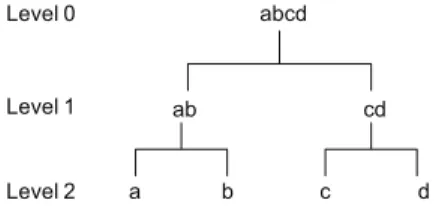
LKC-privacy can be achieved by performing a sequence of generalization and/or suppression operations on the RFID data table. Generalization replaces a specific value with a more general value for a given attribute according to a taxonomy tree. For example, location a can be generalized into a broader location ab according to the taxonomy tree in Figure 2. Similarly, ab can be further generalized into abcd. The same generalization can be performed on the time dimension. Suppression removes a pair from one or more trajectories in the RFID data ta-bleT. For example, Table 2 is the result of suppressingb2 andc4from Table 1. In both the above schemes, if all the instances of a value are generalized or suppressed, then it is called global recoding. In contrast, if some instances of a value remain unchanged while other instances are generalized or suppressed, then it is calledlocal recoding. Refer to [20] for detailed descriptions on different global and local recoding schemes.
In this paper, we employ global suppression, meaning that if a pairpis chosen to be suppressed,allinstances of
pinT are suppressed. Global suppression offers several
a b c d ab cd abcd Level 0 Level 1 Level 2
Fig. 2. Taxonomy tree on location
advantages over generalization and local suppression. First, suppression does not require a predefined taxon-omy tree for generalization, which often is unavailable in real-life databases. Second, RFID data could be ex-tremely sparse. Enforcing global generalization on RFID data will result in generalizing many sibling location or time values even if there is only a small number of outlier pairs, such as c4 in Table 1. Suppression offers the flexibility of removing those outliers without affecting the rest of the data. Note, we do not intend to claim that global suppression is always better than other schemes. For example, LeFevre et al. [20] present some local generalization schemes that may result in less data loss depending on the utility measure. Third, global suppression retains exactly the same support counts of the preserved MFS in the anonymous RFID data table as there were in the raw data. In contrast, a local suppression scheme may delete some instances of the chosen pair and, therefore, change the support counts of the preserved MFS. For example, if the support count of a sequence ⟨(loc1t1)⟩ is 20 and the support count of its super sequence ⟨(loc1t1) → (loc2t2)⟩ is 10, then the confidence of inferring the occurrence of (loc2t2) from (loc1t1) is 10/20 = 50%. Now, suppose we suppress only 10 instances of (loc1t1) from T. The support of ⟨(loc1t1) → (loc2t2)⟩ will vary from 0 to 10 and the confidence of inferring the occurrence of (loc2t2) from (loc1t1)will vary from 0% to 100% depending on which instances have been suppressed. Hence, employing local suppression cannot preserve the truthful support counts of the preserved frequent sequences, implying that the derived knowledge, such as association rules, is not truthful, too.
Definition 3 (Anonymity for MFS in RFID): Given a RFID data table T, a LKC-privacy requirement, a minimum support threshold K′, a set of sensitive values S, the problem of anonymity for MFS in RFID is to identify a transformed version of T that satisfies the LKC-privacy requirement while preserving the maximum number of MFS.
3
THE
ANONYMIZATION
ALGORITHM
Given a RFID data table T, our first step is to iden-tify all sequences that violate the given LKC-privacy requirement. Section 3.1 describes a method to identify violating sequences efficiently. Section 3.2 presents a greedy algorithm to eliminate the violating sequences with the goal of preserving as many maximal frequent sequences as possible.
3.1 Identifying Violating Sequences
An adversary may use any sequence with length not greater than L as background knowledge to launch a linkage attack. Thus, any non-empty sequence q with |q| ≤LinT is a violating sequenceif its groupT(q)does not satisfy condition 1, condition 2, or both in LKC -privacy in Definition 1.
Definition 4 (Violating sequence): Letqbe a sequence of a trajectory in T with |q| ≤ L. q is a violating sequence with respect to a LKC-privacy requirement if (1) q is non-empty, and (2) |T(q)| < K or P(s|q) > C for any sensitive value s∈S.
Example 2: Let L = 2, K = 2, C = 50%, and S = {On-welfare}. In Table 1, a sequence q1 = ⟨b2 → c4⟩ is a violating sequence because |T(q1)| = 1 < K. A sequenceq2=⟨b2→f6⟩is a violating sequence because
P(On-welfare|q2) = 67% > C. However, a sequence
q3 =⟨b2 →c5 → f6 → c7⟩ is not a violating sequence even if|T(q3)|= 1< K andP(On-welfare|q3) = 67%> C because |q3|> L.
A RFID data table satisfies a given LKC-privacy requirement, if all violating sequences with respect to the privacy requirement are removed, because all pos-sible channels for identity and attribute linkages are eliminated. A naive approach is to first enumerate all possible violating sequences and then remove them. This approach is infeasible because of the huge number of vi-olating sequences. Consider a vivi-olating sequenceq with |T(q)| < K. Any super sequence of q with length less than or equal to L, denoted byq′′, in the database T is also a violating sequence because |T(q′′)| ≤ |T(q)|< K.
One incorrect approach to achieve LKC-privacy is to ignore the sequences with size less than L and assume that if a table T satisfies LKC-privacy, thenT satisfies
L′KC-privacy where L′ < L. Unfortunately, this mono-tonic property with respect to Ldoes not hold inLKC -privacy.
Theorem 1: LKC-privacy is not monotonic with respect to adversary’s knowledge L.
Proof. To prove that LKC-privacy is not monotonic with respect to L, it is sufficient to prove that one of the conditions of LKC-privacy in Definition 1 is not monotonic. Following we provide a counter example for both the conditions.
Condition 1: Anonymity thresholdKis not monotonic with respect to L. If all the size-L sequences are non-violating, it does not guarantee that a sequence with size L′ ≤Lis also non-violating. In Table 3, though the size-3 sequences satisfy privacy requirement forK = 2, the size-2 sequence, q=⟨a1 →d2⟩ does not satisfy the requirement.
Condition 2: Confidence thresholdCis not monotonic with respect to L. If q is a non-violating sequence with
P(s|q) ≤ C and |T(q)| ≥ K, its subsequence q′ may or may not be a non-violating sequence. We use a counter example to show that P(s|q′) ≤ P(s|q) ≤ C
does not always hold. In Table 3, the sequence q = ⟨a1 → b2 → c3⟩ satisfies P(On-welfare|q) = 50% ≤ C.
TABLE 3
Counter example for monotonic property
ID Trajectory Status ...
1 ⟨a1→d2⟩ Student ... 2 ⟨a1→b2⟩ On-welfare ... 3 ⟨a1→b2→c3⟩ On-welfare ... 4 ⟨a1→b2→c3⟩ Retired ...
However, its subsequenceq′ =⟨a1→b2⟩does not satisfy
P(On-welfare|q′) = 100%> C.
To satisfyLKC-privacy, it is insufficient to ensure that every sequenceq with only lengthL inT satisfies both the conditions of Definition 1. Instead, we need to ensure that every sequenceqwith length not greater thanLinT
satisfies both the conditions. To overcome this bottleneck of violating sequence enumeration, our insight is that there exists some “minimal” violating sequences among the violating sequences, and it is sufficient to achieve
LKC-privacy by removing only the minimal violating sequences.
Definition 5 (Minimal violating sequence): A violating sequenceqis aminimal violating sequence(MVS) if every proper subsequence ofqis not a violating sequence.
Example 3: In Table 1, given L= 3, K= 2,C = 50%,
S ={On-welfare}, the sequenceq=⟨b2→d3⟩ is a MVS because ⟨b2⟩ and ⟨d3⟩ are not violating sequences. The sequence q = ⟨b2 → d3 → c4⟩ is a violating sequence but not a MVS because its subsequence ⟨b2 → d3⟩ is a violating sequence.
Every violating sequence is either a MVS or it contains a MVS. Thus, ifT contains no MVS, thenT contains no violating sequences.
Lemma 1: A RFID data table T satisfiesLKC-privacy if and only ifT contains no MVS.
Proof. Suppose a data table T does not satisfy LKC -privacy even if T contains no MVS. Then, by Defini-tion 4, the table T contains violating sequence. But, a violating sequence must be a MVS or its subset is MVS, which is the contradiction of the initial assumption. Therefore, the data table T must satisfy LKC-privacy.
Next, we propose an algorithm to efficiently identify all MVS in T with respect to a LKC-privacy require-ment. Based on Definition 5, we generate all MVS of size i+ 1, denoted by Vi+1, by incrementally extending a non-violating sequence of sizei, denoted byWi, with
an additional pair.
Algorithm 1 presents a method to efficiently generate all MVS. Line 1 puts all the size-1 sequences, i.e., all distinct pairs, as candidates X1 of MVS. Line 4 scans T once to compute|T(q)|andP(s|q)for each sequenceq∈ Xi and for each sensitive values∈S. If the sequenceq
violates theLKC-privacy requirement in Line 6, then we addqto the MVS setVi(Line 7); otherwise, addqto the
non-violating sequence setWi(Line 9) for generating the
next candidate setXi+1, which is a self-join ofWi (Line
12). Two sequencesqx=⟨(locx1tx1)→. . .→(locxit x i)⟩and qy = ⟨(locy1t y 1) → . . . → (loc y it y i)⟩ in Wi can be joined
only if the first i−1 pairs of qx and qy are identical
and tx i < t
y
i. The joined sequence is ⟨(loc x
Algorithm 1 MVS Generator
Input: Raw RFID data tableT Input: ThresholdsL,K, and C Input: Sensitive valuesS
Output:Minimal violating sequenceV(T)
1: X1←set of all distinct pairs inT;
2: i= 1;
3: whilei≤LandXi̸=∅do
4: ScanT to compute|T(q)|andP(s|q), for∀q∈Xi,∀s∈
S; 5: for ∀q∈Xiwhere|T(q)|>0do 6: if|T(q)|< K orP(s|q)> C then 7: Addq toVi; 8: else 9: Addq toWi; 10: end if 11: end for 12: Xi+1←WionWi; 13: for∀q∈Xi+1do
14: ifq is a super sequence of anyv∈Vi then 15: RemoveqfromXi+1; 16: end if 17: end for 18: i++; 19: end while 20: returnV(T) =V1∪. . .∪Vi−1; (locx itxi) → (loc y it y
i)⟩. Lines 13-17 remove a candidate q
from Xi+1 if q is a super sequence of any sequence in
Vi because any proper subsequence of a MVS cannot be
a violating sequence. The set of MVS, denoted byV(T), is the union of allVi.
Example 4: Consider Table 1 with L = 2, K = 2, C = 50%, and S = {On-welfare}. X1 = {b2, d3, c4, c5, f6, c7, e8}. After scanningT, we divideX1 into V1 = ∅ and W1 = {b2, d3, c4, c5, f6, c7, e8}. Next, fromW1we generate the candidate setX2={b2d3, b2c4,
b2c5, b2f6, b2c7, b2e8, d3c4, d3c5,d3f6, d3c7, d3e8, c4c5, c4f6, c4c7, c4e8, c5f6, c5c7, c5e8, f6c7, f6e8, c7e8}. We scan T again to determine V2={b2d3, b2c4, b2f6, c4c7,
c4e8}. We do not further generateX3 becauseL= 2. Lemma 2: Algorithm 1 generates all the minimal violating sequences (MVS) of size≤L.
Proof.We use a loop invariant to proof the correctness of Algorithm 1.
Loop Invariant:At the start of each iterationiof the while loop (Line 3), the MVS setV(T)contains all the MVS of size ≤(i−1).
Initialization:Prior to the first iteration of the loop,i= 1, the MVS set V(T)is empty. Invariant is true because by Definition 4 violating sequence can not be of size-0. Maintenance: During the iteration, every candidate se-quence q ∈ Xi that does not satisfy |T(q)| ≥ K or P(s|q) ≤ C is added to the MVS set V(T). Since, the candidate set contains all size-i sequences and the algorithm verifies all candidates, we conclude that loop invariant indeed remains true before the next iteration
i+ 1.
Termination:At termination,i=L+ 1, by loop invariant, the MVS set V(T)contains all the MVS of size≤L.
Definition 6 (Violating pair): A pair pis aviolating pair if it is part of a violating sequence.
Example 5: Given the set of minimal violating se-quence, V(T) = {b2d3, b2c4, b2f6, c4c7, c4e8}, the violating pairs are{b2, d3, c4, f6, c7, e8}.
From Lemma 1, we have to remove all the MVS to satisfyLKC-privacy requirement. We can remove all the MVS by suppressing a subset of violating pairs. Given,
V(T) = {b2d3, b2c4, b2f6, c4c7, c4e8}, we can either suppress {b2, c4} or {b2, c7, e8} and so on. Next, we prove that it is NP-hard to find an optimal subset of violating pairs.
Theorem 2: Given a RFID data tableT and aLKC-privacy requirement, it is NP-hard to find the optimal anonymous solution.
Proof.The problem of finding the optimal anonymous solution can be converted into thevertex cover problem[7]. The vertex cover problem is a well-known problem in which, given an undirected graph G= (V, E), it is NP-hard to find the smallest set of vertices S such that each edge has at least one endpoint inS. To reduce our problem into the vertex cover problem, we consider the set of violating pairs as the set of verticesV. The set of MVS, denoted byV(T), is analogous to the set of edges
E. Hence, the optimal vertex cover,S, means finding the smallest set of violating pairs that must be suppressed to obtain the optimal anonymous data setT′. Given that it is NP-hard to determine the smallest set of verticesS, it is also NP-hard to find the optimal set of violating pairs for suppression.
Finding an optimal solution for LKC-privacy is NP-hard. Thus, we propose a greedy algorithm to efficiently identify a reasonably “good” sub-optimal solution. 3.2 Eliminating Violating Sequences
We propose a greedy algorithm to transform the raw RFID data tableT to an anonymous tableT′with respect to a given LKC-privacy requirement by a sequence of suppressions. In each iteration, the algorithm selects a violating pair p for suppression based on a greedy selection function. In general, a suppression on a vio-lating pair pin T increases privacy because it removes minimal violating sequences (MVS), and decreases data utility because it eliminates maximal frequent sequences (MFS) in T. Therefore, we define the greedy function,
Score(p), to select a suppression on a violating pairpthat maximizes the number of MVS removed but minimizes the number of MFS removed in T. Score(p) is defined as follows:
Score(p) = P rivGain(p)
U tilityLoss(p) + 1 (1) where P rivGain(p) and U tilityLoss(p) are the number of MVS and the number of MFS containing the violating pair p, respectively. A violating pair p may not belong to any MFS, resulting in U tilityLoss(p) = 0. To avoid dividing by zero, we add 1 to the denominator. The
Algorithm 2 Data Anonymizer
Input: Raw RFID data tableT Input: ThresholdsL,K,C, and K′ Input: Sensitive valuesS
Output:Anonymous T′ that satisfiesLKC-privacy
1: GenerateV(T)by Algorithm 1 and build MVS-tree;
2: GenerateU(T)by MFS algorithm and build MFS-tree;
3: whileP Gtable is not emptydo
4: Select a pairwthat has the highestScoreto suppress;
5: Delete all MVS and MFS containingw from MVS-tree and MFS-tree;
6: Update theScore(p) if both w andp are contained in the same MVS or MFS;
7: RemovewfromP GTable;
8: AddwtoSup;
9: end while
10: For∀w∈Sup, suppress all instances ofwfromT;
11: returnthe suppressedT asT′;
violating pair pwith the highest Score(p) is called the winner pair, denoted byw.
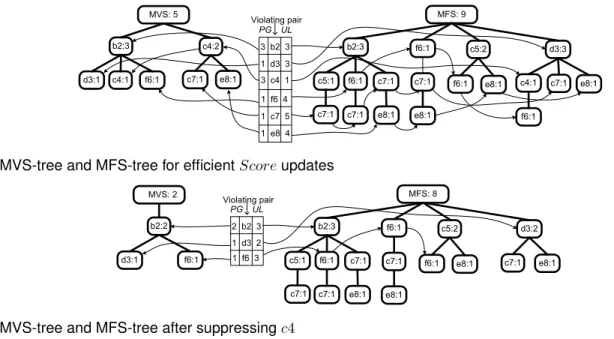
Algorithm 2 summarizes the anonymization algorithm that removes all MVS. Line 1 calls Algorithm 1 to iden-tify all MVS, denoted by V(T), and then builds a MVS-tree with aP Gtable that keeps track of theP rivGain(p) of all violating pairs for suppressions. Line 2 calls a maximal frequent sequence mining algorithm to identify all MFS, denoted by U(T), and then builds a MFS-tree with a U L table that keeps track of the U tilityLoss(p) of all candidate pairs. We modified MAFIA [6], which was originally designed for mining maximal frequent itemsets, to mine MFS. Any alternative MFS algorithm can be used as a plug-in to our method. At each iteration in Lines 3-9, the algorithm selects the winner pairwthat has the highestScore(w)from theP Gtable, removes all the MVS and MFS that containw, incrementally updates the Scoreof the affected violating pairs, and addsw to the set of suppressed values, denoted bySup. Values in
Sup are collectively suppressed in Line 10 in one scan of T. Finally, Algorithm 2 returns the anonymizedT as
T′. The most expensive operations are identifying the MVS and MFS containing w and updating the Score
of the affected candidates. Below, we propose two tree structures to efficiently perform these operations.
Definition 7 (MVS-tree): MVS-tree is a tree structure that represents each MVS as a tree path from root-to-leaf. Each node keeps track of a count of MVS sharing the same prefix. The count at the root is the total num-ber of MVS. MVS-tree has a P G table that maintains every violating pair pfor suppression, together with its
P rivGain(p). Each violating pair pin the P G table has a link, denoted by Linkp, that links up all the nodes in
an MVS-tree containingp.P rivGain(p)is the sum of the counts of MVS on Linkp.
Definition 8 (MFS-tree): MFS-tree is a tree structure that represents each MFS as a tree path from root-to-leaf. Each node keeps track of a count of MFS sharing the same prefix. The count at the root is the total
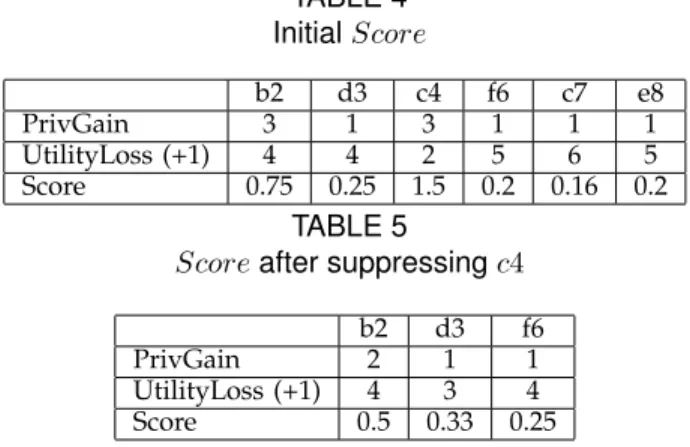
TABLE 4 InitialScore b2 d3 c4 f6 c7 e8 PrivGain 3 1 3 1 1 1 UtilityLoss (+1) 4 4 2 5 6 5 Score 0.75 0.25 1.5 0.2 0.16 0.2 TABLE 5
Scoreafter suppressingc4
b2 d3 f6
PrivGain 2 1 1
UtilityLoss (+1) 4 3 4
Score 0.5 0.33 0.25
number of MFS. MFS-tree has aU Ltable that keeps the
U tilityLoss(p)for every violating pair p. Each violating pair p in the U L table has a link, denoted by Linkp,
that links up all the nodes in MFS-tree containing p.
U tilityLoss(p) is the sum of the counts of MFS on
Linkp.
Example 6: Figure 3 depicts both MVS-tree and MFS-tree generated from Table 1, where V(T) ={b2d3, b2c4, b2f6, c4c7, c4e8} and U(T) = {b2c5c7, b2f6c7, b2c7e8, d3c4f6, f6c7e8, c5f6, c5e8, d3c7, d3e8} withL= 2,K= 2,C= 50%, andK′= 2. Each root-to-leaf path represents one sequence of MVS or MFS. To find all the MVS (or MFS) containingc4, follow Linkc4 starting from theP G (or U L) table. For illustration purposes, we show P G
andU L as a single table.
Table 4 shows the initial Score(p) of every violating pair. Identify the winner pair c4 from violating pairs. Then traverse Linkc4 to identify all MVS and MFS containing c4 and delete them from the MVS-tree and MFS-tree accordingly. These links are the key to efficient
Scoreupdates and suppressions. When a winner pairw
is suppressed from the trees, the entire branch of w is trimmed. The trees provide an efficient structure for up-dating the counts of MVS and MFS. For example, when
c4is suppressed, all its descendants are removed as well. The counts ofc4’s ancestor nodes are decremented by the counts of the deletedc4 node. If a violating pair pand the winner pairware contained in some common MVS or MFS, thenU tilityLoss(p),P rivGain(p), andScore(p), have to be updated by adding up the counts on Linkp.
A violating pair p is removed from the P G table if
P rivGain(p) = 0 because there is no more any MVS containing this pair. The resultant MVS-tree and MFS-tree are shown in Figures 4 after suppressingc4. Table 5 shows the updated Score of the remaining violating pairs. In the next iteration, b2 is suppressed and thus all the remaining MVS are removed. Table 2 shows the resulting anonymous table T′ for(2,2,50%)-privacy.
Lemma 3: Algorithm 2 eliminates all MVS without gener-ating new MVS.
Proof.By Definition 7, MVS-tree represents all the MVS in a tree structure. Thus by suppressing the violating sequences iteratively, the algorithm eliminates all the MVS. However, global suppression does not generate
MFS: 9 b2:3 3 b2 3 1 d3 3 3 c4 1 1 f6 4 1 c7 5 1 e8 4 UL c5:1 f6:1 c7:1 e8:1 c7:1 c7:1 d3:3 c7:1 e8:1 f6:1 f6:1 c7:1 e8:1 c4:1 f6:1 e8:1 c5:2 MVS: 5 c4:2 e8:1 c7:1 d3:1 f6:1 b2:3 c4:1 PG Violating pair
Fig. 3. MVS-tree and MFS-tree for efficientScoreupdates
MFS: 8 b2:3 2 b2 3 1 d3 2 1 f6 3 UL c5:1 f6:1 c7:1 e8:1 c7:1 c7:1 d3:2 c7:1 e8:1 f6:1 c7:1 e8:1 f6:1 e8:1 c5:2 MVS: 2 d3:1 f6:1 b2:2 PG Violating pair
Fig. 4. MVS-tree and MFS-tree after suppressingc4 any new MVS. Consider a new sequence q, which re-sulted from the suppression of its super sequence. The sequence q can not be a MVS since by Definition 5, all the subsequence of a MVS is a non-violating sequence.
We now prove that the anonymous data tableT′ is the
LKC-private version of the raw data table T.
Theorem 3: Given a RFID data table T, the anonymous data tableT′ produced by the anonymization algorithm satis-fiesLKC-privacy.
Proof.The proof follows directly from Lemmas 1, 2 and 3. Since, the anonymization algorithm can enumerate all the MVS (Lema 2) and subsequently remove them with-out generating new MVS (Lema 3), the anonymous table contains no MVS. Finally, according to Lemma 1, the anonymous data tableT′ satisfiesLKC-privacy because it has no MVS.
3.3 Complexity Analysis
Our anonymization algorithm has two steps. In the first step, we determine the set of MVS and the set of MFS. In the second step, we build the MVS-tree and MFS-tree, and suppress the violating pairs iteratively according to their Score. The most expensive operation of our algorithm is scanning the raw RFID data table T once to compute |T(q)| and P(s|q) for all sequence q in the candidate setXi. This operation takes place during MVS
generation. The cost of this operation is approximated as Cost = ∑Li=1mii, where mi = |Xi|. Note that the
searching cost depends on the value of L and size of the candidate set. When i = 1, the candidate set Xi is
the set of all distinct pairs in T. Hence, the upper limit of mi = |d|, where |d| is the number of dimensions. It
is unlikely to have any single pair violating the LKC -privacy; therefore, m2=|d|(|d| −1)/2. In practice, most of the candidate sets are of size-2; therefore, the lower bound of the Cost≤m1+ 2m2=|d|2. Finally, including the dependence on the data size, the time complexity of our algorithm isO(|d|2n).
TABLE 6 Data sets statistics
Dataset Records Avg. trajectory Dimensions Data size
|T| length |d| (K bytes)
City80K 80,000 8 624 2,297
Metro100K 100,000 8 3,900 6,184 In the second step, we insert the MVS and MFS into the respective trees and delete them iteratively afterward. This operation is proportional to the number of MVS and thus in the order of O(|V(T)|) . Due to MVS-tree and MFS-tree data structures, our approach can efficiently calculate and update the the score of the violating pairs.
4
EMPIRICAL
STUDY
The main objective of our empirical study is to evaluate the performance of our proposed algorithm in terms of utility loss caused by anonymization, and scalability for handling large data sets. The utility loss is defined as
|U(T)|−|U(T)′|
|U(T)| , where|U(T)|and|U(T)′|are the numbers of maximal frequent sequences before and after the anonymization of the data set T. It measures the per-centage of MFS loss due to suppressions, so lower utility loss implies better data quality. We could not directly compare our methods with others because no method exists that can anonymize high-dimensional RFID data while preserving maximal frequent sequences. We con-vert the RFID data into relational data and attempt to apply the state-of-the-art anonymization algorithms, such as [12][20][34]. Unfortunately, all these methods are not scalable to high dimensionality and fail to finish the anonymization. We evaluate our algorithm with three differentScorefunctions:
• Score1(p) =U tilityLossP rivGain((pp)+1) (from Equation 1)
• Score2(p) =P rivGain(p)
0% 20% 40% 60% 80% 100% 10 20 30 40 50 U ti li ty L o s s Minimum Anonymity K (a)K′= 0.5% 0% 20% 40% 60% 80% 100% 10 20 30 40 50 U ti li ty L o s s Minimum Anonymity K (b)K′= 1% 0% 20% 40% 60% 80% 100% 10 20 30 40 50 U ti li ty L o s s Minimum Anonymity K (c)K′= 1.5% Fig. 5. Utility loss vs.Kon City80K (L= 3, C = 60%)
0% 20% 40% 60% 80% 100% 0.2 0.4 0.6 0.8 1 U ti li ty L o s s Maximum Confidence C (a)K′= 0.5% 0% 20% 40% 60% 80% 100% 0.2 0.4 0.6 0.8 1 U ti li ty L o s s Maximum Confidence C (b)K′= 1% 0% 20% 40% 60% 80% 100% 0.2 0.4 0.6 0.8 1 U ti li ty L o s s Maximum Confidence C (c)K′= 1.5% Fig. 6. Utility loss vs.Con City80K (L= 3, K = 30)
0% 20% 40% 60% 80% 100% 1 2 3 4 5 U ti li ty L o s s
Maximum Adversary's Knowledge L (a)K′= 0.5% 0% 20% 40% 60% 80% 100% 1 2 3 4 5 U ti li ty L o s s
Maximum Adversary's Knowledge L
(b)K′= 1% 0% 20% 40% 60% 80% 100% 1 2 3 4 5 U ti li ty L o s s
Maximum Adversary's Knowledge L (c)K′= 1.5%
Fig. 7. Utility loss vs.Lon City80K (K= 30, C= 60%)
We used two data sets for the experiments: City80K
and M etro100K. City80K is a data set simulating the routes of 80,000 citizens in a metropolitan area with 26 city blocks in 24 hours, thus forming 624 dimen-sions (different possible pairs). M etro100K is a data set simulating the travel routes of 100,000 passengers in the Montreal subway transit system with 65 stations in 60 minutes, forming 3,900 dimensions. Each record in the data set corresponds to the route of one pas-senger. The passengers’ traffic patterns are simulated based on information obtained from the Montreal metro information website1. Based on the published annual report, all the passengers have an average trajectory length of 8 stations. The data generator also simulates the trajectories according to the current metro map and passengers’ flow in each station. In both data sets, each record contains an attribute with five possible values,
1. http://www.metrodemontreal.com
where one of them is considered to be sensitive. Following the convention for extracting MFS, we spec-ify the minimum support thresholdK′as the percentage of the total number of records in the database. For both data sets, we set K′ = 0.5%, and 1.5% and vary the thresholds of minimum anonymity K, maximum confidence C, and maximum adversary’s knowledge
L to evaluate the performance of the algorithm. All experiments are conducted on a PC with Intel Core2 Duo 1.6GHz CPU with 2GB of RAM.
4.1 Utility Loss
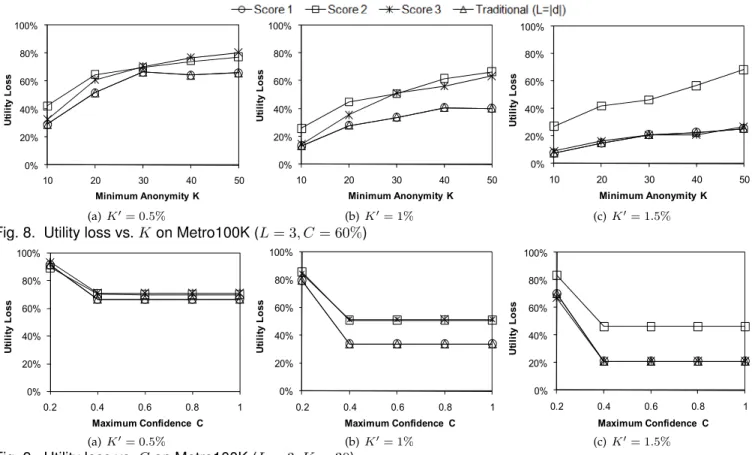
Figure 5. We vary the thresholdK from10 to50 while fixing L = 3 and C = 100% on City80K. This setting allows us to measure the performance of the algorithm against identity linkages without considering attribute linkages. The utility loss ofScore1andScore3generally increases as K increases, so it exhibits some trade-off
0% 20% 40% 60% 80% 100% 10 20 30 40 50 U ti li ty L o s s Minimum Anonymity K (a)K′= 0.5% 0% 20% 40% 60% 80% 100% 10 20 30 40 50 U ti li ty L o s s Minimum Anonymity K (b)K′= 1% 0% 20% 40% 60% 80% 100% 10 20 30 40 50 U ti li ty L o s s Minimum Anonymity K (c)K′= 1.5% Fig. 8. Utility loss vs.Kon Metro100K (L= 3, C = 60%)
0% 20% 40% 60% 80% 100% 0.2 0.4 0.6 0.8 1 U ti li ty L o s s Maximum Confidence C (a)K′= 0.5% 0% 20% 40% 60% 80% 100% 0.2 0.4 0.6 0.8 1 U ti li ty L o s s Maximum Confidence C (b)K′= 1% 0% 20% 40% 60% 80% 100% 0.2 0.4 0.6 0.8 1 U ti li ty L o s s Maximum Confidence C (c)K′= 1.5% Fig. 9. Utility loss vs.Con Metro100K (L= 3, K = 30)
between data privacy and data utility. The utility loss, sometimes, has a slight drop when K increases. This is due to the fact that the greedy algorithm finds only the sub-optimal solution.Score2 has higher utility loss than
Score1 and Score3 because Score2 does not take into account the number of MFS lost during the elimination of MVS.
As K′ increases, the utility loss decreases because the number of MFS decreases and there is less over-lapping between V(T) and U(T), so suppressions have less effect on MFS. Though none of the tradi-tionalK-anonymization algorithms can handle the high-dimensional RFID data in our experiments, our method can achieveK-anonymity by settingL=|d|, where|d|is the number of dimensions. The result strongly suggests that applyingLKC-privacy would result in significantly lowering the utility loss than would applying traditional
K-anonymity.
Figure 6.We vary the threshold C from20% to100% while fixingL= 3andK= 30onCity80K. This allows us to examine the effect of attribute linkages. Approx-imately 1/5 of the records contain a sensitive value, so the utility loss is high at C = 0.2. As C increases, the effect of attribute linkages becomes insignificant. As
K′ increases, the utility loss drops quickly due to less overlapping between V(T) and U(T). The traditional confidence bounding anonymization method [34] can-not handle high-dimensional RFID data, so we achieve confidence bounding by settingL=|d|. Again, the tradi-tional confidence bounding model results in significantly higher utility loss.
Figure 7.We vary the threshold L from 1 to 5 while fixing K = 30 and C = 60% on City80K. This allows us to quantify the utility loss with the increment of an adversary’s background knowledge. The result suggests that up toL= 2, there is no utility loss. AsLincreases, the loss increases quickly due to the increase in the number of violating sequences.
Figure 8. M etro100K is a relatively higher dimen-sional data set (3,900 dimensions) compared toCity80K
(624 dimensions). Unlike inCity80K, passengers follow predefined tracks based on the metro map. In Figure 8, following the same setting of City80K, we vary the value of K from 10 to 50, while fixing L = 3 and
C = 100% on M etro100K. M etro100K has a large number of violating sequences and thus many pairs are suppressed during anonymization. The general trend in M etro100K is more obvious than in City80K. For example, in Figure 8(a), asKincreases from 10 to 50, the utility loss ofScore1 increases from 29% to 66%. As K′
increases from 0.5% to 1.5%, the utility loss ofScore1at
K= 30drops from 66% to 21%. In all test cases,Score1 and Score3 consistently outperform Score2, suggesting that it is vital to consider the loss of MVS in the greedy function. Interestingly, the utility loss is the same for
L= 3 andL=|d| because most of the MVS are of size-3 or less. In other words, there is no difference between
L= 3andL= 4or above in terms of the generated MVS. Hence, the utility loss for L ≥ 3 remains unchanged; therefore, we omit the figure on utility loss vs.L.
Figure 9. We vary the value of C from 20% to 100% while fixing L = 3 and K = 30 on M etro100K. The
0 20 40 60 80 100 120 140 200 400 600 800 1000 T im e ( s e c o n d s )
Number of records (in thousands) R/W Identifying MVS Sup Total
(a) Runtime vs. # of records
0 50 100 150 200 250 300 350 200 400 600 800 1000 T im e ( s e c o n d s )
Number of records (in thousands) L=2 L=3 Traditional (L=|d|) (b) Runtime vs. # ofL 0 50 100 150 200 250 3900 4900 5900 6900 7900 T im e ( s e c o n d s )
Number of dimensions (location x time) R/W Identifying MVS Sup Total
(c) Runtime vs. dimensionality Fig. 10. Scalability(K= 30, C = 60%, K′= 1%)
results have characteristics similar to those in Figure 6. The utility loss increases when C < 40%. Moreover, as
K′ increases, the utility loss decreases significantly. 4.2 Scalability
One major contribution of our work is the develop-ment of an efficient and scalable algorithm for achieving
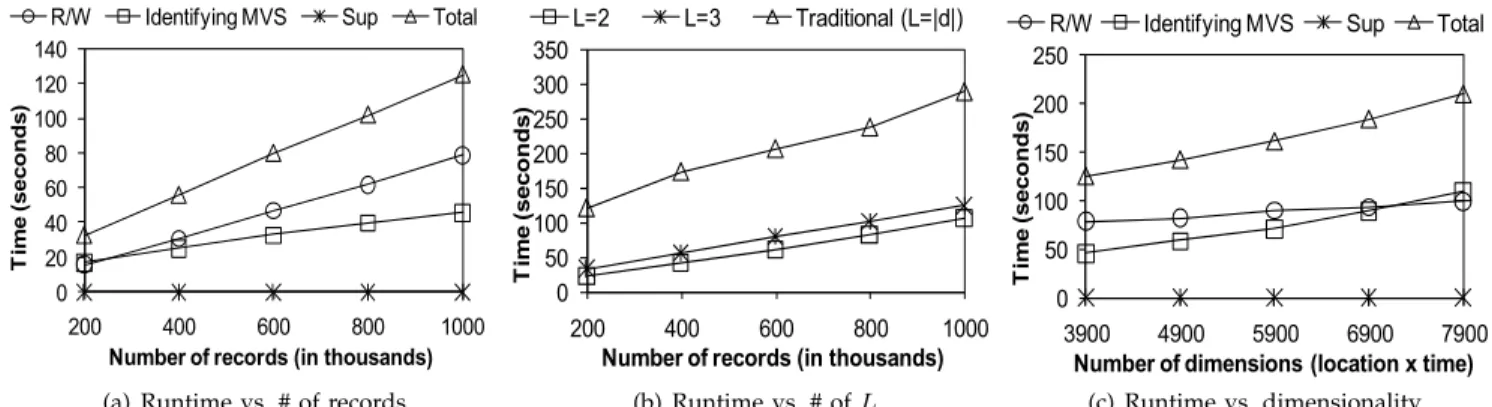
LKC-privacy, traditional K-anonymity, and confidence bounding on high-dimensional RFID data. Every previ-ous test case can finish the entire anonymization process within 15 seconds. We further evaluate scalability with respect to data volume and dimensionality. We conduct all the experiments on the data set M etro100K since it is larger in size and dimensionality. Unless otherwise specified, we fixL= 3,K= 30,C= 60%, andK′ = 1%. Figure 10(a) depicts the runtime in seconds from 200,000 to 1 million records. The total runtime for anonymizing 1 million records is 125 seconds, of which 46 seconds are spent identifying MVS and 79 seconds are spent reading the raw data set and writing the anony-mous data set. It takes less than 1 second to suppress all the MVS due to our efficient MVS-tree and MFS-tree. As the number of records increases from 200,000 towards 1 million, the runtime for read/write and identifying MVS also increases linearly, suggesting that our algorithm is scalable to anonymize large datasets. Figure 10(b) compares the total runtime for L = 2, L = 3, and
L = |d|. L = |d| represents the runtime for achieving traditionalK-anonymity and confidence bounding. The runtime for achieving those models is much longer than ours because L=|d|requires verifying many sequences up toL=|d|. In Figure 10(c), we increase the dimension on the data set with 1 million records. As the number of dimensions increases, the number of MVS also increases due to sparseness; therefore, the runtime for identifying MVS also increases.
4.3 Summary
(1) As anonymity thresholdK or an adversary’s knowl-edge L increases, the data utility decreases. The trend is less obvious on C. (2) As minimum support thresh-old K′ increases, the set of MVS and the set of MFS have less overlapping, so suppressing pairs in MVS has less effect on MFS. (3) Score1 and Score3 outperforms
Score2, suggesting it is important to consider the loss of MFS in the greedy function. (4) High-dimensional data generally has more violating sequences and, therefore, higher utility loss. (5) Our proposed method is scalable with respect to the data size.
5
DISCUSSION
In this section, we provide answers to the following frequently raised questions: Why does the data holder want to publish the sensitive attributes when the goal is to preserve maximal frequent sequences? Can the proposed algorithm be applied to anonymize any data set involving moving objects? What if the adversary only uses time or location to identify an individual?
Sensitive Attribute. The data hold may publish the sensitive attributes because some data mining tasks on RFID data require both trajectory and object-specific data. Analyzing the workflow (traffic flow) without understanding what the objects are often meaningless. For example, transit companies like to understand the characteristics of the passengers’ traffic. However, if there is no such data mining purpose, the sensitive attributes should be removed. Our proposed anonymiza-tion algorithm (Secanonymiza-tion 3) is flexible enough to handle RFID data with or without sensitive attributes. Note that, none of the previous works consider the privacy threats caused by attribute linkages between the trajectory and the sensitive attributes.
Trajectory from Moving Objects. Our algorithm requires the trajectories to have the following form ⟨(loc1t1) → . . . → (locntn)⟩. If the trajectory of a
mov-ing object does not have this form, then preprocess-ing is needed before applypreprocess-ing the proposed algorithm. For example, the trajectory from a mobile device is as a sequence of spatio-temporal points in the form ⟨(x1, y1, t1),(x2, y2, t2), . . . ,(xn, yn, tn)⟩, wheret1 < t2 <
. . . tn and the coordinate (xi, yi)represents the location
of the device at time ti, obtained with the help of GPS
devices and/or by localization techniques. In the prepro-cessing step, the space can be divided into ϵ×ϵ grids, where each coordinate is represented by a grid. Thus, the continuous spatio-temporal points can be transformed into discrete(lociti)pairs, where each grid is represented
by loci. Once the trajectories are transformed into the
Time and Location.It is possible that the adversary’s background knowledge q′ contains only the location
loci or only the timestamp ti. This type of attack is
obviously weaker than the attack based on background knowledge q containing (lociti) because the identified
group|T(q′)| ≥ |T(q)|. Thus, anLKC-privacy preserved table that can thwart linkages on q can also thwart linkages on q′.
6
RELATED
WORK
Privacy-preserving techniques on RFID can be broadly grouped into two categories: data collection and data publishing. While the work on data collection focuses on the privacy and security issues of the RFID tags and readers at the communication level [19], the work on data publishing phase focuses on the privacy and utility at the data level [16]. Below, we briefly summarize the techniques applicable to RFID data privacy.
Location Privacy. Different solutions have been pro-posed to protect the privacy of location-based service (LBS) users. The anonymity of a user in LBS is achieved by mixing the user’s identity and request with other users. Example of such techniques are Mix Zones [5], cloaking [17], and location-based k-anonymity [13]. The objective of these techniques is very different from ours. First, their goal is to anonymize an individual user’s identity resulting from a set of LBS requests, but our goal is to anonymize a high-dimensional RFID data set. Second, they deal with small dynamic groups of users at a time, but we anonymize a large static data set. Hence, their problem is very different from RFID data publishing.
Privacy Models. Traditional K-anonymity [29], [31],
ℓ-diversity [25], confidence bounding [34], and (α, k) -anonymity [36] are based on a predefined set of QID attributes. As discussed earlier, a traditional QID-based approach suffers from the curse of high dimensional-ity [2] and renders the high-dimensional data useless for data mining. In this paper, we solve the prob-lem of dimensionality by assuming that the adversary knows at most L pairs of a victim’s locations and the corresponding times. In [27], Mohammed et al. propose LKC-privacy model that addresses the pri-vacy issues on high-dimensional relational data. They adopt top-down approach to generalize relational data while preserving data utility for classification analy-sis. Unlike [27], the proposed algorithm suppresses the violating pairs based on a heuristic that pre-serves maximal frequent sequences. This is the first paper that propose an anonymization algorithm to achieveLKC-privacy model on RFID data. Furthermore, none of the tested traditional QID-based anonymization methods, namely [12][20][25], are scalable to handle the high-dimensional data in our experiments. Since
K-anonymity [29][31], confidence bounding [34], and (α, k)-anonymity [36] are special cases of the LKC -privacy model, our anonymization algorithm can also be
viewed as a scalable solution for achieving a traditional privacy model for RFID data.
Dwork [9] proposes a privacy model calleddifferential privacy, which ensures that the removal or addition of a single data record does not significantly affect the overall privacy of the database. Most of the works in differential privacy are based on interactive privacy model, where the result of a query is in the form of aggregation [8], [10].
Anonymizing High-Dimensional Data. There are some recent works on anonymizing high-dimensional transaction data [14][33][38][39]. The methods presented in [33][38][39] model the adversary’s power by a max-imum number of known items as background knowl-edge. This assumption is similar to ours, but our problem has two major differences. First, a transaction is a set of items, but a moving object’s trajectory is a sequence of visited location-time pairs. Sequential data drastically increases the computational complexity for counting the support counts as compared to transaction data because ⟨a→b⟩is different from⟨b→a⟩. Hence, their proposed models are not applicable to spatio-temporal data. Sec-ond, we have different privacy and utility measures. The privacy model of [33] is based on onlyK-anonymity and does not consider attribute linkages. Xu et al. [38][39] measure their data utility in terms of preserved item instances and frequent itemsets, respectively, while we measure the utility based on the number of preserved maximal frequent sequences.
Anonymizing Moving Objects. Some recent works [1], [18], [32], [28], [40], [11] address the anonymity of moving objects. Abul et al. [1] propose a new privacy model called (k, δ)-anonymity that exploits the inherent uncertainty of moving objects’ locations. Their method relies on a basic assumption that every trajectory is continuous. Though this assumption is valid for GPS-like devices where the object can be traced all the time, it does not hold for RFID-based moving objects. Another major difference is that [1] achieves the anonymity by space translation that changes the actual location of an object. In contrast, our approach employs suppression for anonymity and thus preserves the data truthful-ness and maximal frequent sequences with true support counts. Hoh et al. [18] present an uncertainly-aware privacy algorithm for GPS traces. They selectively re-move trajectory pairs to increase uncertainly between trajectories to hinder identification. Both the works target GPS traces and can not be employed for anonymizing RFID data.
The privacy model proposed in [32] assumes that dif-ferent adversaries have difdif-ferent background knowledge about the trajectories, and thus their objective is to pre-vent adversaries from gaining any further information from the published data. They consider the locations in a trajectory as sensitive information and assume that the data holder has the background knowledge of all the adversaries. In reality, such information is difficult to obtain. Pensa et al. [28] propose a k-anonymity notion