ISSN 2286-4822 www.euacademic.org
Impact Factor: 3.4546 (UIF) DRJI Value: 5.9 (B+)
Knowledge-based ITS for Teaching Mongo
Database
MOHANAD M. HILLES
Department of Information Technology Faculty of Engineering & Information Technology Al-Azhar University, Gaza, Palestine
Abstract:
Recently, Intelligent Tutoring Systems (ITS) got much attention from researchers even though ITS educational technology began in the late 1960s and ITS is just embryonic from laboratories into the field. In this paper we outline an intelligent tutoring system for teaching basics of the databases system called (MDB). The MDB was built as education system by using the authoring tool (ITSB). MDB contains learning materials as a group of lessons for beginner level which include relational database system and lessons in the process to install and set up a database. MDB system has exams for each level of the Lessons. An evaluation was done to see the effectiveness the MDB among learners and instructors. The outcome of the evaluation was promising.
Key words: Intelligent Tutoring System, Database, Mongo database
INTRODUCTION
This paper presents a Knowledge-based MDB Intelligent
Tutoring System which is a problem-solving environment for
the learners, in which they can practice intangible database
design using the Mongo Database. MDB uses constraint-based
modeling to model the domain knowledge and generate learner
models rules. The paper describes the architecture of system
and its functionality. The MDB system observes actions of
students and adapts to their knowledge and learning
capabilities. MDB has been evaluated in the context of real
teaching environment. We present the results of the two initial
evaluations with learners enrolled in the database courses,
which show that MDB is an effective ITS system. The learners
have loved the adaptability of MDB system and appreciated the
learning style[1].
Mongo Database is an open-source document database
and leading NoSQL database. The MDB intelligent tutoring
system help learners comprehend Mongo Database perceptions
required to build and deploy a extremely scalable and
performance-oriented database [2].
MDB intelligent tutoring divided the teaching materials
to lessons, examples, exercises, and exams. The exercises in
DMB system ranges from level 1 for beginners to level 5 for
advanced users.
MDB intelligent tutoring system was created using
ITSB authoring tool for building ITS system [3]. The ITSB
Tutor Authoring Tool allows an instructor to add learning by
doing to lessons [ 3 ]. ITSB facilitates the creation of intelligent
tutoring systems for student problem solving across a variety of
problems [3].
LITERATURE REVIEW
There are a few intelligent tutoring systems that were designed
and developed for the purpose of education. These systems help
students to learn quickly and increase their self-confidence.
Abu-Naser et al. [10] created and designed ITS called JO-Tutor
for helping students to learn Java Programming language.
Carter et al. [11] developed an ITS for helping students to learn
debugging skills and use case-based reasoning. Abu-Naser. [23]
developed an ITS which called CPP-Tutor for helping student to
learn C++ Programming Language. Butz et al. [6] created and
developed an ITS which called Bits for helping students to learn
C++ Programming Language. Mahmoud et al. [9] developed ITS
called AG_TUTOR for helping Arabic language students to
learn grammar of the Arabic language. Virvou et al. [13]
developed an ITS for helping English Language students to
learn the Passive Voice of English Language. Hennessy et al.
[5] developed an ITS for helping students who between
8-to12-year-olds to learn Primary Mathematics. Other ITS like: A
comparative study between Animated Intelligent Tutoring
Systems (AITS) and Video-based Intelligent Tutoring Systems
(VITS) [5], An agent based ITS for Parameter Passing In Java
Programming[26], Java Expression Evaluation [22], Linear
Programming[15,19], effectiveness of e-learning[7], computer
aided instruction[18], effectiveness of the CPP-Tutor[12],
teaching AI searching algorithms[24], teaching database to
sophomore students in Gaza[21], and Predicting learners
performance using NT and ITS [17], design and development of
diabetes ITS[14 ], ITS teaching grammar English tenses [8 ],
ITS for teaching advanced topics in information security[28],
development and evaluation of the Oracle Intelligent Tutoring
System (OITS)[29], ITS for learning Computer Theory[30],
e-learning system[20,16,27], an Intelligent
Tutoring System for
Entity Relationship Modeling[ 25], an Intelligent Tutoring
System Approach to Teaching Primary Mathematics[4].
SYSTEM ARCHITECTURE
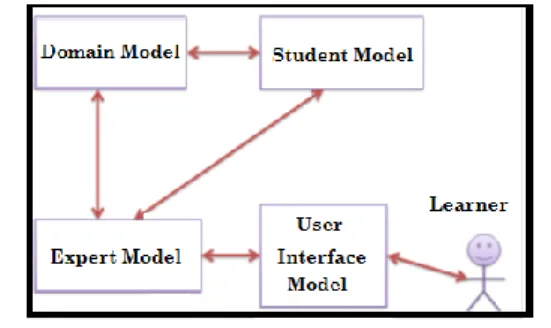
This tool contains four modules: domain model, teaching model,
student model and user interfaces. The first model arranges
and organizes the material in chapters or lessons. The second
model works as control engine. The third model provides the
system with all required information so it can adapt itself to the
student. The last model has two sections - one for the student
and the other for the teacher as shown in Fig 1.
Fig 1: Overall MDB ITS System Architecture.
DOMAIN MODEL ARCHITECTURE
This model deals with the chapters in the course of designed for
Software professionals who are willing to learn Mongo
Database in simple and easy steps. It will shed light on Mongo
Database concepts.
Mongo Database is a cross-platform, document oriented
database that provides, high performance, high availability,
and easy scalability. Mongo Database works on concept of
collection and document. System offers a series of lessons from
one to twenty-five your knowledge about databases to become
the student is able to understand and accommodate the
databases in a smart way and access to the stage where the
student can work for the deployment and use of data sitting
with one of the languages of programming.
STUDENT MODEL
A new student account must be created to have a profile where
it allows the student to study course materials and answer
exercises. The profile has information about the student such as
session date, student name, student number, current score,
overall score, level of difficulty, and problem number during the
each session. The current score represents student score for
each level of a lesson. The overall score represents student
score for all levels of a lesson.
EXPERT MODEL
Expert system module or Teaching module works as a
coordinator that controls the functionality of the whole system.
Through this model, a student can answer questions on the first
level and if he/she gets 70% mark or more, he/she can move to
the second level. But if he/she fails to get the marks, he/she
repeats to the examination at the same level.
USER INTERFACE MODEL
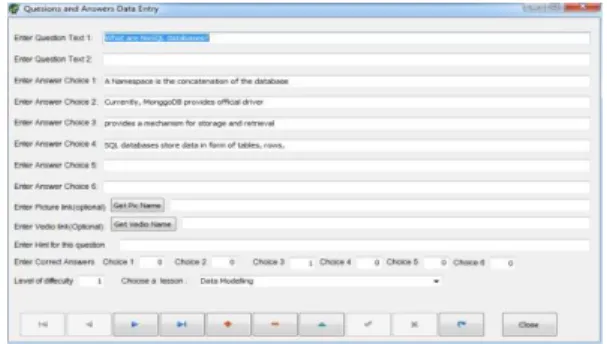
This tool has one interface; it supports two classes of users,
teachers, and students. When the teacher's log in the system,
the teacher can add lessons, exercises, answers, initial
information about the student, configure and adjust the color,
font name, and size of all buttons, menus, comboboxes etc.
Thus, this interface provides the system with the required
robustness and flexibility. A screenshot of the teacher's
interface is shown in Fig 2, to Fig 6.
Fig. 3: Form for adding Lessons and Examples
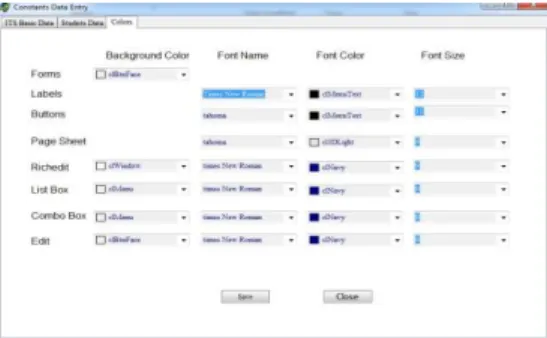
Fig. 4: Form for adjusting Fonts of all screens of the system
Fig. 5: Form for adding constants of the system
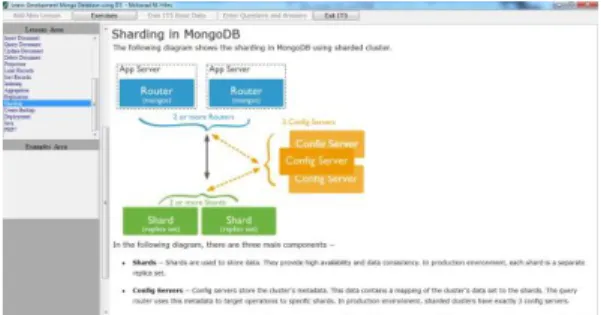
When the student log into the system, he/she will be able to see
the lessons, examples and questions.
The lessons will appear in the form with the name
lessons area and the example for each lesson will appear under
the lessons called example area. When the student clicks on
Exercises button student will be able to see Questions screen.
Thus, be able to answer these questions. To ensure they are
correct answers the student must click on check button. When
the student wants to see his performance must click on a stats
button as seen in Fig 7 to Fig 9.
Fig. 7: Student lessons and examples form
Fig. 9: Student statistics form.
EVALUATION
We have evaluated the MDB Intelligent Tutoring System for
teaching Mnogo Database by presenting the system to a group
of teachers with interest in teaching Database management
system and a group of students in Al-Azhar University taken
the course. We asked both groups to evaluate the MDB system.
Then we asked them to fill a survey about the MDB system.
The survey consisted of questions concerning characteristics of
MDB system, quality of the material, quality of MDB design
and quality of the user interface. The result of the evaluations
by teachers and students were very acceptable.
CONCLUSION
In this paper, we have designed a knowledge based Intelligent
Tutoring System called MDB for teaching Mongo Database by
using ITSB authoring tool. The system was designed to
facilitate learning Mongo Database. MDB System architecture
was outlined clearly. We conducted an evaluation of the MDB
system by a group of teachers and students and the results
were more than acceptable.
1. Akkila, A. N. and S. S. Abu Naser (2017). "Teaching the right letter pronunciation in reciting the holy Quran using intelligent tutoring system." International Journal of Advanced Research and Development 2(1): 64-68.
2. Abu Hasanein, H. A. and S. S. Abu Naser (2017). "An intelligent tutoring system
for cloud computing.".
3. Abu Naser, S. (2008). "An Agent Based Intelligent Tutoring System For Parameter
Passing In Java Programming." Journal of Theoretical & Applied Information Technology 4(7).
4. Abu Naser, S. S. (1999). "Big O Notation for Measuring Expert Systems
complexity." Islamic University Journal Gaza 7(1): 57-70.
5. Abu Naser, S. S. (2001). "A comparative study between animated intelligent
tutoring systems AITS and video-based intelligent tutoring systems VITS." Al-Aqsa Univ. J 5(1): 72-96.
6. Abu Naser, S. S. (2006). "Intelligent tutoring system for teaching database to
sophomore students in Gaza and its effect on their performance." Information Technology Journal 5(5): 916-922.
7. Abu Naser, S. S. (2008). "Developing an intelligent tutoring system for students
learning to program in C++." Information Technology Journal 7(7).
8. Abu Naser, S. S. (2008). "Developing visualization tool for teaching AI searching
algorithms." Information Technology Journal, Scialert 7(2): 350-355.
9. Abu Naser, S. S. (2012). "A Qualitative Study of LP-ITS: Linear Programming
Intelligent Tutoring System." International Journal of Computer Science & Information Technology 4(1): 209.
10. Abu Naser, S. S. and I. S. Zaqout (2016). "Knowledge-based systems that
determine the appropriate students major: In the faculty of engineering and information technology." World Wide Journal of Multidisciplinary Research and Development 2(10): 26-34.
11. Abu Naser, S. S. and S. H. ALmursheidi (2016). "A Knowledge Based System for
Neck Pain Diagnosis." World Wide Journal of Multidisciplinary Research and Development (WWJMRD) 2(4): 12-18.
12. Abu Naser, S. S., et al. (2008). "A Proposed Expert System For Guiding Freshman
Students In Selecting A Major In Al-Azhar University, Gaza." Journal of Theoretical & Applied Information Technology 4(9).
13. Abu Naser, S., et al. (2011). "Human Computer Interaction Design of the LP-ITS:
Linear Programming Intelligent Tutoring Systems." International Journal of Artificial Intelligence & Applications (IJAIA) 2(3).
14. AbuEloun, N. N. and S. S. Abu Naser (2017). "Mathematics intelligent tutoring
system." International Journal of Advanced Scientific Research 2(1).
15. AbuEl-Reesh, J. Y. and S. S. Abu-Naser (2018). "An Intelligent Tutoring System
for Learning Classical Cryptography Algorithms (CCAITS)." International Journal of Academic and Applied Research (IJAAR).
Expression Evaluation."
17. Abu-Naser, S. S. (2016). "ITSB: An Intelligent Tutoring System Authoring Tool."
Journal of Scientific and Engineering Research 3(5): 63-71.
18. Abu-Naser, S., et al. (1995). "& Beattie, GA (2000)." Expert system methodologies
and applications-a decade review from: 9-26.
19. Abu-Naser, S., et al. (2011). "An intelligent tutoring system for learning java
objects." International Journal of Artificial Intelligence and Applications.
20. Alawar, M. W. and S. S. Abu Naser (2017). "CSS-Tutor: An intelligent tutoring
system for CSS and HTML." International Journal of Academic Research and Development 2(1): 94-98.
21. Al-Bastami, B. G. and S. S. Abu Naser (2017). "Design and Development of an
Intelligent Tutoring System for C# Language." EUROPEAN ACADEMIC RESEARCH 6(10): 8795.
22. Albatish, I., et al. (2018). "ARDUINO Tutor: An Intelligent Tutoring System for
Training on ARDUINO." International Journal of Engineering and Information Systems (IJEAIS) 2(1): 236-245.
23. Al-Bayed, M. H. and S. S. Abu Naser (2017). "An intelligent tutoring system for
health problems related to addiction of video game playing." International Journal of Advanced Scientific Research 2(1): 4-10.
24. Al-Bayed, M. H. and S. S. Abu-Naser (2018). "Intelligent Multi-Language
Plagiarism Detection System." International Journal of Academic Information Systems Research (IJAISR) 2(3): 19-34.
25. Aldahdooh, R. and S. S. Abu Naser (2017). "Development and Evaluation of the
Oracle Intelligent Tutoring System (OITS)." EUROPEAN ACADEMIC RESEARCH 6(10): 8711-8721.
26. Alhabbash, M. I., et al. (2016). "An Intelligent Tutoring System for Teaching
Grammar English Tenses." EUROPEAN ACADEMIC RESEARCH 6(9): 7743-7757.
27. Al-Hanjori, M. M., et al. (2017). "Learning computer networks using intelligent
tutoring system." International Journal of Advanced Research and
Development(2): 1.
28. Almurshidi, S. H. and S. S. Abu Naser (2017). "Design and Development of
Diabetes Intelligent Tutoring System." EUROPEAN ACADEMIC RESEARCH 6(9): 8117-8128.
29. Almurshidi, S. H. and S. S. Abu Naser (2017). "Stomach disease intelligent
tutoring system." International Journal of Advanced Research and Development 2(1): 26-30.
30. Al-Nakhal, M. A. and S. S. Abu Naser (2017). "Adaptive Intelligent Tutoring
System for learning Computer Theory." EUROPEAN ACADEMIC RESEARCH 6(10): 8770-8782.
32. Azaab, S., et al. (2000). "A proposed expert system for selecting exploratory factor analysis procedures." Journal of the College of Education 4(2): 9-26.
33. Baker, J., et al. "& Heller, R.(1996)." Information Visualization. Information
Technology Journal 7(2).
34. Baker, J., et al. (1996). "Information Visualization." Information Technology
Journal 7(2): pp: 403-404.
35. Buhisi, N. I. and S. S. Abu Naser (2009). "Dynamic programming as a tool of
decision supporting." Journal of Applied Sciences Research.
36. Chen, R.-S., et al. (2008). "Evaluating structural equation models with
unobservable variables and measurement error." Information Technology Journal.
37. El Agha, M. I., et al. (2018). "SQL Tutor for Novice Students." International
Journal of Academic Information Systems Research (IJAISR) 2(2): 1-7.
38. El Haddad, I. A. and S. S. Abu Naser (2017). "ADO-Tutor: Intelligent Tutoring
System for leaning ADO. NET." EUROPEAN ACADEMIC RESEARCH 6(10): 8810-8821.
39. Elnajjar, A. E. A. and S. S. Abu Naser (2017). "DES-Tutor: An Intelligent Tutoring
System for Teaching DES Information Security Algorithm." International Journal of Advanced Research and Development 2(1): 69-73.
40. Hamed, M. A. and S. S. Abu Naser (2017). "An intelligent tutoring system for
teaching the 7 characteristics for living things." International Journal of Advanced Research and Development 2(1): 31-45.
41. Hilles, M. M. and S. S. Abu Naser (2017). "Knowledge-based Intelligent Tutoring
System for Teaching Mongo Database." EUROPEAN ACADEMIC RESEARCH 6(10): 8783-8794.
42. Hissi, H. E.-., et al. (2008). "Medical Informatics: Computer Applications in Health
Care and Biomedicine." Journal of Artificial Intelligence 3(4).
43. Li, L., et al. (2011). "Hybrid Quantum-inspired genetic algorithm for extracting
association rule in data mining." Information Technology Journal 12(4).
44. Mahdi, A. O., et al. (2016). "An intelligent tutoring system for teaching advanced
topics in information security." World Wide Journal of Multidisciplinary Research and Development 2(12): 1-9.
45. Naser, S. (2009). "Evaluating the effectiveness of the CPP-Tutor an intelligent
tutoring system for students learning to program in C++." Journal of Applied Sciences Research 5(1): 109-114.
46. Ng, S., et al. (2010). "Ad hoc networks based on rough set distance learning
method." Information Technology Journal 10(9).
47. Owaied, H. H., et al. (2009). "Using rules to support case-based reasoning for
harmonizing melodies." Journal of Applied Sciences 11(14): pp: 31-41.
48. Shaath, M. Z., et al. (2017). "Photoshop (CS6) intelligent tutoring system."
Information Technology Journal 7(7): 9-37.
50. Khella, R. A. and S. S. Abu-Naser (2018). "An Intelligent Tutoring System for
Teaching French." International Journal of Academic Multidisciplinary Research (IJAMR) 2(2): 9-13.
51. Marouf, A., et al. (2018). "An Intelligent Tutoring System for Learning
Introduction to Computer Science." International Journal of Academic Multidisciplinary Research (IJAMR) 2(2): 1-8.
52. Mosa, M. J., et al. (2018). "ASP. NET-Tutor: Intelligent Tutoring System for
leaning ASP. NET." International Journal of Academic Pedagogical Research (IJAPR) 2(2): 1-8.
53. Qwaider, S. R. and S. S. Abu-Naser (2018). "Excel Intelligent Tutoring System."
International Journal of Academic Information Systems Research (IJAISR) 2(2): 8-18.
54. Akkila, A. E.-D. N. and S. S. Abu Naser (2018). ITS-Tutor for Teaching Rules of
Tajweed the Holy Quran, Al-Azhar University, Gaza, Palestine.
55. Akkila, A. N. and S. S. Abu-Naser (2018). "Rules of Tajweed the Holy Quran
Intelligent Tutoring System." International Journal of Academic Pedagogical Research (IJAPR) 2(3): 7-20.
56. Abu Ghali, M. J., et al. (2018). "An Intelligent Tutoring System for Teaching