The copyright of this thesis rests with the author and no quotation from it or information derived from it may be published without the prior written consent of the author
For additional information about this publication click this link. http://qmro.qmul.ac.uk/jspui/handle/123456789/1457
Information about this research object was correct at the time of download; we occasionally make corrections to records, please therefore check the published record when citing. For more information contact [email protected]
Title Page
Internet Dispute Resolution
PhD Thesis
Candidate: Julia RamIe
College:
Queen Mary University of London
~upervisors:
Professor Chris Reed and Professor Ian Walden
Julia H6mle
Acknowledgements
My greatest debt in producing this dissertation is owed to my two superyisors, Professor Chris Reed and Professor Ian Walden at the Centre of Commercial Law Studies who have first introduced me to the subject of internet law six years ago when I switched from legal practice to academia. Without their inspiration, enthusiasm, patience and criticism, this dissertation would never haye been
submitted. The subject of Online Dispute Resolution (ODR) was first brought to my attention by Arthur Marriott, QC who kindly trusted me to write a chapter on this subject for Bernstein's Handbook of Arbitration and Dispute Resolution Practice, and to whom I really owe the initial idea for this dissertation. I was also influenced by my involvement in the UN Expert Group in ODR and the debates at the ODR Conference in London which Gregory Hunt (Chartered Institute of Arbitrators) and myself organised in 2004. Professor Ethan Katsh, Dr Thomas Schultz, Colin Rule,
Min~ze Philippe and Professor Louise-Ellen Teitz have all influenced my thinking in this area. Most of all I would like to thank my partner Sean who has put up with my working during the small hours on many occasions and who has selflessly
supported me during this time. And finally and most importantly I must mention my parents, as without their modeL encouragement and love, this thesis would not have been written.
Declaration and Abstract
1. Declaration
I declare that the work presented in this thesis is
my
own .
.
. .
. .
. .
.
. .
. .
.
. .
.
.
. .
.
. .
.
.
.
. .
.
.
.
.
. .
..
Signature
2. Abstract
This thesis develops a model for the fair resolution of internet disputes. The internet has the potential to lead to international~ cross-border disputes. being a powerful ommunications medium, that allows data exchanges in various media formats between a wide range of different users situated in distant locations. It explores the meaning of fairness for the resolution of such disputes.
This thesis refers to the existing literature examining the private international law issues arising from cross-border interactions and transactions on the internet which make litigation and enforcement more costly and lengthy.
For many disputes arising on the internet, alternative ways of resolving such
disputes have to be found. This thesis contains a detailed exploration of the use of mediation and arbitration, using online technology. obviating the need for the parties and lawyers to meet face-to-face and leading to more efficient information processing, and thereby reducing cost and delay in dispute resolution.
Binding dispute resolution and enforceability in cross-border cases are important for internet disputes and can be provided by online arbitration. Therefore, this thesis proceeds to examines in great detail the legal issues surrounding online arbitration.
It looks at questions of due process in arbitration and covers the legal issues
surrounding business-to-consumer arbitration comparing the European approach to that in the
us.
The thesis contains a detailed analysis of the Uniform Domain Name Dispute Resolution Procedure (UDRP) and considers to what extent the dispute resolution model established by the UDRP could or should sene as a model for other types of internet disputes.The conclusion from this examination of all aspects of internet dispute resolution is a model of dispute resolution. which encourages the use of online arbitration for internet disputes. but. where there exists a substantial power imbalance between thc disputants (such as the traditional business-to-consumer paradigm). subjects
traditional commercial arbitration to more stringent due process standards for disputes.
Table of Contents
Chapter 1: The Dissertation
1. Introduction
2. The SUbject
3. The Hypothesis
4. The Literature Review
5. The Contribution
Chapter 2 : The Concepts of Fairness
1. Introduction
2. Definition of Fairness in Dispute Resolution
2.1 Equal treatment of the parties
2.2 A rational approach to dispute resolution
2.3 Effectiveness
2.3.1 Access
2.3.2 Counterpoise
2.4 Conclusion
3. Process Values and Forms of Procedural Justice
3.1 Process values
3.2 The Rawlsian concept of procedural justice
4. Due Process
5. The Difference Principle: Counterbalancing Existing Inequalities
6. The Inherent Conflict Between Due Process and Effectiveness
7. Conclusion
Chapter 3: Internet Disputes
1. Introduction
2. Characteristics of the Internet
2.1 Location irrelevant for functionality
2.2 Difficulty of establishing location of internet users
2.3 Increase in transnational contacts- a quantitative and
qualitative change
2.4 Conclusion: the implications for internet disputes
3. Examples of Internet Disputes
4. Contract and Tort
5. Power in Dispute Resolution
5.1 Resources
5.2 Repeat player effect and power
5.3 Yulnerability
6. Definition of Relevant Disputes in Respect of the Parties
6.1 Meaning of 'Consumer' under different laws and regulations
Table of Contents
6.3 The definition of relevant internet disputes and its purpose
7. Definition of Relevant Disputes in Respect of the Size of the Claim
8. Charge Backs and Refunds by Payment Service Providers
8.1 Credit card charge back and joint liability
8.1.1 Credit charge back explained
8.1.2 UK joint liability for breach of contract and misrep resen ta ti on
8.1.3 Protection against fraudulent misuse of all payment cards
8.1.4 Conclusion as to charge backs
8.2 Paypal
8.3 Conclusion
9. The Jurisdictional Challenge of the Internet
9.1 The complexity of jurisdictional rules
9.2 Cross-border enforcement
9.3 Other cross-border aspects
9.4 Conclusion
10. Conclusion
Chapter 4: ADR and Applicable Law
1. Introduction
2. The Nature of Disputes and What to Do About Them
3. ADR
3.1 Mediation
3.1.1 Mediation explained
3.1.2 How mediation works and its purpose
3.2 Arbitration
4. Applicable Law
4.1 Law of the arbitration agreement, the lex arbitri and applicable law distinguished
4.2 Options
4.3 Determination of the applicable law
4.3.1 Choice of law 4.3.2 No choice of law
4.4 Conclusion: the challenge of applicable law
4.5 Mandatory laws
4.5.1 Mandatory laws explained
4.5.2 Applicability of mandatory laws in arbitration of internet disputes
4.5.3 Mandatory rules applied in practice
4.5.4 Conflict of law rule on mandatory laws for internet disputes
Chapter 5: ODR and Access
1. Introduction
2. Definition of ODR
3. Forms of ODR
3.1 Brief overview
3.2 Case-study: Austrian Internet Ombudsmann
4. Technologies Used
4.1 Online Mediation
4.2 Automated Negotiation-Negotiation Assistance
4.3 Automated Negotiation-Blind Bidding
4.4 Online Juries/Mock Trials
4.5 Online Arbitration
5. Transformative Power of ODR
5.1 Technology as the fourth party in ODR
5.1.1 Overcoming distances
5.1.2 Empowering communication 5.1.3 Saving human labour cost
5.1.4 Psychological effect of online communication- dealing with negative emotions
5.1.5 Jurisdictional problems overcome in cross-border disputes
5.1.6 Faster information processing
5.2 Transformative power: greater access to justice
6. The Paradox of Low Take-up
7. Conclusion
Chapter 6: Arbitration and Due Process
1. Introduction
2. Sources of Legal Due Process
2.1 Professional codes of conduct and contract for arbitral services
2.2 Institutional and other arbitration rules
2.3 National arbitration acts
2.4 English common law
2.5 Human rights standards
2.5.1 ECHRI European Convention of Human Rights
(a) The due process rule of the ECHR and its application to
arbitration
(b) Delegation theory
(c) Indirect applicability
(d) Direct or indirectly applicable
(e) Distinction between voluntary and compulsory
arbitration
(0 Absolute waiver theory
Table of Contents
(h) Requirements for waivers
(i) Conclusion
2.5.2 US constitutional due process standards
2.6 International conventions
2.7 Conclusion
3. Impartiality and Independence in Adjudication
3.1 Impartiality and independence of judges
3.1.1 Defining impartiality and independence
(a) Impartiality (no actual bias)
(b) Independence (no appearance of bias)
3.1.2 Independence and the relevant risk assessment
(a) Automatic disqualification: more serious conflicts
(b) Lesser conflicts: appearance of bias
3.2 Impartiality and independence of arbitrators
3.2.1 The English Arbitration Act 1996 and the common law 3.2.2 Important differences between arbitrators and judges 3.2.3 Arbitrators as men or women of business
3.2.4 Payment and the repeat player syndrome 3.2.5 Appointment by the parties
3.2.6 Systemic bias 3.2.7 Disclosure
3.3 Conclusion
4. Fair Hearing
4.1 Prior notice
4.2 Opportunity to present one's case and rebut that of the other
party- fair hearing in a narrower sense 4.2.1 Fair hearing -the principle
4.2.2 Amorphous nature of the requirements of fair hearing 4.2.3 Fair hearing in arbitration
(a) Party autonomy, flexibility and fair hearing
(b) Equal treatment and rationality as the outer boundaries
4.2.4 Conclusion
5. Duty to Give Reasons
6. Transparency versus Confidentiality
6.1 The case for transparency
6.1.1 Informational equality
6.1.2 Scrutiny as quality assurance 6.1.3 Development of the law
6.2 Presumption of confidentiality in arbitration
6.3 What should be kept confidential?
6.4 Who is under a duty of confidentiality?
6.5 Contract and institutional rules
6.6 Arbitration laws
6.7 Conclusion: an inadequate balance under English law
7. Right of Appeal/Judicial Review of Arbitration Awards
Chapter 7: Internet Disputes and Fair Arbitration
1. Introduction
2. Legal Controls on the Use of Arbitration Clauses in Consumer
Contracts
2.1 Subject-matter arbitrability
2.2 Control of consumer arbitration under English law
2.2.1 Small claims disputes
2.2.2 Regulation of unfair contract terms
(a) Example in the Annex to the Directive
(b) The fairness test
(c) Substantial fairness in the context of pre-dispute arbitration clauses
2.2.3 Conclusion: English law
2.3 Control of adhesion contracts under US State law
2.4 A critique of consumer arbitration
2.4.1 The risk of systemic bias against consumer complainants
2.4.2 Transaction costs 2.4.3 Confidentiality
2.4.4 No reasons and no appeal 2.4.5 Applicable law
2.4.6 One-sided procedure
2.5 Conclusion
3. UDRP as a Model for Online Dispute Resolution
3.1 Brief description of the UDRP
3.2 A critique of the UDRP
3.2.1 Independence and impartiality
(a) Complainant win rates
(b) Impartiality and independence of the panellists
(c) Selection of panellists
(d) Allocation of panellists
(e) Conclusion
3.2.2 Notice and service to the respondent
3.2.3 Fair hearing: minimum standards and equality
(a) No (online) hearings
(b) Further submissions
(c) Complainant has no right of reply
(d) Narrow word- or page limit
(e) Short time limit for filing the Response
(f) Conclusion
3.2.4 Language
3.2.5 Use of online technology
3.2.6 Lack of appeal and inconsistency of decisions
Table of Contents
(b) Substantive appeals
(c) Conclusion as to appeals
3.2.7 Court proceedings as parallel proceedings
(a) Rectifying mistakes under the UDRP
(b) Jurisdiction and conflict of law issues
(c) Conclusion
3.2.8 Transparency
3.3 Conclusion
4. Proportionate Model of Dispute Resolution
4.1 Two spheres one public-one private
4.2 Privatization of public functions
4.3 The waiver doctrine- fully informed and voluntary approach
4.4 Internet disputes and the waiver doctrine
4.5 The proportionate model explained
5. Conclusion
Chapter 8: A Model of Dispute Resolution for the Internet
1. Introduction
2. Bringing the Parties to Arbitration
2.1 Contractually mandated schemes
2.1.1 Arbitration agreement between participants
2.1.2 Arbitration agreement for the benefit of a third party claimant
2.1.3 Contractually mandated schemes in practice
(a) Codes of practice and trust marks
(b) Disputes arising from a platform
(c) The examples in Chapter Three
2.2 Compulsory, statutory arbitration
2.2.1 Ombudsman schemes for communication disputes
2.2.2 Financial Ombudsman Service
2.2.3 Classification of compulsory arbitration/ ombudsman services as arbitration
(a) The position under English law
(b) Enforcement under the New York Convention
(c) An argument for classifying compulsory arbitration
based on agreement as arbitration under the New York Convention
2.2.4 Compulsory adjudication/an ombudsman scheme for internet disputes
3. Standards for Online Arbitration of Internet Disputes- Findings
from Previous Chapters
3.2 Independence and impartiality of the provider and the arbitrators
3.2.1 Independence and impartiality of the arbitrators
3.2.2 Independence of the institution
3.3 Fair hearing
3.4 Reasons for decisions & transparency
3.5 Judicial review/appeal
4. Implementation of the Standards
4.1 Institutional rules
4.2 National legislation
4.3 An international convention on enforcement of awards
4.4 Referral systems/clearing house
5. Proportionality, Costs and State Funding
6. The Model: Resolution of Internet Disputes
6.1 Non-binding forms of ODR
6.2 Payment reverse mechanisms
6.3 Online arbitration
6.3.1 De Minimis
6.3.2 Due process standards & their implementation 6.3.3 Contractually mandated online arbitration 6.3.4 UK National Online Ombudsman Office
6.3.5 New Convention to overcome two potential obstacles to New York Convention
6.4 Litigation
7. Conclusion
List of Abbreviations
Bibliographies
Tables
Annex (not examined)
Annex: The Jurisdictional Challenge of the Internet
1. Introduction
2. Jurisdictional Rules
2.1 Unsatisfactory rules for internet disputes
2.2 English/EU law
2.2.1 Contract-difficul~' to pinpoint activities
(a) Contract made within the jurisdiction
(b) Place of performance of contractual obligation or
breach of contract 2.2.2 Tort-ubiquitous effects
Table of Contents
(a) The fear of being sued everywhere or in an unexpected
location
(b) Connecting factors: place of the commission of the tort
and the place of damage
(c) The place where the tort was committed
(d) The place where the damage occurred
(e) Limitation of jurisdiction under forum non conveniens
under the common law 2.2.3 Consumers
(a) Asymmetrical jurisdiction rules
(b) Applying (at least) consumer protection law mandatory
in the consumer's residence
(c) Applicablity of the rules on consumer protection
(d) Unfair Terms in Consumer Contracts Directive
2.3 Conclusion
2.4 The US approach to jurisdiction
2.4.1 The due process tests
2.4.2 Principles developed in internet cases 2.4.3 Jurisdiction in defamation cases 2.4.4 Consumers
2.4.5 Conclusion
3. Cross-Border Enforcement
4. Cross-Border Aspects
5. A European Small Claims Procedure
5.1 Jurisdictional rules
5.2 Formality
5.3 Enforcement
5.4 Summary
Chapter 1 : The Dissertation
1.
Introduction
In the year 1532, Michael Kohlhaasl, described as an honest and law-abidino-b
Brandenburg merchant, was on his way to an important trade fair in Leipzig. At the border post with Saxony, two of his horses are unlawfully seized and his stable boy is beaten by the local squire. Michael Kohlhaas later seeks justice in the local courts but is denied civil redress. He gathers a gang of rebels, eventually commits murder and bums down and pillages houses in the Saxon squire's town. As the story
progresses, his crusade becomes more and more excessive. He loses his wife, his possessions and finally his life when he is executed some eight years later.
The story of Michael Kohlhaas and his frustrated quest for justice are proverbial in Germany and reflect how, in an extreme case, an unresolved dispute can slowly escalate to a cross-border bloodshed. If he had obtained a remedy at the outset of the story this bloodshed and destruction could have been avoided. This story is relevant to the internet, since, as this thesis will show, the internet brings persons interacting from different countries into conflict with each other, sometimes without access to redress through the state courts. This thesis examines how cross-border internet disputes for which the state courts cannot provide redress can be solved fairly.
2.
The Subject
The starting point for the thesis was the legal and practical obstacles to dispute resolution placed by the traditional rules on jurisdiction and enforcement in cross-border internet cases. These obstacles make it disproportionately expensi\'e and
Chapter 1 : The Dissertation
complex to litigate and enforce small claims in internet disputes.2 In business-to-business (B2B) disputes the parties frequently use alternative forms of dispute resolution (ADR). This raises the question whether it is fair to transplant this model used in B2B disputes to all internet disputes. In answering this question the thesis develops a Model for the fair resolution of internet disputes.
The reader may find a discussion of what are the relevant internet disputes in Chapter Three. Essentially, this thesis is primarily concerned with (i) small3 cross-border internet disputes, where (ii) the parties are subject to a power imbalance.
This question about fairness means that the thesis places special emphasis on internet disputes where the parties are subject to a power imbalance.4 The power paradigm for internet disputes as defined in this thesis is wider than (but inclusive of) the classic business-to-consumer (B2C) paradigm of consumer protection law. The definition of power paradigms can be found in Chapter Three. It encompasses all disputes where one party is an individual and the other party an incorporated
. 5 entIty.
This raises the question whether small cross-border internet disputes between two individuals, such as two consumers (C2C) are covered.6 Since there is no power imbalance, such disputes are not as problematic from a fairness point of view. However, such disputes are important for the second generation internee and are not excluded from the scope of the thesis, as individuals have problems with gaining access to the courts in small claims internet cases and access is one of the
2 Small claims are defined for the purpose of this thesis as a claim in a cross-border internet dispute where the costs of litigating and enforcing it across a border make it disproportionately expensive to do so. Wh~t figure this amounts to depends on the jurisdictions involved and has to be assessed on a case-by-case baSIS.
Figures in Chapter 3-7 and also Chapter 8-5 .
3 The reference to the size of the dispute refers to the value of the claim
42 -2.3.3 and 2-5 and 3-5 and 3-6 5 3-6.3
6 See 3- 6.3
- Taking into consideration the rise of user-generate~ content, auction plat.forms. s~cial n~t\\'orki~g and other interactive web-services, peer-to-peer file shanng and other applicatIOns leadmg to mteractlons between individuals.
elements of fairness. 8 Therefore, the recommendations made in the Model described in Chapter Eight 9 also address disputes between individuals.
In terms of methodology the thesis has been based on an extensive literature review, both in the legal and social science field 10 and literature on jurisprudence and on legal analysis of primary legal sources, including a comprehensive and original review of relevant case law. The research focuses mainly on English and US law 11. These jurisdictions have been chosen, since there the debate on ADR and arbitration is most developed. In some instances the thesis also uses a wider comparative
approach, drawing on the laws of other jurisdictions by way of example to illustrate particular points, where relevant. The law is up-to-date until 1. July 2007, unless stated otherwise.
3.
The Hypothesis
The Hypothesis of this dissertation is that online arbitration is a suitable binding redress mechanism for disputes arising on the internet, but that for disputes between individuals or where the parties are subject to a significant power imbalance, the traditional arbitration model has to be adapted to implement due process standards. Accordingly, this thesis develops a Model for the resolution of internet disputes 12.
4.
The Literature Review
The internet has the potential to lead to an increase in cross-border disputes, since the internet is a powerful communications medium, that allows data exchanges in various media formats between a wide range of different users situated in distant locations. Much has been written about the increase of direct cross-border
82-2.3.1 <) 8-6
10 The latter mainly in respect of the forms and functions of ADR II Lookino mainl\' at federal law and some State law
o
Chapter 1 : The Dissertation
interactions enabled by the internet's borderless nature and the jurisdictional problems for internet disputes this causes. 13
Readers may be aware of the substantial literature about the difficulty of applying private international law rules to the internet, from which many academics and practitioners have concluded that for small cross-border internet disputes, forms of dispute resolution other than traditional litigation have to be used.14 It should be pointed out here that the thesis concentrates on extrajudicial dispute resolution
mechanims. It does not examine in detail how judicial cross-border dispute
resolution could be made more accessible (eg through greater adoption of
technology, international judicial co-operation, investment of financial resources).15
ADR using online technologies, which has been given the term Online Dispute Resolution (ODR) has frequently been hailed as the solution to the internet's
jurisdictional problems. In this context a whole new discipline on ODR has been formed, discussing the benefits and methods of using online technologies for dispute resolution.16
This is the state of the discussion at present. However, no-one has undertaken a systematic analysis of whether the current forms of ADR (transposed into ODR) are best suited to provide fair redress for internet disputants and whether and how ADR
has to be adapted for this purpose.
The main concern of this thesis is fairness in the extra-judicial resolution of internet
disputes. Accordingly, this thesis examines ODR from an ethical perspective. While it is accepted that the availability of ODR may enhance trust so that users engage in online activities and that ODR reduces transaction costs and hence creates greater
1.\ Bibliography to Chapter 3 1-1 Bibliography to Chapter 3
15 Topic for another thesis 16 Bibliography to Chapter 5
wealth for the participants in an activity, this has not been the central focus or concern for this thesis.
Being concerned with fairness, it was necessary to review some of the philosophical approaches of what amounts to fairness in dispute resolution procedures. This part of the thesis is largely, but by no means exclusively, based on John Rawls'
influential book A Theory of Justice. 17 Having worked out the core ingredients of procedural fairness it was then necessary to look at some fundamental and basic concepts and questions in dispute resolution, such as what is a dispute and what is the function of different forms of ADR.18
This examination of the forms and functions of ADR has led to the conclusion that the thesis should mainly focus on online arbitration. The reason for this is not that mediation is unimportant, on the contrary, the thesis argues that mediation should, if practical, be attempted as it has the important function of filtering out disputes
where a compromise can be found. The reason for the focus on arbitration was that arbitration is the only binding ADR form 19 and therefore, in this sense, the only real
1 · d' 20
a ternatlve to court procee lngs.
Therefore, this thesis focuses on fairness in arbitration and asks whether the model set by traditional commercial arbitration would be a suitable model for the
resolution of internet disputes. For this purpose, a detailed examination of due process in arbitration21 and the law applicable in arbitration22 was necessary. As readers may perceive from the literature used, the topic of due process and human rights in arbitration is currently vigorously and critically discussed.23
17 Bibliography to Chapter ~
18 Bibliography to Chapter 4
19 A more precise distinction has to be made between: binding nature of the ADR agreement, finality, res
judicata effect and enforceability . ' . .
:!o Taking a legal equivalence approach, rather than a fun~tIOnal ~qul\'alence approach. An examination of the legal issues arising from mediation warrant another dIssertatIOn.
~I Bibliography to Chapter 6
~~ Bibliography to Chapter 4 .
~.\ In particular the contributions by T Carbonneau. A Jaksic. C Jarrosson. M K.urkel~. W Park. G
Chapter 1 : The Dissertation
Arbitration is based on the parties' agreement to use an alternative to the court system, in a way contracting out of the state court system. Arbitration is based on the premise that the parties should be free to solve disputes in the manner that they agree (the principle of party autonomy) and the waiver doctrine, ie the principle that
the parties have waived their right to solve their dispute by litigation entailing full due process.
Since arbitration is a form of quasi-judicial dispute resolution, readers may find it surprising that the examination of arbitral due process in this thesis reveals that due process standards are lower than before the courtS.24 These lower due process
standards may be justified by the waiver doctrine and the principle of party
autonomy where the parties are of roughly equal bargaining power and both have voluntarily entered into the arbitration agreement. The aim of this thesis has not
been to criticise commercial arbitration as traditionally understood.
However, the crucial point is here that the internet has changed the traditional paradigm. For many cross-border internet disputes the parties are not voluntarily choosing arbitration as a preferred way to solve disputes. Here, arbitration is not an
alternative form of dispute resolution; it may well be the on~y practical form of
dispute resolution. More importantly, arbitration is not voluntary where the parties are subject to a significant power imbalance and where one party imposes
arbitration on the other.25 To illustrate this point, the thesis reviews26 previous research in relation to other non-consensual forms of arbitration, such as the UDRP n and consumer arbitration. 2~
:!4 Chapter 6 25 7-1 and 7-2
26 Chapter 7 . . . _
:!7 The UDRP is not strictly speakIng arbltratloll- by way of analogy :!8 Bibliography to Chapter 7
5.
The Contribution
The original contribution of this thesis is the finding that online arbitration modelled on commercial arbitration is not fair for internet disputes involving
individuals and in particular, where there is a significant power imbalance between the parties29. The research having crystallised that arbitration has to be adapted for
such internet disputes, this thesis explains that a new model is needed to make online arbitration fair for such disputes. This thesis establishes a Model for the resolution of internet disputes, which encourages the use of online arbitration for internet disputes, but subjects traditional commercial arbitration to more stringent due process standards. The thesis defines the relevant power imbalances and sets out minimum due process standards based on the experience with commercial arbitration, the UDRP and consumer arbitration, and projects how these standards could be implemented in the future.
Most books in the ODR field are purely descriptive (describing what Online Dispute Resolution is and its benefits), written from the viewpoint of ADR
practitioners. By contrast, this thesis proceeds from the viewpoint of internet law and regulation and the specific challenges that the internet poses for dispute resolution. At the same time it contains a very detailed, rigorous and practical analysis of arbitration law and due process and applies this profound analysis to internet disputes.
The original contribution to the current debate on ODR is that the thesis (i)
recognises the value of online arbitration for the resolution of internet disputes (ii) proposes how to bring the parties before the online arbitrator (iii) synthesizes the current thinking on private international law , internet regulation. dispute resolution, ADR, ODR and due process in arbitration, (iv) establishes a theory of how the traditional arbitration model needs to be adapted to suit the challenges posed by the
Chapter 1 : The Dissertation
internet and (v) develops a comprehensive and profound Model for fair dispute resolution on the internet.
Chapter 2 : The Concepts of Fairness
"An appreciation of unfairness develops early. A child of jive, perhaps younger, is likely to know the meaning ofunfairness ( ... ). What any child might have more difficulty in doing is to give expression to the converse notion, the idea offairness. Unfairness shouts out. Fairness goes un remarked. "
(JG Riddall Jurisprudence (Butterworths London 1999) 196)
1.
Introduction
This thesis is concerned with the fair resolution of internet disputes. It is necessary to define procedural fairness at the outset. 30
First it is necessary to distinguish procedural fairness from distributive fairness. The latter is concerned with the allocation ofresources31, whereas procedural fairness is not concerned with the outcome of the allocation, but the procedure of getting there.32 Therefore, a theory on dispute resolution (such as this thesis) is about procedural fairness. Hence, this thesis does not explore the issues of fairness of substantive laws and distributive justice.
Fairness is an extremely amorphous and elusive notion and it is frequently used in an emotive way. While most people have an instinctive idea about a procedure
30 The terms 'fair' and 'just' and 'fairness' and 'justice' are used interchangeably in this thesis- it seems that there is little difference in meaning, see also HLA Hart The Concept of Law (2nd Edition Clarendon Press Oxford 1994) 158: 'most of the criticisms made in tenns of just and unjust could almost equally well be conveyed by the words 'fair' and 'unfair'
31 Such as property rights and their limitation, contractual entitlements and obligations, social security etc. Distributive justice is concerned with the fair allocation of resources.
3.::! A Tschentscher 'The Function of Procedural Justice in Theories of Justice' in K Rohl, S Machura (eds.)
Chapter 2: The Concepts of Fairness
being 'unfair' or 'unjust', it is much more difficult to build a comprehensive concept of the converse: fairness in dispute resolution.
This Chapter builds a concept of fairness using the building blocks of the traditional principle of due process33 and relates this to general theories of procedural fairness.
In doing this, the theory of fairness adopted in this thesis leans heavily on Rawls' Theory of Justice. However before looking at Rawls and legal due process, the
following section starts by deliberating on the elements of procedural fairness in a more general manner.
2.
Definition of Fairness in Dispute Resolution
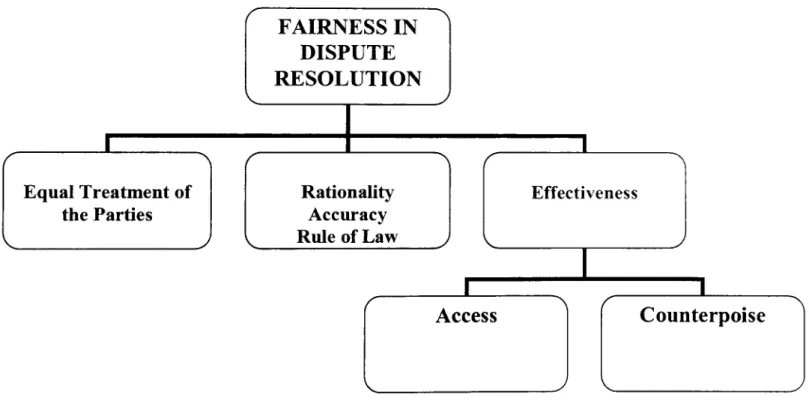
By way of overview, this section puts forward that procedural fairness in dispute resolution should consist of three main principles: equal treatment. a rational
approach to decision-making (adjudication34, such as litigation or arbitration) or to
negotiation (and mediation) and effectiveness, which in turn consists of general access and mechanisms to counter-balance existing procedural inequalities between the parties ('the counterpoise').
2.1 Equal treatment of the parties
The notion of equal treatment has been at the core of fair treatment. 35 A dispute
resolution process, which disadvantages one of the parties. which prevents only one of the parties from advancing any evidence or which involves a decision-maker biased towards one of the parties is self-evidently unfair.
33 The phrases 'due process' and 'natural justice' are used interchangeably with the same meaning. 'Due process' is more commonly used in the US and 'natural justice' more commonly in the English legal tradition. see HJ Friendly 'Some Kind of Hearing' (1975) 123 University of Pennsylmnia Lml' Ret'jell' 1267-1317.1276
34 The term 'adjudication' in this thesis is used as a neutral term to mean a form of dispute resolution invoh'ing a thi;d party making a decision binding on the parties, and is to include arbitration, ombudsmen and litigation rather than in the meaning of 'expert determination'.
The Oxford English Dictionary defines fair as 'treating people equaUy,36. John Rawls in his Theory of Justice posits the greatest possible equality as the first
founding principle of a just society.37 He argues that this would be the first and foremost principle the imaginary founders of a just society would agree upon.
While equal treatment is an obvious ingredient of fairness it is only part of the picture. In addition there must be a qualitative element to dispute resolution.
2.2 A rational approach to dispute resolution
The second element of procedural fairness in dispute resolution is taking a rational approach to solving a dispute.
For Lon Fuller the defining characteristic of adjudication, particularly compared to
other forms of social ordering such as voting, is participation by presenting proofs and reasoned argument and he therefore posits that the results from adjudication are subject to a high standard of rationality. 38
Dispute resolution consists of fact-finding processes, problem-solving and law application.39 These processes should be governed by logic and reason. so that no irrelevant considerations are taken into account. 40
Applying the law in a rational manner also means that like cases should be treated in a like manner. Logic in applying and interpreting the law should determine when two factual scenarios are the same and should be treated the same and when two
36 C Soanes and A Stevenson Concise Oxford English Dictionary (11 th Edition Oxford University Press
Oxford 2004) 37 ibid 53
38 L Fuller 'The Fonns and Limits of Adjudication' (1978-79) 92 Harl'ard Law Re\'ieH' 353-409.364.366. 370
39 As to the different types of dispute resolution and the processes they involve 4-3
Chapter 2: The Concepts of Fairness
factual scenarios are different and should be treated differently.41 Hence rationality implies a degree of regularity in law application.42 This is encapsulated by the principle of the rule of law. HLA Hart points to this close connection between due
process and proceeding by rule.43
Fact-finding processes should be in accordance with logic and accurate, for a
decision based on wrong facts is by definition unfair. Therefore a rational approach to dispute resolution additionally involves a degree of accuracy as to the factual basis of any decision.44
2.3 Effectiveness
A third element of procedural fairness in dispute resolution is the effectiveness of the procedure. Effectiveness means that a procedure leads to a decision or solution of a dispute. It consists of two elements: access and the counterpoise.
2.3.1 Access
If a dispute resolution procedure is so cumbersome, drawn out and expensive that a decision or solution is never reached or only after excessive cost and delay, this would mean that such a procedure is not fair.45 This is encapsulated in the saying 'justice delayed becomes justice denied'.
41 HLA Hart fn 30 159: 'Hence justice is traditionally thought of as maintaining or restoring a balance or
proportion, and its leading precept is often formulated as 'Treat like cases alike'; though we need to add to
the latter 'and treat different cases differently'.
4~
- See also L Fuller fn 38 380-381
4.~ HLA Hart The Concept of Lent' (2nd Edition Clarendon Press Oxford 1994) 160
44 The Oxford English Dictionary accords the expression 'fair and square' the meaning 'with absolute
a~curacy, honestly and straightforwardly'; fn 36 . , . .
4) EU Recommendation 98/257IEC Principle IV 'Effectiveness: see also the .1unsprudence of the ECtHR finding that excessive delay is a breach of the right to a fair trial under Art.6 (l) ECHK see cg Hentrich \' France A Series No. 296-A (1994) 18 E.H.R.R. 440
2.3.2 Counterpoise
While the principle of access looks at effectiveness of the procedure itself, the counterpoise takes into account obstacles to effective participation which are not inherent to the procedure, but arise from a party's inability to take part in the
procedure on an equal footing. Thus the counterpoise is concerned with pre-existing power imbalances between the parties and consists of measures to reduce them. Formal equal treatment of the parties by the judge/mediator/arbitrator and a rational approach to dispute resolution are necessary, but not sufficient, if the parties cannot participate in the dispute resolution process on an equal footing because of pre-existing procedural power imbalances. For example if one party only has no access to legal advice, no experience in litigation and no financial resources to fight a case, he or she would be less equipped to take part in a dispute resolution procedure than the other party.46
In particular, power imbalances are a problem for effectiveness since it is more likely that the dominant party imposes its terms on the weaker party.47 Furthermore, the dominant party is less likely to agree to binding dispute resolution in the first place, if the weaker party is the claimant. 48
Therefore, it must be recognised that there should be some counterpoise to pre-existing power imbalances for the purposes of dispute resolution to enable equal participation by both parties.49
46 3-5 (power in dispute resolution)
4~ 6-4.2.3 (a) (party autonomy) 48 8-2
49 M Cappelletti 'Alternative Dispute Resolution Processes within the Framework o:the World-Wide- . Access-to- Justice Movement 56 The Modern Law Revieow 282-296, 283: G PetrochIl~s Procedural L~H' 111
International Arbitration (Oxford University Press 2004) 128-1.29: L Nader' Altemat!v_es to ~he Am~~can J d · . 1St m' u ICla ys e . . . . -~-':;1 ')9 and L Nader & C Shugart 'Old SolutIOns for Old Problems )7-10_,04-0) In L
Chapter 2: The Concepts of Fairness
2.4 Conclusion
This section has introduced a concept of fairness in dispute resolution consisting of three main principles of equal treatment, rationality and effectiveness. Effectiveness is concerned with access and a counterpoise to existing procedural inequalities. as illustrated in Fig. 1. All three principles must be met to some minimum level to achieve fairness in dispute resolution.
In the next sections this conceptualisation will be deepened by synthesizing the traditional notion of due process and Rawls' Theory of Justice and Habermas' ideas about fair participation.
/ J
Equal Treatment of the Parties
Figure 1: Fairness Definition:
/ FAIRNESS IN DISPUTE RESOLUTION Rationality Accuracy Rule of Law I Access
Illustrating the main principles of fairness in dispute resolution
I
Effectiveness
I
3.
Process Values and Forms of Procedural Justice
I
Counterpoise
Having enumerated the principles which make up the concept of procedural
fairness, it may be worthwhile to pause for a moment and consider process values more generally. Process values are legal principles governing procedures (such as a
rule against torture, for example). Process values have been extensively discussed in literature under the question whether they are important values in their own right or whether they are only important to the extent that they lead to a good outcome (such as a fair decision or a fair settlement). In other words the question to be answered is whether process values are to be judged according to the results they produce or whether they have a value independent of any result they engender.
3.1 Process values
Some US scholars have argued50 that particular features of legal processes are 'process values' independent of whether or not these features contribute to better outcomes of legal processes. They argue that an infringement against such values would be wrong, even if the infringement leads to a 'good outcome' 51. The rationale
behind this argument is that its verity is reflected in the saying that the ends do not always justify the means. In other words adherents to the theory of process values argue that certain features of legal processes must not be changed, even if they have no apparent positive effect on the outcome.
It is submitted that this vague concept of 'process values' is not particularly helpful. 52 The notion of 'process values' in fact only describes the problem of
balancing conflicting results caused by different processes. While the ends may not always justify the means, the means can only be judged by the effects they cause (balancing the intended results and the unintended effects). 53
50 RS Summers 'Evaluating and Improving Legal Processes-A Plea for "Process Values" (1974) 60 Cornell
Law Revic1t' 1-52; MH Redish, LC Marshall 'Adjudicatory Independence and the Values of Procedural Due Process' (1986) 95 Yale La1t, Journal 455-505. 482-491; G Richardson, H Genn "Tribunals in Transition: Resolution or Adjudication"[2007] Public Law 116-141,120
51 The argument that infringement of process values is always wrong, is also unconvincing as it is never explained how to ascertain what amounts to a 'good' outcome.
5~ DJ Galligan Due Process and Fair Procedures (Clarendon Press Oxford 1996) 9; Even John Allison,
who supports the notion of 'process values' admits: 'These values are a bit more slippery than instrumental ones such as accuracy, efficacy and efficiency ( ... ) their amorphous nature also makes them less
susceptible to consensus.' 'A Process Value Analysis of Decision-Maker Bias: The Case of Economic Conflicts of Interest' (1995) 32 AII/crica/l Blisiness LG1t, Journal 481-540,499
D See Art.by Joci1C/l BittnCl" in Die Zeit ~ www.zeit.de2003'31 uneil 2S070Y!pa!.!c.' all [on 14, September 2007]
Chapter 2: The Concepts of Fairness
For example, if we imagine a (truthful) confession resulting from torture- it could (superficially) be argued that an unfair procedure (torture) has lead to a fair result (ascertainment of the truth) and that the apparently fair (intended) result does not make the unfair procedure fair. In fact, the torture has not only lead to a fair result, but also to unintended unfair results, in the sense that the torture left the tortured person psychologically and physically injured and upset the confidence in the legal system. Hence the positive and negative results of the procedure have to be
carefully balanced. A recent case in 2003 has renewed the discussion about whether torture could ever be justified and undermines the absolute nature of process values: a law student named Magnus Gafgen had kidnapped a boy from a banker's family for a ransom. When the police arrested and interviewed Gafgen they thought that the victim may still be alive and would have to be found very quickly to save his life. When Gafgen showed reluctance to admit the location of his victim the police threatened to cause him considerable pain. Gafgen revealed the location of the victim and it turned out that he had murdered the boy. These illegal police tactics caused a loud outcry in Germany and demands that torture should never be used regardless of the circumstances. However the discussion largely overlooked that torture here was not used to obtain a confession for conviction (which would have been inadmissible in court) but in order to save another person's life. Balancing the boy's right to life with the right to bodily integrity of the accused may lead to the conclusion that torture could be justified in some very rare and extreme cases (albeit that it is far from clear whether torture is ever an effective means).
Legal processes are never an end in themselves, but are designed to lead to particular results (such as, eg ascertaining the truth or the correct and fair
application of the law to the facts). The aim of a fair procedure is not the process itself, but the fact that it leads to a fair result and it is the result by which the
procedure is judged. 54 Where a process has been tainted with unfairness, eg a biased judge, the result will be unfair, since there is a risk that the outcome may have been affected (since it cannot be shown with certainty whether or not the outcome was in
fact affected) and since trust in the integrity of the legal system has been undennined.55
In other words, procedures have an instrumental or defining function they serve the purpose of making the process and its result fair. 56 This cannot be more clearly expressed than through Raw Is' concept of procedural justice, which will be discussed in the next section.
3.2 The Rawlsian concept of procedural justice
John Rawls has distinguished between four fonns of procedural justice. 57 For the
first two fonns (perfect procedural justice and imperfect procedural justice) it is clear what the fair outcome of the procedure would be and the purpose of the
procedure is to achieve or approximate this outcome. In other words for perfect and
imperfect procedural justice it can be objectively ascertained a priori what a fair
outcome is and the procedure is instrumental in achieving this.
In particular, for cases of perfect procedural justice the procedure, if properly
applied, realises the fair outcome. An illustration for this is the rule applied between two persons sharing a cake that one person cuts the cake into two pieces and the other chooses which piece he or she takes. In this case the fair outcome is equal treatment and this is achieved by the cake-cutter having an incentive to cut two pieces as equal as possible. In cases of imperfect procedural justice, the procedure
has only an approximating function. In other words, here the procedure merely
increases the chances of the fair outcome. Examples for this are fact-finding procedures in civil and criminal trials, where (part of) the fair outcome is finding the facts of what happened. However. these procedures are called imperfect, since the rules of evidence only imperfectly lead to the truth: 'the characteristic mark of
55 R,' Sussex Justices. c:rp McCarthy [1914] 1KB 256 (Divisional Court) and 6-3
5<> DJ Galligan fn 52 62 _
Chapter 2: The Concepts of Fairness
imperfect procedural justice is that while there is an independent criterion for the correct outcome, there is no feasible procedure which is sure to lead to it. ~ 58
By contrast, for the other two forms of procedural justice~ pure and quasi-pure procedural justice, rules are defining the outcome as being fair. Merely looking at
the outcomes of these procedures it is not discernible whether or not the outcomes are fair-there is no independent criterion to assess whether or not the result is fair. In other words it is the design of the procedural rules and their correct application which define the outcome as being fair. 59
Pure procedural justice defines an outcome as fair, for example a game of chance
allocating statistically equal chances of winning or losing to each participant. While it cannot be said that it is fair that this or the other participant wins, provided the rules have properly been applied, the outcome will be fair. Quasi-pure procedural
rules also define the outcome as fair, but the rules might be contentious, as it is not statistically verifiable whether or not they lead to a fair result. According to Rawls,
the function of quasi-pure procedural justice is to define the limits of discretion of a decision-maker for the selection of an outcome, which is merely one fair outcome of many possible other fair outcomes.60
Applying Rawl's conceptualisation to dispute resolution, dispute resolution involves
both fact-finding processes and processes requiring the exercise of discretion, such as contract bargaining (eg in mediation) and law applying (eg in adjudication, such
as arbitration), for the latter to the extent that the application of law involves a power of discretion, eg in the application and interpretation of the law.
The fact-finding part of the processes should be governed by rules of imperfect procedural justice to ensure that there is a great likelihood that the facts are found out correctly. However, contract bargaining and the exercise of discretion in
58 ibid 75
59 DJ Galligan fn 5~ 62
applying and interpreting law require procedural rules to define them as fair. as it is impossible to discern from the outcome itself whether or not a particular
interpretation of the law is fair or unfair. 61
Lisa Bingham in her examination of the fairness of arbitration awards in
employment arbitration emphasizes the difficulty of measuring the fairness in terms of distributive justice of the outcome and accuracy of fact-finding and law-applying in dispute resolution: 'accuracy, both positive in the sense of correct fact finding and normative in the sense of correct application of decision standards is
notoriously hard to measure in any dispute resolution process' .62 For this reason the
standard of fairness has to be measured by the procedure. Lon Fuller also argues that the procedure of participation by presenting proofs and reasoned arguments by both parties defines the fairness and integrity of adjudication.63
Imperfect procedural justice and quasi-pure procedural justice both deal with deficiencies in human knowledge- the procedure is instrumental to fill this gap in human knowledge. In other words we have no way to find the absolute factual accuracy nor have we any means of ascertaining what the right decision is in the sense of normative regularity, but only procedures, which we have good reason to believe, will lead to the right result. This deficiency of knowledge explains the importance of public confidence in legal procedures and notions such as 'justice must be seen to be done' .64
In conclusion, rather than defining absolute procedural values (such as process values), it is more helpful to regard dispute resolution processes as governed by two types of procedural rules: rules that are instrumental in establishing the truth
underlying factual disputes and also rules defining the boundaries of a fair exercise
61 John R Allison fn 52 493
6:! L Bingham 'On Repeat Players, Adhesive Contracts, And the Use of,Staystic~~in ~udicial Review of
Employment Arbitration Awards' (1998) 29 McGeorge Lm\' ReView 22_~-2)9, 2) /-2)9 6J L Fuller fn 38 364
Chapter 2: The Concepts of Fairness
of discretion in applying and interpreting the law. The next section explains how due process realises both these functions.
4.
Due Process
65John Rawls considers the principle of due process as critical for securing the
greatest equal liberty of citizens.66 He maintains that 'even in a well-ordered society the coercive powers of government are to some degree necessary for the stability of social co-operation'. 67 Hence it is critical that these coercive powers are exercised
in an impartial manner and in accordance with the rule of law. 68
The notion of due process (or natural justice) comprises the two fundamental principles that no-one should be a judge in his or her own cause, meaning that judges should be independent and impartial, and the principle of a fair hearing,
meaning that each party should have an equal opportunity to present evidence and
I aw. 69
The purpose of the principle of impartiality is to ensure that the judge treats the parties equally, maintains an open mind and does not take into account irrelevant considerations 70, hence contributing to equal treatment and the rationality of the
decision and thereby to the fairness of the decision. An impartial mind is also
required to ascertain the facts and is therefore a rule of imperfect procedural justice. But it is also a rule of quasi-pure procedural justice in that it means that the judge applies his or her discretion without pre-judgment or prejudice and therefore defines any resulting interpretation of the law as fair.
65 Elements of due process, see Chapter 6 66 J Rawls fn 57210-211
67 ibid 211
68 ibid 210; for the argument that arbitration is coercive and should therefore comport with notions of due process 6-2.5
h" SH Bailey, JPL Ching, MJ Gunn, DC Ormerod Smith. BailC1' and GUI111: 011 the Modern Legal SysTem
(41h ed Sweet & Maxwell London 2002) 1315.280- see also Chapter 6 70 I urther in 6-3
Similarly the purpose of the principle of a fair hearing7! is to ensure that each party participates in the process and has an opportunity to present their side of the case. thereby ensuring equality between the parties and rationality of the ensuing
decision, and hence, ultimately, fairness. Furthermore a fair hearing is instrumental to finding the facts underlying the case and can therefore be described as a rule of imperfect procedural justice. But to the extent that the parties present legal
arguments the principle of fair hearing also leads to a balanced application of discretion and it is therefore also a rule of quasi-pure procedural justice.
The principle of due process has become so settled by now that it is easy to forget the underlying justification. 72 In essence, the procedural principles encapsulated in
the notion of due process ensure equal treatment and rationality and thus contribute to fairness.
While due process is concerned about equal treatment it ignores pre-existing
inequalities between the parties. It gives each party a formally equal opportunity to participate, but ignores any difference in the parties' actual ability to participate.
5.
The Difference Principle: Counterbalancing Existing
Inequalities
John Rawls in his contract theory establishes two main principles for ensuring fairness in a well-ordered society.73 As has been mentioned, the first principle is that of the greatest possible equal liberty, conferring equal basic rights and duties on all individuals. The second principle has two limbs, ie that there should be fair
equality of opportunity and that the interests of the most disadvantaged groups of society should be advanced to close the gap between the most disadvantaged and the most advantaged:
71
. See 6-4
-~ DJ Galligan fn 52 64.349 n ibid 53
Chapter 2: The Concepts of Fairness
'social and economic inequalities, for example inequalities of wealth and authority, are just only if they result in compensating benefits for everyone, and in particular for the least advantaged members of society.' 74
John Rawls argues that these two principles would be chosen as the governing
principles of justice by the imaginary founders of society (he calls this the original position), if they were not acting in their own interest. This absence of self-interest could be guaranteed by the founders wearing what he calls the 'veil of ignorance', ie they would not know their position in society, which groups or class
they would belong to. John Rawls uses this fiction of the 'veil of ignorance' (which
is in itself an example of quasi-procedural justice) to convince us that the resulting
. . I .c:' 75
pnnclp es are lair.
Although equality is stipulated as a principle, it is also significant, that Rawls
acknowledges that equality cannot be achieved by mere equal treatment. Rawls'
second principle demonstrates that it is necessary to counter-balance the inequalities existing in real societies. Hence in a Rawlsian sense, fairness is more than mere
equal treatment. This argument that fairness transcends mere equality is a very important contribution to the conceptualisation of fairness.
Likewise, for Jurgen Habermas the defining (quasi-procedural) determinant of
fairness is equal participation in legal discourses. This equal participation is more than the formal equality we have found in the notion of due process. In Habermas' view it is critical that the parties can participate on an equal footing in legal
processes.76
-.) ibid 13 75 ibid 118-122
Habermas effectively, like Rawls, argues that power imbalances must be levelled out through procedural fairness77 and he expressly refers to Rawl 's quasi-procedural justice.78 However Habermas assumes that this is less important for adjudication for
the reason that judicial proceedings have institutionalised fair participation of both parties.79 Habermas distinguishes between negotiations which require procedures to ensure that all interests are represented, that power imbalances are levelled out and that coercive powers do not prejudice the outcome80 and judicial proceedings, which have already institutionalised legal discourses inbuilt81. Judicial proceedings define and limit the space in which the argumentation takes place: participation, roles, issues and the processes forming opinions and decisions are regulated. These procedural regulations are necessary to endue judicial proceedings with quasi-procedural justice. 82 Habermas like Rawls argues that equal participation of the
parties has to be guaranteed through procedural rules.
For dispute resolution, Rawls' and Habermas' theories mean that due process (as defined above: equal treatment and rationality) in itself is not sufficient. It is not sufficient to merely ensure that the parties are treated equally and that decisions are rational, accurate and according to the rule of law. In addition, in cases in which a significant power imbalance exists between the parties, fairness means that
measures must be taken to redress this power imbalance to ensure equal participation by the parties. Therefore, the principle of due process in dispute resolution is only a sine qua non condition, but not sufficient to guarantee fairness of procedures. Additional steps must be taken to redress power imbalances. This requirement of a counterpoise to existing power imbalances is an important aspect of fairness which is neglected if one merely focuses on due process.
77 ibid 205 78 ibid 220 79 L Fuller fn 38 366-367 80 J Haberrnas fn 76 218 81 ibid 219 H~ 1 1 __ 'b'd ')'"10
Chapter 2: The Concepts of Fairness
Various methods can be used to redress such power imbalances, the most important of which are legal aid or other mechanisms which give the disadvantaged party greater access to redress (such as small claims procedures in consumer cases). Many of these mechanisms will be of a distributive nature (such as legal aid). A detailed discussion of these distributive mechanisms is outside the scope of this thesis, which merely focuses on procedural rules in extra-judicial dispute resolution.
Furthermore, this thesis only considers power imbalances in dispute resolution. It
does not examine the existence of power imbalances generally and whether and how the substantive law should address or redress such power imbalances. In other words this thesis does not discuss whether there should be new substantive laws to redress power imbalances not recognised at present or whether the scope of
coverage of some protective laws, such as consumer protection should be expanded.83 This would be a topic for another examination. 84
Chapter Three discusses power imbalances in the context of internet disputes. It
considers the factors giving power in dispute resolution and puts forward general criteria for legally determining the presence of a power imbalance between
disputants. However, it would be costly and cumbersome to carry out such an
assessment on a case-by-case basis for each dispute ex post. The approach has to be
a general, ex ante approach which establishes an irrebuttable presumption that a
power imbalance is present, if the parties have a certain status. This is the approach taken in consumer protection law. This will be further discussed in Chapter Three. 85
The following figure illustrates how the three elements of fairness discussed in the first section relate to due process and Habermas' and Rawls' theories:
8~ Briefly discussed in 3-6 for finding a definition for r~levan~ intem~t disputes. . _ X-I Substantive issues are excluded from the scope of thIS theSIS. applIcable law IS mcluded 4-4.)
85 .., 6
.'-1. Due Process
I' FAIRNESS IN
DISPUTE RESOLUTION
1. Due Process
Figure 2: Due process and the Difference Principle
I 2. Access 1 "\ 3. Counterpoise Difference principle (Rawls) Fair participation (Habermas)
The next question is how the three elements of fairness relate to each other. The more all three elements of fairness could be augmented at the same time, the fairer the ensuing procedure would be. Regrettably, this may not be possible as the next section will explain.
6.
The Inherent Conflict Between Due Process and
Effectiveness
It is posited here that an inherent conflict exists between due process and
effectiveness (access and the counterpoise). Due process requirements make legal procedures more elaborate and more strategic involving the expenditure of precious resources and time and are therefore apt to render legal processes lengthy and
costly. They are thus likely to reduce the effectiveness of dispute resolution. Increased costs and delay, however makes procedures not only less effective and
Chapter 2: The Concepts of Fairness
less accessible, but may also reinforce existing power imbalances86. Increased costs and delay put the stronger party at an advantage and the weaker party at a
disadvantage. Therefore, a high degree of due process in legal procedure
necessitates even greater efforts at providing access and a counterpoise to existing inequalities. If such efforts are not made, a higher degree of due process may well be counter-productive for fairness. Since there is a limit to the extent to which it is possible to use resources to increase access and to counter-balance existing
inequalities, there is logically also a limit to due process.
This conflict is reflected in Axel Tschentscher's criticism of Habermas' discourse
theory and Rawl 's contract theory. He argues that they are unrealistic in practice.
Factually existing inequalities in society make equal and non-coercive participation in legal processes impossible.87
Judge Friendly has also eloquently described this conflict between fairness and
cost-effectiveness:
'It should be realized that procedural requirements entail the expenditure of limited resources, that at some point the benefit to individuals from an additional safeguard is substantially outweighed by the cost of providing such protection, and that the expense of protecting those likely to be found undeserving will probably come out of the pockets of the deserving. ,88
This conflict is also the underlying cause for the difficulty of balancing funding and fairness of dispute resolution procedures. If the procedure is expensive, access is restricted (in particular for a party with little resources, such as a consumer) or the cost might be disproportionate to the value of the claim. If the procedure is initiated, set-up, designed, financed and subscribed to by one stakeholder only (such as a business association in B2C disputes) it is likely that the procedure may not be
86 ~-5 for power in dispute resolution
87 A Tschentscher fn 32 114-115
neutral and contrary to due process requirements. In the reverse, a procedure with limited due process which is fast and cheap is likely to be 'rough justice' and infringing on due process principles.
William Park tells the anecdote of a shoe shop in Boston which displayed a notice
in a window listing the following characteristics of its service 'fast service' and 'low price' and 'high quality' with the caption 'pick any two'. 89 The same applies to
dispute resolution.9o Hence the challenge is to find the "right' balance between due process and effectiveness.
However in the reverse it is also true to say that if effectiveness can be increased (for example through state funding91 or through technology92) more due process can
be afforded. Hence it can be argued that measures should be taken to increase both due process and effectiveness and this will be discussed in the final Chapter Eight. 93
7.
Conclusion
This brief Chapter has advanced the proposition that fairness consists of three fundamental principles of due process and access and a counterpoise to reduce pre-existing inequalities. Traditionally, the notion of due process has insured that the parties are treated equally and that dispute resolution is a rational, accurate and regular process. However in the 20th century there has been more emphasis on power imbalances and the need to equalise pre-existing equalities, as for example espoused in Rawls' difference principle. If one accepts that fairness requires due process, access and a counterpoise to pre-existing inequalities a conflict results. If due process is increased, access is likely to be reduced and a greater counterpoise is required. The Chapter has shown that there is an inherent conflict between due process, which tends to lnake dispute resolution less accessible and effectiveness. 89 W Park fn 40 50
90 See also VI' Park fn 40 48-50
9] 8-5 on the need for a subsidy from general taxation
92 5-5 on ODR & access to justice
Chapter 2: The Concepts of Fairness
which requires that access to dispute resolution is increased. Therefore the
challenge of any fair dispute resolution system is to find the 'right' balance between these principles. There is a wide range of methods which might be used to increase
access and to reduce pre-existing inequalities; this thesis will look at one particular method: Chapter Five discusses the potential of Online Dispute Resolution (ODR) to increase access to justice and its ability to act as a counterpoise against existing procedural power imbalances. This thesis will also show in Chapters Seven and Eight that concerns exist as to whether ODR complies with due process
requirements. However before these aspects of fairness are debated and weighed up it will be expedient to demonstrate why ADR and ODR is needed for internet
Chapter 3: Internet Disputes
rf
there is a technological advance without a social advance, there is, almostautomatically, an increase in human misery.
(Michael Harrington (1928-1989))
1.
Introduction
The purpose of this Chapter is to circumscribe the types of disputes this thesis is concerned with. It starts by conceptual ising the characteristics underlying the internet and why this makes the resolution of internet disputes difficult. The Chapter discusses the nature of the internet as a powerful multi-media
communications channel, which has enabled individuals and consumers to take part in international interactions, cross-border e-commerce and international publishing on an unprecedented scale. By way of illustration, this Chapter sketches some typical international disputes, which arise (or hypothetically may ar