TWOPAPERS ON PUERTORICO’S DEBT CRISIS
Ryan Michael Leary
A dissertation submitted to the faculty at the University of North Carolina at Chapel Hill in par-tial fulfillment of the requirements for the degree of Doctor of Philosophy in the Department of
Economics.
Chapel Hill 2018
Approved by: Anusha Chari
Peter Hansen
Neville Francis
Toan Phan
c
2018
ABSTRACT
Ryan Michael Leary: Two Papers on Puerto Rico’s Debt Crisis (Under the direction of Anusha Chari)
My dissertation utilizes the natural experiment of Puerto Rico’s debt crisis in order to investigate the eco-nomic effects of (sub)sovereign default risk and the pricing of security contract provisions.
The first chapter uses the interesting case of Puerto Rico to address the questions: do investors price contract provisions and the related law? Does the pricing of contract provisions vary with credit risk? Puerto Rico provides an interesting case allowing the study of three different types of contract provisions in the presence of high and increasing credit risk; a strong legal system; and rich data to select well matched control groups. I find that investors indeed price contract provisions specifying governing law, securing debt with specific revenues, and including collective action clauses. I also find that investors especially price these contract provisions when credit risk is highest.
ACKNOWLEDGMENTS
I would like to thank my advisor, Anusha Chari, for guiding and supporting me over the years at the
Univer-sity of North Carolina at Chapel Hill. You have set an example of excellence as a researcher, mentor, instructor,
and role model for me. I am forever indebted to all the guidance you have given me and I hope I can one day
approach your level of skill as an economist.
I would like to thank my thesis committee members, Toan Phan, Simon Alder, Neville Francis, and Peter
Hansen, for all their valuable guidance through this process. The discussion, interchange of ideas, and
feed-back have been absolutely invaluable.
I am also grateful for all the comments from participants at the UNC Macroeconomics Workshop and The
TABLE OF CONTENTS
1 Introduction . . . 1
2 The Pricing of Contract Provisions and Law: The Case of Puerto Rico . . . 4
2.1 Introduction . . . 4
2.2 Background on Puerto Rican Debt . . . 9
2.3 The Pricing of New York Law Debt . . . 10
2.3.1 Data and Summary Statistics . . . 11
2.3.2 Methodology and Results . . . 12
2.4 The Pricing of GO and COFINA Debt . . . 15
2.4.1 Data and Summary Statistics . . . 16
2.4.2 Methodology and Results . . . 17
2.5 The Pricing of PROMESA . . . 20
2.5.1 Data and Summary Statistics . . . 20
2.5.2 Methodology and Results . . . 21
2.6 Robustness Checks . . . 23
2.7 Conclusion . . . 24
3 The Costs of (sub)Sovereign Default Risk: Evidence from Puerto Rico . . . 26
3.1 Introduction . . . 26
3.2 Background: The Puerto Rican Debt Crisis . . . 29
3.3 Data . . . 31
3.3.1 Macro Data . . . 31
3.3.3 Financial Market Data . . . 34
3.4 Diverging Growth Rates between Puerto Rico and the U.S. Mainland . . . 35
3.5 The Real Effects of Sovereign Default Risk . . . 37
3.5.1 The Credit Channel . . . 38
3.5.2 The Government Spending Channel . . . 43
3.5.3 The Effects of Default Risk on Private and Public Borrowing Costs . . . 47
3.6 Robustness . . . 51
3.7 Conclusion . . . 54
A Appendix for Chapter 2: The Pricing of Contract Provisions and Law: The Case of Puerto Rico 56 A.1 Tables and Figures . . . 56
A.2 Variable Descriptions . . . 64
A.3 Data Appendix for Section 2.3 . . . 64
A.4 Data Appendix: Section 2.4 . . . 66
A.5 Marginal Effects . . . 69
A.6 Liquidity Discussion . . . 71
B Appendix for Chapter 3: The Costs of (sub)Sovereign Default Risk: Evidence from Puerto Rico 72 B.1 Tables and Figures . . . 72
B.2 Data Construction . . . 81
B.2.1 Construction of Industry Level Dependence on External Finance . . . 81
B.2.2 Tax Adjustment . . . 82
B.2.3 External Finance Channel: Dis-aggregated Lags . . . 84
B.2.4 Government Demand Channel: Dis-aggregated Lags . . . 85
B.2.5 Legal Event Classification . . . 86
B.2.6 Mixed Event Classification . . . 88
CHAPTER 1 INTRODUCTION
The global financial crisis and the subsequent debt crises highlight the heightened levels of sovereign default risk across the developed world. A large literature in international economics investigates the costs of sovereign default and default risk.1 Puerto Rico’s financial crisis, involving a debt burden of about $72 billion, marks the largest municipal restructuring in U.S. history, far surpassing Detroit’s $18 billion bankruptcy.2 The study of Puerto Rico’s interesting crisis allows contributions to two key questions in the sovereign debt literature. First, do investors price contract provisions and the related law? Second, does sovereign default risk have real effects on the economy?
My dissertation uses Puerto Rico’s crisis as a case study to add evidence to the debate surrounding both of these questions with two papers. By focusing exclusively on Puerto Rico’s crisis, the two chapters in my dissertation provide an in depth understanding of the nuances of Puerto Rico’s crisis and in so doing, help address wider questions about sovereign debt crises using Puerto Rico’s unique attributes. My first paper (Chapter 2) investigates the pricing of key contract provisions for Puerto Rican debt. In doing so, the paper contributes to wide ranging research that asks the questions: do investors price contract provisions and the related law? Does the pricing of contract provisions vary with credit or default risk? To my knowledge, this is the first paper to address these questions for the case of Puerto Rico or any municipal issuer.
Puerto Rico’s unique status as a U.S. territory implies that its subsidiaries, such as municipalities, cannot file for bankruptcy under Chapter 9 of the U.S. Bankruptcy Code. Further, while local Puerto Rican laws govern Puerto Rico’s bonds, U.S. courts ultimately determined that Puerto Rico cannot change its laws to reduce its debt as the Contracts Clause provides U.S. constitutional protection on government interference with private contracts (Commonwealth of Puerto Rico v. Franklin California Tax-Free Trust et al., October 2015). Puerto Rico is also an interesting case study because it offers multiple sources of variation in the inclusion of contract provisions across different types of debt.
1
For example, Borensztein and Panizza (2009), Yeyati and Panizza (2011), Cruces and Trebesch (2013), H´ebert and Schreger (2016). The related literature provides a more comprehensive list.
First, Puerto Rico issued debt under New York law in 2014, with the typical and express aim of assuaging investor concerns about the bias of domestic courts.3,4 Second, Puerto Rico issued debt under a related entity, the Puerto Rico Sales Tax Financing Corporation which promises no recourse to the full faith and credit of Puerto Rico, but rather promises by law a first lien on a sales and use tax to secure the debt. Finally, the U.S. federal government passed the Puerto Rico Oversight, Management, and Economic Stability Act (referred to as ”PROMESA” hereafter) which retroactively enacted collective action clauses (referred to as ”CACs” hereafter) for Puerto Rican debt.
To conduct my investigation, I use a dataset retrieved from Bloomberg containing daily bond yields and characteristics for over 4,000 Puerto Rican bonds spanning a decade. The results suggest that investors indeed price contract provisions and law, especially when credit risk is highest. The findings are consistent with the hypothesis that investors price contract provisions and that investors value them more when a restructuring becomes more likely.
First, I find that New York law debt trades at higher yields than Puerto Rican law debt. This result differs from the findings in the existing literature that shows a foreign-law premium (Chamon et al. (2015); Clare and Schmidlin (2014)). I also find that the differential in the pricing of New York law and Puerto Rican law debt increases as Puerto Rico’s credit risk increases. Second, I find that general obligation debt (referred to as ”GO” hereafter) trades at higher yields than COFINA debt. This result is consistent with the finding in the existing literature that secured debt trades at lower yields across corporate issuers (Bradley and Roberts (2015)). I also find that investors pricing differential for the alternative legal protections of each type of debt increases when credit risk is at its highest. Finally, I find that news of PROMESA significantly affects GO bond yields. Specifically, the passage of PROMESA by the U.S. Senate and the signing of PROMESA by President Obama were associated with an increase in bond yields. This result differs from the finding in the existing literature that CACs reduce yields across securities (e.g. Carletti et al. (2017); Bardozzetti and Dottori (2014)). The finding that investors priced news of PROMESA when Puerto Rico was closest to default again supports the hypothesis that legal protections are most valued when credit risk is highest.
In joint work with Anusha Chari and Toan Phan, my second paper (Chapter 3) examines the real effects of anticipation of Puerto Rico’s default. First, using activity for the mainland U.S. as a control, we investigate whether the deterioration in Puerto Rico’s credit rating and credit spreads that occurred after 2012 led to a
3
https://www.publicfinancematters.com/2014/02/could-bondholders-bring-claims-against-puerto-rico-bond-issuers-in-courts-outside-puerto-rico/#more-989
4
significant divergence in Puerto Rico’s real economic activity from the rest of the U.S.. Second, we use an approach similar to Rajan and Zingales (1998) to establish that increased default risk reduces employment in industries that are ex ante more exposed or sensitive to a default event due to greater dependence on external finance. We use this methodology to address the concern that declines in economic activity may drive increased default probability and thus confound identification of the effect of default probability on employment. Similarly, we investigate whether increased default risk reduces employment in industries more exposed to government demand. Third, we use an event study framework to investigate whether changes in Puerto Rico’s credit risk affected yields on government debt or the stock returns of public Puerto Rican firms. We identify changes in Puerto Rico’s credit risk using ratings actions on Puerto Rican debt and legal events related to the legal rights of Puerto Rican government entities to restructure their debt. Standard event-study assumptions allow us to causally identify the effect of changes in sovereign risk on the cost of capital.
The main findings are as follows. First, while the U.S. private employment, economic activity, and invest-ment spending improved significantly post-2012, Puerto Rico’s did not. Specifically, difference-in-difference estimates suggest that average quarterly private employment growth, economic activity growth, and investment spending growth were significantly lower for Puerto Rico compared to the U.S. mainland post-2012 relative to the pre-2012 period. This divergence coincides with the increased credit spreads on Puerto Rican debt and the declining credit ratings that preceded Puerto Rico’s default. These results establish that increased (sub)sovereign risk coincided with a negative and significant aggregate divergence of Puerto Rico’s economy from the rest of the U.S. mainland.
Second, increased default probabilities are associated with lower employment growth in industries that are relatively more exposed to Puerto Rican government demand and more dependent on external finance. These findings are both statistically and economically significant. Further, the magnitude of the negative effect of de-fault risk on employment growth in government-demand-dependent industries increases when the government undertakes austerity measures. One potential rationale for these results is that agents learn about future gov-ernment policy when they observe how austerity measures respond to increased default risk. We also find that increased default risk Granger causes austerity, indicating the government may undertake austerity in response to borrowing constraints or to reassure investors.
CHAPTER 2
THE PRICING OF CONTRACT PROVISIONS AND LAW: THE CASE OF PUERTO RICO
2.1 Introduction
Puerto Rico’s financial crisis, involving a debt burden of about $72 billion, marks the largest municipal restructuring in U.S. history, far surpassing Detroit’s $18 billion bankruptcy.1 This research joins a growing body of literature studying Puerto Rico’s crisis.2 Specifically, this paper conducts a case study investigating the pricing of key contract provisions of Puerto Rican debt. In doing so, this paper contributes to wide ranging research which asks the questions: do investors price contract provisions and the related law? Does the pricing of contract provisions vary with credit risk? To my knowledge, this paper is the first to address these questions for the case of Puerto Rico or any municipal issuer. Puerto Rico is an interesting case study to contribute to this literature because it offers multiple sources of variation in the inclusion of contract provisions.
The case of Puerto Rico’s debt crisis and default in 2016 is the latest in a long line of sovereign default crises which have raised questions about the pricing of contract provisions and their potential modification by sovereigns after issuance (known as legal risk).3 Indeed, sovereign debt is unique in that the issuer’s legislature and court system has the authority to impose restructuring terms on holders of domestic law debt (Zettlemeyer et al. (2013); Chamon et al. (2015)).
To address legal risk with the aim of reducing borrowing costs, sovereigns have turned to issuing debt under foreign legal systems, typically in New York or London, where domestic legislative fiat and domestic courts can not affect contract provisions (Carletti et al. (2017)). Sovereigns have also sought to include contract provisions aimed at streamlining the restructuring process. In particular, collective action clauses (referred to as “CACs” throughout), which allow a majority of creditors to impose restructuring terms on holdout creditors, have been commonly included in sovereign debt since the mid 1990s (Panizza et al. (2009); Aguiar and Amador (2014)). U.S. municipal and corporate issuers have also sought to secure debt by including provisions pledging specific
1
See Park and Samples (2017) for a detailed accounting of Puerto Rico’s debt burden.
2
See Feliciano and Green (2017); Chari et al. (2017); Gulati and Rasmussen (2017); Park and Samples (2017).
3
assets or revenue streams.
Puerto Rico’s interesting status as a sub-sovereign of the United States created an environment where investor concern about legal risk resulted in some of the same contract provisions seen in the sovereign and municipal debt markets. First, Puerto Rico issued debt under New York law in 2014, with the typical and express aim of assuaging investor concerns about the bias of domestic courts.4,5 However, Puerto Rico’s New York law debt is interesting in that it may violate the law by exceeding Puerto Rico’s legally mandated debt service limits, potentially rendering the debt unenforceable and void (Showalter (2017)). I ask the question, how did investors price the Puerto Rican debt issued under New York law versus Puerto Rican law? To answer this question, I match Puerto Rican law debt to New York law debt along observable security issue characteristics and estimate the average yield differential in the otherwise equivalent debt using a panel regression. I also investigate whether this differential varied with Puerto Rico’s credit risk.
Second, Puerto Rico attempted to provide two types of legal protections that to my knowledge, are unique among sovereign issuers and offer protection from the legal risk inherent in domestic law debt. First, Puerto Rico issued general obligation debt (referred to as “GO” hereafter) which is backed by the full faith and credit of Puerto Rico and was further guaranteed to be paid before any other obligation under Puerto Rico’s Constitution. Second, Puerto Rico issued debt under a related entity, the Puerto Rico Sales Tax Financing Corporation (referred to as “COFINA” hereafter) which promises no recourse to the full faith and credit of Puerto Rico, but rather promises by law a first lien on a sales and use tax. The pledged revenues were unavailable for the payment of any other obligation, including GO debt. I ask the question, did investors value the Constitutional protections of GO debt and the securing revenues offered by COFINA debt differently? To answer this question, I match Puerto Rican law GO debt to Puerto Rican law COFINA debt along observable security issue characteristics and estimate the average yield differential in the otherwise equivalent debt using a panel regression. I also investigate whether this differential varied with Puerto Rico’s credit risk.
Finally, the U.S. federal government passed the Puerto Rico Oversight, Management, and Economic Stability Act (referred to as “PROMESA” hereafter) which retroactively imposed CACs on Puerto Rican debt. However, PROMESA differs from other cases of CACs because the decision was imposed by an outside government after issuance and also included an option for a court supervised restructuring process which like CACs, also allows the binding of holdout creditors (Gulati and Rasmussen (2017)). Much like CACs, PROMESA may create an
4
https://www.publicfinancematters.com/2014/02/could-bondholders-bring-claims-against-puerto-rico-bond-issuers-in-courts-outside-puerto-rico/#more-989
5
incentive for Puerto Rico to default by making default easier, reducing individual bondholder rights versus the prior unanimous consent clauses. On the other hand, PROMESA reduces negotiation inefficiencies given default and improves the prospects for an orderly recovery by bondholders.6 I ask the question, how did investors price the change in the restructuring process created by PROMESA? I answer this question by using an event study to measure the effect of news events indicating the law was moving closer to being enacted. I also assess whether the pricing of PROMESA varied with Puerto Rico’s credit risk.
Main Findings: In all three cases, I find that investors indeed price contract provisions and law, especially when credit risk is highest. The results are consistent with the hypothesis that investors price contract provisions and that investors value them more when a restructuring becomes more likely. First, I find that New York law debt trades at higher yields than Puerto Rican law debt. These findings are both statistically and economically significant. This result differs from the findings in existing literature which show a foreign law premium (Cha-mon et al. (2015); Clare and Schmidlin (2014)). One possible explanation is that investors priced the risk that they would not be entitled to recovery in the case of Puerto Rico’s New York law debt due to its potential viola-tion of Puerto Rico’s legal debt limits. I also find that the differential in the pricing of New York law and Puerto Rican law debt increases as Puerto Rico’s credit risk increases.
Second, I find that GO debt trades at higher yields than COFINA debt. These findings are both statistically and economically significant. This result is consistent with the finding in the existing literature that secured debt trades at lower yields across corporate issuers (Bradley and Roberts (2015)). I also find that investors price the different legal protections of each type of debt most when credit risk is highest.
Finally, I find that news of PROMESA did significantly affect GO bond yields. Specifically, the passage of PROMESA by the Senate and the signing of PROMESA by the President were associated with an economically and statistically significant increase in bond yields. This result differs from the finding in the most recent literature that CACs reduce yields across securities (e.g. Carletti et al. (2017); Bardozzetti and Dottori (2014)). It is possible that in the case of Puerto Rican debt, individual creditors valued the right to holdout more than the streamlining of the recovery process affected by the introduction of CACs. This may result from the strength of the U.S. legal system and protections of creditor rights.7 The finding that investors only priced news of PROMESA when Puerto Rico was closest to default again supports the theory that legal protections are most valued when credit risk is highest.
6
See Ghosal and Thampanishvong (2013) for a discussion of this trade-off for CACs.
7
Related Literature: This paper joins a growing number of recent papers studying Puerto Rico’s debt and economic crisis. To the best of my knowledge, this paper is the first to estimate the pricing of contract provisions in the case of Puerto Rico or any other municipal issuer. Feliciano and Green (2017) show the significant negative effect that the repeal of Section 936 tax exemptions had on Puerto Rican manufacturing wages and the number of manufacturing establishments. Chari et al. (2017) find that increased default risk is associated with reduced economic activity in the aggregate and especially in sensitive industries. Gulati and Rasmussen (2017) discuss the legal debate about Puerto Rico’s rights to restructure and Park and Samples (2017) discuss the types of Puerto Rican debt and the related legal issues.
This paper contributes to a broad debate about whether contract provisions matter. Bolton and Jeanne (2009) argue that debt that is harder to restructure is effectively senior and should trade at lower yields. On the other hand, Roubini (2000) and Weinschelbaum and Wynne (2005) argue that protections like CACs and governing law likely don’t matter because investors think they have implicit guarantees of bailouts and because sovereigns can render contract protections null ex-post. This paper’s investigation of the value of governing law, securing revenues, and CACs all add evidence to the debate in this literature.
More narrowly, this paper adds to the literature studying the borrowing costs of domestic law versus foreign law sovereign debt. Studying Eurozone debt, existing work finds that foreign law debt trades at significantly lower yields than domestic law debt, especially when default risk is elevated (Chamon et al. (2015); Clare and Schmidlin (2014); Choi et al. (2011)). Existing work uses Eurozone debt to address the confounding factor of a currency risk premium. The case of Puerto Rico’s issuance of New York law debt provides another case of comparable domestic and foreign law debt issued under the same currency as well as the interesting possibility that the debt will be found to be illegal. In addition, Puerto Rico’s crisis allows me to investigate the effect of governing law in a high credit risk environment when legal protections should matter most.
This paper also contributes to the literature studying the price impact of securing debt. Smith and Warner (1979) argue that secured debt may, in theory, optimally comprise any portion of total debt, depending on the relative costs of the lien imposed on the borrower versus the benefits of improved enforcement and preventing subordination. Bradley and Roberts (2015) find that including debt covenants, including securing debt, reduces yields across borrowers and is especially issued by smaller, high risk borrowers. The investigation of COFINA versus GO debt in this paper exploits the debt of the same issuer facing the same economic risks where prior studies of secured debt focus primarily on cross-issuer variation.
CACs may increase the incentive to default while also increasing recovery rates. Earlier empirical findings about the effect of CACs on prices is mixed and the existing research has vigorously debated the appropriate sampling and methodology (Tsatsaronis (1999); Eichengreen and Mody (2000); Eichengreen and Mody (2004); Becker et al. (2003); Gugiatti and Richards (2003)). These results were subjected to criticisms in later work. Specifically, proxies for the presence of CACs and selection of governing law for a security raised endogeneity concerns (Gugiatti and Richards (2004)). More recently, panel data models identify CACs directly and find that CACs reduce yields and that the effect varies with credit risk, though the results on how credit risk matters differ across studies (Bardozzetti and Dottori (2014); Carletti et al. (2017)). As with the most recent work on foreign law, the data on domestic law bonds with CACs issued in the Eurozone allows the comparison of debt that is issued under the same domestic law and in the same currency. In addition, the issuance of debt with CACs was imposed on the whole Eurozone and is thus exogenous to the issuers (Carletti et al. (2017)).
Puerto Rico provides an additional natural experiment to assess the effect of CACs on borrowing costs. As with the latest existing work on CACs, Puerto Rico allows an investigation of the effect of CACs on debt issued under the same legal system and in the same currency. In contrast to the Eurozone experiment, PROMESA provides exogenous and discrete variation in the presence of CACs within-security, rather than across securi-ties. PROMESA is exogenous because it was imposed by the U.S. federal government, rather than the local government.
Robustness checks and plan of the paper: I conduct several robustness checks to confirm my benchmark results. I find that my results are robust to alternative definitions of which securities price frequently enough to be included in the selected samples. I restrict the benchmark samples to exclude the period following the issuance of the selected securities and preceding Puerto Rico’s default and find my results are robust. I control for outliers in observed yields by using the log of the mid yield rather than the raw mid yield and find the results remain robust. I also confirm my results are robust to an alternative measure of credit risk. To ensure my results are not dependent on the size of the event window in the event study, I expand the benchmark event window and find that the benchmark results remain robust. I also find that my event study results are robust to controlling for time trends and event window overlap.
2.2 Background on Puerto Rican Debt
GO Debt and New York Law: On March 11, 2014 Puerto Rico adopted a bond resolution authorizing the issuance of $3.5 billion in additional GO bonds, maturing on July 1, 2035. This was Puerto Rico’s final issuance of GO debt and amounted to 22% of total GO debt and less than 5% of Puerto Rico’s total public debt. These bonds carried the same legal guarantee as the outstanding GO debt of the Commonwealth. This guarantee is made in Puerto Rico’s constitution and stipulates that GO bonds are backed by Puerto Rico’s full faith, credit and taxing power and, importantly, that GO debt has the first claim on revenues over all of Puerto Rico’s obligations, including operating expenses like public services and the pensions of public employees (Park and Samples (2017)). Of course, much like domestic law CACs (Carletti et al. (2017)), Puerto Rico could overturn existing Puerto Rican law protecting any of its debt with new legislation, but the imposition of this hurdle may nevertheless provide value to investors, depending on the degree of “partial commitment” investors perceive in each type of debt (Aguiar and Amador (2014)).
The major difference between this GO debt issue and the GO debt issued prior to 2014 was the agreement that the laws of the State of New York apply to any case related to these bonds. The lawsuits may be brought in New York state courts, Puerto Rican courts, or U.S. federal courts in New York or Puerto Rico.8 The issuance of this debt occurred in an environment where Puerto Rico had recently been downgraded to a credit rating of BB+ by Standard & Poors, just one notch above junk status. The decision was made to issue the debt with New York governing law in order to provide investors with a forum for resolving disputes which was seen as less partial to Puerto Rican issuers than Puerto Rican courts.9
COFINA Debt: In 2007, Puerto Rico established COFINA in order to finance Puerto Rico’s debt payable to the Puerto Rican Government Development Bank. COFINA debt is secured by the first lien on half of a 5.5% sales and use tax to be deposited in a fund solely for the payment of COFINA debt. This guarantee is made in Puerto Rican law but not in Puerto Rico’s constitution as with GO debt. There is no recourse to the Commonwealth of Puerto Rico beyond the dedicated sales tax. From July 2007 to December 2011 COFINA issued about $38 billion in debt. However, only $16 billion is senior COFINA debt. This amounts to about the same total value as Puerto Rico’s total GO debt issues (Park and Samples (2017)).
PROMESA: On June 30, 2016, President Obama signed PROMESA. The law’s first version had passed the U.S. senate on November 19, 2015 and established a framework for the restructuring of the debt of Puerto
8
http://www.gdbpr.com/investors resources/documents/CommonwealthPRGO2014SeriesA-FinalOS.PDF
9
Rico and its instrumentalities which had not existed previously. The Supreme Court had ultimately affirmed on June 13, 2016 that Puerto Rico could not pass local laws allowing restructuring and that Puerto Rico did not have access to Chapter 9 of the U.S. bankruptcy code, reserved for the municipalities of states. Given this determination, a framework for Puerto Rican restructuring required Congressional action.
PROMESA temporarily halted creditor actions against Puerto Rico until February 15, 2017 and established a seven person oversight board with the aim of eliminating deficits and authority to approve Puerto Rico’s fiscal plans. PROMESA also retroactively inserted standard CACs into Puerto Rico’s debt which allowed a super-majority of creditors to bind holdout creditors to restructuring deals. The CACs replaced the unanimous consent clauses present in Puerto Rican debt prior to PROMESA. PROMESA also allowed Puerto Rico and its instrumentalities to declare a form of bankruptcy in federal court much like Chapter 9 of the U.S. bankruptcy code. Like CACs, the bankruptcy process allows a super-majority of creditors to bind holdout creditors (Gulati and Rasmussen (2017)).
2.3 The Pricing of New York Law Debt
To identify the pricing of Puerto Rican debt issued under New York law versus Puerto Rican law, I adopt a panel data model estimated with pooled ordinary least squares. This approach is based in the foreign law and collective action clause literature, both of which similarly attempt to identify the effect of a time-invariant security characteristic on yields (e.g. Becker et al. (2003); Eichengreen and Mody (2004); Clare and Schmidlin (2014)). Given the interesting case of Puerto Rico, it is theoretically unclear whether Puerto Rico’s New York Law debt should trade at a higher or lower yield than equivalent debt issued under Puerto Rican law.
In the case of typical foreign law sovereign debt, the existing literature is unambiguous that foreign law debt should trade at a premium to otherwise equivalent domestic law debt. This follows from the fact that domestic law debt is subject to the risk that the domestic government will alter contract terms after issuance. In addition, creditor rights for foreign law debt can be litigated in a relatively unsympathetic foreign court and may result in attachment to the sovereign’s assets held overseas (Chamon et al. (2015)). In this sense, Puerto Rico’s New York law debt is similar to other foreign law sovereign debt, in that New York courts are known to be particularly protective of creditor rights.10 Also note that investor concern about the bias of Puerto Rican courts was the express purpose of issuing debt under New York law.11
Showalter (2017) conducts an extensive discussion of the legal issues surrounding Puerto Rico’s New York
10
I thank Mitu Gulati for his expertise on this topic.
11
law debt, which I summarize here. Puerto Rico’s New York law debt is in somewhat uncharted territory because it is not certain that the courts will enforce a clause making the debt subject to New York law. In addition, Puerto Rico’s issuance of New York law debt entailed a consequence that was not foreseen by the creditors’ legal counsel when the debt was issued - namely, that the New York law debt may be a violation of the balanced budgets clause of Puerto Rico’s Constitution. The balanced budgets clause requires that debt may not be issued that would result in Puerto Rico spending more than 15% of its internal revenues on GO debt service. This was found to apply particularly to Puerto Rico’s New York law debt, potentially making this debt illegal and thus unenforceable and void. Importantly, debt issues found to be illegal have been found to be unenforceable in both New York and Puerto Rican case law. However, bondholders may have a chance at getting some recovery as New York courts may only consider the contract illegal if it violates New York law, rather than Puerto Rican law. Bondholder can also try and argue for quasi-contractual protection.
In summary, lawsuits pertaining to New York law debt may be heard in a venue known to be among the most protective of creditor rights, but the debt may also be in danger of being deemed void. Therefore, I leave the sign of investor beliefs about the likely legal outcomes to my empirical investigation. The question of the effect of credit risk on the pricing of New York law debt is more straightforward. If the New York debt issue is associated with different beliefs about recovery rates, then a more likely default should widen this differential.12 2.3.1 Data and Summary Statistics
The analysis of the pricing of Puerto Rican debt issued under New York law versus Puerto Rican law uses two groups of bonds: GO debt issued by Puerto Rico under Puerto Rican law before the issuance of New York law debt on March 11, 2014, and GO debt issued by Puerto Rico under New York law on March 11, 2014 (Puerto Rico’s final GO issuance). The data used in the analysis comes from Bloomberg. The sample of daily mid-yields I use runs from after Puerto Rico’s final issuance of GO debt on March 11, 2014 to before the signing of PROMESA on June 30, 2016.
I filter the sample of Puerto Rican law GO bonds that match the characteristics of New York law GO bonds. I further require that the selected bonds do not mature during the sample period, have between 1 and 30 years until maturity, and have non-stale yield observations in at least 300 of the 598 trading days in the sample period.13 Section A.3 describes the filtering process in more detail.
Table A.1 reports the summary statistics of the New York law GO sample and the Puerto Rican law GO
12This follows from the fact that Puerto Rico would likely seek to avoid the potential reputation cost of default unless it decided to
substantially restructure its debt. This is especially plausible given that New York law debts is a small share of total Puerto Rican debt.
13
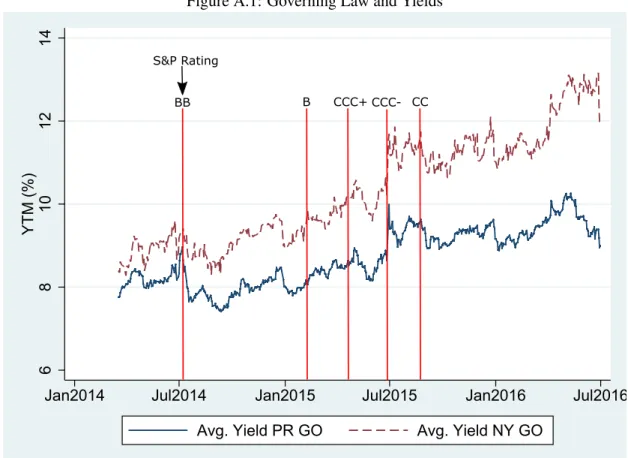
sample. On average, New York law bonds have been outstanding for 6.3 fewer years and have a $3.3 billion higher face value; both differences are significant at the 99% level. However, the average time to maturity of New York law and Puerto Rican law GO debt are not statistically different, averaging about 20 years. The average yield to maturity on New York law bonds is 10.33% and is 1.62% higher than Puerto Rican law bonds, a difference significant at the 99% level. Figure A.1 shows the average yields for the selected sample of New York law and Puerto Rican law bonds. The plot shows that the yields on both types securities increase over the sample period as Puerto Rico approaches default. New York law debt appears to trade at higher yields for the entire period, and the differential between the two sets of securities appears to widen over the sample period as Puerto Rico’s credit risk increases.
2.3.2 Methodology and Results
With the New York law GO sample and the Puerto Rican law GO sample in hand, I ask the following questions: first, do investors price New York law GO debt differently than Puerto Rican law GO debt? Second, does the yield differential vary with Puerto Rico’s credit risk? To answer the former question, I regress the daily mid yield to maturity for security issueion dayton a dummy indicating if New York law pertains to a security issue while controlling for variables capturing the credit rating of Puerto Rico, the term structure of yields, and variables controlling for issue liquidity. The specification also includes time (day) fixed effects to capture security invariant time effects. The standard errors are clustered by security issue. I estimate the following benchmark model:
Y T Mit=α+µt+β1N Yi+β2RISKt+β3Y Mit+β4Y Mit2+β5AGEit+β6F Vi+it (2.1)
whereY T Mit is the mid yield to maturity on security issueion dayt,µtis a time (day) fixed effect, N Y is a dummy indicating if a security is issued under New York law,RISK is the S & P Long Term issuer rating measured as a categorical variable ranging from 1 (AAA) to 22 (D),Y M is the number of years remaining to maturity,AGE is the number of years since issue, and F V is the face value in millions (definitions of the independent variables are included in Table A.9).
debt is on the run during the entire sample period.
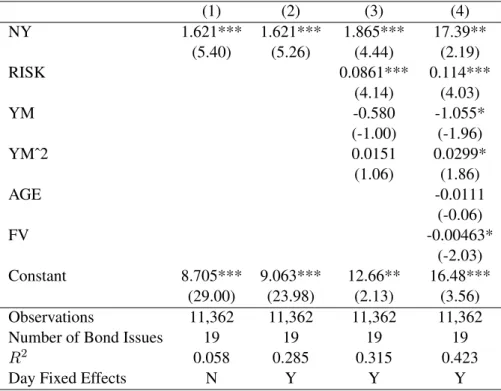
The results are in Table A.2. In column 1, I regress yield on a constant andN Y, excluding fixed effects. The constant term indicates that the average yield for Puerto Rican law GO debt is 8.7%. The coefficient onN Y indicates that New York law GO debt has an average yield 1.6 percentage points higher than Puerto Rican law GO debt, an 18% increase significant at the 99% level. The results are consistent with the hypothesis that from the perspective of investors, New York law debt provided less protection than Puerto Rican law debt, perhaps given the possibility that New York law debt would be deemed void and unenforceable. The results indicate that investors do price contract provisions and the related legal environment. However, specification 1 has a low R squared of .058 and omits several key bond characteristics.
In column 2, I introduce time (day) fixed effects to control for security-invariant time effects, controlling for many plausible types of omitted variable bias. I find an increased R squared of .285 and find no significant change in the results of specification 1. In column 3, I include controls for risk and the term structure of yields to account for bond characteristics and improve model fit. With an R squared of .315, specification 3 further improves explanatory power. The positive coefficient onN Y indicates that New York law debt remains associated with higher yields than debt issued under Puerto Rican law, significant at the 99% level. Turning to additional controls, the positive and significant coefficient onRISKindicates that a one unit increase inRISK (a one notch downgrade) is associated with a .09% increase in yields. This is the expected result and indicates that increased credit risk is associated with higher yields. The coefficients onY MandY M2are not significant. To determine the economic importance ofN Y in specification 3, I use the estimated coefficients of spec-ification 3 and the average values of the independent variables for Puerto Rican law debt. I find the predicted average yield of Puerto Rican law debt is 8.48%, while the predicted average yield of New York law debt that is otherwise the same as Puerto Rican law debt is 10.34% or 22% higher than Puerto Rican law debt.14 Therefore, the controls added in specification 3 improve sample fit and show that New York governing law is associated with a larger increase in borrowing costs once key security characteristics are controlled for.
In column 4, I add controls for liquidity to the model in specification 3. Column 4 continues to show that New York governing law is associated with a significantly higher yield than Puerto Rican law debt. Specifically, New York governing law is associated with yields 17.4% higher than equivalent Puerto Rican law debt, significant at the 95% level. When compared to the predicted average yield of Puerto Rican law debt from specification 4 of 8.3%, New York law debt trades at yields 210% higher than Puerto Rican law debt on average. However, these
14
estimates are based on the assumption that the included liquidity controls do an adequate job of capturing the liquidity premium on both types of debt.
Importantly, there are significant differences in the range of the liquidity controls across samples seen in Table A.1. Specifically, the range of the face value of Puerto Rican law debt is far from the face value of New York law debt. In addition, the fact that New York law debt is on the run also raises the concern that the included liquidity controls may not adequately control for the liquidity premium which may be present in New York law debt. However, note from specifications 1 through 3 that New York law debt trades at significantly higher yields than Puerto Rican law debt in the absence of liquidity controls. If New York law debt carries a significant liquidity premium, the estimates in specifications 1 through 3 would underestimate the positive effect New York governing law has on yields. For this reason, specifications without liquidity controls provide the most conservative estimate of the effect of governing law. I discuss this issue in further detail in Section A.6.
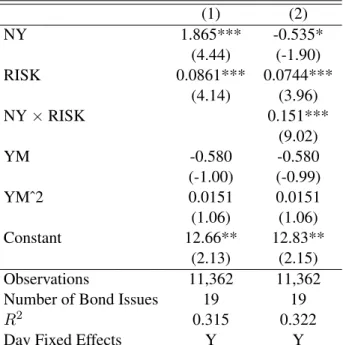
I turn to my next question; does the yield differential between New York law and Puerto Rican law debt vary with credit risk? Figure A.1 offers suggestive evidence that the yield differential between New York law and Puerto Rican law debt widened as Puerto’s credit risk increased. To address this question analytically, I add an interaction term betweenRISK andN Y to specification 3 of Table A.2. I use this specification because it provides the best fit among models that make the more conservative estimate of the effect of governing law. That is, I estimate the model:
Y T Mit=α+µt+β1N Yi+β2RISKt+β3N Yi×RISKt+γXit+it (2.2)
whereγXit=β4Y Mit+β5Y Mit2.
New York law over Puerto Rican law debt. This is consistent with the hypothesis that the more likely default is, the more investors price the different legal environments due to their effect on the recovery process. Taken together, the results indicate that investors price the different legal protections of New York law debt and that the superior legal protection of other GO debt was valued even more as default became more likely.
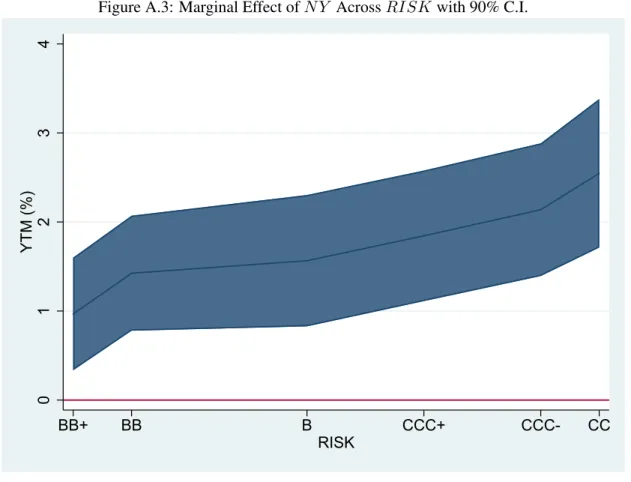
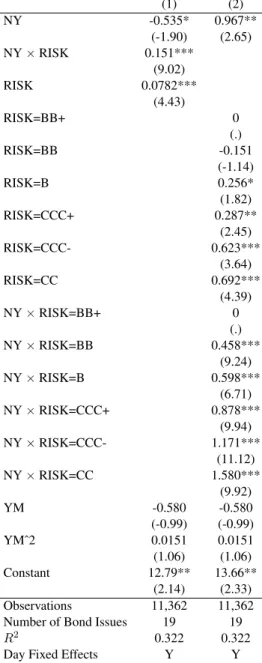
I also adopt a more granular approach to measuring the effect of credit risk on the marginal effect ofN Y. This allows me to investigate the presence of any non-linearities in the effect of credit risk on the marginal effect ofN Y. I do so by estimating the model in equation (2.2) and including indicator variables for each value ofRISK and interacting each of these withN Y. I omit the equation and the results from the main text for brevity. The full results are available in specification 2 of Table A.13. Figure A.3 summarizes these results in graphic form with 90% confidence intervals.15 Figure A.3 shows similar results to those obtained in Table A.3. Specifically, the marginal effect ofN Y is a 1% increase in yield whenRISK is at its lowest observed level during the sample period (BB+ or 11). WhenRISK is at its highest observed level during the sample period (CC or 20), the marginal effect ofN Y is a 2.55% increase in yield, or an approximate doubling of the effect. The observed effect is fairly linear, with a notable spike as Puerto Rico is closest to default.
While the benchmark results establish the pricing of New York law debt by controlling for security charac-teristics, I also seek additional confirmation of these results. To do so, I search for the Puerto Rican law security issue from the benchmark sample with the same maturity date as the New York law issue of July 1, 2035. The maturity matched Puerto Rican law security was issued 2 years before the New York law issue. Figure A.2 plots the yields of the New York law issue and the maturity matched Puerto Rican law issue. Like Figure A.1 and the benchmark regression results, Figure A.2 shows that New York law debt trades at significantly higher yields than Puerto Rican law debt and that this differential appears to widen with increased credit risk.
2.4 The Pricing of GO and COFINA Debt
To identify the pricing of GO and COFINA protections in bond yields, I again adopt a panel data model estimated with pooled ordinary least squares based in the foreign law and collective action clause literature (e.g. Becker et al. (2003); Eichengreen and Mody (2004); Clare and Schmidlin (2014)). This approach is natural because similar to my above investigation of governing law, GO and COFINA legal protections are time-invariant security characteristics. The characteristics of GO and COFINA debt make it theoretically unclear which type of guarantee would be more valuable to investors.
On the one hand, investors in COFINA debt have seemingly clear attachment to a specific revenue stream which are legally required to be sequestered in a fund. These funds can not be used for any other purpose until
COFINA debt is paid, whereas investors in GO debt do not have attachment to specific revenues. For this reason, investors in COFINA debt may be less concerned about difficulties in attaching to revenues. On the other hand, COFINA investors are entirely dependent on a single revenue stream, whereas investors in GO debt have broad priority over all other expenses of Puerto Rico. For this reason, investors in GO debt may feel more secure. It is also important to note there is a potential legal argument that COFINA debt was a violation of Puerto Rico’s constitutional debt limit imposed for GO debt, an argument made by unsecured creditors in recent litigation.16 This leaves seniority between these two types of debt uncertain. Finally, as GO debt is protected by Puerto Rico’s constitution while COFINA is only protected under Puerto Rican law, investors may believe GO debt poses a lesser legal risk. Given these competing influences, either GO or COFINA debt may theoretically be priced higher. This makes the question of whether GO or COFINA protections are more highly valued an empirical one. The question of the effect of credit risk on the pricing of these protections is more straightforward. If GO or COFINA protections are associated with different beliefs about recovery rates, then a more likely default should widen this differential. I also test this hypothesis.
2.4.1 Data and Summary Statistics
The analysis of the pricing of the legal protections of GO and COFINA debt uses two groups of bonds: GO debt issued by Puerto Rico under Puerto Rican law and senior COFINA debt; all of which is issued under Puerto Rican law.17 As in the governing law investigation, I restrict my sample period to before the passage of PROMESA on June 30, 2016. As the final COFINA issuance occurred on December 13, 2011 and the final GO issuance occurred on April 3, 2012, I further restrict the sample to the period beginning after the final issuance of GO and COFINA debt on April 3, 2012. The data used in the analysis comes from Bloomberg.
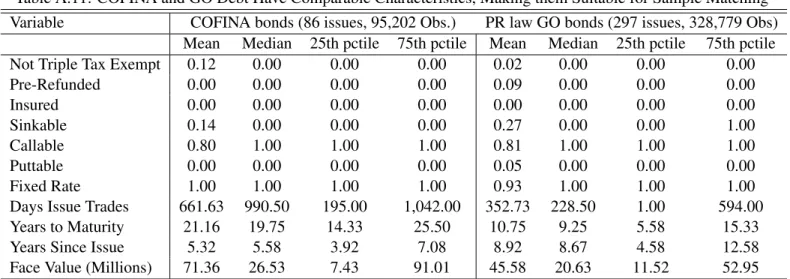
I select a sample of GO debt issued by Puerto Rico under Puerto Rican law and senior COFINA debt by filtering each baseline sample of bonds to include only bonds which are triple tax exempt, not pre-refunded, uninsured, non-sinkable, non-callable, non-puttable, and fixed rate. As before, I also restrict the matched sample to securities with between 1 and 30 years to maturity and that trade in at least half of the sample trading days, in this case in at least 525 of the 1,052 trading days.18 Section A.4 describes the filtering process in more detail.
Table A.4 reports the summary statistics of the Puerto Rican law GO sample and the senior COFINA sample. On average, GO bonds have maturities of about 15 fewer years, have been outstanding for 8 more years and have
16
https://www.debtwire.com/info/legal-analysis-judge-swain%E2%80%99s-prhta-statutory-lien-decision-instructive-other-puerto-rico-bondholders
17
I restrict attention to GO debt issued under Puerto Rican law because COFINA debt is also issued under Puerto Rican law.
18
a $18 million higher face value than senior COFINA debt; all differences are significant at the 99% level. The average yield to maturity on GO bonds is 8.46% and is 1.11% higher than for COFINA bonds, a difference significant at the 99% level. Figure A.4 shows the average yields for the selected sample of GO and COFINA bonds. The plot shows that the yields on both types securities increase over the sample period as Puerto Rico’s credit risk increased. GO and COFINA yields are relatively close for much of the sample, separating sharply as Puerto Rico approaches default and GO yields spike substantially more than COFINA yields.
2.4.2 Methodology and Results
With the Puerto Rican law GO and the senior COFINA sample in hand, I ask the following questions: first, do investors price the different legal protections and security offered by GO and COFINA debt? Second, does the yield differential vary with credit risk? To answer the former question, I proceed in a similar manner as in the governing law investigation by regressing the daily mid yield to maturity for security issueion dayton a dummy indicating if a security issue is COFINA versus GO while controlling for variables capturing risk, the term structure of yields, and variables controlling for issue liquidity. Note that the differentials in the range of the control variables seen in Table A.4 do not include any extreme differences as seen in the governing law investigation, making their inclusion sensible. The specification also includes time (day) fixed effects to capture security invariant time effects. The standard errors are clustered by security issue. I estimate the following benchmark model:
Y T Mit=α+µt+β1COF IN Ai+β2RISKt+β3Y Mit+β4Y Mit2 +β5AGEit+β6F Vi+it (2.3)
whereY T Mitis the mid yield to maturity on security issueion dayt,µtis a time (day) fixed effect,COF IN A is a dummy indicating if a security issue is COFINA versus GO,RISK is the S & P Long Term issuer rating measured as a categorical variable ranging from 1 (AAA) to 22 (D),Y M is the number of years remaining to maturity, AGE is the number of years since issue, and F V is the face value in millions (definitions of the independent variables are included in Table A.9). The coefficient onCOF IN A is the primary variable of interest, capturing whether or not the differing legal protections and security of COFINA and GO debt are associated with a yield differential.AGEandF V are typical controls included to account for liquidity.
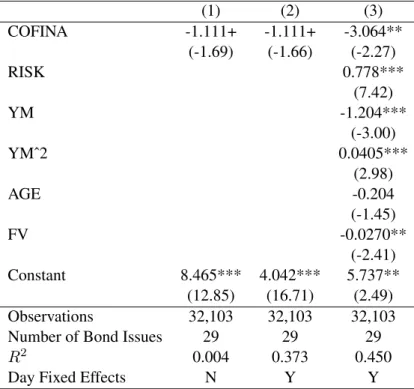
the legal protections and security in GO and COFINA debt. However, these initial results have an extremely low R squared of .004 and do not control for other key bond characteristics. This is key because Table A.4 shows COFINA debt has a significantly different characteristics from GO debt.
In column 2, I include time (day) fixed effects to control for security-invariant time effects, controlling for many plausible types of omitted variable bias. The results show a significant increase in R squared to .373 and no qualitative change in the result that COFINA debt trades at significantly lower yields.
In column 3, I include additional variables to control for key bond characteristics and improve model fit. With an R squared of .450, specification 3 has substantially improved explanatory power over specifications 1 and 2. The negative coefficient onCOF IN Aindicates that COFINA debt is associated with a 3.1% lower yield than otherwise equivalent Puerto Rican law GO debt, significant at the 95% level. Turning to additional controls, the positive and significant coefficient on RISK indicates that a one unit increase in RISK (a one notch downgrade) is associated with a .78% increase in yields. This is the expected result and indicates that increased credit risk is associated with higher yields. The coefficients onY M andY M2 are each significant at the 99% level. The coefficient on F V is significant at the 95% level and indicates that issues with higher face values tend to have lower yields. As higher face values are associated with increased liquidity, the results indicate that more liquid debt trades at a liquidity premium.
To determine the economic importance ofCOF IN Ain specification 3, I use the estimated coefficients of specification 3, and the average values of the independent variables for Puerto Rican law GO debt. I find the predicted average yield of Puerto Rican law GO debt is 7.23%, while the predicted average yield of COFINA debt with the same characteristics of GO debt is 4.16% or 42% lower than equivalent Puerto Rican law GO debt.19 Therefore, the controls added in specification 3 improve sample fit and show that when critical bond characteristics are controlled for, COFINA debt trades at economically and statistically lower yields than GO debt. This supports the hypothesis that investors value the legal protections and security of COFINA debt more than that of GO debt.
I turn to my next question; does the yield differential between COFINA and GO debt vary with credit risk? Figure A.4 offers suggestive evidence that the yield differential between COFINA and GO debt widened as Puerto approached default. To answer this question analytically, I add an interaction term betweenRISK and COF IN A to specification 3 of Table A.5. I use this specification because it provides the best fit. That is, I
19
estimate the model:
Y T Mit=α+µt+β1COF IN Ai+β2RISKt+β3COF IN Ai×RISKt+γXit+it (2.4)
whereγXit=β4Y Mit+β5Y Mit2 +β6AGEit+β7F Vi.
The results are in Table A.6. Specification 1 repeats specification 3 of Table A.5, the benchmark. Specifi-cation 2 shows a negative coefficient on the interaction COF IN A×RISK. Although the coefficient is not individually significant, an F-test of the null hypothesis thatCOF IN AandCOF IN A×RISKare jointly zero rejects the null at the 90% level. Similarly, an F-test of the null hypothesis thatRISKandCOF IN A×RISK are jointly zero rejects the null at the 99% level. The negative coefficient on the interaction indicates that an increase in credit risk is associated with a larger yield differential between GO and COFINA debt.
I use specification 2 in order to determine the economic impact ofRISKon the marginal effect ofCOF IN A. This uses the following expression for the marginal effect of COF IN A: β1COF IN Ai +β3COF IN Ai ×
RISKt. I find that the marginal effect ofCOF IN A is a 2.3% decrease in yield whenRISK is at its lowest observed level during the sample period (BBB or 9). When RISK is at its highest observed level during the sample period (CC or 20), the marginal effect of COF IN Ais a 4.1% decrease in yield, or about 1.78 times the effect at the lowest rating level in the sample. Therefore, although the marginal effect of COFINA is a significantly lower yield than GO debt throughout the sample period, the increase in credit risk observed over the sample period is associated with a significant increase in the yield differential for COFINA versus GO debt. This is consistent with the hypothesis that the more likely a default is, the more investors price the differing protections offered by COFINA and GO debt due to their effect on the recovery process. Taken together, the results indicate that investors price the differing protections of COFINA and GO debt and that this difference was valued even more as default became more likely.
As with governing law, I also adopt a more granular approach to measuring the effect of credit risk on the marginal effect ofCOF IN A. This allows me to investigate the presence of any non-linearities in the effect of credit risk on the marginal effect ofCOF IN A. I do so by estimating the model in equation (2.4) and including indicator variables for each value ofRISKand interacting each of these withCOF IN A. I omit the equation and the results from the main text for brevity. The full results are available in specification 2 of Table A.14. Figure A.5 summarizes these results in graphic form with 90% confidence intervals.20 Figure A.5 shows some differences from the results obtained in Table A.6. The marginal effect of COF IN A remains negative on
average and increases with risk but it is not a linear relationship. The marginal effect of COFINA is relatively low at about -2.5% when risk is at its lowest and nearly zero when risk is towards the middle of the observed range. However, when credit risk is at its highest (CCC- and CC) the marginal effect of COFINA increases to about -4% and -5% respectively, a significant impact on yields. As with governing law, there is a notable spike in the pricing of the differential as Puerto Rico is closest to default.
2.5 The Pricing of PROMESA
To identify the pricing of PROMESA, I use news events related to PROMESA’s passage and an event study approach. Event studies are the standard way to identify the effect of news events on bond yields (e.g. Krish-namurthy and Vissing-Jorgensen (2011), G¨urkaynak et al. (2004) and Wright (2012)). PROMESA provides an interesting experiment where the exogenous decisions of the U.S. federal government produce within security variation in the presence of CACs.
PROMESA imposes CACs much like those seen in sovereign debt. However, PROMESA differs in that it also temporarily halted creditor actions, introduced an oversight board for Puerto Rico’s finances, and created a bankruptcy process similar to Chapter 9 to provide an alternative restructuring framework to CACs.21 This framework was aimed at providing an orderly restructuring process in contrast to the existing unanimous consent clauses in Puerto Rican debt. Like the CACs seen in sovereign debt, PROMESA may also incentivize default by making restructuring more orderly. Thus, like the CACs present in sovereign debt, the effect of PROMESA on yields is theoretically ambiguous. However, note that PROMESA may produce different expectations about recovery prospects than the standalone CACs observed in sovereign debt. For example, investors may value the right to hold out that existed before PROMESA more in the U.S. given the strong legal system in place to protect that right. Investors may also believe that the backstop of a court-supervised bankruptcy process improves or reduces their recovery prospects versus CACs alone. The environment makes the question of the effect of PROMESA an empirical one.
2.5.1 Data and Summary Statistics
I identify news events capturing changes in investor beliefs that PROMESA will become law. Specifically, the release of the bill’s text, the reference of the bill to committee, the passage of the bill by committee, the passage of the bill by a chamber, and the signing of the bill by the President are all key steps in the legislative process which reveal that PROMESA is closer to becoming law.
This process entailed 7 events which all indicate a greater likelihood that Puerto Rican debt will have CACs retroactively imposed by the U.S. federal government. On November 11, 2015 the first version of PROMESA
(S. 2328) was introduced in the Senate and passed. On April 12, 2016 the first House version of the bill was introduced (H.R. 4900). On May 18, 2016 PROMESA was introduced to the House Natural Resources Committee (H.R. 5278). On May 25, 2016 PROMESA cleared the committee with strong bipartisan support. On June 9, 2016 the House passed PROMESA. On June 29, 2016 the Senate passed PROMESA. President OBAMA signed PROMESA on June 30, 2016. Note that although there are differences in the three versions of the bill, they all include CACs for Puerto Rican debt.22
The analysis of the effect of PROMESA on Puerto Rican bond yields uses Puerto Rican GO debt. I use a time series beginning 30 days before the first event and ending 30 days after the last event. The data used in the analysis comes from Bloomberg. I restrict attention to bond issues with the following characteristics: bonds that are not pre-refunded, bonds that are triple tax exempt, bonds that are uninsured, bonds that are not callable or sinkable, bonds that are not puttable, bonds with maturities between 1 and 30 years, and bonds with fixed rate coupons. I further require that the included bonds trade during at least 100 of the 192 trading days in the sample period.23 I construct the daily change in yields in basis points, censoring the variable at the 1st and 99th percentiles to prevent outliers from skewing the results. Table A.7 shows the summary statistics for the selected sample. The sample includes 21 security issues with a total of 4,263 observations. The results show an average increase in yields of 3.41 basis points over the sample period.24
2.5.2 Methodology and Results
I investigate the market’s reaction to news about PROMESA using an event-study.25 Event studies are widely used to examine the reaction of asset prices to public news events. Recently, event studies have been used to investigate the effect of announcements on bond yields.26 Assuming markets are semi-strong form efficient regarding public information, asset prices will adjust quickly to announcements about PROMESA.27 Further, assuming that such news is the dominant news during the event window, that investors’ risk aversion is unchanged, and that PROMESA announcements are not reversed caused by yields at the daily frequency, changes in Puerto Rican yields during the event window will reflect the effect of the events on the expected cash
22
https://www.govtrack.us/congress/bills/114/s2328/summary#libraryofcongress
23
Again, I include this restriction to exclude securities which do not have updated pricing information throughout the sample. As 100 trading days is an arbitrary requirement, I relax this assumption for robustness.
24
Note that Puerto Rico missed its first GO payment on July 1, 2016, immediately following passage of PROMESA. These securities were not included in the sample as they were near maturity.
25
See Mackinlay (1997).
26See Krishnamurthy and Vissing-Jorgensen (2011), G¨urkaynak et al. (2004) and Wright (2012).
flows of each bond.28 Note that with the assumption that rating actions are the dominant news during the event window, the heteroskedasticity-based identification strategy of Rigobon and Sack (2004) simplifies to a standard event study.
Event windows should be small to avoid contamination of the results by news events other than the news of interest and small enough to claim that investor risk aversion is constant. The market for Puerto Rican municipal debt is surely less efficient than the markets for the broad stock indexes and U.S. Treasuries investigated in event studies with relatively narrow event windows of one day or less.29 Therefore, in my benchmark results, I use a two-day window following Krishnamurthy and Vissing-Jorgensen (2011) who study agency and corporate yields.
The event study seeks to investigate how yield changes differ during PROMESA announcements from non-announcement days. To do so, I regress the daily change in yields in basis points on a constant and two dummies; one indicating an announcement on this day and another indicating an announcement the previous day. The model is estimated using OLS with standard errors clustered by security. Statistical significance is assessed using an F-test of the null hypothesis that the sum of the dummies is zero.
The results are reported in Table A.8. For the tests reported for individual events, only event window days for the event under investigation and non-event days are included.30 The results show that only the final passage of PROMESA in the Senate and the signing of the bill by the President are associated with significant changes in yields. Specifically, the passage of PROMESA in the Senate on June 29, 2016 was associated with a two-day increase in yields of 15.1 basis points, significant at the 90% level. The signing of PROMESA by the President on June 30, 2016 is associated with a two-day increase in yields of 23.2 basis points, significant at the 99% level. The results indicate that only the final stages of PROMESA’s passage had a significant effect on yields and that these changes were positive. Although PROMESA made it possible for Puerto Rico to restructure legally and thus would theoretically increase investor expectations of a possible default, Puerto Rico was widely expected to default and indeed missed a payment on GO debt for the first time July 1, 2016 as expected. In fact, this due date prompted passage of the bill on June 30.31Therefore, the most plausible explanation for the effect of PROMESA on yields is that investors believed PROMESA harmed their recovery prospects relative to their
28
Expected cash-flow is in turn affected by default probability, expected recovery rates, and the value of attached options. Note that the benchmark expected change in yields is zero for days where no news arrives.
29
See, for example, Bernanke and Kuttner (2005), G¨urkaynak et al. (2004), and Wright (2012).
30Non-event days are days during the benchmark time series which do not fall in the event window of any event.
earlier expectations.32 This may be because given the strength of the U.S. legal system, investors valued their prior holdout rights more than a relatively orderly restructuring. It is also possible that investors saw the court supervised bankruptcy process as more favorable to the issuer than the traditional standalone CACs observed in sovereign debt. The finding that investors only priced PROMESA when Puerto Rico was closest to default again supports the theory that legal protections are most valued when credit risk is highest.
2.6 Robustness Checks
I conduct several checks to confirm the robustness of my results. The results are omitted for brevity and are available upon request.
Including less liquid control securities: To ensure my results in Sections 2.3 and 2.4 are not sensitive to the samples selected, I do not restrict attention to securities that trade in at least half of the trading days in the sample period. Rather, I allow the samples to include securities that price in at least a quarter of the trading days in the sample period. The results remain robust.
Restricted time series: To ensure my results in Sections 2.3 and 2.4 are not affected by the passage of PROMESA just after the end of the benchmark samples or the issuance of the GO debt immediately preceding the benchmark samples, I restrict the samples to begin 30 days after issuance and end 30 days before PROMESA was passed. The results remain robust.
One particular concern about the benchmark results in Sections 2.3 and 2.4 is that PROMESA had a differ-ential effect on the beliefs of investors about the recovery rates of New York law and Puerto Rican law debt in Section 2.3 or for GO versus COFINA debt in Section 2.4. For example, investors may believe that the CACs in PROMESA would fail to produce a restructuring plan, moving the restructuring to a bankruptcy proceeding which may or may not make any distinction between Puerto Rican and New York law debt or GO and COFINA debt. In this case, news of PROMESA may bias my benchmark results. However, my findings in Section 2.5 shows the only statistically important events immediately precede PROMESA’s passage, so the robustness check ending the sample 30 days before the passage of PROMESA addresses this concern.
Controlling for outliers: One possible concern about the benchmark analyses in Sections 2.3 and 2.4 is that daily yield data can be volatile and contain outliers, skewing the results. To address this concern, I repeat the benchmark analyses using the log of the daily mid yield rather than the raw mid yield. The results remain robust. An alternative measure of credit risk: One possible concern about the benchmark results in Sections 2.3 and 2.4 is that credit ratings may be an inadequate proxy for credit risk. To address this concern, I repeat the benchmark analyses using cds spreads and recovery rates from Markit to calculate the 5 year implied default
probability on Puerto Rican GO debt at the daily frequency and substitute this for the categorical variable cap-turing Puerto Rico’s credit rating. Although this reduces sample size, the results remain robust.
PROMESA sample selection: To ensure my results in Section 2.5 are not sensitive to the sample selected, I do not restrict attention to securities that trade in at least half of the trading days in the sample period. Rather, I allow the sample to include securities that price in at least a quarter of the trading days in the sample period. Given that I am studying changes in yields, I also more greatly restrict the sample to only those securities which price every day in the sample. Finally, I also exclude New York law GO debt to ensure the benchmark results are not driven by that issue which as noted above, is an outlier in many respects. The results remain robust to all of these checks.
PROMESA methodology: To ensure my results are not dependent on the size of the event window, I expand the benchmark event window to 11 days from 2 days and find that the benchmark results remain robust. I also control for overlapping events by using a single dummy for any event day and find the results are robust. Finally, I control for a time trend and find the results are robust.
2.7 Conclusion
This paper conducts a case study investigating the pricing of three key legal provisions of Puerto Rican debt and how these valuations vary with credit risk. In doing so, this paper contributes to wide ranging research which debates the questions: do investors price contract provisions and law? Does the pricing of contract provisions vary with credit risk? To my knowledge, this paper is the first to address these questions for the case of Puerto Rico or any municipal issuer. In all three cases, I find that investors do price contract provisions and the related law, especially when credit risk is elevated.
In each instance, Puerto Rico offers a interesting case to study the pricing of contract provisions and law. First, I use a panel regression to investigate whether investors price the differing legal environments offered by Puerto Rican GO debt issued under New York law and Puerto Rican law GO debt. I find that New York law debt trades at higher yields than otherwise equivalent Puerto Rican law debt. These findings are both statistically and economically significant. This result differs from the findings in existing literature which show a foreign law premium (Chamon et al. (2015); Clare and Schmidlin (2014)). However, Puerto Rico’s New York law debt is unique in that it was later found to be potentially illegal by exceeding the debt service limits set forth in Puerto Rican law (Showalter (2017)). It is possible that investors priced the risk that they would not be entitled to recovery in the case of New York law debt. The differential in the pricing of New York law and Puerto Rican law debt increases as Puerto Rico’s credit risk and hence the importance of legal protections increases.
by Puerto Rican law GO debt and Puerto Rican law debt issued by COFINA - namely, GO debt is guaranteed to be paid before any other obligation under Puerto Rico’s Constitution while COFINA debt is secured by a sales tax under Puerto Rican law. I find that GO debt trades at higher yields than otherwise equivalent COFINA debt. These findings are both statistically and economically significant. This result is consistent with the finding in existing literature that secured debt trades at lower yields across corporate issuers (Bradley and Roberts (2015)). The investigation in this paper is also unique because it compares the secured and unsecured debt of the same issuer and thus studies debt facing the same economic risks where prior studies of secured debt focus primarily on cross-issuer variation. I again find that investors price the different legal protections of each type of debt most when credit risk is highest.