Prepared for submission to JCAP
Testing Predictions of the Quantum
Landscape Multiverse 1: The
Starobinsky Inflationary Potential
Eleonora Di Valentino
1,2and Laura Mersini-Houghton
31Institut d’ Astrophysique de Paris (UMR7095: CNRS & UPMC-Sorbonne Universities),
F-75014, Paris, France
2Sorbonne Universités, Institut Lagrange de Paris (ILP), F-75014, Paris, France
3Department of Physics and Astronomy, UNC-Chapel Hill, NC 27599, USA
Abstract. The 2015 Planck data release has placed tight constraints on the allowed class of inflationary models. The current data favors concave downwards inflationary potentials while offering interesting hints on possible deviations from the standard picture of CMB per-turbations. We here test the predictions of the theory of the origin of the universe from the landscape multiverse, against the most recent Planck data, for the case of concave downwards inflationary potentials, such as the Starobinsky model of inflation. By considering the quan-tum entanglement correction of the multiverse, we can place a lower limit on the local ’SUSY
breaking’ scale b >1.2×10⁷GeV at 95% c.l. from Planck TT+lowTEB. We find that this
limit is consistent with the range for bthat allows the landscape multiverse to explain a serie
of anomalies present in the current data.
Contents
1 Introduction 1
2 The Modified Starobinsky Potential 2
2.1 The Starobinsky Model 3
3 Analysis Method 6
4 Results 9
4.1 Data analysis 9
4.2 The Quantum Landscape Multiverse 17
5 Conclusions 19
1 Introduction
Recent successes in precision cosmology place us in a position where we can discriminate among various inflationary models, while for the first time test new physics beyond the stan-dard model of cosmology. The latest evidence on the existence of anomalies accumulated by the Planck collaboration data [1–3] provides enticing probes into the pre-inflationary universe. In this work we compare the predictions of the theory of the origin of the universe from a
quantum landscape multiverse [4–7] against the recent Planck data. Based on a 7 parameter
likelihood exploration of standard cosmology, the recent results from the Planck collaboration
data tightly constrain the tensor-to-scalar ratiorin the minimal standard cosmological model.
As a result, from the plethora of models, the current data favor pure LCDM or concave
downward inflationary potentials, such as the Starobinsky model [8] and the class of hilltop
inflationary models [9]. Most of the convex potentials resulting in large r seem to be ruled
out.
Modifications to the perturbation spectrum and the gravitational potential, originating from quantum entanglement in the theory of the origin of the universe from the quantum
multiverse [4, 5], were derived in [7] for concave downward inflationary potentials and in
[6] for convex inflationary potentials. The aim of our study is to compare the predictions
of the theory of the origin of the universe from the quantum multiverse against the recent measurements of the Planck experiment in order to test this theory. In a companion paper we test the possibility that if the standard model of cosmology were extended to allow for new physics, such as the theory of the origin of the universe from a quantum multiverse discussed here, then ruling out these models of inflation may not be as straightforward in the extended picture.
The paper is organized as follows: in the next Section we present the Starobinsky model as a representative of a concave downwards potential, and the modified inflaton field solution,
the modified power spectrum, and the modified tensor-to-scalar ratior, with all modifications
derived from the quantum entanglement for our branch of the wavefunction of the universe
with the others [7], in the context of the theory of the origin of the universe from the quantum
multiverse. In Section 3 we present the method of analyzing the predictions of this theory
against data; we provide the results and the likelihood plots in Section4, and we conclude in
2 The Modified Starobinsky Potential
The Starobinsky inflationary model [8] is an example of a concave downwards potential,
where the field is rolling away from its minimum and V00 < 0. Therefore fluctuations can
be unstable away from the flat part of the potential near the top, and since the field is away from its minimum, the saddle point expansion of the action on which the semiclassical approximation of quantum cosmology is based, is invalid. This class of potentials was studied
in detail in [7] for the theory of the origin of the universe from a quantum multiverse. Let us
unwrap some notation and recap the main results of [7] that we need in order to test them
against data below.
In this theory, the wavefunction of the universe propagates through the landscape of
vacua [11]. The wavefunction operates initially on a two dimensional minisuperspace of
3-geometries denoted by aand the landscape moduliφ which serves as a collective coordinate
for the landscape with a disordered potential energyV(φ), which consists of a large number of
vacua all with different energies. Solutions to the wavefunction are found by solving a Wheeler DeWitt (WdW) equation. Perturbing around the 3-geometries and the field vacua, results in
an infinite number of fluctuationsfn. The long wavelength fluctuations are weakly coupled to
the system, therefore they provide the ideal environment for triggering decoherence among the branches (solutions) of the wavefunction, in our case the system, and for inducing the quantum to classical transition of each branch. Including the backreaction of these fluctuations in the WdW equation results in a Master equation and an infinite sized midi superspaced now spanned bya, φ, fn. Details of the formalism and the solutions can be found in [4–7].
The distribution of landscape vacua is disordered. This system is quite similar
math-ematically to spin glass and quantum dots. The local parameter b characterizes the depth,
i.e. the energy of the particular vacuum site on which a branch has localized. This energy
labeled bybis presumably given by the local SUSY breaking scale of that vacuum site. Since
vacua are at different energies, distributed in a disordered way, then the local parameter b
varies from vacua to vacua. In short, each landscape vacuum has two parameters, the global parameter (which is the same for all of the vacua) the string scale that we here take to be the
Planck Mass Mp, and the local ’SUSY breaking’ scale b. Due to disorder, the wavefunction
branches undergo Anderson localization. They localize at different vacua with different ener-gies. One of these branches becomes our universe as it decoheres from the other branches and undergoes a quantum to classical transition, thanks to its interaction with the environment made of the long wavelength fluctuation modes. But coherence and decoherence are closely related, and since we are studying a quantum system, then by unitarity, information about the quantum entanglement of our branch with others, is not wiped out and leaves its imprints in our classical sky after the universe has become classical. We have a coherent picture of how the branch evolves from the landscape and becomes a classical universe. We also have the quantum cosmology formalism that allows us to calculate these solutions and, to calculate the quantum entanglement of our branch with others. The latter enables us to derive how the observables in our sky predicted by inflation, get modified as a result of this additional source to perturbations and the gravitational potential of our universe, the quantum entanglement source. We consider here the Starobinsky model as an example of a concave downwards
po-tential. We use in our analysis the modifications from quantum entanglement derived in [7]
when these potentials are embedded in the framework of a landscape multiverse.
To deal with the concave downwards potentials, the calculation in [7] was performed
corrections, which inverts the potential upside down as explained in detail in [7].
The highly nontrivial corrections to the concave downwards potentials with V00<0 like
the Starobinsky model or hilltop potentials are such thatVef f =V +12 V
2
9M4F[b, V]andm2=
Abs[V00] where the entanglement information is contained in the nonlocal term F[b, V(φ)]
derived from quantum entanglement [7]. Einstein equations get modified accordingly since the
inflaton potentialV is now replaced byVef f. The Friedmann equation for concave downwards
potentials like the Starobinsky model [8], with the notation f(b, V) = 18VM24
pF[b, V], is
3Mp2H2 =Vef f =V +f[b, V]. (2.1)
The field solution is also modified by replacing V withVef f in the field equation. We
have
3Hdφ/dt=−∂Vef f
∂φ . (2.2)
Using dφ/dt=Hdφ/dlogk, the field equation 2.2, from Eq.2.1, becomes
dN = Vef f M2
pVef f0
dφ=−dlogk. (2.3)
The correction term is small compared to the leading termV, so the slow roll conditions
on the slow roll parameters(η)hold even with correction terms. Since the field is in the slow
roll regime (i.e. it satisfies the condition of [10], V(φi)−V(φf)
∇φ4 ≤ 10
−7 with φ
i, φf the value
of the field at the start and end of slow roll and ∇φ the difference between the two), then
although the correction terms are functions of φ we can approximate them with their value
halfway through the slow roll, and the integral in Eq. 2.3 as: R Vef f
Vef f0 dφ'
1+f /V
1+df /dV
R V
V0dφ.
Equation 2.3 gives us the field as a function of k, or equivalently as a function of the
number of efolds N, therefore by requiring for exampleN = 60we can figure out the start of
slow roll. That is, we can integrate dN from the endφend to the start of slow rollφi to get
the total number of efolds N.
2.1 The Starobinsky Model
The Starobinsky potential [8] can be reparameterized in terms of a scalar fieldφto be given
by a potential [8]
V(φ) =V0
1−e−
q 2 3 φ MP 2 (2.4)
and its derivative with respect to the field
V0(φ) = 2 r 2 3 V0 MP
1−e−
q 2 3 φ MP e− q 2 3 φ
MP. (2.5)
The effective potential of the Starobinsky model modified by the quantum entanglement correction of the multiverse, is Vef f(φ) =V(φ) +f(b, V[φ])
wheref[b, V]is given by:
f(φ) = 1 2
V(φ) 3MP2
2
Notice that the correction term in Vef f has a + sign in front as explained in [7]. We
will denote the reduced Planck mass by M = 2.4×10¹⁸ to distinguish it from the Planck
massMp. The nonlocal functionF[b, V]above, which depends on the global string scale, the
inflaton potential V(φ) and the ’SUSY breaking’ scale bof the particular landscape vacuum
where this branch sits is derived in [7] to be
F(b, V[φ]) = 3 2
2 +m
2M2
P
V(φ)
log
b2MP2 V(φ)
−1
2
1 +m 2
b2
e−
3b2MP2
V(φ) . (2.7)
The mass squared term in this expression is given by the magnitude of the curvature
of the potential, and it is positive. Concave potentials have negative curvature and the
calculation is performed in Euclidean section as mentioned above [7]. WhenF[b, V]is derived
and we rotate back to Lorentz section then we have [7] m2 = |V00(φ
in)| > 0 which for the
Starobinsky potential 2.4is
m2' V0
M2 p Abs[e− q 2 3 φ Mp
1−2e−
q 2 3 φ Mp ] (2.8)
N, the total number of efolds is obtained by integrating Eq. 2.3 from the start of slow
rollφin to the end of slow roll φend. So for N '60, we get φin '5.8Mp and from Eq.2.8we
estimate m2 ' MV02
pN.
The derivatives for the effective potential:
df dV = V 9M4 p
F[b, V] +V
2dF/dV
(2.9)
where the expression for F[b, V]is above, and dF/dV is
dF
dV =−
3m2Mp2−M2(b2+m2)Exp[−3b2Mp2
V ]−2V −m
2M2
plog[ b2M2
p
V ]
2V2 . (2.10)
Putting this together we get Vef f0
Vef f0 (φ) =V0(φ)
1 + df dV
. (2.11)
Lets move on to field solutions. We can easily integrate Eq. 2.3to get the field solution,
which is what we did numerically for the analysis in this paper. However to gain some intuition in the field behaviour let us attempt an analytical solution. Note that during the slow roll, the potential is nearly a constant and therefore the correction term can be pulled out of the
integral as explained below Eq. 2.3.
r 2 3
1 Mp
(φ−φend)−
e
q 2
3φ/Mp−e q
2
3φend/Mp
= 4/3log[k/kref]
(1 +df(dVb,V[φ[φ(k(k)])]))
(1 +f[Vb,V[φ[(φk()]k)])
. (2.12)
This is the exact solution. But it is a bit problematic because it is a transcendental
function, thus not easy to invert. Note the correction term multiplying log(k/kref). Taking
r 2 3
1 Mp
(φ0−φ0end)−
e
q 2
3φ0/Mp−e q
2
3φ0end/Mp
= 4/3log[k/kref] (2.13)
where kref is a fiducial scale for the mode that we here take kref = 0.002hM pc−1. Since we
cannot invert Eq.2.12analytically, then we need to somehow approximate it, or, alternatively,
invert it numerically. To get an idea, let us give below the analytic approximation of the above
exact solution, with notations φend and φin =log[4/3(N−log[k/kref])] for the end and start
values of the field during slow roll.
The unmodified field solution is approximately
φ0Analytic(k) =
r 3 2M log[
4
3(N−log[k/kref]) +Exp[φend] +φin(k)−φend] (2.14)
and the approximate modified field solution
φAnalytic(k) =
r 3 2M log[
4
3(N −log[k/kref])
(1 +df(φ0Analytic)/dV)
1 +f(φ0Analytic)/V
+Exp[φend]+φin(k)−φend].
(2.15)
Note that the correction term for the field goes as(1 +df /dV)/(1 +f /V).
All unmodified quantities liker0[k], the scalar spectral indexn0[k], the power spectrum P0[k]etc., are evaluated with respect to the unmodified fieldφ0. All modified quantities such as r[k], n[k] and the power spectrum P[k], are evaluated with respect to the modified field
above φ.
Using the modified field solution to calculate the spetrum, we have
Pζ(k) =
1 24π2M6
P
"
Vef f(φ)3
Vef f0 (φ)2 #
= 1
24π2M6
P
V(φ)3 V0(φ)2
(1 +f /V)3
(1 +df /dV)2. (2.16)
It can be seen that the modified power spectrum is related to the unmodified one ,P0[k],
approximately by
P[φ(k)]≈P0[φ0(k)]
(1 +f /V)3
(1 +df /dV)2. (2.17)
We should bear in mind that there is a difference between the modified and the
un-modified spectra, because the former is evaluated from the un-modified field solutionφ(k), while
the latter is evaluated from the unmodified field solution φ0(k) where φ(k) 6=φ0(k).
There-fore the above expression relating P[φ(k)]to P0[φ0(k)]is only approximate with this caveat.
Also recall that the reduced Planck mass M used for these expressions, is obtained from the
original one Mp by dividing it with 1/
√
8π.
Finally let us estimate the tensor to scalar ratio r[k]
r[k] = 8Mp2 V
0
ef f(φ)
Vef f(φ)
!2
= 8Mp2
V0(φ) V(φ)
2
((1 +df /dV) (1 +f /V) )
2 (2.18)
and the unmodifed one by
r0[k] = 8Mp2
V0(φ0)
V(φ0) 2
Parameter Starobisky
Ωbh2 [0.005,0.1] Ωcdmh2 [0.001,0.99]
Θs [0.5,10]
τ [0.01,0.8]
log(√8πb[GeV]) [16,23] 1010V0/M4 [1.7,2.4]
r [0,3]
Neff [0.05,10]
w [−3.0,0.3]
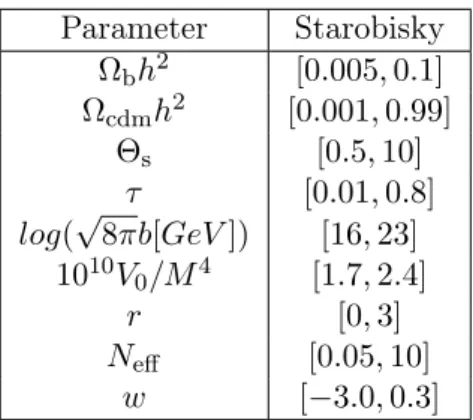
Table 1. External priors on the cosmological parameters assumed in this work.
The tensor to scalar ratio r[k] calculated above can be estimated from V0 and Vef f0 ,
in a straightforward manner. Again, bearing in mind the caveat that the modified field
solution enters the modified tensor index r, while φ0 enters r0[k]estimations, then we have
an approximate relation, r[k]≈r0[k]((1+(1+df /dVf /V)))2.
From here we calculate n[k]−1 = dlog(Pzeta[k])/dlog(k) from the expression for P[k]
above. Then the unmodified scalar tensor is n0[k]−1 = dlog(P0[k])/dlog(k) where recall
that the0 notation always denotes the unmodified field, power spectrum, and scalar or tensor
spectral indices.
3 Analysis Method
We explore the modified Starobinsky model by considering as a baseline the cosmological
parameters listed next. These are the4standard parameters of theΛCDM and3inflationary
parameters: the baryonΩbh2and the cold dark matter energy densitiesΩch2; the reionization
optical depth τ; the ratio between the sound horizon and the angular diameter distance
at decoupling Θs; the natural logarithm of the SUSY-breaking scale associated with the
landscape effects log(√8πb[GeV]) (note the scaling factor √8π coming from the reduced
Planck mass which rescales bsince this is defined in terms of the normal Planck mass in the
correction term); the energy scale of the inflation 1010V
0/M4, and the contribution of the
primordial gravitational waves with a tensor-to-scalar ratio of amplitude r at the pivot scale
kref = 0.002hM pc−1.
Moreover, we also consider extensions to these baseline models, by adding one more
parameter at a time, such as: the effective number of relativistic degrees of freedom Neff and
the dark energy equation of state w. Finally, we vary both extension parameters at the same
time. All the parameters we consider in our analysis are explored within the range of the
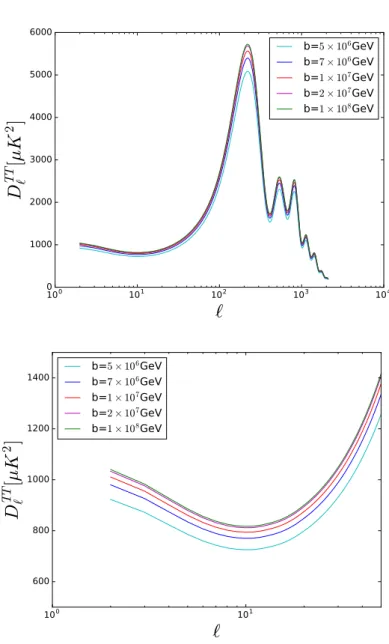
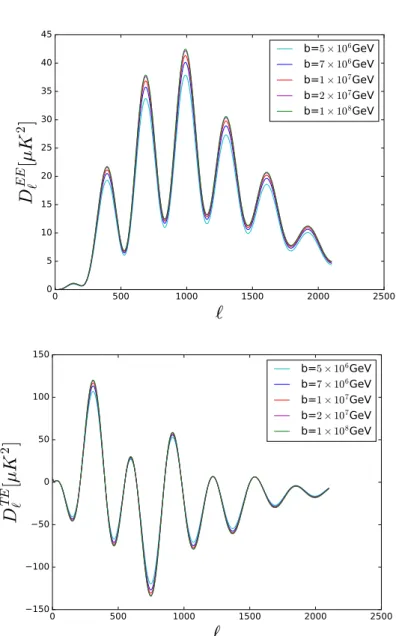
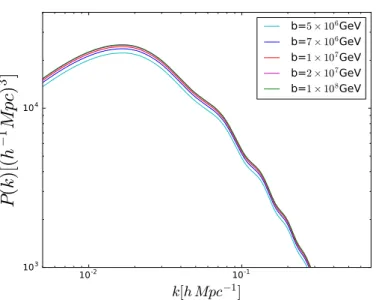
conservative flat priors reported in Table 1. Figs.1, 2and 3 show the manner in which the
SUSY-breaking scale b associated with the landscape effects, affects the CMB temperature,
polarization and matter power spectra, respectively.
We find the constraints on these parameters below by considering several recent cos-mological probes. Firstly, we analyze the “Planck TT + lowTEB” data, i.e. the full range
of the 2015 temperature power spectrum (2 ≤` ≤2500) combined with the low-`
polariza-tion power spectra in the multipoles range 2≤`≤29 provided by the Planck collaboration
100 101 102 103 104
`
0 1000 2000 3000 4000 5000 6000
D
TT `
[
µK
2
]
b=5×10⁶GeV b=7×10⁶GeV b=1×10⁷GeV b=2×10⁷GeV b=1×10⁸GeV
100 101
`
600 800 1000 1200 1400
D
TT `
[
µK
2
]
b=5×10⁶GeV b=7×10⁶GeV b=1×10⁷GeV b=2×10⁷GeV b=1×10⁸GeV
Figure 1. The temperature CMB angular power spectrum by varying the SUSY-breaking scale b
associated with the landscape effects, for the modified Starobinsky model.
30≤`≤2500, that we will call “Planck TTTEEE + lowTEB”. Then, we replace the lowTEB
data with a gaussian prior on the reionization optical depth τ = 0.055±0.009, as obtained
recently from Planck HFI measurements [13], and we will call this prior “tau055”. In addition,
we consider the 2015 Planck CMB lensing reconstruction power spectrum C`φφ [14], and we
will refer to this dataset as “lensing”. We add the baryonic acoustic oscillation data from
6dFGS [15], SDSS-MGS [16], BOSSLOWZ [17] and CMASS-DR11 [17] surveys as was done
in [18], and we will call this dataset "BAO". Furthermore, we consider the “BKP” dataset,
i.e. the CMB polarization B modes constraints provided by the 2014 common analysis of
Planck, BICEP2 and Keck Array [19]. Finally, we will include a gaussian prior on the Hubble
constant H0 = 73.2±1.7 km/s/Mpc, quoting the directly measured value provided recently
0 500 1000 1500 2000 2500
`
0 5 10 15 20 25 30 35 40 45
D
E
E
`
[
µK
2
]
b=5×10⁶GeV b=7×10⁶GeV b=1×10⁷GeV b=2×10⁷GeV b=1×10⁸GeV
0 500 1000 1500 2000 2500
`
150 100 50 0 50 100 150
D
TE `
[
µK
2
]
b=5×10⁶GeV b=7×10⁶GeV b=1×10⁷GeV b=2×10⁷GeV b=1×10⁸GeV
Figure 2. The polarization CMB angular power spectra by varying the SUSY-breaking scale b
associated with the landscape effects, for the modified Starobinsky model.
In order to analyze statistically these data exploring the modified Starobinsky model for the entanglement, we have used the June 2016 version of the publicly available Monte-Carlo
Markov Chain packagecosmomc[21], with a convergence diagnostic based on the Gelman and
Rubin statistic. In this version, we modified the CAMB code [22], to include the primordial
power spectrum of our model. It implements an efficient sampling of the posterior distribution
using the fast/slow parameter decorrelations [23], and it includes the support for the Planck
10-2 10-1
k
[
h Mpc
−1]
103104
P
(
k
)[
(
h
−
1
M
pc
)
3
]
b=5×10⁶GeV b=7×10⁶GeV b=1×10⁷GeV b=2×10⁷GeV b=1×10⁸GeV
Figure 3. The matter power spectrum by varying the SUSY-breaking scaleb associated with the landscape effects, for the modified Starobinsky model.
1.80
1.95
2.10
2.25
2.40
10
10
V
0
/M
4
18.0
19.5
21.0
22.5
lo
g
(
p
8
π
b
[
G
eV
])
PlanckTT+lowP+BAO
PlanckTTTEEE+lowP+BAO
PlanckTT+lensing
Figure 4. Constraints at68%and95%confidence levels on the1010V0/M4vslog(
√
8πb[GeV])plane,
in our modifiedΛCDM+r Starobisky scenario.
4 Results
4.1 Data analysis
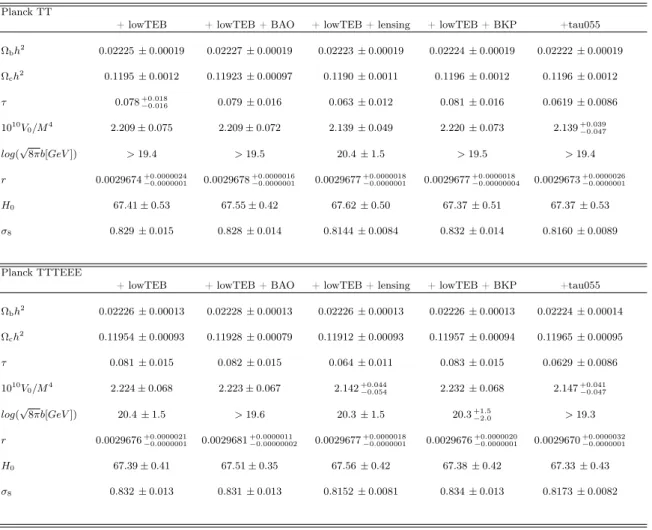
The result of all the explorations are given in Tables 2, 3, 4 and 5, where we report the
constraints at 68% c.l. on the cosmological parameters. All the bounds that we will quote
hereinafter there will be at 68% c.l., unless otherwise expressed. These Tables differ for the
Planck TT
+ lowTEB + lowTEB + BAO + lowTEB + lensing + lowTEB + BKP +tau055
Ωbh2 0.02225±0.00019 0.02227±0.00019 0.02223±0.00019 0.02224±0.00019 0.02222±0.00019
Ωch2 0.1195±0.0012 0.11923±0.00097 0.1190±0.0011 0.1196±0.0012 0.1196±0.0012
τ 0.078+0.018
−0.016 0.079±0.016 0.063±0.012 0.081±0.016 0.0619±0.0086
1010V
0/M4 2.209±0.075 2.209±0.072 2.139±0.049 2.220±0.073 2.139+0−0..039047
log(√8πb[GeV]) >19.4 >19.5 20.4±1.5 >19.5 >19.4
r 0.0029674+0.0000024
−0.0000001 0.0029678 +0.0000016
−0.0000001 0.0029677 +0.0000018
−0.0000001 0.0029677 +0.0000018
−0.00000004 0.0029673 +0.0000026
−0.0000001
H0 67.41±0.53 67.55±0.42 67.62±0.50 67.37±0.51 67.37±0.53
σ8 0.829±0.015 0.828±0.014 0.8144±0.0084 0.832±0.014 0.8160±0.0089
Planck TTTEEE
+ lowTEB + lowTEB + BAO + lowTEB + lensing + lowTEB + BKP +tau055
Ωbh2 0.02226±0.00013 0.02228±0.00013 0.02226±0.00013 0.02226±0.00013 0.02224±0.00014
Ωch2 0.11954±0.00093 0.11928±0.00079 0.11912±0.00093 0.11957±0.00094 0.11965±0.00095
τ 0.081±0.015 0.082±0.015 0.064±0.011 0.083±0.015 0.0629±0.0086
1010V
0/M4 2.224±0.068 2.223±0.067 2.142+0−0..044054 2.232±0.068 2.147 +0.041
−0.047
log(√8πb[GeV]) 20.4±1.5 >19.6 20.3±1.5 20.3+1.5
−2.0 >19.3
r 0.0029676+0.0000021
−0.0000001 0.0029681 +0.0000011
−0.00000002 0.0029677 +0.0000018
−0.0000001 0.0029676 +0.0000020
−0.0000001 0.0029670 +0.0000032
−0.0000001
H0 67.39±0.41 67.51±0.35 67.56±0.42 67.38±0.42 67.33±0.43
σ8 0.832±0.013 0.831±0.013 0.8152±0.0081 0.834±0.013 0.8173±0.0082
Table 2. 68% c.l. constraints on cosmological parameters in our baseline ΛCDM+r scenario from different combinations of datasets with a modified Starobisky inflation.
wCDM+r+Neff.
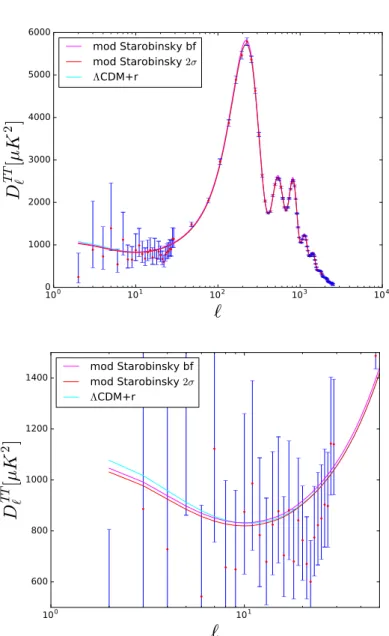
Regarding the results of the Table2, we notice that this modified version of the
Starobin-sky model produces a slightly better fit of the data, especially at the first peak and in the
low-` range, gaining about a ∆ ¯χ2 = 2.5, when considering Planck TT+lowTEB data and
its combinations, and an improvement of about a ∆ ¯χ2 = 3.2, when considering Planck
TT-TEEE+lowTEB data and its combination, with respect to the minimal standard cosmological
model ΛCDM+r (see Figs. 5 and 6). In any case, in the modified Starobinsky model, we
have one less degree of freedom, because r and nS are derived parameters, and we are vary
only 6 parameters instead of 7, as in the standard inflation. In particular, we have a better
fit of the low multipole range, improving the ∆ ¯χ2 of about1.4−1.7 and improving the high
multipole range by about 0.7−1.0, depending on the considered combination of datasets.
The high-` improvement is probably due to the higher first peak preferred by the modified
Starobinsky model for the entanglement, with respect to the minimal standard cosmological
model ΛCDM+r.
When including the high-`’s polarization data, we have a further improvement of the
¯
100 101 102 103 104
`
0 1000 2000 3000 4000 5000 6000
D
TT `
[
µK
2
]
mod Starobinsky bf mod Starobinsky 2σ
ΛCDM+r
100 101
`
600 800 1000 1200 1400
D
TT `
[
µK
2
]
mod Starobinsky bf mod Starobinsky 2σ
ΛCDM+r
Figure 5. Comparison of the temperature CMB angular power spectrum computed for the best-fit
of our modified Starobinsky model (magenta), the lower 2σ limit of b for our modified Starobinsky
model (red), and the best-fit obtained with a minimal standard cosmological modelΛCDM+r (cyan),
with Planck 2015 TT+lowTEB data (points with error bars). The main differences between the two
models are at lower-` and on the amplitude of the peaks, that the Starobinsky model, modified for
the entanglement, prefer slightly higher and more in agreement with the data.
scenario. In fact, we have a shift at more than one standard deviation towards higher values
of the amplitude of the galactic dust for TE, in particular for the 217GHz and the 143×
217GHz, that are in better agreement with the expected values. We find thatAdust,T E143×217shifts from 0.34±0.08 to 0.54±0.13 and Adust,T E217 from 1.67±0.26 to 1.91±0.28 for Planck TTTEEE+lowTEB datasets.
By introducing this modified Starobinsky inflation, as can be seen from the comparison
of Table 2 and Table 6, we have very robust constraints for all the cosmological parameters
0 500 1000 1500 2000 2500
`
20 10 0 10 20 30 40 50
D
E
E
`
[
µK
2
]
mod Starobinsky ΛCDM+r
0 500 1000 1500 2000 2500
`
150 100 50 0 50 100 150
D
TE `
[
µK
2
]
mod Starobinsky ΛCDM+r
Figure 6. Comparison of the polarization CMB angular power spectra computed for the best-fit of our modified Starobinsky model (magenta) and the best-fit obtained with a minimal standard
cosmological modelΛCDM+r (cyan), with Planck 2015 TT+lowTEB data (points with error bars).
bothΩch2and the Hubble constantH0have stronger constraints in the modified Starobinsky
model than the pure inflation scenario, reducing the error bars by a half for all the dataset
combination considered here. For example, we have that Ωch2 = 0.1195±0.0022 for Planck
TT+lowTEB in the minimal standard cosmological modelΛCDM+r, which becomesΩch2=
0.1195±0.0012 in the modified Starobinsky model for the same combination of data, and
where H0 = 67.42 ±0.99 Km/s/Mpc becomes H0 = 67.41 ±0.53 Km/s/Mpc. For this
reason, the tension existing between the Planck data and the direct measurements of the
Hubble constant [20] increases up to 3.2σ. Moreover, if we look at the value ofS8, the other
famous tension between the Planck data and the weak lensing experiments, as for example
2.75
3.00
3.25
3.50
N
eff
66
67
68
69
H
0
PlanckTT+lowP+lensing
PlanckTT+lowP+BAO
PlanckTTTEEE+lowP+BAO
PlanckTTTEEE+lowP+H073p2
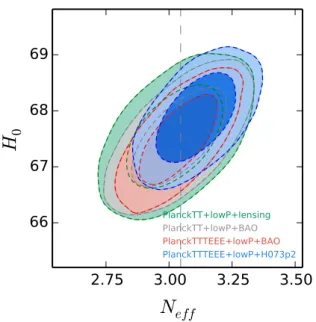
Figure 7. Constraints at 68% and95% confidence levels on theNeff vs H0 plane, in our modified
ΛCDM+r+Neff Starobinsky scenario.
S8 ≡σ8 p
Ωm/0.3, we have from the KiDS-450 collaborationS8 = 0.745±0.039, and we find
S8 = 0.849±0.020, i.e. a2.4σ tension.
When adding the lensing dataset, the optical depth shifts towards a lower value reducing
its error bar more than one third. This parameter, which is equal to τ = 0.067±0.017 for
Planck TTTEEE+lowTEB+lensing data in the minimal standard cosmological modelΛCDM,
becomes, τ = 0.064±0.011 for the same combination of measurements in the modified
Starobinsky model by quantum entanglement, in perfect agreement and with comparable error bars to the new value provided by the HFI data of the Planck collaboration.
Regarding the inflationary parameters that describe the theory analyzed here, we have
a very precise and robust expectation for the derived value of the tensor-to-scalar ratio r,
which is different from zero at several standard deviations. We find for this model, given
the combination of obtained parameters, that r ∼0.002968. If we look at Fig.4 that shows
the constraints at 68% and 95% confidence levels on the 1010V0/M4 vs log(b) plane, we
can see that there exists a lower limit for b at b > 1.2×10⁷GeV at 95% c.l. and V0 =
(2.208±0.075)×1010MP4 at 68% c.l. for Planck TT+lowTEB. An upper limit on b was obtained in [6] by considerations of the inflaton potential remaining nearly flat ∇∇φV4 ≤ 10−7
even in the presence of quantum entanglement corrections given by f[b, V]. Interestingly,
for some combination of datasets, as for example Planck TT+lowTEB+lensing datasets,
some indication at 1σ of an upper and lower bound appear for the ’SUSY breaking’ scaleb,
1.2×10⁷GeV < b < 6.5×10⁸GeV. We remember that from Fig. 4 we can derive the 2D lower limit onb, that is b >1.3×10⁷GeV at 1σ level. However, by marginalizing this result
over all the cosmological parameters, i.e. also over V0 to obtain the posterior distribution of
b, we find b > 5.7×10⁷GeV at 1σ level, as it is reported in Table 2. The best fit of the
parameter bwill be, instead, the value for which we have the minimum value for the χ2, and
this is different from the mean value, if the parameter is not totally gaussian distributed.
Planck TT
+ lowTEB + lowTEB + BAO + lowTEB + lensing + lowTEB + H073p2
Ωbh2 0.02224±0.00019 0.02226±0.00018 0.02222±0.00019 0.02232±0.00018
Ωch2 0.1201±0.0033 0.1191±0.0028 0.1185±0.0030 0.1206±0.0033
τ 0.078±0.017 0.079±0.017 0.064±0.013 0.077±0.016
1010
V0/M4 2.209±0.072 2.210±0.073 2.136±0.050 2.208±0.072
log(√8πb[GeV]) 20.5±1.5 20.4±1.5 >19.7 >19.5
r 0.0029680+0−0..000001300000003 0.0029679 +0.0000015
−0.00000002 0.0029682 +0.0000010
−0.00000002 0.0029680 +0.0000013 −0.00000003
Neff 3.06±0.13 3.04±0.12 3.02±0.12 3.12±0.12
H0 67.43±0.58 67.53±0.55 67.53±0.58 68.00±0.56
σ8 0.831±0.015 0.828±0.014 0.8134±0.0092 0.830±0.015
Planck TTTEEE
+ lowTEB + lowTEB + BAO + lowTEB + lensing + lowTEB + H073p2
Ωbh2 0.02227±0.00014 0.02228±0.00014 0.02226±0.00014 0.02234±0.00013
Ωch2 0.1198±0.0025 0.1192±0.0023 0.1189±0.0024 0.1204±0.0024
τ 0.081±0.015 0.082+0.017
−0.015 0.064±0.012 0.080±0.016 1010
V0/M4 2.223±0.067 2.227±0.069 2.141±0.0048 2.223±0.069
log(√8πb[GeV]) >19.5 >19.4 >19.5 20.4+1.4
−2.0
r 0.0029679+0−0..000001400000005 0.0029676 +0.0000021
−0.00000005 0.0029679 +0.0000015
−0.00000001 0.0029680 +0.0000013 −0.00000004
Neff 3.06±0.10 3.042±0.099 3.032±0.099 3.111±0.099
H0 67.46±0.52 67.50±0.51 67.51±0.51 67.88±0.50
σ8 0.833±0.013 0.831±0.013 0.8148±0.0084 0.833±0.013
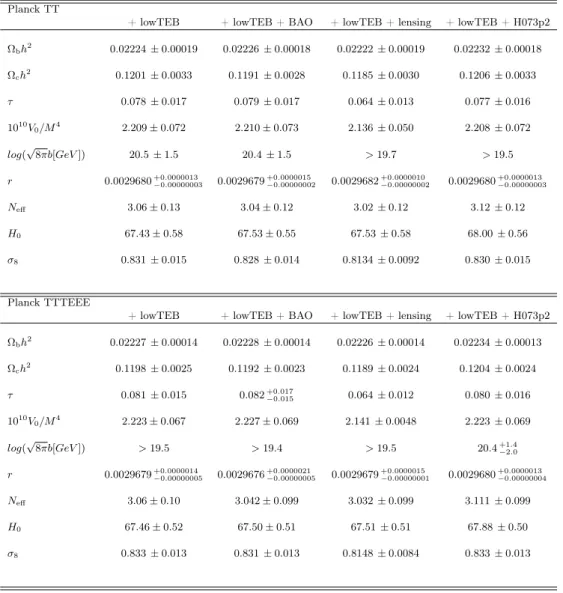
Table 3. 68% c.l. constraints on cosmological parameters in our extended ΛCDM+r+Neff scenario from different combinations of datasets with a modified Starobinsky inflation.
a free dark radiation component is considered, then this theory produces a slightly better
fit of the data by gaining about a ∆ ¯χ2 = 2.9, when considering PlanckTT+lowTEB and its
combinations, with respect to a pure inflation ΛCDM+r+Neff model. However, also in this
case, the modified Starobinsky model has one less degree of freedom. We consider Neff free
to vary, because in this way data usually can accommodate inflationary potentials that are
otherwise disfavored, thanks to its the degeneracy with the scalar spectral index nS.
In this modified Starobinsky scenario, by introducing a dark radiation component free
to vary Neff, we have very robust constraints for all the cosmological parameters, except
Ωch2, which have no significant shifts with respect to ΛCDM+r model (see Table 2). In the
minimal standard cosmological model (see Table 6), or in other inflationary models (see for
example [24,25]), to introduce aNeff free to vary produces a value for this neutrino effective number higher than its expected value3.045[26,27], and a shift of all the parameters that are
2.0
2.1
2.2
2.3
2.4
10
10
V
0
/M
4
0.03
0.06
0.09
0.12
τ
PlanckTT+lowP+BAO
PlanckTTTEEE+lowP+BAO
PlanckTT+lensing
PlanckTT+tau055
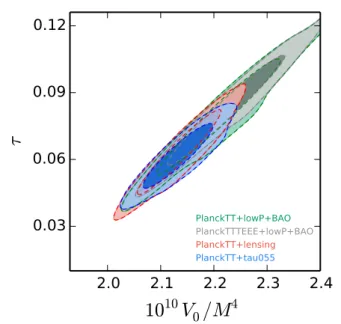
Figure 8. Constraints at68%and95%confidence levels on the1010V0/M4vsτplane, in our modified
ΛCDM+r+Neff Starobinsky scenario.
Hubble constant H0 (see Fig. 7), several authors have tried to solve the tension between the
constraints coming from the Planck satellite [28] and [18] and the local measurements of the
Hubble constant of Riess at al. [29] and [20], thereby increasing the neutrino effective number
[25, 32–34]. In the modified Starobinsky scenario, as showed for the standard Starobinsky
model in [24], this solution is no longer suitable, because we have stronger bounds on theNeff, which is now in excellent agreement with its standard value, in all the cases. For example, if we look at the results for Planck TT+lowTEB, in the minimal standard cosmological model
ΛCDM+r+Neff, we have Neff = 3.23+0−0..3630 and H0 = 68.9+2−3..72 (see Table 6), while in the
modified Starobinsky model for the same combination of data we find Neff = 3.06±0.13 and
H0 = 67.43±0.58, with the error bars reduced at one third and one fifth with respect to the standard model. This happens because in the modified Starobinsky scenario, we are selecting a restricted number of models with a specific scalar spectral index, reducing the allowed
parameter space for Neff that is strongly degenerate with it. In this case, the tension on the
Hubble constant becomes of 3.2σ. Moreover, if we look at the value of S8 = 0.850±0.022,
the tension existing with KiDS-450 [31] becomes of2.3σ.
Although there is this inconsistency at more than 3σ considering our scenario for the
value of the Hubble constant and that one measured in [20], we tried in any case to add the
prior H0= 73.2±1.7 km/s/Mpc, to check the stability of our results. This prior produces a
shift of half sigma of bothNeff = 3.12±0.12and H0 = 68.00±0.56 when adding H073p2 to
Planck TT+lowTEB, but doesn’t change our conclusions. Constraints are very robust and still prefer the standard value for the neutrino effective number and a Hubble constant in tension at about 2.8σ with [20].
Moreover, the cold dark matter densityΩch2has very relaxed constraints by considering
the ΛCDM+r+Neff scenario (see Table 3), than the scenario without dark radiation (see
Table 2). For example we have in the first scenario, that Ωch2 = 0.1201±0.0033 for Planck
Planck TT Planck TT Planck TTTEEE Planck TTTEEE Planck TTTEEE Planck TTTEEE
+ lowTEB + lowTEB + lensing + lowTEB + BAO + lowTEB + lensing +tau055 + lowTEB + H073p2
Ωbh2 0.02228±0.00019 0.02224±0.00018 0.02227±0.00013 0.02227±0.00014 0.02227±0.00014 0.02227±0.00013
Ωch2 0.1195±0.0012 0.1188±0.0011 0.11947±0.00091 0.11906±0.00093 0.11951±0.00094 0.11950±0.00091
τ 0.076±0.017 0.056±0.013 0.081±0.015 0.056±0.013 0.0612±0.0086 0.079±0.015 1010V
0/M4 2.200±0.075 2.104±0.054 2.220±0.067 2.105−+00..049058 2.136 +0.038
−0.043 2.211±0.068
log(√8πb[GeV]) 20.4+1.9
−1.5 >19.6 >19.6 20.5±1.4 20.0
+2.0
−1.0 20.4±1.5
r 0.0029677+0.0000018
−0.00000001 0.0029681 +0.0000013
−0.000000003 0.0029681 +0.0000012
−0.000000001 0.0029682 +0.0000010
−0.00000001 0.0029676 +0.0000021
−0.00000005 0.0029677 +0.0000019
−0.00000003
w −1.54+0.19
−0.39 −1.40
+0.27
−0.45 −1.025
+0.058
−0.050 −1.42
+0.26
−0.45 −1.56
+0.18
−0.38 −1.202±0.061
H0 >80.7 81+20−9 68.2
+1.4
−1.6 81
+20
−7 >81.4 73.6±1.9
σ8 0.98+0−0..1106 0.92 +0.12
−0.07 0.839±0.021 0.92
+0.12
−0.07 0.97
+0.10
−0.05 0.887±0.022
Table 4. 68%c.l. constraints on cosmological parameters in our extended wCDM+r scenario from different combinations of datasets with a modified Starobinsky inflation.
2.0
1.5
1.0
0.5
w
60
70
80
90
100
H
0
PlanckTT+lowP+lensing
PlanckTTTEEE+lowP+BAO
PlanckTTTEEE+lowP+H073p2
Figure 9. Constraints at 68% and 95% confidence levels on the w vs H0 plane, in our modified
wCDM+r Starobinsky scenario.
0.1195±0.0012. Also in this extendedΛCDM+r+Neff scenario, as in theΛCDM+r scenario, by adding the lensing dataset, the optical depth will shift towards a lower value becoming
τ = 0.064±0.012for Planck TTTEEE+lowTEB+lensing (see Fig. 8).
Regarding the inflationary parameters in this extendedΛCDM+r+Neff model, by
con-sidering the modified Starobinsky scenario, the same conclusions of the baseline ΛCDM+r
are valid. We still predict a tensor-to-scalar ratio different from zero at several standard
deviations, with a mean value of about r ∼0.002968. Moreover,bstill has a lower limit, i.e.
b > 1.2×10⁷GeV at 95% c.l. and V0 = (2.209±0.072)×1010MP4 at 68% c.l., for Planck TT+lowTEB datasets, slightly stronger than before. Certain combinations of datasets give
Afterward, we show the bounds for the wCDM+r scenario, using the Starobinsky infla-tionary model to test the modifications derived from quantum entanglement from this theory of the origin of the universe, in Table 4.
In our modified Starobinsky inflationary model, also by varying the equation of state of the dark energy, we find robust constraints for most of the cosmological parameters, which
have no significant shifts with respect to ΛCDM+r model (see Table2). However, due to the
strong degeneracy existing between wandH0, see Fig.9, we have a large shift of the Hubble
constant. For this reason, one can try to consider a dark energy component free to vary,
to solve the tension between the value of H0 measured by the Planck satellite [28] and [18]
and Riess at al. [29] and [20]. Also in this modified Starobinsky inflation, the tension can be solved if we consider an equation of statew <−1, as it has been shown by several authors (see
for example [35, 44]). In fact, we find that, when considering Planck TT+lowTEB+lensing,
we have w =−1.40+0−0..2745 and H0 = 81+20−9 is in agreement within 1σ with [20]. In this case
we can also solve the tension with the KiDS-450 experiment [31], findingS8 = 0.784±0.038
perfectly in agreement with it. By varying w, we can safely consider the prior H073p2 to
Planck TTTEEE+lowTEB, and we find w=−1.202 ±0.061, smaller than the cosmological
constant by more than 3σ andH0 = 73.6 ±1.9. However, in this case, we restore the tension
at 2σ level with the KiDS-450 experiment [31], obtaining S8 = 0.830±0.019.
Moreover, when we consider the BAO dataset, the dark energy equation of state is
consistent with a cosmological constant with equation of state w=−1, thus a slight tension
at 2σ reappears between this Hubble constant and [20].
Regarding the inflationary parameters, we find the same results of the previous scenario
ΛCDM+r. We have the same predicted tensor-to-scalar ratio. The ’SUSY-breaking’ scale
associated with the landscape effects b has a lower limit, i.e. b > 1.3×10⁷GeV at 95% c.l.
and V0 = (2.200±0.075)×1010MP4 at 68% c.l., for Planck TT+lowTEB. Again we find
that certain combinations of datasets give an indication at 1σ for b, as for example Planck
TTTEEE+lowTEB+lensing.
Finally, In Table5 we show the bounds for thewCDM+r+Neff scenario for this theory.
Again we find no significant shifts with respect to ΛCDM+r model (see Table 2), and
the extended parameters Neff and w give the same results as in the Tables 3 and 4. Our
previous conclusions are not affected by the introduction of more degrees of freedom in the model. The implication coming out of these tests is a strong bound for the neutrino number
Neff, in excellent agreement with its standard value, andw <−1andH0 that is in agreement
within 1σ with [20] for Planck TTTEEE+lowTEB+lensing.
4.2 The Quantum Landscape Multiverse
A theory for the origin of the universe from a quantum landscape multiverse was proposed and
developed in [4–7]. By studying the wavefunction of the universe through the landscape by
means of quantum cosmology, this proposal was able to explain why the most probable initial state of the universe is at high energies. Decoherence and the entanglement of our branch of
the wavefunction with all others led to a series of predictions derived in [6]. The effect comes
from the quantum entanglement of our universe with all others and it imprints a series of anomalies in the observables of our sky. However the initial derivation of the modifications from entanglement, imprinted in the CMB and the large scale structure of the universe, was
illustrated in [6] for a convex inflationary potential, the exponential model.
Planck TT Planck TTTEEE Planck TTTEEE + lowTEB + lowTEB + lowTEB + lensing
Ωbh2 0.02229±0.00019 0.02229±0.00014 0.02226±0.00014
Ωch2 0.1195±0.0032 0.1196±0.0025 0.1185±0.0024
τ 0.076±0.017 0.077±0.016 0.058±0.013
1010
V0/M4 2.195±0.074 2.201±0.068 2.109±0.052
log(√8πb[GeV]) >19.5 20.6±1.4 20.6±1.4
r 0.0029679+0−0..000001500000001 0.00296836
+0.00000075
−0.00000002 0.00296831
+0.00000085 −0.00000002
Neff 3.05±0.12 3.05±0.10 3.023±0.099
w −1.53+0.19
−0.41 −1.55 +0.18
−0.38 −1.41 +0.27 −0.45
H0 >80.5 >81.6 81+20−9
σ8 0.975+0−0..1106 0.99
+0.10
−0.05 0.92 +0.12 −0.07
Table 5. 68% c.l. constraints on cosmological parameters in our extendedwCDM+r+Neff scenario from different combinations of datasets with a modified Starobinsky inflation.
of concave downwards potentials in [7]. The class of concave downwards potentials involves
subtleties and need careful derivations, whenever the semiclassical approximation is invoked in quantum cosmology, which was the case for implementing the calculations in this theory. We now know that concave downwards potentials, (with the Starobinsky model and the hilltop inflation models as representatives), are the potentials favored by the Planck collaboration data. The predictions for modifications in the CMB and LSS recently derived for concave
potentials in [7], are based on nonlocal modifications that entanglement introduces to the
field potentialVef f. As reviewed in Section2, these modify the Friedmann equation, the field
solutions φ[k]and consequently the gravitational potential of the universe Φ0 by an amount
δΦ,Φ'Φ0+δΦ. Since the gravitational potential is related to the energy density, then the
effective potential correction can be related to a gravitational potential modification, through the Poisson equation,∇2δΦ = 4πf(b, V). Note that the modification termf[b, V]is negative.
The modified gravitational potential of the universe, and an upper bound forbfrom the
flatness condition on the inflaton potential, were discussed in detail in [6]. Here the lower
bound on b is obtained from analyzing the Planck data.
The key to our analysis are finding the bounds on the parameter b which control the
modification term. If the allowed value by current data on b is such that the correction
f[b, V] to the potential Vef f is 10−20% of the unmodified potential V(φ) then the series
of predictions for the anomalies made in [6] for this theory, fall within the observed range.
Explicitly, analyzing the modifications against current data for the model at hand, we find the
following: the slow roll of the field changes at the lowest k'(0−1)hM pc−1 and at around
k ' 20hM pc−1 leading to suppressed perturbations at those modes and efolds, see Fig. 10. These suppressed perturbations derived from the modified solution of the slow rolling field and the modified potential, can also be seen in the modification in the gravitational potential
correction δΦ[k]. The k O(1) suppression produces a power asymmetry at the dipole level.
was done in detail in [6] (k'1/ahM pc−1 whereais the scale factor), then the suppression at k ' 20hM pc−1 corresponds to a density suppression by about 30% for the lower bound
b'1.5×10⁷GeV, which is most easily seen from the gravitational potential as a void. The
k ' 20hM pc−1 corresponds to a present day redshift of about z ' 1 and size of about 200M pch−1. Physically, the first of the suppressed perturbation modes k'1hM pc−1 occurs
because the modification term is strongest at the start of slow roll, i.e. at the lowest k and
gradually redshifts away. The second disturbance to the field’s slow roll, producing suppressed
perturbations at that efold, occurs at about k'20hM pc−1 and produces a giant void. This
discontinuity is due to the interplay of the strength of theLog versus theExponentialterms
(having different signs, see [6]) in the modification term in the potentialf[b, V]. However the
modification of the potentialVef f−V =f[b, V]which depends on the SUSY breaking scaleb
should be at least of order 10%of the unmodified potential, in order to produce a significant
effect in the suppression of the power spectrum and the correct density contrast suppression for the void. To avoid repetition, we refer the reader to [4–7] for detailed derivations of the effects summarized here.
By placing lower bounds onb through the data, we find that all the anomalies,
includ-ing the giant void, power asymmetry and suppression of the temperature spectrum at low multipoles, are produced for 1.2×10⁷ < b <1×10⁸GeV, while being in excellent agreement with all the astrophysical data accumulated so far. The overall features of the anomalies, such as the suppression of power and suppressed perturbation modes, remains for all values
ofb. However the effect becomes less significant as bis dialed up to higher values because the
correction terms become really small relative to the unmodified potential. For our case that
value of bwhere the modification term is less than 5% of the potential isb= 6×10⁸GeV.
We here derived the CMB and LSS observables, such as the power spectra, the scalar spectral index, the gravitational potential, and the tensor-to-scalar ratio for the modified Starobinsky model obtained from this theory, and analyzed it against the most recent available datasets, including the polarization data. The analysis shows that the modified Starobinsky
model can fit the Planck data as well as the minimal standard cosmological modelΛCDM+r.
Further, the constraint we find on the parameter from the most recent data available is
b >1.2×10⁷GeV which lie within the 2σ region. This is our most important finding for the
concave type potentials: b and f[b, V] from the data constraints, allow for modifications to
the potential to be in the range Vef f be20%−30%in strength at the onset of inflation. This
finding is significant because it confirms that the allowed range forbandV are such that these
models are in excellent agreement with Planck temperature and polarization datasets, while being sufficient to explain the series of anomalies, first predicted in [6] for this theory, namely:
a power suppression at low multipoles, which for the lower limit onbwe find here corresponds
to a power suppressed by 12% at low-`’s; a modification strength f[b, V] to the inflaton
potential by 30% leading to a disturbance of the slow rolling behaviour of perturbations at
very low k, (those around the dipole/quadrupole level), exhibiting as a power asymmetry
between the the two hemispheres; another discontinuity at around k '20hM pc−1 showing
today as a giant void at z'1 and size of about '200M pch−1; a slightly suppressed overall
r[k]; a very mild running for the scalar index n[k]; and σ8 '0.8.
5 Conclusions
10-5 10-4 0.001 0.010 0.100 1 10 k 0.89046
0.89048 0.89050 0.89052 0.89054 0.89056 ϕ/ϕ0
φ/φ0
κ 200 400 600 800 1000k
0.89055 0.89060 0.89065 0.89070 ϕ/ϕ0
φ/φ0
k
10-6 0.001 1 1000 k
-0.175
-0.170
-0.165
-0.160
-0.155
ΔP/P0
ΔP/P0
k
Figure 10. The ratio of the modified field solution φ[k]/φ0[k] and the modified power spectrum
P[k]−P0[k]
P0[k] for a value of the SUSY-breaking scale b = 1.56×10
7GeV and V
0 = 2.25×10⁻¹⁰Mp4
within the 2 sigma allowed region in the likelihood plots of Section 4. We chose this value of b just
as an illustration of the effects, since the difference in the power spectrum is more dramatic. It can
be seen that the power is suppressed by about 14% at low multipoles producing a suppression of
temperature autocorrelation at low multipoles, and the field changes behaviour at the dipole level
k ≈ (0−1)hM pc−1 and at k ≈20hM pc−1 leading to suppressed perturbations of these k−modes,
corresponding to the power asymmetry, and a giant void at z ∼1 of size about 200M pch−1. The
overall behaviour persists for different values of b, V. However the effect gets smaller asbincreases.
quantum landscape multiverse, not only falls within the allowed range of the Planck data on
CMB temperature and polarization, but it is also consistent with the range forb that allows
the landscape multiverse to explain a serie of anomalies, such as power suppression and the giant void, present in the current Planck 2015 data [1–3].
The lower boundb >5.3×10⁷GeV and the constraintV0 = 2.209×10⁻¹⁰Mp4at 1σlevel
are obtained here from analyzing the Planck 2015 data. We find that the modified Starobinsky
model can fit the Planck data as well as the minimal standard cosmological modelΛCDM+r,
by improving the ∆ ¯χ2 = 2.5 for Planck TT+lowTEB data, probably because it can better
recover the first peak and the lower quadrupole of the temperature angular power spectrum.
Anyway, in the modified Starobinsky model, we have one less degree of freedom, because r
is a derived parameter and we are varying only 6 parameters instead of7, as in the minimal
standard cosmological model ΛCDM+r. Interestingly, for some combination of datasets, as
for example Planck TT+lowTEB+lensing datasets, some indication at 1σ level of an upper
Moreover, we have a very precise and robust expectation for the derived value of the
tensor-to-scalar ratio r ∼0.002968. All the other cosmological parameters have no significant shift
with respect to the minimal standard cosmological modelΛCDM+r. Moreover, we tested the
robustness of our results and, also considered extensions of the number of parameters that we are letting free to vary. First, we consider the effective number of relativistic degrees of
freedom Neff because it is strongly degenerate with the scalar spectral index nS, and with
this additional degree of freedom the data can usually accommodate inflationary potentials that are otherwise disfavored. We find instead, that in our modified Starobinsky scenario, the number of neutrino species is perfectly in agreement with the theoretical expected value
Neff = 3.045. We tried also to consider a dark energy equation of state w free to vary, because in this way we can solve the tensions between Planck and external datasets, as
the direct measurements of the Hubble constant [20] and the S8 [30, 31]. In our modified
Starobinsky scenario, we find that, also when considering Planck TT+lowTEB+lensing, a
w < −1 can solve both the tensions. All the other cosmological parameters, in particular
b, have no significant shift with respect to baseline ΛCDM+r modified for the Starobinsky
model.
Finding a model, which theoretically tells a consistent and coherent story of the evo-lution of the universe from its quantum infancy before it underwent inflation to present, is obviously important. But if that model goes beyond a theoretical explanation of the origin of the universe and it fits the standard cosmological parameters such as the temperature and polarization spectra, and predicts a series of anomalies in agreement with the Planck experiment, then it becomes more exciting since it offers us new hints into the physics of the universe from the time the universe was a quantum wavefunction and beyond.
Of course it remains to be seen whether these findings remain solid for other models of inflation. Since the class of inflationary models is large, we can not analyze all of them one by one in the light of this theory. Instead in a companion paper we will analyze the class of hilltop models of inflation to complete the study of concave downwards potentials, and revisit
the exponential model [45].
Note on the History of The Model
The model of inflation discussed here is mostly known in literature as the Starobinsky model. The history of this model was brought to our attention by various colleagues. Although the history of the model is not related to the scope of the paper, we thought it is of interest
and important to share it here. In 1980 Starobinsky proposed the R2 model similar to the
current one in the context of Einstein gravity with conformal anomaly and his focus was on particle creation, in particular graviton production. Since this paper appeared before the theory of inflation was proposed, it was not focused in addressing the usual issues that flatness, homogeniety and isotropy, that inflationary models address. In 1981 Mukhanov and Chibisov studied perturbations of the model and in 1983 Starobinsky introduced the current
R +R2 version of the model, also studied independently in the same year by Barrow and
Ottewill. In 1984 Whitt showed that by changing from Einstein to Jordan frame this model can be equivalently described by a scalar field rolling down a potential V as the one in Eq.4. Then in 1985, Kofman, Linde and Starobinsky, modified the proposal of the 1980 paper by
Starobinsky, and explicitly showed the modified version R+R2 to be a model of inflation
in the plethora of the inflationary paradigm models. Further papers in 1988 by Barrow, and Maeda, discussed this model as an inflationary model. The papers mentioned here in an
historic context can be found below in Ref. [8,36–43]. Since then, there is a vast amount
Planck TT Planck TTTEEE Planck TT Planck TTTEEE
+ lowTEB + lowTEB + lowTEB + lowTEB
Ωbh2 0.02224±0.00023 0.02225±0.00016 0.02240±0.00037 0.02219±0.00025
Ωch2 0.1195±0.0022 0.1197±0.0014 0.1214+0−0..00390043 0.1191±0.0031
τ 0.077±0.019 0.078±0.017 0.082+0−0..021025 0.076±0.018
log(1010AS) 3.087±0.036 3.092±0.033 3.102−0+0..046052 3.086±0.038
nS 0.9666±0.0062 0.9652±0.0047 0.974±0.016 0.963±0.010
r <0.0472 <0.0463 <0.0529 <0.0487
Neff (3.046) (3.046) 3.23−0+0..3036 3.00 ±0.21
H0 67.42±0.99 67.31 ±0.64 68.9+2−3..72 66.9±1.7
σ8 0.828±0.014 0.830±0.013 0.837+0−0..022025 0.827±0.018
Table 6. 68% c.l. constraints on cosmological parameters considering the minimal standard cosmo-logical model for different combinations of datasets.
provide its history.
Acknowledgments
We would like to thank F. R. Bouchet, A. Melchiorri, A. Linde and J. Barrow, for stimulating discussions and comments, and the Planck Editorial Bord for taking the time to review the paper and to approve it. This work has been done within the Labex ILP (reference ANR-10-LABX-63) part of the Idex SUPER, and received financial state aid managed by the Agence Nationale de la Recherche, as part of the programme Investissements d’avenir under the reference ANR-11-IDEX-0004-02. LMH acknowledges support from the Bahnson funds.
References
[1] P. A. R. Adeet al.[Planck Collaboration], “Planck 2015 results. XX. Constraints on inflation,”
arXiv:1502.02114 [astro-ph.CO].
[2] P. A. R. Adeet al.[Planck Collaboration], “Planck 2015 results. XVI. Isotropy and statistics of
the CMB,” arXiv:1506.07135 [astro-ph.CO].
[3] P. A. R. Adeet al.[Planck Collaboration], “Planck 2013 results. XXIII. Isotropy and statistics
of the CMB,” Astron. Astrophys.571, A23 (2014) [arXiv:1303.5083 [astro-ph.CO]];
P. A. R. Adeet al.[Planck Collaboration], Astron. Astrophys.571, A22 (2014)
[arXiv:1303.5082 [astro-ph.CO]].
[4] L. Mersini-Houghton, Class. Quant. Grav.22, 3481 (2005) [hep-th/0504026]; A. Kobakhidze
and L. Mersini-Houghton, Eur. Phys. J. C49, 869 (2007) [hep-th/0410213];
[5] R. Holman and L. Mersini-Houghton, Phys. Rev. D74, 123510 (2006) [hep-th/0511102]; R. Holman and L. Mersini-Houghton, [hep-th/0512070]; L. Mersini-Houghton, AIP Conf. Proc.
878, 315 (2006) [hep-ph/0609157].
[6] R. Holman, L. Mersini-Houghton and T. Takahashi, Phys. Rev. D77, 063510 (2008)
[hep-th/0611223]; R. Holman, L. Mersini-Houghton and T. Takahashi, Phys. Rev. D77,
063511 (2008) [hep-th/0612142]; L. Mersini-Houghton, arXiv:0809.3623 [hep-th];
L. Mersini-Houghton and R. Holman, JCAP0902, 006 (2009) [arXiv:0810.5388 [hep-th]].
[7] L. Mersini-Houghton, arXiv:1612.07129 [hep-th].
[8] A. A. Starobinsky, Phys. Lett. B91, 99 (1980).
A. Kehagias, A. M. Dizgah and A. Riotto, Phys. Rev. D89, no. 4, 043527 (2014)
[arXiv:1312.1155 [hep-th]].
[9] L. Boubekeur and D. H. Lyth, JCAP0507, 010 (2005) [hep-ph/0502047], and references herein;
K. Kohri, C. M. Lin and D. H. Lyth, JCAP0712, 004 (2007) [arXiv:0707.3826 [hep-ph]].
[10] F. C. Adams, K. Freese and A. H. Guth, Phys. Rev. D43, 965 (1991).
doi:10.1103/PhysRevD.43.965
[11] R. Bousso and J. Polchinski, JHEP0006, 006 (2000) [hep-th/0004134]; M. R. Douglas,
Comptes Rendus Physique5, 965 (2004) [hep-th/0409207]; M. R. Douglas, JHEP0305, 046
(2003) [hep-th/0303194]; M. R. Douglas, [hep-th/0405279].
[12] N. Aghanimet al.[Planck Collaboration], [arXiv:1507.02704 [astro-ph.CO]].
[13] N. Aghanimet al.[Planck Collaboration], arXiv:1605.02985 [astro-ph.CO].
[14] P. A. R. Adeet al.[Planck Collaboration], arXiv:1502.01591 [astro-ph.CO].
[15] F. Beutleret al., Mon. Not. Roy. Astron. Soc.416(2011) 3017 [arXiv:1106.3366 [astro-ph.CO]].
[16] A. J. Rosset al., Mon. Not. Roy. Astron. Soc.449(2015) 835 [arXiv:1409.3242 [astro-ph.CO]].
[17] L. Andersonet al. [BOSS Collaboration], Mon. Not. Roy. Astron. Soc.441(2014) 1, 24
[arXiv:1312.4877 [astro-ph.CO]].
[18] P. A. R. Adeet al.[Planck Collaboration], arXiv:1502.01589 [astro-ph.CO].
[19] P. A. R. Adeet al.[BICEP2 and Planck Collaborations], Phys. Rev. Lett.114(2015) 10,
101301 [arXiv:1502.00612 [astro-ph.CO]].
[20] A. G. Riesset al., arXiv:1604.01424 [astro-ph.CO].
[21] A. Lewis and S. Bridle, Phys. Rev. D66, 103511 (2002) [astro-ph/0205436].
[22] A. Lewis, A. Challinor and A. Lasenby, Astrophys. J.538, 473 (2000) [astro-ph/9911177].
[23] A. Lewis, Phys. Rev. D87, no. 10, 103529 (2013) [arXiv:1304.4473 [astro-ph.CO]].
[24] T. Tram, R. Vallance and V. Vennin, arXiv:1606.09199 [astro-ph.CO].
[25] E. Di Valentino and F. R. Bouchet, arXiv:1609.00328 [astro-ph.CO].
[26] G. Mangano, G. Miele, S. Pastor, T. Pinto, O. Pisanti and P. D. Serpico, Nucl. Phys. B729,
221 (2005) [hep-ph/0506164].
[27] P. F. de Salas and S. Pastor, JCAP1607, no. 07, 051 (2016) [arXiv:1606.06986 [hep-ph]].
[28] P. A. R. Adeet al.[Planck Collaboration], Astron. Astrophys.571(2014) A16
[arXiv:1303.5076 [astro-ph.CO]].
[29] A. G. Riesset al., Astrophys. J.730(2011) 119 Erratum: [Astrophys. J.732(2011) 129]
[arXiv:1103.2976 [astro-ph.CO]].
[30] C. Heymanset al., Mon. Not. Roy. Astron. Soc.427, 146 (2012) [arXiv:1210.0032
[31] H. Hildebrandtet al., arXiv:1606.05338 [astro-ph.CO].
[32] A. Heavens, R. Jimenez and L. Verde, Phys. Rev. Lett.113(2014) no.24, 241302
[arXiv:1409.6217 [astro-ph.CO]];
[33] E. Di Valentino, E. Giusarma, O. Mena, A. Melchiorri and J. Silk, arXiv:1511.00975 [astro-ph.CO];
[34] M. Archidiacono, E. Giusarma, S. Hannestad and O. Mena, Adv. High Energy Phys.2013
(2013) 191047 [arXiv:1307.0637 [astro-ph.CO]].
[35] E. Di Valentino, A. Melchiorri and J. Silk, arXiv:1606.00634 [astro-ph.CO].
[36] L. A. Kofman, A. D. Linde and A. A. Starobinsky, Phys. Lett.157B, 361 (1985).
doi:10.1016/0370-2693(85)90381-8
[37] A. B. Goncharov and A. D. Linde, Phys. Lett.139B, 27 (1984).
doi:10.1016/0370-2693(84)90027-3
[38] A. A. Starobinsky, JETP Lett.37, 66 (1983).
[39] B. Whitt, Phys. Lett.145B, 176 (1984). doi:10.1016/0370-2693(84)90332-0
[40] J. D. Barrow, Nucl. Phys. B296, 697 (1988). doi:10.1016/0550-3213(88)90040-5
[41] J. D. Barrow and S. Cotsakis, Phys. Lett. B214, 515 (1988). doi:10.1016/0370-2693(88)90110-4
[42] K. i. Maeda, Phys. Rev. D37, 858 (1988). doi:10.1103/PhysRevD.37.858
[43] J. D. Barrow and A. C. Ottewill, J. Phys. A16, 2757 (1983). doi:10.1088/0305-4470/16/12/022
[44] Q. G. Huang and K. Wang, Eur. Phys. J. C76, no. 9, 506 (2016) [arXiv:1606.05965
[astro-ph.CO]].