Title
Functional Intimacy: Needing-but not Wanting-the Touch of a Stranger Permalink
https://escholarship.org/uc/item/55t3q8pw Journal
JOURNAL OF PERSONALITY AND SOCIAL PSYCHOLOGY, 113(6) ISSN
0022-3514 Authors Schroeder, J Fishbach, A Schein, C et al.
Publication Date 2017-12-01
DOI
10.1037/pspi0000104 Peer reviewed
eScholarship.org Powered by the California Digital Library
IN PRESS, JOURNAL OF PERSONALITY & SOCIAL PSYCHOLOGY
Functional intimacy:
Needing—but not wanting—the touch of a stranger
Juliana Schroeder1, Ayelet Fishbach2, Chelsea Schein3, Kurt Gray3
1University of California Berkeley; 2University of Chicago; 3University of North Carolina
Corresponding Author: Juliana Schroeder
University of California, Berkeley 2220 Piedmont Avenue
Berkeley, CA 94720 Phone: 5106649692
Abstract
Intimacy is often motivated by love, but sometimes it is merely functional. For example,
disrobing and being touched at an airport security check serves the goal of catching a flight, not building a relationship. We propose that this functional intimacy induces discomfort, making people prefer greater social distance from their interaction partner. Supporting this prediction, participants who considered (Experiments 1 and 2) or experienced (Experiment 3) more
physically intimate medical procedures preferred a health-provider who is less social. Increased psychological intimacy also led people to prefer social distance from cleaning- and health-providers (Experiments 4-5), a preference revealed by nonverbal behavior (e.g., turning away and looking away, Experiments 6-7). These patterns of distancing are unique to functional (vs. romantic) intimacy (Experiment 7). Although creating social distance may be an effective strategy for coping with functional intimacy, it may have costs for service providers.
“I have a right to be in public anywhere (even at the airport) without being … intimately groped
without probable cause. What are airports, some kind of ‘normal-human-emotions-don't-exist
zone’?” – Washington Post reader, 11/25/2010
Emotional closeness typically accompanies physical intimacy. Kisses and caresses go
naturally with declarations of affection, but not all intimacy is tied to emotional connection.
Some intimacy is purely functional, undertaken to pursue non-relational goals. When an airport
security agent performs a full-body pat down or a physician performs an intimate medical
procedure, the recipients of these procedures are not seeking love, but only to catch their flight or
to stay healthy. On the one hand, security checks and medical procedures may be objectively
valuable services that recipients want, but on the other hand, the physical and psychological
intimacy inherent in these procedures is usually unwanted. As the Washington Post reader in the
opening quotation suggests, submitting yourself to being “intimately groped” by strangers at
airport security is at odds with normal human emotion. In these uncomfortable situations of
functional intimacy—intimacy that serves a non-relational goal—we propose that individuals
will socially distance themselves from their interaction partners. We test this hypothesis through
seven experiments.
Types of Intimacy
Prior research explores how people react to different types of intimacy, with most
focusing upon intimacy in relationships, that is, intimacy among two (or more) people interested
in forming, building, or maintaining a relationship (for review see Mashek & Aron, 2008). In this
context, individuals react to intimacy positively, both seeking and reciprocating intimacy to
achieve their goal of relationship closeness. A second type is “imposed intimacy,” whereby
sexual violations but also more mundane situations where individuals do not seek intimacy (e.g.,
crowded subway cars). In this context, the dominant response is to avoid the perpetrator of
intimacy and behaviorally “compensate” (Patterson, 1973). In the current paper, we study the
reaction to a third type of intimate interaction: “functional intimacy,” which is characterized by
acts that are prototypically associated with relationship intimacy (e.g., physical touch, emotional disclosure) but that occur not for the goal of relationship closeness but instead to satisfy other goals (e.g., completing a physician examination). Functional intimacy differs from prior types of intimacy because recipients face an approach-avoidance tension: wanting to satisfy their
non-relational goal but preferring to avoid the discrepant intimacy. To better understand functional
intimacy, we review the differences between these three types of intimacy below.
Intimacy in Close Relationships. In close relationships, intimacy is characterized by
features such as a sense of connectedness, shared understanding, and self-disclosure (Mashek &
Aron, 2008; Sexton & Sexton, 1982). In this context, intimacy and mutual disclosure helps
relationships progress (Altman & Taylor, 1973) and increases relationship investment,
commitment, and satisfaction (Hendrick, Hendrick, & Adler, 1988). Relationships higher in
intimacy therefore have greater psychological and physical benefits for the interactants,
including greater passion and sexual satisfaction (Rubin & Campbell, 2012), better psychosocial
adjustment (McAdams & Vallient, 1982), and stronger commitment (Clark & Reis, 1988).
The benefits of relationship intimacy arise from both physical intimacy (e.g., holding
hands and close spatial distance: Andersen 1985; Guerrero & Andersen, 1991; Mehrabian, 1969;
Patterson, 1988; Weitz, 1974) and psychological intimacy (e.g., the disclosure of personal
information and emotions: Berg, 1984; Gaebelein, 1976; Jourard, 1971; Morton, 1978). In
2013) and in experiments. For example, holding the hand of a loved one decreases the threat responses to electric shock, compared to holding the hand of a stranger or no hand holding
(Coan, Schaefer, & Davidson, 2006). In another experiment, married couples assigned to a touch
intervention showed reduced stress compared to those in the control condition (Holt-Lunstad,
Birmingham, & Light, 2008). Recent experiments suggest that even imagined touch can reduce
stress compared to control imaginations or verbal support (Jakubiak & Feeney, 2016). In sum,
when partners have a goal to form or strengthen a relationship, intimacy is desirable and it is
associated with host of positive outcomes.
Imposed Intimacy. In contrast to intimacy among close relations, intimacy among
strangers who have no desire to form a deeper relationship, such as among people standing on a
crowded subway car, can incite compensation instead of closeness. Behavioral compensation
theory (Cappella & Greene, 1982; Patterson, Mullens, & Romano, 1971; Patterson, 1976)
explores imposed intimacy: intimacy that is undesired and/or not personally selected (e.g., close
approach or staring initiated by a stranger). Unlike relationship intimacy (or functional intimacy,
as we next discuss) imposed intimacy is not instrumental; it serves no functional goal and
therefore, individuals wish to escape the intimate situation and the dominant response is
avoidance.
Compensation theory identified various ways of avoidance behavior: spatial distance,
body orientation, body leaning, and eye contact (Patterson, 1973). It proposes that recipients of
imposed intimacy try to entirely avoid the interaction by moving in the opposite direction or by
leaving the interaction altogether (Ellsworth, Carlsmith, & Henson, 1972; Patterson et al., 1971).
The extent of compensation is determined primarily by how much the act deviates from the
constitutes a violation of intimacy; Triandis, Davis, & Takezawa, 1965) and qualities of the
recipient (e.g., recipients with higher “threat thresholds” will compensate less; Burgoon & Jones,
1976). In complete opposition to relationship intimacy, this form of intimacy is associated with a
host of negative consequences for the recipient. For example, recipients who have suffered a
severe enough intimacy violation (e.g., rape) often show emotional trauma and depression
(Cohen & Roth, 1987; McDougall, Langille, Steenbeck, Asbridge & Andreou, 2017). Overall
then, whereas intimacy in close relationships incites reciprocal closeness, imposed intimacy
incites compensation.
Functional Intimacy. We propose a third, unexamined type of intimacy—functional
intimacy—that involves acts that are prototypically associated with relationship intimacy (e.g., touch, disclosure) but which fulfill only non-relational goals. For example, interactions with medical providers can require highly intimate procedures solely for the purpose of maintaining
health, not starting a relationship. We suggest that although functional intimacy does not (by definition) serve a goal of closeness (Prager & Roberts, 2008), and may not necessarily require self-disclosure (Reis & Shaver, 1988), it is nonetheless intimate. For example, a person may self-disclose to a therapist to enhance mental health. The latter behavior is consistent with functional
intimacy whereby the participant engages in a prototypically intimate act (disclosure) but with a
non-relational goal (mental health). Furthermore, a functionally intimate act may make other
aspects of the interaction feel likewise intimate. In the aforementioned example, even
non-intimate topics of conversation may feel more non-intimate once the person has self-disclosed.
We argue that functional intimacy creates a unique tension because recipients want the
instrumental outcomes of the intimacy without intrinsically desiring the intimacy itself. This
Miller, 1944; see also behavioral activation and inhibition systems in relationships, Carver &
White, 1994; Gable, Reis, & Elliot, 2000) which we study here. We note that our definition of
functionality is consistent with the goals literature because recipients use intimacy as a means to
achieve an overriding goal (see goal systems theory; Kruglanski, Shah, Fishbach, Friedman,
Chun, & Sleeth-Keppler, 2002). How, then, do individuals react to functional intimacy?
Reactions to Functional Intimacy
To understand reactions to functional intimacy, it is useful to first consider how people react in functional interactions that are non-intimate and occur either outside or within the context of close relationships. Many everyday functional interactions involve non-intimate services between people who are not necessarily close to each other (e.g., with cab drivers, waiters). In these situations, the person seeking to fulfill a goal (the recipient of help) typically approaches the person with the means to help them fulfill it (the provider of help). The
preference to approach these functional providers is characterized by “objectification” whereby providers are seen as mere tools for goal fulfillment rather than as fully developed humans (Gruenfeld, Inesi, Magee, & Galinsky, 2008; Nussbaum, 1999). For example, patients with functional health goals fail to perceive personal emotions in their physicians, because such feelings are irrelevant for meeting their goals (Schroeder & Fishbach, 2015). In another example of objectification, when participants are presented with instrumental (vs. non-instrumental) individuals (e.g., service providers like fitness coaches), they are more likely to later recall their skills that are goal-relevant (e.g., getting fit) and to confuse them with equally instrumental others (e.g., another fitness coach) in memory tests (Fitzsimons & Shah, 2009).
members to achieve instrumental goals (Fitzsimons & Fishbach, 2010). For example, one’s spouse can support one’s career and fitness goals. When relationship partners support each other’s non-relationship (functional) goals, this increases closeness and approach behavior. Indeed, instrumentality in close relationships improves the relationship because partners are satisfying more goals for each other (i.e., both functional and relationship goals, Fitzsimons, Finkel, & Vandellen, 2015).
The Social Distancing Hypothesis. We examine responses to functional intimacy—when intimacy is needed (to achieve the goal) but not wanted (because it feels discordant). We predict that recipients of functional intimacy will respond by seeking greater social distance from
interaction partners to mitigate their feelings of discomfort (which we define as feeling uneasy,
anxious, or embarrassed; see also Eisenberg, 2000; Keltner & Anderson, 2000). For example,
patients undergoing medical procedures or flyers undergoing airport security do not seek
closeness but instead submit to intimacy to satisfy their non-relational goals; this elicits
discomfort and consequently, we argue, social distancing.
Specifically, because people undergoing functional intimacy choose to do so, their
reaction is not based purely on avoidance (e.g., compensation theory), neither is it based on
approach (e.g., close relationship). Instead, their response is to prefer social distance. Critically,
unlike the complete avoidance found in imposed intimacy, social distancing in functional
intimacy seeks to reduce the surrounding elements of intimacy while still remaining in a
fundamentally intimate situation. In functional intimacy, people seek to obey the “letter” of
intimacy but not the “spirit,” removing the ancillary elements (e.g., eye contact, smiling talking)
We expect both physical and psychological functional intimacy to result in the same
preference for social distance. This preference can manifest in at least three different ways: 1) the
recipient is socially distant, 2) the provider is socially distant, or 3) the situation creates social
distance. First, social distancing can take the form of trying to personally distance oneself (i.e.,
self-distancing), for example by not providing one’s name. Second, people could prefer that their
partner creates distance (i.e., other-distancing), for example by wearing gloves, not talking, or
not paying much attention to the recipient. Finally, there could be a general preference to change
the environment to create distance, like preferring a barrier like a table between oneself and one’s
partner to prevent touching. The latter two methods of distancing may be preferred when the
recipient wants to appear polite and not offend the provider. Notably, any of these types of
distancing might interchangeably involve creating physical social distance (e.g., looking away)
or psychological social distance (e.g., not providing one’s name).
Current Studies
We test whether functional intimacy increases preference for social distance in seven
experiments using vignettes (Experiments 1, 2, and 4), a lab-based pulse-taking procedure
(Experiment 3), a field medical procedure (getting a flu shot; Experiment 5), and a novel
hand-holding/shaking task (Experiments 6 and 7). These experiments examine both physical
(Experiments 1-3) and psychological functional intimacy (Experiments 4-7), and measure social
distance via self-reported preferences or recommendations (Experiments 1-4), self-reported
behavior (Experiment 5), and actual behavior (Experiments 6 and 7). Experiment 7 examines the
mediating role of discomfort in driving preferences of social distance in functional intimacy, and
Pilot Study. Before testing our social distancing hypothesis, we first examine whether lay
people intuitively categorize functionally intimate interactions as “intimate.” An online survey provided 68 participants (Mage = 35.87 SD = 11.15, 35% male) with a list of acts involving low or
high functional intimacy. These acts were drawn from our own experiments (e.g., from
Experiment 1, seeing a person’s arm [low] or buttocks [high]; from Experiment 3, touching a
person’s wrist [low] or neck [high]). We asked participants to select whether each act was
intimate or not. As expected, the high functional intimacy acts were labeled as intimate 71% of the time, whereas the low functional intimacy acts were labeled as intimate with far less frequency only 16% of the time. Moreover, participants were always more likely to categorize the high functional intimacy act as “intimate” than the corresponding low functional intimacy act, ps < .001 (See Appendix for full details).
Experiment 1: Vaccination Shot
This experiment tested whether functional intimacy increases the preference for social distance by manipulating the intimacy of a common medical procedure: getting a vaccination shot. We asked participants to imagine receiving a vaccination shot in the arm (low functional intimacy) or the buttocks (high functional intimacy). We predicted that higher functional
sample size, all data exclusions, all manipulations, and all measures. Surveys and data for all experiments are publicly posted on OSF (https://osf.io/h3qj4/).
Method
We pre-registered our data collection and analysis plan at https://aspredicted.org/ib5v9.pdf.
Participants. We predetermined a sample size of 100 participants per condition. We
chose this sample size because it provides adequate statistical power to detect a medium effect size. In total, 209 adults from Amazon’s Mechanical Turk (Mage = 35.63, SD = 11.65, 48% male) participated in exchange for $0.30 each. We tested for attrition (following Zhou & Fishbach, 2016): no participants dropped the survey after being assigned to condition.
Procedure. Participants read a vignette asking them to imagine that they would like to
get a vaccination shot before traveling—a non-relational goal. The vaccine would be
administered in their upper arm (low functional intimacy) or upper buttocks (high functional intimacy). As a manipulation check, participants reported how intimate getting the shot would be (1=Not at all intimate; 7=Very intimate).
To measure the preference for social distance, participants answered six items (presented in randomized order) about their preference for the nurse’s behavior while administering the shot (1=Not at all preferred; 7=Strongly preferred): 1) the nurse wears plastic gloves, 2) the nurse does not make small talk with me, 3) the nurse stands away from me, 4) the nurse pays little extra attention to me, 5) the nurse does not make eye contact with me, and 6) the nurse treats me as just another job to do. Finally, we asked participants whether they believed the location of the shot would affect their preferences about the nurse (yes or no).
Confirming our manipulation of intimacy, participants believed getting a shot in the buttocks would feel more intimate (M = 3.70; SD = 1.97) than getting one in the arm (M = 2.44; SD = 1.58), t(207) = 5.07, p < .001, 95% CI of the difference [0.77, 1.74], d = 0.70. We next
collapsed the six items measuring preference for social distance (α = .74). Supporting our primary hypothesis, participants preferred that the nurse maintain more social distance when the nurse gave them a shot in the buttocks (M = 4.53, SD = 1.22) than in the arm (M = 3.46, SD = 0.97), t(207) = 7.01, p < .001, 95% CI of the difference [0.77, 1.37], d = 0.97. Despite the modest reliability of the scale, all items showed the same pattern of effect.
Although the location of the shot influenced the desire for social distance, the majority of participants (incorrectly) believed that it would not (70.0%). Participants in the high functional intimacy condition did have a better sense of this effect (43.8% believed the location of the vaccine it would affect their preferences, compared to just 15.4% in the low functional intimacy condition), χ2 (n = 209) = 20.23, p < .001, and it is possible that providing participants with information about both conditions could further increase their insight. Nevertheless, regardless of whether people can infer the effects of functional intimacy, these results reveal that functional intimacy does increase the preference for social distance, consistent with our prediction.
Experiment 2: Airport Security & Dermatology Examination
We sought to generalize our findings in Experiment 1 by testing two different functionally intimate situations: an airport security examination and a dermatologist
functional intimacy creates feelings of discomfort, this may make other aspects of the interaction also feel more intimate, including social aspects. That is, the functionally intimate act
contextualizes the other acts to make them feel likewise more intimate. Method
We pre-registered our data collection and analysis plan at https://aspredicted.org/cg2cy.pdf.
Participants. We recruited the same sample size as in Experiment 1, of at least 100
participants per condition. In total, 410 adults from Amazon Mechanical Turk (Mage = 34.15, SD = 10.66; 38% male, missing 3 participants’ demographic information) participated in exchange for $0.30 each. We found no evidence of attrition in this sample.
Procedure. We employed a 2 (functional intimacy: high vs. low) × 2 (scenario: airport
security vs. dermatology exam) between-participants design. In the high functional intimacy airport scenario, a Transportation Security Administration (TSA) agent performed a pat-down of the participant’s body whereas in the low functional intimacy scenario the agent performed a pat-down of the participant’s bag. In the high functional intimacy dermatology scenario, a
dermatologist examines the skin on the participant’s entire body whereas in the low functional intimacy scenario the dermatologist examines the skin on the participant’s hand.
To measure social distance, we asked participants how much they would prefer that the agent/dermatologist does not do the following four behaviors (1=Not at all true; 7=Very true): 1) makes eye contact with you; 2) smiles at you; 3) asks for your name; 4) tells you something about his or her life.
agent/dermatologist did the same four behaviors (1=Not at all intimate; 7=Very intimate): 1) makes eye contact with you; 2) smiles at you; 3) asks for your name; 4) tells you something about his or her life.
Results and Discussion
An ANOVA of the index of the preference for social distance (α = .87) on 2 (functional intimacy: high vs. low) × 2 (scenario: airport security vs. dermatology exam) yielded the
predicted main effect for intimacy, F(1, 406) = 173.95, p < .001, ηp2 = 0.30. Participants reported greater preference that the service provider not engage in social behaviors in the high functional intimacy condition (M = 4.96, SD = 1.72) than in the low functional intimacy condition (M = 2.98, SD = 1.62), t(408) = 12.02, p < .001, 95% CI of the difference = [1.66, 2.31], d = 1.19. Although this effect was statistically significant in both scenarios, it was unexpectedly moderated by an interaction, F(1, 406) = 4.91, p = .027, ηp2 = .01, such that the effect of functional intimacy on social distancing was stronger in the airport scenario (Mhigh intimacy = 5.81, SD = 1.44 vs. Mlow
intimacy = 3.50, SD = 1.61), t(202) = 10.82, p < .001, 95% CI of the difference = [1.89, 2.73], d = 1.51, than in the dermatology scenario (Mhigh intimacy = 4.11, SD = 1.55 vs. Mlow intimacy = 2.47, SD = 1.47), t(204) = 7.81, p < .001, 95% CI of the difference = [1.23, 2.06], d = 1.09 (see Figure 1). This suggests there is nothing unique about the functional intimacy in medical procedures. There was also a main effect for scenario, F(1, 406) = 83.20, p < .001, ηp2 = 0.17, suggesting that participants desired more social distance with the TSA agent (M = 4.66, SD = 1.91) than with the dermatologist (M = 3.28, SD = 1.72).
Figure 1.
difference = [0.31, 0.94], d = 0.39. For example, making eye contact felt more intimate in the context of full body (vs. hand) examination and in the context of body (vs. bag) check. This effect of functional intimacy was also moderated by an interaction, F(1, 406) = 6.18, p = .013, ηp2 = 0.02, such that the effect was greater for the airport security interaction, t(202) = 4.38, p < . 001, 95% CI of the difference = [0.55, 1.46], d = 0.62, than for the dermatology interaction, t(204) = 1.18, p = .240, 95% CI of the difference = [-0.16, 0.65], d = 0.17. There was also a main
effect for scenario: in the context of the airport security, other aspects of the interaction felt more intimate (M = 4.51, SD = 1.83) than the dermatology exam (M = 3.32, SD = 1.47), F(1, 406) = 19.69, p < .001, ηp2 = 0.05.
In conclusion, consistent with Experiment 1, a more functionally intimate interaction increased preferences for social distance, whether in a medical exam or an airport security exam. Although unpredicted, we thought it was interesting that the preference for social distancing was higher in the airport security exam. There are many possible reasons for this moderation: It could reflect that TSA workers are complete strangers who recipients see only once, in contrast to many physicians. Recipients may also be more likely to trust their physicians, or to believe that physicians will display greater professionalism, which could decrease distancing.
Experiment 3: Taking Pulse
Method
Participants. Based on the large effect sizes in Experiments 1 and 2, and due to the
greater effort required to successfully recruit participants in the laboratory, we aimed for a more modest and manageable sample size than in prior experiments, around 30 participants per condition. In total, 123 students from a University laboratory (Mage = 30.51, SD = 11.66; 54% male) participated in exchange for $3 each.
Procedure. To test our prediction with real intimacy, an experimenter took participants’
pulse by touching either their neck (high intimacy) or their wrist (low intimacy), after saying, “Today I will take your pulse by putting my first two fingers on your wrist [neck]. Here’s how the
procedure will work. First, I will put Purell on my hands. Second, I will need to touch your wrist
[neck] for 1 minute. I may have to feel around your wrist [neck] a bit to find the pulse. Third,
you will record your pulse and take a short survey.”
The experimenter then either asked the participant to complete a survey before the procedure and took the participant’s pulse (to measure anticipatory social distance preferences) or took the pulse first and then asked participants to complete the survey (to measure
experienced social distance preferences). The experiment design was therefore 2 (functional intimacy: high vs. low) × 2 (survey timing: before vs. after procedure) between-participants.
The experimenter always stood in the same location away from the participant and took the pulse using the same procedure. As our manipulation check, we asked participants how physically intimate the procedure was (or was anticipated to be; 1=Not at all intimate, 7=Very intimate).
procedure exactly the same for all participants, participants read that their suggested changes would only be implemented for future participants. We designed these changes to capture different aspects of increased social distance (1=Not at all recommend; 7=Definitely
recommend): 1) recommend the experimenter wear a lab coat, 2) recommend the experimenter
stand farther away, 3) recommend participants take their own pulse, and 4) recommend the experimenter wear plastic gloves. We asked about lab coat because it captures the desire to perceive the person as a role and not as a fellow student.
We also planned to assess whether the participant sought social distancing through distraction (for example, by showing greater desire to read a nearby magazine), but our
procedure was so brief that people did not report any preference to engage in these activities and we therefore could not analyze this measure.
Results and Discussion
As a manipulation check, taking pulse by neck1 seemed more intimate (M = 2.98, SD = 1.85) than taking pulse by wrist (M = 2.13, SD = 1.22), t(121) = 3.04, p < .01, 95% CI of the difference = [0.30, 1.41], d = 0.55. The four recommendations for social distance showed low reliability (α = .58) but loaded onto one factor in an exploratory factor analysis (loadings > .48). An ANOVA of social distance on 2 (intimacy condition) × 2 (survey timing) yielded the
predicted effect of functional intimacy, F(1, 119) = 8.06, p < .01, ηp2 = .06; participants
recommended greater social distance when the pulse was taken by neck (M = 2.41, SD = 1.08) than when it was taken by wrist (M = 1.90, SD = 0.89), t(121) = 2.83, p < .01, 95% CI of the difference = [.15, .86], d = 0.51. There was also a marginal effect of survey timing on
recommendation for social distance, F(1, 119) = 3.24, p = .07, ηp2 = .03, such that participants
marginally recommended more social distance before the procedure (M = 2.31, SD = 0.99) than after the procedure (M = 1.99, SD = 1.03), t(121) = 1.76, p = .08, 95% CI of the difference = [-.04, .68], d = 0.32. This suggests that the experiencing functional intimacy may not be as uncomfortable as expected. Importantly, however, there was no interaction between intimacy condition and timing F(1, 119) < 1 (see Figure 2), showing that intimacy was as likely to lead to distancing before the procedure, t(59) = 2.55, p = .01, 95% CI of the difference = [.13, 1.10], d = 0.66, as it was after the procedure, t(60) = 1.50, p = .14, 95% CI of the difference = [-.13, .90], d = 0.39.
Figure 2.
High functional intimacy (taking pulse by touching neck) vs. low functional intimacy (taking pulse by touching wrist) increases the preference for social distance with experimenter both before and after pulse-taking procedure in Experiment 3. Error bars represent SEM.
interaction with whether or not the intimacy had already been experienced, suggesting both forms of intimacy have an equivalent effect on the preference for social distance.
Experiment 4: Intimate Cleaning
Intimacy is frequently physical, but can also be psychological. To extend our previous findings, this experiment tested whether participants prefer greater social distance from a person with more intimate knowledge of their living arrangement—specifically, someone who cleans their bedroom vs. their living room.
Method
Participants. We predetermined a sample size of 60 participants per condition. 120
adults from Amazon Mechanical Turk (Mage = 30.53, SD = 8.91, 43% male) participated in exchange for $0.30 each. We found no evidence of attrition in this sample.
Procedure. Participants read that they hired a cleaning person for their two-level house.
To manipulate functional intimacy, they read the house has two levels: “The first level is where you usually entertain other people – the dining room and living room. The second level is where you tend to keep your more intimate living items. You rarely allow other people on this level: it is the level of your bedroom and bathroom.” We randomly assigned participants to imagine either that the cleaning person cleans the first level (low functional intimacy) or second level (high functional intimacy). To emphasize our manipulation and ensure that participants were imagining the intimate or non-intimate items that would be cleaned, participants further had to list exactly what and how they wanted the service provider to clean (e.g., dust the living room lamps).
measure preference for social distance, participants reported their preferences for the cleaning person on six items (1=Not at all true; 7=Very true): 1) prefer them to wear gloves while
cleaning; 2) prefer them to wear a cleaning uniform; 3) prefer them to work quietly and not talk; 4) prefer them to stay out of my way as much as possible; 5) prefer them to keep eyes adverted from me while cleaning; 6) prefer them to not touch or move things unless absolutely necessary. Results and Discussion
Confirming the efficacy of our manipulation, cleaning the second level seemed more intimate (M = 4.21, SD = 1.60) than cleaning the first level of the house (M = 2.72, SD = 1.46), t(118) = 5.34, p < .01, 95% CI of the difference [-2.05, -0.94], d =0.98.
We tested the effect of house level (high vs. low functional intimacy) on the preference for social distance (six-item index, α = .81). As predicted, participants preferred more social distance from the cleaning person after they cleaned the second level (M = 4.32, SD = 1.43) than the first level (M = 3.70, SD = 1.33), t(118) = 2.46, p = .02, 95% CI of the difference [-1.12, -0.12], d = 0.45. To ensure the robustness of these results, we conducted an exact replication of this study with a new (and larger) sample on MTurk (n=150, Mage = 35.41, SD = 12.17, 41% male) but did not include a manipulation check for intimacy. We found the same effect on distancing (six-item index, α = .84): participants preferred that the cleaning person keep more social distance when on the second level (M = 3.98, SD = 1.43) than on the first level (M = 3.35, SD = 1.40), t(148) = 2.74, p = .01, 95% CI of the difference [-1.10, -0.18], d = 0.45.2 These results suggest that increased functional intimacy increases preference for social distance, regardless of whether such intimacy is physical or psychological.
Experiment 5: A Field Study in a Flu Shot Clinic
The previous four experiments revealed that functional intimacy caused preferences for service providers to act socially distant towards them. Here we employ a real-world context—a flu shot clinic—to test whether functional intimacy also makes people themselves plan to act more socially distant toward service providers (i.e., nurses) providing them with a valuable service (i.e., a flu shot). This experiment also used a new manipulation of functional intimacy, drawing attention (or not) to the intimate aspects of an act.
Method
Participants. Based on effect sizes from prior experiments, we predetermined a sample
size of 50 participants per condition (100 total). We collected data from as many flu clinics as possible at the University of Chicago, but fell short of the predetermined sample size by 9 participants. The total number of participants was 91 (Mage = 27.62, SD = 10.24; 56% male) who participated in exchange for a lollipop each.
Procedure. All participants received the same flu shot in the same location (upper arm),
and we manipulated the salience of the intimacy it involved. In particular, flu shot clinics can feel intimate because they require exposing one’s arm—potentially removing clothing—in a
nurses in the room)” by writing a number in a blank space. In the low functional intimacy survey, participants simply completed demographics and did not see these specific questions.
To measure preference for social distance, participants answered four questions: 1) how much eye contact will you make with the nurse (1=Will minimize eye contact (mostly looking away); 7=Will maximize eye contact (mostly making contact)), 2) how much small talk do you
plan to make with the nurse (1=Not much small talk; 7=A lot of small talk), 3) how much do you plan to smile at the nurse (1=Not much (e.g., neutral expression); 7=A lot (e.g., a big smile)), and 4) how much will you verbally express your gratitude (i.e., say thank you) to the nurse (1=Will express some gratitude; 7=Will express extra gratitude).
Results and Discussion
Using an index of the social distance items (α = .64), a t-test revealed that participants in the high intimacy condition planned to be less social to the nurse (M = 3.82, SD = 1.12) than those in the low intimacy condition (M = 4.27, SD = 0.86), t(89) = -2.17, p = .03, 95% CI of the difference = [.04, .87], d = .46. All items showed the effect significantly except for the intention to express gratitude (see Figure 3).
Figure 3.
Consistent with our previous experiments, these data reveal that increasing functional intimacy increased the preference for social distance—as measured by plans to avoid social connection with a nurse administering a flu shot. These findings therefore extend from our prior findings because we directly measured individuals’ intentions to behave socially (instead of their indirect preferences for social distance). However, we note that this experiment did not measure actual behavior, because too many participants were getting flu shots at the same time, making accurate behavioral coding impossible. In the next experiment, we create an environment that allows us to measure real social behavior.
Experiment 6: Holding Hands
This paradigm allows us to keep the amount of physical touch the same between conditions and to measure social distancing behavior in response to perceived functional intimacy. Critically, the interactants have no pre-existing social roles that could come with expectations and social knowledge, allowing us to cleanly manipulate only functional intimacy. We note that it is both more intimate and more unusual to hold hands with a stranger than it is to shake hands. Therefore, to make the interaction equally unusual in both conditions, we asked participants to hold or shake hands with their non-dominant hands. A pilot sample of 100 online
participants revealed no significant differences in how much each act seemed unusual (1=Not at
all unusual; 7=Very unusual): (MShake = 4.88, SD = 1.49; MHold = 5.14, SD = 1.63), t(99) < 1. As in previous studies, we predicted that more functional intimacy would result in more social
distancing. Method
Participants. Based on our effect sizes from other experiments and due to the difficulty
of recruiting pairs of participants in the field to do the study, we predetermined a sample size of 40 pairs per condition. 160 students (80 dyads; Mage = 22.04, SD = 4.03, 64% male) participated in dyads in exchange for a candy.
Procedure. We recruited pairs of strangers of same gender3 on a University campus. Pairs were told that they would be either holding hands (high functional intimacy) or shaking hands (low functional intimacy), and with this knowledge then completed a survey measuring their recommendations for social distance. Next they held/shook non-dominant hands for 30 seconds. During their interaction, the experimenter (blind to hypothesis) surreptitiously coded participants’ eye contact (1=direct eye contact, defined as eye contact lasting the entire 30
seconds; 2=indirect eye contact, defined as contact that did not last the entire time; 3=no eye contact) and body orientation (1=facing towards each other; 2=facing away from each other).4
Materials. Our survey started with a manipulation check that asked participants whether
they would prefer to do a different activity that involves social interaction rather than the one to which they were assigned (1 = Not at all; 7 = Definitely). We expected that pairs in the high functional intimacy condition would prefer to do something different more than those in the low functional intimacy condition, because handholding should elicit avoidance more than
handshaking.
To measure preferences for social distance, the survey then asked about three recommendations about the study’s procedure that would increase social distance for future participants: 1) recommend participants put Purell on their hands prior to
handholding/handshaking, 2) recommend participants wear winter gloves while
handholding/handshaking (the study took place outside when it was relatively cold, making this question more realistic for participants), and 3) recommend participants stand with a barrier like a table between them while handholding/handshaking on a scale from 1 (Not all recommend) to 7 (Definitely recommend). We selected these items because they reflect the most consistent effects we found in our own prior experiments on preference for social distance: maintaining
interpersonal distance and avoiding the possibility of touch. Participants’ interest in using Purell measures preference to minimize contact; their interest in wearing gloves measures preference to avoid touch; and their interest in erecting a physical barrier measures preference for greater
interpersonal distance. We predicted participants would recommend that the interaction involve more social distance when they must hold hands than shake hands.
Results and Discussion
To account for the dependency of individual ratings within pairs, we ran multilevel regression models with experimental condition (0 = low functional intimacy; 1 = high functional intimacy) entered as a fixed effect. The intraclass correlation coefficient for our primary measure of social distance recommendations (using the three item index; α = .54) was ρ = -0.01, p > .25, indicating that individuals’ responses within each pair were not significantly correlated (i.e., relatively independent from each other), but we ran the hierarchical regressions to be consistent with the analysis we use in Experiment 7. Confirming that handholding (vs. handshaking) induces greater avoidance motivation, participants preferred more strongly to do a different activity when assigned to handholding (high functional intimacy, M = 3.80, SD = 1.52) than handshaking (low functional intimacy, M = 3.20, SD = 1.53), t(78) = 2.33, p = .02, 95% CI of difference [0.09, 1.11].
To test our primary prediction that functionally intimate pairs would engage in more social distancing behavior, we conducted binary logistic regressions on pairs’ eye contact and body orientation. Two pairs’ orientation in the handhold condition could not be coded because they continually readjusted their body orientation throughout the 30 seconds. As expected, pairs made less eye contact and oriented their bodies away more in the handhold than handshake conditions (see Figure 4). Specifically, 67.5% of pairs holding hands made indirect or no eye contact whereas only 32% of pairs who shook hands made indirect or no eye contact, β = 1.46, SE = 0.48, p < .01. More pairs chose to face away from each other when holding hands (18.4%)
than when shaking hands (2.5%), β = 2.18, SE = 1.10, p = .05. Both of these results were robust when we include the pairs’ gender in the model, βs = 1.33 and 2.32, ps = .03 and .04,
respectively, and there were no interactions between condition and gender, ps > .25. Males were marginally more likely to avoid eye contact than females, β = -2.11, SE = 1.11, p = .06.
Figure 4.
Although participants’ body orientation and eye contact were correlated, r = .52, p < .001, their physical behaviors did not correlate with their recommendations for a less social
interaction, ps > .10.
Despite involving the same amount of physical contact, pairs who held hands
recommended more social distance than those who shook hands. Handholding participants also acted more socially distant by averting their gaze and orienting their bodies away from each other more, once again demonstrating that higher functional intimacy increases social distancing.
Experiment 7: Couples and Strangers Holding Hands
functional, the interactants in the romantic intimacy condition are romantic partners, which makes their experience relatively less functional (i.e., for relationship purpose as well, not just for the purpose of completing the experiment). We tested our predicted mechanism via
moderated mediation, by measuring participants’ discomfort (our predicted mediator), and by analyzing whether intimacy level only affects distancing via discomfort when it is functional (not romantic; our predicted moderator). To provide greater precision on our measure of discomfort, we asked participants to self-report their discomfort and also coded nonverbal discomfort by photographing pairs while handholding or handshaking.
Method
Participants. To be consistent with our sample size in Experiment 6, we predetermined a
sample size of 40 pairs per condition. Because we recruited for the full duration of each day, we collected slightly more participants than we expected: In total, 170 couples or 340 individuals (Mage = 36.83, SD = 14.42; 45% male) from the Chicago Museum of Science and Industry participated in exchange for a candy.
Procedure. For each session, we recruited two pairs of relationship partners and
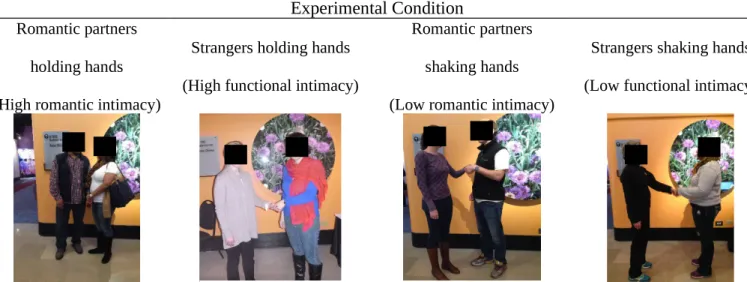
whereas 97% of the pairs in the romantic intimacy condition were opposite gender)5. We told participants they would be either holding hands (high intimacy) or shaking hands (low intimacy) with their partner (who was either a stranger or their romantic partner). See Table 1 for sample photographs from each of the four experimental conditions.
Table 1. Sample photographs from each of the four experimental conditions in Experiment 7.
Experimental Condition
Romantic partners
holding hands
(High romantic intimacy)
Strangers holding hands
(High functional intimacy)
Romantic partners
shaking hands
(Low romantic intimacy)
Strangers shaking hands
(Low functional intimacy)
Note: To maintain confidentiality of participants (per our IRB requirements), we added black
boxes over their faces.
Once participants knew what they would be doing, they completed a short confidential survey measuring their anticipated discomfort which asked, “How will you feel shaking
[holding] a stranger’s [your partner’s] hand today?” with three items: 1) Not at all embarrassed (1) to Very embarrassed (7), 2) Not at all comfortable (1) to Very comfortable (7), and 3) Not at
5 This difference between conditions could create a problematic confound if being with a same- (vs. different-) gender partner creates greater social distancing, thereby providing an alternative explanation to our predicted explanation of discomfort. To test this possibility, we examined whether same-gender (versus opposite-gender) partners showed more distancing among
all pleasant (1) to Very pleasant (7). We separated participants when they completed this survey
so that they could not see each other’s responses.
Pairs then held/shook (non-dominant) hands for 30 seconds while two experimenters (blind to hypothesis) assessed social distance as in Experiment 6, via lack of eye contact and orienting their bodies away from each other. Initial coding of the two experimenters was 92% consistent; they resolved the other 8% by discussion. Experiments also took photographs of the
pairs (with their permission; two out of 170 pairs refused), which allowed us to code hand-use
and non-verbal discomfort displays. After interacting, participants completed the same three-item
social distance recommendation measure used in Experiment 6 except we replaced “recommend wearing winter gloves” with “recommend future participants put Purell on their hands prior to handholding [handshaking]” (because it was no longer cold). Therefore the three items measured recommendations for sanitizing hands, standing with a barrier between interactants, and not making small talk, from 1 (Not all recommend) to 7 (Definitely recommend).
Results and Discussion
Manipulation checks. In a pilot study to ascertain whether intimacy between strangers
indeed feels more “functional” than intimacy between romantic partners, 100 online participants read instructions from the four different conditions, and rated how “functional” each behavior
seemed on a 7-point scale, along with the explanation: “If you’re doing the behavior purely for
functional reasons, it means you’re doing it because the experimenter told you to do it.” In a 2
(stranger vs. romantic partner) × 2 (shaking vs. holding) repeated-measures ANOVA, there was
only an effect of stranger versus romantic partner, F(1, 100) = 49.94, p < .001, such that
with a stranger than to hold or shake hands with a romantic partner (M = 4.18, SE = 0.23), as we
predicted.
We examined participant photographs (n=168) to test compliance across conditions with
instructions to use non-dominant hands. Although we did not know actual hand dominance for
each participant, we tested whether there were equal rates of hand-use across conditions.
Specifically, we coded each photograph for: 1) whether each individual used their right hand (vs. left hand) and 2) whether each pair interacted with the same hand (vs. opposite hand). We ran a binary logistic regression (at the individual participant level) on right hand use (left hand = 0, right hand = 1) that included dummy-coded predictors of intimacy level condition (low = 0, high = 1), intimacy type condition (functional = 0, romantic = 1), and their interaction. There was no effect of intimacy level condition, β = 0.14, p = .719, no effect of intimacy type condition, β = -0.14, p = .732, and no interaction, β = -0.48, p = .430. We next ran a binary logistic regression (at the pair level) on same-hand frequency (opposing hands = 0, same hands = 1) that included the same dummy-coded predictors of intimacy level condition, intimacy type condition, and the interaction. There were no significant effects, βs < 1.01, ps > .176. Together, these results demonstrate that hand-use was not significantly different across conditions, indicating similar compliance with our instructions across conditions.
Social distancing behavior. As in Experiment 6, we collected two measures of social
distancing behavior: eye contact (some or none) and body orientation (angling toward or away).6
Binomial logistic regressions (intimacy level: 0 = low; 1 = high) revealed that—among strangers —higher intimacy (handholding) versus lower intimacy (handshaking) led to more turning away, (65.9% vs. 16.7%, respectively, β = -2.27, SE = .53, p < .01, and less eye contact, (41.5% vs. 21.4%, respectively, β = -0.95, SE = .49, p = .05. However, these relationships did not hold among romantic couples; they were not significantly more likely to turn away (24.4% vs. 8.7%, respectively, β = -1.22, SE = .64, p = .06) nor more likely to avoid eye contact (0% vs. 4.3%, respectively, β = 18.11, SE = 6277.1, p = .99) whether undergoing high (vs. low) intimacy. There were no interactions between intimacy level and type for either measure of social distancing, ps > .21 (see Figure 5).
Figure 5.
High intimacy (handholding) vs. low intimacy (handshaking) in the functional intimacy condition (with a stranger) but not the romantic intimacy condition (with a romantic partner) increases facing away (Panel 1) and reduces eye contact (Panel 2) in Experiment 7. Error bars represent SEM.
Recommendations for social distance. The three recommendations showed poor
therefore report the results on these items separately and together. To account for the dependency of individual ratings within pairs, we ran multilevel regression models with intimacy level condition (0 = low intimacy; 1 = high intimacy), intimacy type condition (0 = functional intimacy; 1 = romantic intimacy), and their interaction entered as fixed effects. Indeed, the intraclass correlation coefficient for social distance recommendations (ρ = 0.21, p = .01) suggests that individuals’ responses within each pair were interdependent, which indicates that multilevel modeling is the appropriate analysis to use.
There was a main effect of intimacy level on overall social distance recommendations, β = 0.76, SE = .20, p < .01: Pairs in the high intimacy condition recommended more social distance (M = 3.79, SD = 1.43) than pairs in the low intimacy condition (M = 3.42, SD = 0.92). There was no effect of intimacy type, β = -0.03, SE = .19, p = .87. But we found an interaction between intimacy level and type, β = -0.78, SE = .28, p = .01. Decomposing the interaction reveals, as we expected, that there was no effect of intimacy level in the romantic intimacy condition, β = -0.02, SE = .17, p = .89, but there was an effect of intimacy level in the functional intimacy condition β
= 0.76, SE = .22, p < .01, such that strangers in the high intimacy condition recommend more social distance (M = 4.19, SD = 1.58) than strangers in the low intimacy condition (M = 3.44, SD = 1.02).
The same main effect of intimacy level emerged for the recommendation to clean hands, β = 0.93, SE = .36, p = .01, and for the recommendation to put a barrier between interactants, β =
0.94, SE = .32, p < .01, and non-significantly albeit in the predicted direction for the
recommendation of a barrier, β = -0.73, SE = .44, p = .10, and was non-significant for small talk, β = -0.45, SE = .52, p = .38. There were no main effects of intimacy type for any of the
individual recommendations (i.e., sanitizing hands, standing with a barrier between, no small talk), ps > .25.
Reported (explicit) discomfort. We created an index of discomfort by averaging
participants’ survey responses (α = .81). There was an effect of intimacy level, β = 0.81, SE = . 18, p < .01, such that pairs in the high-intimacy conditions felt more discomfort (M = 2.55, SD = 1.44) than pairs in the low-intimacy conditions (M = 2.16, SD = 1.15), an effect of intimacy type, β = -1.20, SE = .18, p < .01, such that strangers felt more discomfort (M = 3.19, SD = 1.16) than
romantic partners (M = 1.54, SD = 0.87), and an interaction, β = -0.91, SE = .26, p < .01. As we expected, decomposing the interaction revealed an effect of intimacy level among strangers, β = 0.81, SE = .20, p < .01 (high-intimacy strangers felt more discomfort, M = 3.60, SD = 1.12, than low-intimacy strangers, M = 2.79, SD = 1.06), but no effect among romantic partners, β = -0.09, SE = .16, p = .56.
Coded (implicit) discomfort. We asked 30 online participants who were blind to
experimental condition to rate all 168 photographs on how uncomfortable the pair seemed (1=Not at all uncomfortable; 7=Very uncomfortable). We analyzed the effect of experimental condition on implicit discomfort by running a 2 (intimacy level) × 2 (intimacy pair) ANOVA on these discomfort ratings. Consistent with the manipulation, these raters believed that strangers looked more uncomfortable (M = 3.35, SD = 0.49) than romantic partners (M = 3.03, SD = 0.51), F(1, 166) = 18.91, p < .001, ηp2 = 0.10, and that people holding hands looked more
intimacy type, F(1, 166) = 3.55, p = .061, ηp2 = 0.02 such that the effect of intimacy level was larger during functional intimacy than romantic intimacy. The ratings of (implicit) discomfort from the photographs were correlated with self-reported (explicit) discomfort, r = 0.21, p = .005.
Moderated mediation. We tested whether self-reported discomfort mediated the effect
of intimacy on recommendations for social distance, and whether this was moderated by intimacy type using Hayes (2013) Process Macro for SPSS (Model 7). We expected to find mediation only under functional intimacy, not romantic intimacy. As shown in Figure 6, a 10,000-sample bootstrap test conducted at the individual level (n = 340) provided support for moderated mediation with an index of -0.24, bootstrapped SE = 0.08, 95% CI [-0.44, -0.11]. Specifically, the indirect effect of intimacy level condition on recommendations via discomfort was statistically significant for functional intimacy (indirect effect = 0.22, bootstrapped SE = 0.07, 95% CI [0.10, 0.39]) but non-significant for romantic intimacy (indirect effect = -0.03, bootstrapped SE = 0.04, 95% CI [-0.10, 0.04]). Including discomfort in the model reduced the direct effect of intimacy level on recommendations to β = 0.26, SE = 0.13, p = .04.7
7 To account for dependency within pairs, we conducted several robustness checks. First, we included a clustering variable in the moderated mediation model that separated each participant in the pair (1) from the other (0). Second, we aggregated ratings of discomfort and social
Figure 6.
Moderated mediation model in Experiment 7. Intimacy type (functional vs. romantic) moderates whether explicit discomfort mediates the relationship between intimacy level (high vs. low) on distancing recommendations.
Using the same analysis strategy described above, we also tested for moderated mediation using implicit discomfort (coded from photographs) instead of explicit discomfort. Results again supported moderated mediation with an index of -0.07, bootstrapped SE = 0.04, 95% CI [-0.19, -0.01]. The indirect effect of intimacy level condition on recommendations via discomfort was statistically significant for functional intimacy (indirect effect = 0.08,
bootstrapped SE = 0.04, 95% CI [0.01, 0.17]) but non-significant for romantic intimacy (indirect effect = -0.003, bootstrapped SE = 0.02, 95% CI [-0.05, 0.04]). In this model, the direct effect of intimacy level on recommendations was β = 0.41, SE = 0.13, p < .01.
In sum, Experiment 7 yields support for our predicted model: only functional intimacy provokes discomfort, thereby people behave less socially. When in romantic intimacy, there is no need to reduce sociality with greater intimacy. But when in functional intimacy, as when
strangers must hold hands, people behave less socially. Pairs’ discomfort mediated only the effect of functional intimacy, not romantic intimacy, on their recommendations for social distance.
Internal Meta-analysis
β = 0.27, p < .01
β = 0.81, p < .01 β = -1.20,
p < .01
Intimacy level (0=low; 1=high) Recommendations for social distance Explicit discomfort Intimacy type (0=functional; 1=romantic)
Given that effects vary in magnitude across studies and coding method, we performed an internal meta-analysis using the effect sizes (Cohen’s d) of the preference for social distance under conditions of high (vs. low) functional intimacy. We included pilot and replication experiments in this analysis, resulting in 12 separate samples total (see Appendix for details). Because each study differed in its manipulations and measures, we used a random-effects model for the meta-analysis. Averaging across coding method and study reveals clear evidence for our hypotheses: The aggregate effect size was d = 0.74, SE = 0.11, 95% CI [0.52, 0.95], Z = 6.62, p < .001, suggesting that functional intimacy has a large effect on preferences for social distance. Despite significant heterogeneity across studies, Q(11) = 50.43, p < .001, Τ2 = 0.11, the I2 statistic was 0.782, indicating that 78.2% of the observed variance reflects differences in true effect sizes rather than sampling error.
General Discussion
A series of experiments reveal that functional intimacy makes people prefer social distance, whether people imagined (Experiments 1-2, 4) or engaged in (Experiments 3, 5-7) intimate interactions that served non-relational goals. Importantly, this preference is not due to concern about germs, as manipulating the psychological intimacy of the same act also impacts social distance preference (Experiments 4-7). Moderated mediation analyses suggest that the effect of intimacy level on social distance preferences is driven by the desire to reduce one’s own discomfort, and is specific to functional intimacy (versus romantic intimacy; Experiment 7).
Like other behaviors (Kruglanski et al., 2002), people can engage in intimacy to satisfy functional, non-relational goals (e.g., catching flight), often with strangers (e.g., TSA agents). Whereas intimacy for relational goals typically increases well-being and deepens social connection, intimacy for functional goals seems to produce discomfort and instead result in social distancing.
Another theoretical contribution we make is providing multi-experiment convergent validity for the construct of social distancing. Although we did not explore all of the downstream consequences of social distancing in the current paper, we think it has the potential to
meaningfully influence service provider-recipient relationships. When recipients of functional intimacy act socially distant, it will lead service providers to feel isolated, potentially harming their future well-being (Cacioppo et al., 2006). Prior research is broadly consistent with this idea: service providers whose services require functional intimacy report feeling more dehumanized (e.g., airport security agents; Anteby & Chan, 2015), and report more stress and burnout (e.g. gynecologists, Martini, Arfken, Churchill, & Balon, 2004; front-line physicians, Shanafelt et al., 2012). These consequences of stress and burnout may create other adverse personal
consequences for service providers (e.g., broken relationships and alcohol use, Shanafelt, Sloan, & Habermann, 2003; Oreskovich et al., 2012), and as a result, can reduce the quality of care for recipients (e.g., medical errors, Dyrbye et al., 2010; Shanafelt et al., 2012). This suggests that although social distancing may make recipients of care feel momentarily better, it may harm them in the long run.
Caveats
social distancing and objectifying can lead to deleterious consequences for service providers. However, we suggest that social distancing is theoretically unique from objectification.
Objectification involves viewing instrumental others as mindless tools (Frederickson & Roberts, 1997; Gruenfeld et al., 2008; Nussbaum, 1999) and arises during functional but non-intimate interactions, whereas social distancing involves wanting instrumental others to act as non-social agents and arises during functional intimacy. Objectification comes from wanting to approach an instrumental target, whereas social distancing is elicited from an approach-avoidance conflict. We also demonstrate clear behavioral analogues to the preference for social distance (averting eye gaze and turning away); in contrast, objectification is a perception, not a behavior, and its behavioral analogues are less clear.
individuals prefer distance primarily to reduce their own discomfort, not because of their concern for the provider’s feelings. See full details in the Appendix.
Implications and Future Directions
These studies suggest several implications as well as open questions. First, what are the implications of our research for how to provide good service? Definitions of good customer service may hinge upon the intimacy of a service context. Whereas under low intimacy circumstances, people are likely to want their service provider (e.g., a restaurant server) to be friendly and warm, these same social traits may be undesirable under high functional intimacy circumstances (e.g., service providers in security and medicine). Therefore, people may view a socially distant service provider as a better provider when functional intimacy exists. In this way, although customer service is often predicated on being friendly and sociable with customers, in situations of high functional intimacy it may counterintuitively pay to be unfriendly. Future research could identify the “optimal” level of social distance to maintain in functionally intimate interactions.
becomes more frequent (and normative), we may no longer desire as much social distance from TSA workers. Future research should reveal the bidirectional relationships between norms, intimacy, and discomfort.
Third, an interesting future direction is to examine whether intimacy could elicit different kinds of discomfort and distancing. We used a face-valid measure of discomfort (feeling uneasy,
anxious, or embarrassed), but discomfort can be more complex, involving not just self-focused
(e.g., embarrassment) but also other–focused (e.g., irritation) components (Chentsova-Dutton & Tsai, 2010). When might functional intimacy elicit more other-focused discomfort, and what are the consequences? One possibility is that when intimacy is more extreme, crossing the line from functional to imposed, it may elicit more other-focused discomfort, resulting in greater reactance against the provider. For example, submitting to an airport security check is functional but if the security agent is overly familiar, the recipient may start to view the intimacy as imposed (and unnecessary). In this case, rather than focusing on reducing their own discomfort (via distancing) recipients may instead focus on expressing their discomfort toward the provider, consistent with the approach-orientation that negative emotions like anger can elicit (Carver & Harmon-Jones, 2009). Alternatively, recipients may feel like their goal is no longer worth submitting to the intimacy violation and may try to leave the interaction, consistent with research on reactions to imposed intimacy (Patterson, 1973).
become close to their therapist over time, even falling in love with their therapist. Relatedly, in services for which the recipient expects to develop a relationship (e.g., with one’s therapist), intimate acts may be considered less functional and more relational.
Conclusion
When we think of intimacy, our minds may automatically picture kisses and caresses between lovers, but many cases of intimacy involve goal-directed interactions between complete strangers. We often find ourselves being touched or groped not because we want to connect, but because we want to stay healthy or safe. Although functional intimacy feels necessary, it seldom feels good, and this discomfort makes people prefer social distance from the providers of
intimacy. When we stop smiling, talking, or looking at the nurses, cleaners, and TSA officials who serve us, we feel better but they likely feel worse—with potential costs to us for achieving our goals.
References
Altman, I., & Taylor, D. (1973). Social penetration: The development of interpersonal
relationships. New York, NY: Holt, Rinehart and Winston.
Andersen, P. A. (1985). Nonverbal immediacy in interpersonal communication. In A. W. Siegman & S. Feldstein (Eds.) Multichannel integrations of nonverbal behavior. Hillsdale, NJ: Lawrence Erlbaum.
Anteby, M., & Chan, C. K. (2015). Task segregation as a mechanism for within-job inequality: Women and men of the transportation security administration. Administrative Science Quarterly, 61, 184-216.
Berg, J. H. (1984). The development of friendship between roommates. Journal of Personality
and Social Psychology, 46, 346-356.
Burgoon, H. K., & Jones, S. B. (1976). Toward a theory of personal space expectations and their violations. Human Communication Research, 2, 131-146.
Burgoon, J. K., Buller, D. B., & Woodall, W. G. (1989). Nonverbal communication: The unspoken dialogue. New York: Harper & Row.
Cacioppo, J. T., Hughes, M. E., Wiate, L. J., Hawkley, L. C., Thisted, R. A. (2006). Loneliness as a specific risk factor for depressive symptoms: Cross-sectional and longitudinal analyses. Psychology and Aging, 21, 140-151.
Carver, C. S., & White, T. L. (1994). Behavioral inhibition, behavioral activation, and affective responses to impending reward and punishment: The BIS/BAS scales. Journal of Personality and Social Psychology, 67, 319-333.
Clark, M. S., & Reis, H. T. (1988). Interpersonal processes in close relationships. Annual Review of Psychology, 39, 609-672.
Coan, J. A., Schaefer, H. S., & Davidson, R. J. (2006). Lending a hand: Social regulation of the neural response to threat. Psychological Science, 17, 1032-1039.
Cohen, L. J., & Roth, S. (1987). The psychological aftermath of rape: Long-term effects and
individual differences in recovery. Journal of Social and Clinical Psychology, 5, 525-534.
Debrot, A., Schoebi, D., Perrez, M., & Horn, A. B. (2013). Touch as an interpersonal emotion regulation process in couples’ daily lives: the mediating role of psychological intimacy. Personality and Social Psychological Bulletin, 39, 1373-1385.
Dyrbye, L. N., Massie, F. S., Eacker, A., Harper, W., Power, D., Durning, S. J., … Shanafelt, T. D. (2010). Relationship between burnout and professional conduct and attitudes among U.S. medical students. Journal of American Medical Association, 304, 1173-1180. Eisenberg, N. (2000). Emotion, regulation, and moral development. Annual Review of
Psychology, 51, 665-697.
Ellsworth, P. C., Carlsmith, J. M., & Henson, A. (1972). The stare as a stimulus or flight in human subjects: A series of field experiments. Journal of Personality and Social Psychology, 21, 302-311.
Fishbach, A., & Shah, J. Y. (2006). Self control in action: Implicit dispositions toward goals and away from temptations. Journal of Personality and Social Psychology, 90, 820-832. Fitzsimons, G. M., Finkel, E. J., & vanDellen, M. R. (2015). Transactive goal dynamics.
Psychological Review, 122, 648-673.
Fitzsimons, G. M., & Fishbach, A. (2010). Shifting closeness: Interpersonal effects of personal goal progress. Journal of Personality and Social Psychology, 98, 535–549.
Fitzsimons, G. M., & Shah, J. Y. (2009). Confusing one instrumental other for another: Goal effects on social categorization. Psychological Science, 20, 1468–1472.
Fredrickson, B. L., & Roberts, T-A. (1997). Objectification theory: Toward understanding women’s lived experiences and mental health risks. Psychology of Women Quarterly, 21, 173–206.
Gable, S. L. (2006). Approach and avoidance social motives and goals. Journal of Personality, 74, 175-222.
Gable, S. L., Reis, H. T., Elliot, A. J. (2000). Behavioral activation and inhibition in everyday life. Journal of Personality and Social Psychology, 78, 1135-1149.
Gaebelein, J. (1976). Self-disclosure among friends, acquaintances, and strangers. Psychological Reports, 38, 967-970.
Gervais, S. J., Vescio, T. K., Förster, J., Maass, A., & Suitner, C. (2012). Seeing women as objects: The sexual body part recognition bias. European Journal of Social Psychology, 42, 743-753.
Gray, K., Knobe, J., Sheskin, M., Bloom, P., & Barrett, L. (2011). More than a body: Mind
perception and the nature of objectification. Journal of Personality and Social