MEASURING THE QUALITY OF FAMILY PLANNING SERVICE DELIVERY IN URBAN KENYA
Katherine Marie Tumlinson
A dissertation submitted to the faculty at the University of North Carolina at Chapel Hill in partial fulfillment of the requirements for the degree of Doctor of Philosophy in the
Department of Epidemiology in the Gillings School of Global Public Health.
Chapel Hill 2014
Approved by: Brian W. Pence Sian L. Curtis
© 2014
ABSTRACT
Katherine Marie Tumlinson: Measuring the quality of family planning service delivery in urban Kenya
(Under the direction of Brian W. Pence)
To my family, both my given and my chosen.
To Moe, the world’s most faithful (and beloved) canine companion.
And most of all, to Mehul, who managed to keep me laughing even when I felt like crying and who—despite being forced to listen to my defense no fewer than a dozen times—still
ACKNOWLEDGEMENTS
An account of all the people who have provided me with moral and technical support and pure inspiration could fill a whole separate dissertation. The Measurement, Learning & Evaluation (MLE) project has provided incredibly rich research opportunities and generous funding for this degree, as well as life-long friendship. Chinelo Okigbo is the kind of officemate who makes you look forward to getting to work everyday; life has not been the same since we were upgraded to separate cubicles.
In collaboration with the MLE project, the American Psychological Foundation provided funding for my dissertation data collection activities in Western Kenya through research and travel grants from the Henry David Fund. While in Kenya, my officemates at
Tupange, Jenipher Ang’aha and Rebecca Dalizu, kept me in good company and gave me a
sense of belonging, helped along by a ridiculously fun weekend trip to Jenipher’s rural home in Kakamega and Rebecca’s endless patience in trying to teach me the steps at her aerobics class. As a first-time principal investigator, I had to rely heavily on others; the world’s
greatest team of data collectors taught me a tremendous amount about conducting a study and were always gentle when helping to correct my mistakes. Their contributions form the
Additionally, I am grateful to the staff at the many health care facilities in Kisumu East District who eagerly participated in this study and generously tolerated our disruptions to their work. Dr. Titus Kwambai, District Medical Officer, and Mr. Tom Arunga, District Health Records and Information Officer, Ministry of Public Health, were unfailingly kind and generous in their support for this research and their expert dissemination of results within Kisumu East District; I would welcome the opportunity to collaborate with them again. I am also indebted to Dr. Linda Archer, Director of Monitoring, Evaluation and Research at Jhpiego/Nairobi (an affiliate of John Hopkins University) for facilitating my introduction to collaborating partners, sharing my enthusiasm for this work, encouraging wide dissemination of my results, and inviting me into her family home in Nairobi. I couldn’t ask for a more fascinating and generous mentor or a more supportive friend.
While collecting data for this dissertation for four months in Kisumu, Kenya, I lived apart from my family and friends in the states. The profound homesickness I experienced combined with the never-ending challenges of primary data collection in a foreign and resource-constrained setting, theft, and contraction of a blistering case of M.A.V.
Westercamp, Ludmilla, Dr. Tina Oneko, Dr. Christina Polyak, Dr. Ben Woods, Maria Oziemkowska, Alkesh Patel, Celia and Josh (and Petey and Johnny) Hattingh. Thank you, thank you, thank you.
Back in the states, I’ve been fortunate to enjoy the support and guidance of a doctoral committee comprised of scholars who are both brilliant and approachable – a rare
combination. It would be easy to take their contributions for granted, given they make their work look easy. However, I don’t take lightly the multiple readings of long manuscripts and even longer dissertation chapters; I also don’t take lightly the quick and generous responses to countless requests for letters of reference and academic and professional guidance. I have seen my work improve and my development as a scholar grow tremendously under their direction. It is both humbling and thrilling to have the expert input and guidance of five scholars that I admire and hold in great esteem: Professors Brian Pence, Ilene Speizer, Sian Curtis, Steve Marshall, and Anna Maria Siega-Riz. I’m also grateful for the contributions of Professor Frieda Behets in the earlier stages of this work.
I’m grateful to be a member of the BEST advisee group at UNC; the number of supportive texts, emails, and phone calls we engage in on a weekly basis is impressive. I won’t soon forget our always adventurous car pool home from weekly meetings. No other group of people could inspire me to cheerfully gather for breakfast at 7:30am and I count each of them as a lifelong friend: Tiffany Breger, Nalyn Siripong, Julie O’Donnell, Chris Gray, and Nadya Belenky.
My friends have kept me afloat when sleep deprivation and mountains of unattended laundry threatened to swallow me whole. These women could probably recite my study aims by heart and have been tirelessly forgiving when I have failed to return phone calls, texts, and emails over the previous five years. I first crossed paths with some of these women in
international or clinical settings that have deeply informed this work. These are brilliant, hilarious, and compassionate women and true agents of change, and their contagious faith in me propelled me forward to complete this degree: Ellen Huntley, Leah Fox, Julie Frisbie-Knudsen, Sabina Neugebauer, Tricia Petruney, Kate Rademacher, and Katie West Greenwood.
I am grateful to my mom, Sue Tumlinson, a long-time and generous volunteer and advocate for women’s reproductive rights and the person who encouraged me along this path. My sister, Anne Tumlinson, was the first person to tell me I am smart and convince me that it’s true. My dad, James Tumlinson, has supported every decision I’ve ever made (including my gap year traveling around the US in my jeep and the six months I spent in Europe
determined to become a travel writer) and told me nearly two decades ago that I would make a great scientist. Like all of his advice, it took me a long time to realize he was right. Better late than never. My niece and nephew, Grace and James, were great motivation to take time out for family and my brother-in-law, Greg Stohr, never failed to tell me how proud he was of me at each and every goal post.
I am grateful to my life partner, Mehul Patel, for so much more than can be stated here. I am thankful for study breaks spent eating popsicles on the tree bench outside
Locopops on Franklin Street, meandering walks with Moe spent puzzling through my latest analytical road block, daily Skype calls while I was in Kenya collecting data for this
dissertation (requiring him to get up before 6am every morning for four months), pep talks before each exam and presentation and interview, expert coding advice, and lots and lots of comic relief. While it’s true that I probably could have done it all on my own, the last four years would have been so much less joyful without him by my side.
Lastly, I am grateful to all the Kenyan women who contributed their personal data to the MLE project. This is, undoubtedly, a debt I can never repay. Ninashukuru sana, dada zangu. The hope and desire that one day, every woman in every country has the means and ability to safely and freely determine the number and spacing of her children is the
PREFACE
A ceiling fan swirled lazily above our heads, doing little to dissipate the intense heat of an afternoon in Western Kenya during the region’s dry season. Ten pairs of eyes watched me expectantly as I waited impatiently for my presentation to load and project onto the concrete block wall. It was the first day of a week-long training that would precede nearly three months of data collection at health care facilities in Kisumu, Kenya. This was my first experience serving as the principal investigator for a study, and I was a bundle of anticipatory nerves. My goal was to charge my data collection team with a sense of urgency and an
understanding of the life-saving benefits of family planning for women and their children. The day stretched long as we unpacked the relationship between contraceptive prevalence and maternal, infant, and child health. At the end of the day, I felt encouraged when one member of my team stayed behind to share, “I learned so much today. You’ve given me a
language to talk about family planning with women and their partners.”
2012 to implement an unusual study. I worked with a team of undercover data collectors— local women hired to pose at facilities as new family planning clients and then report back to research staff about their experiences.
The quantitative data I collected in Kisumu, with the help of my data collection team, were used to answer the research question posed in the first aim of this dissertation. Yet, unexpected qualitative findings also emerged. Sometimes my undercover data collectors came back to me with glowing reports of service providers truly devoted to the well-being of their clients. Other times, however, members of my team reported less positive experiences, such as waiting all day at a facility without ever receiving services or witnessing a family planning provider shouting at clients as the clients waited long hours to be served. I was also surprised when a number of my data collectors reported being charged for services that are reportedly provided for free. This often happened behind closed doors and without receipts. These findings are not the focus of this dissertation, but a published manuscript presenting these results has been included in the appendix of this dissertation.
provide valuable insight into actual provider practices. This information, in turn, can be used to design interventions that effectively improve the quality of care, with the ultimate goal of more satisfied clients and more family planning use among women with unmet need.
TABLE OF CONTENTS
LIST OF TABLES ... xvii
LIST OF FIGURES ... xix
LIST OF ABBREVIATIONS ... xx
CHAPTER I. INTRODUCTION ... 1
A. Family Planning Saves Lives and is Under-Utilized in Sub-Saharan Africa ... 1
B. The Kenyan Context... 2
CHAPTER II. LITERATURE REVIEW ... 4
A. Historical Background ... 4
1. Defining the Elements of Quality in Family Planning Service Delivery ... 8
2. Conceptual Framework ... 13
3. Instruments for Measuring Quality Elements ... 17
4. Methodological Concerns ... 21
5. Conclusion ... 26
B. Critical Review of the Literature ... 27
1. Quality of Care in Sub-Saharan Africa ... 28
2. Quality of Care in North Africa, the Middle East, & Eastern Europe ... 36
3. Quality of Care in Asia ... 42
4. Quality of Care in Latin America and the Caribbean ... 52
C. A Summary of Quality of Care in All Regions ... 60
D. Statement of Specific Aims... 61
1. Specific Aims ... 61
2. Hypothesis... 61
3. Rationale ... 62
CHAPTER III. METHODS ... 63
A. Overview of Methods... 63
B. Design... 65
1. Subject Identification/Sampling ... 65
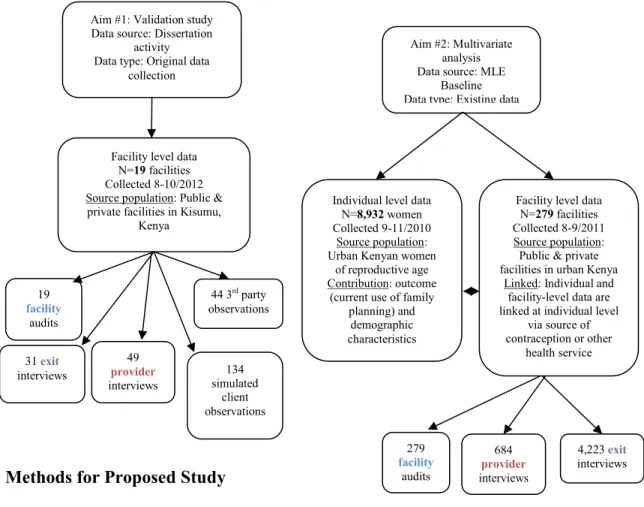
2. Methods for Proposed Study ... 70
CHAPTER IV. RESULTS ... 81
A. Specific Aim and Manuscript 1—Validity of Standard Measures of Family Planning Service Quality ... 81
1. The Simulated Client Method ... 85
2. Objectives ... 87
3. Methodology ... 88
4. Results ... 94
5. Discussion ... 107
B. Specific Aim and Manuscript 2—Quality of Care and Contraceptive Use in Urban Kenya ... 113
1. Methods... 116
2. Results ... 126
3. Discussion ... 139
CHAPTER V. CONCLUSIONS ... 144
A. Quality of Care in Urban Kenya ... 144
B. Study Strengths ... 148
C. Study Limitations ... 149
D. Public Health Implications ... 151
E. Future Directions ... 152
APPENDIX I. INFORMED CONSENT DOCUMENTS ... 154
APPENDIX II. DATA COLLECTION INSTRUMENTS ... 161
APPENDIX III. SIMULATED CLIENT PAPER ... 282
APPENDIX IV. FIGURES AND TABLES ... 299
LIST OF TABLES
Table 1.1. Fertility-Related Demographic Indicators in
Contrasting Settings, 2013 ... 3 Table 3.1 Quick Definitions of the Six Elements of Quality of
Care and Rationale for Inclusion of Each Element ... 72 Table 3.2. Indicators that Measure Quality of Care for Each Data
Collection Instrument... 73 Table 4.1. Quality of Care Indicators ... 83 Table 4.2. Characteristics of Family Planning Providers and New
Clients Interviewed at 19 Health Facilities in Kisumu, Kenya 2012 ... 96 Table 4.3. Family Planning Providers Achieving Quality-of-Care
Indicators during Simulated Client Visits Occurring in 19 Health
Facilities in Kisumu, Kenya, 2012 ... 98 Table 4.4. Comparing Results of Simulated Client Visits and Provider
Interviews in the Measurement of Quality-of-Care Indicators among 49
Family Planning Service Providers ... 101 Table 4.5. Comparing Results of Simulated Client Visits and
Third-Party Observations in the Measurement of Quality-of-Care
Indicators among 44 Family Planning Service Providers ... 104 Table 4.6. Comparing Results of Simulated Client Visits and New
Client Exit Iinterviews in the Measurement of Quality-of-Care
Indicators among 31 Family Planning Service Providers ... 105 Table 4.7. Demographic Characteristics of Women Ages
15 to 49 in Rrban Kenya, 2010 ... 123 Table 4.8. Family Planning and Specific Method Use among
Women Ages 15 to 49 in Urban Kenya, 2010 ... 128 Table 4.9. Characteristics of Select Healthcare Facilities in Urban Kenya, 2011 ... 129 Table 4.10. Quality of Care among Select Healthcare Facilities in
Urban Kenya, 2011 ... 130 Table 4.11. Multivariate Logistic Regression Examining the Relationship
between Quality of Care and Current Use of Modern Contraception
Table A1. Comparing Results of Simulated Client Visits and Provider Interviews in the Measurement of Quality-of-Care Indicators among
49 Family Planning Service Providers ... 300 Table A2. Comparing Results of Simulated Client Visits and
Third-Party Observations in the Measurement of Quality-of-Care
Indicators among 44 Family Planning Service Providers ... 301 Table A3. Comparing Results of Simulated Client Visits and New
Client Exit Interviews in the Measurement of Quality-of-Care
LIST OF FIGURES
Figure 2.1. Conceptual model demonstrating the known and hypothesized relationships between quality of family planning services, contraceptive uptake and continuation, and fertility. Anrudh Jain, The Population
Council, 1989 ... 14 Figure 3.1. Graphic representation of data sources... 70 Figure 4.1. Recruitment of participating family planning service
providers in 19 health facilities in Kisumu, Kenya, 2012... 138 Figure A1. Directed Acyclic Graph (DAG) for the relationship between
quality of family planning services and contraceptive use among women
LIST OF ABBREVIATIONS
APHRC African Population Health Research Center APR Adjusted Prevalence Ratio
CIOMS Council for International Organizations of Medical Sciences DHS Demographic and Health Surveys
ICPD International Conference on Population and Development IUD Intrauterine Device
KEMRI Kenya Medical Research Institute LR+ Positive Likelihood Ratio
LR- Negative Likelihood Ratio
MLE Measurement, Learning & Evaluation Project NPV Negative Predictive Value
OC Oral Contraception
OR Odds Ratio
PI Principal Investigator PoA Program of Action PPV Positive Predictive Value PSU Primary Sampling Unit
PR Prevalence Ratio
QIQ Quick Investigation of Quality SPA Service Provision Assessments TFR Total Fertility Rate
CHAPTER I. INTRODUCTION
A. Family Planning Saves Lives and is Under-Utilized in Sub-Saharan Africa
Family planning has been shown to save the lives of women and children living in developing countries (Cleland et al., 2006). In such settings, where perinatal services are often deficient and where women experience frequent and closely spaced pregnancies, an estimated 350,000 women die annually from complications related to pregnancy and delivery (Hogan et al., 2010). According to the Alan Guttmacher Institute (2008), fulfilling unmet need for family planning1 would reduce the maternal mortality rate by 35% worldwide. In
addition, high fertility rates often result in increased use of abortion services. In 2003 in developing countries, 29 abortions occurred for every 1,000 women of reproductive age. Annually, 70,000 women die from unsafe abortion and tens of thousands of women are injured (Cohen, 2009). Family planning can also help women achieve healthy birth intervals of at least two years, which, in developing countries, can contribute to significant reductions in infant and child mortality (The Population Reference Bureau, 2009), potentially reducing childhood deaths by nearly 10 percent (Cleland et al., 2006). Despite the overwhelming success of family planning programs in many world regions, the prevalence of contraceptive use in sub-Saharan Africa remains low while fertility and population growth remain high (Cleland et al., 2006). Less than 20% of married women are modern method users and, on average, one in four women with a desire to space or limit pregnancy are not using a modern
1Unmet need for family planning refers to the percentage of women in the population with a desire to delay or limit pregnancy who are not
contraceptive method (Population Reference Bureau Datafinder, 2013; Population Resource Center, 2002). Low contraceptive use contributes to an average fertility rate in sub-Saharan Africa of 5.2 children per woman—more than two times the global average (Population Reference Bureau Datafinder, 2013; Population Resource Center, 2002, 2011).
B. The Kenyan Context
Located on Africa’s eastern coast, the population of Kenya totals more than 40 million people (Population Reference Bureau, 2012). Kenya’s total fertility rate (TFR)2 has
declined substantially in the past 40 years, in large part due to a growing acceptance of family planning and increased contraceptive availability. From a TFR of more than 8 children per woman in the 1970’s, fertility rates dropped to approximately 4.7 children per woman by 2008. However, progress has been at a standstill since 2008 (The Measurement Learning & Evaluation Project Web site, 2012). In addition, Kenya has been crippled by the AIDS epidemic, leading to substantial declines in the average life expectancy. As a result of continued high fertility and mortality, Kenya has a young population in which close to half (42%) of the population is under the age of 15 years (Population Reference Bureau, 2012). Kenya has an infant mortality rate of 59 deaths per 1,000 live births (Table 1) and an adjusted maternal mortality ratio of 530 per 100,000 live births (Population Reference Bureau, 2012). In 2011, it was estimated that approximately 20% of Kenyans lived in an urban environment and 55% of Kenya’s urban population is reportedly living in slums with little access to basic amenities (Population Reference Bureau, 2012). As urban populations in Africa are expected to double by 2030, the proportion living in slum conditions in Kenya will rapidly increase (The Measurement Learning & Evaluation Project Web site, 2012).
2The total fertility rate (TFR) refers to the number of live births a woman would have, on average, if she lived through the end of her
Table 1.1.
Fertility-Related Demographic Indicators in Contrasting Settings, 2013 (Population Reference Bureau, 2012)
Region/Country Contraceptive Prevalence Rate*
Total Fertility
Rate**
Unmet Need for Family Planning***
Lifetime Risk of Maternal Death—1
woman in:
Infant Mortality Rate****
More Developed 63 1.6 --- 3800 5
Less Developed 56 2.6 18 150 44
Least Developed 29 4.4 24 52 66
Latin
America/Caribbean 68 2.2 11 520 19
Asia 61 2.2 16 290 35
Sub-Saharan Africa 21 5.2 25 39 73
Kenya 39 4.5 26 38 54
CHAPTER II. LITERATURE REVIEW
A. Historical Background
Family planning programs were first implemented in developing countries in the 1950s and have successfully reduced fertility in many low-income countries around the world, most notably in Asia, Latin America, and North Africa (Bongaarts, 2011; Cleland et al., 2006). Large declines in fertility are most evident in Latin America and Asia, where total fertility rates (TFR) in the past 60 years have dropped from nearly 6 births per woman to less than 2.5 (Bongaarts, 2011). In contrast, the majority of countries in sub-Saharan Africa continue to experience high rates of fertility with a regional TFR of 5.2 births per woman— more than twice the global average (Population Reference Bureau, 2011; Population
Resource Center, 2002; Bongaarts, 2011). These regional disparities in fertility began to gain attention in the late 1980s and early 1990s, prompting many members of the international family planning community to question whether continued improvements in geographic and financial access to services in sub-Saharan Africa would be sufficient to close the gap in fertility rates (Barry, 1996; Bertrand et al., 1995; Bruce, 1994).
Simmons & Elias, 1994). Conventional wisdom that increasing service delivery points could address the principal reasons for the unmet need for family planning was strongly challenged when survey data from 1986–1990 on causes of unmet need in 27 developing countries indicated that the primary reasons for nonuse included fear of side effects, lack of
knowledge, and cultural disapproval—reasons that could be addressed by improvements to the quality of family planning service delivery (Bongaarts & Bruce, 1995; Blanc et al., 2002). Additional studies from the same time period in Asia and sub-Saharan Africa also found fear of side effects played a significant role in explaining the gap between fertility goals and actual practice, contributing significantly to contraceptive discontinuation, while geographic access was of less importance (Casterline et al., 1997; Cotten et al., 1992). Such findings prompted some to conclude that despite the ability of many family planning programs to reach remote areas of poor countries, they were “social failures” for their inability to address cultural factors, health concerns, and misinformation in the populations they serve
(Bongaarts & Bruce, 1995). The meaning of success in family planning programs was redefined to apply to those programs that effectively helped women and couples safely determine the number and spacing of their children (Jain et al., 1992).
It is important to acknowledge that the very first family planning programs in
late 1960s that large ideal family sizes in many developing countries would inhibit
achievement of replacement-level fertility, some family planning programs chose to short-cut the longer-term societal changes necessary to reduce desired fertility by using a variety of means to influence couples’ ideal family size (Jain, 1989). The neglect of quality and a rights-based approach to family planning service delivery, therefore, was a natural
consequence of programs being evaluated based on their ability to attract new contraceptive users rather than on the quality of services provided to clients (Jain, 1989; RamaRao & Mohanam, 2003; Brown et al., 1995; Suh et al., 2007). The consequence of neglecting quality is well illustrated by the failed introduction of the intra-uterine device (IUD) in parts of Asia in the mid 1960s. Half of new IUD users had discontinued within two years, many due to unwanted side effects for which they were unprepared. Several researchers
hypothesized that rates of discontinuation would have been significantly lower had these women received information on the possibility of side effects with IUD use (Bruce, 1987; Jain, 1989).
A shift among leaders in the field of international family planning from a focus on demographic targets to a prioritization of meeting client needs marked the beginning of a new era in contraceptive research (Paine et al., 2000; Berer, 1993; Bertrand et al., 1995; Helzner, 2002; Jain, 1989; Ketting, 1994; Whittaker et al., 1996). By the mid-1990s ‘quality-of-care’ had become part of the regular discourse in the field of family planning, with most major international family planning agencies showing strong commitment to improving access to high-quality services, working under the hypothesis that such improvements would not only lead to reductions in fertility but also better meet the reproductive needs of
RamaRao & Mohanam, 2003; Simmons & Elias, 1994). The changing tide in the field of family planning was apparent at an important meeting in 1994, the International Conference on Population and Development (ICPD) in Cairo, widely viewed as a watershed event in sexual and reproductive rights (Pellegrom, 2006). The Cairo conference, attended by delegates from 180 countries, issued a Program of Action (POA) condemning coercive tactics and rejecting demographic targets (Caldwell et al., 2002; Helzner, 2002; Hull, 1996). The POA also promoted the reproductive right of couples to choose the number and spacing of their children free from coercive practices (United Nations, 1994). Those in the field of international family planning were called on to think about family planning in a much broader sense as part of a range of reproductive services and to prioritize the needs of individual women and men over the achievement of demographic goals (Cohen & Richards, 1994).
Inherent in the discourse on quality was a focus on the importance of safe-guarding reproductive rights. Those taking a rights-based perspective argued that without reproductive rights, the reproductive health needs of women are secondary to national demographic goals or the “collective good” and the negative consequences of high fertility on individual women are ignored (Wang and Pillai, 2001). A reproductive rights approach to developing family planning policies recognizes that lack of access to quality family planning services has more than demographic consequences and takes into account the needs and interests of women, men, and their communities (Berer, 1993). Providers who have adopted a reproductive rights approach are better placed to deliver high-quality services (Helzner, 2002).
quality of care in family planning service delivery (Bruce, 1990; Hull, 1996). This framework, developed by researcher Judith Bruce, includes aspects of both technical competency and interpersonal relations, reflecting and reinforcing the shift in focus from demographic targets to a client-centered and reproductive rights approach (Hull, 1996). Bruce’s framework is based, in part, on the earlier work of physician and scholar Avedis Donabedian, who wrote extensively on the quality of healthcare services and suggested assessing quality in terms of three categories: structure (infrastructure, supplies,
management), process (interpersonal relations and technical competence), and outcome
(client satisfaction and changes in health behavior) (Donabedian, 1988). Bruce states that the six elements included in her framework for quality of care in family planning programs “reflect six aspects of services that clients experience as critical” (Bruce, 1990). These include:
A. Choice of methods,
B. Information given to clients,
C. Provider competence,
D. Interpersonal relations,
E. Follow-up or continuity mechanisms, and F. Appropriate constellation of services.
1. Defining the Elements of Quality in Family Planning Service Delivery
Choice of Methods: Having a choice of methods means that a satisfactory selection of methods, in terms of both number and type, is available on a reliable basis. Choice of
methods is determined not only by the physical availability of multiple methods but also by willingness on the part of the provider to discuss multiple methods (Mensch et al., 1994b). Choice is important for multiple reasons. Women and their partners have different
to delay childbirth may later wish to space, and eventually limit, future pregnancies. A choice between short- and long-acting methods helps accommodate these life changes. Another important reason for providing access to a variety of methods is the desire on the part of many women to avoid undesirable side effects such as disruptions to menstrual patterns, headaches, weight gain, or nausea, common with hormonal methods. Such side effects, which are impossible to predict, are consistently found to be one of the main reasons women report contraceptive discontinuation within the first year of use, particularly among women who have not been told what to expect (Bruce, 1990; Ali & Cleland, 1999; Burke & Ambasa-Shisanya, 2011; Cotten et al., 1992; Curtis et al., 1997). First-time contraceptors may
therefore need to switch methods to find one with tolerable side effects. In addition, given the frequent occurrence of insufficient or inconsistent supplies in many international family planning programs, the presence of many methods increases the probability that a minimum of one method will be available at any one time (Bruce, 1990). As a final note, in addition to these practical reasons, from a philosophical standpoint, ensuring access to a variety of methods reaffirms the commitment to meeting the needs of individual women as opposed to the blind promotion of a single method (Bruce, 1990). This is a mark of a client-oriented program.
Information Given to Clients: Providing information to clients means that clients receive information from their service provider on a range of methods, including the
hormonal methods, the presence of which may affect daily activities. As Bruce (1990) points out, the client is selecting a method that must fit into her daily life, including social activities and intimate sexual experiences. Unpredictable menstrual patterns, for example, may impact religious practices, work routines, and sexual experiences and it is important for women to be prepared for this possibility in advance (Bruce, 1990). By ensuring that the client is informed and knowledgeable about potential side effects, the provider is, in effect, helping the client manage their expectations of their contraceptive experience.
Provider Competence: Provider competence refers to the technical competence of the service provider and is a separate element from the interpersonal relationship between the provider and the client. A competent provider is one who demonstrates adequate technical competence and adherence to medical guidelines and protocols. Failure to observe safe clinical standards may not only result in harmful health outcomes but could also generate negative rumors about family planning programs or methods (Bruce, 1990). This element is perhaps the most difficult to measure given that clients are not well placed to judge technical competence. Training is often used as a proxy for competent clinical performance, although trained providers have been known to display incompetence. Observations of client-provider interactions are frequently employed to determine whether providers engage in such basic procedures as adequate record-keeping and hand-washing prior to physical exams.
of reasons, including the client’s pregnancy status, misinformation such as use of outdated eligibility criteria, and personal bias on the part of the provider (Greene & Stanback, 2011; Bertrand et al., 1995). Thanks in large part to improvements in provider training and more universal availability of family planning guidelines and job aids (Tumlinson et al., 2010), medical barriers have greatly decreased in the past decade, but they still exist (Greene & Stanback, 2011; Tumlinson et al., 2010). For example, providers will often deny
contraception to women who are not menstruating out of fear they may be pregnant, causing delays in method procurement for countless women. This practice continues to be well-documented in many countries including Guatemala, Senegal, Jamaica, Kenya, and Ghana (Greene & Stanback, 2011). Quality assessment is necessary to determine existing disparities between standards of technical competence and actual practice in the field (Bruce, 1990).
of demographic targets can undermine attempts by providers to respond to the individual needs of their clients (Bruce, 1990). Interventions to improve client-provider interactions may include analysis of providers’ case-loads or increased managerial support for improved interpersonal performance (Bruce, 1990; Jain, 1989).
Continuity and Follow-Up: This element of quality ensures that follow-up mechanisms are in place, such as scheduling of future appointments or home visits, to
encourage contraceptive continuity. Assisting clients with resupply may result in greater rates of contraceptive continuation, an important component of the overall prevalence rate (Bruce, 1990). Although many family planning programs have traditionally focused on the
recruitment of new clients, some research suggests that programs will be more successful both in terms of achievement of demographic targets and commitment to individual welfare if they focus on providing good care to a small number of satisfied clients rather than recruiting large numbers of acceptors, the majority of whom later discontinue their method due to dissatisfaction (Jain, 1989; Blanc et al., 2002).
resulting in an unsafe abortion and a second time when she left treatment for the unsafe abortion without a reliable method of family planning (Huber & Bowles, 1999).
2. Conceptual Framework
Bruce’s quality of care framework was developed in response to the need to
operationalize a more “client-centered” approach to family planning service delivery with the expectation that improved quality of care would increase client satisfaction and enable clients to exercise control over their fertility and achieve their reproductive goals. However, many proponents have argued that in addition to these individual-level benefits, on the macro-level, high-quality reproductive health services may contribute significantly to increases in
contraceptive prevalence and lower levels of fertility (Bruce, 1990; Arends-Kuenning & Kessy, 2007). Anrudh Jain (1989), a senior researcher at The Population Council, developed the conceptual model displayed in Figure 2.1, which demonstrates the hypothesized
mechanism by which quality may affect contraceptive behavior. Simply put, improvements in quality may increase both acceptance and continuation of contraception which will, in turn, reduce fertility (Jain et al., 1992).
Efforts to improve quality of care, much like efforts to increase geographic and financial accessibility, are typically classified as supply-side family planning interventions because they facilitate a couple’s ability to use family planning, responding to an existing demand for services. In contrast, demand-side interventions, such as interventions to
Jain, however, has suggested that improvements in quality may straddle these two categories given the powerful role of word-of-mouth communication in many communities of interest. Therefore, in addition to the direct relationship displayed in Figure 2.1, Jain hypothesizes that clients well-satisfied by high quality services are likely to influence other members of their community, helping transform latent demand for services into actual contraceptive use (Jain, 1989). Although researchers have looked extensively at demand-side factors such as
demographic characteristics and cultural values, relatively little is known about how supply-side factors such as quality of care affect contraceptive use (Arends-Kuenning & Kessy, 2007).
Figure 2.1. Conceptual model demonstrating the known and hypothesized relationships between quality of family planning services, contraceptive uptake and continuation, and fertility. Anrudh Jain, The Population Council, 1989 (Jain, 1989).
In the interpretation of Figure 2.1, Jain also points out that ‘motivation’ plays an important role in the relationship between service quality and contraceptive prevalence. According to Jain, those couples strongly motivated to avoid unintended pregnancy will overcome the hardships imposed by poor quality services to achieve their reproductive goals. Conversely, those with little to no motivation to prevent pregnancy will not become
Contraceptive Acceptance (Outcome of interest) Quality of Services: (Main
Exposure) A. Choice of Methods B. Information to users C. Provider competence D. Client/Provider relations E. Follow-up mechanisms
F. Appropriate constellation of services
Contraceptive Prevalence
Fertility
Other proximate determinants Contraceptive Continuation
Other factors
contraceptive adopters even if excellent services are available. For these two extreme groups, the quality of family planning service delivery is unlikely to have much impact on
contraceptive use and continuation. However, for clients whose level of motivation and corresponding demand for services falls somewhere between these two extremes, quality is expected to have a significant impact (Jain et al., 1992; RamaRao et al., 2003).
In preparing to assess the relationship between quality and contraceptive use, some researchers have suggested that achieving a high level of service quality may not be realistic in the absence of adequate service infrastructure (Tuoane et al., 2004). In other words, those with direct client contact—the service providers—need support in the form of training, guidance, supplies, and educational materials to do their job well (Huezo & Diaz, 1993). RamaRao and Mohanam (2003) note that program managers have cited deficiencies in the service infrastructure as a key barrier to providing good quality services. As such, the term “quality” can be expanded to include not only the dynamics of the interaction between the provider and client but also the degree to which facilities are prepared to offer services. The quality of service infrastructure is commonly referred to as a facility’s “readiness” and this concept draws attention to factors that may impede the provision of high quality services (RamaRao & Mohanam, 2003). In comparing the concept of readiness and Bruce’s quality framework to Donabedian’s three-pronged approach to measuring quality (structure, process, and outcome), readiness could be considered to map to Donabedian’s “structure” while Bruce’s framework aligns closely with “process.”
example, a study using 1989–1991 data from rural Bangladesh looked at the relationship between perceived quality and subsequent adoption or continuation of a contraceptive method, using prospective data from 7,800 women (Koenig et al., 1997). According to their perceptions, 28% of women received good quality of care most or all of the time and these women were significantly more likely to adopt a method (risk ratio: 1.27, p≤0.05) or to continue use (risk ratio: 1.41, p≤0.001), after controlling for other factors. A subsequent study in Tanzania considered whether perceptions of quality from knowledgeable informants were correlated with objective measures of quality and found that though a few objective traits were associated with perceptions of quality, many were not (Speizer & Bollen, 2000). As a result, some researchers have concluded that even when perceived quality is
significantly associated with contraceptive use and continuation, little is known about how family planning programs can influence these perceptions, for example improving
availability of methods or ensuring privacy (Arends-Kuenning & Kessy, 2007).
their status within their community (Pritchett, 1994). Bongaarts (1994) took issue with Pritchett’s view that “excess fertility” was not a matter of great importance, citing the hazards to both women’s health and the planet of unchecked population growth and stating, “Helping women (and men) to implement their reproductive preferences is an obvious place to start if one wants to reduce fertility and future population growth” (Bongaarts, 1994). Although Bongaarts recognized the important role of economic development in achieving fertility reductions, he pointed out the critical ability of family planning programs to address established barriers to contraceptive use, namely fear of side effects and cultural disapproval, thereby reducing the “non-economic” costs of using family planning methods (Bongaarts, 1994).
3. Instruments for Measuring Quality Elements
Since its introduction in 1990, Bruce’s framework for quality of care in family planning service delivery has become the recognized standard for measuring quality in the field of international family planning (Askew et al., 1994; Barry, 1996; Brown et al., 1995; Hull, 1996; Jain et al., 1992; Jain et al., 1992b; Ketting, 1994). However, global adoption of the framework coupled with the overwhelming and broad support for prioritizing service quality that emerged from the 1994 ICPD was only a first step. Figuring out how to
context of family planning programs (Brown et al., 1995) and were beginning to think about how to translate Bruce’s framework into “programmatic reality” (Cohen & Richards, 1994). As Donabedian points out, it can be a mistake to assume that quality cannot be measured and yet an equal error in judgment to think such measurements are easy and precise, “as if a sack of potatoes was being weighed” (Donabedian, 1988).
The need for systematic, reliable, and relatively fast measures of quality gave rise to the development a set of instruments known as the Situation Analysis (Simmons & Elias, 1994), first developed by the Population Council’s Africa Operations Research and Technical Assistance Project in 1989 (Fisher et al., 1992) and later revised and adapted by other groups for regions outside sub-Saharan Africa. As the first attempt to operationalize the concept of quality (Miller et al., 1991), the objectives of the first situation analysis were to describe both the quality and “functioning” of family planning services and to evaluate the impact of quality on the outcomes of client satisfaction, realization of reproductive goals, contraceptive prevalence, and fertility (Fisher et al., 1992). The “functioning” of family planning services refers to whether a specified service delivery point is ready to provide services based on indicators such as adequate supervision, contraceptive supplies and equipment, staffing, training, record keeping, and the availability of educational materials commonly referred to as Information, Education, and Communication (IEC) (Mensch et al., 1994b). This concept is similar to those of “readiness” or “structure,” discussed previously.
service delivery point, although a research team may omit one or more of these instruments depending on available resources:
1. A facility audit inventories supplies and equipment and collects information on infrastrure, record-keeping, and management.
2. An observation guide is a protocol for observing the client-provider
interaction during the family planning consultation and also allows assessment of the provider’s adherence to national standards and guidelines.
3. A questionnaire for interviewing family planning clients as they exit the facility allows assessment of the client’s viewpoint of the service delivery setting.
4. A questionnaire for interviewing service providers collects information from providers on training, supervision, and attitudes about their work environment (Fisher et al., 1992; MEASURE DHS, 2012).
An additional and similar set of tools useful in assessing quality with relative speed is the Quick Investigation of Quality (QIQ): A User’s Guide for Monitoring Quality of Care in
Family Planning developed by MEASURE Evaluation in 2000 (MEASURE Evaluation,
2001). In the initial phase of development, staff and collaborators of MEASURE Evaluation identified more than 200 indicators of quality of care. Through a series of field tests in 1998– 1999 designed to judge both feasibility of collecting this data and its corresponding
reliability, this list was narrowed down to a short list of 25 indicators for inclusion in the final QIQ (RamaRao & Mohanam, 2003; Bessinger & Bertrand, 2001). Much like the situation analysis, the QIQ includes several basic data collection instruments designed to assess the quality of family planning service delivery but omits the questionnaire for interviewing service providers. The three methods of data collection included in the QIQ are the facility audit, the observation guide for client-provider interaction, and the questionnaire for interviews with exiting family planning clients (MEASURE Evaluation, 2001). These
the situation analysis and those included in the QIQ but suggest that the more concise nature of the QIQ is advantageous for programs wanting to monitor quality on an annual or biannual basis (MEASURE Evaluation, 2001).
Several large-scale multi-country surveys collecting data on population and health indicators have incorporated some version of the instruments included in the situation analysis or the QIQ to measure service quality at the facility level. Among those still in use, one example is the Service Provision Assessment (SPA) implemented in select developing countries by the Demographic and Health Survey (DHS) program. The DHS is a survey conducted in approximately 90 developing countries. The DHS SPA measures the quality of several types of services including child health, maternity and newborn care, sexually transmitted infections and other infectious diseases, and HIV/AIDS—in addition to family planning services. Each SPA survey employs a representative sampling frame and includes a sample of over 400 facilities ranging from hospitals to health posts. A DHS SPA will
typically have observations of about 4,000 provider-client interactions and will include interviews with a minimum of 1,000 healthcare providers (MEASURE DHS, 2012).
Although development of the situation analysis and corresponding SPA surveys has enabled select countries to collect data on family planning service delivery at the facility level, the DHS does not provide the means for linking individual and facility-level data by geographic location or by individual woman (Gubhaju, 2009). For this reason, it is
challenging to assess the relationship between quality and individual outcomes such as contraceptive use or continuation using DHS data. In addition, since 1999, only nine
(2001, 2007), Tanzania (2006), Uganda (2007), Bangladesh (1999–2000), Egypt (2002, 2004), Ghana (2002), and Guatemala (1997 but final report still pending). Three of these countries (Bangladesh, Egypt, and Ghana) omitted at least one of the following instruments: the provider interview, the exit interview, or the observation protocol (MEASURE DHS, 2012).
Another large-scale multi-country survey to include assessments of quality at the facility level is the Measurement, Learning & Evaluation (MLE) Project, implemented by the Carolina Population Center at the University of North Carolina at Chapel Hill. In 2009, the Bill and Melinda Gates Foundation funded the Urban Reproductive Health Initiative (URHI), a five-year project to increase the contraceptive prevalence rate in select urban areas of Kenya, Senegal, Nigeria, and Uttar Pradesh, India. The MLE project is a six-year project to evaluate this initiative and collects data at both the individual and facility level. The facility-level instruments used to collect data on quality of care in the MLE project include the facility audit and the provider and exit interviews. In addition, the MLE project contains sufficient information to allow for the linking of individual and facility-level data.
4. Methodological Concerns
Courtesy Bias: It should be noted that the structured format of questions used in the exit interview combined with the close proximity to facility personnel often results in courtesy bias, whereby clients feel uncomfortable reporting negative aspects of care. Courtesy bias tends to skew results related to client satisfaction in a positive direction of higher perceived quality (MEASURE Evaluation, 2001; Simmons & Elias, 1994; Bessinger & Bertrand, 2001; Whittaker et al., 1996). At a minimum—ie., assuming the errors in
in inflated standard errors and results that incorrectly appear insignificant (Mensch et al., 1994a).
Reliability of Provider Interview: Providers may report their intentions or an “ideal” of service delivery rather than what they do in practice (Simmons & Elias, 1994). The desire to report what they believe they should be doing rather than providing an accurate description of existing services could be the result of social desirability bias, whereby the respondent wants to please the data collector, or may result from fear of losing their jobs if their actual practices are revealed. As with courtesy bias, the inflation of provider competence and service delivery practices likely skews quality in a positive direction.
Hawthorne Effect: Direct observation of the client-provider relationship is one way to avoid exit interview courtesy bias or provider interview misinformation because a third party observes the client-provider interaction and objectively and systematically records
impressions. However, direct observation is not without problems (Simmons & Elias, 1994; MEASURE Evaluation, 2001). Of primary concern is the fact that when providers know that they are being watched and observed, they are likely to change their behavior and act
differently than if they were alone with the client; in other words, providers are on their “best behavior” during observations (MEASURE Evaluation, 2001; Bessinger & Bertrand, 2001). For example, during a situation analysis conducted in Kenya in 1991, a provider reported, “I usually do not have this much time for clients, but in view of your presence, I had better try to do an especially good job” (Miller et al., 1991).
widely used in developing countries. Another, more commonly employed, approach for conducting observations is use a mystery or “simulated” client method (Hardee et al., 2001; Huntington & Schuler, 1993; Leon et al., 2007; Madden et al., 1997; Maynard-Tucker, 1994; Naik et al., 2010; Population Council, 1992; Schuler et al., 1985). In this approach, a woman pretending to be an actual new family planning client presents at a health facility and
undergoes a family planning counseling session. During the session the provider is unaware that their client has a research agenda (Madden et al., 1997). Following the session, the “undercover” data collector then records or reports her observation. The main benefit of this method of conducting observations is that it is an unobtrusive means of collecting data and likely to be more accurate than a third-party observation; it collects data on actual practice that would be difficult to obtain through other means (Madden et al., 1997). In addition, the use of simulated clients can be useful when the flow of new clients is low or when clients decline to be interviewed (Simmons & Elias, 1994; Mensch et al., 1996). For example, in a situation analysis conducted in Kenya in 1990, only 48 of the 99 selected clinics had new clients on the day they were visited and as a result the analysis was considerably restricted (Miller et al., 1991).
The key to accuracy with the simulated client method is the employment of simulated clients who present realistically to the observed providers, are representative in their
levels of agreement (interclass correlation = .5) within pairs, indicating the likelihood of rating errors (Leon et al., 1994). In studies in which a single provider is evaluated by a single observer, doubt must be expressed about the reliability of the evaluation. One solution is the use of checklists to help the simulated client recall and objectively evaluate providers.
In addition to the many methodological benefits of using simulated clients to collect data on provider-client interactions, there are ethical concerns with this type of data
collection (Madden et al., 1997). Because it is inherently necessary for simulated clients to engage in subterfuge by masking their true purpose and intent, obtaining informed consent from providers is not possible (Huntington & Schuler, 1993). One possible negative consequence of this approach is that once providers become aware that they have been observed without their consent, it is likely to undermine the relationship and rapport between providers and their supervisors who have approved such methods. In addition, it’s possible that clients may have to undergo an unwanted physical exam to maintain the ruse of their visit (RamaRao & Mohanam, 2003; Madden et al., 1997). Guidelines for addressing ethical concerns in epidemiologic research published by the Council for International Organizations of Medical Sciences (CIOMS) suggest absence of informed consent may be acceptable in scenarios where full disclosure would interfere with the study purpose (Madden et al., 1997). Huntington and Schuler (1993) also suggest ways to uphold ethical integrity while still gaining the benefits of this approach. One solution is to disclose to the provider the
discuss all ethical concerns with clinic managers to find ways to implement client
simulations with integrity (Huntington & Schuler, 1993). Many feel the validity benefits of employing simulated clients outweigh these concerns (Boyce & Neale, 2006).
Recall Effects: When interviewing family planning clients just before they exit the health facility, it is important to remember that these clients may have difficulty recalling the information that they received during their family planning counseling session. For example, even when providers discuss possible side effects of the client’s chosen method, the client may not be able to remember that this information was given to them. They may also feel that some of the information they discussed with their provider is private and may therefore deliberately omit some information during the interview to shield their privacy. Authors of the QIQ suggest using a client interview instrument containing only a limited number of questions to reduce interviewee fatigue and subsequent lack of recall (MEASURE Evaluation, 2001). However, it may also be the case that a client’s lack of recall of the information provided is a relevant measure of quality. Whether or not poor recall introduces bias into a study depends on the research question.
Cost: Some researchers suggest choosing between conducting exit interviews and direct observations in settings where research resources are scarce given that some studies have found a high degree of agreement between the two instruments, particularly with respect to indicators measuring interpersonal relations (Bessinger & Bertrand, 2001). Others suggest conducting both exit interviews and direct observations rather than substituting one for the other given the unique perspective provided by each (MEASURE Evaluation, 2001). For example, clients often have difficulty expressing dissatisfaction with provider
feedback or for fear that the provider may learn of their comments (RamaRao & Mohanam, 2003). In contrast, poor performance by the provider will be evident to an observer even when the client is reluctant to identify such behavior. Selecting only one of the two
instruments, therefore, limits the number and types of indicators that can be used to measure quality (Bessinger & Bertrand, 2001). It is also important to note that clients can not provide information on specific clinical practices related to technical competence because they don’t have the necessary clinical background to assess this aspect of care. Similarly, only client exit interviews can provide client perspectives. In addition, collecting the same information with more than one instrument allows researchers to conduct “internal validity checks” (Mensch et al., 1994b).
5. Conclusion
In summary, over the past two decades quality of care has become the issue to champion by those in the field of international family planning. Yet despite widespread endorsement of the Bruce framework and development of standardized data collection instruments, obstacles to obtaining accurate measures of quality remain. Few countries collect facility-level data and even fewer use observation of the client-provider interaction to verify the data collected from exit and provider interviews. And although the simulated client method could be considered the gold standard for collecting data on most elements of
It is unfortunate that after 20 years of research, very little is known about quality and family planning despite the impression that quality is a proven determinant of contraceptive prevalence (RamaRao & Mohanam, 2003).This is likely the result of the pervasive agreement that quality is an important factor in ensuring reproductive rights. Such widespread
consensus may eclipse the fact that although high-quality care can still be deemed essential from a reproductive rights perspective, there is a scarcity of information about successful efforts to provide good quality or its subsequent effect on contraceptive behavior (RamaRao & Mohanam, 2003). As the following literature review will demonstrate, few
methodologically rigorous investigations of quality exist and many of those have found only a weak association between quality and contraceptive prevalence; whether this is because quality is of little public health importance or due to significant problems in the way quality is measured remains unknown (Mensch et al., 1994a).
B. Critical Review of the Literature
A systematic review of published literature was conducted to investigate the relationship between family planning service provision and contraceptive behavior.
Literature was identified by electronic searches of Pubmed using appropriate MeSH search terms as well as follow-up of citations in the identified literature and consultation with experts. The following review is organized by region, beginning with studies in sub-Saharan Africa and followed by a review of the literature in North Africa, Asia, and Latin America and the Caribbean. A final section is devoted to large multi-country studies. Unless otherwise stated, multivariate analyses in this review controlled for demographic and regional
residence. National surveys such as the Demographic and Health Surveys (DHS) use statistical techniques to ensure nationally representative samples.
1. Quality of Care in Sub-Saharan Africa
Descriptive studies
Several studies have described the quality of family planning service delivery and infrastructure in sub-Saharan Africa using the situation analysis approach (Agha & Do, 2009; Askew et al., 1994; Mensch et al., 1994b; Miller et al., 1991; Tuoane et al., 2004). Three of these five studies were conducted in Kenya between 1991 and 2004 while two additional situation analysis studies were conducted in Nigeria and Lesotho in the mid-1990s. Most of these situation analyses used a combination of the main data collection instruments (facility audit, observation, interviews with providers and/or clients) to measure quality as defined by the Bruce framework. This consistent adherence to standard definitions and data collection instruments allows for more balanced comparison between studies.
and, as a result, half of selected clinics could not be observed providing services to new
family planning clients. Using mystery clients would circumvent this problem and address concerns about the Hawthorne effect expressed by the authors. A follow-up study in 1993, focusing on public facilities in Nairobi had greater success with the one-clinic-per-day strategy and was able to observe new clients in 80% of the 46 selected facilities. This assessment of infrastructure and service quality (n=46 providers and 100 family planning clients) did not differ markedly from the Kenyan national study and used similar data collection instruments (Mensch et al., 1994b). A much later study using data from the 2004 Kenya Service Provision Assessment compared quality of care at public versus private facilities (n=323 facilities and 628 clients) and found that private facilities outperformed their public counterparts in several areas including infrastructure, client-provider relations, and client satisfaction, yet no difference was found between facility types in terms of the technical competence of providers (Agha & Do, 2009).
A study conducted in 1992 in Nigeria used all four standard data collection
instruments from the situation analysis approach including facility audits (n=178), interviews with providers (n=289), interviews with exiting family planning clients (n=1433), and
standard framework of quality, using indicators that relate primarily to infrastructure or ‘readiness’ and omitting those related to service quality. Authors emphasized restrictive hours of operation, lack of visual privacy, and provider bias as major obstacles to improving contraceptive prevalence in Lesotho.
Observational studies
Three observational studies assessed the relationship between quality and
contraceptive use in countries primarily in east Africa (Arends-Kuenning & Kessy, 2007; Mensch et al., 1994a; Mroz et al., 1999). The first of these studies used data from the
1991/1992 Tanzania DHS (n=5628) to look at the effect of community-level perceptions of a facility’s quality on contraceptive use among individual community members (Mroz et al., 1999). This study found that perceived quality was one of the more important factors associated with contraceptive use, on par with husband’s education and marital status. A subsequent study conducted in Tanzania among more than 7,000 primarily rural women used data from the 1996 Tanzania Demographic and Health Survey and the 1996 Tanzania Service Availability Survey to assess the relationship between quality and use, linking the two data sources by geographic cluster. This study found that two aspects of quality were strongly and significantly associated with contraceptive use: information given to clients (odds ratio=2.37,
difficult to know if all or only some of these items are significantly associated with use. Last, a multi-country situation analysis conducted in the early 1990s in Nigeria, Tanzania, and Zimbabwe looked at the effect of facility “readiness” on contraceptive use and found only a weak association between infrastructure and use (Mensch et al., 1994a).
Experimental or evaluation etudies
A total of nine studies were identified that evaluate the effectiveness of interventions designed to improve quality of care in sub-Saharan Africa (Ajuwon et al., 2006; Huntington et al., 1990; Kim et al., 1992; Lynam et al., 1993; Sanogo et al., 2003; Valadez et al., 1997; Agha, 2010; Reynolds et al., 2008; Suh et al., 2007). These studies took place in West Africa (Ghana, Nigeria, and Senegal) as well as East Africa (Kenya and Uganda). The majority of these studies evaluated provider trainings, some of which focus on counseling skills while others emphasize technical competence and capacity building. Two of these studies evaluated trainings that introduce self-assessment techniques. In addition to interventions focused on the provider, two studies were identified that evaluate efforts to improve supervisor
performance.
A prospective study conducted in 1997–1998 in Senegal investigated whether quality of care was superior at health facilities targeted by a government-sponsored quality
were 1.30 (p≤0.01) times as likely as those receiving low-quality services to be using a method at follow-up. It would be interesting to validate self-reported measures of quality in this study using third-party observations or mystery clients.
Several studies have assessed the effectiveness of training providers to improve service quality. A 1995 study evaluated technical competence among family planning service providers in Kenya to better understand how well providers retain knowledge and skills following training (Valadez et al., 1997). Two groups were compared, one trained within two months and the other trained one year prior to the study. Investigators discovered that the ability of providers to retain skills was determined by whether they had the opportunity to actually deliver services rather than by the time elapsed since training. From 1999 to 2002, a not-for-profit organization in Nigeria implemented a three-year quality improvement
intervention designed to improve performance of personnel working in private health facilities providing reproductive health services (Ajuwon et al., 2006). Personnel were provided with capacity building, supplies, equipment, and educational materials. Between baseline and follow-up, the percentage of providers offering family planning services increased only a small amount, from 40% to 43%. This intervention focused on improvements to facility readiness rather than elements associated with a standardized quality of care framework. In addition, the use of self-completed questionnaires for providers and clients may have led to certain biases best avoided by use of direct observations.
performance was compared to nurses who had not received this supplemental training (Kim et al., 1992). Provider performance was evaluated by both direct observation (n=39) and client exit interviews (n=480). Trained providers significantly outperformed those without the supplemental training in each of three quality of care elements investigated: interpersonal relations, information giving, and continuity. In addition, clients attended to by providers
trained in counseling skills were almost twice as likely (p≤0.001) to return to the clinic for
follow-up visits compared to those attended to by untrained providers. One year later in Ghana, researchers evaluated a similar training program, also using observation and exit interviews, but with a unique difference: 18 women posing as clients visited clinics and evaluated provider performance (Huntington et al., 1990). These mystery clients revealed that trained providers offered more complete information but, like the untrained providers, often treated younger clients with disrespect. The use of mystery clients in the Ghana study may have helped avoid the Hawthorne effect possibly present in the Nigeria study.
observations might have provided more valid data for this analysis. A more recent self-assessment study using data from 2006 in Uganda focused on reproductive health services provided by private-sector midwives (Agha, 2010). A facility audit, midwife interviews, and observations of client-provider interactions were used to assess quality at baseline and follow-up after 276 midwives were randomly assigned to experimental or control groups. Differences in quality between the control and experimental groups were only seen in
facilities in which supervisors also received training. Changes were primarily seen in facility readiness, including infrastructure and equipment, days of open for business, and
guidelines/job aids. Aspects of quality also showed improvement, including interpersonal relations and information given. Although quality improved in both of these studies, nothing is known about the effect of these improvements on contraceptive behavior.
Two studies were identified that evaluated the effectiveness of training interventions for supervisors (Reynolds et al., 2008; Suh et al., 2007). In the first evaluation, 60
evaluation of supervisor training, service quality was evaluated in 45 health facilities in Senegal in 2005 following two rounds of supervision by trained supervisors (Suh et al., 2007). Supervisor checklists were used to assess quality in four areas, including
infrastructure, management, record keeping, and technical competence. Although improvements were seen in all four areas, no information was provided on the statistical significance of the results or any outcomes related to contraceptive use or continuation.
Summary of quality of care in sub-Saharan Africa
Assessments of quality in sub-Saharan Africa conducted primarily in Kenya in the 1990s indicate significant room for improvement in terms of both quality of care and facility readiness. Observational studies designed to identify associations between quality of care and contraceptive use found strong associations between perceptions of quality at the community level and use and also identified two aspects of quality to be significantly associated with use: information given and technical competence. A multi-country study found only a weak association between facility readiness and use. Interventions to improve quality in both East and West Africa have been moderately successful; government sponsored quality
2. Quality of Care in North Africa, the Middle East, & Eastern Europe
Descriptive studies
A total of eight studies were identified that describe the quality of family planning services in North Africa and the Middle East (Al-Qutob and Nasir, 2008; Brown et al., 1995; Mohammad-Alizadeh et al., 2009a; Mohammad-Alizadeh et al., 2007; Mohammad-Alizadeh et al., 2009b; Nakhaee and Mirahmadizadeh, 2005; Swar-Eldahab, 1993; Khademloo et al., 2008). The majority of these were conducted in Iran but three studies also took place in Jordan, Morocco, and Sudan. Only two of these studies, conducted in Morocco and Iran, used some or all of the standard data collection instruments included in the situation analysis approach to measure quality of care as defined by the Bruce framework. Two other studies in Sudan and Iran employed quantitative techniques such as household interviews or exit interviews but failed to tie their results to any established framework of quality. The remaining three studies, in Iran and Jordan, used focus group discussions to assess quality according to both providers and clients. A final study considered the role of side effects in discontinuation of the copper IUD among women in Iran.
A situation analysis was conducted in Morocco in 1992–1993 in 49 facilities using all four standard data collection instruments: facility audits (n=49), observations of