Molecular classification of Crohn’s disease reveals two clinically
relevant subtypes
Matthew Weiser*,1,2, Jeremy M. Simon*,1, Bharati Kochar2,3, Adelaide Tovar3,4, Jennifer W.
Israel1, Adam Robinson3, Gregory R. Gipson3, Matthew S. Schaner3, Hans H. Herfarth3, R. Balfour Sartor3, Dermot P.B. McGovern5, Reza Rahbar6, Timothy S. Sadiq6, Mark J.
Koruda6, Terrence S. Furey1,2,7,*, and Shehzad Z. Sheikh1,2,3,4,*
1Department of Genetics, University of North Carolina at Chapel Hill
2Curriculum in Bioinformatics and Computational Biology, University of North Carolina at Chapel
Hill
3Center for Gastrointestinal Biology and Disease, University of North Carolina at Chapel Hill
4Curriculum in Genetics and Molecular Biology, University of North Carolina at Chapel Hill
5F. Widjaja Foundation Inflammatory Bowel and Immunobiology Research Institute, Cedars-Sinai
Medical Center, Los Angeles, California
6Department of Surgery, University of North Carolina at Chapel Hill
7Department of Biology, University of North Carolina at Chapel Hill
Abstract
Objective—The clinical presentation and course of Crohn’s disease (CD) is highly variable. We sought to better understand the cellular and molecular mechanisms that guide this heterogeneity, and characterize the cellular processes associated with disease phenotypes.
Design—We examined both gene expression and gene regulation (chromatin accessibility) in non-inflamed colon tissue from a cohort of adult CD and control patients. To support the generality of our findings, we analyzed previously published expression data from a large cohort of treatment-naïve pediatric CD and control ileum.
Corresponding authors: Shehzad Z. Sheikh, M.D., Ph.D., Departments of Medicine and Genetics, University of North Carolina at Chapel Hill, 7340B Medical Biomolecular Research Building, Chapel Hill, NC 27517, [email protected]. Terrence S. Furey, Ph.D., Departments of Biology and Genetics, University of North Carolina at Chapel Hill, 5022 Genetic Medicine Building, Chapel Hill, NC 27517, [email protected].
*These authors contributed equally #Co-corresponding authors
COMPETING INTERESTS
The authors have declared that no competing interests exist
AUTHOR CONTRIBUTIONS
MW, JMS, BK, AT, AR, GRG, MSS, and DPBM acquired data. MW, JMS, and JWI analyzed and interpreted data. MW and JMS prepared figures, drafted and revised the manuscript. RBS, HHH, RR, TS and MJK provided help with tissue acquisition and patient phenotyping. SZS and TSF designed and supervised the study, acquired, analyzed and interpreted the data, drafted and revised the
HHS Public Access
Author manuscript
Gut
. Author manuscript; available in PMC 2018 January 01. Published in final edited form as:Gut. 2018 January ; 67(1): 36–42. doi:10.1136/gutjnl-2016-312518.
A
uthor Man
uscr
ipt
A
uthor Man
uscr
ipt
A
uthor Man
uscr
ipt
A
uthor Man
uscr
Results—We found that adult CD patients clearly segregated into two classes based on colon tissue gene expression—one that largely resembled the normal colon and one where certain genes showed expression patterns normally specific to the ileum. These classes were supported by changes in gene regulatory profiles observed at the level of chromatin accessibility, reflective of a fundamental shift in underlying molecular phenotypes. Further, gene expression from the ilea of the treatment-naïve pediatric CD patient cohort could be similarly subdivided into colon- and ileum-like classes. Finally, expression patterns within these CD subclasses highlight large-scale differences in the immune response and aspects of cellular metabolism, and were associated with multiple clinical phenotypes describing disease behavior, including rectal disease and need for colectomy.
Conclusion—Our results strongly suggest that these molecular signatures define two clinically relevant forms of CD irrespective of tissue sampling location, patient age or treatment status.
Keywords
Crohn’s disease; RNA expression; gene regulation; IBD clinical; IBD molecular subtypes
INTRODUCTION
Crohn’s disease (CD) is a chronic heterogeneous inflammatory disorder with distinct patterns of clinical behavior. CD may present or evolve with time into a more complex phenotype with patients developing strictures, fistulae, and/or abscesses, and many patients experience highly variable response to therapies. Genetic associations[1, 2] and a recently defined lipid metabolism-based gene expression signature predictive of disease
involvement[3] suggest that molecular or genetic factors are associated with and may contribute to disease heterogeneity, but precise mechanisms are poorly understood. Molecular subtypes defined by gene expression that impact clinical phenotypes have also been documented in other complex diseases, especially cancers[4, 5, 6]. Whether adult CD can be similarly separated into two or more subgroups and whether these molecular classes can explain disease phenotypes remains largely unknown.
Understanding how genes are regulated provides complementary information to gene expression. We and others have studied gene regulation by focusing on accessible chromatin, which allows transcriptional regulators to bind to the otherwise highly condensed nuclear genome. Chromatin accessibility has been associated with promoters, enhancers, silencers, and insulators[7], and changes as cellular identity is established through differentiation and development[8, 9] or in response to cellular stresses. Chromatin profiling provides a mechanism as to why expression is changing, and whether observed changes may be transient or persistent. We have shown that chromatin accessibility can differentiate disease subtypes[10] and helps to describe genetic and environmental contributors to disease[11]. We therefore sought to determine whether multiple clinically distinct subclasses of adult CD exist by examining both gene expression, using RNA-seq, and chromatin accessibility, using Formaldehyde-Assisted Isolation of Regulatory Elements (FAIRE-seq)[12], in CD and non-IBD patient samples of unaffected colon mucosa.
A
uthor Man
uscr
ipt
A
uthor Man
uscr
ipt
A
uthor Man
uscr
ipt
A
uthor Man
uscr
RESULTS
Whole genome interrogation of the colonic transcriptional and chromatin landscape reveals two distinct molecular classes in Crohn’s disease
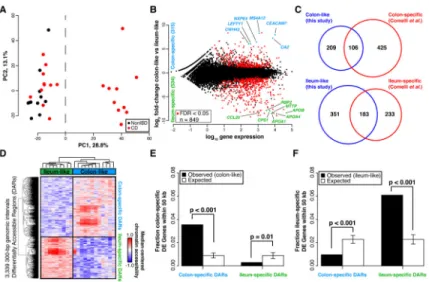
To determine, in an unbiased manner, whether gene expression levels separated samples into distinct molecular groups, we performed a principal components analysis (PCA) using gene expression profiles from a combined set of 21 CD and 11 non-IBD patients. A striking clustering pattern emerged whereby the CD individuals were divided into two distinct, expression-based subclasses, one of which clustered with the non-IBD controls (Figure 1A). To specifically interrogate these two CD subclasses, we identified genes differentially expressed between these two groups of CD patients (849 genes at FDR<0.05; Figure 1B, see Supplementary Table 1 for top 20 differentially expressed genes in each CD subclass). Surprisingly, when looking at the top 25 differentially expressed genes regardless of direction, most had tissue-specific expression patterns that discriminated colon from the small intestine (ileum), including NXPE4, CWH43, and CA2 (colon-specific), as well as RBP2, TM6SF2, APOB, MTTP, CREB3L3, and CPS1 (ileum-specific)[13]. CD samples similar to non-IBD controls (Figure 1A) exhibited abundant expression of the above colon-specific genes, whereas the other CD subclass showed expression patterns more consistent with ileum despite being sampled from the colon. To explore this more globally, we compared all these differentially expressed genes to 947 genes with known significant differential expression between colon and ileum (Figure 1C)[14]. We found that 34% of the genes more highly expressed in the colon-like CD samples were indeed markers of normal colon, and 44% of ileum marker genes were more highly expressed in the ileum-like CD samples (p<1×10−95, hypergeometric test). To validate these expression differences, we performed RT-qPCR on 18 CD samples of unaffected colon mucosa (9 colon-like, 9 ileum-like) using CEACAM7 and APOA1 as a proxy for colon-like and ileum-like expression patterns (Supplementary Figure 1A). In agreement with the RNA-seq data, CEACAM7 was significantly more abundant in colon-like CD samples (p=0.017, one-sided t-test), whereas APOA1 was significantly more abundant in ileum-like CD samples (p=0.020, one-sided t-test).
To determine whether these expression changes represented a fundamental shift in the functional cellular identity of these tissues, we investigated chromatin accessibility by performing FAIRE-seq[12] on the same samples from both CD subclasses. Supporting a fundamental shift in underlying molecular phenotypes, we identified 3,339 300-bp regions with significantly differential chromatin accessibility between colon-like and ileum-like CD samples (Figure 1D; p<0.05, two-sided t-test), hereafter referred to as Differentially
Accessible Regions (DARs). These DARs could be divided into two classes based on greater accessibility in colon-like or ileum-like CD samples, and further, an unsupervised PCA of FAIRE-seq data nearly separated ileum-like from colon-like CD subclasses (Supplementary Figure 1C). Subclass-specific changes in the chromatin landscape corresponded strongly to differences in nearby (within 50 kb) gene expression (Figure 1E–F; p≤0.01, permutation). Additionally, both colon-specific and ileum-specific DARs exhibited a significant enrichment for CD GWAS SNP loci[15] compared to what was expected due to random
A
uthor Man
uscr
ipt
A
uthor Man
uscr
ipt
A
uthor Man
uscr
ipt
A
uthor Man
uscr
chance (colon-specific p=0.018, ileum-specific p=0.006; permutation), suggestive that changes in chromatin accessibility occur at disease relevant regions of the genome.
We next sought to annotate these DARs based on tissue-specific gene regulatory
information. Post-translational modifications on histone proteins serve to compartmentalize the genome and demarcate putative function of regulatory elements[16]. Using ChIP-seq data from the Roadmap Epigenomics Project[17], we assessed the enrichment of seven histone modifications reflective of underlying regulatory activity (active: H3K4me1, H3K4me3, H3K27ac, H3K36me3; repressive: H3K27me3, H3K9me3) around colon-specific and ileum-colon-specific DARs. We found that colon-colon-specific DARs were demarcated by H3K27ac and H3K4me1 modifications present in colon but not ileum (Supplementary Figure 1B), suggesting these DARs function as active regulatory regions only in the normal colon. In contrast, ileum-specific DARs demonstrated positive H3K27ac and H3K4me1 enrichment found only in normal small intestine, despite these samples originating from colon tissue. These suggest that regulatory activity in DARs contribute to the colon-like and ileum-like expression levels. To confirm regulatory activity, we cloned three DARs (two with colon-specific and one with ileum-specific chromatin accessibility) into luciferase vectors upstream of a minimal promoter in both orientations using THP-1 monocytes (Supplementary Figure 1D). Relative to empty vector controls, two DARs (associated with SATB2-AS1 and DEPDC7) exhibited a significant increase (p<0.01, one-sided t-test) in luciferase activity in both orientations, strongly suggestive of enhancer function. The third DAR (associated with SLC16A9) also enhanced luciferase activity significantly
(p=8.9×10⁻⁵, one-sided t-test), however only in the reverse orientation.
Together, these data support the existence of two molecularly distinct subclasses of CD. Further, chromatin accessibility data suggests these subclasses exist due to stable molecular transformations of the genomic architecture in colon tissue cells, and not transient
differences due to external cellular signaling.
Whole genome RNA-seq analysis reveals colon-like and ileum-like subclasses in treatment-naïve pediatric Crohn’s disease patients
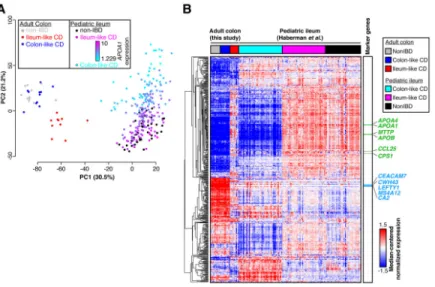
Gene expression profiles in adult CD patients may vary due to patient treatment histories. Therefore, we sought to determine whether treatment-naïve pediatric CD patients also segregated into similar molecular classes. We performed PCA on previously published RNA-seq data from ileal biopsies in age-matched pediatric CD (n=201) and non-IBD (n=40) patients generated within the Pediatric Risk Stratification Study[3]. Though a clustering as distinct as with the adult samples was not observed, non-IBD ileum samples clustered with some CD samples along the first principal component, whereas the other CD samples were separate (Supplementary Figure 2). To determine whether this pattern was related to the adult CD molecular subtypes, we performed PCA on combined adult colon and pediatric ileum expression data (Figure 2A). Unsurprisingly, samples predominantly separated by tissue of origin (colon vs. ileum; first principal component). However, a separation indicative of two molecular subclasses was evident along the second principal component, and
correlated nearly exactly with the first principal components in single cohort PCAs (Figure 1A, Supplementary Figure 2). Further, pediatric CD samples fell on a spectrum highly
A
uthor Man
uscr
ipt
A
uthor Man
uscr
ipt
A
uthor Man
uscr
ipt
A
uthor Man
uscr
correlated with expression of APOA1, a marker gene of the ileum and indicator of disease outcome in the pediatric cohort[3]. This pattern aligned well with the ileum-like (APOA1-high) and colon-like (APOA1-low) subclasses we identified in the adult CD colon.
To closely examine the relationship between the two CD subclasses across the adult and pediatric cohorts, we assessed gene expression patterns across the 500 most-variably-expressed known colon and ileum marker genes[14] using hierarchical clustering (Figure 2B). To focus this analysis, we selected the 50 pediatric ileum samples each that were most colon-like and most ileum-like based on the PCA (Figure 2A, second PC). Many of the colon and ileum representative genes described above (e.g. APOA1, CEACAM7, MTTP, LEFTY1, and CA2) exhibited highly consistent expression patterns across all samples in a defined molecular subclass, regardless of cohort. Interestingly, for these 500 genes, expression patterns were extremely consistent between colon-like CD and non-IBD colon samples, as well as between ileum-like CD and non-IBD ileum samples. Importantly, we note that a subset of genes differentiate all colon tissues from all ileum tissues indicating that tissue-of-origin-specific expression is not completely lost. Together, these data strongly suggest that the colon-like and ileum-like molecular signatures define two forms of CD present regardless of tissue sampling location, patient age, or treatment status.
Metabolic and immune activation gene expression profiles characterize distinct molecular phenotypes in adult and pediatric CD
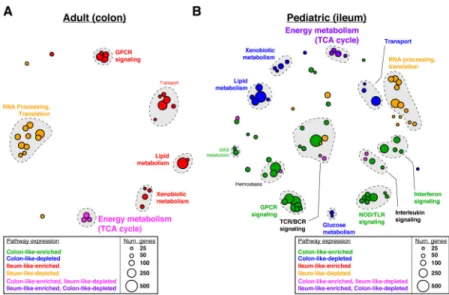
Gene expression differences between colon-like and ileum-like subclasses in the adult and pediatric CD cohorts went beyond the marker genes described above (Figure 1B–C). To evaluate this more broadly, we computed and compared pathway-level expression patterns of both CD subclasses and non-IBD controls in both patient cohorts[18, 19]. We then grouped significantly altered pathways based on similarity in both gene composition and direction of expression difference (Figure 3, Supplementary Figures 3 and 4). First, numerous pathways related to interferon signaling, GPCR signaling, and antigen processing were significantly upregulated in CD patients as a whole relative to non-IBD controls in both cohorts
(Supplementary Figure 3, “CD-enriched”, red). Given that the adult patient cohort consisted of disease-unaffected tissue, and the pediatric cohort was treatment-naïve, this suggests a basal activation of the immune system in CD. In contrast, many pathways related to the RNA processing, translation, and transcription were downregulated in CD in the pediatric patients (Supplementary Figure 3, “CD-depleted”, blue). These results strongly corroborate studies in mice and humans linking overall defects in cellular protein processing in CD to immune activation and unabated inflammation[20].
Next, we identified significantly altered pathways that described how the ileum-like and colon-like CD subclasses differed. Among the most pronounced effects in both cohorts reflected strong differences in metabolic activity including pathways involved in lipid metabolism and metabolism of foreign (xenobiotic) agents (Figure 3A;
“Ileum-like-enriched”, red; Figure 3B; “Colon-like-depleted”; blue). Interestingly, energy production by way of the TCA cycle was significantly affected in opposing ways: in adults, it was
upregulated in the colon-like class and simultaneously downregulated in the ileum-like class in colon tissue (Figure 3A; “Colon-like-enriched, Ileum-like-depleted”, pink); whereas in
A
uthor Man
uscr
ipt
A
uthor Man
uscr
ipt
A
uthor Man
uscr
ipt
A
uthor Man
uscr
pediatric patients it was downregulated in the colon-like class and upregulated in the ileum-like class in ileal tissue (Figure 3B; “Ileum-ileum-like-enriched, Colon-ileum-like-depleted”, purple). This suggests that energy production increases in patients where the subtype is more similar to the tissue of origin, and decreases when gene expression adopts patterns of the opposite tissue. In addition, several pathways related to G-protein coupled receptor (GPCR) signaling were upregulated in the ileum-like subclass in colon tissue (Figure 3A;
“Ileum-like-enriched”, red) and upregulated in the colon-like subclass in ileum tissue (Figure 3B; “Colon-like-enriched”, green). GPCRs are highly expressed in monocytes and macrophages central to the development and progression of inflammation in CD, mainly through
migration and accumulation within the inflamed tissues[21].
Taken together, dysregulation of metabolic pathways may represent defining features of CD subtypes. Although dysregulation of lipid metabolism has been previously described in CD[3], our data suggest these alterations may be specific only to patients within a certain subclass and dependent on the tissue being assayed. Further, these data indicate that despite a striking similarity in expression of key ileum and colon marker genes (Figure 2B), there are key differences in pathway-level expression patterns between adult and pediatric CD patients, such as the immune response (e.g. NOD/TLR signaling, interleukin signaling), that point toward clinically relevant phenotypes and characteristics of each subclass.
Molecular subclasses are associated with clinical outcomes
To understand the impact of molecular phenotype on clinical disease, we studied the clinical characteristics of treatment-naïve pediatric patients with respect to molecular
subclassification. We again used the 50 ileum-like and 50 colon-like pediatric samples defined above. We found that significantly more colon-like CD patients displayed both colon and ileum involvement (p=0.0014), had deep ulcers (p=0.0002), and showed macroscopic inflammation (p=0.0156), whereas more ileum-like patients showed no inflammation (p=0.0122) and a strong skew in prevalence towards colon-only involvement (p=0.0528; Table 1).
We next performed an in-depth retrospective chart review and a prospective follow-up of all adult CD patients (Table 1; Supplementary Table 1) to see if a similar clinical impact of molecular subclass was observed. Patients with colon-like CD had greater rectal disease involvement (p<0.01) and were more likely to eventually need a colectomy (p=0.01). Patients with ileum-like CD tended to have ileal disease (p=0.06) and required the use of post-operative biological therapy (p=0.02). Though our sample size is small, these data suggest that molecular subtypes of CD can stratify patients into clinically distinct and relevant subgroups, and may prospectively identify those more likely to require intensive medical therapy.
DISCUSSION
We identified two distinct molecular phenotypes in colon tissue obtained from adult CD patients. When we applied the same analytical approach to pediatric RNA-seq data from ileum, two molecular phenotypes also emerged, albeit the clinical consequences in both circumstances were relevant to the population of study and limited to the data collected for
A
uthor Man
uscr
ipt
A
uthor Man
uscr
ipt
A
uthor Man
uscr
ipt
A
uthor Man
uscr
each population in terms of clinical phenotype. Although the adult patient sample size was limited, in only the colon-like CD subclass were there patients with rectal disease, or that required a colectomy. Rectal CD is particularly difficult to manage, and though it may represent a unique CD phenotype, its underlying molecular mechanisms are unknown[22, 23, 24]. Pediatric patients with colon-like disease were more likely to have macroscopic inflammation, deep ulcers, and involvement of both the ileum and colon. These data emphasize the need to continue and expand these studies over time to incorporate the evolving clinical phenotype in both adult and pediatric patients, and the need to study both tissues in the same patient. Only through such studies will we uncover whether the tissue of origin dictates potential clinical phenotype similarly.
The ileum-like CD subclass was primarily characterized by an upregulation of pathways involved in lipid and xenobiotic metabolism. The mechanistic link between these clinical phenotypes and the lipid metabolic signature defined here is yet to be explored, however the implication that lipid metabolism may be involved is interesting for several reasons. First, lipid metabolism and altered levels of certain lipids have been previously associated with IBD (reviewed in [25]), and may be linked to inflammation state and immune signaling (reviewed in [26]), in addition to diet and intestinal microbiota composition[27]. Lipid levels may also be a cause or result of increases in intestinal oxidative stress, which has also been shown to be elevated in CD patients (reviewed in [28]). Notably, two of the top differentially expressed genes between CD subclasses were in fact GSTA1 and GSTA2, key mediators of the oxidative stress response[29]. Furthermore, diet, cholesterol, and microbiota composition have each been studied either themselves as potential therapies or how their levels change as a result of surgery or biologic use (reviewed in [25]).
The diversity in cellular state demonstrated at both the transcriptional and chromatin levels has important potential therapeutic implications. Our results suggest that additional testing of CD patients for particular molecular signatures, especially metabolic pathways, may determine potential therapeutic subgroups. This approach has already increased our understanding of human cancer biology. Patient sub-classification in various forms of cancer, most notably invasive breast tumors[4, 5], has led to numerous associations with clinical outcome and helped to shape future treatment strategies. There is growing consensus that subtypes exist in CD as well, each with its own presentation, genetic makeup, and prognosis. As a first step, molecular stratifications of archived patient tissue and serum from major clinical trials could be performed in the context of response to biologic and microbial therapies for CD[30].
Our current studies did not allow for the investigation of both intestinal regions from the same individual, but they provide significant motivation for future exploration of these molecular subclasses longitudinally in larger cohorts of matched colon and ileum tissue of the same patient. New larger studies should allow for a more complete understanding of the molecular effects of host-environment interactions on disease, and its utility in guiding clinical decisions. In addition, our sample numbers here are too limited to study the effects of genetic variation on identified changes in chromatin accessibility and gene expression. Our chromatin accessibility data strongly suggested that changes occurred at genomic loci previously associated with disease through genetic variation. Future studies with larger
A
uthor Man
uscr
ipt
A
uthor Man
uscr
ipt
A
uthor Man
uscr
ipt
A
uthor Man
uscr
sample sizes will help identify specific relationships between genetic disease predisposition, regulatory activity, gene expression levels and clinical phenotypes and to better characterize individual-level disease sub-phenotypes within this very heterogeneous disease and tissue. Genomic studies on composite cell types (e.g. immune and epithelial cells) may also become necessary to study cell specific mechanisms driving phenotype specific disease
pathogenesis.
MATERIALS AND METHODS
For more detailed information, see the Supplemental Methods. All processed sequencing data are available in GEO under accession GSE85499 with raw sequence data available through dbGaP. Full data tables are also hosted at http://fureylab.web.unc.edu/datasets/ crohns-disease-molecular-subtypes/.
Statistics
Differential gene expression was detected using DEseq with an adjusted p-value threshold of 0.05. Differential chromatin accessibility was detected using a 2-sided t-test with p-value threshold of 0.05. Pathway enrichments were determined using GSAA (FDR<0.1, permutation test) for all pairwise comparisons between all CD, colon-like CD, ileum-like CD, and non-IBD samples based on differential gene expression p-values calculated using 2-sided t-tests. Clinical phenotype associations were tested with 2-2-sided t-tests or Fisher’s Exact Tests.
Study Approval
All procedures were approved under University of North Carolina IRB protocols 10-0355, 14-2445 and 11-0359.
Supplementary Material
Refer to Web version on PubMed Central for supplementary material.
Acknowledgments
We thank B. Aronow and L. Denson for assistance with pediatric patient data (CCFA RISK cohort). This work was supported by American Gastroenterological Association Research Scholar Award (SZS), Broad Medical Research Program (SZS), Crohn’s and Colitis Foundation of America’s Career Development Award (SZS), and Microbiome Consortium (RBS, DPBM), R01-ES024983 (SZS, TSF), UNC Team Translational Science Award (SZS, TSF), R01-DK094779 (RBS, SZS), P30-DK034987 (RBS, SZS), U01-DK062413, P01-DK046763 (DPBM), Helmsley Trust SHARE 2, Project 3 (SZS, RBS, DPBM), and T32-DK007634 (BK).
Abbreviations
CD Crohn’s disease
PCA principal components analysis
FAIRE formaldehyde-assisted isolation of regulatory elements
DARs differentially accessible regions
A
uthor Man
uscr
ipt
A
uthor Man
uscr
ipt
A
uthor Man
uscr
ipt
A
uthor Man
uscr
References
1. Cleynen I, Boucher G, Jostins L, Schumm LP, Zeissig S, Ahmad T, et al. Inherited determinants of Crohn’s disease and ulcerative colitis phenotypes: a genetic association study. Lancet. 2016; 387:156–67. [PubMed: 26490195]
2. Jostins L, Ripke S, Weersma RK, Duerr RH, McGovern DP, Hui KY, et al. Host-microbe interactions have shaped the genetic architecture of inflammatory bowel disease. Nature. 2012; 491:119–24. [PubMed: 23128233]
3. Haberman Y, Tickle TL, Dexheimer PJ, Kim MO, Tang D, Karns R, et al. Pediatric Crohn disease patients exhibit specific ileal transcriptome and microbiome signature. J Clin Invest. 2014; 124:3617–33. [PubMed: 25003194]
4. Perou CM, Sorlie T, Eisen MB, van de Rijn M, Jeffrey SS, Rees CA, et al. Molecular portraits of human breast tumours. Nature. 2000; 406:747–52. [PubMed: 10963602]
5. Cancer Genome Atlas N. Comprehensive molecular portraits of human breast tumours. Nature. 2012; 490:61–70. [PubMed: 23000897]
6. Brannon AR, Reddy A, Seiler M, Arreola A, Moore DT, Pruthi RS, et al. Molecular Stratification of Clear Cell Renal Cell Carcinoma by Consensus Clustering Reveals Distinct Subtypes and Survival Patterns. Genes Cancer. 2010; 1:152–63. [PubMed: 20871783]
7. Thurman RE, Rynes E, Humbert R, Vierstra J, Maurano MT, Haugen E, et al. The accessible chromatin landscape of the human genome. Nature. 2012; 489:75–82. [PubMed: 22955617] 8. Dixon JR, Jung I, Selvaraj S, Shen Y, Antosiewicz-Bourget JE, Lee AY, et al. Chromatin
architecture reorganization during stem cell differentiation. Nature. 2015; 518:331–6. [PubMed: 25693564]
9. McKay DJ, Lieb JD. A common set of DNA regulatory elements shapes Drosophila appendages. Dev Cell. 2013; 27:306–18. [PubMed: 24229644]
10. Simon JM, Hacker KE, Singh D, Brannon AR, Parker JS, Weiser M, et al. Variation in chromatin accessibility in human kidney cancer links H3K36 methyltransferase loss with widespread RNA processing defects. Genome Res. 2014; 24:241–50. [PubMed: 24158655]
11. Simon JM, Davis JP, Lee SE, Schaner MR, Gipson GR, Weiser M, et al. Alterations to chromatin in intestinal macrophages link IL-10 deficiency to inappropriate inflammatory responses. Eur J Immunol. 2016
12. Simon JM, Giresi PG, Davis IJ, Lieb JD. Using formaldehyde-assisted isolation of regulatory elements (FAIRE) to isolate active regulatory DNA. Nature protocols. 2012; 7:256–67. [PubMed: 22262007]
13. Uhlen M, Fagerberg L, Hallstrom BM, Lindskog C, Oksvold P, Mardinoglu A, et al. Proteomics. Tissue-based map of the human proteome. Science. 2015; 347:1260419. [PubMed: 25613900] 14. Comelli EM, Lariani S, Zwahlen MC, Fotopoulos G, Holzwarth JA, Cherbut C, et al. Biomarkers
of human gastrointestinal tract regions. Mamm Genome. 2009; 20:516–27. [PubMed: 19711126] 15. Welter D, MacArthur J, Morales J, Burdett T, Hall P, Junkins H, et al. The NHGRI GWAS Catalog,
a curated resource of SNP-trait associations. Nucleic Acids Res. 2014; 42:D1001–6. [PubMed: 24316577]
16. Ernst J, Kellis M. Discovery and characterization of chromatin states for systematic annotation of the human genome. Nat Biotechnol. 2010; 28:817–25. [PubMed: 20657582]
17. Kundaje A, Meuleman W, Ernst J, Bilenky M, Yen A, et al. Roadmap Epigenomics C. Integrative analysis of 111 reference human epigenomes. Nature. 2015; 518:317–30. [PubMed: 25693563] 18. Xiong Q, Ancona N, Hauser ER, Mukherjee S, Furey TS. Integrating genetic and gene expression
evidence into genome-wide association analysis of gene sets. Genome Res. 2012; 22:386–97. [PubMed: 21940837]
19. Xiong Q, Mukherjee S, Furey TS. GSAASeqSP: a toolset for gene set association analysis of RNA-Seq data. Sci Rep. 2014; 4:6347. [PubMed: 25213199]
20. Garg AD, Kaczmarek A, Krysko O, Vandenabeele P, Krysko DV, Agostinis P. ER stress-induced inflammation: does it aid or impede disease progression? Trends Mol Med. 2012; 18:589–98. [PubMed: 22883813]
A
uthor Man
uscr
ipt
A
uthor Man
uscr
ipt
A
uthor Man
uscr
ipt
A
uthor Man
uscr
21. Smith PD, Ochsenbauer-Jambor C, Smythies LE. Intestinal macrophages: unique effector cells of the innate immune system. Immunol Rev. 2005; 206:149–59. [PubMed: 16048547]
22. Singh S, Ding NS, Mathis KL, Dulai PS, Farrell AM, Pemberton JH, et al. Systematic review with meta-analysis: faecal diversion for management of perianal Crohn’s disease. Aliment Pharmacol Ther. 2015; 42:783–92. [PubMed: 26264359]
23. Bailey EH, Glasgow SC. Challenges in the Medical and Surgical Management of Chronic Inflammatory Bowel Disease. Surg Clin North Am. 2015; 95:1233–44. vii. [PubMed: 26596924] 24. Harb WJ. Crohn’s Disease of the Colon, Rectum, and Anus. Surg Clin North Am. 2015; 95:1195–
210. vi. [PubMed: 26596922]
25. Agouridis AP, Elisaf M, Milionis HJ. An overview of lipid abnormalities in patients with inflammatory bowel disease. Ann Gastroenterol. 2011; 24:181–7. [PubMed: 24713706] 26. Shores DR, Binion DG, Freeman BA, Baker PR. New insights into the role of fatty acids in the
pathogenesis and resolution of inflammatory bowel disease. Inflamm Bowel Dis. 2011; 17:2192– 204. [PubMed: 21910181]
27. den Besten G, van Eunen K, Groen AK, Venema K, Reijngoud DJ, Bakker BM. The role of short-chain fatty acids in the interplay between diet, gut microbiota, and host energy metabolism. J Lipid Res. 2013; 54:2325–40. [PubMed: 23821742]
28. Rezaie A, Parker RD, Abdollahi M. Oxidative stress and pathogenesis of inflammatory bowel disease: an epiphenomenon or the cause? Dig Dis Sci. 2007; 52:2015–21. [PubMed: 17404859] 29. Gorrini C, Harris IS, Mak TW. Modulation of oxidative stress as an anticancer strategy. Nat Rev
Drug Discov. 2013; 12:931–47. [PubMed: 24287781]
30. Sands BE, Anderson FH, Bernstein CN, Chey WY, Feagan BG, Fedorak RN, et al. Infliximab maintenance therapy for fistulizing Crohn’s disease. N Engl J Med. 2004; 350:876–85. [PubMed: 14985485]
A
uthor Man
uscr
ipt
A
uthor Man
uscr
ipt
A
uthor Man
uscr
ipt
A
uthor Man
uscr
SUMMARY BOX
What is already known about this subject
• Crohn’s disease is a clinically heterogeneous disease with variable presentation and progression.
• Current therapies for Crohn’s disease patients are largely based on subjective clinical classifications resulting in an inconsistent response. Unlike other complex diseases, notably certain cancers, there is currently no way to determine a personalized approach to therapy.
• Genetic association studies suggest that underlying molecular or genetic factors contribute to disease heterogeneity, but precise mechanisms are poorly understood.
What are the new findings
• Gene expression and chromatin accessibility can subdivide Crohn’s disease into at least two distinct molecular subclasses that associate with specific disease phenotypes.
• These subclasses exhibit stark expression differences in cellular metabolism and immune pathways.
• Similar molecular phenotypes are also observed in treatment-naïve pediatric Crohn’s disease patients, thus defining true disease subclasses independent of treatment history and patient age.
How might it impact on clinical practice in the foreseeable future
• Our findings thus provide evidence of a molecular basis for the observed heterogeneity in Crohn’s disease. They also offer a unique opportunity to begin exploring customized treatment options guided by disease subclass providing novel therapeutic avenues and predictors of disease outcomes.
A
uthor Man
uscr
ipt
A
uthor Man
uscr
ipt
A
uthor Man
uscr
ipt
A
uthor Man
uscr
Figure 1. Two distinct molecular subtypes in adult CD
(A) PCA analysis of RNA-seq data from colon tissue from 21 CD and 11 non-IBD patients
shows two distinct clusters. (B) 849 genes are differentially expressed between the two CD subclasses (adjusted p<0.05, DEseq), defined as colon-like and ileum-like. Known markers of colon and ileum are highlighted. (C) Genes upregulated in colon-like (top) and ileum-like (bottom) CD subclasses overlap previously defined colon-specific and ileum-specific genes, respectively. (D) Differentially accessible regions (DARs) identified using FAIRE-seq (p<0.05, two-sided t-test, normalized read counts, 300-bp windows) show distinct profiles in colon-like and ileum-like CD samples. (E) Colon-like-associated DARs are enriched and ileum-like-associated DARs are depleted near genes upregulated in colon-like samples (p≤0.01, permutation test). (F) Ileum-like-associated DARs are enriched and colon-like-associated DARs are depleted near genes upregulated in ileum-like samples (p<0.001, permutation test).
A
uthor Man
uscr
ipt
A
uthor Man
uscr
ipt
A
uthor Man
uscr
ipt
A
uthor Man
uscr
Figure 2. Treatment-naïve pediatric CD samples show similar molecular subtypes
(A) PCA analysis of combined RNA-seq data from adult colon tissue and pediatric ileum
tissue from CD and non-IBD patients shows separation of tissue types (PC1) and replicates ileum-like and colon-like clusters (PC2). Expression of APOA1 (blue-pink, low-high) in pediatric samples aligns well with subclasses. (B) Hierarchical clustering of RNA-seq data using 500 colon- and ileum-specific genes show clusters of genes associated with ileum-like and colon-like samples across both the adult colon and pediatric ileum cohorts, as well as genes associated with tissue of origin.
A
uthor Man
uscr
ipt
A
uthor Man
uscr
ipt
A
uthor Man
uscr
ipt
A
uthor Man
uscr
Figure 3. Pathways enriched for differentially expressed genes associated with CD phenotypes
Pathway enrichments were determined using GSAA (FDR<0.1, permutation test) for all pairwise comparisons between all CD, colon-like CD, ileum-like CD, and non-IBD samples. Separate analyses in (A) adult colon and (B) pediatric ileum show similar and unique pathways associated with CD phenotypes. Each circle represents Reactome-defined pathway with the size reflecting the number of genes in the pathway. Pathways were grouped based on similarity in gene membership, and labels describing multi-pathway clusters are shown. See Supplementary Figures 3–4 for CD vs non-IBD comparisons and full list of pathways.
A
uthor Man
uscr
ipt
A
uthor Man
uscr
ipt
A
uthor Man
uscr
ipt
A
uthor Man
uscr
A
uthor Man
uscr
ipt
A
uthor Man
uscr
ipt
A
uthor Man
uscr
ipt
A
uthor Man
uscr
ipt
T ab le 1Clinical phenotypes associated with CD subclasses
Pediatric and adult patient phenotypes, se
gre
g
ated by colon-lik
e and ileum-lik
e classif
ications, were compared using Fisher’s Exact T
ests (for cate
gorical
data) or tw
o-sided t-tests (for continuous data). Signif
icant associations (p<0.05) are bolded. See Supplementary T
ables 2–3 for data on indi
vidual patients. Phenotype P ediatric (ileum) Adult (colon) Ileum-lik
e (n = 50)
Colon-lik
e (n = 50)
p-v
alue
Ileum-lik
e (n = 10)
Colon-lik
e (n = 11)
p-v alue Location Ileum-only 10 10 1 2 0 0.21 Colon-only 21 11 0.0528 1 6 0.06 Ileum+Colon 19 29 0.0014 7 5 0.39 P
atient characteristics Mean age
12.1 12.4 0.6193 35.1 35.3 0.98 Male 28 29 1 3 3 1 Female 22 21 1 7 8 1 Smok er N A N A N A 5 4 0.67 Inflammation Macr oscopic 29 41 0.0156 N A N A N A Microscopic 8 6 0.7742 N A N A N A None 13 3 0.0122 N A N A N A
Phenotypes and in
A
uthor Man
uscr
ipt
A
uthor Man
uscr
ipt
A
uthor Man
uscr
ipt
A
uthor Man
uscr
ipt
Phenotype P ediatric (ileum) Adult (colon) Ileum-like (n = 50)
Colon-lik
e (n = 50)
p-v
alue
Ileum-lik
e (n = 10)
Colon-lik
e (n = 11)
p-v alue Stricturing N A N A N A 7 4 0.2 Penetrating N A N A N A 5 4 0.67 Pre-operati v
e treatment history
Steroids N A N A N A 8 10 0.59 5-ASA N A N A N A 8 10 0.59 Immunomodulation N A N A N A 8 8 1 Anti-TNF N A N A N A 7 10 0.31 Non-anti-TNF biologic N A N A N A 0 2 0.48 Post-operati v e outcome Post-operati v
e disease recurrence
N A N A N A =2/8 =0/10 0.18 P ost-operati v
e biologic use
N A N A N A =6/9 =1/11 0.02 Colectomy N A N A N A 0 6 0.01 Second resection N A N A N A 3 6 0.39 Median T
ime to f
irst resection (years)
N A N A N A 3 5 0.91 Median T
ime from f
irst to second resection (years, if applicable)