ADAPTIVE CORRELATES OF SOCIALLY AGGRESSIVE BEHAVIOR IN PEER RELATIONSHIPS
Nicole Heilbron
A dissertation submitted to the faculty of the University of North Carolina at Chapel Hill in partial fulfillment of the requirements for the degree of Doctor of Philosophy in the
Department of Psychology (Clinical Psychology)
Chapel Hill 2006
Approved by
Advisor: Mitch J. Prinstein Reader: Martha J. Cox Reader: Daniel J. Bauer
ABSTRACT
NICOLE HEILBRON: Adaptive Correlates of Socially Aggressive Behavior in Peer Relationships
(Under the direction of Mitch Prinstein, Ph.D.)
This study examined concurrent and longitudinal associations among overt and social forms of aggression, peer status, and friendship quality over an 11-month period. A sample of 559 adolescents (50% girls) in grades 6-8 participated in the study. Participants completed a measure of friendship quality at both time points. Measures of aggression and peer status (preference-based and reputation-based popularity) were collected using a standard
TABLE OF CONTENTS
Page
LIST OF TABLES...v
LIST OF FIGURES ... vi
Chapter I INTRODUCTION ...1
Purposes of the Present Study...2
Review of Definitions and Key Findings...3
Emphases of Recent Research on Socially Aggressive Behaviors ...4
Questioning Basic Assumptions: Emerging Issues...8
II STUDY METHODS...20
Participants...20
Measures ...21
III RESULTS ...25
Longitudinal Prediction of Peer Relations at the Group Level...26
Longitudinal Prediction of Peer Relations at the Dyadic Level ...30
Path Analysis ...33
IV DISCUSSION ...38
LIST OF TABLES
Table Page
1. Means and Standard Deviations for Primary Variables...54
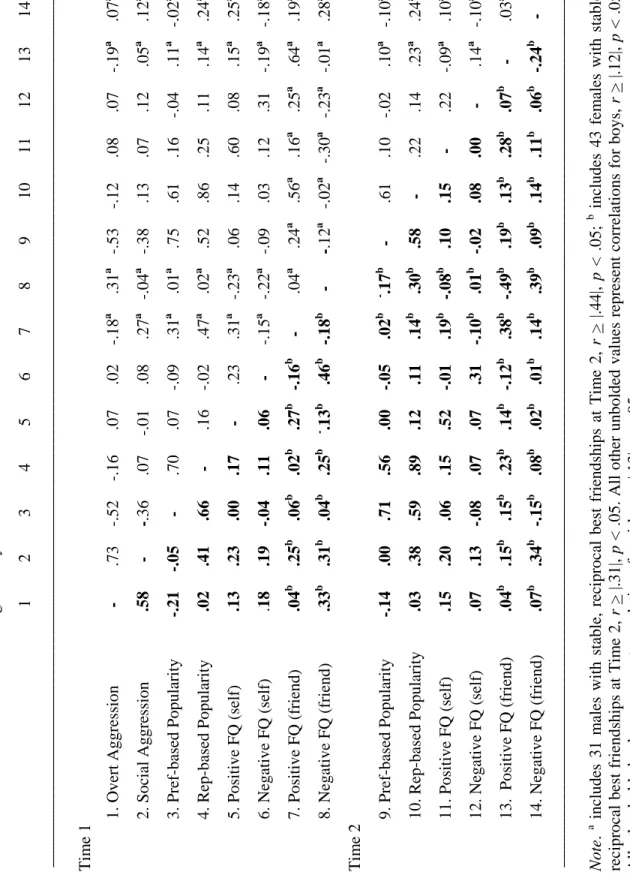
2. Bivariate Associations Among Primary Variables ...55
3. Longitudinal Prediction of Preference-Based Popularity by Aggression and Gender ...56
4. Longitudinal Prediction of Reputation-Based Popularity by Aggression and Gender ...57
5. Logistic Regression Results for Friendship Reciprocity ...58
6. Logistic Regression Results for Friendship Stability...59
7. Prediction of Self-Reported Friendship Quality by Aggression and Gender ...60
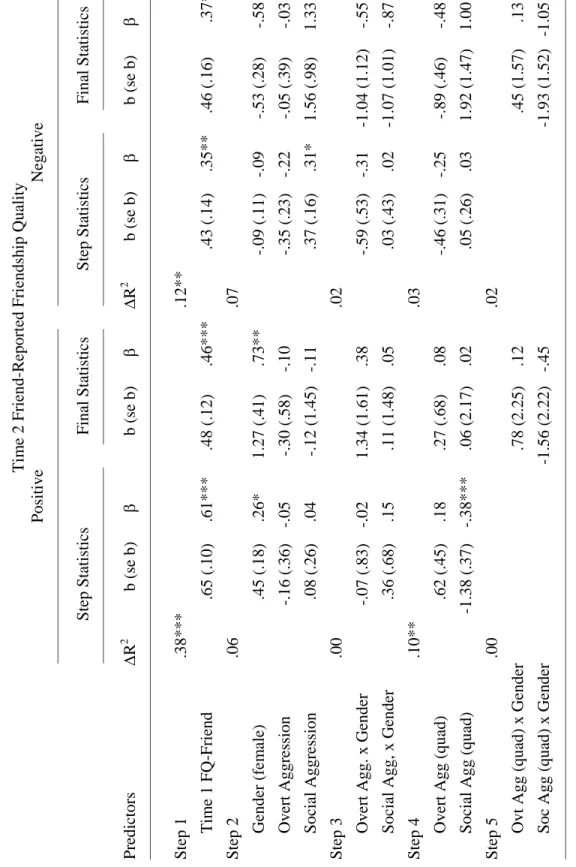
8. Prediction of Friend-Reported Friendship Quality by Aggression and Gender ...61
LIST OF FIGURES
Figure Page
1. Path Analysis of Associations Among Primary Variables ...63
2. Curvilinear Trends of Social Aggression and Preference-Based Popularity for Boys ...64
3. Curvilinear Trends of Overt Aggression and Preference-Based Popularity for Girls ...65
4. Curvilinear Trends of Social Aggression and Reputation-Based Popularity for Boys...66
5. Curvilinear Trends of Social Aggression and Positive Friendship Quality ...67
CHAPTER I INTRODUCTION
Perhaps one of the most pressing concerns examined in clinical child psychology pertains to the predictors and consequences of aggressive behavior. Over the past three decades, a considerable empirical literature has demonstrated associations between physical aggression and various indices of social incompetence, including social-cognitive biases, social skill deficits, and peer rejection (e.g., Dodge, 1983; Lochman & Dodge, 1998). Numerous longitudinal studies have identified childhood physical aggression as a risk factor for future delinquency, criminal activity, school dropout, and substance use during adolescence and adulthood (e.g., Nagin & Tremblay, 1999; Patterson, Capaldi, & Bank, 1991). Given that treatment of antisocial and aggressive behavior represents the leading cause of referral to inpatient and outpatient clinics for adolescents, knowledge of the adverse correlates and consequences of aggression has been critical for informing effective intervention and prevention programs (Kazdin, 1995).
Although physical behaviors have been the focus of the majority of research efforts on aggression, recent interest in the constructs of social, relational, and indirect aggression has prompted a reexamination of the form, function, and operationalization of aggressive behavior (Underwood, 2003). Whereas physical and verbal aggression involve overt
revealed that nonphysical aggression (e.g., snubbing, ignoring) was experienced as hurtful by victims (Feshbach, 1969; Feshbach & Sones, 1971). Research demonstrating similar
deleterious consequences of nonphysical forms of aggression has rapidly proliferated in the past decade (e.g., Crick, 1995, 1997; Crick & Grotpeter, 1995; Galen & Underwood, 1997). However, there is a danger that empirical work on these topics has outpaced the development of theory needed to guide this research in the most productive directions. This study offered a preliminary exploration of nonphysical forms of aggression in friendship and group contexts with a careful consideration of theory and conceptualization that should underpin this and future investigations.
Purposes of the Present Study
The present study was motivated by the hypothesis that socially aggressive behaviors may be associated with both adaptive and maladaptive social-psychological correlates. To explore specific questions related to this hypothesis, at least two central issues must be addressed. First, there is considerable confusion regarding the nomenclature used to describe social types of aggressive behaviors. Second, work on nonphysical forms of aggression has remained relatively detached from theoretical advances that have been widely adopted
Review of Definitions and Key Findings
As research on nonphysical forms of aggressive behavior has expanded over the past decade, theorists have lamented the definitional obfuscation that now characterizes work in this area. Therefore, it is instructive to begin by clarifying underlying differences in
constructs referred to as social, relational, and indirect aggression. Social aggression refers to behaviors that intentionally damage interpersonal relationships and/or social status through nonconfrontational and generally concealed methods. Socially aggressive behaviors typically require the involvement of members of the social community (e.g., gossip, social exclusion, ostracism, negative facial expressions; Cairns, Cairns, Neckerman, Ferguson, & Gariepy, 1989; Galen & Underwood, 1997; Paquette & Underwood, 1999). This broad definition is designed to include both direct and indirect behaviors, verbal and nonverbal social exclusion, malicious gossip, and friendship manipulation (Underwood, 2003).
Though similar to the social aggression construct, relational aggression has been defined as subtly, but importantly distinct. Relationally aggressive behaviors also are defined as behaviors that cause social rather than physical harm. However, relationally aggressive behavior primarily involves the direct manipulation of peer relationships and by definition, does not include negative facial expressions or gestures (Crick, 1995, 1997; Crick & Grotpeter, 1995). These behaviors may be confrontational (e.g., publicly excluding a peer from the social group) or nonconfrontational (e.g., character defamation), and may or may not involve members of the social community. Individual differences in relational
Crick & Grotpeter, 1995). That said, this issue has been confounded by measurement and methodological constraints, and therefore continues to be a subject of considerable debate within the literature (Bjorkqvist et al., 1992; Crick & Grotpeter, 1995; Underwood, 2003). Lastly, indirect aggression broadly refers to behaviors that are covert, such as ignoring, avoiding, or excluding others from social interactions (Bjorkqvist et al., 1992). This
terminology was first introduced by Feshbach (1969, 1971) to define the behavior of individuals who snubbed a newcomer during a laboratory observation session. Lagerspetz and colleagues later adopted the term to refer to behavioral strategies that allow the aggressor to cause harm without being identified by the victim (e.g., Bjorkqvist, Osterman, &
Kaukiainen, 1992; Lagerspetz & Bjorkqvist, 1994; Lagerspetz, Bjorkqvist, & Peltonen, 1988). Indirect aggression is distinct from social aggression because the perpetrator does not necessarily employ other members of the peer group in the aggressive act and refers
specifically to nonconfrontational behaviors (Xie, Cairns, & Cairns, 2004). Perhaps because of this rather limiting definition of behavior, indirect aggression is the least frequently studied of the three forms.
Through the process of clarifying distinctions between social, relational, and indirect aggression, it is apparent that these constructs share an inherent definitional complexity that does not characterize physical aggression. Although there are similarities in the
conceptualizations, semantic and definitional issues have plagued prior studies of social aggression. Given that the existing definition of social aggression represents the broadest of the three conceptualizations, this term is used for clarity and ease of presentation.
In spite of the contentious debate among scholars as to what extent social, relational, and indirect aggression represent overlapping constructs, research linking nonphysical forms of aggression to indices of social-psychological maladjustment has made an impressive
contribution to the scientific literature. Over the past decade, studies of children, adolescents, and young adults who are the targets of socially aggressive behaviors have demonstrated clear associations between this form of victimization and concurrent social and emotional difficulties (Crick, Casas, & Nelson, 2002; Crick & Grotpeter, 1996; Prinstein, Boergers, & Vernberg, 2001; Werner & Crick, 1999). Experiences of relational aggression in childhood have also been implicated in the prediction of future maladjustment for both sexes (Crick, 1996; Crick & Bigbee, 1998; Crick, Casas, & Ku, 1999; Crick & Grotpeter, 1995).
Research on the social-psychological adjustment of social aggressors is in its early stages; however, the evolution of the literature is notable for its emphasis on gender differences in the frequency and psychological correlates of social aggression (e.g., Crick, 1996; Crick & Grotpeter, 1995). This emphasis has been, quite explicitly, designed to address a perceived bias of past research (Crick, 1995). Specifically, this work has been motivated by a stated desire to demonstrate that socially aggressive behaviors are forms of maladjustment, or even psychopathology, that have gone unnoticed due to a relative neglect of girls’ mental health issues (Crick, Wellman, Casas, O’Brien, Nelson, & Grotpeter, 1999). As definitions of nonphysical aggression were expanded from obviously confrontational behaviors (e.g., social exclusion, rejection) to include more subtle behaviors (e.g., eye-rolling, gossip), many
findings support the contention that boys are more verbally and physically aggressive than girls (e.g., Coie, Dodge, & Copottelli, 1982; Crick & Grotpeter, 1995), and that girls are more likely to use social rather than physically aggressive strategies to harm a target (see Crick, Wellman, et al., 1999 for a review). However, data are equivocal about whether girls are more socially aggressive than boys, with some studies finding evidence for this
proposition (e.g., Crick & Grotpeter, 1995; Lagerspetz et al., 1988; McNeilly-Choque, Hart, Robinson, Nelson, & Olsen, 1996), some finding no such gender differences (Hart, Nelson, Robinson, Olsen, & McNeilly-Choque, 1998; Pakaslahti & Keltikanagas-Jaervinen, 2000; Phillipsen, Deptula, & Cohen, 1999; Rys & Bear, 1997; Willoughby, Kupersmidt, & Bryant, 2001) and still others finding that boys are more socially aggressive than girls (David & Kistner, 2000; Henington, Hughes, Cavell, & Thompson, 1998; Tomada & Schneider, 1997). In addition to addressing whether socially aggressive behavior is more common among girls than boys, researchers have used conceptual frameworks from studies of physical aggression to explore the psychological correlates of social aggression (Underwood, 2003). For example, associations between physical aggression in boys and social-information processing biases, experiences of peer rejection, and long-term negative psychological outcomes have been well-established in some research literature. Accordingly, it seems reasonable to anticipate similar links between social aggression in girls and maladaptive consequences. In fact, it has been argued that social aggression may serve a similar function in the developmental psychopathology of girls as physical aggression does in boys (Crick, Wellman, et al., 1999). There remains a relative paucity of research to support this
ambiguous interpersonal cues as hostile (Crick, 1995; Crick, Grotpeter, & Bigbee, 2002). With respect to psychological maladjustment, preliminary findings from studies of preschool and school-aged children, adolescents, and young adults suggest that social aggression is concurrently associated with, and sometimes longitudinally predictive of, difficulties in the peer domain (e.g., peer rejection) and internalized distress (e.g., depression, anxiety, loneliness) (Crick, Casas, & Mosher, 2002; Crick & Grotpeter, 1996; Prinstein et al., 2001; Werner & Crick, 1999). Results from several cross-sectional and longitudinal studies of socially aggressive boys and girls suggest that these children are at increased risk for peer rejection and involvement with deviant peers (e.g., Crick, 1996; Werner & Crick, 2004). In sum, research to date has provided the essential groundwork for advancing
conceptualizations of socially aggressive behavior. Despite the lack of consensus about terminology, researchers have generated an important body of literature demonstrating that the construct captured within the definitions of indirect, social, and relational aggression represents a robust psychological phenomenon. Given that the vast majority of studies have been informed by well-developed theoretical models of physical aggression in boys, research on social aggression has generally focused on identifying the maladaptive consequences associated with such behaviors and describing gender differences in how children aggress. Unfortunately, most research in this area has been based on untested assumptions regarding the nature of socially aggressive behaviors. As a consequence, research on social aggression largely has adopted theories and approaches from the physical aggression literature without careful consideration of whether behavior defined as socially aggressive truly meets
below that because of the varied manifestations and dependence on intangible, social (i.e., nonphysical) goals, social aggression is more difficult to characterize as ‘aggressive’ than has been suggested in past literature.
Questioning Basic Assumptions: Emerging Issues
Although the methods and constructs derived from the history of research on physical aggression have proven invaluable in extending our knowledge of socially aggressive
behaviors, it has become clear that new models for defining and classifying social aggression are warranted (Underwood, 2003; Underwood, Galen, & Paquette, 2001). Indeed, the focus on establishing parallels between the developmental psychopathology of physical aggression in boys and social aggression in girls may have obscured fundamental differences between the functions and potential clinical significance of these behaviors. As such, recent efforts to further our scientific understanding of the development of socially aggressive behavior have underscored the importance of questioning the emphasis on maladjustment (Hawley, 2003; Underwood, 2003). To this end, there also are calls to explore whether existing definitions are perhaps overly inclusive of behaviors that have been prematurely and inaccurately deemed aggressive. Of particular importance are two key issues; (a) the inherent ambiguity of many behaviors currently defined as social aggression; and (b) the problems that arise from confounding how an individual aggresses (i.e., the form of the behavior) and why an individual aggresses (i.e., the function of the behavior). A discussion of these issues is provided below.
Lamb, 1983, Parke & Slaby, 1983). It may be argued that instances of physical aggression clearly meet these criteria. In contrast to social aggression, physically aggressive behaviors are generally defined by the behavior or action itself (e.g., hitting, punching). However, problems arise when applying these ideas to socially aggressive behavior. The definition of social aggression requires consideration of the social context and cannot easily be reduced to a set of observable behaviors. Behaviors currently included in contemporary definitions of socially aggressive behavior (e.g., eye-rolling, gossip, social exclusion) may represent emotional expression rather than behaviors directed towards a target. Moreover, these behaviors actually may serve prosocial, normative functions such as establishing greater intimacy between friends and establishing network boundaries. This contention is controversial because it questions a basic assumption of the conceptualization of social aggression as psychopathology. Although it is not suggested that socially aggressive
behaviors are exclusively adaptive, it does appear that these behaviors present challenges to current classification systems of aggressive behavior.
In addition to these definitional issues, a remaining key issue pertains to the goals of aggressive behavior. Empirical research on physical aggression generally has supported the distinctiveness and differential predictive characteristics of behaviors that are reactive versus proactive (e.g., Atkins & Stoff, 1993; Crick et al, 1997; Dodge & Coie, 1987; Hartup, 1974; Poulin & Boivin, 1999, 2000; Price & Dodge, 1989; Pulkkinen, 1996). Attempts to apply this dichotomy to socially aggressive behaviors illustrate difficulties in current conceptualizations of the social aggression construct.
Reactive aggression is conceptualized as a response to antecedent conditions of
This notion is predicated on the long-studied frustration-aggression hypothesis (Dollard, Doob, Miler, Mowrer, & Sears, 1939). This hypothesis posits that aggression is the natural behavioral outcome of an individual’s experience of goal-blocking and frustration (Dollard et al., 1939). Revisionists (e.g., Berkowitz, 1962, 1989) have modified the theory, restricting tests of the hypothesis to behaviors that are hostile rather than instrumental in nature, and to situations for which the resultant frustration stems from the failure to attain an anticipated gratification, rather than in situations of deprivation. Berkowitz (1989) further stipulates that frustration in response to aversive events only is likely to generate aggressive acts to the extent that the events themselves produce negative affect for the individual. In the initial conceptualization of the frustration-aggression hypothesis, Dollard and colleagues proposed that in some cases, the threat of retaliation or punishment necessarily restricts the direct expression of aggression, but noted that this restriction does not change the motivation to aggress. Accordingly, certain situations may produce a displacement of the aggressive response in which the individual minimizes the threat of punishment by acting aggressively through more indirect channels.
There are several ways that the frustration-aggression hypothesis provides a useful framework for integrating existing conceptualizations of reactive forms of social aggression. From a theoretical perspective, social aggression might function as an outlet for the
expression of anger in the context of reduced likelihood of damaging retaliation or
Moreover, because social forms of aggression do not necessarily identify the aggressor, it is possible to minimize the potential for retaliation from the victim, reduce the chances of being punished for the negative behavior by authority figures, and avoid appearing mean while harming other people’s relationships (Merten, 1997; Xie, Swift, Cairns, & Cairns, 2002). Thus, conceptualized as a skillful form of anger expression, social aggression represents a potentially adaptive form of reactive aggression that theoretically might have concurrent associations with high levels of social competence.
In addition to the possibility that social aggression presents opportunities to skillfully express anger with reduced fear of recrimination, the use of social aggression may be particularly adaptive in the peer context because such behaviors are socially acceptable, perhaps even socially valued. Theoretically, it is true that this argument could also be made for physical aggression. Indeed, several studies have revealed that in particular
developmental and cultural contexts, physically aggressive behavior may be linked to social competence and may serve a variety of potential normative and prosocial functions (e.g., Hawley, 2003; Hawley & Vaughn, 2003; Strayer & Noel, 1986). From a dyadic perspective, there has been some (inconsistent) evidence that overtly aggressive children may not differ from their nonaggressive peers in having reciprocated friendships (c.f., Cairns et al., 1989; Hektner, August, & Realmuto, 2000). With respect to social aggression, Rys and Bear (1997) found that socially aggressive children were as likely as nonaggressive children to have one or more reciprocated friendships.
aggressive children, the friendships of socially aggressive children were characterized by higher concurrent levels of intimacy and personal disclosure. Thus, perhaps social aggression may prove functional in establishing and maintaining close friendships. It also may be argued that the advantages of social strategies are particularly salient for girls because physical expressions of anger are less gender normative (see Underwood, 2003 for a review). With respect to negative friendship qualities, recent findings reported by Cillessen, Jiang, West, and Laszkowski (2005) showed that reports of relational aggression were related to self-reports of negative friendship quality. However, these associations were not found for peer-reports of social aggression. Although there remains a paucity of empirical research
addressing these questions, the theory underlying the frustration-aggression hypothesis may be useful in generating hypotheses about the relationship between emotional expression, friendship quality, and social aggression.
Interestingly, these ideas suggest that social aggression, more than physical aggression, should be associated with an advanced capacity for delayed gratification, greater (or at least temporary) frustration tolerance, and social nuance. The extent to which an individual responds to frustration with a social rather than a physical response suggests the presence of at least some adaptive social attributes. Note that even a response to frustration that is socially aggressive may not be considered as adaptive as a nonaggressive response.
In contrast to reactive aggression, proactive aggression is understood as aggressive behavior that is directed toward attaining a specific, self-serving goal (Dodge & Coie, 1987). Proactive aggression is cited in evolutionary models and ethological studies suggesting that aggressive behavior may be used to achieve any number of species-preserving functions (e.g., Lorenz, 1966). Extensions of this original ethological conceptualization of aggression (e.g., Daly & Wilson, 1988, 2003) recommend the consideration of aggression as an evolved adaptation to particular environmental and adaptive problems. As such, aggressive behavior is understood as a tactic used to pursue social goals that cannot be qualified as normal or abnormal (Anderson & Bushman, 2002).
A recent application of these ideas pertains to the use of aggressive behavior to establish social dominance. Hawley’s (1999) resource control theory questions the hegemony of the aggression-maladaptation association by proposing that social competence requires a balance between agency and communion, and aggressive and prosocial interpersonal orientations. In contrast to ethological views of social dominance as aggressive behavior with impunity (e.g., Bernstein, 1981), Hawley (1999) defines social dominance as the result of effective use of resource control strategies. Specifically, resource control theory hypothesizes that some aggressive individuals employ only coercive strategies of resource control (e.g., threatening others), whereas others employ both coercive and prosocial strategies (e.g., promise
controllers who generally have high status in the social network, enjoy a variety of positive personal outcomes, and are socially skilled (Hawley, 1999).
In applying resource control theory to understanding social aggression, several key differences with physical forms of aggression emerge. Indeed, researchers have proposed a conceptual link between social aggression and centrality in the social group by arguing that socially aggressive behavior is used to strategically manipulate the social world in ways that may be effective in achieving and maintaining popularity, such as representing social status by selectively associating with others (e.g., Cairns & Cairns, 1994; Underwood, Galen, & Paquette, 2001; Xie et al., 2002). To date, preliminary findings support this proposition. Consistent with the basic tenets of resource control theory, Hawley (2003) reported that children who acknowledged using both coercive and cooperative strategies in social
As a complement to ethological perspectives of proactive aggression, social learning models posit that individuals learn to aggress through modeling, direct operant reinforcement in the form of reward or punishment, and vicarious reinforcement through observational learning (Bandura, 1973). As such, patterns of aggressive behavior develop in a social context and may prove functional in acquiring specific social benefits. From this perspective, proactive aggression is believed to be reinforced by the rewards that the aggressive behavior was designed to elicit such as status or social dominance (Bandura, 1973, 1983). Support for this proposition was reported by Prinstein and Cillessen (2003) who found that the proactive use of aggression was associated longitudinally with high levels of popularity, suggesting that adolescents may perceive the use of such aggressive strategies as a means of maintaining status in the peer group.
In addition to the application of social learning principles to understanding potential instrumental functions, Xie et al. (2004) propose extending Bandura’s concept of neutralization strategies to consider the function of socially aggressive behaviors.
behaviors exhibited through proactive means may indicate a form of resource control, assertion of dominance, and are rewarded within the social hierarchy, social aggression should be associated with some measures of high status and social skill.
The above review offers preliminary theoretical evidence to demonstrate that unlike physically aggressive behaviors, social aggression may be associated with adaptive, as well as maladaptive psychological correlates. This hypothesis has important implications for the conceptualization of socially “aggressive” behaviors as aggressive at all, and offers hope for new directions in the study of these unique behaviors
The present study was designed to examine socially aggressive behavior as a concurrent and prospective predictor of adaptive peer relationships at both the group and the dyadic levels. This analytic approach is consistent with a longstanding tradition of examining effects in multiple social and interpersonal contexts (Hartup, 1996). Group level peer
experiences are focused on peer experiences and reputations within the overall social context (such as acceptance/rejection or popularity). Dyadic level peer experiences include
participation in friendships, friendship stability, and the positive and negative friendship qualities of these relationships.
developed to reflect youths’ reputations of status and popularity at the group level (based on peer nominations of most- and least-popular) (Parkhurst & Hopmeyer, 1998). Similar to studies in sociology and human ethology, reputation-based popularity is thought to represent dominance and positions within the social hierarchy (Prinstein & Cillessen, 2003; Rose et al., 2004).
It was anticipated that social aggression, but not overt aggression, would be positively related to increases in reputation-based popularity in the peer group. In contrast, no
significant associations were expected for changes in preference-based popularity (i.e., peer acceptance/rejection). It also was expected that associations between social aggression and peer status may vary, in part, on the functions served by aggression. Unfortunately, data regarding aggressive functions were not available. However, recognizing the potential functional heterogeneity of youths’ aggressive behavior, curvilinear associations were examined. Specifically, it was anticipated that both high and low levels of socially aggressive behavior (i.e., reflecting perhaps excessive or sporadic uses of this form of aggression), would be associated with decreases in reputation-based peer status. No
curvilinear effects for overt aggression were hypothesized. Interestingly, no prior work has examined longitudinal curvilinear associations of aggressive behavior on later group-level peer status.
In terms of dyadic effects, several hypotheses were offered relating to indices of
social aggression as a possible intimacy-enhancing and relationship boundary-maintaining behavior, it was hypothesized that social aggression would be associated with closer friendships, as evidenced by a greater likelihood of friendship reciprocity. Yet, social aggression may have deleterious consequences for friendship in the long term. Specifically, it was hypothesized that social aggression would be associated with less friendship stability over time. Given mixed findings in past research, no specific predictions were offered for overt aggression as a predictor of friendship reciprocity and stability.
The potential for social aggression to function as a mechanism for enhancing some positive aspects of relationship quality, while also perhaps reflecting a tendency for
intrarelationship conflict, suggested that social aggression would be uniquely associated with increases in both positive and negative friendship qualities (e.g., Crick & Grotpeter, 1996; Rys & Bear, 1997). In contrast, it was anticipated that overt aggression only would be associated with increased levels of negative friendship quality. This study also allowed for the examination of friendship quality, as reported by adolescents and their friends. It was hypothesized that social aggression, but not overt aggression, would be associated with increases in both adolescents’ and friends’ reported friendship qualities.
With respect to gender differences in the associations between aggression and friendship variables, several tentative hypotheses were offered. First, because past research has
suggested that girls exhibit social aggression with a greater relational emphasis than do boys (Underwood, 2003), it was anticipated that the potential friendship benefits of social
aggression would be greater for girls than for boys. Accordingly, it was hypothesized that gender would moderate the relationship between aggression and both self- and friend-reported friendship quality. No specific hypotheses were offered regarding moderational influences of gender on associations between aggression and friendship reciprocity or friendship stability.
CHAPTER II STUDY METHODS Participants
Participants included 559 children and adolescents (50% females) in grades six (35%), seven (30%), and eight (35%) at the outset of the study. With respect to the ethnic
composition of the sample, 87% were European American, 2% were African American, 4% were Asian American, 2% were Latino American, and 6% were of mixed ethnic
backgrounds. Participants were enrolled in public schools within a city of fairly homogenous, middle class socioeconomic status (per capita income = $30, 220; Connecticut State
Department of Education, 2000). According to school records, 11% of students were eligible for free or reduced price lunch.
At Time 1, all students were recruited for participation and consent forms were returned by 92% of families (n=784). Of these, 85% of parents gave consent for their child’s
participation (n = 666, 78% of the total population). Students who were absent on one of the testing days or who opted not to participate (n = 25) were not included in this study, yielding a final sample of 641 participants at Time 1. Data were collected 11 months later (i.e., Time 2) from a total of 559 of the initial participants (87%). Attrition was the result of participants moving away from the area, absenteeism, incomplete data, and refusal to continue
levels of overt aggression, M = -.11, SD = .82, and social aggression, M = -.07, SD = .82, than adolescents who did not participate at Time 2, Overt: M = .30, SD = 1.20; t (639) = 3.89, p < .001; Social: M = .21, SD = 1.09; t (639) = 2.73, p < .01. Adolescents who participated at both time points also had higher levels of reputation-based popularity, M = .07, SD = .98, than adolescents who did not participate at Time 2, M = -.29, SD = .99; t (614) = 2.98, p < .01. Finally, adolescents who participated at both time points had higher levels of
preference-based popularity, M = .14, SD = .92, than adolescents who did not participate at Time 2, M = -.34, SD = 1.05; t (639) = 4.23, p < .001. No significant differences were revealed between the adolescents who participated at both time points and those who only participated at Time 1 on positive and negative self-reported friendship quality, or rates of friendship stability.
Measures
Measures of preference- and reputation-based popularity, peer nominations of forms of aggression, and friendship quality were administered at both time points.
Measures of peer status were obtained from standard sociometric procedures.
“like most” and “like least” standard scores and restandardizing this value. Higher scores of preference-based popularity indicate greater likeability among peers (Coie & Dodge, 1983). Additionally, adolescents were asked to nominate peers who were “most popular” and “least popular” (LaFontana & Cillessen, 1999; Parkhurst & Hopmeyer, 1998). Standardized
nominations were computed for these items. Difference scores were computed and restandardized to represent levels of reputation-based popularity, with higher scores indicating that an adolescent was perceived by his or her classmates as having a higher reputation of popularity. Sociometric nomination procedures are believed to generate the most reliable and valid indices of peer status, and the procedure generates an ecologically-valid measure that is not influenced by adolescents’ self-report (Coie & Dodge, 1983; Parkhurst & Hopmeyer, 1998).
To assess forms of aggression, an unlimited nomination procedure was completed using rosters of all academic teammates. Adolescents were asked to identify peers who exhibited overt and social forms of aggression. The mean score of results from two peer nomination items were used to index social aggression (e.g., “Who ignores classmates or stops talking to them to be mean?”, and “Who spreads rumors or gossips about classmates to be mean?”) and overt aggression (e.g., “Who starts fights?” and “Who gets mad and angry easily?”) (Coie & Dodge, 1983; Prinstein & Cillessen, 2003). The mean scores for each form of aggression were then standardized.
adolescents were then asked to select a single “very best friend” as well as two additional “best friends.” The same procedure was repeated 11 months later at Time 2. Consistent with past research (Parker & Asher, 1993), friendships were considered to have been reciprocated if both members of the dyad reported one another as either a very best friend, or as a friend who was listed among the top three closest friends. Similarly, friendships were considered stable if the very best friend at Time 1 was nominated as one of the closest (i.e., top 3) friends at Time 2.
Adolescents were asked to complete the Network of Relationships Inventory (NRI; Furman, 1998) to assess various positive and negative qualities associated with their best friendship. The NRI was completed at both time points and the adolescent reported on his or her current best friendship. The NRI is comprised of 30 items (i.e., assessing companionship, intimacy, reliable alliance, emotional support, conflict, criticism, and dominance). Each domain is assessed with three items describing behaviors that occur within the relationship and participants respond to each item using a five-point Likert scale. The psychometric properties reported by Furman (1998) support the NRI as a reliable and valid measure of friendship quality. Factor analyses of the individual narrow-band domains consistently have identified two broad-band factors: positive friendship quality (companionship, intimacy, reliable alliance, emotional support) and negative friendship quality (criticism, dominance, conflict) (Furman, 1998). Adequate internal consistency for these subscales has been
For friend-reported friendship quality, only reciprocal dyads were included in the analyses. This is because data were needed from both members of the dyad in response to items regarding the same relationship. However, data from each dyad member were available only for the single “very best friend” of each adolescent. Therefore, reciprocity of
CHAPTER III RESULTS
Means and standard deviations for all primary variables are presented in Table 1. T-tests to examine gender differences revealed higher levels of Time 1 overt aggression for boys as compared to girls, and higher levels of preference-based popularity and positive self- and friend-reported friendship quality for girls as compared to boys at both Times 1 and 2 (see Table 1).
Pearson correlations were conducted to examine bivariate associations among all study variables (see Table 2). For boys, significant associations were revealed both concurrently and longitudinally between low levels of preference-based popularity (i.e., peer rejection) and high levels of both forms of aggression (overt and social). A slightly different pattern emerged for boys’ reputation-based popularity in that low levels of Time 1 reputation-based popularity were significantly associated with high levels of overt aggression. No associations were revealed between Time 1 reputation-based popularity and social aggression. At Time 2, high levels of boys’ reputation-based popularity were associated with high levels of social, but not overt aggression. For girls, a consistent pattern of associations was observed at both time points. Specifically, low levels of preference-based popularity were significantly associated with high levels of overt, but not social aggression. High levels of girls’ reputation-based popularity were significantly associated with high levels of social
For dyadic friendship variables, no significant correlations were revealed between boys’ self- or friend-reported measures of friendship quality (positive and negative) and aggression (social and overt) at either time point. A different pattern of associations emerged for girls. Specifically, high levels of Time 1 self-reported positive and negative friendship quality were significantly associated with high levels of both overt and social aggression. High levels of Time 2 self-reported positive and negative friendship quality were significantly associated with high levels of overt and social aggression with one exception; no association was revealed between Time 2 self-reported negative friendship quality and overt aggression. For friend-reported measures of friendship quality, significant associations were noted between high levels of Time 1 negative friendship quality and high levels of both overt and social aggression. At Time 2, high levels of friend-reported negative friendship quality were associated with high levels of social, but not overt aggression.
Longitudinal Prediction of Peer Relations at the Group Level
Two hierarchical multiple regressions were conducted to examine overt and social aggression as prospective predictors of each group peer relations construct (i.e., preference-based popularity, reputation-preference-based popularity) within the full sample of participants (n = 559). In addition to testing linear associations between the group-level peer relations variables and both forms of aggression, curvilinear trends were examined in these models. The presence of curvilinear trends would suggest that both high and low levels of aggression may be associated with changes in preference- and reputation-based popularity.
entered as predictors simultaneously in Step 2. The potential moderating effects of gender were tested by entering gender in Step 2 of the models, and entering an interaction term of gender and each predictor in a third step. The potential curvilinear associations then were tested by entering the quadratic terms of both predictors (overt and social aggression) simultaneously in a fourth step. Finally, the moderating effects of gender on the curvilinear associations were tested by entering an interaction term of gender and the quadratic predictor terms simultaneously in a fifth step (see Tables 3 and 4).
p = .065. If statistically significant, this effect would suggest that both high and low levels of
social aggression were associated with increases in Time 2 preference-based popularity. For girls, this slope was not significantly different from zero, b = .01, SE = .02, β = .03, NS. The combined presence of the linear and curvilinear trends suggested that the data were best fit by a J-shaped curve. For boys, lower levels of social aggression were associated
predominantly with increases in preference-based status, although there is some subtle trend for high levels of social aggression also to be associated with increases in preference-based popularity. In addition, a significant moderated curvilinear term was revealed for overt aggression. Specifically, slopes suggested that both high and low levels of overt aggression were associated with increases in preference-based popularity for girls, b = .16; SE = .06,
β = .73, p < .01, but not for boys, b = .01; SE = .01, β = .04, NS.
To further qualify the nature of the curvilinear findings, scatterplots were examined for each effect. Specifically, for every model that had a significant curvilinear effect,
see whether the curvilinear effect was due to systematic variation in the data at either high or low levels of social aggression. A lowess fit line (i.e., denoted as the fit line at total on the plots) was plotted, as well as a projected curvilinear fit line.
With respect to the curvilinear findings of an association between social aggression and increases in preference-based popularity, visual inspection of the scatterplot (see Figure 2) suggested a slight effect of high levels of social aggression on increases in preference-based popularity. It should be noted, however, that this effect may be the result of a pattern of outliers in the data, such that the curvilinear finding is largely driven by a number of participants in the study who were rated as socially aggressive by the vast majority of their peers such that they are several standard deviations above the mean on social aggression. Similarly, the scatterplot of unstandardized residuals from the model of reputation-based popularity and overt aggression among girls revealed that the curvilinear effect was based on very few participants who were deemed highly socially aggressive in the peer nomination procedure (see Figure 3).
SE = .02, β = .02, NS. A significant moderated curvilinear term also was revealed for overt aggression; however, significant slopes were not revealed for either girls or boys, all
β’s < .26, NS. Visual inspection of a scatterplot of the unstandardized residuals for the
overall model and social aggression suggested that similar to the findings for preference-based popularity, the curvilinear effect for boys was only revealed for high levels of social aggression, and the effect was small in magnitude (see Figure 4).
Longitudinal Prediction of Peer Relations at the Dyadic Level
were tested by entering gender on the initial step in the model as well, and entering an interaction term of gender and each predictor in the second step. To examine possible curvilinear effects, the quadratic terms for overt and social aggression were entered in the third step. Finally, the potential moderating effects of gender on the curvilinear effects were tested by entering an interaction term of gender and each quadratic term in the fourth step. Step statistics are presented in Table 5. The overall model was statistically significant,
χ2
(9) = 22.09, p < .01; -2 Log Likelihood = 475.38. A significant main effect suggested that
higher levels of overt aggression were associated with a lower likelihood of friendship reciprocity, (see Wald at step). A marginal effect for gender was noted in that there was a trend for boys to evidence a lower likelihood of having a reciprocated friendship as compared to girls. A trend also was noted for the interaction between social aggression and gender. Specifically, a marginal effect was observed such that higher levels of social aggression among boys were associated with a lower likelihood of having a reciprocated friendship, b = -.60, SE = .21, Wald = 8.18, odds ratio = 1.51, p < .01, whereas no such trend was observed for the relationship between social aggression and friendship reciprocity among girls, b = .33, SE = .27, Wald = 1.49, odds ratio = .67, NS. There were no main effects of either of the quadratic predictors of overt and social aggression on friendship reciprocity. Similarly, there were no significant interaction effects for either of the quadratic predictors (overt and social aggression) x gender.
Of the 289 adolescents in a reciprocated best friendship at Time 1, 74 (26%; 43 girls, 31 boys) remained in a stable friendship with the same friend over time. A logistic
dichotomously (yes/no) based on whether an individual remained in a stable friendship with the same friend at both time points. The friendship stability indicator served as the dependent variable in a logistic regression analysis. A hierarchical multiple regression analysis similar to above was conducted to examine linear and curvilinear effects of overt and social
aggression as prospective predictors of friendship stability.
Step statistics are presented in Table 6. The overall model was statistically significant,
χ2
(9) = 17.03, p < .05; -2 Log Likelihood = 310.77. A marginal trend was revealed in that
lower levels of social aggression were associated with an increased likelihood of maintaining a stable friendship. No other significant main effects or interactions were revealed.
Two hierarchical multiple regressions were conducted to examine overt and social
aggression as prospective predictors of self-reported positive and negative friendship quality, respectively, within the full sample (n = 559). Each model included Time 2 levels of self-reported (positive or negative) friendship quality entered as a criterion variable, and corresponding Time 1 levels of self-reported friendship quality entered on an initial step. To examine the main hypotheses, both forms of aggression were entered as predictors simultaneously in Step 2. The potential moderating effects of gender also were tested by entering gender in as an initial step in the models, and entering an interaction term of gender and each predictor in the final step (see Table 7).
was revealed for social aggression as a longitudinal predictor of decreases in positive friendship quality. Visual inspection of a scatterplot of the unstandardized residuals for the overall model for positive friendship quality and social aggression suggested that the
curvilinear effect was only revealed for high levels of social aggression such that there was a slight decrease in positive friendship quality (see Figure 5). A significant curvilinear effect also was revealed for overt aggression as a longitudinal predictor of changes in negative friendship quality. Again, visual inspection of a scatterplot of the unstandardized residuals for the overall model for negative friendship quality and overt aggression suggested that the curvilinear effect was only revealed for high levels of overt aggression such that there was a slight decrease in negative friendship quality (see Figure 6).
This dataset allowed for a unique opportunity to examine friendship quality based on friends' report. Specifically, among adolescents in reciprocated friendships that remained stable between time points (n = 74), it was possible to examine friends' NRI scores as an external report of friendship quality. Thus, for this subsample of participants, analyses were conducted to determine whether the forms of aggression were associated with changes in friendship quality as reported by friends. Models identical to the examination of self-reported friendship quality were conducted (see Table 8). Results revealed a significant curvilinear effect for social aggression on changes in positive friendship quality. Both high and low levels of social aggression were associated with decreases in positive friendship quality over time, as reported by adolescents’ friends.
Path Analysis
likelihood as implemented in Amos version 6.0 (Arbuckle, 2005). Based on the findings from the aforementioned correlation and regression analyses, a multiple-group (by gender) initial path analysis included all observed primary variables in the study (overt and social
aggression, quadratic terms for overt and social aggression, preference- and reputation-based popularity, and self-reported friendship quality) (see Figure 1). Autoregressive paths were estimated for preference- and reputation-based popularity at Times 1 and 2, as well as for self-reported friendship quality at both time points. Paths were included for each
hypothesized association, including the prediction of Time 2 peer status (preference- and reputation-based popularity) and dyadic friendship quality (positive and negative self-report) from Time 1 overt and social aggression. In addition to the linear effects of overt and social aggression, curvilinear effects were examined by entering the quadratic terms of overt and social aggression into the model as predictors. All exogenous variables were allowed to covary. Shared-method variance was modeled by allowing the error terms for Time 2 peer-reported reputation-based and preference-based popularity to correlate, and the Time 2 self-reported positive and negative friendship quality error terms to correlate. Because there was a theoretical basis to predict different patterns of associations across gender for each tested path, a multiple group analysis initially was conducted to yield separate, freely-varying estimates for boys and girls. The fit of the model (Model 1) was satisfactory, χ2 (32) = 60.10, p < .002; χ2 / df = 1.88; normed fit index (NFI) = .99, comparative fit index (CFI) = .99, root mean square error of approximation (RMSEA) = .04.
fixed path coefficients for boys and girls significantly reduced model fit. Fit reliably
decreased when fixing all paths by gender (see Table 9, Model 2). This indicated that specific paths in Model 1 may have needed to freely vary by gender (i.e., evidence of gender
moderation). To identify sources of moderation, four models were then estimated in which the stabilities of each construct were constrained. Specifically, the stabilities of preference-based popularity, reputation-preference-based popularity, positive self-reported friendship quality, and negative self-reported friendship quality were each constrained (Models 2a-2d). Model fit did not significantly decrease by fixing these paths. Thus, these four paths were fixed by gender and used as a new baseline for comparing other potentially moderated paths (see Model 2e). Next, sixteen models were estimated to test whether the effects of either linear or curvilinear effects of either form of aggression (overt and social) on 1) group-level peer status
(preference- and reputation-based popularity) or 2) self-reported friendship quality (positive and negative) were moderated by gender. For each of these sixteen models, a chi-square difference test was conducted against Model 2e.
Results revealed a significant change in chi-square, indicating significantly decreased model fit when six specific paths were fixed across gender. Specifically, the effects of social aggression (both linear and quadratic terms) on preference-based popularity, social
the fit of the model as compared to Model 2e, χ2 (46) = 71.10, NS, χ2 / df = 1.55; NFI = .98, CFI = .99, RMSEA = .03, yet yielded a more parsimonious model.
Several additional steps were taken in attempts to further improve model fit, consistent with hypotheses and results from regression analyses above. Four nonsignificant paths were removed, including (1) the prediction of negative friendship quality from social aggression; (2) the prediction of positive friendship quality from overt aggression; (3) the prediction of negative friendship quality from the quadratic social aggression term; and (4) the prediction of positive friendship quality from the quadratic overt aggression term. Removal of these paths, individually and combined, did not offer significant improvement to model fit. As such, the final model retained all paths from Model 4, which subsequently was interpreted at the best fitting model for these data.
In addition to significant auto-correlations, statistically significant paths revealed several associations for each outcome measure. For preference-based popularity, results revealed that among boys, high levels of Time 1 social aggression negatively predicted Time 2 preference-based popularity. As noted above, inspection of a scatterplot of unstandardized residuals from the regression analyses suggested that the significant curvilinear association reflected a slight trend for high levels of social aggression to be associated with increased levels of Time 2 preference-based popularity for boys. Finally, a curvilinear association between Time 1 overt aggression and Time 2 preference-based popularity was revealed for girls, but not for boys. This finding was consistent with findings from the regression analyses, and visual inspection of a scatterplot of unstandardized residuals from the
For reputation-based popularity, a significant curvilinear effect was observed for boys which suggested that high and low levels of social aggression were associated with high levels of Time 2 reputation-based popularity. Again, visual inspection of the scatterplot of unstandardized residuals from the regression analyses indicated that the curvilinear effect for boys was only revealed for high levels of social aggression, and the effect was small in magnitude. No associations (linear or curvilinear) were noted between social aggression and either of the peer status variables for girls.
CHAPTER IV DISCUSSION
The emergence of a growing research literature exploring parallels between physical and social forms of aggression has raised many questions about the developmental effects of aggressive behavior on psychological functioning and on peer relationships. Although both forms of aggression have been linked to peer rejection in childhood and adolescence, more recent findings have highlighted the importance of considering the possible social rewards conferred by social aggression in peer groups and dyadic friendships (e.g., Cillessen & Mayeux, 2004; Prinstein & Cillessen, 2003). Accordingly, this study considered adaptive longitudinal correlates of socially aggressive behavior by examining associations between peer-reported social aggression and several key peer status and friendship variables. Results provided mixed support for the central hypothesis of this study. Specifically, it was hypothesized that social aggression would be associated with social benefits at both group and dyadic levels. At the group level, it was hypothesized that social aggression would be related to increases in reputation-based popularity, but not preference-based popularity. It was further anticipated that this effect would be moderated by gender such that there would be a more pronounced effect for girls. Consistent with past research
significant proportion of variance in the changes in reputation-based popularity could be explained after accounting for the linear effects. Results revealed a slight curvilinear effect for boys such that high levels of social aggression were positively related to increases in reputation-based popularity. The same pattern of associations was revealed for preference-based popularity in that high and low levels of social aggression were longitudinally associated with increases in preference-based popularity for boys, but not for girls. Thus, results provide support for the hypothesis that for boys, being highly socially aggressive may contribute to social centrality and likeability in the peer group. However, it is important to consider that the scatterplots revealed that the curvilinear effects of boys’ social aggression on peer status were largely the result of a number of highly socially aggressive boys. Given this, replication of these findings for highly socially aggressive boys is warranted to
determine whether there is indeed a subset of boys that warrants future study.
for shared variance between the predictors, what remains in the peer status constructs is somewhat different for girls and boys.
Recent findings provide support for this interpretation in that there is evidence the two peer status constructs become increasingly differentiated over time, and that this
group norms such that the perceived acceptability of socially aggressive behavior within a given group may have an important moderating influence.
The study of associations between aggression and group-level peer status has benefited considerably from drawing a distinction between the constructs of reputation- and
preference-based popularity. Indeed, being perceived as popular by peers is only moderately related to being liked (e.g., LaFontana & Cillessen, 1999; Parkhurst & Hopmeyer, 1998). As a consequence, research efforts aimed at addressing mechanisms through which aggressive behaviors may enhance or detract from peer status are well-advised to consider this important distinction. Moreover, recent findings have emphasized the bidirectional relationships
of social aggression requires advanced interpersonal and social-cognitive skills that are not well-developed in younger children. Given the potential salience of both gender and developmental factors in appreciating the associations between aggression and peer status, perhaps the results of the present study did not replicate other longitudinal findings because the data were collected at arbitrarily selected time points and bidirectional relations were not considered in the analyses.
Similar to the findings for social aggression, results for overt aggression were inconsistent with prior research. Indeed, given that a substantive research literature has identified overt aggression as a robust correlate of low peer rejection (see Coie & Dodge, 1998; Underwood, 2002), it is curious that high levels of overt aggression did not predict decreased peer acceptance in this study. One possibility is that overt aggression may become more acceptable in the peer group as adolescents get older. Cillessen and Mayeux (2004) reported that the negative effect of overt aggression on likeability progressively decreased from age 10 to 14, and that this decrease was most pronounced for girls. Although the association remained negative, Cillessen and Mayeux (2004) proposed that adolescents may be more accepting of antisocial behavior as they progress through middle school. Moreover, the larger social contexts of middle school and high school could present increased
consequences of engaging in overtly aggressive behavior may be buffered by a history of having been highly accepted in the peer group.
Overall, results offered mixed support for the study hypotheses related to peer status. Several findings were unanticipated and inconsistent with hypotheses and findings from prior investigations. For instance, based on the results of several prior studies, no associations were predicted between social aggression and changes in preference-based popularity; however, results indicated a significant linear effect for boys. It should be noted that although results attained statistical significance, the size of the effects were generally small in magnitude and as such, caution must be exercised when interpreting these findings. In addition, it is
important to note that the present study was designed to examine residual change from Time 1 to Time 2 on the outcome measures. Given the relatively high stabilities of the peer status constructs in particular, it is possible that the results are inconsistent with findings from prior studies because there is limited variance remaining in preference- and reputation-based popularity after accounting for initial levels of each form of peer status. The remaining variance may be better explained by examining the bidirectional associations between the constructs, rather than simply focusing on the unidirectional prediction of status from aggression. Despite the relatively small effect sizes and focus on residualized change in the outcome variables, results do highlight the complex nature of associations between
preference-based popularity (i.e., peer acceptance/likeability), reputation-based popularity (i.e., peer-perceived popularity), and aggression.
research, adolescents who were highly overtly aggressive were less likely to be in a
reciprocated friendship (e.g., Hektner et al., 2000). No association between social aggression and friendship reciprocity was observed for boys; however a negative trend was noted for boys whereby high levels of social aggression were related to a decreased likelihood of having a reciprocated friendship. One possible explanation of this finding is that social aggression may be perceived as gender nonnormative behavior for boys in some peer
contexts. As such, it may be that there are negative consequences for friendship reciprocity in environments that do not reward social aggression among boys. This interpretation is
consistent with the research cited above on how peer group norms may moderate the relationship between aggression and peer status.
It is interesting to note that, consistent with findings reported by Rys and Bear (1997), there was no effect of social aggression on the likelihood that socially aggressive girls had reciprocated friendships. Although speculative, this finding may provide preliminary evidence of the social benefits associated with social aggression for girls. Given that the success of many socially aggressive behaviors (e.g., spreading rumors, social exclusion) depends on the participation of other peer group members, it would seem that having at least one reciprocated relationship is necessary for engaging in social aggression. It also is
gossip is validated or positively reinforced by a friend, the initial speaker may experience increased feelings of inclusion and trust, and a decreased sense of vulnerability. This reduced vulnerability may in turn promote self-disclosure, emotional intimacy, and positive affect in the friendship. Thus, perhaps some forms of social aggression are effective in the initiation and, to some extent, maintenance of friendships for girls.
An alternative explanation may be that adolescents who demonstrate well-developed social skills are able to both maintain friendships and use social aggression successfully. Indeed, it is possible that for some individuals, social aggression covaries with other adaptive social behaviors. There is evidence that peer ratings of social aggression are positively correlated with social intelligence (i.e., possessing strong social cognitive skills, able to accomplish social goals) (Kaukiainen et al., 1999). These findings are consistent with the ethological perspective detailed in Hawley’s (1999) resource control theory. Specifically, Hawley (1999, 2003) has argued that individuals who balance prosocial and coercive strategies are socially central and dominant in the peer group, and also possess the social skills generally associated with emotional intelligence. It follows that clarifying the
mechanisms through which socially aggressive behavior is reinforced in dyadic relationships will inform current conceptualizations of the developmental trajectories of social aggression. Interestingly, results for friendship stability revealed a trend in which high levels of social aggression were predictive of friendship dissolution for both boys and girls. Thus, it seems that socially aggressive behavior may confer some benefits in the shorter-term for
friendships, but may present high costs for the long-term stability of those friendships.
sociological and anthropological research has demonstrated the positive functions of negative evaluation gossip in the communication of social information, clarification of social norms, and promotion of group cohesion (Eder & Enke, 1991; Eder & Sanford, 1986; Fine, 1986; Illich, 1982). Indeed, shared social evaluations of an absent third party may increase solidarity and intimacy in a relationship by creating a “we-against-them” climate (Beisner, 1989; Eckert, 1990; Gottman & Mettetal, 1986; Rysman, 1977; Suls, 1977). Given that it has been argued that social aggression increases social prominence through its effects on dyadic friendships (i.e., Cillessen et al., 2005), it follows that attention to relational dynamics, as well as to the social and developmental contexts in which social aggression occurs, is critical to understanding potential prosocial functions of socially aggressive behavior at the group level. As such, it could be that for some individuals, the perceived benefits of enhancing social status at the group-level outweigh the possibility that social aggression will ultimately compromise the long-term stability of a given friendship.
Cillessen et al. (2005) reported that within reciprocated friendships, peer nominations of social aggression did not predict positive friendship quality for either boys or girls, but did predict self-reports of higher friendship conflict for boys. It is interesting to note that Cillessen et al. (2005) found that peer nominations of social aggression were not correlated with self-reported friendship quality, whereas self-ratings of social aggression were in fact correlated with both positive and negative friendship quality. Because it was determined that this finding was not entirely the result of a lack of shared variance between peer nominations and ratings of friendship quality, Cillessen et al. (2005) proposed that the lack of correlation is evidence that social aggression may function as a “double-edged sword” in friendships. This contention garners support from ethological and social learning theories which suggest that the negative consequences associated with aggressive behavior are coupled with
seemingly paradoxical advantages, including increased attention to the aggressor’s needs and ascension of dominance in the peer group. Although results from the present study do not provide direct support for this proposition, it is an intriguing possibility.
The modest curvilinear effect for social aggression on change in positive friendship quality may provide preliminary evidence that at the dyadic level, there are benefits
associated with engaging in moderate levels of social aggression. The focus of most studies on linear associations between aggression and group- and dyadic-level variables has made important contributions to the literature; however, perhaps moderate levels of
peer-nominated social aggression reflect more skillful use of socially aggressive strategies. It also is possible that from a methodological perspective, the use of peer-nominated social
acknowledged that peer nomination procedures reliably identify individuals who are highly overtly and socially aggressive, it may be that there are highly socially aggressive individuals who are extremely effective in the use of covert behaviors such that they are less likely to be identified as social aggressors by a network of peers. Conversely, perhaps individuals who are identified as highly socially aggressive through peer nominations are generally less effective in their use of the behaviors. If this were indeed true, it follows that as compared to their more skillful counterparts, these individuals may be less likely to reap the social
rewards associated with social aggression.
To what extent peer nomination procedures may conflate aggressive behaviors that are covert and skillful with behaviors that are more direct and perhaps less effective raises an issue of critical importance in the study of human aggression, namely the problem of confounding form (i.e., how an individual aggresses) and function (i.e., why an individual aggresses). Unfortunately, the majority of previous studies have not elaborated differences between the form and function of socially aggressive behavior. The lack of a functional perspective presents several significant limitations to the current conceptualization of socially aggressive behavior. For example, perhaps in some contexts, social aggression presents an outlet for the expression of negative affect, as well as a means of regulating emotional distress. Underwood (2003) suggests that socially aggressive attempts to harm another