Journal of Athletic Training 2016;51(1):28–34 doi: 10.4085/1062-6050-51.2.05
Óby the National Athletic Trainers’ Association, Inc
www.natajournals.org original research
Work-Based Social Interactions, Perceived Stress, and
Workload Incongruence as Antecedents of Athletic
Trainer Burnout
J. D. DeFreese, PhD; Jason P. Mihalik, PhD, CAT(C), ATC
University of North Carolina at Chapel Hill
Context: Burnout is an important psychological health concern for working professionals. Understanding how psycho-logical stress and markers of workload contribute to athletic trainers’ (ATs’) perceptions of burnout is highly valuable. Both positive (social support) and negative social interactions should be considered when examining relationships among markers of ATs’ health and wellbeing.
Objective: To examine the potential effects of social interactions on the relationships between (1) burnout and perceived stress and (2) burnout and workload incongruence in ATs.
Design: Cross-sectional study.
Setting: Participating ATs completed a computer-based survey during the fall sports season.
Patients or Other Participants: Responding participants were ATs randomly sampled from the National Athletic Trainers’ Association membership (N¼154; men¼78, women¼76; age ¼36.869.5 years).
Main Outcome Measure(s): Participants completed self-report assessments (Perceived Stress Scale, Social Support Questionnaire, Positive and Negative Social Exchanges, Mas-lach Burnout Inventory–Human Services Survey) via a secure
e-mail link. Workload incongruence was calculated by subtracting anticipated work hours from actual current work hours (6.069.6 hours). We used hierarchical multiple regression analyses to examine hypothesized relationships among study variables.
Results: Social interactions did not affect the relationships between burnout and perceived stress or workload incongru-ence at the global or dimensional level. However, perceived stress (b¼.47,P,.001), workload incongruence (b¼.12,P,
.05), and social support (b¼.25,P,.001) predicted global AT burnout. Negative social interactions trended toward signifi-cance (b ¼ .12, P ¼ .055). Our findings suggest that stress perceptions and social support drive the dimensional AT burnout experience, whereas workload incongruence (emotional ex-haustion) and negative social interactions (depersonalization) were linked to specific burnout dimensions.
Conclusions: Social interactions and markers of stress and workload should be considered when seeking to understand ATs’ experiences with burnout and to design workplace interventions.
Key Words: psychological health, social perceptions, sports medicine
Key Points
Perceived stress, workload incongruence, and social support predicted global burnout in athletic trainers. Workload incongruence and negative social interactions were associated with specific burnout dimensions. Preventing burnout in athletic trainers will facilitate better care for the athletes and teams they serve.
W
orking individuals invest both physical andpsychological effort and resources into their employment and, as a result, may experience
both positive (eg, engagement and job satisfaction)1,2 and
maladaptive (eg, burnout) psychological outcomes.3 The
athletic trainer’s (AT’s) work environment is characterized by a myriad of job-related demands and social interactions4
and thus presents a setting ripe for the examination of AT
burnout. Burnout is a psychological cognitive-affective
syndrome5,6 driven by work-based perceptions of its 3
carefully defined dimensions: emotional exhaustion,
deper-sonalization, and reduced accomplishment. Emotional
exhaustionis represented by mental fatigue and emotional
distance from one’s work. Depersonalization involves
distancing oneself from service recipients (eg, patients), andreduced accomplishment is characterized by a lack of job-related efficacy. Collectively, these dimensions
repre-sent an important psychological health concern for working professionals.7
As a result of the demands and frustrations associated with patient interactions,8burnout is of concern in
people-oriented professions,6,7including sports medicine. Athletic
trainers provide preventive and rehabilitative care to multiple athletes within the competitive sport
environ-ment.9,10 Moreover, administrative and supervisory roles
may exacerbate job-related stress.4 Accordingly, research
suggests that some degree of burnout may be experienced
by as many as 30% of ATs,11with evidence indicating that
female ATs endorse higher levels of exhaustion.12,13
Antecedents of AT burnout, including markers of workload, role conflict, and control, have been associated with AT
burnout levels.14 The burnout dimensions of emotional
exhaustion and personal accomplishment have been shown to be positively and negatively, respectively, related to
reflecting workload (ie, number of sports and athletes) have been positively associated and markers of psychological wellbeing and health (ie, work engagement, perceived
wellness, and self-report physical activity)12,13 were
negatively associated with AT burnout. Variables reflecting the work-based social environment (eg, social support) were also important in the AT’s level of burnout,15as were
psychological stress and broad markers of workload.16
Building on this work, continued examination of stress and individual perceptions of workload as contributors to AT burnout is needed. To fill this gap, we focused on workload incongruence (ie, the difference between anticipated and actual work hours) as an exploratory marker of workload within the AT’s social environment.
Social interactions, or interpersonal social exchanges
with significant others,17 are influential contributors to
psychological health and wellbeing18 and may shape the
effects of stress and workload incongruence on ATs’ psychological outcomes. Athletic trainers engage with many social actors at work (eg, athletes, coaches, administrators); the frequency and diversity of these interactions suggest that we need to examine how social support (ie, positive social interactions) and negative social
interactions affect AT burnout. Several authors2,19 have
investigated the potential buffering effects of social support on outcomes reflecting psychological health. Negative social interactions have the potential to exacerbate the
effects of stress and workload on burnout.17,20 For ATs,
social support and negative social interactions may affect the relationships of perceived stress and workload incon-gruence with burnout perceptions. Such work has implica-tions for the psychological health and wellbeing of ATs and may enhance professional-retention efforts. A recent National Athletic Trainers’ Association (NATA) position statement promotes the psychological health and wellbeing
of athletes.21 Such consideration should also be afforded
ATs themselves, and preventing burnout represents 1 means to accomplish this goal.
The purpose of our study was to examine social interactions as potential moderators (ie, factors affecting the nature) of the relationships between AT (1) burnout and perceived stress and (2) burnout and workload incongru-ence. We hypothesized that higher levels of social support would buffer the relationship of perceived stress and workload incongruence with dimensional (emotional ex-haustion, depersonalization, reduced accomplishment) and global AT burnout perceptions. We also hypothesized that higher levels of negative social interactions would exacerbate the relationships of perceived stress and workload incongruence with dimensional and global AT burnout.
METHODS
Participants
A random sample of 1000 NATA members was obtained from the organization’s general membership for recruit-ment purposes. No stratification of individuals was requested; thus, individuals were not sampled according to geographic location, position type, years of experience, or any other demographic variable. Respondents were
professional NATA members (N¼ 154; 78 men and 76
women) and ranged in age from 24 to 64 years (mean¼
36.8 6 9.5 years). Hispanic or Latino ethnicity was
affirmed by 3.9% (n¼6) of participants. Most participants
self-identified as white (96.8%; n¼149) with the remaining
participants self-identifying as black or African American
(0.6%; n¼1), more than 1 race (0.6%; n¼1), Asian (0.6%;
n¼1), or American Indian/Alaskan Native (0.6%; n¼1) or
not responding (0.6%; n¼1). A small number of graduate
and undergraduate athletic training students (n ¼4) also
completed the survey but they were not included in the present study sample. Accordingly, they are not reflected in the study descriptive information or regression analyses.
Measurements
Demographics.Questionnaire items asked participants to report their age, sex, ethnicity, race, and employment position types (ie, sports medicine professional, graduate athletic training student, undergraduate athletic training student).
Psychological Measures. Participants endorsed self-reported perceptions of study variables. We chose all measures based on reliability and validity in previous burnout research as outlined below. Perceived work stress
was assessed using the Perceived Stress Scale.22 Previous
work15in AT populations has shown scores on this measure
to possess acceptable internal-consistency reliability and exhibit a positive association with burnout scores, supporting the validity of the Perceived Stress Scale. An adapted version of the Social Support Questionnaire (SSQ) short form has been used to assess social support from
individuals at work.23To minimize the response burden and
use methods consistent with those of previous sport-based
burnout researchers,24 we did not include supplementary
SSQ items asking about availability and the number of support providers. Hendrix et al15 found that scores on the
SSQ exhibited acceptable internal-consistency reliability as well as evidence for validity in an AT sample. Negative social interactions were assessed using the negative items from the Positive and Negative Social Exchanges
instrument.25 Previous authors25 demonstrated acceptable
internal-consistency reliability as well as expected relationships with supportive behaviors and markers of psychological health. Finally, AT burnout was assessed using the Maslach Burnout Inventory–Human Services
Survey.26 This measure has demonstrated acceptable
internal-consistency reliability in ATs as well as expected relationships with variables theoretically expected to be associated with AT burnout.11,12,15Consistent with
athlete-burnout research,27 we examined both dimensional and
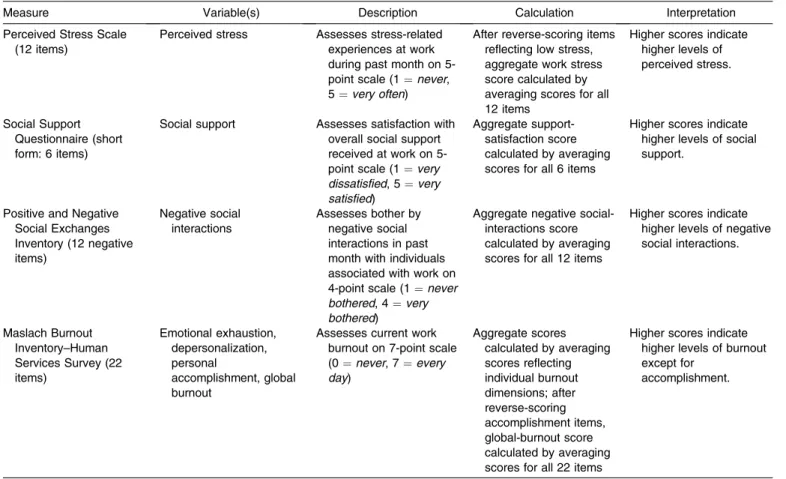
global burnout scores. More detailed information on psychological measures is presented in Table 1. Internal-consistency reliability (Cronbach a) of scores for all study measures is presented in Table 2.
position (ie, larger perceived workload incongruence). We developed this measure because we wanted to examine a slightly more nuanced yet still practical marker of workload compared with previous authors, who often looked at the number of athletes or coaches served.
Procedures
The procedures were approved by an institutional review board and were consistent with American Psychological Association ethical standards. An online survey was used.
The study procedures approximated the Dillman method28
of survey administration. Participants answered a comput-er-based survey in a convenient location during the fall sports season and could take more than 1 sitting to complete the survey if desired. Participants accessed the survey through a secure online link (Qualtrics, LLC, Provo,
UT). The first page of the survey provided an explanation of the voluntary nature of participation and a brief overview of the study procedures. Consenting participants assessed their work-related perceptions of stress, workload incon-gruence, social interactions, burnout, and demographic information. Study measures were presented in the same order for all participants. Participants were informed that answers were neither correct nor incorrect and were given the option to skip any survey questions they did not feel comfortable answering. Participants were informed that all answers would be kept anonymous. No respondent took more than 30 minutes to complete the survey. Four survey reminders were sent by e-mail during the 1-month data-collection period. Respondents had the opportunity to enter an incentive raffle after the study via a secure link unconnected to the survey data. Through these methods,
we achieved a study-wide response rate of 15% (n¼154).
Table 1. Description, Calculation, and Interpretation of Study Psychological Measures
Measure Variable(s) Description Calculation Interpretation
Perceived Stress Scale (12 items)
Perceived stress Assesses stress-related experiences at work during past month on 5-point scale (1¼never, 5¼very often)
After reverse-scoring items reflecting low stress, aggregate work stress score calculated by averaging scores for all 12 items
Higher scores indicate higher levels of perceived stress.
Social Support Questionnaire (short form: 6 items)
Social support Assesses satisfaction with overall social support received at work on 5-point scale (1¼very dissatisfied, 5¼very satisfied)
Aggregate support-satisfaction score calculated by averaging scores for all 6 items
Higher scores indicate higher levels of social support.
Positive and Negative Social Exchanges Inventory (12 negative items)
Negative social interactions
Assesses bother by negative social interactions in past month with individuals associated with work on 4-point scale (1¼never bothered, 4¼very bothered)
Aggregate negative social-interactions score calculated by averaging scores for all 12 items
Higher scores indicate higher levels of negative social interactions.
Maslach Burnout Inventory–Human Services Survey (22 items)
Emotional exhaustion, depersonalization, personal
accomplishment, global burnout
Assesses current work burnout on 7-point scale (0¼never, 7¼every day)
Aggregate scores calculated by averaging scores reflecting individual burnout dimensions; after reverse-scoring accomplishment items, global-burnout score calculated by averaging scores for all 22 items
Higher scores indicate higher levels of burnout except for
accomplishment.
Table 2. Descriptive Statistics and Correlations for Study Variables (N¼154)
Variable 1 2 3 4 5 6 7 8
1. Perceived stress (a¼.80) –
2. Workload incongruencea 0.20b –
3. Social support (a¼.92) 0.49b 0.27b –
4. Negative social interactions (a¼.87) 0.27b 0.02 0.25b –
5. Emotional exhaustion (a¼.93) 0.64b 0.28b 0.53b 0.29b –
6. Depersonalization (a¼.70) 0.46b 0.18b 0.39b 0.33b 0.64b –
7. Personal accomplishment (a¼.75) 0.27b 0.12 0.27b 0.05 0.13 0.18b –
8. Global burnout (a¼.89) 0.65b 0.28b 0.55b 0.30b 0.90b 0.79b 0.48b –
Mean 2.64 5.99 3.28 1.99 2.41 1.49 4.66 1.81
SD 0.51 9.61 0.86 0.58 1.32 1.06 0.90 0.84
Data Analysis
Descriptive statistics were calculated with all study variables, including demographics, via frequency counts or means and standard deviations (or both). We conducted preliminary data screening and hierarchical multiple regression analyses using SPSS (version 21; IBM Corpo-ration, Armonk, NY) via the best-practices procedures
outlined by Tabachnick and Fidell.29 The independent
variables were perceived stress, workload incongruence, social support, and negative social interaction, and the dependent variables were the burnout dimensions of emotional exhaustion, depersonalization, personal accom-plishment, and global burnout. The a priori value for significance was set atP,.05 for all statistical tests.
RESULTS
Preliminary Data Screening
Our examination of skewness and kurtosis values and pairwise scatterplots for all study variables revealed no violations of the assumptions of multivariate analysis. For the study variables (see Table 1 for descriptions), missing data were no greater than 0.6% for any 1 variable. Missing scores for these few data points were mean imputed. Examination of Mahalanobis distance values revealed 1 potential multivariate outlier based on the constellation of scores on predictor variables. The study results were not substantively different when this case was removed, so we retained it. The analyses that follow are based on 154 valid cases.
Descriptive Statistics
Descriptive statistics appear in Table 2. Participants reported low to moderate levels of mean emotional exhaustion, depersonalization, and global burnout and
moderate to high levels of personal accomplishment relative to response set options. Burnout and its dimensions were associated with antecedent variables in theoretically expected ways. We calculated and interpreted mean burnout scores consistent with the previous burnout
literature.26 However, when burnout symptoms were
summed for participants reporting all individual-item
scores (n ¼ 153), participants endorsed high (36%; n ¼
55), moderate (27%; n ¼ 41), and low (37%; n ¼ 57)
emotional exhaustion; high (16%; n¼24), moderate (36%;
n ¼ 56), and low (48%; n ¼ 73) depersonalization; and
personal-accomplishment scores representative of high
(22%; n¼34), moderate (30%; n¼45), and low (48%; n
¼74) burnout, according to established guidelines (a lower
score equates to a higher level of burnout).26
Perceived Stress, Workload Incongruence, and Social Interactions as Predictors of Burnout
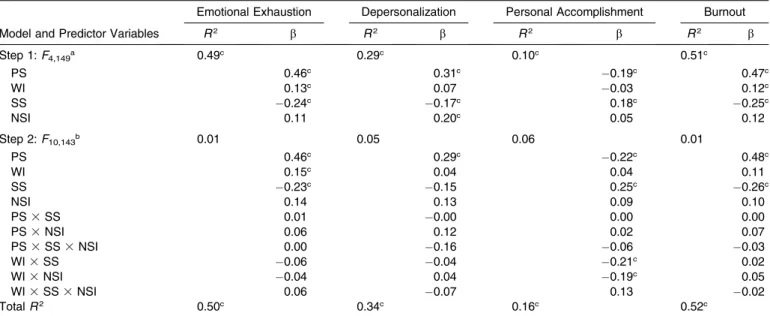
Antecedent variables (ie, perceived stress, workload incongruence, social support, and negative social interac-tions) were entered in the first step of the analysis, with interaction terms entered in the second step to assess their possible prediction of dimensional and global-burnout outcomes beyond main effects (Table 3). Of note, higher emotional-exhaustion scores were associated with higher perceived-stress and workload-incongruence and lower social-support scores but not negative social-interactions scores. Cumulatively, antecedent variables accounted for
50% of the variability in ATs’ exhaustion (R2 ¼ 0.50).
Higher depersonalization scores were associated with higher perceived stress and negative social interactions and lower social-support scores but not workload-incon-gruence scores. Cumulatively, antecedent variables accounted for 34% of the variability in ATs’ depersonal-ization (R2¼0.34). Higher personal-accomplishment scores
were associated with lower perceived-stress scores but not
Table 3. Hierarchical Linear Regression Analyses Assessing the Associations of Perceived-Stress, Workload-Incongruence, and Social-Interactions Variables with Burnout (N¼154)
Model and Predictor Variables
Emotional Exhaustion Depersonalization Personal Accomplishment Burnout
R2 b R2 b R2 b R2 b
Step 1:F4,149a 0.49c 0.29c 0.10c 0.51c
PS 0.46c 0.31c 0.19c 0.47c
WI 0.13c 0.07 0.03 0.12c
SS 0.24c 0.17c 0.18c 0.25c
NSI 0.11 0.20c 0.05 0.12
Step 2:F10,143b 0.01 0.05 0.06 0.01
PS 0.46c 0.29c 0.22c 0.48c
WI 0.15c 0.04 0.04 0.11
SS 0.23c 0.15 0.25c 0.26c
NSI 0.14 0.13 0.09 0.10
PS3SS 0.01 0.00 0.00 0.00
PS3NSI 0.06 0.12 0.02 0.07
PS3SS3NSI 0.00 0.16 0.06 0.03
WI3SS 0.06 0.04 0.21c 0.02
WI3NSI 0.04 0.04 0.19c 0.05
WI3SS3NSI 0.06 0.07 0.13 0.02
TotalR2 0.50c 0.34c 0.16c 0.52c
Abbreviations: NSI, negative social interactions; PS, perceived stress; SS, social support; WI, workplace incongruence. aMain effects predictors entered in step 1.
workload-incongruence or negative social-interactions scores; social-support scores were not associated with personal-accomplishment scores but trended toward a positive contribution. Cumulatively, antecedent variables accounted for 16% of the variability in ATs’ personal accomplishment (R2¼0.16). Finally, higher global-burnout
scores were associated with higher levels of perceived stress and workload incongruence and a lower level of social support; negative social interactions were not associated but trended toward a significant positive contribution. Cumulatively, antecedent variables accounted for 52% of the variability in global AT burnout (R2¼0.52).
No interaction terms were significant predictors of any burnout outcomes.
DISCUSSION
Work-based perceived stress, workload incongruence, and social interactions promote further understanding of AT burnout experiences. These findings inform the extant knowledge base on AT burnout by highlighting the individual importance of work-based social support and negative social interaction to specific aspects of the burnout experience. We discuss the implications for future research and intervention efforts.
Our specific study hypotheses were not supported as social interactions did not moderate (ie, affect the nature of) the relationships between AT (1) burnout and perceived stress or (2) burnout and workload incongruence. This result is somewhat surprising given the many theoretical models that suggest the potential protective effects of social
support on outcomes of stress and health30,31 as well as
parallel thoughts that negative social interactions may increase the effect of stress and workload incongruence on burnout. It is possible that our AT sample did not view social interactions as affecting how stress and workload influenced their burnout experiences. Alternatively, the relationships may be more salient in larger groups of ATs experiencing higher levels of burnout. Nonetheless, future examination of other variables that may influence (eg, moderate) relationships among AT stress, workload, and
burnout, such as coping resources32 and dispositional
optimism,33 is warranted. Altogether, the present findings
support all antecedent variables (ie, perceived stress, workload incongruence, social perceptions) as having direct effects on ATs’ burnout perceptions.
A discussion of the individual contributions of antecedent variables to global burnout provides the most complete picture of this work-based syndrome. All study focal variables except negative social interactions were associ-ated with ATs’ global-burnout perceptions in theoretically expected directions. Specifically, this result showcases the importance of social support as a positive burnout antecedent and stress and workload incongruence as negative burnout antecedents; these findings are consistent with research on the importance of stress and social support
to AT burnout.15Workload incongruence was also revealed
as an environmental variable germane to AT burnout. Finally, the study findings should not be interpreted to reduce the importance of negative social interactions to the burnout experience. In the current sample, negative social interactions had a reasonable (but nonsignificant) negative association with global burnout yet were positively
associated with the burnout dimension of depersonalization. Based on the importance of negative social interactions in the broader sport-based burnout literature,34,35we interpret
our study results as supporting the importance of both social support and negative social interactions to AT burnout experiences moving forward.
Differences in study findings across burnout dimensions also merit discussion. Perceived stress and social support were significant or trended toward significance for global burnout and all burnout dimensions, providing evidence for their importance in all facets of the burnout experience. However, perceptions of workload incongruence were positively associated only with emotional exhaustion. Some work-burnout scholars consider exhaustion to be an especially important burnout dimension that may drive the overall experience.36Therefore, it is not surprising that
this workload marker is linked to this specific burnout dimension. If an AT feels that he or she is working more than was originally anticipated at the start of the job, work-driven emotional exhaustion may result. Thus, workload-incongruence perceptions can be early markers of AT burnout risk. Moving forward, workload incongruence has utility as a burnout antecedent with the potential to inform empirically driven prevention strategies, such as establish-ing clear workload expectations for AT positions.
Similarly, negative social interactions were positively associated with the burnout dimension of depersonalization. This suggests that ATs’ experiences of unwanted advice or intrusion, failure to provide help, unsympathetic or insensitive behavior, and rejection or neglect from individuals at work contribute to higher levels of disen-gagement with the athletes they serve and the profession at large. This finding is consistent with extant research in the broader negative social-interactions literature.37,38 Further
attention should be given to both social support and negative social interactions in AT burnout research and practice, particularly in terms of important differences relative to global- or dimensional-burnout assessment.
Our results also inform education and prevention practices relative to AT burnout. Perceived stress appears
to be a relatively ubiquitous burnout antecedent.11,15
Specific efforts to cope with psychological stress at work8
(eg, exercise, stress management, strategies for successful navigation of the work social environment) merit careful consideration relative to ATs’ abilities to accommodate work demands and deter burnout. Interventions to prevent burnout would also benefit from programming designed for broader working populations39with careful consideration of
environmental factors salient to the athletic training
profession. Leiter and Maslach40 suggested that the areas
of work life (ie, workload, control, reward, community, fairness, values) are modifiable organizational factors with the potential to deter burnout and promote engagement in the workplace. Some support for this position has been
found in athlete populations.41Accordingly, this approach
Cumulatively, these intervention efforts may aid in retaining ATs within the profession as opposed to losing well-trained practitioners to other allied health fields.42
Limitations and Future Directions
A careful discussion of our study’s limitations is important to future research efforts. First, we had a relatively modest response rate and did not compare burnout across common settings for ATs’ professional practice (eg, collegiate, secondary school, hospital or clinic). The small sample size suggests the need for caution in generalizing the study findings to the broader AT population, particularly given the inherent limitations of self-reported assessments. Thus, future authors who assess AT burnout with larger samples, stratified by practice setting, will provide important contextual information regarding the development of burnout in ATs. Second, our measure of workload incongruence, which was created as an exploratory and feasible assessment of AT burnout, merits further validation and development. Moreover, other
workload measures exist, such as the Task Load Index.43
Future researchers should examine the Task Load Index as a way to measure the workload antecedent of AT burnout. These efforts may serve to further validate the current study’s workload marker. Third, our sample consisted entirely of practicing athletic training professionals. Based on the dual educational and professional roles of athletic training students, they merit specific empirical attention relative to burnout-related perceptions. Fourth, we did not differentiate among all potential work-related social actors (eg, athletes, coaches, administrators, coworkers, parents) when assessing ATs’ perceptions of social support and negative social interactions. Further examination of how specific social actors contribute to work-based social perceptions will advance our understanding of the mech-anisms by which the AT social environment cultivates burnout. Fifth, ATs experiencing high levels of burnout may have left the profession or be less likely to participate
in research (or both), a phenomenon known as the‘‘healthy
worker effect.’’36 Future investigators should specifically
target ATs with high levels of burnout and use qualitative
methods44to gather in-depth information on the
experienc-es of currently ‘‘burned-out’’ ATs. Finally, the
cross-sectional study design limits our ability to draw causal conclusions. Longitudinal research efforts examining associations among contextually relevant antecedents (ie, stress, workload, social interactions) and ATs’ burnout perceptions are warranted.
CONCLUSIONS
Ultimately, those we interact with at work influence our burnout perceptions. This is true for a variety of people-oriented professions, including athletic training. The ability to successfully accommodate and cope with work-based social relationships is a beneficial skill for promoting psychological health. The intervention efforts we have described would further benefit from the use of social agents at work (eg, coworkers) as a means to deter burnout and promote more adaptive psychological outcomes within the athletic training work environment.
An increased focus on burnout deterrence will not only improve the psychological health and wellbeing of ATs but
will undoubtedly facilitate better care for the athletes and teams they serve. Evidence suggests that elevated burnout levels in coaches may be associated with burnout in their
athletes.45 Like coaches, ATs represent social actors with
the potential to affect athletes’ psychological health and wellbeing. Accordingly, deterring AT burnout resulting from stress, dissatisfaction with work demands, or negative social interactions could ultimately deter athlete burnout as well. This represents a potentially fruitful future research direction.
Its limitations acknowledged, the current study fills a notable research gap by examining the influence of perceived stress, workload incongruence, and social interactions as concomitant antecedents of AT burnout. Specifically, social support and negative social interac-tions are important factors when variables reflecting stress and workload are considered. Collectively, these results enhance our understanding of burnout in athletic training populations and inform efforts to prevent its occurrence.
REFERENCES
1. Bakker AB, Hakanen JJ, Demerouti E, Xanthopoulou D. Job resources boost work engagement, particularly when job demands are high.J Educ Psychol. 2007;99(2):274–284.
2. Ducharme LJ, Martin JK. Unrewarding work, coworker support, and job satisfaction: a test of the buffering hypothesis. Work Occup. 2000;27(2):223–243.
3. Maslach C. Job burnout: new directions in research and intervention.
Curr Dir Psychol Sci. 2003;12(5):189–192.
4. Pitney WA. Organizational influences and quality-of-life issues during the professional socialization of certified athletic trainers working in the National Collegiate Athletic Association Division I setting.J Athl Train. 2006;41(2):189–195.
5. Maslach C.Burnout: The Cost of Caring. Englewood Cliffs, NJ: Prentice-Hall; 1982.
6. Shirom A. Reflections on the study of burnout.Work Stress. 2005; 19(3):263–270.
7. Maslach C, Schaufeli WB, Leiter MP. Job burnout. Annu Rev Psychol. 2001;52:397–422.
8. Maslach C, Goldberg J. Prevention of burnout: new perspectives.
Appl Prev Psychol. 1998;7(1):63–74.
9. Pitney WA, Ilsley P, Rintala J. The professional socialization of certified athletic trainers in the National Collegiate Athletic Association Division I context.J Athl Train. 2002;37(1):63–70. 10. Winterstein AP. Organizational commitment among intercollegiate
head athletic trainers: examining our work environment.J Athl Train. 1998;33(1):54–61.
11. Kania ML, Meyer BB, Ebersole KT. Personal and environmental characteristics predicting burnout among certified athletic trainers at National Collegiate Athletic Association institutions. J Athl Train. 2009;44(1):58–66.
12. Giaccobbi PR Jr. Low burnout and high engagement levels in athletic trainers: results of a nationwide random sample.J Athl Train. 2009; 44(4):370–377.
13. Naugle KE, Behar-Horenstein LS, Dodd VJ, Tillman MD, Borsa PA. Perceptions of wellness and burnout among certified athletic trainers: sex differences.J Athl Train. 2013;48(3):424–430.
16. Clapper DC, Harris LL. Reliability and validity of an instrument to describe burnout among collegiate athletic trainers. J Athl Train. 2008;43(1):62–69.
17. Newsom JT, Mahan TL, Rook KS, Krause N. Stable negative social exchanges and health.Health Psychol. 2008;27(1):78–86.
18. Reis HT. Relationship experiences and emotional well-being. In: Ryff CD, Singer BH, eds.Emotion, Social Relationships, and Health. New York, NY: Oxford University Press; 2001:57–86.
19. Etzion D. Moderating effect of social support on the stress-burnout relationship.J Appl Psychol. 1984;69(4):615–622.
20. Van Der Doef M, Maes S. The job demand-control(-support) model and psychological well-being: a review of 20 years of empirical research.Work Stress. 1999;13(2):87–114.
21. Neal TL, Diamond AB, Goldman S, et al. Inter-association recommendations for developing a plan to recognize and refer student-athletes with psychological concerns at the collegiate level: an executive summary of a consensus statement.J Athl Train. 2013; 48(5):716–720.
22. Cohen S, Kamarck T, Mermelstein R. A global measure of perceived stress.J Health Soc Behav. 1983;24(4):385–396.
23. Sarason IG, Sarason BR, Shearin EN, Pierce GR. A brief measure of social support: practical and theoretical implications. J Soc Pers Relat. 1987;4(4):497–510.
24. DeFreese JD, Smith AL. Athlete social support, negative social interactions and psychological health across a competitive sport season.J Sport Exerc Psychol. 2014;36(6):619–630.
25. Newsom JT, Rook KS, Nishishiba M, Sorkin DH, Mahan TL. Understanding the relative importance of positive and negative social exchanges: examining specific domains and appraisals.J Gerontol B Psychol Sci Soc Sci. 2005;60(6):P304–P312.
26. Maslach C, Jackson SE, Leiter MP. Maslach Burnout Inventory Manual. 3rd ed. Menlo Park, CA: Mind Garden, Inc; 2010. 27. Raedeke TD, Smith AL.The Athlete Burnout Questionnaire Manual.
Morgantown, WV: West Virginia University; 2009.
28. Dillman DA. Mail and Internet Surveys: The Tailored Design Method. 2nd ed. Hoboken, NJ: Wiley; 2007.
29. Tabachnick BG, Fidell LS.Using Multivariate Statistics. 5th ed. New York, NY: Pearson; 2007.
30. Cohen S, Underwood LG, Gottlieb BH.Social Support Measurement and Intervention. New York, NY: Oxford University Press; 2000. 31. Holt NL, Hoar SD. The multidimensional construct of social support.
In: Hanton S, Mellalieu SD, eds. Literature Reviews in Sport Psychology. New York, NY: Nova; 2006:199–225.
32. Ben-Zur H, Michael K. Burnout, social support, and coping at work among social workers, psychologists, and nurses: the role of challenge/control appraisals. Soc Work Health Care. 2007;45(4): 63–82.
33. Chang EC. Does dispositional optimism moderate the relation between perceived stress and psychological well-being? A prelim-inary investigation.Pers Individ Dif. 1998;25(2):233–240.
34. Smith AL, Gustafsson H, Hassm´en P. Peer motivational climate and burnout perceptions of adolescent athletes. Psychol Sport Exerc. 2010;11(6):453–460.
35. Udry E, Gould D, Bridges D, Tuffey S. People helping people? Examining the social ties of athletes coping with burnout and injury stress.J Sport Exerc Psychol. 1997;19(4):368–395.
36. Schaufeli W, Enzmann D. The Burnout Companion to Study and Practice: A Critical Analysis. London, UK: Taylor & Francis; 1998. 37. Rook KS. The negative side of social interaction: impact on psychological well-being. J Pers Soc Psychol. 1984;46(5):1097– 1108.
38. Rook KS. Investigating the positive and negative sides of personal relationships: through a lens darkly? In: Spitzberg BH, Cupach WR, eds.The Dark Side of Close Relationships. Mahwah, NJ: Erlbaum; 1998:369–393.
39. Maslach C, Leiter MP.The Truth About Burnout: How Organizations Cause Personal Stress and What to Do About It. San Francisco, CA: Joey-Bass; 1997.
40. Leiter MP, Maslach C. Areas of worklife: a structured approach to organizational predictors of job burnout. In: Perrewe PL, Ganster DC, eds. Research in Occupational Stress and Well-Being. Oxford, United Kingdom: Elsevier; 2004.
41. DeFreese JD, Smith AL. Areas of worklife and the athlete burnout-engagement relationship.J Appl Sport Psychol. 2013;25(2):180–196. 42. Kahanov L, Eberman LE, Juzeszyn L. Factors that contribute to failed retention in former athletic trainers. Internet J Appl Med Rehabil. 2013;11(4):1–7.
43. Hart SG, Staveland LE. Development of NASA-TLX (Task Load Index): results of empirical and theoretical research. In: Hancock A, Meshkati N, eds. Human Mental Workload. Amsterdam, Nether-lands: North Holland Press; 1988.
44. Gustafsson H, Hassm´en P, Kentt¨a G, Johansson M. A qualitative analysis of burnout in elite Swedish athletes. Psychol Sport Exerc. 2008;9(6):800–816.
45. Price MS, Weiss MR. Relationships among coach burnout, coach behaviors, and athletes’ psychological responses. Sport Psychol. 2000;14(4):391–409.