G5 SAHEL EXTERNAL INFLUENCE COMPARISON:
THE EUROPEAN UNION, THE UNITED ARAB EMIRATES AND SAUDI ARABIA
Michelle Angeline Miller
A thesis submitted to the faculty at the University of North Carolina at Chapel Hill in partial fulfillment of the requirements for the degree of Master of Arts in the Department of Political
Science, Concentration TransAtlantic Studies.
Chapel Hill 2019
Approved by:
Donald Searing
Liesbet Hooghe
ii © 2019
iii
ABSTRACT
Michelle Miller : G5 SAHEL EXTERNAL INFLUENCE COMPARISON : THE EUROPEAN UNION, THE UNITED ARAB EMIRATES AND SAUDI ARABIA
(Under the direction of Donald Searing)
The five West African states making up the G5 Sahel rely on foreign contributions to
support the nascent regional organization. In February 2018, the European Union (EU) and Saudi
Arabia were the top contributors to the G5, each pledging 100 million euros. The investment
from the EU builds upon previous agreements and missions for regional development and
security. The equal contribution from Saudi Arabia is unprecedented. The partnership with the
Sahel G5 emerged about the same time as another Saudi Arabian initiative, the Islamic Military
Counter-Terrorism Coalition (IMCTC). The IMCTC serves as the construct for the G5 Sahel
partnership. Another relevant actor and investor with the IMCTC is the United Arab Emirates,
contributing 30 million euros to the G5, and backing Saudi regional plans. The emergence of a
new regional power acting in the Sahel motivated a comparison study with the EU. The research
question will answer which external partner(s), the European Union, or SA with the UAE, is
more influential over the political, economic and security goals and activities of the G5
Sahel. To determine the effect of EU, Saudi and UAE investment in the G5 Sahel this thesis will
include a review of the respective partnerships and the comparison of a series of indicators to
iv
TABLE OF CONTENTS
LIST OF TABLES……….. v
LIST OF FIGURES………... vi
LIST OF ABBREVIATIONS……….. vii
INTRODUCTION……….. 1
BACKGROUND……… 4
METHODOLOGY………. 8
INFLUENCE INDICATORS: DATA COMPARISON AND ANALYSIS……… 11
Political Indicators………... 11
Economic Indicators……… 21
Security Indicators………... 29
CONCLUSION……… 35
APPENDIX……….. 40
v
LIST OF TABLES
Table 1 – Comparison of Objectives……….. 19
Table 2 –Economic Contribution Summary Table……… 26
vi
LIST OF FIGURES
Figure 1 – Combined Development Funds………. 28
vii
LIST OF ABBREVIATIONS
ACP Africa, Caribbean and Pacific
ADFD Abu Dhabi Fund for Development
AGFUND Arab Gulf Program for UN Development Organizations
AQIM Al-Qaeda in the Islamic Maghreb
BADEA Arab Bank for Economic Development in Africa
CAEMU Central African Economic and Monetary Union
CSDP Common Security and Defence Policy
CTF Combat Terrorism Financing
ECOWAS Economic Community of West African States
EEAS European External Action Service
EU European Union
EUCAP EU Capacity Building Mission
EUTM EU Training Mission
FC-G5S G5 Sahel Joint Force
GCC Gulf Cooperation Council
IMCTC Islamic Military Counter-Terrorism Coalition
JAES Joint Africa-EU Strategy
MINUSMA UN Multidimensional Integrated Stabilisation Mission in Mali
MNJTF Multinational Joint Task Force
OFID OPEC Fund for International Development
RIP Regional Indicative Program
viii
SFD Saudi Fund for Development
1
INTRODUCTION
The Sahel is a land of transition. Geographically, it is the transition from the Sahara Desert
to the savanna and forests of sub-Saharan Africa. The populations that live there are also in
transition. They are tribally affiliated and move with herds of livestock and caravans of goods. The
zone is arid and vulnerable to desertification. Culturally, the region shares a common history of
Arabization and French colonialization in the central and western Sahel. The artificial borders
created during colonialization remain porous. Sahelian states are underdeveloped with weak
democracies, underemployed youth, and ungoverned territory creating safe havens for illicit
activity. Consequently, the Sahel is a tumultuous region, rife with militant groups, drug, human
and arms trafficking. The compilation of conflict in Libya to the north, the Tuareg rebellion in
Mali, and Boko Haram encroaching on the Lake Chad Basin, coupled with environmental
pressures, make the Sahel a lightning rod for instability.
In light of the commonalities shared by states of the Sahel, the G5 Sahel political regional
organization formed to address issues of transnational insecurity and development challenges.
Established in 2014, it is made up of Mauritania, Mali, Niger, Chad and Burkina Faso. The
organizational goals all address insecurity or development, or more accurately human development
to address insecurity challenges. The organization groups activities into the following categories:
security and defense, governance, infrastructure and resilience. In 2017, the G5 Sahel security
force became operational with the political backing of international organizations. The African
Union Peace and Security Council approved the implementation of a regional Sahel security force
2
international concurrence and legitimacy.1 The three on-going security missions are all
trans-border, operating across the territory of each G5 member state. They function as a
counter-terrorism force and work in conjunction with the UN Multidimensional Integrated Stabilisation
Mission in Mali (MINUSMA) and the French Sahelian Operation Barkhane. The capabilities of
the G5 Sahel are limited by the strained resources of the member states and their competing
priorities.
The international community applauds the G5 Sahel as an independent African regional
organization to address regional concerns. However, the G5 Sahel as an independent regional body
is far from the reality. All planning and operational functions rely on external funding, and there
is no shortage of international interest in the Sahel. The Arab Gulf States, China, the United States
(US) and the European Union (EU) all have increasing presence. The Arab Gulf states invest in
social capital, supporting religious and educational enterprises. China is interested in raw resources
and foreign direct investment through bilateral agreements. The US since 2001, invests in security
and counter-terrorism partnerships. The EU is likewise concerned with insecurity and the
destabilizing effects of migration. Apart from China, all fund the initiative of the G5 Sahel. The
most substantial international investors include France, the EU, Saudi Arabia (SA), the US and the
United Arab Emirates (UAE).2
The dependence of the G5 Sahel on foreign funding, puts these actors forefront in relations
with the nascent regional organization. The EU and SA are the top contributors, they have the most
1 Zoë Gorman and Dr Grégory Chauzal, “Establishing a regional security architecture in the Sahel”, Stockholm
International Peace Research Institute (2018). Accessed 13 July 2018 at https://www.sipri.org/commentary/topical-backgrounder/2018/establishing-regional-security-architecture-sahel.
2 At the Brussels Conference in February 2018 the EU and SA both pledged 100 million euros, the US pledged 60 million dollars, and the UAE 30 million euros.
3
at stake financially if not politically, in the success of the G5 Sahel. Although the US also invested,
it is more interested in continuing bilateral military partnerships than further involvement with the
G5.3 The UAE aligns with the geostrategic position of SA concerning the Sahel. Qatar is another
Gulf state that is active in the region, but it diverges from the rest of the Gulf Cooperation Council
(GCC) in its relations with the Sahel. Qatar’s support of militant groups branded as terrorist
organizations in Mali, is a reason for the recent rupture with the UAE and SA.4 The remaining
international players strongly behind the G5 are the EU, SA and the UAE. This study will measure
and compare the influence of these primary investors. The research question is which external
partner(s), the European Union, or SA with the UAE, is more influential over the political,
economic and security goals and activities of the G5 Sahel? To determine the effect of EU, Saudi
and UAE investment in the G5 Sahel, this thesis will include a review of the respective partnerships
and a comparison of a series of indicators to determine which partner, and to what extent they
influence the region.
The results of this study seek to explain the political, economic and security alignment of
the G5 Sahel. Alignment refers to coherence in goals and activities between the G5 Sahel and the
three chosen external partners. The following section will include a brief background of
international relations between the chosen actors including the context of the Saudi and the UAE
partnership with the Sahelian states since the 1980s, and the EU’s increasing involvement in the
wake of the migration crisis. The background will inform why the selected partners make for a
telling comparison. Following the background will be the methodology. The methodology will
3 “EU doubles funds for G5 Sahel military anti-terror security force”, Deutsche Welle, (2018), doi: https://www.dw.com/en/eu-doubles-funds-for-g5-sahel-military-anti-terror-security-force/a-42711948.
4 Haim Malka “Maghreb Neutrality: Maghreb-Gulf Arab Ties Since the GCC Split”, Center for Strategic and
4
explain the choice of indicators, how they will be compared, and how influence will be ultimately
assessed. Next, will be the analysis of indicators in the three categories of influence. The data will
determine the existence and degree of influence. The analysis and comparison of external partners
with the G5 make this thesis research relevant to current international relations in this strategic
geopolitical region. Understanding the level of real influence by the most invested players, can
provide insight to the current and future alignment of the G5 Sahel.
Background
The many acronyms associated with the organizations and initiatives active in the Sahel
and relevant to this study, are organized by actor and the sector in which they engage in charts in
the Appendix for reference. Prior to the creation of the G5, political-economic unions created a
space of interdependence with integrated markets in Central and West Africa. The Economic
Community of West African States (ECOWAS) and the West African Economic and Monetary
Union (WAEMU) include Mali, Niger and Burkina Faso. Chad is part of the Central African
Economic and Monetary Union (CAEMU). 5 The WAEMU and CAEMU dating from the 1960s,
created a precedence for regional coordination dependent on external backing. ECOWAS has a
secondary function in multilateral cooperation as the “regional gendarme” assisting in
mediations and peace operations.6 In Mali, it was ECOWAS that started the multinational
peacekeeping mission after the French intervention. The ECOWAS peacekeeping mission
ultimately failed. The accords signed were not respected, and member states did not work well
5 Gerard Clément, Pierre Roquet and Dominique Jambard,Géopolitique de l’Afrique, du
5
together, each defending separate interests.7 The failings of ECOWAS at regional cooperation
hastened the creation of the G5 Sahel.
The organization is intergovernmental, with heads of state directly engaged. It formed in
Nouakchott, Mauritania at a summit with the executive leaders from the five states.8 Multiple
crises spurred its formation in the absence of an accepted regional body to respond. From the
north, the eruption of conflict and disorder in Libya sent arms and experienced militants into
northern Mali and elsewhere in the Sahel, facilitating the Tuareg rebellion and arrival of
Al-Qaeda in the Islamic Maghreb (AQIM) in Mali in 2013. From the south is the Boko Haram
conflict spilling over from Nigeria into the Lake Chad Basin. Transnational trafficking is a
source of funding for subnational militants perpetuating conflict. The lack of a peaceful
resolution in Mali, and the efforts by Chadian and Nigerien militaries to contain Boko Haram,
motivated requests by Sahelian states for foreign support. Likewise, foreign powers wanted to
intervene to prevent spillover of conflict, the second-order effects of instability, and also to serve
their own geostrategic interests.9
The very existence of the organization is an ironic juxtaposition of regional autonomy
and external dependence. Included in its mandate is coordination with the efforts of existing
international organizations, including the UN, EU, World Bank, International Monetary Fund,
7 Edgard Kpatindé, “Quel rôle pour les institutions africaines (CEDEAO et UA)” in Menaces en Afrique du Nord et
au Sahel et sécurité globale de l’Europe, eds. Jacques Frémeaux, Philippe Evanno and Aymeric Chauprade (Paris, Sorbonne, 2013), 111.
8 Nicholas Desgrais, “La Force conjointe du G5 Sahel ou l'émergence d'une architecture de défense collective propre au Sahel”, Les Champs de Mars 30, no. 1 (2018), 213, doi : https://www-cairn-info.libproxy.lib.unc.edu/revue-les-champs-de-mars-2018-1-page-211.htm.
9 Mehdi Taje, “Le défi fondamentaliste en Afrique du Nord et dans le Sahara”, in Menaces en Afrique du Nord et au
6
African Union, and ECOWAS.10 While at the same time, their first objective is “to preserve the
territorial integrity of its states and to lead.”11 In 2017, the creation of the G5 Sahel Joint Force
(FC-G5S) overshadowed any development initiatives. The Force’s first mission occurred in
November 2017 operating across the borders of Niger, Mali and Burkina Faso. The FC-G5S is
small, split over three geographic zones and equaling about 4,550 soldiers.12 By comparison, the
French had 9,000 soldiers deployed in the Sahel in 2014.13
The FC-G5S is strained for many reasons. First, the member states already commit forces
to the MINUSMA mission in northern Mali, and Chad and Niger support operations against
Boko Haram with the Multinational Joint Task Force (MNJTF). Second, there is political
competition from rival organizations, such as the Lake Chad Basin Commission and the
Nouakchott Process which includes the Sahel states.14 The G5 has limited internal resources.
Burkina Faso, Niger and Chad rank within the five lowest states in the world as determined by
the UN Development Program’s Human Development Index. Another challenge is the great
expanse of territory. The Sahel is under-governed, and borders are difficult to secure. In
addition, harsh desert conditions and weak state logistics hinder sustained surveillance.
Therefore, the G5 is in a difficult position, it cannot function autonomously and to function must
work with foreign partners with professed similar motives.
10 Desgrais, 213.
11 Final Communiqué from the Summit of the Heads of State of the G5 Sahel, “Création d’un cadre institutionnel de coordination et de suivi de la coopération régionale”, (Nouakchott, 2014).
12 International Crisis Group, “Finding the Right Role for the G5 Sahel Joint Force”, AFRICA 258 (Brussels/Dakar, 2017), 7.
7
The Arab Gulf states have deep roots and a growing footprint in the Sahel. Due to early
Arabization, the Arabian Gulf shares a cultural connection with North Africa and the Sahel.
Additionally, SA considers the region within its sphere of influence. Since the 1980s, SA
expanded its influence in the Sahel with the Islamic Development Bank a Saudi creation
supported by the Saudi King, and the formation of sponsored non-governmental organizations
(NGOs) promoting religious education proselytizing Wahhabism, in which the UAE and Qatar
are also active.15 The timing with the region’s post-colonial political reorientation beyond
Europe, hastened a welcoming of Gulf investment. Besides SA and the UAE, other GCC
member states have a presence in the Sahel, but there is no common regional foreign policy
towards the region. The UAE is another substantial player, both in funding the G5, and in its
similar social and economic investments to member states. SA and the UAE’s stated objectives
and supported programs, along with their actions within the member states of the Sahel, will
provide a fuller picture of their involvement and influence after the evaluation of political,
security and economic indicators.
For the Sahel, Europe and predominately France is the most present external partner since
independence. The EU participates in the Sahel to counter terrorism, curb arms trafficking from
Libya, stop the movement of drugs to Europe, counter migration to Europe, maintain ease of trade
for natural resources, and counter US influence.16 Before their commitment to the G5 Sahel,
Europe was already the highest contributor for development aid. 17 The 2007 EU Strategy for
15Osman Antwi‐Boateng, “The Rise of Pan‐Islamic Terrorism in Africa: A Global Security Challenge”, in Politics
and Policy 45, no. 2 (2017), 268.
16 Christophe Réveillard “Le rôle de l’union européenne face aux défis géopolitiques sahéliens. Le caractère ontologique de son impuissance”, Menaces en Afrique du Nord et au Sahel et sécurité globale de l’Europe eds. Jacques Frémeaux, Philippe Evanno and Aymeric Chauprade, (Paris, Sorbonne, 2013), 104.
8
Africa broadened European interests beyond development and trade to include security and
governance. The Strategy includes a three-part support plan to the G5 Sahel to include political
partnership with dialogue between the European External Action Service (EEAS) and Sahelian
foreign ministers, development assistance with a substantial amount committed to reversing
irregular migration, and security support with the three Common Security and Defence Policy
(CSDP) missions.18 The EU through the EEAS intervenes multilaterally, with a soft power
approach that has a political, economic and security impact.
Methodology
Influence is difficult to ascertain concretely and even more difficult to prove. There will
always be unknown variables, whether they are motivations, pressures or personality dynamics of
the actors involved. The combination of visible and invisible motives for an action or decision
make labeling any one causal factor unrealistic. For that reason, this research measures and
compares perceivable indicators that can yield influence with political, economic or security aims.
It is admittedly not all inclusive and cannot provide a formula explaining actual influence exerted
by an external actor. What the indicators offer are plausible, comparable explanations for external
influence on the G5 Sahel. The compiled data will provide a picture of professed support and
objectives (political), tangible or pledged material support (economic), and hard power initiatives
through training and coordinated missions (security). The analysis of influence indicators will
show how the EU, SA and the UAE use soft or hard power in their relations with the G5 Sahel,
and to what extent. The indicators represent different elements of potential influence in the
political, economic and security sectors.
18 European Commission, “The EU's partnership with the G5 Sahel countries” European Commission: Press Release
9
To start with, overt political influence manifests through published organizational or
national objectives, international relations policies, and legal frameworks for intervention. It is
visible through official diplomatic communiqués and public statements. In order to choose
indicators that are measurable, comparable and reliable, this study uses data from academic
sources, and official press releases covering governmental conferences that document
commitments for engagement, organizational constructs, and actual agreements between the EU,
SA, and the UAE with the G5 Sahel. If published objectives align with those of the G5 Sahel it
implies either common interests, or the possible orientation of the G5 towards the objectives of a
key partner. Additionally, if actions correspond with published objectives, then there is a
consistency that builds the political credibility of the organization. A table will facilitate
comparison of stated objectives, showing congruence or incongruence across key focus areas of
the G5 Sahel. What the objectives for the Sahel are expected to show are the goals of the three
external partners for the G5 Sahel, and the timing of the established objectives. If they published
their objectives before the G5 Sahel and they correspond, then there is a potential to influence
the political goals of the regional organization.
The amount of financial support, trade and investment may not equate to influence, but it
does show the level of interdependence or dependence that can become a leverage factor
impacting the G5. The economic indicators include direct funding of the G5 Sahel, bilateral
funding to G5 member states, and also trade contributions and development aid. The importance
of funding to the G5 is obvious, as it relies on foreign funding of operational costs. Yet, bilateral
contributions are also important because G5 heads of state commit to and lead the organization.
If there is a strong bilateral partnership with the EU, SA or the UAE, that can weigh in on the
10
development projects are therefore important. NGOs and private enterprises can also have state
funding or support state functions, especially in the Gulf states.
The data relies on EU reported trade figures, economic commitments and program
spending in the Sahel. Data for SA and the UAE comes from public statements, government
sources and development agencies allied with the two Gulf states. The analysis will compare
total financial contributions by the EU, SA and the UAE to the G5 Sahel and its members. It will
also look at which sectors are funded, and whether the economic exchange is short or long term.
Long term investments and trade deals, the funding of essential G5 operations, and essential state
functions have the most potential to influence. Long term investments and trade deals indicate an
enduring partnership and interdependence. The funding of essential G5 operations, makes the
foreign contributions a necessity to the organization. Supporting member state functions is a
competing priority because of the role of heads of state. The economic data will be compiled
into a table showing financial contributions by type including development aid, loan assistance
and G5 Sahel regional support for the three external partners to provide as complete a picture of
donor economic activity as possible. Accompanying charts will allow for a visual comparison.
The security capabilities of the G5 Sahel, the FC-G5S, are recently rapidly expanding,
which has several implications. If the FC-G5S becomes a primary security provider in the region,
G5 member states will need continued support from their external partners and their influence can
grow. For the perspective of external partners there is a motive to influence for security purposes.
The EU intends to transition active EU missions to the FC-G5S, and in that case, the EU would
come to rely on the Force to bolster regional stability. SA and the UAE through its security
partnership IMCTC, use operations in the Sahel with the FC-G5S as their first publicized initiative
11
actors, joint operations, equipment provided, and military and police presence by SA, the UAE
and EU. The training indicator will look at the scope and longevity of the training missions. If
there is participation in joint operations, both combat and advise and assist missions are important
indicators. Combat operations show greater investment and involvement. However, advise and
assist missions present an opportunity to influence the focus and abilities of the security force. If
equipment greatly advances the capabilities of the FC-G5S that can also be a reason for influence.
Military and police presence expresses a level of commitment by external partners. What the
analysis of the security indicators will provide is a description of the ways external partners are
supporting security capabilities of the FC-G5S to determine if they fulfill their security interests,
bolster their position in the region, or create a dependence of G5 member states on the FC-G5S for
their security.
Influence Indicators: Data Comparison and Analysis
Political Indicators
The stated objectives of the G5 Sahel and of external partners’ involvement in the Sahel,
are general and altruistic. However, they are worth considering and comparing because they
show where the focus differs, including the exclusion of certain G5 functions. Where the
language is similar there is an alignment of stated political goals which could be the result of
external influence. Table 1 in this section displays the published objectives of the three external
partners for the Sahel and compares them with the organizational goals of the G5. Objectives
alone can be empty, political relevance depends on the actors’ commitments and actions
supporting their objectives, evidence of which is an indication for influence. The reaction of the
12
change in diplomatic relations. The political indicators are organized by actor: G5, EU, SA and
the UAE.
To start with the G5, the G5 Sahel Convention signed by member states in 2014 lists the
following: to guarantee conditions for development and security of member states; offer strategic
leadership intervention in order to improve life conditions of civil populations; the alliance of
development and security, supported by democracy and good governance for regional
cooperation and mutual international benefit; and promote inclusive and durable regional
development.19 The Permanent Secretariat has four departments that address the stated objectives
which are security and defense, governance expertise, infrastructure, and resilience. 20 The
organizational construct shows consistency between published principles and the functioning
organs of the organization. The Defense and Security Department lists Operation Barkhane as a
partner, indicating the importance of external partners and coordinating foreign military
operations.21
Notably, the official G5 Sahel website acknowledges the EU as the sponsor of the site,
whether that is acknowledging financial and technical support for the site or content is unclear.
The Permanent Secretariat publishes a biannual review titled “Sécurité et Développement” with
articles on G5 activities organized by the four departments. The official messaging in this
publication fits with stated organizational objectives describing projects and programs in each of
19 Secrétariat Permanent du G5 Sahel, “Le G5 Sahel,” last modified 29 September 2015, https://www.g5sahel.org/qui-sommes-nous/le-g5-sahel.
20 Permanent Secretariat Departments are: Resilience, Defense and Security, Infrastructure, and Governance. Secrétariat Permanent du G5 Sahel, last modified 15 October 2015, http://www.g5sahel.org/index.php/qui-sommes-nous/le-dispositif-de-pilotage-du-g5-sahel/le-secretariat-permanent-du-g5-sahel.
13
the four departments and highlighting progress being made.22 An article within the periodical,
attributes resilience of economic projects to foreign partners. It also describes a bilateral meeting
between Niger and Chad for seven transborder development projects financed by the EU.23 The
article is either crediting its external partners to appease them, or to draw attention to the
commitment of external partners in the Sahel.
EU objectives and conditions for intervention in the Sahel are outlined in several
agreements predating the G5 Sahel, and mirror those communicated at the International High
Level Conference on the Sahel in February of 2018. In 2007, the EU Directorate-General for
External Policies developed the Joint-Africa EU Strategy. 24 It builds on the previous Cotonou
Agreement from 2000 which linked development in Africa, within the Africa Caribbean and
Pacific (ACP) region, to political stability and security. Article 1 promotes and expedites
economic, cultural and social development in the ACP, whereas Article 11 attributes
development to furthering peace and security, while promoting a stable and democratic political
environment.25 The EU’s Action Plan for Support to Peace and Security in Africa specifically
lays out criteria for the EU CSDP to conduct executive missions in Africa in the framework of
African led or UN peacekeeping missions.26 Article 43 from the Lisbon Treaty provides the legal
22 G5 Sahel “Sécurité et Développement” Revue Semestrielle d’Information du G5 Sahel,no. 4, (February 2018), 1-28, accessible at http://www.g5sahel.org/images/Docs/G5_SAHEL_revue_N4.pdf.
23 G5 Sahel “Sécurité et Développement,” 23.
24 Gloria Okemuo, “The EU or France? The CSDP Mission in Mali the Consistency of the EU Africa policy”
Liverpool Law Review, no. 34 (2013), 225. Accessible at DOI 10.1007/s10991-013-9139-7.
25 European Commission, The Cotonou Agreement, (Cotonou, 2000, amended in 2010, Ouagadougou), 16, 22. Accessible at
http://www.europarl.europa.eu/document/activities/cont/201306/20130605ATT67340/20130605ATT67340EN.pdf
14
framework that specifies reasons for CSDP external civilian and military operations for joint
disarmament, humanitarian and rescue tasks, military advice and assistance tasks, conflict
prevention and peacekeeping tasks, tasks of combat forces in crisis management, including
peace-making and post-conflict stabilization.27 Nearly all tasks can be applied to conditions in
the Sahel and justify EU operations.
In July, 2017 France and Germany established the Alliance for the Sahel to coordinate
regional development cooperation.28 The Alliance for the Sahel is consistent with former
external action policies towards Africa but lists goals specific to the Sahel. It takes the political
stance of describing external action objectives in the Sahel as a European priority. The Alliance
also lists those objectives which fall within the security, development and governance categories.
Objectives for the Sahel are youth employment; rural development, agriculture and food
security; climate, notably energy access, green energy and water; governance; support for return
of basic services throughout the territory, including through decentralization; and security.29 The
2018 International High Level Conference on the Sahel mobilized funding and commitment to
the G5 Sahel echoing CSDP priorities for the region along three lines political support, financial
assistance for security and coordination of development efforts.30
27 Okemuo, 227.
28 European External Action Service, “Alliance for the Sahel will reinforce EU work for stability and development of key region,” European External Action Service Press Release, 14 July 2017, accessible at
https://eeas.europa.eu/headquarters/headquarters-homepage/29876/alliance-sahel-will-reinforce-eu-work-stability-and-development-key-region_en.
29 European Commission, “The EU’s Partnership for the Sahel,” 2018, accessible at
https://ec.europa.eu/commission/sites/beta-political/files/the-eu-partnership-with-the-sahel_en.pdf
15
To illustrate how the programs materialize, EU reports describe activities linked to
priorities. In Mali, the Youth and Stablilisation Programme restores and strengthens access to
essential services. The associated joint security program aims at improving border security,
internal security forces, and rule of law.31 The Hybrid Solar Centre in Niger, supporting
sustainable development, is to increase power availability and create jobs. The Emergency
Programme for the Sahel’s activities in northern Burkina Faso are for security and local
governance with an accompanying undefined, social-economic development plan.32 There’s a
designated border security program for Chad, and a rural development project for Mauritania to
address food insecurity.33 The program descriptions are anecdotal and only a sampling of EU
supported initiatives, but they nonetheless communicate tangible efforts. The linking of financial
commitment and projects to specified objectives in the Sahel adds weight to the EU CSDP for
the Sahel.
The political objectives of SA and the UAE are less delineated. The Kingdom of SA and
the UAE Foreign Affairs Ministries, the Islamic Military Counter-Terrorism Coalition (IMCTC)
led by SA, and Arabic Development Agencies, are all players in the Sahel with possible political
impact. Saudi development government agencies include the International Islamic Relief
Organization, the International Muslim World League and the Saudi Fund for Development.34
The Arab Bank for Economic Development in Africa and the Arab Organization for Agricultural
Development directly supports the G5 Sahel. The new Saudi-Emirati political and military
31 European Commission, “The EU’s Partnership with the Sahel,” 23 February, 2018, accessed at https://ec.europa.eu/commission/sites/beta-political/files/the-eu-partnership-with-the-sahel_en.pdf. 32 European Commission, “The EU’s Partnership with the Sahel.”
33 European Commission, “The EU’s Partnership with the Sahel.”
34 Ministry of Foreign Affairs, Kingdom of Saudi Arabia, official website:
16
alliance is expected to supplant the GCC, weakened since relations soured with Qatar. Critics
view the new alliance as consistent with a more active Saudi foreign policy to garner African
support, indicated by its increased presence in the Sahel through military and development aid.35
One apparent response to Saudi and Emirati political influence was the reaction of
Sahelian states after the removal of Qatar from the GCC. In June 2017, SA and the UAE cut ties
with Qatar because of its open support of Islamist political movements, and the its use of the Red
Cross to supply and aid terrorist groups in Mali. In response, Chad and Mauritania also broke
diplomatic ties with Qatar.36 The reactions of Chad and Mauritania were likely due to political
pressure by SA and the UAE due to the timing of the decision and the GCC split. The most
recent foreign policy shift is towards counter-terrorism. The UAE closely resembles the Saudi
approach in economic partnerships, Wahhabi religious proselytization, and the recent investment
in the G5 Sahel Joint Force.37 Since the Saudi-Emirati alliance does not have published
objectives for relations with the Sahel, the IMCTC strategic objectives provide the security goals
of SA and the UAE and are the most compatible for cross-regional comparison to EU goals for
security.
The IMCTC has six strategic objectives. The first is to strengthen the contribution of
Islamic countries towards global security and peace. Second, is to reinforce solidarity and
collaboration among coalition member countries to present a unified front against terrorist
organizations. The third is to counter radical ideology in Coalition member countries through
35 John Irish, “Saudi-backed military alliance to help G5 Sahel fight,” Reuters (Paris, 14 December 2017). Accessed at https://uk.reuters.com/article/uk-africa-security-sahel-saudi/saudi-backed-military-alliance-to-help-g5-sahel-fight-minister-idUKKBN1E81IM.
17
strategic communication campaigns to refute the radical and extremist narratives and
propaganda. Fourth, is reaffirm the moderate values of Islam and its principles of peace,
tolerance and compassion. Fifth, is to combat terrorism financing (CTF) in collaboration with
Coalition member countries and international CTF authorities, and promote compliance with
international agreements and advance legal, regulatory, and operational frameworks. The last
goal is to establish strategic partnerships between member countries, supporting nations and
international organizations to share counter terrorism information and expertise.38 All objectives
reference counter-terrorism, stability and collaboration.
State sponsored development agencies are also part of the SA and the UAE’s strategy in
the Sahel. SA founded the Islamic Relief Organization and the Muslim World League which
have principles based on religious tenets. The Muslim World League has a charter with founding
principles. The principles of the charter all appeal to the goal of unifying Muslims.39
Additionally, it surveys mosques around the world to collect and publish religious data. While
the mission of the Muslim World League is clearly religious direction under Saudi Wahhabi
ideology, it does share the characteristic of collaboration and social justice found within the
objectives of the G5 Sahel and EU Alliance for the Sahel. The Muslim World League
publications and website do not offer information on development programs or activities by
location, instead press releases make political statements supporting the Saudi position.40
Additionally, the Arab Bank for Economic Development in Africa (BADEA) acts in
accordance with Saudi and Emirati foreign policy in West Africa. It has a mandate with three
38 Islamic Military Counter-Terrorism Coalition, “About IMCTC,” accessed at website: https://imctc.org/English. 39 Muslim World League, “Introduction to Muslim World League,” accessed 28 August 2018, official website: http://en.themwl.org/about-mwl.
18
objectives: participate in financing economic development in African countries, stimulate the
contribution of Arab capital to African development, and provide the technical assistance
required for the development of Africa.41 The bank’s coordinating group has five members that
work on joint development projects and co-finance programs. Those relevant to this study
include the Arab Fund for Economic and Social Development, the Arab Gulf Program for UN
Development Organizations (AGFUND), the Islamic Development Bank, and OPEC Fund for
International Development (OFID), the last of which is supplemented by bilateral institutions
including the Abu Dhabi Fund for Development (ADFD) and Saudi Fund for Development
(SFD).42
The bank funds development in four states of the G5, all except Mauritania. Investment
and aid are for infrastructure, institutional support, health and social sectors.43 Although BADEA
is a multinational banking institution, the heavy involvement of SA and the UAE make it a
notable organization regarding their influence in the development domain of the Sahel. The
ADFD includes in its strategy UN Sustainable Development Goals (SDG). The SFD objectives
are less value focused and address the means of development through loans, technical assistance,
institutional support and guaranteeing national non-crude oil exports.44 The section on economic
indicators will provide more information on development programs. The table below compiles
published objectives of the three external partners compared with those of the G5 Sahel.
41 Arab Bank for Economic Development in Africa, “Operations,” accessible at https://www.badea.org/operation-search.htm.
42 Arab Bank for Economic Development in Africa. 43 Arab Bank for Economic Development in Africa.
19
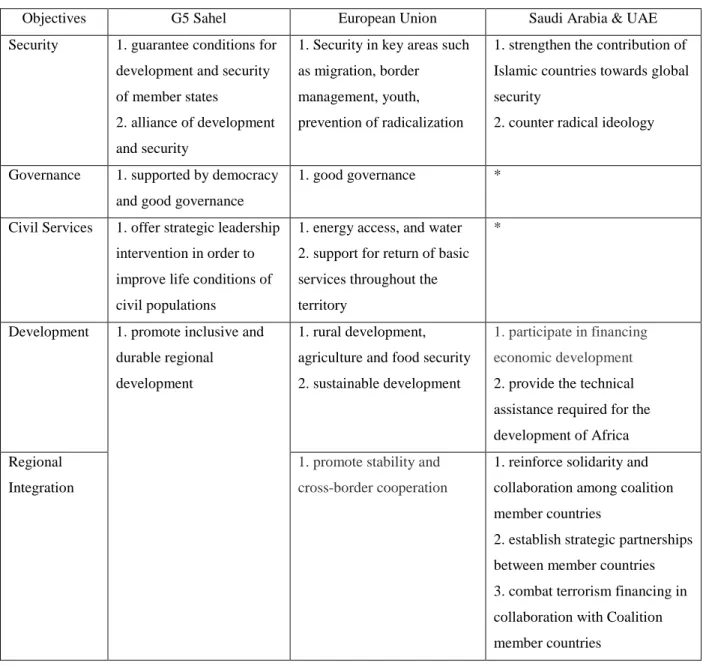
Table 1: Comparison of Objectives 45
Objectives G5 Sahel European Union Saudi Arabia & UAE Security 1. guarantee conditions for
development and security of member states
2. alliance of development and security
1. Security in key areas such as migration, border management, youth, prevention of radicalization
1. strengthen the contribution of Islamic countries towards global security
2. counter radical ideology
Governance 1. supported by democracy and good governance
1. good governance *
Civil Services 1. offer strategic leadership intervention in order to improve life conditions of civil populations
1. energy access, and water 2. support for return of basic services throughout the territory
*
Development 1. promote inclusive and durable regional development
1. rural development, agriculture and food security 2. sustainable development
1. participate in financing
economic development
2. provide the technical assistance required for the development of Africa Regional
Integration
1. promote stability and cross-border cooperation
1. reinforce solidarity and collaboration among coalition member countries
2. establish strategic partnerships between member countries 3. combat terrorism financing in collaboration with Coalition member countries
45 Table 1Sources : “Le G5, Sahel” Secrétariat Permanent du G5 Sahel, last modified 29 September 2015, http://www.g5sahel.org/index.php/qui-sommes-nous/le-g5-sahel.
European Commission, “The EU’s Partnership for the Sahel,” 2018, accessible at
https://ec.europa.eu/commission/sites/beta-political/files/the-eu-partnership-with-the-sahel_en.pdf. EEAS, “Alliance for the Sahel will reinforce EU work for stability and development of key region,” 2017, accessible at https://eeas.europa.eu/headquarters/headquarters-homepage/29876/alliance-sahel-will-reinforce-eu-work-stability-and-development-key-region_en.
Islamic Military Counter-Terrorism Coalition, “About IMCTC,” accessed at website: https://imctc.org/English Arab Bank for Economic Development in Africa, “Introduction” accessed 28 August 2018, official website: https://www.badea.org/introduction.htm.
20
Comparing political objectives is straight-forward concerning the EU and G5 Sahel. Both
organizations have official websites with listed goals for the region. There is remarkable overlap
between their respective objectives. The overlap may be explained by the similar timeframe. The
objectives of the G5 Sahel date back to 2014. Very similar objectives, or priority areas, were laid
out during the 4th EU-Africa Summit in 2014.46 By 2017, the EU Alliance for the Sahel included
all areas of the G5 Sahel objectives with the addition of youth employment.47 The coherence and
timing of objectives could likely be the product of joint Africa-EU conferences. Although,
principles of both sets of security and development objectives are largely international. UN
SDGs have the same development goals, which also mention peace and stability. It is therefore
difficult to determine how much the similarity is political influence by the EU, and not the
international community at large.
SA and the UAE required research into multiple domains for a comprehensive
understanding of political goals and influence. Most notable here are the differences. There is no
reference to governance or support to civil services as objectives. The two countries professed
support to the G5 Sahel for security and development with a heavier emphasis on security
through the IMCTC. The UAE does not have an independent set of objectives towards the Sahel.
Instead, it is incorporated into several Gulf partnerships, which is why the IMCTC and BADEA
objectives are equally applicable to the UAE and SA. Considering the principles set forth by the
IMCTC concerning the Sahel, the counter-terrorism goals fit security objectives of the G5. There
is less compatibility between the development objectives of the G5 and those listed by BADEA
46 European Commission, “Joint Africa-EU Strategy,” International Cooperation and Development, accessible at https://ec.europa.eu/europeaid/regions/africa/continental-cooperation/joint-africa-eu-strategy_en.
47 European Commission, “The EU’s Partnership for the Sahel,” 2018, accessible at
21
and national Saudi and Emirati development agencies. The development principles from
BADEA only discuss development broadly and mention providing technical assistance.48
Evaluating political influence, the EU developed its objectives for the Sahel building off
of existing partnerships with the Sahel, expanding from trade to development, and more recently
including governance and security. The compatibility of objectives, several of which predate the
G5 Sahel, make the EU a likely influencer in shaping G5 objectives. The EU and G5 objectives
are taking on the character of international norms specifically adapting language used in the UN
SDGs. SA and the UAE are less interested in domestic management of resources, with technical
assistance instead of sustainable development, and no reference to governance. One exception is
the ADFD’s reference to UN SDGs in its strategy. SA’s and the UAE’s political aims are not to
adapt to G5 goals, but to pull the Sahel states further into its sphere of influence through its
coalition. They cite pan-Islamic motivations for their expanding presence and development
activities. SA uses the IMCTC platform to assume leadership in a new domain in the Gulf and
project that image outward. In summary, EU influence is an extension from former ACP
relations which emphasized political relations through trade and aid, to include sustainable
development with an environmental focus, security and governance. SA and the UAE are
strengthening relations with the G5 to bring the Sahel states into a closer alliance and expand
their activities.
Economic Indicators
The motivation behind this study was interest in the high amount of investment pledged
by the EU, SA and the UAE to the G5 Sahel in February 2018. Apart from direct investment in
the G5, there are multiple additional sources of financing for the Sahel states. Member states of
22
the EU make bilateral contributions. Similarly, SA and the UAE invest in the member states of
the Sahel individually as foreign direct investment, social and development funding. Altogether,
private commercial firms, NGOs, governmental and intergovernmental organizations are all
sources of financing for the states of the G5 Sahel. This section will identify to the extent
possible, the sources and amounts of funding to the member states of the G5 and the G5 itself,
from the EU, SA and the UAE. Any type of funding to a state government from external actors
has the potential to motivate national leaders and can therefore be influential. Funding source
and purpose are important; and will be quantified for the three external actors by type (G5,
bilateral) along with the sector funded.
To start with the source of initial interest, the International High Level Conference on the
Sahel occurred 23 February 2018 with a 100 million euro pledge by the EU and SA, and 30
million euro from the UAE to fund the G5 Sahel.49 The operating budget of the FC-G5S is 115
million euro per year. 50 Effectively, the EU, SA and the UAE pledged enough at the Conference
to fund two years of operations. SA and the UAE are new security investors in the Sahel. The
FC-G5S partnership is the first initiative of the IMCTC since its creation.51 As such, the outcome
of that investment will be telling for Gulf partners. The EU on the other hand, funds three
missions in the Sahel and contributes to the peacekeeping mission in Mali. The EU is indirectly
supporting French military operations through the FC-G5S. The FC-G5S closely coordinates
with French Operation Barkhane, and so funding the FC-G5S allows the French to delegate some
responsibility to African partners.52 The growing economic investment in security with the
49 Gorman and Chauzal.
50 Gorman and Chauzal. 51 Irish.
23
financing of the FC-G5S was the key outcome of the International High Level Conference on the
Sahel.
Trade relations are of great importance to the Sahel’s external partners. Economic
influence by means of trade arrangements is nothing new to the region. The EU maintains ACP
privileged trade relations reaffirmed with the Cotonou Agreement, which includes Sahel states.53
The ACP partnership allowed access to the common market, price protections, and a guaranteed
European market for raw materials.54 It also created dependencies and a lack of economic
diversification in ACP states. The 2000 Agreement maintains “trade for aid” but the 2010
updates discuss gradual European market preference erosion to enable integration into the world
economy.55 ACP relations are indeed transforming, but France especially ensures continued
access to natural resources in the Sahel. Uranium is a key resource for French energy power from
Niger, gold is the top resource in Mali, and the new petrol basin of Taoudeni located in northern
Mali, is also of interest.56 Sahel resources will likely remain an important element of the
EU-Sahelian relationship. Additionally, the EU is the largest contributor of financial aid in the
region. Most recently, in December 2018 the EU added 125 million euro for security and
development programs to the four billion euros already committed for the 2014 to 2020 time
53 Hugon, 106.
54 Charles de Marcilly, “Post-Cotonou, the modernization of the ACP partnership,” Foundation Robert Schuman, 17 July 2017, accessed at https://www.robert-schuman.eu/en/european-issues/0440-post-cotonou-the-modernisation-of-the-acp-partnership.
55 European Commission, The Cotonou Agreement, Cotonou, 2000, amended in 2010, Ouagadougou. http://www.europarl.europa.eu/intcoop/acp/03_01/pdf/mn3012634_en.pdf
56 Aymeric Chauprade, “Les intérêts géopolitiques des acteurs de la crise du Mali,”Menaces en Afrique du Nord et
24
period for the five Sahel states.57 Development is a key aspect of the EU-Sahel relationship. The
enormous amount of funding is often aligned with conditions for improving governance,
integrating into the world market, and stability.58 The conditionality is a manner of influence, for
Sahel states to implement development funds, they have to make progress towards governance
and development goals agreed with the EU.
The Gulf states are also interested in maintaining trade deals with the Sahel and over the
last ten years they have strengthened economic ties. The UAE alone is now home to more than
10,000 African companies.59 Africa provides an enticing market for the Gulf states to diversify
their oil-based economies. The UAE is investing heavily in telecommunications contracts in the
Sahel, whereas SA is investing in agriculture in Mauritania, utilizing the sparse arable land.60
Throughout North and West Africa, Gulf investment is in the form of real estate.61 The two Gulf
partners are becoming competitive in securing influence through trade, described as playing the
role of gatekeepers for Africa’s rising economies.62 However, in the Sahel states trade
contributions by SA and the UAE remain far behind the EU.63
57 European Commission, “The European Union’s partnership with the G5 Sahel countries,” 06 December, 2018, accessed at http://europa.eu/rapid/press-release_MEMO-18-6670_en.htm
58 Réveillard, 98.
59 STRATFOR, “Why the GCC States think Africa is Worth Fighting Over,” STRATFOR Worldview, 1 May 2018, accessed at https://worldview.stratfor.com/article/why-gcc-states-think-africa-worth-fighting-over.
60 STRATFOR. 61 Malka, 5. 62 STRATFOR.
25
Saudi and Emirati banks are active in the region. The line is sometimes blurred between
national bank and development agency as “aid” which is most often in the form of loans. For
example, the UAE’s ADFD invested 59.9 million dollars in Niger for electricity and water
projects but, all in the form of loans.64 Burkina Faso is a very similar case. Yet in Mali, it is a
much higher amount; 294 million dollars in total aid, of which 263 million are loans.65
Concerning actual development programs in the Sahel, the ADFD announced a new initiative in
Chad in December 2018 for water accessibility, livestock and agricultural projects. Additional
Sahel projects are for infrastructure in Mali constructing dams, similar dam projects in Burkina
Faso plus a solar energy project, and a dam and electrical power project in Niger.66 SA’s
development spending in the Sahel states is all in the form of loans.67 In 2016, SA awarded a
loan to Chad for vocational education amounting to 30 million dollars and 50 million dollars to
Mauritania.68 The SFD website lists projects by country covering health, education,
infrastructure and food security in Niger, infrastructure, agricultural and livestock projects in
Mali, 11 infrastructure projects in Burkina Faso, and water distribution, education, mining and
infrastructure projects in Mauritania.69 Economically, through loans for development, trade, and
security partnerships, SA and the UAE are expanding their presence in the Sahel states.
64 Abu Dhabi Fund for Development, “Niger: Facts and Figures,” accessible at https://www.adfd.ae/english/Countries/Pages/countrydetails_new.aspx?12.
65 Abu Dhabi Fund for Development. 66 Abu Dhabi Fund for Development. 67The Saudi Fund for Development.
68 The Saudi Fund for Development, “Signed Loan Agreements,” accessed at https://www.sfd.gov.sa/.
26
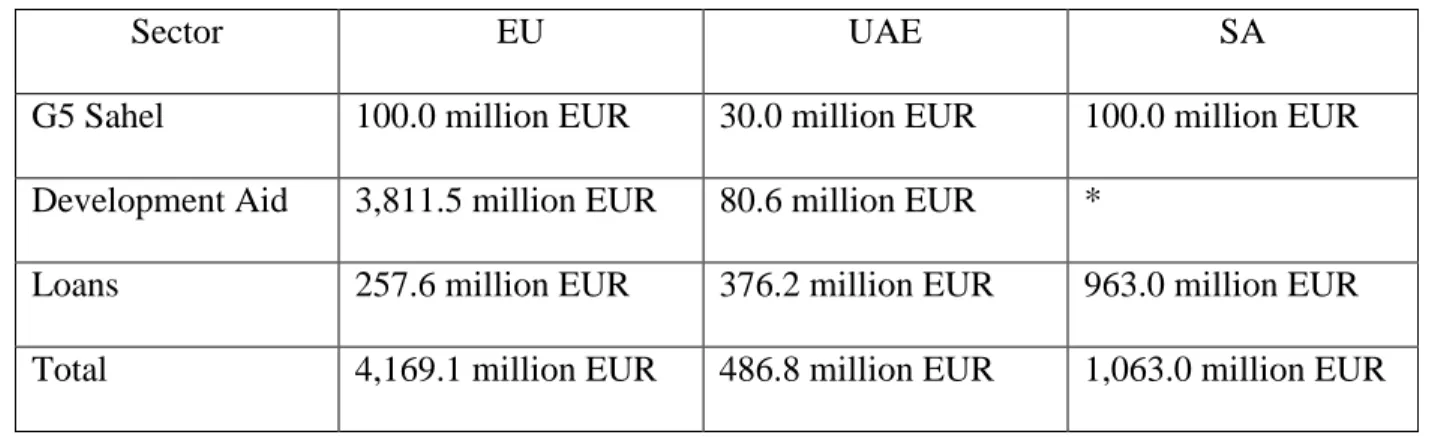
To compare the economic impact of SA with the UAE and the EU, Table 2 below tallies
up the amounts of economic contributions to the Sahel member states and the G5 Sahel since
2014 and projected through 2020. Important to note, the EU contributions do not include
separate bilateral contributions from individual EU Member states, which is approximately four
billion euro during the same time period.70 Separate contributions by EU member states were not
included to keep the integrity of presenting the EU as a unique regional entity. Also excluded
are Emirati and Saudi development contributions through regional and international development
agencies such as OFID.
Table 2: Economic Contribution Summary Table 71
Sector EU UAE SA
G5 Sahel 100.0 million EUR 30.0 million EUR 100.0 million EUR
Development Aid 3,811.5 million EUR 80.6 million EUR *
Loans 257.6 million EUR 376.2 million EUR 963.0 million EUR
Total 4,169.1 million EUR 486.8 million EUR 1,063.0 million EUR
In Table 2, contributions to the Sahel includes development aid for multiple programs,
loans and separate funding to the G5 Sahel. The EU’s Regional Indicative Program (RIP) is for
trade and development in the five Sahelian states. It is for further integration into the world
70 European Commission, “The European Union’s partnership with the G5 Sahel countries.”
71 Table 2 Sources: Abu Dhabi Fund for Development, The Saudi Fund for Development, The European Commission, Deutsche Welle (2018). Saudi contributions converted from SAR to EUR 10 April 2019.
27
market in partnership with ECOWAS. RIP “aims to strengthen regional integration notably by
boosting trade relations between countries in the region and between the EU and the
sub-region. This should enable the West African region (WAEMU and ECOWAS) to increase its
trading activities in the region.”72 RIP funding for the Sahel is divided into several categories
with different purposes. The European Development Fund is makes up the largest component of
RIP and supports health, food security, agriculture, water, and sustainable health initiatives. The
Emergency Trust fund for Africa is for regional projects, loans (or loan-grant blending
mechanisms) are for infrastructure projects, and humanitarian aid makes up the final category. 73
From the collated data, the UAE and SA are far behind the EU when it comes to
development and trade contributions. In 2018, the EU remains the region’s largest trade partner
at 28.5 percent of total trade, the UAE was the tenth trading partner at 1.5 percent.74 However,
for the G5 Sahel organization, SA and the EU are on equal footing, and the addition of the UAE
pledge puts the SA and the UAE ahead in organizational funding. Figure 1 below is the graphical
depiction of the combined development aid and loan contributions to the five Sahel states
comparing the EU with the two Arab Gulf states.75 Figure 2 depicts separate organizational
funding to the G5 Sahel.76
72 EEAS, “Burkina Faso and the EU” Delegation of the European Union to Burkina Faso, accessed at https://eeas.europa.eu/delegations/burkina-faso_en/4352/Burkina%20Faso%20and%20the%20EU. 73 European Commission, “The European Union’s partnership with the G5 Sahel countries.” 74 European Commission, “European Union, Trade in goods with ACP -- West Africa.”
75 Percentages are of the total contributed by the three external partners. Figure 1 sources: Abu Dhabi Fund for Development, The Saudi Fund for Development, The European Commission.
28
In terms of economic support, there is no question that the EU contributes the most to the
Sahelian states. The EU member states also match the EU institutional contributions reported
here in development financing.77 If taken into account, the EU and its member states’ separate
contributions come to approximately eight billion euro, which is over four times that of SA and
the UAE combined. However, the increase in trade and counter-terror financing from SA and
the UAE is also relevant to note. SA is now an equal contender with the EU in G5 Sahel support.
Since they both have an equal stake in the organization’s investment, that gives the G5 multiple
external partners of significance. The governments of the five states likewise depend on
development and “aid for trade” funding to run their administration and provide essential
services.78 Both avenues of funding to the G5 organization and to its member states are relevant.
Another indicator of direct economic influence is the oversight committee designed to monitor
G5 funds.79 The oversight committee would be answerable to external partner financiers, which
77 European Commission, “The European Union’s partnership with the G5 Sahel countries.” 78 Clément, Roquet and Jambard, 166-167.
79 Continental Alignments, 20736.
74% 18%
8%
Figure 1: Combined Development Funds
EU SA UAE
44%
44% 12%
Figure 2: Contribution to the G5 Sahel
29
naturally, gives them a level of organizational control if they choose to oppose how funds are
employed.
To conclude, the data from the economic indicators points to the EU as having the most
potential influence, with the emerging SA and UAE as new actors of interest. The EU commits
most to development and trade, whereas SA and the UAE are contributing to security financing,
and loan investments. The trade partnership and the amount of development financing reveals a
steady commitment from the EU. Since the G5 Sahel as an organization cannot be separated
from its member states, their financial dependence on the EU should not be discounted in how
they direct the G5. SA and the UAE are taking up an interest in the G5 Sahel, and if treated as a
forerunner of a more assertive foreign policy, more investment will likely follow.
Security Indicators
The G5 Sahel started out as a regional political organization for cooperation,
development and security. Early on, more emphasis was placed on governance and development.
Now with the creation of the FC-G5S in 2017, and the funding that came pouring in from
external partners, security operations captured international attention surrounding the G5.
International partners identified security concerns in the Sahel region since the early 2000s,
augmented by the crisis in Mali in 2012. The security response continues to grow with external
partners worried about spillover effects.80 Spillover within the Sahel as militant groups disperse
to recruit and find safe haven in remote border regions. Spillover beyond the Sahel to Europe
includes human, arms, and drug trafficking which often finance conflict. Years after the initial
military intervention in Mali, the MINUSMA mission stagnates without tangible progress, as
30
peace agreements fail and violence against peacekeepers continues. Meanwhile, the Lake Chad
Basin is affronted by the Boko Haram conflict. The limitations of the affected states, and
multilateral missions, drove the demand for a greater security focus by the G5.
Hard power has a tendency towards overuse by the governments of the Sahel, something
in common with sub-Saharan Africa in general. The prevalence of military coups and the close
relationship between political power and a strong security apparatus in the Sahelian member
states, make hard power initiatives easy to criticize. However, the rise of non-state militant
groups with connections to terrorist organizations was the justification for foreign interventions
that opened the door to hard power solutions. International organizations, the US, the French, the
EU and now the IMCTC, are all involved in military operations to address insecurity in the
Sahel. The G5 Sahel presents the opportunity for a Sahelian led force, which is preferred
politically by external partners. Propping up the security apparatus of the G5 can be a short-term
means of influence, or a continued security partnership can yield long-term influence.
Security indicators include influence through training, conducting joint patrols, and
equipping the FC-G5S. Indicators also include military and policing presence in the G5 states for
coordinating military operations. Cooperation with existing security operations is a part of the
FC-G5S mandate.81 There is an inherent degree of influence from the actors guiding the
enduring security operations. As long as they continue, the FC-G5S will have a supporting role.
For direct involvement with the FC-G5S, the greater the foreign presence and longer the
duration, the more influence is expected. Additionally, if operations depend on equipment and
specific training to operate, the provider is likewise expected to exert more influence.
31
For Europe, the Sahel is of particular interest for domestic security. Germany and France
consider the Sahel to be a potential base for terrorists to train and plan attacks in Europe.82 Since
the Joint Africa-EU Strategy (JAES) of 2007, there is ever increasing emphasis on defense and
security operations. It opened the door to the three current EU missions in the Sahel. The EU is
engaged in two civilian and one military mission.83 The longest duration is the EU Capacity
Building Mission, EUCAP Sahel Niger, since 2012. EUCAP Sahel Niger’s purpose is to train
and support Nigerien authorities for counter-terrorism and crime prevention.84 The civilian
mission has as much a focus on governance as on security. Successful counter-terrorism and
crime prevention depend on the judicial system, anti-corruption measures, and effective
intelligence and information management. To support the mission, the EU keeps security and
legal experts stationed in Niamey, Niger. The experts engage in train the trainer programs, with
internal Nigerien security forces, the Nigerien Army, and judicial authorities. 85 The civilian
mission has a transnational focus targeting trafficking and militant facilitation networks and
containing migration, which ultimately benefits the EU. It is a product of the EU’s Strategy for
Security and Development in the Sahel published in 2011.86 The EUCAP Sahel Niger civilian
mission is one of the external missions with which the G5 Sahel is expected to coordinate. The
82 International Crisis Group, 9.
83 EEAS, “Military and civilian missions and operations,” 3 May 2016, accessible at
https://eeas.europa.eu/headquarters/headquarters-homepage/430/military-and-civilian-missions-and-operations_en. 84EEAS, “About EUCAP Sahel Niger,” 20 June 2016, accessed at
https://eeas.europa.eu/csdp-missions-operations/eucap-sahel-niger/3875/about-eucap-sahel-niger_en.
32
transnational nature of the mission and the purpose of the EUCAP Sahel Niger, closely resemble
that of the FC-G5S, which could indicate EU influence on the Sahel Force in setting its agenda.
The EU Training Mission (EUTM) in Mali supports the French Operation Barkhane and
the UN MINUSMA mission since 2013. EUCAP Sahel Mali is an accompanying civilian
mission. While civilian missions still involve training of security forces, and the EUCAP Mali
mission “provides experts in strategic advice and training to the Malian Police, Gendarmerie,
National Guard and the relevant ministries in order to support reform in the security sector.”87 It
addresses all sectors of internal security, implying both reorganization of the administrations and
anti-corruption measures. The renewed mandate extends the mission until 2021 and includes
instructions for inter-operability and coordination with G5 Sahel countries.88 EUTM Mali is
similar in that it is a train and advise mission that does not participate in combat. An interesting
stipulation in the EUTM’s mission statement is to train and operationalize the G5 Sahel Joint
Force. EUTM is therefore taking responsibility for the preparation and action of the FC-G5S.
The inclusion of the FC-G5S in the EUTM strategic objectives is an assertion of influence, as it
seeks to prepare the FC-G5S to share its mission. The EU renewed mandates for the three
missions, and at this point they can be considered long-term. They will likely remain a means of
influence through the commitment set with the G5 Sahel. The summary table below consolidates
the three EU missions in the region presenting the sectors that they support. All missions either
coordinate with the G5 Sahel or train the FC-G5S.
87 EEAS, “About EUCAP Sahel Mali,” 20 June 2016, accessed at https://eeas.europa.eu/csdp-missions-operations/eucap-sahel-mali/3900/node/3900_en.