i
DOES SHAREHOLDER LITIGATION MATTER?
Justin J. Hopkins
A dissertation submitted to the faculty of the University of North Carolina at Chapel Hill in
partial fulfillment of the requirements for the degree of Doctor of Philosophy in the
Kenan-Flagler School of Business.
Chapel Hill
2012
Approved by:
Edward Maydew
Jana Raedy
Robert Bushman
Thomas Hazen
ii
ABSTRACT
JUSTIN J. HOPKINS: Does Shareholder Litigation Matter?
(Under the direction of Jana Raedy and Edward Maydew)
This study examines whether an unexpected shock to the risk of class-action lawsuits filed
under securities laws affects the level of discretionary revenues, the market reaction to
unexpected revenues, and the likelihood of restatements. I identify a court decision that
reduced the risk of shareholder litigation for firms headquartered within a single jurisdiction.
Subsequent to the decision, the likelihood of a restatement and the level of discretionary
revenues increased while the market reaction to unexpected revenues declined for firms
headquartered in this jurisdiction relative to firms headquartered in other jurisdictions.
Further, these changes were driven primarily by firms that faced the highest risk of
shareholder litigation. Overall, results indicate that the risk of shareholder litigation
constrains managers from making opportunistic reporting choices. This study is relevant to
the global policy debate about class-action litigation as a mechanism to regulate securities
iii
iv
ACKNOWLEDGEMENTS
I especially thank my advisors: Ed Maydew and Jana Raedy and dissertation committee
members: Robert Bushman, Tom Hazen, and Wayne Landsman. I also thank three
anonymous conference reviewers, Brian Broughman (discussant) and participants at the
Sixth Annual Conference on Empirical Legal Studies at the Northwestern University Law
School as well as Jeff Abarbanell, Dan Amiram, Tom Baker, Dain Donelson, Bert Fox, John
Gallemore, Sean Griffith, Peter Henning, Karla Johnstone, Eva Labro, Mark Lang, Mark
Maffett, Katie McDermott, Jenna Meints, Chris Noe, Doug Shackelford, Holly Skaife, Steve
Stubben, Terry Warfield and workshop participants at the University of North Carolina in
Chapel Hill, and the University of Wisconsin-Madison for their helpful comments and
v
TABLE OF CONTENTS
LIST OF TABLES ... vi
LIST OF FIGURES ... vii
LIST OF EXHIBITS ... viii
Introduction ...1
Institutional Background on Securities Laws ...5
Related Literature and Hypotheses ...9
Empirical Design ...16
Empirical Results ...25
Conclusion ...34
vi
LIST OF TABLES
Table
1.
Composition of the Sample ...37
2.
Descriptive Statistics and Correlations ...39
3.
Tests of Discretionary Revenues ...40
4.
Tests of Market Returns to Unexpected Revenues ...42
5.
Descriptive Statistics of Restatements ...44
6.
Tests of Restatements ...45
7.
Tests of Rolling Regressions Using Pseudo-Event Dates...46
vii
LIST OF FIGURES
Figure
1.
Structure of the U.S. Federal Court System ...33
viii
LIST OF EXHIBITS
Exhibit
1
1.0 Introduction
Shareholder lawsuits for violations of securities fraud (class actions) impose a tremendous burden on the U.S. economy and judicial system, but provide uncertain benefits. In the average year, investors file 200 lawsuits alleging losses of hundreds of billions, while firms pay billions to settle and defend these claims (Research, 2009).1 Further, many liken settlement payments to “extortion” and allege that these lawsuits are frivolous, inhibit the competitiveness of U.S. financial markets and endanger thousands of jobs and billions of revenues for U.S. firms (Forum, 2007; Romano, 1991; Bloomberg & Schumer, 2007; Pritchard, 2009). Yet, given the substantial costs, it is not clear whether these lawsuits accrue important benefits in terms of financial market regulation. Some claim that these lawsuits "[deter] fraud"2, and are “an essential supplement to [public enforcers]”.3
However, others suggest "private class actions move a lot of money around, but add little to deterrence at the margin” (Pritchard, 2009). Accordingly, this paper examines the alleged benefits of class actions by testing whether an unexpected decline in litigation risk affects the levels of discretionary revenues, the market reactions to unexpected revenues and the likelihood of restatements.
This question is timely as policy makers around the world are debating and adopting legal reforms to encourage class-action litigation in all areas of law.4 Restoring confidence in and
1
In this paper I refer only to class-action lawsuits brought by shareholders under the Securities Act of 1933 and the Securities and Exchange Act of 1934 and subsequent amendments. Hence, when referring to lawsuits or class-action lawsuits I refer specifically to lawsuits filed by shareholders under securities laws as opposed to other types of class-action lawsuits or lawsuits brought by public regulators under securities laws.
2
See Justice Kennedy in Dura Pharmaceuticals, Inc. v. Broudo (544 U.S. 336, 2005).
3 See Justice Ginsberg in Tellabs Inc, v. Makor Issues & Rights Ltd. 551 U.S. 308.
4 In the U.S. see, for instance, The Liability for Aiding and Abetting Securities violations Act of 2009, S. 1551, 111th
2
strengthening the stability of financial markets is a major impetus behind this movement. Hence, in light of the tremendous costs class actions impose and the global trend to encourage this litigation, whether these lawsuits improve the financial reporting process by constraining managers from adopting aggressive reporting practices is an important and timely topic.
Furthermore, whether class actions affect financial reporting choices is not apparent for the following reasons. First, the corporation and insurance companies pay the majority of the costs of litigation. In fact, individual directors and executives, on average, personally only contribute around 0.4% of the total settlements. Their personal costs may be too low to prevent managers from reporting opportunistically relative to the gains they can accrue (Coffee, 1986). For instance, Gary Winnick, founder of Global Crossing, personally paid $55 million to the settlement, which was one of the largest sums ever paid by an individual. However, he earned over $730 million by selling stock prior to the collapse (Morgenson, 2005). Second, many class actions may be baseless allegations unrelated to the reliability or accuracy of firm disclosures (Pritchard, 2009; Alexander, 1991; Grundfest, 1995). Third, plaintiffs’ attorneys arguably have no incentive to structure settlements in order to punish those culpable. In fact, these attorneys could actually gain from future securities violations by representing shareholders in subsequent lawsuits. Fourth, shareholders are widely dispersed and recover only 2-3% of losses which may be insufficient to provide incentives to vigorously monitor management. Since it is not clear whether class actions affect financial reporting choices, empirical studies are needed to guide policy debates.
3
and class-action litigation (Jennings, Kedia, & Rajgopal, 2011). In contrast, this study examines whether an unexpected change in litigation risk affects financial reporting choices reflected in mandatory disclosures. Hence, it provides evidence of the possible financial reporting consequences of policy reforms affecting class-action litigation.
My research design focuses on a specific court decision, Re: Silicon Graphics Inc. Securities Litigation (SGI), which reduced the risk of shareholder litigation under securities laws for firms headquartered within the United States Court of Appeals for the Ninth Circuit (Ninth Circuit).5,6 Prior literature has empirically demonstrated that the SGI decision affected legal outcomes such as dismissals (Pritchard & Sale, 2005). Further, as discussed below, since SGI was unexpected, widely publicized in popular media, unlikely to be driven by environmental factors and only affected firms headquartered in the Ninth Circuit, it provides a strong setting to test the research question.7
I examine the changes in the levels of discretionary revenues, the market reactions to unexpected revenues, and the likelihood of a restatement for firms headquartered in the Ninth Circuit relative to firms headquartered in other federal circuits. The empirical tests focus on the revenue account because a majority of lawsuits allege manipulations in this account (Cornerstone Research, 2005) and a recent study concludes that 60% of fraud in public companies involves revenue (Beasley, Carcello, Hermanson, & Neal, 2010). I also focus on firms that face the highest level of litigation risk as prior research has
5
The following reasons are some that motivate Johnson et al. (1999) to examine the same setting to test the valuation implications of shareholder lawsuits under securities laws.
6 The Silicon Graphics decision reduced litigation risk by requiring that plaintiffs provide evidence that the
defendant acted with “deliberate recklessness”. The prior standard, established by GlenFed, Inc. Securities Litigation (42 F.3d 1541), held that “plaintiffs may aver scienter generally, just as the rule states - that is, simply by saying that scienter existed”. This standard required one of the lowest levels of proof among all circuits. Hence, in one decision, the Ninth Circuit moved from among the least restrictive in terms of evidence required to demonstrate scienter to among the most restrictive. See the following section for more detail.
7 While shareholders may file lawsuits in any federal jurisdiction, as elucidated below, the vast majority of lawsuits
4
demonstrated that this may vary by firm characteristics (Rogers & Van Buskirk, 2009; Kim & Skinner, 2010; Cao & Narayanamoorthy, 2009; Francis, Philbrick, & Schipper, 1994; Kasznik & Lev, 1995).8
Results indicate that a decline in litigation risk is detrimental to quality of the financial reporting process. Before the decision, firms facing a high risk of litigation in the Ninth Circuit reported low levels of discretionary revenues relative to firms headquartered elsewhere. This is consistent with prior literature suggesting that firms headquartered in the Ninth Circuit faced a more punitive legal regime during this period (Grundfest & Pritchard, 2002; Sale, 1998; Gibney, 2001; Perino, 2003). After the decision, however, the level of discretionary revenues increased to a level on par with firms located in other jurisdictions, and the market response to unexpected revenues declined for this subset of firms indicating that the reporting change was opportunistic in nature. Lastly, the likelihood of a restatement increased for the average firm headquartered within the Ninth Circuit relative to firms headquartered elsewhere, and this result is driven by firms that face a high risk of litigation.
This paper demonstrates that the risk of private securities litigation constrains managers from adopting opportunistic and aggressive accounting choices. Accordingly, it suggests that class-action lawsuits filed under securities laws serve an important role to regulate securities markets, and are not just frivolous allegations as many have argued. As such, it contributes to the literature that examines the determinants and consequences of litigation risk in terms of accounting outcomes (Baginski, Hassell, & Kimbrough, 2002; Field, Lowry, & Shu, 2005; Francis, Philbrick, & Schipper, 1994; Johnson, Kasznik, & Nelson, 2001; Johnson, Nelson & Pritchard 2007; Kasznik & Lev 1995; Palmrose & Scholz, 2004; Rogers & Stocken 2005; Skinner, 1994; Skinner, 1997; Rogers & Van Buskirk, 2009). Further, it contributes to the literature in law and economics that examines the economic benefits of class actions (La Porta, Lopez-de-Silanes, & Shleifer, 2006; Coffee, 2006; Jackson & Roe, 2009; Cox & Thomas, 2009).
This paper is organized in six sections. The next section provides institutional detail on securities litigation. The third reviews related literature and outlines the hypotheses. The fourth details the empirical model of the tests. The fifth interprets the empirical results, and the last concludes.
5 2.0 Institutional Background on Securities Laws
2.1 Private Securities Litigation Reform Act
Congress passed the Private Securities Litigation Reform Act of 1995 (PSLRA) in response to complaints that class-action lawsuits filed under securities laws impose significant costs on the economy. The PSLRA included several provisions to reduce baseless lawsuits and ease the legal burden on corporations and third party actors such as law and accounting firms. One of the key areas of reform heightened the standards plaintiffs must plead in order to enter into the discovery phase and gather evidence of fraud.
Prior to PSLRA, shareholders could file a lawsuit against a corporation with relatively little evidence of misrepresentation on the part of the corporation. The plaintiffs could gather evidence during the discovery process. Congress sought to limit these "fishing expeditions" by delaying discovery until the plaintiff survived pretrial defense motions. Specifically, PSLRA requires that, in order to pass pretrial motions to dismiss, plaintiffs must "state with particularity facts giving rise to a strong inference that the defendant acted with the required state of mind" (§78u-Fb2).
Subsequently, circuits interpreted the phrase “strong inference" differently. The Second and Third Circuits held that Congress intended to codify their pre PSLRA standard of demonstrating either (1) motive and opportunity or (2) strong circumstantial evidence of recklessness or conscious misbehavior (as illustrated in Shields v. Citytrust Bancorp, 25 F. 3d 1124, 1128, 2d Cir. 1994).9 Other circuits (the First, Fourth, Fifth, Sixth, Seventh, Eighth and Tenth) determined that Congress intended to raise the pleading requirement above that which existed in the Second and Third Circuits prior to PSLRA. Finally, the Ninth Circuit interpreted PSLRA’s pleading provision in the strictest manner. In Re: Silicon Graphics Inc.
9 Regarding the interpretation of the Second Circuit, see Press v. Chemical Inv. Servs. Corp., 166 F. 3d 529, (“The
6
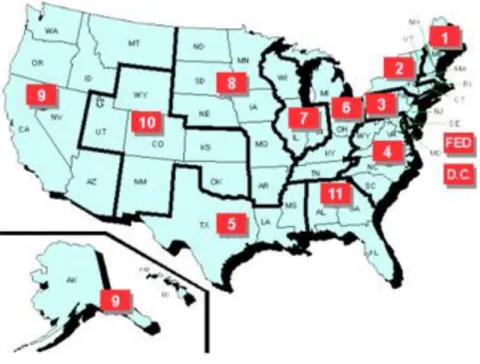
Securities Litigation (SGI) the Ninth Circuit required plaintiffs to "plead, at a minimum, particular facts giving rise to a strong inference of deliberate recklessness." (See Figure 1 for a geographic representation of the structure of the federal court system.)
2.2 Re:Silicon Graphics, Inc., Securities Litigation
The intent of this paper is to test whether a change in litigation risk, such as those currently debated around the globe, affect managers’ financial reporting choices. As such, the setting is critical as it must replicate, to the closest degree possible, an actual policy intervention. In this respect, the Silicon Graphics decision is nearly ideal for the following six reasons.
First, it interpreted the pleading requirement, which can dramatically affect the outcome of the case. Judge Nygaard called these requirements the "key that opens access to courts".10 Empirically, studies demonstrate that these differences had a material effect on both the rate that courts dismiss claims (Pritchard & Sale, 2005) as well as the amount of claims filed (Perino, 2003). Hence, the SGI decision is a powerful setting as it led to a strong shift in litigation risk.
Second, the SGI decision primarily affects firms headquartered in a single jurisdiction, the Ninth Circuit, which is a critical element of the research design. Shareholders can file a securities class-action lawsuit in any district where the corporation has an economic presence. However, over 85% of class actions are ultimately consolidated and litigated in the federal district where the corporation maintains its headquarters (Cox, Thomas, & Bai, 2009).11 Therefore, the litigation risk managers face is apparent at the time they make financial reporting choices. Furthermore, since only public firms headquartered in the Ninth Circuit are affected by the decision, the remaining firms can be utilized as a control group. This
10 Philllips v. Allegheny (515 F.3d 224). 11
7
design creates a natural control for changes in the business environment, such as macro economic shocks, which enhances the validity of the study.
Third, the SGI decision was widely publicized and coverage clearly articulated how it would affect firms.12 The AP newswire covered the decision the day of the announcement, July 2, 1999. Then, the San Francisco Chronicle, the San Jose Mercury News and the Los Angeles Times reported on the decision the next day, a Saturday. The following Monday it was covered in the Wall Street Journal.13 Furthermore, writers indicated the effect of the decision on litigation risk suggesting that “future lawsuits against high-tech firms in Silicon Valley appear to have little chance of success” (Holding & Carlsen, 1999). Since this paper examines the effect of court decisions on managerial reporting choices, it is critical that managers were aware of these decisions and their effect on the risk of class-action litigation.
Fourth, given the judicial history of the Ninth Circuit the manner in which it interpreted the pleading provision of PSLRA was a surprise. Prior to PSLRA, the Ninth Circuit adopted among the lowest pleading provisions of all circuits (Gibney, 2001).14 In contrast to the plaintiff-friendly environment that existed prior to PSLRA, the Ninth Circuit adopted the highest standard of all circuits after the PSLRA (Grundfest & Pritchard, 2002). Thus, with one split decision, the Ninth Circuit unexpectedly moved from one of the easiest circuits to certify a class action to one of the most difficult. Since it was not anticipated, firms could not gradually phase in changes to reporting regimes making it a powerful setting to examine changes in financial reporting choices.
Fifth, the process of judge selection and the manner in which judges decide cases suggests that the outcome of the SGI decision was not driven by contemporaneous financial reporting choices. The
12
Many decisions were important in establishing precedence and determining future legal outcomes in all jurisdictions. However, since I examine the managerial response to changes in the litigation environment, it is important that managers are also informed of the decision and its potential effect on future outcomes of shareholder security litigation. Consistent with law literature on PSLRA, I searched factiva and found that none of the following decisions were covered in the business press that might have reached corporate reporting decision makers: Dura Pharmaceuticals, Inc. v. Broudo, 544 U.S. 336, Wright v. Ernst & Young 152 F.3d, and South Ferry LP #2 v. Killinger F.3d, 2008. Hence, I focus my examination on the SGI decision as it was heavily covered in the business press.
13 Further, this decision prompted the San Francisco Chronicle to conduct a five-part series on ethical lapses in the
Silicon Valley and corporate fraud.
8
Ninth Circuit’s policy for selecting judges is based on “random draw from the circuit-wide pool of senior and active judges”.15
Also, recent research indicates that judges decide cases in accordance with personal beliefs and characteristics suggesting that environmental factors did not affect the outcome (Altieri, Apple, Marquette, & Moore, 2001; Schneider, 2002).16 Further, corporate fraud occurred regularly in the Ninth Circuit at the time of the SGI decision (Beasley, Carcello, & Hermanson, 1999). Hence, if judges were responding to the environment, the decision would have been to encourage, not constrain, private litigation. These factors all indicate that reverse causality is less of an issue in this setting.
Sixth, it is well recognized that, at the time of the SGI decision, the Ninth Federal Circuit was the most important venue in terms of the volume of class-action securities lawsuits (Pritchard & Sale, 2005). Hence, an examination of securities lawsuits must emphasize this important legal jurisdiction.
In summary, this study contributes to the debate as to whether class actions should be encouraged or stymied. As such, the setting should mirror a policy change as closely as possible. The SGI decision is a good setting as it was well publicized, unexpected, important to judicial outcomes, unlikely to be caused by environmental factors and its affect on firms’ litigation risk was unambiguous and known at the time managers made reporting choices.
15
See section 3.2.1 of The General Orders for the U.S. Court of Appeals for the Ninth Circuit (Circuit 2010).
16 At the time of the SGI decision, 23 active judges sat on the Ninth Circuit. The panel which decided the SGI case
9 3.0 Related Literature and Hypotheses
3.1 Literature Review
This paper examines how the risk of class-action lawsuits filed under securities laws affects discretionary revenues, market reactions and restatements. Thus, it is related to literatures examining the consequences of shareholder litigation in terms of economic and accounting outcomes as well as the determinants and consequences of financial restatements. This section reviews these studies below.
One stream of literature, grounded in law and economics, examines the economic effects of private enforcement of securities laws (via shareholder lawsuits and market disciplinary actions) and public enforcement mechanisms (via regulators). La Porta et al. (2006) theorize that regulators cannot marshal the resources necessary to adequately discipline corporations and lack financial incentives to vigorously pursue violators of securities laws. They survey legal experts in 49 countries and find that the private enforcement mechanisms (liability standards and disclosure requirements) are positively related to financial development while the public enforcement measures are not. Coffee (2007) argues that these results are misleading as they only measure the "laws on the books" and not the strength of the regulator. Jackson and Roe (2009) follow by examining the relation between measures capturing the strength of the regulator and financial development. They find that both public and private mechanisms of enforcement lead to financial development. The current study contributes to this literature by examining one channel through which private securities litigation might affect financial market development: by enhancing the veracity of firm-specific accounting information.
10
earnings forecast is decreasing in litigation risk (Rogers & Van Buskirk, 2009; Baginski, Hassell, & Kimbrough, 2002). Alternatively, some studies suggest that litigation risk may create incentives for managers to preempt bad news which might discourage litigation (Skinner, 1994; Field, Lowry, & Shu, 2005; Kasznik & Lev, 1995), and reduce the costs of litigation (Skinner, 1997). However, other studies indicate that voluntary disclosures do not deter litigation (Francis, Philbrick, & Schipper, Shareholder litigation and corporate disclosures, 1994; Johnson, Kasznik, & Nelson, 2001).
While these papers examine the link between litigation risk and voluntary disclosure, they do not address the effect of litigation risk on mandatory financial reports as opposed to announcements or descriptions of the reports. Yet, mandatory financial statements are fundamentally different from voluntary earnings guidance. For example, the accuracy of managerial estimates will be readily verified shortly after the forecast when earnings are released. Hence, misrepresentations or errors will be quickly discovered while erroneous or fraudulent accounting estimates may take years to be revealed. Further, voluntary forecasts are less affected by contractual incentives than actual financial data. Overall, this literature makes significant contributions, but does not examine the effect of litigation risk on financial reporting choices reflected in mandatory disclosures. Alternatively, the following two papers examine financial reporting choices in different contexts.
Qiang (2007) examines the interrelated roles of conditional and unconditional conservatism under costs induced by contracting, litigation, regulation and taxes. She finds that conditional and unconditional conservatism for 633 firms over the period 1988-1999 are unique and firms tradeoff one for the other. Further, both conditional and unconditional conservatism are related to litigation risk.
11
that discretionary accruals decline in the periods following both public SEC investigations and class-action litigation.
While these papers are interesting, the current study features a unique setting with two important characteristics that enhance the validity of the research design over other research. First, the SGI decision represents an unexpected shift in litigation risk. This is critical because studies suggest that causality can also run from accounting outcomes to litigation (Johnson, Nelson, & Pritchard, 2006; Palmrose & Scholz, 2004). However, as noted in section 2.2, the institutional features of the current setting make reverse causality unlikely. Further, the SGI decision primarily affected only a subset of firms determined by geography. The difference-in-differences design featured in this study tests changes in financial reporting practices within industries. This is important as accounting outcomes are driven by innate factors that are affected by routine business cycles and industry norms (Francis, LaFond, Olsson, & Schipper, 2005). Overall, since I focus exclusively on the financial reporting consequences of shareholder litigation (as opposed to comparing litigation with SEC enforcements as in Jennings et al. (2011)) I can examine a sharper setting and construct finer tests that naturally rule out many alternative explanations.
12
risk of litigation deters restatements.17 Thus, this paper is unique because it provides evidence of the role of private litigation in affecting the frequency of restatements.
3.2 Arguments for Alternative Hypotheses
Whether class actions constrain managers from adopting aggressive reporting policies is an open question. Some argue that shareholder lawsuits are an integral component of the regulatory structure of the financial markets. Justice Ginsburg reflects “This Court has long recognized that meritorious private actions to enforce federal antifraud securities laws are an essential supplement to criminal prosecutions and civil enforcement actions brought, respectively, by the Department of Justice and the Securities and Exchange Commission (SEC) [emphasis added]” (Tellabs Inc, v. Makor Issues & Rights Ltd. 551 U.S. 308). On the other hand, an expert in securities law testified before the Senate suggesting “private class actions [lawsuits] move a lot of money around, but add little to deterrence at the margin” (Pritchard, 2009). While private litigation, as an enforcement mechanism, may constrain managers' financial reporting choices, there are five reasons why it may not.
First, the costs any individual bears may be too low to discipline managers from violating securities laws (Coffee, 2006). In the aggregate, individual executives or directors contribute only around 0.4% of total settlements whereas insurance companies and the corporation bear the majority of the cost (Dunbar, Foster, Juneja, & Martin, 1995).18 This is what prompts Coffee (1986) to suggest that private securities litigation is simply a wealth transfer from current to past shareholders less considerable legal fees. And, this circularity makes it impossible to hold managers accountable for misdeeds.
Empirically, it is not clear whether class actions levy reputational penalties on managers, executives and directors. Helland (2006) finds that directors actually gain more directorships in other firms after serving on the board of a firm sued for violating securities laws. He suggests that lawsuits are
17 For the reasons noted in the next section, it does not follow that litigation reduces restatements just because
restatements may increase the likelihood of litigation.
18 Consider, for instance, that the largest sum that an individual ever paid in regards to settling a class action suit was
13
so commonplace that they actually improve director's human capital in a meaningful way. Srinivasan (2005) samples 135 class actions that follow a restatement and finds that only 5.5% of the outside directors and audit committee members are named in the lawsuit. This suggests that directors do not face explicit penalties. However, Fich and Shivdasani (2007) find that outside directors of firms that face class action securities lawsuits reduce board seats in other firms. And, the departure at the interconnected firm is viewed positively by investors.
Overall, this literature does not provide strong evidence that managers face implicit penalties, suggesting that they may not respond to changes in litigation risk. Furthermore, even if managers did face career concerns, the "final period problem" suggests that the greater the likelihood that the manager will be dismissed, the less he or she can be dissuaded from committing fraud (Gulati, 1999).
Second, if class actions are meritless, managers may not have the ability to prevent them through their financial reporting choices. And, some argue that many lawsuits have no merit (Alexander, 1991; Grundfest, 1995; Pritchard, 2009; O'Brien, 1993). Furthermore, if directors and shareholders perceive that lawsuits are frivolous they may be less likely to penalize financial officers and those culpable.
Third, the institutional structure of lawsuits may preclude any deterrence effect. Plaintiffs’ attorneys have strong profit motives to file and litigate class actions. However, they have no incentive to structure settlements to deter future violations. In fact, these attorneys can actually gain from future securities violations by representing injured shareholders.
Fourth, the dispersed nature of shareholders and low recover values lead to collective action problems. In aggregate, shareholders only recover 2-3% of losses incurred by alleged wrongdoings (Milev, Patton, & Starykh, 2011). Furthermore, dispersed ownership reduces incentives for shareholders to monitor executives and hold individuals accountable for infractions of laws that reduce shareholder values (Berle & Means, 1932; Jackson & Roe, 2009).
14
In conclusion, it is not clear whether private litigation affects financial reporting outcomes. While some, such as Justice Ginsburg, suggest that these lawsuits accrue important benefits, others disagree. The next section details the hypotheses tested in this paper to provide empirical evidence on the debate.
3.3 Hypotheses
Given the possibility that litigation risk may not affect accounting outcomes, I focus on the most powerful setting, which is the revenue account in the subset of firms most likely to respond to changes in litigation risk. Revenues are important because, as the Director of Enforcement at the SEC noted, “revenue recognition remains the recipe of choice for cooking the books” (Holding, 1999). Furthermore, prior research suggests that the likelihood of shareholder litigation varies based on firm characteristics (Rogers & Van Buskirk, 2009; Kim & Skinner, 2010; Cao & Narayanamoorthy, 2009; Francis, Philbrick, & Schipper, 1994). In the context of the Silicon Graphics decision, I argue that size and industry are especially relevant identifiers of litigation risk.19
In contrast to the arguments in the prior section, a long line of research in accounting suggests that managers alter financial reporting practices in response to changes in incentives and opportunities (Jones J., 1991; Christie, 1990; Dechow, Ge, & Schrand, 2010). And, several studies suggest that litigation risk does affect managers’ choices as they relate to voluntary disclosures (Johnson, Kasznik, & Nelson, 2001; Baginski, Hassell, & Kimbrough, 2002; Skinner, 1994; Francis, Philbrick, & Schipper, 1994; Rogers & Van Buskirk, 2009). Therefore, I believe that this enforcement mechanism may affect financial reporting choices, especially for the subset of firms most likely to face shareholder litigation.
Given that the Silicon Graphics decision reduced the risk of shareholder litigation, I hypothesize, in alternative form:
H1a: In the post-SGI period, high-risk firms headquartered in the Ninth Circuit recorded more discretionary revenues than in the pre-SGI period relative to firms headquartered in other jurisdictions.
15
Recording revenues more aggressively after the SGI decision, as suggested in the prior hypothesis, may suggest managerial opportunism. If this occurs, the market response, in terms of abnormal returns, to revenue surprises should decline indicating that investors are more suspicious of the levels of revenues reported. Accordingly, I hypothesize, in alternative form:
H2a: In the post-SGI period, the market response to unexpected revenues for high-risk firms headquartered in the Ninth Circuit was lower than in the pre-SGI period relative to firms headquartered in other jurisdictions.
Finally, I examine the likelihood of a restatement as it adds a different dimension of the financial reporting process. The prior empirical measures capture more subtle variations in accounting choices across the entire cross section of firms. However, the restatement construct captures more egregious violations of GAAP.20 In this sense, this measure is closest to the “unethical and unsafe practices” against which the Securities Acts of 1933 and 1934 were intended to protect.21 I hypothesize, in alternative form:
H3a: In the post-SGI period, the likelihood of a restatement for high-risk firms headquartered in the Ninth Circuit was higher than in the pre-SGI period relative to firms headquartered in other jurisdictions.
20 Restatements occur for a variety of reasons such as changes in accounting principles. However, I follow a method
similar to Hennes et al. (2008) and only include the most severe restatements. See section 4.5 for further detail.
21 As a definition of the purpose of the Securities Acts of 1933 and 1934, see the message from President Franklin
16 4.0 Empirical Design:
This paper examines whether the SGI ruling affects the subsequent financial reporting decisions of managers in firms headquartered in the Ninth Federal Circuit that face the greatest risk of shareholder litigation. Hence, research design choices include selecting an appropriate proxy to measure financial reporting decisions, modeling the change in this proxy around the SGI decision, and identifying the high-risk subset of firms. This section discusses these choices.
4.1 Proxies for Financial Reporting Choices:
The ideal dependent variable would capture whether a firm's financial reporting choices violated securities laws. However, this variable does not exist because one can only judge compliance with securities laws after careful ex post analysis of the facts and circumstances of each case. Instead, I examine three variables, each capturing a unique aspect of financial reporting.
4.1.1 Discretionary Revenues
First, I examine discretionary revenues as measured by Stubben (2010). Conceptually, this variable measures the level of premature revenue recognition. Intuitively, it measures the speed by which firms recognize revenue, relative to industry peers, controlling for changes in receivables. Hence, it allows for an analysis of how litigation risk affects the aggressiveness of revenue recognition across the entire cross section of firms. And, to the extent that lawmakers are concerned with aggressive revenue recognition, it closely reflects the construct of interest.
17
Hermanson, & Neal, 2010). In fact, the Director of Enforcement at the SEC acknowledged that “revenue recognition remains the recipe of choice for cooking the books” (Holding, 1999). Hence, for purposes of this paper, the sharpest indicator of securities laws violation would be to examine the revenue account.
Second, Stubben (2010) demonstrates that this measure is more effective in detecting revenue manipulation than either the modified Jones model or the Dechow-Dichev measure of accruals. In fact, the discretionary revenue model detects over 20% of the instances of revenue manipulation when 1% of assets is added to the change in fourth quarter revenues and the receivables accrual. On growth firms, many of which may be in my sample, this measure demonstrates less bias (in the form of lower abnormal accruals) than other measures of discretionary accruals models on samples where no manipulation is induced.
Finally, this measure outperformed accruals measures in tests against actual financial reporting outcomes. Stubben examines 173 firms subject to SEC enforcement for improper revenue recognition and concludes that his model has both higher power and lower bias in detecting improper revenue recognition policies than accruals models.
I follow Stubben (2010) and estimate this cross-sectional model by industry and quarter:
(ARi,q + ARi,q-1 + ARi,q-2 + ARi,q-3) - ( ARi,q-4 + ARi,q-5 + ARi,q-6 + ARi,q-7) =α0 + β1(REVi,q - REVi,q-4)
+ β2[(REVi,q-1 + REVi,q-2 + REVi,q-3) - (REVi,q-5 + REVi,q-6 + REVi,q-7)] + ɛ (1)
Where:
ARi,q = Net accounts receivable for firm i in quarter q measured from the statement of
cash flow.
REVi,q = Total revenues (REVTQ) of firm i in quarter q.
The intercept is allowed to vary over the most recent quarter because sales initiated in this period are more likely to remain uncollected than those initiated in prior quarters. The residual represents the level of discretionary revenues as it is the portion of the change in accounts receivable that cannot be explained by the change in revenues. All variables are scaled by average total assets (ATQq+ATQq-4/2).
18
Consistent with all main empirical analyses in this paper, I examine discretionary revenues in a differences-in-differences specification. This model controls for cross-sectional variations in firm-specific characteristics that also affect accounting outcomes and are relatively stationary over time. Such characteristics could be related to the fundamental earnings process or unobservable characteristics such as governance. Further, it also controls for any time-period effects, such as boom or bust cycles. Therefore, this model provides a more clear analysis of litigation risk on accounting outcomes than other models, such as those examining litigation risks in the cross section.
To test hypothesis 1, I estimate the following cross-sectional model quarterly over the four-year window centered on the event date (July 2, 1999) separately for the high-risk and non-high-risk groups:
DiscRevi,q =α0 + β1Circuit9i + β2Postq + β3Circuit9i * Postq + βiControlsi,q + ɛ (2)
Where:
DiscRevi,q = The level of discretionary revenues for firm i in quarter q as defined by
Stubben (2010) as the residual from equation (1).
Circuit9i = (1) if firm i is headquartered within the Ninth Federal Circuit and (0)
otherwise.
Postq = (1) for report dates (RDQ) after the Silicon Graphics decision on July 2, 1999
and (0) otherwise.
Controlsi,q= A vector of controls described below.
The coefficient of interest is β3, whichmeasures the change in discretionary revenues for firms headquartered in the Ninth Circuit over the event period relative to the change in discretionary revenues of other firms. Hypothesis 1 suggests that it is positive and significant over high-risk firms, indicating that high-risk firms headquartered within the Ninth Circuit altered revenue recognition policy subsequent to the SGI decisions.22
For control variables I use SaleGrowth, ROA and MTB as proxies for growth opportunities that may affect the receivable-revenue relation independent of litigation risk. I use Size and BigSix as larger firms and those audited by a big six auditor may have different opportunities and abilities to alter revenue recognition policies. All variables are defined in Exhibit 1.
19
4.2.1 Market Reaction to Unexpected Revenues:
In order to examine whether investors became more suspicious of unexpected revenues after the SGI decision, I examine the relation between short-window abnormal returns and revenue surprises.23
I follow Jegadeesh and Livnat (2006) and model the expectation of revenue surprises as a seasonal random walk with a drift using the following methodology:
(3)
Surgei,q is the standardized unexpected revenue growth for firm i in quarter q. The standard deviation of revenues (σRevi,q) is taken over the prior 8 quarters and the expectation of revenues is modeled following a seasonal random walk with a drift:
E(Revi,q) = Revi,q-4 + δi,q (4)
Where Rev is the quarterly revenue per share and the drift (δi,q) is modeled as:
(5)
I also follow Jegadeesh and Livnat (2006) and model abnormal returns as:
(6)
Where Ri,j is the actual return compounded over the three-day period beginning one day prior to the earnings announcement. BRi,j is the return on the size-matched decile portfolio.
4.2.2 Market Reaction Specification
To test whether the SGI decision affected the market reaction to unexpected revenues and whether the effect is concentrated in the high-risk group, I estimate the following cross-sectional model quarterly over the four-year window centered on the event date separately for the high-risk and non-high risk groups:
23
20
CARi,q = α0 + β1Circuit9i + β2Postq + β3Surgei,q + β4Circuit9i*Surgei,q+ β5Postq*Surgei,q +
β6Circuit9i*Postq + β7Circuit9i*Postq*Surgei,q + βiControlsi,q + βkControlsi,q*Surgei,q
+
ε
i,q (7)Where:
CARi,q = The cumulative abnormal return for the three-day event window centered on
the earnings announcement date calculated as the actual return less the portfolio based on year-end size decile and compounded over the event period.24
Circuit9i = (1) if firm i was headquartered within the Ninth Circuit and (0) otherwise.
Postq = (1) for report dates (RDQ) after the Silicon Graphics decision on July 2, 1999
and (0) otherwise.
Surgei,q = The standardized unexpected revenue growth defined in equation (3).
Controlsi,q= A vector of controls described below.
The coefficient of interest is β7,which represents the incremental change in the revenue response coefficient for firms headquartered in the Ninth Circuit after the SGI decision relative to firms headquartered in other jurisdictions. Based on hypothesis 2, I expect it to be negative when estimated over high-risk firms.
Consistent with prior papers that examine the relation between unexpected earnings and short-window returns I control for a variety of firm characteristics that may alter the relation between revenues and returns independent of litigation risk (Blouin, Raedy, & Shackelford, 2003; Hayn, 1995). All of the following variables except Nonlinear are inserted in the specification individually and interacted with Surge resulting in a vector of 11 terms: Nonlinear, MTB, Persist, Size, Predict, Expense Surprise (ExpenseSurp), Loss and Beta. All variables are defined in Exhibit 1.
I restrict this test to firms that have the eight necessary lags of quarterly revenues to calculate the drift term.
4.3.1 The Likelihood of a Restatement
This paper examines whether litigation risk constrains managers from making opportunistic financial reporting choices. However, restatements can occur for a variety of seemingly innocuous reasons such as a change in GAAP. Hence, the ideal measure would capture only restatements caused by managerial decisions to intentionally bias reporting. Since that variable does not exist, I follow a method
24
21
similar to Hennes et al. (2008). Specifically, I classify a restatement as intentional if any of the following occur: the restatement announcement explicitly mentions the term “fraud”, the SEC publicly disclosed an investigation into the accounting issue, or there is a subsequent class-action lawsuit.25 While this method is certainly not perfect, restatements captured will likely be those more damaging to the reputation of the firm and consumer confidence in financial reporting processes than other restatements. Hence, these restatements more closely reflect regulators intentions to prevent abuses of the financial reporting process.
4.3.2 Restatement specification
Restatements pose a unique challenge in a quarterly event study because firms often restate the entire year. Thus, quarterly financials filed before the SGI decision could be restated for GAAP violations that occur after the SGI decision. Therefore, I exclude fiscal years that overlap the SGI decision and compare the two years prior to the excluded year with the two years subsequent to the excluded year.26 I examine the following cross-sectional, logistic model estimated quarterly over this period:
Restatei,q =α0 + β1Circuit9i + β2Postq + β3Circuit9i * Postq + βiControlsi,q + ɛ (8)
Where:
Restatei,q = (1) if the quarterly observation was subsequently restated because of an
intentional misapplication of GAAP and (0) otherwise.
Circuit9i = (1) if firm i was headquartered within the Ninth Circuit and (0) otherwise.
Postq = (1) for report dates (RDQ) after the Silicon Graphics decision on July 2, 1999
and (0) otherwise.
Controlsi,q = A vector of controls described below.
The coefficient of interest is β3, which measures the change in the likelihood of a restatement for firms headquartered in the Ninth Circuit after the SGI decision, relative to firms headquartered outside the Ninth Circuit.27 Hypothesis 3 suggests that it is positive indicating that restatements increased for firms headquartered within the Ninth Circuit subsequent to the SGI decisions.
25
Given that class-action lawsuits declined after the SGI decision (Perino, 2003), the choice to include restatements with a corresponding lawsuit will bias the test against finding an increase in restatements after the decision.
26 I also run this model over a four-year period centered on the event date, consistent with the prior models.
Conclusions are not sensitive to this change.
27 Ai and Norton (2003) demonstrate that the coefficient, β
3, estimated in a nonlinear model, such as equation (8),
22
Controlsi,q are a vector of variables to control for changes in the firm over the event window and include: MTB, ROA, Leverage, BigSix, SaleGrowth and Size following prior literature (Agrawal & Chadha, 2005). All variables are defined in Exhibit 1.
4.4 Identification of high-risk firms
Prior research suggests that the likelihood of shareholder litigation varies across firms based on characteristics such as size and industry (Rogers & Van Buskirk, 2009; Kim & Skinner, 2010; Cao & Narayanamoorthy, 2009; Francis, Philbrick, & Schipper, 1994).28 In the context of the Silicon Graphics decision, these characteristics are especially relevant identifiers of cross-sectional differences in firm responses to changes in litigation risk.
Size is an important identifier for the following three reasons. First, it is well recognized that attorneys have little incentive to bring costly litigation against smaller firms that have fewer resources to pay settlements (Cox, Thomas, & Kiku, 2006; Perino, 2003). Second, PSLRA requires that lawsuits proceed past the defendant’s initial dismissal motions in order to reach the discovery phase. Hence, the plaintiff’s complaint must be based on either public information or testimony obtained from a whistleblower. Larger firms will have more public information available upon which a case can be built and more employees which can potentially serve as whistleblowers. So, ex ante, it will be easier to build a case which withstands dismissal motions for larger than smaller firms. Third, size also captures how well the firm is informed about the actual litigation risk it faces. Larger firms are more likely to be staffed with in-house counsel and others informed about relevant case law. These firms may also have more extensive processes that require review or approval of accounting choices by individuals familiar with litigation risk. Thus, not only does size affect the actual risk of litigation, but size also affects the link between
probability function and not the change in the expectation of a restatement. They propose a technique to properly determine the full interaction effect that has been adopted by previous papers (Bushman, Dai, & Wang, 2010). I follow this research and compute the marginal effect of the interaction term using the delta method.
28
23
actual litigation risk and accounting choices. Accordingly, in this paper, I set a size threshold as assets that exceed $100 million.29
Similarly, industry is an important measure of litigation risk for the following reasons. First, it is well recognized that certain industries were most frequently subjected to class-action lawsuits, especially in the geographic area comprising the Ninth Circuit during the period of the SGI decision (Grundfest & Perino, 1997; Jones & Weingram, 1996; Johnson, Nelson, & Prichard, 1999; Johnson, Kasznik, & Nelson, 2001; Francis, Philbrick, & Schipper, 1994). Second, firms in these industries were instrumental in lobbying for PSLRA and subsequent legislation that constrained litigation (Eaton, 1998). Finally, popular press accounts of the Silicon Graphics decision emphasized the importance of the decision to the specific industries.30 Following Francis et al. (1994) I identify high-risk industries as biotechnology, software, hardware, electronics and retailing industries. See Exhibit 1 for definitions of these industries.
4.5 Sample
The sample window for the main tests runs from July 1997 through July 2001. I use Compustat quarterly for the accounting data, and CRSP for the returns data. I eliminate observations with a change in fiscal year end, financial institutions, utilities and foreign firms as they face a different regulatory structure and litigation environment.
Audit Analytics provides a dataset of financial restatements that is well suited for this paper. This dataset identifies restatements by searching for terms such as “restate”, “error”, and “prior period adjustments”. They also collect all 8-Ks that contain “Item 4.02 Non Reliance” language. They then read
29 This threshold is consistent with Beasley et al. (2010) who examine fraud in overlapping time periods and report
that the median public company that engaged in fraud had a size of $100 million. In robustness tests I examine the sensitivity of my results to this threshold.
30 For example, the San Jose Mercury News documented the Silicon Graphics decision the day after by writing "a
24
all applicable 10-Ks and 10-Qs to ensure that the restatement is not caused by adoption of new accounting principles or revisions attributable to mergers and acquisitions.31
One concern regarding the restatement data is that the Audit Analytics dataset begins capturing restatements publicly disclosed after January of 2000 while the event window runs from July 1997 through July 2001. However, the construct of interest is not the disclosure of the restatement, itself, but rather the period over which financial statements violated GAAP. As demonstrated below, the restatement window (the period over which the financial statements violated GAAP) and the disclosure lag (the distance between the end of the restatement window and the public disclosure) are sufficiently large that the average restatement falling within the event window will be captured in the dataset.32
25 5.0 Empirical Results
5.1 Descriptive Statistics
Table 1 describes the geographic composition of the sample. Approximately 25% of the total observations and 34% of the high-risk observations in the sample are headquartered in the Ninth Federal Circuit. Panel B demonstrates that 77% of the observations in the Ninth Federal Circuit are headquartered within the state of California. Panel C shows that around 6% of the observations in the sample are in the high-risk group headquartered in the Ninth Circuit (2% prior to the SGI decision and 4% after) while twice as many high-risk firms were headquartered outside the Ninth Circuit (12%).
Table 2 presents the descriptive statistics for the samples used in the paper. Overall, the firms are large, profitable, use a big six auditor and have low abnormal returns around earnings announcements. Around 18% of the observations in the sample are high risk, average assets are around $1 billion, revenues around $283 million for the average firm, and 84% use a Big Six auditor.
Panel B shows the correlations. The measure of discretionary revenues is positively correlated with Surge, MTB, ROA and SaleGrowth and negatively correlated with Leverage, Sales and BigSix. Overall, this suggests that levered firms subject to a more stringent auditor have lower discretionary revenues than faster growing firms.
5.2 Testing Discretionary Revenues
26
revenues over the pre SGI period relative to high-risk firms headquartered in other jurisdictions, confirming hypothesis 1.
Model 2 analyzes the non high-risk firms. The interaction term is not significant indicating that non high-risk firms headquartered in the Ninth Circuit did not alter revenue recognition policy relative to non high-risk firms headquartered in other jurisdictions.
Panel B tabulates tests of differences in the levels of discretionary revenues among groups and periods separately. The first test (column 1) examines the change in the levels of discretionary revenues before and after SGI within the same group. Results in this column indicate that the statistically significant interaction coefficient in Panel A is driven by an increase in discretionary revenues for high-risk firms headquartered in the Ninth Circuit. Discretionary revenues actually declined over the event period for all other groups although the decline is not statistically significant. The increase in the level of discretionary revenues for the high-risk firms headquartered in the Ninth Circuit is dramatic. In terms of magnitude, the increase for the mean (median) firm is equivalent to an increase in revenue of $13.5 ($2.6) million which is 3.7% (3.9%) of total revenues reported for the quarter. Further, column 2 (3) tests differences in the levels of discretionary revenues between high-risk firms headquartered in the Ninth Circuit and all other firms before (after) the SGI decision. Results in column 2 indicate that the level of discretionary revenues for high-risk firms headquartered in the Ninth Circuit was significantly lower than all other groups prior to the SGI decision. However, column 3 indicates that the level of discretionary revenues for high-risk firms headquartered in the Ninth Circuit was no different from the other groups after the SGI decision.
27
two-year period prior to the SGI decision. Hence, managers "funded" an increase in discretionary revenues in the period subsequent to the SGI decision by reporting abnormally low discretionary revenues in the period preceding the SGI decision. This is consistent with the well-recognized phenomenon that the Ninth Circuit provided one of the most favorable circuits to litigate securities class-action lawsuits prior to the SGI decision (Grundfest & Pritchard, 2002; Sale, 1998; Gibney, 2001; Perino, 2003). Overall, this panel indicates that the heightened risk of litigation prior to the SGI decision constrained managers from aggressively recognizing revenues. After the SGI decision reduced litigation risk, discretionary revenues increased to a level consistent with peer firms headquartered in other areas of the country.
5.3 Testing Market Reaction to Unexpected Revenues
Documenting a shift in discretionary revenues after the SGI decision, while interesting, is insufficient to determine whether class actions constrain managers from adopting aggressive revenue recognition practices. Managers could have recognized revenue more aggressively to signal private information or to opportunistically bias reporting. The prior motivation would presumably improve financial information while the latter would not. Equation 7 tests whether investors subsequently discounted unexpected revenues prior to the SGI decision. A decline in the investor response would indicate that the more aggressive revenue recognition policy after the SGI decision was likely opportunistic. An increase in the investor response would suggest that litigation risk actually inhibits managers from incorporating value-relevant information into the firm's revenue. Hypothesis 2 suggests that the market's reaction to unexpected revenues is attenuated for high-risk firms headquartered in the Ninth Circuit declined after the SGI decision.
28
1.5% for the baseline regression in column 1. This magnitude is consistent with prior literature (Kama, 2009). Column 2 is the difference-in-differences specification across high-risk firms. The three-way interaction among Surge, Post and Circuit9 is negative and significant. This indicates that the market response to unexpected revenues declined for high-risk firms headquartered in the Ninth Circuit subsequent to the SGI decision relative to other firms.33 Column 3 is the same analysis over non high-risk firms. Consistent with the prior panel, which demonstrated no change in the level of discretionary revenues for the non high-risk firms, this model shows that the market reaction to unexpected revenues did not change for this population. Overall, results from this panel are consistent with the prior: a shift in the financial reporting process for high-risk firms headquartered in the Ninth Circuit. This panel complements the prior by demonstrating that the increase in discretionary reduced the information content of revenues.
Panel B tabulates tests of differences in the revenue response coefficient among groups and periods separately. Column 1 examines differences in revenue response coefficients within the same group comparing the pre and post period. The only statistically significant change in the market response to unexpected revenues over the event period occurred in the Ninth Circuit, high-risk group where the market response to revenue declined by nearly 30%. The revenue response coefficient actually increased for all other groups, although the increase is not statistically significant. The difference between the pre and post value for the Ninth Circuit, high-risk group is very significant, economically. The mean (median) high-risk firm headquartered in the Ninth Circuit that reported a positive value of unexpected revenues after the SGI decision would have seen a .61% (.50%) increase in the three-day raw return had the market response to unexpected revenues not changed subsequent to the SGI decision.
33 An alternative explanation for this result is that the reduction in market reactions is driven by an increase in
29
The next columns test the nature of the shift in the market response to unexpected revenues documented in column 1. The market response to unexpected revenues could have been greater for high-risk firms headquartered in the Ninth Circuit prior to the SGI decision, and converged after the decision relative to other firms. Alternatively, the market response to unexpected revenues for high-risk firms headquartered in the Ninth Circuit could have been no different prior to the SGI decision, but declined after the SGI decision, relative to other firms. If the market rewards revenue surprises more when litigation risk is high, the former explanation would prevail. However, if the market response to litigation risk is more acute after a high-profile event, such as the SGI decision, then the latter explanation should dominate. Although the revenue response coefficient for the Ninth Circuit, high-risk group is higher than all other groups prior to the SGI decision, the difference is not statistically significant (column 2). Instead, the last column indicates that the revenue response coefficient for the Ninth Circuit, high-risk firms after the SGI decision is significantly lower than each of the other 3 groups. These results suggest that the punitive litigation environment in the Ninth Circuit prior to SGI did not affect market reactions to unexpected revenues during that period. However, after the SGI decision, investors became suspicious of unexpected revenues reported by firms most susceptible to litigation.
Overall, this table is generally consistent with the results in the prior panel. The market response to unexpected revenues declined only for high-risk firms headquartered in the Ninth Circuit. This suggests that the discretion was opportunistic in nature and did not enhance the information available to the market.
5.4 Testing the Likelihood of a Restatement
30
Alternatively, restatements capture only shifts from reporting choices consistent with GAAP to those that violate GAAP. Accordingly, it captures more egregious violations of GAAP which are clearly indications that managers adopted aggressive reporting practices.
Table 5 examines the restatement data used in this analysis. Panel A tabulates descriptive statistics of the restatement data and demonstrates that the average restatement that occurred during the SGI event window will be captured in the data. As discussed above, the SGI window runs from July 1997 through July 2001. However, Audit Analytics did not begin collecting restatement data until January of 2000. Per Panel A, the average restatement window for the entire dataset is 612 days. And, the average disclosure lag is 263 days meaning that the average delay between the beginning of the restatement window and disclosure is 875 days. Thus, the Audit Analytics sample will capture the average restatement beginning from mid 1997 through the end of the SGI event window. See Figure 2 for a timeline of restatement events.34
Panel B examines the change in restatements by the location of the firm’s headquarters and whether it occurred before or after SGI. As described above, the dataset will contain more restatements in the post SGI period because of the data collection process. Overall, the number of restatements nearly triples for firms headquartered within the Ninth Circuit while they just more than doubled outside the Ninth Circuit. The right side of the table scales these measures by the number of observations in each group. The proportion of restatements in and out of the Ninth Circuit roughly doubled after the SGI decision.
Table 6 examines whether the probability of a restatement increased subsequent to the SGI decision in a multivariate setting. Column 1 tests whether the likelihood of a restatement increased for
34 Although a restatement in the pre period is captured in the data for the average firm there could be systematic
31
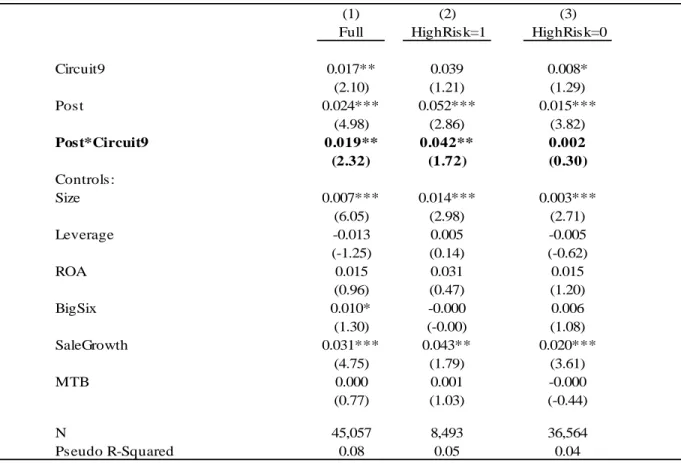
the average firm headquartered in the Ninth Circuit. The marginal effect of the interaction between post and Circuit9 is positive and significant at a p<.01 level. This indicates that the probability of a restatement increased for the average firm headquartered in the Ninth Circuit relative to the average firm headquartered in other judicial circuits after the SGI decision. The next columns split the sample according to the high-risk dimension. Results indicate that the increase in the likelihood of a restatement noted in column 1 is driven by the high-risk firms. Economically, the likelihood of a restatement after the SGI decision for high-risk firms headquartered in the Ninth Circuit firms rose nearly 3% relative to before the SGI decision and relative to the change in restatements over the same period for firms headquartered outside the Ninth Circuit. This result supports hypothesis 3.
5.5 Robustness
This section conducts a series of tests to examine whether prior results are robust to a variety of alternative design choices. Table 7 tabulates the interaction coefficients in regressions centered on a pseudo-event date which is the actual event date shifted quarter-by-quarter forward and backward using the same four-year event window.35 For example, the coefficient reported in period Q+1 in the first column is the interaction in equation (2) between Post and Circuit9 using discretionary revenues as the dependent variable centered 1 quarter after the SGI decision. The column 2 tabulates tests that replicate Table 4 by reporting the three-way interaction among Post, Circuit9 and Surge. All specifications include the same controls as described above and standard errors clustered at the firm level. Results indicate that the increase in discretionary revenues and the decline in the investor reaction to unexpected revenues are concentrated around the actual event date and fade as the pseudo-event date moves away from the actual event date.
The next tests examine the sensitivity of prior conclusions to alternative windows. All prior tables used a four-year window (two years prior and two years subsequent to the decision). Table 8 tabulates the results of these tests using windows of two years, one year and two quarters. Reported values are the