Matthew J. Farrell. Born-Digital Objects in the Deeds of Gift of Collecting Repositories: A Latent Content Analysis. A Master’s Paper for the M.S. in L.S degree. July, 2012. 49 pages. Advisor: Christopher A. Lee
This study describes a latent content analysis of the deeds of gift currently used by collecting repositories in the United States. The study was conducted to determine the presence of a range of concepts related to digital materials and born-digital objects in a collecting repository’s deed of gift.
Nearly one-third of 80 deeds of gift discuss digital materials, yet only five repositories currently address born-digital objects. Access to digital materials and digital preservation activities are the concepts most likely to be addressed in deeds of gift, while the
specification of the repository as holder of the official research digital copy, the creation of technical metadata, and method of capturing born-digital objects are among the concepts least likely to be discussed. Data suggest longer deeds of gift are more likely to address concepts related to digital materials and born-digital objects.
Headings:
Archival appraisal
Archives -- United States -- Administration.
Content analysis
Digital curation
Digital Preservation.
by
Matthew J. Farrell
A Master’s paper submitted to the faculty of the School of Information and Library Science of the University of North Carolina at Chapel Hill
in partial fulfillment of the requirements for the degree of Master of Science in
Library Science.
Chapel Hill, North Carolina
July 2012
Approved by
Introduction
For an archival repository, the donor agreement or deed of gift is one of the foundational legal documents underpinning the archives' ability to achieve its mission.
Without a legally sound contract between the donor of archival materials and the archives, a repository has no right to perform basic archival tasks such as arrangement
and description, storage and conservation, or providing access to researchers. In addition to a transfer of ownership, the deed of gift is relied upon “to clarify and document” the expectations of both the donor and the archives about the lifecycle of the donated
materials (Lee, 2010, donor agreements sidebar, p. 57). Archives often have a template donor agreement on file, which is then tailored to the specific collection.
Archives literature since the 1980s has increasingly concerned itself with electronic records and other born-digital materials. While digital materials often have much in common with the form and content of their analog antecedents (e.g., email
messages borrow the basic structure from a physical letter or memorandum), there are fundamental differences between the tangible analog and the considerably more abstract
digital file. Practitioners and researchers in the field of digital preservation have
implemented changes in the way digital materials are captured, stored, and managed in archival repositories. Issues related to ensuring the authenticity of materials over long
periods of time permeate literature spanning the fields of archives, libraries, health informatics, computer science, and more; little is known, however, regarding how the
has affected the donor policies and donor agreements in archival repositories.
The present study examines whether or not deeds of gift from archival repositories in the United States contain language pertaining to born-digital objects. A latent content
analysis of documents gathered from repositories across the United States showed that overall, collecting repositories were somewhat likely to address digital materials, but
unlikely to specifically address born-digital objects.
A review of relevant literature includes best practices recommended by several collaborative projects regarding donor agreements and born-digital objects. Following are
results from a latent content analysis of 80 template donor agreements. The study concludes with a discussion of the findings, suggestions for archival repositories
1. Literature Review
1.1 Terms Used
Due in part to a wide variety in the character, mission, and focus of repositories,
the archival lexicon lacks consistency. For the purposes of the present study and the sake of consistency, the following terms are used throughout.
The terms Deed of gift and donor agreement are often used synonymously to refer to a written document wherein one party transfers items to another. The document is signed by both parties and is legally binding (Peterson & Peterson, 1985, p. 108).
Alternatively, some repositories use the term gift agreement. This study uses deed of gift as the preferred term for its formal wording. Two further aspects worth pointing out
include that the deed should transfer property without an exchange of money and that deeds of gift “take the form of a contract establishing conditions governing the transfer of title to documents and specifying any restrictions on access and use” (Pearce-Moses,
2005, p. 108-109).
Various archival repositories also focus on different types of materials. The texts
that form the basis of archival practice in the 20th century—e.g. the Dutch Manual (Muller, Feith, and Fruin 2003) and the works of Jenkinson (1966) and Schellenberg (1984)—describe to archival collections as administrative records of a government or
business acting in an official capacity (Muller et al., 2003, p. 20-21). In the years since, the concept of archival material has expanded to include the personal papers of notable
archives will be used throughout, as they each cover repositories that actively seek
special collections materials “from individuals, families, and organizations other than the parent organization” (Pearce-Moses, 2005, p. 76). Institutional archives, archives of
private companies, and government archives are excluded because such repositories often have a mandate to collect or receive records and other archival materials. In the case of
government or institutional archives, a legal record may be used to transfer materials, but this is generally in the form of a records transfer or deposit agreement. For example, the archives of a business may transfer records between the office of creation and the
archives, but the records and their intellectual rights never leave the aegis of the company itself. A collecting repository, meanwhile, is “generally more detached from the records
creation process...[and] frequently archivists in collecting repositories have little control over the form in which they receive [electronic] records, or whether essential metadata accompanies them” (Davis, 2008, p. 169).
Many terms may be used for material created on a computer. Born-digital objects will be used throughout, in order to distinguish between materials that were subsequently
digitized and those that were created in a digital environment. Further discussion regarding the physical and logical structure of digital objects is offered below (see 1.3).
1.2 Deeds of Gift and Their Elements
Written deeds of gift are “essential for acquisition of archival documents”
intellectual property (Danielson, 2010, 72), and curatorial intent, a deed of gift is “one of the most important legal documents the archivist will ever sign” (Ham, 2005, p. 139). The deed, created before an archives physically receives materials, establishes “the rights
to and responsibilities for” archival materials (Ham, 2005, p. 138). The rights that need to be stated in a deed of gift include physical ownership and the transfer of copyright.
Regarding physical and intellectual rights, the Society of American Archivists (SAA) recommends a deed of gift include the names of donor and recipient, the title and description of materials, the transfer of ownership, and a transfer of copyright
(Weideman, 1998). Though the transfer of physical and intellectual rights may appear clear cut, the wording requires a great deal of specificity. A discussion of the recipient of
the materials, for instance, is made more complex if the collecting repository is part of a larger institution (Peterson & Peterson, 1985, p. 25). Issues regarding intellectual property also complicate a deed of gift. The SAA guidelines encourage “donors...to
transfer all rights they possess in and to the materials donated to the repository” (Weideman, 1998), yet that action may be untenable to a potential donor particularly if
the donor receives royalties from the materials to be donated. In an event such as this, “the deed should make provision for eventual transfer” (Ham & Boles, 2005, p. 141), yet it may be difficult to ascertain what a date of eventual transfer should be.
In addition to rights, responsibilities are another key concept outlined in a traditional deed of gift. Hand in hand with issues regarding access recommended for
materials donated be closed to researchers, or only letters exchanged between the donor and the donor's ex-wife? Will portions of the collection be restricted for a set period of time, or until the donor's death? Can researchers gain access to restricted portions with
permission? Who has the authority to grant permission, restrict access, or remove restrictions? As open and equitable access is a core value of the archival profession
(Society of American Archivists Council, 2011), issues regarding access and any
restrictions applied to it are central to the donation and must be worked out in advance of the point of acquisition. Other responsibilities that may be addressed in a deed of gift are
what the collecting repository is to do with materials appraised as non-archival, whether the collecting repository may discard or sell the materials at a later date, and what
preservation activities will be performed on the materials.
The third concept to address in a deed of gift are the list and description of materials to be donated. Peterson and Peterson recommend inclusion of the creator(s) of
the materials, the volume, and the dates of creation or coverage. The degree of specificity depends on the materials donated, “for most donations, however, it is useful to attach to
the deed an appendix containing a detailed archival description of the material donated” (Peterson & Peterson, 1985, 25). Such an inventory can be useful to both the donor and the collecting repository. Donated materials are often claimed as tax deductions, while
repository staff find an inventory valuable during subsequent arrangement and description.
template, upon which more specific criteria may be built (Peterson & Peterson, 1985, 27). Using the template as a foundation, the collecting repository can then tailor each deed of gift to the transaction at hand, adding specific criteria on a case-by-case basis. The
combination of augmenting a template for each transaction allows the collecting repository to exhaustively cover itself legally, while forming a close relationship with
each donor.
1.3 Born-Digital Objects: Abstraction
For the purposes of this discussion, born-digital objects are divided into two broad categories: those types of objects that have analog corollaries, and those that are wholly
new object types. An example of an object with an analog antecedent is the email message, which borrows its form and structure from that of the administrative
memorandum. The header information found at the beginning of each email includes
fields for sender, recipient, date, and subject. As a measure of authenticity, a
memorandum often bears the signature or initials of the sender; an email message stores
within its header specific information about the sending email server. An example of an object with little resemblance to a physical object is a user's social media account. Facebook allows the user to download the entirety of the content posted, and while some
aspects of a Facebook page resembles a physical scrapbook or photo album, the ability to interact with friends both on one's Facebook page and on other users' pages make the
object itself a constantly moving target, unlike the relatively static scrapbook of one's summer vacation.
way users treat born-digital objects, which in turn affects the range of choices available to a collecting repository. In the first category, a user may store the definitive copy of a document as a Microsoft Word file, considering it equal to a printed copy of the same
document. The born-digital object, however, is inherently abstract. In order to read the document, the user must maintain an entire host of hardware and software components.
Meanwhile, the same user may trust contributions to an online social media environment to the service, assuming that that content will always be available. Abstraction, the method by which born-digital objects are made understandable by human users with no
vast understanding of information technology, is at once both a benefit for users and challenge for archivists, librarians, and other professionals working in the field of digital
curation and preservation.
A born-digital object can be conceptualized in a number of ways. Thibodeau (2002) defines a digital object as “an information object, of any type of information or
any format, that is expressed in digital form” (p. 6) and further introduces a three-in-one concept of the digital object: that each is a physical, logical, and conceptual object. A
digital object's physical aspect is that it is some type of mark on some type of media. The physical facet is less robust than what is generally considered a physical object—
magnetized filings spread across the surface of a disk are comparatively less stable than
paper. A digital object's logical aspect is its readability by one or more software
applications. Two important ideas related to the logical aspect of a digital object are that
digital object's conceptual aspect is what an end user interprets the object to be. It may be magnetic filings on a floppy disk at the physical level and a string of 1s and 0s that a computer's operating system identifies as ASCII text at the logical level, but the end user
thinks of the digital object as a term paper written by the user for a college course conforming to a particular format and structure (Thibodeau, 2002, p.6-10).
1.4 Environments Made of Born-Digital Objects
The multifaceted nature of born-digital objects has some overlap with physical
materials. A manuscript collection of personal papers may include items that have both informational and evidential value, but artifactual value as well. And with traditional
manuscript collections, the archival notions of provenance and original order dictate that materials be kept together, in the order in which they were created or used. This preserves the context, which is central to the research of primary, unpublished sources. Similarly,
the preservation of born-digital objects “means preserving not only the object itself, but also its relationship to other objects, or its position as part of a larger process. Those
relationships...are what make each file unique and irreplaceable” (Kirschenbaum, Ovenden, & Redwine, 2010, p. 23). Taken in aggregate, born-digital objects and their relationships comprise environments that differ from traditional archival collections. A
collection of personal papers may include photographs of the subject's home, and the archival principles of provenance and original order dictate that the materials reflect the
circumstances of their creation so that they continue to offer context for future
writing technologies, but they are also environments” (Kirschenbaum et al., 2009, p. 111 emphasis in original). John (2008) discusses the need for preserving the entire
environment as the first requirement of preserving the digital aspect of personal life: “to
capture as far as possible the whole contextual space of the personal computer (the entire hard drive or set of hard drives for example) and not just independent individual files,
thereby strengthening authenticity” (p. 48).
In addition to thinking of whole systems as environments, born-digital objects may also be considered as environments on an individual level. Rothenberg (1999, p. 5)
discusses the difficulty of parsing single computer files without contextual information: “a bit stream [the series of ones and zeroes that make up a digital object at a low-level]
has implicit structure that cannot be represented explicitly in the bit stream itself”. In this way, a born-digital object can be considered an environment unto itself. “In effect, document files are programs, consisting of instruction and data that can be interpreted
only by the appropriate program” (Rothenberg, 1999, p. 10). A physical object may be complex in that its makeup includes a variety of chemical compounds interacting with
one another, but a digital object is made up of a complex physical compound, with an additional abstract inscription.
1.5 Current Trends and Emerging Technologies
A computer, hard drive, or removable storage device can contain “many
thousands of files of all types” (Kirschenbaum et al., 2009, p. 106 emphasis in original),
research...or the trash folder of an email account could contain discarded emails important to an understanding of a particular manuscript” (Redwine, 2010, p. 75), and that “to preserve a digital object, we must be able to identify and retrieve all its digital
components” (Thibodeau, 2002, p. 12), archivists have begun to explore the use of digital forensics tools for implementation into digital preservation and digital archiving
workflows. John (2008, p. 49) includes “computer forensic software and hardware” as one of three major components to the archiving of personal papers in the digital era, providing a description of tools typically used in law enforcement, their functionality, and
how they might be applied to archival practice. One such example—“an initial examination of a digital archive can be facilitated at the home of the creator using a
forensic laptop and a preview facility...helping curators and creators decide whether an archive fits into the collection development policy of the repository before being transferred there” (John, 2008, p. 51)—hews closely to the practice of traditional
appraisal. Similarly, Kirschenbaum et al. (2010, p. 28) establish the possibility “to use forensic techniques to determine what has been altered and when, thus not only allowing
archivists...to reestablish provenance but perhaps also enabling archivists to document the absence, as well as presence, of certain materials.” Kirschenbaum et al. (2010, p. 31) also offer a direct, clear description of the aim of digital forensics in archival practice: that the
most basic uses of forensics are meant to establish a born-digital object's authenticity, characteristics, and chain of custody.
(Cunningham, 1994), while Redwine (2010, p.75) has referred to “ethical
concerns...around born-digital manuscript drafts deleted by a creator [and] files 'hidden' within a computing system...”, both of which are potentially discoverable through the use
of digital forensics tools. One hypothetical situation, well within the realm of possibility, would be for a repository to recover a deleted email exchange detailing the donor's illegal
activities. If the exchange occurred via physical correspondence, there is little chance the donor would ever have donated them to the collecting repository. John, Rowlands, Williams, and Dean (2010, p. 52) call for the development of “strategies to avoid legal
actions, and to maintain a balance between the research imperative and the rights to individuals.” The deed of gift is an obvious place in which a delicate balance can be made
explicit, yet “the language used in existing [deeds of gift] is rarely specific enough to resolve the ethical issues” (Lee, 2010, donor agreements sidebar, p. 57) raised by the technological capabilities of modern digital forensics and analysis tools. A deed of gift
that covers intellectual and property rights, and the responsibilities of the repository, leaves a gap with respect to what the donor intends to donate.
1.6 The Relationship Between Donor and Repository: Curatorial Intent
The concept of curatorial intent, introduced above, is proposed as a way of
“operationalizing the values of stakeholders” (Lee, 2010, p. 3). Curatorial intent goes beyond outlining the rights and responsibilities to which the collecting repository and the
materials the donor feels worthy of permanent retention in a repository; what the donor wishes for the materials in terms of long term preservation and access) and the future plans the archives has for the materials (e.g. what preservation actions will be performed
on the materials; how the materials fit into the collecting focus of the repository). Hedstrom (1998, p.200-201) notes that resources are scarce enough that only through
planning can the costs of digital preservation be managed effectively, and “it seems likely that preservation responsibilities will be distributed among individual creators, rights holders, distributors, small institutions, and established repositories.” Curatorial intent
allows for integration of planning for the receipt, preservation, and management of born-digital objects into the donor relationship. Whereas planning is often seen as a one-sided
task, curatorial intent expands the pre-donation discussion process so that both the donor and the repository may work together for the transfer of large quantities of volatile born-digital objects.
1.7 Recommendations
Much of the activity in the digital archives community addresses the technical challenges posed by the ascendance of electronic record-keeping and personal digital archives, and though donor relations are mentioned, they have rarely been the focus of
initiatives related to digital preservation. In recent years, however, several collaborative projects have made recommendations for improvement of donor relations with respect to
PARADIGM project, a joint venture from the Universities of Oxford and Manchester published a workbook of best practices. The workbook makes several recommendations for ideal items to include in written deeds of gift:
• “the relative proportions of hard copy and digital material”;
• permission to “undertake preservation actions on the digital component of the
archive”, which may include media refreshing or migration, fixity checks, making copies in order to ensure redundancy, and other like measures;
• “because accessioning a digital archive may involve taking copies of records
rather than the 'originals'”, the repository should make clear it is the holder of the
official research copy;
• that all “metadata required for long-term preservation” will be created, the
copyright of which will reside with the repository;
• permission to outsource the processing or storage of digital materials, if using a
third party (Personal Archives Accessible in Digital Media [PARADIGM], 2008,
Donation and Deposit Agreement section).
Further, the AIMS project, funded by the Andrew W. Mellon Foundation and including the University of Virginia Libraries, Stanford University Libraries and Academic
Resources, the University of Hull Library, and Yale University Library, makes similar recommendations in its final report. In addition to some of the criteria from PARADIGM,
AIMS recommended the following elements for inclusion in a repository's deed of gift:
• processes for reporting and documenting acknowledgement of successful capture;
• “arrangement for transfer or capture of born-digital materials;”
• “reference to preservation of digital materials;”
• “conditions of or limitations to access” (An Inter-institutional Model for
Stewardship [AIMS] Workgroup, 2010, p. 9-10).
2 Research Design and Methods
2.1 Study Design and Primary Purpose
The primary purpose of this study is to determine if collecting repositories are
addressing specific aspects of born-digital content in deeds of gift. Members of the AIMS group note that not much research has been accomplished in the area of legal agreements
and deeds of gift (Chan, Gueguen, Matienzo, and Wilson, 2012, webinar), and it is an aim of this study to gauge where collecting repositories stand, identify room for improvement, and start a conversation in the archival community with respect to deeds of gift in
particular and donor relations in general. A latent content analysis was decided upon as more suitable than manifest, because the study's goal is to identify the presence of
specific concepts rather than the frequency of particular words or phrases. The core questions this study seeks to answer are: do collecting repositories address born-digital objects in their written deeds of gift and are certain concepts more or less likely to be
absent or present in a deed of gift? By identifying concepts more likely to be absent, a discussion of why these lacunae might exist will offer topics for further research.
Template or blank deeds of gift were solicited for this study for two reasons. On a practical level, because donor agreements are legal documents, once completed they contain private data regarding the donating party—information that is both irrelevant to
the study and confidential. On a conceptual level, the study is interested in current, regular practice. Although collecting repositories often tailor a deed of gift to each
specific transaction, the study is interested in the starting point: the criteria regarding born-digital objects a repository uses in every donor transaction.
sent to the Manuscripts Repositories Section of the Society of American Archivists (SAA) listserv. Second, 203 repositories located in the United States were selected from the online directory, “Repositories of Primary Resources” (Abraham, 2012). Of these,
eleven repositories offer a template deed of gift freely on their website. A request identical to that sent to the SAA listserv was sent to the remaining 192 repositories via
email. The request asked for template or blank deeds of gift, and stipulated that the identities of participating repositories would not be disclosed and any identifying information removed from direct quotation. In all, 80 written deeds of gift are gathered:
two from the SAA listserv request, eleven found online, and 67 from the repositories directly contacted—a response rate of .34. The goal was to only collect data from
non-institutional archives, however some collecting repositories are made up of several merged collections and use a single template deed of gift for both the institutional archive and the collecting repository.
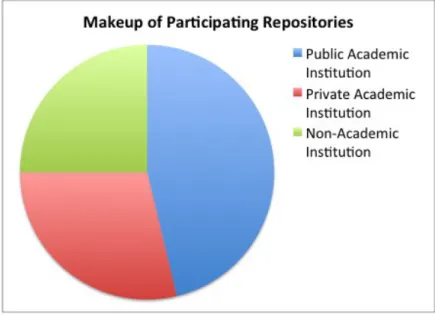
Figure 1: Composition of the sample
up of repositories whose parent organization is a public academic institution. The deeds of gift from 37 such repositories are analyzed. 23 deeds of gift are collected from repositories whose parent organizations are private academic institutions. Finally, 20
deeds of gift are collected from repositories that either have no parent institutions, or whose parent institution is a non-academic organization. Repositories falling into this
third category include community libraries that collect manuscript materials, historical societies, museums, and collecting repositories focusing on a single subject. What resulted is a convenience sample, which “relies on the selection of readily available
units” (Neuendorf, 2002, p. 87). Given the varied makeup of the archival profession coupled with its lack of an official governing body, however, a convenience sample was
judged as sufficient. Steps were taken in order to mitigate the effects of the convenience sample. For example, repositories were contacted from each state in the United States. Close to 200 repositories were contacted in order to build as large a data set as possible.
The concepts outlined in 1.7 (above) formed the basis of the codebook (see Appendix B). In addition to the concepts from the AIMS and PARADIGM projects, the
codebook included other measures:
• whether the deed mentions digital materials;
• whether the deed distinguishes between born-digital objects and materials
digitized from analog originals;
• whether the deed includes blanket statements regarding archival procedure (e.g.,
standard archival practice);
• whether the deed includes a user guide explaining concepts in natural language;
A code form was created as a spreadsheet. Each deed of gift received a number, and these numbers were listed along the leftmost column of the code form. Each of the concepts was listed along the top of the code form. When examining a deed of gift, the
presence of each concept, or answering yes to a particular question was marked with a 1, while the concept's absence or no answer was marked with a 0. All data collected was
treated as nominal with the exception of word count. Because most data was treated as nominal, any statistical tests performed needed to account for that. Calculations of correlation used the point-biserial correlation coefficient (rpb), which allows for fitting
nominal to quantitative data. 12 deeds of gift selected at random (15% of the sample) were coded by a second coder in order to determine a measure of intercoder reliability.
These results were then compared to those of the first set and Cohen's kappa (κ) values were calculated for each concept. Cohen's kappa was chosen because “it assumes nominal level data “ Neuendorf, 2004, p. 150) and calculates reliability beyond chance.
The formula for kappa is:
κ = (PAO – PAE) / (1- PAE)
Where, PAO equals proportion agreement, observed and PAE equals proportion agreement,
3 Findings
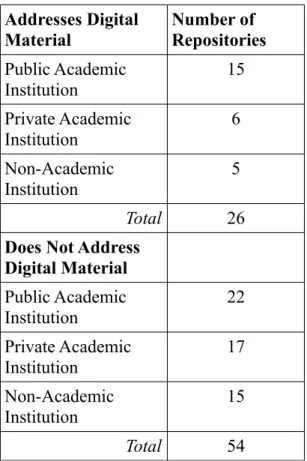
Table 1: Number of Repositories Addressing Digital Materials by Category
Addresses Digital
Material Number of Repositories
Public Academic Institution 15 Private Academic Institution 6 Non-Academic Institution 5 Total 26
Does Not Address Digital Material Public Academic Institution 22 Private Academic Institution 17 Non-Academic Institution 15 Total 54
3.1 General Findings and Digital Materials in Brief
Nearly one third (32.5%) of the deeds of gift addresses digital materials
somewhere in at least one section of the deed (table 1). 17 repositories whose deeds of gift address digital materials (65.3%) do so in reference to allowing users access via the
Internet. Similarly, 15 repositories (57.7%) that do address digital materials also address digital preservation activities. If a repository includes language directly aimed at digital materials in the deed of gift, language is most likely directed at either access to digital
materials or in reference to digital preservation activities.
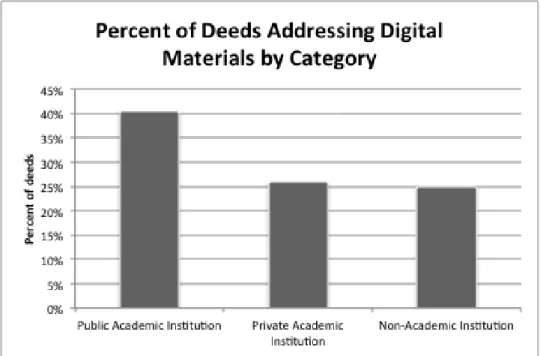
(Fig. 2). 40.5% of repositories within publicly-funded academic institutions address digital materials in their deeds of gift, compared to 26.1% and 25% in privately-funded academic and non-academic organizations, respectively.
Figure 2: Percent of deeds addressing digital materials by repository category
One repository includes language specifically addressing the proportion of digital
materials to physical materials in a prospective donation; however, each deed in the sample includes either space within the deed for the donor to list the materials donated or asked the donor to include an inventory as attachment to the deed. Although these
inventories never specifically mention digital objects as part of this inventory, it may be assumed that an inventory could include an enumeration of the digital objects to be
donated.
Half of repositories' deeds of gift contain language pertaining to preservation activities (n=37, or 46.3%). Preservation activities refers to both the activities of
language in each deed of gift explicitly lays out the property and intellectual rights of the donor and the repository with respect to the donated materials. This is unsurprising, as the traditional role of the deed of gift is to record the legal transfer of archival materials.
Blanket statements are phrases employed as proxy for specific language. For example, deed 03 notes materials donated are “subject to standard archival practice and
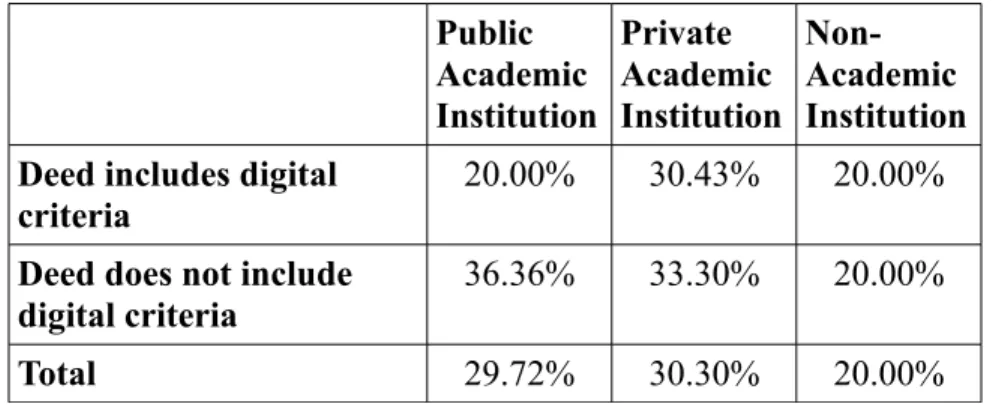
procedures,” whereas deed 40 employs the phrase “the performance of normal archival work,” and deed 63 includes the phrase “according to accepted archival principles.” Among deeds that make no reference to digital materials, 29.6% (n=16) include blanket
statements. The study attempts to show that collecting repositories use blanket statements to cover born-digital objects. Although the present data are too varied to draw
conclusions in this regard (table 2), further research regarding general statements in place of specific criteria may be fruitful.
Table 2: Percentage of deeds containing blanket statements of archival practice.
Public Academic Institution Private Academic Institution Non-Academic Institution Deed includes digital
criteria 20.00% 30.43% 20.00%
Deed does not include digital criteria
36.36% 33.30% 20.00%
Total 29.72% 30.30% 20.00%
3.2 The Distinction Between Born-Digital Objects and Digitized Materials
Of the repositories whose donor agreements address digital materials, only five deeds (19.2% of deeds addressing digital materials, 6.3% of total sample) distinguish
and the capture of digital objects and will be discussed in the appropriate sections below.
Figure 3 (left):Repositories that address digital materials and distinguish between born-digital and digitized objects.
Figure 4 (right): Repositories that distinguish between born-digital and digitized objects (all repositories)
The relative dearth of language relating specifically to born-digital objects shows that repositories do not consider the challenges posed by born-digital objects—
specifically, the differences between born-digital objects and materials with a physical backup. Despite this, there are some areas related to born-digital objects that receive more attention than others. Findings related to digital preservation, the capture of
born-digital objects, and access to them reflect the unbalanced focus present in the deeds gift.
3.3 Digital Preservation
materials to appear in a repository's deed of gift, appearing in 57.7% of deeds that address any issue related to digital materials, and 18.8% of the entire sample. When comparing deeds of gift that address digital preservation with deeds of gift that also distinguish
between born-digital objects and digitized material (Table 3), the focus on digital
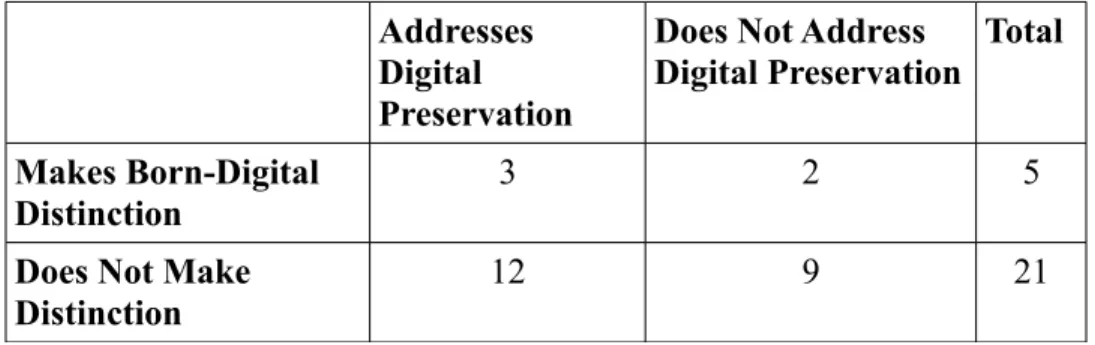
preservation becomes clear. Of the 15 deeds that mention digital preservation, only three
also specifically mention born-digital objects.
Table 3: Count of Deeds Addressing Digital Preservation and Born-Digital Objects
Addresses Digital Preservation
Does Not Address
Digital Preservation Total
Makes Born-Digital Distinction
3 2 5
Does Not Make Distinction
12 9 21
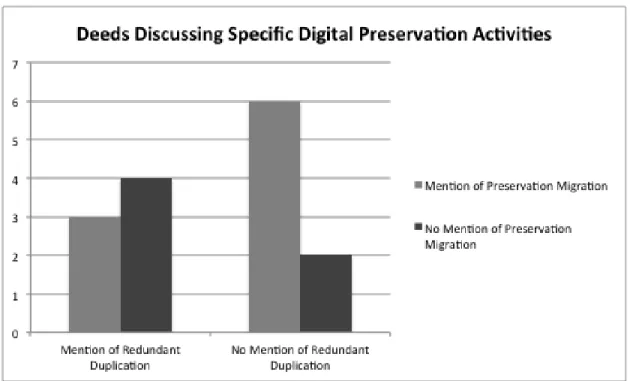
The analysis also looked for evidence of specific digital preservation activities (Fig. 5). The analysis coded for three activities: the migration of digital materials for
preservation purposes, the redundant duplication of digital objects across multiple storage systems, and preservation fixity checks. Preservation migration is the act of changing a
computer file format to a different file format while still maintaining its essential and unique properties. An example is reformatting a file created in Microsoft Word (.doc file extension) into a portable document format (.pdf file extension) because it is assumed a
PDF will remain readable by more computer systems for longer. Redundant duplication of digital objects across multiple storage systems hedges agains media failure.
redundant duplication, on the other hand, are present in almost equal measures. Of the 15 deeds that address digital preservation, seven (46.7%) discuss redundant duplication and nine (60%) discuss preservation migration. Three deeds mention both activities, while
two discuss digital preservation as a general concept but do not make reference to any specific digital preservation practice.
Figure 5: Discussion of specific digital preservation activities in deeds of gift
The number of deeds discussing digital preservation was also compared with the number of deeds that mention preservation more generally (Fig. 6). 37 deeds of gift
Figure 6: Deeds Addressing Preservation Activities and Digital Preservation Activities
3.4 Capture of Digital Objects
There are myriad ways in which born-digital objects might be created. Some
software applications create a single file that can be considered a standalone, identifiable unit (e.g. word processing software). Other applications create a series of related files that must be viewed in aggregate to be considered a unit. Given the various environments in
which digital objects can be created, manipulated, and stored, and considering the pace at which new technologies are developed, it is unsurprising that numerous ways exist in
which to capture digital objects. One simple way might be to copy a file from a CD-ROM and copy it to a repository staff member's local computer. Alternately, a repository's workflow might package a number of digital objects together. Further still, a repository
capture method is, and so the study looked for provisions in the deed of gift related to the capture of digital objects. Three deeds of gift address the capture of digital objects. While this is a low number, these also made up three of the five deeds that make the distinction
between born-digital objects and digital objects generated from physical materials, hinting at a consistency regarding born-digital objects that may yet emerge in future
research. In addition, two of the three specifically discuss the method by which capture will take place. None of the three, however, address the method of reporting a successful capture, nor the technical requirements of the capture method.
3.5 Access to Digital Objects
As mentioned above, access to digital objects is the most common concept related to digital materials present in the deeds of gift. 17 of deeds that address digital materials (65.3%) include reference to methods of access for digital objects, mainly discussing the
right of the repository to make materials available via the Internet. Of the five deeds that distinguish between digitized content and born-digital objects, four discuss access to
digital material. As with the capture of digital objects (3.4) above, there is a level of consistency among the repositories whose deeds of gift distinguish between categories of digital objects.
The study also looked at the overlap between the two most common criteria related to digital materials (Fig. 6), comparing access to digital materials to the
that address digital materials make no mention of either digital preservation or access to digital materials.
3.6 Deed Length and User Guide
Eight repositories (10.0% of total sample) include additional guides for potential
donors as part of their deed of gift. These guides translate legal concepts into natural language and explain options available to donors. In addition, five of the eight repositories also address digital materials in their deeds of gift (19.2% of deeds
discussing digital materials). Three deeds including a guide for potential donors also distinguish between born-digital objects and other types of digital material (60.0% of
deeds specifically discussing born-digital objects).
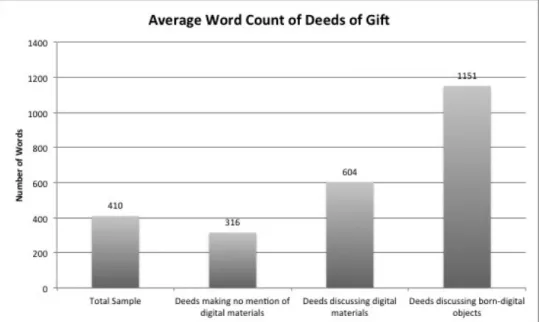
The study also performed a word count on the deeds of gift (Fig. 7). For the entire sample (n=80) the average deed is 410 words long. Of deeds that do not address digital
materials (n=54),the average length is 316 words. Of the deeds that address digital materials (n=26), the average length is 604 words. Of deeds that address specifically
Figure 7: Average Word Count of Deeds of Gift
Correlations between individual concepts and a deed's word count (Table 4) show relationships of weak to moderate strength. In this study, with a sample size of 80 deeds (n=80) a correlation of 0.20 or more is judged statistically significant (Lowry, 2012,
Chapter 4). All but one of the concepts boast a rpb greater than 0.20. The two weakest relationships are the concept explicitly stating the proportion of born-digital objects to
physical materials in the donation and discussing the creation of preservation and technical metadata; each concept only appeared in one deed of gift. The point-biserial correlations suggest that repositories that use longer deeds of gift are more likely to
discuss concepts related both to digital materials and born-digital objects in specific. Since some concepts appear rarely, the generalizability of those relationships is limited.
Table 4: Relationship Between Individual Concepts and Deed Word Length
Concept Point-Biserial
Correlation Coefficient (rpb)
Deeds Including Concept
Addresses Digital Material 0.37 26
Distinguishes between born-digital and other digital objects
0.53 5
Specifies the proportion of born-digital
objects to other materials in donation 0.03 1
Discusses preservation activities 0.42 37
Discusses digital preservation activities 0.45 15
Repository has official copy 0.54 3
Discusses creation of metadata 0.26 1
Discusses method of capture 0.64 3
Discusses access to digital materials 0.48 17
3.7 Official Research Copy and Metadata
Two final categories of criteria related to born-digital objects are almost entirely
ignored by the deeds analyzed. Three deeds of gift contain a statement making explicit the repository's status as holder of the official research copy of digital materials. Of the three, two do not distinguish between born-digital objects and digitized content.
Language clearly stating the repository as the official research location of the materials is less important when the donor turns over the originals. When the capture of digital
objects entails creating a copy of the materials instead of taking physical control of the original computer itself, the importance of a statement designating the repository as the copy of record is apparent.
One deed of gift contains language regarding the creation of metadata required for the long-term administration of digital objects. While this deed is one that distinguishes
ascribing copyright of metadata to the repository. However, since much of the language in each deed of gift regards the transfer of copyright from donor to repository,
repositories might consider their existing language regarding property rights sufficient.
3.8 Intercoder Reliability
Table 5: Intercoder reliability reported as observed proportion agreement and calculated Cohen's kappa
Concept Proportion Agreement κ
Digital criteria 1.00 1.00
Distinguishes between born-digital and other digital objects
0.92 0.62
Specifies the proportion of born-digital objects to other materials in donation
1.00 N/A
Discusses preservation activities 0.92 0.83
Discusses digital preservation activities 0.92 0.62
Discusses preservation migration 1.00 1.00
Discusses preservation fixity 1.00 N/A
Discusses preservation duplication 0.83 -0.09
Repository has official copy 1.00 N/A
Discusses creation of metadata 0.83 0.00
Discusses capture of born-digital objects 1.00 N/A
Discusses access to digital materials 0.92 0.75
Employs blanket terms 0.92 0.62
After initial coding, 15% of the sample selected at random were coded by a
second coder. Those results were compared, with observed proportion agreement as well as Cohen's kappa values presented (Table 5). Raw proportion agreement, for all concepts,
chance. Kappa values reflected fair to strong agreement beyond chance for seven categories. Of the remaining six concepts, two of these—whether or not the deed of gift discusses preservation duplication and the creation of technical and preservation metadata
—reflected weak agreement beyond chance. These may result from error on the part of the primary coder or a codebook that was unclear to the secondary coder. In the other
cases, despite perfect agreement, kappa values were not assigned. This was due to the nonexistent observation by either coder of those concepts for the 15% subset. For these concepts, perfect observed agreement was counteracted by an perfect expected chance
4. Discussion
Less than one third of repositories address digital materials at all and fewer single out issues related to born-digital objects in their deeds of gift. One potential reason for
not addressing digital materials in a repository's deed of gift is a lack of consistency in practice across the archival profession. While the specifics of acquisition, arrangement
and description, and access vary from repository to repository with regard to materials, the broader concepts behind them have remained stable over the last fifty years. The appraisal, acquisition, and documentation of born-digital objects, on the other hand, still
lack widespread agreement in the field. The PARADIGM and AIMS projects have much in common in their attempts to make recommendations regarding the inclusion of
born-digital objects in collecting repositories, but neither have yet resulted in comprehensive standards issued or adopted by the Society of American Archivists.
Even were a standard or best practice to reach near-universal acceptance,
institutional policy is often slow to adapt. In larger institutions, this may result from the number of stakeholders involved in redrafting the deed of gift. In addition to librarians,
archivists, and curators, changing policy with respect to a legal agreement potentially involves high level administration or legal counsel as well, all of which may complicate reaching consensus and slow the editing and approval process. Smaller institutions might
lack the staff, technical expertise, or legal knowledge to comprehensively adapt current deeds of gift into a document more capable of addressing born-digital objects.
currently in the process of assessing donor policy and deed of gift with intention to update as necessary. For this reason, it would be interesting to conduct this or a similar study in the future and gauge how much practice has changed in the interim.
There are several items of note regarding the findings. First, although no single category of collecting repository overwhelmingly address digital materials, repositories
attached to publicly-funded academic institutions address digital materials more frequently than those attached by either privately-funded academic institutions or non-academic institutions by a significant margin—40.5% of publicly-funded non-academic
institutions versus 26.1% and 25% of privately-funded academic and non-academic organizations, respectively. Although privately-funded academic institutions may be
better-funded than their public counterparts, it is clear this has little to do with the policies in place at particular institutions. The surprising aspect of this statistic is that privately-funded academic institutions and non-academic organizations address digital
materials at a near-equal rate. Public institutions often must deal with public records, and may be more attuned to the unique nature of born-digital objects than their private
counterparts. The present data do not allow a more specific conclusion in this regard. The use of fixity checks is widely advised as a method of ensuring that a digital object remains unchanged over time. Dollar (2000) recommends the calculation of
checksums to ensure authenticity when reformatting and copying digital materials (p. 103-106). Novak (2006) notes although calculating checksums is the “simplest and least
Similarly, statements regarding the creation of technical or preservation metadata as well as the methods of capturing born-digital objects are almost entirely absent in the deeds analyzed. Perhaps archivists are wary of including too technical of language in deeds of
gift for fear of confusing potential donors. Many deeds, however, employ legalistic language in their discussion of intellectual and other property rights. Additionally, eight
repositories (10.0%) include a user guide along with their donor agreements. These user guides translate the legal rights statements into natural language and explain options available to the donor. There is no reason why the same could not be done for fixity
checks, statements regarding the creation of metadata, and other concepts related to born-digital objects that may appear too technical. One repository attached a born-born-digital
collection policy, but it appears from the tone that the document is intended for an internal audience.
There is tension between the desire to keep a repository's deed of gift short and
simple and the desire to be detailed and explicit. Hirtle, Kenney, and Ruttenberg (2012) found concern among some research libraries “that legalistic documents may intimidate
possible donors and so [librarians] prefer documents that are as simple as possible... [while] others favor a document that is very explicit in laying out rights and
responsibilities” (p. 2). It is unlikely that the two ideas will be completely rectified,
although drafting a user guide or sharing internal policy with prospective donors would allow the signed agreement to remain simple while still allowing the repository to have
an informed discussion with donors.
specifically digital preservation. Some deeds address digital preservation but make no mention of specific digital preservation activities. Reasons for this are unclear; perhaps archivists hope to refer to general statements in the course of responding to unforeseen
events. Since the deed of gift is meant to be a clear statement of rights and responsibilities, however, specific statements are preferable.
The most commonly included concept regarding digital materials was a statement regarding the provision of access. This reinforces one of the archival profession's core tenets: providing all patrons with equitable access to materials. As information literacy
and access to the Internet continues to rise, research increasingly shifts from the traditional reading room to remote web-based methods. It is promising that archivists
have recognized the trend and are actively working toward providing electronic access to materials. Similarly, the relatively high rate of inclusion regarding digital preservation measures indicate that focus on the theory and practice of digital preservation initiatives
5. Current Limitations and Future Research Potential
As discussed above, the sample of deeds gathered is in no way a random sample. Since repositories are not likely to share their deeds of gift publicly online, sending
individual requests was the next best tact. Abraham's list of repositories of primary sources is vast, but it is also divided by location as opposed to repository type, further
hindering the ability to adequately represent repositories of different focus. Issues of time result in a sample smaller than is desirable. The codebook, while clear and concise for the primary coder, may be unclear for additional coders, particularly if secondary coders are
unfamiliar with digital preservation terminology and concepts. Repeating the study with a larger sample would produce more generalizable results, particularly with respect to the
correlations between word count and presence of specific concepts. Because some concepts occur in only a few instances, the present statistical findings can not be seen as definitive. Requiring each coder to code the entire sample instead of a subset may result
in a more accurate report of intercoder reliability.
The units of analysis in the study are template deeds of gift. Since every donation
is unique, repositories usually customize their document to each particular situation. It is possible, then, that an archivist may add language specific to digital materials as they arise. Specifically addressing born-digital objects in the deeds of gift is important enough
that language related to born-digital objects should be included in every donation, particularly as born-digital objects increasingly supplant their analog corollaries in
everyday use.
degrees of specificity with respect to intellectual and property rights, although the variety in word count suggests that some repositories are more detailed than others. A future study may investigate how specific a deed is toward copyright with how specific its
language is regarding born-digital objects.
As mentioned throughout, there is much room for further research in the area of
donor policy and relations. A similar study conducted in the future would help establish the rate of development with regard to deeds of gift. Further, if results are similar in a few years time, it could serve as a stronger call for action. Research as to the use of general or
blanket statements to stand in for more specific criteria may yield interesting results. Such work would entail surveys or structured interviews with archivists and legal counsel
regarding the process by which deeds of gift are drafted and approved. Interviews with archivists would also provide insight into what issues and values most inform a
repository's deed of gift.
The low proportion of repositories who address born-digital repositories in their deeds of gift is not entirely unexpected. Davis (2008, p. 177) found that 47% of
respondents to a survey of collecting repositories at the time accepting born-digital objects, with an additional 22% reporting that having plans to do so. The same study also reported that 76% of collecting repositories do not have a policy in place for the
acquisition of born-digital objects. The present study only evaluates the deed of gift and not the repository's broader policies, so these findings cannot prove growth in this area.
6. Conclusion
If collecting repositories are to adequately serve their various constituents— including patrons, donors, archivists, and administrators—deeds of gift currently in use
need to be updated. Less than half of deeds analyzed as part of this study address digital materials, and of these, few specifically address born-digital objects. In some ways, this
is unsurprising, but given digital technologies increasing usage, it is untenable for repositories to disregard digital objects in their legal agreements with donors. Standards regarding digital objects will emerge as best practice recommendations and evaluated
further, but the standardizing process take time. The rapid pace of technological
development leave repositories' current practice inadequate in the face of the amount of
digital materials on the horizon over the next decade. The creation of explanative guides for prospective donors is one way in which a repository might discuss technical concepts with donors unfamiliar with the issues inherent to including born-digital objects in
References
Abraham, T. (2012, June). Repositories of Primary Sources. Retrieved May 1, 2012 from http://www.uiweb.uidaho.edu/special-collections/Other.Repositories.html An Inter-institutional Model for Stewardship Work Group. (2010). AIMS born-digital
collections: An inter-institutional model for stewardship. Retrieved from http://www2.lib.virginia.edu/aims/whitepaper/AIMS_final.pdf
Banerjee, M., Capozzoli, M., McSweeney, L., & Sinha, D. (1999). Beyond kappa: A review of interrater agreement measures. The Canadian Journal of Statistics, 27(1), 3-23.
Chan, P., Gueguen, G., Matienzo, M. A., & Wilson, S. (2012, June 7). Born-digital collections: An inter-institutional model for stewardship (AIMS). In Association of College and Research Libraries Digital Curation Interest Group (Producers), Conversations with... series. Webinar retrieved from
http://connect.ala.org/node/132171 June 29, 2012.
Cunningham, A. (1994). The archival management of personal records in electronic form: Some suggestions. Archives and Manuscripts, 22(1), 94-105.
Danielson, E. S. (2010). The ethical archivist. Chicago: Society of American Archivists.
Davis, S. E. (2008). Electronic records planning in 'collecting' repositories. The American Archivist, 71(1), 167-189.
Dollar, C. M. (1999). Authentic electronic records: Strategies for long-term access. Chicago: Cohasset Associates.
Ham. F. G. (2005). Accessioning—transferring records to the custody of the archival repository. In F. Boles, Selecting & appraising archives & manuscript (pp. 137-148). Chicago: Society of American Archivists. (Original work published in 1993) Hedstrom, M. (1998). Digital preservation: A time bomb for digital libraries.
Computers and Humanities, 31(3), 189-202.
Hirtle, P. B., Kenney, A. R., & Ruttenberg, J. (2012). Digitization of special collections and archives: Legal and contractual issues. Research Library Issues, 279, 1-3. Jenkinson, H. (1966). A manual of archival administration. London: Percy Lund,
Humphries & Co.
John. J. L. (2008). Adapting existing technologies for digitally archiving personal lives: Digital forensics, ancestral computing, and evolutionary perspectives and tools. In Proceedings of iPres 2008: The fifth international conference on preservation of digital objects (pp. 48-55). London: The British Library.
John. J. L., Rowlands, I., Williams, P., & Dean, K. (2010). Digital lives: Personal digital archives for the 21st century—an initial synthesis. London: The British
Library.
environments. In Proceedings of iPres2009: The sixth international conference on preservation of digital objects (pp. 105-112). Oakland, CA: California Digital Library.
Kirschenbuam, M. G., Ovenden, R., & Redwine, G. (2010). Digital forensics and born-digital content in cultural heritage collections. Washington: Council on Library and Information Resources.
Lee, C. A. (2010a). Computer-supported elicitation of curatorial intent. In Chanod, J., Casarosa, V., Dobreva, M., & Rauber, A. (eds.), Dagstuhl seminar proceedings 10291: Automation in digital preservation. Dagstuhl, Germany: Schloss Dagstuhl —Leibniz-Zentrum fuer Informatik.
Lee, C. A. (2010b). Donor agreements. In Kirschenbaum, M.G., Ovenden, R., & Redwine, G., Digital forensics and born-digital content in cultural heritage collections (p. 57). Washington: Council on Library and Information Resources. Lowry, R. (2012). A first glance at the question of statistical significance. In Concepts
and Applications of Inferential Statistics. Retrieved from http://vassarstats.net/textbook/ch4pt1.html
Muller, S., Feith, J. A., & Fruin, R. (2003). Manual for the arrangement and description of archives: Drawn up the by the direction of the Netherlands association of archivists (A. H. Leavitt, trans.). Chicago: Society of American Archivists. (Original work published 1898)
Neuendorf, K. A. (2002). The content analysis guidebook. Thousand Oaks, CA: Sage Publications, Inc.
Novak, A. (2006, November). Fixity checks: Checksums, message digests, and digital signatures. Retrieved from
http://www.library.yale.edu/iac/DPC/AN_DPC_FixityChecksFinal11.pdf
Pearce-Moses, R. (2005). A glossary of archival and records terminology. Chicago: Society of American Archivists.
Personal Archives Accessible in Digital Media. (2008). Donation and deposit agreements. In Workbook on Digital Private Papers. Retrieved from http://www.paradigm.ac.uk/workbook/record-creators/agreements.html
Peterson, G. M., & Peterson, T. H. (1985). Archives & manuscripts: Law. Chicago: Society of American Archivists.
Redwine, G. (2010). Archives and 'the archive': The computer as archival object. In Proceedings of Digital Humanities 2010 conference abstracts (pp. 74-76). London: King's College London.
Rothenberg, J. (1999). Ensuring the longevity of digital information. Retrieved from http://www.clir.org/pubs/archives/ensuring.pdf/view
Schellenberg, T. R. (1984). The appraisal of modern public records. M. F. Daniels & T. Walch (Eds.), A modern archives reader: Basic readings on archival theory and practice (pp. 57-70). Washington: National Archives and Records Service, U.S. General Services Administration. (Original work published in 1956).
Society of American Archivists Council. (2011, May). Core values of archivists. Retrieved from http://www2.archivists.org/statements/saa-core-values-statement-and-code-of-ethics#core_values
international perspective conference proceedings (pp. 4-31). Washington: Council on Library and Information Resources.
Appendix A:Request to Repositories
Dear archivist:
I am conducting research regarding the factors shaping the donor agreements and deeds of gift of archival repositories with respect to born-digital objects. The research will be used as the basis for a master's paper for the degree of Master of Science in Library Science at the University of North Carolina at Chapel Hill. Professor Cal Lee is acting as my advisor on this project. I am contacting you to request your institution's assistance.
Much of the recent professional discussion regarding born-digital materials has revolved around the issues of long-term digital preservation. In addition to the challenges of preservation, the differences between traditional physical materials and their digital counterparts pose issues for donor outreach and relations. Recent collaborative projects (e.g. Born-Digital Collections: An Inter-Institutional Model for Stewardship [AIMS] 2011) and reports (e.g. the Council on Library and Information Resources report on Digital Forensics and Born-Digital Content in Cultural Heritage Collections 2010) have made recommendations for how to craft donor policy to better handle born-digital
objects, but there is a lack of information regarding what the donor agreements and deeds of gift currently in use address. It is this question I hope to explore through a latent content analysis of sample, template, and blank donor agreements and deeds of gift collected from collecting manuscript repositories.
Specifically, I am asking that you send a copy of your repository's template or blank donor agreement to me for use in my project, where it will serve as the unit of analysis. This research is voluntary, and seeks no personal or identifying information. All data will be anonymized, and no reference to your specific institution will be included in the resulting paper. All responses are anonymous and confidential. I understand that specific agreements are often individualized for each situation, but by analyzing the contents of basic agreements, I hope to draw general conclusions as to the current state of the archival profession regarding donor policy and electronic materials.
I hope that you agree to participate by sending your repository's template donor agreement. If you have additional questions that you want answered before making a decision, you may contact me at the above phone number or email address.
Thank you for considering this request.
Matthew Farrell
Candidate for MSLS 2012
Appendix B: Codebook
1) Deed ID: The identification number assigned to each deed of gift
2) Repository Category: Indicate the category of repository from the list below. 1. Academic Library - Public - The repository's parent institution is a publicly-funded academic library. Example: special collections branch of the University of North Carolina at Chapel Hill Libraries
2. Academic Library - Private - The repository's parent institution is a privately-funded academic library. Example: Rare Books & Manuscripts Library of Emory University
3. Museum/Historical Society/ non-profit archive/community library - The repository is not attached to an academic library.
3) Digital Criteria: Indicate whether digital materials are specifically mentioned. Also acceptable are statements regarding format that include terms such as electronic, computer-generated, and the like.
1. Yes 0. No
4) Distinction: Indicate whether distinction is made between born-digital objects and digital reproductions of physical materials
1. Yes 0. No
5) Proportion: Indicate whether space exists to specify the proportion of the donation made up of born-digital objects.
1. Yes 0. No
6) Preservation Activities: Indicate whether a statement exists regarding the preservation of materials.
1. Yes 0. No
7) Digital Preservation Activities: Indicate whether the permission to perform digital preservation actions is granted.
1. Yes 0. No
8) Media Refreshing or Migration: If yes to the 7, indicate whether media refreshing or migration are specifically mentioned.
9) Fixity Checks: If yes to 7, indicate whether fixity checks are specifically mentioned 1. Yes
0. No
10) Duplication to ensure redundancy: If yes to 7, indicate whether redundant duplication is specifically mentioned.
1. Yes 0. No
11) Official Copy: Indicate whether a statement establishing the repository as the holder of official research copy of all digital objects.
1. Yes 0. No
12) Metadata: Indicate whether a statement regarding the creation of metadata required for long-term preservation exists.
1. Yes 0. No
13) Metadata Copyright: If yes to 12, indicate whether a statement of copyright regarding any generated metadata exists.
1. Yes 0. No
14) Capture: Indicate whether arrangement for the transfer or capture of born-digital materials is made in the agreement.
1. Yes 0. No
15) Capture Reporting: If yes to 14, indicate whether a statement exists that document how successful capture of born-digital materials will be reported.
1. Yes 0. No
16) Capture Method: If yes to 14, indicate whether the method of capturing born-digital materials is described.
1. Yes 0. No
17) Capture Method Requirements: If yes to 14, indicate whether the description includes technical requirements of the capture method. Example: The repository uses software incompatible with the Mac OS.
1. Yes 0. No
outlined with specific respect to digital materials. 1. Yes
0. No
19) Blanket Terms: Indicate whether the agreement includes statements referring to archival practices in general. This may include phrases such as "subject to standard archival practices and procedures" that may be used to apply to concepts not specifically included in the document.
1. Yes 0. No
20) Word Count: Count the number of words in the deed of gift.
21) User Guide: Indicate whether the agreement includes an attached guide for the user. This guide may explain legal terms or concepts in plain language, offer the range of choices a potential donor has, or otherwise explain the purpose of the deed.