Elizabeth Brooke Guthrie. Special Collections Instruction and the Undergraduate Student: A Study of the Wilson Special Collections Library’s Collaboration with the Introductory English Program at the University of North Carolina at Chapel Hill. A Master’s Paper for the M.S. in L.S degree. July, 2015. 68 pages. Advisor: Helen Tibbo. This study presents the results of a survey distributed to first-year undergraduate students at the University of North Carolina at Chapel Hill. The survey examined instruction offered at the University of North Carolina at Chapel Hill’s Louis Round Wilson Special Collections Library to undergraduate students during the spring semester of 2015. Focusing on first-year undergraduates enrolled in the University’s required introductory English course, the survey collected information about the student experience in special collections instruction and the impact of instruction on the ability of undergraduates to conduct research at Wilson Library. The survey produced thirty-five responses and revealed that students, while largely unfamiliar with special collections research, found the instruction session useful and relevant to their immediate needs. Survey responses also revealed a number of challenges faced by both students and library instructional staff and suggest that future instruction may benefit from changes in practice.
Headings:
Libraries—Special collections
Bibliographic instruction—College and university students Library instruction
SPECIAL COLLECTIONS INSTRUCTION AND THE UNDERGRADUATE STUDENT: A STUDY OF THE WILSON SPECIAL COLLECTIONS LIBRARY’S COLLABORATION WITH THE INTRODUCTORY ENGLISH PROGRAM AT THE
UNIVERSITY OF NORTH CAROLINA AT CHAPEL HILL
by
Elizabeth Brooke Guthrie
A Master’s paper submitted to the faculty of the School of Information and Library Science of the University of North Carolina at Chapel Hill
in partial fulfillment of the requirements for the degree of Master of Science in
Library Science.
Chapel Hill, North Carolina July 2015
Approved by
Table of Contents
Introduction 3
Literature Review 8
General Library Instruction and the Undergraduate Student 8 Library Instruction in Special Collections and Archives 12
Methodology 22
Instrument 22
Recruitment and Survey Distribution 26
Description of the Classes 28
Limitations 29
Results and Analysis 31
Discussion 52
Bibliography 57
Appendix A: Student Survey 62
Appendix B: Faculty Recruitment Letter 64
Figures
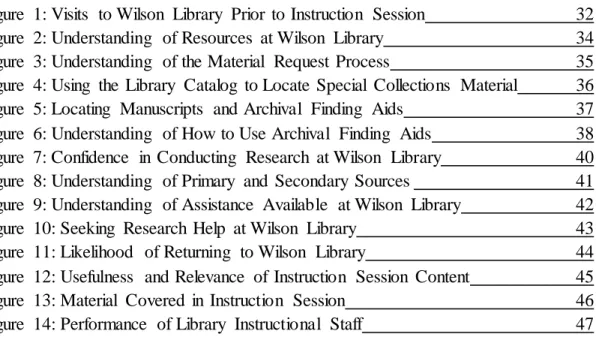
Figure 1: Visits to Wilson Library Prior to Instruction Session 32 Figure 2: Understanding of Resources at Wilson Library 34 Figure 3: Understanding of the Material Request Process 35 Figure 4: Using the Library Catalog to Locate Special Collections Material 36 Figure 5: Locating Manuscripts and Archival Finding Aids 37 Figure 6: Understanding of How to Use Archival Finding Aids 38 Figure 7: Confidence in Conducting Research at Wilson Library 40 Figure 8: Understanding of Primary and Secondary Sources 41 Figure 9: Understanding of Assistance Available at Wilson Library 42 Figure 10: Seeking Research Help at Wilson Library 43 Figure 11: Likelihood of Returning to Wilson Library 44 Figure 12: Usefulness and Relevance of Instruction Session Content 45 Figure 13: Material Covered in Instruction Session 46 Figure 14: Performance of Library Instructional Staff 47
Tables
Introduction
In recent decades, academic libraries have increasingly started to view student instruction as an integral part of a larger institutional mission. Teaching members of the campus community to effectively locate and critically analyze relevant information is a goal that librarians, faculty, and students generally agree is worthwhile and necessary, particularly at a time when the information available online and elsewhere is growing. As recently as twenty years ago, instruction efforts focused on faculty and graduate students rather than a university’s much larger and much less experienced undergraduate
population. Current trends have shifted the instruction spotlight toward undergraduate students and their particular information needs. Library instruction, especially that tailored to a younger audience, is generally associated with main campus libraries and general reference staff, but special collections libraries and archives are investing more time and resources in undergraduate instruction initiatives. In particular, librarians working in the special collections environment are making efforts to connect with undergraduates in the earliest stages of their college careers.
Librarians at the University of North Carolina at Chapel Hill have embraced these recent trends. Research and instructional services staff across the campus library system connect with undergraduate course instructors in a range of academic departments and conduct instruction sessions throughout the school year. In the past decade, special
particularly notable example of such an initiative is the libraries’ collaboration with the introductory English program at UNC. Beginning in the fall of 2012, all undergraduate students entering UNC were required to enroll in and pass a section of English 105 during their first year in order to graduate. Designed for first-year college students, the English 105 course is intended to give undergraduates a foundation on which to build the rest of their academic and professional careers. According to the program’s faculty coordinator, the course is “designed to give students practice in many of the skills and techniques that professional researchers use to collect, organize, analyze, and present their research findings.” Aimed primarily at students just out of high school, the goal of the English 105 course is to “usefully extend students’ prior preparation” in academic research and writing and prepare new undergraduates for high level college courses across disciplines (Carolina Undergraduate Admissions, 2012). The course is taught throughout the school year in sections of around twenty students each. In the fall of 2014, approximately 170 sections of the course were taught.
collections library and its primary archival repository, has formed a strong relationship with the English 105 program over the past three years. This relationship has allowed instructional staff at Wilson Library to reach a large number of undergraduates that have little or no experience with the special collections library.
Wilson Special Collections Library has much to offer to a course focused on building the skills necessary for college-level research and writing. Home to five major collections, the North Carolina Collection, the Southern Historical Collection, the Rare Book Collection, the Southern Folklife Collection, and University Archives, Wilson Library is a rich resource for researchers and for instructors hoping to integrate primary source research and analysis into their curriculum. Wilson Library’s Research and
Instructional Services Department coordinates instruction and integrates material from all of the collections into the sessions held for students. Individual English 105 sections generally attend a single instruction session with a small group of instructors returning to allow students to conduct research during class time.
The Wilson Library instruction sessions, although they can vary in content depending on the topic of the class, largely follow a similar pattern. The librarian begins by welcoming the class to Wilson Library and describing the collections, the types of materials housed at the library, and policies related to using the rare and often fragile material. Students are then shown material related to their class topic and given time to interact with the material. If time allows, the librarian uses the final portion of the session to demonstrate how to search the library catalog for additional material at Wilson
students to relevant online resources such as digitized newspaper databases. The elements of a particular instruction session and the amount of time devoted to each are subject to significant time constraints. English 105 classes are, on average, 60 minutes in length. Many of the English 105 sections studied here were only able to devote 50 minutes to instruction at Wilson Library.
Reaching undergraduates, particularly first-year students, is an important, but often difficult task and instruction sessions are a key means of making this connection for Wilson Library staff. Using Wilson Library is a vastly different experience from using main campus libraries. The building itself is rather imposing and, for undergraduates whose knowledge of special collections and archival research is rudimentary at best, actually using its materials can be a potentially intimidating and confusing task. Materials often require special handling procedures, must be read in library reading rooms, and cannot be checked out. In addition, the nature of the materials and the task of locating relevant materials are generally unfamiliar to students just out of high school. Using manuscript materials, for instance, would require a student to locate and navigate a collection’s finding aid, something they are unlikely to have encountered before. The special context of Wilson Library means that instruction is crucial to getting new students to use the library’s collections in the present and laying a foundation for students to return in the future.
instruction and the fact that the number of sessions is expected to grow in the future, the effectiveness of Wilson Library undergraduate instruction and, in particular, that offered to English 105 classes, is a relatively unstudied area. The sessions are meant to introduce students to the research process at Wilson Library, but no formal analysis has been done to see if the library’s objectives and the objectives of the English 105 program are being achieved. Instruction sessions offer librarians a limited amount of time to interact with students and it is important that they make the best use of the time they are given. Librarians and English 105 instructors have a vested interest in ensuring that students learn useful skills from the instruction session. Do students feel prepared to conduct research after attending a session or are they still unsure of the resources available at Wilson Library? Do first-year students feel that the instruction session was relevant to their needs and offered a valuable experience? Are we teaching new undergraduates the skills they need now and planting the seeds for them to return in the future?
The purpose of the present study is to address these questions. In order to gather information on the student experience of special collections instruction and the impact of instruction on the ability of undergraduates to conduct research at Wilson Library, a brief electronic survey was administered to 5 sections of the English 105 class during the Spring 2015 semester. This paper analyzes the existing literature for undergraduate library instruction and the literature for instruction in the special collections environment, discusses the methods used to conduct the current study, and analyses the survey
Literature Review
General Library Instruction and the Undergraduate Student
The growing importance of library instruction at Wilson Library and at other academic institutions has been reflected in the scholarly literature on the subject. Academic researchers and practicing librarians have written extensively on general library instruction, instruction tailored to the needs of new undergraduates, and
instruction specific to the special collections environment. Instruction has long been an important library function, particularly in academic library settings. These sessions, often created with the needs of new users in mind, cover topics such as catalog searching, citation creation, and database use. Although now often associated with more modern, computer-based skills, instruction has a long history in American libraries. In the late nineteenth century, librarians articulated the primary goals of instruction, including the promotion of lifelong learning, helping library users to become independent researchers, and fostering the development of critical thinking skills, that can still be seen in today’s practices and in today’s concept of information literacy (Tucker, 1979; Tiefel, 1995, pg. 320). Later, in the twentieth century, libraries began to focus more heavily on teaching patrons how to locate and access library resources (Tiefel, 1995, pg. 322). However, the main audience of these early instruction efforts were university faculty and graduate students rather than the undergraduate population (Farber, 1999, pg. 172).
information resources with “teaching critical thinking skills to enable students to evaluate and select the best information for their needs (Tiefel, 1995, pg. 322-323). A survey of ARL members in the late 1980s demonstrated that instruction had become a core function of academic libraries. The survey also revealed the beginnings of a shift toward
instruction tailored to the needs of new students. At the time, over ninety percent of the institutions surveyed were conducting instruction sessions for new students (Chadley & Gavryck, 1989). Rather than teaching only general information literacy skills, librarians who conduct sessions for new students emphasized the importance of course-based library instruction and its ability to have a greater impact on student learning. Instructions sessions that are related to the topic of a particular class or, more specifically, an
assignment or other immediate research need, have long been argued within the
professional literature to be most effective means of teaching important library skills and “students are more likely to develop critical judgment through active learning strategies” (Kunkel, Weaver, & Cook, 1996, pg. 432; Tiefel, 1995, 324).
Responding to the increased focus on instruction in academic libraries, many researchers have sought to evaluate the impact of library instruction on students, particularly within the context of increasing library use and promoting information
instruction and a group of students who had not. She found that “library instruction sessions generally increased the number of visits students made to the library” and increased the students’ use of library resources in conducting research (Knott, 2008, pg. 50-51).
Looking beyond the growth in a library’s own statistics, researchers have also focused on the skills that students gain through these sessions as well as their satisfaction with library services as a way to measure the effectiveness of instruction. Empirical research in this area has often been devoted to skill assessment. David King and John Ory (1981) found that students who attend instruction sessions were better able to incorporate and accurately cite multiple types of sources in assignments. Mark Emmons and Wanda Martin (2002) assessed student research papers against a predetermined rubric and found that students who received library instruction tended to submit higher quality work. Rachel Wasserman’s 2013 master’s paper attempted to take a similar approach and used the Association of College and Research Libraries Information Literacy Competency Standards for Higher Education as a benchmark for instruction success. Wasserman
looked specifically at English courses offered to first-year students at UNC-Chapel Hill with required library instruction components. Unfortunately, her findings were hindered by the low survey response rate (Wasserman, 2013). In addition to skill assessments, researchers have frequently used satisfaction as a way to indicate the success of
Many researchers in this area have often focused on the experiences of new undergraduate students. Although most studies look at groups that include, but are not limited to, first-year students, some researchers, like Wasserman, have turned their attention to new undergraduates. Emmons and Martin’s rubric-based study evaluated students in introductory English classes at the University of New Mexico who attended the library’s general instruction program. After assessing research papers written by the students, the researchers found that instruction contributed to a greater awareness of sources available, the use of wider variety of sources in papers, and improved skills in searching and navigating in databases. Somewhat surprisingly, instruction did not seem to help students analyze and evaluate the sources they found or better relate them to their topic of choice (Emmons and Martin, 2002). Jeanine Mazak and Frank Manista (2000) similarly worked with first-year students at Michigan State University and emphasized the long-term benefits that instruction can bring. They noted that prior to instruction new undergraduates were not able to effectively utilize library resources and often moved forward without the research skills necessary for later coursework. By not obtaining these research skills early on, faculty teaching higher-level courses would have to backtrack and use valuable class time to teach these skills.
was specifically assigned for a class (Katte, 2002). Face-to-face instruction has the potential to address these problems and ensure that new students receive the information about the library that they need in order to succeed in their college careers.
Library Instruction in Special Collections and Archives
“basic conceptual knowledge” about how archival material is represented, described, and searched for is a necessary component of user education efforts (pg. 54).
The confusing nature of archival research has been echoed elsewhere in the literature. Christopher J. Prom’s (2004) study of user interactions with online finding aids found that individuals new to an archival setting had problems understanding the
hierarchical structure of finding aids. New users, like first-year undergraduates, required more time to find a relevant source than their more experiences counterparts. Novices also expected a finding aid to link to digital material from the collection. Wendy Scheir’s (2005) exploratory study of novice finding aid users reached similar conclusions. Scheir noted that a gap exists between what archivists think users understand and what users actually understand about archival research. Novice users are often frustrated, but, according to Scheir, this frustration can be reduced through simple user education. Doris Malkmus (2008), an archivist at Pennsylvania State University, reviewed the literature on undergraduate primary source use and concluded that this user group is generally
In addition to guiding students through the initial stages of the research process, scholars have also argued that special collections instruction can play an important role in addressing the problem of library or archival anxiety. Early studies, for instance C.A. Mellon in 1986, brought awareness to the idea that the majority of undergraduates experience anxiety the first time they have to use the library. Users new to archives can often experience a similar anxiety that can stem from not knowing where materials are located, lacking knowledge about how to begin research, and, more simply, intimidation from the size of the library and its unfamiliarity (Cleveland, 2004). Searching for information to use in daily life or locating books and journal articles in the library are activities that, unlike research in the archives, new undergraduates are generally accustomed to. This difference can lead to what one researcher in this area has termed “archival anxiety” (Johnson, 2006). For new students, archives are often not viewed as a welcoming place and, for many, the first step in using an archive is getting past the fear of the unknown. The often walled-off nature of an archive and its contrast with the usually bustling buildings that dominate college campuses can act as a psychological barrier to use for some. Students are initially put off by the security measures and use restrictions. However, once students receive an explanation of why these procedures are necessary, “archival anxiety” can quickly decrease (Johnson, 2006; Zhou, 2008; McCoy, 2010). Since librarians and archivists have limited contact with individual students, instruction sessions can play an important role in reducing anxiety and creating a welcoming environment for new students.
its ability to improve critical thinking skills and better engage students. Although
assessing the impact of an instruction session on a student’s critical thinking abilities is a difficult task and one that only a few researchers have tackled, the topic is frequently discussed in the literature. Marcus Robyns (2002) notes that “teaching students to think critically and reflectively has become a major concern within the last twenty years” and suggests that university special collections departments are well placed to significantly enhance undergraduate education (pg. 363). The primary source materials available in archives and special collections provide an opportunity for students to independently analyze, interpret, and evaluate. While primary sources can act as a launchpad for critical inquiry across user groups, Robyns argues that students early in their undergraduate careers should be the primary targets of library instructors. First and second year undergraduates have had little, if any, primary source experience. In addition, education researchers and psychologists have shown that this group of students is developmentally ready to learn critical thinking skills.
Library staff and teaching faculty are generally enthusiastic about the benefits that this type of instruction can bring to undergraduate students. Undergraduate instructors interviewed by Magia Krause (2010) view special collections sessions as a way to generate excitement about research and about a course’s general subject material. Echoing Robyns, Krause argues that primary sources can help foster students’ analytic skills and enrich the learning experience by offering “contextual support for the concepts teachers describe, enhancing their meaning and grounding them in actual events and real people’s lives” (pg. 401). Doris Malkmus reported in 2010 that university faculty
including primary sources into the classroom is “enormously more rewarding than using textbooks and lectures alone” (Malkmus, 2010, pg. 419). Anna Allison’s (2005) survey of eighty- five university archives departments in the United States found that using original materials, which can included both documents and realia, in undergraduate instruction sessions is a particularly effective and highly valued means of engaging students. Assessing her own performance and experience as a special collections instruction
librarian, Emily Kader (2013) argued that instruction sessions “can break down the many barriers that impede student curiosity and critical engagement.” Assignments that
incorporate special collections materials are, according to Kader’s observations,
important opportunities for students to “connect, collaborate, and critically engage” with a subject (pg. 25-26).
Of the few case studies that have focused on the development of critical thinking skills, the results have been largely positive, but somewhat vague. A case study
Discovering the information needs of undergraduate users and the advantages of primary source-based instruction is just the first step. Researchers have also made an effort to observe instruction in practice and assess its impact on students and student learning outcomes in specific settings. Jennifer Crye (2013), for example, surveyed undergraduate students and faculty involved in instruction sessions at UNC-Chapel Hill’s special collections library. The students who responded to the survey gave positive feedback about the instruction sessions they attended. They felt that the research skills taught in the session were relevant to their current classes and would be useful as they continued in their college careers. Many students also reported feeling more confident in finding and using primary source materials after the instruction session. While student feedback was largely positive, not all of the participants were totally satisfied. Several of the students felt that the session could have been more relevant to their particular needs and could have showcased material related to their research projects. There was also a desire among the students that more basic information, like how to request material online, be included in the session. Crye also found faculty to be overwhelmingly positive about special collections instruction. A few faculty members did offer suggestions for future sessions including dedicating more time to searching techniques and explanation of finding aids.
archival research and ranked their confidence level in finding appropriate sources low. After the session, students reported being more confident in their abilities to find sources and were satisfied with the session’s content. Duff and Cherry also found that students who attended archival instruction were likely to return on their own and use materials for course research. However, despite positive ratings overall, many students still felt
unprepared for archival research.
Barbara Rockenbach (2011) conducted a case study that, like Duff and Cherry’s, took place at Yale University libraries. Rockenbach worked with undergraduates that had not previously used primary sources for individual assignments. When required to
incorporate primary materials into a research project, this group of first-year students did so without much analysis and without connecting the documents to larger historical issues. Instead, students simply added sources to their paper in order to meet the
assignment’s requirements. Despite these challenges, the students Rockenbach assessed were eager to work with the materials and those students that did use archival materials were more motivated and interested in their assignments. At the same time, this group showed an improvement in their ability to assess and utilize primary sources as they continued through the course.
completed using archival resources and found that students who received instruction were better able to identify, describe, and analyze primary sources. Krause argued that this initial testing indicated that “empirical evidence, based on student performance rather than perception,” demonstrates “that archival instruction can help students learn to use primary sources meaningfully” (pg. 528). Another study, with students at DePaul University researching missionaries in China, found that students who attended sessions developed an interest in the subject fueled by the use of original documents and reported forming bonds with the individuals whose letters they read. Instructors have also noted that papers using archival resources are better informed and more engaging when compared to those relying solely on secondary sources (McCoy, 2010).
Just as researchers interested in general library instruction have used information literacy as a means of assessment, archivists and special collections librarians have begun to promote the idea of primary source literacy. Joanne Archer, Ann M. Hanlon, and Jennie A. Levine’s 2009 study is one of the few to test the possibility of using this type of literacy to assess students in the library. The majority of research experience that
students do have comes from using secondary sources and, as the researchers found, it is not always clear to them that a different approach is needed for primary source research and analysis. Xiaomu Zhou (2008), studying undergraduates at the University of
2009). The challenges faced by this group seem to be addressed, at least in the students’ opinions, through instruction. Zhou, for instance, found that after completing an archival orientation session students reported feeling more confident in their ability to conduct research and felt that they had learned valuable and broadly applicable research skills.
In addition to becoming primary source literate, Elizabeth Yakel and her colleague Morgan Daniels (2013) surveyed over 400 undergraduates, of which nearly half were freshmen, and found that instruction can affect student learning in a number of ways. For some, simply learning that a special collections department existed and was available for their use was a revelation for many students. Echoing Zhou’s findings, the students acquired useful skills such as how to locate relevant sources at the library and how to conduct research in archival collections. More generally, students were thought to improve their time management skills and ability to handle long-term projects. Student confidence in conducting research was also enhanced and, as a result, students who received instruction were more likely to return to the archives in the future, which is a chief concern for institutions struggling to maintain relevance in the digital age and avoid budget cuts.
As the extensive literature described above demonstrates, library instruction, particularly that aimed at the needs of new college students, can have a positive impact on students and on the library itself. Special collections and archival instruction has, especially in recent years, received a great deal of attention by librarians and university faculty. Reaching and connecting with new undergraduates can be a difficult, but
prepared to conduct research, evaluation of current instruction practices should be undertaken at the institutional level. Despite the many existing studies in this area, few have looked at specific initiatives designed to offer special collections instruction to large numbers of first year undergraduates on an ongoing basis. The collaboration between the introductory English program at UNC-Chapel Hill and Wilson Special Collections Library offers a unique opportunity to obtain feedback from this important undergraduate population and consider the future direction of an instruction effort that is projected to reach more students in subsequent years.
Methodology
The purpose of this study was to assess the ability of first-year undergraduate students to conduct research in Wilson Library as well as to gather information about the students’ experience attending instruction sessions at Wilson Library. The ultimate goal of the research was to suggest ways that instruction at Wilson Library could be improved or retooled to better meet the needs of first-year students. The assessment was conducted by administering an electronic survey to first-year undergraduates at UNC-Chapel Hill who had attended instruction sessions at Wilson Library as part of their English 105 classes. The survey was administered to students who had attended instruction sessions during the Spring 2015 semester. Students who participated in the survey attended instruction sessions during a period beginning in mid-January 2015 and ending in early April 2015.
Instrument
students that included mostly Likert scale questions and a few open-ended questions. The students were primarily asked about the content of the instruction session, the relevance of the presented information to their needs, and the librarian’s conduct during the session (Sutton and Knight, 2006). Other studies have employed similar methods. Wendy Duff and Joan Cherry, in their assessment of archival orientation sessions at Yale University libraries, surveyed students both before and after the instruction session. The short questionnaires used in the Yale study asked mainly about student confidence in
conducting archival research and student satisfaction with the instruction session using both Likert and open-ended style questions (Duff and Cherry, 2008).
for short responses from the students. The questions, for instance, asked students what “part of the session stood out to you” and whether they felt equipped to conduct research in Wilson Library (Cyre, 2012). Although many studies of library instruction, both master’s papers and otherwise, have sought to assess students before and after an instruction session, often incorporating the use of control groups, the limited time given to complete the current study and the limited amount of time allotted for library
Once students had agreed to the initial questions, they were then asked to answer questions about their experience in Wilson Library. In order to determine if the
instruction session at Wilson Library was a student’s first exposure to the library,
respondents were asked to indicate how many times, prior to the session, they had entered the library building. If the instruction session is the first and only experience that first-year students have had with Wilson Library, instructional staff may need to incorporate more basic information about the library into the session. For the uninitiated, Wilson Library can seem intimidating and unfamiliar when compared the other libraries on the UNC campus. The idea of a closed-stack library, for instance, is likely to be a new concept to first-year students and the layout of Wilson Library is often a point of confusion for students at all levels. Determining a base level of familiarity with Wilson Library can help instruction librarians better know their audience.
The following section asked respondents to rate a series of statements about their instruction session experience and their ability to conduct research in Wilson Library. Respondents were asked to assign each statement a number from 1 to 5 with 1 indicating that they strongly disagreed with the statement, 3 indicating a neutral feeling, and 5 indicating strong agreement with the statement. Students were, for instance, asked to respond to statements such as “The content covered in the instruction session was useful and relevant to my needs” and “I know how to use the UNC Libraries catalog to find resources located at Wilson Library.” The final section of the survey gave students the opportunity to provide feedback through a set of three free response, short answer questions. This series of questions was included in the hopes that students would
instruction session that might help instruction librarians plan sessions in the future. The first and second short answer questions asked students to note which parts of the section they found to be the most and least useful to their own needs. The third and last question asked students note any suggestions for improving future instruction sessions at Wilson Library. The full text of the survey can be found in Appendix A.
Recruitment and Survey Distribution
The students recruited to participate in this study were all first-year
undergraduates at the University of North Carolina at Chapel Hill enrolled in a section of the required English 105 course on composition and rhetoric during the spring semester of 2015. Potential participants must also have attended an instruction session at Wilson Library in order to respond to the survey. For the purposes of the present study, students were considered to have attended a Wilson Library instruction session if they were present in the classroom while the library instruction occurred. As noted above, a question early in the survey asked students to indicate whether they had attended a session or not. Students who reported that they had not attended an instruction session were unable to continue with the survey. The focus of this research, the nature and limited number of the classes available for study, and time constraints placed on the research necessitated the use of a convenience sample of participants rather than a random sample of students and classes.
In order to reach the target audience for this study and further insure that
recruitment strategy. The researcher, as a member of the Wilson Library Research and Instructional Services staff, attended and helped plan many of the instruction sessions and was introduced to English 105 instructors in the process. To insure that students had attended a Wilson instruction session and were within the target population, surveys were only distributed to students in English 105 sections that had been identified through the official Wilson Library Research and Instructional Services department instruction calendar. The researcher, with the assistance of Research and Instructional Services staff, identified English 105 instructors who had scheduled instruction sessions during the Spring 2015 semester and gathered the contact informatio n for each. In total, seven English 105 instructors were contacted about the survey and asked for their cooperation in distributing the survey. The researcher contacted each of the instructors twice via email. On the first occasion, the instructors were given a brief overview of the survey and the purpose of the research and asked if they would consider distributing the survey link to their students. Five out of the 7 the instructors contacted responded to the initial request and agreed to distribute the survey link to their students representing a 71% instructor response rate. This set of instructors then received an email to forward to their students through the class’s listserv or to be posted on the course website. This second email, similar in many ways to that sent initially to the instructors, described the survey’s purpose to the students, emphasized that all responses would be kept anonymous, and provided the link the electronic survey. The text of the IRB-approved emails sent to both the instructors and the students can be found in Appendix B and Appendix C.
distributed on a single day. Instead, the email to students containing the survey link was sent to the course instructor within a two-week period following the instruction session. The intended purpose of staggering the distribution to follow the instruction schedule of individual English 105 classes was to get student feedback on the sessions while the experience and the material covered was fresh in their minds. This was also done with the goal of obtaining a useful number of responses. Students, the researcher assumed, would be more likely to respond to a survey administered relatively soon after the event being asked about. The survey remained open throughout the semester, from late February to early April, to allow for the dispersed nature of the instruction sessions.
During the time that the survey was open, the researcher received 35 responses from the 5 English 105 classes that participated in the survey. English 105 classes are designed to be small with approximately 20 first-year undergraduates enrolled in each section. Through the 5 sections the participated in the survey, it can be estimated that the survey had a potential participant pool of approximately 100 students. The 35 responses received translate into a 35% response rate.
Description of the Classes
Although all of the English 105 classes surveyed were part of the same
skills that might be needed to complete assignments incorporating Wilson Library material.
Multiple English 105 instructors in the Spring 2015 semester chose to have their students research the history and controversy surrounding significant landmarks on the UNC campus. Prior to the Wilson Library visit, students were given an assignment that asked them to “research and publish an article detailing the history of a monument on UNC’s campus.” Students were tasked with using a variety of both primary and secondary sources to write a scholarly article. For the classes focused on campus monuments, the majority of the sources cited in the final report were to come from the collections at Wilson Library. Other classes that participated in the survey came to Wilson Library with very different research needs. For instance, one English 105 instructor chose to have her class focus on the politics and culture of Chapel Hill, North Carolina during the 1970s. Like the class on campus monuments, the English 105 section focused on the 1970s required students to locate and analyze multiple types of sources found in Wilson Library in order to complete a final research project. Regardless of the topic, the English 105 students were required to work with the materials in Wilson Library, both during their instruction session and in subsequent visits to the library outside of class. In addition, while Wilson Library staff highlighted material related to each class’s topic during the instruction session, students generally had to locate additional materials in order to successfully complete their assignment.
Limitations
Results and Analysis
The first three questions answered by survey participants required, as discussed above in the methodologies section, a positive answer to move forward. As a result, discussion and analysis of the survey results will begin with the fourth survey question.
Question 4
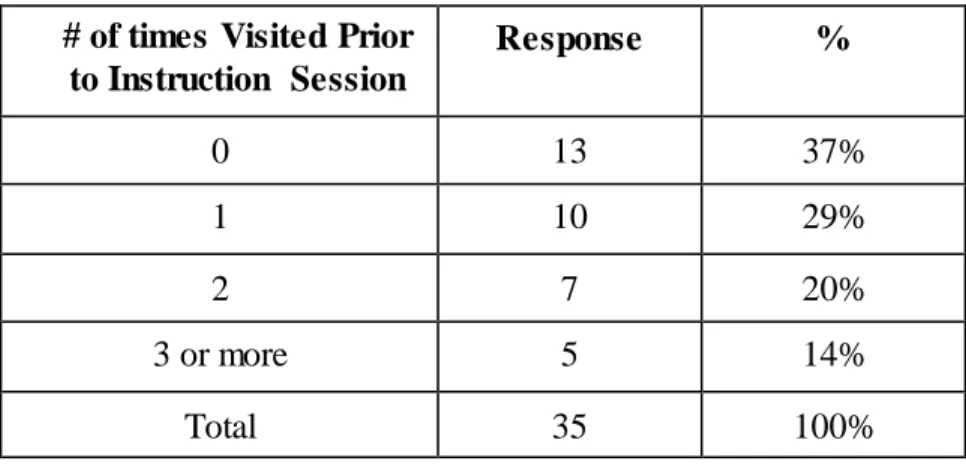
Table 1: Visits to Wilson Library Prior to Instruction Session
# of times Visited Prior to Instruction Session
Response %
0 13 37%
1 10 29%
2 7 20%
3 or more 5 14%
Total 35 100%
Figure 1: Visits to Wilson Library Prior to Instruction Session
proximity to the Undergraduate Library and main classroom buildings, a significant portion of the first-year undergraduates have never entered the building. The students recruited to participate in this research were enrolled in English 105 during the spring semester. Despite being in the second semester of the academic year, many of the students surveyed had little or no contact with Wilson Library for an eighth of their undergraduate career at UNC. As a result, librarians cannot assume that this group of students has even a basic understanding of the library building’s physical layout, the types of material housed in Wilson Library, or the procedures for using a special collections library. The broad nature of the question also indicates that Wilson Library, unlike the other libraries and landmarks on campus, is not included on the itinerary for campus tours or new students orientation sessions. Collaboration with English 105 instructors and instructions sessions for English 105 classes may be one of the primary means of reaching new undergraduates.
Question 5: Statements 1-13
After setting a baseline for the students’ familiarity with Wilson Library, the survey had participants rate aspects of their instruction experience as well as their ability to conduct research at Wilson Library. Students were given 13 statements and instructed to indicate a level of agreement with each statement. The scale for rating the statements was given as follows:
Statement 1
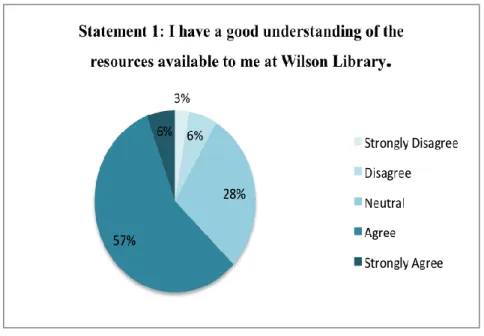
The first statement had students rate their understanding of the resources available to them at Wilson Library. The mean rating was 3.57 indicating that, after attending an instruction session, first-year undergraduates felt moderately confident about their understanding of the resources at the special collections library. Twenty students, or approximately 57% of survey respondents, agreed that they “had a good understanding of the resources available to me at Wilson Library.” Two students strongly agreed with the statement. In total, the majority of students, 22 of the 35 surveyed, either agreed or strongly agreed with this statement. The level of disagreement with this statement was small, only 3 students disagreed or strongly disagreed, but a large group of students, 28% of those surveyed, were neutral.
Statement 2 and Statement 3
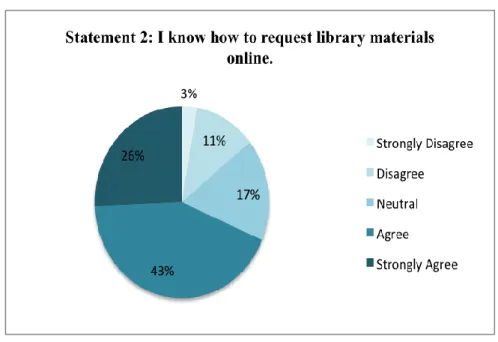
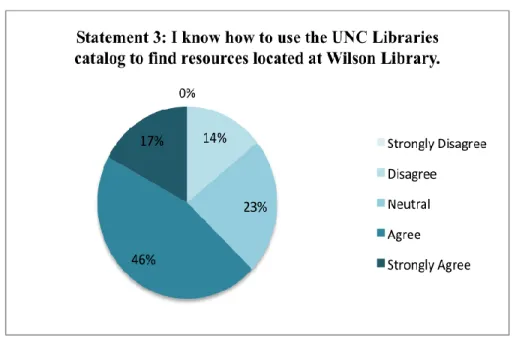
The second and third statements offered to survey participants dealt with the student’s level of confidence in placing online requests for research materials and in their ability to utilize the main UNC Libraries catalog to locate relevant special collections resources. On average, students felt more confident about their ability to request library materials through Wilson Library’s online request system and in their ability to use the UNC libraries than they did about their understanding of the nature of the resources housed at the library. The mean response to the statement “I know how to request library materials online” was 3.77. Fifteen students, or nearly 43% of respondents, agreed with this statement and 9 students, or nearly 26%, strongly agreed with this statement. The mean response to the statement “I know how to use the UNC Libraries catalog to find resources located at Wilson Library” was slightly lower at 3.66. The majority of students, 22 of the 35 participants, either agreed or strongly agreed with this statement.
Figure 4: Using the UNC Libraries Catalog to Locate Special Collections Material
While the level of agreement with this pair of statements was relatively high, the numbers indicate that students leave an instruction session only mildly confident in their ability to perform additional research. The contrast between the mean responses from statements 2 and 3 and that from the first statement one interesting. Students generally feel confident that they can find and access the needed resources, but are slightly unsure of resources available to access.
Statement 4 and Statement 5
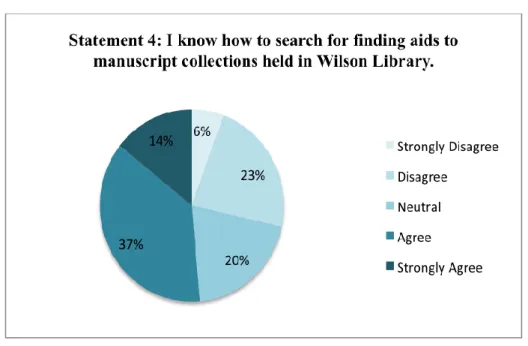
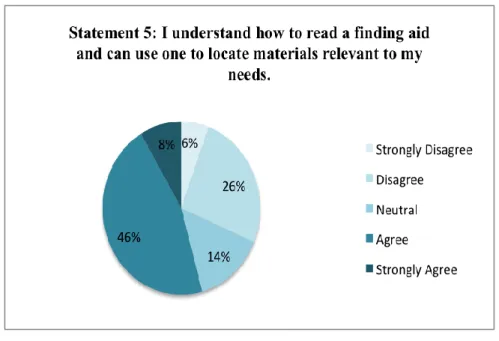
with the statement. The following, related statement, “I understand how to read a finding aid and can use one to locate materials relevant to my needs” had the lowest mean response rate for the survey at 3.26. Although nearly 20 students, or 57%, agreed with this statement to some degree, 11, or 31%, of their peers doubted their ability to effectively use a finding aid, an important skill for researchers working at an institution that houses a large volume of archival material.
Figure 6: Understanding of How to Use Archival Finding Aids
All of the English 105 classes analyzed for this survey saw archival material from the Southern Historical Collection and University Archives relevant to their research topics during the instruction sessions. Manuscript boxes and folders were available
during the instruction sessions for students to explore and consider using as a resource for their assignment. For many English 105 instructors, the ability to effectively utilize
Statement 6
In addition to the individual aspects of research such as catalog searching and the use of archival finding aids, students were asked to rate, generally, their confidence level in their own ability to conduct research. When asked to respond to the statement
Figure 7: Confidence in Conducting Research at Wilson Library
Statement 7
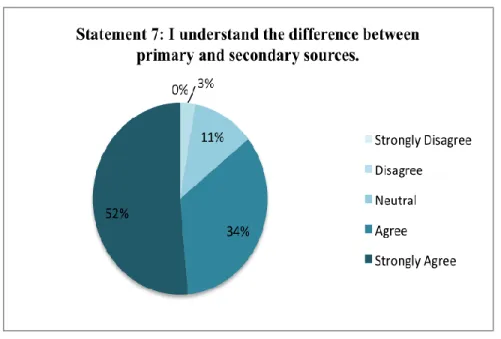
secondary sources. Four students, or 11%, were neutral. Only 1 student disagreed with the statement and no students strongly disagreed.
Figure 8: Understanding of Primary and Secondary Sources
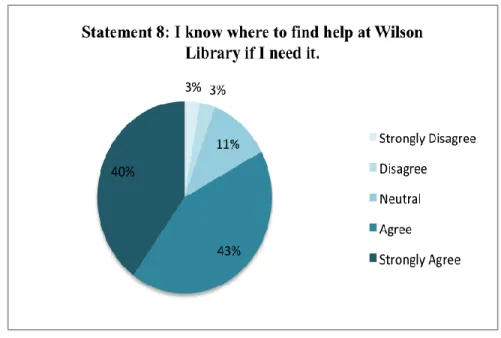
Statement 8 and Statement 9
agreed” while another 15 students, or 43% of participants “agreed” with the statement. The following statement, “I feel comfortable asking Wilson Library staff members for help,” had a comparable mean response rate of 4.11. The percentage of students, nearly 83%, agreed this with statement to some degree while a slightly higher number of participants strongly agreed. Overall, students leave an instruction session with the understanding that staff at Wilson Library are available to help students navigate the library and conduct research. In addition to knowing that help can be obtained and where help can be obtained, students feel confortable seeking out Wilson Library staff, all of which are key ideas that instruction sessions are meant to convey to students.
Figure 10: Seeking Research Help at Wilson Library
Statement 10
The next statement presented to the students is one of particular interest to Wilson Library staff. A significant goal of the undergraduate instruction session is to introduce students to the resources available at the library in the hopes that they will return throughout their college careers for later class assignments or for their own personal research interests. When given the statement “I plan to return to Wilson Library and conduct research there in the future,” students generally agreed, although not to a particularly high degree. The mean response rate was 3.74. A significant portion of the students, 11 out of the 35 surveyed or approximately 31%, neither agreed nor disagreed with this statement. However, an identical number of students “agreed” that they planned to return to Wilson Library in the future and 10 students strongly agreed with the
sessions may spur at least some students to conduct research at Wilson Library in the future.
Figure 11: Likelihood of Returning to Wilson Library
Statement 11 and Statement 12
The next, related statement received similar responses. The mean response for the statement “The material covered in the session was interesting and engaging” was 4.17. Fourteen students, or 40% of participants, strongly agreed with the statement and an equal number of students agreed with the statement. Six students were neutral while only a single student disagreed with the statement. Wilson Library staff devote a significant amount of time to locating material and tailoring the content of the session to the research needs and subject matter of each class. Ensuring that the material selected is both useful and interesting to the students is crucial to the success of the instruction session. In addition, the ability of the material to engage and excite students impacts the chance that students will view Wilson Library as a valuable resource and return to the library.
Figure 13: Material Covered in the Instruction Session
Statement 13
Figure 14: Performance of Library Instructional Staff
Open-ended questions
Question 1
cited “seeing actual material that related to our class topic” as a particularly useful component of the instruction session. Several students included specific examples of material in their response. For example, students mentioned the ability to access and read old newspaper articles as well as the opportunity to see materials, such as records related to the installation of major campus monuments or documents published by student activist groups, that document the university’s past.
Relatedly, many students also mentioned the ability to physically interact with the material and begin connecting it to their class assignments. For instance, one student listed “the time to work with my group and use the materials during class” as a positive feature of the session. Another student mentioned that “it was also great to be able to view original periodic pieces and work with those items.” While having research material relevant to each class in the instruction room received overwhelmingly positive responses from undergraduate students, a few of the responses hinted that students view the pre-selected material as an endpoint rather than as a starting point for further research. One student, for instance, liked “Having many materials laid out and chosen for use so we didn’t have to go through the difficulty of finding stuff.”
In addition to seeing and using examples of material, a comparable number of students listed learning how to request material using the library’s online system as useful part of the instruction session. “Learning how to request material” and “requesting
find some of the sources from the North Carolina Collection,” and “finding out that many newspapers can be found online.”
Question 2
The second open-ended question asked students “Which parts of the session did you find to be the LEAST useful?” Twenty-two students, or approximately 63% of participants, provided a response to this question. Of those that provided a response, 9 students, or 41%, wrote “none,” “N/A,” or stated, in the case of one student, that “There was not much information that I did not find useful.” Fortunately, other survey
devoted to viewing the material and that a greater emphasis on the process for locating material online would have been more useful.
Question 3
The final question of the survey asked students “What suggestions would you make to improve future sessions?” Twenty-three students, or approximately 66% of participants, provide a response to this question. A few students thought that including a tour of the building in the instruction session would be an improvement. One student, for instance, suggested that the librarians “focus more on learning about how to navigate Wilson library rather than the Wilson library web site.” The distribution of handouts was a particularly popular suggestion. Several students wanted a handout of resources
relevant to their class’s topic. One respondent thought that librarians should provide the students with “a ready-made catalog or list of resources/documents relevant to the topic of their class project.” The suggestion for handouts also included a desire for a “print out of an outline of the basics of how to do things and how everything works.” Multiple students indicated that this outline of the basics should include steps for searching the online catalog and requesting materials online. One student explained that “it was very easy for me to forget everything within a couple of days. As a result, I’d be doing research ultimately just to figure out how to use everything again, which would make a lot of the session not very beneficial in the end.”
to explore material” and “more time look over manuscripts and less rambling” were common comments. One student “didn’t feel like it was long enough to cover all of the topics they tried to cover.” Suggestions regarding time were often coupled with
Discussion
The responses to the survey offer interesting insights for instructional librarians working in the special collection environment. More specifically, the survey results may prove useful to Wilson Library staff as they plan for future undergraduate instruction sessions and work to continue and extend the library’s relationship with the English 105 program at UNC-Chapel Hill. As the literature review shows, library instruction can benefit both students and the library itself. Students who attend an instruction session are more likely to return to the library and utilize library resources in the future. Special collections instruction, in particular, can help students develop an understanding of the scholarly research process and gain experience working with a variety of sources. In addition, special collections instruction offers students a chance to encounter primary sources in their original form and practice critical analysis. For new undergraduate students, special collections instruction is particularly important. These students are generally unfamiliar with special collections or archival research. The strategies for locating relevant material, archival terminology, and finding aids are just a few of the new and potentially anxiety- inducing features of this type of research. Instruction, as staff at Wilson Library have long recognized, is essential to introducing new students to a valuable resource and creating a welcoming environment.
analysis. While the present study is limited in several ways, the findings are useful and indicate directions for future assessment efforts. One of the most basic and yet most revealing findings was that English 105 students, which, in this case, were in their second semester at UNC, had limited contact with Wilson Library before the instruction session. Librarians cannot assume that students are familiar with the concept of a special
collections library or archival repository. At the most basic level, instruction can make students aware that the library and its resources exist for their use, an idea likely to be new to many first year undergraduates. The survey suggests that, despite students’ minimal experience with Wilson Library, after the instruction session students were generally confident about their ability to conduct research at Wilson Library and were largely positive about the instruction experience more broadly.
were instruction elements that students viewed positively and indicate high student satisfaction rates. For first-year undergraduates, the session was useful and relevant and the special collections material was interesting and engaging.
In addition to gathering general information about the new undergraduate
instruction experience, the survey received a number of comments about specific aspects of instruction and suggestions for the improvement of sessions. Several students
mentioned the need for more instruction time. For some, additional time to interact with the material was needed, while, for others, more time should be allotted to locating and requesting additional materials. The frequent mentions of the time constraints placed on instruction raises an important issue for library staff. Should all of the elements currently included in instruction sessions remain? Or should staff try to limit the areas covered in sessions and devote more time to fewer elements? If all of the current elements are necessary, is it feasible, in terms of both library staff and faculty time, to hold multiple sessions for English 105 sections? Undoubtedly, an in-depth conversation with all faculty involved in the English 105 program and all of the involved instructional librarians would be good step going forward.
The calls for more time or better time management were often accompanied by suggestions for prepared handouts to be given to students as part of the instruction effort. Documents explaining the procedures for requesting material or how to read a finding aid could be easily prepared and could potentially allow staff to devote instruction time to other aspects of the research process. The call for handouts and, in a few cases, for lists of the resources related to a topic suggests that students want to find material for
students who are accustomed to quick results via a Google search and fast access to a wealth of digital resources on the Internet may have different research needs and require the teaching of different skills than students just five or ten years ago would have. Searching through a manuscript box or scrolling through microfilmed newspapers are processes far removed from experiences of most students entering college in 2015. As the students attending instruction change, assessing instruction and considering the
information needs and information-seeking behavior of students are likely to be increasingly important tasks in the future.
Because of the benefits that instruction can bring to students and libraries as well as the significant amount of time and effort devoted to planning and conducting
instruction sessions, occasional assessment is good practice for any institution. The English 105 program at UNC is especially worthy of assessment. Multiple sections of the English 105 course attend instruction at Wilson Library each semester. This presents library staff with a relatively large pool of undergraduate students to study and from whom to gather feedback. The multi-year relationship between Wilson Library and the English 105 program also provides an opportunity for tracking change or patterns over time. A before and after approach to surveying students could better capture the impact of instruction on undergraduates. The use of a control group of English 105 students who did not attend Wilson Library instruction could also be useful in obtaining valuable feedback. The assignments completed by the English 105 classes that visit Wilson
The potential the English 105 program offers for special collections librarians to connect with a large group of undergraduates is an opportunity that should not be missed. The objectives of the English 105 course to prepare students to critically analyze a variety of sources and teach academic writing skills align well with the professional mission of instruction libraries across institutions. As a result, by providing a useful and engaging instruction experience to English 105 students, Wilson Library staff are helping to teach skills critical to college success and developing a relationship with students early on that will hopefully lead to return library visits later. The potential to develop awareness among the campus community and increase user statistics is particularly important at a time when the resources allocated to libraries and archival institutions are constantly being called into question by university administrators and state governments. Although the focus of this study was the English 105 experience at Wilson Library, the analysis of sessions for the Spring 2015 semester and any future assessment efforts should not be limited to the discussion of this specific program. Study of this group of students can be related to undergraduate instruction more broadly and additional efforts to foster
Bibliography
Allison, Anna E. (2005). Connecting Undergraduates with Primary Sources: A Study of Undergraduate Instruction in Archives, Manuscripts, and Special Collection. Master’s Paper for M.L.S degree. University of North Carolina at Chapel Hill. Archer, Joanne, Hanlon, Ann M., & Levine, Jennie A. (2009). Investigating Primary
Source Literacy. Journal of Academic Librarianship 35(5), 410-420.
Barton, Jacqueline A. (2003). Promoting Information Literacy: an Evaluation of the Library’s Collaboration with the First-year English Program at UNC-Chapel Hill. Master’s Paper for M.L.S. degree. University of North Carolina at Chapel Hill. Carolina Undergraduate Admissions. (2012, March 28). Interview with Professor Jane
Danielewicz about English 105 [Web blog post]. Retrieved from
unc-admissions.blogspot.com/2012/03/interview-with-professor-jane.html. Chadley, Otis and Gavryck, Jacquelyn. (1989). Bibliographic Instruction Trends in
Research Libraries. Research Strategies 7, 106-113.
Cleveland, Alison. (2004). Library Anxiety: a Decade of Empirical Research. Library Review.53(3), 177-185.
Crye, Jennifer L. (2012). Instruction and Assessment in Special Collections: An
Exploratory Study of Student, Staff, and Faculty Perceptions. Master’s Paper for M.L.S degree. University of North Carolina at Chapel Hill.
Duff, Wendy M. & Cherry, Joan M. (2008). Archival Orientation for Undergraduate Students: An Exploratory Study of Impact. American Archivist, 71, 499-529. Emmons, Mark & Martin, Wanda. (2002). Engaging Conversation: Evaluating the
Contribution of Instruction to the Quality of Student Research. College and Research Libraries, (Nov.), 545-560.
Farber, Evan. (1999). College Libraries and the Teaching/Learning Process: A 25-Year Reflection. Journal of Academic Librarianship 25, 171-177.
Johnson, Greg. (2006). Introducing Undergraduate Students to Archives and Special Collections. College and Undergraduate Libraries, 13(2), 91-100.
Kader, Emily L. (2013). Object Lessons: An Assessment of Special Collection Pedagogy. Master’s Paper for M.L.S degree. University of North Carolina at Chapel Hill. Katte, Jill. (2002). Reaching Out to Researchers: A Model for Web-Based User
Education Resources for Archives and Manuscript Collection. Master’s Paper for M.L.S. degree. University of North Carolina at Chapel Hill.
King, David & Ory, John. (1981). Effects of Library Instruction on Student Research: A Case Study. College and Research Libraries, 41, 31-41.
Knott, Katherine G. (2008). The Effect of Library Instruction on Undergraduate Library Use. Master’s Paper for M.L.S. degree. University of North Carolina at Chapel Hill.
Krause, Magia G. (2010). It Makes History Alive for Them: The Role of Archivists and Special Collections Librarians in Instructing Undergraduates. Journal of