Charles S Fultineer. A Case Study and Literature Review: How Effective IT Governance is the Key to Successful Enterprise Resource Planning Deployments. A Master’s Paper for the M.S. in IS degree. April, 2015. 43 pages. Advisor: Lew Hassell
Deploying an Enterprise Resource Planning (ERP) solution is a complex and risk laden program of work that not every company is successful in delivering. In this study, the author (an IT leader at a large pharmaceutical company) presents a case study where he draws upon his experiences and learnings from leading two ERP implementations, as well as a literature review examining whether the author’s hypothesis that IT Governance is the critical success factor in ERP deployments is supported amongst IT industry
researchers, analysts, and strategists. The study goes was able show a strong correlation between companies who have strong IT Governance presence on ERP deployments and their ability to deliver the program of work successfully.
Headings:
Information System Management
Projects, Information Technology
A CASE STUDY AND LITERATURE REVIEW: HOW EFFECTIVE IT GOVERNANCE IS THE KEY TO SUCCESSFUL ENTERPRISE RESOURCE
PLANNING DEPLOYMENTS
by
Charles S Fultineer
A Master’s paper submitted to the faculty of the School of Information and Library Science of the University of North Carolina at Chapel Hill
in partial fulfillment of the requirements for the degree of Master of Science in
Information Science.
Chapel Hill, North Carolina April 2015
Approved by
Table of Contents
Table of Contents ... 1
1. Introduction ... 2
2. Case Study ... 5
2.1 Study Context... 5
2.2 The Data Set: Risks, Responses and KPIs ... 6
2.3 Methods... 12
2.4 Analysis and Interpretation ... 12
3. Literature Review... 21
3.1 Literature Review Context ... 21
3.2 The role of IT Governance through the Program Lifecycle ... 21
3.3 Why ERP Deployments Fail and How ERP Deployments Succeed ... 26
4. Methodology ... 28
4.1 Study Set Up ... 28
4.2 Case Study Data Set ... 28
4.3 Literature Review Data Set ... 29
4.4 Tools Used ... 29
5. Results ... 30
5.1 Case Study Results ... 30
5.2 Literature Review Results ... 32
5.3 Convergences ... 32
5.4 Divergences... 32
6. Discussion ... 34
6.1 Significance... 34
6.2 Limitations ... 34
6.3 Future Works ... 35
7. Conclusion ... 36
Bibliography ... 37
1.
Introduction
At a prominent global pharmaceutical company (we will refer to the company as
xPharma for the remainder of this paper to provide anonymity to the company and protect
any non-disclosure agreement obligations I have to the company as a current employee),
the company's executive team approved a plan to simplify its operations by streamlining
its Manufacturing and Supply Chain (MSC), Finance, and Human Resource (HR)
business processes and systems. xPharma’s IT business unit was tasked to drive this
simplification program by moving the company off of bespoke processes and systems to
enterprise technology platforms known as Enterprise Resource Planning (ERP) solutions.
The vision that many large companies across a range of industries (including
pharmaceuticals) have is to buy commercial Software as a Service (SaaS) applications
that meet the needs of the majority of their business and move away from building and
supporting highly customized, high total cost of ownership (TCO) applications that meet
the needs of a few. The concept is to purchase as much as possible out-of-the-box (also
known as commercial off the shelf – COTS) to reduce configuration, customization, and
ongoing support costs. The onus and costs to maintain the applications with patches and
bug fixes, software upgrades, data storage, and even training is being pushed to these
software providers to reduce the internal overhead of having in-house resources that
industry leader in technology research) suggests ERP business benefits are realized in the
form of: IT cost savings, business process efficiency through standardization, and
business innovation (Gartner, 2013). There are a number of software providers that offer
ERP solutions to companies like xPharma such as Oracle (Oracle e-Business Suite), SAP
(SAP Business One), Workday Inc. (Workday), and Microsoft (Microsoft Dynamics).
xPharma has selected SAP Business One for its GMS and Finance demands, and
Workday for its HR requirements.
My roles at xPharma during the ERP deployments were to serve as a Business
Consultant supporting the IT Lead of the Finance - SAP implementation in the Research
& Development (R&D) business unit through the business initiation and planning and
phases of the program; my other role was IT Lead overseeing the program management
on the HR – Workday ERP implementation (also within the R&D business unit) where I
was accountable for the overall driving and management of the program through the full
program lifecycle:
Figure 1: Program/Project Lifecycle
Focusing on the latter bullet, IT Governance (ITG), is what I and other key opinion
believe to be one of the most critical tools in a program leads tool belt to ensure a
complex program of work like an ERP deployment is delivered successfully. ITG is
defined as the processes that ensure the effective and efficient use of IT in enabling an
organization to achieve its goals. Through my experiences as a contributor on one IT
Governance Board and the leader of another, I attribute the success of the ERP programs
I participated on principally to effective ITG (not solely to, but certainly largely on
effective ITG). This paper is in-part a case study where I draw upon my experiences as an
IT leader at xPharma tasked to direct the delivery of two large ERP deployments and
achieved success through effective ITG, and a second component of the paper is a
literature review examining the role ITG plays in ERP deployments through the eyes of
key opinion leaders in the industry (researchers, consulting firms, etc.). It is my
hypothesis based on my case study and literature review that effective IT Governance is
2.
Case Study
2.1 Study Context
The backdrop and scope of this case study is essential in order to fully appreciate
how complex ERP deliveries are and why ITG is so key, especially in a big corporation
like xPharma: a fortune 100 company with one hundred thousand employees across 150
countries in a heavily regulated industry (pharmaceuticals). The Manufacturing and
Finance ERP deliveries of SAP alone will cost xPharma 2.5 billion dollars and take 5
years to fully incubate and embed these solutions to each of the 150 countries. The HR -
Workday implementation is smaller in complexity, so in turn will cost less and take less
time to deliver, yet the price tag is still expected to reach 500 million dollars and take 3
years to deliver to all 150 countries.
Pre-ERP conception, xPharma had an estimated 125 GMS, 75 Finance, and 50
HR legacy systems supporting their respective business units that have built-up large
volumes of data and have been customized to support hundreds of specialized business
processes over the years (some systems have been in place for 2 plus decades).
Furthermore, dozens of these processes and thousands of records are subject to legal
preservation, regulatory review, are currently being used in a clinical study (which can
run 10-15 years), etc., which prohibits xPharma from being able to just turn off the lights
(retire) one system and turn on another seamlessly. Because of this, a significant portion
of the ERP budget is allocated to the business analysis, risk management, data migration,
(xPharma being one of them), companies have no choice but to ultimately keep and run
the legacy systems in parallel with the ERP solution for a period of time, or even
indefinitely, until they can fully break their dependencies on the legacy systems. It is also
widely recognized that ERP solutions out of the box only meet roughly 80% of a
company’s business requirements, so the other 20% of their requirements must either be
built into the ERP solution through costly customizations and/or configurations, or be
fulfilled in a separate system.
2.2 The Data Set: Risks, Responses and KPIs
Upon taking my assignment as the R&D IT Lead over the HR program, I was
given the following advice from my leadership team: “ERP programs are complex and most companies are unsuccessful because they do not embrace the complexity; it’s not a
matter of if something will go wrong, but a matter of when” (the xPharm R&D
Leadership Team). My performance as the IT Lead over the HR ERP deployment was
evaluated based on two criterions:
1. Was the program delivered successfully with Key Performance Indicators
(KPIs) realized?
2. Did I demonstrate sound leadership when issues surfaced, and were the
strategies and risk mitigation plans I put in place as part of the IT Governance
Board effective?
As foretold, throughout the R&D ERP programs at xPharma (namely the Finance and HR ERP deployments) challenges/risks were posed to xPharma’s IT organization at various
stages in the ERP program lifecycle. The following risks are a sample from the R&D
Risk Risk Attributes
R1) The Board of Directors and Executive Team selected a one size fits all ERP system (a single SAP template) for their Finance processes, yet there are currently 4 separate instances of Oracle (xPharma’s legacy Finance technology) setup for each of the 4 business units (R&D, Sales and Marketing, MSC, & Corporate) because their processes and technology needs are disparate. This introduces a risk that R&D will not be able to decommission their legacy systems as key
processes are not available in target SAP template
Lifecycle Stage: Initiation
Probability Risk materializes:
High
Impact if Risk will materialize:
Diminished Overall Customer Satisfaction & Benefits Realization
R2) Quality documentation and subject matter expertise of existing HR legacy systems and processes were sparse considering those who built the systems and designed the processes several years to decades ago have long since left the company. This introduced several risks including quality risks to the implementation because trying to write “To Be” requirements without fully understanding the “As Is” requirements leaves room for error in the requirements gathering and planning
Lifecycle Stage: Planning
Probability Risk materializes:
High
Impact if Risk will materialize:
Diminished Quality
R3) Timelines for the ERP production releases were set & strictly enforced by xPharma’s executive team with little input from the IT organization. The IT organization did not have the autonomy to adjust the plans as they see fit. If the program was not ready to migrate all business processes by the mandated cutover/Go Live date, the legacy systems would need to remain in production
Lifecycle Stage: Planning
Probability Risk materializes:
High
Impact if Risk will materialize:
Diminished Quality & Business Case
R4) Not all of the nuances of change moving from the legacy technology to the new ERP systems were fully understood and consequently scoped prior to the production releases. This introduces a risk that the programs missed requirements and have a high probability of deploying defective code
Lifecycle Stage: Execution
Probability Risk materializes:
High
Impact if Risk will materialize:
Increased Volume of defects
R5) IT Programs tend to have heavy resource (namely contractor) engagements during the initiation, planning and execution phases, but much of the talent tappers off before closure given this is the most tactical phase of a program. This poses a risk to the organization in that there may be unfinished deliverables like an Action Review (AAR) where learnings are collected,
documented succession plans, knowledge transition to xPharma staff accountable for steady state support, etc. that could extend the project timelines if not completed
Lifecycle Stage: Closure
Probability Risk materializes:
Medium
Impact if Risk will materialize:
Extended Timelines
R6) the combinations of a multi billion dollar joint venture, a massive xPharma restructure, & 3 concurrent ERP deployments in the same timeframe put strain on
Lifecycle Stage: All Phases
Probability Risk materializes:
the organization and posed a risk that too much change may leave too little time for proper ERP training & change management
Impact if Risk materializes:
Poor
Organizational Readiness
Figure 2: Joint R&D ERP Programs Risk Registry
The abovementioned risks are real examples that tested the xPharma IT organizations’
resilience, agility, and leadership. In an ideal situation, all complexities/challenges/threats
(AKA risks) to these programs would be known in advance of initiation with fixed plans
in place to mitigate those risks. In reality, ERP deployments are dynamic and
complicated, and not every company is successful in their ERP deployments because they
do not have the leadership (inclusive of ITG) in place to manage the complexity and
volatility of ERP deployments. As Accenture (a market leader in management consulting, technology services and outsourcing) astutely explains, “the large and complex nature of
a global ERP implementation requires a similarly expansive and robust governance model” (Accenture, 2013) For such risks, an IT Governance Board (or often called a
Steering Team) was formed at xPharma to assess (what are the risks to the program?),
diagnose (what are the root causes of the risks?), act(what actions should we take to
respond to these risks?), and monitor (how effective have our actions been at resolving
the issues?). The IT Governance Board (ITGB) framework used at xPharma during both
Figure 3 - IT Governance Board Framework (Elite International Consultancy, 2013)
As outlined in the diagram above (Figure 3 – IT Governance Board Framework), ITG is
embedded through the program/project lifecycle with controls in place to iteratively monitor and influence the programs’ progress. This case study examines how the IT
Governance Boards at xPharma responded to the risks identified in the Finance and HR
ERP deployments using the ITGB process, and how those decisions ultimately affected the programs’ KPIs.
The following KPIs were established to measure success across each of the ERP
Figure 4: xPharma's R&D ERP KPIs
How an organization defines success on an ERP program is subjective and inconsistent
across the industry, but one principle KPI companies are weighing more heavily than
others is ROI, or as xPharma calls it Benefits Realization. Panorama Consulting Solutions
supports this principle in their Defining ERP Success for Your Organization article explaining: “the business case should be an important mechanism to not only justify the
investment in the ERP system but also to define what will constitute ERP success”
(Kimberling, 2013). xPharma evaluated the IT organization against their ability to
achieve all of their KPIs, but in following this industry trend, xPharma valued ROI more
heavily than the other KPIs. Specifically, xPharma considered the ERP programs a
was a mandatory KPI that needed to be achieved in addition to 3 other KPIs before the program could declare victory. Here’s how xPharma’s Finance and HR ERP deployments
faired against theirKPIs:
Figure 5: xPharma's R&D ERP Scorecard
As the scorecard unveils, the jury is still out on whether the Finance implementation will
12 months post deployment and the software has only been in production for 6 months as
of April 1, 2015. Albeit, there is already evidence to suggest that both the R&D Finance
and HR deployments both had elements of their programs that went well (as indicated in the “Achieved SLA” cells), and there is also data to support that the Finance deployment
experienced shortcomings (“Did not Achieve SLA”) in areas where the HR deployment
excelled. Some of the Finance deployment struggles can be attributed to it being a more
complex endeavor than the HR implementation (moving from 75 legacy Finance systems
to 1 vs. the HR program entailed moving from 50 legacy systems to 1), but there is also a
correlation between the successes experienced as part of the HR deployment and the
proactive measures taken by their IT Governance Board to collect learnings from the
Finance ITGB (i.e. what worked well? what did not work well?) and refine their HR
ITGB strategy to ensure they did not repeat missteps from the Finance program.
2.3 Methods
To quantify the impact effective ITG had on the Finance and HR ERP programs,
we conducted a side-by-side comparison of the decisions made by the Finance ITGB and
the HR ITGB, and assessed whether those actions positively or adversely impacted their respective program’s KPIs. In response to the abovementioned risks highlighted in the
Joint R&D ERP Programs Risk Registry, the Finance and HR ITGBs had critical decisions to make as to how they would respond to each of the program risks.
2.4 Analysis and Interpretation
The following assessment how their responses ultimately affected the outcomes (KPIs) of
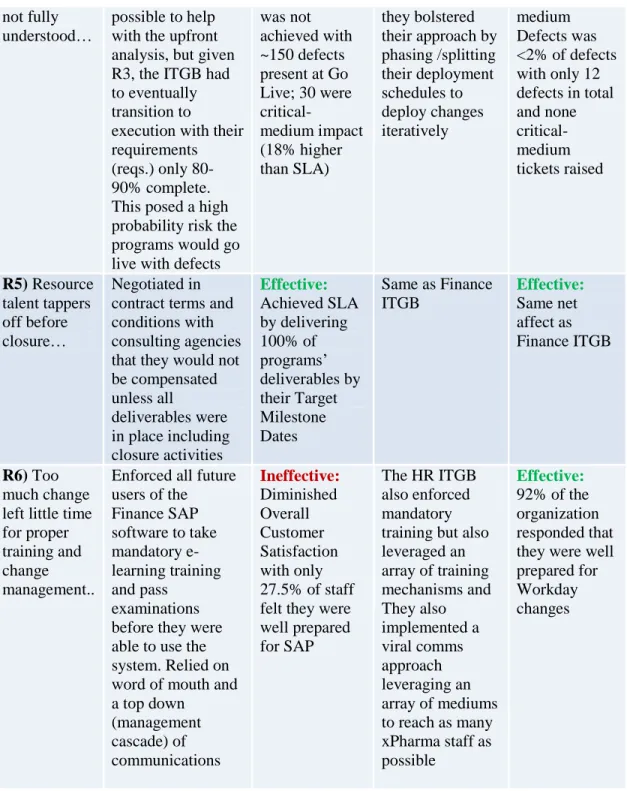
Risk (summarized from Figure 2) Finance ITGB Risk Response Effectiveness of Finance ITGB Response HR ITGB Risk Response Effectiveness of HR ITGB
Response R1) The Board of Directors and Executive Team
selected a one size fits all ERP system…
Requested 27 customizations to template and only 7 were approved by executive team, so 4 “nice-to-have” business processes were retired & the other 15 “should have” & “must-have” processes will continue to be supported in the legacy systems Ineffective: Overall Customer Satisfaction diminished with only 75% of the
organization responding that they would recommend the ERP solution to a friend
Not Applicable – this risk is unique to the Finance program
Not Applicable
R2) Lack of quality documents & SMEs of legacy HR systems & processes…
Not Applicable – this risk is unique to the HR program
Not Applicable Partnered with contractor organizations to find former xPharma employees who had domain knowledge of the HR systems & processes Effective: Mitigated high impact Quality risks, and program met its KPI whereby <2% of the defects were High-Medium impact tickets R3) Timelines for the ERP production releases set by xPharma’s executives… Only approved projects at Stage Gates if scope was limited to solely moving from one technology to another to thwart scope creep like enhancement requests. Any proposals to change requirements had to be approved via a Change Control whereby only the ITGB could approve the change
Ineffective:
Overall customer satisfaction was only ~75% b/c process enrichments were desired
Same as Finance ITGB Ineffective: Same net affect as Finance program R4) Legacy and ERP technology
Secured as many high talent resources as
Ineffective:
Volume of Defects KPI
HR ITGB also blitzed the upfront reqs., but
Effective:
critical-not fully understood…
possible to help with the upfront analysis, but given R3, the ITGB had to eventually transition to
execution with their requirements (reqs.) only 80-90% complete. This posed a high probability risk the programs would go live with defects
was not achieved with ~150 defects present at Go Live; 30 were
critical-medium impact (18% higher than SLA)
they bolstered their approach by phasing /splitting their deployment schedules to deploy changes iteratively medium Defects was <2% of defects with only 12 defects in total and none critical-medium tickets raised R5) Resource talent tappers off before closure… Negotiated in contract terms and conditions with consulting agencies that they would not be compensated unless all
deliverables were in place including closure activities Effective: Achieved SLA by delivering 100% of programs’ deliverables by their Target Milestone Dates
Same as Finance ITGB Effective: Same net affect as Finance ITGB R6) Too much change left little time for proper training and change management..
Enforced all future users of the Finance SAP software to take mandatory e-learning training and pass
examinations before they were able to use the system. Relied on word of mouth and a top down
(management cascade) of communications Ineffective: Diminished Overall Customer Satisfaction with only 27.5% of staff felt they were well prepared for SAP
The HR ITGB also enforced mandatory training but also leveraged an array of training mechanisms and They also implemented a viral comms approach leveraging an array of mediums to reach as many xPharma staff as possible
Effective:
92% of the organization responded that they were well prepared for Workday changes
Figure 5: R&D ERP ITGB Effectiveness Analysis
Per Risk 1 (the Board of Directors and Executive Team selected a one size fits all ERP system…): the ITGB is only as effective as their span of control can reach. Despite
board, the reality is some organizations value some business unit’s inputs more than others. In xPharma’s case, the IT organization is considered a support organization, and
there Chief Information Officer (CIO) is three levels removed/below the board of
directors and two levels below the Chief Executive Officer and his executive team. It
would be convenient for the purposes of this study to say the R&D Finance ITGB made
missteps in their response to this risk as it would suggest gaps in ITG affect a program’s success, but the consensus amongst xPharma’s R&D Leadership Team (senior executives
who evaluated the R&D ERP program teams’ performance) is the measures taken by the
R&D Finance ITGB may not have been enough to completely mitigate Risk 1 but no
action at all would have completely derailed the program from going forward. The 7
template changes were absolute necessities in order for R&D to be able to operate in the
new SAP system. Since R1 could not be mitigated fully, the Overall Customer
Satisfaction diminished with only 75% of the organization responding that they would
recommend the ERP solution to a friend, which is 15% lower than their KPI SLA.
Risk 2 (lack of quality documents & SMEs of legacy HR systems & processes…):
the HR ITGB was able to locate some former xPharma employees that worked in the HR
domain through LinkedIn, and partnered with their consulting alliances (Accenture,
Cognizant, etc.) to reach out to these employees and bring them in as contractors through
their organization to work on this program. Some of these resources have left xPharma
because of performance reasons, others for other employment opportunities, some for
retirement, and everything in between, so the talent pool varied resource to resource.
Notwithstanding, the overwhelming feedback from the R&D Leadership Team is the HR
deployment. The program met its KPI whereby <2% of the defects were High-Medium
impact tickets.
Risk 3 (timelines for the ERP production releases set by xPharma’s
executives…): like Risk 1, the executive team’s plans trump the IT organizations, and
both the Finance and HR programs had little options other than to accept these risks and
do everything in their power to minimize the impact to the organization (AKA collateral
damage). In this example, it physically was not possible to deploy all must-have and
should-have requirements within the timelines set by the executive team, so limiting the
scope of the deployments was a sound tactic to ensure timely delivery, but it came with a
transparent cost – diminished overall customer satisfaction. Whenever you crack open the
hood of a system (whether it be a business application, a car, etc.) ideally one would look
to fix or improve as many things as possible to get the system running optimally;
however, adding these other fixes and enhancements come with timeline and cost
implications that not all companies, car owners, etc. can entertain. In an IT project, a
popular pit fall is scope creep, where additional requirements are added to the project
after project approval (Stage Gate 2). The drivers behind the executive team enforcing
such stringent and arguably unrealistic expectations on the organization are a result of
their research into what makes an ERP deployment (or any large IT project for that
matter) successful and why they fail. xPharma, a loyal consumer of Gartner services, follows Gartner’s project management best practices: “to optimize success, look for ways
to limit the size, complexity and duration of individual projects.”(Mieritz, 2012).
McKinsey consulting elaborates: large IT projects fail more often and deliver less value
projects with budgets over 15 million dollars run 45% over budget, 7% behind schedule,
and deliver 56% less functionality than forecasted (Wailguim, 2009). During the
requirements gathering phase of the programs, the Business Analysts (BAs) and Business
Consultants (BCs) documented dozens of examples where the business didn’t currently
have a feature/capability in their legacy system, yet they listed these functions as must
have requirements. It also was not uncommon for the requirements to evolve over time where “nice to haves” became “must haves” and new requirements were added during
execution (UAT is a popular time for new requirements to surface). The R&D HR ITGB
was able to intercept such instances and reject the requirements through the ITGB Stage
Gate and Change Control protocols. Without senior oversight of the requirements and
scope of work would have been significantly larger. It is estimated that the R&D ERP
ITGBs rejected approximately 20% of the requirements per program. Twenty percent of a
2.5 billion dollar Finance program and a 500 million dollar HR program that run 5 and 3
years respectively, would have cost xPharma an extra 50 million dollars and an extra year
to deliver the Finance program, and an additional 10 million dollars and take an extra half
year to deliver. This is significant money and time to even a large pharmaceutical
company like xPharma.
Risk 4 (legacy and ERP technology not fully understood…): post production
issues were significant for the Finance implementation with 150 incident/problem tickets
logged in the R&D organization within the first month of Go Live, while the HR
deployment logged only 12 incident tickets in the R&D organization. The HR ITGB took
a conscience decision to not work up to the deadline and do a one fell swoop deployment
projects and deploy changes iteratively. Having led both Waterfall and Agile projects as a
former Project Manager, we were able to assess which methodology we thought would
give our HR program the best chance for success, so we found project resources that
knew how to run Agile projects and the results were favorable. Having iterative releases
enabled us to prioritize deployments (deliver more value more quickly), spread the risk of
the deployments (allows ability to fail earlier and smaller than large deployments), and it
allotted the teams more time to assess the complex requirements and move those releases
to a later date. The R&D HR projects and the consultants signed off/approved at Stage
Gate 2 that they were 90-100% confident in their requirements. The low number of total
defects recorded from the HR program demonstrates the actions taken by the ITGB were
effective in driving comprehensive, high quality requirements that ultimately resulted in a
higher quality end product.
Risk 5 (resource talent tappers off before closure…): both programs worked with
the Project Management Office (center of excellence that drives program/project best
practices) to add terms and conditions to their contracts with xPharma’s consulting
partners (e.g. Accenture, Cognizant Technology Solutions, etc.) to ensure all deliverables
were met (including closure activities) before the vendors could be compensated.
Because the programs run over multiple years, there is no guarantee that the consulting
agencies can retain the same consultants from start to finish, so the ITGBs negotiated that any loss in productivity as a result of resource turnover would be at the vendors’ expense.
The Finance ITGB had to execute this provision in the contract and demanded the
deliverables by their Target Milestone Dates through the measures taken to retain
resources through the duration of the project and tie compensation to deliverables. The
contributions the ITGBs made by effectively responding to the closure risks are
considerate. According to CIO.com, 54% of IT projects go over time and budget
(Mieritz, 2012).
Risk 6 (too much change left little time for proper training and change
management…): both programs mandated training and examinations, but the Workday
solution delivered 45 days after the SAP solution, so based on the negative voice of
customer raised around how cumbersome and ill-timed the training offerings were for the
Finance program, the HR ITGB refined their training approach. Specifically the HR
ITGB offered earlier training engagements through various training mechanisms
(e-Learning courses, instructor led training, and self paced training materials like FAQs).
The Finance ITGB change management approach received a black eye with negative VOC where 30% of xPharma’s staff responded that they felt there was
inadequate/impersonal communications around what the move to SAP means for them,
and 25% of the staff felt the 2 day mandatory training was too onerous with all other
organization changes going on concurrently that they also need to comprehend. The
combined overall readiness score was 27.5% felt they were prepared for the SAP
implementation (well below the target SLA of 80% readiness) Furthermore, the SAP
training course offerings were only available in August (the month before Go Live),
which is peak vacation season. It is common for Europeans to take the entire month of
August off. The HR ITGB established a more robust stakeholder communications plan
newsletters with countdown to go live details, social media posts, leadership team presentations, road shows at xPharma’s cafeterias so staff did not have to use valuable
meeting hours to learn about Workday, etc. These ITGB measures did not go unnoticed
by the organization. After Go Live, all 100, 000 xPharma staff were polled and roughly
20%/20,000 responded to the surveys with overwhelmingly supportive VOC: 92% of the
organization responded that they were well prepared for Workday changes exceeding the
3. Literature Review
3.1 Literature Review Context
When I first took the assignments of Business Consultant and IT Lead on two
large scale ERP programs, the first thing I did was conduct a SWOT (Strengths,
Weaknesses, Opportunities, and Threats) analysis on ERP programs (with a particular
focus on large companies that are comparable in size to xPharma). Before looking inward
at how well positioned xPharma was to take on these ERP programs (AKA the Strengths
and Weaknesses), I researched what made other companies successful in their ERP
programs (Opportunities) and what were some of the key reasons why ERP deployments
fail at others (Threats). This literature review examines critical ERP success factors from
both journal publications as well as articles from key opinion leaders (KOLs) in the IT
industry.
3.2 The role of IT Governance through the Program Lifecycle
Most companies have some form of ITG present on their IT programs but only at
certain stages in the program’s lifecycle. It is popular for companies to have governance
at the start of development (planning) and at the end (closure) but sparse governance in
the initiation and execution phases of the program. The literature reviewed suggests each
phase of a large IT project (especially an ERP program) has risks, and those companies
with inadequate governance to help mitigate those risks fail more often than those
companies whom have a governance presence cradle to grave (initiation through closure).
needs to run end-to-end, and while rigor might surround the initial approval of funds,
governance tends to fall away” (Zarrella, 2005). Following the theme from the xPharma
ERP case study, the role of ITG throughout the program lifecycle is investigated.
In several articles, KOLs identify a lack of ITG at the onset/initiation phase of an
ERP program as a common pitfall for organizations attempting to kick start an ERP
program. In a study where researchers assessed the impact critical success factors have
across the program lifecycle stages of enterprise resource planning implementations, the
authors declare the most critical phase in an ERP implementation is during initiation
when the selection of the software package and the preparation to make the selection take
place (Somers and Nelson, 2001). One of the most common mistakes companies make is
in their decision as to which ERP solution is appropriate for their organization. ERP
software providers like SAP and Workday devote a lot of resources to forging alliances
and wooing executives on why their products are best in bread and offer irrefutable benefits. In xPharma’s case, several investment firms put out guidance to investors that
buying shares in xPharma is a risk because xPharma has a marginal ERP footprint and its
competitors are much further along in the ERP arms race giving them a competitive
advantage over xPharma. With the allure of significant positive ROI through process
efficiencies and reduced IT overhead, in juxtaposition with the demands from
shareholders, xPharma set out on a 5 year 5 billion dollar ERP journey to move the
company to SAP and Workday. The decision which software to select for the
Manufacturing & Supply Chain and Finance organizations was a joint CIO and CEO
decision to adopt SAP, however, the decision to move to Workday rested solely with the
HR services and Workday is a cloud based, peer-to-peer application (both of which are outside of xPharma IT’s comfort zones), but the CEO found the price tag and user
interface of Workday to be more attractive than SAP. The CEO also had final say on
which software version xPharma would deploy and how many customizations and
configurations could be accommodated. The decision to adopt a single template for all
four of its business units, for example, was a decision that the IT organization was never
able to fully recover from, and business benefits were diminished as a result. In order to
keep the business running, IT had no choice but to keep the legacy finance systems
running in parallel until the ERP systems meet the business requirements. The ERP
business case rested largely on projected savings from process efficiencies moving to a
single system with standardized processes and reduced TCO/on-going support costs of
legacy systems that are expected to be retired. Through the literature review, it became
evident other companies reduce their chances of being successful in their ERP endeavors
because non-IT executives make IT decisions when in best practice it should be a joint
organizational governance (executive level) and IT Governance agreement. In The Role
of Governance in ERP System Implementation, the author states,“IT governance is not an
isolated activity but is an integral part of organizational governance because it provides direction, through the implementation of an IT strategy” (Fitz-Gerald, 2003). Selecting
the wrong ERP solution can derail an ERP program before it even gets started, hence why
ITG through the initiation phase, including ERP software selection, is critical to the program’s success. CIO.com lists poor [system] planning as the number one ERP mistake
companies make; specifically, companies select ERP solutions yet they do not fully
efficiency benefits offered with an ERP solution (Shiff, 2012). Researchers from Bar
Ilan University articulate the impacts of selecting the wrong ERP system further:
“Companies often suffer poor fit between ERP system and organization. A misfit between the best practice processes implemented within the ERP system and the organization’s pre-implementation business processes leads to more software process customization, more cycles of reimplementation, greater complexity, increases in resources, and a longer project schedule.” (Shaul and Tauber, 2000)
Shaul and Tauber go on to recommend companies should establish a framework (like that
of an IT Governance Board) to ensure sound leadership, project management best
practices, data assurance, etc. are staples of the ERP programs. As mentioned in the
Introduction to this paper, customizing an ERP system is a costly endeavor and is a
catalyst/slippery slope to enabling the next high TCO legacy system at a company.
Getting the ERP program off on the right footing and trajectory toward success during the
initiation phase is a prerequisite to the subsequent phases in the program lifecycle. This
sentiment is echoed in an article that researched ERP adoption lessons learned:
“preventing and resolving future problems must be taken well before the project phase even begins since in many cases only senior executives can address the preexisting organizational challenges that threaten ERP success” (Markus et al., 2000).
Again, the correlation between early engagement and effective governance (inclusive of
leadership) is paramount to ERP success.
Assuming the ERP program survives the initiation phase, the planning phase
where the project plans are created, the financial plans are solidified, the quality, risk and
compliance plans (QRC) are agreed, etc. is also a critical phase of an ERP program that
requires further ITG supervision.
system are made, including business cases, user requirements, usage scenarios, operational requirements, and system requirements” (Shaul and Tauber, 2013)
The effort put in during the planning phase of a program is a significant undertaking and
the duration of this exercise can span months to years. It is essential to have milestones
and timelines established during the planning phase as the teams would spend as much
time as allotted to further refine requirements, get additional clarity, confirm
assumptions, etc., but eventually the programs need to deliver. The ITGB plays an
integral part in setting analysis and planning parameters and milestone (e.g. in 4 months
from Stage Gate 1 the Business Requirements must be between 95-100% complete, and
the project costs and timelines 90% accurate). Limiting the scope of a program is one of
the most tangible contributions an ITG team can make to a program (the smaller the
project the higher the success rate).
The role of IT Governance through the execution phase is to ensure the projects
deliver what has been agreed in the planning phase, stays within the budgets and
timelines, and meets the final product meets the business expectations. Giga Research
expands on the role of ITG through execution by also calling on the ITG Boards to
maximize resources, work with the PMO to ensure the portfolio is balanced, and drive
project management best practices (Leganza, 2003). During execution, particularly UAT
is a popular time for the business to add additional requirements to the scope, and it is
imperative the business has oversight and a strict change control process in place to
prevent any scope increase requests. Once the changes go into production, IT Governance
will play a very active role in helping assess, diagnose, act and monitor any post
–ERP implementations, they found when senior leaders were engaged throughout the
program, post deployment issues were identified sooner and resolved faster than
programs that had disparate ITG engagements with the programs.
During the project closure phase, the post production issues should have tapered
off at this point (if issues persist it is unlikely the IT backend support division will accept
project closure), and the ITG role will be focused on continuous improvement of what
has been delivered, ensuring documentation quality and completeness are delivered,
lessons learned are captured, transitions to steady state support are seamless, etc.
3.3 Why ERP Deployments Fail and How ERP Deployments Succeed
IT Governance is not a novel concept to the IT industry; but rather a growing necessity for companies to get right as the demands for integrated enterprise technologies
grow. In Attempting to Define IT Governance: Wisdom or Folly?, the authors comment:
“Since the 1990s ITG has been a concern. However, good ITG is no longer a ‘nice to have’, but a ‘must have’ and can contribute to higher returns on assets at a time when business is spending increasing amounts on technology investment” (Webb, Pollard, and Ridley, 2006).
Gartner further confirms that ITG has been recognized as a CIO top-10 issue for more
almost a decade and is steadily rising in priority each year. IT leaders with the ability to
shepherd programs through the intricacies and challenges large IT programs pose is part
of the ITG value proposition; equally critical is the ability to have clear accountabilities
established and decision makers lined up to help knock down barriers and keep the
business goals and the IT program deliverables aligned. In a 2004 the Harvard Business
School Press put out an article that concludes companies with the same strategic
company with superior governance is expected to earn at least 20% higher profits than
(Weill and Ross, 2004). Companies are starting to acknowledge IT Governance
4. Methodology
4.1 Study Set Up
In recognition that a case study in isolation has confines in that they focus on a
limited data set in a particular setting that may not resonate with a broad readership, a
complementary literature review was also conducted to bridge the gap between being too
narrowly focused on a few data points vs. being too theoretical with a macro level
literature review on the subject. As mentioned in the literature review, I of n effort to
provide both a micro analysis of two real ERP focus into a real world the limited data
sets offered with a case study and the theoretical nature of literature reviews a study aIn
recognition that case studies alone are often perceived as being too narrowly focused with a limited data set based on the researcher’s specific setting, and a literature review in
isolation is arguably too theoretical to be used as a mature framework for field work, the
two research approaches were brought together into one comprehensive, practical
assessment for aspiring ERP program leads and ERP stakeholders.
4.2 Case Study Data Set
The case study follows to In following the generic/IT industry standard lifecycle
of a program or project of work (initiation, planning, execution, and closure), the
hypothesis is there are key decisions made by those accountable for the IT Governance
throughout each of these phases in the lifecycle. The case study examined those decisions or “risk responses” and quantified the effectiveness of those decisions by measuring the
xPharma and how those decisions either positively contributed to or adversely impacted
the respective programs success measures (i.e. KPIs). The IT Governance Board (ITGB)
at xPharma. At xPharma, when a software is released to a user community the entire user
community is polled to gauge customer satisfaction. On average, only twenty percent of
those polled respond. In the
4.3 Literature Review Data Set
Both the Association Computer Machinery (ACM) and Library and Information
Science Abstract (LISA) databases returned dozens of articles when the search terms “IT Governance” and “ERP Programs” were queried with several articles that support my
hypothesis. Additionally, we in the IT industry (particularly in the pharmaceutical sector)
rely heavily on outside industry analysts and strategists like McKinsey & Company,
Gartner Inc., etc., so I also leveraged online publications on the topics of IT Governance
and ERP Programs.
4.4 Tools Used
The program/project lifecycle, the IT Governance Board framework, and success measures/KPIs (the SLAs were customized however) were generic industry recognized
tools. The only tool that was customized was the risk registry (albeit risk descriptions,
impact, and risk responses are common features used by Project Management Offices).
5. Results
5.1 Case Study Results
Per Risk 1 (the Board of Directors and Executive Team selected a one size fits all ERP system…) Results: Only 75% of the organization responding that they would recommend
the ERP solution to a friend, which is 15% lower than their KPI SLA. This is attributed to
the ineffectiveness of the Finance ITGB to be able to influence the scope of the ERP
program to include more SAP template changes.
Risk 2 (lack of quality documents & SMEs of legacy HR systems & processes…)
Results: The HR ITGB was able (effective) to find SMEs to help bridge knowledge gap
and as a result delivered the ERP solution with <2% of the defects being High-Medium
impact tickets.
Risk 3 (timelines for the ERP production releases set by xPharma’s executives…)
Results: Both ERP programs limited the scope of the project to must have and should
have requirements, and the Overall Customer Satisfaction for both programs was only
around 75% of the organization being willing to recommend these ERP solutions to a
friend (15% below the 90% target SLA) and the trends captured in the comments section
indicated the customer was disappointed the systems do not meet all of their
requirements. Neither ITGB were effective in influencing the timelines and scope of their
programs limiting them to rationing the requirements that would be delivered.
Risk 4 (legacy and ERP technology not fully understood…) Results: there were
Go Live of SAP with 30 critical-medium impact tickets logged (18% higher than SLA).
The HR deployment logged 12 incident tickets within the R&D organization with 0
critical-medium logged (achieved SLA of <2% of defects being critical-medium impact).
This is attributed to Finance ITGB only having ~90% confidence in requirements and
moving into execution to meet the timelines, and the HR ITGB moving to an agile
methodology to deliver and assess in parallel.
Risk 5 (resource talent tappers off before closure…) Results: Finance and HR
programs achieved their SLAs: 100% of deliverables delivered on time as a result of
ITGB response to tie compensation to deliverables.
Risk 6 (too much change left little time for proper training and change management…) Results: Per the Finance deployment: out of the 100,000 employees
polled, 30,000 (30%) felt there was inadequate communications and 25% of the staff felt
the raining was too onerous and inconveniently scheduled. The two scores were averaged
together to arrive at only 27.5% of staff were adequately trained before Go Live, which is
well below target VOC of 90. This is attributed to the minimalist word of mouth
communications strategy and training schedule oversight. Per the HR deployment: out of
the 100, 000 xPharma staff were polled and roughly 20%/20,000 responded to the
surveys with overwhelmingly supportive VOC: 92% of the organization responded that
they were well prepared for Workday changes exceeding the Organizational Readiness
KPI SLA by 12%. The results are tied to the ITGB robust/viral communications strategy
and a more accommodating training approach to enable online, self paced, etc. training
5.2 Literature Review Results
The literature review suggests ERP Programs succeed when they have a
comprehensive IT Governance model place and fail when they do not. Both researchers
and KOLs from industry analysts and strategists converge on a common theme: ERP
complexity requires senior stakeholder sponsorship and an efficient, participatory IT
Governance team engaged through the life of the programs.
5.3 Convergences
Both the case study and literature review found strong evidence to suggest IT
Governance is a critical success factor in ERP deployments. Per the case study, where
there was ineffectiveness and gaps in ITG, the programs suffered in missed KPIs. The
literature overwhelming suggested ITG voids are direct contributor to ERP deployment
failures. The risks that came in fruition and materialized during the xPharma ERP
deployments are common risks that other companies grapple with. For example, in both
the case study and literature review, selecting the wrong technology, not fully
understanding legacy and ERP processes and technologies, resources moving off the
projects before closure, etc. are some of the top challenges ERP programs face that are
often not overcome by many companies. In addition to the parallels between xPharma’s
ERP risks and those found in the literature review, is the commonality of how xPharma
defined ERP success
5.4 Divergences
There were several articles that made very closely aligned inferences to that of my
own (effective ITG is key to ERP success), while others listed ITG as one of many
hypothesis, but rather there were articles that put equal emphasis on disciplines like
project management best practices, building strong relationships with the vendors, etc.
Another common nuance between this study and what has been found in the literature
review is several journal articles and websites generically suggest effective “IT leadership” is a critical success factor in ERP programs, which is implicit of IT
6. Discussion
6.1 Significance
The results from both the case study and literature demonstrate a strong
correlation between ITG effectiveness and ERP deployment successes. The case study
and literature review converge/share several of the same conclusions surrounding the
criticality ITG plays in ERP deployment outcomes, and they diverge infrequently and
subtly. Readers of this study whom are embarking on an ERP deployment will at a
minimum find practical examples of some of the challenges ERP programs pose and how
effective ITG responses can affect outcomes.
6.2 Limitations
There are limitations to the case study in that most of the measures and
conclusions shared are qualitative in that xPharma defined the success criteria and self
evaluated whether the ITGB responses were “effective” or “ineffective. Another potential
limitation is I was more intimately engaged on the HR ERP deployment where I was
accountable for the ITG through the entire lifecycle vs. only being a contributor on two of
the phases on the Finance program. This may introduce some bias in that I am evaluating
many of my own decisions on the HR ERP deployment, vs. my reflections on the Finance
ERP are potentially more objective as I was one of many decision makers on the ITGB.
Another limitation is there were few examples found in the literature review that
novel undertaking that could not be substantiated as a sound methodology since other
researchers and analysts have not attempted this.
Furthermore, the Finance program has not completed their benefits realization
analysis yet, because there is still another 6 months until the program is expected to
realize its benefits. This means there is a subset of the data that is partial and cannot be
used in this study. This was viewed as minor limitation to the study since metrics were
available for the other six KPIs.
6.3 Future Works
I will be leading another ERP program in the fall of 2015 where xPharma will
replace their legacy accounting systems with an enterprise solution. This will provide a
third set of ERP data points to help further test my hypothesis. Moreover, by the end of
2015 we will also have full metrics on the business realization KPIs from the Finance
7. Conclusion
The goal of this paper was to provide both a deep-dive assessment of 2 real world
ERP implementations and to also assess what the leading IT industry key opinion leaders
(consultants, researchers, etc.) feel are the keys to successful ERP deployments. Both the
case study and literature review converge on the concepts of strong IT Governance
devotion through the life of an ERP program exponentially increases the odds an ERP
deployment will succeed. The next evolution of such a study is to dig deeper into how we
as IT industry quantify the benefits of ITG (we see it work and feel its affects but how do
we calculate these qualitative findings?) and share specific examples of where effective
ITG helped resolve a significant risk, seize an opportunity, and be that true
Bibliography
1. Accenture. (2013). Contemplating a Global ERP Solution? Here’s What You
Need to Get Right. Retrieve February 20, 2015 from
http://www.accenture.com/us-en/Pages/insight-mobility-global-erp-success-factors.aspx
2. Elite International Consultancy. (2013). Project and Programme Services. Retrieved January 30 2015 from http://ei-cs.com/what-we-do/project-and-programme-services/
3. Fitz-Gerald, L. (2003). The Role of Governance in ERP System Implementation. Retrieved January 30, 2015 from
http://citeseerx.ist.psu.edu/viewdoc/download?doi=10.1.1.96.6417&rep=rep1&ty pe=pdf
4. Gartner. (2013). Enterprise Resource Planning (ERP). Retrieved January 10, 2015 from http://www.gartner.com/it-glossary/enterprise-resource-planning-erp/ 5. Gerrard, M. (2009). IT Governance, a Flawed Concept: It’s Time for Business
Change Governance. Gartner Research, Stamford.
6. Kearney, A. (2008). The Seven Habits of Highly Effective IT Governance.
Retrieved December 5, 2014 from
http://www.atkearney.com/documents/10192/288860/the7habitsofitgovernance.pd f/c60a495f-326c-4ab7-8f7a-093e90bb7df1
7. Kimberling, E. (2013). Defining ERP Success for Your Organization. Retrieved January 11, 2015 from http://panorama-consulting.com/defining-erp-success-for-your-organization/
8. Leganza, G. (2003). Project Governance and Enterprise Architecture Go Hand in Hand. Retrieved February 10, 2015 from
http://www.enterprise-architecture.info/Images/Documents/Giga-Governance-EA.pdf
9. Markus, M. L., Axline, S., Petrie, D., and Tanis, C. (2000). Learning from
Adopters Experiences with Erp: Problems Encountered and Success Achieved. Journal Inf. Technol.,15, 245-265.
10. Mieritz, L. (2012). This Is What Good Looks Like.Retrieved February 1, 2015
from http://thisiswhatgoodlookslike.com/2012/06/10/gartner-survey-shows-why-projects-fail/
11. Pereira, R., & Mira da Silva, M. (2012). A Literature Review: IT Governance
Guidelines and Areas. Proceedings of the 6th International Conference on Theory
12. Peter, W., & Ross, J. (2004). IT Governance: How Top Performers Manage IT Decision Rights for Superior Results. Boston, MA: Harvard Business School Press.
13. Schiff, J. (2012). 13 Common ERP Mistakes and How to Avoid Making Them.
Retrieved February 20, 2015 from
http://www.cio.com/article/2397802/enterprise-resource-planning/13-common-erp-mistakes-and-how-to-avoid-making-them.html
14. Shaul, L. and Tauber, D. (2000). The Enterprise Systems Experience- From
Adoption to Success. In Framing the Domains of IT Research: Glimpsing the
Future Through the Past. Cincinnati, OH: Educational Resources.
15. Shaul, L., & Tauber, D. (2013). Critical Success Factors in Enterprise Resource
Planning Systems: Review of the Last Decade. ACM Computing Surveys,45(4).
Retrieved December 5, 2014, from http://dl.acm.org/citation.cfm?id=2501669 16. Somers, T. M. and Nelson, K. G. (2001). The impact of critical success factors
across the stages of enterprise resource planning implementations. In Proceedings of the 34th Hawaii International Conference on System Sciences. 1–10.
17. Usher, B., & Olfman, L. (2009). An Examination of the Role of IT Governance
in the ERP Post-Implementation Phase. AMCIS 2009, Paper 111. Retrieved
December 5, 2014, from http://aisel.aisnet.org/amcis2009/111
18. Wailguim, T. (2009). What Does a “Successful” ERP Implementation Actually
Mean. Retrieved December 11, 2014 from
http://www.cio.com/article/2373219/enterprise-software/what-does-a--successful--erp-implementation-actually-mean-.html
19. Webb, P., Pollard, C. and Ridley, G. (2006). Attempting to Define IT
Governance: Wisdom or Folly? System Sciences. HICSS 06 Proceedings of the
39th Annual Hawaii International Conference,8, 194a-194a. Retrieved December 5, 2014, http://dx.doi.org/10.1109/HICSS.2006.68
20. Zarrella, E. (2005). 13 Common ERP Mistakes and How to Avoid Making Them.
Retrieved February 13, 2015 from
Appendix I
Glossary of Terms
IT governance (ITG): is defined as the processes that ensure the effective and
efficient use of IT in enabling an organization to achieve its goals.
http://www.gartner.com/it-glossary/it-governance/
Software as a Service (SaaS): software that is owned, delivered and managed
remotely by one or more providers. The provider delivers software based on one set of
common code and data definitions that is consumed in a one-to-many model by all
contracted customers at anytime on a pay-for-use basis or as a subscription based on use
metrics. http://www.gartner.com/it-glossary/software-as-a-service-saas/
Enterprise Resource Planning (ERP): is defined as the ability to deliver an
integrated suite of business applications. ERP tools share a common process and data
model, covering broad and deep operational end-to-end processes, such as those found in
finance, HR, distribution, manufacturing, service and the supply chain.
http://www.gartner.com/it-glossary/enterprise-resource-planning-erp/
Bespoke: The term "bespoke" comes from England where it originally referred to
custom or tailor-made clothing. In recent years, however, the term has been applied to
information technology (IT), and refers to custom services or products.
http://techterms.com/definition/bespoke
Program: a program is a group of related projects managed in a coordinated way
other hand, has a defined start and end point and specific objectives that, when attained,
signify completion.
Program Management vs. Project Management: Project managers manage and
coordinate tasks and activities. They are team players who may contribute to deliverables
and motivate through use of knowledge and skills. Program managers provide leadership
and vision. They play the role of facilitators and coaches who can inspire and guide
project managers and their teams to achieve the strategic goals of the programs.
http://www.pmi.org/eNews/Post/2008_08-08/NextLevelUp_RoleOfPogramManVsProjectMan.html
Business Processes: A series of related business activities aimed at achieving one
or more business objectives in a measurable manner.
http://www.knowledgetransfer.net/dictionary/ITIL/en/Business_Process.htm
Total Cost of Ownership (TCO): a comprehensive assessment of information
technology (IT) or other costs across enterprise boundaries over time. For IT, TCO
includes hardware and software acquisition, management and support, communications,
end-user expenses and the opportunity cost of downtime, training and other productivity
losses.
Commercial off-the-shelf (COTS): an adjective that describes software or
hardware products that are ready-made and available for sale to the general public.
http://www.techopedia.com/definition/1444/commercial-off-the-shelf-cots
Scope Creep: refers to a project that has seen its original goals expand while it's in
progress. As the term suggests, scope creep is a subtle process that starts with small
before they are finished. Even if the project is completed, scope creep can result in final
deliverables that look nothing like what was originally envisioned.
http://www.techopedia.com/definition/24779/scope-creep
Legacy system: in the context of computing, refers to outdated computer
systems, programming languages or application software that are used instead of
available upgraded versions. Legacy systems also may be associated with terminology or
processes that are no longer applicable to current contexts or content.
http://www.techopedia.com/definition/635/legacy-system
Key Performance Indicators (KPIs): A set of quantifiable measures that a
company or industry uses to gauge or compare performance in terms of meeting their
strategic and operational goals. KPIs vary between companies and industries, depending
on their priorities or performance criteria. http://www.investopedia.com/terms/k/kpi.asp
Stage Gate: used to describe a point in a project or plan at which development can
be examined and any important changes or decisions relating to costs, resources, profits,
etc. can be made.