Antecedent-Based Interventions for Restricted Repetitive Behaviors in School-Aged Children Diagnosed with Autism Spectrum Disorder
Brittney Lopez Senior Honors Thesis
School of Education
University of North Carolina at Chapel Hill November 14, 2016
Approved by:
_________________________________________________ Dr. Sandra Evarrs - Thesis Advisor
_________________________________________________ Jessica Amsbary - Second Thesis Reader
_________________________________________________ Dr. Sharon Palsha – Reader
Table of Contents
Introduction 5
Literature Review 14
Stimulus Control 14
Visual Cues 19
Peer Mediated 21
Sensory Integration 23
Schedules 27
Methodology 31
Availability of Resources 32
Data Analysis Plan 33
Results 34
Number of Participants 34
Diagnoses of Participants 35
Age of Participants 36
Target Behavior 37
Setting 38
Implementer of Intervention 39
Duration 40
Year of Intervention 42
Discussion 44
Implications for Teachers 44
Implications for Future Research 52
Conclusion 54
References 55
Abstract
Antecedent-based interventions are a way of reducing the occurrence of restricted repetitive behaviors demonstrated by children with autism spectrum disorder by altering or removing the stimulus that occurs before the behavior typically occurs. The following research seeks to provide teachers with a selection of antecedent-based interventions that can be implemented in the classroom in order to reduce the occurrence of RRBs. The following literature review analyzed twenty research articles acquired through searching three databases: EBSCO Host, Google Scholar, and Articles +. The research articles were then sorted by category, number of participants, diagnosis of participants, age of participants, target behavior, setting of intervention, implementer of intervention, duration of intervention, and year of publication. These factors were then analyzed for trends in order to illustrate how each contributed to the overall efficacy of an intervention. Through interpreting these data, this review provides teachers with antecedent-based interventions that teachers can use to reduce a wide variety of restricted repetitive behaviors in the classroom.
Interventions for Restricted Repetitive Behaviors in School-Aged Children with Autism Spectrum Disorder
Autism Spectrum Disorder (ASD) is a neurodevelopmental disorder characterized by, “persistent deficits in social communication and social interaction across multiple contexts, as manifested by the following, currently or by history” and “restricted, repetitive patterns of behavior, interests, or activities” (American Psychiatric Association, 2013). Currently 1 in 68 children are diagnosed with ASD compared to rate of 1 in 150 children recorded in 2000 and affects individuals from all socioeconomic, ethnic, and racial demographics (Center for Disease Control, 2015).
Social communication deficits in an individual with ASD can interfere significantly with the manner in which the individual communicates with others. Some individuals are non-verbal or are unable to follow he back-and-forth rules of conversation. In other individuals it is the repetitive behaviors demonstrated that appear to contribute to making social interactions challenging (American Psychiatric Association, 2013). Examples of restricted, repetitive behaviors (RRBs) demonstrated by children with ASD include insistence on sameness, stereotyped or repetitive movements, and restricted interests (American Psychological
Association, 2013). These behaviors can sometimes serve as coping mechanisms for individuals during stressful situations, but at other times can serve as an obstacle for social interaction and responsiveness (Harrop & Kasari, 2015). When these RRBs become a social obstacle, it is important for individuals who work with children with ASD to employ intervention strategies to reduce these behaviors.
disorder. Not only must we have an understanding of how ASD is conceptualized currently, but also how the theories and diagnostic criteria surrounding ASD have changed over the last six decades. By knowing more about ASD we can then realize how the RRBs displayed in young children with ASD differ from the repetitive behaviors exhibited by children with typical development and by individuals with obsessive compulsive disorder (OCD). This knowledge may allow teachers, family members, and others to help children with ASD regulate the RRBs that would, in turn, increase communication abilities for those children.
The goal of this current research is to examine the effects of antecedent-based
interventions on restricted repetitive behaviors. As RRBs are a core symptom of ASD, providing teachers a way to manage these behaviors could greatly benefit children with ASD in a
classroom setting and could be communicated across grades. Antecedent-based interventions are defined by the National Professional Development Center on Autism Spectrum Disorder as “arrangement of events or circumstances that precede the occurrence of an interfering behavior and designed to lead to the reduction of the behavior.” These interventions often alter the
environment to reduce an interfering behavior by changing the materials in a room, providing the child with choices, or by priming the child for upcoming activities (National Professional
Development Center on Autism Spectrum Disorder, 2015). The present study seeks to examine whether or not antecedent-based interventions can reduce the incidence of RRBs in elementary school aged children, in a classroom environment.
What is Autism Spectrum Disorder?
individual must exhibit both social communication delays and restricted, repetitive behaviors. Delays in social communication entail deficits in verbal communication, forming and retaining social relationships, and difficulty in exhibiting reciprocity in social and emotional settings. Restricted, repetitive behaviors can be illustrated through repetitive speech, manipulation of objects, or physical movement (Harrop, 2016). It can also be manifested through specific, inflexible interests, ritualized behaviors, or an abnormal reaction to sensory input.
Today, these symptoms are commonly associated with what we know as ASD, however Kanner (1943) first described them as a manifestation of “infantile autism”. He described eleven children all of whom displayed severe speech delays with some delays so severe that the child would only speak through echolalia or by repeating something heard in the environment. In addition, these children illustrated ritualized and extremely repetitive behaviors throughout the day. Kanner explained symptoms that are indirectly associated with ASD such as feeding issues and chronic gastrointestinal distress. When Kanner analyzed the eleven case studies, he
researched their family background and attributed these developmental delays to a prolonged feeling of loneliness and hypothesized that a cold parental demeanor and isolation from society may be the root cause of autism, coining the term “refrigerator mothers” (Kanner, 1943). He noted “In the whole group, there are very few really warmhearted fathers and mothers. For the most part, the parents, grandparents, and collaterals are persons strongly preoccupied with abstractions of scientific, literary, or artistic nature, and limited in genuine interests in people” (Kanner, 1943, p. 250).
After Kanner’s initial research in 1943, interest around what was termed “infantile
autism. The diagnosis of infantile autism became recognized in the third edition of the
Diagnostic and Statistical Manual of Mental Disorders (DSM-III), which was used between the years 1980 through 1994, under the class “pervasive developmental disorder”. The diagnosis “residual infantile autism” also became official and indicated children who were considered autistic earlier in development but no longer completely met that criteria (Volkmar & McPartland, 2013).
The DSM-IV, which was used in the years 1994 to 2013, then eliminated the term “infantile autism” and replaced it with the diagnosis of “autistic disorder” (Volkmar &
McPartland, 2013). In this edition, individuals displaying symptoms of ASD could be diagnosed with autistic disorder, Asperger’s disorder, childhood disintegrative disorder, or pervasive developmental disorder (APA, 2013). In order to have a diagnosis of autistic disorder as defined by the DSM IV, an individual must exhibit symptoms in two of the three following domains: social communication, social interaction, and restricted, repetitive behaviors and interests (Harrop, 2016).
Now in the DSM-5 published in May of 2013, pervasive developmental disorder is no longer a diagnosis and instead, individuals are now diagnosed on a scale of severity under the diagnosis ASD. Asperger’s disorder is no longer a separate diagnosis and many of these
individuals may be placed on the higher functioning end of the spectrum. According to the DSM-5, individuals must display deficits in social communication and interaction as well as the
presence of RRBs in order to receive a diagnosis of autism spectrum disorder (APA, 2013). What are RRBs?
routine or habitual behavior, repetitive physical movement, repetitive action with objects, and over or under responsiveness to sensory information (Harrop, 2016). These behaviors can fall into two categories: higher order and lower order (Boyd, McDonough, & Bodfish, 2012).
Lower order RRBs are usually more habitual or ritual-based by nature. These include the repetitive handling of specific objects or a repetitive physical movement such as hitting a surface repeatedly. Currently many of our evidence-based practices designed to address RRBs focus primarily on lower order behaviors, which are also known as stereotyped behaviors (Boyd, McDonough, & Bodfish, 2012). Higher order RRBs typically stem from a more conscious level. These behaviors involve incredibly specific interests such as a preoccupation with clocks or habitual routines like having to close all doors in a room (Harrop & Kasari, 2015).
young boy’s intense interest is trains may help him build stronger, yet limited, relationships with his peers.
Given that these RRBs can be beneficial at times, it can be difficult for a parent or service provider to decide when it is advantageous to intervene in order to decrease these behaviors. Although RRBs can serve as an effective coping mechanism, they can become an obstacle if they begin to interfere in a child’s social interaction. For example, if a child begins banging a table repeatedly during lunch or center-time, this behavior may appear intimidating to classmates and impair social interaction. Restricted, repetitive behaviors must also be intervened upon if they result in any kind of harm for the child. If a child engages in a behavior that involves repeatedly hitting his own head, this could result in a head injury and must be remedied (Harrop & Kasari, 2015).
How do the RRBs Associated with ASD Differ from the Repetitive Behaviors Exhibited by Children with Typical Development?
Children with typical development often display repetitive behaviors which are
considered a part of learning and development. Circular reactions, are an accepted part of child development in which children explore through repeated actions involving their own body and aspects of the environment. Given that repetitive actions can be a typical part of child
development, it can be difficult to acknowledge when these actions cross over to the realm of RRBs (Berk, 2011).
A study led by Harrop and colleagues (2013) explored a participant sample of children with ASD and children with typical development to note differences in repetitive behavior. The study found that children with typical development not only display a smaller amount of
children exhibited repetitive behaviors that involved manipulating and investigating toys and objects, but the group of children with ASD displayed other repetitive behaviors such as those that centered on sensory input. The group of children with ASD exhibited more repetitive behaviors even if these were behaviors shared by their peers with typical development. This study illustrates that although both groups exhibit repetitive behaviors, they may serve slightly different purposes. While children with typical development may be exploring objects through these repetitive behaviors, children with ASD may be repeatedly manipulating an object because they cannot shift their attention. This repeated manipulation associated with ASD could be attributed to a need for sensory input (Harrop, McConachie, Amsley, Leadbitter, & Green, 2013).
In another study, Honey and colleagues (2013) investigated the correlation between repetitive behaviors and imaginative play in children with typical development and children with ASD. The researchers hypothesized that RRBs may take the place of imaginative play in
children with ASD and that the more children with ASD engage in RRBs, the less they engaged in imaginative play. Through parental reports, the researchers found that RRBs were only associated with the group of children with ASD. The results showed that the less time children with ASD engaged in RRBs, the more they engaged in play activities. This may demonstrate that the repetitive actions in which children with ASD engage may lack the imaginative or play qualities that professionals expect to see in children with typical development (Honey, Leekam, Turner, & McConachie, 2013).
repetitive behaviors to explore their environment, children with ASD may exhibit RRBs because they have trouble shifting their attention to a new stimulus (Harrop et. al, 2013). It is also shown that while repetitive behaviors may be an activity that children with typical development engage in occasionally, RRBs sometimes dominate the play of children with ASD. In both instances while repetitive behaviors are sometime common to both groups, RRBs are seen as exclusive to children with ASD (Honey, Leekam, Turner, & McConachie, 2013).
How do RRBs Differ from the Repetitive Behaviors Exhibited by Children with OCD? Obsessive compulsive disorder (OCD) is also closely associated with repetitive behaviors and often the resulting behaviors will present in a similar manner. The difference between repetitive behaviors exhibited by children with ASD and children with OCD is in the motivation behind the action. In children with ASD, RRBs do not cause distress and are often enjoyable to the individual (Meyer, 2016). For example, if a child with ASD has an intense interest in cars, he will often enjoy engaging in any activity or ritual that involves this interest. In children with OCD, it is not enjoyable to complete a ritual or compulsion, rather these actions are completed in order to ward off a building anxiety or to settle an irrational belief (Meyer, 2016).
Another study conducted by Ruzzano, Borsboom, and Geurts (2014) sought to
investigate these differences in ASD and OCD. This study revealed through network analysis that while ASD and OCD have a high comorbidity rate and display some similarities, their symptoms are significantly distinct. While both children with ASD and children with OCD displayed ritualistic behaviors in response to certain sensory input, children with OCD displayed behaviors such as compulsive checking and hand washing that are not associated with ASD (Ruzzano, Borsboom, & Guerts, 2014).
Literature Review
The interventions in the following literature review focus on the treatment of restricted, repetitive behaviors (RRBs), specifically antecedent-based interventions which focus on changing the environment or stimulus preceding the targeted RRB in children with ASD (National Professional Development Center on Autism Spectrum Disorder, 2015). These
interventions have all either been implemented in a classroom setting, in the home setting, or in a hospital setting. Although not all interventions were implemented in a classroom environment, all have the potential to be adapted to the classroom and implemented by a teacher. The goal of this review is to evaluate interventions and categorize them into their core elements so that a teacher can have a way of implementing these methods into the classroom and even share these strategies with parents.
Two of the interventions reviewed targeted the participant’s self-injurious behavior (SIB) which are not always categorized as RRBs. In both instances the participants are engaging in the SIB by repeatedly hitting their heads with their open hands in a repetitive manner, therefore the behavior is treated with interventions similar to those used to treat motor RRBs which makes the studies relevant to the criteria of this review (Humenik et al., 2008; O’Reilly et al., 2005).
Stimulus Control
In this review, a stimulus control intervention was defined as an intervention that sought to reduce the occurrence of RRBs through changing the physical stimulus that the child interacts with before an RRB typically occurs. This type of intervention was implemented by introducing activities that the child preferred before an academic class time or by removing objects or tasks that were associated with the child engaging in higher levels of RRBs (Rapp et al., 2004; Boyd et al., 2006; Humenik et al., 2008; Sigafoos et al., 2009; Lang et al., 2009).
Rapp, Volmer, Peter, Dozier, and Cotnoir (2004) used a combination of blocking objects that precede RRBs and presenting stimulus cards to indicate when it was appropriate to engage in RRBs during the day to reduce the occurrence of RRBs during class time. This single case study included five children between the ages of 5 and 14 who had a duel diagnosis of autism and mental retardation, now defined as intellectual disability, or a stand-alone diagnosis of childhood disintegrative disorder. The intervention took place in one of three settings: an inpatient hospital, a classroom, or a home environment. In the first phase of the intervention, in which four of the five children participated, each participant’s target behavior was identified and then prevented by removing objects that the behaviors centered around or using verbal
room and use of stimulus cards, all were able to reduce their engagement in RRBs when the environment was enriched with sensory stimulating toys, food, and the redirection of their RRBs (Rapp, Volmer, Peter, Dozier, and Cotnoir, 2004).
to return to the middle of the semicircle every thirty seconds in order to confirm his choice in peer interaction. The results of the study showed that the introduction of toys representing the participant’s CI increased each child’s social interaction (Boyd, Conroy, Mancil, Nakao, & Alter, 2006).
Humenik, Curran, Luiselli, and Child (2008) also explored the use of children’s
preferences in the classroom to reduce RRBs in their study. Their single case study focused on intervening in the self-injurious behavior (SIB) of a 7-year-old girl with a diagnosis of autistic disorder according to the DSM-IV. The participant attended a residential school for children with developmental disabilities. The participant frequently engaged in SIB by hitting her head with one or both of her hands. The intervention took place in a separate room containing a table and chairs within the residential school. Two observers were present during the sessions that took place for thirty minutes, three to four times per week. Before the intervention was implemented, the researchers talked to the participant’s teachers to identify her favorite foods and toys. Then a functional behavior assessment was conducted to establish when the SIB occurred most
continuous as to food condition was the most effective in reducing the participant’s SIB (Humenik, Curran, Luiselli, & Child, 2008).
Sigafoos, Green, Payne, O’Reilly, and Lancioni (2009) also examined preference-based interventions for stereotypic behavior. The participant in this study was a 15-year-old boy who had a diagnosis of autism according to the DSM-IV who attended a special education classroom. The participant was preoccupied with rearranging objects on his desk. During the initial baseline phase, the researchers observed the participant to determine his engagement in RRBs. Then during the treatment phase, a trainer would greet the participant and gain his attention. After this greeting, the trainer would give the participant a choice between a book or puzzle and model the use of the object to him. The trainer would then monitor the participant’s engagement in RRBs. The results of this study illustrated that providing a participant with non-academic breaks during the day lead to a decrease in the participant’s RRB during class time. (Sigafoos, Green, Payne, O’Reilly, & Lancioni, 2009).
free play precede her more academic work (Lang, O’Rielly, Sigafoos, Lancioni, Machalicek, Rispoli, and White, 2009).
Visual Cues
Interventions that were defined as visual cue interventions in this study sought to reduce the occurrence of RRBs by creating a system of visuals that indicate when it is appropriate to engage in RRBs and when it is not appropriate. This was primarily achieved by presenting green stimulus cards when it was a time in which the child could engage in RRBs and red stimulus cards to indicate that it was time to participate in class activities and that it was not appropriate to engage in RRBs (Conroy et al., 2005; Brusa & Richman, 2008; Haley, Heick, and Luiselli, 2010).
Conroy, Asmus, Sellers, and Ladwig (2005) used an intervention relying on visual cues to reduce vocal stereotypy in a 6-year-old boy diagnosed with high functioning autism according to the DSM-IV. This intervention took place in an inclusive general education kindergarten classroom during the math portion of the participant’s day with his twenty-two classmates in an inclusive classroom. First, a descriptive assessment was conducted to determine the antecedent and following events of the participant’s stereotypic behavior. Then a functional behavior
assessment was conducted to determine the purpose of the behavior to the participant. During the treatment phase, the researchers used two cue cards with the symbols O and Ø with the former symbols indicating that it was acceptable to talk and the latter indicating that it was not
that the participant’s stereotypic behavior was reduced during the Ø condition (Conroy, Asmus, Sellers, & Ladwig, 2005).
Brusa and Richman (2008) also explored the effect of stimulus cards on an 8-year-old boy’s repetitive behavior of shaking a string in front of his face. All intervention sessions were conducted by a student teacher in the student’s self-contained class in a public elementary school for twenty-five sessions. The child and teacher sat at a table at the back of a classroom while a data collector observed the sessions. Initially, a functional analysis was conducted to determine which conditions stimulated the child’s repetitive behavior. Then during the baseline phase, the child was given a period of free play during which the red and green stimulus cards were
presented one after another. This phase was used to determine whether the stimulus cards held a prior meaning to the participant prior to the intervention. During the discrimination training package phase, the participant was instructed that when the red card was displayed, he was not allowed to engage in string play and when the green card was out, he was allowed to engage in string play. The results of this study showed that the child’s engagement in RRBs decreased when the red stimulus card was placed in view (Brusa & Richman, 2008).
name and “okay to speak”. The “quiet” card was placed on the participant’s desk for fifteen minutes and the “okay to speak” card was placed on his desk for fifteen minutes. A ten minute instruction period was conducted before class to explain the purpose of the cards. For the following five weeks, the cards were displayed for fifteen minutes each during the participant’s art period and the cards were reduced in size for generalization purposes. The results of the study showed that the participant’s engagement in RRBs were reduced during the “quiet” card
condition (Haley, Heick, and Luiselli, 2010). Peer Mediated
Peer mediated interventions were included in this study because although improving peer interactions focuses on social communication goals, this can also affect the occurrence of RRBs. Improvement in social interaction was correlated with decrease in engagement in RRBs in some instances (Lee, Odom, & Loftin, 2007; Loftin, Odom, & Lantz, 2007; Ganz & Flores, 2007).
Lee, Odom, and Loftin (2007) evaluated the effects of peer-mediated interventions in reducing motor and vocal stereotypy in in three boys diagnosed with autism according to the DSM IV4. The three participants varied in race and were 7 and 9 years in age. The intervention took place in a play area in the special education class that the participant’s attended with classmates with disabilities. A pre-baseline phase was conducted in which the researchers
interaction was not initiated within thirty seconds, the teacher gave the peers a prompt. Two generalization peers were then added to the group. The final intervention phases proceeded in this same way but with a reduction in prompts from the teacher. The results showed that all participants decreased their stereotyped behaviors when interacting with peers using this technique (Lee, Odom, & Loftin, 2007).
Loftin, Odom, and Lantz (2007) also explored peer-mediated interventions for RRBs. The participants of this study were three boys, ages 9 and 10 years, diagnosed with autistic disorder according to the DSM-IV who engaged in repetitive motor behaviors. The intervention was implemented in an inclusive elementary school during lunch and recess periods. Initially a baseline phase was conducted in which the research assistant greeted the participant and
collected data for five minutes. Then a peer training session took place in which the participants’ peers were taught to respond to his social initiations. During the next social initiation instruction phase, the participants were taught to monitor and take count of each of their own social
initiations. Finally, the researchers monitored the participants during lunch and recess while they took a tally of their social initiations. The results showed that the participants’ motor stereotypy decreased while they were engaging in social interaction with peers in a controlled manner (Loftin, Odom, & Lantz, 2007).
Ganz and Flores (2007) also researched the effects of structured play groups on RRBs. In this research, the participant sample consisted of three, 4-year-old boys diagnosed with autism or PDD-NOS. Two of the participants were Caucasian and one was Hispanic. Four typically
group with two of the participants participated in the baseline phase because the other child was ill for two weeks. During this phase, the children participated in an “ocean theme park” themed play group in which the participants were told to engage in play with their typically developing peers. In the script instruction phase, the typically developing peers were instructed in how to engage with the participant and were taught how to use script cards that would be posted around the room during play groups. The participants were also provided with scripts to use during play fifteen minutes before the session. During the script intervention phase, the typically developing peers were reminded to use the script cards while the participants were instructed in using their script cards using hand over hand guidance and verbal modeling. In the generalization phase, the participants and typically developing peers were given new script but less prompting. The results of this research showed that only one of the three children showed greater response to peers, but as peer engagement increased, the students’ engagement in RRBs decreased (Ganz & Flores, 2007).
Sensory Integration
sensory input while hyper-sensitivity to sensory input can cause a child to feel overwhelmed by sensory information. Both of these reactions can cause a child to have trouble engaging in the classroom.
During their research in 2004, Schilling and Schwartz explored the effects of alternative seating on class engagement. The participant sample consisted of four males between the ages of 3 years and 11 months and 4 years and 2 months. All intervention sessions took place in a public preschool program located on a university campus. In the pre-baseline session, each child was fitted with a therapy ball and stabilizer ring while the teachers were interviewed in order to determine when the therapy balls would most beneficial to use. In the baseline and withdrawal phases the participants were observed to determine their typical in-seat behavior. In the
intervention phase, no other changes were made to the participants’ schedules other than the use of the therapy balls in place of chairs. The results of this study showed that the use of therapy balls did improve both in-seat behavior and class engagement over a period of at least two weeks, by providing additional sensory input (Schilling and Schwartz, 2004).
circle time for nine days. During the choice phase, the children were given a choice between a typical chair and a therapy ball during circle time for five days. In the choice phase, one child chose the therapy ball five out of five days and the second choose the therapy ball four out of five days. The results of this research showed that only one out of the six students showed any improvement in in-seat behavior or engagement over a period of fourteen days (Bagatell, Mirigliani, Patterson, Reyes, and Test, 2010).
Umeda and Deitz (2011) further investigated the effects of alternative seating on the in-seat behavior and engagement of children with ASD with sensory processing differences. Both participants were male and between the ages of 5 and 6-years-old. The intervention took place in an integrated kindergarten class associated with the University of Washington’s Experimental Education Unit during the math portion of the day. The intervention was implemented by the participants’ special education teacher, accompanied by a teacher’s assistant, occupational therapist, and speech language pathologist. In the baseline phase, the participants used standard chairs during math and their behavior was recorded. In the first intervention phase, no changes were made to the participants’ schedule other than the use of therapy cushions during math. In the second intervention phase, a video camera was used to record the session. In the choice phase, the participants were given the choice to use a standard chair or therapy cushion during math time. There was one week between each intervention phase. The results of this research showed that there was no improvement of in-seat behavior or engagement for either of the participants (Umeda and Deitz, 2011).
analysis was conducted to determine under what conditions the RRBs took place. In the baseline phase, the child engaged in fine motor activities with the interventionist for fifteen minutes during which the child was give verbal prompts, then verbal prompts with modeling, and finally verbal and physical prompts. All stereotyped behavior was ignored and there was no sensory brushing. In the intervention phase, the child’s mother was instructed in brushing technique and brushed him seven times, spaced equally throughout the day. In the final return to baseline phase the brushing protocol after six months and was sustained for six months. The results of this study showed that the child’s RRBs, hand flapping, finger flicking, and body rocking did decrease after the intervention was implemented seven times a day for a period of eight months (Davis,
Durand, and Chan, 2011).
Murdock, Dantzler, Walker, and Wood (2014) explored the effects of vestibular activities in soothing RRBs in participants ages 2 to 6-years-old. The participant group consisted of thirty children who had a diagnosis of autism or PDD-NOS according to the DSM IV and attended preschool classes at a comprehensive treatment center. Twenty-six of the participants were male and four were female, and all engaged in significant stereotypic behaviors. During the
intervention, the children were given a choice of three activities, coloring, puzzles, or beading, to engage in for five minutes at a table. During this time the researchers took a baseline
in-seat behavior, and restricted repetitive behaviors (Murdock, Dantzler, Walker, & Wood, 2014).
Schedules
The category of schedule oriented interventions was defined as any intervention that attempted to reduce the occurrence of RRBs by introducing either a visual representation of the events that the child would experience that day or by rearranging the sequence of events to provide outlets of stress for the child at regular intervals (Agosta, Graetz, & Matropieri, 2004; Crozier & Tincani, 2007; O’Reilly et al., 2005; Taylor, Hoch, & Weissman, 2005). These interventions often helped to reduce the stress that is often associated with transitions for children with ASD. Social stories were included in this section because while they do not serve as a visual schedule, as the illustrations are often less prominent than those in a visual schedule, social stories serve as detailed narrations of the events in a child’s day or the events of a specific activity. In this way, social stories serve a similar purpose as visual schedules by giving the child a sequence of events for the day.
occurred, the social story was repeated. By day four, the social story was read three or four times before the circle time. In the second treatment phase, the same procedure was repeated but the happy face reinforcement system was removed. In the return to baseline session, the social story was removed and only verbal praise was given for not screaming. The total intervention took place over a period of twenty-five days. The results of this study showed that the participant’s rate of screaming was reduced when the social story was introduced and then maintained when only verbal praise was given (Agosta, Graetz, Mastropieri, and Scruggs, 2004).
Crozier and Tincani (2007) also investigated the impact of social stories on target behaviors, including self-stimulatory behaviors. The participants of this study were three males between the ages of three and 5 years with a diagnosis of autism spectrum disorder. The
intervention took place in a university preschool with a full inclusion model and was led by the participants’ classroom teachers and class aides, accompanied by a special education teacher. In the baseline phase, researchers observed and recorded the participants’ behavior during the typical class schedule. In the initial intervention phase, the participants were read a social story and then given reading comprehension questions before joining the activity, during which their behavior was recorded. In the following phases, the social story was read five minutes before the child joined the activity. In the final maintenance phase, the teachers were instructed how to implement the social story and did so for a total of five weeks. Overall, the entire treatment lasted for eight weeks. The results of this research showed that the social stories had a positive effect on inappropriate classroom behaviors and appropriate behavior. For one student, there was a decrease in inappropriate behavior, but no increase in appropriate behavior (Crozier and
O’Reilly, Sigafoos, Lancioni, Edrisinha, and Andrews (2005) explored the effects of an activity schedule on the self-injurious behavior (SIB) of a twelve-year old male with a duel diagnosis of autism and intellectual disability. All intervention sessions took place in the participant’s classroom in a school for children with autism and were implemented by two special education graduate students. Initially a functional analysis was conducted to determine when the participant engaged most in self-injurious behavior. Then a no schedule phase was conducted in which the participant’s behavior was recorded for a thirty minute period in which the class schedule carried on as usual. In the schedule phase, the child followed a schedule alternating conditions every five minutes. The schedule began with the attention condition in which the participant was ignored unless he engaged in self-injurious behavior. This was followed by the non-interaction condition in which the interventionist did not interact with the participant regardless of behavior. In the demand condition, the participant completed tasks which were removed for ten seconds if self-injurious behavior occurred. In the play condition, the participant engaged in play with the interventionist intervening every thirty seconds. In the final follow up condition, the teacher used the schedule and conducted assessments for five months. The results of this research showed that classroom engagement improved and self-injurious behavior decreased while the schedule was implemented (O’Rielly, Sigafoos, Lancioni, Edrisinha, and Andrews, 2005).
Methodology
This research seeks to analyze the current intervention strategies for reducing a core symptom of ASD, restricted, repetitive behaviors (RRBs), the classroom settings. As this research relies on the evaluation of previous research, the main resource used was the UNC Chapel Hill Library database. The three databases primarily relied upon were Education Full Text, Google Scholar, and Articles +. While using these databases the search terms employed were “repetitive behavior” and “intervention”. The search term “autism” was then added to narrow the body of articles to be more relevant to the exclusion criteria. As the research progressed, the terms “self-injurious”, “antecedent-based intervention”, “visual schedule”, “alternate seating”, “therapy cushion”, and “social stories” were also incorporated.
research had to have a diagnosis of autistic disorder, autism, or autism spectrum disorder. Studies that included children with comorbid disorders, such as Fragile X, ADHD, and anxiety disorders were also included in this research. All studies found took place in the United States, but this was not a part of the exclusion criteria. The search criteria were limited to scholarly articles that were published after 2004 and provided full-text access.
The search criteria was derived from the Evidence Based Practice Report released by the National Professional Development Center on Autism Spectrum Disorder (Wong et al., 2015). This research provided general information about evidence-based interventions for individuals with ASD including antecedent-based interventions (Wong et al., 2015).
In addition to the use of the aforementioned databases, the reference list of the included research articles were examined for associated articles: Boyd, McDonough, and Bodfish (2012); Machlicek, O’Reilly, Beretvas, Sigafoos, and Lancioni (2007); Lang, Koegel, Ashbaugh,
Regester, Ence and Smith (2010) and Laquia, Machalicek, and Rispoli (2012). Although these review articles did not meet the specified inclusion criteria, they still provided pertinent information about antecedent-based interventions for RRBs. Specific research in the literature review were also examined for further bodies of research and these research articles ware marked with an asterisk (*) in the references section.
Availability of Resources
database was provided using an Onyen while the google scholar database is open to all with internet access.
Data Analysis Plan
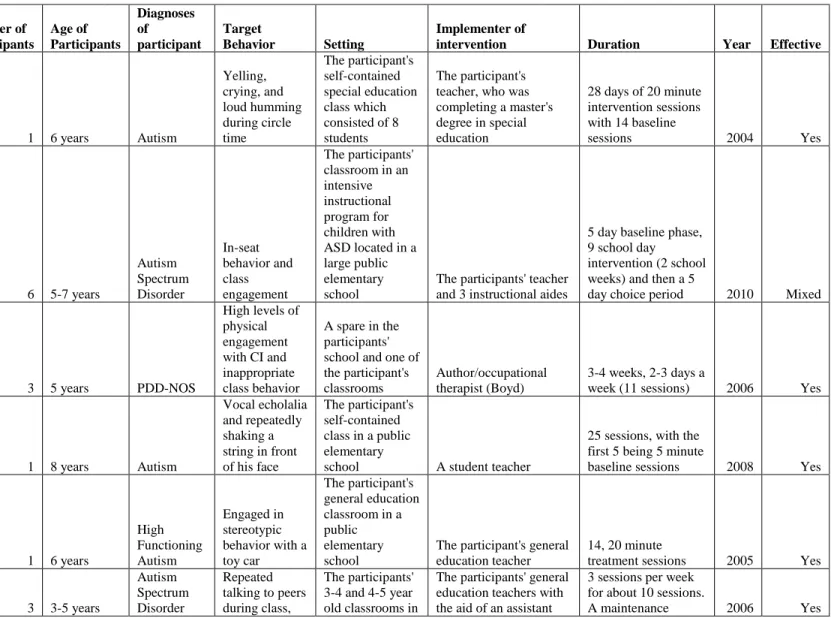
Through further examination of the literature, it became apparent that it was necessary to categorize the data in order to bring out trends revealed by the compilation of sources. First, the most important categories of data were selected from the articles. Then this information was placed in a table with the categories of information in uniform columns and information peculiar to each body of research in a column. The furthest left column contains the article being
Results
The purpose of this literature review was to examine the specific characteristics associated with effective antecedent based interventions for restricted, repetitive behaviors (RRBs). A total of twenty research articles were evaluated and categorized to determine which aspects of the interventions were most associated with a positive outcomes. The current chapter outlines the trends found in each aspect and demonstrates which intervention qualities are most associated with an effective outcome.
Number of Participants
In terms of the number of participants that were utilized in the participant sample of the studies there were no immediately noticeable trends. All of the interventions that were described as less effective used a participant sample of more than one child. The work described by Umeda and Deitz (2011) used two participants, while Rapp et al. (2004) used a participant sample of five children. The study conducted by Bagatell et al. (2010) described a participant sample of six children. Another research article analyzed the largest participant sample out of all the research studies evaluated and used a participant sample of thirty people (Murdock et al., 2014). This could communicate that it is more difficult to illustrate effectiveness using an intervention that is applicable to a larger group. All of the interventions that were reviewed as effective utilized sample sizes that consisted of five or less participants. These research studies also followed a single-case study model, meaning that data were analyzed for each individual participant. Diagnoses of Participants
previously mentioned diagnoses of Down Syndrome and intellectual disability (Ganz & Flores, 2007; Murdock et al., 2014). One group of researchers implemented their intervention using an individual diagnosed with high functioning autism (Conroy et al., 2005). One of the research articles described a participant sample who had a diagnoses of PDD-NOS (Boyd et al., 2006).
There was also not quite enough data to develop a trend relating to the diagnosis of the participants, but two out of the four less effective research studies used participant samples of children who displayed compound diagnoses. These diagnosis included autism, PDD-NOS, and intellectual disability (Murdock et al., 2014; Rapp et al., 2004). One of the studies also included a child who had a diagnosis of Down Syndrome and intellectual disability (Rapp et al., 2004). The majority of the successful interventions were implemented with participant samples of a homogenous diagnoses, although one successful intervention also utilized participants with and without intellectual disability (O’Reilly et al., 2005)
Age of Participants
All of the participants within the literature review were under the age of 15, although the initial target age for the study was elementary school-aged or under 12 years. Ten of the twenty research studies utilized participant samples that ranged in age from 4 to 6 years-old (Agosta et al., 2004; Boyd et al., 2006; Conroy et al., 2005; Crozier & Tincani, 2006; Davis, Durand, & Chan, 2011; Ganz & Flores, 2007; Murdock et al., 2014; Taylor, Hock, & Weissman, 2005; Umeda & Deitz, 2011). Six of the studies used an increased age range of 7 to 10 years (Brusa & Richman, 2008; Haley, Heick, & Luiselli, 2010; Humenik et al., 2008; Lang et al., 2009; Lee, Odom, & Loftin, 2007; Loftin, Odom, & Lantz, 2008). Two of the twenty studies used
the ages of 5 to 7 years. Another study conducted by Rapp et al. (2004) used the broadest age range which consisted of individuals between the ages of 5 to 14 years old.
When examining the age groups targeted by the interventions that were described as less effective, an interesting trend arose. All of the interventions that were less effective targeted age groups particularly within the range of 5 to 6 years (Bagatell et al., 2010; Murdock et al., 2014; Umeda & Deitz, 2011). The other study that illustrated a less effective intervention used children within the age range of 5 to 6 years old, but also encompassed a whole age range of 5 to 14 years of age (Rapp et al., 2004). There was no clear trend that relayed an association between
interventions being implemented during a certain age range, however all of the interventions implemented during the ages four and under were considered effective.
Target Behavior
All interventions evaluated in the literature review addressed RRBs, but there was variance as to which types of RRBs were addressed. These variances included motor stereotypy, vocal stereotypy, in-seat engagement, self-injurious behavior (SIB), and circumscribed interests (CIs). Six of the twenty research articles targeted motor stereotypy (Conroy et al., 2005; Crozier & Tincani, 2006; Davis, Durand, & Chan, 2011; Lang et al., 2009; Loftin, Odom, & Lantz, 2008; Sigafoos et al., 2009). Four of the twenty research articles target both motor and vocal stereotypy (Brusa & Richman, 2008; Ganz & Flores, 2007; Lee, Odom, & Loftin, 2007; Rapp et al., 2004). Four of the studies focused on the target behavior of in-seat behavior, as a result of RRBs
manipulating the participants’ interaction with their circumscribed interests or CIs (Boyd et al., 2006).
When examining the target behaviors addressed by the interventions, three out of four of the less effective interventions addressed the same behavior. This type of behavior either
involved in-seat behavior or class engagement as a result of a RRB, usually sensory oriented (Bagatell et al., 2010; Murdock et al., 2014; Umeda & Deitz, 2011). Overall the target behaviors of the interventions were varied and included differing forms of motor stereotypy and vocal stereotypy.
Setting
The goal of this review was to evaluate interventions that can be used by teachers in the classroom setting. With this goal in mind, fifteen of the twenty articles examined interventions that were implemented in the participants’ general classroom setting. Two of the research studies evaluated an intervention that was implemented in a classroom other than the participants’ classroom (Boyd et al., 2006; Humenik et al., 2008). One of the interventions took place in the child’s home (Davis, Durand, & Chan, 2011). Another intervention took place in a private occupation therapy clinic rooms (Murdock et al., 2014). A third intervention was implemented in either the participants’ classroom, home, or inpatient hospital depending on each participant’s needs at the time (Rapp et al., 2004).
hospital, the child’s home, and the child’s classroom (Rapp et al., 2004). Although the articles that were less effective revealed no trends, the majority of successful interventions were implemented in the participants’ classroom. The vast majority of successful interventions were implemented in the participant’s typical classroom environment, or in a familiar classroom in the child’s school.
Implementer of Intervention
Although the goal of this research was to evaluate interventions that can be implemented by classroom teachers, only eight of the twenty studies used the participants’ teachers as the implementers of the interventions (Agosta et al., 2004; Bagatell et al., 2010; Brusa & Richman, 2008; Conroy et al., 2005; Crozier & Tincani, 2006; Humenik et al., 2008; Schilling & Schwartz, 2004; Taylor, Hoch, & Weissman, 2005). One intervention was implemented by two special education graduate students who were not the participant’s teachers (O’Reilly et al., 2005). Five of the interventions were implemented by therapists (Lang et al., 2009; Murdock et al., 2014; Rapp et al., 2004; Sigafoos et al., 2009; Umeda & Deitz, 2011). In one study the intervention was implemented by both a parent who was trained by an occupational therapist and the child’s occupational therapist (Davis, Durand, & Chan, 2011). Two of the interventions evaluated were implemented by the researchers themselves (Boyd et al., 2006; Haley, Heick, & Luiselli, 2010). For three of the studies, researchers trained typically developing peers of the participants’ and the peers implemented the intervention (Ganz & Flores, 2007; Lee, Odom, & Loftin, 2007; Loftin, Odom, & Lantz, 2008).
therapist (Murdock et al., 2014; Rapp et al., 2004). However within the larger breadth of this research, the vast majority of successful interventions were implemented by the participants’ classroom teachers.
Duration
The duration of each intervention period was measured in different increments from study to study. Some measured the intervention in number of sessions while others were measured in number of weeks. A small number of the studies did not give a clear listing of the duration of the intervention. A total of thirteen of the research studies relayed the duration of the intervention in terms of the number of sessions while five of the studies listed duration by days, weeks, or months. Two of the studies did not give a clear definition of the duration of the intervention.
Most interventions were described by the number of sessions over which they were implemented. The intervention evaluated by Crozier and Tincani (2006) was implemented over nine sessions while other interventions took place over sixty sessions (Sigafoos et al., 2009). The research conducted by Boyd et al. (2006) took place over eleven sessions that took between three and four weeks to complete. Another study by Humenik et al. (2008) was implemented across twelve intervention sessions. Two other interventions were conducted over the course of fourteen to fifteen intervention sessions that were each twenty to thirty minutes in length (Conroy et al., 2005; Lang et al., 2009).The intervention explored by Brusa and Richman (2008) was
length (Haley, Heick, & Luiselli, 2010; Loftin, Odom, & Lantz, 2008). An intervention evaluated by Talyor, Hoch, and Weissman (2005) took place over the course of fifty intervention sessions.
Five of the twenty articles described the duration of the interventions in terms of days, months, or weeks. The shortest intervention period took place over nine days or less than two school weeks, while the longest intervention took place over eight months and was implemented seven times a day (Bagatell et al., 2010; Davis, Durand, & Chan, 2011). The intervention
explored by Schilling and Schwartz (2004) took place over two school weeks and the work done by Lee, Odom, & Loftin (2007) took place over three school weeks. Another intervention was described as being implemented over a four-week period, four to five days a week, with thirty minute sessions (Ganz & Flores, 2007). The intervention evaluated by Agosta et al. (2004) was conducted during twenty-eight days, which translates to a little over five and a half weeks of twenty-minute intervention sessions. The intervention explored by Umeda and Deitz (2011) was implemented over thirteen and a half school weeks.
Two of the articles analyzed did not provide a particularly clear definition of the duration of the intervention. In the article published by Murdock et al. (2014), it was relayed that there were two, five-minute data collection sessions during each intervention period but it was not specified how long each session was or how many sessions took place. The intervention evaluated by Rapp et al. (2004) occurred between twenty and eighty sessions depending on the participant. The intervention was modified until it was successful for all participants (Rapp et al., 2004).
interventions list unclear periods of duration (Murdock et al., 2014; Rapp et al., 2004). These data illustrate that an intervention with a shorter duration period, may not show effectiveness, not because they do not have the capability of being successful, but because the intervention has not had the time to be beneficial for the participant. All effective interventions took place over an intervention period longer than two weeks. This further demonstrates that there is a need to implement an intervention over the course of several school weeks before its efficacy is evaluated.
Year of Intervention:
conducted by Davis, Durand, and Chan (2011) evaluated an intervention that was deemed successful, while the intervention evaluated by Umeda and Deitz (2011) was shown to have no significant effect on the participants’ RRBs. The most recent research was conducted in 2014 by Murdock et al. and described an intervention that had no significant effect on the participants’ RRBs.
Discussion
The purpose of this study was to provide interventions that teachers can use to reduce the occurrence of restricted, repetitive behaviors (RRBs) in children with autism spectrum disorder (ASD) in their classroom. The research found that what worked to reduce the occurrence of RRBs were antecedent-based interventions that required the teacher to change aspects of the classroom environment or stimuli that the students encounter, rather than to provide
consequences after the RRB already occurred. This finding resulted from reviewing a series of research articles that examined the efficacy of interventions that target varying types of motor and verbal RRBs, to determine the factors that contribute to successful interventions. The interventions reviewed specifically targeted the RRBs of children with ASD within the classroom environment. Although RRBs can sometimes be a way to cope with stressful
situations, the time consumed by participating in these behaviors can take away from the child’s learning during class time (Harrop & Kasari, 2015). Because the classroom is a place where students spend a majority of their time, teachers often need to know how to utilize interventions in order for all students to benefit from the education provided in the classroom. This research draws from a pool of twenty articles. By analyzing the factors of successful versus unsuccessful interventions for RRBs, this research provides teachers with helpful strategies to quell the interfering behaviors of children with ASD.
Implications for Teachers
will need to be implemented in the school system in order for teachers to be equipped with the knowledge they need to provide successful interventions for RRBs in a classroom environment.
Target age. A review of the twenty research articles revealed an interesting trend that indicated that 3 of the 4 less effective interventions were implemented between the ages of 5 and 7 years while the interventions implemented before and after this age range were categorized as successful. These data emphasize the importance of early intervention. This calls attention to the need for preschool teachers to receive education concerning interventions for RRBs as well as elementary school teachers. If early education teachers can be more thoroughly trained in interventions that can reduce the occurrence of RRBs in the classroom, they can establish behaviors that promote in-class engagement that can carry on into the child’s elementary school classroom. For example, there is typically little communication between preschool and
kindergarten teachers, especially if the child did not attend a preschool affiliated with an elementary school. If helpful interventions for RRBs that allow the child to have greater
participation in class activities are established in the child’s preschool class, it would be helpful to have documentation of this intervention to pass on to the child’s kindergarten teacher. This also emphasizes the need for teachers to communicate with the child’s parents about what classroom strategies are most successful with the child, so that there can be a greater consistency of intervention use across different settings.
will not disrupt the child’s routine by asking him to transition to another setting (APA, 2013). Antecedent-based interventions are often based in the classroom and focus on enhancing the environment to reduce stimuli that serve as a catalyst to the RRB or introduce a stimulus, such as a visual schedule, that provides cues to help reduce the RRB (Wong et al., 2015). Although antecedent-based interventions focus on changing aspects of the environment, it is important to maintain the teacher as implementer of the intervention. Many children with ASD also have trouble building social relationships with others and this means it may take a longer time to build a fully trusting relationship with a teacher (American Psychological Association, 2013). Rather than introducing a new therapist or teacher in order to implement an intervention with the child, it would be more efficient to educate the child’s existing teacher how to use interventions in the classroom. This eliminates the time that it would take for a child with ASD to become
comfortable with a new adult. In addition, teachers spend a consistent amount of time with students while a therapist may only be able to visit once or twice a week. In contrast, a teacher can work to implement a strategy within the classroom seven hours a day, five days a week. Within the studies analyzed in the literature review, the vast majority of successful interventions were implemented within the classroom and the interventions were administered by the typical classroom teacher. By using interventions within the classroom as a teacher with an
interventionist, this establishes a greater amount of consistency for children with ASD.
Reducing consequences. The information analyzed through the literature revealed that an effective method of reducing interfering behaviors, which often took the form of RRBs was eliminating the factors in the classroom that may stimulate the behavior or by introducing activities that reduce stressful moments that cause RRBs to commence. When utilizing a
respond to the behavior which interrupts the education of the student who is participating in the RRBs and his fellow classmates. By implementing an antecedent-based intervention, the teacher is reducing the factors in the environment that cause the RRB to occur. Eventually this strategy will become a part of the classroom schedule and will not take away from instruction time in the classroom as the teacher will not have to react to what are often deemed problem behaviors. By avoiding the situations that provoke RRBs, the teacher is creating an environment in which there is less stress for the child. In reducing the occurrence of RRBs in the classroom, there will also be less stress for the teacher, because the intervention is a part of the class schedule itself, rather than a separate component to make time for.
Peer engagement. Although RRBs do not fall under the category of social
communication symptoms, a child’s engagement in RRBs can inhibit his engagement with peers in the classroom. One study even demonstrated that RRBs and social engagement illustrated a negative correlation with each other. As social engagement with peers increased for the students with ASD, their engagement in RRBs decreased (Ganz & Flores, 2008). Data such as this cannot determine a causal link, but there is a possibility that as students gain skills that allow them to socialize with peers, they experience a reduction in RRBs. This could be especially applicable if the source of the child’s stress that causes him to engage in RRBs stems from social interaction. It could prove to be valuable to keep the student integrated within typical classroom events while implementing an intervention, so that he can continue to gain productive social skills. Students need to be provided with the opportunity to be included with their peers in a classroom setting while receiving intervention so that they make build the skills to replace their RRBs with more pro-social behavior.
Duration. The data gained from the literature review demonstrated that many of the interventions that used a shorter period of duration for the intervention were less effective, whereas all of the interventions that took place over a period of several weeks or months were more effective. The amount of time that it will take for an intervention to be effective for each individual child will vary depending on the child’s target behavior and temperament, but
resulting in an immediate decrease in RRBs, but should be given a longer period of duration in order for the child to get used to the new schedule and allow the strategies of coping with his RRBs to become a part of his daily routine.
Categories of interventions. Through the preceding literature review, five different categories of interventions were determined that can be implemented in a classroom setting: stimulus control, visual cues, peer-mediated, sensory integration, and schedule-based. These interventions are often used to circumvent different types of RRBs and so by altering separate aspects of the environment.
Stimulus control interventions rely on changing the stimulus that the child encounters directly before engaging in RRBs. This means that the teacher must observe what toys, activities, or situations the child is engaged in before the RRB occurs. Often this type of intervention will introduce a preferred activity to engage the child, before moving on to an academic task that the child may find more stressful. For example, if the child enjoys playing with blocks, the teacher could build strategic periods for the child to play with blocks which could decrease the stress that a child feels during academic work and subsequently reduce engagement in RRBs (Rapp et al., 2004; Boyd et al., 2006; Humenik et al., 2008; Sigafoos et al., 2009; Lang et al., 2009).
Visual cue interventions are often implemented by introducing two stimulus cards to the child. A red card was used to indicate that it was not an appropriate time to engage in RRBs while a green stimulus card indicated that it was a suitable time to engage in RRBs. The child was engaged in an instruction period to explain what each card indicated and then the cards were displayed during appropriate times. This type of intervention provides the student with additional structure dictating when it is acceptable to engage in RRBs (Conroy et al., 2005; Brusa &
Peer-mediated interventions can be used to decrease the occurrence of RRBs in a child by increasing that child’s social engagement. In these interventions, a peer in the child’s classroom is instructed in specific techniques to engage the target child in play and is given opportunities to implement these techniques during group play time. All three of the peer-mediated interventions evaluated, showed that as social engagement increased, the child’s engagement in RRBs
decreased (Lee, Odom, & Loftin, 2007; Loftin, Odom, & Lantz, 2007; Ganz & Flores, 2007). Sensory integration interventions were used primarily to reduce the occurrence of RRBs by addressing hypo-sensitivity to sensory input. This was achieved by providing additional sensory input in order to give the child the input that he is not getting from the typical classroom environment. Many of these interventions relied on providing the participants with vestibular stimulation, such as therapy cushions or balls, which can be utilized while seated in order to improve in-seat engagement (Schilling & Schwartz, 2004; Bagatell et al., 2010; Umeda & Deitz, 2011; Davis, Durand, & Chan, 2011; Murdock et al., 4014).
Lastly, schedule-based interventions were implemented by providing the child with a step by step representation of the school day in order to reduce anxiety surrounding transitions during the day. One way of doing so was providing the child with a picture schedule that provided a picture of each activity that the child would participate in sequential order with a label. Schedule-based interventions could also be implemented by reading the child a social story which
Change of policy. Although it may be inefficient to train teachers in every intervention listed for RRBs, it is necessary for teachers to have greater access to resources for learning how to use interventions in the classroom setting. Often there is a disconnect between the classroom environment and the therapy or interventions that a student receives, as these interventions are sometimes implemented in a pull-out method in which the teacher does not see what kind of intervention the therapist is using. Students can still maintain their pull-out therapies while also receiving consistent attention in the classroom. In order for teachers to provide students with effective interventions for RRBs they must receive training or be able to contact an additional education professional who can help the teacher find the most beneficial intervention for each student and decide how it can be implemented in the classroom.
Limitations
Although this research is derived from a variety of studies, most of the studies included were single-case studies with limited sample sizes. Because the information gained is considered isolated to the small experimental groups, this would make the data less generalizable for the entire population of children with ASD who display restricted repetitive behaviors. Not only were the sample sizes of each research study very small, but there were a limited number of articles that met the inclusion criteria. This meant that there was a limited data pool and may not be considered representative of all antecedent-based interventions for RRBs.
One of the largest sets of limitations was the lack of information provided by many of the research in regard to duration of the interventions. Many of the research articles listed the
frequency or even the length of the treatment sessions, but not the number of weeks over which the sessions took place. Because of this, it was difficult to determine whether or not the
Another factor that could be a limitation in this research is that the participants of the studies evaluated are primarily males. Because the sample pool has a vast majority of males, there are no data indicating whether the interventions that are effective for male students are equally as effective for female students. In this way, it makes it difficult to know if the interventions analyzed will be easily generalized to all students in the classroom.
In addition to almost all of the participants being male, many of the participants had different diagnoses that were not ASD, such as PDD-NOS or comorbid diagnoses. This means that although some interventions were considered successful, they may have a different effect on children with PDD-NOS than children with ASD. Also comorbid diagnoses may affect the severity of the child’s RRBs and how they respond to intervention.
Because the research evaluated is primarily implemented in the classroom setting, it is possible that the benefits may not prove to be as useful to parents as it is to teachers. While these interventions could be applied in several different settings, they are more specifically designed to be implemented by teachers in a classroom setting. Although not all interventions were
implemented in the classroom. Some took place in the home environment and some in a hospital setting. These interventions may not be as effective in a setting where a teacher has to attend to multiple children rather than concentrating solely on the participant.
Implications for future research
majority of the articles that resulted from the literature search primarily focused on social communication symptoms rather than RRBs.
One of the primary areas that demonstrated a need for further research, was the amount of time over which it is necessary to implement an intervention in order for it to be considered effective. For example, a portion of the research articles evaluated did not specify the exact amount of time over which the intervention took place (Murdock et al., 2014; Rapp et al., 2004). It is pertinent for teachers and other education professionals to understand at what period during the course of the intervention that they should begin to see progress, so that they know whether the child’s behavior is progressing in an acceptable manner.
Although all of the research articles outline how a specific intervention was implemented, there is little information provided concerning how a particular intervention is chosen for a child. As such, a guide to what kinds of interventions are suitable for particular RRBs would also be a useful resource for teachers. Being that there are varying types of motor and vocal RRBs, there are equally varying interventions to target each type of behavior (APA, 2013). Although a teacher will typically receive intervention ideas from a therapist or other educational
professional, it would a helpful resource for teachers to have a base of research that dictates which types of interventions are most effective for specific types of RRBs.
further analyze what factors are different between ineffective and effective sensory-integration interventions.
Conclusion
The current study sought to evaluate a body of intervention strategies for antecedent-based interventions for RRBs often associated with ASD that can be implemented by teachers in the classroom environment. It is vital that teachers are provided with effective interventions for RRBs as they spend a majority of the day with students during the week. By implementing antecedent-based interventions in the classroom, teachers can limit the occurrence of RRBs in their classroom rather than taking from classroom time to appropriately react to the behavior. By providing teachers with resources that they can use to develop interventions that can be
References
American Psychiatric Association. (2013). Diagnostic and Statistical Manual of Mental Disorders (5th ed.). Washington, D.C.: American Psychological Association. American Psychiatric Publishing. (2013). Autism Spectrum Disorder. Retrieved from
http://www.dsm5.org/Documents/Autism%20Spectrum%20Disorder%20Fact%20Sheet. pdf
Bagatell, N., Marigliani, G., Patterson, C., Reyes, Y., and Test, L. (2010). Effectiveness of therapy ball chairs on classroom participation in children with autism spectrum disorders. American Journal of Occupational Therapy, 64(6), 896-903. doi: 10.5014/ajot.2010.09149
Berk, L. (2011). Infants and Children: Prenatal through middle childhood (7th ed.). Boston, MA: Pearson Education.
Boyd, B.A., Conroy, M.A., Mancil, G.R., Nakao, T., & Alter, P.A. (2006). Effects of circumscribed interests on the social behaviors of children with autism spectrum disorders. Journal of Autism and DevelopmentalDisorders, 37(8), 1550-1561. doi: 10.1007/s10803-006-0286-8
Boyd, B.A., Mcdonough, S.G., and Bodfish, J.W. (2012). Evidence-based behavioral
interventions for repetitive behaviors in autism. Journal of Autism and Developmental Disorders, 42(6), 1236-1248. doi: 10.1007/s10803-011-1284-z