Alexandra E. Fox. Battle of the Music Recommender Systems: User-Centered
Evaluation of Collaborative Filtering, Content-Based Analysis and Hybrid Systems. A Master's paper for the M.S. in I.S. degree. November, 2007. 104 pages. Advisor: Robert M. Losee
This study analyzes five music recommender systems that are also internet radio systems from a user-centric perspective. Ten artists were chosen and ten songs allowed to play for each artist on each of the five systems. Using a 10 point scale on each of five attributes established by the researcher, an overall score for each system was computed and used to rank the systems. Using the rankings, an attempt was made to establish which method (collaborative filtering, content-based analysis, or a hybrid of the two) provides the best music recommendations. Although the results were somewhat inconclusive, collaborative filtering is shown to play an important role in music recommender systems.
Headings:
BATTLE OF THE MUSIC RECOMMENDER SYSTEMS:
USER-CENTERED EVALUATION OF COLLABORATIVE FILTERING, CONTENT-BASED ANALYSIS AND HYBRID SYSTEMS
by Alexandra E. Fox
A Master's paper submitted to the faculty of the School of Information and Library Science of the University of North Carolina at Chapel Hill
in partial fulfillment of the requirements for the degree of Master of Science in
Information Science.
Chapel Hill, North Carolina November, 2007
Approved by:
Table of Contents
1 INTRODUCTION 4
1.1 Discovering Music on the Internet 4
1.2 History of Music on the Internet 5
1.3 What is a recommender system? 8
1.4 What are recommender systems used for? 8
2 LITERATURE REVIEW 10
2.1 History of Recommender Systems 10
2.2 Relevance Feedback 12
2.3 Types of systems 13
2.3.1 Collaborative Filtering 13
2.3.2 Content-Based Analysis 16
2.3.3 Hybrid Systems 18
2.3.4 Other Systems 20
2.4 Human-Recommender Interaction 21
3 METHODOLOGY 24
3.1 How Systems Were Chosen 24
3.2 Systems Chosen 25
3.2.1 Last.fm (http://www.last.fm) 25
3.2.2 Pandora (http://www.pandora.com) 27
3.2.3 GhanniMusic (http://www.ghannimusic.com) 29
3.2.4 Jango (http://www.jango.com) 30
3.2.5 MeeMix (http://www.meemix.com) 31
3.3 Artists 32
3.3.1 How Artists Were Chosen 32
3.3.2 Artists chosen 33
3.4 What Is A Good Recommendation? 34
3.6 System Testing 40
3.6.1 Computer Set up 40
3.6.2 Testing 41
3.7 Data Analysis 43
3.7.1 Ranking 43
3.7.2 Artist Performance 44
3.7.3 Learning Ability 44
3.7.4 Trust Fluctuation 44
4 RESULTS 45
4.1 The Rankings 45
4.2 Analysis of the Rankings 45
4.3 Artist Performance Across Systems 47
4.4 Trust Fluctuation 50
4.5 System Ability to Learn 51
4.6 Other Opinions 53
5 CONCLUSION 57
5.1 Lessons Learned 58
5.2 Further Research 59
5.3 Future of Recommender Systems 60
5.4 Final Thoughts 61
6 BIBLIOGRAPHY 62
7 APPENDIX 66
7.1 MeeMix Data 74
7.2 Jango Data 66
7.3 GhanniMusic Data 82
7.4 Last.fm Data 89
TABLE OF FIGURES
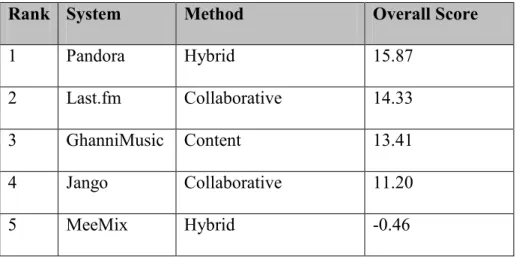
FIGURE 1: ORIGINAL RANKINGS 45
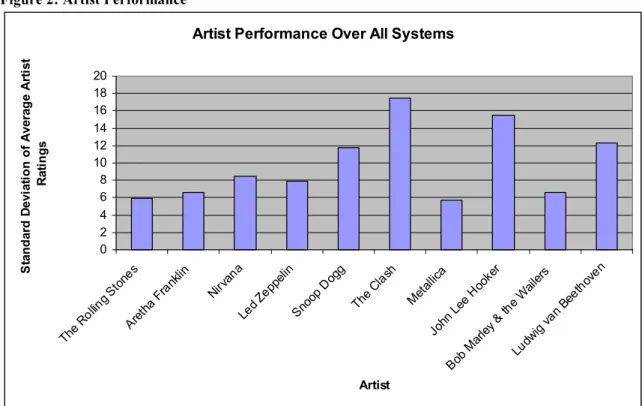
FIGURE 2: ARTIST PERFORMANCE 48
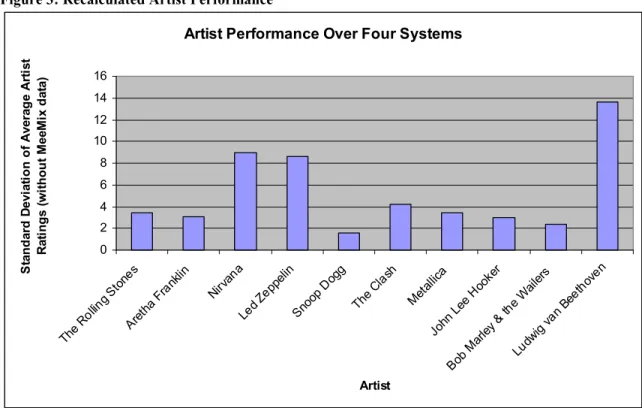
FIGURE 3: RECALCULATED ARTIST PERFORMANCE 49
FIGURE 4: REVISED RANKINGS 49
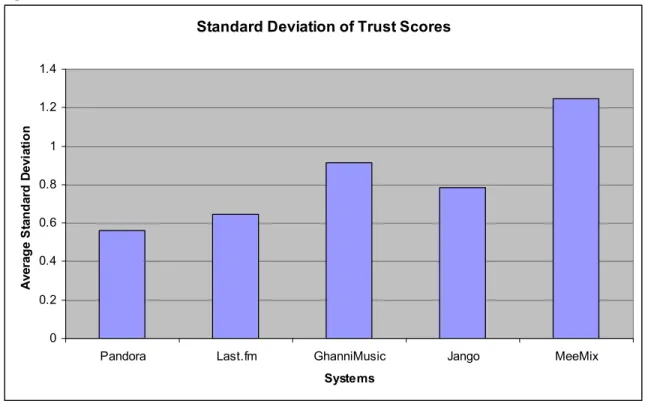
FIGURE 5: TRUST FLUCTUATION 50
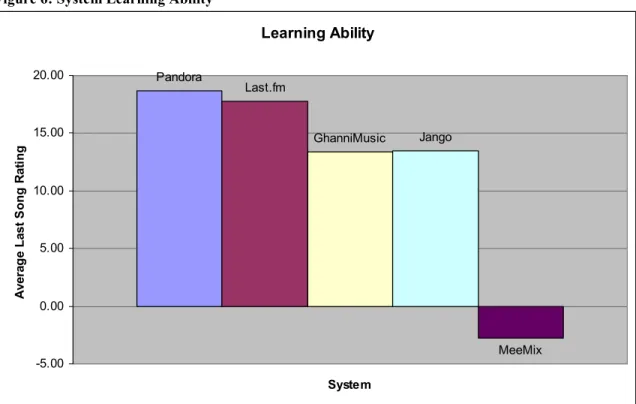
FIGURE 6: SYSTEM LEARNING ABILITY 51
1 Introduction
1.1 Discovering Music on the Internet
Music has never been quite so accessible as it is now. Music lovers all over the
world are connecting with each other through social networking sites built around music
and discovering new music through music recommender systems. The term ‘information
overload’ has become a household word and the phrase ‘google it’ now refers to using
any search engine to help find the information. Recommender systems are just another
way to sort through all that information. However, while google.com attempts to help
you find information you are specifically looking for, recommender systems usually
focus on helping to find items the user will like but were not necessarily looking for
specifically. They help users discover new information on a particular domain, such as
music.
This paper will examine five music recommender systems and rate their
performance from a user-centric perspective in order to determine which provides the
best recommendations overall. In addition, the functionality of each system will be
discussed and analyzed in order to infer which method, collaborative filtering,
1.2History of Music on the Internet
Music on the internet is currently a hot topic. Some have referred to it as an
“internet music revolution” (Collard, 2006, p. 1). The advent of music on the internet
has caused the music industry to scramble to restructure its models for pricing and
delivery methods. In this sense, it truly is a revolution. The music industry has spent the
past ten years fighting the implications of this technology on the grounds of copyright
infringement. Providing a brief overview of the history of music on the internet is a
worthwhile endeavor when analyzing recommender systems in order to show how and
why music recommender systems were developed.
The MP3 file format, the most common file type for music, was first introduced in
1994. The first MP3 player appeared about a year later. The internet at that time was
still fairly new and not widely accessible. While there was almost certainly MP3 file
sharing in the early years, it “was a non-trivial task and … remained a niche activity”
(Collard, 2006, p. 1). As modem speeds and hard drive space increased and users
replaced dial up internet access with broadband access, more and more people began to
use digital music files more and CDs less. More MP3 player software emerged and
peer-to-peer file sharing networks such as Napster emerged and became immensely popular.
The ease and rate of music file sharing alarmed the music industry due to its legal
implications on copyright protection.
Lawsuits have been filed against companies and individuals for illegally sharing
music files - most notably the suits filed against Napster and the criminal charges filed
against some of its individual users by the music industry (artists and record companies).
that Pepsi made commercials about preteens being branded as criminals for illegally
downloading music. While there are still ‘barely legal’ file sharing systems being used
(e.g. LimeWire, Kazaa), the effects of the music industry’s lawsuits against Napster led
to the introduction of Digital Rights Management (DRM) technology and internet radio.
DRM technology is controversial because it prevents the owner of the file, even if
purchased legally, from making as many copies as she likes. Legally this is referred to in
the United States as ‘Fair Use’ (Arnab, 2003). The DRM technology limits the number
of copies and the number and types of devices on which the file can be played. The use of
this technology means that if a legally purchased file is then shared illegally, the illegal
use can only occur a handful of times since the number of copies is limited by the
technology. Unfortunately, this also limits the legal use of the file. Many users feel that
although they legally purchased the file, they do not, in fact, truly own it, since its use is
limited. One study found that DRM technology “restrict[s] personal use in a manner
inconsistent with the norms and expectations governing the purchase and rental of
traditional physical CDs” (Mulligan et al., 2000, p. 77). The music industry is trying to
limit fair use of its digital products and the consumers want to broaden it – or make it
limitless. This perceived ill-will of the record companies against their customers (the
lawsuits, the criminal charges and the DRM technology) has led to customers seeking
other avenues. These other avenues include internet radio, recommender systems and
social networking sites such as MySpace which centralizes its users around music
appreciation. Many of these systems concentrate on recommending non-commercial
artists in an effort to circumvent the record companies’ established protocol and link
In addition to providing lesser-known artists an avenue of discovery and a sales
outlet, the internet and recommender systems are also allowing well-known artists to
break with their record companies and produce their own music. Some artists have been
forming their own record labels and relying on their notoriety and the internet for
marketing. Internet radio and recommender systems make this all possible. By changing
the avenues of discovery from traditional radio airplay to internet radio and recommender
systems and allowing listeners to purchase an individual song rather than a whole album
on a physical compact disc, music is more available and the role of the record company
has been permanently altered.
The record companies have not yet embraced this new technology and have yet to
deduce how to make it work for them rather than against them. The file-sharing lawsuits
and legislation are still transpiring. Many of the lawsuits have not yet been settled or
come to trial. The music industry continues to attempt to adjust to this new environment.
Some record labels have recently abandoned the use of DRM technology. Others are still
pursuing four year old lawsuits. There is also now legislation championed by the music
industry to impose compliance with the payment of royalties and even to raise the rates
that internet radio stations must pay for playing songs. Since some internet radio stations
attempt to fund their services through advertising alone (i.e. they do not charge a
subscription fee to their users) this raise in rates may put them out of business. Those
that do charge fees will be forced to raise them and risk losing clientele. The fate of
internet radio has not yet been decided.
The fight continues, however. It is clear that music consumers do not appreciate
and not the record companies. Given that the record industry has made it more difficult
to illegally access music, many users are turning to internet radio and recommender
systems as an alternative to purchasing new music. Some users have decided that they
don’t need to own it if they can hear it on internet radio. Others prefer to discover new
music, which they may or may not later purchase, using a recommender system.
1.3What is a recommender system?
A recommender system is exactly what it sounds like - a system that provides
recommendations to a user based on that user’s preferences. These systems are designed
to perform the same function as a knowledgeable friend who recommends a restaurant or
a movie. Recommender systems are somewhat like search engines in that they use
algorithms to filter information to provide the user with what it is hopefully only useful
information. However, while search engines attempt to find something more or less
specific based on the search criteria given by the user, recommender systems are used to
find information that is unknown, forgotten or of questionable quality.
1.4What are recommender systems used for?
Recommender systems can and are used for all sorts of purposes. Some common
systems are Netflix.com which recommends movies to its customers, Tivo which
recommends TV programs and movies to its customers and Amazon.com which employs
a system to recommend items for purchase on its website. Users of Amazon.com will
note that a plethora of items are available for purchase which could make
recommendations harder to make. It is always easier to compare apples to apples rather
Although recommendations for sites like Amazon.com can be quite lucrative and
are therefore highly important from a marketing perspective, this study focuses on
non-commercial systems and the methods employed by them to provide recommendations for
a purpose other than exclusively sales and profits. A more exhaustive discussion of
2 Literature Review
2.1History of Recommender Systems
Informal recommender systems have been in use for years. In fact, “even in
prehistoric days, our species relied upon informal collaborative filtering” (Riedl &
Konstan, 2002, p. 1). When prehistoric man encountered a new berry, not everyone in
the tribe ate it right away. Some would wait to see if the others became sick before trying
a new food. If no one became sick, then this acted as a recommendation for eating the
berry. If people did become sick then it served as a negative recommendation for the
berry in question (Riedl & Konstan, 2002). This is a rather simplified view of
recommender systems but accurate nonetheless. Positive and negative recommendations
help others to avoid things that they don’t like or are bad for them and discover things
that they do like.
To continue the prehistoric example, suppose that one tribe came upon another
tribe and shared knowledge. As populations grew and spread, so did knowledge. This is
the basic tenet behind the collaborative filtering method of recommender systems. As
technology has advanced, automated systems have been built and other methods
employed to make recommendations.
The first formal recommender system, named Tapestry, was created in 1992 and
its developers coined the term “collaborative filtering” (Resnick, 1997, p. 56) Developed
filter email from newsgroups using collaborative filtering as opposed to content
analysis (Goldberg & Nichols 1992). Goldberg et al were of the opinion that employing
a human element would improve the system. They did, indeed, find this to be the case.
Any preliminary research on the subject of recommender systems will yield the
names Resnick, Herlocker, Riedl and McNee. Paul Resnick is a self-described pioneer in
the field of recommender systems beginning his research in 1994 with his study of
collaborative filtering of newsgroups at the University of Minnesota using a system
called GroupLens. GroupLens is a system which uses user ratings to recommend news
articles to other users. Jonathan Herlocker is also a former student of GroupLens which
is now led by John Riedl. The GroupLens group at the University of Minnesota has also
now launched MovieLens, which was developed in part by Sean McNee. They have
even launched a WikiLens which appears to be attempting to provide recommendations
for anything and everything users contribute to the wiki. Since this study focuses on
music recommender systems, none of the GroupLens systems will be used. However,
there is a vast quantity of Information Science and Computer Science literature
surrounding recommender systems, specifically collaborative filtering systems, which
bears some relationship to the University of Minnesota and the GroupLens research.
The majority of non-collaborative filtering recommender system research is
relatively recent. Collaborative filtering does have some faults and researchers have set
2.2Relevance Feedback
Before discussing the different methods used by recommender systems, it is
important to note that relevance feedback is a significant element in many recommender
systems regardless of the method employed. Relevance Feedback is a term that comes
from the field of Information Retrieval. The term ‘relevance feedback’ was first coined
by John Rocchio in the mid-1960s from his effort to solve the problem of users searching
a domain whose terminology may be unfamiliar to the user (Belkin, 2000). If users are
not aware of the specific language used in a particular domain it is much more difficult to
find the information sought. This is where relevance feedback becomes invaluable. In
essence, it asks the user to provide feedback to the retrieval system regarding the
relevance of the retrieved information. The system then uses this feedback to tailor
results. Measuring relevance is very subjective much like measuring how good a
recommendation is (see section 3.4). It is arguable whether it is even possible to measure
relevance. However, it is agreed upon that some measure is useful in providing better
results to the user. Relevance Feedback is used to ‘learn’ the individual tastes of the user
and mold the retrieved information to those tastes. Nicholas Belkin (2000) found that
relevance feedback “worked well in an interactive information retrieval environment” (p.
60).
Relevance Feedback works similarly for recommender systems. Belkin’s
research (2000) focused on information retrieval in environments where the use was not
completely sure of what information she was seeking. Recommender systems are similar
in that regard. If the user knew exactly what she was seeking, she wouldn’t need a
most popular method appears to be a binary function with two basic options: “I Like It”
or “I Don’t Like It.” There is also an implicit third option which is to do nothing and
give no feedback. Many music recommender systems also allow the user to skip a song.
This information may or may not be included in the algorithm powering the
recommendations. It is a very useful function in the music domain because it provides
users a method of saying, ‘I may like this song but I don’t want to hear it now in this
context.’
2.3 Types of systems
2.3.1 Collaborative Filtering
As defined by Goldberg & Nichols (1992) “collaborative filtering simply means
that people collaborate to help one another perform filtering by recording their reactions
to documents they read” (p. 61) This definition is in the context of the aforementioned
system Tapestry where information professionals were helping one another save time by
recommending, or not recommending, email documents. However, the definition still
holds across other domains and with novice users. Analogous to the prehistoric man
example, users may not realize they are helping others, but by rating movies on
Netflix.com, one user is helping another user receive better movie recommendations.
As previously mentioned, most of the literature surrounding this topic, Resnick et
al.(1994), Resnick & Varian (1997), Herlocker et al. (2000), Riedl (2002) and McNee et
al. (2006), bears some relation to the GroupLens group from the University of Minnesota.
Collaborative Filtering is the most common type of recommender system and is rapidly
Paul Resnick began the research in 1994 by creating the GroupLens system.
GroupLens was designed to filter netnews and recommend news articles to users using
collaborative filtering (Resnick, 1994). It is still being used today. Resnick later
published a short article comparing five collaborative filtering systems (1997). In it he
discusses the implications of using relevance feedback, which is an essential part of
collaborative filtering. Without feedback (a.k.a. ratings), there can be no collaborative
filtering. Resnick discusses the implications of different scenarios where collaborative
filtering can break down due to user ratings (Resnick & Varian, 1997). Specifically, how
systems handle ratings given by a handful of users but used to recommend items to a sea
of users. Given that relevance feedback is usually voluntary, how well can a system
function if the majority of users are not actively participating in the process? They also
question the level of trust and security in these user ratings in systems that allow user
anonymity. If the user is not accountable in some way for his ratings, how can he be
trusted to provide accurate ratings? These are important obstacles to overcome in a
collaborative filtering system.
Another similar obstacle to overcome in collaborative filtering is how to treat
newly introduced items that have not been rated by anyone. This obstacle has recently
been overcome by incorporating content-based filtering which will be discussed in the
next section.
Johnathan Herlocker, Joseph Konstan and John Riedl, all students of Resnick,
continued collaborative filtering research with their study on automated collaborative
filtering (2000). Automated collaborative filtering uses ratings given by humans and
that collaborative filtering has been successful in entertainment domains (such as music
and movies) but not in other domains (Herlocker et al, 2000). Once again the concept of
trust is examined. User A is more likely to spend $15 on a CD recommended by some
User B who is personally unknown to User A, than he is to spend much more on a
vacation package recommended by User B (Herlocker et al, 2000). How does User A
know he can trust User B’s recommendation when he knows nothing else about User B?
Herlocker et al (2000) also discusses the issue of sparsity of data previously discussed by
Resnick. While collaborative filtering is often very effective, sparsity of data (user
ratings) can also occasionally produce spectacularly bad recommendations. With all this
is mind, Herlocker, et al (2000) created a new system for the University of Minnesota
called MovieLens which recommends movies.
The following year Herlocker again collaborated with the GroupLens Research
Group (Konstan, Terveen and Riedl, 2001) to conduct a study on how to evaluate
collaborative filtering recommender systems. The paper discusses why it is so difficult to
evaluate algorithms and systems since performance may be based on domain or other
factors and because researchers themselves often do not agree on which attributes should
be measured and what metrics should be used (Herlocker et al., 2001). The group
identifies user tasks, datasets and accuracy metrics they believe to be important for
evaluating recommender systems while acknowledging that it is a difficult task that has
not been widely researched
John Riedl and Joseph Konstan published a book titled Word of Mouse on
collaborative filtering and its use in marketing (Riedl & Konstan, 2002). The book is
commercial systems such as Amazon.com. Although it is more of a marketing how-to
guide than a scholarly work on collaborative filtering, it makes some excellent points
about how best to employ this method in a commercial system and includes an example
for Launch.com in the music domain. Unfortunately Launch.com, now Yahoo Radio, is
not included in this study for several reasons. Since it is a highly commercial system it is
not free and it is also largely genre-based rendering it more of an internet radio system
than a recommender system. While it does employ collaborative filtering it does not
allow customization and personalization like the other systems in this study.
2.3.2 Content-Based Analysis
While collaborative filtering has been widely used for many domains for some
time, only recently has content based analysis been extensively studied. Rooted in the
field of information retrieval, it has been principally applied to the domain of text in the
past and only recently has the technology been applied to the domains of media (e.g.
images, video and audio) (Adomavicius & Tuzhilin, 2005). In the domain of music there
are two methods for content analysis: using the metadata from an audio file (e.g. the ID3
tag from an .mp3 file) which is used in normal information retrieval and actually
analyzing the content of the file. For music this means the instruments, the tempo, the
vocals, etc.
In 2000, Pedro Cano, Markus Koppenberger and Nicholas Wack built a
content-based music recommender system which does not use metadata (Cano et al., 2000).
Noting the previously mentioned drawbacks in collaborative filtering systems, they
through obscure or unknown music. As mentioned before, collaborative filtering fails
when there are no ratings - which is frequently the case for lesser known artists in music
recommender systems.
Miguel Ramírez Jávega wrote his 2005 master’s thesis on a prototype
content-based music recommender system he developed at the Universitat Pompeu Fabra in
Barcelona (Ramírez, 2005). In addition to building a prototype and discussing the
algorithm used, his thesis analyzes “the problem of predicting music preferences”
(Ramírez, 2005, p. 21). Unlike Cano’s system, Ramírez’ system does use metadata from
ID3 tags (found on mp3 files) as well as content attributes stored in the SIMAC database1
and the MTG-DB database2. He also enumerates the drawbacks of content-based
recommender systems. Ramírez calls attention the fact that one of the reasons to
employ content-based analysis can also be detrimental to its performance in two different
ways. First, the content being analyzed has a limited number of attributes. In the domain
of music this may or may not be a factor as there are a large number of potential
attributes that can be quantified. The second drawback is that the system might work too
well in that it only recommends items that are very similar and thus closes the door to
discovering “novel items” (Ramírez, 2005, p. 58).
Lastly, Ramírez notes that for those systems that include an element of relevance
feedback, new users will likely not receive as good recommendations as users who have
1
http://www.semanticaudio.com
2
been using (and rating) the system for some time. There is normally a level of effort
required by the user for content-based systems to be effective.
Hoashi et al. describe a music recommender system which uses an audio retrieval
method called TreeQ in conjunction with a relevance feedback element (Hoashi et al.,
2003). The TreeQ method used essentially forms a tree of music which is liked by a
particular user and a tree of music which is disliked. Vectors are then used to determine
which unrated songs that user might like. Hoashi et al., experimented with this system
and determined that it worked well but required a lot of input from the user in the form of
relevance feedback. In an effort to curb the amount of effort required by the user they
examined generating genre profiles but ultimately determined that using the specific
ratings data generated better recommendations.
Most content-based music recommender systems use content gleaned from
metadata and/or musical attributes defined and assigned by humans and then entered in a
database. In contrast, Tetsuro Kitahara examines methods for automatically recognizing
musical instruments in polyphonic music files and its applications to music information
retrieval. If a computer can determine what instruments are present, the pitch and the
timber, the technology could be directly applied to music recommender systems and
alleviate the human workload. This technology appears to be rather young, however, and
is not used in any of the systems in this study.
2.3.3 Hybrid Systems
Robin Burke gives a general overview of recommender systems surveys and
introduces a hybrid system for recommending restaurants that uses collaborative filtering
knowledge-based part of the system enhance the effectiveness of collaborative filtering.”
(Burke, 2000, p. 331)
Although this study concentrates on music recommendations and systems that use
a content analysis rather than a knowledge-based method, others have also found that
hybrid systems often perform better than single method systems in other domains.
Some argue that “secondary content information can often be used to overcome sparsity”
in collaborative filtering systems (Popescul, 2001, p. 437). Since each system has its
foibles “several researchers are exploring hybrid collaborative and content-based
recommenders to smooth out the disadvantages of each” (Popescul, 2001, p. 437). “Pure
collaborative systems tend to fail when little is known about a user, or when he or she has
uncommon interests. On the other hand, content-based systems cannot account for
community endorsements” (Popescul, 2001, p. 437). These are the arguments made by
Popescul before describing the probabilistic method developed by his team for unifying
collaborative filtering and content-based recommendations.
While Popescul’s study focuses on non-specific sparse-data environments,
Melville’s study looks at “content-boosted collaborative filtering” in movie recommender
systems (2002, p. 1). Melville et al., postulate that both content-based and collaborative
filtering fail when used individually (Melville et al, 2002). Using the domain of movies,
the group built a system and implemented both a pure content-based component and a
collaborative filtering component and tested them separately. They then combined the
two using an average of the two systems’ ratings. They ultimately determined that, for
filtering given a heavier weighting, functioned best, hence the name “content-boosted
collaborative filtering” (Melville et al, 2002, p. 1).
Balbanović and Shoham have similar findings in their work with the Fab system
(1997). They begin by providing an overview of content-based and collaborative
filtering methods and their shortcomings. They then propose the Fab System, used for
recommending digital library items, which uses content-based analysis to create user
profiles and collaborative filtering to connect those profiles. The Fab system uses the
advantage of other users’ experiences in collaborative filtering and content based
recommendations for new, unrated items in a digital library setting.
Yoshi’s study (2006) examines a hybrid collaborative filtering and content-based
probabilistic model for recommending music. This system was built and analyzed for
performance. Similar results were found indicating that content-based methodology
enhances the performance of a traditional collaborative filtering system. Yoshi agrees
that collaborative filtering cannot work if there are no ratings available and “that artist
variety… tends to be very poor” (Yoshi, 2006, p. 1).
2.3.4 Other Systems
Although there are more types of recommender systems, as Robin Burkes shows
in her 2002 work on hybrid recommender systems, collaborative filtering and
content-based systems are the two main types currently relevant to music recommendation.
Burke begins by explaining recommender systems and quickly discussing each of the five
traditional methods that drive them. She defines these methods as collaborative,
those systems enumerated by Burke there is also a newly emerging type of system for the
music domain: context-based analysis. As the name implies, context-based
recommender systems are designed to recommend music for a certain context (e.g. a
department store during the Christmas season or a pub on Friday night). However, the
scope of this study only includes collaborative filtering, content analysis and hybrids of
the two since the other methods are either not usually applied to music recommender
systems or context specific. Therefore other types of recommender systems will not be
discussed in detail.
2.4 Human-Recommender Interaction
Jonathan Herlocker, formerly of the GroupLens Research Group, investigated the
evaluation of collaborative filtering recommender systems and identified six elements
that should be included an evaluation. These elements are tasks, datasets, accuracy
metrics, comparing metrics on the same system, identifying which metric are effective on
which datasets and non-accuracy metrics such as user satisfaction (Herlocker et al., 2001)
It is this last class of evaluation metrics that is of interest for this study.
Herlocker identifies the following elements as non-accuracy metrics that should
be evaluated: coverage, learning rate, novelty and serendipity and confidence. Coverage
represents the quantity and variety of items within the dataset with respect to the domain.
Learning Rate is indicative of how quickly the system learns from the user feedback.
Novelty and serendipity represent the system’s ability to make unexpected good
Confidence in this case is defined as the system’s confidence in the strength of
recommendation (where strength refers to an accuracy metric).
Sean McNee, a member of the GroupLens Research Group, has co-authored two
recent articles on the accuracy and performance of recommender system from a more
user-centric perspective. He and his GroupLens colleagues postulate that “most research
up to this point has focused on improving the accuracy of recommender systems” and
that “this narrow focus has been misguided” and “has even been detrimental to the field”
(McNee, Riedl & Konstan, 2006, p. 1097). They argue that “the recommendations that
are most accurate according to the metrics are sometimes not the recommendations that
are most useful to users” (McNee, Riedl & Konstan, 2006, p. 1097). They further assert
that similarity, serendipity and user needs and expectations should play a larger role in
evaluating the accuracy of recommender systems.
In a separate work from the same year, the three men further articulate the
attributes that should be considered when evaluating a recommender system. They
identify eight such attributes: correctness, usefulness, transparency, salience, serendipity,
quantity, spread and usability (McNee, Riedl & Konstan, 2006). Correctness is judged
by the user regarding whether or not the recommendation is good and satisfies his
information need. Whether or not the recommendation is useful is also user-determined
and signifies the probability that the user will employ it or if it is in some way helpful
with regard to his information need. Transparency indicates whether the user
understands why the recommendation was made in the context given. Salience indicates
that the recommendation is notable in some way or that it “stands out” either negatively
Quantity is the number of recommendations received. Spread represents the user’s
opinion of the variety of recommendations or the “percentage of items in the domain
considered.” Finally, usability describes the system interface and its role in
manufacturing a pleasant and effortless experience that also satisfies the original
information need (McNee, Riedl & Konstan, 2006, p. 1106).
One human element relevant in the study of collaborative filtering recommender
systems that has been touched on but not fully discussed yet is trust. In addition to the
Resnick study previously discussed, O’Donovan & Smyth discuss how and why the
trustworthiness of users should be an important consideration (2005). While this is a
valid point, the element of trust should also be examined from a user-system perspective
(see section 3.4). Trust is a system encompasses not only the collective trust in the users,
3 Methodology
In this study, five music recommender systems were evaluated from a user-centric
perspective. Ten artists were chosen and ten songs allowed to play for each artist on each
of the five systems. Using a 10 point scale on each of five attributes established by the
researcher, an overall score for each system was computed and used to rank the systems.
System methodologies were also examined and the rankings scrutinized to determine if
the rankings indicated which methodology produced the best recommendations for one
particular user on one domain. Details of the research and exact methodologies carried
out are discussed in this section.
3.1 How Systems Were Chosen
Many systems were evaluated for inclusion in this study. Ultimately five were
chosen and each is described in the next section. Systems were chosen based on the
following criteria:
1. The system must be capable of playing the recommended music
2. The system must allow a particular artist to be entered
3. The system must employ collaborative filtering, content-based analysis or
some hybrid combination of the two
4. The system must be available for use free of charge
The use of these criteria eliminated many systems. By limiting the study to systems that
double as internet radio systems, the researcher was able to immediately evaluate the
recommendations given even if they were unfamiliar. A system which allows
customization by entering a particular artist can rightly be considered as a recommender
system in that it is supposed to play music similar to the artist entered thus
recommending that music. Limiting the systems by method limits the scope of the study
to only those methods of interest and allows for the potential to not only compare systems
but the methods they employ as well. Using non or less commercial systems aids in
weeding out internet radio systems that are less concerned with music discovery and
more concerned with profits. Disallowing systems that are genre based further limits the
field and further ensures that either collaborative filtering or content-based analysis is at
work behind the scenes. While genre is used in many systems, systems that rely on
genres for recommendations tend to function poorly in comparison – particularly for
users with eclectic cross-genre tastes.
3.2 Systems Chosen
3.2.1 Last.fm (http://www.last.fm)
Owned by CBS with offices headquartered in London and a website registered in
the Federated States of Micronesia to attain the top-level domain country code .fm,
Last.fm is a cross between a social networking site, a music recommender system and
internet radio. Not to be confused with other social networking sites like MySpace,
Last.fm does not allow customization of user home pages and is much more about the
charge with the option of paying to upgrade to a premium user. However, free accounts
appear to have most of the functionality as premium accounts. The main difference is
that during times of high volume usage, customers with free accounts may have their
internet radio cut off in order to preserve service for premium users. In addition, only
premium users have the option to play a personalized internet radio station which
includes artists they already know and like. Both account levels have the ability to play a
radio station of personalized recommendations.
In addition to an internet radio music player which requires a download, users can
“scrobble” music played from their computers or other devices. “Scrobbling”, a term
unique to the AudioScrobbler system which powers Last.fm, also requires the download
of a widget that records and then uploads what music has been listened to. Any music
played on the player is automatically “scrobbled”. Users can add friends and the system
compares musical tastes based on the “scrobbled” songs. In keeping with the social
networking aspect, the system also displays user information about other users who have
similar tastes and allows users to contact each other regardless of whether they have
established themselves as friends.
While the player functions as a recommender system itself, the site also
occasionally displays recommendations. However, for this study, only the
recommendation player, which requires a download, will be used. The player allows the
user to pick an artist as a starting point and then plays a personalized radio station based
on the original artist chosen. This personalized radio station acts as a recommender
station with each song it plays. By incorporating relevance feedback, the player allows
options: a heart, a double arrow and a universal No sign. Clicking on a heart indicates
that he loves the song or that it is a favorite. The double arrow indicates he does not wish
to give it a rating one way or another but merely wants to skip the song. This allows the
user to essentially say that he either has a neutral opinion of this song in general or that he
simply doesn’t feel like hearing it at the moment. The universal No sign indicates dislike
and tells the system not to play it again – ever. It is banned.
Last.fm uses the collaborative filtering method of recommendation. It uses the
songs you have “scrobbled” to learn what songs you like. The obvious theory here is that
if a user played it, she probably owns it and likes it, particularly if it has been played
more than once. The system then compares this information with other users. For
example, user A has scrobbled many songs by The Rolling Stones. User B has also
scrobbled many songs by The Rolling Stones as well as The Who. Last.fm might then
recommend The Who to User A based on user B’s tastes. With only two users and one
band this is somewhat of a risky recommendation. However, Last.fm has data on
millions of users listening to thousands of bands which eliminates much of the risk.
Given its system of ‘scrobbling’ it has more user data than other systems because it is
able to use data generated from sources other than its player. With over 15 million active
users acquired without the use of marketing and only word of mouth, Last.fm has
capabilities that many collaborative filtering systems can only wish for (Lake, 2006).
3.2.2 Pandora (http://www.pandora.com)
In contrast to Last.fm, Pandora is a recommender system that is largely
music. In the beginning there was no thought as to what use they put this classification.
This project was coined the Music Genome Project and only later did it evolve into a
music recommender system and popular internet radio system.
It is technically a hybrid system since it does incorporate an element of
collaborative filtering. But it is not a 50-50 blend. It is impossible to tell how much of
any recommendation is made using content information and how much is collaborative
filtering. However, given that its content analysis is based on the Music Genome Project
and its founder has given many talks around the country about how Pandora generally
works, it seems safe to assume that this system is at least 75% content analysis. Pandora
is a sort of a ‘collaborative-boosted’ content based recommender system.
The Music Genome Project has identified hundreds of musical attributes:
“everything from melody, harmony and rhythm, to instrumentation, orchestration,
arrangement, lyrics, and of course the rich world of singing and vocal harmony”
(Pandora, 2007). Every song is classified according to its “genes.” This classification is
all done by people, most of whom have a background in music.
Pandora does not require a download – merely an Adobe Flash plug-in installed in
the internet browser is needed. Accounts are free of charge but not required. It is
possible to listen to Pandora internet radio recommendations without an account although
without an account, relevance feedback cannot be recorded and recommendations
probably won’t be as good. Much like Last.fm, relevance feedback in Pandora consists
of three elements: a thumbs up, a thumbs down and a skip option.
Although Westergreen declines to answer the question of how many users
since Pandora is driven more my content-based analysis this may not affect its
performance.
Operating as internet radio means that Pandora must pay royalties for the songs it
plays. It also must pay all the people it employs to classify each and every song in the
Music Genome Project. How then can it provide this service free of charge? Pandora
uses advertising and provides inconspicuous links to both Amazon.com and iTunes.com
to purchase the music playing. Pandora receives a percentage of each sale made on
Amazon which originates from their site. This means that if a user clicks on the link to
buy the music from Amazon and then also adds more items to his purchase, Pandora will
receive a percentage of the total purchase.
3.2.3 GhanniMusic (http://www.ghannimusic.com)
GhanniMusic, a French company whose system is currently in beta, is unique in
two ways. Firstly, it is the only entirely content-based music recommender system
included in this study. Secondly, it has a significant constituency of French-language
music in its dataset.
As discussed earlier, content-based analysis can be performed on the content of
the file or on the metadata associated with the file. In this case it would seem that “in
addition to their content-based features related to timbre, pitch and tempo, they are
including features that are typically found in a song's metadata. This includes the year of
release and the genre of the song” (Lamere, 2007). However, GhanniMuisc itself has this
to say about it:
song. This information is grouped into Ghanni’s fingerprint metadata. Ghanni’s fingerprints are independent from the actually used metadata such as genre. Ghanni’s fingerprints are extremely compact (as low as 2KB per song), intuitive, easy to obtain, and easy to use. By leveraging them, cost-effective and attractive personalized services can be launched, both for online and offline modes and whatever the support is (Internet, MP3 Player and Mobile phone). (GhanniMusic, 2007)
Perhaps what is actually happening is that while the metadata is not being directly
accessed, it is included in the ‘fingerprint.’
GhanniMusic requires no special software or downloads (although it does not
seem to function properly in Firefox). It is free and does not use accounts. Since there
are no accounts, there can be no collaborative filtering. This also means there can be no
relevance feedback which may prove detrimental. The user simply enters an artist name
and the system plays a song by that artist. The player continues to play music relevant to
the artist entered until it is stopped or paused. There is no relevance feedback
incorporated in the system so it cannot ‘learn’ the user’s tastes. It can only provide
recommendations determined by its algorithm to be valid for the content of the artist
entered.
3.2.4 Jango (http://www.jango.com)
Jango is a social networking music recommender system whose tagline is
“personal radio that learns from your taste and connects you to others who like what you
like” (Jango, 2006). Jango was founded in 2006 in New York and is currently in beta.
An invitation is required for use at this time although invitations are not difficult to
information. An invitation was received within one day of submission. Using a
university email address may or may not help in acquiring an invitation.
Due to its social networking component, Jango is obviously employing collaborative
filtering behind the scenes. On the surface it appears to be similar to Last.fm. However,
being a rather new system, there is a dearth of information regarding Jango. For
whatever reason they have managed to stay off the blog radar - until recently. They plan
to launch in mid-November of 2007 and claim to have 300,000 beta users (Kirkpatrick,
2007).
3.2.5 MeeMix (http://www.meemix.com)
Headquartered in Tel Aviv, Israel, MeeMix is yet another internet radio music
recommender system that incorporates social networking. The system is currently in beta
and requires an invitation to use the system. Invitations are not hard to come by at this
time, however. All that is required is to go to the website and click on the large blue link
that says, “Click Here To Get An Invitation” and approximately 24 hours later an
invitation is extended. It may or may not have made a difference that a university email
account was used for the request.
Like Pandora, MeeMix employs humans, known as MeeMix musicologists, to
classify the music. This indicates the use of content-based analysis in the MeeMix
algorithm. Unlike Pandora, however, separate stations created on MeeMix are linked.
Unlike most other systems, MeeMix uses a rating scale from -6 to 6 instead of a binary
feedback system. There is no option to skip a song and only a rating of -6 will cause a
other controls to help guide the music played by the system. MeeMix’s ‘Mood Control’
gives the user the option to adjust a ‘Surprise Me’ level from 0-6, a ‘Pulse’ level from 0-6
and a Volume control (0-100).
Like Last.fm and Jango, MeeMix is also a social networking site and encourages
users to contact one another and share their personalized radio stations. Due to the social
nature of the site and system, it can also be assumed that collaborative filtering is also at
work behind the scenes making this a hybrid recommender system. The number of
current beta users is unknown rendering it impossible to predict its collaborative
performance (although it only recently launched in beta).
To elaborate further on how MeeMix works here is a quote from an interview
with the MeeMix CEO:
When a channel is created by a member we consider 3 worlds; behavior, member profile and songs parameters. In a Mee Station there are no play lists, every song you hear was picked up at that same moment in relation to a world of parameters and considerations preformed by our taste engine. Just like the butterfly effect, the members' actions, demographics, rates, immediate
relations and many additional aspects affect the next song you will get. That is the beauty of nature, just like the nature of our preferences. (Stern, 2007)
3.3Artists
3.3.1 How Artists Were Chosen
A list of artists was generated to use on each system. There are 10 artists on the
list representing various music genres and eras. The artists were picked using the
following criteria:
• Consistency of sound – artists whose sound changed significantly (e.g. the
Beatles) were not included (with one exception)
• Genre variety – a variety of genres were chosen
• Era variety – artists from different eras were chosen
• Exceptions – Although the goal of genre and era variety was met, there is also
some overlap. In addition, one artist included did not have overwhelming
consistency of sound. These decisions were partially due to the tastes of the
researcher, but also designed as a test of system performance.
• Familiarity - artists/genres which are unfamiliar to the researcher were not
included
• Likeability – artists/genres not liked by the researcher were not included
3.3.2 Artists chosen
Ludwig van Beethoven
Aretha Franklin
John Lee Hooker
The Rolling Stones
Led Zeppelin
The Clash
Metallica
Nirvana
Snoop Dogg
3.4 What Is A Good Recommendation?
Before gathering the data, a system for evaluating that data on the fly must be
established. In essence the goal of this study is to determine if any one system is better
than another. One way to judge that is to score its recommendations where higher scores
indicate a good recommendation and lower scores indicate a bad recommendation. How
can a user determine if a recommendation is good using something other than a gut
feeling?
Whether or not a recommendation is good is largely based on the user's opinion
and therefore highly subjective. A recommendation is ultimately deemed good if the user
likes the item being recommended and bad if he doesn't. Of course, it is much easier to
make a judgment after the fact - he either liked the song or he didn't. The
recommendation proved to be either good or bad (or perhaps neutral) only after
examination. So, by extension, a good recommender system would be a system that
consistently provides good recommendations.
Although seeking recommendations is an act not generally considered high-risk,
in order to find out whether a recommendation is good there is an element risk involved.
The user must risk a bad recommendation in order to potentially discover a good one.
Common sense dictates that the perceived gain must be perceived as greater than the
potential loss or harm in order for the risk to be taken. Given that the risk of suffering a
bad music recommendation is neither life-threatening nor terribly time consuming, the
risk is likely to be taken. After taking such risks with a recommender system, the user
often discerns a pattern. If the recommendations prove to be frequently good, then over
recommendations are frequently bad, the user will likely discontinue taking the risk of
using that particular system.
There are many factors that can be used to predict whether a recommendation will
prove to be good. As just described above, one of these factors is trust in the source of
the recommendation. In this case, it applies to recommender systems but the general
concept of trusting a system is not that different from trusting a person. Although there is
some argument among scholars on this point, they do agree that a loose definition of trust
can apply to both humans and systems (Friedman, 2000). For the purposes of this study,
relying on a general concept of the idea of trust is sufficient and can be applied to both
humans and recommender systems. The general concept of trust used here will be made
clear shortly.
Morton Deutsch, one of the pioneers in the subject of trust in the realm of
psychology states that "one element common to many usages of [the word] 'trust' is the
notion of expectation or predictability" (Deutsch, 1958, p. 265). As mentioned earlier, a
user may come to trust a system over time which then allows him to better predict the
value of any recommendation from a given trusted system. Consider this scenario: Bob,
who you have known for years and who has consistently provided you with good
recommendations, makes a new recommendation to you. In contrast, Jill, who you met
only a month ago and has never made a recommendation to you, also makes a
recommendation to you. Which recommendation would be considered better? Most
likely Bob's recommendation. Why? Because you trust the source of the
recommendation. Why do you trust Bob? Because you have a history of receiving good
The same is true of systems. People are likely to trust a recommender system only after
having used it for some time and it consistently providing recommendations subjectively
deemed as good. The inverse of this is also true. Have you ever had a friend that you
knew fairly well and even trusted with your life but who consistently made bad
recommendations? You may still like and trust this person but history has proven to you
that her recommendations are bad for you (although someone else may find them good).
You trust that her recommendations are bad. Trust is still playing a very crucial role in
determining the value of the recommendation itself. From this trust, predictability and
expectation are derived.
Trustworthiness is closely linked with credibility. Credibility, particularly when
interacting with other people, is often associated with appearance (Fogg, 2003). For
example, a person attempting to sell insurance neatly groomed and wearing a suit may be
found more trustworthy or credible than an unkempt man wearing torn jeans and a dirty
T-shirt. This is also true on the internet. Site design, user interface and company name
all play an important role in establishing the credibility of a website or a recommender
system. Company names that are well known, such as Microsoft or Google, will have a
higher perceived credibility than those that are not so recognizable (Fogg, 2003). While
all of these elements play a role in determining credibility and trustworthiness, these
elements are outside the scope of this paper. The intention here is to analyze the system
itself, as well as its output (i.e. the recommendation), and not its packaging. Therefore,
the front end design of the system will be mostly ignored.
The question of what makes a recommendation good is still unanswered,
has consistently recommended liked items. But why were those items liked in the first
place? What made them good recommendations? McNee, et al. argue that “salient
recommendations” are “recommendations that strike an emotional response from a user”
(2006, p. 1106). Richins states that many studies “have found emotions to be an
important component of consumer response” (1997, p. 127). Although the systems in
this study are less commercial than others, such as Amazon.com, they are still providing
a consumer product. Unfortunately, an emotional response or a ‘gut reaction’ is difficult
to quantify for a study. What then makes up an emotional response? “An emotion is a
valenced affective reaction to perceptions of situations” (Richins, 1997, p. 127). This
indicates that the situation, or context, is an important element of the emotional response.
The context may be determined by the intended use of the system, the user’s expectation
at any given moment, or a combination of both.
Consciously or unconsciously the user must have set some expectation which was
then met by the recommendation. In music recommender systems, expectations are
usually set by first choosing an artist or a song that the user likes and allowing the system
to choose another song for her based on the knowledge that she likes first song. Just like
a friend, the system knows something about her likes, and perhaps her dislikes as well,
and therefore recommends another song that is either similar in sound/content or liked by
other users who have similar tastes. Regardless of the method used by the system, which
is transparent to most users, there is still an expectation being set by the user and
potentially being met by the system using some sort of similarity measure.
Similarity may be judged by the system in different ways. Content-based
qualities, instruments used, melody, harmony, etc. The user may not even be aware of all
these individual qualities but has a general idea of an overall sound which represents the
complex relationship between all the audio elements. Even this general idea is often
difficult for the user to define (Hoashi, 2003). In contrast, collaborative filtering
similarity is based on a comparison of one user’s tastes to another’s. If one user has
similar tastes to 10 others and those 10 all indicate a preference for an artist that the first
user has not, then that artist is said to be similar to the first user’s over all tastes.
There may, however, be more to her music recommender expectations than
similarity. A good recommendation should be useful as well. To be useful, the user’s
expectation must be met within the context of the intended use. If her expectation is
simply to hear a song that she enjoys then it would also be deemed useful if she enjoyed
it. However, if she set her expectations slightly higher, and hopes to hear something new,
then the recommendation is only useful if the system plays a song with which she is
unfamiliar. Context, or rather the reason she is seeking the recommendation, plays a
crucial role.
As just established, there are many different reasons to use a music recommender
system. Since this paper focuses on music recommender systems that are also music
players the user expectation could be to discover new music in order to simply listen to it.
Or to listen to it in order to make an informed decision about whether or not to buy it. Or
the user may simply want to hear a radio station tailored to his tastes, or perhaps even use
the system to produce a playlist which is used to set the mood for a party. In all these
cases, a recommendation would be deemed good if it meets the user’s expectation –
if, as Belkin states, the user is in an “anomalous state of knowledge” (ASK) and is not
clear on what his information needs are (1980, p. 133)? He knows he wants to hear
music that he likes and he knows what he likes. Beyond that, he may not have any
specific purpose or expectation. If the user is in the ASK state then he is not going to be
able to fully define his expectation until after it has been met. Therefore, while it is
possible to make a prediction about the quality of the recommendation by measuring the
level of trust in the system, the user will not be able to determine the goodness of any
recommendation until after it has been examined.
Having now identified five factors that can affect the user's opinion of whether a
recommendation is good, perhaps a scale can be built in order to quantify the subjective
opinions and emotions of the user in regard to each recommendation. The five factors
are: Trust, Expectation, Similarity, Usefulness and Context. These factors incorporate
many of the eight attributes identified by McNee et al. referenced earlier (McNee, Riedl
& Konstan, 2006). In this case Expectation will capture McNee’s correctness,
transparency and salience attributes. Similarity is a concept not accounted for amongst
McNee’s attributes although he mentions its importance as an accuracy metric. Context
will include McNee’s spread and serendipity attributes. Usefulness incorporates the gut
reaction of liking the song with McNee’s usability attribute. Trust will capture the user’s
level of trust in the system based on all recommendations made before the current song.
3.5 Quantifying the Recommendations as Good or Bad
Using the five factors just established, a formula was generated to quantify the
elements listed above was used. The scale spans from -5 to 5 with a zero value reflecting
a neutral opinion. For the first artist test on each system, the value for trust was set to
zero. The level of trust was then expected to rise or fall as the tests continued in order to
reflect the level of trust in the system as more recommendations were made. The other
four elements were similarly evaluated after examining the recommendation, resulting in
an overall score ranging from -25 to 25 for each song. These values were then averaged
for each artist and those averages further averaged for an overall system score. Scores of
10 or higher were deemed good and scores of -10 or lower bad. Any scores between -10
and 10 were considered neutral or anomalous.
3.6 System Testing
3.6.1 Computer Set up
Now that a scale has been established to use for rating each site, the methodology
of the system testing can now be described. Since all of these systems are web-based and
most likely use cookies, and at least one of these systems attempts to access local
Windows Media Player and iTunes music playing histories, a clean computer was used
for testing. The School of Information & Library Science (SILS) computer lab houses
‘frozen’ computers which return to their original state after each restart. By using these
frozen machines for testing, there was no danger of previous session cookies or
application data skewing results. The PCs in the SILS computer lab run Windows Vista
3.6.2 Testing
3.6.2.1 Creation of Test Accounts
New accounts were created for each system that uses accounts just before the
testing began. This ensured that no previous data collected during the research phase was
used to generate recommendations during the testing. A university email address was
used to create all accounts. For the two systems that required invitations, the invitations
had been issued approximately one week before testing began. However, they were not
redeemed until the day of the day of testing.
3.6.2.2 Determining System Order
System testing order was determined to have little effect on the overall study and
therefore the order in which the systems were tested was somewhat arbitrary.
Considering this, the systems were loosely ordered by user experience. Systems with
which the researcher had the most familiarity were tested last.
System Order:
1. Jango
2. MeeMix
3. GhanniMusic
4. Last.fm
5. Pandora
Ten artist names were printed on a piece of paper and cut into strips of equal size.
During the testing of the first system, fellow students in the SILS computer lab were
asked to pick a strip from a hat to determine a random order for testing the artists. The
same artist order was then used for all subsequent system testing. The artist order is as
follows:
1. The Rolling Stones
2. Aretha Franklin
3. Nirvana
4. Led Zeppelin
5. Snoop Dogg
6. The Clash
7. Metallica
8. John Lee Hooker
9. Bob Marley & the Wailers
10.Ludwig van Beethoven
3.6.2.4 The Test
Testing was conducting over a period of 7 days in the SILS computer lab and
cumulated approximately 30 hours. All systems were tested using Internet Explorer 7
running on Windows Vista. For each system, an account was created where necessary
and each artist was entered in the order previously given. Ten songs were allowed to
play for each artist. Before each song played a trust rating was assigned (-5 to 5). The
evaluated using the same -5 to 5 scale for the following factors: Expectation, Similarity,
Context and Usefulness. Each song, therefore, could potentially score from -25 to 25.
An Excel spreadsheet was used to record song title and artist name for all songs played.
The spreadsheet was also used to record all scores and average scores for each artist and
system were automatically computed during the testing.
Although each system began with a trust rating of zero, trust ratings were carried
over from artist to artist throughout the system test. This allowed the level of trust in the
system to grow or deteriorate over time and usage. It also allowed one artist’s score to be
influenced by the previous artist. This effect can be counterbalanced by observing the
change in the trust score from Song 1 to Song 10 for any particular artist.
3.7 Data Analysis
The simplest way to analyze the data is to simply rank the five systems by their
overall scores. In addition to ranking the systems, which may overlook subtle nuances
that could be important, other analyses were also performed. The methodology for each
analysis is discussed in the sections that follow. An analysis of the actual data can be
found in section 4.
3.7.1 Ranking
Rankings were generated by using the previously described overall average
scores. These scores were generated automatically during the testing by averaging the
average artist scores. The score closest to 25 is deemed the best system and given the
3.7.2 Artist Performance
Performance by artist was examined to determine if any one or more artist(s)
skewed the data. The standard deviation was computed for all average artist scores
across all five systems. Due to the behavior of one particular system, the standard
deviation was again computed across only four of the systems.
3.7.3 Learning Ability
To determine how well the system learned over the course of ten songs, the scores
of the last songs for each artist on each system were averaged and compared across
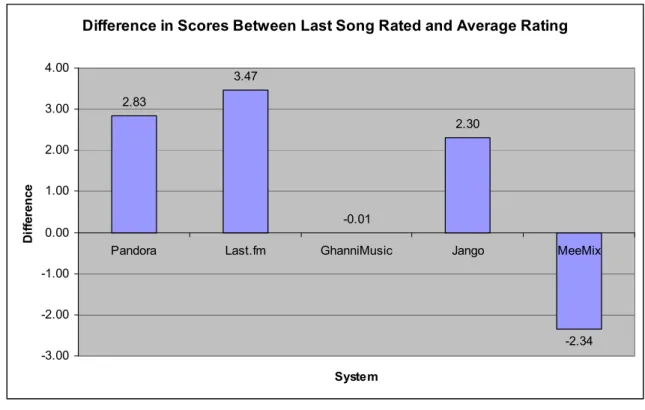
systems. Higher scores may indicate that learning took place. In addition, the difference
between the ratings for the last songs and the overall system average score were also
compared. Last song scores should be higher than the average score if learning has
occurred.
3.7.4 Trust Fluctuation
To determine how the user’s level of trust fluctuated throughout the test, the
standard deviation of trust scores for each artist on each system was computed and then
those numbers were averaged. An average standard deviation closest to zero indicates a