Kristen L. Bowen. UNC-Chapel Hill North Carolina Collection Fiction from 2000-2014. A Master’s Paper for the M.S. in L.S degree. November, 2014. 45pages.Advisor: Dr. Claudia J. Gollop
This study investigated how North Carolina fiction set in North Carolina has developed over the time period of 2000-2014. The North Carolina fiction studied was fiction held in the North Carolina Collection at UNC-Chapel Hill that had been published in the years 2000-2014 and was blogged on the Read North Carolina Novels blog. Seventy-five books were included in the study, and the genres, settings, and authors of these books were examined.
Based on the results of the study, the data revealed that the two most popular genres for the years of 2000-2014 were mystery and romance/relationship. These two genres contain different subgenres and are adaptable to appeal to a wide range of users and also to authors because of their marketability. However, the lack of science fiction/fantasy novels from these years demonstrates the importance of studying North Carolina fiction to determine what is actually occurring within this market.
Headings:
Library special collections --North Carolina Fiction -- North Carolina
UNC-CHAPEL HILL NORTH CAROLINA COLLECTION FICTION FROM 2000-2014
by
Kristen L. Bowen
A Master’s paper submitted to the faculty of the School of Information and Library Science of the University of North Carolina at Chapel Hill
in partial fulfillment of the requirements for the degree of Master of Science in
LibraryScience.
Chapel Hill, North Carolina November 2014
Approved by
Table of Contents
Introduction ... 2
Literature Review... 3
Significance... 13
Background ... 14
Methodology ... 15
Results ... 21
Discussion ... 26
Limitations ... 31
Future Research ... 32
Bibliography ... 34
Appendix A: Book Chart ... 36
Introduction
discover whether novels set in North Carolina have changed in the time period of 2000-2014. This was done by going through the novels on the Read North Carolina novels blog that were published during this time period. The researcher attempted to answer this question by asking the following research questions:
• What genres were more common in North Carolina novels published in 2000-2014?
• When it comes to settings, is it more common to write about rural, urban, or suburban areas?
• Are there more non-North Carolinians writing novels set in North Carolina than there used to be, less, the same?
Literature Review
Bowker, a ProQuest affiliate, states that it is “the world's leading provider of bibliographic information management solutions designed to help publishers, booksellers, and libraries better serve their customers.” In 2012, Bowker published its annual report on U. S. print book publishing for 2011, compiled from its Books In Print database. This report from Bowker is a source of publishing statistics; the 2012 report is the latest to be released to the public. The 2012 report projected over 60,000 fiction books to be
published in 2011. This would make up a little over 17% of the amount of books
published in that year, with a 6% increase in the amount of fiction books published from 2010 to 2011. However, this increase stems mainly from the growth of the
disseminate weekly, monthly, and yearly lists. A reader can see a list that puts the books altogether or one where the books are separated by categories such as nonfiction, fiction, paperback, e-book, etc. These lists are popular and show the popularity of fiction
materials. This study will show what changes have been going on in fiction and possibly help to discover what has become popular in fiction. In this study, emphases is placed specifically on what has changed in North Carolina fiction and will therefore show what has become popular, interesting, entertaining or informative to readers of North Carolina fiction.
The importance of fiction as a whole has been questioned in the past and is still questioned today. One question being asked is whether fiction can be collected alongside history. In September of 2001, the Joyner Library at East Carolina University opened their Eastern Carolina Digital History Exhibits to the public, which included historical items mainly representative of the eastern region of the state, which is the University and library’s target population. Around the same time that the exhibits went public, Joyner Library’s North Carolina Collection received a collection of fiction. This collection was “a remarkable collection of fiction set wholly or partially in North Carolina. The fiction includes some rare items, a number of historical novels, and novels written during
the queue of documents to be digitized.” In her search of the Internet to see if fiction materials were being included in digital history websites, Shires discovered support from the classroom, support from the social sciences, and support from brain research,
neurolinguistics, psychology, and related areas as to the importance of the inclusion of fiction. The conclusion was that, “for a variety of reasons -- educational, social, psychological, biological -- fiction is important in the study of history. Not only can novels and stories be valuable additions to digital history websites, but also narrative structure itself can enhance their usefulness.” Shires decisively found the inclusion of fiction to be a valuable addition.
“documents depicting slavery, literature, education, and religion in the South through the words of the people who experienced and participated in them” (Read).
By going to the Documenting the American South website and clicking on collections, users can see the website divided into categories. The collection, “Library of Southern Literature,” “includes the most important Southern literary works from the colonial period to the beginning of the twentieth century. This collection presents the varied and rich foundation of Southern writing.” The description of “Library of Southern Literature” does not explicitly state that it includes fiction, but fiction falls under the category of literature. However there is another collection that does explicitly state the inclusion of fiction. The collection, “The North Carolina Experience” states, in its description on the collections page, that it includes “representative histories, personal narratives, descriptive accounts, institutional reports, fiction, and other published writings to help users gain greater insight into the diverse social, economic, religious, and political history of North Carolina.” UNC-Chapel Hill librarians count fiction as a part of the North Carolina experience and history.
listed falls closer to what the researcher wishes to convey. Weblog is defined here as, “A frequently updated web site consisting of personal observations, excerpts from other sources, etc., typically run by a single person, and usually with hyperlinks to other sites; an online journal or diary.” The digital history website implemented by the Joyner Library at East Carolina University and the Documenting the American South website at the University of North Carolina at Chapel Hill can both be put into the category of weblog when loosely following this definition. The Read North Carolina Novels blog created and maintained by the North Carolina Collection in Wilson Library at the University of North Carolina at Chapel Hill can also be placed into the category of a weblog.
Returning to the topic of usage of websites/blogs in academia; it may be easier for librarians and the public to understand how blogs could find a place within public
community [by] setting up blogs for each genre – mysteries, horror, science, fiction, romance, etc.” (157). But, serving the community could also be combined with the category “providing reference services.” This category is not given a strict definition but just followed by a statement telling what blogs can do for reference services, “reference should always be up-to-date. Reference blogs can serve the right information in the right time” (Mandal 157). An example of this combination can be seen in the website for Wake County Public Libraries.
reader’s advisory, which is also serving the community and encouraging interaction between the two groups.
Another tool that is used by the Wake County Public Libraries is called “ Book-A-Day,” which is a blog of staff picks that is updated every day with a new book. This tool creates a community of interaction between librarians and the community as well as serving the community by providing reference services, just like the two teen blogs. However, this tool reaches out to a broader audience than the two teen blogs. The blogs posted here are staff picks, which do not have to fit into any specific genre or be for any designated community, like the teen blogs. For these blogs, it is left up to the librarians to decide. With a diverse library population, this tool could help to broadly reach the Wake County public libraries community of users and, since it is on the web, it could even reach beyond just the Wake County community. Those that aren’t a part of the
could use blogs in the same way as public libraries. The Read North Carolina Novels blog is a combination of the teen blogs and the “Book-A-Day” blog. The blog hosted by the North Carolina Collection at Wilson Library is closest in similarity to the “Book-A-Day” blog but also serves a special population like the teen blogs hosted by the Eva Perry Regional Library.
The comparison between the blogs produced by the Eva Perry Regional Library, Wake County Libraries, and the Read North Carolina Novels blog may provide a look into how usage of blogs at academic libraries has come to include uses that may have at first been thought to be most pertinent to public libraries. Additionally, Mandal’s usage categories provide a concept of the way information and library services can put blogs to use. However, neither of these focuses completely upon the usage of blogs in academic libraries. Steven Bell, in his article on library blogs, takes the focus off of the theoretical use of blogs in libraries and specifically discusses their use in academic libraries and what would be needed from these blogs in order to make them a success. Early on in the article, Bell expresses what may have been a common thought when first confronted with the idea that blogs could be used in academic libraries, “Blogs are supposed to be
dynamic, challenging, newsworthy, regularly updated, and even a bit entertaining. The library’s blog is none of the above.” Bell does not refer to any particular type of library, but is referencing library blogs in general, Most blogs are personal and opinionated and how would that fit into an academic library? Even if the library presented a good blog, it wouldn’t be worth much if it doesn’t reach the intended audience (Bell).
about their libraries and the available resources. Soon experiments were under way. Blogs were used as a means to internally communicate, sharing information with library staff. Other libraries set out to make their blogs sources of news. One such library was at Georgia State University. This library created news feeds across many disciplines and gained recognition for doing so, “In addition to standard library news, they offer over 15 feeds for news in fields such as education, economics, world politics, health science, and history” (Bell). These blogs produced by the library at Georgia State University were set up so that individual users could subscribe to them if wanted. Bell believes this ability to be an important factor that could make or break a library blog. The final question that Bell poses is to ask why should it matter to others in the world of academia, such as library administrators and faculty, if their librarians choose to create a library blog. The blog doesn’t take anything but time. The conclusions presented are that these librarians are ahead of their time, which was 2006, and the popularity of blogs just might well be here to stay.
Reinforcing the thought that librarians were ahead of their time and blogs were here to stay, at the American Library Association’s Annual Conference in 2007 there was a poster session devoted to blogs. The poster session, entitled “Blogging Along: Side by Side Library Blogs,” presented the various blogs in use by the Instructional Resource Center (IRC) at Ashland University Library (Schrecker). This University developed blogs that fit into many of Mandal’s categories and provided a broad spectrum of the
another over the blog, an instructional technology blog and what they called “Library Cloud,” which is a collaborative professional development blog. The purpose of this poster session was to show that academic library blogs can be successful, to encourage their usage, and to increase knowledge about how they could be used. The spreading of academic library blog usage was just truly catching on at that time. Today, even more academic libraries are using blogs to reach out to their communities. Also, the
understanding of how they can be used within academic libraries has increased, as well as innovative ideas for their use, such as a way to show their community what the library has available for them to access.
Proceeding to the study presented in this paper, the North Carolina Collection (NCC) is housed within Wilson library on UNC’s Campus. NCC’s mission statement broadly addresses what can be found within the collection, “The North Carolina
In this age of high-speed computer technology, the use of social media to get information out and pull people in has become very common. An example of this is blogging. Bloggers can build their own websites using templates like Wix.com and create a blog that way. Then there are also networks of bloggers; a popular one is Tumblr, a social networking website and blogging platform. Tumblr was created in 2007 and currently has over 197 million blogs on the site. The Read North Carolina novels blog’s first posts are from the year 2008. But, there are books included on the blog that were published as early as 1840 and continuing on into present day. The blog was created to get information out on the novels that are collected by the North Carolina Collection and demonstrate how the history of the state is documented through literature that is set in North Carolina. History is usually associated with nonfiction but novels can be great sources of history as well when based on actual places, events and people.
Significance
likely to collect fiction. However, this work may also be useful to other special
collections like the North Carolina Collection. Finally, this study is significant because no similar research of this of this specific type has been seen by either this researcher nor by the Associate Curator of the North Carolina Collection.
Background
The researcher is familiar with North Carolina as she is a native. In addition she has become familiar with the North Carolina Collection, its mission and its function. This has been acquired through her work with the NCC at Wilson Library. Also, she is in close contact with the NCC novels and the main developer of the collection, the Associate Curator for the NCC, which allowed the researcher to easily access the collection and get all blog questions answered.
Using the blog allowed the researcher to effortlessly exclude novels that are within the collection because they were written by North Carolina authors but not necessarily set in North Carolina. When it comes to collecting novels, the Associate Curator for the NCC usually tries to obtain at least two copies of a novel so that there is a copy that is always kept within the library and another copy that can circulate. This was a big motivation for this study, which focuses on fiction and not nonfiction material. Firstly, the inclusion of nonfiction may make the study too broad and would make it harder to find common ground for the books. But, the fact that a lot of novels in the North Carolina Collection also have circulating copies makes it easier to gain access, for
Searching the catalog, in comparison with the blog, for novels located in the NCC from 2000-present gives 3,787 results. However, that does not separate out the novels written by North Carolina authors but not set in North Carolina, which would narrow down the selection. The ability to separate novels set in North Carolina and those that were written by North Carolina authors, but not set in North Carolina, is not an option in the catalog; this makes going through the catalog a time-consuming effort. However, the blog has 1,027 posts published in the years from 2000 to present day. Factoring in the removal of novels not set in North Carolina would bring the catalog number down, possibly by at least half. Going through the blog provided a good selection of what the North Carolina Collection has to offer from this time period.
Additionally, looking through the blog provided the researcher with an idea of what the novels are about, as well as a feel for what another reader may have thought of the novel. The inclusion of five books from each year enabled the researcher to discover the changes that have occurred in these novels over time. In order to see how North Carolina novels and authors have developed over this time period, the researcher looked at the blog posts for each book that was included and researched the authors of the books in order to discover whether their life experiences may have influenced the settings that were chosen.
Methodology
study. This means the 2000 to 2014 portion of blog posts makes up almost eighty-five percent of the total posts on the blog. Additionally, since the blog only includes novels set in North Carolina, this helped to exclude novels written by North Carolina authors but not set in North Carolina. Since these materials are also collected by the North Carolina Collection at Wilson Library, the catalog includes both and there is no way to distinguish between the two in a catalog search. Performing a catalog search for fiction books in the North Carolina Collection, which were published between the years 2000 to 2014
produced 3,787 results. This means the 1,027 posts that the researcher examined made up at least twenty-seven percent of UNC-Chapel Hill’s North Carolina Collection fiction from that time period. The percentage would be higher for North Carolina fiction set in North Carolina, as stated earlier, the catalog does not provide the choice to narrow the selection down to only novels set in North Carolina. The novels that make up the North Carolina Collection are a combination of novels set in North Carolina and novels written by North Carolina authors. Since, this study focuses on novels set in North Carolina and not on novels written by North Carolina authors, but not set in North Carolina, using the catalog would have also called for the weeding out of these novels. Returning to outlining the study, novels that are written by North Carolina authors and are also set in North Carolina are included in the study and treated the same as any of the other novels.
novels written by North Carolina authors and those written by non-North Carolinians are both included. Additionally, novels that are set in North Carolina, but are set in fictional places were deemed acceptable material as well.
The basic question that the researcher set out to answer from this research is whether, in this time span, North Carolina novels have differed at all. The first focus is upon the themes themselves leading to whether there has been a change in what is more prevalent. Another topic addressed is whether it has become more common for non-North
Carolinians to write novels set in North Carolina or not. Further delving into the
classification of the novels on the blog, the researcher tried to discover if certain genres were more popular to write about at the beginning of this time period than they are now in the present and vice versa.
Study Sample
In order to compare the different elements of these novels, five novels from each publication year, 2000-2014, on the Read North Carolina Novels blog were selected. The first five novels classified under each publication year, from 2000 to 2014, on the blog were selected. Some blog posts were posted under the production year of the movie adaptation of a novel. These were not included so that the integrity of book publication year would be kept intact. Thus, the first five novels listed in a publication year were chosen. Then the blog posts were read, and the classifications studied, in order to
get a feel for their experiences, as well as checked their websites to discover whether the author was a North Carolinian or not.
Data Collection
The description of each book was broken down into the year the book was published, the number of the book from 1-75, the genre of the book, and “author roots,” which designates whether the author is a North Carolinian, Non-North Carolinian or Undetermined. This information was put into a chart which can be found in Appendix A. The use of a chart was chosen so that data could easily be taken out to compare the settings and how they may have changed throughout the years. Numbers were used to identify the books instead of book titles so that the chart would not be overcrowded. The book numbers correspond to book titles and author names found in Appendix B.
For Appendix A, book numbers are listed in order by the years published. The first five books, which would be the first five found on the blog that were published in the year 2000, are numbered 1-5 and this continues on down to number seventy-five. The next element is genre. The Read North Carolina Novels blog contains a list of genres that are used by their bloggers. Most posts are tagged with a genre. If the post had a genre chosen for a book, then that genre was used in the chart. However, if a post was lacking a genre, then the researcher categorized the post into one of the genres listed on the blog. The list on the blog consisted of eleven genres and they are listed here:
• Children & Young Adults • Docufiction
• Horror • Humor • Mystery
• Religious/ Inspirational • Romance/ Relationship • Science Fiction/ Fantasy • Suspense/ Thriller • Urban Fiction.
The genre list did not come with definitions of the genres or how they were categorized. When a post did not have a genre tag attached to it, the researcher went through books categorized under the genres to get a sense of how the bloggers
categorized the books and how the researcher should categorize those that did not have a genre tag. Books can be categorized as more than one genre.
distance; in rural settings there may have been mention of farms or livestock. The designation of rural was reserved for settings that would be considered country.
Last in the Appendix A chart is the element titled “Author Roots.” Under this heading are three categories, North Carolinian, Non-North Carolinian and Undetermined. Authors were considered North Carolinian if they had been born in North Carolina, had lived in North Carolina (not visiting but lived; attending a college or university in North Carolina counted) for any period of time, or is presently living in North Carolina. If none of these were true for the author, then it was the determined that the author was Non-North Carolinian. However, the category Undetermined had to be added after the
researcher found that for some authors there was not enough information to determine if they had ever lived in North Carolina or not. If the researched could not find enough information on an author to designate that author as North Carolinian or Non-North Carolinian, then the category of Undetermined was used. Twelve out of the seventy-five books have an author that falls into the category of undetermined.
The addition of Appendix B was made so that readers could investigate books and authors themselves, if so inclined. The “Book Number” section in Appendix A
corresponds to the book numbers in Appendix B. Refer to Appendix B to find the book titles and author names that were not included in Appendix A.
Data analyses of the results are based on the three research questions:
• When it comes to settings, is it more common to write about rural, urban, or suburban areas?
• Are there more non-North Carolinians writing novels set in North Carolina than there used to be, less, the same?
Results
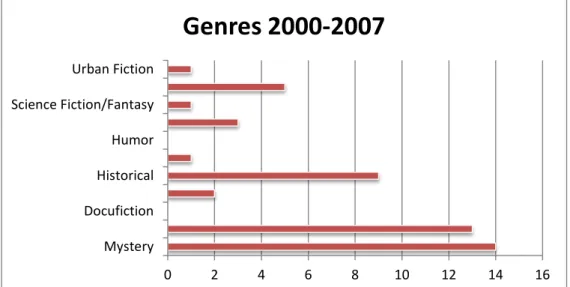
There were seventy-five books chosen from the publication years 2000-2014 on the Read North Carolina Novels blog. Since books can have more than one genre, there were more than seventy-five genre categorizations. Overall, there were ninety-one genre categorizations, and the genre percentages were taken out of this number. 30% of the books were mysteries, 27% of the books fell into the category of romance/relationship, none of the books were categorized as docufiction, 6% were children & young adults books, 14% were classified as historical, 1% were horror books, none of the books were classified as humor, 8% were religious/inspirational, 2% were science fiction/fantasy, 9% were categorized as suspense/thriller, and 3% of the books were urban fiction novels. Out of all the genres, the two most popular for the years of 2000-2014 were mystery and romance/relationship. None of the other genres came close to the popularity of those two.
romance/relationship (29%) remained the most popular genres to be written about. However, historical (9.5%) became less popular over the years, lowering in popularity by almost half. Also, in the years 2000-2007, mystery and romance/relationship had only a 1% difference with romance/relationship being the most popular. Between the years 2008-2014, mystery has taken the lead in genres with 2% higher than
romance/relationship.
Figure 1: Genre Categorizations from 2000-2007
Figure 2: Genre Categorizations from 2008-2014
0 2 4 6 8 10 12 14 16
Mystery Docufiction Historical Humor Science Fiction/Fantasy Urban Fiction
Genres 2000-2007
0 2 4 6 8 10 12 14
Mystery Romance/RelationshipDocufiction Children & Young AdultsHistorical Horror Humor Religious/Inspirational Science Fiction/FantasySuspense/Thriller Urban Fiction
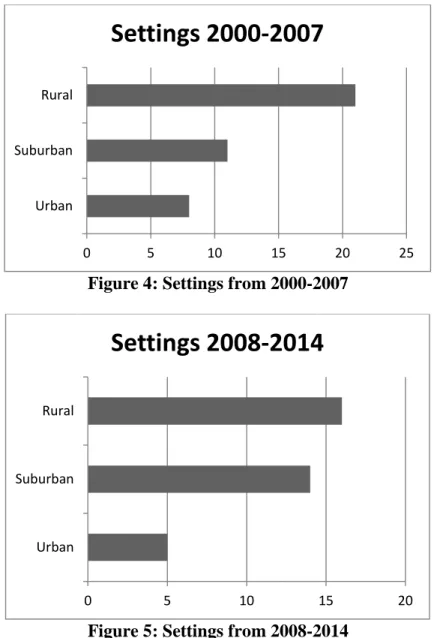
Out of seventy-five books, 37 of them took place in rural settings, 25 in suburban and 13 in urban settings. Rural settings made up almost fifty percent of the settings, showing that rural areas are the most commonly written about. The complete results can be viewed in Figure 3. The researcher also separated these out into the years of 2000-2007 and 2008-2014; figures 4 and 5 display the numbers for these. For the years of 2000-2007, rural areas make up more than half of the settings with 52% of the books being set in rural areas. The percentage of books set in suburban areas was 28% and the percentage set in urban areas was 20%. In the years of 2008-2014, rural areas remained the most popular settings, but suburban moved up to a close second. Rural areas made up 46% of the novels, 40% were set in suburban areas, and 14% of the novels were set in urban areas. Overall, the setting of North Carolina novels in rural parts of North Carolina has remained popular, not falling far below 50%. Also, the use of suburban settings has increased in popularity so that it is up to 40%, which makes it a strong second behind rural settings.
Figure 3: Settings Percentages for 2000-2014 Rural
49% Suburban
33% Urban
16%
Figure 4: Settings from 2000-2007
Figure 5: Settings from 2008-2014
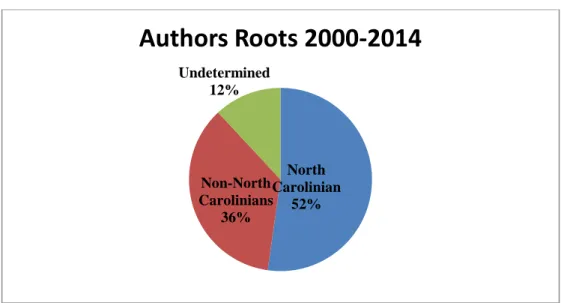
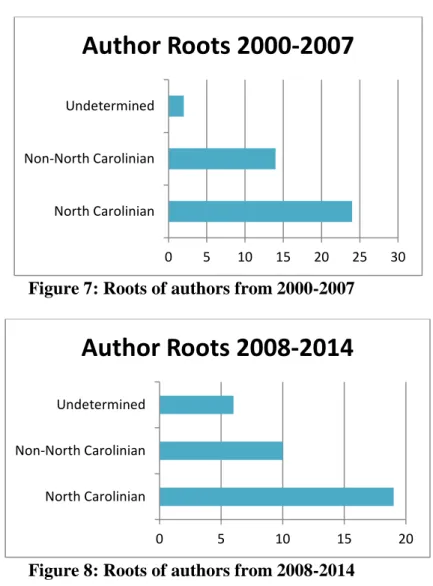
The last category recorded in Appendix A provides information on whether the authors of the novels are North Carolinians, Non-North Carolinians, or Undetermined in origin. Figures 6-8 respectively depict the overall percentages for the years 2000-2014 and the results broken down into the years 2000-2007, and the years 2008-2014. North Carolinians were the highest occurrence, making up 52% of the authors. Non-North Carolinians made up 36% of the authors and 12% of the authors were classified as Undetermined. The majority of the authors of novels set in North Carolina from
2000-0 5 10 15 20 25
Urban Suburban Rural
Settings 2000-2007
0 5 10 15 20
Urban Suburban Rural
2014 are North Carolinians, meaning they have lived in North Carolina at some point in their lives.
When the results were broken down into the years of 2000-2007, there were 24 authors that were North Carolinians, which makes up 60% of the authors from these years. Non-North Carolinians came in second with 35% and 5% were Undetermined. With over 50%, North Carolinians were writing the majority of the novels published from 2000-2007. In the years of 2008-2014 there is a shift. The amount of North Carolinians decreases to 54%. However, the thought that this would mean an increase in the number of Non-North Carolinians writing these novels is proved incorrect. Non-North Carolinian authors also decrease, from 35% to 29%. The increase is seen in the number of authors classified as Undetermined (17%).
Figure 6: Categorization of Authors for 2000-2014
North Carolinian
52% Non-North Carolinians
36% Undetermined
12%
Figure 7: Roots of authors from 2000-2007
Figure 8: Roots of authors from 2008-2014
Discussion
One interesting development within the genre categorizations is the fact that there were only two novels out of the seventy-five that were classified as science
fiction/fantasy. This genre is extremely popular today and it is fascinating to note that this is not a popular genre in North Carolina fiction. There wasn’t even an increase in the number of novels classified as science/fiction fantasy from the collection of years 2000-2007 to the collection of years 2008-2014. Both only had one science fiction/fantasy book. Altogether, the genre percentages presented earlier displayed a proclivity for
0 5 10 15 20 25 30
North Carolinian Non-North Carolinian Undetermined
Author Roots 2000-2007
0 5 10 15 20
North Carolinian Non-North Carolinian Undetermined
authors to write North Carolina books that fall into the genre categories of mystery (30%) and/or romance/relationship (27%).
When the genre results were divided into the two different year collections, the historical genre was shown to have decreased in regularity by almost half. This was an interesting find as the assumption was that it would have become even more popular to write historical novels over time. Also, in both year collections, romance/relationship was one out of the two highest reoccurring genres. It is not a surprise that the
romance/relationship genre has remained popular throughout the years. In her article discussing the importance of including the romance genre in library collections, Kellie Tilton touches upon the success of paranormal and fantasy, which includes science fiction. This hearkens back to the interesting development of only two novels being classified as science fiction/fantasy throughout the years of 2000-2014. Throughout the article, Tilton also discusses different types of romance fiction, such as westerns, historical romances, and also the paranormal fantasies. This is another reason the
continual popularity of the romance/relationship genre is not surprising to see. There are many subgenres of romance fiction and these just continue to grow, “Once rigid lines that defined the genre are beginning to blur, and new ideas, trends, and subgenres are able to claim room for themselves in the market. The subgenre heavy hitters--contemporaries, historicals, and paranormals--continue to grow and evolve, inviting new readers to jump in while bringing longtime fans back for more” (Tilton). The romance/relationship genre is easily adaptable to reach a broad spectrum of readers.
would even say they are the same thing. However, Carl Malmgren, in his article
discussing the anatomy of murder in fiction discusses the differences in the genres. In the Read North Carolina novels blog, detective fiction and crime fiction would be
categorized as mysteries. But, Malmgren is ultimately using these distinctions and descriptions to explain the popularity of mystery fiction. He states, “…then, the
transformations and revisions that murder fiction works upon basic novelistic signs make for very different narrative forms and reading experiences, all of which helps to explain the popularity that this kind of fiction enjoys” (Malmgren). Just like with the
romance/relationship genre, mystery fiction can have many different subgenres and its adaptability allows it to appeal to a wide range of readers, and also authors as there is a continual market for both of these genres. Therefore the lack of science fiction/fantasy novels included in the study is unexpected due to the present demand for this genre. Nonetheless, the most popular genres being romance/relationship and mystery was not unexpected as these genres are timeless in their popularity.
Conclusions to the first research question, "What genres were more common in North Carolina novels published in 2000-2014,” are drawn by pulling together the results of the first category of genre in Appendix A; the results are also seen in Figures 1 and 2. The overall most popular genres are mystery and romance/relationship. This remains true when the years are broken down into two collections, the most significant difference between the two collections being the growth of the historical genre over the years.
discoveries. The overall settings percentages show that it was more common to write books that were set in rural areas of North Carolina in the years 2000-2014. This was also an assumption the researcher had because of the continual decrease of rural areas in the state. The researcher thinks that the decrease in rural areas can cause nostalgia for more rural areas and therefore there is an increase in the percentage of North Carolina fiction set in rural areas. However, when broken down into the separate collection, the resultant numbers show a noteworthy change in settings from the years of 2000-2007 to the years of 2008-2014. Refer to figures 3-5 and Appendix A to see this information. Urban areas have become less popular by 6%. However, the significant changes are seen in the rural and suburban area settings. Setting novels in suburban areas of North Carolina has become over 10% more popular and setting novels in rural areas has decreased by 8%. But, the increase in novels set in suburban areas could account for the change in percentage of novels set in rural areas. Overall, rural areas remain the most common settings for North Carolina fiction, which was suspected to be the case, but the move towards writing novels set in suburban areas was an unexpected turn.
Non-North Carolinian writers of North Carolina fiction decreased, the percentage of Undetermined authors increased from 5% to 17%. North Carolinians have remained in the majority for the authors of fiction set in North Carolina, but the increase in authors being categorized as Undetermined was worth noting. There was an assumption that over the years,there would be an increase in authors that were self-publishing. The Bowker annual report on U.S. print book publishing mentioned the increasing popularity of self-publishing as a reason for the self-publishing numbers to have shown an increase from the 2010 to the 2011 report. Many of the books, from the years 2008-2014, that had authors classified as Undetermined were self-published.
Marc Bousquet, an associate professor of English at Emory University, discusses the development and increasing popularity of self-publishing in the U.S. book market in an article published last year. Bosquet mentions how digital publishing “hit its stride” around 2008. There had been a much discussed crisis in scholarly publishing which was related to the crisis that traditional publishers were facing in working to distribute literary and mass-market fiction (Bousquet). Many new and/or upcoming writers could not get contracts or were receiving advances so low that the authors could not continue to produce. Young writers could no longer imagine making a living by writing, not even writing mass-market fiction. However, when digital publication “hit its stride” in 2008, things were turned around. Some self-publishers were made into millionaires, while other up and coming writers are now living comfortably after having self-published
(Bousquet).
author, for the researcher to determine whether the author was a North Carolinian or Non-North Carolinian. Most did not even have a Wikipedia page and, if they did, there was no more than a paragraph included on the page about the author. The numbers for the years 2008-2014 prove the assumption of an increase in self-publishing to be correct. However, the effect that self-publishing had on obtaining information about authors was not foreseen.
Limitations
Since the study does not cover all of the novels from 2000-2014 held within the North Carolina Collection, the results could be skewed as the entire collection was not included in the study. However, there is the precedent of other studies using samples when studying the whole is not possible or necessary. The North Carolina Collection’s mission statement speaks of documenting the history and literature of the state, amongst other things. The researcher interprets this to mean that novels relating to North Carolina are collected without prejudice. However, collection development is often at the
Therefore, the researcher was unable to determine the roots of all authors, whether they are North Carolinian or Non-North Carolinian, and had to introduce the category of undetermined
Future Research
Bibliography
Bell, Steven. "The Library Blog: Innovative Idea or Wasted Words." Library Issues 26.3 (2006). Print.
Bousquet, Marc. "A Self-Publication Gold Rush?." Chronicle Of Higher Education 59.35 (2013): A52. Academic Search Complete. Web. 27 Oct. 2014.
"DocSouth Collections." Documenting the American South. University Library, University of North Carolina at Chapel Hill. Web. 15 Sept. 2014.
“fiction, n.” Merriam-Webster.com. Merriam Webster, September 2014. Web. 16 September 2014.
Malmgren, Carl D. "Anatomy Of Murder: Mystery, Detective, And Crime Fiction." Journal Of Popular Culture 30.4 (1997): 115-135. Academic Search Complete. Web. 26 Oct. 2014.
Mandal, Partha Sarathi. "Blog And Its Role In Library And Information Services."
DESIDOC Journal Of Library & Information Technology 31.3 (2011): 155-158. Library, Information Science & Technology Abstracts with Full Text. Web. 16 Sept. 2014.
“novel, adj.” Merrian-Webster.com. Merriam Webster, September 2014. Web. 16 September 2014.
Perry, Lisa. Personal Interview. 12 April 2014.
"Publishing Market Shows Steady Title Growth in 2011 Fueled Largely by Self-Publishing Sector." Bowker - Publishing Market Shows Steady Title Growth in 2011 Fueled Largely by Self-Publishing Sector. Ed. Beth Dempsey. Bowker, 5 June 2012. Web. 15 Sept. 2014.
Read, Brock. "First-Person Accounts of the American South Fill Web Site at the U. of North Carolina." The Chronicle of Higher Education. The Chronicle, 26 Apr. 2002. Web. 15 Sept. 2014.
Schrecker, Diane L. "Using Blogs in Academic Libraries: Versatile Information Platforms." New Library World 109.3 (2008): 117-29. ProQuest. Web. 16 Sep. 2014.
Tilton, Kellie. "The Heart Of Romance." Library Journal 139.17 (2014): 42. Academic Search Complete. Web. 26 Oct. 2014.