Eric B. Forster. Future Directions for Identifying and Collecting Open Access Electronic Resources in the Humanities. A Master’s Paper for the M.S. in L.S degree. April, 2009. 55 pages. Advisor: Jeffrey Pomerantz.
This paper presents research on the collection status of four different open access scholarly electronic resources in the humanities – the Stanford Encyclopedia of
Philosophy, the Perseus Digital Library, the William Blake Archive, and NINES – among 110 university library members of the Association of Research Libraries (ARL). The necessity of collecting these resources not due to the building of a permanent collection of materials, which is likely impossible with the current structure of scholarly electronic resources; it is a user service: by the act of providing an access point to open access resources, libraries provide the scholarly and academic context for patron experience in a manner that open web search cannot. Current aggregations like DOAJ and OpenDOAR are assessed, along with electronic resource management tools, in order to make
recommendations toward facilitating the collection of high quality open access resources in ARL online public access catalogs (OPAC).
Headings:
Academic libraries--Collection development Humanities--Digital libraries
by Eric B. Forster
A Master’s paper submitted to the faculty of the School of Information and Library Science of the University of North Carolina at Chapel Hill
in partial fulfillment of the requirements for the degree of Master of Science in
Library Science.
Chapel Hill, North Carolina April 2009
Approved by
Table of Contents
Introduction 2
Library Collections as Scholarly Context 4
Methodology 7
Open Access Electronic Resources Profiles 10
DOAJ and OpenDOAR – Open Access Aggregators 16
Data Analysis: ARL OPAC’s and Websites 19
Comparative Analysis 22
Recommendations for Collecting Open Access Electronic Resources 25
Conclusion 27
Notes 29
Appendix A – Operational Definitions 33
Appendix B – ARL Libraries 34
Appendix C – WorldCat Data 40
Appendix D – Library Website Data 43
Introduction
Open access electronic resources present unusual problems for collection development. No longer constrained by budgets, cost inflation, deadlines, and the aggressive business models of many publishers, selectors seem free of the typical constraints that limit collections of electronic resources. Yet, the complexity of open access electronic resources – varying in form from databases, to peer reviewed journals, to online collections, to digital libraries – combined with the lack of typical restrictions, may cause these valuable items1 to be neglected, falling out of the priority workflow. Like gifts, open access electronic resources may seem to entail too much trouble and expense to be worthwhile to an academic library.
maintaining title authority and URL’s in the library catalog may be particularly difficult for many resources, especially if they are not tracked by electronic resource management tools as parts of larger collections.3
Library Collections as Scholarly Context
Recognizing context building as a user-centered approach to collections is important for research involving electronic resources.6 With open access electronic resources, which exist on the Internet for all to peruse, a catalog entry in the library’s OPAC represents the act of collection. There is no locally present physical item toward which the OPAC directs a patron. Despite the physical remove of the resource – and its resulting autonomy from the library – it is still important for collections to include such resources as catalog items. While many academic institutions incorporate search boxes for Google and Google Scholar, for the purposes of this study, Google searches will not be considered the act of selecting open access electronic resources as a user service. On the one hand, Google is still far too broad a search to return results that allow the library to act as a quality filter for information; on the other hand, Google Scholar is oriented toward print resources that have been digitized, and does not give direct links to born digital material such as the materials analyzed in this study.7
with certain kinds of queries, as it is a resource that provides access to a larger academic context of multiple libraries – so why would it be accepted practice to refer that same patron to Google in order to find The William Blake Archive, instead of the library OPAC? The answer is simple, at least in the case of many academic libraries: the reference
librarian uses Google because there is no other choice; The William Blake Archive may not be available in the OPAC, on subject or course pages, or in an A-Z list.
Further, Google is not as consistent as might be imagined, regarding its display of open access electronic resources. For a general search on the topic of “William Blake” on the Google main page, The William Blake Archive is listed prominently in the second position, behind the Wikipedia entry on Blake. While it almost goes without saying that
Methodology
The collection habits of a large selection of members of the Association of Research Libraries (ARL) are examined regarding whether they collect any of a small group of open access electronic resources. This is done to determine whether there are meaningful differences in their frequency of collection, and if so, upon what these differences depend. This information will be considered in recommending best practices for ensuring all open access electronic resources that might be desired for
library-centered access are collected more efficiently, in terms of collection development work flow.
The 110 ARL libraries12 examined in this study were chosen for their affiliation with institutions of higher education whose primary language of instruction is English. Thirteen ARL libraries were left out of the study,13 either because they had no affiliation to a formal academic institution of higher education, because their primary language of collection or instruction is not English, or because their OPAC was unavailable during the data-gathering period.14 The four electronic resources that were chosen for
comparison across the collections of the 110 ARL libraries were picked due to quality of content, robustness, institutional affiliation,15 and variety of form: there is one
available on a library’s website, but not present in its catalog. Accurate representation of library catalogs would lend credence to the notion of using WorldCat as a tool for
assessing peer institution collecting habits, and suggest that those libraries providing access to a particular resource, but not cataloging it the resource in the OPAC, modify their cataloging process to include open access electronic resources, in order to aid bibliographers in their assessment of peer institution collecting habits.
On the websites of the 110 selected libraries, both title and keyword searches were conducted. This was done in the general catalog, in the electronic resources section (i.e. the A-Z list), and in subject guides. Variant titles were attempted.16 Searches were conducted with reasonable effort and within the realistic time constraints of 10 minute maximum allowed. If some failures of cataloging or interface have caused false negative results to be reported, these are interpreted as uncollected resources. If patrons, or even librarians, cannot find resources held in collection with a reasonable search, then effectively those resources are not in collection. This is particularly the case with e-resources. In other words, open access electronic resources must be accessible enough through a library’s website, in order that it may contend with Google in terms of efficiency. “Contend” is here understood as a subjective assessment, granting considerable leeway to library OPAC and website performance. Few of the searches responded as quickly as Google might, but all provided much better contexts, both for searching and in retrieval.
Google Scholar is entirely, and surprisingly ineffective for discovering the resources searched for in this study, as they are born digital. Google Scholar returns zero results for searches regarding the four open access electronic resources in this study, as they are outside of its scope.
Open Access Electronic Resources Profiles
The Stanford Encyclopedia of Philosophy (SEP) was founded in September of 1995, by John Perry,17 who at the time was director of the Center for the Study of Language and Information (CSLI), already having been twice chair of Stanford’s Philosophy Department and President of the Pacific chapter of the American
Philosophical Association.18 Thus the Stanford Encyclopedia of Philosophy came into being with a considerable academic pedigree. It was initially conceived as a static encyclopedia, similar to a print edition. Edward Zalta had been senior researcher at the CSLI for six years when the SEP was founded. He developed it into the dynamic aggregating resource it is today.19
The project received seven grants, totaling $1,884,128, from 1998 through 2007.20 Further, the SEP has involved libraries in its funding, generating an endowme from donations from libraries at universities with philosophy programs. This prov operating funds for the project. The endowment is to be returned to library donors if the project should the project ever come to termination.
nt ides
21
This is an unusual business model, requiring an initial outlay of funds, which are then used to support the project in
perpetuity. Typical business models – even those originating from academic institutions – require yearly maintenance fees to be paid, despite considerable front-end cost.
The result, however, is perpetual open access, as all operating costs would be accounted.23
A particularly robust feature of the SEP is its stability for citations, despite being an aggregating resource. This is because its software design is such that it “automatically creates an archive every quarter, providing the proper basis for scholarly citation.”24 Further, the SEP is designed both with an automated use tracking system to monitor user actions on the site, and with “software [that] dynamically cross-references the SEP when new entries are published,”25 which also reports link errors.26
The quality of contributed articles is high, as they are “rigorously refereed,”27 prior to publication. Its content includes over 750 articles and nearly 8 million words,28 all of which are written by faculty from academic departments of wide-ranging
institutions, including several abroad. All contributors are named as subject editors, and in almost every case their professional information is available via hyperlink.29
Because of a variety of factors, the Stanford Encyclopedia of Philosophy is a very high profile project. In 2005-2006, the site was accessed as many as 750,000 times per week.30 The reasons for its popularity are perhaps difficult to measure, but two features stand out in separating the SEP from the three other electronic resources with which it will be compared in this study: the first is the financial partnership the SEP has forged with libraries; the second is its membership in The Directory of Open Access Journals.
Galleries; the Essick Collection; the New York Public Library; the Pierpont Morgan Library, New York; the Houghton Library and Fogg Museum of Art, Harvard; the Yale Center for British Art; the Glasgow University Library; the Fitzwilliam Museum, Cambridge; the British Museum; the National Gallery of Art, Washington; the National Gallery of Victoria, Melbourne; the Metropolitan Museum of Art, New York; the
Museum of Fine Arts, Boston; the Birmingham Art Museum; the Whitworth Art Gallery, Manchester; and the Victoria and Albert Museum.”33
The William Blake Archive’s editors, Morris Eaves, Robert N. Essick, and Joseph Viscomi have spent considerable effort defining its editorial principles.34 Their efforts have met with considerable success: In 2005, the Committee on Scholarly Editions of The Modern Language Association of America gave the William Blake Archive its seal of approval,35 having already won the 2003 Prize for a Distinguished Scholarly Edition from the same.36 To date, it is the only web resource to have done so. In the latter instance, the awarding committee stated its reasons for granting the honor to the Blake Archive thus: “The William Blake Archive is a dazzling combination of hypertextually organized texts, bibliographical and historical commentaries, and beautifully reproduc visual images, including thousands of plates of Blake drawings, watercolors, and manuscripts. In the past the prize has been awarded to single volumes in a multivolume series. This year's prize, similarly, is awarded to major scholarly additions to the archive published in 2001 or 2002, including Blake's first group of twenty-one watercolors illustrating the book of Job and three copies of The [First] Book of Urizen. If, as has been frequently suggested, the future of editorial scholarship lies in online editions, the
William Blake Archive has set a high mark for future editorial practice through it
ed
user-friendliness, beauty, and erudition.”37 The MLA was founded as a scholarly professional association in 1883. Such praise as it reserves for The William Blake Archive indicates that any library that selects resources in the humanities should want to include it in its collection.
and
Further, the editorial principles of the William Blake Archive are explicit in their claims to the importance of contextualized collections: “The Archive strives to be much more than the gateway to a vast pile of accurate reproductions and faithful texts… The Archive does its best to live up to the principle that works of art make sense only in context.”38
The Perseus Digital Library was first published in 1992, by Yale University Press, as a collection of Greek and Roman materials available on CD-ROM. By 1995, the
project had established itself as a WWW site.39 Since 2006, the Perseus Digital Library
has been published in XML according to the standards40 of the Text Encoding Initiative, (TEI).41 In 2007, the source code from the project was released, opening its development under the Creative Commons license.42
breadth and the lexical tools it offers, gives it a high profile in the scholarly community of the humanities. Further, its editor in chief, Gregory Crane, has been a highly
recognized figure in the field,45 having won the Vannevar Bush Award for Best Paper,
Joint Conference in Digital Libraries, 2001.
Despite its pedigree, and despite its technical proficiency and its consistently progressive policies – its editors are currently attempting to apply the concepts of FRBR to the project46 – the Perseus Digital Library comes off as the product rather less rich in materials and scholarship than the William Blake Archive, but still of very high usefulness and quality.
NINES, the Networked Infrastructure for Nineteenth-century Electronic
Scholarship,47describes itself as “a scholarly organization in British and American
nineteenth-century studies supported by a software development group assembling a suite of critical and editorial tools for digital scholarship.”48 NINES is both a scholarly
organization for, and a federated collection of, digital projects. It describes its mission as similar to that of DOAJ, but with a narrower focus, serving “as a peer-reviewing body for digital work in the long 19th-century (1770-1920), British and American.”49 Included in the peer-review process is an examination metadata and XML encoding to TEI
standards.50
NINES also functions, through its open source Collex interface51 as a federated database for critical material relating to its participating collections, allowing users to “search and browse more than 175,000 peer-reviewed texts, images, and citations in
with a different content focus.
collections Collex searches, i.e. critical editions in which the editors are prominent
creators of content. Collex can search the online exhibitions of its members, and it can be searched via a user generated tag cloud that spans the collections. “Collex is a set of tools designed to aid students and scholars working in networked archives and federated repositories of humanities materials: a sophisticated collections and exhibits mechanism for the semantic web. It allows users to collect, annotate, and tag online objects and to repurpose them in illustrated, interlinked essays or exhibits.”53
Along with the William Blake Archive, fourteen other open access electronic critical editions have chosen to participate in NINES54 and are integrated into Collex. 55 These projects include, British Women Romantic Poets,56 the Charles Chesnutt
Archive,57 Collective Biographies of Women,58 the Dickinson Electronic Archives,59
From Goslar to Grasmere,60Leigh Hunt Online: The Letters,61Romantic Circles62
DOAJ and OpenDOAR – Open Access Aggregators
High quality, peer-reviewed, open access scholarly electronic content is becoming more prevalent by the day.70 The Directory of Open Access Journals, or DOAJ, is an online collection whose aims are "to increase the visibility and ease of use of open access scientific and scholarly journals thereby promoting their increased usage and impact," and "to be comprehensive and cover all open access scientific and scholarly journals that use a quality control system to guarantee the content."71 The directory defines as open access those journals using "a funding model that does not charge readers or their institutions for access."72 Further collection criteria include a research audience, lack of an embargo period, an ISSN and status as a periodical, as well as a peer-review process or editorial quality control.73
DOAJ now provides access to 265191 articles in 3960 online journals.74 Over 35 percent of the journals – 1414 currently – can be searched on the article level.75 Over the past fifteen months, the DOAJ collection of titles has grown by over 30 percent,76 while over the past three years the title list has expanded by over 90 percent.77 During the same period, article search capability by title has increased by 44 and78 177percent,79
respectively.
bringing this information into the academic context of the library. Serials Solutions can automatically upload tracking, URL, authority, link resolution, and other essential information for electronic journals into computerized integrated library systems. This can be done on a title-by-title basis, but more commonly it is done on the level of a collection. This is done not only in the case of for-profit publishers and vendors like EBSCO, but also for vetted open access collections like DOAJ. It is therefore a major advantage, from a collection development standpoint, for an open access journal to belong to an aggregation; selectors no longer have to worry about titles that have no bearing on their budget lines, but may select all of DOAJ as a single intellectual act. By vetting aggregating open access electronic resources, DOAJ simplifies the act of selection and makes collection justifiable within collection development work flows, which must necessarily favor spending effort on resources that affect the budget. The implementation of serials management software like Serials Solutions applied to DOAJ allows for nearly 4000 journals to be selected, tracked, and maintained nearly as easily as a single journal.
While membership in DOAJ facilitates the collection of open access electronic periodicals, like the Stanford Encyclopedia of Philosophy, not all high quality, vetted, and institutionally supported projects qualify to be included.
The Directory of Open Access Repositories (OpenDOAR), is a project of the University of Nottingham.82 It began in 2005, growing rapidly to cover more than 300 repositories. It experienced considerable and sudden growth in the latter part of 2006, more than doubling the size of its aggregation to 800 repositories. Since the middle of 2007, OpenDOAR has grown steadily at a pace of around 30 repositories a month, to its current aggregation of around 1400 titles.83
OpenDOAR specifically describes its scope as one that is not intended to overlap the efforts of DOAJ.84 Its inclusion and exclusion aims85 are such that it should capture all of the open access electronic resources mentioned in this paper, except the Stanford Encyclopedia of Philosophy, which is already included in DOAJ. It does collect the
Data Analysis: ARL OPAC’s and Websites
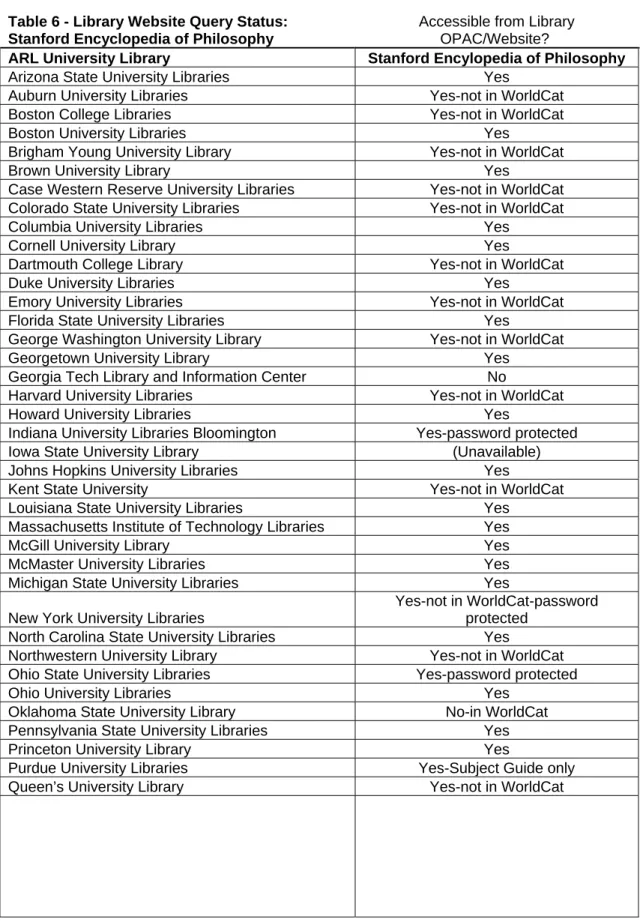
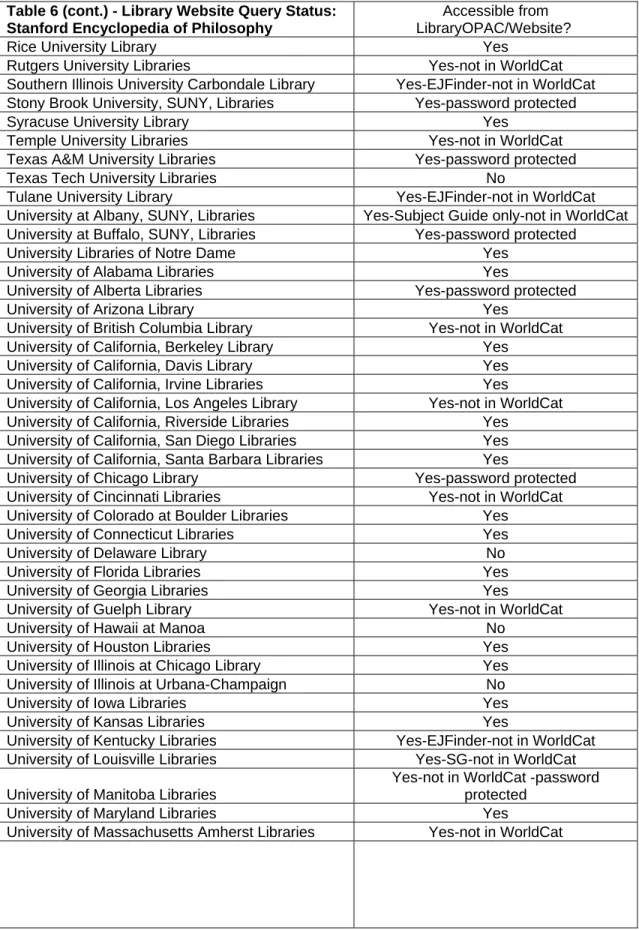
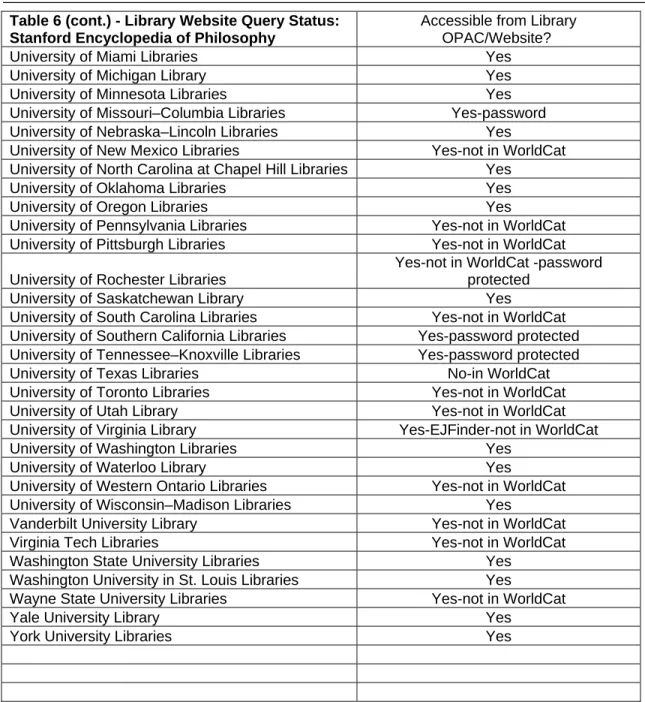
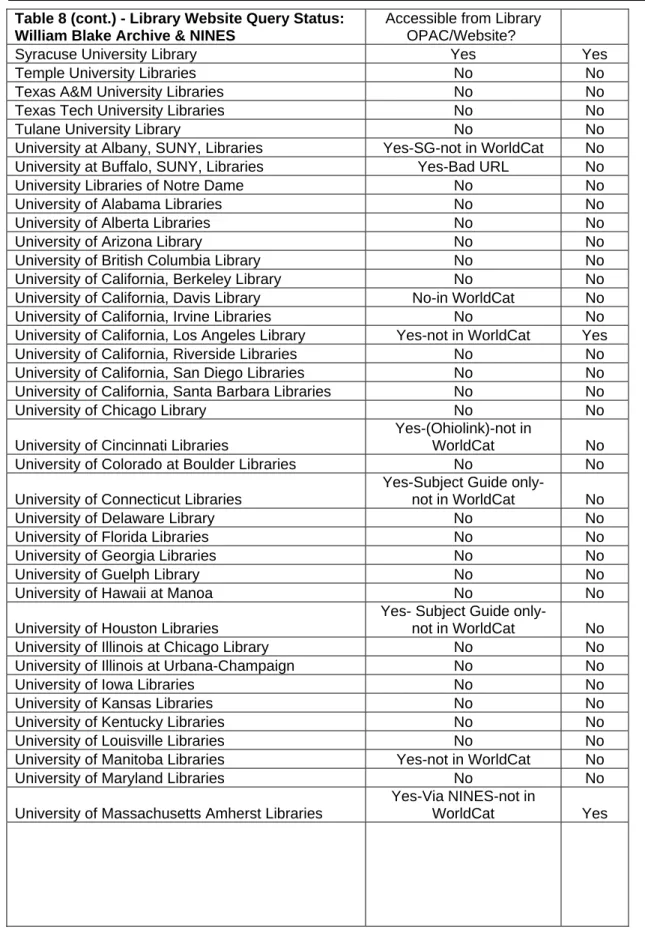
Raw data on WorldCat and library website queries is presented on Tables 4 through 8, in Appendices 2 and 3.87 The Stanford Encyclopedia of Philosophy is the most widely collected of the four resources chosen for this study, with 103 of 110 institutions linking to it either through the OPAC, a subject guide, or an electronic journal finder (an A-Z list). The SEP was present in 93.6 percent of collections, but only represented in WorldCat to be held by 61.8 percent – 68 of 110 - of the same selection of libraries. WorldCat also showed holdings at two libraries for which no result could be obtained; thus, it was in error for 36 of the 110 libraries queried, an error rate of 32.7 percent for the SEP.
Despite its status as an open access resource, the SEP was password protected from library websites in 21 of 103 cases – 20.3 percent of the time – so actual
accessibility from an open access standpoint was present for only 82 of 110 queries, or 74.5 percent of the time. This failure to provide access to an open resource is likely not the result of a failure in collection development, either in terms of selection will or awareness, but it does point to a system failure in over 20 percent of cases. Thus nearly one in five libraries who collect the SEP make off campus access unnecessarily more difficult than Google, likely encouraging the abandonment of the library website while searching.
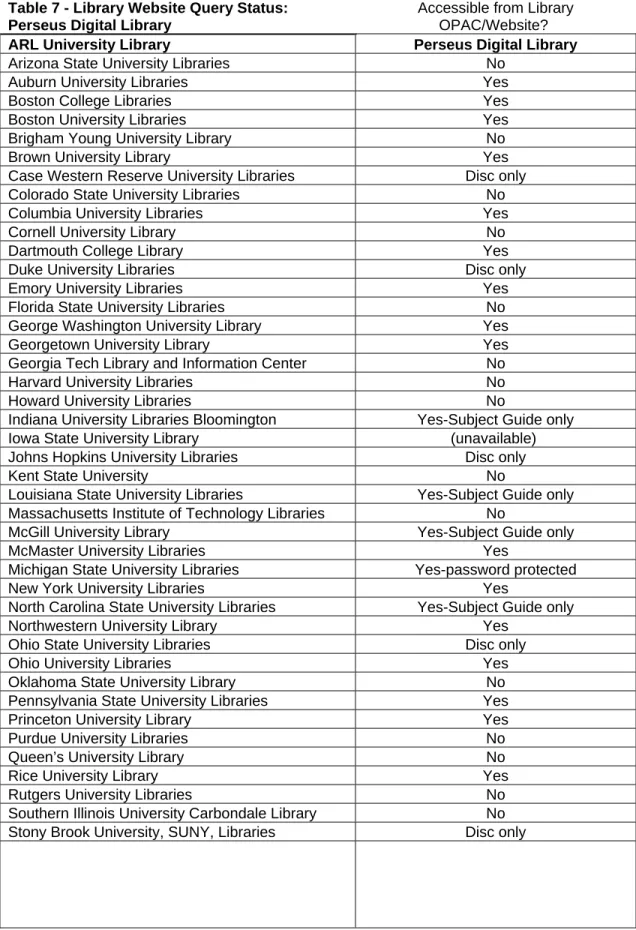
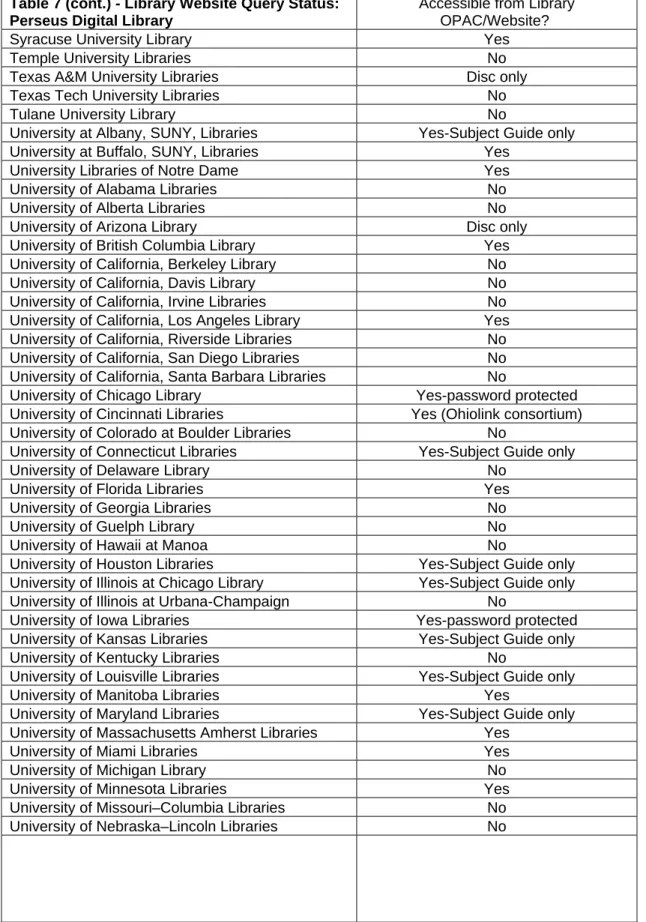
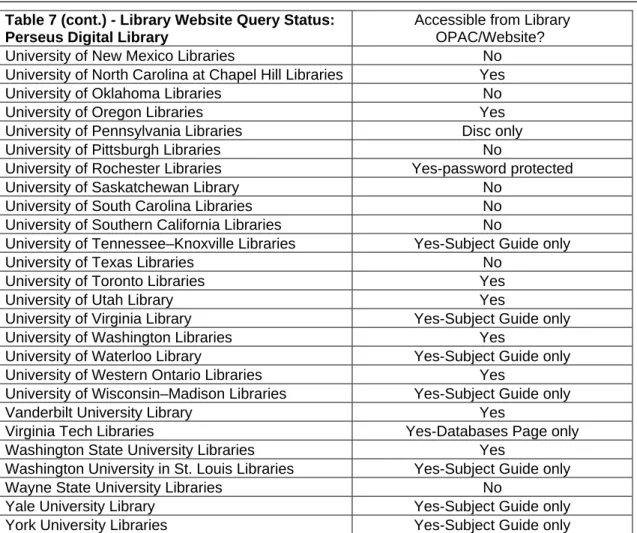
percent. Often, it is not available through the library catalog, but through password protected subject guides, so in 22 cases – 38.5 percent of the time – this open access resource was unnecessarily restricted for off-campus users. Perseus is collected just over half as often, but restricted at nearly double the rate of the SEP. Actual open access is available in only 35 of the 110 tests, 31.8 percent of the time. As it is unclear if password restriction is the intentional result of library policy,88 or the result of technical
carelessness, the Perseus Digital Library can be considered to be collected by 51.8 percent of the selected libraries.
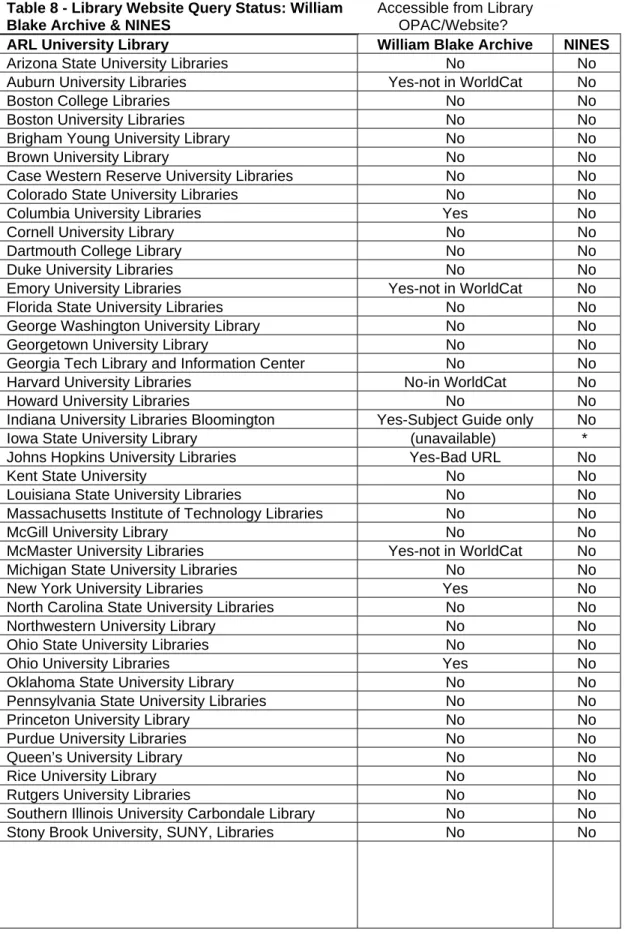
WorldCat has the William Blake Archive possessed by 14 of the 110 institutions studied, 12.7 percent. In fact, 27 of them do provide access via a direct link from the library website, which is 24.5 percent of the total selected libraries. 10 of these, or 37 percent, restrict access to the site with a password, so the WBA is actually only accessible 17 times in 110, or 15.4 percent of the time. As with the Perseus Digital Library, it is unclear if this is intentional. The WBA is collected half as often as the
Perseus Digital Library, but restricted around the same rate, twice the rate of the SEP.
NINES is nearly invisible to libraries, despite the fact that it operates like many subscription federated databases. Thus it provides more than content, but access. It is useful and free, but not collected. Four of the 110 libraries studied, only 3.6 percent, had a link to NINES. Each of these libraries also had links to the other three resources tested in this study.
Comparative Analysis
The Stanford Encyclopedia of Philosophy is no more esteemed than the William Blake Archive; neither does it have the lexical tools nor the lasting pedigree of the
Perseus Digital Library; it doesn’t have the federated searching capabilities of NINES, and its institutional affiliation is equal relative to the discipline it serves: Stanford is a giant in philosophy, but so too is Virginia in English Romanticism. Despite this, the
Stanford Encyclopedia of Philosophy is linked on library websites nearly twice as often as the Perseus Digital Library, nearly four times as often as the William Blake Archive, and over 23 times as often as NINES. There are several likely causes for this distribution. The Stanford Encyclopedia differs from the other three resources inasmuch as it qualifies to belong to the Directory of Open Access Journals (DOAJ). As a dynamic encyclopedia, it is treated as a peer reviewed serial. It has an ISSN, and is updated in an irregular and non-terminal manner. This is true of none of the other resources tested here. Since DOAJ currently contains 3960 titles, and continues to grow rapidly, it has the
critical mass it needs to be selected by bibliographers as a batch process. Further, DOAJ periodicals are tracked by automated journal maintenance systems like Serials Solutions. This is true of none of the other tested resources. Because of its status as a DOAJ
necessary, but ongoing maintenance is lower than subscription resources, as there are no licenses to renew, no subscription fees to pay.
The Perseus Digital Library has none of the advantages of a DOAJ affiliation: it is not tracked by Serials Solutions; it cannot be collected as part of a batch process. It is collected twice as often as the William Blake Archive, which it exceeds in breadth, but whose uniqueness and quality of content it does not achieve.90 The Perseus Digital Library has been around a long time, for an electronic resource, but appeared on the Internet only a year before the William Blake Archive.
The primary difference arises from a close examination of the data, particularly in several cases in which the Perseus Digital Library was not linked by a library website. On eight occasions, a search for the website link resulted in a catalog record for the old CD-ROM version (1.0) of the Perseus Project. As a physically collectable object, the
Perseus Digital Library had been cataloged in many of the libraries studied. Some of these have not yet added a link to the project website. As a physical object that could be possessed by a library, the original Perseus Project 1.0 CD-ROM fit the traditional collection model for libraries. While this may not be the collection model of the future, or in some cases even of the present, the Perseus Digital Library made the transition – from a digital object possessed by a collecting institution to a digital object remotely accessed by a portal – with the library. Because of its long and multi-format history, the
Recommendations for Collecting Open Access Electronic Resources
WorldCat draws a picture for the bibliographer that looks very little like the reality of institutional access to these sorts of resources. Even the Stanford Encyclopedia of Philosophy, as a high profile DOAJ periodical, is poorly represented in terms of peer collecting: WorldCat represents it as being widely collected among university affiliated ARL’s, when in fact it is almost universally collected.
The Directory of Open Access Journals has necessary exclusions in order for it to maintain itself as a quality collection of identifiable purpose. By making access selection work easier, or even possible, for bibliographers of open access electronic resources, these exclusions have the unwittingly marginalized high-quality non-qualified resources like the William Blake Archive and NINES. The Perseus Digital Library’s current popularity among university ARL’s, the result of having spanned the transition from collection to access, is an historical exception that cannot be duplicated in the present.
Newer, non-serial, high quality open access electronic resources need a way to be visible in collection development selection processes, a way to be selected efficiently, and a way to become visible to Serials Solutions and maintained efficiently.
A dynamic index, itself a serial, which vetted non-serial open access electronic resources with principles similar to DOAJ would be an effective solution. Such an index, properly implemented, should raise the collection rate of resources like NINES, the William Blake Archive, and likely even the Perseus Digital Library to Stanford Encyclopedia of
be tracked and maintained by Serials Solutions. Its implementation would require grant funding to set up, the establishment of a peer review for inclusion of resources, and marketing both to libraries and to those resources it would represent.
Having already gathered together a considerable stable of resources, OpenDOAR represents a part of the solution to this problem. Extending the scope of its aggregated collection, as well as its visibility to Serials Solutions and bibliographers, should result in increased collection of high quality open access electronic resources by academic
Conclusion
By including such high quality open access electronic resources as the Stanford Encyclopedia of Philosophy, the William Blake Archive, the Perseus Digital Library, or
NINES, libraries may broaden and deepen the scholarly context of their collections for patrons. Enriching the scholarly context benefits not only patrons, but also libraries. While developing research contexts is a service that adds value for patrons, it also keeps libraries relevant by improving the research experience. The nearly universal willingness of ARL libraries to provide access to the Stanford Encyclopedia of Philosophy
demonstrates that, when awareness is present, so to is the desire to collect high quality open access electronic resources.
Current collecting practice is, however, insufficient. While the Stanford Encyclopedia of Philosophy represents the ideal – an excellent resource made widely accessible through library websites – other excellent resources are collected at considerably lower rates. The factors that make the SEP a success from a collecting standpoint – library investment in its continued financial support, and membership in the DOAJ aggregation – may not be attained by other open access electronic resources possessing equally excellent and desirable content.
resources for bibliographers, allowing them to select titles in large batch processes that do not require individual title assessment. Both aggregations are limited, however: DOAJ by the kind of content to will allow to participate as a member of its aggregation, OpenDOAR by its lack of completeness and it’s current low profile.
In order for academic libraries to include the best access to appropriate open access electronic resources with the highest efficiency, they need not only higher profile and more comprehensive aggregations of materials, but also an automated way to track and maintain the resources accessed via the library website. Electronic resource tools like Serials Solutions already provide this service for e-books and journals; its scope could be extended to include those open access electronic resources that are currently unaccounted. Serials Solutions includes a link resolver, which helps both in keeping URL’s current and in identifying those electronic resources that do not require password protection. Thus, the best solution to current uneven collecting practices regarding open access electronic resources involves re-tasking existing technologies in order to make feasible better access, and in turn better service.
Notes
1
For a cost-benefit analysis of the relative value of open access electronic resources, see Brown, Christopher C., and Elizabeth S. Meagher, “Cataloging Free e-Resources: Is it Worth the Investment?” Interlending & Document Supply 36, no. 3 (2008): 135-141. For a more conservative counter-opinion, see Medieros, Norm. “On the Road Again: a Conversation with Jill Emery.” OCLC Systems and Services 22, no. 1 (2006): 10-14.
2
For the positive effect for patrons of the presence of open access electronic resources in the OPAC, see Waldenberg, Alison R. “Freely Available and Paid-For Electronic Journals: A Comparative Study of Use.” Thesis, The University of North Carolina at Chapel Hill, 2006: 9.
3
For less expensive options than the purchase of an electronic resources management system, see Murray, Adam, “Electronic Resource Management 2.0: Using Web 2.0 Technologies as Cost-Effective Alternatives to an Electronic Resource Management System,” Journal of Electronic Resources Librarianship 20, no. 3 (2008): 156-168.
4
See Appendix B, Table 1 for a list of ARL libraries.
5
Waldenberg, Alison R. “Freely Available and Paid-For Electronic Journals: A Comparative Study of Use.” Thesis, The University of North Carolina at Chapel Hill, 2006: 9.
6
Lee, Hur-Li, “What Is a Collection?” Journal of the American Society for Information Science 51, no. 12 (2000): 1112.
7
For an extensive and recent case study of the scope and usefulness of Google Scholar, see Mayr, Philipp, and Anne-Kathrin Walter, “An exploratory study of Google Scholar,” Information Review 31, no. 6 (2007): 814-830.
8
Srivastava, Sandhya and Paolina Taglienti, “E-Journal Management: an Online Survey Evaluation,” Serials Review 31, no. 1 (March 2005): 28-38. This article argues that fundamental to library services is the ability to provide vast amounts of information to patrons in-house.
9
Eaves, Morris, Robert N. Essick, and Joseph Viscomi, eds. The William Blake Archive; available from Internet http://www.blakearchive.org/blake/main.html accessed 7 March 2009.
10
ibid. http://www.blakearchive.org/blake/MLA.html “The members of the selection committee were A. R. Braunmuller (Univ. of California, Los Angeles); Timothy Brennan (Univ. of Minnesota); and Leah S. Marcus (Vanderbilt Univ.), chair."
11
I do not intend to impugn Google Scholar, which is quite useful at discovering print resources. Electronic resources are out of its explicit scope, which covers “peer-reviewed papers, theses, books, abstracts and articles, from academic publishers, professional societies, preprint repositories, universities and other scholarly organizations,” http://scholar.google.com/intl/en/scholar/about.html. The branding of Google and Google Scholar might give the impression to patrons not only that the latter has a more academic character – which it does – but also that the context it generates is complete. Further, it is likely quite difficult for patrons to discern the difference between academic publishers and content generated and published by academic institutions.
12
See Appendix B, Table 2 for a list of libraries included in this study.
13
See Appendix B, Table 3 for those ARL libraries that were omitted from the study.
14
The OPAC of Iowa State University Libraries was offline for the period of data gathering.
15
See Appendix A for the Operational Definitions for this section.
16
For Perseus, both “Perseus Project” and “Perseus Digital Library” were attempted; “a hypermedia archive” was added to the William Blake Archive in cases of a null result; “nineteenth-century studies online” was substituted for NINES.
17 Allen, Colin, Uri Nodelman, and Edward N. Zalta, eds.,
Stanford Encyclopedia of Philosophy; available from Internet http://plato.stanford.edu/about.html, accessed 4 March 2009.
18 ibid. http://www-csli.stanford.edu/~jperry//vita/vita.html 19 ibid. http://plato.stanford.edu/about.html 20 ibid. 21
Zalta, Edward N., “The Stanford Encyclopedia of Philosophy: a University/Library Partnership in Support of Scholarly Communication and Open Access,” College & Research Libraries News 67, no. 8 (September 2006): 502-504,507.
22
23
ibid.
24
Allen, Colin, Uri Nodelman, and Edward N. Zalta, eds., Stanford Encyclopedia of Philosophy; available from Internet http://plato.stanford.edu/about.html, accessed 4 March 2009.
25
ibid.
26
ibid.
27
Zalta, Edward N., “The Stanford Encyclopedia of Philosophy: a University/Library Partnership in Support of Scholarly Communication and Open Access,” College & Research Libraries News 67, no. 8 (September 2006): 502-504,507.
28
ibid.
29
Allen, Colin, Uri Nodelman, and Edward N. Zalta, eds., Stanford Encyclopedia of Philosophy: History; available from Internet http://plato.stanford.edu/board.html, accessed 4 March 2009.
30
Zalta, Edward N., “The Stanford Encyclopedia of Philosophy: a University/Library Partnership in Support of Scholarly Communication and Open Access,” College & Research Libraries News 67, no. 8 (September 2006): 502-504,507.
31 Eaves, Morris, Robert N. Essick, and Joseph Viscomi, eds.
The William Blake Archive; available from Internet http://www.blakearchive.org/blake/ accessed 7 March 2009.
32 ibid. http://www.blakearchive.org/blake/public/about/plan/index.html 33 ibid. 34 ibid. http://www.blakearchive.org/blake/public/about/principles/index.html 35 ibid. http://www.blakearchive.org/blake/main.html 36 ibid. http://www.blakearchive.org/blake/MLA.html 37 ibid. 38 ibid. http://www.blakearchive.org/blake/public/about/principles/index.html 39 http://www.perseus.tufts.edu/hopper/help/versions.jsp 40 ibid. 41 http://www.tei-c.org/index.xml 42 http://creativecommons.org/licenses/by-nc-sa/3.0/us/
43 Crane, Gregory ed.
Perseus Digital Library; available from Internet
http://www.perseus.tufts.edu/hopper/help/versions.jsp, accessed 2 March 2009.
44 ibid. 45 ibid. http://www.perseus.tufts.edu/hopper/about/who/gregoryCrane 46 ibid. http://www.perseus.tufts.edu/hopper/ 47
McGann, Jerome, et al. NINES: Nineteenth-century Studies Online; available from Internet http://www.nines.org/, accessed 7 March 2009.
48 ibid. 49 ibid. http://www.nines.org/tab_about 50 ibid. http://www.nines.org/scholarship/peerReview.html 51 ibid. http://www.nines.org/search 52 ibid.
53 Nowviskie, Bethany, “Collex: Semantic Collections & Exhibits for the Remixable Web;” available from
Internet www.nines.org/about/Nowviskie-Collex.pdf, accessed 13 February 2008.
54 McGann, Jerome, et al.
NINES: Nineteenth-century Studies Online; available from Internet http://www.nines.org/search, accessed 7 March 2009.
55
ibid. http://www.nines.org/tools/collex.html
56
available from Internet http://digital.lib.ucdavis.edu/projects/bwrp/ accessed 7 March 2009
57
available from Internet http://www.chesnuttarchive.org/ accessed 7 March 2009
58
available from Internet http://womensbios.lib.virginia.edu/ accessed 7 March 2009
59
available from Internet http://www.emilydickinson.org/ accessed 7 March 2009
60
available from Internet
http://collections.wordsworth.org.uk/GtoG/home.asp?page=GtoGGoslartoGrasmereTitle accessed 7 March 2009
61
available from Internet http://www.lib.uiowa.edu/spec-coll/leighhunt/index.html accessed 7 March 2009
62
available from Internet http://www.rc.umd.edu/ accessed 7 March 2009
63
available from Internet http://www.ambrosebierce.org/ accessed 7 March 2009
64
65
available from Internet http://unixgen.muohio.edu/~poetess/ accessed 7 March 2009
66
available from Internet http://www.rossettiarchive.org/ accessed 7 March 2009
67
available from Internet http://swinburnearchive.indiana.edu/swinburne/www/swinburne/ accessed 7 March 2009
68
available from Internet http://www.whitmanarchive.org/ accessed 7 March 2009
69
available from Internet http://cather.unl.edu/ accessed 7 March 2009
70
Over the three-year period discussed here, DOAJ has added 1886 journals, for an average of about 1.7 new titles daily.
71 Lund University Libraries.
DOAJ: Directory of Open Access Journals; available from Internet http://www.doaj.org/doaj?func=loadTempl&templ=about accessed 9 March 2009.
72
ibid.
73
ibid.
74
There is some evidence that DOAJ has not held to its principles fully, see Morris, Sally, “When is a journal not a journal? A closer look at the DOAJ,” Learned Publishing 19, no. 1 (January 2006): 73, 75-76. For collection size concerns and criticism, see Peek, Robin, “Counting OA Journals,” Information Today 22, no. 11 (December 2005): 17-18.
75
ibid. http://www.doaj.org/ 3-26-09
76
ibid. http://web.archive.org/web/20080102181813/http://www.doaj.org/ 3032 journals
77
ibid. http://web.archive.org/web/20060303053440/http://www.doaj.org/ 2074 journals
78
ibid. http://web.archive.org/web/20080102181813/http://www.doaj.org/ 984 searchable titles
79
ibid. http://web.archive.org/web/20060303053440/http://www.doaj.org/ 510 searchable titles
80
http://www.serialssolutions.com/
81
Murray, Adam, “Electronic Resource Management 2.0: Using Web 2.0 Technologies as Cost-Effective Alternatives to an Electronic Resource Management System,” Journal of Electronic Resources
Librarianship 20, no. 3 (2008): 156-168. Murray argues that patron input (Web 2.0) can be a highly cost-effective way highlight new resources and their uses to patrons.
82
University of Nottingham UK. OpenDOAR; available from Internet http://www.opendoar.org/about.html accessed 31 March 2009.
83 ibid. http://www.opendoar.org/onechart.php?cID=&ctID=&rtID=&clID=&lID=&potID=&rSoftWareName=&se arch=&groupby=r.rDateAdded&orderby=&charttype=growth&width=600&height=350&caption=Growth %20of%20the%20OpenDOAR%20Database%20-%20Worldwide 84 http://www.opendoar.org/about.html 85 ibid. 86 ibid. http://www.opendoar.org/find.php?search=Perseus&clID=&ctID=&rtID=&cID=&lID=&rSoftWareName= &submit=Search&format=summary&step=20&sort=r.rName&rID=&ctrl=new&p=1 87
An answer of “Yes” or “No” in the table indicates that the resource was found in the OPAC, unless noted otherwise, e.g. “Subject Guide only.” WorldCat presence or absence is indicated when in conflict with the actual holdings; Perseus and NINES are not considered for WorldCat presence, because of authority complications in the former case, and a lack of positives in the latter. “EJFinder” indicates presence in an A-Z list only.
88
Consider Michigan State, which password protects Perseus, but not the SEP, or Indiana, which does the inverse, or SUNY Buffalo, which does as Michigan State does, but then has a bad URL for the William Blake Archive; these examples, and many others seem to indicate a technical error, but this cannot be assured in every case within the scope of this study.
89
OCLC accession numbers 37550526; 179833493; 68115052; 224325075; 56222659; 44367830; 299634346; and 312604973
90
91
Appendix A – Operational Definitions
Efficiently Collected: Selected by bibliographers, to the greatest extent possible, not as individual items, but as aggregated collections that have already undergone some form of peer review or rigorous editorial process.
High Quality: Those resources that are peer reviewed, have won competitive rewards, or belong to federated collections of peer reviewed and/or award winning resources. Open-Access: Available on the web without required direct cost to patrons or institutions
for access.
Intent to Collect: Present in the library OPAC, or from a link on its website, (e.g. a subject guide).
Collected: Present in the library OPAC, or from a link on its website, (e.g. a subject guide), and made accessible to any patron with access to that OPAC.
Better Context: Resources that are not only relevant to a particular academic discipline, but also have been subjected to a consistent and rigorous editorial process. The accuracy of the information in the resource is immaterial to this consideration. Thus, Google, which so often offers Wikipedia entries in its results list, is
necessarily not a better context. This is not due to the validity or accuracy of the information Wikipedia presents, which can be quite good and is potentially excellent, but due to its lack of a consistent and rigorous editorial process. Consistent and Rigorous Editorial Process: A process that, regardless of specific
character, product, manifestation, or method, places the editors’ professional reputations at stake through an explicit involvement with discursive production. Robustness: Textual encoding standards; financial support; academic departmental
Appendix B – ARL Libraries
Table 1 – List of ARL Libraries (123 total)
Arizona State University Libraries Auburn University Libraries Bibliothèque de l’ Université Laval Bibliothèques de l’Université de Montréal Boston College Libraries
Boston Public Library Boston University Libraries Brigham Young University Library Brown University Library
Canada Institute for Scientific and Technical Information (CISTI) Case Western Reserve University Libraries
Center for Research Libraries Colorado State University Libraries Columbia University Libraries Cornell University Library Dartmouth College Library Duke University Libraries Emory University Libraries Florida State University Libraries George Washington University Library Georgetown University Library
Georgia Tech Library and Information Center Harvard University Libraries
Howard University Libraries
Indiana University Libraries Bloomington Iowa State University Library
Johns Hopkins University Libraries
Kent State University Libraries and Media Services Library and Archives Canada
Library of Congress
Louisiana State University Libraries
Massachusetts Institute of Technology Libraries McGill University Library
McMaster University Libraries Michigan State University Libraries National Agricultural Library National Library of Medicine New York Public Library New York State Library New York University Libraries
North Carolina State University Libraries Northwestern University Library
Ohio State University Libraries Ohio University Libraries
Oklahoma State University Library Pennsylvania State University Libraries Princeton University Library
Table 1 (cont.) – List of ARL Libraries (123 total)
Rice University Library Rutgers University Libraries Smithsonian Institution Libraries
Southern Illinois University Carbondale Library Stony Brook University, SUNY, Libraries Syracuse University Library
Temple University Libraries Texas A&M University Libraries Texas Tech University Libraries Tulane University Library
University at Albany, SUNY, Libraries University at Buffalo, SUNY, Libraries University Libraries of Notre Dame University of Alabama Libraries University of Alberta Libraries University of Arizona Library
University of British Columbia Library University of California, Berkeley Library University of California, Davis Library University of California, Irvine Libraries University of California, Los Angeles Library University of California, Riverside Libraries University of California, San Diego Libraries University of California, Santa Barbara Libraries University of Chicago Library
University of Cincinnati Libraries
University of Colorado at Boulder Libraries University of Connecticut Libraries
University of Delaware Library University of Florida Libraries University of Georgia Libraries University of Guelph Library
University of Hawaii at Manoa Library University of Houston Libraries University of Illinois at Chicago Library
University of Illinois at Urbana-Champaign Library University of Iowa Libraries
University of Kansas Libraries University of Kentucky Libraries University of Louisville Libraries University of Manitoba Libraries University of Maryland Libraries
University of Massachusetts Amherst Libraries University of Miami Libraries
University of Michigan Library University of Minnesota Libraries
University of Missouri–Columbia Libraries University of Nebraska–Lincoln Libraries University of New Mexico Libraries
Table 1 (cont.) – List of ARL Libraries (123 total)
University of Oklahoma Libraries University of Oregon Libraries University of Pennsylvania Libraries University of Pittsburgh Libraries University of Rochester Libraries University of Saskatchewan Library University of South Carolina Libraries University of Southern California Libraries University of Tennessee–Knoxville Libraries University of Texas Libraries
University of Toronto Libraries University of Utah Library University of Virginia Library University of Washington Libraries University of Waterloo Library
University of Western Ontario Libraries University of Wisconsin–Madison Libraries Vanderbilt University Library
Virginia Tech Libraries
Washington State University Libraries Washington University in St. Louis Libraries Wayne State University Libraries
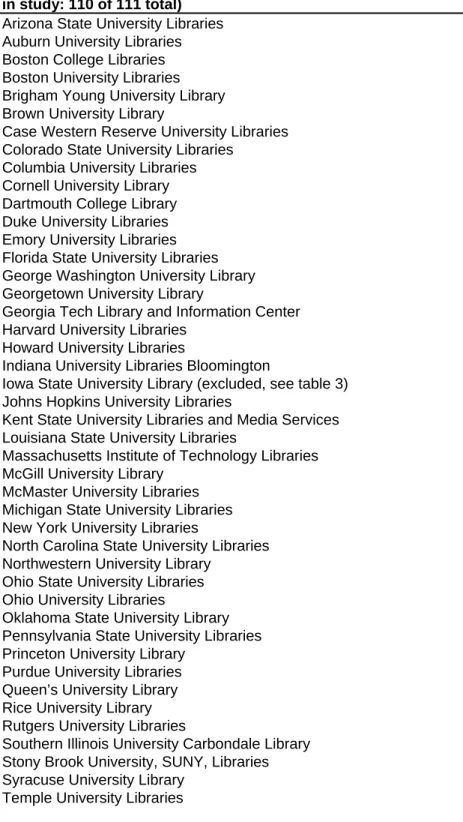
Table 2 – English Language ARL University Libraries (included
in study: 110 of 111 total)
Arizona State University Libraries Auburn University Libraries Boston College Libraries Boston University Libraries Brigham Young University Library Brown University Library
Case Western Reserve University Libraries Colorado State University Libraries
Columbia University Libraries Cornell University Library Dartmouth College Library Duke University Libraries Emory University Libraries Florida State University Libraries George Washington University Library Georgetown University Library
Georgia Tech Library and Information Center Harvard University Libraries
Howard University Libraries
Indiana University Libraries Bloomington
Iowa State University Library (excluded, see table 3) Johns Hopkins University Libraries
Kent State University Libraries and Media Services Louisiana State University Libraries
Massachusetts Institute of Technology Libraries McGill University Library
McMaster University Libraries Michigan State University Libraries New York University Libraries
North Carolina State University Libraries Northwestern University Library
Ohio State University Libraries Ohio University Libraries
Oklahoma State University Library Pennsylvania State University Libraries Princeton University Library
Purdue University Libraries Queen’s University Library Rice University Library Rutgers University Libraries
Southern Illinois University Carbondale Library Stony Brook University, SUNY, Libraries Syracuse University Library
Temple University Libraries
Texas A&M University Libraries Texas Tech University Libraries Tulane University Library
Table 2 (cont.) – English Language ARL University Libraries
University Libraries of Notre Dame University of Alabama Libraries University of Alberta Libraries University of Arizona Library
University of British Columbia Library University of California, Berkeley Library University of California, Davis Library University of California, Irvine Libraries University of California, Los Angeles Library University of California, Riverside Libraries University of California, San Diego Libraries University of California, Santa Barbara Libraries University of Chicago Library
University of Cincinnati Libraries
University of Colorado at Boulder Libraries University of Connecticut Libraries
University of Delaware Library University of Florida Libraries University of Georgia Libraries University of Guelph Library
University of Hawaii at Manoa Library University of Houston Libraries University of Illinois at Chicago Library
University of Illinois at Urbana-Champaign Library University of Iowa Libraries
University of Kansas Libraries University of Kentucky Libraries University of Louisville Libraries University of Manitoba Libraries University of Maryland Libraries
University of Massachusetts Amherst Libraries University of Miami Libraries
University of Michigan Library University of Minnesota Libraries
University of Missouri–Columbia Libraries University of Nebraska–Lincoln Libraries University of New Mexico Libraries
University of North Carolina at Chapel Hill Libraries University of Oklahoma Libraries
University of Oregon Libraries
University of Pennsylvania Libraries University of Pittsburgh Libraries University of Rochester Libraries University of Saskatchewan Library University of South Carolina Libraries University of Southern California Libraries University of Tennessee–Knoxville Libraries University of Texas Libraries
Table 2 (cont.) – English Language ARL University Libraries
University of Utah Library University of Virginia Library University of Washington Libraries University of Waterloo Library
University of Western Ontario Libraries University of Wisconsin–Madison Libraries Vanderbilt University Library
Virginia Tech Libraries
Washington State University Libraries Washington University in St. Louis Libraries Wayne State University Libraries
Yale University Library York University Libraries
Table 3 – ARL Libraries Excluded from Study (13 total)
Bibliothèque de l’ Université Laval Bibliothèques de l’Université de Montréal Boston Public Library
Canada Institute for Scientific and Technical Information (CISTI) Center for Research Libraries
Iowa State University Libraries (OPAC unavailable at time of study) Library and Archives Canada
Library of Congress
National Agricultural Library National Library of Medicine New York Public Library New York State Library
Appendix C – WorldCat Data
Table 4 - Library has Stanford Encyclopedia of Philosophy (According to WorldCat) 68 total
Arizona State University Libraries Boston University Libraries Brown University Library Columbia University Libraries Cornell University Library Duke University Libraries Florida State University Libraries Georgetown University Library Howard University Libraries
Indiana University Libraries Bloomington Iowa State University Library
Johns Hopkins University Libraries Louisiana State University Libraries
Massachusetts Institute of Technology Libraries McGill University Library
McMaster University Libraries Michigan State University Libraries North Carolina State University Libraries Ohio State University Libraries
Ohio University Libraries
Oklahoma State University Library Pennsylvania State University Libraries Princeton University Library
Purdue University Libraries Rice University Library
Stony Brook University, SUNY, Libraries Syracuse University Library
Texas A&M University Libraries University at Buffalo, SUNY, Libraries University Libraries of Notre Dame University of Alabama Libraries University of Alberta Libraries University of Arizona Library
University of California, Berkeley Library University of California, Davis Library University of California, Irvine Libraries University of California, Riverside Libraries University of California, San Diego Libraries University of California, Santa Barbara Libraries University of Chicago Library
Table 4 (cont.) - Library has Stanford Encyclopedia of Philosophy
(According to WorldCat)
University of Florida Libraries University of Georgia Libraries University of Houston Libraries University of Illinois at Chicago Library University of Iowa Libraries
University of Kansas Libraries University of Maryland Libraries University of Miami Libraries University of Michigan Library University of Minnesota Libraries
University of Missouri–Columbia Libraries University of Nebraska–Lincoln Libraries
University of North Carolina at Chapel Hill Libraries University of Oklahoma Libraries
University of Oregon Libraries University of Saskatchewan Library University of Southern California Libraries University of Tennessee–Knoxville Libraries University of Texas Libraries
University of Washington Libraries University of Waterloo Library
University of Wisconsin–Madison Libraries Washington State University Libraries Washington University in St. Louis Libraries Yale University Library
Table 5 - Library does not have Stanford Encyclopedia of Philosophy
(According to WorldCat) 43 total
Auburn University Libraries Boston College Libraries
Brigham Young University Library
Case Western Reserve University Libraries Colorado State University Libraries
Dartmouth College Library Emory University Libraries
George Washington University Library Georgia Tech Library and Information Center Harvard University Libraries
Kent State University Libraries and Media Services New York University Libraries
Northwestern University Library Queen’s University Library Rutgers University Libraries
Southern Illinois University Carbondale Library Temple University Libraries
Texas Tech University Libraries Tulane University Library
University at Albany, SUNY, Libraries University of British Columbia Library University of California, Los Angeles Library University of Cincinnati Libraries
University of Delaware Library University of Guelph Library
University of Hawaii at Manoa Library
University of Illinois at Urbana-Champaign Library University of Kentucky Libraries
University of Louisville Libraries University of Manitoba Libraries
University of Massachusetts Amherst Libraries University of New Mexico Libraries
University of Pennsylvania Libraries University of Pittsburgh Libraries University of Rochester Libraries University of South Carolina Libraries University of Toronto Libraries University of Utah Library University of Virginia Library
University of Western Ontario Libraries Vanderbilt University Library
Virginia Tech Libraries
Appendix D – Library Website Data
Table 6 - Library Website Query Status: Stanford Encyclopedia of Philosophy
Accessible from Library OPAC/Website?
ARL University Library Stanford Encylopedia of Philosophy
Arizona State University Libraries Yes
Auburn University Libraries Yes-not in WorldCat
Boston College Libraries Yes-not in WorldCat
Boston University Libraries Yes
Brigham Young University Library Yes-not in WorldCat
Brown University Library Yes
Case Western Reserve University Libraries Yes-not in WorldCat
Colorado State University Libraries Yes-not in WorldCat
Columbia University Libraries Yes
Cornell University Library Yes
Dartmouth College Library Yes-not in WorldCat
Duke University Libraries Yes
Emory University Libraries Yes-not in WorldCat
Florida State University Libraries Yes
George Washington University Library Yes-not in WorldCat
Georgetown University Library Yes
Georgia Tech Library and Information Center No
Harvard University Libraries Yes-not in WorldCat
Howard University Libraries Yes
Indiana University Libraries Bloomington Yes-password protected
Iowa State University Library (Unavailable)
Johns Hopkins University Libraries Yes
Kent State University Yes-not in WorldCat
Louisiana State University Libraries Yes
Massachusetts Institute of Technology Libraries Yes
McGill University Library Yes
McMaster University Libraries Yes
Michigan State University Libraries Yes
New York University Libraries
Yes-not in WorldCat-password protected
North Carolina State University Libraries Yes
Northwestern University Library Yes-not in WorldCat
Ohio State University Libraries Yes-password protected
Ohio University Libraries Yes
Oklahoma State University Library No-in WorldCat
Pennsylvania State University Libraries Yes
Princeton University Library Yes
Purdue University Libraries Yes-Subject Guide only
Table 6 (cont.) - Library Website Query Status:
Stanford Encyclopedia of Philosophy
Accessible from LibraryOPAC/Website?
Rice University Library Yes
Rutgers University Libraries Yes-not in WorldCat
Southern Illinois University Carbondale Library Yes-EJFinder-not in WorldCat
Stony Brook University, SUNY, Libraries Yes-password protected
Syracuse University Library Yes
Temple University Libraries Yes-not in WorldCat
Texas A&M University Libraries Yes-password protected
Texas Tech University Libraries No
Tulane University Library Yes-EJFinder-not in WorldCat
University at Albany, SUNY, Libraries Yes-Subject Guide only-not in WorldCat
University at Buffalo, SUNY, Libraries Yes-password protected
University Libraries of Notre Dame Yes
University of Alabama Libraries Yes
University of Alberta Libraries Yes-password protected
University of Arizona Library Yes
University of British Columbia Library Yes-not in WorldCat
University of California, Berkeley Library Yes
University of California, Davis Library Yes
University of California, Irvine Libraries Yes
University of California, Los Angeles Library Yes-not in WorldCat
University of California, Riverside Libraries Yes
University of California, San Diego Libraries Yes
University of California, Santa Barbara Libraries Yes
University of Chicago Library Yes-password protected
University of Cincinnati Libraries Yes-not in WorldCat
University of Colorado at Boulder Libraries Yes
University of Connecticut Libraries Yes
University of Delaware Library No
University of Florida Libraries Yes
University of Georgia Libraries Yes
University of Guelph Library Yes-not in WorldCat
University of Hawaii at Manoa No
University of Houston Libraries Yes
University of Illinois at Chicago Library Yes
University of Illinois at Urbana-Champaign No
University of Iowa Libraries Yes
University of Kansas Libraries Yes
University of Kentucky Libraries Yes-EJFinder-not in WorldCat
University of Louisville Libraries Yes-SG-not in WorldCat
University of Manitoba Libraries
Yes-not in WorldCat -password protected
University of Maryland Libraries Yes
Table 6 (cont.) - Library Website Query Status:
Stanford Encyclopedia of Philosophy
Accessible from Library OPAC/Website?
University of Miami Libraries Yes
University of Michigan Library Yes
University of Minnesota Libraries Yes
University of Missouri–Columbia Libraries Yes-password
University of Nebraska–Lincoln Libraries Yes
University of New Mexico Libraries Yes-not in WorldCat
University of North Carolina at Chapel Hill Libraries Yes
University of Oklahoma Libraries Yes
University of Oregon Libraries Yes
University of Pennsylvania Libraries Yes-not in WorldCat
University of Pittsburgh Libraries Yes-not in WorldCat
University of Rochester Libraries
Yes-not in WorldCat -password protected
University of Saskatchewan Library Yes
University of South Carolina Libraries Yes-not in WorldCat
University of Southern California Libraries Yes-password protected
University of Tennessee–Knoxville Libraries Yes-password protected
University of Texas Libraries No-in WorldCat
University of Toronto Libraries Yes-not in WorldCat
University of Utah Library Yes-not in WorldCat
University of Virginia Library Yes-EJFinder-not in WorldCat
University of Washington Libraries Yes
University of Waterloo Library Yes
University of Western Ontario Libraries Yes-not in WorldCat
University of Wisconsin–Madison Libraries Yes
Vanderbilt University Library Yes-not in WorldCat
Virginia Tech Libraries Yes-not in WorldCat
Washington State University Libraries Yes
Washington University in St. Louis Libraries Yes
Wayne State University Libraries Yes-not in WorldCat
Yale University Library Yes
Table 7 - Library Website Query Status:
Perseus Digital Library
Accessible from Library OPAC/Website?
ARL University Library Perseus Digital Library
Arizona State University Libraries No
Auburn University Libraries Yes
Boston College Libraries Yes
Boston University Libraries Yes
Brigham Young University Library No
Brown University Library Yes
Case Western Reserve University Libraries Disc only
Colorado State University Libraries No
Columbia University Libraries Yes
Cornell University Library No
Dartmouth College Library Yes
Duke University Libraries Disc only
Emory University Libraries Yes
Florida State University Libraries No
George Washington University Library Yes
Georgetown University Library Yes
Georgia Tech Library and Information Center No
Harvard University Libraries No
Howard University Libraries No
Indiana University Libraries Bloomington Yes-Subject Guide only
Iowa State University Library (unavailable)
Johns Hopkins University Libraries Disc only
Kent State University No
Louisiana State University Libraries Yes-Subject Guide only
Massachusetts Institute of Technology Libraries No
McGill University Library Yes-Subject Guide only
McMaster University Libraries Yes
Michigan State University Libraries Yes-password protected
New York University Libraries Yes
North Carolina State University Libraries Yes-Subject Guide only
Northwestern University Library Yes
Ohio State University Libraries Disc only
Ohio University Libraries Yes
Oklahoma State University Library No
Pennsylvania State University Libraries Yes
Princeton University Library Yes
Purdue University Libraries No
Queen’s University Library No
Rice University Library Yes
Rutgers University Libraries No
Southern Illinois University Carbondale Library No
Table 7 (cont.) - Library Website Query Status:
Perseus Digital Library
Accessible from Library OPAC/Website?
Syracuse University Library Yes
Temple University Libraries No
Texas A&M University Libraries Disc only
Texas Tech University Libraries No
Tulane University Library No
University at Albany, SUNY, Libraries Yes-Subject Guide only
University at Buffalo, SUNY, Libraries Yes
University Libraries of Notre Dame Yes
University of Alabama Libraries No
University of Alberta Libraries No
University of Arizona Library Disc only
University of British Columbia Library Yes
University of California, Berkeley Library No
University of California, Davis Library No
University of California, Irvine Libraries No
University of California, Los Angeles Library Yes
University of California, Riverside Libraries No
University of California, San Diego Libraries No
University of California, Santa Barbara Libraries No
University of Chicago Library Yes-password protected
University of Cincinnati Libraries Yes (Ohiolink consortium)
University of Colorado at Boulder Libraries No
University of Connecticut Libraries Yes-Subject Guide only
University of Delaware Library No
University of Florida Libraries Yes
University of Georgia Libraries No
University of Guelph Library No
University of Hawaii at Manoa No
University of Houston Libraries Yes-Subject Guide only
University of Illinois at Chicago Library Yes-Subject Guide only
University of Illinois at Urbana-Champaign No
University of Iowa Libraries Yes-password protected
University of Kansas Libraries Yes-Subject Guide only
University of Kentucky Libraries No
University of Louisville Libraries Yes-Subject Guide only
University of Manitoba Libraries Yes
University of Maryland Libraries Yes-Subject Guide only
University of Massachusetts Amherst Libraries Yes
University of Miami Libraries Yes
University of Michigan Library No
University of Minnesota Libraries Yes
University of Missouri–Columbia Libraries No