20
Predictive factors for general health status in Iranian high school students; an unvariate and multivariate logistic regression analysis
Ataollah Hashemian1, Ashraf Direkvand-Moghadam1*, Ali Delpisheh2, Azadeh Direkvand-Moghadam3
1. Psychosocial Injuries Research Center, Ilam University of Medical Sciences, Ilam, Iran 2. Department of Clinical Epidemiology, Faculty of Medicine, Ilam University of Medical
Sciences, Ilam, Iran
3. Student Research Committee, Ilam University of Medical Sciences, Ilam, Iran
Abstract
Introduction: Adolescents are the important portions of the Iranian population. Adolescents health status has a critical role in their learning ability and their performance. The present study aimed to determine the predictive factors for general health status in Iranian high school students in 2014.
Materials and methods: In a cross-sectional study evaluated the predictive factors for general health status among 381 high school students in Ilam, west of Iran in 2014. The samples were selected by a multi-stage sampling method. Data was collected by a two-part questionnaire. The first part of the questionnaire was included the personal characteristics. Second part of the questionnaire was General Health Questionnaire- 28 (GHQ-28). SPSS software Package 16 was used to analyze the data.
Results: Overall 236 (61.9%) students put into the health status and 145 (38.1%) of all have disorders in one or more dimensions of their general health status. The univariate logistic regression analysis shows that the gender, mother´s occupation, father education and school grade are the main predictive factors of general health status. With the multivariate logistic regression analysis school grade was considered as independent predictive variable for students’ health status (OR = 0.761, P= 0.016).
Conclusion: There are several risk factors for students’ general health disorder. It seems that gender, mother´s occupation, father education and school grade are some suitable independent predictive factors for students’ general health disorder. It is concluded that high school students at risk of health disorder could be diagnosed using some predictive analysis models allowing timely interventions to be performed..
Keywords: GHQ-28, Predictive factors, Multivariate logistic regression analysis, Unvariate logistic regression analysis
Introduction
Health is an individual and social value and defined as a state of complete physical, mental and social well-being and not means the absence of disease. In all society, health is considered as a primary humanity need (1). Adolescents are a main
portion of each population and their health effect on future health society. Therefore, several studies evaluated the adolescent health status in different parts of the worldwide (2-6). A study reported the ethnicity, study demands and gender as the
*Corresponding author: Tel: +98 8432240404; fax: +98 8432240404
Address: Psychosocial Injuries Research Center, Faculty of Nursing and Midwifery, Ilam University of Medical Sciences, Ilam, Iran
E-mail: [email protected]
Received; 2015/03/7; revised 2015/03/15; accepted 2015/04/15
21
main effective factors on student
psychological health (7).
Recently a cohort study showed the health status is changing in adolescents and
students. This study evaluated the
prevalence of unhealthy behaviors among 783 adolescents aged 12-17 years and reported that females are significantly more sedentary than males (8).
In another study investigated the risk and
protective factors of some
health-compromising behaviors among 2574 male and 2939 female adolescent in the United States. The results of the study reported the history of abuse, family
violence, depressive symptoms, and
stressful life events as the main effective risk factors on health (9). Mackenzie et al (2013) investigated the risk factors of adolescent substance use. Based the results of study familial, social, and individual characters were the main risk factors for adolescent substance use (10).
A student´s health status has an important role in their learning ability and their performance (11). There is a relationship between the mental health and school progresses. The educational progress increased among healthy mental students (12).
Depression is one of the most important demission of health status. Several studies reported that depression is related to the brain's reward system, which is known to be affected by the release of dopamine (13-14). The brain dopamine deficiency may be associated with depression. Therefore, the person seeks other sources for a dopamine replacement and finally caused the substance use (13).
As general student´s health status is a serious issue in adolescence. It is necessary to recognize the epidemiology and risk factors to predict the status before it threatens the survival of students. Therefore, the present study aimed to determine the predictive factors for general health status in Iranian high school students in 2014.
Materials and methods
In a cross – sectional study evaluated the role of demographic variables in prediction of general health status among 381 high school students in Ilam, west of Iran in 2014. We considered N= 50000. The sample size was determined 381 high school students with confidence interval 95%. The samples were selected by a multi-stage sampling method. Subjects were divided into two groups: healthy and disorder students. Data was collected by a two-part questionnaire. The first part of the
questionnaire was included personal
characteristics such as age, gender, parents´ occupation, parents´ education, number of children. Second part of the questionnaire was GHQ-28 .
The GHQ-28 is a screening tool used in epidemiological studies. GHQ-28 has been developed by Goldberg in 1972 (14). The purpose of this questionnaire was to explore psychiatric disorders in different
situations. The GHQ-28 has been
translated into several languages and used internationally. Validity and reliability of GHQ-28 Test have been confirmed in previous studies (15-21) and Iranian population (22).
Several different scoring methods have been proposed for GHQ-28, which are affecting the total score. The traditional scoring method provided assigns a score of 0 for responses 1 and 2 (“not at all” and “no more than usual”) and a score of 1 for responses 3 and 4 (“rather more than usual”and“much more than usual”) (16-18). Another scoring option is a Likert method to indicate symptom severity, which scores the item response between 0– 3 (0–1–2–3, subscale range) (20). We used the traditional scoring method and assign a score of 0 for responses 1 and 2 and a score of 1 for responses 3 and 4. GHQ-28 is contains 4 scale physical symptoms (items 1–7), anxiety and insomnia (8–14), social dysfunction (15–21) and severe depression (22–28). Previous research has determined a cutoff point 6 in the Iranian
22
population. Participants who receive a score of 6 or less is considered as healthy and participants who receive a score of 7 or higher are considered as disorders (20). This study was undertaken with the approval of the Ethical Committee of the Ilam University of Medical Sciences. The aim of the study was described an informed consent was obtained from all participants before the enrollment in the study. To enhance confidentiality, all
questionnaires were completed
anonymously and only required
information was collected.
Results are expressed as mean ± standard deviation. The Kolmogorov-Smirnov test was used to test the normality in continuing variables. The independent t-test was used to compare the mean age in
two groups. Chi-square (χ2) test was used
to explore the relationship between gender, parents’ education, parents’ occupation and the number of children. Both univariate and multiple logistic regression analyses were used to indicate the
association between the dependent
(healthy vs. disorder) and independent
variables. The forward logistic regression method was used to choose the best multivariate logistic regression model in independent variables such as between gender, parents’ education, parents’ occupation and the number of children. The predicted probability for health status was computed using the multivariate logistic model. SPSS software package 16 was used to analyze the data of this project.
Results
A total 381 student was studied. Overall 236 (61.9%) students put into the health status and 145 (38.1%) of all participants have disorders in one or more dimensions of their general health status.
The Mean ± SD age was 16.68 ± 1.1 and 16.31 ± 1.1 years in healthy status students and disorder status students, respectively (P = 0.002). A significant relationship was found between age, gender, mother´s occupation, parents´ education, number of children and health status (P<0.05).
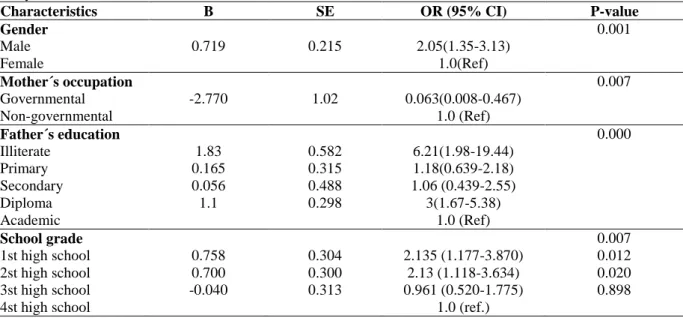
Table 1. The association between students’ health status and other variables using univariate logistic regression analysis.
Characteristics B SE OR (95% CI) P-value
Gender 0.001
Male 0.719 0.215 2.05(1.35-3.13)
Female 1.0(Ref)
Mother´s occupation 0.007
Governmental -2.770 1.02 0.063(0.008-0.467)
Non-governmental 1.0 (Ref)
Father´s education 0.000
Illiterate 1.83 0.582 6.21(1.98-19.44)
Primary 0.165 0.315 1.18(0.639-2.18)
Secondary 0.056 0.488 1.06 (0.439-2.55)
Diploma 1.1 0.298 3(1.67-5.38)
Academic 1.0 (Ref)
School grade 0.007
1st high school 0.758 0.304 2.135 (1.177-3.870) 0.012
2st high school 0.700 0.300 2.13 (1.118-3.634) 0.020
3st high school -0.040 0.313 0.961 (0.520-1.775) 0.898
4st high school 1.0 (ref.)
The results obtained from the univariate logistic regression analysis indicated that there was a significant relationship between gender and health status so that
the risk of student´s health disorder increased 2 times in males compared to the females (P = 0.001).
23
The results obtained from the univariate logistic regression analysis indicated that there wasn’t a significant relationship between father´s occupation and student´s health disorder (P = 0.303).
The association between students’ health status and other variables using univariate logistic regression analysis are presented in Table 1 .
With the multivariate logistic regression analysis school grade was considered as
independent predictive variable for
students’ health status (OR = 0.761, P= 0.016).
Discussion
In the present study investigated the predictive factors for general health status in Iranian high school students in 2014 in Ilam, Western of Iran. About two third of all participants (61.9%) have healthy status. The univariate logistic regression analysis show that the gender, mother´s occupation, father education and school grade as the main predictive factors of general health status in our population. Based our results, the prevalence of health disorder was higher in male student in comparison to female students. Several studies evaluated the effect of gender on health status (7, 8). However a study in contrast of our results reported that females are significantly more sedentary than males (8). It may be due to some governmental low in Iran. If an Iranian male can’t continue his education in academic grade, he has to spend 2 years of their age in soldiery period. Therefore, researcher thinks that the stress of failure in the achievement of academic education can cause a distress for male Iranian students. This prolonged distress may be effected on emotional health and induced the male depression .
The results of the present study showed that the younger student has 2 time health
disorder in comparison to healthy students. It may be related the puberty changed in younger students. However, we have any information about puberty age in our population; but also, it will know that the puberty period is associated with the physiological and psychological changes. These changes have important effect on
the individual, family and society.
Previous research indicated that puberty sing started about 10 years of old and complete with 12.68 (11.27-15.96) years of old in Iranian girls (23). We well know the puberty period occurs in male 2 years later than female.
Based the results the mother´s occupation
and father´s education were other
predictive factors in students’ general health. So that students who theirs father was Illiterate, the risk of health disorder increased 6 times in comparison who their father has academic education grade. Another study confirmed the effect of family factors on the health status (10). Conclusion
In view of the above findings, there are several risk factors for students’ general health disorder. It seems that gender, mother´s occupation, father education and
school grade are some suitable
independent predictive factors for
students’ general health disorder. It is concluded that high school students at risk of health disorder could be diagnosed using some predictive analysis models allowing timely interventions to be performed.
Acknowledgment
This study was approved by the Ilam University of Medical Sciences. We thank the participants, coordinators, and data collectors who assisted in this study.
24
References
1. Lee A, Kiyu A, Milman HM, Jimenez
J. Improving health and building
human capital through an effective primary care system. J Urban Health. 2007; 84(3 ):75-85.
2. Donovan JE, Jessor R, Costa FM.
Structure of health-enhancing behavior
in adolescence: a latent-variable
approach. J Health Soc Behav.1993; 34(4):346-62.
3. Turbin MS, Jessor R, Costa FM.
Adolescent cigarette smoking:
health-related behavior or normative
transgression? Prev Sci. 2000;
1(3):115-24.
4. Guilamo-Ramos V, Litardo HA,
Jaccard J. Prevention programs for
reducing adolescent problem
behaviors: Implications of the co-occurrence of problem behaviors in adolescence. J Adolesc Health. 2005; 36(1):82-6.
5. Tosh AK, Simmons PS. Sexual activity
and other risk-taking behaviors among Asian-American adolescents. J Pediatr Adolesc Gynecol. 2007; 20(1):29-34.
6. Christopherson TM, Jordan-Marsh M.
Culture & risk taking in adolescents' behaviors. MCN Am J Matern Child Nurs. 2004; 29(2):100-5.
7. Dyrbye LN,Thomas MR, Shanafelt
TD. Medical student distress: Causes, consequences, and proposed solutions. Mayo Clin Proc. 2005; 80(12):1613-22.
8. Kaplan CP, Zabkiewicz D, McPhee SJ,
Nguyen T, Gregorich SE, Disogra C et al. Health-compromising behaviors among Vietnamese adolescents: the role of education and extracurricular activities. J Adolesc Health. 2003; 32(5):374-83.
9. Simantov E1, Schoen C, Klein JD.
Health-compromising behaviors: why do adolescents smoke or drink?
identifying underlying risk and
protective factors. Arch Pediatr
Adolesc Med. 2000; 154(10):1025-33.
10.Noorbala AA, Bagheri Yazdi SA,
Yasamy MT, Mohammad K. Mental health survey of the adult population in Iran. Br J Psychiatry. 2004; 184:70-3.
11.Novello AC, Degraw C, Kleinman D.
Healthy Children Ready to Learn: an
Essential Collaboration between
Health and Education. Public Health Rep. 1992;107:3–15.
12.Ansari W, Stock C. Is the Health and
Wellbeing of University Students
Associated with their Academic
Performance? Cross Sectional Findings from the United Kingdom. Int J Environ Res Public Health. 2010; 7(2):509-27.
13.Brady KT, Sinha R. Co-occurring
mental and substance use disorders: the neurobiological effects of chronic
stress. Am J Psychiatry. 2005;
162(8):1483-93.
14.Naranjo CA, Tremblay LK, Busto UE.
The role of the brain reward system in
depression. Progr
Neuro-Psychopharmacol Biol Psychiatry. 2001; 25(4):781-823.
15.Goldberg DP, Hillier VF. A scaled
version of general health questionnaire. Psychol Med. 1979; 9(1): 131-45.
16.Seva R, Magallón A, Sarasola JA.
Merino. GHQ-28 validation in a Spanish general urban population. Er J Psychiatry. 1992; 6(3): 147-53.
17.Mari JJ, Williams P. A comparison of
the validity of two psychiatric
screening questionnaires (GHQ-12 and SRQ-20) in Brazil, using Relative
Operating Characteristic (ROC)
analysis. Psychol Med. 1985; 15(3): 651-9.
18. Bridges KW, Goldberg DP. The
validation of the GHQ-28 in
neurological patients. Br J Psychiatry. 1986; 148: 548-53.
19.Sriram TG, Chandrashekar CR, Isac
MK, Shanmugham V. The General
Health Questionnaire (GHQ):
Comparison of the English version and
25
Indian version. Soc Psychiatry
Psychiatr Epidemiol. 1989; 24(6): 317- 20.
20. Aderibigbe YA, Gureje O. The
validation of the GHQ-28 in a Nigerian
clinic. Soc Psychiatry Psychiatr
Epidemiol. 1992;27(6):280-3.
21.Stansfield SA, Marmot MG. Social
class and minor Psychiatric disorder in British civil servants: A validated screening survey using the General health Questionnaire. Psychol Med. 1992;22(3):739-49.
22.Noorbala AA, Bagheri Yazdi SA,
Yasamy MT. [The Validation of General Health Questionnaire- 28 as a Psychiatric Screening Tool]. Hakim Res J 2009; 11(4): 47-53. (Article in Persian)
23.Razzaghy-Azar M, Moghimi A,
Sadigh N, Montazer M, Golnari P, Zahedi-Shoolami L, et al. Age of puberty in Iranian girls living in Tehran. Ann Hum Biol. 2006; 33(5-6):628-33.