Chelsey A. Masterson.School and Public Library Collaboration: Identifying Facilitators and Barriers.A Master’s Paper for the M.S. in L.S. degree. April, 2012. 66pages.
Advisor: Sandra Hughes-Hassell
This study surveyed school and public youth services librarians to discover the nature of collaboration between their organizations as well as their perceptions of factors that facilitate and act as barriers to collaboration between their institutions. Previous studies have identified a plethora of potential facilitators and barriers to collaboration and cooperation, such as support from managers, colleagues, and fellow collaborators, or a lack of time and money. Recent studies on collaboration between school and public libraries, however, have centered on case studies of successful collaborative endeavors rather than on ways that collaboration might not work between these two organizations. This study builds on the broader survey studies from the past to continue the discussion on the nature of collaboration and its purpose in school and public libraries. It concludes with suggestions for further research on this topic.
Headings:
Library cooperation
Libraries & children
Surveys -- Public libraries
by
Chelsey A. Masterson
A Master’s paper submitted to the faculty of the School of Information and Library Science of the University of North Carolina at Chapel Hill
in partial fulfillment of the requirements for the degree of Master of Science in
LibraryScience.
Chapel Hill, North Carolina
April 2012
Approved by
_______________________________________
Table of Contents
Introduction ...2
Literature Review...4
Research Questions ...10
Methodology ...12
Results ...14
Discussion ...28
Conclusion ...36
References ...39
Appendix A ...41
Appendix B ...47
Appendix C ...58
Appendix D ...60
Introduction
Collaboration has been a “hot topic” in libraries for years. Reference manuals
instruct librarians to use collaboration as a tool to answer patrons’ queries, and academic
libraries have started designing spaces specifically for collaboration. Lately, public
libraries in particular have been trying to establish themselves as the so-called “third
place” for people in their communities – that is, they want to be seen as gathering places,
places that welcome the sharing of ideas as well as resources. These are places where
groups are encouraged to work together on projects, whether for school, for a household
task, or for lifelong learning. Likewise, school libraries are transforming themselves
from sterile book repositories to media centers, where students are encouraged to be
talkative, work on group assignments, and learn about resources housed in multiple new
formats. Considering the values of collaboration that these two institutions are promoting
to their patrons, it seems only natural that they would also endorse collaboration between
their organizations.
In a 1989 study of public and school libraries in Indiana, Callison, Fink, and
Hager note that “[t]he need for greater cooperative efforts may become essential as
secondary school library media programs face [decreases in budgets and increases in
costs].” Unfortunately, 23 years later, school library media centers and public libraries
are still seeing their budgets slashed. In these times of meager budgets, sharing and
promoting each other’s resources appears wise not only from a theoretical standpoint, but
Historically, librarians from public libraries and from schools have cited a lack of
time as a reason for failing to collaborate with each other (Shannon, 1991). While this
may indeed be true, particularly when both institutions’ budgeted staff hours continue to
be cut, research seems to indicate that student learning increases with increased levels of
collaboration. Thus, it seems logical that public and school libraries should work
together, as both organizations should be striving to provide the best services possible for
their constituents.
Admittedly, collaboration is not an ideal that all librarians support. Previous
studies have attributed failed collaborative efforts to barriers such as a lack of time and
money for collaboration. However, studies have also indicated that positive attitudes
towards collaboration and a history of successful collaborative efforts between school
and public librarians have facilitated the execution of future collaborative efforts. This
study examined public and school librarians’ opinions on these and other facilitators and
Literature Review
According to Shirley Fitzgibbons, “cooperation may be the only solution to
providing adequately for the library needs of children and young adults” (2001). In her
2001 literature review on collaboration, Fitzgibbons compiled a list of barriers and
facilitators for collaboration. Barriers include staffing issues (both public libraries and
schools lack children’s and young adult librarians and media specialists), dated and
insufficient resources, and the attitude that school and public libraries serve separate and
unique populations. While the opposites of all of these barriers are facilitators,
Fitzgibbons also lists adequate funding, a “shared vision and common goals,” effective
communication, and commitment as being extremely important in facilitating
collaboration (2001). Fitzgibbons ends her literature review with recommendations for
encouraging collaboration, stating that “[c]ommunication and commitment are probably
the most important factors as first steps to cooperation” (2001).
In their 2003 study, Hughes-Hassell, Mancall, Reid, and Deglin enlisted a group
of 24 school and public librarians to participate in seven professional development
workshops designed to teach them new technology skills. Each participant was paired
with a participant from the same community who worked at the opposite institution.
Pairs were tasked with creating a web site for their communities. The goal of the
workshops was to promote collaboration between the school and public libraries by
creating a resource that would mutually benefit both institutions (as well as their
Collaboration Factors Inventory. This test found that the participants were most pleased
with the respect, flexibility, and communication shown by their teammates and that
“[l]ow-scoring factors related to process, structure, and resources” (Hughes-Hassell et al.,
2003). Although participants were pleased to be working with their counterparts, they
wished that their superiors would take a more active role in promoting such relationships.
The Hughes-Hassell et al. (2003) study suggests that technology can be a tool for
promoting and facilitating collaboration, particularly when it is used to create a product
that benefits both organizations. Building a shared website also implies a potential
shared goal of collaboration: collaborative efforts can increase the marketability of both
organizations while strengthening bonds between each organization’s members. The
study also describes several barriers to collaboration: that the librarians lacked the time
and the money to collaborate and that they felt “a need for management to take a more
active role in promoting and supporting [collaboration]” (Hughes-Hassell et al., 2003).
Tice (2001) describes the Connecting Libraries and Schools Project (CLASP), a
collaborative effort between the New York Public Library systems and New York City
public schools to support collaboration between public schools and libraries, to encourage
family literacy, and to increase community use of the public library. CLASP was created
in 1991, and since then, it grew to serve “more than 240,000 students in seven
community school districts with over 300 schools, public and private” (Tice, 2001). The
program introduced school librarians and administrators to children’s and young adult
public librarians so that these professionals would have contacts with their counterparts,
which resulted in an increased ability to advertise programs, events, and services for both
CLASP began creating their summer reading lists alongside the public librarians, both to
get a new perspective on appropriate titles and to ensure that these titles would be
available for students and parents in the public libraries. Also, CLASP librarians led
professional development seminars for school administrators and educators. These
collaborative efforts allowed the public libraries to have an increased presence in the
community, which resulted in many new patrons visiting the library. Tice’s article also
describes a qualitative study that showed that 75 percent of fifth and seventh graders
surveyed could remember a CLASP visit to their classes (2001). This finding suggests
that collaboration can increase awareness of library services to children.
In a 1994 article, Oestreich also features CLASP, describing the program as
having provided a way for public librarians to make connections in schools. Oestreich’s
interviews with CLASP administrators suggest that these connections were instrumental
in the program’s success, as school librarians informed the public librarians of where to
go and to whom to talk in their schools in order to make collaboration work. Also,
administrators noted that partnerships with public librarians allowed school librarians to
have a more defined presence at their schools, which helped them have a greater impact
on students and teachers (Oestreich, 1994). While the libraries involved with CLASP
received a grant in order to promote collaboration, Oestreich emphasizes that school and
public librarians should not need money in order to talk to each other; this is something
they should attempt to accomplish in any case (1994).
While neither Tice nor Oestreich identified specific barriers the CLASP librarians
faced when collaborating, both mention aspects of the program that facilitated
collaborate, which then led school and library administrators to back the librarians’
collaborative efforts. Both Tice (2001) and Oestreich (1994) also mention that the school
librarians were not seen as collaborators prior to CLASP; however, with CLASP in place,
the school librarians’ colleagues began to view them as having more collaborative value
(Tice, 2001; Oestreich, 1994). This suggests that having the support of one’s colleagues,
not just management, also facilitates collaboration.
Bates and Webster (2009) describe a successful month-long collaborative
program between the elementary school and public library in their community entitled
“One School, One Book” (OSOB). The annual OSOB program enlists all families in the
community to read the same book over the course of one month. The public library
purchases several copies of this book to lend, and the school purchases the rest of the
books, in bulk and at a discounted rate, to sell at minimal price to its students. According
to Bates and Webster, “[n]o family has ever been denied the opportunity to participate”
(2009). The public library provides homework help to students every afternoon, and
during the OSOB month, the help center includes time designated to be spent reading the
month’s specified book. So far, the program appears to be extremely successful, as
“students have averaged 90 percent (or better) on the Virginia Standards of Learning
reading test over the past three years [since the program began]” (Bates & Webster,
2009).
DeFilipo (2010) describes a case study of a collaborative program between the
Carnegie Library of Pittsburgh and the Pittsburgh Public School District called BLAST
(Bringing Libraries and Schools Together). BLAST is a school outreach program
success, the program expanded to include the following goals: enhancing reading
attitudes and abilities of third-graders, providing equal access to public library materials,
and increasing public library visibility in the classroom (DeFilipo, 2010).
DeFilipo (2010) outlines numerous facilitators and barriers to collaboration. She
describes how the Carnegie Library of Pittsburgh’s youth services manager was
instrumental in instituting collaboration with the school district, which emphasizes
Hughes-Hassell et. al.’s (2003) findings that managerial attitudes act as either barriers or
facilitators of collaboration. Barriers that DeFilipo (2010) discussed include the fact that
school districts often change administrators, which suggests that public librarians need to
continually make initial contact with new people in order to continue collaboration.
Also, funding for the BLAST program has become a barrier. Initially, the program
received financial support from the Grable Foundation, but now the program is funded
through tax support and Pittsburgh Public Schools (DeFilipo, 2010). While funding is
presented as a barrier here, as in many other studies, the fact that the public school system
is providing monetary assistance to BLAST emphasizes its positive impact on public
schools.
Shannon (1991) surveyed a geographically narrow group of librarians in her study
of one county in North Carolina. She conducted her study via surveys sent through the
mail; interestingly, 77% (23 of 30) of the questionnaires were returned by the school
librarians and 77% (13 of 17) were returned by the public librarians. These surveys were
designed to provide information about collaboration and cooperative programs that
existed at the time between school and public librarians in the county, as well as factors
responses also indicated that public and school librarians reported varying statistics on
how much collaboration existed. Perhaps this indicates that the questions asked were
unclear, or perhaps different respondents were attempting to make themselves (or their
libraries) look better through the surveys. In any case, Shannon’s (1991) results support
the assertion that time and attitudes play a large part in the success or failure of
collaborative efforts between these institutions.
LaMaster (2005) also used surveys when she studied one public library and one
public elementary school from each of the county seats in Indiana. Like Shannon, she
mailed her surveys, but she did not have as high a response rate (64% of public libraries
and 51% of school media centers responded). Her purpose was to discover whether or
not librarians were collaborating using the seven guidelines set by the Public Library
Commission of Indiana in 1904. LaMaster’s responses indicated that 57.1% of school
media center respondents and 79.6% of public library respondents performed direct
communication with their organizational counterparts (2005). However, a much smaller
percentage of librarians met face-to-face when communicating.
LaMaster noted several new barriers and facilitators to collaboration between
school and public libraries. As in previous studies, both sets of librarians cited a lack of
time as a barrier, but they also described a lack of education and training as barriers to
collaboration. Respondents also stated that territorialism, or the desire to not encroach on
the other institution’s domain, was a barrier to collaboration. Facilitators included
“persistence, direct contact with the other agency, administrative support and committed
Research Questions
School library media centers and public libraries are continually seeing their
budgets slashed. In these times of meager budgets, sharing and promoting each other’s
resources appears wise not only from a theoretical standpoint, but also from a fiscal
perspective. The purpose of this study was to gain a greater understanding of the factors
that affect existing collaboration between school and public libraries throughout the
United States. In order to accurately describe the current state of collaboration between
the school and public libraries in the country, this study surveyed youth services
librarians and school library media specialists who subscribed to three professional
listservs. With these surveys, the study hoped to discover:
1) What is the nature of collaboration between public and school libraries in the
United States?
2) What outside factors (such as budget cuts and institutional locations) impact
the nature of collaboration between public and school libraries in the United
States?
3) What are the facilitators and barriers to collaboration between public and
school libraries in the United States?
From the review of the literature, it appears that the research studying the state of
collaboration between school and public libraries is currently lacking in breadth. While a
number of survey studies on the nature of collaboration were conducted in the late 1980s
specific case studies of successful collaborative efforts. The survey that this study
conducted sought to partially fill this gap in the current literature by reaching a large
Methodology
Because of the large number of participants, an online survey was the most
feasible method of data collection for the purpose of this study. The Qualtrics survey software was selected for its clean interface and logical survey design. The sample of
participants was limited to librarians who were members of three American Libraries
Association (ALA) professional listservs: AASL-forum, ALSC-l, and YALSA-bk.
Because the study featured gathering responses for two distinct groups of librarians, two
surveys were designed, one for public librarians and one for school librarians.
AASL-forum is the general listserv associated with the American Association of
School Librarians (AASL). It is open only to members of AASL; prospective listserv
subscribers must request admission to the listserv and be approved by the listserv
administrator, who verifies that each subscriber is a member of AASL. AASL-forum
currently has 713 subscribers. ALSC-l is the general listserv associated with the
Association of Library Services to Children (ALSC). Unlike AASL-forum, subscription
to ALSC-l is not dependent upon membership in ALSC. This listserv currently has 1,935
subscribers. YALSA-bk is a listserv dedicated to young adult book discussions. It is
associated with the Young Adult Library Services Association (YALSA), although
membership in this division of ALA is not required for subscription to YALSA-bk.
While this listserv does not specifically address librarians for research purposes, it was
selected for this study because of its large number of subscribers; currently, YALSA-bk
association with the ALA, and the assumption that, as professional library listservs, the
majority of their subscription bases are professional librarians who serve youth in
libraries.
The survey was active on the Qualtrics website from February 27, 2012 through March 12, 2012, giving the potential subjects a period of two weeks in which to submit
their responses. Invitations to participate were originally sent via email to subscribers of
ALSC-l and YALSA-bk on February 27 and to AASL-forum on February 28. The
survey software allowed the participants to begin responding to the survey, stop, and
return to the survey at a later time if they chose to do so. In order to minimize multiple
responses from the same participant, after the initial invitation to participate, the subjects
Results Respondents
It is probable that a number of librarians subscribe to multiple professional
listservs. Because invitations were sent out over three listservs, it is impossible to know
exactly how many school and public librarians received invitations to participate in this
study. Therefore, an accurate response rate cannot be calculated. Of the 103 school
librarian surveys started, 91 were completed. This indicates an 88% response completion
rate. The public librarian survey had a similar percentage: of the 282 surveys started, 238
were completed, which indicates an 84% rate of completion. The large difference in
number of surveys completed by public librarians versus school librarians could be
attributed to a number of factors: the much lower number of subscribers to AASL-forum;
the idea that many school librarians are the only library workers at their school, leaving
them with less free time to participate in studies; or some unknown factor.
The opening questions in the survey were “filter” questions, asking whether the
participants were public librarians, public school librarians, or private school librarians
and whether or not they worked with children under age 20 for at least 75% of their work
day. Of the respondents who answered the school librarian survey, 82 (84%) identified
themselves as working in a public school, 14 (14%) as working in a private school, and 2
(2%) as working in a public library. The two respondents who stated they worked in
public libraries do not necessarily negate their survey responses, as hybrid school/public
respondents of the public librarian survey who answered this question stated that they
worked in a public library setting. Only one respondent (1%) to the school librarian
survey stated that he/she spends less than 75% of his/her work day serving children
younger than age 20. However, 70 respondents (26%) to the public librarian survey
stated that they spend less than 75% of their work days serving youth younger than age
20, while 200 (74%) responded in affirmation to this question. This may suggest that
public librarians are more frequently called upon to serve adults as well as youth.
Excluding Pre-kindergarten, each grade level was fairly evenly represented by the
school librarians who participated in the survey (20% of respondents stated they served
Pre-kindergarteners, while all other grades were served by 37%-42% of respondents).
The vast majority (80%) of respondents stated that they were the sole librarians in their
schools, and 51% responded that they had no library assistants, either. However, 43% of
respondents stated that they had one library assistant who was either full-time or
part-time. These librarians represented a variety of school sizes and locations. Mid-range
sized schools were best represented, with 67% of respondents serving 201-800 students,
but large schools (13% of respondents served schools with more than 1,400 students)
were better represented than small schools (only 2% of respondents work at schools with
fewer than 200 students). Likewise, suburban schools were represented by the most
respondents (49%), while urban and rural schools were represented by 28% and 23% of
respondents, respectively.
The public librarians surveyed also served a wide variety of communities. The
librarians reported serving communities with populations as small as 300 and as large as
49% of respondents rating their communities as such. Urban and rural communities were
also represented by similar numbers, with 22% and 29% of respondents, respectively.
Also, a number of respondents wrote in that they served a combination of urban,
suburban, and rural communities. Unlike school librarians, 50% of public library
respondents worked with 1-3 other youth librarians at their libraries, while only 24%
stated they worked alone, and 19% that they worked with 4-7 other librarians. This idea
of a team of public youth librarians is reinforced by the statement of 82% of librarians
surveyed that they serve a combination of ages of youth. The majority (74%) of
respondents stated they have a master’s degree in library science, and 87% of respondents
reported to being employed full-time at their libraries.
Responses
This section will present the survey responses in relation to the study’s research
questions.
Research Question 1: What is the nature of collaboration between public and school libraries in the United States?
After the “filter” questions, the survey began by asking whether or not the
respondents had collaborated with their counterpart in a school/public library at least
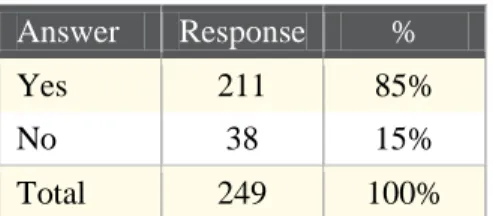
once in 2011. Figure 1A shows that 57% of school librarians reported collaborating with
public librarians at least once. A much greater percentage of public librarians reported
that they had collaborated with a school librarian; Figure 1B shows that an impressive
immediately followed, asking the respondents to indicate the number of times they had
collaborated with their counterparts. 51 of the 54 school librarians (94.4%) who
answered “yes” to the previous question responded to the follow-up, and their responses
varied from “once” (7 responses) to “well over 50 times” (all responses can be found in
Appendix A). One hundred ninety-one of the 211 public librarians (90.5%) who
answered “yes” to the previous question responded to the follow-up. Eight respondents
indicated they had collaborated only once in 2011, while several stated they collaborated
daily (see Appendix B for the full text of all responses).
Figure 1: Collaboration between Public and School Librarians in 2011
Answer Response %
Yes 54 57%
No 40 43%
Total 94 100%
Fig. 1A: School Librarian responses
Answer Response %
Yes 211 85%
No 38 15%
Total 249 100%
Fig. 1B: Public Librarian responses
Next, respondents were asked to share specific ways that they had collaborated
with their counterparts throughout 2011. Two hundred twenty-three public librarian and
55 school librarian respondents answered this question. (Note that both of these
respondent rates are higher than are those who responded “yes” to collaborating with
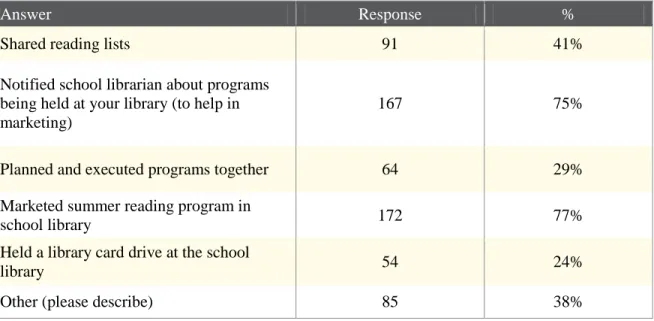
their counterparts.) Figure 2 displays that the two most popular collaborative efforts
according to public librarians were marketing the summer reading program to local
school libraries (77%) and notifying the school librarians about programs being held at
the public library (75%). Forty-one percent of public librarians also said they shared
reading lists with school librarians. Among the “Other” responses, a number of
presenting storytimes, and the Battle of the Books program as collaborative efforts they
shared with the school librarians.
Figure 2: Ways of Collaboration – Public Librarian (n=223)
Answer Response %
Shared reading lists 91 41%
Notified school librarian about programs being held at your library (to help in marketing)
167 75%
Planned and executed programs together 64 29%
Marketed summer reading program in
school library 172 77%
Held a library card drive at the school
library 54 24%
Other (please describe) 85 38%
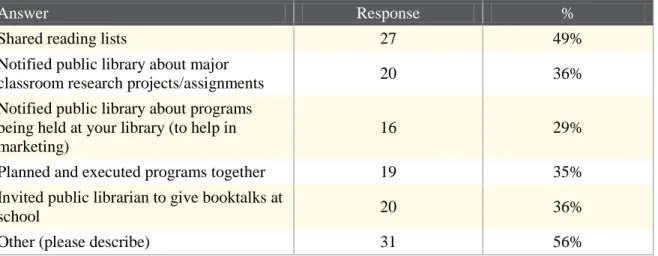
Figure 3 shows that the school librarians’ responses regarding methods of
collaboration were much more evenly spread than were the public librarians’ responses.
Most popular for these respondents was “shared reading lists,” at 49%. Least popular for
these respondents was notifying the public library about programs being held at the
school library (29%). Many of the write-in “Other” responses noted some kind of
advertising between the public and school libraries, such as promoting the summer
reading program or distributing public library cards at the school library. One respondent
wrote that the public librarian had conducted a workshop at the school library for parents,
Figure 3: Ways of Collaboration – School Librarian (n=55)
Answer Response %
Shared reading lists 27 49%
Notified public library about major
classroom research projects/assignments 20 36%
Notified public library about programs being held at your library (to help in marketing)
16 29%
Planned and executed programs together 19 35%
Invited public librarian to give booktalks at
school 20 36%
Other (please describe) 31 56%
Research Question 2: What outside factors (such as budget cuts and institutional locations) impact the nature of collaboration between public and school libraries in the United States?
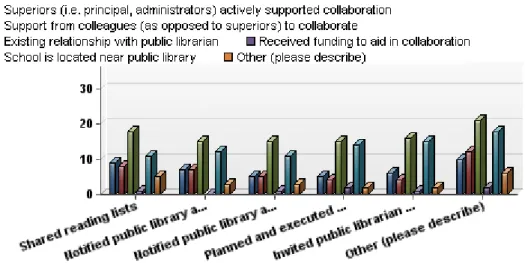
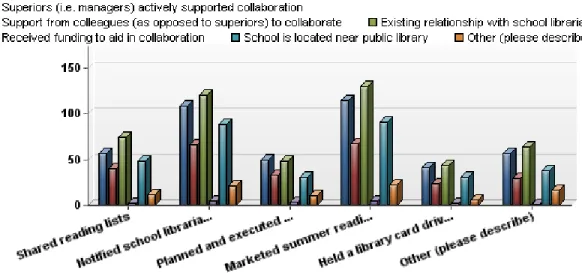
Figure 4 compares the school librarian respondents’ answers to the question
“What would you perceive as factors that facilitated your ability to collaborate with
public librarians” to their responses regarding ways that they had collaborated with public
librarians. The answer choices for this question (as well as the ones shown in Figures
5-7) were assembled from the literature review of previous studies’ popular responses to
similar questions about facilitators (and barriers) to collaboration. The graph clearly
shows that respondents who stated that they had an existing relationship with the public
librarian and that their school was located near the public library described more
instances of collaboration than did those who listed other facilitating factors. The graph
shows that the next two facilitating factors that most corresponded with collaboration
least importance to these respondents was receiving funding to collaborate with public
librarians.
Figure 4: Factors that Facilitated Collaboration in Relation to Methods of Collaboration – School Librarian (n=63)
Figure 5 is similar to Figure 4, except that it compares factors that school librarian
respondents listed as barriers to the ways that they collaborated with public librarians.
The overwhelming response from school librarians was that a lack of time to collaborate
was the greatest barrier to collaboration; however, 35 respondents (60.3%) who listed this
as a barrier stated that they had collaborated at least one time in 2011 with a public
librarian, while only 23 respondents (39.7%) stated that they did not collaborate in 2011.
This ratio of respondents who listed factors as barriers to collaboration and did
collaborate regardless of these barriers to respondents who listed barriers and did not
collaborate in 2011 remains fairly steady at approximately 60%-40% for the other two
highest-scoring barriers: lack of money to collaborate and “Other”. Among the write-in
responses, school librarians frequently cited a belief that the school library and the public
library support different missions and goals as well as a lack of interest (on the part of
Figure 5: Factors that Acted as Barriers to Collaboration in Relation to Methods of Collaboration – School Librarian (n=82)
Figure 6 compares public librarian respondents’ discussion of factors that
facilitated collaboration to their responses regarding ways they collaborate with school
librarians. Like school librarians, public librarian respondents also selected “existing
relationship with school librarian” as the most popular factor facilitating collaboration.
Following close behind for the public librarians, however, was the factor of managers
supporting collaboration. Also similar to the school librarian respondents, the public
librarians listed receiving funding to aid collaboration as being the least popular
facilitating factor. In fact, aside from receiving funding and “Other”, all of the response
Figure 6: Factors that Facilitated Collaboration in Relation to Methods of Collaboration – Public Librarian (n=214)
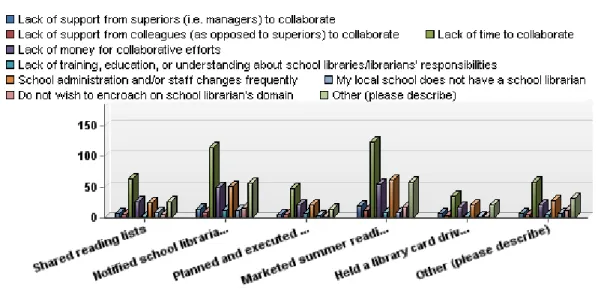
Figure 7 shows the relationship between public librarians’ responses regarding
barriers to collaboration and their responses about the way that they collaborated with
school librarians in 2011. Like school librarians, the public librarians responded that a
lack of time to collaborate was the largest and most consistent barrier to collaboration.
However, 89.2% of public librarians who listed time as a barrier to collaboration also
stated that they had collaborated at least once in 2011 with a school librarian. For the
librarians who listed time as a barrier, the most popular methods of collaboration were
marketing the summer reading program in the school library, notifying the school
librarian about programs being held at the public library, and sharing reading lists with
the school librarian. The next two most frequent barriers across methods of collaboration
were a lack of money and the response that school administration or staff changes
Figure 7: Factors that Acted as Barriers to Collaboration in Relation to Methods of Collaboration – Public Librarian (n=226)
Research Question 3: What are the facilitators and barriers to collaboration between public and school libraries in the United States?
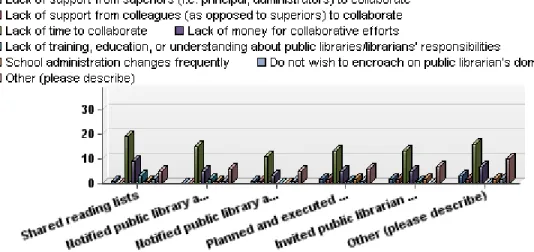
Sixty-three school librarian respondents indicated factors they considered to be
facilitators to collaboration; however, two of the “Other” responses stated that the
respondents did not collaborate. Figure 8 shows that an overwhelming 65% of these
respondents stated an existing relationship with the public librarian facilitated their
collaboration. In addition, several respondents wrote that their past relationships with
public librarians facilitated their willingness to collaborate with current public librarians.
The location of the school near the public library was also a popular facilitating factor,
receiving 59% of respondents’ votes. Only 3% of respondents indicated that receiving
funding to aid in collaboration was a facilitator. Interestingly, one write-in respondent
Figure 8: Factors that Facilitate Collaboration – School Librarian (n=63)
Answer Response %
Superiors (i.e. principal, administrators) actively supported collaboration
16 25%
Support from colleagues (as opposed to superiors) to collaborate
17 27%
Existing relationship with
public librarian 41 65%
Received funding to aid in
collaboration 2 3%
School is located near public
library 37 59%
Other (please describe) 10 16%
Two hundred fourteen public librarian respondents indicated their opinions on
factors that facilitate collaboration with school librarians. Figure 9 shows that the public
librarian respondents agree with the school librarians that an existing relationship with
the school librarian was the most popular factor facilitating collaboration, indicated by
73% of the respondents. Having the support of superiors as well as the location of the
school near the public library were also selected by a majority of respondents (67% and
54% of respondents, respectively). Also like school librarians, only 3% of the public
librarians responded that receiving funding for collaboration was a facilitating factor.
Among the “Other” responses, having the support of the school librarian for collaboration
was listed by multiple respondents, re-emphasizing the importance of the public
Figure 9: Factors that Facilitate Collaboration – Public Librarian (n=214)
Answer Response %
Superiors (i.e. managers) actively supported collaboration
143 67%
Support from colleagues (as opposed to superiors) to collaborate
83 39%
Existing relationship with
school librarian 157 73%
Received funding to aid in
collaboration 6 3%
School is located near
public library 116 54%
Other (please describe) 30 14%
While 63 respondents indicated facilitators to collaboration, 82 provided their
ideas of barriers. It should be noted that two respondents indicated that they work in
international schools, rather than at schools in the United States. As Figure 10 shows,
71% of respondents overwhelmingly indicated a lack of time as a barrier to collaborating
with public librarians. 33% of respondents stated that a lack of money to collaborate was
a barrier, but none of the other provided responses received a large percentage of
respondents’ selections. However, the write-in responses included in the “Other”
category were very interesting. A number of these responses discussed a lack of interest
in collaboration on the public librarians’ part or a negative interaction with a public
librarian that discouraged the respondents from pursuing collaborative efforts. Another
barrier that was written in was the opposite of the facilitator of the institutions being
located close to each other – several respondents stated they were unsure of which branch
missions of the school library and the public library were very different, which they
believed hindered collaboration. However, three respondents wrote in that they did not
perceive any barriers to collaborating with public librarians.
Figure 10: Barriers to Collaboration – School Librarian (n=82)
Answer Response %
Lack of support from superiors (i.e. principal, administrators) to collaborate
10 12%
Lack of support from colleagues (as opposed to superiors) to collaborate
6 7%
Lack of time to collaborate 58 71%
Lack of money for
collaborative efforts 27 33%
Lack of training, education, or understanding about public libraries/librarians' responsibilities
6 7%
School administration
changes frequently 4 5%
Do not wish to encroach on
public librarian's domain 7 9%
Other (please describe) 29 35%
Two hundred twenty-six respondents provided their opinions on barriers to
collaboration, compared to the 214 that indicated factors that facilitated collaboration.
Similar to school librarian respondents, 74% of public librarian respondents noted a lack
of time to collaborate. The next two most popular responses indicated that the school
administration and/or staff change frequently and the respondents experienced a lack of
money for collaboration, with 33% and 32% of responses, respectively. The respondents
responses indicated that the respondents had difficulty communicating with school
librarians and/or administrators who seemed uncooperative in collaborating with them.
Another popular write-in response was that the school and testing curriculum made it
difficult for respondents to find a way “in” to collaborate. Also, a number of respondents
stated that the school librarians were experiencing limited resources, which gave them
little time to collaborate with public librarians. However, four respondents stated that
they perceived no barriers to collaboration with school librarians.
Figure 11: Barriers to Collaboration – Public Librarian (n=226)
Answer Response %
Lack of support from superiors (i.e. managers) to collaborate
29 13%
Lack of support from colleagues (as opposed to superiors) to collaborate
14 6%
Lack of time to collaborate 168 74%
Lack of money for
collaborative efforts 73 32%
Lack of training, education, or understanding about school libraries/librarians' responsibilities
14 6%
School administration and/or
staff changes frequently 75 33%
My local school does not
have a school librarian 21 9%
Do not wish to encroach on
school librarian's domain 27 12%
Discussion
This study’s main aim was to build on the foundation of discussion that
researchers such as Callison, Fink, and Hager (1989), Shannon (1991), and LaMaster
(2005) laid with their survey studies. Ultimately, the study’s findings largely confirm
what these previous studies found, as both public and school librarian respondents
overwhelmingly cited a lack of time as a barrier to collaboration.
This discussion distinguishes between collaboration and cooperation.
Collaboration, in this discussion, refers to efforts that involve both a school and a public
librarian doing some kind of work or producing some kind of product that will then be
shared with the collaborative partner. A clear example of collaboration between school
and public librarians would be planning and creating a program together. Cooperation,
on the other hand, refers to an endeavor that is largely created by one of the partners and
accepted by the other partner, who then promotes the aims of the original partner’s
efforts. An example of cooperation would be the public librarian posting flyers for the
school librarian’s program or event, or vice versa.
Research Question 1: What is the nature of collaboration between public and school libraries in the United States?
The first interesting statistic from this survey is the large variation between the
amount of collaboration reported by public librarians (85% of respondents stated they had
respondents reported collaborating at least once). Because the respondents were not
asked who had initiated the collaborative efforts that they reported, a comparison
between this and Shannon’s (1991) study, which also found a large difference in reported
collaborative efforts between public and school librarians, would be unwise to make.
One possible explanation for the drastically smaller amount of reported collaboration on
the part of school librarians could be the fact that a fewer number of school librarians
responded to the survey; however, the percentage differences remain telling. More
research into this anomaly would certainly prove interesting. The large variation in the
number of reported collaborative efforts remained constant for both school and public
librarians, so this, at least, seems to definitely be a matter of personal or organizational
choice. Clearly, one cannot make any kind of conclusion about the amount of
collaboration that two organizations undertake with each other just because they agree to
work together.
The nature of collaboration that public library respondents reported was largely
one of marketing. Seventy-seven percent of respondents stated they had marketed their
summer reading programs in the school library, and 75% said they had notified the
school librarian about programs they were holding at the public library. The clear
purpose for both of these collaborative (more like cooperative, in this case, as school
librarians were most likely not required to do anything but post flyers, announce
programs, or allow the public librarian to make his or her own announcements) efforts is
one of marketing. The desire of public librarians to use the school library as a marketing
tool is quite understandable; as children and teenagers are required to attend school,
audience of potential patrons who they might never have communicated with had the
public and school libraries not been in some kind of cooperative relationship.
Marketing strategies were popular write-in responses for the public librarian
respondents, as well. Booktalking in schools and giving library tours are both activities
that benefit the public librarian because they allow him or herself to become a face that
students will recognize, which will hopefully then, as Tice (2001) found in her CLASP
survey, increase awareness of the public library to children in schools. Presenting
storytimes and planning and executing programs with the school librarian (to which 29%
of public library respondents and 35% of school library respondents reported) can serve
this same purpose.
Interestingly, booktalking, library tours, and marketing programs in the school are
activities that most likely required minimal effort from the school librarian. This trend
holds true for the third most popular response from public librarians regarding the nature
of their collaboration – 41% responded that they had shared reading lists with school
librarians. Sharing reading lists is a cooperative effort that benefits both organizations
greatly, as it reduces the work load of both parties involved without increasing it. The
trend also holds true for the respondents who wrote in that they donate books to the
school library. This last cooperative effort most likely benefits the public librarian by
fostering a sense of camaraderie, generosity, and helpfulness between him or herself and
the school librarian, which can then facilitate future collaborative endeavors.
The school library responses showed that sharing reading lists was the most
popular method of collaborating. Again, this is an effort that is clearly collaborative, as it
among both school and public librarians. School librarians also seemed likely to engage
in cooperative endeavors, such as notifying public librarians about upcoming school
assignments, for which the library might want to prepare itself, and inviting the public
librarian to give booktalks at the school. Many of the school library respondents also
discussed efforts that caused them to be distributors of sorts – of public library cards,
summer reading program materials, and program flyers. Again, all of these cooperative
efforts can easily foster a sense of goodwill and a spirit of helpfulness between the
organizations. Thus, while school librarians might not gain anything directly by helping
the public library market itself to students, they can gain allies and contacts at the public
library to help them in the future.
Research Question 2: What outside factors (such as budget cuts and institutional locations) impact the nature of collaboration between public and school libraries in the United States?
The discussion above regarding the importance of fostering a sense of reciprocal
helpfulness and open communication is extremely important when considering factors
that impact the nature of collaboration, according to both public and school librarian
respondents. School librarians responded more frequently that the outside factor of
location (the school being located near the public library) was helpful in encouraging all
methods of collaboration. This could have happened for a number of reasons – in a city
with multiple branch libraries, for example, a school librarian might feel more
comfortable approaching a public librarian if he or she knows that the branch is located
However, that is purely speculation. The public librarians, on the other hand, responded
that having managerial support was a greater factor in their participation in collaborative
efforts of all natures. Perhaps this indicates that public librarians are more likely to have
the support of their superiors for collaboration than are school librarians to have support
from their administrators, or perhaps it is only an indication of the differences in both
organizations’ internal hierarchies. One final observance of note is that both school and
public librarians listed “receiving funding” to help in collaboration very low in relation to
their collaborative efforts. This likely does not indicate that receiving funding does not
facilitate collaboration, but rather that only a few respondents actually did receive
funding for this purpose.
A lack of time was the overwhelming leader of barriers to collaboration among all
respondents. However, it is important to note that more than half of both school and
public library respondents who listed time as a hindrance still admitted to collaborating
with their colleagues in 2011. While true collaboration takes a good deal of time from
both parties involved, it is encouraging that both school and public librarians seemed to
agree that working together was worth the effort, at least for some collaborative
endeavors, such as marketing purposes and sharing reading lists.
Both sets of respondents also detailed what they perceived to be their most
successful collaborative endeavor with their counterparts in 2011. Popular responses
from the public librarians were marketing library programs (particularly the summer
reading program), coordinating public librarian visits to the schools, running book clubs
at the schools, and holding library card drives at the schools. Among school librarians,
schools, coordinating programs together (such as author visits), marketing the summer
reading program, sharing resources (including databases, books, and book lists), and
holding library card drives. Clearly, marketing programs – especially summer reading –
is an endeavor that many respondents valued highly, and a number of respondents
mentioned their appreciation at having a partner with whom to share resources because of
their own lack in these areas.
Question 3: What are the facilitators and barriers to collaboration between public and school libraries in the United States?
As mentioned briefly above, both the public librarian (73%) and school librarian
(65%) respondents selected having an existing relationship with the school librarian as
the number one facilitator to collaboration. Both school and public librarians also
mentioned relationships in their write-in responses – that past working collaborative
relationships and having their counterpart’s support were both important factors that
facilitated collaboration. Clearly, the relationship (and the history of this relationship
from one’s predecessors) can have either a highly positive or a negative effect on
collaboration. A number of respondents (both school librarian and public librarian) wrote
that they had contacted their counterparts, who seemed resistant to collaboration, which
then turned them off of the idea. One public librarian wrote that “[t]he high school
librarian is HIGHLY resistant to collaborating with me. The two elementary schools and
the middle school are enthusiastic.” From this one response, it is clear that personal
important facilitating factors for collaboration; likewise, their opposites would signify
one of the most difficult barriers to collaboration to overcome.
A number of school librarians wrote that they were unsure with which public
library branch they should collaborate, either because their city had multiple library
branches or because they served students from a large area, who would have differing
“home” public libraries themselves. This confusion might signify why 59% of school
librarians listed the location of the school near the library as a facilitator to collaboration.
Fifty-four percent of public librarians agreed, though they did not seem to share the
confusion of the school librarian respondents nearly as much. Public librarians also
responded heavily that having their managers’ support when collaborating was a
facilitator for them.
The overwhelming response regarding barriers to collaboration from both sets of
respondents was a lack of time to collaborate. (Interestingly, one school librarian stated
that “time” was a facilitator for his or her collaboration with public librarians, but he or
she did not elaborate further.) Many public librarians wrote in that they experienced
barriers to collaboration because the school librarians were so stretched for time, so this
lack of time appears to be a well-understood barrier. Public librarians mentioned school
budget cuts that had stripped school librarians from having any support staff (one
respondent even stated incredulously “I don’t know how she [the school librarian] can
accomplish anything without any support staff”) and, in some cases, from their own jobs.
This is “such an unfortunate situation,” as one public librarian respondent elaborated,
because they want to help the school librarians, but they lack the time to set up the
was a barrier not because he or she lacked the time to collaborate, but because the public
library had limited hours and was “mostly open after the school closes, making it difficult
to truly collaborate.”
Several school librarian respondents wrote that they did not collaborate with
public librarians because they felt the two organizations focused on different missions.
One even stated he or she did not know what he or she would collaborate about with a
public librarian, or why. To this end, training about the benefits of collaboration might
be helpful for both school and public librarians. (Interestingly, only 7% of school
librarians and 6% of public librarians responded that a lack of understanding of their
counterpart’s responsibilities was a barrier, so perhaps some librarians do not realize that
this lack of training could be a barrier.) Some public librarians agreed with this belief of
differing organizational missions, as they wrote in that they could not find a way to
connect with the school librarians, who were so focused on testing, to collaborate with
Conclusion
The goal of this study was to supplement the broad literature on collaboration,
which currently consists mainly of case studies of successful collaborative endeavors,
many of which have been given grants to monetarily support the efforts between school
and public librarians. It hoped to take a broader look at the perceptions of school and
public librarians from around the country in order to widen the scope of the current
literature. In actuality, this study’s findings largely reaffirm those from earlier studies
regarding the facilitators and barriers to collaboration that school and public librarians
perceive. This study was limited by time and scope, but clearly, this is a discussion that
merits further research. Future researchers might pursue questions about the importance
of certain facilitators and barriers over other ones. For example, is a lack of time a
greater barrier to collaboration than an existing relationship between organizations is to
facilitating collaboration? A study that asked its participants to rank their perceptions on
facilitators and barriers would indeed be insightful and interesting.
Another gap arises when one considers that not everyone supports collaboration
between school and public libraries. Several respondents (though not many) wrote in that
they did not feel the need to collaborate with their counterparts, or that they felt their
organization’s mission was too disparate to collaborate with their counterparts. Of
course, it is true that schools and public libraries exist for different purposes, but they do
would be interesting to do a study on why opponents to collaboration feel the way they
do.
This study also attempts to address outside factors that either facilitate or act as
barriers to collaboration and their effects on the ways that school and public librarians
collaborate with each other. A number of respondents wrote that budget cuts in schools
had caused school librarians to lose their support staff or even their own jobs, thus
making collaboration extremely difficult (or impossible). Many respondents also
highlighted the importance of building location to the feasibility of collaboration. While
respondents spoke about outside factors such as these as either facilitators or barriers,
they did not mention their correlation (or lack thereof) of these factors to the kind of collaborative efforts they had chosen to undertake. A study looking specifically at these
factors would be insightful and enlightening.
Another opportunity for further research is to interview or survey managers and
administrators, rather than librarians, to discover their perceptions on facilitators and
barriers to collaboration. Public librarians widely stated that the support from their
management team was a strong facilitator to their successful collaboration, but what do
these administrators think? A study such as this would be a useful companion study, and
would surely add to the discussion on positive and negative perceptions of collaborative
endeavors.
For proponents of collaboration, this study brings mostly good news – the
majority of participants’ responses appeared to encourage their willingness to collaborate.
Collaboration and cooperation are ideals that seem to be encouraged within the library
the scholarly discussion of collaboration by presenting a range of viewpoints from a
broad group of individual librarians. It also presents opportunities for future research, so
References
Bates, J. & Webster, N. R. (2009). One school, one book: One successful school-library
collaboration. Children & Libraries, 7(3), 42-46.
Callison, D., Fink, J., & Hager, G. (1989). A survey of cooperation and communication
between public and school librarians in Indiana and beyond. Indiana Libraries, 8(2), 78-86.
DeFilipo, G. (2010). BLAST school outreach program. In B. Diamant-Cohen (Ed.),
Children’s Services: Partnerships for Success (55-61). Chicago, IL: American
Library Association.
Fitzgibbons, S. A. (2001). School and public library relationships: Déjà vu or new
beginnings. Journal of Youth Services in Libraries, 14(3), 3-7.
Hughes-Hassell, S., Mancall, J. C., Reid, S., & Deglin, S. (2003). Moving from
cooperation to collaboration through the use of technology: A professional
development model for school and public librarians. In M. A. Fitzgerald, M.
Orey, & R. M. Branch (Eds.), Educational Media and Technology Yearbook 2003 (260-273). Westport, CT: Libraries Unlimited.
LaMaster, J. (2005). Collaboration of Indiana public and school media center youth
services: A survey analysis of current practices. Indiana Libraries, 24(1), 38-41. Oestreich, D. (1994). Public library-school library cooperation. CMLEA Journal, 18(1),
Shannon, D. (1991). Cooperation between school and public libraries: A study of one
North Carolina county. North Carolina Libraries, 49(2), 67-70.
Tice, M. (2001). Queens Borough Public Library and the Connecting Libraries and
Appendix A. School Librarian Write-in Responses
How many times would you say that you collaborated with a public librarian?
2
Weekly
1
once - for promotion of summer reading
2 10 2 3 3 4 Times 2
Numerous-we connected at least two or three times a month throughout the school year.
5-6 times 1 2 5-6 times 5-7 times 10 1 2 1 2 3 three times 2 3 Once.
at least twice a month
Twice
3
one project, three library visits
Twice
4 or more
1
4
4
30
4-5 times; we are collaborating even more this year.
One time in 2011
3
About a dozen
5
10
3
Since we share a space with the public library, we share information regularly.
twice
well over 50 times
About 10 times
five
Please describe the most successful collaborative effort(s) that you experienced with a public librarian in 2011.
We shared our summer reading list with the public library systerm
As a Coordinator for K-12 Media Services, I provided support to the public library staff during the development of a public service/literacy grant proposal.
Offering a program during which the public librarians helped student get their e-readers set up to download public library e-books.
Invited public librarian to tell stories for Scary story night
Her performing storytelling at my Barnes and Noble Bookfair
Kindergarten Literacy Education at Play program that was created by the public librarians and executed at the school library.
We teamed with the local independent book store's childrens' book buyer to present a workshop on three-way collaboration at our state library media association conference. Created some helpful booklists to coordiante with this.
We brought our students to the Map Division at the 42nd Street library...this was a new partnership for both parties.
National Library Card Sign up Month--Sept. Students signed up at the high school library, I took the forms to the public library and returned the cards. The Friends of the public library paid for a pizza party for the class tht has the highest percentage of students with library cards.
All 4 Elementary Libraians in our region meet with the two Children's Libriarians where our district resides to create a summer reading list by grade level that is shared with all the students, posted on our web sites etc... so that what we choose is available or opurchased so the children can have access to them.
Our most successful efforts in collaboration dealt with our town's one town, one book community reading program.
none - our public library in Garland is not receptive to school librarians
see above
Right now, the most successful collaborative experience is interlibrary loans. We often have teachers who request multiple titles of one book and we will contact the Public Library to help get in these extra copies.
Author Holly Black visited our school thanks to a collaborative effort with the public library youth services department.
Have worked to get public library cards for our students and instructed them in the use of the catalog and selected databases. Public librarians have been helpful and supportive of students who visit.
Emailed summer reading lists upon request
Having the public librarian here at lunchtime gave her a chance to see students and for them to see her.
I have been a librarian in a public library early in my career. I appreciate greatly what they do. The school library where I work has great resources and very seldom do we need to use the resources of our public library. Also we do interlibrary loans as needed for our faculty and students.
Publisizing a Holocaust event that the public library sponsored in our school.
Nothing successful in 2011--the public library outreach staff was decimated by layoffs.
Battle of the Books
I was able to get some literature on the summer reading program, blank library card applications and some bookmarks, literature for my students.
book club
Summer reading celebration
from both the high school and the public libraries.
Public librarian presented at my school
We held a Storytelling Night at the public library during my school's Literacy Festival, where elementary students dressed in costume as book characters and attended storytelling sessions at the public library (they provided the storytellers and a library scavenger hunt; we provided treat bags and publicity)
Our school is lucky enough to have a public library branch one block away. I collaborated with the childrens/YA librarian at that branch and one of our language arts teachers to bring her classes on a walking field trip to the public library, where they were introduced to the databases and other resources offered there. The students really benefitted by seeing all the available resources that can use when doing research, beyond what our school library can purchase.
Working with Graduation Project research--we bring the seniors to the public library and use their resources for one of our days for research. They are able to find many new resources that we don't offer.
they came to register kindergartners for library cards
Our books - Our public librarian not only attends our lunch time book clubs, but works to provide us with public library books so all club members can have a copy of the selected book to read. We have our own due dates
Storytelling / literacy night.
book and craft clubs
Working with the public librarian to provide resoruces for parents of children that utilize the school library. Increase usage of the school libray and public library by parents of school age children.
author visit
A project that began in August 2011 and is spanning the current school year is our first ever MD Black-eyed Susan Battle of the Books trivia competition. I have worked very closely with the public librarians at our branch to prepare our trivia teams to compete against trivia teams from another school in our region. The event will be held in April 2012 at the public library branch. They have handled a lot of the publicity for the two schools competing and have be instrumental in seeing that we have enough books for our trivia team kids to read and prepare. It has been amazing!
Our public librarian ensured that the students in our book club each had a copy of the titles we read.
Our county has its own Battle of the Books type program and we facilitate with the public library to plan each year's book list, secure multiple copies of the books, advertise the club, and judge the competition.
public librarian booktalk
Sharing of book lists, help with Battle of the books, sharing of summer reading programs
A teen rep from the public library came to tell students about the summer reading program and gave booktalks related to the theme.
We are a small charter school and they generously share their resources and welcome our high school students
I participated in a grant funded project called Raising Readers, which is an early literacy initiative. The public librarian helped facilitate training, we collaborated on presenting "how to choose a good book" to the group of trainees, and we continue to meet to refine the Raising Readers clubs. I run clubs at my school, which the public library helps to promote, and I bring the club to the library for one meeting of each series for a presentation by the public librarian on the resources available.
What would you perceive as factors that facilitated your ability to collaborate with public librarians in 2011? Choose all that apply. Other (please describe)
Experience in knowing the value of a strong partnership between the school and public library in the support of children and the community.
Summer reading
I used to be a public librarian
The Public Librarians works at our school during the day.
I had a wonderful relationship with the public librarians in the state I moved here from
no collaboration
Did not collaborate
Very supportive library media supervisor who encourages a community partnership with the public library
time
What would you perceive as factors that acted as barriers to your ability to collaborate with public librarians in 2011? Other (please describe)
I work in a grade 11-12 high school. These juniors and seniors are so busy, free reading just does not enter into the picture. I do not have a book club either. I do a lot of collaboration with other media specialists in my district -we work on databases, reference works, interlibrary loans, new book reviews, catalogue updates.
Don't really need it
Public librarian is extremely difficult to work with and this is my first year here.
timing and staffing
The public libraries are all Korean. (I work at an international school in Korea.) I don't speak Korean.
We are a bilingual school (French/English) and I would be "weighing" the English side further if I invited/collaborated with more English faculty than I already am...
lack of interest on the part of public librarians can be a barrier
lack of desire on public library's part
The librarians are not always responsive.
Don't see need to collaborate with our public library
reduced public library staffing delays the production of library cards
Our school is a rural library with a large geographic area. Students attending our school may be members of 4 different public libraries.
We are a small town school with a small town library. The library is mostly open after the school closes, making it difficult to truly collaborate.
mo barriers
Perceptions among students about what the public library has and their ability to use it
We are a regional school and serve students from multiple towns.
Information not required except for 3 times
Lack of communication from the public library.
Lack of time to collaborate among public librarians.
Public librarians are ecstatic with programs that have 12-15 attendees, whereas school officials want their school librarians to collaborate/work with 95% of their population.
director of library transition
Public library seems focused on reading & reading programs while we're focusing on common core & essential standards
don't know who to contact at the public library, what would we collaborate about? why?
Our public, charter school is located about 1 mile over the next county's line, so the Mecklenburg library will not allow our teachers to access teacher cards (for extended check out periods), and we were not able to host a storyteller free at our school... even though over 80% of our students are Meck residents
none
In an International setting and public librarians speak another language than English (our school is in English)
I approached the public librarian who was bossy and unhelpful. She ended any thoughts I had of collaborating because I didn't want to work with her.
Our students come from all over the district instead of a specific neighborhood, so there is not one specific library with which we can collaborate.