Francesca E. Perez. A Content Analysis of Consistency of Information Available on State Archives Websites. A Master’s Paper for the M.S. in L.S degree. November 2010. 45 pages. Advisor: Christopher Lee.
This study analyzed state archives websites and the consistency of information provided on the website from state-to-state. The study analyzed all fifty state archives websites in the United States of America. The web addresses were collected from the Council of State Archivists (CoSA) website. The study focused on contact information, social media, digital collections, services, list of record types and a genealogical section. The study concluded that information was not consistent on state archives websites.
Headings:
State Archives
by
Francesca E. Perez
A Master’s paper submitted to the faculty of the School of Information and Library Science of the University of North Carolina at Chapel Hill
in partial fulfillment of the requirements for the degree of Master of Science in
Library Science.
Chapel Hill, North Carolina November 2010
Approved by
Table of Contents:
List of Figures...2
Introduction...3
Literature Review ...4
State Archives...4
Archives Users...6
Archives Websites ...9
Methods...14
Results & Analysis ...24
Conclusion ...37
Works Cited...39
Works Consulted...41
List of Figures
Figure 1: New York State Archives Homepage ...17
Figure 2: Idaho State Historical Society Digital Collection ...18
Figure 3: Alabama Department of Archives and History Digital Archives ...19
Figure 4: Pennsylvania State Archives Request Form ...20
Figure 5: Colorado State Archives Old Age Pension Index...21
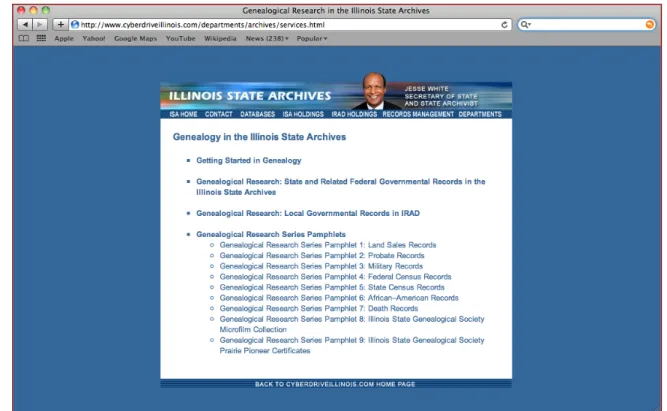
Figure 6: Illinois State Archives ...22
Figure 7: Contact Information ...26
Figure 8: Social Networking ...28
Figure 9: Digital Collections ...30
Figure 10: Services ...34
Figure 11: List of Record Types ...35
Introduction:
Websites are the gateway for many patrons to learn about state archives institutions in the United States of America. The Internet is a source for the public to learn about the missions of state archives and their physical holdings. A website can lead an individual to correspond or visit an archival institution. Providing basic information can also help patrons learn about traditional operating hours of state archives. Online access can reach to wider audiences.
The following literature review will include ideas regarding state archives, state archives patrons, and archives websites. This literature review evaluates state archives, state archives patrons, and archives websites. State archives are complex institutions that depend on the state government to provide original records and resources. Identifying state archives users is necessary in this literature review because there is a direct
correlation between the information provided on websites and their users. Little research has been done in general on state archives websites in comparison to academic archival institutions websites. However, there has been research on tools and resources that institutions provide on websites such as Encoded Archival Description (EAD) finding aids.
fifty state archives websites will be evaluated to determine whether state archives websites provide consistent types of information.
Literature Review:
State Archives:
State archives have played an important role in the safekeeping of state records and county records. According to the table of “years in which state archives were
established,” Alabama was the earliest state archives with an established date of 1901 and District of Columbia was the last repository established in 1985 (CoSA, 2007, p. 2). However, many state archives did not receive the authority to “preserve and protect state government records” until the beginning of the twentieth century (p. 1).
Victoria Iron Walch (1997) states that “Multiple responsibilities: state archives and records management” include the following criteria: “culture and education, administration and management, and information and communication” (p.135). State archives hold original records of the state. Also, some state archives hold original records of counties, municipalities, individuals, and non-governmental organizations (CoSA, 2007, p. 25).
department in which state archives are located will depend on which types records are available. Also, Council of State Archives (CoSA) states “state archives and record management programs core responsibilities” are “managing the documentation of state government, providing stewardship of records of state government, and supporting access to and use of records of state government” (p. 8 -10). State archives have a great
responsibility to ensure that records are available and accessible to the public. A majority of states have laws to ensure that records are given and provided to state archives (p. 8).
CoSA (2007) states “federal, state, and local level, governments in the United States are empowered by the electorate to protect life, property, and the rights of citizens” (p. v). People expect state archives to uphold their duties to collect records of the state. During times of emergency, citizens want to know they can locate original records at their local institutions. According to CoSA, government depends on these institutions to preserve and make the records accessible to the public (CoSA, 2007, p. v).
State Archives Patrons:
The valuable records at State archives are the main reason that patrons come to the State archives. Understanding State archives patrons will give an overview of the type of content available on the State archives websites. Institutional websites are meant for users to have a source available to them on the Internet. Websites attract State archives patrons to either visit or correspond with the institution.
The user needs are important to archival institutions since archives are open to the pubic for use. Evans (2007) writes that archives should be accessible and open in order to continue to have public trust (Evans, p. 400). Users expect that information will be made available for them to use. Finch (2000) writes “the identity and the research habits of our users- who they are, how they think, how they learn, how they assemble information” should be incorporated in the way archives “acquire, process, describe, and service records” (p. 415). Understanding patrons will help provide the right resources to be presented to the public. State archives continuously collect records, so that current records are made available to the public. It is important to think about the user when making the records available in search room.
Anne Gilliland-Swetland (2001) writes about finding aids and the following user groups of finding aides: Academic Historians, Institutional Administrators, K-12
“officials to attorneys, surveyors, scholars, teachers, students, and avocational researchers (CoSA, p. 10). A wide range of state archives users expect information to be available on State archives websites. Websites are the most accessible way for patrons to find
information about state archives.
CoSA (2007) writes that genealogists are the main users of State archives (p. 35). Kristin Shaffer (2009) uses the FY 2004 Survey of State Archives and Records
Management Programs and establishes the fact that 48 % of use of government records is for the purpose of genealogy (p. 27 -28). She was able analyze the CoSA survey data in order to analyze outreach of State archives (Shaffer, 2009). Some genealogists are particular about what they want to research at State archives. Gilliland-Swetland (2001) states that genealogists want to know where the different types of records are located, so they can begin their research (p. 213).
While there are genealogists that are knowledgeable researchers, there are some genealogists that are beginning or unfamiliar with original records. These types of genealogists need guidance. Yakel and Torres (2003) write about archival intelligence and what users know about archival methods and collections.
% and “Property/legal research” is 13 % (Shaffer, p. 27). These users need to use the records for court cases and historical research about agencies.
Depending upon the organization of various states institutions, state agencies, counties, and municipalities the records management will vary from state to state. New Mexico, Colorado, Utah, Wyoming, Nevada, Alaska, Hawaii, Washington, Alaska and Arizona are a part of joint archives and records management programs (Walch, 1997, p. 140). California has a separate archives and records management programs (Walch, 1997, p. 140). Patrons of these institutions depend on the services provided by the archives since the law mandates these institutions to keep these state records. For example North Carolina Government Records Branch website (2010) states, “The primary mission of the Government Records Branch is to provide and administer records management services to state government agencies, local government agencies, and state supported institutions of higher education in North Carolina in accordance with General Statutes 121 and 132 and the mandate provided in these for the preservation of the historical record of this state” (Home page). State archives and record management organizations are working closely with agencies, “chief information officers and information technology
departments” to create schedules for digital records (CoSA, 2007, p. 19). According CoSA survey, “archivists and records managers serve as a central resources to assist citizens as well as government officials to identify, locate, and make accessible
Archives Websites:
Archives websites have become a way for patrons to retrieve information about institutions and collection of archives. Since websites are available 24 hours per day, patrons can view the site at their own time. It is necessary for archives need to keep their information up to date in order for accurate information to be available to the public. In Society of American Archivists (SAA) Presidential Address on August 30, 2001, Leon J. Stout spoke about the “Cyberarchivist” and the importance for archives to make
resources available to the public through the Internet (Stout, 2002). According to Stout (2002), “every archives has or needs a website… websites are our front door to the world” (p. 19).
General information about state archives is essential to be made available on a website. Contact information is essential in order for the public to communicate a request or ask a general question. Bromley (2010) surveyed thirty academic websites and found that all institutions information regarding phone numbers and hours of operation (p. 26). He also found that the majority of “contact information” on the websites included directions to the repository (Bromley, 2010, p. 25).
Archives are able to communicate with the public through the Internet.
and 97 % of the institutions provided the “reference email address or email of staff members” and 77% supply a postal address for to use (p. 26).
The State Archives and Records Management section of the CoSA 2007 report on “access to and use of the records” focuses on the “impact of the Internet” (CoSA, 2007, p. 33). According to the report, the Internet has increased the amount of users of archives and places where records can be found (CoSA 2007, p. 33). Archives are providing digital collections online by “virtual exhibits or memory projects” (p. 33). Stout (2002) writes, “archives on the Web so far seem to be largely collections of on-line brochures, photo exhibit and historical information, the being of access to collection through on-line finding aids, and the beginning of collections of actual scanned images of archival resources” (p. 14). However, Stout (2002) states that many archives have very little collections on the Internet (p. 14).
Most repositories have records available on the Internet or are working on future digitization projects to made available on their websites. During the CoSA survey 32 states had “digital collections, virtual exhibits, and state memory projects” available for the public (CoSA, 2007, p. 105-108). Even by 1997, Oregon State Archives put an online digitization project on their website using the document “Declaration of Intention” and provided a “transcription” of the document. (Lowell, 1997). When the public is not able to visit a repository, digital collections can be very beneficial to their research.
Pitti (2000) states that there is “universal access” through “online catalogs” that opens the door for the public to learn about collections (p. 399). Online catalogs can be installed onto websites of archives. They can be expensive depending on if state archives purchase an already built catalog system or have the Information Technology branch within an organization to create a catalog system from scratch.
Online EAD Finding Aids have become a great resource for patrons to use on archives websites. Finch (2000) writes about paper findings aids and how every user should be able to use a finding aid and understand the information within the document (p. 425). According to Gilliland-Swetland (2001),”the finding aid is the workhouse of archival practice-a complex, multifunctional descriptive tool critical to bother
management and reference of archival holdings” (p. 200). Finding aids can be complex works, but if handled with delicacy the pubic should be able to access and use the source.
documents within the collections. According CoSA (2007), “government archives … see themselves playing an important role in providing the public with access to government information (p. 10). The way archives are providing these services are by developing “finding aids, indexes, and other tools for access” (CoSA, 2007, p. 10).
Websites can offer many ways to learn about collections and contact archives. Keeley Murray (2010) wrote about reference services available at the North Carolina State Archives, University of North Carolina at Greensboro, and Duke University Archives (p. 32). She did a quick overview of what sources were on the websites, which included “finding aids, online projects and reference (email & phone)” (Keeley, 2010, p. 32). Murray did not do a comprehensive examination of archives websites, but she includes a sample of information on websites of state and universities archives.
It is important to note literature review on family history centers within libraries. Sarah E. Watts wrote about websites of family history collections within libraries (Watts, 2006). Watts (2006) states, “there is no set of standards employed by the libraries to present their local history collection online” (p. 54).
Methods:
The purpose of this research paper is to investigate whether the content of State Archives websites are consistent from state-to-state.
Most state archives are under an umbrella of a parent agency such as the Secretary of State or the Department of Cultural Resources. For example, Oregon State Archives is a division of the Oregon Secretary of State, while the Idaho archives is included in the Idaho State Historical Society. The parent institutions sometimes pose as problems for this study because the information about the individual state archives was laid out through the parent agencies’ websites. Limitations were created in order to collect the same information throughout the study.
I studied all fifty states not including territories of the United States of America. The fifty-state study was completed Fall 2010. The web addresses for the state archives websites were obtained from the Council of State Archivists (CoSA) “Directory of State and Territorial Archives and Records Program”
(http://www.statearchivists.org/states.htm). The CoSA website was updated on October 22, 2010 and two web addresses were redirected to new addresses. It is important to understand that these websites may move to a new address and/or information may change over time.
networking, services, list of record types, records management, and genealogy. The following elements were studied and recorded using a spreadsheet:
• Contact Information on the main archives homepage Email
Phone Number Mailing Address Physical Address Search Room Hours • Social Networking
Twitter Facebook Blog Flickr • Digital Collections
Photographs Original Papers • Services
Request Form Online Catalog Online Finding Aids
Records Management Services • List of Records Types
• Genealogical Section
State archives are diverse from state to state. Therefore, it was important to create criteria for each element of information collected.
Contact Information:
Phone number: General Phone number to reach the archives.
Mailing Address: Address clearly stated as a mailing address for patrons to make requests. A mailing address was also counted when the following layout was used on the website “P.O. Box address/physical address”.
Physical Address: An address available on the website so patrons can visit the institution.
Hours: Search Room hours for patrons to visit the archives. Social Networking:
All Social Networking features were counted when affiliated with the state archives. Figure 1 illustrates examples of icons of social networking.
Twitter: Twitter icon on the website for patrons to follow.
Blog: Blog icon or hyperlink for patrons to read the blog about archives. RSS feeds were not counted as a blog.
Flicker: Flickr icon or hyperlink for patrons to view archives photographs on the flickr website.
Figure 1: New York State Archives Homepage showing social networking icons on left bottom corner
Digital Collections:
Figure 2: Idaho State Historical Society Digital Collection: An example of digital collection that was counted because it was a part of the parent agency
Manuscripts: Scans of manuscripts allow patrons to view original records of the archives. Samples and scans of collections were counted. Digital collections of
Figure 3: Alabama Department of Archives and History Digital Archives showing letters written during the Civil War, 1861-1865
Services:
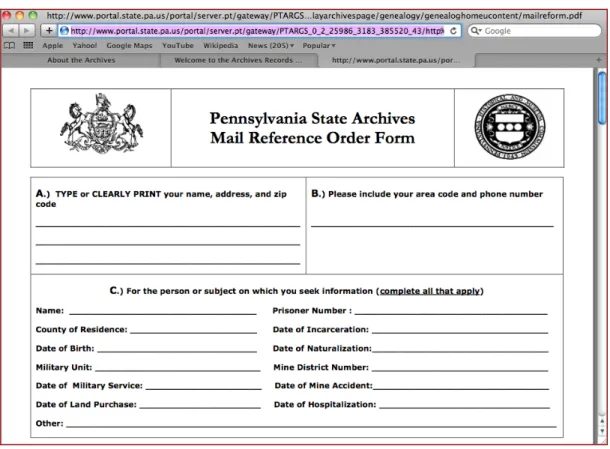
Figure 4: Pennsylvania State Archives Request Form
Online Catalog: An online catalog was counted when labeled as online catalog, library catalog (archives), or catalog. Patrons use online catalogs to learn about
collections and records at the state archives. An online catalog was counted when a repository had one catalog for library and archival materials because the catalog was affiliated with the archives.
container lists were counted in the study. When a database was used as an index it was not counted because a patron could not browse the index.
Figure 5: Colorado State Archives Old Age Pension Index
Records Management Services: Records management services are for state agencies, counties, and municipalities. These services help employees learn about retention schedules and answer questions. For example, a link or section for record managements services was counted for services.
Record Types:
Genealogy Section:
Genealogists are frequent visitors to state archives. The genealogical section is different for each state since the type of organization differs. Figure 6 illustrates an example of a state archives website that had a genealogical section. The information provided in the genealogical section varied state-to-state depending on the types of records available at the state archives. The point of this element was to observe who provided resources for genealogists on their website. The genealogical section could be called various names as long as it related to genealogy (family history). Therefore, it was important to collect how many state archives have a genealogical section.
Content analysis was used to analyze the data collected from the state archives for the website study. The study went through the fifty state archives websites and
Results & Analysis:
Contact information available on state archives websites is one of the most important pieces of information to be present. Contact information allows patrons to find ways to communicate with the archives. It is particularly essential for state archives to have the information available on these websites since the records they hold are open to the public.
Contact information was consistently found on each website. All fifty state archives websites provided a phone number and physical address. Since the phone
numbers are listed on state archives’ websites, a patron can contact the state archives with comments or questions. These questions might include information about the website itself, how to request copies of original records, or whether the state archives have a specific record and how to obtain it.
Forty eight (96%) of the state archives websites studied list their search room hours. High patron visitation to the state archives institutions illustrates the need to have the search rooms open to the public. Providing search room hours can support the mission of state archives to provide access to records for the public.
While a patron could call the archives to obtain the archives mailing address, the institution’s website could provide this information as well.
Forty-one (82 %) of state archives websites studied provided an email address. The percentage of state archives websites providing emailing addresses could have been higher if the study limitations included certain aspects. A “contact us” linked to the email address was not included because a patron needs to have an email client set up on the computer that he/she is using in order to contact the state archives by clicking on the mailto: link. Many people can be using browser-based email such as Gmail and Yahoo. An email address provided in full text on the page allows more options for all patrons trying to contact the archives. It would permit more access to the state archives users for any questions that may arise.
Providing the phone number, physical address and search room hours were the most important elements in the “contact information” section of the state archives
websites study. All except two websites presented all three elements. These elements are essential for patrons to contact and visit the repository. Forty-eight (96%) of the
repositories studied posted the phone number, physical address and search room hours, proving that state archives repositories find these elements essential for patrons to obtain from their websites.
Figure 7: Contact Information
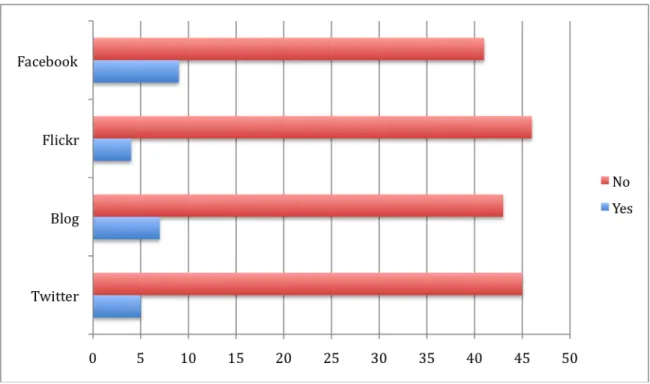
Social networking is a new element that archives repositories are starting to explore. One benefit of social networking sites is that institutions can use many of them without having to pay a fee. The state archives websites study revealed that many state archives are not using social networking.
Twitter to communicate with their patrons. There are only four institutions that provided evidence on their sites of using Flickr to share photographs.
Many non-state archival institutions are using social networking to connect with the public. State archives, according to the study, are not following this trend. Social networking has become popular for much of the American population. These social networking tools can be used on the computer and on a cell phone with Internet connection such as iPhone, Blackberry, or Droid. Patrons with these types of “smart” phones can access social networking tools frequently and on their own time.
The various social networking media can increase communication between state archives institutions and the public. For instance, the New York State Archives using Twitter, Facebook, and Flickr to communicate with its patrons
(http://www.archives.nysed.gov/aindex.shtml). New York State Archives can correspond with a wide variety of users because a patron may use Facebook and may not use Twitter. The North Carolina State Archives blog is a way for patrons to communicate about events and new collections available for the public (http://ncarchives.wordpress.com/).
state archives would benefit using the resources to be in consistent contact with its visitors.
Figure 8: Number of Sites with Given Social Networking Features
Digital collections available on websites have provided patrons with resources without having to visit the institutions. Patrons can use these digital collections at their own time and pace. State archives digital collections are very diverse and each archives has their own type of digital collection. State archives employees decide what collections need to be made available on websites.
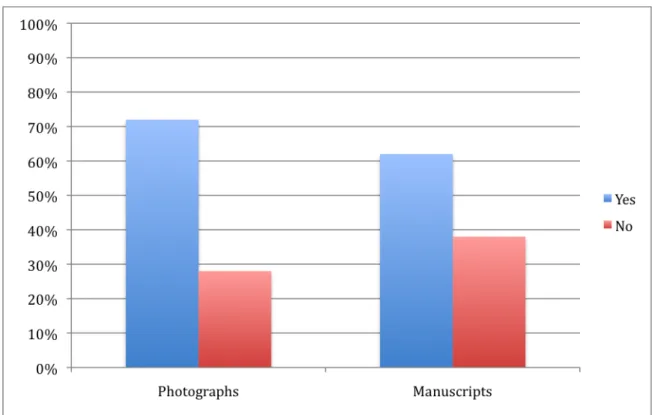
There are a high percentage of photographs being made available on state
on their websites. Fewer state archives have manuscripts collections on the websites. Only thirty-one (62%) of state archives studied had digital collections of manuscripts.
The New York State Archives website has a comprehensive digital collection. New York provides a “digital image collection by topic” with such topics as “business & labor, environment & landscape, politics, legal, military, and transportation” (New York State Archives websites). Patrons can choose a topic and view the digital collections and use the collections for their own research.
Figure 9: Digital Collections
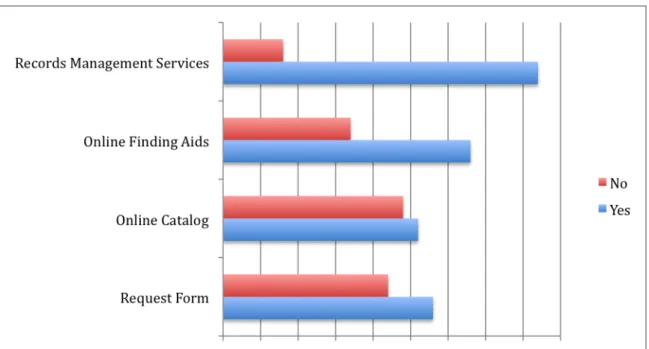
State archives websites provide a variety of services on their websites. The four main services studied were request forms, online finding aids, online catalog, and records management services. These services provided on the websites allow patrons to learn about collections and request records.
records the state archives employees will search. Request forms are made available on twenty-eight (56%) of state archives websites.
A total of seven (14%) state archives have an online catalog, online finding aids, types of records and request forms. Catalogs, finding aids and record types are resources to learn about documents at the state archives. These elements are searchable online in order for the public to develop their request. Thirteen (26%) state archives websites provide online catalogs and request forms and eighteen (36%) state archives websites provide finding aids and request forms. Also, twenty-six (52%) state archives websites offer record types and request forms. All these elements are connected because these resources allow patrons different avenues to collect data they desire. Providing these resources online allows patrons to get a citation and request copies of original records from the specific state archives.
Patrons can learn about certain records and collections through online catalogs. These catalogs have basic and advanced functions for patrons to search archival
Online finding aids are another way for patrons to learn about records and
collections. The online finding aids counted for this study were finding aids that could be browsed. Thirty-one (62 %) of state archives websites had searchable finding aids on their websites. Patrons benefit from using these resources because they list specific records in collections.
Both online catalogs and online finding aids are resources for patrons to search and find records. Not all state archives have one or both of these resources. Only eight (16%) state archives websites provide neither online catalogs nor finding aids. Databases were not counted as catalog or finding aids. Databases are considered searches that patrons are unable to browse. Some of these institutions did provide databases for their patrons to find documents in their collection. The quantity would have been lower if the study included state archives with databases.
Even though twenty-four (48%) state archives websites offer no online catalogs, sixteen (32%) of those archives have finding aids. These state archives offer a source that patrons can learn about collections. These resources can be beneficial to patrons who are not able to physically visit the state archives search rooms. A patron can learn about documents and request a copy through the state archives correspondence section. Repositories that charge a fee for copies can make a profit from these requests.
websites supply both online catalogs and finding aids. The expectation was higher for state archives to provide both these resources for the public.
It can be beneficial for state archives websites to list the types of records that the state archives holds. A majority (90%) of state archives provide a list of records types on their websites. An example of list of records types could include state agency records, local or county records and personal or private collections. The list of record types shows patrons what types of records they can search at state archives repositories. Once patrons view the list of records at a repository, they may want to visit the state archives. It is important that state archives websites provide search room hours so that patrons can visit the state archives to view these records. Eighty-six (86 %) of state archives provide both search room hours and a list of record types.
Government employees depend on the record management services on state archives websites. These employees can use the resources on the Internet without having to contact an employee at the state archives or records management department. Forty-two (86%) of state archives websites provide hyperlinks or sections for records managers to use.
Most state archives collect and organize state records and these agencies need to be able to access these materials.
Figure 11: List of Record Types
A genealogical section was the final element to be observed on state archives websites. Only twenty-nine (58%) of state archives websites provided a section for genealogists, which is lower than the researcher expected. However, the mission
statements of state archives are to make records open to the public. It is not necessary for state archives to provide extra resources to genealogists.
resources that are online allow the public to learn about the various records available at different state archives institutions. Finally, fourteen (28%) state archives have both request forms and a genealogical section. Genealogists can use the genealogical section of state archives websites and use the request records that they learned about from these resources. The request form could be especially beneficial for those researchers who are out of state.
Conclusion:
There are no state archives websites that have all the elements listed in the methods’ section. A majority of state archives websites provide the elements in the contact information section. A majority of state archives do not provide social media on their website. There was no consistency of state archives websites providing the elements in the digital collections, services, record types, and or genealogy sections. The largest inconsistency was in the services section. The study concluded that state archives websites are not consistent regarding provided information.
All elements studied were considered to be important information made available on state archives websites. Not all state archives collect the same types of records
including state agency records, county records or private collections. The elements studied may not meet all of the clientele’s needs at each individual state archives. Employees may have limited resources preventing them from making certain elements available on the websites.
Even though usability was not considered as a part of the study it is important to take into account that it did effect finding the elements on state archives websites. There may be some of these elements on some of the state websites, however, I was unable to locate them on the websites. It is important to include vital information on a website, but if a patron is unable to find the information it is useless.
Works Cited:
Bromley, B. S. (2010). Finding what, you know: A content analysis of the websites of
archival repositories for markers of archival intelligence (Master’s Paper).
University of North Carolina, Chapel Hill.
Council of state archivist. (http://www.statearchivists.org).
Council of state archivist. (2010). Directory of state and territorial archives and records program. (http://www.statearchivists.org/states.htm).
Council of State Archivist. (2007). The sate of state records: a status report on state archives and records management programs in the United States.
(http://www.statearchivists.org/reports/2007-ARMreport/index.htm).
Evans, M. J. (2007). Archives of the people, by the people, for the people. American
Archivist, 70 (2), 387 – 400.
Finch, E. F. (2000). In the eye of the beholder: archives administration from the user’s point of view. In R. C. Jimerson (Ed), American Archival Studies: Readings in
Theory and Practice (pp. 417-448). Chicago: The Society of American Archivist.
Gilliland-S-Swetland, A. J. (2010). Popularizing the finding aid. Journal of Internet
Cataloging, 4 (3), 199 – 225.
Landis, W. (1995). Archival outreach on the world wide web. Archival Issues, 20 (2), 129-147.
Murray, K. (2009). The future of archival reference: services, technology, and trends. Journal for the Society of North Carolina Archivist, 7 (2), 26-40. North Carolina State Archives Blog. (http://ncarchives.wordpress.com/).
Pitti, D. V. (2000). Encoded archival description: the development of an encoding standard for archival finding aids. In R. C. Jimerson (Ed), American Archival
Studies: Readings in Theory and Practice (pp. 395-414). Chicago: The Society of
American Archivist.
Shaffer, K. J. (2009). Outreach in state archives and public use of government
records (Master’s Paper). University of North Carolina, Chapel Hill.
Stout, L. J. (2002). Archives: two tales for the information age. American Archivist, 65(1), 9 -23.
Walch, V. I. (1997). State archives in 1997: diverse conditions, common directions.
American Archivist, 60 (2), 132-151.
Watts, S. E. (2006). Moving out of the corner and onto the web: An evaluation of
websites created for local history collection in public libraries (Master’s
Paper). University of North Carolina, Chapel Hill.
Yakel, E. & Torres, D. A. (2003). AI: Archival intelligence and user expertise.
Works Consulted:
Baker, K. H. (1997). The business of government and the future of government Archives. American Archivist, 60 (2), 234-252.
Cox, R. J. (2000). Closing an era: historical perspectives on modern archives and
records management. Westport, CT: Greenwood Press.
Gray, V. (2008). Who’s that knocking on our door?: Archives, outreach and Community, Journal of the Society of American Archivist, 29 (1), 1-8. Krause, M. G. and Yakel, E. (2007). Interaction in virtual archives: The polar bear
expedition digital collection next generation finding aid. American Archivist, 70 (2), 2832-314.
Prom, C. J. (2004). User interactions with electronic finding aids in a controlled setting. American Archivist, 67 (2), 234-268.
Turnbaugh, R. C. (1997). Technology, records, and state archives. American
Archivist, 60 (2), 184-200.
Waters, E. (2010). Usability studies of online finding aids: a content analysis of the
literature,1998–2008 (Master’s Paper). University of North Carolina, Chapel Hill.
Weir, C. (2004). The marketing context. Outreach: luxury or necessity? Journal of the
Society of Archivist, 25 (1), 71-77.
Yaco, S. (2008). It's complicated barriers to EAD implementation. American
Appendix: List of State Archives Websites from Council of State
Archivist (http://www.statearchivists.org/):
Alabama http://www.archives.state.al.us/index.html Alaska http://www.archives.state.ak.us/
Arizona http://www.lib.az.us/archives/
Arkansas http://www.ark-ives.com/
California http://www.sos.ca.gov/archives/
Colorado http://www.colorado.gov/dpa/doit/archives/ Connecticut http://www.cslib.org/archives
Delaware http://archives.delaware.gov/
Florida http://dlis.dos.state.fl.us/index_researchers.cfm Georgia http://www.sos.state.ga.us/archives/
Idaho http://www.idahohistory.net/library_archives.html
Illinois http://www.cyberdriveillinois.com/departments/archives/archives.ht ml
Indiana http://www.in.gov/icpr/2358.htm
Iowa http://www.iowahistory.org/archives/index.html
Kansas http://www.kshs.org/research/collections/documents/govtrecords/in dex.htm
Kentucky http://www.kdla.ky.gov/home.htm
Louisiana http://www.sos.louisiana.gov/tabid/53/Default.aspx
Maine http://www.maine.gov/sos/arc/
Maryland http://www.msa.md.gov/
Massachusett s
http://www.sec.state.ma.us/arc/arcidx.htm
Michigan http://www.michigan.gov/dnr/0,1607,7-153-54463_19313---,00.html
Minnesota http://www.mnhs.org/preserve/records/index.htm
Missouri http://www.sos.mo.gov/archives/
Montana http://www.his.state.mt.us/research/library/archcoll.asp#State%20G overnment%20Records
Nebraska http://www.nebraskahistory.org/lib-arch/index.htm
Nevada http://nsla.nevadaculture.org/index.php?option=com_content&view =article&id=579&Itemid=418
New
Hampshire http://www.sos.nh.gov/archives/
New Jersey http://www.njarchives.org/links/archives.html
North
Carolina www.archives.ncdcr.gov
North Dakota http://history.nd.gov/archives/index.html Ohio http://www.ohiohistory.org/resource/statearc/ ;
http://www.ohiohistory.org/resource/archlib/ Oklahoma http://www.odl.state.ok.us/oar/index.htm Oregon http://arcweb.sos.state.or.us/
Pennsylvania http://www.portal.state.pa.us/portal/server.pt/community/state_archi ves/2887
Rhode Island http://sos.ri.gov/archives/ South
Carolina http://scdah.sc.gov/
South Dakota http://history.sd.gov/Archives/ Tennessee http://www.tennessee.gov/tsla/
Texas http://www.tsl.state.tx.us/agency/contact/contactaris.html
Utah http://archives.utah.gov/
Vermont http://vermont-archives.org/ Virginia http://www.lva.virginia.gov/
Washington http://www.sos.wa.gov/archives/archives_state.aspx West
Virginia