Sharif University of Technology
Scientia IranicaTransactions A: Civil Engineering http://scientiairanica.sharif.edu
Strength development of binary cement concrete, using
Pulverized Fly Ash (PFA) under various curing
conditions
S. Samad
a, A. Shah
b;, M.C. Lambachiya
c, and S.B. Desai
ca. Department of Civil Engineering, City University of Science and IT, Peshawar, Pakistan; and Department of Civil Engineering and Construction, Kingston University, London, UK.
b. Department of Civil Engineering, City University of Science and IT, Peshawar, Pakistan. c. Faculty of Science, Engineering and Computing at Kingston University, London, UK. Received 22 December 2015; received in revised form 18 June 2016; accepted 14 October 2017
KEYWORDS Supplementary cementitious material; Pulverized y ash; Partial replacement; Compressive strength; Curing.
Abstract. Binary cement incorporating Supplementary Cementitious Material (SCM) is widely used in concrete to reduce the cement consumption in construction industry. Cement production is a major source of emission of Green House Gases (GHG), and there is increasing pressure to reduce its consumption to avoid further global warming, climate changes, etc. In this research, Pulverised y Ash was used to partially replace cement in the concrete. Three levels of replacement of cement by PFA were selected, and the specimens were cured under summer and winter environments. The strength development characteristics of the blended concrete were compared with the control mix without PFA. The strength gain under winter curing condition was observed as slower. At water cement ratio of 0.35, concrete with 30% replacement of cement by PFA achieved high early-age strength. PFA concrete gained more strength than the PC concrete did, after the age of 28 days. The 28-day compressive strength of blended concrete for 30% of cement replacement by PFA was observed to be nearly the same as that of control concrete mix.
© 2019 Sharif University of Technology. All rights reserved.
1. Introduction
According to the UNEP [1], the concept of sustainabil-ity has been known for a long period, and many con-ferences around the world exist in which governmental and non-governmental organisations have participated to create awareness about the environmental impacts of modern developments. According to the Concrete Centre [2], the amount of Embodied CO2 (ECO2) of
concrete is a function of the cement content in the
*. Corresponding author.
E-mail addresses: [email protected] (S. Samad); [email protected] (A. Shah);
[email protected] (M.C. Lambachiya); [email protected] (S.B. Desai)
doi: 10.24200/sci.2017.4537
mix designs. Hence, more production of concrete will lead to more cement consumption and emission of CO2
as a result. To reduce cement contents in concrete, various Supplementary Cementitious Materials (SCM) are used, which include Pulverized Fly Ash (PFA), too. Brundtland Commission [3] dened sustainable development in 1987 as \the development that meets the needs of the present without compromising the ability of future generations to meet their own needs". The extensive emission of Green House Gases (GHG), due to industrialization and use of fossil fuels in auto-mobiles, has led to global warming, Climate Changes (CC), and other environmental degradations, further intensifying the need for sustainable development [4]. Embodied CO2 (ECO2) is the measure of the amount
of CO2 emissions generated from the energy needed
trans-portation, assembling, installation, disassembly, and deconstruction for any system over the duration of a product's life. ECO2 of the construction material is
the highest one. For example, ECO2 for cement is
913 kg/tonne [5]. There is a general understanding that one tonne of cement production leads to almost one tonne of CO2. On the other hand, concrete as
construction material has been one of the major inputs of socio-economic development of societies, and its consumption may continue. It is the second largest used material after water and stands at two tonnes per capita per year on global average [6].
To end poverty, protect the planet, and ensure prosperity for all, as part of a new sustainable develop-ment agenda, dierent countries of the world adopted a set of goals on September 25, 2015. Each goal has specic targets to achieve over the next 15 years. To combat climate change and its impacts is one of the important goals of the Sustainable Development Goals (SDG). The SDG are comprised of 17 goals and 169 targets, which address the social, economic, and envi-ronmental dimensions of development. The SDG goal 9 is based on industry, innovation, and infrastructure as well as demanding robust and resilient infrastructure by retrotting the existing one and construction of new one in the developing and Least Developing Countries (LDC). Hence, the construction industry has to grow, exponentially with the demand for new infrastructure. The cement consumption as a result would also increase greatly, leading to more Green House Gases (GHG) emissions in times to come. To oset the detrimental impacts of cement production, the research on explor-ing more Supplementary Cementitious Material (SCM) as partial replacement of cement may continue with rigor in future [7]. To oset the negative impacts of the cement production on environment and reduce the cost of concrete, construction industry and concrete technologists around the world have been attempting to explore cementitious and pozzalonic materials. In this context, Ground Granulated Blast Furnace Slag (GGBS) and Pulverized Fly Ash (PFA) have been extensively used during the last two decades. Nailk and Ramme [8,9] used various mix proportions of y ash added concrete for various levels of substitutions and reported the optimum level up to 55% to achieve the concrete with 28-day compressive strength in the range of 35 MPa. Poon [10] used low calcium High Volume Fly Ash (HVFA) for high strength concrete and achieved 28-day compressive strength of 83 MPa. The high Loss on Ignition (LoI) value for y ash severely aects the compressive strength and creep of concrete when used as replacement of cement in concrete. The un-burnt ash particles increase the water requirement and reduce the compressive strength, too. To reduce this impact, High Range Water Reducers (HRWRs) have been used [11,12]. Huang et al. [13] developed
a rational mix design method for concrete having 20-80% replacement of cement by HVFA. They reported a signicant increase in the compressive strength of HVFA blended concretes at later ages such as 90 days and onwards.
According to Higgins [14], UK uses about two million tonnes of GGBS as cement per year, 500,000 tonnes of y ash as cement addition per year, and 100,000 tonnes of y ash as a component of blended cement. In China, about 15 million tonnes of GGBS is used per year [15]. According to the information given in the United Kingdom Quality Ash Association (UKQAA) (2004), PFA is a by-product obtained at power stations and is a solid material extracted by electrostatic and mechanical means from ue gases of furnaces red with pulverised bituminous coal. It is carried by the exhaust gases and recovered as y ash with ne particles. According to Thomas [16], the use of y ash as supplementary cementing material in concrete has been known from the start of the last century; however, the rst research on y ash was conducted at the university of California by Davis et al. [17]. The rst signicant utilization of y ash in concrete began with the construction of the Hungry Horse Dam in Montana in 1948. The production of the material has changed to reduce the gaseous emissions in recent years, but has not aected the nature of PFA, except that it has increased the Loss On Ignition (LOI). The standards and specication of PFA are covered under BS EN 450-1 (2012) [18] and ACI-committee 226 [19].
PFA has been used widely as cementitious ma-terial in construction industry. Dhir [20] found that PFA neness aected the strength of concrete, and the strength of PFA concrete was reduced by using coarser PFA. In order to take care of the eect of PFA neness on strength, they developed a simple procedure of varying the water content, cement content, or both. Kayali and Ahmed [21] prepared concrete mixes by replacing PC with dierent percentages of y ash. The water/cement ratio was 0.38 for all the concrete mixes and the total amount of cementitious material content was kept constant for all the mixes and was equal to 450 kg/m3. The concrete samples were cured
with fog for seven days and, then, were air dried until the age of 28 days for testing. They reported that there was a decrease in the compressive strength of concrete made with y ash, and this decrease was accelerated with the replacement level of y ash. In the Angel Building, London, self-compacting concrete with 36% y ash was used to eliminate the need for conventional methods of compaction, such as vibrating pokers. By using PFA, workability of concrete was improved around dicult interfaces, and the light grey colour of PFA concrete was added to aestheticize the building. According to Neville [22], creep of GGBS
and PFA concrete is lower than that of the CEM-I concrete, if cured in an environment where there is no moisture loss. Fly ash has been extensively used as a partial replacement to cement in concrete: rstly, to reduce the cement consumption in concrete, thereby making it relatively sustainable material and, secondly, to increase the mechanical properties of concrete in fresh and hardened forms [23]. The environmental considerations of High Volume Fly Ash (HVFA) and its contribution to develop green & sustainable concrete have been researched extensively [24,25].
1.1. Eect of curing on strength of y ash concrete
The curing process also aects the properties of con-crete made from ordinary cement or blended cement incorporating PFA. The water curing was found more eective than heat curing [26,27]. The slow steam curing of PFA added concrete gained strength more than water and air cured specimen [28]. Safan and Kohoutkova [29] reported that continuous water-cured concrete specimens provided a better rate of strength development compared to other curing conditions, and the compressive strength aected by the drying condition varies at dierent ages. Hongen et al. [30] checked the inuence of curing temperature on the compressive strength of Fly Ash based Geo-polymer Concrete (FAGC). The y ash concrete specimens were cured under dierent curing conditions. The author concluded that high temperature was vitally important for specimens to gain higher compressive strength, especially the early strength. The specimens cured at room temperature for one day and, then, cured at high temperatures had higher strength than that directly cured at high temperature. Ki-Bong Park and Takafumi Noguchi [31] concluded that the compressive strength of concrete specimens cured in water at 20C
was higher than that of the sealed specimen. At low water cement ratio, there is a possibility of self-desiccation of concrete, and there are limitations to continuous cement hydration, which explains the dier-ence in strength between concrete specimens. External water is required to enable hydration to continue un-inhibited. The strength development of concrete made under winter weather conditions (9C) was found faster
than that of concrete made under summer conditions (20C), both for the standard and sealed specimens.
For y ash concrete (40% y ash), the strength of the specimens made under winter conditions was lower than that made under summer conditions.
In this research, the eects of the partial replace-ment of cereplace-ment with PFA on strength developreplace-ment of concrete under dierent curing conditions have been studied. The use of PFA in concrete tends to slow down the early-age strength, which limits its use in the fast track construction and post-tensioned concrete,
subjected to high early loads. Early-age strength of concrete containing PFA can be increased by reducing the water/cement ratio.
2. Research signicance
There is a limited research work undertaken on eect of compressive strength and strength development characteristics of concrete incorporating PFA in various curing conditions. The non-uniform physical properties of PFA found in various parts of the world also aect the performance of concrete produced. It is expected that the results of the research will add to the existing data on the use of blended cement in concrete and its performance under various curing conditions. The early-age strength of blended concrete is relatively less than that of the normal concrete, restricting its use in many important projects. Based on various trials mix-ing, the optimal level of water cement ratio, chemical admixtures, and replacement of cement by PFA have been established in various curing conditions. This will contribute to a further number of researches on standardization, properties, and mixing of the concrete made with blended cements.
3. Experimental program 3.1. Material
3.1.1. Pulverised Fly Ash (PFA)
PFA conforming to BS-EN 450-1 [18] was used as a bi-nary cement component in the production of concrete. PFA used in the concrete is commercially available in the UK and is classied as CEM IV according to BS EN 197-1 (2011) [18].
3.1.2. Portland cement
Ordinary Portland Cement (OPC) used conformed to BS EN 197-1 [18] and was classied as CEM-I. The Portland cement was stored in the laboratory to avoid exposure to humidity.
3.1.3. Superplasticiser (SP)
High-performance liquid superplasticizers conforming to BS-EN 934-2 [32] were used to achieve the required workability.
3.1.4. Aggregates
Graded natural sand with a maximum particle size of 5 mm and complying with the requirements of BS EN 12620-1 (2009) [33] was used as ne aggregate in the concrete mixes. Thames valley natural aggregates, averaging 12.5 mm, were used as coarse aggregates in the concrete mixes. The maximum size of the aggregate used was 20 mm.
3.1.5. Concrete mix proportions
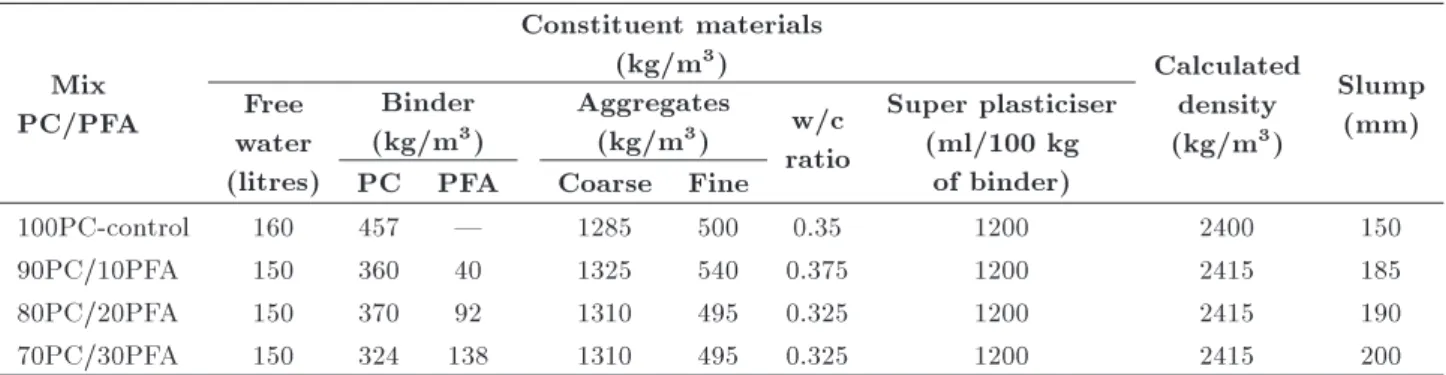
Trial mixes of concrete were designed to achieve equal 28-day compressive strength of 40 MPa and
the strength of 10 MPa after 16 hours and 25 MPa after 38 hours to meet the practical requirement of post-tensioned concrete beams. The trial mixes are shown in Tables 1 and 2. To achieve a practical level of workability and cohesion, suitable for pumping, concrete was designed for a target slump of 200 mm. The overall maximum water/cement ratio was maintained at 0.45 and the overall minimum cement content at 340 kg/m3. A superplasticiser was used to
minimise water and cement contents to achieve low free w/c ratio.
3.1.6. Test Samples and testing procedure
Two batches of concrete were made for each concrete mix to cast samples. Sixty 100 mm 100 mm cubes were cast for each mix to measure the compressive strength development according to the British standard test method (BS EN 12390) [34] at the age of 1, 2, 3, 5, 7, 14, 28, and 56 days cured under dierent curing regimes.
Two cube specimens from each mix and curing regime were tested for compressive strength using an Avery Denison 2500 kN machine, as shown in Figure 1. In the case of more than 10% dierence in two results, a third specimen was also tested. The concrete samples cured under regime C3 were dried at room temperature for three hours before testing. The specimens were loaded at the rate of 0.4 N/s until failure, following the method described in EN 12390-3 (2009) [21].
Figure 1. Compressive strength test using Avery Denison 2500 kN machines.
3.1.7. Curing environments
Engineering performance of concrete cured under three dierent regimes was recorded. The following three methods were chosen for curing the concrete, having a close resemblance with the onsite curing environment in the UK.
3.1.8. Summer Curing Environment (C1)
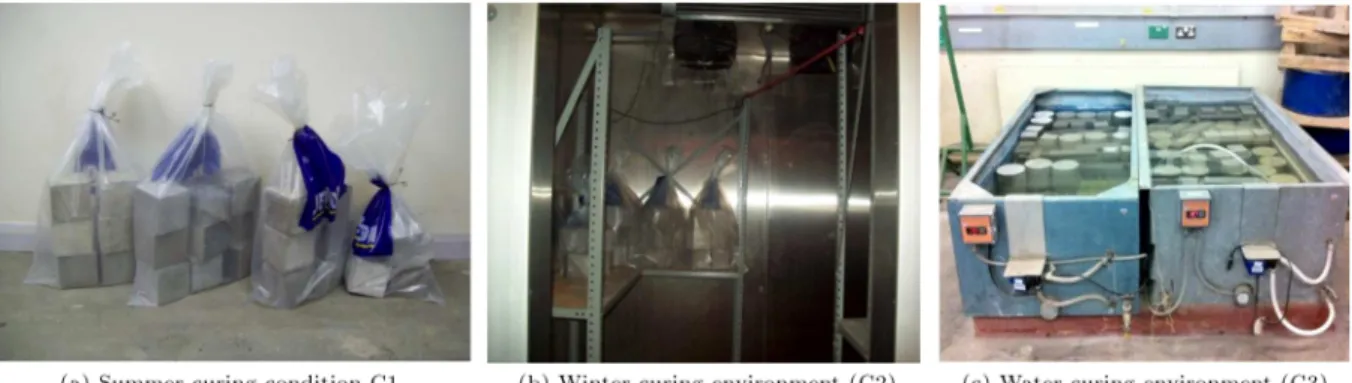
After casting concrete in the moulds, it was stored for 24 hours at a laboratory temperature of about 20 2
C and covered with plastic sheets to minimize the loss of moisture. After 24 hours, concrete was demoulded and sealed in air-tight plastic bags so that there is no loss of moisture and stored at a laboratory temperature of 20C. This curing environment is titled as C1 and
shown in Figure 2(a).
3.1.9. Winter curing environment (C2)
After casting concrete, it was stored for 24 hours in the moulds in the environmental chamber controlled at a temperature of 7C and 55% relative humidity,
which resembles the normal winter temperature in the UK. Moulds were covered with plastic sheets to minimize the loss of moisture. After 24 hours, concrete was demoulded and sealed in the air-tight plastic bags to avoid any loss of moisture and stored in the environmental chamber controlled at 7C. Concrete
cubes were cured under the C2 curing environment, as shown in Figure 2(b).
3.1.10. Water curing environment (C3)
After casting concrete in the moulds, it was stored at laboratory temperature of 20C and was covered with
plastic sheets. After 24 hours, concrete was demoulded and immersed in the water chamber controlled at a temperature of 20 2C. Concrete stored under curing
environment C3 is shown in Figure 2(c). 4. Results and discussion
The strength development of various concrete mixes cured under two curing conditions, C1 and C2, is shown in Table 2. The compressive strengths of PFA concrete
Table 1. Concrete mix proportion.
Mix PC/PFA
Constituent materials
(kg/m3) Calculated
density (kg/m3)
Slump (mm) Free
water (litres)
Binder (kg/m3)
Aggregates
(kg/m3) w/c
ratio
Super plasticiser (ml/100 kg
of binder)
PC PFA Coarse Fine
100PC-control 160 457 | 1285 500 0.35 1200 2400 150
90PC/10PFA 150 360 40 1325 540 0.375 1200 2415 185
80PC/20PFA 150 370 92 1310 495 0.325 1200 2415 190
70PC/30PFA 150 324 138 1310 495 0.325 1200 2415 200
Table 2. Compressive strength development of various concrete mixes for summer environment C1 and winter environment C2, expressed as % of compressive strength at 56 days.
Age (days)/compressive strength (MPa)
Curing 1 D 2 D 3 D 5 D 7 D 14 D 28 D 56 D Dierence
(MPa/%)
31% 47% 56% 78% 81% 88% 97% 100%
100PC- control-375 kg/m3@ w/c 0.40
C1 17 25 33 41.5 45.5 46.5 51.5 57.5
6 (10%)
30% 43% 57% 72% 79% 81% 90% 100%
C2 17 24 27 35 36.5 39 46 51.5
33% 47% 52% 68% 71% 76% 89% 100%
C3 51.5 58
90PC/10PFA@ w/c 0.40
C1 13 22 25.5 26.5 29 31.5 41 44.5
4 (9%)
29% 49% 57% 60% 65% 71% 92% 100%
C2 13 19.5 21 23 26 29 31 40.5
32% 48% 52% 57% 64% 72% 77% 100%
C3 42.5 44
80PC/20PFA@ w/c 0.35
C1 16.5 24.5 25.5 28 30.5 38.5 42.5 46
4.5 (10%)
36% 53% 55% 61% 66% 84% 92% 100%
C2 16.5 19.5 21 25.5 27 31.5 34 41.5
40% 47% 51% 61% 65% 76% 82% 100%
C3 42.5 44
70PC/30PFA@ w/c 0.325
C1 20 | 34 38.5 41 46 55 65
7 (10%)
31% 52% 59% 63% 71% 85% 100%
C2 20 - 28.5 30.5 34 40.5 44 58
34% 49% 53% 59% 70% 76% 100%
: The representative samples under C1 and C2 are de-moulded after one day and tested. Hence, the compressive strengths of the samples are treated the same at the age of 1 day.
Table 3. Compressive strength at the age of 28 and 56 days cured under various curing regimes. Concrete mix
Test age days/comp strength (MPa)
28 days 56 days
C1 C2 C3 C1 C2 C3
70PC/30PFA 55 97%
44 78%
56.5 100%
65 105%
58 94%
62 100% 80PC/20 PFA 42.5
100% 34 80%
42.5 100%
46 104%
41.5 94%
44 100% 90PC/10 PFA 41
95% 31 72%
43 100%
44.5 101%
40 91%
44 100% 100PC-control 51.5
96% 46 86%
53.5 100%
57.5 99%
51.5 88%
58 100%
Figure 3. Compressive strength development of 100PC-Control concrete mix under various curing conditions.
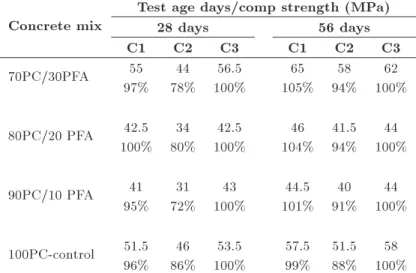
under water curing all the curing conditions are given in Table 3. The strength development characteristics of dierent mixes of concrete under the three regimes are shown in Figures 3, 4, and 5 for control mix, 90PC/10PFA, 80 PC /20PFA, and 70 PC /30PFA, respectively.
4.1. Strength development of blended concrete with PFA
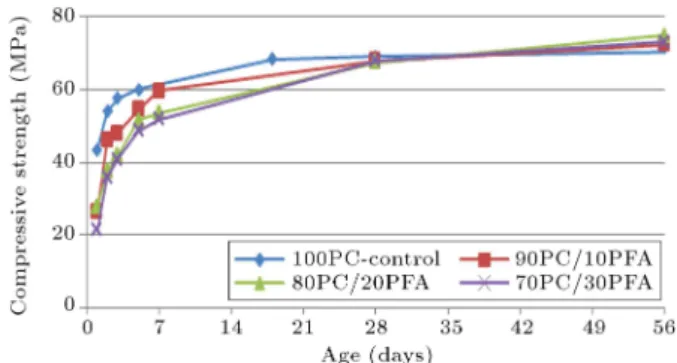
Strength developments of various PFA concrete mixes and 100 PC control mix, cured under curing regime C1, are compared in Figure 6. The following ndings are noted.
- The compressive strength of PFA concrete mixes cured under regime C1 (cured in sealed plastic bags at 20C) is slightly less than that cured under regime
C3 (cured under water at 20C). It is concluded that
there is a close correspondence between the com-pressive strengths of the specimens cured in sealed plastic bags for minimising the loss of moisture and
Figure 4. Compressive strength development of 90PC/10PFA concrete mix under various curing conditions.
Figure 5. Compressive strength development of 80PC/20PFA concrete mix under various curing conditions.
concrete specimens cured under water at the same temperature of 20C;
- The winter curing environment at 7C (C2 curing
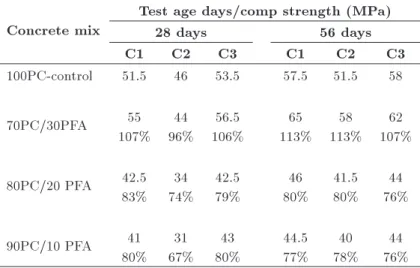
con-Table 4. Comparison of compressive strengths of blended concrete for various levels of replacement of cement with PFA and control mix with no PFA at the age of 28 and 56 Days.
Concrete mix
Test age days/comp strength (MPa)
28 days 56 days
C1 C2 C3 C1 C2 C3
100PC-control 51.5 46 53.5 57.5 51.5 58 70PC/30PFA 55
107% 44 96%
56.5 106%
65 113%
58 113%
62 107% 80PC/20 PFA 42.5
83% 34 74%
42.5 79%
46 80%
41.5 80%
44 76% 90PC/10 PFA 41
80% 31 67%
43 80%
44.5 77%
40 78%
44 76%
Figure 6. Compressive strength development of 70PC/30PFA concrete mix under various curing conditions.
crete mixes including 100PC-Control concrete mix, but reduced the strength of PFA concrete more than the 100PC-Control concrete mix. In winter, it is recommended that the curing temperature of the PFA concrete be kept at least 20C at early ages
to gain enough strength to be used in the fast track construction; to enhance the long-term strength of PFA concrete, an extended curing time is required.
PFA concrete has shown that the early-age strength development is slow due to the apparent slow pozzolanic reactions between PFA and the lime (Ca(OH)2) generated by the PC concrete. Under
curing regime C1, the strengths of 90PC/10PFA, 80PC/20PFA, and 70PC/30PFA concrete mixes are 25.5 MPa, 25.5 MPa, and 34 MPa, respectively, at the 3-day age, as compared to 33 MPa for the 100PC-control concrete mix. At the 14-day age, the strengths increased to 31.5 MPa, 38.5 MPa, 46 MPa, and 46.5 MPa, respectively. At the age of 28 days, these strengths are further increased to 41 MPa, 42.5 MPa,
55 MPa, and 51.5 MPa, respectively. The dierence in the compressive strengths at the age of 28 days for PFA concrete and 100PC concrete is relatively low. For 70PC/30PFA at w/c ratio of 0.325, the blended concrete has achieved the maximum of 56-day compressive strength of 65 MPa under curing condition C1, as compared to 57.5 MPa for 100PC with no y ash. The strength gain in PFA concrete is maximum during 28 and 56 days of age. The strength development of PFA-added blended concrete for various cement replacements, under various curing conditions, is also shown as % of the control mix with no PFA, as shown in Table 4. The comparison in Table 4 shows that 33% replacement of cement by PFA gives the best results under all curing conditions. The compressive strengths of such concrete are either equal to that of control mix, where no PFA has been used or even greater.
4.2. Strength development of concrete under various curing conditions
Strength development of PFA concrete mixes is com-pared with that of the PC concrete mix cured under regime C1 (20C) in Figure 7 and cured under regime
C2 (7C) in Figure 8.
- The compressive strength for all ages of concrete under winter conditions of curing is low. Hence, low winter temperature (7C) has severe impact
on compressive strength and the concrete temper-ature needs to be maintained at minimum summer temperature of 20. The compressive strength gain under water curing conditions C3 is, however, the maximum in all cases;
- The 28-day compressive strengths for 70PC/30PFA mix under C1, C2, and C3 are 55 MPa, 44 MPa, and 56.5 MPa, respectively, showing that there is no much dierence in strength gain under C1 and
Figure 7. Comparison of compressive strength
development of PFA concrete with control mix under C1 curing conditions.
Figure 8. Comparison of compressive strength
development of PFA concrete with control mix under C2 curing conditions.
C3 conditions. For mix 80PC/20PFA, the values are 42.5, 34, and 42.5 MPa, respectively. For mix 90PC/10PFA, these values are 41, 31, and 43 MPa and for 100PC; the values under three curing conditions are 51.5, 46, and 53.5 MPa, respectively. The comparison of values in Table 2 for 28 days shows that the samples have gained almost the same strength under curing conditions C1 and C3 and 72%-82% under C2 (winter conditions).
The strength gain between the ages of 28 and 56 days is compared in Table 3 and expressed as percentage of 56-day strength of C3 curing conditions when the samples are cured under water. Herein, the strength gain in PFA concrete is relatively faster than the 100PC samples. This is in line with the general observations with the concrete having SCM, where the specied compressive strength is calculated at the age of 56 days, instead of 28 days.
5. Conclusion and directions for future work The following conclusions are made based on the tests blended cement concrete specimen tested under various curing conditions:
- Partial replacement of cement by PFA up to 30% has little impact on the compressive strength at
the age of 28 days when compared with samples having no PFA, as the compressive strength achieved has a reasonable value for use in structural works. This can oer greater opportunity for saving of cement and CO2emissions, thereby making concrete
relatively sustainable;
- The strength development of PFA concrete is rela-tively slow in the beginning up to 7 days and, then, increases with a relatively high rate. The optimum strength is achieved at 56 days, instead of 28 days of age;
- The results show that there are signicant reductions in the rate of strength gain of concrete cured under winter curing conditions (7C), as compared to those
of summer curing and under water (20C). In winter
conditions at water cement ratio of 0.35 for concrete containing PFA up to 30%, special care should be taken regarding the temperature increase of the curing environment, especially at the early age to gain enough strength. This can be achieved by covering the concrete in sealed conditions. The heating of concrete buildings, which increases the temperature for curing, is a common practice in cold areas;
- The strength development under the summer condi-tions and under water is almost the same for PFA concrete in which cement is partially replaced by 20% and 30%;
- Based on the comparison of the compressive strength developments of PFA concrete results between the ages of 28 and 56 days, it is evident that the strength gain is relatively higher during this period as com-pared to the 100% PC concrete with no PFA. It is more advisable to use the specied strength of PFA concrete at the age of 56 days, as already suggested by earlier research on the blended concrete.
For future works, the following are recommended.
- To check the eects of extreme summer temperature on strength development of PFA concrete;
- To check the impact of curing temperature on normal strength concrete containing PFA;
- To estimate the environmental benets associated with using PFA in concrete as a partial replacement of cement.
Acknowledgement
We would like to pay special thanks to the Kingston University, UK, and the technical sta of Concrete and Materials Laboratory, especially Mr. Peter and Mr. Howard who assisted us during the experimental work.
References
1. UN (1983) \Report of the world commission on environment and development", [online] available at: http://www.un.org/documents/ga/res/42/ares42-187.htm (Accessed 4 May, 2010).
2. The Concrete Centre \Concrete industry sustainability performance report", Surrey, UK, [online] available at http://www.sustainableconcrete.org.uk/ (Accessed 15 Feb, 2011) (2010).
3. Brundtland Commission \Our common future", Tech-nical Report, World Commission on Environment and Development (WCED), Oxford University Press (1987).
4. Struble, L. and Godfrey, J. \How sustainable is con-crete?", Proceedings of the International Workshop on Sustainable Development and Concrete Technology, Beijing, China, pp. 201-211 (2004).
5. United Kingdom Quality Ash Association \Embod-ied CO2 of UK cement, additions and cementi-tious material", Technical Data Sheet 8.3, MPA UK quality Ash association; [online] available at http://www.ukqaa.org.uk. (Accessed 4th October, 2012) (2010).
6. Harrison, A.J.W., TecEco Cement Concretes - Abate-ment, Sequestration and Waste Utilization in the Built Environment, TecEco Pty. Ltd, Hobart, Tasma-nia, Australia, [online] (Accessed 12th March, 2012). Available at: http://www.tececo.com/les/ confer-ence%20papers/TecEco TechnologyAbatementSequest rationandWasteUtilsation290105.pdf (2003).
7. http://www.un.org/sustainabledevelopment/
sustainable-development-goals/ (Accessed 14th June, 2017).
8. Naik, T.R. and Ramme, B.W. \Setting and hardening of high y ash content concrete", American Coal Ash Association's 8th International Coal Ash Utilization Symposium, Washington, American Coal Ash Associ-ation, pp. 16-120 (1987).
9. Naik, T.R. and Ramme, B.W. \High strength concrete containing large quantities of y ash", ACI Mater J., 86(2), pp. 111-7 (1989).
10. Poon, C.S. \Study on high strength concrete prepared with large volumes of low calcium y ash", Cem. Concr. Res., 30(3), pp. 447-55 (2000).
11. Berry, E.E. and Malhorta, V.M. \Fly ash for use in concrete - a critical review", ACI Mater. J., 77(2), pp. 59-73 (1980).
12. Lee, T. and Wu, L.S. \Eects of the LOI of y ash on the concrete properties", Conference on the Appli-cation of Fly-Ash Concrete in Taiwan, Department of Civil Engineering of National Central University, pp. 17-23 (1992).
13. Huang, C.H., Lin, S.K., and Chen, H.J. \Mix propor-tions and mechanical properties of concrete containing very high-volume of class F y ash" Construction and Building Materials, 46, pp. 71-78 (2013).
14. Higgins, D. \Sustainable concrete: How can additions contribute", Proceedings of the Institute of Concrete Technology Annual Technical Symposium, Institute of Concrete Technology Camberley, UK (2003).
15. Wang, L., Tian, P., and Yao, Y. \Application of ground granulated blast furnace slag in high-performance con-crete in China", Proceedings of International Con-ference on Sustainability and Concrete Technology, Beijing, China (2004).
16. Thomas, M.D.A., Optimizing Fly Ash Content for Sustainability, Durability, and Constructability, Uni-versity of New Brunswick, Department of Civil Engi-neering, Canada (2010).
17. Davis, R.E., Carlson, R.W., Kelly, J.W., and Davis, H.E. \Properties of cements and concretes containing y ash", Journal of the American Concrete Institute, 33, pp. 577-611 (1937).
18. British standard institute BS EN 450-1:2012, Fly Ash for Concrete, Denition, Specication and Conformity Criteria, London: British Standard Institute (2012).
19. ACI Committee 226 \Use of y ash in concrete", ACI Mater J., 84(5), pp. 381-409 (1987).
20. Dhir, R.K. \Pulverised-fuel ash", Concrete Technology and Design, Cement Replacement Materials, Surrey University Press, London, 33, Ch. 7, pp. 197-255 (1986).
21. Kayali, O. and Ahmed, M.S. \Assessment of high volume replacement y ash concrete - Concept of performance index", Construction and Building Ma-terials, 39, pp. 71-76, Elsevier (2013).
22. Neville, A.M., Properties of Concrete, Longman Group Limited, 4th Edn., London, England (1995).
23. Malhotra, V.M. and Mehta, P.K., High-Performance, High-Volume Fly Ash Concrete. Supplementary Ce-menting Materials for Sustainable Development, Inc., Ottawa, Canada, 124 pages (2005).
24. Yang, E.H., Yang, Y., Li, V.C. \Use of high volumes of y ash to improve ECC mechanical properties and material greenness", ACI Materials Journal, 104(6), pp. 620-628 (2007).
25. Lepech, M.D., Li, V.C., Robertson, R.E., and Ke-oleian, G.A. \Design of green engineered cementitious composites for improved sustainability", ACI Materi-als Journal, 105(6), pp. 568-575 (2008).
26. Qureshi, M.N. and Somnath, G. \Eect of curing conditions on the compressive strength and microstruc-ture of alkali-activated GGBS paste", International Journal of Engineering Science Invention, 2(2), pp. 24-31 (2013).
27. Islam, M.M., Islam, M.S., Mondal, B.P., and Islam, M.R. \Strength behavior of concrete using slag with cement in sea water environment", Journal of Civil Engineering (IEB), 38(2), pp. 129-140 (2010).
28. Barnett, S.J., Soutsos, M.N., Millard, S.G., and Bungey, J.H. \Strength development of mortars con-taining ground granulated blast-furnace slag", Eect of curing temperature and determination of apparent activation energies", Cement and Concrete Research, 36, pp. 434-440 (2010).
29. Safan, M. and Kohoutkova, A. \Inuence of dierent drying conditions on high strength concrete compres-sive strength", Acta Polytechnica, 41(3), pp. 24-28 (2001).
30. Hongen, Z., Ling, T., Xiaoshuang, S., and Wang, Q. \Inuence of curing condition on compressive strength of low-calcium y ash-based geopolymer concrete", Journal of Residuals Science & Technology, 14(1), p. 1544 (2017).
31. Ki-Bong Park1 and Takafumi Noguchi \Eects of mixing and curing temperature on the strength devel-opment and pore structure of y ash blended Mass Concrete", Advances in Materials Science and Engi-neering, 27, 11 pages (2017).
32. British Standard Institute BS EN 934-2:2009+A1: 2012, Admixtures for Concrete, Mortar and Grout. Concrete Admixtures. Denitions, Requirements, Con-formity, Marking and Labelling (2012).
33. British Standard Institute BS EN 12620-1: 2009, Aggregates for Concrete, London, British Standard Institute (2009).
34. British Standards Institution BS EN 12390-3: 2009, Testing Hardened Concrete, Part 3: Compressive Strength of Test Specimens, London: British Standards Institute (2009).
Biographies
Shahab Samad is currently an Assistant Professor at Civil Engineering Department, City University of Science and IT, Pakistan. He received his BS from UET Peshawar Pakistan and MS from City University London, UK. He obtained his PhD from Kingston
University London. He worked as a Structural En-gineer with GD Partner, UK, and as Lecturer at Kingston University, UK. His research areas include, use of supplementary cementitious material in concrete, binary cement and design of steel structures.
Attaullah Shah is a Professor of Civil Engineering at City University of Science and IT Pakistan. He received his BS and MS from UET Peshawar, Pakistan and PhD from UET Taxila, Pakistan. He is also the corresponding author. His research areas include shear properties of high strength concrete, retrotting of damaged RC structures, and sustainable built envi-ronment.
Mukesh C Limbachiya is a Professor of Civil En-gineering and the Head of Natural and Built Environ-ment, Faculty of Science, Engineering and Computing at Kingston University, UK. He received his BS Civil Engineering from Jeevan Sadhana, India, MS from University of Baroda, Manchester, and PhD from Hallam University, UK. Professor Limbachiya has been a member of numerous prestigious bodies, namely Fellow of Institution of Civil Engineers, UK, Chartered Engineer, UK, FICE and many more. His areas of interest include the use of blended cement in RC, reuse of waste material, and retrotting of damaged structures.
Satish B Desai is a Professor at Kingston University, London, PhD Civil Engineering, Chartered Engineer (CEng), Fellow of the Institution of Civil Engineers and the Institute of Materials, Minerals & Mining, with a strong demonstrable experience of strategic leader-ship and management in a multidisciplinary higher education sector. He has an academic career with an extensive experience of teaching and curriculum development.