
A Population-Based Analysis of Lymphatic Mapping and Sentinel Lymphadenectomy Utilization for Melanoma
By
Karyn B. Stitzenberg, M.D.
A Master's Paper submitted to the faculty of The University of North Carolina at Chapel Hill
In partial fulfillment of the requirements for The degree of Master of Public Health in
The Public Health Leadership Program.
ABSTRACT
INTRODUCTION: Lymphatic mapping and sentinel lymphadenectomy
(LM/SL) is considered the nodal staging procedure of choice for patients with
intermediate thickness (> 1.0mm, <4.0mm) melanoma. Despite this, the procedure
has not been universally adopted. The aims of this investigation are to document
the prevalence of LM/SL utilization and to identifY predictors of under use.
I
METHODS: All incident cases of melanoma from 1999-2001 reported to the
North Carolina Central Cancer Registry (CCR) were examined. Subjects who had
primary tumors> l.Omm and <4.0mm thick and no clinical evidence of nodal or
distant metastases were considered eligible for LM/SL. Bivariate and multivariate
logistic regression analysis was performed to identifY factors associated with
receipt of LM/SL.
RESULTS: There were 3436 incident cases of melanoma reported for 1999-2001
(1111 in 1999, 1089 in 2000, and 1236 in 2001). 273 cases (8%) were excluded
from analysis due to distant metastases or palpable adenopathy. An additiona1916
L
(29%) cases were excluded because the T classification of the primary tumor wasnot reported. Of the remaining 2247 cases, 1242 (55%) were eligible for LM/SL
(44% in 1999, increasing to 52% in 2000 and 50% in 2001, p=0.05). Subjects 60 years and older were less likely to undergo LM/SL compared to subjects less than 60 years (39% vs. 55%, p<O.OOl ). Subjects with head or neck primary tumors were significantly less likely to undergo LM/SL compared to subjects with trunk or extremity primaries (32.9% vs. 51.4% and 51.9%, respectively, p<O.OOl), and subjects with T2 lesions were less likely to receive LM/SL than subjects with T3 lesions (41.7% vs. 53.6%, p<O.OOl). All of the associations remained statistically significant on multivariate analysis.
INTRODUCTION
Since most melanoma care occurs in the outpatient setting, documenting the incidence of melanoma is very difficult.1-3 Documenting the diagnostic and
treatment options offered to patients with melanoma is even more problematic. Single- or even multi-institution studies of melanoma do not provide information about cases that are managed in the offices of community physicians, in
outpatient surgical centers, or even in small community hospitals. As a result, there is a paucity of information about the care delivered to melanoma patients in the United States. To understand the diagnostic and treatment options used for patients with melanoma requires a population-based approach.
Lymphatic mapping and sentinel lymphadenectomy (LM/SL) is a good example of a diagnostic option for which little is know about actual utilization for patients with melanoma. LM/SL has become the nodal staging procedure of choice for patients with intermediate thickness melanoma.4-6 LM/SL provides
important staging information and identifies which patients may benefit from adjuvant therapy or clinical trials. However, to date, only one study has attempted to document the utilization ofLM/SL for melanoma.7 Examining Surveillance, Epidemiology and End Results (SEER) data, Baxter and Tuttle found that only 4 7% of patients diagnosed with an intermediate thickness melanoma (Breslow thickness :::>:l.OOmm) underwent LM/SL between 1998 and 2000.
Three broad categories of factors that influence the receipt of optimal cancer care have been described: structural factors, physician/clinical factors and patient factors. 8 Physician/clinical factors are those factors that may influence
!
!.
i
physician decision-making and physician recommendations. This study will
examine how various physician/clinical factors may influence incorporation of
LM/SL into the care of patients with intermediate thickness melanoma in North
Carolina. We hypothesize that a significant portion of eligible patients are not
receiving any surgical nodal staging and that certain factors, including patient age
and location of the primary tumor, significantly influence whether a patient
undergoes LM/SL.
METHODS
The North Carolina Central Cancer Registry (CCR) is a comprehensive
I
state tumor registry, managed by the North Carolina State Center for Health
Statistics. The CCR collects data on all cancer cases diagnosed among North
Carolina residents through mandatory reporting. North Carolina law(§ 130A-209)
requires that "All health care facilities and health care providers that detect,
diagnose, or treat cancer shall report to the central cancer registry each diagnosis
of cancer in any person who is screened, diagnosed, or treated by the facility or
provider." Hospitals are the primary sources of data for the CCR. These data are
then supplemented with data from private physicians and pathology laboratories
and with information obtained from death certificates. All incident cases of
melanoma between January 1, 1999 and December 31,2001 reported to the CCR
before February 2004 were analyzed for this study.
Cases in which there was any indication of distant metastasis or palpable
categorized by reported T classification [American Joint Committee on Cancer (AJCC) Staging Manual, 5th edition].9 T1 (Breslow thickness :s;0.75mm) and T4 (Breslow thickness >4.0mm) cases were excluded from the analysis as LM/SL would not have been universally recommended for these cases. Cases that did not have a reported T classification were also excluded. As a result, cases that were considered "eligible" for LM/SL included all subjects who had a reported T classification of T2 or T3 and no reported clinical evidence of nodal or distant metastasis at the time of diagnosis.
The proportion of eligible cases that received LM/SL was calculated. Cases were considered to have received LM/SL ifLM/SL was ever attempted. Consequently, cases in which LM/SL was performed and followed with completion lymph node dissection, either immediately or as part of a second procedure, were considered to have received LM/SL. Additionally, cases in which LM/SL was attempted, but no sentinel node was identified, were also considered to have received LM/SL.
Some patients received other, unspecified nodal staging procedures. These cases may have included elective lymph node dissections, LM/SL that were not coded as such, or other nodal sampling procedures. To maximize sensitivity for nodal staging, the proportion of eligible cases who received any type of nodal
staging procedure was also calculated. Subjects were considered to have received
I
L
The relationships between receipt of LM/SL and multiple clinical, histopathologic, and demographic factors that may have affected physician decision-making were examined. Bivariate analysis was performed using the Pearson's chi-square test for categorical variables and logistic regression for continuous variables (Stata 8.2, StataCorp, College Station, Texas). Race was dichotomized due to the small number of African-American, Hispanic, Asian, and Native American subjects, and Fisher's Exact test was used, since very few non-White subjects were eligible for LM/SL. The associations were confirmed using multivariate logistic regression, incorporating all factors into the model.
Pearson's chi-square, Fisher's Exact, and logistic regression were also used to examine the relationships between receipt of any nodal staging procedure and the various clinical, histopathologic, and demographic factors.
T classification was used to define eligibility for LM/SL, since actual Breslow thickness was only available for a subset of the cases (821/3436). Relying on categorization by T classification required "eligible" cases to be defined as those with a Breslow thickness 0.76-4.00mm. However, use ofLM/SL is controversial for cases with a Breslow thickness between 0. 75mm and
1.00mm.10•19 As a result, the analysis was repeated for the subset of patients for
whom Breslow thickness was known in order to validate the main analysis. For the subset analysis, "eligible" cases were limited to those with a Breslow
thickness 1.00mm-4.00mm.
'
f-The study protocol was approved by the North Carolina Central Cancer Registry and by the University of North Carolina School of Medicine Institutional Review Board.
RESULTS
There were 3436 incident cases of melanoma in North Carolina between 1999 and 2001: 1111 in 1999, 1089 in 2000, and 1236 in 2001. Overall, there were 1948 (56.7%) men and 1488 (43.3%) women with a mean age for the cohort of57.3 years (SD+/-17.3 years). 97.7% (3356/3436) of subjects were White. The
primary site was reported as head or neck in 721 (21. 0%) cases, trunk in 1129 i
I
(32.9%) cases, extremity in 1373 (40.0%) cases, and other or unknown in 213 (6.2%) cases.
273 cases (8%) were excluded from analysis due to distant metastasis (192), palpable adenopathy (57), or both (24). T classification was not available for 916 (29%) cases. Of the remaining 2247 cases, 1242 (55%) were eligible for
r
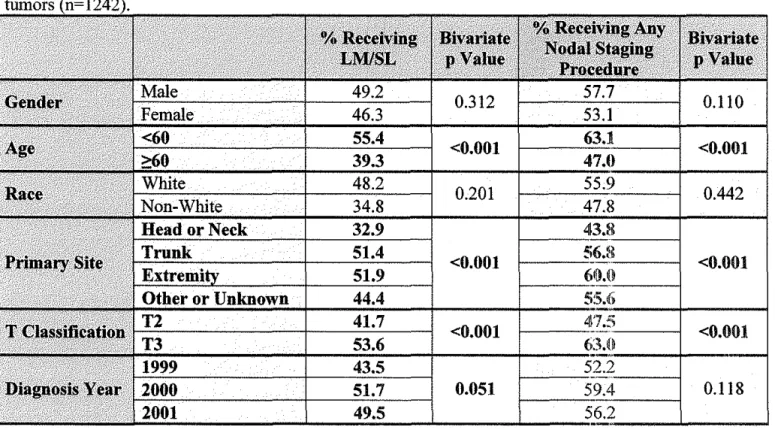
T 1 LM/SL (T2 or T3).Overall, 48.0% (596/1242) of eligible subjects received LM/SL. Use of LM/SL increased slightly over the three years. Table 1. The increase from 1999 to 2000 was statistically significant (p=0.021). Subjects with head or neck primary tumors were significantly less likely to receive LM/SL compared to subjects with trunk or extremity primaries (32.9% vs. 51.4% and 51.9%,
Although males (49.2%) and Whites (48.2%) were more likely to receive LM/SL than females (46.3%) and non-Whites (34.8%), these differences were not
statistically significant on bivariate analysis.
When age was examined as a continuous variable, there was a significant association between diagnosis age and receipt ofLM/SL (OR 0.979, 95% CI 0.972, 0.985) Figure 1 demonstrates that use ofLM/SL begins to drop off significantly as early as the sixth decade. 39.3% of subjects 60 years of age or older received LM/SL compared to 55.4% of subjects less than 60 years of age (p<0.001). Even when the very young (<20 years) and very old (>84 years) were excluded, the difference remained highly statistically significant ( 41.2% vs.
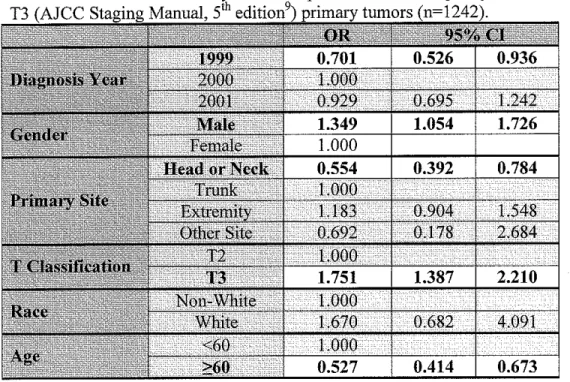
On multivariate analysis, the associations between receipt of LM/SL and
I
55.1%, p<0.001).diagnosis year, primary site, T classification, and diagnosis age remained
significant. Table 2. In addition, after adjusting for the other variables, although still small, the difference between males and females was statistically significant (OR for males 1.35, 95% CI 1.05, 1.73).
When the analysis was limited to those subjects who received a nodal staging procedure, primary site was the only factor significantly associated with receipt ofLM/SL (p=0.002). Figure 3. Subjects with trunk lesions were the most
likely to receive LM/SL, while subjects with head or neck primary tumors were the most likely to receive a nodal staging procedure other than LM/SL. Even after adjusting for the other factors, subjects with a head or neck primary tumor who underwent nodal staging were significantly less likely to have received a LM/SL (p<0.001). Table 3.
Since the utility of LM/SL for patients with a Breslow thickness between 0. 75rnm and 1.00rnm is controversial, 19 the analysis was repeated using the reported Breslow thickness to defme eligibility for LM/SL. A reliable Breslow
thickness was available for 23.9% (821/3436) of all cases. Forty-five (5.5%)
i
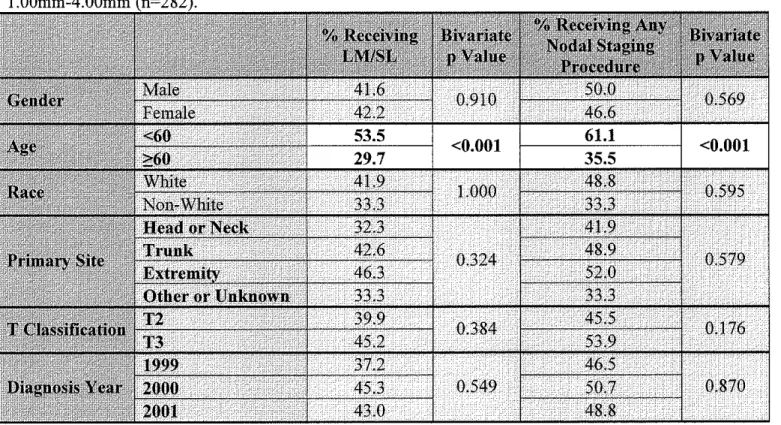
' subjects were excluded for distant metastasis or palpable adenopathy at diagnosis.Of the remaining 776 cases, 282 (36.3%) were eligible for LM/SL (Breslow thickness :0:1.00 and ::;4.00rnm). 41.8% (118/282) of these cases underwent LM/SL. An additional 19 ( 6. 7%) cases underwent some other type of nodal staging procedure. While the proportions of subjects who received LM/SL by primary site, diagnosis year, and T classification were comparable to those found for the whole group analysis, these associations were not statistically significant
for the subset. Tables 4 and 5. In contrast, the association between receipt of L LM/SL and diagnosis age was again highly statistically significant on multivariate
DISCUSSION
LM/SL is regarded as the nodal staging procedure of choice for patients with intermediate thickness melanoma,4• 6 yet roughly half of eligible patients do
not receive the procedure.7 Consistent with Baxter and Tuttle's experience using SEER data, we found that only 48% of eligible subjects underwent LM/SL in North Carolina between 1999 and 2001. Three categories of factors (structural, physician/clinical, and patient) may influence receipt of optimal cancer care.8 This study examined several physician/clinical factors that may influence
physician decision-making, including depth of the primary tumor, patient gender, primary site, patient race, and patient age. Additionally, diagnosis year, which could be viewed as a structural factor, was examined.
Increasing Breslow thickness is known to be associated with an increasing risk of recurrence and death.2
°
Consequently, depth of the primary tumor may influence physician decision-making. Subjects with T2 lesions (Breslowthickness 0. 76-l.50mm) were less likely to receive nodal staging procedures than subjects with T3 lesions (Breslow thickness l.51-4.00mm), suggesting that physicians may be less likely to endorse LM/SL for less advanced lesions.
In contrast, although older age has been suggested to be a risk factor for poor prognosis in patients with melanoma, 21• 22 older adults were less likely to
receive nodal staging even after adjusting for other factors. Use ofLM/SL was uniform among adults less than 50 years of age. However, after age 50, the use of nodal staging dropped off steadily. It is understandable that LM/SL might not be offered to the very old, who would not be eligible for clinical trials and may not
r
be able to tolerate additional surgical procedures or chemotherapeutic regimens. However, for adults in their 50s, 60s, and 70s, the reason for decreased utilization is not as clear.
Subjects with head or neck primary tumors were also less likely to receive nodal staging. Not only were nodal staging procedures, in general, less common for this group, but among patients who did receive a nodal staging procedure, subjects with head or neck primary tumors were far less likely to receive LM/SL than subjects with trunk or extremity primary tumors. This difference deserves further exploration.
Although we did not have information on the specialty of the primary surgeon, we suspect that the training of the primary surgeon may be an important factor impacting physician decision-making and leading to this difference.
LM/SL of the head and neck is technically more difficult than in other regions due to the variability in lymphatic drainage patterns.23 It is likely that most general surgeons are not as comfortable with nodal dissections of the head and neck as they are with dissections of the axilla and groin. As a result, subjects with head and neck primary melanomas who are managed by general surgeons may be Jess likely to receive nodal staging. Alternatively, since otolaryngologists are less likely to have been trained to perform LM/SL, they may be more likely to perform a nodal staging procedure other than LM/SL on their patients with melanoma. While this is simply speculation, further investigation into the factors contributing to the decreased use ofLM/SL in patients with head or neck primary tumors is warranted.
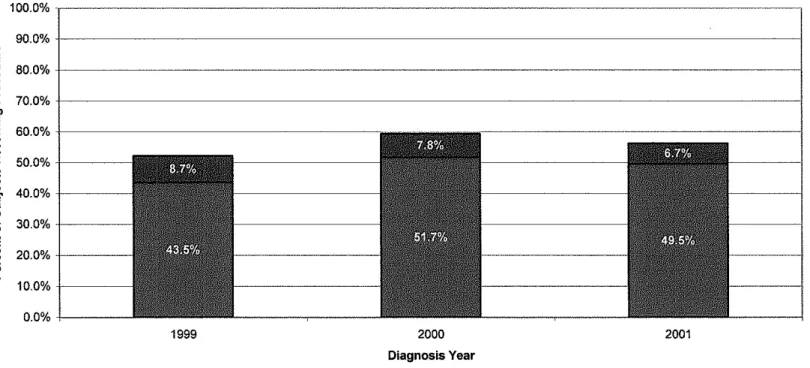
With only three time points, we were unable to demonstrate an increase in utilization over time. While there was a significant increase in the utilization of LM/SL between 1999 and 2000, a similar increase was not seen from 2000 to 2001. Similarly, Baxter and Tuttle demonstrated an increase in use ofLM/SL from 1998 to 1999 ( 40% to 50%), but were unable to show a consistent trend. 7
Limitations
This analysis was limited by the fact that T classifications had to be used to determine eligibility for LM/SL. Although Breslow thickness is more precise a reliable Breslow thickness was only available for a subset of cases, all of which were reported by a certain subset of facilities. As a result, using Breslow thickness would have led to a systematic selection bias. For a true population-based analysis, T classifications were felt to be more appropriate. The drawback of using T classifications is that staging recommendations from the AJCC Staging Manual, 5th Edition9 were in effect during this time period, so T2 and T3 lesions included all lesions 0.76mm-4.0mm thick. Consensus regarding the utility of LMISL is limited to lesions 1.00mm-4.00mm thick.19 As a result, relying on T classifications potentially could have resulted in underestimation of the use of LM/SL for cases with Breslow thickness 1.00mm-4.00mm. However, utilization of LMISL in the subset analysis was even lower than in the main analysis, despite using Breslow thickness of 1.00mm as the lower limit of eligibility,.
Consequently, we do not feel that inclusion of primary tumors of Breslow
thickness 0. 76mm-1.00mm in the main analysis significantly impacted our results.
When working with population-based cancer registries, there is always concern about the completeness of the data. This is particularly true for
melanoma, since complete case ascertainment for melanoma has historically been difficult. I-J Incomplete reporting of first course of treatment information could
have led to underestimation of the use of nodal staging procedures. However, our results were consistent with the previous analysis of SEER data, 7 and the North Carolina CCR has been certified by the North American Association of Central Cancer Registries every year since 1997, establishing a track record of complete case ascertainment. 24 As a result, we do not feel incomplete data collection led to vast underestimation of the use of LM/SL.
CONCLUSION
FIGURE 1. Use ofLM/SL by age at diagnosis.
100
90
r----80
··--'
i
70 -'g> :i!: 60
~
'
""'
...
.,.......
I
50"
"'
40-~
0
-
c~ 30
d?.
20 !---·
10
r--0
0-19 20-29 30-39 40-49
----..._
50-59
Diagnosis Age
~
60-69
·---~
·-' "-'
~
FIGURE 2. Summary of All Nodal Staging Procedures by Diagnosis Year.
e
"
'C"
ue
a."'
c:~
"
u &11
"
:i5'"
"'
'0 ~ c"
1:! ~ 100.0% 90.0% 80.0% 70.0% 60.0% 50.0% 40.0% 30.0% 20.0% 10.0% 0.0%1999 2000
Diagnosis Year
I•
LM/SL BOther Nodal Staging Procedure!Figure 3. S=ary of All Nodal Staging Procedures by Primary Site.
100.0%
90.0%
I!!
"
"C
..
80.0%u
e
70.0%a.
"'
c
:~
..
60.0%u
& 50.0%
~
..
40.0%
:c'
"
"'
0 30.0%c
..
20.0%
!:?
..
a.10.0%
0.0%
Head or Neck Trunk
Primary Site
Extremity
TABLE 1. Bivariate analysis of receipt of nodal staging among subjects with T2 or T3 (AJCC Staging Manual, 5'h edition9) primary
0.312 0.110
<0.001 <0.001
0.201 0.442
<0.001 <0.001
<0.001 <0.001
Multivariate analysis of receipt ofLM/SL among subjects with T2 or ~~ Marmal, s'h ~Ull.lUU
TABLE 3. Multivariate analysis of receipt ofLM/SL among subjects who received a nodal "agmg p1ruc:~uun:o
:
t
t :
REFERENCES
1. Hall HI, Jamison P, Fulton JP, Clutter G, Roffers S, Parrish P. Reporting cutaneous melanoma to cancer registries in the United States. JAm Acad
Dermatol. Oct 2003;49(4):624-630.
2. Koh HK, Clapp RW, Barnett JM, et al. Systematic underreporting of cutaneous malignant melanoma in Massachusetts. Possible implications for national incidence figures. JAm A cad Dermatol. Apr 1991 ;24( 4):545-550. 3.
4.
5. 6.7.
8.
9. 10. 11. 12.13.
14.Zippin C, Lum D, Hankey BF. Completeness of hospital cancer case reporting from the SEER Program of the National Cancer Institute.
Cancer. Dec I 1995;76(11):2343-2350.
Cascinelli N, Belli F, Santinami M, eta!. Sentinel lymph node biopsy in cutaneous melanoma: the WHO Melanoma Program experience. Ann Surg
Oneal. Jul2000;7(6):469-474.
McMasters KM, Reintgen DS, Ross MI, et a!. Sentinel lymph node biopsy for melanoma: how many radioactive nodes should be removed? Ann Surg
Oneal. Apr200!;8(3):192-197.
Reintgen D, Pendas S, Jakub J, eta!. National trials involving lymphatic mapping for melanoma: the Multicenter Selective Lymphadenectomy Trial, the Sunbelt Melanoma Trial, and the Florida Melanoma Trial. Semin
Oneal. Jun 2004;31(3):363-373.
Baxter NN, Tuttle, T.M. Increased utilization of regional lymph node staging for melanoma. Annals of Surgical Oncology. February 2004;11(2):Sl21.
Shavers VL, Brown ML. Racial and ethnic disparities in the receipt of cancer treatment. J Natl Cancer Inst. Mar 6 2002;94(5):334-357. Carcinoma of the skin (excluding eyelid, vulva, and penis). In: Fleming
ID, Cooper JS, Henson DE, eds. AJCC Cancer Staging Manual, 5th ed Philadelphia, PA: Lippincott-Raven; 1997:157-161.
Agnese DM, Abdessalam SF, Burak WE, Jr., Magro CM, Pozderac RV, Walker MJ. Cost-effectiveness of sentinel lymph node biopsy in thin melanomas. Surgery. Oct 2003;134(4):542-547; discussion 547-548. Bedrosian I, Faries MB, Guerry Dt, eta!. Incidence of sentinel node metastasis in patients with thin primary melanoma ( < or = I mm) with vertical growth phase. Ann Surg Oneal. May 2000;7(4):262-267. Bleicher RJ, Essner R, Foshag LJ, Wanek LA, Morton DL. Role of sentinel lymphadenectomy in thin invasive cutaneous melanomas. J Clin
Oneal. Apr 1 2003;21(7):1326-1331.
Dubois R W, Swetter SM, Atkins M, et al. Developing indications for the use of sentinel lymph node biopsy and adjuvant high-dose interferon alfa-2b in melanoma. Arch Dermatol. Sep 2001;137(9): 1217-1224.
Jacobs IA, Chang CK, DasGupta TK, Salti GI. Role of sentinel lymph node biopsy in patients with thin (<I mm) primary melanoma. Ann Surg
Oneal. Jun 2003;10(5):558-561.
15. Lowe JB, Hurst E, Moley JF, Cornelius LA. Sentinel lymph node biopsy in patients with thin melanoma. Arch Dermatol. May 2003;139(5):617-621. 16. 17. 18. 19. 20. 21. 22. 23. 24.
Nahabedian MY, Tufaro AP, Manson PN. Sentinel lymph node biopsy for the Tl (thin) melanoma: is it necessary? Ann Plast Surg. Jun
2003;50(6):601-606.
Statius Muller MG, van Leeuwen PA, van Diest PJ, Vuylsteke RJ, Pijpers R, Meijer S. No indication for performing sentinel node biopsy in
melanoma patients with a Breslow thickness of less than 0.9 mm.
Melanoma Res. Jun 2001;11(3):303-307.
Thompson JF, Shaw HM. Sentinel node metastasis from thin melanomas with vertical growth phase. Ann Surg Oneal. May 2000;7( 4):251-252. Stitzenberg KB, Groben, P.A., Stem, S.L., Thomas, N.E., Rensing, T.A., Sansbury, L.B., Ollila, D.W. Indications for Lymphatic Mapping and Sentinel Lymphadenectomy in Patients with Thin Melanoma (Breslow thickness <=l.Omm). Annals of Surgical Oncology.In Press.
Balch CM, Soong SJ, Gershenwald JE, eta!. Prognostic factors analysis of 17,600 melanoma patients: validation of the American Joint Committee on Cancer melanoma staging system. J Clin Oneal. Aug 15
2001; 19(16):3622-3634.
Kalady MF, White RR, Johnson JL, Tyler DS, Seigler HF. Thin melanomas: predictive lethal characteristics from a 30-year clinical experience. Ann Surg. Oct 2003;238(4):528-535; discussion 535-527. Chao C, Martin RC, 2nd, Ross MI, eta!. Correlation between prognostic factors and increasing age in melanoma. Ann Surg Oneal. Mar
2004; 11 (3):259-264.
Chao C, Wong SL, Edwards MJ, eta!. Sentinel lymph node biopsy for head and neck melanomas. Ann Surg Oneal. Jan-Feb 2003;10(1):21-26. North American Association of Central Cancer Registries. Available at: http://www.naaccr.org/. Accessed June 13,2004.



![endo,endo,endo 9,9,10,11,12 Pentabromotricyclo[6 2 2 02,7]dodeca 2(7),3,5 triene](data:image/gif;base64,R0lGODlhAQABAIAAAP///wAAACH5BAEAAAAALAAAAAABAAEAAAICRAEAOw==)