Ashraf F. Farrag. A comparison of patient cohort discovery tools. A Master’s Paper for the M.S. in I.S degree. April, 2010. 28 pages. Advisor: Javed Mostafa
The patient cohort discovery tools from UNC Chapel Hill, Harvard and Stanford medical centers are compared in terms of features, access to data and query limitations.
Headings:
by Ashraf F. Farrag
A Master’s paper submitted to the faculty of the School of Information and Library Science of the University of North Carolina at Chapel Hill
in partial fulfillment of the requirements for the degree of Master of Science in
Information Science.
Chapel Hill, North Carolina April 2010
Approved by
Table of Contents
1 Introduction 5
1.1 Translational research and electronic health records 5
1.2 Limitations of study 6
2 System Architecture 7
2.1 Carolina Data Warehouse - Health 7
2.2 STRIDE 8
2.3 i2b2 8
3 System Capabilities 10
3.1 Privacy 10
3.2 Client Interface 10
4 Query Parameters 10
4.1 Introduction 10
4.2 Demographics 14
4.3 Diagnoses 15
4.4 Procedures 16
4.5 Labs and medications 16
5 Queries 17
5.1 Query building logical operations 17
5.2 Query parameter operations 19
5.3 Querying free-text fields 20
5.4 Retention of query definitions 20
5.6 Retention of query results 24
6 Summary and Conclusions 24
Table of Figures
Figure 1 – Diagram of the CDW-H system architecture (Mostafa)... 7 Figure 2 – Diagram of STRIDE system architecture (Lowe et al.) ... 8 Figure 3 – Diagram of i2b2 system architecture - ("Information for Integrating Biology & the Bedside")... 9 Figure 4 – Screen capture of CDW-H data fields (Carolina Data Warehouse - Health) .. 11 Figure 5 – Screen capture of i2b2 query objects... 13 Figure 6 – STRIDE query fields ("Stride Anonymous Patient Cohort Discovery Tool
User Documentation - February 2009")... 14 Figure 7 – CDW-H query expression builder, example of Boolean operators... 17 Figure 8 – i2b2 query expression builder, example of Boolean operators ... 17 Figure 9 – STRIDE Boolean operators in the diagnosis portion of the query builder
("Stride Anonymous Patient Cohort Discovery Tool User Documentation - February 2009")... 18 Figure 10 – CDW-H subquery formulation example ... 18 Figure 11 – STRIDE lab test results – Boolean operators and selection of comparison
Figure 13 – STRIDE visualization of query results ("Stride Anonymous Patient Cohort
Discovery Tool User Documentation - February 2009")... 22
Figure 14 – i2b2 visualization of query results... 23
Figure 15 – i2b2 timeline visualization of query results... 23
1
Introduction
1.1
Translational research and electronic health records
Translational research has been coined as the idea of taking science research from the “bench to bedside” (Fontanarosa and DeAngelis). In order to begin this process, investigators often want to study humans. The first step for an investigator who has a specific clinical question in mind is to identify a group of patients that share a common set of clinical characteristics of interest to the investigator. This group of patients is commonly termed a patient cohort.
Electronic health records primarily serve as documentation for the care of patients, which can be termed as clinical usage. As electronic records have been adopted and used in mass, one aspect of utilizing the information in the records to their fullest is being able to use the data for purposes other than a record of a patient’s care. In this case, this data is purposed for research, specifically translational science, where studies are conducted on patients.
provide expedient access to this data by researchers, patient cohort discovery tools have been developed such that they have flexibility in examining the population of patient records in great detail for the desired patient characteristics (examining the patient demographics, diagnostic procedures, treatments, laboratory reports and medications relevant to their clinical questions) without compromising the privacy of patient records at an institution.
Several institutions have tackled creation or adoption of data explorer tools and systems to process the raw clinical data for anonymous use in a simple manner for research purposes. They have done so either by writing custom software and developing systems on top of their production systems or adapting commercial software for the same purpose. In this analysis, the patient cohort discovery tools from UNC Chapel Hill, Stanford and Harvard medical centers are examined. We will be determine how the three different approaches to accessing the data compare, how query results are delivered to the investigator and limitations they may have in comparison with each other.
1.2
Limitations of study
2
System Architecture
2.1
Carolina Data Warehouse - Health
UNC’s Carolina Data Warehouse - Health is best described as a stack with the top layer being the research portal web interface. The actual portal is built upon SAP
BusinessObjects Web Intelligence 11. Data for the portal is sourced from the two main live production clinical databases (decision support and clinical data repository) and regularly imported into the research portal database via many batch jobs that extract, transform and import the data into intermediate databases (staging and atomic data store, for example). The entire process from the source database to the data warehouse takes approximately 18-20 hours (Mostafa).
2.2
STRIDE
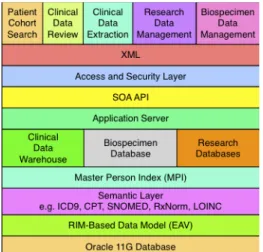
Stanford’s STRIDE is described as a stack architecture, each layer of the system building upon the lower layers. XML is used as the communication protocol between the patient cohort tool and the data store (Lowe et al.).
Figure 2 – Diagram of STRIDE system architecture (Lowe et al.)
2.3
i2b2
Figure 3 – Diagram of i2b2 system architecture - ("Information for Integrating Biology & the Bedside")
3
System Capabilities
3.1
Privacy
All of these systems document that searches and data in the cohort searches have been made HIPAA compliant such that unique identifiers of patients are either removed or substituted with a surrogate identifier. Non-identifying basic demographic information for each patient is retained for the query results. The STRIDE tool documentation mentions that the tool uses additional measures to preserve patient anonymity by reducing means of discovering patient identity. Cohorts less than ten patients are reported as “less than ten” and individual categories in the criteria results are reported in increments of five with an arbitrary rounding factor to each result ("Stride Anonymous Patient Cohort Discovery Tool User Documentation - February 2009").
3.2
Client Interface
CDW-H utilizes a Java applet contained within the web browser window. STRIDE and i2b2 utilize a standalone Java application. i2b2 also has a web client application. By using Java or the Java Runtime Environment, all three solutions are platform independent and capable of running on any recent operating system.
4
Query Parameters
4.1
Introduction
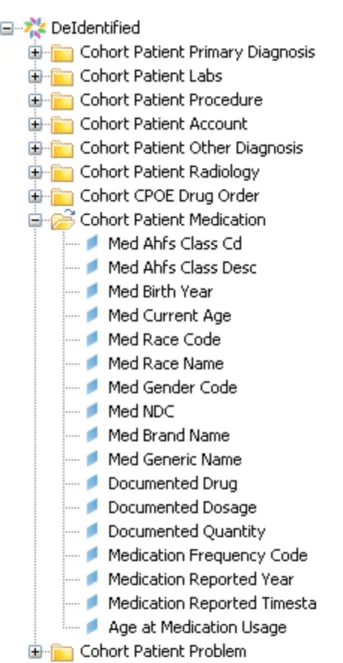
CDW-H organizes the query objects into a hierarchy consisting of these primary categories with the individual fields for each category falling underneath. The primary search outputs for CDW-H (age, race and gender) are present under each primary
category as the records are culled from several separate databases and thus one can search these criteria as it applies to the original parent record.
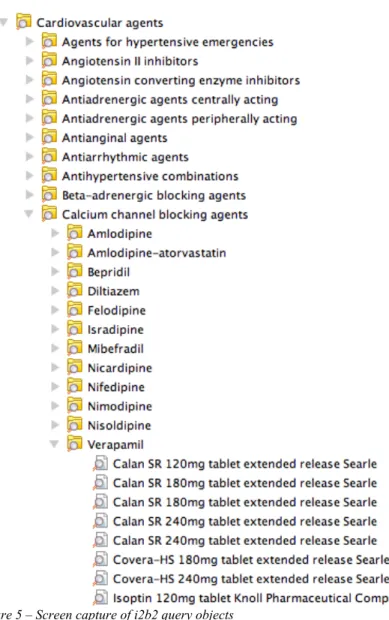
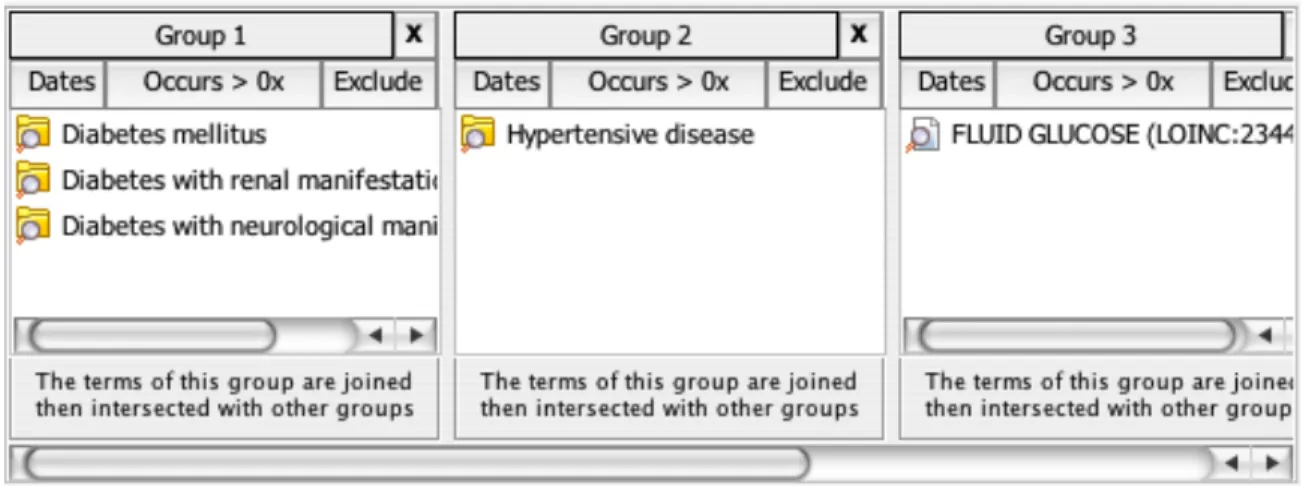
Figure 5 – Screen capture of i2b2 query objects
It also contains a search feature that allows one to retrieve the specific criteria for inclusion in a clinical query if it is known beforehand. For example, ICD-9 codes or drugs are searched and then the corresponding object is dragged into the query builder interface (they can not be entered directly). Frequently used objects can be saved in a “favorites” area.
to be for the entire query and not for the specific query objects or groups, which are available for CDW-H and i2b2 ("Stride Anonymous Patient Cohort Discovery Tool User Documentation - February 2009"). As a result, the date for a specific query object is not directly accessible by the end-user.
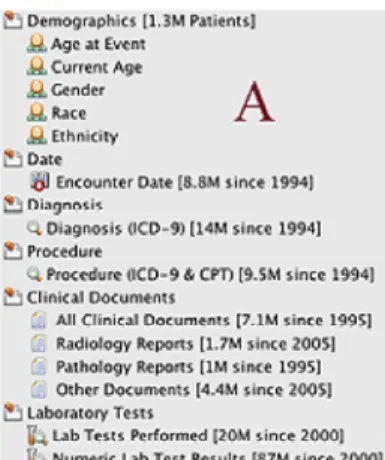
Figure 6 – STRIDE query fields ("Stride Anonymous Patient Cohort Discovery Tool User Documentation - February
2009")
4.2
Demographics
CDW-H includes the following demographics for queries: birth year, current age, race, gender as well as arrival, admission and discharge timestamps (and the calculated patient age at admission and discharge timestamps).
i2b2 demographics include the following: age, gender, language, marital status, race, religion, vital status and zip code. Each criterion can be included in the search in its entirety or they can be broken down into clusters to narrow the search.
User Documentation - February 2009"). STRIDE allows querying by the encounter date as well as the derived attribute of the patient age at event. Information queried includes diagnosis codes, procedure codes, clinical documents (radiology, pathology and other free text documents) and lab tests (which have numeric results). CDW-H allows for a similar operation by having a query field for age and time for the categories it offers. i2b2 has an overall age demographic for the patient and then allows application of filtering based upon date for any of criteria being queried.
4.3
Diagnoses
STRIDE only offers search by specific ICD-9 codes and not by the text field of a
diagnosis. It attempts to locate a code for text typed into the query box and runs the final query against the code. i2b2 limits diagnosis code search similarly through the object hierarchy, however it allows browsing of the hierarchy/ontology to facilitate searching. CDW-H allows searching on the diagnosis code text field, searching by the code values and browsing a list of code text or values.
4.4
Procedures
STRIDE specifically mentions in the documentation that procedures are coded with ICD and CPT (Current Procedural Terminology) depending on if they are inpatient or
outpatient and recommendation is that queries in the field for any one procedure be combined with a logical OR with the different types of codes for the procedure ("Stride Anonymous Patient Cohort Discovery Tool User Documentation - February 2009"). This appears to be a major work-around for lack of standardization in the data compared to the other two tools from the standpoint of having to lookup/enter multiple codes for a single procedure. STRIDE has the same limitation of only being able to combine codes with a logical OR with diagnoses that i2b2 and CDW-H do not have as well not being able to browse.
4.5
Labs and medications
5
Queries
5.1
Query building logical operations
The CDW-H portal allows query objects to be joined by logical AND as well as logical OR operators, both of which are clearly marked in the interface. Query filters can be combined in multi-level groups in varied combinations as well.
Figure 7 – CDW-H query expression builder, example of Boolean operators
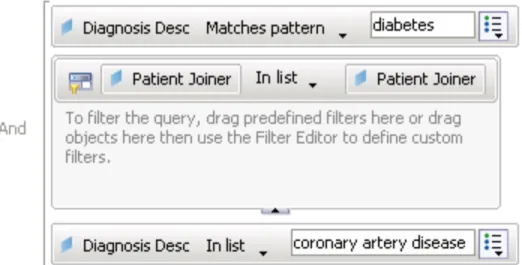
i2b2 allows for a similar functionality when individual query attributes are either placed into the same group (logical OR) or in different groups (logical AND).
Figure 8 – i2b2 query expression builder, example of Boolean operators
STRIDE offers limited logical OR/AND operators within each of the main query objects but not with arbitrary combinations of them as i2b2 or CDW-H is able to.
Figure 9 – STRIDE Boolean operators in the diagnosis portion of the query builder ("Stride Anonymous Patient Cohort
Discovery Tool User Documentation - February 2009")
CDW-H also allows for subquery formulation as shown in the following figure.
Figure 10 – CDW-H subquery formulation example
5.2
Query parameter operations
The CDW-H allows numeric query objects to be specified using a variety of comparison operators. Less than/greater than operators (in combination with equal to), (not) between, (not) in list, (not) is null, both and except are all provided for numeric fields.
STRIDE has similar functionality for the numeric values in the lab tests. For each lab test result in the database, one may select from a smaller subset of the options that CDW-H offers: less than or equal to, greater than or equal to, is, is not equal to, is between. Since STRIDE was engineered as a cohort discovery application, the patient
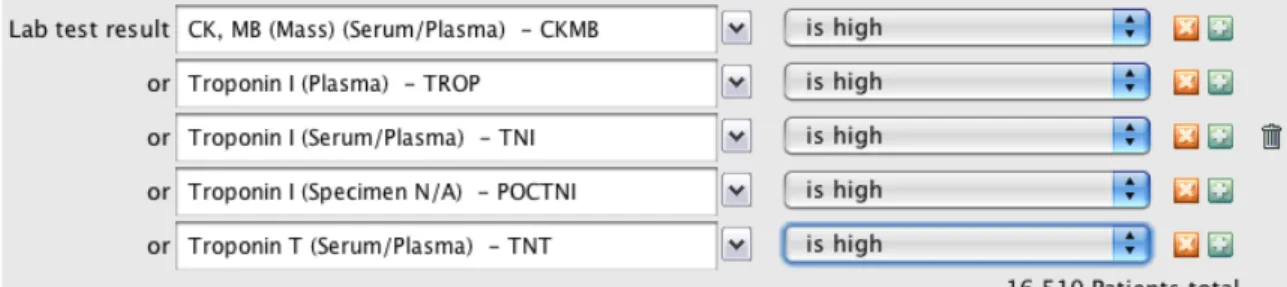
demographics commonly used as search parameters are not generalized inputs (as they are in CDW-H) and when you specify those parameters, you go directly to a drop-down box to make the selection and don’t have the additional step of looking up the values for those parameters, as the query control is pre-populated. STRIDE also offers the ability to check the value of a lab test against a set of standard values and return results based on whether or not the test is low, normal or high without the researcher having to enter the actual value(s) and selecting the appropriate query parameter(s) for that test result.
Figure 11 – STRIDE lab test results – Boolean operators and selection of comparison against test standard values
("Stride Anonymous Patient Cohort Discovery Tool User Documentation - February 2009")
i2b2 seems to offers the low/high operation on lab results in the query builder. Searching for specific values of lab tests or a range as in CDW-H and STRIDE does not appear to
STRIDE Anonymous Patient Cohort Discovery Tool 10/2008 - User Documentation – Page 16
EXAMPLE - Patients with elevated CPK-MB or Troponin I or Troponin T:
EXAMPLE - Patients with high TSH and low T4:
STRIDE CDW Laboratory Batteries/Packages and Test Result Reference
For a list of Laboratory Batteries/Packages currently in the STRIDE CDW see:
http://clinicalinformatics.stanford.edu/STRIDE/cdw-alllabbp.html
For a list of all Laboratory Tests currently in the STRIDE CDW see:
http://clinicalinformatics.stanford.edu/STRIDE/cdw-alllabtest.html
For a list of Lab Tests with numeric results currently in the STRIDE CDW see:
be possible (at least when examined for a cohort search of patients having diabetes mellitus and selecting fluid glucose as search criteria and attempting to filter the glucose parameter).
STRIDE input fields for codes/procedures operates on a “search as you type” of the unstructured text of the desired code and displays a drop-down box of matching codes in the database for selection ("Stride Anonymous Patient Cohort Discovery Tool User Documentation - February 2009"). A browse functionality, as found in i2b2 and deeper in the CDW-H interface in the query parameters is not indicated in the documentation and the user must know a priori exactly what they are planning to search for.
5.3
Querying free-text fields
CDW-H has free-text fields (Patient Problem Description, for example) that can be searched. This adds “matches pattern” and “different from pattern” to the query
parameters. STRIDE has similar fields for matching against free-text documents that can be searched as a part of the cohort search and it offers the options to retrieve results for the query text where documents contain the individual words “near each other” or “in the same document” ("Stride Anonymous Patient Cohort Discovery Tool User
Documentation - February 2009").
5.4
Retention of query definitions
results. As each query is created and before it can be processed, the user is required to name the query. It is identified either with a name uniquely specified by the user or an automatically generated name from the query parameters and the date/time of creation. STRIDE appears to allow for queries to be stored to the end-user’s local computer storage ("Stride Anonymous Patient Cohort Discovery Tool User Documentation - February 2009").
5.5
Visualization of query results
CDW-H only returns the demographic attributes age, race and gender. The data are returned in bar graph format along with number values for each of these attributes.
Figure 12 – CDW-H visualization of query results
patient cohort search. Each is displayed in bar graph format but without specific numeric values for the categories of each demographic ("Stride Anonymous Patient Cohort
Discovery Tool User Documentation - February 2009").
Figure 13 – STRIDE visualization of query results ("Stride Anonymous Patient Cohort Discovery Tool User
Documentation - February 2009")
Figure 14 – i2b2 visualization of query results
In addition, there is also a timeline visualization of data. For each variable selected in the query (where applicable) a mark is displayed indicating what date the information is recorded for each patient found in the cohort.
Figure 15 – i2b2 timeline visualization of query results
hypertensive disease between 12/2004 and 01/2005 and an event of cardiovascular agents (medication) several months later between 05/2005 and 06/2005.
Figure 16 - i2b2 timeline visualization of query results, zoomed view
5.6
Retention of query results
The CDW-H allows the visualized queries to be exported to PDF and Excel formats. i2b2 allows each of the visualized queries to be exported in PNG format. The STRIDE documentation indicates that the queries may be stored to the end-user’s computer but does not seem to indicate a facility for exporting of the visualizations, aside from a third party screen capture tool ("Stride Anonymous Patient Cohort Discovery Tool User Documentation - February 2009").
6
Summary and Conclusions
basic user tasks (i.e. saving/exporting). It is only with very in-depth examination of the tools that specific differences are found where in certain areas, one tool may have a distinct advantage over another. The pre-populated inputs for patient demographics as well as lab result categorization in STRIDE, the ontology of the search terms in i2b2 and the subquery facility in CDW-H each highlight one area where each of the tools
demonstrates an advantage over the others.
It seems as if a tool, which combined all of these strengths, would yield the best usability experience for the end-user. In doing some “armchair programming”, it is not clear which tool would be the optimal one to serve as the base to add the features that it lacks. Of the three, it appears as if STRIDE is the most limited in architecture, given it is more of a specifically programmed search form than an end-user modifiable search desktop and making it the least likely to use as a base. Between the CDW-H and i2b2
7
References
Carolina Data Warehouse - Health. Computer software. UNC Chapel Hill.
"Information for Integrating Biology & the Bedside". Partners Healthcare. 04/29/2010. <http://www.i2b2.org/software/>.
"Nc Tracs Institute Cdw-H Cohort Discovery Training Video". Chapel Hill, 2010. NC TraCS Institute. 04/29/2010.
<https://tracs.unc.edu/index.php?option=com_content&view=article&id=613&Ite mid=537>.
"Stride Anonymous Patient Cohort Discovery Tool User Documentation - February 2009." (2009): 18 pp.
Fontanarosa, P. B., and C. D. DeAngelis. "Basic Science and Translational Research in Jama." JAMA 287 13 (2002): 1728. Print.
Lowe, H. J., et al. "Stride - an Integrated Standards-Based Translational Research Informatics Platform." AMIA Annu Symp Proc 2009 (2009): 391-5. Print. Mostafa, Javed.Carolina Data Warehouse - Health. Powerpoint Presentation. UNC