Matthew O. Thomas. Stakeholder Perceptions of Drupal Project Success. A Master’s Paper for the M.S. in I.S degree. April, 2010. 54 pages. Advisor: Diane Kelly
The purpose of this research was to collect descriptive data about Drupal projects and explore the relationships between various factors and perceived project success. Literature was examined to explore a variety of perspectives on project success. From this literature, a survey was developed. This survey was administered to a sample of Drupal project stakeholders. It collected information about Drupal expertise and experience level, asked respondents to consider their most recent Drupal project and answer questions about it, and asked respondents to rate characteristics of projects in terms of their association with project success and failure. The survey also collected qualitative data about stakeholder perceptions of project success. Results and
implications of the research are discussed and suggestions for future research are presented.
Headings:
Computer Software - Drupal
Computer Software - Evaluation
Administration - Project Management
by
Matthew O. Thomas
A Master’s paper submitted to the faculty of the School of Information and Library Science of the University of North Carolina at Chapel Hill
in partial fulfillment of the requirements for the degree of Master of Science in
InformationScience.
Chapel Hill, North Carolina
April 2010
Approved by
Introduction
Drupal is a free, open-source content management system. It is used to publish,
organize, and manage content on the Web. Drupal powers a wide variety of Internet sites,
from small weblogs to e-commerce sites to major news outlets. Between July 2007 and
June 2008, Drupal was downloaded over 1.4 million times (Buytaert, 2008). Many
Drupal-based sites are designed and implemented by developers interacting with project
managers, clients, and other project stakeholders. These interactions share characteristics
with other IT projects. While a large amount of research exists concerning success
measures for other types of IT projects, there is a lack of such information about
Drupal-specific projects.
Drupal has a stock installation, Drupal core, which provides basic functionality.
This functionality can be extended through the use of contributed modules. While anyone
can contribute code to Drupal core, all changes must be reviewed by a Drupal core
developer. On the other hand, anyone can create a Drupal module. A module might
interact with an external Web system, fight comment spam, allow for the management of
multiple subsites, or keep track of a user's interaction with a site. Drupal comes with
several default themes, which can be used to customize the appearance of a site. Drupal
implementers can also create custom themes and download custom themes created by
others.
A Drupal developer might be hired for a simple default installation and
configuration, to design a custom theme, to make modifications to existing modules, or to
create new modules. Project scope can range from very narrow to very broad. Project
teams might consist of a single developer or many developers, project managers, graphic
designers, and others. Though Drupal is extremely customizable, all Drupal projects
make use of Drupal core. Drupal.org's "Best practices" page (2009) encourages
developers to plan their projects ahead, create sites that are easy to upgrade, back up sites,
and test code. Developers are encouraged to contribute their work back to the Drupal
community. Drupal.org's "Hiring a Drupal site developer" page (2009) encourages
developers and stakeholders to define in detail the scope, requirements, and budget of a
project.
The pages mentioned above provide general best practices for Drupal projects.
The Drupal community could benefit greatly from empirical research into what makes a
successful Drupal project and why. It is not clear what project success means to various
Drupal project stakeholders and what causes Drupal projects to succeed or fail. It may be
that project success perceptions differ based on certain qualities of project stakeholders. It
may also be that there are common factors which contribute to project success or failure.
Investigating how Drupal project stakeholders define success has the potential to improve
the Drupal community's understanding of how Drupal is used and perceived.
Investigating the factors that contribute to project success and failure has the potential to
improve the Drupal community's understanding of the barriers to Drupal project success,
This study poses two research questions: 1) How do stakeholders in Drupal
projects define success? 2) What factors do stakeholders believe contribute to the success
or failure of Drupal projects? The first question seeks an understanding of how Drupal
project stakeholders' perceptions of project success vary along a variety of factors. These
factors include cultural, organizational, or industrial. Perceptions may also vary by
project type, scope, size, and cost. The second question seeks an understanding of why
Drupal projects succeed or fail. It seems likely that perceptions of what makes projects
succeed or fail will also vary by stakeholder and project. By isolating the perceived
factors that contribute to Drupal project success or failure, it is hoped that developers,
project managers, other stakeholders, and other members of the Drupal community will
be better informed informed about how to maximize a Drupal project's chance of success.
It is hoped that this understanding will lead to more successful Drupal projects.
Literature Review
This literature review explores a variety of perspectives from which project
success has been investigated and considered. Such inquiries have focused on how
developer communication affects project success, how project success measures vary for
specialized types of products, and how factors like a project’s industry and development
culture affect perceptions of project success. In many cases, common measures exist for
evaluating and defining the success of a project. The perspectives detailed below range
from the theoretical to the quantitative, but only one offers a Drupal-specific inquiry into
In considering the following articles, it is important to mention a distinction
pointed out by Morisio, Egorova, and Torchiano (2007). In their article, which will be
examined later, they stated, "very often we can find a confusion between two quite
different concepts: what we mean for a successful project or product (we will call this a
success indicator) and what causes a project to be successful (we will call these success
or failure factors). Both indicators and success factors are, in the end, measures, and
should be defined and validated accordingly" (Morisio, Egorova, & Torchiano, 2007, p.
301). Some of the articles below deal with indicators, some with success factors, some
with both, and some do not clearly differentiate between the two concepts. It is important
to note that this distinction does not specify how a successful project is defined. This
concept will be explored later in this literature review.
Beaver, Cui, St. Charles, and Potok (2004) attempted to create a predictive model
of success in Free/Libré/Open Source (FLOSS) software development. The research
explored existing literature to develop indicators of project success, leveraged these
indicators against SourceForge project development data, and attempted to create an
agent-based model of project development capable of predicting project success.
By examining existing literature, the researchers found that success in software
development can be measured in different ways, such as software quality, efficiency, and
the effectiveness of the team. The researchers focused on social indicators, such as "the
ability of the distributed group to maintain or grow in membership, to effectively
organize and coordinate source code contributions across multiple developers, and to
produce software products that are useful in the user community" (Beaver, Cui, St.
The researchers collected data about 67 FLOSS projects in the SourceForge
Research Data Archive. SourceForge is an online development tool for FLOSS projects.
From their literature review, the researchers isolated five measures of FLOSS success
available in the data. These were group maturity, indicated by development status; group
membership, indicated by the number of developers; number of events, indicated by the
number of software releases; group utility, indicated by the number of downloads; and
group popularity, indicated by the SourceForge group ranking.
The simulation created by the researchers simulated project development in terms
of the behavior of project agents and developer agents. The model's predictive data was
validated against actual project data in terms of accuracy of fit and predictive validity.
The researchers found that the model was not highly accurate but was able to "predict for
group-level behaviors such as group membership changes, group efficiency and
popularity, and the occurrence of group-level events or actions" (Beaver et al., 2009, p.
7).
There are major differences in the type of software development studied by
Beaver et al. and Drupal development. Drupal projects use a preexisting FLOSS tool to
meet client requirements, rather than creating new products from scratch. Drupal projects
may lead to code contributions to the Drupal project, but that activity is not a focus of this
research. Drupal project structure may also tend to differ from FLOSS project structure in
terms of developer interaction and project approach.
Beaver et al.'s research highlights that success in software projects can be
measured in a wide variety of ways. The complexity of these measures was considered
as message board posts and bug fixes was able to lead to predictions of software project
success was also of great interest. These indicators are divergent from traditional
indicators of project success. This article led to the consideration of developer
communication as a possible indicator of a Drupal project's success.
Wixom and Watson (2001) explored project success factors for a specific type of
project.They looked at data warehousing projects, a specific subset of IT projects. They
identified research which suggested that 1/3 to 2/3 of all data warehousing projects fail.
The authors made the point that data warehousing projects are infrastructure projects.
Infrastructure projects are defined as "a set of shared, tangible IT resources that provide a
foundation to enable present and future business applications" (Wixom & Watson, 2001,
p. 18). Wixom and Watson argued that IT infrastructure projects may have different
success indicators than other IT projects and pointed out that very little research has been
done on this type of project. This lack of research justifies this investigation of Drupal
project success. Because of Drupal's robustness, it is possible for it to be deployed in a
variety of roles, including infrastructure projects.
Wixom and Watson (2001) surveyed 126 attendees of a data warehousing
conference. The survey asked two open-ended questions about success factors and
obstacles to success in data warehousing projects. The results of this survey, along with
the results of 10 expert interviews, were used to create a research model. This model
identified 7 implementation factors which contributed to 3 levels of project
implementation success. These levels of project implementation success contributed to 2
Wixom and Watson (2001) obtained usable results from 111 companies in various
industries. The data indicated that perceived net benefits were associated with data
quality and system quality. It also indicated that organizational, project, and technical
implementation success had no effect on data quality. Organizational implementation
success did effect system quality and management and resources contributed to
organizational implementation success.
Berntsson-Svensson and Aurum (2006) examined what makes successful software
projects and products. Their research began by referencing research indicating that,
despite increasing success rates, software projects still fail. Berntsson-Svensson and
Aurum examined previous research on measures of software project success and found
that these measures vary widely based on one's definition of success.
The researchers posed three research questions: "What is the effect of certain
factors on the success or failure of projects across various industries?" "How do various
industries define project success and are there any differences across industries?" and
"How do various industries define product success and are there any differences across
industries?" (Berntsson-Svensson & Aurum, 2006, p. 146). The differentiation between
project success and product success comes from Baccarini's (1999) research, which
argues that project success comes from a combination of project management success and
project product success. To answer these questions, the researchers created a
questionnaire of 33 mostly closed-ended questions. The questionnaire collected
demographic information, information about the subjects' last completed software
project, and asked subjects to rank eight product success factors for all projects in which
the ranking. The questionnaire was used to sample 27 subjects involved in software
development in 15 companies in financial services, consulting, and telecommunications.
These were distributed randomly and through the researchers's contacts at companies and
supplemented by interviews.
Berntsson-Svensson and Aurum (2006) found that demographic information and
perceptions about which factors influenced the success and failure of projects varied
across industries. There were some common elements amongst the three industries: all
three industries had approximately 75% success rate for their software projects. Subjects
from all three industry types indicated that "complete and accurate requirements from
project start" and "having enough time for requirements elicitation" were important
factors in project success (Berntsson-Svensson & Aurum, 2006, p. 150). This perception
seems supported by the research, as no failed project started with complete requirements
(Berntsson-Svensson & Aurum, 2006). Subjects from financial services and consulting
perceived having a good project schedule to be a success factor. The study found that
adding new personnel to a late project increased its risk of failure and the experience
level of the project manager was found to have no effect on project success. In terms
of product success, subjects from all three industries considered a satisfied
customer the most important measure of product success. Financial services respondents,
whose projects were 75% in-house (vs. 10% and 22% for the other two industries) also
listed "a satisfied organization/top management as an important factor for product
success" (Berntsson-Svensson & Aurum, 2006, p. 151).
Berntsson-Svensson and Aurum's (2006) research suggests that a wide variety of
diverge along industry lines. The article's conclusion hypothesized that success measures
might diverge depending on the type of project. Both of these points resonate within this
research.
Pereira, Cerpa, Verner, Rivas, and Procaccino (2008) found that software project
stakeholders' perceptions of software project success indicators can vary across cultural
boundaries. This research is justified by this finding, as it gives another axis along which
stakeholder perceptions of Drupal project success might vary. Pereira et al. (2008)
identified several other sources which seemed to confirm this assertion and explored
previous research to identify success indicators. From this review, they developed a
survey designed to gauge stakeholders' perception of project success. The goal of this
research was to aid in developing "software project success/risk analysis models that can
aid project managers in identifying, analyzing and controlling potential risks during
software development" (Pereira, Cerpa, Verner, Rivas, & Procaccino, 2008, p. 898).
The survey collected respondents' demographic information and examined how
project management factors, project estimation factors, the development team's
relationship with the customer/user, requirements engineering, the respondent's career
progress, the development team's interactions and management, and communicative
factors affected project success perceptions. This survey was distributed via email to
software development organizations throughout Chile. 201 professionals responded. The
results of this survey were compared with a similar study of software development
professionals in the US.
Pereira et al. (2008) found that US development professionals seemed to be
The researchers also suggested that US teams may "have more constraining peer control
than the respondents in the Chilean group" as they ranked freedom within the
development process higher than the Chileans (Pereira et al., 2008, p. 905). Chilean
development professionals, on the other hand, seemed to be more process-focused. They
gave top rankings to keeping on schedule and good project estimation. Chileans also
seemed to prefer a less stressful working situation than US counterparts and considered
job satisfaction more important than project success. That this study found software
development professionals' perceptions of project success differed across cultural
boundaries is interesting in the context of the research detailed below.
Linberg (1999) studied developer perceptions of project failure. Of interest in this
review is his first research question, "How do software developers define software
development project success or failure?" (Linberg, 1999). Linberg examined existing
literature and found that software project success is often defined as meeting budget,
deliverables, business objectives, and meeting or exceeding expectations. From his
review, he identified the following factors as increasing the likelihood of project success:
"effective leadership, conducive organizational climate, technologically realistic
requirements, realistic schedule and effort estimates, sufficient software personnel and
other necessary resources, and a diverse and synergistic team" (Linberg, 1999). Linberg's
review of the literature found that unrealistic estimates of project schedules, efforts, or
technological requirements can contribute to disenfranchisement of developers and thus
project failure. The literature suggested that effective management was necessary to
Linberg (1999) performed a case study of a project that seemed to lack all of the
above success indicators. The project was the development of an instrument for use in
medical procedures. The project consisted of hardware, software, and firmware
components. The project's estimates were revised four times over the course of its
lifecycle and in the end, its cost and size exceeded all estimates. The project's cost
exceeded the approved budget by 419%, software size was 130% of estimations, and
firmware size was 800% of estimations. All of the project's initial cost and size estimates
were created by managers with no software development experience. When the project's
developers were interviewed, they stated that they often had to go behind management's
back to get the resources needed to complete the project.
Surprisingly, 5 of the project's 8 developers interviewed said it was the most
successful project on which they'd ever worked! The remaining 3 said it was the 2nd
most successful. The reasons the developers give for ranking this project so highly
included: because it produced a working product, was technically challenging, and the
team was small and high-performing. When asked about the least successful project on
which they'd worked, the developers cited factors such as poor management, poor
marketing research, long hours worked, staff being added to a project midway through its
development, and a poor understanding of customer requirements as contributing to
project failure.
These developers were highly motivated, had high job satisfaction, and worked
reasonable hours. When asked why the project was late, they listed factors such as
unrealistic schedule expectations, lack of resources, and a poor understanding of the
doomed to fail by common success indicators, yet all of a particular type of stakeholder
viewed it as a success. This finding justifies the need for further inquiry into how project
stakeholders define success. It would have been interesting to measure management's
perceptions of the studied project's success. A broader comparison of stakeholders'
perceptions of project success is a goal of this research.
The previous literature examined has demonstrated that IT project success is a
difficult concept to define. Morisio, Egorova, and Torchiano (2007) argued that
measuring success is also difficult. The authors made the point that "software
development is not a hard science, but it is a human, brain intensive activity" and should
therefore "be regarded more as a soft science, such as sociology, economics, and partially
medicine" (Morisio et al., 2007, p. 300). Despite the involvement of computers in
software development, the software itself being a rigid object always producing the same
results for a given input, and software engineers often being trained in hard sciences, "the
process to develop a program is not a hard process, it is a design activity mostly based on
human activity" (Morisio et al., 2007, p. 300).
Morisio et al.'s (2007) research exists within the framework of ESE or
Experimental Software Engineering. This view holds that once metrics or models are
proposed they should be validated using empirical studies, then used by other researchers
or practitioners once favorable evidence has been established. In their study, the
researchers assembled a list of factors from previous literature. They created a
questionnaire using these factors, asking each participant to gauge the presence of these
factors in one successful and one failed project. Results were collected from 14
Morisio et al. (2007) found that defining requirements at the beginning of a
project, performing good project planning, customer involvement, and correct
identification of risks were associated with project success. People added to a project
after its initiation led to failure. Interestingly, being on time or on budget was not found
to be a contributing factor to success or failure. This result is consistent with developers'
perceptions in Linberg's research. These results are similar to other studies mentioned and
suggests that there is some common ground in perceptions of project success factors.
It has been suggested that there are success measures that do not necessarily
involve project stakeholders' perceptions at all. Thong and Yap (1996) explored user
satisfaction as a measure of information systems effectiveness. They noted that user
satisfaction is often ignored as a measure of system success. They noted that research
attempting to use user satisfaction as a success measure is often criticized because of
"questionable operationalizations of the user satisfaction construct," "poor theoretical
understanding of the user satisfaction construct," and "misapplication of user satisfaction
instruments" (Thong & Yap, 1996, p. 601). It is interesting to note the general absence of
user satisfaction as a success factor in the previously-explored research.
Thong and Yap (1996) noted that there are no universally agreed-upon definitions
of IS systems success or models to measure effectiveness. Previously-used measures
include "cost-benefit analysis, system usage estimation, user satisfaction, incremental
performance in decision-making effectiveness, utility analysis, analytic hierarchy
approach, and information attribute examination" (Thong & Yap, 1996, p. 602). Thong
the variables associated with their effectiveness will vary with the organization in which
the system exists.
Thong and Yap (1996) also noted that, despite the difficulties associated with its
operationalization and measurement and it often being overlooked, some consider user
satisfaction to be the most important criterion in measuring IS success and failure. Thong
and Yap (1996) detailed in depth some of the problems with measuring user satisfaction
such as differing theories of attitude and user behavior. Thong and Yap's (1996) work
represents a detailed examination of the concept of user satisfaction. It is included in this
review to point out the possibility of user satisfaction as an external measure of systems
effectiveness and success. It will be interesting to see if Drupal project stakeholders
perceive user satisfaction as a defining factor of project success.
Edberg (1997) also explored measuring system success. Her research was
designed to empower IS managers in evaluating their production systems. Edberg
proposed that IS managers need comprehensive measurement programs to understand the
reasons for project success or failure. Edberg asserted that such measurement programs
often do not exist in organizations: "Although executives would not ask a credit manager
to improve operations without first determining the current and potentially optimum
accounts-receivable turnover ratios, they frequently ask IS managers to improve
operations without any idea about important current and projected data and ratios"
(Edberg, 1997).
Edberg (1997) introduced a measurement program framework that focuses on
goals, rather than metrics. Once a system's goals are defined, Edberg (1997) asserted that
produced, then metrics can be created to measure them. For instance, a goal might be to
increase defect containment. A question coming from this goal might be, "What is the
currently known effectiveness of the defect detection process before release?" (Edberg,
1997). From this question, defect containment effectiveness could be measured by
dividing the number of prerelease defects by the number of total defects (pre- and
post-release).
Edberg (1997) divided performance measurement into four categories: Project:
understanding and measuring "the characteristics of a specific development or
maintenance project by focusing on the attributes that make each project unique;"
Product: "the growth and progression of a development and maintenance product;"
Process: "highlights the desire to modify the process used to develop and maintain
information systems so that procedures reflect the best practices discovered in industry
and within a given organization;" and Performance: "encompasses measurements that
track both the traditional technical measures of performance as well as metrics that
indicate the success of the system as defined by an organization's strategies and policies"
(Edberg, 1997). It should be noted that "Performance" metrics require defining system
success. Edberg's article also gave advice for IT managers in terms of metric selection
and measurement program management.
Edberg's (1997) article is included in this review because it demonstrates a
tangible need for project success measures in an organizational setting. It is hoped that
this study will help satisfy that need by providing Drupal project stakeholders with
Julia Kulla-Mader (2009) performed an informal survey into Drupal project
success factors. It is the only inquiry into Drupal project success found as part of this
research. Kulla-Mader's (2009) findings were presented as a slideshow at a Drupal
convention. Kulla-Mader's (2009) research collected information about Drupal
experience level, stakeholder definitions of success, and success factors related to a
specific project. Kulla-Mader's (2009) research was limited by a small sample size, a
self-selected sample, and a lack of historical Drupal success data. Kulla-Mader (2009) found
that early definition of project requirements, ongoing review of project progress, small
project size, and high module performance were correlated with Drupal project success.
Kulla-Mader's research forms the foundation for the instrument and research employed in
this study.
The preceding literature explored perceptions, definitions, and effects of success
across a wide variety of project types. Beaver, Cui, St. Charles, and Potok's (2004)
research suggested that social factors can be indicators of project success. Wixom and
Watson's (2001) research indicated that many traditional measures of success had no
effect on the data quality in specialized data warehousing projects. Berntsson-Svensson
and Aurum (2006) found that perceptions of success varied across industries. As
suggested by Wixom and Watson's (2001) findings, Berntsson-Svensson and Aurum
(2006) posited that different types of projects might have different success measures.
Pereira, Cerpa, Verner, Rivas, and Procaccino (2008) found that perceptions of success
can vary along cultural lines. Linberg (1999) performed a literature review, identifying
common measures of success. Linberg (1999) then performed a case study on a project
Morisio, Egorova, and Torchiano (2007) made the case for software development as a
soft science, rooted in the activity of designing. Morisio et al. (2007) also performed an
empirical investigation into stakeholder perceptions of project success. Their findings
were consistent with those of Linberg's literature review. Thong and Yap (1996) explored
user satisfaction as a measure of the effectiveness of information systems. Edberg (1997)
also explored the idea of measuring system measurement, dividing system measurement
into four categories. Kulla-Mader's (2009) is the only Drupal-specific project success
research that the author encountered. It forms a basis for the research detailed below.
Method
This study sought to answer the research questions via primarily-quantitative,
small-scale, cross-sectional survey. This survey was administered to a sample of the
Drupal development community. The survey probed how different Drupal project
stakeholders define project success and identified factors that contribute to Drupal project
success and failure.
The survey sought to find correlations between project success and other
variables. The concept of project success is approached in two ways. The survey probed
how its definition varies according to stakeholder and project type. The survey also
explored the relationship between project success and a variety of implementation
factors.
A draft questionnaire was created based on the instruments employed by Morisio
instrument was administered to a group of pilot testers. The questionnaire was modified
based on this feedback and the final instrument was created.
The questionnaire consisted of four sections. Section 1 of the questionnaire dealt
with a respondent’s Drupal experience level. Questions in this section of the
questionnaire collected information about a respondent’s technical skills and the duration
of their usage of Drupal. Section 2 of the questionnaire asked respondents to consider the
most recent Drupal project in which they were involved and answer questions about it.
These questions assessed the Drupal-specific tasks associated with the project; its size,
cost, scope, industry, and other similar information; the stakeholder’s role in the project;
and the project’s level of abandonment.
Section 3 of the questionnaire also asked respondents to answer questions about
the most recent Drupal project in which they were involved. The first of these asked
respondents to gauge the project’s success. Subsequent questions asked about success
factors identified by Kulla-Mader (2009) and Morisio et al. (2007) and included in their
instruments. These factors included project type; stakeholder involvement; the presence,
involvement, and experience level of a project manager; the definition of project
requirements, schedule, and budget; identification of risks; stakeholder involvement; and
the performance of Drupal modules. This section of the questionnaire administered skip
logic to avoid irrelevant questions.
Section 4 was made up of two questions. These questions asked respondents to
rate a series of factors in terms of their importance in defining a successful Drupal project
and their association with failed projects. The order of these factors was randomized to
Aurum (2006). Section 4 of the questionnaire also allowed respondents to enumerate any
additional factors they associated with Drupal project success or failure. This section of
the questionnaire directly assessed stakeholder definitions of project success and failure.
The full text of the questionnaire is included in Appendix A.
The sample for this study was recruited via Twitter, emails to Drupal and PHP
usergroups, and a post on drupal.org. Sampling was based on convenience. Recruitment
was carried out only by the researcher; however, recipients of recruitment messages were
encouraged to redistribute them. The questionnaire was administered via the online
survey system SurveyGizmo and took approximately 10 minutes to complete. Responses
were collected from February 9, 2010 to February 27, 2010. There were no inducements
to participation. Participants’ informed consent was attained before administering the
survey. Prior to starting the study, it was approved by the UNC IRB #10-0227.
Once the survey closed, data were exported into SPSS for analysis. No personal
identifiers were included in this export. Some responses had to be recoded due to
problems with the automated export. Ordinal data were analyzed for bivariate
correlations using Pearson’s correlation coefficient. Binary data were analyzed using a
Chi-Square test. This analysis compared a stakeholder’s perception of project success
with their responses to questions about various success indicators. A two-tailed test for
significance was employed. For all questions collecting quantitative data that received
Results
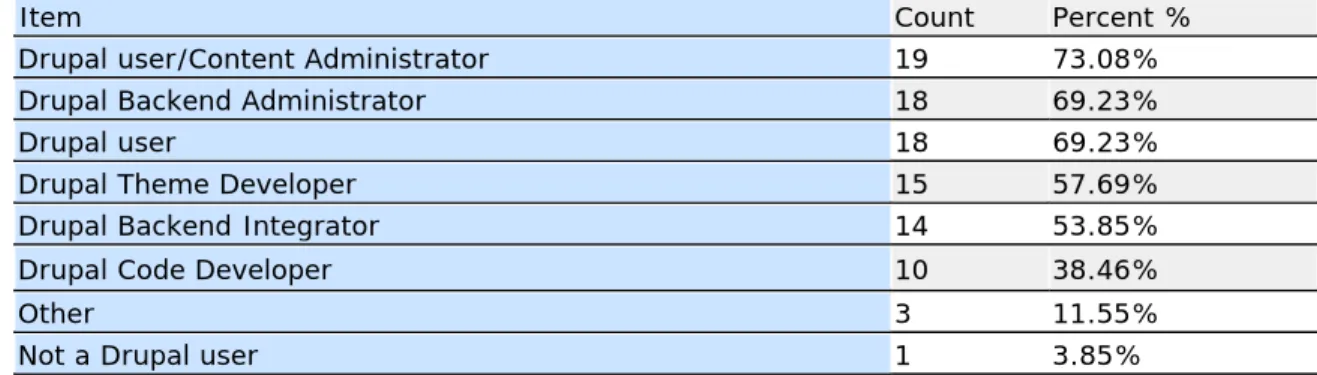
In total, 26 usable responses were collected. When asked to indicate their
experiences performing particularly project-related tasks, most respondents indicated
they had experience with content administrators, managing website content and
performing basic administrative tasks (Table 1). Respondents also self-identified as
Drupal backend administrators, capable of performing more advanced administrative
tasks within Drupal’s administrative interface; as basic users; and as more advanced roles
like code and theme developers. Nine respondents indicated they work for a web
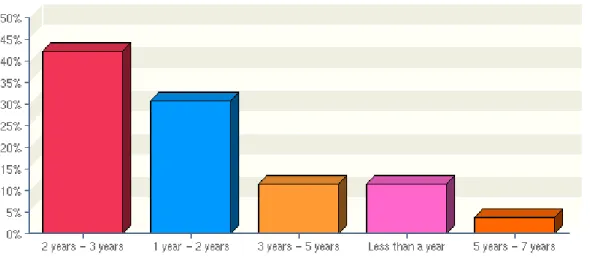
development company (Table 2). Most respondents had been working with Drupal
between 2 and 3 years (Figure 1).
Table 1. Drupal Experience Level
Please rank your Drupal experience level. Select as many apply.
*Multiple responses accepted, results do not sum to 100%
Item Count Percent %
Drupal user/Content Administrator 19 73.08%
Drupal Backend Administrator 18 69.23%
Drupal user 18 69.23%
Drupal Theme Developer 15 57.69%
Drupal Backend Integrator 14 53.85%
Drupal Code Developer 10 38.46%
Other 3 11.55%
Table 2: Frequencies for Web Development Company Involvement
Do you work for a Web Development Company?
Item Count Percent %
No 17 65.38%
Yes 9 34.62%
Figure 1: Drupal Experience Graph
How many years have you worked with Drupal?
Project Information
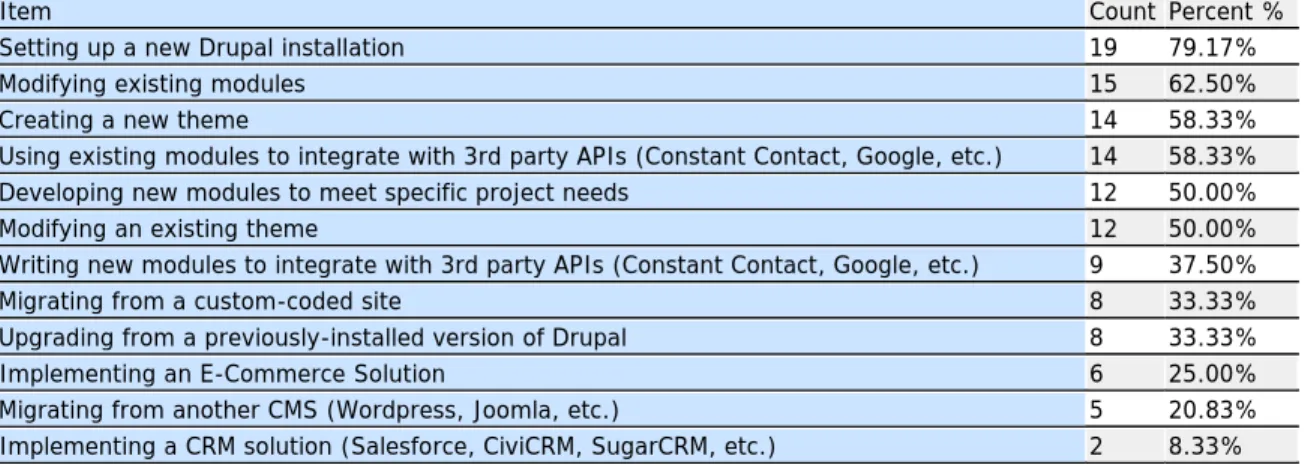
Section 2 of the survey asked respondents to consider the most recent Drupal
project in which they were involved. Most projects consisted of setting up a new Drupal
installation, modifying existing modules, creating a new theme, and using existing
modules to integrate with 3rd party APIs (Table 3). Most projects were either over 1500
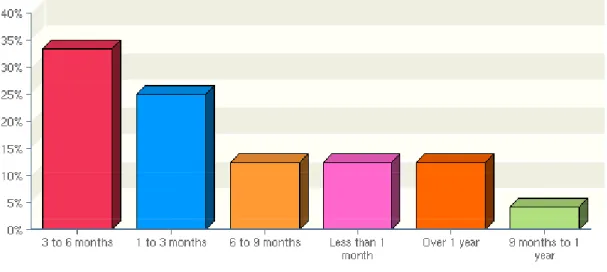
nodes or between 101 and 500 nodes in size (Figure 2). Most projects took between 3 and
6 months to complete, with between 1 and 3 months being the second most common
Table 3: Project Tasks Frequencies
*Multiple responses accepted, results do not sum to 100%
Item Count Percent %
Setting up a new Drupal installation 19 79.17%
Modifying existing modules 15 62.50%
Creating a new theme 14 58.33%
Using existing modules to integrate with 3rd party APIs (Constant Contact, Google, etc.) 14 58.33%
Developing new modules to meet specific project needs 12 50.00%
Modifying an existing theme 12 50.00%
Writing new modules to integrate with 3rd party APIs (Constant Contact, Google, etc.) 9 37.50%
Migrating from a custom-coded site 8 33.33%
Upgrading from a previously-installed version of Drupal 8 33.33%
Implementing an E-Commerce Solution 6 25.00%
Migrating from another CMS (Wordpress, Joomla, etc.) 5 20.83%
Implementing a CRM solution (Salesforce, CiviCRM, SugarCRM, etc.) 2 8.33%
Figure 3: Project Length Graph
How long did the project take to complete?
The most common response for project cost was split between $10,001 to $20,000
and $5,001 to $10,000 (Table 4). The average number of project stakeholders was 5.57.
The number of project stakeholders ranged from 1 to 20, with a mean of 5.57 and a
standard deviation of 4.501. Twenty-one projects used Drupal 6, the most current stable
version of Drupal core (Figure 4). Most projects experienced no abandonment, however,
30.77% experienced some reduction in scope (Table 5). Project industries varied widely,
but are not reported here to avoid the risk of deductive disclosure. Respondents’ role in
the projects was primarily that of Drupal developer, with 17 respondents self-identifying
Table 4: Project Cost Frequencies
Item Count Percent %
Between $10,001 and $20,000 5 22.73%
Between $5,001 and $10,000 5 22.73%
Over $100,000 4 18.18%
Between $20,001 and $30,000 3 13.64%
Between $30,001 and $50,000 2 9.09%
Between $50,001 and $100,000 2 9.09%
Between $1,000 and $5,000 1 4.55%
Under $1,000 1 4.55%
Figure 4: Drupal Versions Graph
Table 5: Project Abandonment Frequencies
Was all or part of the project abandoned?
Item Count Percent %
No abandonment: The project ended fully meeting the specifications assigned in the beginning. 17 65.38% Partial abandonment: There was a reduction in overall scope but no major changes to the
original specification. 8 30.77%
Substantial abandonment: A major truncation or simplification of the project occurred and the
Figure 5: Stakeholder Roles Graph
Success Factors
Section 3 of the survey asked respondents to consider the most recent Drupal
project in which they were involved. The first question asked respondents to gauge the
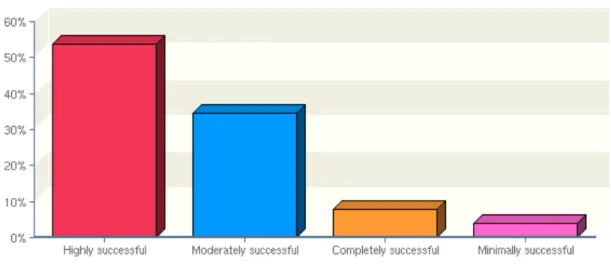
success of the project identified in the previous section. Most survey respondents
considered the most recent project in which they were involved to be "highly successful"
(Figure 6). The other questions in this section focused on identifying the presence of
various factors found in the literature to be possibly associated with stakeholder
Figure 6: Project Success Graph
Fifteen projects were developed in-house, ten were developed for a customer, and
one was outsourced. For the ten projects developed for a customer, respondents rated the
involvement of the customer’s level of involvement in the project. In Linberg’s (1997)
interviews, some stakeholders identified an uninvolved customer as possibly contributing
to project failure. Consequently, this scale was included in the survey to gauge the
involvement of customers in respondents’ Drupal projects. The mean reported value for
customer involvement was 4.9 on a 6-point Likert-like scale, with 6 labeled "closely
involved" and 1 labeled "uninvolved." Responses ranged from 4 to 6 on the scale, with a
standard deviation of .738.
Section 3 of the survey asked a series of questions about the presence, experience
level, and activities of the project manager. None of the survey’s respondents answered
these questions, so their results are not included here. It is not clear why these questions
when unanswered, no respondents indicated whether or not their most recent Drupal
appeared in the survey if a respondent indicated that their most recent Drupal project had
a project manager. Twenty respondents (76.9%) indicated that their projects had defined
project requirements. Five projects did not have defined requirements and one respondent
was unsure if project requirements were defined. For most projects, this definition took
place before the project’s start (Table 6). The question asking about when project
requirements were defined allowed respondents to enter their own responses. Four
respondents (20%) indicated that requirements were defined both before project start and
during project development (Table 6). Twelve respondents (60%) thought that enough
time was devoted to defining requirements, but a large minority of eight respondents
(40%) did not think that enough time was devoted to defining project requirements.
Similarly, ten respondents (50%) thought that requirements were adequately defined, but
eight respondents (40%) did not and two (10%) were unsure.
Table 6: When Project Requirements Defined Frequencies
Item Count Percent %
Before project start 10 50.00%
During the project 6 30.00%
Before and during 2 10.00%
before set groundwork, adjusted during as client learned 1 5.00%
both before and during 1 5.00%
*Italics indicate user-provided response
Section 3 of the survey asked respondents whether project plans were created in
their most recent Drupal projects. In thirteen projects (50%), a project plan was created
(Table 7). Perceptions about the quality of these thirteen project’s plans were mixed: on a
6-point Likert-like scale with 6 labeled as "High Quality" and 1 labeled as "Low
Quality," responses ranged from 1 to 5, with a standard deviation of 1.261. The mean
Table 7: Creation of Project Plan Frequencies
Item Count Percent %
Yes 13 50.00%
No 10 38.46%
I don't know 3 11.54%
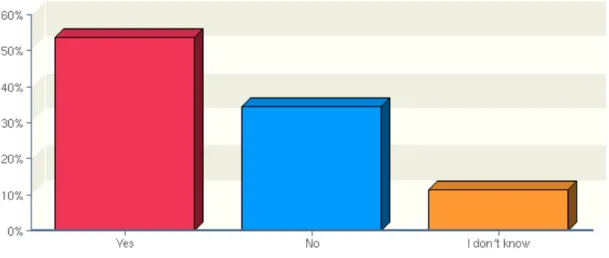
Fourteen projects (53.85%) had a budget, nine projects (34.62%) did not and three
respondents (11.54%) were not sure (Figure 7). Of the fourteen projects with budgets,
seven (50%) were completed within budget, five (35.71%) were not, and two respondents
(14.29%) were not sure.
Figure 7: Budget Creation Graph
Did the project have a budget?
Fourteen (56%) reporting projects had a development schedule, eight (32%) did
not, and three respondents weren’t sure (12%). Of the fourteen projects with development
schedules, eight (57.14%) adhered to this schedulewhile six (42.86%) did not. In twelve
projects (46.2%), staff were added to the project after its start. Fourteen projects
Most projects did not define risks at their outset, with only eight respondents
(30.77%) indicating that risks were defined at the beginning of their projects. Fourteen
respondents (53.85%) indicated that their projects did not define requirements at their
beginnings and four respondents (15.38%) indicated that they did not know if project
requirements were defined at the beginning of the project. In twenty projects (80%),
stakeholders met regularly to discuss the project. Three respondents (12%) indicated that
stakeholders did not meet regularly to discuss the project and two respondents (8.00%)
indicated that they did not know if stakeholders met regularly.
Few projects contributed modules back to the Drupal project, with just three
respondents (11.54%) indicating that their projects contributed modules back to
Drupal.org (Figure 8).
Figure 8: Contributing Modules Graph
Did the project contribute modules back to Drupal.org?
The survey asked to rate how Drupal and the modules used in their projects
"Very Poorly" and 6 labeled "Very Well" (Table 8). Responses ranged from 3 to 6 on this
scale, with a standard deviation of .884.
Table 8: Module Performance Frequencies
How well did Drupal and the modules used in the project perform?
Item Count Percent %
5 12 46.15%
4 7 26.92%
3 6 23.08%
6 1 3.85%
Project Success Definitions
Part 4 of the questionnaire asked respondents to rate 6 different factors in terms of
their association with Drupal project success and 5 factors in terms of their association
with Drupal project failure. This rating took the form of a 5-point Likert-like scale with 1
labeled "Very Unimportant," 2 labeled "Unimportant," 3 labeled "Neutral," 4 labeled
"Somewhat Important," and 5 labeled "Very Important." The highest rated factors were,
"Working product" and "satisfied customer," followed by "Minimal bugs" and "Project
team satisfaction." The lowest rated success factors were "Project management
satisfaction" and "Technically challenging project." The success factors rankings
experienced a fairly low standard deviation, especially the higher-ranked factors. This
seems to indicate relative agreement amongst respondents about the project success
indicators. See Table 9 for more information about respondents’ ratings of project
Table 9: Descriptive Statistics for Project Success Factors, where 1=very unimportant
and 5=very important
Option Mean Std. Deviation Working
product
4.96 .196
Satisfied customer
4.81 .402
Minimal bugs
4.42 .857
Project team satisfaction
4.12 .993
Project management satisfaction
3.58 .902
Technically challenging project
3.00 1.02
There was not as clear agreement amongst respondents in rating the project failure
factors. Means were lower and standard deviations higher for these ratings than in its
counterpart. It may be that respondents were in less agreement on what defines a failed
project than on what defines a successful one. It may also be that the instrument created
confusion amongst respondents. This rating took the form of a 5-point Likert-like scale
with 1 labeled "No Association," 2 labeled "Low Association," 3 labeled "Neutral," 4
labeled "Moderate Association," and 5 labeled "High Association."
The factor rated as most closely associated with project failure was "Exceeding
project budget." This factor was followed by "Exceeding project schedule," and
management" and "Poor definition of project requirements." See Table 10 for more
information about respondents’ ratings of factors associated with project failure.
Table 10: Descriptive Statistics for Project Failure Factors, where 1=no association and
5=high association
Option Mean Std. Deviation
Exceeding project budget
3.15 1.317
Exceeding project schedule
2.85 1.317
Lack of resources
2.77 1.423
Poor project management
2.69 1.517
Poor definition of project requirements
2.65 1.231
In section 4 of the survey, respondents could provide their own factors associated
with project success or failure. For project success, these included, "flexibility on the part
of the designer for changes which were made by the project team during creation,"
"completion on time and within budget," and "Ability to upgrade modules and core.
Make backups and restore." For project failure, these included, "Technical bugs, like
uninstalling a module that deletes everything because of a bug and having to recoup the
work," "Poor client oversight of developer coupled with poor/no project management
development plan," "Poor requirements and lack of input and feedback from the project
stakeholders," "Lack of knowledge of company procedures by some team members," and
"ill defined completion point or changing target, insufficient time, wrong framework
selected (sometimes Drupal isn't the correct framework to use)."
Relationships Among Variables
In addition to calculating and reporting descriptive statistics, data were analyzed
to explore potential relationships between perceived project success and various factors.
This analysis focused on information collected in sections 2 and 3 of the survey. In terms
of project information, there were a few significant relationships, which are reported
here. No other significant relationships were found.
There was a significant relationship between project abandonment and perceived
project success. The r-value for this relationship was -.461, p=.018, and N=26. Projects
experiencing higher levels of abandonment also experienced lower levels of perceived
project success. This finding seems to indicate that reductions in a project’s intended
scope are associated with project failure. The performance of Drupal and the modules
used was also significantly correlated with perceived project success (r=.444, p=.023,
N=26).
There was a significant relationship between a project being completed within
budget and stakeholder perceptions of project success. For this relationship, the
Chi-Square value was 8.473 (p=.014 and N=12). See Table 11 for crosstabulation between
Table 11: Crosstabulation for Completion within Budget and Perceived Success
How successful do you think this project was?
Total Minimally successful Minimally successful Minimally successful
Was the project completed
within budget ?
Yes 1 0 6 7
No 0 4 1 5
Total 1 4 7 12
There was a significant relationship between the regularity with which
stakeholders meet to discuss a project and stakeholder perceptions of its success (N=25,
Chi-Square=13.467, p=.036). See Table 12 for crosstabulation between these variables.
Table 12: Regular Stakeholder Meetings and Perceived Success
Did stakeholders meet regularly to discuss
the project?
Total
Yes No I dont know
How successful do you
think this project was?
Minimally successful 0 0 1 1
Moderately
successful
6 1 1 8
Highly successful 12 2 0 14
Completely
successful
2 0 0 2
Total 20 3 2 25
Discussion
Despite its small scale, the research presented here has yielded some interesting
results. It was interesting to note that 58.33% of respondents’ projects consisted of using
often used to integrate with 3rd party applications. Future research might explore the
prevalence of and Drupal’s effectiveness at integrating with 3rd party APIs.
It was also interesting to note that, while 17 stakeholders indicated acting in a
development role in their most recent project, only 10 self-identified as having Drupal
code development skills. It may that because of budgetary or staffing constraints, Drupal
project stakeholders must perform tasks that exceed their skill set. Future research could
explore how Drupal project stakeholders are required to perform unfamiliar tasks in the
course of Drupal project development and if this phenomena has a relationship with
perceived project success.
It was surprising that only 50% of projects had development plans and that
perceptions about the quality of these plans were mixed. Perhaps future research could
explore how often Drupal project plans are created and what factors motivate the creation
(or ignorance) of these plans. Similarly, only 30.77% of respondents indicated that their
projects identified risks before project start. Further research is needed to find if Drupal
projects at large are neglecting risk identification at project start and, if so, why.
Most respondents considered their most recent Drupal project to be "Highly
successful." This response cannot be considered representative of Drupal projects at
large, but may be interesting for future research. Drupal has established itself as an
extremely popular content management system. It may be that Drupal projects experience
a higher success rate than projects using competing systems like Wordpress or Joomla.
This avenue of inquiry may prove an interesting one for future research. It would be
useful to have some representative data about the overall success rate of Drupal projects.
could consider implementing an assessment program to gauge the success of Drupal
implementations.
That project abandonment is correlated with perceived project success is not
surprising. This finding seems related to the finding that "Working product" was rated as
most associated with project success. When a project’s scope is reduced and requirements
are abandoned, it seems logical that it could be considered a failure. In future work, it
might be interesting to explore how a broadening of scope is related to project failure.
The finding of this research suggests that when a project does less than was specified, it
is more likely to fail. It would be interesting for future research to explore what happens
when a project goes beyond its original specification.
Drupal projects are united by their use of a single system to form the base of their
functionality. This feature sets them apart from other types of projects in which custom
systems are built for the needs of the client or parent organization. While there was no
significant relationship between the version of Drupal used in a project and its perceived
success, there was a significant relationship between the performance of Drupal and the
modules used in a project and perceived project success. Browsing the issue queues on
Drupal.org for various contributed modules, one can find reported issues ranging in
severity from minor user interface problems to database corruption and site crashes.
Encountering these issues has the potential to severely hinder the development of a
Drupal project, as supported by this finding. A content analysis of these posts might
show that certain issues are common across Drupal modules and inhibit successful
Morisio et al. (2007) found that being on time or budget was not associated with
project success. Though this research did not find a significant relationship between
adhering to a schedule, there was a significant relationship between a project being
completed within budget and its perceived level of success. While this finding cannot be
considered representative of Drupal projects in general, its contrast with Morisio et al.
(2007) is interesting. It may be that there are commonalities to Drupal projects that render
completing a project within budget a requirement for project success. For instance, it may
be that if Drupal projects are often web design/implementation projects for a customer,
then not exceeding a project’s budget is more critical than for projects that are completed
in-house. Perhaps future research can consider this possibility.
Many of the success factors identified in the literature review had no significant
relationship with perceived project success. The lack of such relationships in the sample
may not be meaningful given the previously-explored weaknesses of the research.
However, it may be that contributing factors to project success are more nuanced and
paradoxical than conventionally thought. Linberg's (1999) case study demonstrated that
projects can defy conventional success measures and still be considered successful. It
may be that there are aspects of Drupal projects or IT/IS projects in general that defy
conventional success measures. Perhaps future research can explore project success in a
manner which abandons conventional success measures.
Contrasting with the possibility of unorthodox consideration of project success are
the results of the section 4 of the questionnaire. Respondents rated conventional project
success factors highest of all listed factors, rating "working product," "satisfied
satisfaction," and "technically challenging project." These results may indicate that
Drupal projects are unlike the project studied by Linberg (1999) and are bound to more
conventional project success measures. As stated earlier, it may be that Drupal projects
are often web design/implementation projects for a customer, consequently customer
satisfaction and a working product with few bugs are critical for the success of such
projects. Confirming such a hypothesis would more extensive Drupal usage data than is
currently available.
Respondents' ratings of factors associated with project failure were less definitive.
Responses in this section experienced lower means and higher standard deviations than
its counterpart. Most of the factors were rated very closely. As mentioned earlier, one
respondent expressed confusion about this portion of the instrument. It seems likely that
the weaknesses of the instrument were at least partially responsible for the ambiguity of
these results. This question also allowed respondents to enter their own factors associated
with project failure. A variety of information was entered into this question, which is
reported in the results section of this document. Perhaps future researchers can use this
information to explore alternative factors for Drupal project success and failure. Many of
the respondents associated problems with the client/developer relationship with project
failure. These problems might include poor communication between client and developer,
lack of trust, and a lack of oversight. Respondents also listed a lack of knowledge of
organizational procedures, a poor development plan, and using Drupal in a project for
which it is ill-suited as factors associated with project failure. Perhaps future research can
explore in more detail how the relationship between the client or "owner" of a project and
It is interesting to note that, in section 4 of the survey, the factor rated as most
closely associated with project failure was, "Exceeding project budget." This finding may
be associated with the significant relationship in the sample between a project’s being
completed on budget and its perceived success. It may be that unique aspects of Drupal
projects cause their success to depend on completion within budget. This relationship
could be explored by future research in a variety of ways. It would be interesting to
perform case studies on projects with a variety of budget types and project outcomes or to
collect quantitative data about project size, budget, cost estimation, etc. Perhaps these
data could be compared with the results of interviews with stakeholders from these
projects. Whatever method is used, one of this study’s strongest suggestions for future
research is the exploration of this relationship.
The research detailed here suffers from many weaknesses. First, the study’s
sample was extremely small. The PI originally hoped for at least 100 responses to the
survey. In the end, collecting 26 usable responses proved a difficult undertaking. Partially
because the sample size was so small, it is not expected that the findings of this research
can be generalized to be applied to the Drupal development community. Instead, it is
hoped that the findings of this research can inform and provide guidance to future
inquiries into Drupal project success.
The sampling method for this study was purposeful and dictated by convenience.
Local developers and personal contacts of the PI were solicited to take the survey. This
sampling method likely suffered from several biases, including self-selection, as is
indicated by the large portion of developers in the sample. It is also likely that the
on instruments used by other researchers and was subjected to pilot testing, the PI
received some negative feedback concerning the design of the questionnaire after it had
been published. In section 4 of the survey, at two respondents used the area in which
other factors associated with project failure and success could be written to express
confusion with respect to the question. In response to a forum post advertising the survey,
criticisms were made of the wording of some questions and the use of node count as a
measure of site size. Because of the abbreviated nature of the study’s timetable, it was not
possible to revisit the instrument and incorporate this feedback. These potential biases are
also reasons that this study’s results cannot be considered representative.
Conclusion
The research presented here represents an initial exploration of stakeholder
perceptions of Drupal project success. Through an examination of existing literature, it is
hoped that the wide variety of approaches to project success has been presented. The
issue of project success and stakeholder perceptions of it has been approached in many
ways, from theoretical explorations to quantitative inquiries. What is lacking from the
body of literature on project success are Drupal-specific inquiries.
As Drupal grows and is used by more and more intricate, expensive, and visible
projects, it becomes critical to have an understanding of what factors contribute to Drupal
project success and how Drupal project stakeholders conceptualize Drupal project
success. Along with the work of Kulla-Mader (2009), the research presented here
findings cannot be considered representative, the research detailed here seeks to provide
guidelines for more definitive research into Drupal project success.
This research found significant relationships between several aspects of Drupal
projects and the perceived success of those projects. These factors include the
performance of Drupal and modules used, project abandonment, and completion within
budget. The research also collected information about which factor stakeholders most
closely associated with Drupal project success and failure. Amongst these, "working
product," "satisfied customer," and "minimal bugs" were most closely associated with
Drupal project success. Ratings for project failure seemed much less definitive, perhaps
because of flaws in the research instrument or ambiguity of perceptions about
contributing factors to project failure.
Future research into Drupal project success could take the form of any
combination of interviews, focus groups, qualitative or quantitative surveys, examination
of usage data, or case studies. Given the general absence of research into Drupal project
success, each of these methods could provide valuable information to Drupal project
stakeholders, developers, and other members of the Drupal community. In particular, it
would be useful to have information about what aspects of Drupal projects are unique
compared with IS/IT projects in general and how these unique aspects contribute to
perceptions of Drupal project success.
As mentioned above, it may be that because Drupal projects are often outsourced,
their success depends more on completion within budget than other types of IS/IT
projects. Comprehensive usage data about how Drupal is implemented would help to
studies, interviews, and focus groups could be used to obtain client and vendor
perspectives on what makes a successful Drupal project. It may also be that there are
nuances of Drupal projects that defy conventional success measures. Extensive
quantitative research could explore Drupal projects and determine what, if any, aspects
complicate measuring Drupal project success.
The primary message of this research is that more research is necessary to attain
an understanding of stakeholder perceptions of Drupal project success. The limitations of
this research mean that at best it acts as a set of guidelines and questions for future
inquiry, rather than being able to present any conclusive findings about Drupal project
success and stakeholders’ perceptions of it. Despite its limitations, it is hoped that this
References
Baccarini, D. (1999). The logical framework method for defining project success. Project
Management Journal, 30(4), 25-32.
Beaver, J. M., Cui, X., St Charles, J. L., and Potok, T. E. (2009). Modeling success in
FLOSS project groups. In Proceedings of the 5th international Conference on
Predictor Models inSoftware Engineering (Vancouver, British Columbia,
Canada, May 18 - 19, 2009). PROMISE '09. ACM, New York, NY, 1-8.
DOI=http://doi.acm.org/10.1145/1540438.1540461
Berntsson-Svensson, R. and Aurum, A. (2006). Successful software project and products:
An empirical investigation. In Proceedings of the 2006 ACM/IEEE international
Symposiumon Empirical Software Engineering (Rio de Janeiro, Brazil,
September 21 - 22, 2006). ISESE '06. ACM, New York, NY, 144-153.
DOI=http://doi.acm.org/10.1145/1159733.1159757
Best Practices. (2009, November 9). Site Building Guide. Retrieved from
http://drupal.org/best-practices
Buytaert, Dries. (2008, July 14). Drupal download statistics. Retrieved from
http://buytaert.net/drupal-download-statistics-2008
Buytaert, Dries. (2009, October 25). Whitehouse.gov using Drupal. Retrieved from
Edberg, D. T. (1997). Creating a balanced IS measurement program. Information Systems
Management, 14(2), 32-40.
Hiring a Drupal site developer. (2009, February 16). About the Drupal project. Retrieved
from http://drupal.org/node/51169
Kulla-Mader, J. (2009, September 20). Drupalcamp Atlanta Presentation: Why do Drupal
Projects Fail? Retrieved from
http://www.juliakm.com/drupalcamp-atlanta-presentationwhy-do-drupal-projects-fail
Linberg, K. R.. (1999). Software developer perceptions about software project failure: a
case study. Journal of Systems and Software. 49(2-3), 177-192.
DOI=http://dx.doi.org/10.1016/S0164-1212(99)00094-1
Morisio, M., Egorova, E., and Torchiano, M. (2007). Why software projects fail?
Empirical evidence and relevant metrics. In Proceedings of the International
Conference on SoftwareProcess and Product Measurement (Mensura, November
5-8, 2007). 299-308.
Pereira, J., Cerpa, N., Verner, J., Rivas, M., and Procaccino, J. D. (2008). What do
software practitioners really think about project success: A cross-cultural
comparison. J. Syst. Softw.81(6), 897-907. DOI=
http://dx.doi.org/10.1016/j.jss.2007.07.032
Thong, J. Y. and Yap, C. (1996). Information systems effectiveness: a user satisfaction
approach. Information Processing & Management. 32(5), 601-610.