AODV with DSR Protocol Heirarchy For Packet Dropped Forgery
Attacks
K.Ramya Sree, A.Radhika
M.tech(CSE),Dept. of CSE, Sr.Asst Professor, Dept of CSE S.R.K Institute of Technology
[email protected], Email Id: [email protected]
Abstract: Far reaching scale sensor frameworks are sent in different application spaces, and the data they accumulate are used as a piece of essential initiative for fundamental structures. Data are spilled from different sources through midway taking care of center points that aggregate information. Provenance organization for sensor frameworks exhibits a couple testing requirements, for instance, low imperativeness and exchange speed usage, beneficial limit and secure transmission. a novel lightweight arrangement to securely transmit provenance for sensor data. relies on upon inpacket Bloom channels to encode provenance. Regularly recommend lightweight procedure for parcel drop affirmation in remote sensor systems. We recommended a AODV with DSR (Dynamic Source Routing) where the IDS hubs are set in wanton technique just when required, to recognize the sporadic refinement in the quantity of data. Our experimental results show efficient data achnowledgement in real time data transmission and other configurations with realistic data delivery. DSR is only for assigning efficient data independence in detection of attacker formed by Forgery presense in real time wireless communication Snsor Networkd.
Keywords: WSNS, AODV protocol, DSR routing protocol, Intrusion detection systems.
I. INTRODUCTION
Wireless Sensor Networs (WSNs) are used to set up wireless collaboration in the extemporized environment without a foreordained workplaces or concept management. WSN has been consistently implemented in adverse and intense environment where the main power point is a bit much. Another unique feature of WSN is the able features of its structure topology which would be as often as possible modified because of the surprising flexibility of hub. Besides, every convenient hub in WSN works a stereo change part while trading information over
the structure. Consequently, any affected locations under a foe's management could carry about large injury to the performance and protection of its structure since the effect would appropriate in performing redirecting tasks.
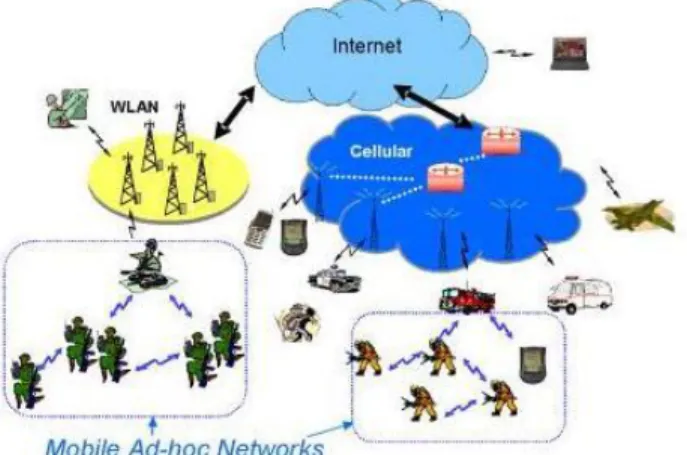
Figure 1: Wireless Sensor Networkd with data transmission.
At the point when a resource hub preparations to business information to a space hub package are visited through the propeller locations, consequently, checking for and quickly building up an impact from an focal point in a space hub is an essential issue for WSNs shown in figure 1. The as of now accessible redirecting methods are mostly organized into 2 types. So taking over is the types [1] 1. Practical redirecting methods 2. Sensitive redirecting methods In Practical redirecting methods each hub proactively questions for paths to different locations, and continually transactions redirecting information, with a specific end goal to keep the progression in the redirecting table a la method and suitable. Because of confinement in force and Data business useage of WSN locations, traditional transferring of redirecting information would immediate obstruction of the structure.
they give the organization by offerring packages over themselves. With support this organization, locations implement some redirecting methods, for example, AODV (Ad-hoc On-Demand Range Vector), DSR (Dynamic Source Routing) and DSDV (Destination-Sequenced Distance-Vector). Other than switching out to be parts, every hub additionally works as a stereo change to find a going and ahead packages to the best hub in the structure. As wi-fi exclusively hired techniques do not have an workplace, they are exposed to significant amounts of attacks [2] [3]. One of these attacks is the Black Gap attack. In the Black Gap attack, a dangerous hub takes up all information packages in it, like an starting which maintains in everything. Along these lines, all packages in the structure are reduced. An risky hub losing all the activity in the structure creates make use of the disadvantages of the road finding packages on the on requirement methods, for example, AODV [4]. In keeping, finding system for AODV technique, powered locations are accountable to get a clean on the way to the region, offerring finding packages to the next door neighbor locations [5]. Harmful locations don't implement this strategy and rather, they react right away to the resource hub with can be found just as it has sufficient clean on the way to the region. Thusly resource hub provides its information packages by means of the painful hub for the region, supposing it is a authentic cause. A dim Gap attack might happen because of an risky hub, which is deliberately causing issues, and in addition a damaged hub interface. Regardless, locations in the structure will frequently attempt to get a course in the region, which creates the hub eat its battery pack despite losing packages.
Regular attacks experienced by frameworks integrate Forgery, gray crevice and Forgery attacks, and IP spoofing [4]. Forgery attacks are dangerous locations that don't ahead traffic [5]. Outside attacks can in general be managed a ideal range from by utilizing common guarantee frameworks, for example, fire partitioning, security requirements. Inward attacks are in general more authentic attacks, following to painful master locations as of now are a piece of the structure as a professional collecting and are in this way properly secured with the insurance frameworks the structure and its companies offer. In this way, such risky associates who might even work in a group might implement standard guarantee plans to really secure their attacks. These kinds of dangerous events are known as affected locations, as their workouts cope the guarantee of the entire exclusively hired structure.
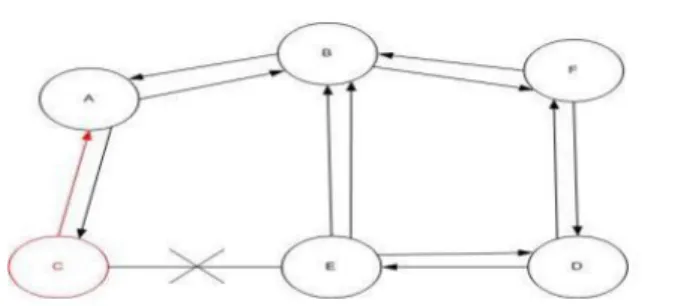
Figure 2:Forgery attack procedure in WSNs.
The strategy, how dangerous hub harmonizes the information paths differences. Figure 2 reveals how the dark gap issue happens, here hub "A" need to show information packages to hub "D" and the road finding process. So if hub "C" is a dangerous hub, then it will show that it has the best way to deal with the predetermined area when it gets RREQ packages. It will then show the reaction to the hub "A" previous whatever other hub. Along these collections hub "A" will believe this is the highly effective way and hence powerful way finding is completed. Hub "A" will neglect every single different reaction and will start seeding information packages to hub "C". Along these collections all the information group will be losing consumed or losing. In this review, the suggested redirecting relies upon on the DSR and is changed with recommendation requirements. It is part into two stages: Recognition amongst way organization and Recognition amongst information delivering. The relaxing potential of suggested agreement is its housing and efficiency finding painful locations not with standing, when the structure is incredibly extreme.
Remaining of this papers arrange as follows: Area 2 explains related work for detection Forgery strikes in WSNs. Area 3 explains AODV method structure for detection of Forgery strikes. Area 4 accomplishes DSR method process for detection of Forgery strikes. Area 5 formalize simulated evaluation results with AODV and DSR in bundle distribution rate and wait options and conversations. Area 6 indicates DSR in Forgery in mobile ad hoc Indicator Systems.
II. RELATED WORK
too prevented by the suggested strategy. Combinations of TESLA authenticators (MACs) are included by innovative changes and a hashing strategy to protected the found paths. The suggested strategy's protection frameworks are practical and can furthermore apply to the comprehensive variety of redirecting techniques.
Bhalaji et al. [9] split down the dim gap and powerful Dark gap attack which is one of the new and the possible attack in unplanned frameworks. In this attack an risky hub developments itself as having the most effective way to the hub whose packages it needs to identify. To reduce the possibility it is suggested hold up and examine the responses from all the nearby locations to identify a protected course. In the event that these risky locations work as a collecting then the damage will be extreme. This kind of action is called powerful Dark gap attack. Our primary discovers the properly secured going at the center of source and area by determining and determining Dark crevice locations. In this database, by means of duplication, the suggested treat are analyzed and in connection it with the standard DSR process in the declares of throughput, Package flow amount and lack of exercise.
Dadhania et al [10] examined the efficiency of AODV and DSR in existence of Dark crevice attack (noxious hub) and without dim gap hit with CBR (Constant Bit Rate) activity under the various convenient structure flexibility. Reproduction was conducted to examine the effect and evaluate it with schedule strategy in the declares of throughput, Package appropriation amount and End to End Wait. Extensive assessments utilizing the structure test program 2 for 50 locations unplanned structure was conducted. Results show the AODV is more weak to Forgery attack than DSR.
In DPDAODV (Detection, Protection and Delicate AODV) [11], they have defined a novel process to identify the dim crevice assault: DPRAODV, which segregates that painful hub from the structure. The professional stores the Location agreement number of incoming keeping response (RREPs) packages in the redirecting table and chooses the side quality to look at the capable planning information in each time period.
III. FORGERY ATTCKS WITH LIGHT WEIGHT PROTOCOL HEIRARCHY A Light Weight method a fragile guiding technique for unplanned and convenient frameworks that manage paths just between locations which need to interface. Redirecting strategies are going up against with an comprehensive variety of attacks. Forgery attack [7] is one such attack and a sort of Refusal Of Service (DOS) [8] [9] in which a dangerous hub makes usage of the
disadvantages of the road finding packages of the guiding technique to advance itself as having the snappiest course to the hub whose packages it needs to recognize [10] [11]. This attack is gone for changing the guiding technique with the goal that activity moves through a particular hub oversaw by the foe. Amongst the Path Finding technique, the source hub provides RREQ packages to the propeller locations to discover clean keeping to the planned place. Dangerous locations react instantly to the place to start hub as these locations don't associate the guiding workspace. The resource hub talks to that the road finding method finished, forgets other RREP information from different locations and choices the course through the painful hub to course the information packages. The risky hub does this by giving a high agreement wide variety to the sensitive group. The foe now drops the step information in comparison to delivering them as the procedure needs.
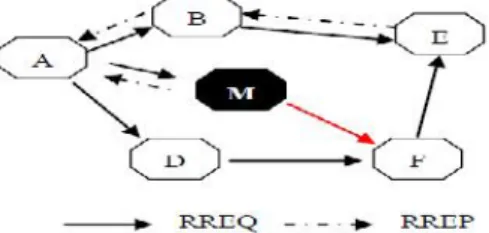
Figure 3: Forgery attack problem in Light weight. In the above figure 3, build up a dangerous hub „M‟. At the factor when hub „A‟ shows a RREQ package, locations „B‟ „D‟ and „M‟ get it. Hub „M‟, being a dangerous hub, does not check up with its guiding workspace for the asked for way to cope with hub „E‟. Thus, it quickly provides back a RREP package, stating a way to cope with the region. Hub „A‟ gets the RREP from „M‟ forward of the RREP from „B‟ and „D‟. Hub „A‟ talks to that the street through „M‟ is the quickest course and provides any team to the region through it. At the factor when the hub „A‟ provides information to „M‟, it takes up all the information and therefore with recent application information transmitting.
resource hub shows the RREQ concept for any place, the black gap hub in a second reacts with a RREP concept which contains the most agreement comprehensive variety and this concept is considered though it is from the region or from a hub which has a sufficiently perfect way to cope with the region. The resource talks to that the region is behind the black crevice and gets rid of the other RREP packages from alternate locations. Then the resource starts to show out its packages to the black crevice based upon on that these packages will accomplish the region. Along these lines the black gap will attract every one of the packages from the root and as opposed to delivering those packages to the region it will basically get rid of of those. In this manner the packages drawn by Forgery node, then the information does not reach the destination in wireless ad hoc Sensor Network.
IV. DSR BASED FORGERY DETECTION The Dynamic Source Routing (DSR) technique is an on-interest guiding technique. DSR technique safety measures the road stockpiling resource to shop the way to cope with the flexible hub it knows. This tactic including of two large stages: way discovering and way overhauling. At whatever point any hub has the information to express, first it assessments the road stockpiling shop for the way to cope with the area. DSR is ready for minimal frameworks as its package price can run the gap down to zero when all locations are typically changed. The team information price will rise considerably for frameworks with higher jump sizes as all the more guiding information should be found in those headers. The DSR method composed of two main frameworks that work to allow development and assistance of resource paths in the exclusively hired framework.
Documentations:
SN: Resource Node IN: Advanced hub DN: Location hub ACK: Recognition parcel 1. SN demonstrates sham RREQ.
2. On the off chance that SN gets RREP for sham RREQ
3. SN evaluations the RREP pack for the arrangement with of the hub instated RREP and speaks to the hub as hurtful,
4. Else 5. Continue conveying the consistent RREQ 6. In the event that RREP from DN 7. Consider the way to stay secure and start diverting the data bundles
8. Else if RREP from IN 9. At that point past hub of the IN, convey an ACK to the destination along the way,
10. In the event that past hub gets reaction of the
ACK
11. At that point past hub cosiders way to stay secure and unicast the RREP pack to the root hub and source hub start conveying the information
12. Else 13. Past hub transmitted the ready idea about the destructive hub.
Algorithm 1: Proposed algorithm for detection of Forgery attacks
The suggested guiding relies on DSR with modify for recommendation of the black gap attack. It is part into two stages: Recognition before way organization and counteractive action of painful locations amongst information delivering. The huge potential of suggested agreement is its housing and efficiency in discovering dangerous locations in factor conditions.
This criteria has been given in light of the thought that painful hub might feel the team or modify the package. The DSR is changed to contain new features known as End Head (TH). Amid recommendation organize, the locations first look at the entire two jump nearby next door neighbor hub id's and provides snare package with TH composed of off platform information spot for a its two leap other people who live close-by. On the off chance that the getting hub declares that it has the road to the incorrect area in its stockpiling source, and has provided the information team to next leap then the hub is approved to be a Dark crevice risky hub. This information about the vindictiveness takes place in the locations. Amid course disclosure, the locations mix check the paths in its stockpiling source and if the road created risky hub, the hub negates that way and begins another way discovering keeping the dangerous hub. Accordingly, the suggested technique mitigates the Dark gap attack by a uncomplicated technique of capturing the dangerous locations and avoiding it in any of the programs amongst transactions information bundles.
250-meter power variety. One of a kind way point summarize is used in conditions with hub flexibility. The selected quit time is 30s a little bit. A visitors marking was made to simulate unlimited part sum (CBR) resources. The duration of information payload is 512 bytes. In our situation, we take 30 locations in which locations 1-22 and 25-30 are uncomplicated locations, and hub 23 and 24 is dangerous hub or Black gap hub. The reenactment is used NS-3, to assess the efficiency of the structure by various the locations flexibility [11] [12]. The researchers used to assess the efficiency are given fallows.
a) Packet Delivery Ratio: The speed between the assortment of bundles began by the "application layer" CBR assets and the assortment of bundles acquired by the CBR channel in a definitive area.
b) Throughput: Throughput is the basic measure of compelling idea conveyance over an association course. c) Node Mobility: Node adaptability shows the adaptability rate of hubs.
We formalize simulation results with comparison results of both AODV and DSR for discussion of the above considerations with following parameters:
Property Value
Coverage Area 1500*1500
Number of Nodes 60
Simulation Time 30S
Transmission Range 250 m
Mobility Speed 0-20m/sec
Number of Forgery nodes 10
Check point nodes 4
nodes(Fixed)
Table 1: Simulation Parameters.
Packet Delivery Ratio: The packet delivery ratio (PDR) ascertained for the AODV strategy when the hub adaptability is moved forward. The outcome uncovers both the cases, with the dim crevice strike and without the dim hole strike. It is ascertained that the group dispersion rate significantly diminishes when there is a hurtful hub in the framework. For instance, the group dispersion rate is 100% when there is no effect of the Forgery strike and when the hub is moving at the pace 10 m/s. yet, because of the effect of the Black crevice strike the group appropriation rate diminishes to 82 %,
in light of the fact that a portion of the bundles are diminished by the Black hole hub.
Packet Delivery Ratio (PDR) is the assortment of the number of information packets diminished to the number of data bundles sent.
NumberOfPacketsDropped
PDR
NumberOfPacketsSent
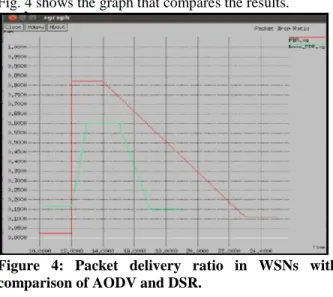
In our experiment, the proposed technique shows better results compared to the previous technique.
Fig. 4 shows the graph that compares the results.
Figure 4: Packet delivery ratio in WSNs with comparison of AODV and DSR.
Table 2:
Comparative values with respect to LightWeight and DSR.
From Table 2, it can be determined that after the implementation of suggested strategy, the bundle fall rate has been dropped to 12% whereas in the situation of current strategy the bundle drop ratio is 25%. Thus the bundle distribution rate has been enhanced in the suggested strategy.
Detection Ratio: Recognition Rate is described as rate of count of defected nodes recognized and count of actual defected node present in a system.
Total number of nodes detected Total number of actual defected node
DetectionRatio
It is one of the main parameter when it comes to identify the presence of strike in a system.
Approach Vlaues
LightWeight 25%
Figure 5: Detection rate in Forgerys in WSNs.
Table 3: Comparative detection values with resect to LightWeight and DSR.
From Table 3. it can be examined that the recognition amount was 30% when the recognition of dark gap nodes was under LightWeight protocol and it has been improved to 60% under the DSR method. So the suggested strategy is more effectively discovering the dark gap nodes which display that our strategy is extremely powerful.
VI. CONCLUSION
We tended to the issue of safely transmitting provenance for sensor arranges, and proposed a light-weight provenance encoding and unraveling plan in light of Bloom channels. The plan guarantees privacy, uprightness and freshness of provenance. We extended the plan to join information provenance official, and to incorporate bundle succession data that backings recognition of bundle misfortune assaults. In this paper, we prescribe an arrangement for finding Forgery strike in WSNs to be specific DSR Protocol, which is introducing bunching in the street discovering phase of DSR strategy. The proposed strategy is straightforward and proficient furthermore gives better standards to package fall rate and acknowledgment rate when contrasted with the current arrangement.
REFERENCES
[1] Rajib Das, Dr. Bipul Syam Purkayastha “Security Measures for Forgery Attack in WSN: An Approach”, International Journal of Network Security, Vol.5, No.3, PP.338–346, Nov. 2014.
[2] M. G. Zapata and N. Asokan, “Securing Ad-Hoc Routing Protocols,” Proc. 2002 ACM Wksp. Wireless Sec., Sept. 2002, pp. 1–10.
[3] B. Wu et al., “A Survey of Attacks and Countermeasures in Mobile Ad Hoc Snsor Networkd,”
Wireless/Mobile Network Security, Springer, vol. 17,
2006.
[4] C. Perkins, E. Belding-Royer, and S. Das, “Ad Hoc On demand Distance Vector (AODV) Routing,” IETF RFC 3561, July 2003.
[5] IETF WSN Working Group AODV Draft, http://www.ietf.org/internet-drafts/draft-ietf-WSN-aodv-08.txt, Dec 2002.
[6] Elizabeth M. Royer et. al. “A Review of Current Routing Protocols for Ad Hoc Mobile Wireless Snsor Networkd”, IEEE Personal Communication, April 1999. [7] Dokurer, S.; Erten Y.M., Acar. C.E., SoutheastCon Journal, “Performance analysis of ad-hoc Snsor Networkd under Forgery attacks”. Proceedings IEEE Volume, Issue, 22-25 March 2007 Page(s):148–153. [8] A. Shevtekar, K. Anantharam, and N. Ansari, “Low Rate TCP Denial-of-Service Attack Detection at Edge Routers,”IEEE Commun. Lett., vol. 9, no. 4, Apr. 2005,
pp. 363–65.
[9] Mohammad Al-Shurman and Seong-Moo Yoo, Seungjin Park, “Forgery Attack in Mobile Ad Hoc Snsor Networkd” Proceedings of the 42nd annual Southeast regional conference ACM-SE 42, APRIL 2004, pp. 96-97.
[10] Y-C Hu and A. Perrig, “A Survey of Secure Wireless Ad Hoc Routing,” IEEE Sec. and Privacy,
May–June 2004.
[11] K. Sanzgiri et al., “A Secure Routing Protocol for Ad Hoc Snsor Networkd,”Proc. 2002 IEEE Int’l. Conf.
Network Protocols, Nov. 2002.
[12] Sanjay Ramaswamy, Huirong Fu, Manohar Sreekantaradhya, John Dixon and Kendall Nygard. “Prevention of Cooperative Forgery Attack in Wireless Ad Hoc Snsor Networkd”. Department of Computer Science, IACC 258 North Dakota State Universities, Fargo, ND 58105.
[13] Harmanpreet Kaur, P. S. Mann “Prevention of Forgery Attack in WSNs Using Clustering Based DSR Protocol” IJCST Vol. 5, Iss ue 4, Oct- Dec 2014 ISSN : 0976-8491 (Online) | ISSN : 2229-4333 (Print).
[14] K.Mahamuni1* and Dr.C.Chandrasekar2, “Mitigate Forgery Attack In Dynamic Source Routing (DSR) Protocol By Trapping”, IJCSI International Journal of Computer Science Issues, Vol. 10, Issue 4, No 2, July 2013 ISSN (Print): 0814 | ISSN (Online): 1694-0784www.IJCSI.org.
Approach Vlaues
LightWeight 30%
[15] Mr.Rahul Vasant Chavan 1, Prof.M S.Chaudhari“ Enhanced DSR protocol for Detection and Removal of Selective Forgery Attack in WSN”, International Research Journal of Engineering and Technology (IRJET) e-ISSN: 2395 -0056 Volume: 02 Issue: 04 | July-2015 www.irjet.net p-ISSN: 2395-0072.
[16] Bouhorma, M., Bentaouit, H., and Boudhir, A. (2009, April). Performance comparison of ad-hoc routing protocols AODV and DSR. International Conference on Multimedia Computing and Systems’2009(ICMCS'09), 2-4 April 2009, pp. 511-514.
[17] Salmin Sultana,Gabriel Ghinita, “A Lightweight
Secure Scheme for Detecting Provenance Forgery and Packet Drop Attacks in Wireless Sensor Networks”, IEEE TRANSACTIONS ON DEPEDABLE AND SECURE COMPUTIN VOL. 6, NO. 1, JANUARY 2015.
AUTHOR’S BIOGRAPHY
Ms K.RamyaSree is a student of S.R.K Institute Of Technology , Enikepadu . Presently she is pursuing her M.Tech [Computer Science and Engeering] from this college and she received her B.Tech degree from Vijaya Institute of Technology for Womens, Enikepadu in the year 2014. Her area of interest includes Computer Networks, MANETs Security Concepts and all current trends and techniques in Computer Science.