Sharon L Kolling-Perin. What It Means To Use Gender to Guide Readers’ Advisory. A Master’s Paper for the M.S. in L.S. degree. March, 2016. 60 pages. Advisor: Sandra Hughes-Hassell
Readers’ advisory is a central job of librarians who work with youth, and it is especially critical for youth who are struggling or reluctant readers. Readers’ advisory is often conducted based on gender, partially due to the fact that boys are more often seen as reluctant readers, and score lower on reading measures. As there is growing awareness that not all youth fit into the classic definition of a gender binary, librarians must reconcile the needs of reluctant readers and the needs of gender non-conforming youth.
This study examined what youth librarians in school and public libraries understand about using gender in readers’ advisory. The study consisted of four semi-structured interviews with youth librarians, exploring the issues of readers’ advisory, gender, and gender non-conformity.
Headings:
Children & youth Gender identity LGBTQ studies
WHAT IT MEANS TO USE GENDER TO GUIDE READERS’ ADVISORY
by
Sharon L Kolling-Perin
A Master’s paper submitted to the faculty of the School of Information and Library Science of the University of North Carolina at Chapel Hill
in partial fulfillment of the requirements for the degree of Master of Science in
Library Science.
Chapel Hill, North Carolina April 2016
Approved by
Introduction
Readers’ advisory is a crucial aspect of librarianship, particularly for librarians working with children. Readers’ advisory can take many forms, from individually working with children to find the books they need or want, to conducting book talks, inviting authors to speak to groups of students, or even creating displays and materials. School librarians have the added responsibility to guide their students and help them find books that will help them reach their academic potential as well help with their personal growth. The American Association of School Librarians, in their Standards for the 21st Century Learner (2007), lists reading for pleasure and personal growth along with reading in order to make inferences and gather meaning as critical skills for all learners. As these are vital skills a school librarian must teach to all students, they must be able to provide the books that will allow students to develop and augment these skills. For all students, this means connecting to books that are meaningful. Additionally, the Young Adult Library Services Association (YALSA, 2010) has developed a list of competencies for librarians who work with youth. This list of competencies comprises having
For reluctant readers, readers’ advisory is particularly crucial as these are children who struggle with reading, are uninterested in reading, or are both disinterested and struggling. Boys are more likely to be described as reluctant readers and they lag behind girls in reading test scores, starting in the early grades, and continuing through high school (National Assessment of Education Progress, 2013). Due to the perception of boys as reluctant readers and their lagging test scores, there has been an effort over the past twenty years to find and make accessible books that boys will be more interested in reading. Classroom teachers, school librarians, public librarians, parents, and others interested in the reading lives of boys all contribute to these efforts to help boys achieve as readers. Acclaimed author Jon Scieszka (2015) has even started a web-based literacy program, Guys Read, dedicated to helping boys become lifelong readers, with book recommendations, story collections, and other initiatives aimed at boys as readers.
With these efforts to improve boys as readers, readers’ advisory is often
conducted based on gender. Books are labeled as ‘for girls’ or ‘for boys’ and suggestions are often made based on gender. In one well-publicized incident during the winter of 2015, school administrators at a middle school only gave permission to the girls at the school to attend an author visit with Shannon Hale (Hale, 2015). The message sent to the students was that female authors and female protagonists are not important for boys to learn about and understand; simultaneously the message to boys was that there is a certain way that is acceptable to be a boy. A strict gender binary is often seen as
At the same time that schools and libraries are conducting readers’ advisory with gender as one determinant, there is also greater understanding that not all children fit neatly into a classic definition of a gender binary model. In the binary model of gender, there are two distinct genders, male and female, which conform to the biological sexes of male and female (Newman, 2002). This binary model does not work for how many people identify themselves, however, and there is greater understanding that this one-to-one correlation between sex and gender is insufficient. There is comprehension now that many people are gender non-conforming, meaning the gender they identify with does not match the sex they were born with; or gender fluid, meaning they do not subscribe to the rigid gender boundaries set by society, such as how to dress (Gender Diversity, 2015). When librarians conduct readers’ advisory with gender as one of the guiding principles, they must make assumptions about the child’s gender. In addition, they must make assumptions about traditional gender roles, and a child’s conforming to those gender roles.
With such strong anecdotal evidence and empirical research on the needs of boys that is enmeshed with the needs of reluctant readers, as well as the newer understanding of gender fluidity, it is important to understand how librarians view their roles in
exactly how to conduct readers’ advisory with students who are potentially gender non-conforming.
As the needs of all children are paramount to the job of the librarian it is important to understand how to best help students with conflicting needs. My research examines what youth services librarians, in both schools and public libraries, understand about using gender in readers’ advisory. It also explores librarians’ understanding of the research behind finding books for reluctant readers, many whom are boys, and their understanding of gender fluidity and the needs of gender non-conforming students. I examine how librarians deal with gender stereotypes and the gender binary within their libraries when conducting readers’ advisory and in working with youth. This research will inform the field of library science about what school librarians view as best practices in dealing with gender in readers’ advisory, whether there is consensus on these issues, and what research needs to be done in order to best serve all students, regardless of their gender or identity.
Literature Review Gender in Reader’s Advisory and Collection Development
in the library and in interacting with children and youth. Librarians want to find books that appeal to all of the children in our school libraries and in our public libraries. There has been a concerted effort over the past many years to make sure that we are including books that show a diversity of characters, including characters of different genders, races, family structures, sexual orientation, religion and ability. We need Diverse Books (2015) is an organization founded in 2014 in response to the lack of diversity seen in children’s literature. As libraries have worked to include more books that may appeal to all of the various children that patronize the library, there has also been additional work to make sure those books enter into the hands of children who may not find them on their own. Boys have been a particular target of many of these campaigns, as they are more likely to be reluctant readers, or less interested in reading (Smith & Wilhelm, 2002). Getting books into the hands of boys has resulted in using gender in this specific way to encourage reading in this population.
However, using gender can have unintended consequences. Lukoff (2013) makes the point that when we use gender in readers’ advisory, we are assuming that we can tell a person’s gender identity by looking at them. He postulates that librarians must be sensitive to the needs of the youth who are marginalized by their gender identity, which includes not making assumptions about their identity or needs. He argues that librarians must meet these conflicting needs of getting books into the hands of boys while also recognizing that there are differences in gender identity, roles, and expectations of which they may not be aware.
Since the National Assessment of Educational Progress began tracking student data in 1992, boys have consistently underperformed girls on every measure of
achievement (NAEP, 2013). Boys underperform girls in reading starting in young grades, are less motivated to read, and value reading less than their female counterparts (NAEP, 2013).
Boys’ achievement
Boys consistently underperform on every literacy measure compared to girls. In the 2013 National Assessment of Educational Progress (NAEP), less than a third (32 percent) of fourth grade boys scored at or above proficient in reading, compared to 38 percent of girls. By eighth grade, only 31 percent of boys were reading at proficient, while girls had increased to 42 percent proficient. By twelfth grade, thirty percent of boys were not even reading at the basic level, compared to only 21 percent of girls. According to Kleinfeld (2006), boys lag a full year and a half behind girls in reading and writing achievement. Furthermore, African American males perform even lower than white males. According to the National Assessment of Educational Progress (2015), in twelfth grade, African American males scored an average score of 263 on the reading
assessment, compared to an average score of 292 for white males, and an average score of 273 for African American females. Smith and Welhelm (2002) also found that girls tend to read earlier than boys, understand expository and narrative texts better than boys, and are more confident in their reading ability than boys.
Boys’ motivation
2014). Girls also show slightly higher levels of achievement with greater levels of motivation, however motivation is imperative for boys (Smith & Wilhelm, 2002). Boys can be motivated, particularly when they feel competent, and when they feel they have choice over the reading material and situation (Wilhelm & Smith, 2014). Marinak and Gambrell (2010) documented that motivation and achievement can run in a cycle of success or failure. As students feel more motivated, they score higher on every measure of achievement, and as they achieve more, they feel more motivated. This cycle also works in the opposite direction. Children who are not achieving at high levels may have less motivation, and less motivation leads to lower achievement.
Boys’ Preferences
reading books about sports, hobbies, and things they like to do. Furthermore, they found that boys enjoy escapism and humor, as well as science fiction and fantasy. Boys also resist reading books about girls, while girls do not resist stories about boys.
Among African American and Latino boys, two cohorts of adolescents who score even lower on reading tests than youth overall (NAEP), there is even greater urgency to understand their needs and preferences. Hughes-Hassell and Rodge (2007) found that low income, minority urban boys are less likely to read than their female counterparts. When they do read, both the girls and boys in the study showed a strong preference for reading magazines. Furthermore, the boys preferred reading books about sports, video games and music.
Gender Fluidity
used within the classroom. In fact, Martino & Kehler (2007) examined how a strict binary construction of gender reinforces a very narrow definition of what is masculine.
There are many gender stereotypes that exist in the school realm in particular related to both achievement and ability, as well as behavior. For example, in the realm of achievement and ability, it is well documented that male students are seen as better at math than female students (Steffens and Jelenec, 2011). But while the perception may be that boys are better at math or science, male students are also more likely to see
themselves as unsuccessful at school. Hartley and Sutton (2013) found that primary and adolescent boys see girls as academically more successful than them, and are less likely to try academically in reaction. Heyder and Kessels (2014) found that these stereotypes of male and female students effected how teachers viewed student behavior and
achievement. In that study, traditionally masculine stereotypes were seen as less
academically engaged than female stereotypes. These stereotypes can affect how students act, as they conform to what they believe is expected of them, and how teachers perceive student behavior and ability.
very young age, but it takes conscious effort on the part of the teacher to recognize children’s questioning of gendered assumptions. When librarians conduct readers’
advisory with gender as one of the guiding principles, they must make assumptions about the child’s gender. In addition, they are likely to make assumptions about traditional gender roles, and a child conforming to those gender roles.
Needs of LGBTQIA students
Throughout the United States, there are many teachers, librarians and youth organizations that recognize that they must meet the needs of their youth who identify as lesbian, gay, transgender, and queer, or any other identity that does not fit within the normative gender binary. Blackburn (2002/2003) explored the ways young adults examine their identity through literacy performances at a LGBTQ center for youth. This focus on identity formation helped the youth to be more comfortable with their identities. The American Library Association (2015) has compiled many lists of books and
resources that can help libraries maintain collections that are cognizant of the needs of LGBTQ patrons, and youth in particular. These lists include bibliographies of resources for teens, bibliographies of resources for children, resources for services on Delicious, and lists for winners of the Stonewall Book Award, an award from the American Library Association’s Gay, Lesbian, Bisexual and Transgender Round Table (2016) that honors books for “exceptional merit relating to the gay/lesbian/bisexual/transgender experience.”
Harris, 2013; Singer-Stanback, 2011; Williams & Deyoe, 2015). Rauch (2011) examines the needs of LGBTQ resources and programming in order for youth to meet their
information needs.
Lack of access to the information needs of LGBTQ youth can contribute to their higher rates of depression and suicide. Alexander and Miselis (2007) explored how robust collections focused on LGBTQ issues can help reduce feelings of isolation and depression that are common among these youth. A full collection can also fight against the stigma many LGBTQ youth face. These studies are crucial to the health of LGBTQ patrons. The National Transgender Discrimination Survey (2011) found that among people who identify as transgender or gender-non-conforming while in grades K-12 face harassment (78 percent), physical assault (35 percent), and sexual violence (12 percent). One-sixth (15 percent) of people who identify this way report leaving school either in K-12 or in higher education, due to harassment. Furthermore, many students who identify this way report that some of the harassment in schools comes not from peers but from teachers. Conversely, Kosciw, Palmer & Boisen (2013) found that knowing that there are teachers who are supportive of LGBTQ students can have a huge impact on these
students. LGBTQ students who identified 11 or more supportive educators in their school feel more connected to their school community, have higher GPAs, and were less likely to feel unsafe in school or miss school than students with no supportive staff.
changing of their legal sex, and 31.6 percent have been prevented from wearing clothes deemed inappropriate based on their legal sex. The report also found that these policies lead to students missing school more often than children who do not face these kinds of discriminatory policies, as well as having lower GPAs, lower self-esteem, and higher levels of depression.
Conclusion
As librarians face the needs of reluctant readers and underperforming students, who are likely to be boys, as well as people who identify as transgender or outside of the gender binary, they need direction on how to best help all of these patrons. While
research shows that understanding the needs of boys as readers can help boys become more motivated and achieve more as readers, librarians also must be aware of the best way to address children without making assumptions about gender identity and gender roles. This research study is the first step in understanding how librarians are reconciling these two conflicting needs.
Method
In this section, I will describe how I conducted this study to explore the question of what librarians understand about using gender in reader’s advisory, and the
implications it has for youth who do not conform to the gender binary. The four semi-structured interviews specifically explored the librarians’ perspectives and experiences regarding readers’ advisory, gender stereotypes, and gender non-conformity.
issues in librarianship, as evidenced by their social media presence, or due to personal relationships. I made initial contact through emails, sending each librarian an informed consent document that explained their rights as participants, including the right not to answer any question, and to terminate the interview at any time (see Appendix B). Each of them was also informed of the anonymity of the interviews and data collected.
I conducted three of the semi-structured on the phone, and one in person using a prepared script that allowed for open-ended discussion on the topics (see Appendix A). Each interview lasted from thirty-five minutes to one hour. With permission, I recorded the interviews with a digital voice recorder in order to have a record of the interviews in addition to my own observations. I transcribed the interviews verbatim, editing only to remove verbal pauses. I removed all identifying information from the transcripts, and provided each interview subject with a pseudonym.
Once the interviews were complete, I coded the data using an inductive coding scheme, and analyzed for similarities and differences in the librarians’ experiences and thoughts regarding using gender in readers’ advisory, gender stereotypes, and gender non-conformity. Coding took place in multiple stages. Initially, I read and annotated each of the four interview transcripts, color coding various categories. With this baseline of categories coded, I subsequently compared the transcripts with one another in order to look for similarities, differences, and newly emerging themes, and in order to solidify my coding scheme. Finally, I coded all of the transcripts another time with the finalized coding schemed I had developed through the first two iterations.
gender and gender fluidity and the implications that has for working with children. I was able to explore how librarians are thinking about gender in the context of readers’ advisory, the ideas librarians hold about “girl books” and “boy books,” reluctant readers and how gender pertains to that issue, gender stereotypes and the role of librarians in addressing them, gender conformity and librarians’ response to gender non-conforming students, collection development and library programming as it pertains to gender, and education of teachers and librarians on gender and gender non-conformity issues.
Limitations of This Study
This study is an exploratory study that sets to examine how a small number of librarians who are cognizant of diversity and equity issues in libraries are thinking about gender and gender non-conformity. With a sample size of four participants, the results of this study cannot be taken as representative of all youth librarians, and cannot be
generalized to the entire population of youth librarians.
Results
seven years as an elementary school librarian, and the last three years as a high school librarian. The third interview was with an elementary school librarian whom I will call “Kathy” and who has been at her current library for four years. All three of these librarians prefer that others use the pronouns “she,” “her” and “hers” and that is how I will refer to them. The fourth interview was with a public youth librarian who has been working as a librarian for three years, and who I will call “Laura.” Laura uses the
pronouns “they,” “them,” and “theirs” and so I will use those pronouns in discussing their responses to the interview questions.
Readers’ Advisory and Gender
All of the librarians interviewed indicate that they conduct readers’ advisory interviews the same way research on best practices suggests reference interviews begin-- with broad questions in order to understand what a youth is looking for from the library, including what they are interested in, what kinds of books they have liked in past, what kinds of books they have disliked, or what genres they generally read. Julie said “I generally ask pretty broad genre questions about what kind of books they want to read. I narrow it by genre and then towards books that are popular.” Similarly, Kathy responded, “The first things that I usually ask is tell me something that you really liked.” Laura said, “I usually just lead off with the question, is there anything you’ve read or liked in the past.”
None of the librarians mentioned the gender of the youth, or any other characteristics of the students beyond their interests. Laura said:
The other factor that is part of the readers’ advisory interview for these librarians is author or style of writing. Terry said, “I think about trying to get a clear idea about what types of things they like and what types of things they don’t like. Is there a certain author or style that you really like?” As I will discuss below, while the librarians indicated that they do not initially think of the gender of the youth when they are conducting readers’ advisory, many authors are connected in their minds with either boy readers or girl readers.
Not only did the librarians say they do not think about the gender of the youth when initiating readers’ advisory, when asked directly about gender, they all pushed back on the idea that there could be “girl books” or “boy books.” For instance, Laura said, “I think [the idea of boy books and girl books] is really limiting to patrons. I feel like everybody should be free to read whatever they want to read without judgment.” All of the librarians except Terry insisted that they do not use gender at all in readers’ advisory activities, or even actively work against using gender as a factor.
Boys Will Only Read about Boys and Girls Will Read Anything
It seems that the only times the gender of the protagonist matters to these librarians is when the youth specifies wanting a book with a character representing a particular gender. Kathy said, “I had a conversation the other day with a girl who said, ‘I like to read anything that is pink.’ So I had to sort of go, okay she is self-identifying as a pretty girly-girl.” Julie also indicated that she has had students insist they only want to read books with one gender, and she respects that wish. The stereotype that girls will read anything and boys will not read about girl protagonists is also evident in the libraries these librarians all work at to some extent. Terry described it as a Venn Diagram:
“I guess that there is a larger body of works I would recommend to a boy and a girl. I think that there are some books that unless a boy tells me, I’m not going to recommend to a male student unless they say something that leads me to believe that that is kind of what they are looking for.”
The idea that boys won’t read girl protagonists is very firmly entrenched. Julie said: “There are some guys who really just check out books with male protagonists, but that is not always the case. Generally if there is a student who would prefer to read a book with a certain gender protagonist, it does tend to be guys not wanting to read books with girl protagonists rather the other way around.”
And Laura added, “I just have a much harder time usually getting [boys] to pick up a book that publishing has decided is aimed at girl. Or books that have a female main character.” The observation that girls will read anything is as firm as the observation that boys will not. Terry recognized this as potentially problematic:
Kathy also admits, “The truth is I don’t really see anything as a ‘boy book.’ It is hard for me not to see some books as ‘girl books.’”
Laura sees both their female patrons and their patrons who do not fall on the gender binary as being more open to all books than their male patrons, “I feel like as of right now, my girls are much more omnivorous readers, and my folks who identify outside the binary are much more omnivorous readers. They will read books with any protagonist with any topic.”
“Boy Books” and “Girl Books”
In fact, three of the librarians see specific authors and series as being either for boys or for girls. Mike Lupica, Matt Christopher, and Jeff Kinney are all authors that these librarians see as speaking to boys, while they named Wendy Mass, Sarah Dessen, Jenny Han, and the Rainbow Fairies books as books for girls. “You’ve got the readers who will really go for anything, and then you’ve got the readers who are right on track with Mike Lupica or all the way with Wendy Mass or something,” according to Julie. Terry said, “I generally think if there is a guy who comes up and asks for something to read, chances are I am going to not steer them towards Sarah Dessen or something…Girls tend to read Sarah Dessen and Jenny Han…If you wanted boys’ books it was Matt
Christopher or something like that.” Kathy, despite trying not to see books as girl books and boy books admitted, “It’s very hard for me to not look at the Rainbow Fairies…the books all feature different fairies. They present as very feminine and they are full of sparkles. It’s very hard to not see something like that as a ‘girl book.’”
parents, and the students themselves. Julie said, “I do hear a lot from teachers and
students, “oh that is a ‘girl book,’ that is a ‘boy book.’” I hear people say that all the time, and while I am less likely to call them out on it, those aren’t categories I like to use.” Kathy indicated that fighting against it is challenging:
“Before I worked in a school I actually came from a bookstore background and there I would try but I would find a lot of times that people would look at me like I was crazy. Like if someone came in saying, ‘I want to find a birthday present for my twelve year old grandson.’ I would try to do stuff, like hand them something like Roller Girl, and they would look at me like I was nuts.”
Laura, who identifies as gender queer, refers to their personal need to stop
gendering books so that today’s youth don’t experience what they experienced and hated: “I think it is a bit colored by my own experiences. But I always hated it when I was a kid when people would…see that I am outwardly female and so they would try to give me ‘girl books’ and I’ve despised that from the depths of my being my whole life so I try not to do that to other people.”
The Specific Needs of African American Boys
The one place where two of the librarians draw distinctions about providing particular books to youth based on their gender is for African American males. Julie and Laura identify a need, based on research, to provide materials to African American male youth that speak to their particular needs and connect to their lives. Julie says, “I feel like most of the recent literature I’ve been reading is focused on African American males or at risk male youth and literacy, and often it’s about focusing on things that can connect to their lives and feel important in that way, that’s relatable.”
collection development and readers’ advisory with them in mind.” They went on to explain that they has seen a difference in their library when they has been able to connect an African American youth with a protagonist that is also an African American youth. They described successes with these boys when they was able to get into their hands books with protagonists like them.
Boys as Reluctant Readers
These librarians are all aware of the existence and needs of reluctant readers in their schools, libraries and communities. They know that any youth they encounter could be a reluctant reader, and they tailor their readers’ advisory services to those needs. Among these librarians, they see both male and female readers who could be considered reluctant readers. Terry says, “We definitely have reluctant female readers, but it seems like it is more of an obstacle to overcome with our male readers.” Laura also sees that it is widespread, “Just about everybody in my particular community is a reluctant reader. I guess if I had to make a distinction I would say probably [boys are more likely to be reluctant readers].”
start getting more books with more appeal into the hands of boys who might otherwise think that they couldn’t read or didn’t like to read.” Laura said, “The guys are the more reluctant readers or the ones looking for something short, or something fast, or something easy.”
Several of the librarians pointed out that the communities they live in create circumstances where boys have an image to maintain in regards to masculinity and what it means to be a man. This image often does not include reading, and in fact being a reader is seen as a feminine characteristic. Laura said:
“I think that in high school they think they have this image to maintain. We have a group of guys that is going to read avidly and not care what people think, but I think you probably have more guys who think that the way they show they are cool is by not reading, than girls who have that same feeling. You still have a lot of girls who don’t like to read, but it’s not so much about an image thing with them.”
Laura sees a very specific image problem in their library that does not pertain to the content or subject of the books, but the look of the book. They notices that boys have an image to maintain that preclude them from reading books that appear highly feminine, or simply not masculine enough. “I think there’s always some social pressure around being seen with certain books. So with some kids, it’s not even the content of the book, it’s being a tough guy being seen with a book with a pink cover.”
books aren’t really cool, but if I am going to read a book, I am going to read a sports book mentality.”
The only public librarian interviewed, Laura questioned the definition of
“reluctant reader” and “reader” in general. They believes too many people define reading too narrowly, and so miss the kinds of reading that many engage in. They said:
“I suppose it depends on how you define reader. I’m pretty equal opportunity when it comes to reading. Words on a page is reading. I don’t care if you are reading fan fiction, or manga, or a novel, reading is reading to me. Some people I know would probably call my diehard graphic novel and manga readers ‘reluctant readers’ because they are very reluctant to tackle a novel, an actual novel, but I find it hard to apply the label ‘reluctant’ to a teen that consumes manga at amazing rates.”
Gender stereotypes
All of the librarians interviewed recognize gender stereotypes that exist in their schools and libraries. These stereotypes are often unconscious, and reinforced by adults, as well as the students themselves. The reality that this is a highly gendered society is hard to avoid. Laura established the problem not as one of stereotypes alone, but as the fact of the gender binary itself. They explained:
children and youth will be interested in based on their gender, thereby putting them into very narrow confines. One instance they describes is in the simple acting of giving out coloring sheets at the librarians’ desk. The desk might have princesses, superheroes, My Little Pony, and other sheets. “So many people that I work with, or parents that come up, say ‘Give me a girl page, give me a boy page.’ Or a librarian will be assisting a
child…and it will be a young girl so they will go over and get her Pinkalicious without even asking.”
The stereotypes are often much more restrictive in terms of what boys can or should like than it is for girls. Julie explained about working with the school counselor to find books on various careers for a unit with Kindergartners. She said:
“We were looking for books that had females and males in non-traditional roles, and an interesting thing that we saw is that there is actually more books where females are doing traditionally male roles than the other way around and I kind of think I see that with students, where a student might very quickly call out, ‘oh girls can do that too,’ but I wouldn’t necessarily see it the other way. That’s just something we ran into looking for books that showed males doing traditionally female careers or professions.”
Despite working in a school that actively fights against gender stereotyping, Kathy sees similar gender breakdowns at her progressive school. She described what she sees when she looks out at the playground for recess:
“There is a football game that is entirely comprised of boys, and then there is a jump rope games that is entirely comprised of girls, and then there are some kids that go around doing other things that are considered gender neutral. Those dynamics definitely exist and we are not immune.”
more reluctant readers or might be struggling and might feel less able to acknowledge that and go and seek help.” By using these gender stereotypes, librarians and teachers are not being as effective as they could be in providing support, resources and materials to youth.
Another area where librarians see gender stereotypes is in the intersection between gender and sexuality. Whereas girls are allowed and even pushed to embrace romance and emotions, boys are supposed to be immune to those things. And a boy who expresses any emotion especially toward another boy would be particularly outside of the norm. Kathy described a story where she was reading a story out loud, and a boy in the class commented that the main character was really good looking, “That drew some snickers, which I don’t think it would if a girl had commented that a main character was really beautiful.” On the other hand, Laura described girls that are “Just so over the whole romance in every single YA book thing.”
line up children boy-girl in order to keep the boys separated, or composing groups to include equal numbers of boys and girls.
Rather than letting their gender dictate who they are, or what they are interested in, these librarians believe the youth themselves need to be able to figure out what gender means for them. According to Julie, “The more we can allow students to find their own ideas of what male and female mean, the better.” She went on, “I feel that the more we can provide a spectrum of experience in the books we read and the way we talk about things the better. I certainly don’t want to make our students feel like there is a right or a wrong way to be a certain gender.”
Not only do youth need to be able to define themselves regardless of their gender, they have to feel safe no matter how they define themselves. All of the librarians stressed the importance of youth being safe to express themselves and learn about who they are without fear of reprisal. All of the adults in a youth’s life, librarians, teachers, parents and others, must help to create that safe space. “I think in order for a child to be safe, they have to be comfortable saying or asking questions or saying whatever they need to say to the adults that they trust,” said Kathy.
Whose Responsibility Is It to Talk about Gender Stereotypes?
teachers try to incorporate that, if we are talking about playing dress-up in preschool or toys, the teachers are careful not to include gendered language about that.” She feels teachers in her school have the freedom to do that because the parents are a self-selecting group of parents who care about things like that. The parent population is drawn to the school precisely because of that ethos. For Julie, she feels that the burden is on her to make sure she creates an atmosphere where she is working on breaking down barriers. She herself must talk to the children about gender when it comes up. “It is just me being conscious of it, and making it routine.” While she sees parents, teachers and other students as playing a part, she knows that regardless of school culture, she has the responsibility in the library to talk about gender stereotypes.
While Laura agreed that they personally has to create an atmosphere where the gender binary does not dictate how we respond to children, they also sees that ultimately the responsibility to make decisions for youth is the parents’. They believes only the parents can make the final choices, “The responsibility lies with the parent. We cannot judge that. That’s up to them and their parents to figure out.” Only Terry indicated that discussing gender stereotypes and norms is not the responsibility of the librarians at all. She said that there is a place for that in the health curriculum.
Gender Non-Conformity
queer, brought up the gender binary as one of the major problems in the perpetuation of gender stereotypes. The definitions the librarians gave all include the idea that a person’s identity does not conform with traditional norms or expectations. They also see that a binary of only two choices is not as applicable as previously assumed. The various definitions given are below:
“I think of it as someone who does not conform with the traditional ideas of a gender in our society” (Julie).
“I guess just not conforming to what society says is expected of someone born male or someone born female. I think that the more we learn about it, the more that we see that it is a spectrum and not this absolute thing that people thought it was for so long” (Terry).
“I think that the way I define it in my head is that the gender that the child was assigned at birth doesn’t necessarily match the gender that they know themselves to be or the gender might change from day to day” (Kathy).
“Anyone who doesn’t feel like they fit into society’s traditional roles for male and female and there can be a variety of components to that. There can be some typical dysphoria which might be mild or severe. It could be private or it could be publicly performed. It could be a combination of inward feeling and outward expression, either of which can be outside the norm” (Laura).
The librarians all know of youth in their schools and communities who identify in some way as gender non-conforming. Terry described her school as having a large LGBTQ population. As mentioned, Julie has a student she knows to be gender non-conforming from the parent, but also adds, “I am certain they are not the only child in our school who has questions about gender and who thinks about that.”
Dangers to Gender Non-Conforming Youth
anything.” However, Terry and the other librarians all mentioned the dangers that face gender non-conforming youth. The dangers the librarians mentioned range from isolation and verbal abuse to homelessness and suicide. Laura mentioned the constant belittlement of transgender people. “I think [gender non-conformity] is something that is completely misunderstood most of the time. Most people have little to no knowledge on the topic and it is something that is often mocked all the time. You just turn on the TV and you see cross-dressing jokes, and trans jokes and stuff like that. Trans jokes are everywhere all the time.”
Terry and Kathy both focused on the physical dangers to transgender and other LGBTQ youth. Terry mentioned an article she had seen that referenced statistics about the dangers facing DC youth. “There was an article in the in the Washington Post talking about how over half of the homeless youth in DC are LGBTQ. It had the statistics that they are more likely to be bullied, more likely to be runaways, more likely to attempt suicide. It’s huge.” Kathy also referenced the danger of suicide that is prevalent among LGBTQ youth, and added, “One of the most chilling statistics I have ever read is how much higher the suicide rate is for LGBT individuals of color than it is for white people.”
For students who do not identify on the strict gender binary, the gender
stereotypes that are pervasive work to further alienate and isolate them. Julie put it simply as “I think gender stereotypes can obviously isolate a child, and make them feel like they are doing it wrong, or they are not a part of whatever group because [of how they
the feminine gender stereotype on them.” Laura went on to say that by deciding books based on outward gender appearance can even affect literacy success. “Make sure that Pinkalicious is really what she wants. That’s going to translate into later reading success. If you’re giving them books they are not interested in when they are younger because you are making assumptions, that is going to hurt their future chances at being strong
readers.”
Not only are we forcing children into a box that may feel alien to them by reinforcing gender stereotypes, but the ingrained idea of what it is to be a male or a female can cause those who don’t adhere to those ideals as targets. Laura said, “For somebody who’s already perhaps non-binary, being seen with a book that everyone knows is one of those ‘gay books’ or something like that. There is always that social aspect of what you are being seen reading, or what people know you read.”
The Importance of Language Around Gender
The language we use about and with gender non-conforming youth is extremely important according to the librarians interviewed. Julie put it as “trying not to be
like ‘girls have this and boys have this,’ we talk specifically about body parts. There are some bodies that have this, there are some bodies that have that.”
One example Kathy gave for a way to be more respectful with the language we use is in the signs for bathrooms. There is respect in not only being sensitive about how we use language in order not to offend or hurt, but in proactively supporting all people. Getting rid of the bathroom signs that have pictures that show a man-slash-woman is the first step, but is not enough, “We have a solo bathroom that has a sign on it that
specifically says this is an all gender bathroom. The sign is there to make a statement to say we are in support.”
Laura also indicated the importance of educating youth and adults about the language they use. They polices the use of the word “gay” and words like that being used as a slur, and has had success with other staff at her library and her patrons. They
describes how vital that is in this way, “You can offer all the programs and readers’ advisory you want but if you as a person are not educated about the topic and you’re not aware of language issues…than you have done the job by the letter, but in spirit you have failed that youth.”
The Library as a Safe Space
“[It is important] that people will see it as their responsibility to make their libraries welcoming and inclusive no matter what their personal views are. Public libraries are for everyone. School libraries are for all students. So, it’s really important that we be able to serve all of those and that they all feel welcome.” Several of the librarians mention being at least one person a student can talk to about anything. Kathy said, “I think that a lot of times, kids have nobody to talk to about it. Maybe they are not supported by their families or their teachers. The library is the only place where you can find safety or somebody who understands.” Terry echoed this sentiment of the library being the one place for many students where they can find this safety, “I want there to be a place where teens can go where they really can feel accepted. And there are a lot of teens who don’t really feel accepted for who they are.” Julie
expressed how this safe space is created by the librarian, “I think as a general rule, being a safe person to talk to [is the most important]. Being open and available to people is important. I think it comes down to being kind and thoughtful.” Laura expanded on this idea, moving toward the idea that not only should the librarian be kind and respectful, but teach others to be as well:
“I feel it is my responsibility to make sure that my library, my programs, my teen area are safe and welcoming to people of all genders and of all sexualities. Part of that is educating the teens about these things so that they can be respectful. I don’t care what your personal viewpoints are, and I am not trying to change your
personal views on the topic, but when you are in this library, everyone is welcome and you must be respectful of everyone.”
Collection Development
something that librarians feel comfortable with, and that is definitely an easy thing that we can do.” The librarians all feel this is easier now than ever, as there are more books being published that are either gender neutral, involve LGBTQ characters, or are specifically about the LGBTQ experience. Julie explained, “I am lucky enough to have the freedom to find some of those materials and luckily on the Internet people talk about gender neutral picture books and things like that.” In addition Terry said, “Like all of the books being published now, or over the past several years, we have had an increase in such wonderful titles.”
These librarians see a value in having these books for youth who identify on the traditional gender binary as well as youth who may be gender non-conforming or questioning their identity. Julie concluded, “All students should be exposed to literature that doesn’t pin down gender in ways that it often is.” Laura explained that not only do we have a responsibility to try to avoid gender stereotypes, but to actively introduce youth to worlds outside of their own. Laura said:
“Your collection needs to reflect the world. You need to collect with the needs of your specific patrons in mind, but you also need to have a diverse collection that reflects all the people that live in the whole wide world and that includes books that include gender diversity as well.”
Terry opined, “I want to make sure that everyone, not just the LGBTQ students see the books that are available.”
out of a book, if you can get them to read it. “If I can get them to read something that maybe falls outside of their typical expectations, they always enjoy it, they have a great time, they look for more,” Laura said. The challenge that librarians must take on is “getting them to read it in the first place, that is always difficult.”
For youth who are questioning or identify differently from the gender binary, it is a matter of helping them to see themselves in the world, and feel less alone. Laura put it this way:
“I think I am just much more likely to try to seek out books that I know are going to be friendly to their world view and that’s a lot of what I read personally, so that is something that is important. I don’t want to just give them another book that’s going to reinforce everything they are struggling against. I’ll try to give them a book where the world of the book is more welcoming to people like them and to show them that there are fictional worlds, that we can imagine worlds where this is not an issue and where you are fine just the way you are. Just give them a place where they can feel okay with where they are in the world.”
Finally, Kathy points out that the books in the collection have to be authentic. Just as it is important to have books on all of the various populations in the world that are written by members of that population, libraries must have books about the transgender experience written by transgender people. Kathy said, “You can do things like buy books by transgender people. There is a small but growing body of children’s literature that are books about transgender kids that are written by transgender people.” Julie pointed to the recently published book George as a “kid-appropriate” book that addresses the
transgender experience and is written by a person who is genderqueer.
and another place for another kind of book.” Kathy insisted that the LGBTQ titles must be shelved with the rest of the collection. “I don’t have a display of here are my favorite transgender books, but I have these books that are great for certain age levels…just like you would with any other books.” Kathy also added that if a librarian is aiming for a collection that provides a diverse window in the whole world, for all youth, then “don’t treat them as books that are only for specific kids or books that are unique and need to be kept separately. Just treat them like regular books and put them where anyone can
discover them.”
Kathy and Laura insisted that all displays and collections should be diverse
throughout, and not only in gender and identity, but in all the many ways that libraries are diverse. The way that librarians can do this is through the integration of all different kinds of titles. For instance, Kathy said, “If somebody comes through and asks me for a
romance, I make sure that I have a wide variety of romances. I have some that are LGBT, I also try to include inter-racial romances.” Laura put it another way, “Any display you do make sure you include diverse books of all kinds. You make reading lists, you make sure they are on your reading lists. Just balance everything. Everything needs to be balanced.”
In addition to having the collection, and having it shelved with everything else, the collection itself has to be diverse. It cannot be a collection that focuses on “all gay, white, cisgender males” as Laura pointed out. Kathy pointed out that when librarians think about LGBTQ books and collections, they cannot only focus on a “single story” of what it means to be LGBTQ:
being transgender is different from being gay or lesbian, and between someone who is lesbian and transgender. And also that there are different experiences also for people of color than there are for white people.”
Laura pointed out the need to have “balance across the QIA part” of the LGBTQIA acronym:
“Finally we are starting to get more books with the QIA part too. The intersex. Asexual still doesn’t really happen, but we are getting there. There’s still a lot more that can be done, but we are finally starting to see more outside of cisgender men and women in same sex relationships. We are finally starting to see a little bit of bisexuality out there, more books featuring transgender characters, so making sure you have a more balanced collection is important.”
Even more important than maintaining a diverse collection that reflects the diversity of youth in a library, school or community is making that collection accessible. Kathy insisted, “don’t be afraid to put those books on display. I do it all the time.” Terry explained farther:
“The executive chair of YALSA was very quick to say this is not about collection development. That is such a small part of it. We are very good at collection development, we know our books, but we need to go way beyond that as
librarians…being able to really communicate with the kids in a way so they know that you care about them, and that you see them. Books are good, but it goes way beyond books.”
Roll of Publishers
picture book…I purchased the book because they are marketing it in that way.” The publishers are also responsible for reinforcing negative gender stereotypes, as well as a strict gender binary through what they choose to buy, publish, and market. “I think so much of [the gender stereotypes being reinforced] happens at the publishing level,” said Laura simply.
How they market the books they publish is also problematic for librarians who try to encourage children to read across gender lines. Because gender norms are established and reinforced in society, youth are often hesitant to act in a way that might be seen as wrong for their gender and that includes reading books that seem to be for the opposite gender. The librarians see this problem compounded by how much the publishing industry genders books, particularly with the cover. Laura explained:
“I know the publishing industry would slap a pink cover and a princess tiara on a book and call it a girl book and that would make it very hard for people who identify as traditionally masculine to pick up that book and be seen with that book, but I don’t think that those narratives are not for boys.”
Julie echoed Laura’s sentiments, placing the responsibility firmly on the publishers, while holding up a pink and sparkly book:
“This book could really be enjoyable for a male student, but they are never going to pick it up, or they are less likely to pick it up. The publishing end of things, they have a lot of work to do. I would have a really hard time selling a book with this cover to male students.”
Barriers
the materials and promote them. Julie spoke directly to this difference between collection and use when she said, “While I feel comfortable collecting resources for the library that might be on a certain theme, I think there might be more barriers to using them on a class.” She went on to say that she feels “very supported by the administration as far as what I collect,” but “there’s barriers to the materials I use in class.”
Kathy spoke to what she sees are the possible repercussions to librarians, though it is not something she faces personally:
“I am very fortunate both that I am in [a liberal city and a] liberal institution that goes out of its way to support transgender kids, but I am sure that in other places in the world there are librarians who face losing their jobs if they bought certain books or especially if they displayed certain books.”
A common theme that the librarians returned to repeatedly is that they have not experienced problems with using materials, but that they and other librarians censor what materials they use out of fear of problems. They said that self-censorship either from librarians or administration happens before anyone complains or has a problem with materials or teaching. Laura explained, “I think a lot of it is fear and self-censorship. People who work in communities where they think it will be received badly are afraid of the conflicts that might arise.” She went on to say, “So I think a lot of people self-censor. They don’t even buy them. I think they are afraid to actually promote the books if they do buy them.” This is even true for the places and libraries where there has never been a complaint.
would invite a lot of pushback, and that it would because it is a teacher teaching something, that is different than a child choosing it off the shelf.”
While the barriers and self-censorship may come from the librarians’ fear of reprisals, or administrations’ concern over complaints, another barrier is librarians’ own discomfort over gender con-conformity and LGBTQ issues in general. As someone who is gender queer, Laura described their colleagues as uncomfortable with patrons looking for LGBTQ books or materials. They explained:
“I have a co-worker, who any time anyone comes in and asks for LGBT anything she just calls me no matter where I am [and asks me to help them]. I’ve made reading lists, I have pamphlets out, I have book displays. It’s very much like these patrons are somehow different from all of our other patrons. Their needs are so foreign and how could she ever possibly help them. The second these people walk in, there is an instant level of discomfort sometimes. Even the conversation will be stiffer.”
Terry also sees that discomfort, “I am sure that there are folks who are uncomfortable with that whole thing and its still a little disconcerting, even where I am, which is quite a mishmash of different ethnicities and just a variety of different people.”
Library Schools
The librarians overall did not have very much training in their Masters’ programs concerning gender non-conformity. Julie said, “I don’t know that we really talked about gender non-conforming students in library school. I don’t actually think we addressed it, or if it was it was in passing.” Kathy echoed that sentiment in saying, “I am not
remembering anything. That doesn’t mean we didn’t talk about it at some point but I am not remembering anything.” Terry recalled discussing it in a class on young adult
class as covering the issues, “YA literature class is very inclusive, so I think there should really be an emphasis on all of those literature classes on diverse literature in general, but making sure not to forget gender diversity and that doesn’t mean reading ‘girl books’ and ‘boy books.’ It means true gender diversity.”
For Laura, they sought education about these issues out for themself, so they doesn’t know “if what I got was what the usual person would get.” They did Diversity 101 training and Safe Zone training, both of which they thinks everyone should be required to take. They explained why, “Both of those were very valuable, even as a person who identifies as non-binary and who identifies as bisexual, it was still useful for me, so it would be useful for anyone.” They went on to emphasize how much more it should be addressed in library school, “We devote so much time in library school to things that I ultimately didn’t end up using that we could absolutely make more of a place for discussion of diversity in general and gender diversity specifically.”
Professional Development
Laura described this kind of training as “something I make a priority and
something I seek out.” They has “been to conference programs, to workshops, things like that, that were specifically focused on outreach and diversity and they did include gender diversity in that as well.” Laura expressed disappointment that it is not required for staff at their library to do this kind of training, “I just hope that this will become a mandatory part of professional development.” Julie expressed a similar wish, saying she is hoping, “we can incorporate things like that into professional development and training next year for all staff.”
Alone among the librarians interviewed, Kathy explained how much training her school provides for every teacher and staff member at the school;
“I’ve had a parent who is a specialist in language around transgender and
sexuality issues come in and do a program with the teachers. Also the school sent a number of teachers to a conference on supporting transgender students. When they came back the teachers all reported out. I got to have a lot of conversations.” In addition to these conferences and training, her school has brought in authors who write about trans issues to speak to parents, as well as having brought in a transgender youth to speak to the eighth grade students. Kathy attributed this focus on training to the director of diversity at her school. “We have a really wonderful director of diversity here which is a wonderful resource for us. She knows a lot about everything so whenever we have questions I can talk to her. And she also sends articles. The school is doing a lot actually.”
Discussion
stereotypes are reinforced in schools, and how these stereotypes are affecting all students, male, female, and those who do not conform to this binary way of thinking about gender. These interviews also start a conversation about what a library can be doing to help all students feel safe, as well as free of gender expectations, and what Library Science programs, schools, and libraries can be doing to educate librarians about gender fluidity and gender stereotypes.
Gender Stereotypes
These librarians are thinking about gender stereotypes, gender non-conformity and the need for their libraries to be safe spaces for all students. Not surprisingly, knowing their patrons and students is of utmost importance to them and they want to provide services to their youth as individuals, not as stereotyped groups. However, they also recognize that stereotypes come into play in almost all interactions with unknown patrons, and they affect how librarians respond to youth. While these librarians for the most part try not to have gender come into play in readers’ advisory, programming, or displays, gender is a factor, and that includes the stereotypes that come with gender. Even when the librarians try to avoid gendered language or making choices because of gender, other librarians, teachers, parents, and the students themselves constantly reinforce the gender binary and gender stereotypes.
friends with boys, and girls should only be friends with boys, but they do regularly alternate boys and girls in line in order to have order. This may not be an examined position, but it is one that is common in schools. This works as a further solidification of the gender binary in addition to separating students by gender.
While these librarians soundly reject the idea of “boy books” and “girl books” initially, the reality is that this idea is firmly entrenched. Publishers constantly publish books with the idea that some are to be marketed to girls, while others should be marketed to boys, with others that are for all genders. The books that are marketed for girls are so blatant in their covers, photos and titles that they are difficult for a boy in this heavily gendered society to pick up and carry around without fear of reprisals or harming his status or reputation. Not only do publishers create books that are designed to be gendered, but society maintains rigid enough gender stereotypes that many people still conform to them. Students themselves choose books as “girl books” or “boy books” because they have been educated from the earliest ages that that is what they are expected to like. So the idea of gendered books is reinforced by the selections of children
themselves. So while the librarians interviewed do not want to only provide gendered books to their youth, they also recognize that the stereotype that boys will only read about boys and girls will read about anything is maintained by the publishing industry, students and the larger society.
Reluctant Readers
see the high incidence of boys as reluctant readers often as a response to our treatment and expectations of boys. The stereotypes in our society of boys as athletes instead of scholars contribute to the fact that being a reader is not seen as masculine. These same stereotypes keep girls from admitting to struggling with reading, perhaps keeping them from getting the help they need.
Furthermore, while these librarians do not see the boys as reluctant readers in the same way that much of the research, and literacy statistics would suggest, they do see them as different kind of readers than girls. These differences may be attributed to expectations of boys as readers, society’s expectations of masculinity, or perceptions on the part of teachers and librarians. The experiences of these librarians in fact suggest that how all of the adults in a child’s life treat them in regards to gender can affect their performance and self-conception as a reader and as a student. They suggest further that we are harming all of our students, across the gender spectrum, when we use gender as a determinant in how we treat students, either consciously or unconsciously. The boys may meet the expectations we set that says they are not readers, and girls may not get the help they need if they see reading as a boy problem, and not one they can admit to.
An important point that came across from all of these librarians is how to walk the line between using everything you know about a student to address their needs and
male characters, but they did point to research that shows the importance of being able to give these youth books that reflect them and their experiences. They also point to the need to have collections for LGBTQ students, acknowledging all the while that what those youth may want is a book about a unicorn, or any other subject. So while using these stereotypes is useful to some extent, librarians need to be aware of bringing in knowledge outside of these stereotypes.
Gender Non-Conformity
While these librarians all recognize that for the most part stereotypes are harmful for children and youth across the board, they are especially devastating for students who do not fall on the gender binary. For students who already question their identity, or who do not adhere to traditional gender stereotypes, a reinforcement of these stereotypes can further isolate them. These youth already get the message through popular culture and society that they are different, or even the subject of ridicule, and schools and libraries are tacitly reinforcing that in using rigid gender definitions.
The data indicates that these librarians see the harm that can come to gender non-conforming students and are already working to create libraries that are safe spaces for these youth. Even the librarian who did not see it as her explicit job to talk to the students about gender stereotypes sees the importance of building collections that support these students so they can live full and happy lives however they identify. She emphasized collecting not only fiction titles with LGBTQ characters, but also community resources to help address the stigma, depression, and dangers that often accompany gender
These librarians also see the importance of language around gender issues. They recognize that the language used around youth tells them the expectations we have for them, whether it is positive or negative, and it also tells gender non-conforming students how open we are to them. Gendered language works to create assumptions and
expectations, and also reinforces gender stereotypes. It also works to exclude youth who do not fall on the gender binary. The librarians expressed that you cannot have the safe space that all libraries ostensibly aim to be if the language is exclusionary.
Implications
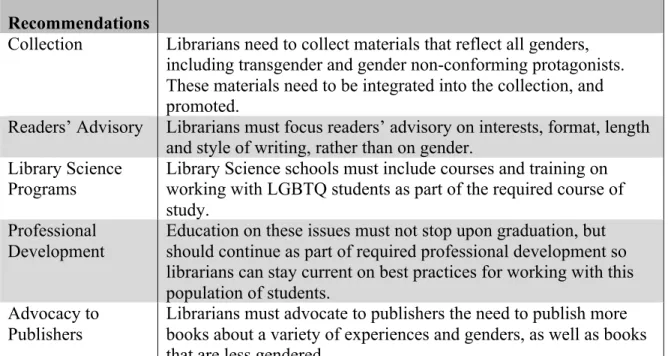
The knowledge these librarians shared is a solid starting point for how public libraries and school libraries can work to meet the needs of reluctant readers of all kinds while also addressing the need to create libraries that are welcoming and safe spaces for children who do not fall on the traditional gender binary. Several things need to be done in order to make a libraries meet both of these needs for all students.
Table 1: Recommendations for Librarians Working With Youth
Recommendations
Collection Librarians need to collect materials that reflect all genders, including transgender and gender non-conforming protagonists. These materials need to be integrated into the collection, and promoted.
Readers’ Advisory Librarians must focus readers’ advisory on interests, format, length and style of writing, rather than on gender.
Library Science Programs
Library Science schools must include courses and training on working with LGBTQ students as part of the required course of study.
Professional Development
Education on these issues must not stop upon graduation, but should continue as part of required professional development so librarians can stay current on best practices for working with this population of students.
Advocacy to Publishers
One thing that libraries need to continue doing is to focus on collecting materials that cover a wide range of diverse genders. Every library needs to collect and promote books from across the gender spectrum including transgender people. Youth of all kinds, no matter where they identify within the spectrum need to see diverse people in the books they read. These books need to be promoted in library materials and programs.
This research also indicates the need to provide readers’ advisory to reluctant readers regardless of gender. This could mean having lists of books across a range of topics, with all kinds of protagonists, and from all genres that are engaging, with an immediate grab, in a diverse range of formats and lengths. A reluctant reader may in fact be a male youth who wants to read sports books, and the library collection needs to include those resources, but that reader may also need fantasy, romance, or other realistic fiction. Every collection must provide for all of the various kinds of reluctant readers that may come in, regardless of gender.
education on these topics. Also, unless they are working at a library or school where this kind of training is required, many librarians may avoid this education completely if they do not want to seek it out. Library schools have a lot of curriculum to teach in a short span of time, and this kind of gender diversity training could improve practice for new librarians entering the field.
Because understanding of gender fluidity is still relatively nascent, it is important that education for libraries does not only occur in library masters programs. This
education and training must be ongoing, adding new information as it is explored and discovered. These librarians all indicated a willingness to learn more about these topics from their professional organizations, their equity leaders, and the conferences they go to. They also all mentioned having colleagues who do not understand these issues, and actively promote gender stereotypes and make unnecessary distinctions between boys and girls. Professional development would be helpful so that the onus of creating a safe environment for gender non-conforming youth does not lie solely on one or two librarians, but is addressed by a whole school or library, such as in Kathy’s case.
Finally, these librarians make the case for why librarians must continue to push publishers to make more titles available that cover a wide variety of experiences and identities, and also to pull back on marketing such heavily gendered items. The
Conclusion
Librarians who work with youth have a responsibility to help set youth up for a lifetime of success in reading. Connecting readers to the books they need is one crucial aspect of this responsibility. This is especially important for reluctant readers who may need more motivation than other students to finish a book, or even pick one up in the first place. Because librarians often cannot know every patron that comes into the library, they must make assumptions about the patrons they do not know in order to help them find the books they need. This research indicates that making assumptions based on gender alone may not be the most efficacious means of providing the best readers’ advisory. The growing understanding of gender fluidity indicates that librarians need to be more aware of what making assumptions about gender does to youth who do not identity on the gender binary.