First and Second Order Generalized Estimating Equations and Their
Application in Analyzing Longitudinal Microleakage Data
F. Zayeri1 , S. Bardineshin 2, AR. Akbarzadeh-Bagheban3, M. Adel 4,S. Asgari 4
1Assistant Professor, Proteomics Research Center, School of Paramedical Sciences, Shahid Beheshti University of Medical Sciences, Tehran, Iran
2MS Student, Department of Biostatistics, School of Paramedical Sciences, Shahid Beheshti University of Medical Sciences, Tehran, Iran
3Assistant Professor, Department of Biostatistics, School of Paramedical Sciences, Shahid Beheshti University of Medical Sciences, Tehran, Iran
4Assistant Professor, Department of Endodontics, School of Dentistry, Qazvin University of Medical Sciences, Qazvin, Iran 5Professor, Endodontic Research Center, School of Dentistry, Shahid Beheshti University of Medical Sciences, Tehran, Iran
Corresponding author: F. Zayeri
,
Assistant Professor, Proteomics Research Center, School of Paramedical Sciences, Shahid Beheshti University of Medical Sciences, Tehran, Iran [email protected]Received: 23 Nov 2011 Accepted: 25 Feb 2012
Abstract
Background and Aim: Longitudinal data are frequently obtained in medical studies. When the main aim of a study is marginal modeling of the mean and the correlation structure is considered as a nuisance parameter, the first- order generalized estimating equations (GEE1) is usually an appropriate option. However, when the modeling of correlation structure is considered the aim of a study, the second- order generalized estimating equations (GEE2) may be the first choice for analyzing the available data. The aim of the study was to evaluate application of first- and second-order generalized estimating equations to analyze longitudinal microleakage data.
Materials and Methods: In this study, the GEE1 and GEE2 methods were used to analyze the data from a study of microleakage in two root- end filling materials (CEM and MTA) in two different thicknesses and two diameters at three different times of measurement (one day, one week and one month after treatment). The obtained results from these statistical approaches were compared in continuous and binary (presence or absence) microleakage data.
Results: The results from the GEE1 and GEE2 methods showed that time of measurement, material type, diameter and thickness of filling material had significant effects on (continuous) microleakage rate. In addition, in binary microleakage data, these methods revealed that only time and material type were the significant factors. The correlations between measurements were not significant in continuous data, while they were significant in binary response microleakage data.
Conclusion: Since the correlations between pairs of measurements were not significant in continuous microleakage data and the obtained estimates were similar in both GEE1 and GEE2 methods, so the simpler GEE1 method seems to be adequate for these data. In contrast, in binary microleakage data, significant correlations were found between measurements. Therefore, in this case the GEE2 methodology may be used to estimate the correlation structure more efficiently.
Key Words: Microleakage, longitudinal study, GEE1, GEE2
Journal of Islamic Dental Association of IRAN (JIDAI) Winter2013 ;25, (1)
Introduction
Correlated medical responses are frequently seen in studies related to paired organs of the body, and in longitudinal studies. In these studies, the principle sampling unit is a group or a cluster of subjects (sampling unit), and one observation for each subject in a cluster is recorded. In longitudinal studies, the response variable and a collection of covariates for each subject (unit) are observed or measured at different times. Since these repeated measurements are obtained from each subject under study, thus these measurements should be considered as correlated observations [1,2]. Therefore, traditional methods should not be used in longitudinal data analysis [3], and the cor-relation between observations must also be consi-dered to achieve correct results and valid conclu-sions [1, 2, and 4].
There are two objectives in longitudinal data anal-ysis. First; modeling the marginal response proba-bilities as a function of covariates (marginal mod-eling), and second; modeling the correlation be-tween the response pairs (modeling the correlation structure). In the first case, the correlation structure is a nuisance parameter, and the first-order Genera-lized Estimating Equations (GEE1) gives a suitable solution, but in the second, the second-order Gene-ralized Estimating Equations (GEE2) produces an analytical solution, using correlation coefficient or odds ratio as a measure for the correlations [5, 6]. When data are quantitative, correlation coefficient is usually used, and when the data are binary, the odds ratio is used as a measure for correlations [7]. There is a long history of attempts to save and maintain teeth using various methods, and to date, a variety of treatments have been developed for preservation of teeth or remaining tissues. Endo-dontics is one of the most common treatment me-thods, aiming to maintain the treated tooth in a healthy and efficient state. This aim is achieved by early diagnosis, appropriate treatment strategy, cleaning and shaping the root canal cavity, and a full and dense 3-D filling with filling material of specific properties [8]. A major failure factor of endodontic treatment is penetration of bacteria or
their toxins through the crown or root canal to the periodontal space around the root. Leakage of these pathogens can cause widespread contamina-tion of the canal, both before root canal filling (in intervals between sessions), and after obturation and before permanent restoration of the crown. Therefore, root canal filling material should be chosen to have impermeable sealing properties to prevent leakage and subsequent contamination of the canal. This is even more important when tooth is still immature and the canal space is wider than normal. In such cases, a new technique called apic-al plug is performed for filling the root-end, using filling material (root-end filling). A retro-filling material should possess properties like good compatibility with tooth sidewalls (creating a good seal), dimensional stability, ability to induce ce-ment ogenesis, and bio-compatibility, without so-lubility, toxicity, or erosion. But, none of the mate-rials available have all these properties, and none is able to create a 100% seal. Thus, by examining the properties of existing material, researchers are al-ways trying to develop and introduce more suitable materials [9, 10].
Various materials have been used in periapical surgery. Mineral Trioxide Aggregate (MTA) is one such material, which was first introduced in 1993 as a root-end filling with good bio-compatibility. Due to satisfactory results achieved, this material is now considered one of the best endodontic bioma-terials, and is used by dentists worldwide. Howev-er, it has its flaws as well including difficulty of use, prolonged setting time, weak anti-microbial properties, discoloration of teeth, and cost [11, 12]. Considering advantages and disadvantages of MTA, a material has recently been developed by one of the authors of this manuscript (Dr Asgari) called Calcium Enriched Mixture (CEM). An ap-plication of this new material is treatment of apical plug for open-apex teeth. Therefore, this study aims to use first and second order Generalized Es-timating Equations for analysis of microleakage data, and introduction of a more suitable material for root-end filling of open-apex teeth with consid-eration for the thicknesses and diameter factors
.
Materials and Methods
Microleakage data: In this manuscript, the Data from a joint study by Endodontic Research Center at Shahid Beheshti University of Medical Sciences and Dentistry School of Qazvin University of Medical Sciences was used. In this experimental study, two different filling materials with two dif-ferent thicknesses (3 and 5 mm), and two difdif-ferent diameters (1.1 and 1.7 mm) were used for assess-ment of factors affecting the microleakage level. Each combination (2×2×2 modes) was investigated on 15 teeth (15 replicates), so 120 samples were studied in total. Then, microleakage level was measured on three occasions; the first day, the first week, and the first month (360 measurements in total), using a liquid filtration system with measur-ing unit in liters [13]. In addition to micro-leakage numerical data, micromicro-leakage binary data were also used (by converting numerical data to two states of, with and without microleakage). Data analysis:Since the repeated measurement of each tooth microleakage creates correlated res-ponses, thus the analysis of such data requires me-thods that consider these correlations [14, 15]. To determine the simultaneous effects of 4 indepen-dent variables (microleakage measuring time, type of filling material, thicknesses, and diameter of material), the marginal modeling and the first [16, 17], and second [18, 20] order Generalized Esti-mating Equations approaches were used. The SPSS software was employed for marginal modeling us-ing the GEE1 method, and MAREG software was used for the marginal modeling using the GEE2 approach. P-values les than0.05 were considered statistical significant.
Data structure: Assume there are t times of mea-surement for each subject (unit) in a longitudinal study. Hence, ithsubject (i= 1 …N) is observed on occasions, t=1, 2 … ti, where tiHt. For simplicity, assume ti=t. So, the response variable associated with ith subject at time t can be shown as yit and each subject has tvector of covariates xit with p×1 dimension. Therefore, the t×p matrix of Xi=[xi1,
…, xit]is the covariates matrix for ith subject.
Marginal model and correlation structures: mar-ginal modeling approach is one of the most com-mon methods for analyzing longitudinal data sets. A marginal model for longitudinal data analysis can be written as:
Where:
= Regression coefficients vector,
xit= Covariate vector it= mean response given xit
The link function g(.) relates the expectation of responses to the covariate vector, and type of link function depends on the type of response variable. Correlation parameters for the vector of repeated measures (cluster) are assumed to be independent of the regression parameters. The important as-sumption in this model is assuming a correlation between repeated observations for each sampling unit. Different structures (shown below) of this correlation are included in the model:
A) Independent structure: It assumes no correlation between responses in a cluster.
B) Exchangeable structure: It assumes equal correlation for each pair of data in a cluster. C) First order auto-regressive structure (AR1): It assumes that correlation between data diminishes with increasing the lag in measurement intervals. D) Stationary K-Dependent structure: It is similar to AR1, the only difference is that after time interval K, zero correlations are considered.
E) Unstructured structure: A distinct correlation parameter for each pairs of responses or two observations in a cluster is considered.
Estimating the Regression parameters (J) in the marginal model can be performed by either of the GEE1 or GEE2 approaches.
First order Generalized Estimating Equations: In this method, regression parameters are estimated by solving the following equation:
The ith subject covariance matrix is
(
)
0 )( 1
1
= =
= i i i
N
i i i V y
U µ µ
2 1 2 1
i i i
i A R A
V =
( )
µit xitg =
Where Aiis a diagonal matrix, and the elements on the main diagonal is given by;
(
Yit Xi)
( )
itVar = µ
Riis the working correlation matrix that determines data correlation structure.
Second order Generalized Estimating Equations: A set of estimating equations are now introduced that result in consistent estimates for both the re-gression and correlation parameters. These estimat-ing equations are called second order generalized estimating equations. Generally, in this method there are t(t-1)/2 second order expressions in the form of zi =
(
zi12,zi13,...,zi( )t1t)
which can be mod-eled using li( ) ( )
=Ezi and an appropriate link function. Correlation coefficient or odds ratio can be used as the measure of correlation [20]. For in-stance, in continuous data analysis, estimates of the regression and correlation parameters can be found by solving the following equation system:Where li
( )
is the correlation coefficient for the repeated observations.Results
Analysis of microleakage quantitative data: To investigate simultaneous effects of type of filling material, thicknesses, diameter, and time of mea-surement on the level of microleakage, the margin-al modeling using the GEE1 (in which, the correla-tion structure is considered as a parameter in the model) and GEE2 methods (in which, the correla-tion between observacorrela-tions is modeled separately) [20, 21] were utilized.
The following is the utilized marginal model:
( )
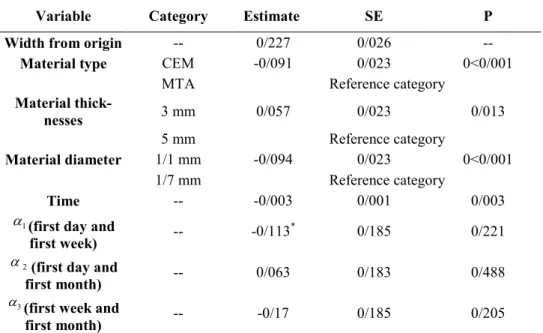
days t i Time Diameter Height Material Y E it 30 , 7 , 1 ; 120 ,..., 2 , 1 4 3 2 1 0 = = + + + + =Where, yit shows the microleakage level of the ith tooth at the tth time of measurement [22, 24]. The results of this model are shown in table 1. The ob-tained results from the marginal modeling using the GEE1 method for microleakage data indicate
that the time trend has significantly influenced the microleakage level (p=0.001). Also, the time pa-rameter estimate of -0.003 means an average daily reduction in microleakage level of 0.003 ml. In addition, type and diameter of the root-end filling material significantly influence microleakage level (p=0.001). According to these results, CEM filling material showed less microleakage level than MTA, and, level of microleakage was lower in 1.1 mm diameter than in 1.7 mm diameter of filling material. Also, filling material thicknesses made a significant difference in the level of microleakage (P=0.014), with this level being lower in 5 mm thicknesses than in 3 mm thicknesses .
Now, consider the marginal modeling using the GEE2 method for microleakage data. In this me-thod, the correlation between pairs of microleakage measuring times (day one, week one, and month one) is estimated using the Pearson’s correlation coefficient between repeated observations. Results of this model are shown in table 2.
The results of analysis of microleakage level data using GEE2 marginal modeling revealed that time trend has significantly reduced microleakage level (P=0.003). Also, the two filling materials were significantly different in terms of their effects on microleakage level (P<0.001), and according to the results obtained, the filling material CEM reduced microleakage level more than did MTA filling ma-terial. The thickness and diameter of filling materi-al materi-also had significant effects on microleakage lev-el (P=0.013 and P<0.001, respectivlev-ely), and micro-leakage was less at 5 mm thicknesses of filling ma-terial than at 3 mm thicknesses. Also, with 1.1 mm diameter of filling material microleakage level was less than what it was with 1.7 mm diameter. How-ever, no significant correlations was found be-tween pairs of microleakage measurements (be-tween the first day and the first week, the first day and the first month, or the first week and the first month) (P>0.05).
Analysis of binary microleakage qualitative data: In this step of data analysis, the marginal modeling using the GEE1 and GEE2 methods were utilized To investigate the simultaneous effect of type of
( ) ( )
( , ) ( ) 0
,
0 1
1
= =
= i i
i i i i i i i i N
i i i
i z y z V y z Cov z y Cov y V U l l l µ µ
* Values are in ml
* Correlation between microleakage levels in day 1 and week 1
filling material, thicknesses, diameter, and time on microleakage, First, marginal modeling with GEE1 estimating method for binary microleakage data was considered. The following is the utilize mar-ginal model:
( )
( )
days t
i
Time Diameter Height
Material Y
P Y P
it it
30 , 7 , 1 ; 120 ,..., 2 , 1
1 0
log 0 1 2 3 4
= =
+ +
+ +
= = =
In which, yit indicates the presence (code 1) or
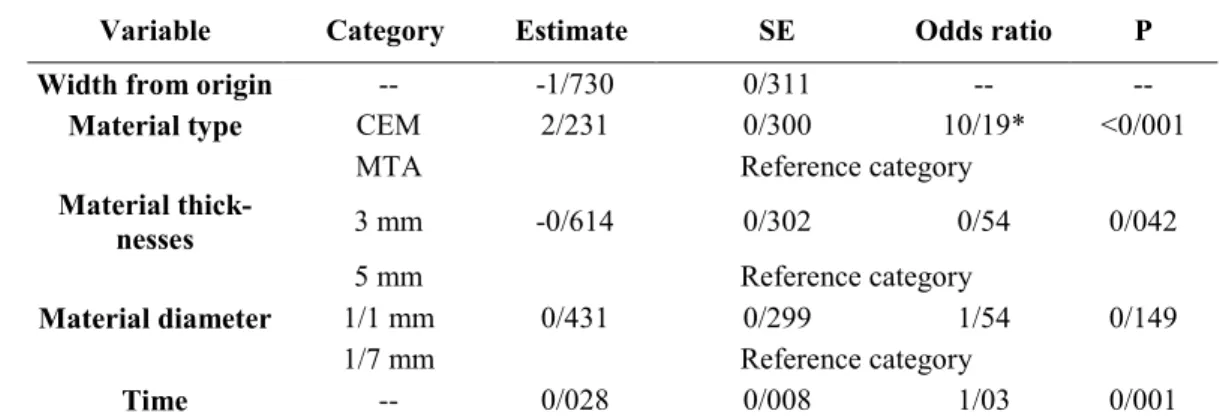
ab-sence (code 0) of microleakage in the ith tooth at the tth time of measurement [25]. The obtained results for this model are presented in table 3. Results of the analysis of microleakage data using the marginal modeling with GEE1 showed that the time trend has significantly influenced on the pres-ence of the microleakage (p=0.001). This means that the odds of absence of microleakage increased by 0.03 daily (OR=1.03). Also, the two filling
ma-Variable Category Estimate SE P
Material type CEM -0/091* 0/023* 0<0/001
MTA Reference category
Material
thickness 3 mm 0/057 0/023 0/014
5 mm Reference category
Material
di-ameter 1/1 mm -0/094 0/023 0<0/001
1/7 mm Reference category
Time -- -0/003 0/001 0/001
Variable Category Estimate SE P
Width from origin -- 0/227 0/026 --
Material type CEM -0/091 0/023 0<0/001
MTA Reference category
Material
thick-nesses 3 mm 0/057 0/023 0/013
5 mm Reference category
Material diameter 1/1 mm -0/094 0/023 0<0/001
1/7 mm Reference category
Time -- -0/003 0/001 0/003
1(first day and
first week) -- -0/113
* 0/185 0/221
2(first day and
first month) -- 0/063 0/183 0/488
3(first week and
first month) -- -0/17 0/185 0/205
Table 1. Results of the marginal modeling using the first and second order Generalized estimating equations
Table 2. Results of the marginal modeling using the first and second order Generalized Estimating Equations for the microleakage level data
terials differed significantly in terms of microlea-kage (p<0.001), and the odds of absence of micro-leakage was over 10 times with CEM as that with MTA (OR=10.19). Therefore, compared with MTA, CEM is recommended. The thicknesses of filling material also influenced microleakage sig-nificantly (p=0.042), and odds of absence of mi-croleakage at 3 mm thicknesses was 0.46 less than that at 5 mm thicknesses (OR=0.54). Therefore, it is recommended to use 5 mm thicknesses of filling material. However, the diameter of the filling ma-terial did not show a significant effect on the pres-ence of microleakage (p=0.149).
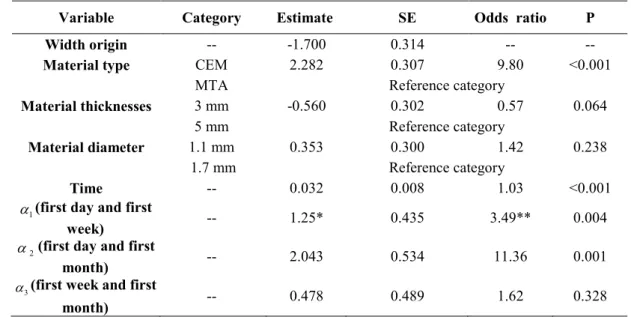
Finally, we present the obtained results from the marginal modeling using the GEE2 for the binary microleakage data. In this method, the odds ratio (OR) is used as the measure of correlation between pairs of binary responses, and the correlation be-tween microleakage at three times of measurement (the first day, the first week, and the first month) is estimated using paired odds ratio between repeated measures, assuming presence of dependence be
Discussion
To find consistent regression coefficients in GEE2 methodology, both the mean and correlation struc-tures should be properly identified. However, the main advantage of GEE1 is that, only correct iden-tification of mean structure is required, and eve this model are shown in table 4.
tween these observations. The obtained results for Analysis of microleakage data using GEE2 method revealed that time trend significantly influenced the presence of microleakage (p<0.001). Also, there was a significant difference between two fill-ing materials in terms of the presence of microlea-kage (p<0.001), and the odds of absence of micro-leakage with CEM was 10 times higher than with MTA (OR=9.8). Therefore, it is recommended to use CEM filling material instead of MTA. Howev-er, filling materials’ thickness and diameter did not significantly influence the presence of microlea-kage (p=0.064 and p=0.238, respectively). The association between the first day and the first week observations was significant (p=0.004), with value of 3.49 for the odds ratio of microleakage between the first day and the first week. Also, association between the first day and the first month observa-tions was significant (p=0.001), with an estimated odds of 11,36 for the presence of microleakage in the first day compared to first month.
with correlation structure not correctly identified, regression parameter estimates still remain consis-tent. Therefore, if in GEE2 method, significant efficiency is not obtained, GEE1 method can al-ways provide acceptable regression parameter es-timates [26].
Variable Category Estimate SE Odds ratio P
Width from origin -- -1/730 0/311 -- --
Material type CEM 2/231 0/300 10/19* <0/001
MTA Reference category
Material
thick-nesses 3 mm -0/614 0/302 0/54 0/042
5 mm Reference category
Material diameter 1/1 mm 0/431 0/299 1/54 0/149
1/7 mm Reference category
Time -- 0/028 0/008 1/03 0/001
Table 3. Results of the marginal modeling using the first order Generalized Estimating Equation for microleakage data
* The presence of microleakage is considered as the reference category
Laing et al in a simulation study showed that if correlation parameters are regarded as nuisance parameters, or if the number of clusters is large in comparison with the cluster size, the GEE1 method will be more efficient than the GEE2 for estimating the regression coefficients. Conversely, in cases where correlation parameters are important and their estimates is the researcher’s intention, or if the number of clusters is small, then GEE2 is the preferred option [27].
Analysis of microleakage data using both the first and second order Generalized Estimating Equa-tions methods were performed, and obtained re-sults indicate that type, thicknesses, and diameter of filling material significantly influence level of microleakage. In that, microleakage level is less with CEM filling material compared to MTA, and with 5 mm thicknesses, there is less microleakage compared with 3 mm thicknesses, also, 1.1 mm diameter produces less microleakage than 1.7 mm diameter. Results obtained with these methods in-dicate how time influences microleakage level, and that, this level decreases with passage of time. But, the results obtained using GEE2 method showed that correlation of microleakage levels was not significant between any of two measuring
occa-sions (between first day and first week, first day and first month, or first week and first month). Considering the obtained results from microleakage level data using GEE1 and GEE2 showed equal standard deviation for the estimates and regression parameters were significant similarly with both the methods. In addition, the correlation between ob-servations was not significant in GEE2 method, therefore use of GEE1 method (that is theoretically and practically simpler) would be sufficient. Analysis of binary microleakage data using both the first and second order Generalized Estimating Equations also was performed. Results obtained for both methods showed that time significantly influenced the presence of microleakage, which meant, the odds of absence of of microleakage (since tooth filling day) increased with passage of time. Also, there is a significant difference be-tween the two filling materials in terms of presence of microleakage, and non-existence chance of mi-croleakage is higher with CEM material than with MTA. Hence, CEM filling material is recommend-ed. However, filling material diameter did not sig-nificantly affect presence of microleakage. With GEE1 method, thicknesses of the filling ma
Variable Category Estimate SE Odds ratio P
Width origin -- -1.700 0.314 -- --
Material type CEM 2.282 0.307 9.80 <0.001
MTA Reference category
Material thicknesses 3 mm -0.560 0.302 0.57 0.064
5 mm Reference category
Material diameter 1.1 mm 0.353 0.300 1.42 0.238
1.7 mm Reference category
Time -- 0.032 0.008 1.03 <0.001
1(first day and first
week) -- 1.25* 0.435 3.49** 0.004
2(first day and first
month) -- 2.043 0.534 11.36 0.001
3(first week and first
month) -- 0.478 0.489 1.62 0.328
Table 4. Results of the marginal modeling using the second order Generalized Estimating Equations for the presence of microleakage data
-terial showed a significant effect on presence of microleakage, and the odds of absence of micro-leakage was less at 3 mm thicknesses than at 5 mm thicknesses. But, with GEE2 method, filling ma-terial thicknesses did not show any significant ef-fect. Also, results of GEE2 showed significant as-sociation between first day and first week, and also between first day and first month.
Given the results from the GEE1 and GEE2 me-thods for presence of microleakage data, it is clear that standard deviations of estimates are the same and significance of regression parameters are also the similar with both methods. But, since correla-tion between repeated measures in GEE2 was sig-nificant, use of GEE2 method will produce more explicit estimates of these correlations.
Apical microleakage is an important factor in the etiology of root canal treatment failure. For suc-cessful treatment of roots of immature teeth, mi-nimal canal preparation and then, placement of filling material with apical plug technique is sug-gested. A variety of materials are used for this purpose, which should be capable of creating a proper and compatible seal. MTA is an expensive material with difficult clinical application. Hence, it seems logical to produce an alternative material in this country that is inexpensive and widely available. So, it is necessary to conduct investiga-tions and compare alternative materials with the original [28].
Many studies have been conducted in the field of microleakage, but comparative association of these studies and the present one is a difficult task. Since in these studies different time intervals, different root-end filling materials, and different microlea-kage measurement methods have been used. In a study by Razmi et al with the aim to compare mi-croleakage levels using MTA and CEM materials, results revealed that CEM had lower leakage than MTA. These results are in agreement with the re-sults obtained in this study that showed less micro-leakage with CEM compared with MTA [12]. Al-so, in an investigation by Asgari et al, sealing properties of CEM and MTA as root filling mate-rials were the same, and better than that of IRM. In
their study, investigation of microleakage level in CEM and its comparison with MTA and IRM has shown that the created seal in these three materials were IRM<MTA< CEM respectively. But there was no significant difference between CEM and MTA. So, it became clear that the seal property created by CEM and MTA was the same and both better than IRM [29]. Also, Zafar et al in their study evaluating sealing capability of three filling materials MTA, CEM, and AH26 concluded that, sealing capability of CEM was better than the rest [30].
A notable point in the above studies is that most of them used classic statistical tests (like, t-test and ANOVA test) for comparing different groups. But, the important point with this study was application of new and relatively complex statistical models for the analysis of data and subsequent presenta-tion of more accurate results for comparison be-tween groups. Accordingly, it is suggested that for the analysis of data that is normally collected over time in the form of repeated measurements, ad-vanced statistical models should be used, in which simultaneous effects of several factors on the re-sponse variable, correlation between data, and in-fluence of time are taken into account.
Conclusion
When modeling the mean is of utmost importance (correlation parameter is considered as nuisance), GEE1 could be the best choice for estimating re-gression parameters, without the need for modeling correlation parameter. But, if correlation modeling is the main goal, GEE2 is the best method for es-timating regression and correlation parameters si-multaneously. Our findings indicate that in treat-ment of apical plug, it is better to use CEM for fill-ing root-end of teeth with open apex.
REFERENCES
1- Liang KY, Zeger SL. Longitudinal data analysis using generalized linear models. Biometrika 1986 Jan;73(1):13-22.
2- Gardiner JC, Luo Z, Roman LA. Fixed effects, random effects and GEE: What are differences? Stat in Med. 2009 Jan;28(2):221-239.
3- Doboson A. An introduction to generalized linear models, 2 nd ed. Florida: Chapman & Hall/ CRC; 2002.
4- Qu A, Song P. Assessing robustnesse of generalized estimating equations and quadratic inference functions. Biometrika 2004 Nov; 91(2): 447-459.
5- Carey V, Zeger SL, Diggle P. Modeling multivariate binary data with alternating logistic regressions.Biometrika 1993 Sep;80(3):517-526. 6- Ananth CV, Kantor ML. Modeling multivariate binary responses with multiple levels of nesting based on alternating logistic regressions: An application to caries aggregation.J Dent Res. 2004 Oct;83(10):776-781.
7- Zeger SL, Liang KY. An overview of methods for the analysis of longitudinal data. Stat In Med. 1992 Oct-Nov; 11(14-15):1825-39.
8- Farhad AR, Javadi GHR. [An in vitro compari-son of apical microleakage in two obturation tech-niques: Lateral condensation and one- step]. J Isfa-han Dent Sch. 2006 Spring;2(1):39-45. (Persian) 9- Tabrizizadeh M, Aghajani A. [An in vitro eval-uation of microleakage of three temporary restora-tive materials used between endodontic appoint-ments]. J Islamic Dent Assoc of IRAN. 2002 Spring; 1(40):5-14. (Persian)
10- Al-Kahtani A, Shostad S, Schifferle R, Bhambhani S. In-vitro evaluation of microleakage of an orthograde apical plug of mineral trioxide aggregate in permanent teeth with simulated immature apices. J Endod. 2005 Feb; 31(2):117-119.
11- Torabinejad M, Watson TF, Pitt Ford TR. Sealing ability of mineral trioxide aggregate when used as a root end filling material. J Endod. 1993 Dec;19(12):591-5.
12- Razmi H, Shokouhinejad N, Fekrazad R, Mo-tahary P, Alidoust M. [Comparison of the sealing ability of two root- end filling material (MTA and CEM Cement) following retropreparation with
ul-trasonic or ER, CR: YSGG laser]. J Dent Med. 2010 Winter; 4(61):144-151. (Persian).
13- Javidi M, Naghavi N, Roohani E. Assembling of fluid filtration system for quantitative evaluation of microleakage in dental materials.Iranian Endod J. 2008 Summer; 3(3):68-72.
14- Lindsey JK. Models for repeated measure-ments, 2nd ed. New York: Oxford University Press; 1999.
15- Fitzmaurice GM, Laird NM, Ware JH. Applied longitudinal analysis. New York: John Wiley & Sons; 2004, Chapter 13-14.
16- Catalano PJ. Bivariate modeling of clustered continuous and ordered categorical outcomes. Stat in Med. 1997 April; 16(8):883-900.
17- Liang KY, Zeger SL. Longitudinal data analy-sis using generalized linear models. Biometrika J. 1986 Jan;73(1):13-22.
18- Lipsitz SL, Laird NM, Harrington DP. Generalized estimating equations for correlated binary data: Using the odds ratio as a measure of association. Biometrika 1991Dec;78(1):153-160. 19- Prentice RL.Correlated binary regression with covariates specific to each binary observation. Biometrics J. 1988 Dec;44(4):1033-1048.
20- Wu R, Connolly D, Ngelangel C, Bosch FX, Munoz N, Cho KR. Somatic mutations of fibrob-last growth factor receptor 3 (FGFR3) are uncom-mon in carcinomas of the uterine cervix. Onco-gene. 2000 Nov;19(48):5543-6.
21- Hardin JW, Hilbe JM. Generalized estimating equations. New York: Chapman & Hall/CRC; 2002.
22- Diggle PJ, Heagerty P, Liang KY, Zeger SL. Analysis of longitudinal data, 2nd ed. New York: Oxford University Press; 2002.
23- Qu Y, Piedmonte MR, Medendorp SV. Latent variable models for clustered ordinal data. Biome-trics J. 1995 March;51(1):268-75.
24- Williamson JM, Lipsitz SR, Kim K. Geecat, Geegor: Computer programs for the analysis of correlated categorical response data. Computer Metho Prog In Biomed. 1999 Jan;58(1):25-34.
25- Kleinbaum DG, Klein M. Logistic regression, A self- Learning Text, 3rded. NewYork: Springer; 2005.
26-Balemi A, Lee A. Comparison of GEE1 and GEE2 estimation applied to clustered logistic regression. J Stat Comput Simul. 2009 April; 79 (4):361-378.
27-Liang KY, Zeger SL, Qaqish B. Multivariate regression analyses for categorical data. J Royal Stat Soci. Series B. 1992 Jan;54(1):3-40.
28-Abedi H, Jalalzadeh M, Khoushbin E, Rahbar-zadeh GH. [In- vitro evaluation of apical microlea-kage using three different root- end filling mate-rials]. J Dent (Shiraz Univ Med Sci). 2009 Fall; 3(24):249-254. (Persian)
29-Asgary S, Eghbal MJ, Parirokh M. Sealing ability of a novel endodontic cement as a root-end filling material. J Biomed Mat Res. 2008 Dec; 87 (3):706-709.
30-Zafar M, Iravani M, Eghbal MJ, Asgary S.
Coronal and apical sealing ability of a new endodontic cement.Iranian Endod J. 2009 Winter; 4(1):15-19.