Automatically Extracting Variant-Normalization Pairs
for Japanese Text Normalization
Itsumi Saito Kyosuke Nishida Kugatsu Sadamitsu∗
Kuniko Saito Junji Tomita NTT Media Intelligence Laboratories
{saito.itsumi, nishida.kyosuke}@lab.ntt.co.jp {saito.kuniko, tomita.junji}@lab.ntt.co.jp
Abstract
Social media texts, such as tweets from Twitter, contain many types of non-standard tokens, and the number of nor-malization approaches for handling such noisy text has been increasing. We present a method for automatically extracting pairs of a variant word and its normal form from unsegmented text on the basis of a pair-wise similarity approach. We incor-porated the acquired variant-normalization pairs into Japanese morphological analy-sis. The experimental results show that our method can extract widely covered vari-ants from large Twitter data and improve the recall of normalization without degrad-ing the overall accuracy of Japanese mor-phological analysis.
1 Introduction
Social media texts contain many non-standard tokens (lexical variants), e.g., by lengthen-ing (“goooood” for “good”) or abbreviatlengthen-ing them (“tmrw” for “tomorrow”). Current lan-guage processing systems often fail to ana-lyze such non-standard tokens, so normaliz-ing them into standard tokens as a prepro-cess is promising for analyzing such noisy texts robustly (Cook and Stevenson, 2009; Han et al., 2012;Li and Liu,2012,2014). The normalization task mainly consists of two components. One is detecting variant words and generating normaliza-tion candidates. The other is constructing a word lattice from possible normalization candidates and decoding to select the best normalized word se-quences. Early work on normalization focused on supervised approaches using labeled text, e.g., an approach based on a statistical machine translation
∗
Present affiliation: Future Architect,Inc.
(Aw et al., 2006; Pennell and Liu, 2011). How-ever, social network service (SNS) text has a dy-namic nature, and large SNS text is costly to an-notate. Recent work has been focused on unsuper-vised approaches. For example,Han et al.(2012) proposed generating variant-normalization pairs automatically on the basis of distributional simi-larity and string simisimi-larity. Hassan and Menezes (2013) developed the approach by using a graph-based approach. Yang and Eisenstein (2013) in-troduced a highly accurate unsupervised normal-ization model. As just described, unsupervised methods have been developed for English normal-ization tasks.
Japanese SNS text also contains variant words, and several normalization methods have been pro-posed (Sasano et al.,2013;Kaji and Kitsuregawa, 2014;Saito et al.,2014). The basic framework of Japanese normalization is quite similar to that of English normalization. However, the problem is more complicated in Japanese normalization be-cause Japanese words are not segmented using explicit delimiters, so we have to estimate word segmentation simultaneously in the decoding step. Variant words are also more difficult to extract automatically in Japanese than in explicitly seg-mented languages such as English. Unlike En-glish normalization, the approaches for generating normalization candidates in Japanese are based on manually created rules or supervised training us-ing annotated text. Japanese normalization con-tains problems to which the English unsupervised approach is simply applied. Although the English unsupervised approach assumes that there are ex-plicit word segmentations, conventional analyz-ers often fail to segment non-standard words in Japanese. Therefore, to extract variants in an un-supervised fashion, we have to introduce an idea to generate correct word segmentation of variant words.
Our idea for this problem is to use short sen-tences and phrases in SNS text. SNS text, like tweets from Twitter, contains many short sen-tences and phrases consisting of a single word or several words. For Example, “
(ohayon, Good Morning)” is a variant form of “
(ohayou),” and “ (cho
samii, It is very cold)” is a variant form of “
(cho, very)/ (samui, cold).” Since these short sentences often contain variant words, they can be used as efficient cues for extracting a variant word. Our idea is to not extract a variant-normalization pair in one step. Instead, we present a two-step normalization approach. In the first step, we ex-tract coarse candidates for variant-normalization pairs from unlabeled text, and in the second step, we incorporate the extracted pairs into Japanese morphological analysis and normalization. The appropriate normalization candidates are selected in the second step. We use training data for mor-phological analysis in the second step but do not use annotated data in the first step. Therefore, we can efficiently extract many types of variant-normalization pairs that appear in real text.
The contributions of this study are summarized as follows.
• We developed a new method for extract-ing pairs of variant and normal forms from tweets, which have no explicit delimiters, by focusing on short phrases and sentences in Twitter.
• We incorporated the variant-normalization pairs extracted by our method from tweets into a Japanese morphological analysis method and statistically significantly im-proved the accuracy for variant words with-out degrading the overall accuracy for Japanese morphological analysis.
2 Background
2.1 Japanese Morphological Analysis
As we mentioned above, we have to consider Japanese normalization tasks with Japanese mor-phological analysis. In this section, we describe the basic idea of Japanese morphological analy-sis. Japanese Morphological analysis can be in-terpreted as ranking while using a word lattice and scores of each path (Kaji and Kitsuregawa, 2013). There are two points to consider in the analysis procedure: how to generate the
とー
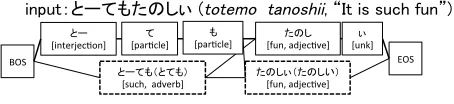
Figure 1: Example of Japanese morphological analysis and normalization
word lattice and how to formulate the score of each path. In Japanese morphological anal-ysis, the dictionary-based approach has been widely used to generate word lattices (Kudo et al., 2004; Kaji and Kitsuregawa, 2013). To calcu-late the score of each path, two main scores are widely used: the score for a candidate word and the score for a pair of adjacent parts-of-speech (POSs). We can consider other various scores by using discriminative model (Kudo et al.,2004; Kaji and Kitsuregawa,2013).
2.2 Related Work
Several studies have been conducted on Japanese morphological analysis and normalization. The approach proposed bySasano et al.(2013) devel-oped heuristics to flexibly search by using a sim-ple, manually created derivational rule. Their sys-tem generates a normalized character sequence based on derivational rules and adds new nodes when generating the word lattice using dictionary lookup. Figure1presents an example of this ap-proach. If the non-standard written sentence “
(totemo tanoshii, It is such fun)” is
input, the traditional dictionary-based system gen-erates nodes that are described using solid lines, as shown in Figure1. Since “ (totemo, such)” and “ (tanoshii, fun)” are Out Of Vocabulary (OOVs), the traditional system cannot generate the correct word segments or POS tags. However, their system generates additional nodes for the OOVs, shown as broken line rectangles in Figure1. In this case, derivational rules are used that substitute “ ” with “null” and “ (i)” with “ (i)”, and the system can generate the stan-dard forms “ (totemo, such)” and “
(tanoshii, fun)” and their POS tags. If we can
Figure 2: Overview of proposed system
ranking the word lattice when the number of can-didates increases becomes a serious problem.
Saito et al. (2014) proposed supervised extrac-tion of derivaextrac-tional patterns (we call them trans-formation patterns), incorporated these patterns into a word lattice, and formulated morphologi-cal analysis and normalization using a discrimi-nate model. Although this approach can generate broad-coverage normalization candidates, it needs a large amount of annotation data of variant words and their normalization. Kaji and Kitsuregawa (2014) also proposed morphological analysis and normalization based on a discriminative model and created variant words on the basis of hand-made rules. As far as we know, automatic extrac-tion of variant-normalizaextrac-tion pairs has not been re-searched. If we can extract variant-normalization pairs automatically, we can decrease the annota-tion cost and possibly increase accuracy by com-bining our method with other conventional meth-ods.
Several studies have applied a character-based approach. For example, Sasaki et al.(2013) pro-posed a character-level sequential labeling method for normalization. However, it handles only one-to-one character transformations and does not take the word-level context into account. The proposed method can handle many-to-many character trans-formations and takes word-level context into ac-count, so it has a wider scope for handling non-standard tokens.
Many studies have been done on text normaliza-tion for English; for example, Han and Baldwin (2011) classifies whether or not OOVs are non-standard tokens and estimates standard forms on the basis of contextual, string, and
phonetic similarities. Han et al. (2012) and Hassan and Menezes (2013) developed the method of extracting variant-normalization pairs automatically for English. Yang and Eisenstein (2013) introduced a highly accurate unsupervised normalization model using log-linear model. In these studies, clear word segmentations were assumed to exist. However, since Japanese is unsegmented, the normalization problem needs to be treated as a joint normalization, word segmentation, and POS tagging problem.
Thus, we propose automatically extracting nor-malization candidates from unlabeled data and present a method for incorporating these candi-dates into Japanese morphological analysis and normalization. Our method can extract new vari-ant patterns from real text.
3 Proposed Method
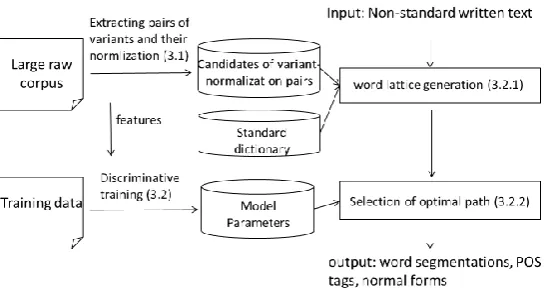
Our method consists of two parts. The first in-volves extracting normalization candidates and their normal forms from unlabeled data. The sec-ond involves a morphological analysis and nor-malization using extracted variants. Basically, we use a previously proposed dictionary based approach (Sasano et al., 2013; Saito et al., 2014; Kaji and Kitsuregawa, 2014), but the method for generating normalization candidates and some features used in a discriminative model are new. The proposed system is illustrated in Figure2.
Twitter data
Extracting short sentences and phrases
short phrase list
coarsely
Figure 3: Flow of generating coarsely segmented corpus
method assigns a node to not only single words but also short phrases (See.3.1). To calculate similar-ity between two nodes, we use semantic similarsimilar-ity and phonetic similarity. After calculating ity, we filter the pairs that do not exceed a similar-ity threshold. We use word embeddings as a se-mantic similarity measure. We describe this more precisely in3.1.2.
In the second part, the problem is how to incor-porate extracted variants into Japanese morpho-logical analysis. We use a discriminative model and Viterbi decoding for estimating word seg-mentation, POS tagging, and normalization. To prevent degradation induced by incorporating ex-tracted variants, we introduce many types of fea-tures. We describe this more precisely in3.2.
3.1 Extracting Candidates of
Variant-Normalization Pairs from Twitter Texts
3.1.1 Preparation of Coarsely Segmented Corpus Using Short SNS Sentences and Phrases
We have to prepare a segmented corpus for gen-erating normalization candidates and calculating similarity. The flow of generating coarsely seg-mented corpus is shown in Figure3. As we men-tioned above, we cannot determine the explicit word segmentation of unlabeled data, especially for variant words. However, we can assume that there are some explicit segmentations in text: the left and right ends of sentences and symbols such as punctuation, brackets, pictographs, emoticons, linefeed characters, commas, and spaces. SNS text contains many short sentences and phrases con-sisting of a word or several words. Our idea is to use the units of short sentences and short phrases delimited in symbols in SNS text as cues for ex-tracting variant words.
More specifically, we first segment large Twitter
text with several predefined symbols, extract acter sequences consisting of ten or fewer char-acters, and insert them into a standard dictionary. Then we segment the large twitter corpus using an expanded dictionary and conventional analyzer. An example of a segmented sentence using an ex-panded dictionary is “ (ohhayou)/ (Good morning!)”, whereas the result using a stan-dard dictionary is “ (o)/ (ha)/ (yo)/ (u)/ ” Since this segmented text contains several segmentation errors and noise, we extract reliable candidates using a similarity threshold described in the next subsection.
3.1.2 Similarity Measures
To calculate the similarity between two nodes wi
andwj appearing in a segmented corpus (3.1.1),
we mainly use two similarity measures: semantic and phonetic.
Semantic Similarity We calculate semantic
similarity between wi and wj by inducing dense
real-valued low-dimensional embeddings from large unlabeled text (Mikolov et al., 2013). We use the tool word2vec 1 to calculate embeddings
of each node. Semantic similarity is defined as
semsim(wi, wj) =cos(vec(wi), vec(wj)) (1)
This semantic similarity is used as a feature of a normalization and morphological analysis model (3.2.3). We set the embedding size is 200.
Phonetic Similarity We first convert a surface
string into pronunciations (Japanese Kanji to Hira-gana) and calculate the edit distance. We use two types of edit distance: standard and modified. For calculating modified edit distance, we set the sub-stitution cost of two strings 0.5 when two strings have the same vowels, two strings have the same consonant or two strings are vowels. We also set insertion and deletion cost of vowels 0.5, while the standard cost of substitution, insertion and dele-tion is 1.
p(mi, mj) = 1−MED(mi, mj)/OC(mi, mj)
(3) Where OC(mi, mj) indicates the total number
of operations for calculating edit distance of mi
and mj and MED(mi, mj) indicates the
modi-fied edit distance. mi and mj indicate the
mor-phemes inwiandwj, respectively.
To calculate morphological-level features, we analyzed wj using conventional morphological
analyzer and make morphological-level alignment using character-level alignment ofwi andwj and
morphological information ofwj. Here,wjandwi
are regarded as a normal form and a variant form, respectively. Here is an example ofwi = “
(birthday)” andwj= “
(birth-day)”. In this case, morphological-level alignment
is ( / , / ) since
character-level alignment is ( / , / , / , / , / , / ) and word segmentation ofwj is (
, ).
3.1.3 Candidate Filtering using Similarity Measures
We calculate the pairwise similarity between two nodes appearing in a segmented corpus (3.1.1) and their filter using a similarity measure we de-fined (3.1.2). The set of nodesN consists of all tokens w that appear in the segmented corpus. Since there is a huge number of node pairs and most are irrelevant, we have to filter the pairs that have low similarities. Here, we set the thresh-old ofsemsim to 0.4, and the threshold of stan-dard phonetic edit distance is 2. Moreover, we filter the pairs in which the consonants of the be-ginning phonetic symbols of each morphemes are different or morphological-level phonetic similar-ity p(mi, mj) is lower than 0.6. We also filtered
the candidates when the number of consonants and all characters in a variant form (except for “ ”, “ ”, and lower case letters) are larger than that of a normal form at morphological level. If a vari-ant word is already exists in a standard dictionary, we filtered the candidate. Note that this filtering is not intended to exactly identify whether the pair has the relationship of variant and normalization. Since we use only two similarities, simple pho-netic information and the coarsely segmented cor-pus in this phase, we only extract candidates of variants and their normal forms coarsely in the first step. Then, we exactly identify the word seg-mentation and normalization simultaneously in the
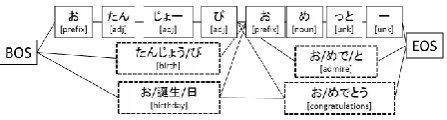
Figure 4: Example of proposed lattice
second step (3.2).
3.2 Normalization and Morphological Analysis
3.2.1 Incorporating Normalization
Candidates in Japanese Morphological Analysis
We generate the word lattice using extracted can-didate for variant-normalization pairs and dictio-nary lookup (See Figure4). The broken line rect-angles in Figure4 are nodes added by the pro-posed method. We exploit dictionary lookup by using the possible character sequence of the ex-tracted normalized character sequences when vari-ant character sequences match the input charac-ter sequences. For example, we exploit dictio-nary lookup for input character sequences such as
“ (happy birthday)”
and add the possible normalized word sequences such as “ / / birthday ” and “ /
(congratulations)” which are from extracted variant-normalization candidates. The proposed method is intended to generate normalized word sequences. In the first step, appropriateness of word segmentation is not taken into account, but in this phase, we can exactly evaluate whether the acquired pair is appropriate for normalization or not by considering the morphological connectiv-ity.
3.2.2 Objective Function
We used a discriminative model for incorporating many features. The decoder selects the optimal se-quenceyˆfromL(s)when given the candidate set
L(s)for sentences. This is formulated as follows (Jiang et al.,2008;Kaji and Kitsuregawa,2013):
ˆ
y= arg max
y∈L(s) w·f(y) (4)
Name Feature
Word unigram score fmipi
POS bi-gram score fpi−1,pi Character sequence score 1/log(p′
ti/p′s)ifp′ti > p′sotherwise0. where,p′
x=p1/length(x)x ,px =∏kj=1p(cj|cjj−−15),x∈(s, ti)
Character similarity score log(psim)
Semantic similarity score log(semsim)
Character frequency score log(freqw+ 1)
Character and morph transformation score log(freqct+ 1),log(freqmt+ 1),ϕct,ϕmt
Table 1: Feature list
weight vectorwand feature vectorf(y). The opti-mal path is selected in accordance with thew·f(y)
value. For estimating parameters, we used the av-eraged perceptron, which is widely used (Collins, 2002).
3.2.3 Features
The proposed lattice generation method generates a lattice larger than that generated in traditional dictionary-based lattice generation. Therefore, we need to introduce appropriate normalization scores into the objective function to prevent degradation. Table1lists the features we used. Letmibe theith
word candidate andpi be the POS tag ofmi.pi−1
andmi−1are adjacent POS tag and word,
respec-tively. We used the word unigram scorefmipi, the cost for a pair of adjacent POSs fpi−1,pi that are estimated by MeCab2, and additional scores.
The character sequence score reflects the char-acter sequence probability of the normalization candidates (Saito et al.,2014). Here, sandti are
input string and transformed string, respectively (e.g., in Figure4, for the normalized node ”
(birthday)”,sis ” ”
andtiis ” ”. Thenpsandpti are calculated by using the character 5-gram of a news corpus. cj is the jth character of character
sequence. We also used character sequence score as a candidate filter. We filtered the candidates that did not satisfy the pre-defined condition that
p′
s≤p′ti.
The character similarity score is calculated using psim (see 3.1.2). The semantic sim-ilarity score is calculated using semsim (see 3.1.2). The Character frequency score is a fre-quency of surface character sequences of ant nodes appeared in news data. Since
vari-2http://taku910.github.io/mecab/ (in Japanese)
ant words rarely appear in the news data, we use this feature to identify variant words and stan-dard words. The character and morph transfor-mation score is related to transfortransfor-mation patterns.
log(freqct+ 1)andlog(freqmt+ 1)are the
fre-quency of transformation patterns ct (character-level) and mt (morphological-level) that are ex-tracted from variant-normalization candidates, re-spectively. ϕct and ϕmt are 1 if a node contains
transformation patternsctandmt, otherwise 0, re-spectively. The scale of features were adjusted.
Since all those features can be factorized, the optimal path is searched by using the Viterbi algo-rithm.
3.2.4 Candidate Expansion
Although our method can extract many variants, we expand the variants to achieve higher recall. We use a simple rule for adding simple variation in the decoding step. For example, first, repeti-tions of more than one character of “ ”, “ ” and “ ” are reduced to one character and repetitions of more than three characters of Japanese Hiragana and Katakana are reduced to three characters and one character. Moreover, we use the patterns of deletions of “ ”, “ ”, “ ” and lowercase char-acters (Saito et al.,2014).
4 Experiments
4.1 Data and Settings
variant forms norm forms translation semsim
(ureshiii) (ureshii) happy 0.655
(ureshii) (ureshii) happy 0.684
(ureshii) (ureshii) happy 0.575
(uresui) (ureshii) happy 0.568
(uretii) (ureshii) happy 0.649
(ureshishu) (ureshii) happy 0.715
(kawaee) (kawaii) cute 0.744
(kanwaii) (kawaii) cute 0.683
(kyawaii) (kawaii) cute 0.770
/ / / (o/negee/shi/masu) / / / (o/negai/shi/masu) please 0.657
/ / / (o/nagai/si/masu) / / / (o/negai/shi/masu) please 0.590
/ / / (o/negai/shi/mahu) / / / (o/negai/shi/masu) please 0.678
/ (tikare/ta) / (tukare/ta) I’m tired 0.742
/ (o/medeto) / (o/medetou) congratulations 0.911
/ (o/medeto) / (o/medetou) congratulations 0.796
/ (o/metto) / (o/medetou) congratulations 0.753
/ (o/meteto) / (o/medetou) congratulations 0.665
Table 2: Example of extracted pair of variants-normalization candidates
word segmentations, POS tags, and normal forms for variant words and consist of 7,213 sentences and 995 variant words. We used Unidic (unidic-mecab)3as a standard dictionary.
4.2 Baselines and Evaluation Metrics
We compared the three methods listed in Ta-ble 3 in our experiments. Conventional means a method that generates no normalization candi-dates and only uses the word cost and the cost for a pair of adjacent POSs, so we can consider it as a conventional Japanese morphological anal-ysis. Rule-based means the conventional rule-based method proposed by Sasano et al. (2013). The rule-based method considers insertion of long sound symbols and lowercase characters and sub-stitution with long sound symbols and lowercase characters. We basically use the transformation rule ofSasano et al.(2013) and use three features for the model of Rule-based method: the word score, score for a pair of adjacent POSs, and char-acter transformation score. The charchar-acter trans-formation score is constant for all transtrans-formation rules. Proposed is our method. We used ex-tracted variant-normalization pairs and all features described in3.2.3.
We evaluated each method on the basis of preci-sion, recall, and the F-value for the overall system accuracy and the recall for normalization. Since Japanese morphological analysis simultaneously
3http://osdn.jp/projects/unidic/ (in Japanese)
estimates the word segmentation and POS tagging, we have to assess whether or not adding the nor-malization candidates negatively affects a system.
4.3 Results
4.3.1 Results of Extracted
Variant-Normalization Candidates
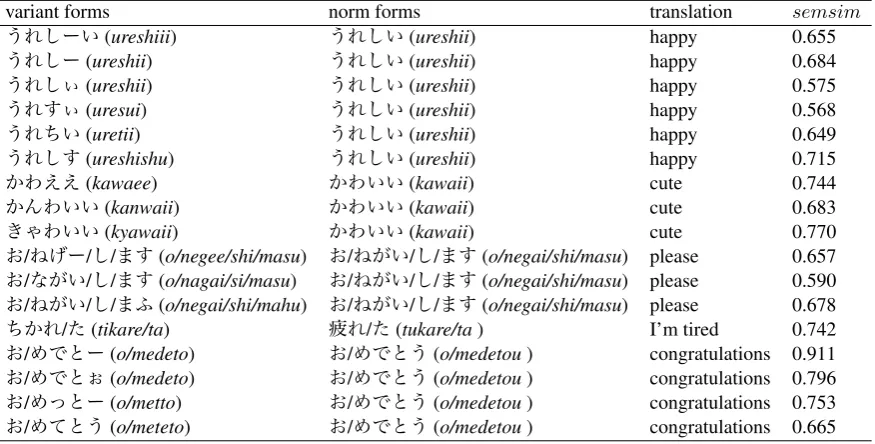
Table 2 lists examples of the extracted variant-normalization candidates. Our method automat-ically extracted well-known transformation pat-terns such as substitution of lowercase characters, insertion of lowercase characters, and insertion of “ ” and “ ” such as “ (ureshii)”.
Our method also extracted more variant pho-netic transformation patterns such as substitu-tion of “shi” with “pi,” “ji,” or “hi” and these combinations such as “ (uretii)”. We also list examples of extracted multi-word variant-normalization pairs. The phrase “ /
/ / (o/nege/shi/masu)” is a variant
pat-tern of the original phrase “ / /
(o/negai/shi/masu)”. Our method extracted these
multi-word mappings.
Moreover, our method can extract typing errors such as / (o/medetou) with “ /
(o/meteto)” and slang such as (
ure-shisu) with (ureshii). Such relatively
word seg word seg and POS tag normalization
method prec rec F prec rec F rec
Conventional 0.865 0.949 0.905 0.837 0.919 0.876 -Rule-based 0.879 0.952 0.914 0.848 0.918 0.881 0.294 Proposed 0.882 0.951 0.915 0.851 0.918 0.883 0.340
Table 3: Test data (Twitter) precision, recall, and F-value results
proposed conventional gold translation
(1) ( ) / ( ) / I thought
omo(omott) /ta omota omo(omott) /ta
(2) ( ) / / ( ) violin
bayorin(baiorin) ba/yo/rin bayorin(baiorin)
(3) ( ) / / ( ) cute
kanwaii(kawaii) kan/wa/ii kanwaii(kawaii)
(4) ( ) / ( ) It is cold
samu(samui) sa/mu samu(samui)
(5) ( ) / ( ) It is funny
waroeru(waraeru) waro/eru waroeru(waraeru)
(6) / / ( ) Kingdom
oo/koku oo/koku ookoku(oukoku)
(7) ( ) / / ( ) Twitter
tuitta(tuitta) tu/i/ta tuitta(tuitta)
“/” indicates the estimated word segmentation. Words in parentheses “()” are esti-mated normal forms. Underlined words are variant words.
Table 4: Example of morphological analysis and normalization outputs
pairs. This often degrades the results of morpho-logical analysis. We use a discriminative model to prevent such paraphrase pairs appearing in the decoding step.
4.3.2 Morphological Analysis and Normalization Results
Tables 3 and 4 list the results for the Twitter text. The F-value of the proposed method is sig-nificantly higher than those of the conventional method and rule-based method. Our method was able to extract broad-coverage variant words, and these candidates also improve the recall of normal-ization without degrading the overall accuracy of morphological analysis.
Table4show examples of the system output. In the table, slashes indicate the positions of the esti-mated word segmentations, and the correctly ana-lyzed words are written in bold. Examples (1) to (5) are examples improved by using the proposed method. Examples (6) and (7) are examples that were not improved.
Error Analysis There were roughly two types
of errors. The first occurred as a result of a lack of
variant-normalization candidates, and the second was search errors. Example (6) shows an example of a case in which our method could not generate the correct normalized form because we could not extract the correct normalized form. Because we extract normalization candidates by phrase level, some patterns are difficult to extract as a word unit. To increase recall, we need to extract character-level and morph-character-level transformation patterns that occur frequently from phrase-level patterns and add them into morphological analysis and normal-ization. Example (7) shows an example of a case in which a normalized candidate was generated but a search failed. We will need to develop a more complicated model or introduce other features into the current model to reduce the number of search errors.
or calculate similarity scores more precisely. Also, some errors are associated with unknown words. Twitter data contain many unknown words such as names, and our system sometimes treats these names as other nouns. Non-standard and standard words needs to be more precisely discriminated between for higher accuracy.
5 Conclusion and Future Work
We introduced a new idea for extracting variant words from an unsegmented corpus and incorpo-rated it into morphological analysis. The proposed method can effectively analyze noisy words with-out manual annotation. The limitation of this work is that this method is based on phonetic similar-ity. Although our method can extract many vari-ant patterns, it cannot extract a pair of words that have quite low phonetic similarity. In addition, our method is based on a heuristic segmentation method for extracting normalization candidates. Though it works well in practice, we want to ex-tend this idea for a more general framework.
In future work, we would like to increase the coverage of variant-normalization pairs. For this, we have to extract the character- and morph-level transformation patterns from the acquired phrase level variant-normalization pairs.
References
AiTi Aw, Min Zhang, Juan Xiao, and Jian Su. 2006. A phrase-based statistical model for sms text normal-ization. Proceedings of the COLING/ACL on Main Conference Poster Sessions, pages 33–40.
Michael Collins. 2002. Discriminative training meth-ods for hidden markov models: Theory and exper-iments with perceptron algorithms. InProceedings of the 2002 Joint Conference on Empirical Methods in Natural Language Processing, pages 1–8. Paul Cook and Suzanne Stevenson. 2009. An
unsuper-vised model for text message normalization. Pro-ceedings of the Workshop on Computational Ap-proaches to Linguistic Creativity, pages 71–78. Bo Han and Timothy Baldwin. 2011. Lexical
normal-isation of short text messages: Makn sens a #twit-ter. Proceedings of the 49th Annual Meeting of the Association for Computational Linguistics: Human Language Technologies - Volume 1, pages 368–378. Bo Han, Paul Cook, and Timothy Baldwin. 2012. Au-tomatically constructing a normalisation dictionary for microblogs. Proceedings of the 2012 Joint Con-ference on Empirical Methods in Natural Language Processing and Computational Natural Language Learning, pages 421–432.
Hany Hassan and Arul Menezes. 2013. Social text normalization using contextual graph random walks.
Proceedings of the 51st Annual Meeting of the As-sociation for Computational Linguistics (Volume 1: Long Papers), pages 1577–1586.
Wenbin Jiang, Haitao Mi, and Qun Liu. 2008. Word lattice reranking for chinese word segmentation and part-of-speech tagging. Proceedings of the 22Nd In-ternational Conference on Computational Linguis-tics - Volume 1, pages 385–392.
Nobuhiro Kaji and Masaru Kitsuregawa. 2013. Effi-cient word lattice generation for joint word segmen-tation and pos tagging in japanese. Proceedings of the Sixth International Joint Conference on Natural Language Processing, pages 153–161.
Nobuhiro Kaji and Masaru Kitsuregawa. 2014. Accu-rate word segmentation and pos tagging for japanese microblogs: Corpus annotation and joint modeling with lexical normalization. In Proceedings of the 2014 Conference on Empirical Methods in Natu-ral Language Processing (EMNLP), pages 99–109, Doha, Qatar. Association for Computational Lin-guistics.
Taku Kudo, Kaoru Yamamoto, and Yuji Matsumoto. 2004. Applying conditional random fields to japanese morphological analysis. In Proc. of EMNLP, pages 230–237.
Chen Li and Yang Liu. 2012. Improving text nor-malization using character-blocks based models and system combination. Proceedings of COLING 2012, pages 1587–1602.
Chen Li and Yang Liu. 2014. Improving text normal-ization via unsupervised model and discriminative reranking. InProceedings of the ACL 2014 Student Research Workshop, pages 86–93, Baltimore, Mary-land, USA. Association for Computational Linguis-tics.
Kikuo Maekawa, Makoto Yamazaki, Toshinobu Ogiso, Takehiko Maruyama, Hideki Ogura, Wakako Kashino, Hanae Koiso, Masaya Yamaguchi, Makiro Tanaka, and Yasuharu Den. 2014. Balanced corpus of contemporary written japanese. Language Re-sources and Evaluation, pages 345–371.
Tomas Mikolov, Wen-tau Yih, and Geoffrey Zweig. 2013. Linguistic regularities in continuous space word representations. In Proceedings of the 2013 Conference of the North American Chapter of the Association for Computational Linguistics: Human Language Technologies, pages 746–751, Atlanta, Georgia. Association for Computational Linguistics.
Itsumi Saito, Kugatsu Sadamitsu, Hisako Asano, and Yoshihiro Matsuo. 2014. Morphological analysis for japanese noisy text based on character-level and word-level normalization. InProceedings of COL-ING 2014, the 25th International Conference on Computational Linguistics: Technical Papers, pages 1773–1782, Dublin, Ireland. Dublin City University and Association for Computational Linguistics. Akira Sasaki, Junta Mizuno, Naoaki Okazaki, and
Ken-taro Inui. 2013. Normalization of text in microblog-ging based on machine learning(in japanese) (in japanese). In Proc. of The 27th Annual Conference of the Japanese Society for Articial Intelligence. Ryohei Sasano, Sadao Kurohashi, and Manabu
Oku-mura. 2013. A simple approach to unknown word processing in japanese morphological analysis. Pro-ceedings of the Sixth International Joint Conference on Natural Language Processing, pages 162–170. Yi Yang and Jacob Eisenstein. 2013. A log-linear