Berkowitz 1 Project RIPPLE (Residency Initiatives Preparing Providers for LGBT-patient
Encounters):
A Program and Evaluation Plan
By
Cara K. (C.K.) Berkowitz
A Master‟s Paper submitted to the faculty of the University of North Carolina at Chapel Hill in partial fulfillment of the requirements for the degree of Master of Public Health in the Public
Health Leadership Program.
Chapel Hill 2011
________________________________________
Advisor
________________________________________
Date
________________________________________
Second reader
________________________________________
Berkowitz 2 Abstract
The American lesbian, gay, bisexual, and transgender (LGBT) population does not experience the same level of health as the average American population. Examples of health disparities this population faces include increased risk of suicide in LGBT youth,
underutilization of cancer screening in the lesbian patient population, increased rates of alcohol and tobacco abuse in lesbians and bisexual women, increased rates of obesity in lesbians, and increased prevalence of HIV and STIs in transgender individuals (DHHS, 2011). Therefore, the Department of Health and Human Services (DHHS) has updated their Healthy People 2020 objectives to include lesbian, gay, bisexual, and transgender health. The DHHS acknowledges that one of the social considerations contributing to the health disparities faced by LGBT patients is a “shortage of health care providers who are knowledgeable and culturally competent in LGBT health” (Ibid.).
Although studies are beginning to examine how best to include LGBT patient
Berkowitz 3 Table of Contents
Introduction ……… 4
Background ……….. 4
Purpose ………. 7
Systematic review ………... 9
Strategy ………. 9
Programs of interest ………. 11
Summary table ………. 26
Program plan ………. 29
Program overview and context ……… 29
Program theories ………. 30
Goals and objectives ……… 33
Implementation ……… 35
Logic model ………. 42
Evaluation plan ………. 43
Evaluation background ……… 43
Evaluation methods ……….. 47
Evaluation tables ……….. 48
Dissemination ……….. 54
Discussion ……… 55
Acknowledgments ……….. 58
Berkowitz 4 Introduction
Public health issue to be addressed
The American lesbian, gay, bisexual, and transgender (LGBT) population does not experience the same health status as the average American population. According to the Fenway Health Project, “LGBT (lesbian, gay, bisexual and transgender) Americans … experience health disparities because of continuing discrimination and ignorance related to sexual orientation or gender identity” (Makadon, 2008).
Many governmental health organizations, including the Department of Health and Human Services (DHHS) and the Center for Disease Control (CDC), have noted several health disparities occurring in the American LGBT population. Some examples of these disparities include increased risk of suicide in LGBT youth, underutilization of cancer screening in the lesbian patient population, increased rates of alcohol and tobacco abuse in lesbians and bisexual women, increased rates of obesity in lesbians, and increased prevalence of HIV and STIs in transgender individuals (DHHS, 2011).
Data from multiple studies emphasize the presence of these health disparities in the American LGBT population. In a secondary analysis of data from the National Longitudinal Study on Adolescent Health, the adjusted odds ratio (with heterosexual youth as the referent group, and adjusted for potential confounders such as race/ethnicity, gender, and urban vs. rural environment) was 2.94 (95% CI: 2.06-4.19) for suicidal ideation in LGBT youth and 2.96 (95% CI: 1.41-6.21) for suicide attempts in LGBT youth, indicating increased suicide risk in LGBT youth (Silenzio et al., 2007).
Berkowitz 5 percentage of lesbians in their study population reporting an annual Pap test for cervical cancer screening was statistically-significantly much smaller compared to reported annual tests among their heterosexual counterparts (Matthews et al., 2004). These findings provide an example of underutilization of cancer screening in the lesbian population.
Related to increased rates of alcohol abuse in lesbians and bisexual women, one caveat is researchers‟ assertion that two factors, (1) difficulty obtaining large enough populations to sample and (2) previous snowball sampling methods that obtained the majority of respondents from lesbian-friendly bars, make it harder to estimate accurate rates of alcohol abuse in
populations of lesbians and bisexual women (Song, Sevelius, Guzman, and Colfax, 2008). Even with these less-precise parameters, however, most studies found a significantly higher mean rate of alcohol abuse in lesbian respondents (Ibid.).
Boehmer, Bowen, and Bauer, studying lesbians and risk of obesity, found that even after adjustment for possible confounding factors, lesbians (with heterosexual women as the referent) had increased risks of overweight and obesity, with the odds ratio for obesity risk in lesbians being 2.47 (95% CI: 1.19-5.09) and the odds ratio for overweight risk in lesbians being 2.69 (95% CI: 1.40-5.18) (Boehmer, Bowen, and Bauer, 2007).
Berkowitz 6 Subproblem of the bigger issue
One area where there is great potential for both reducing differential access to and increasing receipt of quality health care by LGBT individuals is with physicians themselves. The Fenway researchers assert that there are multiple ways that physicians currently underserve LGBT patients, either through simply being “unaware of specific health issues impacting LGBT people,” or by never receiving the training necessary for “making their practices welcoming and inclusive of LGBT patients” (Makadon, 2008). Unfortunately, LGBT competency and
sensitivity training for physicians is not currently included in the standard medical education process.
The Department of Health and Human Services (DHHS) has updated their Healthy People 2020 objectives to include lesbian, gay, bisexual, and transgender health. The DHHS acknowledges that one of the social considerations contributing to the health disparities faced by LGBT patients is a “shortage of health care providers who are knowledgeable and culturally competent in LGBT health” (Department of Health and Human Services, 2009). Part of the rationale behind the addition of LGBT health to Healthy People 2020, therefore, is that by learning competencies and gaining sensitivity in working with LGBT patients, physicians can greatly improve health outcomes for these individuals and subsequently reduce or eliminate health disparities they face.
One of the challenges accompanying the expansion of provider competency is the
Berkowitz 7 LGBT patient competency training in the undergraduate medical education, there has not yet been as much work examining how best to include LGBT patient competency training in the graduate medical education.
Given that the literature reviewed included three undergraduate medical programs
(Kelley, Dibble, Robertson, and Chou, 2008; Tang, Hernandez, and Adams, 2004; Dixon-Woods et al., 2002), one residency program (McGarry, Clarke, Cyr, and Landau, 2002), and one
provider continuing education program (Vanderleest and Galper, 2009), it is inspiring to observe that this programming trend is beginning to spread into all levels of the medical education. From the small body of literature that does exist, though, one conclusion that can be drawn is that curricular interventions aimed at improving providers‟ competency with and sensitivity to LGBT-specific health issues are associated with some short-term improvements in these areas (Kelley, Dibble, Robertson, and Chou, 2008; McGarry, Clarke, Cyr, and Landau, 2002; Dixon-Woods et al., 2002). Another conclusion that can be drawn is that there is not yet a standardized approach to this area of programming, and that all of the existing programs were developed
somewhat organically (i.e., without any input from a standardized set of objectives or modules.)
Purpose of this paper
Berkowitz 8 competency and sensitivity with respect to LGBT-specific health issues, and secondly, that this training approach could be reproducible in other family medicine residency programs.
Berkowitz 9 Systematic review
Strategy
I conducted this mini-systematic review to find programs of interest that were similar to Project RIPPLE with respect to overall goals, learning objectives, and teaching methods. Another goal of this literature review was to find aspects of these existing programs that might inspire helpful additions to the methodology of Project RIPPLE.
These are the main themes of Project RIPPLE‟s curriculum: 1. Teaches family practice residents basic LGBT terminology
2. Gives family practice residents practice and personal experience interacting with LGBT-identified patients
3. Elaborates LGBT-patient-specific issues
4. Focuses on eliminating LGBT-related health disparities 5. Incorporates mentoring from senior residents
6. Multi-part intervention: introductory training modules with follow-up discussions and practice patient encounters
Berkowitz 10 Methods
Research question
For this literature search, I used the research question of: What programs of interest are similar to Project RIPPLE with respect to overall goals, learning objectives, and teaching methods? I included programs that had the following characteristics: (1) the target recipients were individuals at some point in their medical education, and (2) the program‟s intervention included teaching about issues specific to the access to and receipt of healthcare in the lesbian, gay, bisexual, and/or transgender patient population.
Search strategy
After meeting with Mellanye Lackey, a UNC Health Sciences Librarian who was extremely helpful in assisting with the formulation of a search strategy, I searched Medline (PubMED), EMBase, and CINAHL to find articles describing programs of interest. I used the following two search phrases: (1) “education, medical” AND (homosexuality OR “diversity training”) and (2) “education, medical” AND (homosexuality OR gay OR lesbian OR lesbian OR bisexual OR transgender). I also searched to see whether or not articles of interest were cited in any later articles. I then read the abstracts, introductions, and methods sections of articles of interest to determine whether they met the guidelines for inclusion in this review. The inclusion guidelines were:
Berkowitz 11 target audience of the reviewed programs to be medical residents, but the program should occur as part of some aspect of the recipients‟ medical educations.
The program of interest should include an educational curriculum developed to increase provider competency with working with minority-identified individuals.
The language of the article is English.
Programs of interest UCSF’s LGBT health curriculum
The first program of interest is an LGBT health curriculum that the University of California-San Francisco (UCSF) designed for its medical students. This program shares the most common ground with Project RIPPLE. Faculty and students at this medical school
developed this program in response to feedback from the school‟s medical students that they did not learn enough about LGBT health in their standard curriculum (Kelley, Dibble, Robertson, and Chou 249). This program‟s goal was three-part: (1) “to increase awareness of students‟ existing assumptions about LGBT people,” (2) “to highlight disparities of health care to which LGBT patients are vulnerable,” and (3) “to underscore the important role that physicians can play in dispelling these disparities to optimize LGBT health care” (Ibid.). The goal of this program is very similar to the goal of Project RIPPLE.
Berkowitz 12 that covered the instructional goals, which included terminology, LGBT-specific patient issues, “the health hazards of homophobia,” and a transgender-specific section with special definitions and patient issues (249). The second part of the curriculum was a panel for the whole group of students, with 3 LGBT-identified community members speaking and answering questions from the group. The third part of the curriculum was small-group sessions led by LGBT-identified physicians and residents affiliated with the school, and they led the small groups through 3 cases written to teach the participants about issues specific to LGBT patients (Ibid.).
The authors evaluated their program by surveying student participants before and after the students experienced the curriculum. They used a 16-item survey (with Likert-scale based response options) whose content they had already validated by pilot-testing it in a sexual health elective the year before (Ibid.). This survey was created using two background sources: (1) the Index of Attitudes toward Homosexuals and (2) Blumenfeld‟s research on problems caused by homophobia (249). The authors also included 3 questions where students could assess the program by quantifying their beliefs regarding how much each aspect of the program helped their education.
Berkowitz 13 teaching them a greater awareness of LGBT issues (250). Although the results of the student-evaluation-of-curriculum question were encouraging, this positive impact is tempered somewhat by the mean responses to the pre- and intervention questions, which showed
post-intervention knowledge/attitude mean improvements in only ¼ of the question items. One factor that may have contributed to this discrepancy is that student participation in the survey was voluntary, so only 52% of the students who received the intervention completed both surveys. Shown in Table 1 of the article, the only way in which the group of respondents differed significantly from the overall group who received the intervention was that there was a smaller percentage of males in the group of survey-responders than there was in the overall intervention group (250). Except for this difference, the survey-responder group seems similar enough to the overall intervention group to eliminate most selection bias.
Another factor that may have contributed to this discrepancy is that not all of the
participants completed all aspects of the intervention. According to the students who responded to the survey, 80% read the informational syllabus, 85% went to the patient panel, and 100% went to the small groups (250). This information has further limitations because: (1) these values are self-reported and may include differential over-reporting of attendance, and (2) there is no way to know the attendance rates of the students who chose not to respond to the survey. Even with these concerns, the huge level of enthusiasm reported by survey respondents as to how all aspects of this program helped them learn more about LGBT patient issues is highly
promising.
This program design is highly similar to Project RIPPLE‟s initial intervention. It features a relatively brief, targeted intervention that introduces future clinicians to three crucial
Berkowitz 14 background knowledge, a firsthand interaction with the stories of LGBT patients, and a chance to work through cases (featuring LGBT-specific health issues) in small groups.
In terms of differences from Project RIPPLE, the UCSF program was limited to the one intervention, and did not include any follow-up experiences, interventions, or evaluations. The authors acknowledged that they only measured outcomes right after the intervention, and “did not assess long-term incorporation of these concepts and attitudes into students‟ thinking and practice” (252). In order to guarantee that Project RIPPLE‟s curriculum generates lasting improvement in residents‟ knowledge and attitudes regarding LGBT-specific health issues, it will feature several brief follow-up encounters in addition to the initial intervention. In these follow-up encounters, more senior residents will have the opportunity to both practice
interviewing standardized patients with LGBT-related cases and discuss their experiences with junior residents.
Brown University’s Lesbian and Gay Health Care Curriculum
Berkowitz 15 they created would “impact … the self-reported level of preparedness and comfort in dealing with lesbian and gay patients among general internal medicine residents” (Ibid.). The seminar contained three parts: first, a video called “Tools for Caring about Lesbian Health” (which covered lesbian-specific obstacles to receiving good medical care) and discussion of the video; then, a lecture covering three topic areas: an overview of past shortcomings in the treatment of lesbian and gay patients, an overview of lesbian- and gay-specific health needs, and “gender-neutral suggestions for taking an optimal social and sexual history;” third, the opportunity to review and discuss a case written about a teenager‟s coming-out process (246).
To evaluate the outcomes of their program, the authors surveyed participants before and after the intervention. Although survey response was voluntary, 100% of the participating residents chose to respond to the post-intervention survey (the authors did not specify the percentage that chose to respond to the pre-intervention survey.) The authors found that 95% of the residents responded that “they felt more prepared to care for their lesbian and gay patients after the seminar” (246). There was a statistically significant improvement (from 2.35 before the intervention to 1.88 after the intervention, p < 0.0001, with a lower score correlated with greater degree of preparedness) in the mean value (by a Likert scale response) assigned by respondents to quantify their degree of preparedness to work with lesbian and gay patients (246).
Additionally, out of the small number of residents who indicated some level of discomfort working with lesbian or gay patients before the intervention, the overwhelming majority of these individuals “reported an improvement in comfort level post-seminar” (246).
Berkowitz 16 without risking the loss of participants who might get called away for other duties such as
admitting new patients, responding to floor emergencies, or being required to go home so as not to violate duty hour restrictions.
One of the limitations of this evaluation method is self-report, and there might be a differential reporting bias in the direction of responses considered to be socially appropriate for that particular environment.
The main difference between Project RIPPLE and Brown University‟s seminar for its internal medicine residents is that the Brown University intervention does not include content related to transgender patients. Given that its participants responded well to the curriculum regarding gay and lesbian patients, however, I would predict that a module related to transgender patient issues could be added to this curriculum. Brown‟s program is also only a one-time intervention, which is different from the longitudinal follow-up cases and group discussions featured in Project RIPPLE.
Arizona University College of Medicine’s training module for providers working with transgender patients
The third program of interest is a “4-hour comprehensive training module” that faculty members at the University of Arizona College of Medicine developed to familiarize community providers with transgender-specific patient issues (Vanderleest and Galper 414). This program is similar to Project RIPPLE because it uses a training module as an intervention to: (1) increase clinician familiarity with transgender patient-specific issues and terminology and (2) help clinicians become more competent and familiar with the established recommendations,
Berkowitz 17 The goal of this program was “to further increase the pool of providers willing to and capable of providing more advanced clinical care to transgender populations” (Ibid.).
For this program, the investigators surveyed providers in their community to find individuals concerned with learning better ways to provide care for transgender community members. They did not elaborate on the content of this survey, but it helped the creators select which providers to invite to the training. One incentive for participation in the training was that it was linked to continuing education credits for the participants (414). The authors identified the learning objectives of the program as: a thorough overview of basic definitions and transgender-related language; transgender-specific health care issues and health care access issues;
recommendations for how to care for transgender patients in a primary care setting; and attention to “the importance of clinical advocacy” (Ibid). However, they did not describe the methods used to convey these objectives during the seminar. Although it is difficult to know (without a description of their methods) to what degree this program‟s training methods overlap with the methods proposed for Project RIPPLE, the learning objectives of both are very similar.
One impressive aspect of the Arizona program‟s teaching methodology, however, was that 2 out of the 3 facilitators for the training were transgender-identified individuals. As demonstrated in previous studies, the added personal connection of firsthand learning from an individual identified with the group of interest is a very powerful tool for raising awareness of the dire need for such training (Kelley, Dibble, Robertson, and Chou, 2008).
Berkowitz 18 questions they used to assess the participants, what specific areas of knowledge were covered in the questions, how these questions related to the eight original learning objectives, and whether or not the participants were surveyed both before and after the intervention. Therefore, we are also unsure of the initial knowledge base of the participants, which would be an important
benchmark for determining the impact of the intervention. On a related note, the authors also did not provide statistical analysis as to whether or not there were significant changes in any of the response means or percentages. Without this information, it is difficult to quantify the effects of this intervention on participant knowledge and attitudes regarding care of transgender patients.
One strength of this program was that the majority of its facilitators were transgender-identified individuals. Although the authors did not evaluate the effect of having transgender individuals facilitate the program, other related studies would suggest that this decision would have a strong positive effect on participant perception of the training objectives as relevant and important information (Kelley, Dibble, Chou, and Robertson, 2008). Another strength of this program was its establishment of provider advocates, defined as “clinicians interested in assuring quality care delivered in a nonjudgmental fashion to transgender men and women,” as a
framework for connecting interested providers to the relevance and salience of this training curriculum (414). Project RIPPLE will employ the provider advocate concept slightly differently, using senior residents who have completed the training curriculum as mentors for junior residents currently working through the curriculum, but the rationale, i.e. having peers who value the training help convince other clinicians of the relevance of the training, is similar to the Arizona program.
Berkowitz 19 that the Arizona program only covers issues associated with transgender patients, while Project RIPPLE covers lesbian, gay, bisexual, and transgender patient issues. Additionally, the Arizona program is a one-time intervention, while Project RIPPLE follows the initial training module with subsequent discussion groups and standardized-patient practice sessions.
Leicester-Warwick Medical School’s Human Sexuality course
The fourth program of interest is a United Kingdom program, Leicester-Warwick Medical School‟s Human Sexuality course for its first- and second-year medical students. This program presented an overview of human sexuality as related to primary care practice, including lesbian, gay, and bisexual-specific patient issues. Similarly to Project RIPPLE, the LWMS program was a multiple-part intervention, occurring in 3 faculty-led didactic sessions (each session had several components), as well as outside assignments in the interim. The goal of this program was “to encourage students to develop appropriate knowledge, skills, attitudes, and values towards human sexuality” (Dixon-Woods et al. 437).
Berkowitz 20 The authors had two goals in their evaluation of this program: (1) evaluating the
effectiveness of both the structure of the modules and the teaching methods in accomplishing the course objectives, and (2) “to assess the extent to which students‟ attitudes, knowledge, and values in relation to human sexuality changed as a result of the course” (435). In order to meet both of these evaluation goals, they evaluated the impact of the program in two different ways. Their first evaluation strategy was “non-participant observation,” where they had a psychologist observe the majority of the sessions and note “how the students coped with the challenges of the course, focusing on reactions, responses, and group interactions” (Ibid.). This evaluation method deserves note because out of all of the programs reviewed, this program is the only one that evaluated the effectiveness of the teaching method and classroom process.
The second evaluation strategy was a questionnaire that all of the participating students completed before and after their participation in the training modules. The questionnaire used a Likert-scale response system to assess students‟ degree of agreement with how the course helped with “their achievement of the objectives, including those related to knowledge, values and attitudes” (435). The questions were validated through pilot testing with an earlier group of students (Ibid.). The authors then used a Wilcoxon statistical test to compare the before-and-after paired responses, of which they received a 75% response rate (436).
As an assignment related to the course, instructors divided the students into small groups and assigned each group to produce an informational brochure to serve as a “guide to human sexuality for medical students” (435). This assignment, an impressive form of program
Berkowitz 21 training program is another aspect unique to this program, and may be a helpful addition to Project RIPPLE.
In the first evaluation method (observation), the psychologist observer recorded overall observations that “some students experienced more difficulties than others,” and that “while the course was compulsory for all students, it was not too difficult for reluctant or unmotivated students to „opt out‟ of group discussion or exercises if group sizes were not kept small” (436). One of the specific difficulties the psychologist observed was that in session 2, where students discussed lesbian and gay patient issues, some of the participants had difficulty talking about controversial issues such as the conflict between homosexuality and religious teachings (Ibid.).
Berkowitz 22 interesting to examine whether the changes in knowledge will be enough to impact sustained behavior change when working with lesbian and gay patients.
Similarly, Project RIPPLE will also evaluate the impact of the intervention by assessing participants‟ pre- and post-intervention knowledge and attitudes. Adding an observational evaluation component may be useful in determining to what degree the program‟s teaching process is effective in conveying the program‟s objectives.
One difference between the LWMS program and Project RIPPLE is that because the LWMS program focused on sexuality, the investigators did not include gender identity (i.e., transgender patients) in the curriculum. Also, the LWMS program worked with medical students, which means that the intervention occurred much earlier in these students‟ medical educations than would Project RIPPLE. In terms of differing impacts of interventions occurring earlier in the medical education, long-term data are needed to ascertain whether or not earlier interventions produce either lasting differences in knowledge levels and/or more sustained behavior change.
University of Michigan’s Peer-Teaching Model for Diversity Training
The fifth program of interest is a peer-taught diversity training module designed for medical students at the University of Michigan Medical School. This program “recruited 4th
Berkowitz 23 LGBT-identified patients,) it seemed worth including because the peer-teaching methodology is very similar to the higher-level resident mentoring system featured in Project RIPPLE.
As stated above, the goal of this program was “to advance students‟ existing knowledge, attitudes, and skills related to sociocultural medicine” (61). In order to achieve this goal, the medical school faculty recruited 12 4th-year students to serve as trainers for their peers in the 2nd -year class. The faculty then facilitated a training session for the peer trainers, with several learning objectives, including: (1) “awareness of one‟s own social and cultural background and its influence on health behaviors, practices, and health care utilization,” (2) “health and health care disparities between social and cultural groups in the United States,” and (3) “development of small group facilitation skills” (61). One notable aspect of this intervention is that it was the only program in this group that taught the trainers a standardized set of facilitation methods.
The authors evaluated the program outcomes by surveying the peer teachers instead of the end recipients of the intervention, the 2nd-year medical students. Although this method of evaluation does not directly assess the impact of the intervention on the end recipients, it does provide insight into the degree to which the peer facilitators believed that their training prepared them for teaching the curriculum to the 2nd-year students. To evaluate their program, the authors developed a questionnaire that the peer teachers completed before and after their educational seminar. They used a Likert-scale response system to assess three types of outcomes in terms of the peer facilitators‟ perceptions of the impact of the program. The three areas that the
Berkowitz 24 background, health, and medicine” and “proficiency around teaching sociocultural medicine curriculum to medical students junior in their training” (62). One caveat of these results,
however, is the extremely small sample size (n=12). Related to this caveat, one limitation of this program is that, given that some of the evaluation questions assessed the effects of the
intervention on knowledge and attitudes of the end recipients, surveying the peer facilitators instead of the end recipients of the intervention was not the most effective way to assess the overall effectiveness of the intervention. Surveying the end recipients would have created a much larger sample size, and perhaps the results from the peer facilitator survey could have been used as a pilot-test for validation of the survey.
Analysis
These five programs of interest serve as a good framework for comparison of educational interventions with the goal of teaching providers more about how to provide better-quality care for populations with minority sexual orientation and/or gender identity. The target audiences of these programs were slightly different, with one aimed at internal medicine residents, three aimed at medical students, and one aimed at community providers receiving continuing education. The teaching methods used by these programs had a large degree of overlap, however, with case-based sessions and didactic lectures featured in all five programs and facilitation or presentations by minority-identified individuals featured in three out of the five programs.
Project RIPPLE could be aided by addition of select strategies from among the programs reviewed to its curriculum. One such strategy, as seen in the UCSF, Brown, and Arizona
Berkowitz 25 addition to the teaching curriculum. Another strategy, as seen in the Leicester-Warwick
program, is that having participants create a final project based on what they have learned from the intervention is a great way to both assess recipients‟ degree of learning and produce a useful resource for future students interested in the curriculum.
Another difference among these programs is that the total time of the intervention greatly varied. The UCSF, Brown, and Arizona programs were one-time interventions, while the
Leicester-Warwick and Michigan programs occurred over the course of a year of medical school. Meta-comparison of short-term and long-term effect variations based on total time of the
intervention would be a useful tool to analyze whether or not one short intervention is as equally effective as a series of follow-up interventions. Even though this data does not yet exist, Project RIPPLE will feature a series of follow-up interventions, with the hope that repeated practice of knowledge and skills will assist with long-term proficiency in this area.
In terms of evaluation strategies, all of the programs surveyed participants to determine if the intervention inspired changes in knowledge and attitudes. Although all of the reviewed programs made survey completion voluntary, Project RIPPLE will likely require completion of pre-and post-intervention surveys by all participants so that we can more accurately analyze the impact of the intervention on the entire population of recipients.
Two out of the five programs (Leicester-Warwick and University of Michigan) also included evaluation measures about the teaching methods themselves; I would predict that the inclusion of this evaluation strategy would be helpful for eliminating differences in teaching methods as a possible factor that could confound the impact of the intervention. Also, the inclusion of process evaluation by an outside observer (as seen in the Leicester-Warwick
Berkowitz 26 over- or under-reporting that could occur in the participant self-assessment evaluation strategies used by all of the other programs.
One problem faced by all of the programs analyzed is that none of them included follow-up assessments to determine the long-term impact of the interventions on knowledge, attitudes, and behaviors of providers with respect to working with LGBT-identified patients. Although these studies are all relatively recent, future assessment of such trends will be necessary to determine if these types of interventions are a worthwhile way to improve providers‟ competency and sensitivity in working with LGBT-identified patients.
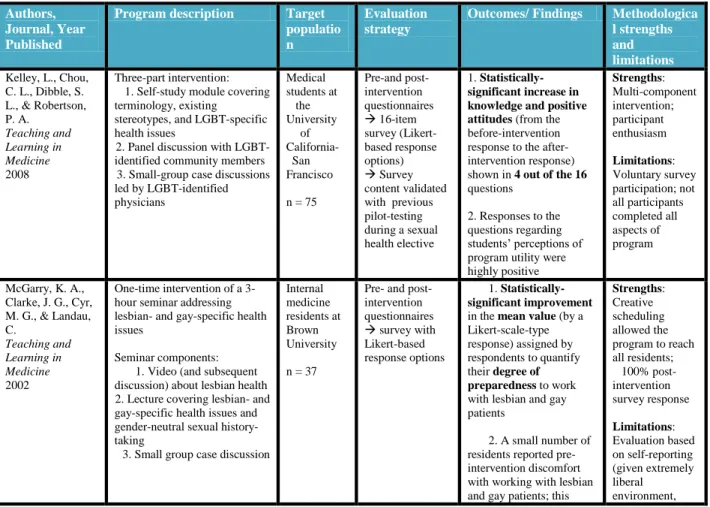
Table 1: Summary of studies reviewed
Authors, Journal, Year Published
Program description Target populatio n
Evaluation strategy
Outcomes/ Findings Methodologica l strengths and limitations
Kelley, L., Chou, C. L., Dibble, S. L., & Robertson, P. A. Teaching and Learning in Medicine 2008 Three-part intervention: 1. Self-study module covering terminology, existing
stereotypes, and LGBT-specific health issues
2. Panel discussion with LGBT-identified community members 3. Small-group case discussions led by LGBT-identified physicians Medical students at the University of California-San Francisco
n = 75
Pre-and post-intervention questionnaires 16-item survey (Likert-based response options) Survey content validated with previous pilot-testing during a sexual health elective
1. Statistically-significantincrease in knowledge and positive attitudes (from the before-intervention response to the after-intervention response) shown in 4 out of the 16
questions
2. Responses to the questions regarding students‟ perceptions of program utility were highly positive Strengths: Multi-component intervention; participant enthusiasm Limitations: Voluntary survey participation; not all participants completed all aspects of program
McGarry, K. A., Clarke, J. G., Cyr, M. G., & Landau, C.
Teaching and Learning in Medicine
2002
One-time intervention of a 3-hour seminar addressing lesbian- and gay-specific health issues
Seminar components: 1. Video (and subsequent discussion) about lesbian health 2. Lecture covering lesbian- and gay-specific health issues and gender-neutral sexual history-taking
3. Small group case discussion
Internal medicine residents at Brown University
n = 37
Pre- and post-intervention questionnaires survey with Likert-based response options
1. Statistically-significant improvement in the mean value (by a Likert-scale-type response) assigned by respondents to quantify their degree of preparedness to work with lesbian and gay patients
2. A small number of residents reported pre-intervention discomfort with working with lesbian and gay patients; this
Berkowitz 27
number greatly decreased post-intervention
possibility of differential reporting bias)
Vanderleest, J.G., & Galper, C.Q.
Journal of the Association of Nurses in AIDS Care
2009
One-time intervention of a 4-hour seminar addressing transgender-specific health issues (facilitated by transgender-identified community stakeholders)
Described learning objectives of the program, which were:
Overview of basic definitions and related language, transgender-specific health care issues and health care access issues Recommendations for how to care for transgender patients in a primary care setting Creation of physician advocates for transgender patients
(Did not describe the methods used to convey these objectives during the seminar)
Surveyed providers in Arizona community to find individuals interested in learning better ways to provide care for transgender community members
n = 10
“Self-assessments … with queries about participant level of confidence of knowledge in six areas”
“All participants
increased their levels of confidence in working with transgender patients”
(Did not describe their statistical analysis, if any)
Strengths: Transgender-identified facilitators; creation of provider advocate program
Limitations: No elaboration of teaching methods, exact evaluation strategy, or statistical analysis Dixon-Woods, M., Regan, J., Robertson, N., Young, B., Cordle, C., & Tobin, M.
Medical Education
2002
Human Sexuality course: an overview of human sexuality as related to primary care practice, including lesbian, gay, and bisexual-specific patient issues
Multiple-part, longitudinal intervention:
3 faculty-led didactic sessions (each session had several components)
Outside assignments in the interim (e.g., a small-group assignment to create an informational brochure based on knowledge gained during the intervention) First- and second-year medical students at Leicester-Warwick Medical School (England)
n = 173
1. “Non-participant observation” to evaluate teaching methods
2. Pre- and post-intervention questionnaires (Likert-scale response system Used Wilcoxon test to compare before- and- after paired responses
Statistically-significant improvements in participants‟ perceptions
of:
(1)Awareness of LGBT-specific health issues (2)Comfort working with LGBT patients Strengths: Evaluated teaching methods; included a project to apply new knowledge
Berkowitz 28
Tang, T. S., Hernandez, E. J., & Adams, B.S.
Teaching and Learning in Medicine
2004
Peer-led diversity training module
Multiple-part, longitudinal intervention:
1. Trained 4th-year students to
be peer facilitators: Training on “health and health care disparities between social and cultural groups in the United States”
Training on facilitation methods for leading small groups
2. Peer leaders then facilitated small-group discussions (for
2nd-year medical students) on sociocultural-related health disparities Second- and fourth-year medical students at the University of Michigan Medical School
n = 12
Surveyed peer leaders with pre- and post-intervention questionnaires survey with Likert-based response options
Berkowitz 29 Program plan
Program overview
Part of the rationale behind the addition of LGBT health to Healthy People 2020 is that by learning competency for working with LGBT patients, physicians can greatly improve health outcomes for these patients (and subsequently reduce or eliminate health disparities faced by these patients.) Since family practitioners are where a large amount of the American population receives primary care, Project RIPPLE will serve to create a training program for Asheville family medicine residents that compacts the Healthy People 2020 LGBT patient care goals into a multi-part curriculum.
After reviewing the literature related to LGBT health-related curricular interventions in medical education, one shortcoming acknowledged by multiple authors was that the isolated interventions studied might have less of long-term impact on behavioral change. Therefore, Project RIPPLE will address this concern by providing a longitudinal intervention over at least the entire intern year. Project RIPPLE will consist of a four-part curricular intervention: (1) an online training module addressing LGBT terminology and LGBT-specific health issues and disparities, (2) a panel discussion featuring local LGBT-identified community members, (3) a series of small-group case discussions facilitated by faculty members and senior resident
mentors, and (4) practice encounters with standardized patients trained in LGBT-specific roles.
Program context
Berkowitz 30 the LGBT patient population subsequently seen by these residents,) it is important to choose a location where there is both a family medicine residency and a substantial LGBT patient population. For this reason, Project RIPPLE will occur in Asheville, NC, where there is both a family medicine residency (through Mountain AHEC) and a large LGBT population.
The risk factor on which Project RIPPLE will focus is the association between LGBT (lesbian, gay, bisexual, transgender) identification and lack of quality health services. According to the Fenway Guide to Lesbian, Gay, Bisexual, and Transgender Health, “LGBT patients
frequently encounter problems with access to quality health services, experience disparities in screening for chronic conditions, and report a lack of counseling pertinent to actual lifestyle behaviors” (Makadon, Mayer, Potter, and Goldhammer, 2007.). Therefore, this program will attempt to address this risk factor by creating trainings for family medicine residents that will allow these physicians to improve the quality of care provided to LGBT-identified patients.
Program theories
Issel suggests that there are three components to an effect theory: the causal theory, the intervention theory, and the impact theory.
Berkowitz 31 revelation that their patients were gay or lesbian,” and these reactions included tendencies to “misdiagnose conditions, provide inadequate treatment, offer irrelevant health teaching … ask insensitive and biased questions, and make sexist remarks” (Ibid.). As a result of these negative reactions, Harrison suggests that these physicians‟ LGBT-identified patients received a lower quality of care.
Therefore, it is very important that Project RIPPLE addresses the negative reactions that incoming family medicine residents may have toward their LGBT-identified patients. After reviewing relevant literature, I observed that three programs of interest (UCSF, Brown
University, and the University of Arizona) found that the inclusion of presentations by LGBT-identified individuals was an effective strategy to reduce these negative reactions. Therefore, Project RIPPLE‟s curriculum will include a panel presentation by LGBT-identified community members. Several of the studies reviewed found that small-group case discussions were effective ways to address negative bias; this educational component will also be included in Project RIPPLE‟s curriculum.
Issel defines the intervention theory as explaining “how interventions affect the causal factors or possibly the moderating or mediating factors” (Issel, 2009). Therefore, the
Berkowitz 32 LGBT patients. Additionally, in reviewing contemporary literature, Harrison found that “the patient-physician relationship … can be vitally important in a patient‟s physiological and psychological responses to therapy, compliance with medical advice, and overall satisfaction with care received” (Harrison, 1996). In this sense, training physicians in how to create non-judgmental relationships with their LGBT-identified patients could counteract the effects of previous physician attitudes on the quality of health care received by LGBT patients.
Harrison‟s theory suggests that there are specific interventions in physician training that could help strengthen physician-patient relationships with LGBT patients and allay patients‟ fears surrounding coming out to their physician. These learned behaviors include “maintaining a non-homophobic attitude toward [LGBT] patients, distinguishing sexual behavior from sexual identity, communicating with gender-neutral terms, and maintaining awareness of how
[physicians‟] own attitudes affect clinical judgment” (Harrison, 1996). Training surrounding these specific intervention objectives will be featured in both the online module section and the small-group case discussion section of Project RIPPLE‟s curriculum, and will be reinforced through the practice encounters with standardized patients.
Issel defines impact theory as “statements about how the outcomes lead to impacts” (Issel, 2009). Unfortunately, almost no research exists as to the impacts (on LGBT patient health outcomes) created by training physicians in LGBT patient competency and sensitivity.
Berkowitz 33 Goals and objectives
The overall goal of Project RIPPLE is to create and implement a LGBT training curriculum for Asheville, NC family medicine residents.
Project RIPPLE also has several curricular learning objectives. Its curricular learning objectives are to:
1. Teach family practice residents basic LGBT terminology
2. Give family practice residents practice and personal experience interacting with LGBT-identified patients
3. Elaborate upon LGBT-patient-specific issues
4. Focus on addressing and eliminating LGBT-related health disparities 5. Incorporate mentoring from senior residents
6. Offer a multi-part intervention: introductory training modules with follow-up discussions and practice patient encounters
Project RIPPLE has several short-term program objectives (defined as achievable within the first 1-3 years of program implementation.)
First of all, by year 1 of implementation, program staff will have recruited a pilot group
Berkowitz 34
Secondly, by year 1 of implementation, 50% of teaching faculty and 75% of second-year
residents will have satisfactorily completed both the training modules and facilitator training from the program staff.
The third short-term objective is that by year 2 of implementation, 95% of the first intern class to receive the training will have completed the training curriculum‟s introductory modules (both the online basic terminology module and the in-person patient panel.)
The fourth short-term objective is that by year 3 of implementation, 95% of the first
intern class to receive the training will have completed 2 follow-up patient encounters.
The fifth short-term objective is that by year 3 of implementation, 95% of the residents
that started this training as first-year interns will be able to meet the Healthy People 2020 objective of competently and sensitively including acknowledgment of sexual orientation as a positive component of a patient‟s healthcare experience (Healthy People 2020, 2009).
Project RIPPLE also has several long-term program objectives (defined as achievable within 3-5 years of program implementation.)
The first long-term objective is that by year 4 of implementation, 25% of the residency
program faculty (assisted by second- and third-year residents) will be able to run the program without external assistance from program staff.
Secondly, by year 4 of implementation, program staff and residency program faculty will
work together to create two short refresher training modules.
The third long-term objective is that by year 5 of implementation, 95% of the Asheville
Berkowitz 35 evaluation of the AAFP LGBT-patient-specific competencies for family practice
residents.
Implementation Implementation strategies
In order to meet these objectives, several activities will occur. These activities will create curricular interventions that address each of Project RIPPLE‟s learning objectives.
Objective 1: To teach family medicine residents basic LGBT terminology
First, the program staff will work to develop an online introductory teaching module that will both teach the family medicine interns about basic LGBT terminology and provide examples of LGBT-specific health issues. Examples of such modules can be seen in the Fenway Project resource guide, the UNC Safe Zone curriculum, and the UNC School of Medicine‟s capstone course cases. (Details about the UNC Safe Zone curriculum and the UNC School of Medicine‟s capstone course cases are provided in Appendices 1 and 2.) This module will also introduce the Healthy People 2020 objectives for how providers can reduce LGBT-related health disparities.
Objective 2: To give family medicine residents practice and personal experience interacting with LGBT-identified patients; Objective 3: To put a personal face on and elaborate LGBT patient-specific issues
Berkowitz 36 discussion would last approximately one hour and allow the community members to share both positive and negative experiences that they have had in their interactions with health care providers. After the panel, there would be time for the residents to ask questions. Ideally, this panel would be sustainable in that it could occur yearly for each incoming intern class, but an alternative strategy would be to videotape the panel (if the participants were comfortable with this idea) and then show the video to future intern classes. One important caveat with this component of the intervention would be to make sure that the community members are comfortable sharing their stories with the residents and that the residents respect the confidentiality of the panelists.
Objective 4: To focus on reducing and eliminating LGBT-related health disparities
For the third part of the initial curricular intervention, the program staff will develop cases for the interns to review and discuss in a small-group format. The material in these cases will address LGBT-specific health issues, and examples of such cases can be viewed in the appendix of this program plan. After each group has a chance to review and discuss the cases, the facilitators will then use lessons learned from the cases to transition the discussion into how best to reduce LGBT health disparities such as increased rates of suicide in LGBT youth, increased risk of obesity in lesbians, underutilization of cancer screening in lesbians, and increased risk of HIV in transgender individuals.
Objective 5: To incorporate mentoring from senior residents
Berkowitz 37 residents will help facilitate the small-group case discussions, and will then serve as a source of continuity and assistance for helping reinforce the learning objectives during future clinical encounters with the interns. In exchange for agreeing to participate as a mentor, senior residents who successfully complete the mentoring program will receive a certificate of appreciation, a recommendation letter from the teaching faculty involved with the program (which will benefit these residents in the post-graduation hiring process), and an opportunity to participate in future curriculum development.
Implementation resources
In order to achieve these learning objectives and successfully train Asheville‟s family medicine residents, Project RIPPLE will need both human and financial resources. For the human resources, the project will hire a program director with the qualifications of both a master‟s degree in public health and experience in program and curriculum development. In the initial years of implementation, the program director will be assisted by 1-2 program interns who are MD/MPH students working on their practicum. With this arrangement, the grant funding will cover the program director‟s salary, and the intern staff will get less of a salary but will receive school credit for their contributions. Additionally, having program interns that have medical experience will allow consideration of the clinical perspective during curriculum development and initial implementation.
Berkowitz 38 main costs will be in the areas of online module development and programming, reproducing curricular materials, and compensating standardized patients. For online module development and programming, the program staff would first attempt to contract with members of the local LGBT community with experience in or connections to computer programming. If these individuals had the resources to donate their services, offer their services at a reduced price, or sponsor the provision of these services, then this specific implementation cost would be much more affordable. If Project RIPPLE was unable to obtain these services in this fashion, then the program staff would apply for grant funding (e.g., a technology innovations grant) to cover the online programming.
For reproduction of curricular materials, the yearly budget will include $500 for reproduction of materials ($175 for the creation of 50 manuals, costs obtained from Kinko‟s Copies, $75 for supplies such as poster board and markers, and $250 for printing of other
materials such as handouts and summary sheets.) For standardized patients, Project RIPPLE will hire two of the standardized patients already employed by the Asheville family medicine
Berkowitz 39 Implementation timeline
The timeline for implementation of Project RIPPLE begins with year one, when a program director and two summer program interns will be hired in the early spring. Once these individuals are hired, they will start out by facilitating a meeting between key stakeholders in the local LGBT community and teaching faculty in the Asheville family medicine residency
Berkowitz 40 To recruit both faculty members interested in facilitating the program and residents interested in mentoring younger residents, the program staff will hold an information session as soon as the curriculum is developed. Interested faculty members and residents will participate in a training session where the program staff will teach the residents and faculty three components: first, the basic terminology and health issues covered in the online training module; second, the AAFP and DHHS objectives that the program hopes to reinforce; third, facilitation and mentoring techniques. The program staff will complete the recruitment and training of these individuals by December of the first year. Once the program staff completes focus-group testing of the online curriculum and the small group cases, they will introduce the revised curriculum and case materials to the participating faculty members and resident mentors by March of the first year. The faculty members and resident mentors will have March and April of the first year to practice becoming familiar with the material covered in the revised online module and small group cases.
At the end of the first year (in April and May,) the program staff will write four scenarios for standardized patients to use to play LGBT-specific roles. If LGBT community stakeholders are interested in assisting with the creation of these scenarios, then the program staff will welcome their valuable contributions. The program staff will spend 5 hours training two standardized patients (already employed by the residency program) to take on these additional roles. The program staff will also use time in May to prepare and reproduce curriculum materials such as participant manuals and case discussion handouts.
Berkowitz 41 modules, view the LGBT patient panel, and begin small-group discussions with their older resident mentors. In the first few iterations, program staff will assist with this facilitation, but one of the program objectives is to transition to complete facilitation by faculty by year 4. As the second year progresses, groups of interns will rotate through case-discussion groups during their ambulatory months. In December of the second year, the interns will have their first practice encounter with the standardized patients. Program staff and the senior resident mentors will review the feedback from these encounters and use any areas that are lacking to inform the scenarios for the second standardized-patient encounter, in March of the second year. At the end of the second year, the intern class will participate in an assessment with the standardized
Berkowitz 43 Evaluation Plan
Evaluation background
The CDC provides several reasons why programs should be evaluated. Out of the reasons for evaluation provided in the CDC reading‟s table, however, certain ones stand out as especially helpful to ensuring that the objectives of Project RIPPLE are met. The primary reasons that Project RIPPLE should be evaluated include “to monitor progress toward the program‟s goals,” “to determine whether program components are producing the desired progress on outcomes,” “to justify the need for further funding and support,” and “to find opportunities for continuous quality improvement” (5).
Given that I am a university student designing this program (as opposed to a part of the program staff), my role as an evaluator for Project RIPPLE would be that of an external
Berkowitz 44 also be hired. The only drawback of this approach would be that funding to pay the external consultant would need to be added to the budget.
The CDC provides several examples of key skills and characteristics needed by a good evaluator. Out of these, the key skills and characteristics an evaluator would need to evaluate Project RIPPLE would include skills and characteristics specific to both the internal evaluator and the external consultant. For the internal evaluator, the most important skills and
characteristics would be the abilities “to work with a wide variety of stakeholders,” “[to
incorporate] evaluation into all program activities,” “[to understand] both the potential benefits and risks of evaluation,” “[to] give staff the full findings,” “[to have] strong organization and coordination skills,” and “[to exhibit] cultural competence” (CDC 8). Specific examples of these skills and characteristics that would be necessary for an internal evaluator of Project RIPPLE include the ability to interact and foster dialogue with stakeholders in both the medical and LGBT communities, the ability to tie each component of the curricular intervention to a
corresponding evaluation inquiry, and the ability to interact with the local LGBT community in a respectful, positive, and competent manner.
Berkowitz 45 AAFP competencies, or collaboration with teaching faculty to establish a comparison matrix for pre- and post-intervention standardized-patient scores.
According to the CDC, there are three categories of stakeholders to consider when evaluating a program. The first category is “those involved in program operations: management, program staff, partners, funding agencies, and coalition members” (CDC 11). In Project RIPPLE, these individuals would be the program director, the program interns, the teaching faculty and upper-level residents in the Asheville family medicine residency, and members of the local LGBT community serving as panelists and assistants in program development. The questions about which these stakeholders would be most concerned might pertain to the efficacy of program processes to produce desired outcomes and the efficiency with which program funds were being used. Ways to involve these stakeholders would be to have the program staff help create a framework for data collection/analysis and to have the coalition members create a list of priorities addressing the reasons why Project RIPPLE is significant to each member group.
Berkowitz 46 outcomes (e.g., patient satisfaction with the physician interview) that could be assessed in the evaluation.
The third category is “those who are intended users of the evaluation findings: persons in a position to make decisions about the program, such as partners, funding agencies, coalition members, and the general public or taxpayers” (CDC 11). Similarly to the first category of stakeholders, the questions about which these stakeholders would be most concerned might pertain to the efficacy of program processes to produce desired outcomes and the efficiency with which program funds were being used. Ways to involve these stakeholders might include both the creation of a financial analysis scheme to make sure funds were being spent most efficiently and the comparison of outcomes data to the initial goals and objectives of the program.
Berkowitz 47 Evaluation methods
Study design
The study design is a combination of observational and interventional, meaning that both strategies will be used to evaluate certain aspects of the program. In terms of the interventional strategy, data will be collected (in the form of pre- and post- intervention questionnaires and interviews) to assess whether or not the intervention improved the unbounded outcome of increased provider competency with and sensitivity to LGBT-identified patients. In terms of the observational strategy, there is not a comparison group, so it would be difficult to evaluate how the program affected patient outcomes in an interventional design. For this reason, using a prospective cohort design to follow residents who have completed the program (and collecting interview and patient observational data from this cohort of residents at several time intervals after the intervention) will also contribute to the evaluation of this program.
Study methods
The study methods consist of both quantitative and qualitative strategies. Evaluators will use these forms of data collection to determine the answers to several evaluation questions. Through answering these questions, the evaluators will be able to determine if the program activities are meeting Project RIPPLE‟s objectives.
The quantitative strategies, which serve to collect data in a numerically-based format, consist of surveys (pre- and post-intervention questionnaires after each curricular intervention) and comparison of pre- and post-intervention scores from standardized patient evaluations. Evaluators will use the pre- and post-intervention surveys and pre-and post-intervention
Berkowitz 48 on achievement of several of Project RIPPLE‟s objectives. Although the standardized patient assessments will be scored by teaching faculty, the comparison of scores pre- and
post-intervention will occur as a collaboration between teaching faculty and program evaluators. The qualitative strategies, which serve to collect data in a dialogue-based format, consist of individual interviews (or focus groups if individual interviews are too time-consuming) and curriculum review/discussion. Evaluators will use these strategies to determine residents‟ and faculty‟s perceptions of the efficacy of the interventions in increasing their capacity to work with LGBT-identified patients in a knowledgeable and sensitive fashion. Once the evaluators have heard the residents‟ and faculty‟s opinions as to how participation in the interventions has
impacted their capability to competently work with LGBT-identified patients, then the evaluators can compare this data to the desired outcome for each curricular and program objective. These interviews or focus groups will be moderated by the program staff and participated in by the residents and/or teaching faculty.
Evaluation tables
Learning objective: Give family medicine residents practice and personal experience interacting with LGBT-identified patients
Evaluation question Participant Evaluation method
(reaction)
a. Did the family medicine residents enjoy the patient panel discussion?
b. Did the family medicine residents feel that the patient panel discussion was a good use of their time? (Kirkpatrick question)
Berkowitz 49 (learning)
c. Did the family medicine residents experience what was intended for them to
experience? (Kirkpatrick question)
d. In terms of increased comfort level with interacting with LGBT-identified patients, what is the extent of
improvement in this area after the patient panel? (Kirkpatrick question)
Family medicine residents Pre- and post-panel questionnaires
(behavior)
e. Did the family medicine residents put their learning into effect when back on the job? (Kirkpatrick question) f. Are the family medicine residents aware of their change in comfort level interacting with LGBT-identified patients? (Kirkpatrick question)
g. Was this change sustained? (Kirkpatrick question)
Family medicine residents Individual interviews, one and six months after the patient panel
(results)
h. Are the family medicine residents achieving increasing scores on their
LGBT-standardized patient practice sessions and assessments?
Family medicine residents Observation and comparison of practice session and assessment scores
Learning objective: Offer a multi-part intervention: introductory training modules with follow-up discussions and practice patient encounters
Berkowitz 50 (reaction)
i. Do the family medicine residents feel that the multi-component design of the training was a good use of their time? (Kirkpatrick question)
j. Do the faculty preceptors feel that the multi-component design of the training
increased residents‟ potential for applying increased knowledge of and sensitivity to issues related to LGBT patients? (Kirkpatrick question)
Family medicine residents
Teaching faculty preceptors
Resident-specific
questionnaires distributed before the initial activities and after the final activities
Faculty-specific questionnaire distributed after the final activities
(learning)
k. Did the family medicine residents experience what was intended for them to
experience? (Kirkpatrick question)
l. In terms of increased knowledge of and sensitivity to issues related to LGBT patients, is the extent of residents‟ improvement in this area greater after multiple program components?
Family medicine residents Questionnaires before and after and interviews after each activity observation of trends in results
(behavior)
m. Does each activity continue to help family medicine
residents put their learning into effect when back on the job? n. After each activity, are the family medicine residents aware of an added increase in comfort level interacting with LGBT-identified patients? (Kirkpatrick question)
o. Was this change sustained? (Kirkpatrick question)
Family medicine residents Individual interviews, one and six months after the
Berkowitz 51 (results)
p. Are the family medicine residents achieving increasing scores on their
LGBT-standardized patient practice sessions and assessments?
Family medicine residents Observation and comparison of practice session and assessment scores
Short-term objective: By year 2 of implementation, 95% of the first intern class to receive the training will have completed the training curriculum‟s introductory modules (both the online basic terminology module and the in-person patient panel.)
Evaluation question Participant Evaluation method
q. Have all of the family medicine residents who started this training as interns
completed the introductory modules? If no, why not?
Family medicine 2nd-year residents
Individual interviews at the beginning of these individuals‟ 2nd year (or, alternately, a focus group if individual interviews take too much time) r. What were the reasons why
certain residents did not participate in the introductory modules?
Family medicine 2nd-year residents
Individual interviews at the beginning of these individuals‟ 2nd year (or, alternately, a focus group if individual interviews take too much time) s. Were there any perceived
barriers to the participation process?
Family medicine 2nd-year residents
Individual interviews at the beginning of these individuals‟ 2nd year (or, alternately, a focus group if individual interviews take too much time) t. How can the process in
which residents are able to participate be improved? u. What were some of the successes in recruiting residents to participate in the introductory modules?
Family medicine 2nd-year residents
Individual interviews at the beginning of these individuals‟ 2nd year (or, alternately, a focus group if individual interviews take too much time)