Sharif University of Technology
Scientia IranicaTransactions B: Mechanical Engineering http://scientiairanica.sharif.edu
Performance study of an innovative heating technique
for a modied solar still
A.E. Kabeel
a, M.M. Bassuoni
a,b;, and M.A. Rozza
aa. Department of Mechanical Power Engineering, Faculty of Engineering, Tanta University, Egypt.
b. Department of Mechanical Engineering, Faculty of Engineering, Taif University, Al Haweiah, P.O. Box 888, 21974, Saudi Arabia. Received 14 May 2016; received in revised form 19 January 2017; accepted 6 March 2017
KEYWORDS Solar still; Desalination; Solar energy.
Abstract. An experimental comparison of water productivity between a conventional single slope, solar still, and a modied one is introduced in this work. The modied solar still is incorporated with a new heating technique on the saline water surface using nned cover with holes. These ns are used to increase the heat transfer area between the cover and saline water; meanwhile, holes are used to allow evaporated water to go through. These experiments are held under the outdoor conditions of Tanta, Egypt. The performance of the two solar stills has been tested at a water depth of 0.05 m and a quantity of saline water of 50 L. The results indicated that the productivity of water per square meter per day for the modied design still is higher than the conventional still by about 30.6%. © 2018 Sharif University of Technology. All rights reserved.
1. Introduction
Solar stills of dierent designs have been investigated by many researchers. Arunkumar et al. [1] studied the eect of hemispherical solar still with and without cooling for this cover on the productivity of fresh water. The maximum productivity is achieved by cooling the cover compared to the cover without cooling its surface and enhancing radiation by a factor of 1.25.
Ahsan et al. [2] investigated new design, fabri-cation and performance of tubular solar still in their design. They tried to reduce the weight and increase the durability of their still using available materials resulting in a cost reduction of still. These changes had their eect by reducing both cost and weight by 92% and 61%, respectively.
Rajamanickam and Ragupathy [3] studied the inuence of water depth in a double-slope solar still
*. Corresponding author.
E-mail addresses: kabeel6@hotmail com (A.E. Kabeel) [email protected] (M.M. Bassuoni)
doi: 10.24200/sci.2017.4329
compared to a conventional single-slope solar still. The comparison was held with xed feed water conditions and at the same ambient temperature with south direction facing the sun and wind. The experiments were performed at three dierent levels of water, and revealed that productivity is inversely proportional to water depth. The maximum productivity was achieved for the double-slope solar still.
Panchal and Shah [4] investigated solar stills with oating plates. They manufactured three solar stills with the same area. The rst one with a oating aluminum plate and the second one with a galvanized iron plate; however, a third one is conventional which is set as the reference still. The plates will play a role as a heat storage element to increase the evapora-tion. The experiment proves that the aluminum plates had the maximum productivity than iron plates and conventional solar still; further, they found that the productivity is proportional to the solar intensity.
Omara et al. [5] improved the single-slope solar still by increasing heat transfer surface area. They created two dierent modied bases in the solar still: the rst base with the addition of ns; the second one corrugated to increase surface area. The third
increases the productivity more than free convection by 25%.
Abdul-Wahab and Al-Hatmi [7] designed and analyzed an inverted solar still integrated with a refrigeration cycle. In their experiment, they stud-ied the relation between water depth and feed-water temperature with the productivity. They proved that, at high levels of water, the productivity increased in contrast with normal conventional solar stills, whose productivity increased at lower levels.
Dashtban and Tabrizi [8] investigated weir-type cascade solar still integrated with phase-changing mar-tial to keep latent heat during sunshine hours on the lake till nightfall. In their experiment, they studied the system with and without PCM and recorded the productivity of both cases. They concluded that productivity is increased by 31% for the system with PCM.
Kabeel et al. [9] improved the stepped solar still by putting the water in trays which are dierent in length and depth. They compared the productivities and performances of the stepped solar and conventional solar stills; moreover, they used vacuum tube solar collector to control the feed-water temperature entering the still. They concluded that maximum productivity was achieved with a tray dimension of 50 mm depth and 120 mm length. Also, the productivity increased by about 57.3%, compared to conventional solar still.
Monowe et al. [10] developed a new solar still with an external boosting reector to increase solar radiation in the solar still. They added a condenser to still, which played two important roles in the experiment. The rst role is cooling and condensing the product water, and the second role is warming up the feed water to the still. The eciency of such a still reached up to 77% if the preheated saline water was used for domestic purposes, and it was up to 85% if preheated saline water was used to operate the still during night times and recharge the still by the next batch of preheated water.
Tanaka [11] investigated theoretically the perfor-mance of a solar still incorporated with solar reector
ifying the area of the basin. They studied a solar still with sponge inside due to capillary force of sponge to suck water and increase of heating surface. The productivity of their still increased by about 15.3% compared to conventional solar still.
El-Sebaii and El-Naggar [14] studied a theoretical and experimental model for a solar still with a nned basin liner made of copper. They studied the year-round performance of the still in terms of the monthly average of daily productivity and eciency. It was also inferred that the n material did not aect the still productivity.
From the previous researches, it is clear that in-creasing the basin area aects the overall productivity of the solar still positively. Therefore, the aim of this study is to compare the performance of conventional single-slope basin solar still with that of a modied solar still. The modied still uses a new heating absorber on the water surface integrated with ns to increase contact area. The novelty in the modied still is that heating process for water occurs from the absorber (covered with ns and holes) (i.e., top heating). On the other hand, the conventional system heats water from solar basin (bottom).
2. Experimental setup
Two solar stills are designed and constructed to com-pare the performance of the proposed modied solar desalination system with the conventional still. A photograph of the experimental setup of both stills is shown in Figure 1. The setup consists of a saline water tank, a conventional still (single basin solar still), and a nned cover solar still.
2.1. Conventional solar still
Basin area of the conventional still is 1 m2 (50 cm
200 cm), the high-side wall depth is 45 cm, and the low-side wall height is 16 cm. The still is made of galvanized iron sheets (1.5 mm thick). The whole basin surfaces are coated with black paint from inside to increase their absorptivity. In addition, the still is insulated
Figure 1. Photograph of the experimental set up.
from the bottom and side walls with sawdust of 40 mm thick to reduce the heat loss from the still to ambient temperature. The insulation layer is supported by a wooden frame. The basin is covered with glass sheet of 3 mm thickness inclined with nearly 30 on the
horizontal, which is the latitude of the Tanta city, Egypt. Silicon was used as a seal to prevent leakage from any gap between the glass covers and still box. 2.2. Modied solar still
The modied still has the same construction of the conventional one compared to the cover with nineteen ns. These ns are welded to the cover to increase the heat transfer surface area. Further, the cover is punched with 180 holes, each with 20 mm diameter, to allow evaporation to go up through. Figure 2 shows a schematic diagram of the modied solar still cover with ns. These ns are made up of iron sheet of 1.5 mm thick and each has an area of (5 cm 48 cm). The interval space between each of two ns is 10 cm. The holes are distributed in twenty rows; each row has nine holes. The space between each of two holes is 5.5 cm. Figure 3 shows a photograph of the modied solar still.
Figure 2. A schematic for components of the modied solar still.
Figure 3. Photograph of the modied solar still.
3. Experimental procedure
Experiments were conducted at the Faculty of Engi-neering Tanta University, Egypt. The experiments were carried out in the period of 9 a.m. to the sunset during July 2014. The solar radiation, atmo-spheric temperature, basin temperature, saline water temperature, glass temperature, and distilled water productivity were measured every 1 hour. However, the accumulated productivity during the 24 hours was measured in each experiment.
The present experimental study aims to study the eect of heating the free surface of water on freshwater productivity and the eciency of the basin still in two dierent cases. The rst one is conducted at equalizing the saline water depth in the two tested solar stills (0.05 m), while the second is conducted at equalizing quantity in two tested solar stills (50 L).
4. Results and discussion
Prior to the experimental discussion, a comparison between the present study and that of Omara et al. [5] is introduced in Figure 4. The comparison shows that the modied solar still has the greatest
accumulated productivity by about 34.3% compared to [5]. Depending upon climate condition, the wind speed varied from 0.5 to 6.5 m/s and solar intensity varied from 20 to 1000 w/m2, the performances of both
solar stills were measured at constant water depth and constant quantity of water.
4.1. Eect of solar intensity on the performance of solar stills
The variations of solar intensity, ambient temperature, and water temperature for both stills are shown in Figure 5. As shown in the gure, the temperature increases as solar intensity increases, reaching the maximum value at afternoon and starting to decrease afterwards.
In addition, in Figure 5, the maximum increase in temperature takes place from 1:30 p.m. until 4:00 p.m. It is noticed that the variation between water temperatures of modied and conventional solar stills is about 0:5.75C. This variation can be explained as a
result of ns integrated with still cover which increases the heat transfer surface area.
The temperatures of the modied cover with ns (absorber) and increasing in water temperature for both modied and conventional stills are monitored as shown in Figure 6. From this gure, it is noticed
Figure 5. Basin water temperature variation with solar radiation.
Figure 6. Basin water and steel temperature variations with solar radiation.
Figure 7. Glass cover temperature variation with solar radiation.
that the heat loss between modied cover and water in the proposed solar still is smaller than that between water and metal sheets of conventional still. The water productivity of modied still is increased compared to the conventional still due to water temperature increase.
In Figure 7, the variation of glass temperature for both modied and conventional stills is registered. The glass temperature of the modied still is increased from 0:3.6C, this increase in temperature refers to the
increase in amount of evaporation in modied still than that in the conventional still.
4.2. Results of both stills at constant water depth (5 cm)
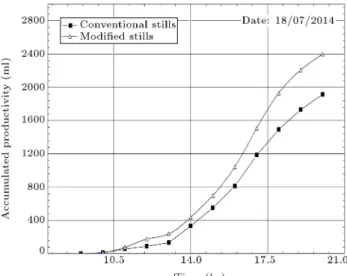
A compassion between the hourly productivity of both conventional and modied solar stills at constant depth is illustrated in Figure 8. The productivity increases with time until reaching the maximum value at after-noon, and then decreases.
In addition, it is noticed from Figure 9 that the productivity of modied solar still is more than that of conventional still for the following reasons. The design of heating surface absorber allows surface
Figure 8. Hourly productivity for conventional and modied stills (constant depth).
Figure 9. Accumulated productivity of conventional and modied stills (constant depth).
particle to evaporate freely, the cover surface area of modied still is much larger than conventional one (1.43 m2 and 1 m2, respectively), and the quantity
of water in conventional still is more than that in modied still (50 L and 48.9 L, respectively). The dierence in quantities of water occurs at constant depth experiments, as the extra volume of the ns in a modied still results in a decrease of water quantity of (48.9 L), compared to 50 L for the conventional one. 4.3. Results of both stills at constant quantity
of saline water
A comparison between the hourly productivities of both conventional and modied solar stills at a con-stant quantity of saline water is illustrated in Figure 10. It is apparent that the modied still has higher pro-ductivity than the conventional one due to the fact that adding ns to basin solar still decreases the pre-heating time required for the evaporating process [13]. Moreover, ns increase projected surface area of the absorber.
Figure 10. Hourly productivity for conventional and modied solar stills (constant quantity).
Figure 11. Accumulated productivity for conventional and modied solar stills (constant quantity).
Further, accumulated productivity is presented in Figure 11, clearly showing that the modied solar still has maximum productivity. The equilibrium between water in the basin and atmosphere occurs nearly between 8.30 and 9.00 pm.
Measurements of accumulated distillate water during experiments are tabulated in Table 1. It is clear from this table that the modied solar still at constant depth and quantity has a higher productivity by approximately 20-30%, respectively, as compared to conventional still.
5. Conclusion
From the presented experimental results of innovative and conventional stills, the following conclusions can be summarized:
1. The performance of a solar still is strongly inu-enced by changing the place of the heating absorber
24/7/2014 7.36 29.4 2590.5 2265
(modied cover with ns) also with the variation of contact area with the basin;
2. At a constant water depth, the amount of fresh water per square meter from modied still is higher than conventional still by about 20% per day;
3. At constant saline water quantity, the amount of fresh water produced from modied still per square meter could be higher than conventional still by about 30% per day;
4. The estimated costs per 1 litter of distillate water for conventional and modied solar stills are 0.062 $ and 0.042 $, respectively.
Acknowledgment
The authors wish to take this opportunity to express their sincerest appreciation to the Higher Institute of Engineering at Tanta, Egypt for its serious help to nish building up the experimental setup in its labs.
References
1. Arunkumar, T., Jayaprakash, R., Denkenberger, D., Amimul Ahsan, Okundamiya, M.S., Sanjay Kumar, Hiroshi Tanaka, Aybarg, H.S \An experimental study on a hemispherical solar still", Desalination, 286, pp. 342-348 (2012).
2. Ahsan, A., Imteaz, M., Rahman, A., Yusuf, B., and Fukuharad, T. \Design, fabrication and performance analysis of an improved solar still", Desalination, 292, pp. 105-112 (2012).
3. Rajamanickam, M. and Ragupathy, A. \Inuence of water depth on internal heat and mass transfer in a double slope solar still", Energy Procedia, 14, pp. 1701-1708 (2012).
4. Panchal, H. and Shah, P.K. \Investigation on solar stills having oating plates", International Journal of Energy and Environmental Engineering, 3(1), pp. 1-5 (2012).
5. Omara, Z., Hamed, M.H. and Kabeel, A. \Performance of nned and corrugated absorbers solar stills under Egyptian conditions", Desalination, 277(1), pp. 281-287 (2011).
6. Taamneh, Y. and Taamneh, M.M. \Performance of pyramid-shaped solar still: Experimental study", De-salination, 291, pp. 65-68 (2012).
7. Abdul-Wahab, S.A. and Al-Hatmi, Y.Y. \Study of the performance of the inverted solar still integrated with a refrigeration cycle", Procedia Engineering, 33, pp. 424-434 (2012).
8. Dashtban, M. and Tabrizi, F.F. \Thermal analysis of a weir-type cascade solar still integrated with PCM storage", Desalination, 279(1), pp. 415-422 (2011).
9. Kabeel, A., Kabeel, A.E., Khalil, A., Omara, Z.M., and Younes, M.M. \Theoretical and experimental parametric study of modied stepped solar still", Desalination, 289, pp. 12-20 (2012).
10. Monowe, P., Masale, M., Nijegorodov, N., and Vasilenko, V. \A portable single-basin solar still with an external reecting booster and an outside con-denser", Desalination, 280(1), pp. 332-338 (2011).
11. Tanaka, H. \A theoretical analysis of basin type solar still with at plate external bottom reector", Desalination, 279(1), pp. 243-251 (2011).
12. Tanaka, H. \Tilted wick solar still with at plate bottom reector", Desalination, 273(2), pp. 405-413 (2011).
13. Velmurugan, V., Gopalakrishnan, M., Raghu, R., and Srithar, K. \Single basin solar still with n for enhancing productivity", Energy Conversion and Management, 49(10), pp. 2602-2608 (2008).
14. El-Sebaii, A.A. and El-Naggar, M. \Year round perfor-mance and cost analysis of a nned single basin solar still", Applied Thermal Engineering, 110, pp. 787-794 (2017).
Biographies
Abd Elnaby Elbaiomy Kabeel is a Professor at the Department of Mechanical Engineering at the University of Tanta, Egypt. Now, he is the Vice Dean for Postgraduate Studies and Research. In the same faculty and university, he was the Head of Mechanical Power Engineering Department, from 2013 to 2016 and the Vice dean for Community Service and Environment Development, from 2010 till 2013. He harvested many scientic awards, the most recent of which was Shoman prize for Arab researchers, 2014. His research interests lie in the area of thermal energy science. In recent years, he has focused on better techniques for enhancing thermal processes, especially in cooling and desalination programs. He has about 180 research papers in international journals and con-ferences.
Mohamed Mahgoub Bassuoni is an Associative
Professor at the Department of Mechanical Engineering at the University of Tanta, Egypt where he has been a faculty member since 2000 (permanent address). His current address is now at Taif University-KSA.
His research interests lie in the area of thermal science. In recent years, he has focused on better techniques for expressing, analyzing, and executing desalination programs. He has collaborated actively with researchers in several other disciplines of hybrid air conditioning.
Mohamed Atef Rozza is a Mechanical Engineer at West Delta Electricity Production Company ABO QIR thermal power station Alexandria Egypt since 2011(permanent address). His research interests lie in the area of thermal energy science. In recent years, he has focused on creating a new design to enhance performance and the technique which solar system used to increase productivity, especially in solar still, which used to desalt water.