R E S E A R C H A R T I C L E
Open Access
Combining the effects of process design and pH
for improved xylose conversion in high solid
ethanol production from
Arundo donax
Benny Palmqvist
*and Gunnar Lidén
Abstract
The impact of pH coupled to process design for the conversion of the energy cropArundo donaxto ethanol was assessed in the present study under industrially relevant solids loadings. Two main process strategies were investigated, i.e. the traditional simultaneous saccharification and co-fermentation (SSCF) and a HYBRID design, where a long high temperature enzymatic hydrolysis step was carried out prior to continued low temperature SSCF, keeping the same total reaction time. Since acetic acid was identified as the major inhibitor in the slurry, the scenarios were investigated under different fermentation pH in order to alleviate the inhibitory effect on, in particular, xylose conversion. The results show that, regardless of fermentation pH, a higher glucan conversion could be achieved with the HYBRID approach compared to SSCF. Furthermore, it was found that increasing the pH from 5.0 to 5.5 for the fermentation phase had a large positive effect on xylose consumption for both process designs, although the SSCF design was more favored. With the high sugar concentrations available at the start of fermentation during the HYBRID design, the ethanol yield was reduced in favor of cell growth and glycerol production. This finding was confirmed in shake flask fermentations where an increase in pH enhanced both glucose and xylose consumption, but also cell growth and cell yield with the overall effect being a reduced ethanol yield. In conclusion this resulted in similar overall ethanol yields at the different pH values for the HYBRID design, despite the improved xylose uptake, whereas a significant increase in overall ethanol yield was found with the SSCF design.
Keywords:Bioethanol; High solids loading; Xylose fermentation; SSCF; Enzymatic hydrolysis
Introduction
The lignocellulosic ethanol industry is moving from pilot scale to demonstration/full scale operation, which is evi-denced by the construction of several production facil-ities worldwide (Balan et al. 2013; Janssen et al. 2013). Driven by this transition, research has been intensified towards problems related to high solid operation, an im-portant factor for process economy (Humbird et al. 2010; Macrelli et al. 2012). By increasing the content of water insoluble solids (WIS) throughout the process a number of benefits can be gained, e.g. reduced water usage with lowered distillation and waste water treat-ment costs as a result. Benefits can also be gained by re-ductions in investment and production costs since
equipment size and energy consumption can be reduced (Galbe et al. 2007; Wingren et al. 2003).
Looking at some of the larger plants in operation today, various agricultural residues (or in some cases dedicated energy crops) are used as raw material to a large extent. One example is Beta Renewables' full scale plant in Crescentino, Italy, which will convert wheat straw and Arundo donax (is a perennial cane used as a dedicated energy crop) to bioethanol, with biogas and bioelectricity as the main co-products. A common fea-ture of these straw based raw materials is their relatively high content of the C5 sugar xylose (Wiselogel et al. 1996), which makes good xylose conversion another high priority target in order to reach an economically feasible process (Sassner et al. 2008). Today a number of Saccharomyces cerevisiaestrains (the common workhorse in the bioethanol industry) have been genetically engi-neered in order to convert also xylose to ethanol. The * Correspondence:[email protected]
Department of Chemical Engineering, Lund University, Box 124, SE-221 00 Lund, Sweden
main genetic modifications made are the insertion of either a bacterial xylose isomerase, or a fungal xylose reductase and xylitol dehydrogenase, together with over-expression of several genes in the pentose phos-phate pathway (PPP) in order to convert xylose to xylulose and further on to ethanol through the PPP (Almeida et al. 2011; Van Vleet and Jeffries 2009; Hahn-Hägerdal et al. 2007). Although impressive achieve-ments have been accomplished with genetic and evolu-tionary engineering, glucose is still the preferred substrate over xylose. It has, however, previously been shown that xylose conversion can be increased with clever process de-sign (Olofsson et al. 2010a; Olofsson et al. 2008; Olofsson et al. 2010b).
As previously mentioned, working at high WIS con-tent pocon-tentially improves process economy. However, high solid operation has also been shown to generally decrease the yields of both enzymatic hydrolysis and simultaneous saccharification and fermentation (SSF) (Kristensen et al. 2009b). Two of the main issues when increasing the WIS loading are the dramatically in-creased viscosities as a result of the fibrous nature of the biomass (Knutsen and Liberatore 2009; Roche et al. 2009; Viamajala et al. 2009; Wiman et al. 2011) and the increased concentrations of biomass degradation prod-ucts, e.g. hydroxymethylfurfural (HMF), furfural and acetic acid, which potentially inhibit the fermenting micro-organism (Almeida et al. 2011). The formation of inhibi-tory degradations products, for example HMF and furfural, can be avoided by designing a mild pretreatment step. Acetic acid, in contrast, is inherent in the biomass material itself where acetyl groups are present on the xylan back-bone. During pretreatment (and possibly enzymatic hydrolysis) the acetyl groups are released from the hemicellulose, hence forming acetic acid, which may inhibit the fermentation. It has been shown that the inhibitory effects can be decreased by operating at a higher pH-value, since it is the undissociated form of the acid that causes inhibition. The pKa value of acetic acid is 4.76, so large effects can be anticipated around a pH-value of 5. The positive effect has been shown to be particularly strong for xylose fermenta-tion (Bellissimi et al. 2009; Casey et al. 2010).
The increased viscosities of the high solid slurries can create mixing problems in the reactors (Viamajala et al. 2010) as well as problems in pumping of the slurry. Well mixed hydrolysis, and fermentation, processes are im-portant in order to avoid temperature, pH and concen-tration gradients, since these could cause yield losses. One way to quickly reduce viscosity, and ease mixing, is the introduction of a high temperature hydrolysis step, commonly referred to as viscosity reduction (VR), or li-quefaction (Jorgensen et al. 2007), prior to the more traditional SSF concept. This HYBRID process design,
where a high temperature hydrolysis is followed by a low temperature fermentation (and continued hydrolysis) of the whole remaining slurry is potentially a good process option. It allows (partly) independent optimization of the hydrolysis and fermentation steps, which is beneficial since the optimal temperature for the cellulose mixture typically is about 50˚C whereas the yeast grows opti-mally at temperatures around 30–35˚C. Furthermore, it may be beneficial to increase the fermentation pH above 5.0 (the typical optimum for enzymatic hydroly-sis) in order to decrease the toxic effects of the hydro-lyzate if high amounts of acetic acid are present. The improvement of commercially available enzyme mix-tures (McMillan et al. 2011) works towards favoring of this HYBRID process concept due to improved temperature stability and decreased end-product inhibition, as argued by Cannella and Jorgensen (2013). In the work by Cannella and Jorgensen, however, the added complexity of co-fermenting xylose and glucose to ethanol was not addressed. It is well-known that high glucose concentrations inhibit xy-lose uptake by the yeasts (Lee et al. 2002; Saloheimo et al. 2007). Therefore, in the case of co-fermentation of xylose, the SSCF process (with “C” indicating co-fermentation) has the advantage over a HYBRID process that you can keep a low, but non-zero, concentration of glucose in the media, which has been proven very beneficial for xylose consumption (Bertilsson et al. 2008; Meinander et al. 1999). In this work, we assess how ethanol yields and xylose conversion are affected by the choice of process design at different pH levels. The raw material used in the study is pretreatedArundo donaxat industrially relevant solids con-centrations. Importantly, by analyzing fiber composition after each experiment the effects on the enzymatic hydroly-sis, and the fermentation of both xylose and glucose could be assessed separately for the different scenarios. The ef-fects of an increased pH at high acetic acid and sugar con-centration were furthermore assessed separately in shake flask fermentations of fiber-freeArundo donaxhydrolyzate.
Materials and methods Raw materials
Cell cultivation
The recombinant xylose-fermenting strain S. cerevisiae TMB3400 (Wahlbom et al. 2003) was used in all experi-ments. The yeast was produced by an initial pre-culture in shake flask, followed by an aerobic batch cultivation on glucose, and finally an aerobic fed-batch cultivation on Arundo donax hydrolyzate liquid, in order to im-prove inhibitor tolerance by adaptation as previously shown by Alkasrawiet al.(Alkasrawi et al. 2006).
The yeast was inoculated (from agar plate) in 300 ml shake flasks (liquid volume of 100 ml) containing 16.5 g L−1 glucose, 7.5 g L−1 (NH4)2SO4, 3.5 g L−1
KH2PO4, 0.74 g L−1MgSO2∙7H2O, trace metals and
vi-tamins. The cells were grown for 24 h at 30°C and a starting pH of 5.2 in a rotary shaker at 180 rpm. Subse-quently, aerobic batch cultivation was performed in a 2.5 L bioreactor (Biostat A, B. Braun Biotech Inter-national, Melsungen, Germany) at 30°C. The working vol-ume was 0.7 L and the medium contained 20.0 g L−1 glucose, 20.0 g L−1 (NH4)2SO4, 10.0 g L−1 KH2PO4,
2.0 g L−1 MgSO4, 27.0 mL L−1trace metal solution and
2.7 mL L−1vitamin solution. The cultivation was initiated by adding 20.0 mL of the pre-culture to the bioreactor. The pH was maintained at 5.0 throughout the cultivation,
by automatic addition of 3 M NaOH. The trace metal and vitamin solutions were prepared according to Taherzadeh et al. (Taherzadeh et al. 1996). Aeration was maintained at 1.2 L min−1, and the stirrer speed was kept at 800 rpm. When the ethanol produced in the batch phase was de-pleted, the feeding of clarified hydrolyzate liquid (obtained by pressing the Arundo donax slurry) was initiated. 1.0 L of liquid (supplemented with 35 g/L glucose to ensure a sufficiently high final cell concentration) was fed to the re-actor with an initial feed rate of 0.04 L h−1which was in-creased linearly to 0.10 L h−1during 16 h of cultivation. The aeration during the fed-batch phase was maintained at 1.5 L min−1, and the stirrer speed was kept at 800 rpm.
After cultivation, the cells were harvested by centrifu-gation in 700 mL flasks using a HERMLE Z 513 K cen-trifuge (HERMLE Labortechnik, Wehingen, Germany). The pellets were resuspended in 9 g L−1NaCl-solution in order to obtain a cell suspension with a cell mass con-centration of 80 g dry weight L−1. The time between cell harvest and initiation of the following SSCF/shake flask fermentation was no longer than 3 h.
Hybrid SSCF experiments
All experiments were carried out under anaerobic condi-tions using 2.5 L bioreactors (Biostat A, B. Braun Biotech International, Melsungen, Germany) with an initial WIS content of 21% and a final working broth weight of 1.0 kg. The experiments were run for a total time of 96 h. SSCF experiments were compared to HYBRID ex-periments were a high-temperature hydrolysis step had been conducted for the first 48 hours (keeping a total time of 96 hours). During the enzymatic hydrolysis a temperature of 45˚C was maintained and when yeast was added (i.e. during the SSCF phase) the temperature was lowered and kept at 34˚C. The enzyme solution used was Cellic CTec 3 provided by Novozymes (Novozymes A/S, Bagsvaerd, Denmark) at a dose of 0.075 g enzyme solution g−1 glucan. The pH was maintained at either 5.0 or 5.5 throughout the fermentations by automatic addition of 4 M NaOH. TheArundo donaxslurry was supplemented with 0.5 g L−1 NH4H2PO4, 0.025 g L−1 MgSO4· 7H2O
and 1.0 g L−1yeast extract at the start of the fermenta-tion phase. An initial yeast concentrafermenta-tion of 3 g dry weight L−1of the cultivated cells was used. In addition, a hydrolysis experiment was performed at 34˚C in order to see how well the material hydrolyzed at the lower SSCF temperature. All experiments were carried out in duplicates.
Shake flask fermentations
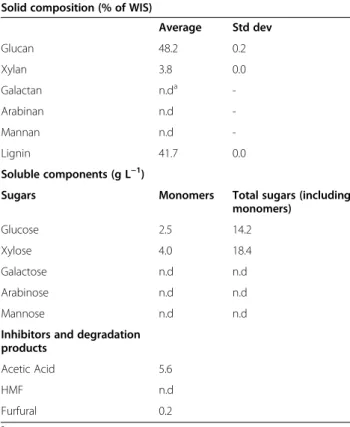
100 mL shake flask fermentations were carried out in du-plicates under anaerobic conditions in 300 mL Erlenmeyer flask. The medium used for the fermentations was the clarified liquid fraction obtained by separating the Table 1 Composition of the pretreatedArundo donax
slurry
Solid composition (% of WIS)
Average Std dev
Glucan 48.2 0.2
Xylan 3.8 0.0
Galactan n.da
-Arabinan n.d
-Mannan n.d
-Lignin 41.7 0.0
Soluble components (g L−1)
Sugars Monomers Total sugars (including monomers)
Glucose 2.5 14.2
Xylose 4.0 18.4
Galactose n.d n.d
Arabinose n.d n.d
Mannose n.d n.d
Inhibitors and degradation products
Acetic Acid 5.6
HMF n.d
Furfural 0.2
a
n.d. = not detected, i.e. below detection limit.
The solid composition is based on wt-% of the WIS content and the soluble components are reported in g L−1
remaining solids (with vacuum filtration) after enzym-atic hydrolysis of steam pretreated Arundo donax. The enzymatically hydrolyzed steam pretreated material was provided by Biochemtex and the separation of solids was carried out at Lund University. Two different acetic acid levels were investigate by first diluting the hydroly-zate slightly to achieve an acetic acid concentration of approximately 4 g L−1and then supplementing one part of it with acetic acid to reach 8 g L−1. pH was set ini-tially to 5.0, 5.5 and 6.0, respectively, for both acetate levels. Prior to fermentation the medium was auto-claved, to ensure sterile conditions, and supplemented with 0.5 g L−1 NH4H2PO4, 0.025 g L−1 MgSO4· 7H2O
and 1.0 g L−1yeast extract (same supplements as in the hybrid SSCF experiments). The temperature was kept constant at 34˚C. An initial yeast concentration of 3 g dry weight L−1 of cultivated yeast was added to start the experiment. 2.5 mL liquid samples were taken re-peatedly during 48 hours and analyzed for sugars and metabolites as well as pH and optical density.
Analysis
HPLC was used for analysis of sugars and metabolites. Samples from the hydrolysis liquid were centrifuged (16,000 × g) in 2 mL eppendorf tubes at 14,000 rpm for 5 min. (Z 160 M, HERMLE Labortechnik, Wehingen, Germany). The supernatant was filtered through 0.2 μm filters, and stored at−20°C. The concentration of sugars, glycerol and xylitol were determined using a polymer column (Aminex HPX-87P, Bio-Rad Laboratories, München, Germany) at 85°C. MilliQ-water was used as eluent, with a flow rate of 0.6 mL min−1. Organic acids, furans and ethanol concentrations were determined with an Aminex HPX-87H column (Bio-Rad Laboratories, München, Germany) at 60°C. 50 mM H2SO4 was used
as eluent, with a flow rate of 0.6 mL min−1. The sugars, acetate, glycerol, xylitol and ethanol were detected with a refractive index detector (Waters 2410; Waters, Milford, MA, USA) and HMF and furfural with a UV detector at a wavelength of 210 nm (Waters 2487; Waters, Milford, MA, USA). A larger sample volume was taken for the final (96 h) and liquid densities were determined (solids separated by centrifugation and filtration, as described above) by pippeting 0.500 ml on to an analytical scale to record the weight. Triplicates were performed with a standard deviation of less than 1%.
Optical density (OD) was measured with a spectropho-tometer at 600 nm (Helios Gamma; Spectronic Camspec Ltd, Leeds, UK) in order to follow cell growth during the shake flask fermentations. The OD values were then cor-related to cell dry-weight through a calibration curve ob-tained from dry-weight measurements and dilutions of the concentrated yeast suspension obtained after the culti-vation procedure.
A one-way analysis of variance (ANOVA) was per-formed in MATLAB R2011b (Mathworks, Natick, USA) to established significant differences in fermentation yields and xylose uptake for both the reactor and shake flask experiments.
Calculation of yields and carbon recovery
The standard assumptions when calculating glucose and ethanol yields are generally those of a constant volume and liquid density throughout the reaction. However, significant errors in yield calculations will result from using these assumptions during high solids operation (Kristensen et al. 2009a; Zhu et al. 2011). Therefore, in order to accurately estimate the hydrolysis yield in this study, we measured the WIS content and analyzed the solid composition according to standard NREL proced-ure (Sluiter et al. 2008b) after each fermentation. Hence the hydrolysis yields (YHyd) could be calculated as the
difference in total amount of glucan between start and end samples, according to Equation 1. The degree of xy-lan hydrolysis was calculated analogously.
In all following equations, mreacdenotes the total mass
of the slurry, WIS the fraction of water insoluble solids in the total slurry (g/g), xi the mass fraction of the
re-spective polymer in the insoluble solids (g/g) andφithe
molecular ratio of the polymer to its corresponding monomer. VLiqdenotes the volume of hydrolysate liquid
(L) andρLiqthe corresponding density of the liquid (g/L).
[i] denotes the concentration (g/L) of compound i, mea-sured by HPLC, and Mi the c-mole mass of the
com-pound. The short notations for the compounds are Glu (glucose), Xyl (xylose), Xyli (xylitol), Gly (glycerol), Cel (cellobiose), X (biomass) and EtOH (ethanol). The sub-script tot, indicates the concentration determined by total sugar analysis for the respective sugars and subscript 0 and end indicates values at 0 and 96 hour respectively. The initial and final mass, mreac, will be slightly different
due to the loss of carbon dioxide in the fermentation. The loss will be in the order of a few percent, and was in the calculations made here not compensated for.
YHyd¼mreac0WIS0XGlu0−mreacendWISendXGluend mreac0WIS0XGlu0
ð1Þ
In order to further, calculate the ethanol yield based on measured HPLC concentrations, liquid densities were measured for both start and final samples (in addition to the WIS and glucan content). The fermentation yield, YEtOH, (based on the amount of consumed glucose and
xylose) could then be calculated on a mass basis ac-cording to Equation 2, and the technical ethanol yield,
and xylose) could be calculated according to Equation 3. Both equations are based on an equation previously presented by Kristensenet al.(Kristensen et al. 2009a).
YEtOH¼
EtOH
½ EndVLiq End
mreac0WIS0 φGluXGlu0þφXylXXyl0
−mreacendWISend φGluXGluendþφXylXXylend
þ ½Glutot0þ½Xyltot0
VLiq0−½GluEndþ½XylEnd
VLiqEnd
ð2Þ
YEtOHtech ¼
EtOH
½ EndVLiqEnd mreac0WIS0 φGluXGlu0þφXylXxyl o
þ ½Glutot0þ½Xyltot0
VLiq0
ð3Þ The liquid volume was calculated according to Equation 4.
VLiq¼mreac
1−WIS
ð Þ
ρliq ð4Þ
A calculation of the carbon recovery (CR), on c-mole basis, was done for both the hybrid SSCF and shake flask experi-ments in order to see if all major products had been accounted for. Since carbon dioxide was not measured the amount was instead estimated based on stoichiometry from the ethanol production, hence the factor 1.5 (c-mole c-mole−1) in Equation 5. Furthermore, due to (well established) difficulties in estimating cell dry weight in fiber slurries,biomass was not includedin the recovery calculations for the SSCF/HYBRID experiments, i.e. part of the missing carbon will be biomass. Biomass was, however, included in carbon recovery for the shake flask experiments.
CR¼
1:5½EtOHEnd
MEtOH þ
Gly
½ End
MGly þ
Xyl
½ End
MXyl þ Xyli
½ End
MXyli þ Cel
½ End
MCel þ GluEnd
½
MGlu þ
X
½ End
MX
VLiqEndþmreacendWISend
φGluXGluEnd
MGlu þ
φxylXXylEnd MXyl
mreac0WIS0
φGluXGlu0
MGlu þ
φxylXXyl0
MXyl
þ ½Glutot0
MGlu þ
Xyltot
½ 0
MXyl þ X
½ 0
MX
VLiq0
ð5Þ
Results
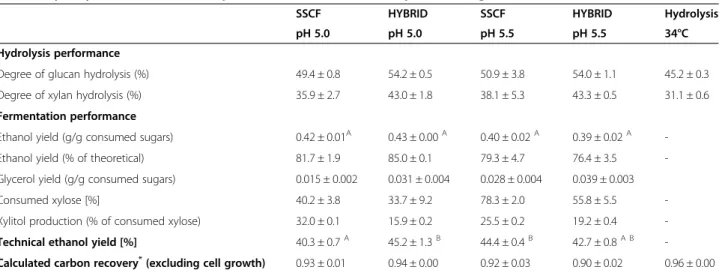
Experiments were made to compare the standard SSCF strategy to a HYBRID scenario in which a 48 hour high temperature hydrolysis step was conducted prior to continued hydrolysis and fermentation, at lower temperature, keeping a total process time of 96 hours. The strategies were investigated at two different pH levels, in order to eluci-date how the inhibitory effect of the present acetic acid affected especially xylose consumption during the different process designs (Table 2). Post-fermentation material analyses of the residual solids were furthermore conducted for all the experiments and with these analysis it was possible to calculate the amount of released sugars and hence also the amount consumed by the yeast during fermentation. Based on this, the hydrolysis performance could be sepa-rated from the fermentation performance and be assessed individually for the different process designs. Furthermore the analysis allowed for the calculation of carbon recovery for each experiment by taking volume and density changes during the process into account (Eq 5). The carbon balance could be closed around 95% for the enzymatic hydrolysis experiment, whereas for the HYBRID/SSCF experiments where biomass could not be measured (and CO2 only esti-mated), the carbon recovery was slightly reduced, to around 90% (Table 2). This indicates that all major compounds have been considered.
The effects of changing pH at different process designs
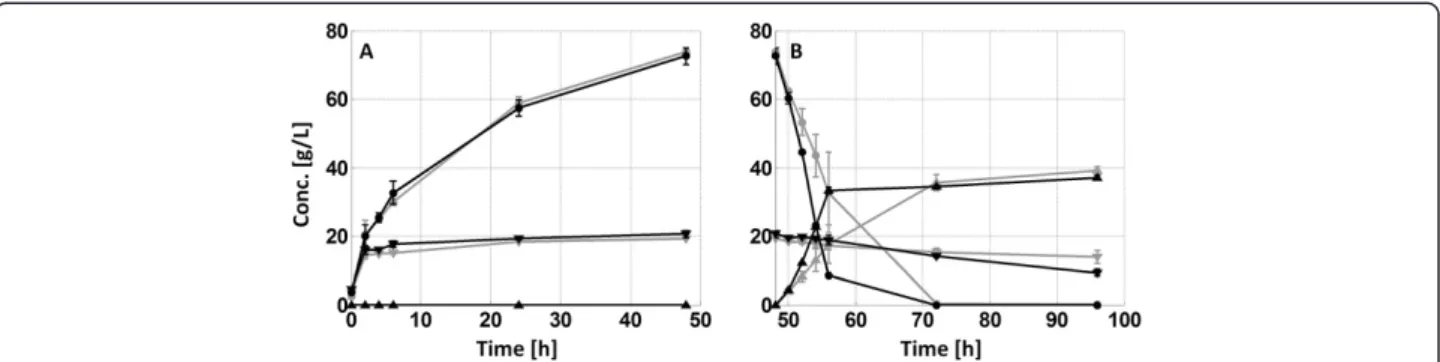
Since no significant differences in hydrolysis perform-ance was observed (Figure 2A and Table 2), this points towards a decrease in fermentation yield (although no statistically significant difference was found) at the higher pH. A potential yield reduction could be related to the fas-ter initial fermentation rate observed at the less inhibiting conditions at the higher pH (Figure 2B). At less inhibiting conditions, cell growth and associated glycerol production is favored, which typically reduces the ethanol yield. Cell growth could not be measured in the slurries, but an in-crease was indicated by the higher glycerol production at the higher pH level (Table 2).
Furthermore, the degree of hydrolysis was higher in the HYBRID process design in comparison to the SSCF
case. As a reference to the SSCF experiment a 96 hour enzymatic hydrolysis experiment was run at 34˚C. As expected, a very significant temperature effect on the en-zymatic hydrolysis was found and a similar sugar release was obtained after a 48 hour hydrolysis at 45˚C as after 96 h at 34˚C (data not shown). It was also found that the overall glucan conversion was increased in SSCF compared to an enzymatic hydrolysis at the same temperature, indicating end product inhibition (Table 2).
Fermentation at different pH and acetic acid concentrations
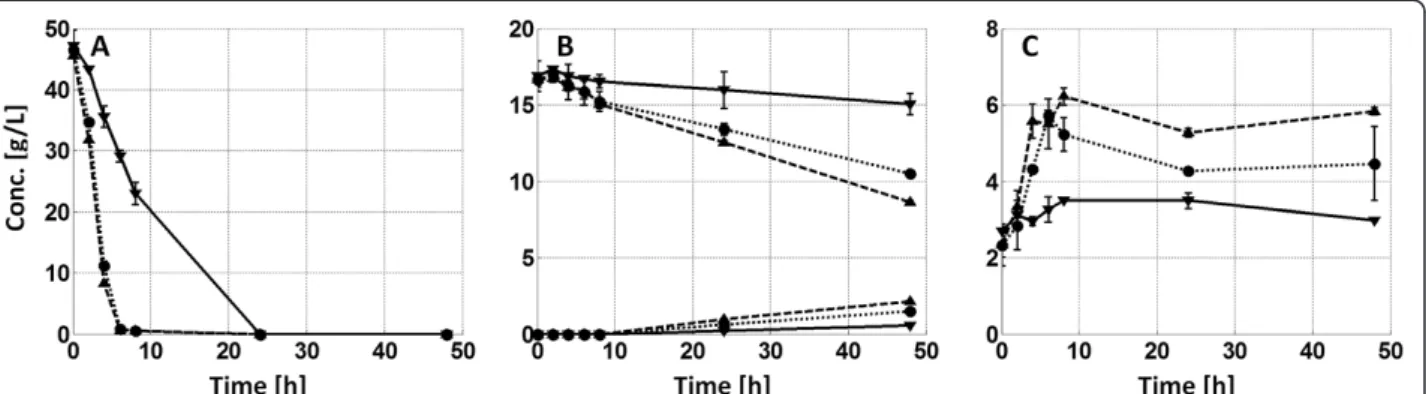
Shake flask fermentations were set up in order to further evaluate the effects of pH on acetic acid inhibition at two different acetic acid concentrations (4 and 8 g L−1) during fermentation of hydrolyzate liquid. Three differ-ent pH levels (5.0, 5.5 and 6.0) were used, resulting in a set of 6 different conditions. The xylose consumption was clearly enhanced by increased pH, regardless of acetic level (Table 3). However, it was also seen that the ethanol yield (based on consumed sugars) was reduced at the less inhibiting conditions, i.e. high pH and low acetic acid concentration. By measuring OD it could be confirmed that cell growth was indeed promoted together with enhanced glucose consumption when increasing pH at high acetic acid concentrations (Figure 3). However, under milder acetic acid conditions, i.e. 4 g L−1, the effect of increasing pH above 5.0 was not as evident on cell growth (data not shown). One need also keep in mind that these experiments were made without fibers.
Discussion
The present work showed that the HYBRID design, i.e. a high temperature enzymatic hydrolysis step prior to
Figure 1Concentration profiles throughout the SSCF
experiments at pH 5.0 (grey) and 5.5 (black).Glucose (●), xylose
(▼) and ethanol (▲). The error bars represent standard deviation of duplicate experiments.
Table 2 Hydrolysis and fermentation performance for the different process designs
SSCF HYBRID SSCF HYBRID Hydrolysis
pH 5.0 pH 5.0 pH 5.5 pH 5.5 34°C
Hydrolysis performance
Degree of glucan hydrolysis (%) 49.4 ± 0.8 54.2 ± 0.5 50.9 ± 3.8 54.0 ± 1.1 45.2 ± 0.3
Degree of xylan hydrolysis (%) 35.9 ± 2.7 43.0 ± 1.8 38.1 ± 5.3 43.3 ± 0.5 31.1 ± 0.6
Fermentation performance
Ethanol yield (g/g consumed sugars) 0.42 ± 0.01A 0.43 ± 0.00A 0.40 ± 0.02A 0.39 ± 0.02A
-Ethanol yield (% of theoretical) 81.7 ± 1.9 85.0 ± 0.1 79.3 ± 4.7 76.4 ± 3.5
-Glycerol yield (g/g consumed sugars) 0.015 ± 0.002 0.031 ± 0.004 0.028 ± 0.004 0.039 ± 0.003
Consumed xylose [%] 40.2 ± 3.8 33.7 ± 9.2 78.3 ± 2.0 55.8 ± 5.5
-Xylitol production (% of consumed xylose) 32.0 ± 0.1 15.9 ± 0.2 25.5 ± 0.2 19.2 ± 0.4
-Technical ethanol yield [%] 40.3 ± 0.7A 45.2 ± 1.3B 44.4 ± 0.4B 42.7 ± 0.8A B
-Calculated carbon recovery*(excluding cell growth) 0.93 ± 0.01 0.94 ± 0.00 0.92 ± 0.03 0.90 ± 0.02 0.96 ± 0.00
*
Carbon recovery calculated according to Eq.5in material and methods, with CO2estimated based on ethanol production.
fermentation, gave a higher overall glucan conversion compared to a 96 hours SSCF process (Table 2). This is well in-line with results reported by Cannella and Jorgen-sen for pretreated wheat straw (Cannella and JørgenJorgen-sen 2013), and supports their claim that commercial enzyme mixtures available today are less end-product inhibited and exhibit improved long time temperature stability. It deserves to be pointed out, that the advantage comes from the high temperature for enzymatic hydrolysis. If SSCF and pure hydrolysis is compared at the same (permissible) temperature, e.g. 34˚C as done in this study, a better glu-can conversion is indeed obtained for the SSCF case (Table 2–first and last columns). This confirms that SSCF
most likely still gives a reduced end-product inhibition of the enzymes. However, this decreased end-product inhib-ition does not outweigh the enhanced enzymatic activity at the higher temperatures, which resulted in a better overall glucan conversion in the HYBRID process design (Table 2).
With respect to fermentation, the fundamental differ-ence between the two process designs is the availability of glucose throughout the fermentation. During the HYBRID design, a large fraction of the total amount of both glucose and xylose that are to be fermented to etha-nol are present from the start of the fermentation, whereas during SSCF the glucose is slowly being released from the
Figure 2Concentration profiles throughout the HYBRID process design at pH 5.0 (grey) and 5.5 (black). A)The 48 hour high temperature hydrolysis.B)The SSCF phase during the final 48 hours. Glucose (●), xylose (▼) and ethanol (▲). The error bars represent standard deviation of duplicate experiments.
Table 3 Summary of the fermentation performance during the shake flask fermentations
4 g L−1acetic acid
pH 5.0 5.5 6.0
Ethanol yield (g/g consumed sugars) 0.44 ± 0.01A 0.43 ± 0.00A B 0.40 ± 0.02C
Ethanol yield (% of theoretical) 85.5 ± 1.2 83.8 ± 0.6 78.5 ± 3.6
Glycerol yield (g/g consumed sugars) 0.043 ± 0.007 0.042 ± 0.002 0.045 ± 0.004
Consumed xylose (%) 27.4 ± 1.9C 38.7 ± 2.5A 50.2 ± 1.2B
Xylitol production (% of consumed xylose) 23.9 ± 0.2 25.2 ± 4.0 28.5 ± 2.6
Calculated carbon recoverya(including cell growth) 0.99 ± 0.00 0.99 ± 0.01 0.97 ± 0.04
8 g L−1acetic acid
pH 5.0 5.5 6.0
Ethanol yield (g/g consumed sugars) 0.43 ± 0.03A D 0.43 ± 0.01A D 0.42 ± 0.01B C D
Ethanol yield (% of theoretical) 84.9 ± 5.4 84.5 ± 1.9 82.3 ± 0.9
Glycerol yield (g/g consumed sugars) 0.039 ± 0.009 0.042 ± 0.003 0.046 ± 0.000
Consumed xylose (%) 10.7 ± 1.2D 37.0 ± 0.6A 48.0 ± 2.0B
Xylitol production (% of consumed xylose) 32.1 ± 7.8 23.8 ± 0.7 27.2 ± 2.0
Calculated carbon recovery*(including measured cell growth) 0.95 ± 0.04 0.99 ± 0.01 1.01 ± 0.02 *
Carbon recovery calculated according to Eq.5in material and methods, with CO2estimated based on ethanol production.
fibers throughout the process, hence limiting the fermen-tation rate. One observed effect of this difference in avail-able glucose was that xylose consumption was better with the SSCF design in comparison to the HYBRID process, most likely since high initial glucose levels are known to inhibit xylose uptake (Lee et al. 2002; Saloheimo et al. 2007). The effect on xylose consumption from process design was, however, not as large as when in-creasing the fermentation pH. A higher pH was found to clearly reduce the inhibitory effect of the acetic acid, as previously shown by for example Casey et al. (2010). An increased pH significantly enhanced xylose consumption for both process designs, although the SSCF design was more favored than the HYBRID de-sign (Table 2). The strong correlation between xylose utilization and pH in the presence of acetic acid was furthermore confirmed in shake flask fermentations (Figure 3B and Table 3).
The increase in pH for the HYBRID design resulted not only in improved xylose consumption, but also the glucose uptake rates were significantly improved at the less inhibiting conditions (Figure 2). Coupled to the in-creased sugar uptake rate, a reduced fermentation yield was observed together with increased glycerol produc-tion, potentially indicating increased cell growth. Since cell growth is very difficult to quantify in fiber suspen-sions, shake flask fermentations where carried out on fiber free hydrolyzate where it could be concluded that an overall faster glucose consumption at less inhibiting conditions was correlated to enhanced cell growth (Figure 3). This agrees well with previous studies on both pure glucose and mixed sugar fermentations with other strains ofS. cerevisiae, where ethanol yields were reduced at increased pH in the presence of acetic acid as a consequence of improved anaerobic cell growth (and associated glycerol production) (Casey et al. 2010; Taherzadeh et al. 1997). However, for the SSCF experiment the fermentation yield seemed less affected compared to
the HYBRID design, possibly since the glucose uptake rate was limited by the rate of hydrolysis.
Conclusion
In conclusion, this study shows that the impact of an in-creased pH on the overall ethanol yield is not necessarily in agreement with an a priori expectation, but will de-pend on the process design. The overall ethanol yield in-creased significantly for the SSCF strategy at inin-creased pH, whereas no significant difference (or even a slight reduction in yield) was observed with the HYBRID strat-egy. This can be explained by the difference in available sugars during the fermentation. The high sugar concen-trations in the HYBRID design resulted in both a re-duced fermentation yield at the higher pH as well as a hampered xylose consumption in comparison to the SSCF strategy.
Competing interests
The authors declare that they have no competing interests.
Acknowledgements
This study was made within the EU Project“Second generation BIOethanol process: demonstration scale for the step of Lignocellulosic hYdrolysis and FErmentation”(BIOLYFE, FP7, EU contract No. 239204) funded by the European Union. Biochemtex S.p.A. Italia, Novozymes A/S and Taurus Energy, are gratefully acknowledged for providing pretreatedArundo donax, enzymes and the yeast strain used in the work.
Received: 14 February 2014 Accepted: 1 April 2014
References
Alkasrawi M, Rudolf A, Lidén G, Zacchi G (2006) Influence of strain and cultivation procedure on the performance of simultaneous saccharification and fermentation of steam pretreated spruce. Enzyme Microb Technol 38(1–2):279–286 Almeida JRM, Runquist D, Sànchez Nogué V, Lidén G, Gorwa-Grauslund MF
(2011) Stress-related challenges in pentose fermentation to ethanol by the yeast Saccharomyces cerevisiae. Biotechnol J 6(3):286–299
Balan V, Chiaramonti D, Kumar S (2013) Review of US and EU initiatives toward development, demonstration, and commercialization of lignocellulosic biofuels. Biofuels, Bioproducts and Biorefining. doi:10.1002/bbb.1436 Bellissimi E, Van Dijken JP, Pronk JT, Van Maris AJA (2009) Effects of acetic acid on
the kinetics of xylose fermentation by an engineered, xylose-isomerase-based Saccharomyces cerevisiae strain. FEMS Yeast Res 9(3):358–364
Figure 3Concentration profiles for glucose consumption (A), xylose consumption/xylitol production (B) and cell growth (C) during
shake flask fermentations with 8 g L−1acetic acid at pH 5.0 (▼), 5.5 (●) and 6.0 (▲).The error bars represent standard deviation of
Bertilsson M, Andersson J, Lidén G (2008) Modeling simultaneous glucose and xylose uptake inSaccharomyces cerevisiaefrom kinetics and gene expression of sugar transporters. Bioprocess Biosyst Eng 31(4):369–377
Cannella D, Jørgensen H (2013) Do new cellulolytic enzyme preparations affect the industrial strategies for high solids lignocellulosic ethanol production? Biotechnol Bioeng. doi:10.1002/bit.25098
Casey E, Sedlak M, Ho NWY, Mosier NS (2010) Effect of acetic acid and pH on the cofermentation of glucose and xylose to ethanol by a genetically engineered strain of Saccharomyces cerevisiae. FEMS Yeast Res 10(4):385–393
Galbe M, Sassner P, Wingren A, Zacchi G (2007) Process Engineering Economics of Bioethanol Production. In: Olsson L (ed) Advances in Biochemical Engineering/Biotechnology, vol 108. Springer, Berlin Heidelberg, pp 303–327. doi:10.1007/10_2007_063
Hahn-Hägerdal B, Karhumaa K, Fonseca C, Spencer-Martins I, Gorwa-Grauslund M (2007) Towards industrial pentose-fermenting yeast strains. Appl Microbiol Biotechnol 74(5):937–953
Humbird D, Mohagheghi A, Dowe N, Schell DJ (2010) Economic impact of total solids loading on enzymatic hydrolysis of dilute acid pretreated corn stover. Biotechnol Prog 26(5):1245–1251
Janssen R, Turhollow AF, Rutz D, Mergner R (2013) Production facilities for second-generation biofuels in the USA and the EU–current status and future perspectives. Biofuels Bioprod Bioref 7(6):647–665
Jorgensen H, Vibe-Pedersen J, Larsen J, Felby C (2007) Liquefaction of lignocellulose at high-solids concentrations. Biotechnol Bioeng 96(5):862–870
Knutsen JS, Liberatore MW (2009) Rheology of high-solids biomass slurries for biorefinery applications. J Rheol 53(4):877–892
Kristensen J, Felby C, Jørgensen H (2009a) Determining Yields in High Solids Enzymatic Hydrolysis of Biomass. Appl Biochem Biotechnol 156(1):127–132 Kristensen J, Felby C, Jorgensen H (2009b) Yield-determining factors in high-solids
enzymatic hydrolysis of lignocellulose. Biotechnol Biofuels 2(1):11
Lee WJ, Kim MD, Ryu YW, Bisson L, Seo JH (2002) Kinetic studies on glucose and xylose transport in Saccharomyces cerevisiae. Appl Microbiol Biotechnol 60(1–2):186–191
Macrelli S, Mogensen J, Zacchi G (2012) Techno-economic evaluation of 2nd generation bioethanol production from sugar cane bagasse and leaves integrated with the sugar-based ethanol process. Biotechnol Biofuels 5 (1):1–18
McMillan JD, Jennings EW, Mohagheghi A, Zuccarello M (2011) Comparative performance of precommercial cellulases hydrolyzing pretreated corn stover. Biotechnol Biofuels 4:29
Meinander NQ, Boels I, Hahn-Hägerdal B (1999) Fermentation of xylose/glucose mixtures by metabolically engineered Saccharomyces cerevisiae strains expressing XYL1 and XYL2 from Pichia stipitis with and without overexpression of TAL1. Bioresour Technol 68(1):79–87
Olofsson K, Rudolf A, Lidén G (2008) Designing simultaneous saccharification and fermentation for improved xylose conversion by a recombinant strain of Saccharomyces cerevisiae. J Biotechnol 134(1–2):112–120
Olofsson K, Palmqvist B, Liden G (2010a) Improving simultaneous saccharification and co-fermentation of pretreated wheat straw using both enzyme and substrate feeding. Biotechnol Biofuels 3(1):17
Olofsson K, Wiman M, Lidén G (2010b) Controlled feeding of cellulases improves conversion of xylose in simultaneous saccharification and co-fermentation for bioethanol production. J Biotechnol 145(2):168–175
Roche CM, Dibble CJ, Knutsen JS, Stickel JJ, Liberatore MW (2009) Particle Concentration and Yield Stress of Biomass Slurries During Enzymatic Hydrolysis at High-Solids Loadings. Biotechnol Bioeng 104(2):290–300 Saloheimo A, Rauta J, Stasyk O, Sibirny A, Penttilä M, Ruohonen L (2007)
Xylose transport studies with xylose-utilizing Saccharomyces cerevisiae strains expressing heterologous and homologous permeases. Appl Microbiol Biotechnol 74(5):1041–1052
Sassner P, Galbe M, Zacchi G (2008) Techno-economic evaluation of bioethanol production from three different lignocellulosic materials. Biomass Bioenergy 32(5):422–430
Sluiter A, Hames B, Ruiz R, Scarlata C, Sluiter J, Templeton D (2008a) Determination of sugars, byproducts and degradation products in liquid fraction process samples (LAP). NREL, Golden, CO.
Sluiter A, Hames B, Ruiz R, Scarlata C, Sluiter J, Templeton D, Crocker D (2008b) Determination of structural carbohydrates and lignin in biomass (LAP). NREL, Golden, CO.
Taherzadeh MJ, Lidén G, Gustafsson L, Niklasson C (1996) The effects of pantothenate deficiency and acetate addition on anaerobic batch
fermentation of glucose by Saccharomyces cerevisiae. Appl Microbiol Biotechnol 46(2):176–182
Taherzadeh MJ, Niklasson C, Lidén G (1997) Acetic acid—friend or foe in anaerobic batch conversion of glucose to ethanol by Saccharomyces cerevisiae? Chem Eng Sci 52(15):2653–2659
Van Vleet JH, Jeffries TW (2009) Yeast metabolic engineering for hemicellulosic ethanol production. Curr Opin Biotechnol 20(3):300–306
Viamajala S, McMillan JD, Schell DJ, Elander RT (2009) Rheology of corn stover slurries at high solids concentrations - Effects of saccharification and particle size. Bioresour Technol 100(2):925–934
Viamajala S, Donohoe BS, Decker SR, Vinzant TB, Selig MJ, Himmel ME, Tucker MP (2010) Heat and Mass Transport in Processing of Lignocellulosic Biomass for Fuels and Chemicals. Sustainable Biotechnology: Sources of Renewable Energy. Springer. doi:10.1007/978-90-481-3295-9_1
Wahlbom CF, van Zyl WH, Jönsson LJ, Hahn-Hägerdal B, Otero RRC (2003) Generation of the improved recombinant xylose-utilizing Saccharomyces cerevisiae TMB 3400 by random mutagenesis and physiological comparison with Pichia stipitis CBS 6054. FEMS Yeast Res 3(3):319–326
Wiman M, Palmqvist B, Tornberg E, Lidén G (2011) Rheological characterization of dilute acid pretreated softwood. Biotechnol Bioeng 108(5):1031–1041 Wingren A, Galbe M, Zacchi G (2003) Techno-economic evaluation of producing
ethanol from softwood: comparison of SSF and SHF and identification of bottlenecks. Biotechnol Prog 19(4):1109–1117
Wiselogel A, Tyson S, Johnson D (1996) Biomass feedstock resources and composition. In: CE W (ed) Handbook on bioethanol: production and utilization. Taylor & Francis, Washington, DC, pp 105–118
Zhu Y, Malten M, Torry-Smith M, McMillan JD, Stickel JJ (2011) Calculating sugar yields in high solids hydrolysis of biomass. Bioresour Technol 102(3):2897–2903
doi:10.1186/s13568-014-0041-z
Cite this article as:Palmqvist and Lidén:Combining the effects of process design and pH for improved xylose conversion in high solid ethanol production fromArundo donax.AMB Express20144:41.
Submit your manuscript to a
journal and benefi t from:
7Convenient online submission
7Rigorous peer review
7Immediate publication on acceptance
7Open access: articles freely available online
7High visibility within the fi eld
7Retaining the copyright to your article