A Systematic Review on Bilingualism and Language Processing
from 2015-2019
SOH, OR-KAN
School of Language Studies & Linguistics Faculty of Social Sciences & Humanities
Universiti Kebangsaan Malaysia
HAZITA AZMAN
School of Language Studies & Linguistics Faculty of Social Sciences & Humanities
Universiti Kebangsaan Malaysia [email protected]
HO, SU-MEI
School of Language Studies & Linguistics Faculty of Social Sciences & Humanities
Universiti Kebangsaan Malaysia
ABSTRACT
Over the past few decades, research on bilingualism has been extensively covered but still leaves room for much to be discovered especially in the context of language processing. Thereis a lack in systematic review on studies that examine the trends, effects, methodological approaches, challenges and limitations on bilingualism in relation to language processing. Therefore, this article aims to offer current understanding on bilingualism and language processing through a process of a critical analysis and synthesis. A total of 20 articles published from 2015-2019 in peer-reviewed journals both abroad and locally were selected to be included in this review for content analysis. Hence, this paper attempts to give a systematic report on the findings categorized by trends, effects, methodological approaches, challenges and limitations. Few main findings emerged: (a) An increasing trend in the study on internal language processing and individual factors affecting bilingualism; (b) The existence of inconsistent effects; (c) The need to re-evaluate methodological approaches; and (d) The lack of research conducted in Malaysia. This review also provides suggestions and opportunities for future research in bilingualism and language processing.
Keywords: systematic review; bilingualism; language processing; qualitative method; challenges
INTRODUCTION
bilinguals to manoeuvre between two languages and inhibit the languages not in use in order to produce fluent language performance, is the fundamental of all research regarding bilingualism and executive function.
This underlying mechanism deduced by Valian (2015) was first proposed by Green (1998), known as Inhibition Control (IC) which sparked off various research showing advantages of bilinguals compared to monolinguals in areas extending even beyond language processing which is widely known as the bilingual advantage (Bialystok, 1999). Since then, an extensive quantity of literature that examined the hypothesis regarding the bilingual advantage have suggested that there are advantages to the bilingual experience such as greater mental flexibility (Bialystok & Martin, 2004), problem solving skills (Leikin, 2012) and even the greater plasticity in the physical structure of the brain which can help delay the onset of Alzheimer’s disease (Antoniou, 2019; Bialystok, Craik & Freedman, 2007). Conversely, in recent years, a substantial amount of research indicating no bilingual advantage or even opposing results have also emerged (Costa, Hernandez, Faidella, & Galles, 2009; Sandoval, Gollan, Ferreira & Salmon, 2010). Valian has attempted to explain the inconsistencies in results by suggesting that such inconsistencies are to be expected due to the fundamental vagueness in understanding about which exact section of the executive function is activated in the tasks used therefore producing uncertainty about how different variations of the tasks used might have an effect on the results. Valian also cited individual differences such as education, social economic status, leisure activities and musical training as factors for inconsistent results as these factors might contribute to the enhancement of the executive function. On the other hand, Bruin, Treccani and Sala (2015) have concluded that such inconsistencies exist because of the existing publication bias which promotes the publishing of research with only positive results.
Existing literature reviews have extensively covered many aspects of bilingualism by synthesizing trends as well as contributing an analysis of findings (Valian, 2015). However, the substantial amount of published research reporting on the various aspects of bilingualism such as the advantages, disadvantages, limitations and challenges have indicated a lack of condensed and focused research in particular areas of bilingualism especially over the past 5 years. This means that there is a lack of systematic research on bilingualism especially in relation to language processing. Thus through a synthesis of 20 selected articles on studies conducted internationally and in Malaysia, this study aims to report the current understanding as well as to fill a gap in the current research on bilingualism and language processing. Additionally, this study also analyses the current literature in the context of Malaysia as bilingualism is deeply rooted in the historical and educational development of Malaysia (Chan & Abdullah, 2015). Therefore, within this context, this review is guided by the following research question: “What is the current understanding about bilingualism in relation to language processing over the last five years?”
RESEARCH METHODS
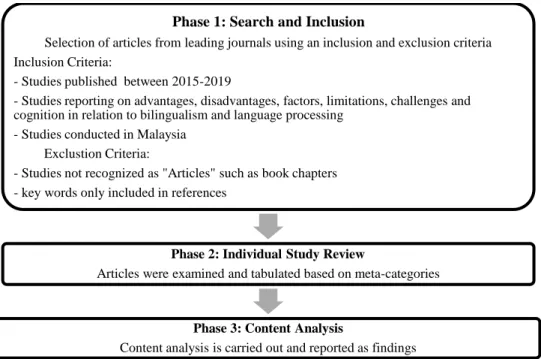
The synthesis in this review went through three distinct phases (Figure 1) - Phase 1: search and inclusion, Phase 2: individual study review and Phase 3: content analysis through cross-study comparison and analysis which is modelled after the research conducted by Baran (2014). In phase 1, the purpose was to employ a consistent manner in searching and selecting through an inclusion and exclusion criteria the most relevant journals for this review. A search by employing keywords such as “bilingualism” and “language processing” or “language processing” and “bilingual” or “bilingual” and “language” in the Web of Science (WOS) complete database produced 730 results. In order to guarantee reliability, a guideline for carrying out literature reviews proposed by Webster and Watson (2002) was used in which the authors proposed that contributions published in leading journals should be a starting point when ascertaining relevant literature. Therefore, a second manual search was later conducted in high-ranked journals in the field of bilingualism namely International Journal of Bilingualism and Bilingualism: Language and Cognition. To further ensure reliability, the search results were then examined using an inclusion and exclusion criteria as proposed by Bacca, Baldiris, Fabregat, Graf and Kinshuk (2014). In order to refine the search results, articles were selected based on general and specific inclusion criteria as well as exclusion criteria by considering the research questions, time frame as well as scope of the relevant studies. The overarching general criteria entailed studies published between 2015and 2019 as well as studies that centres around bilingualism in language processing. Additionally, relevant criteria that were specified in the scope of search included studies that report on the advantages, disadvantages, factors, limitations and challenges of bilingualism on language processing; studies that report on cognition and language processing in relation to bilingualism; studies that report on assessment methods for bilingualism on language processing and also studies done locally were included in this review. Important to note that, studies that met the exclusion criteria and are not recognized in the journals as “Articles” such as book chapters as well as studies which only included the key terms which are “bilingualism” and “language processing” in their references were excluded. The relevance and reliability of the chosen articles was also examined by conducting a manual search in the leading journals. Therefore, 20 articles published from 2015-2019 in peer-reviewed journals which covered the advantages, disadvantages, factors, methods, limitations and challenges of bilingualism on language processing were selected to be included in this review.
FIGURE 1. Research Procedures
FINDINGS
Through the research synthesis conducted on the selected 20 articles about bilingualism and language processing, few main findings emerged that can inform the methodology and perspectives on bilingualism research in differentiated contexts. These findings are reported below in terms of trends, outcomes, methodological approaches, challenges and limitations.
TRENDS IN THE BILINGUALISM AND LANGUAGE PROCESSING LITERATURE
The 20 articles that were chosen to be analysed were set with a time frame of 2015-2019 in order to obtain updated and relevant literature. Within the time period of 5 years, an equal amount of literature was selected for each year in order to analyse the trends of the literature in each particular year. Research done in Malaysia was also included in each year in order to determine the overall trend in the local scene.
Overall, the aim of the studies analysed in this review can be categorized into three main types. The first is the effects of bilingualism on external language processing which is language production. The second category is the effects of bilingualism on internal language processing which has to do with executive function or cognition and the brain. The third would be the factors that affect the bilingual experience in language processing. More than half of the research conducted over the period of 2015-2019 have been dedicated to finding out the effects of bilingualism on internal language processing such as the benefits of bilingualism on executive function, cognition or the physical structure of the brain which affects language processing (n = 8). A significant but slightly lesser amount of studies conducted aims to find out the effects of bilingualism on external language processing such as verbal interference control, code-switching, phonetic sensitivity and plural expressions (n = 6). Only a small number of research has focused on the factors that affect bilingualism and language processing (n=3). Only one of the research
Phase 1: Search and Inclusion
Selection of articles from leading journals using an inclusion and exclusion criteria Inclusion Criteria:
- Studies published between 2015-2019
- Studies reporting on advantages, disadvantages, factors, limitations, challenges and cognition in relation to bilingualism and language processing
- Studies conducted in Malaysia Exclustion Criteria:
- Studies not recognized as "Articles" such as book chapters - key words only included in references
Phase 2: Individual Study Review
Articles were examined and tabulated based on meta-categories
Phase 3: Content Analysis
conducted consist of aiming to find out both internal and external language processing. The remaining two studies were not really centred on bilingualism and language processing but geared towards bilingualism and education policy including teacher’s and student’s perception. However, they were selected as they were local articles which were important to identify the local trends.
Delving into the trends of each year, it is apparent that the focus of research towards the effects of bilingualism on internal language processing has increased throughout the years. Between 2015 and 2016, only 1 article each year was found to have reported on internal language processing and the rest of the 6 articles were focused on external language processing. However, a shift in 2017 saw a significant increase in articles (3 out of 4) about how language is processed internally. Subsequently in 2018, the focus shifted to studies on factors that affect bilingualism and language processing as well as the teacher’s and student’s perception. Unlike the previous year, only 1 article was found to report on internal language processing. A similar trend can also be observed in the year 2019 in which 2 articles have purposed to study internal language processing while the other 2 centres on the external effects as well as factors. In contrast, the overall trend in the study of bilingualism and language processing locally over the period of 2015-2019 was not apparent as studies related to bilingualism were mostly centred on education. Only 2 articles were found to be close to reporting on the effects and factors of bilingualism in relation to language processing.
In relation to the methodologies employed by the studies reviewed, it was found that majority of the investigations employed the qualitative approach (n = 9) as well as the mixed = method (n = 5) designs. However, a few were investigated as case studies (n = 4), while the remaining studies (n = 2) employed the quantitative method. Relatedly, the range of research participants ranged from infants (age 16 months) children (provide age range age 4-13) to adults (provide age range age 20-35) and older adults (provide age range age 59-83). As for the participants, 25% of the studies focused on children as their participants while 30% of articles aimed to study on adults. Only 1 article was found to study on older adults and another 1 article employed both children and adults as their participants. Additionally, data sources comprised journal articles, performances of various tasks, observations via video or audio recording, questionnaires as well as Magnetic Resonance Imaging (MRI) and Electroencephalogram (EEG) scans and reports.
THE VARIED EFFECTS OF BILINGUALISM ON LANGUAGE PROCESSING
language processing. For example, Kroll, Dussias, Bice and Perrotti (2015) revealed that there is an absence of the bilingual effect in many studies conducted among young adults.
Most of the research done regarding the effects of bilingualism on internal language processing has seen advantages which stems from the bilingual experience. For instance, in the study conducted by Bialystok (2017), it is found that the bilingual experience modifies the structure of the brain that is related to language processing due to the joined activation of language in the bilingual brain which requires inhibition and selection and the benefits extends beyond just one region. Therefore, both younger and older bilinguals are able to outperform monolinguals when it comes to tasks which require the use of the executive function, which also controls language processing. Similarly, Hämäläinen, Sairanen, Leminen and Lehtonen (2017) also reported advantages through a MRI scan and found that major language-related white matter trajectories contained bilingualism-induced modulations in which the most notable ones were along the left section of the arcuate fasciculus as well as an increased density which is in line with the findings of Pliatsikas, DeLuca, Moschopoulou and Saddy (2016) as well as Zirnstein, Hell and Kroll (2019) which revealed an expansion and increased thickness in various subcortical structures compared to monolinguals as well as a significant reshape in the caudate nucleus. However, the research conducted by White, Titione, Genesee and Steinhauer (2017) have reported no noteworthy differences or results among both native and late L2 learners in both accuracy and categorizing syllables with non-native phonological contrast particularly in their neurocognitive processes.
METHODOLOGICAL APPROACHES IN THE BILINGUALISM AND LANGUAGE PROCESSING LITERATURE
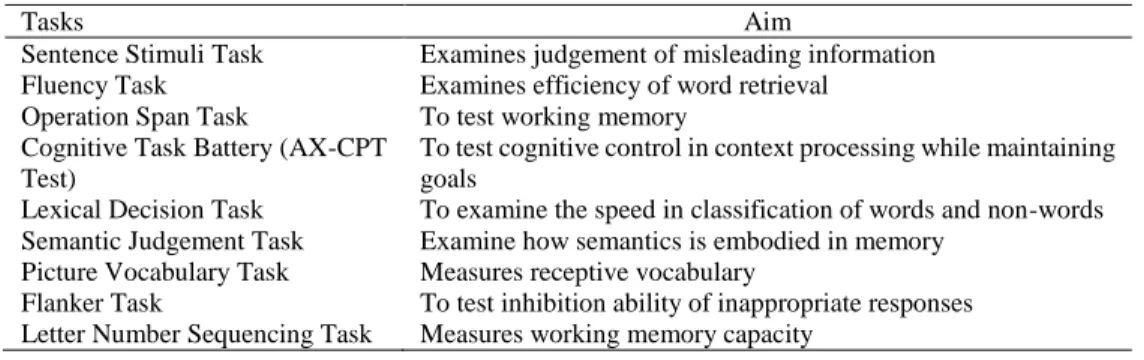
The current research analysis and synthesis revealed the many different methodological approaches as well as variations that have been employed by the researchers throughout the chosen articles which are most commonly task-based in order to determine how the bilingual experience plays a role in language processing. Some of the most common tasks used in the bilingualism literature are Sentence Stimuli Task in determining whether previous sentence was true or false, Fluency Task, Operation Span Task used to test the memory of letters while solving math problems, as well as a Cognitive Task Battery known as the AX-CPT test, Lexical Decision Task, Sematic Judgement Task, Picture Vocabulary Task, Flanker task as well as the Letter Number Sequencing Task (Table 1). All these tasks are utilized particularly in determining how bilingualism affects language processing through executive function or cognition such as in reading comprehension or cognitive development when learning a second language (Zirnstein et al., 2019; Legault, Grant & Fang, 2019).
TABLE 1. Commonly employed tasks and in the bilingualism and language processing study
Tasks Aim
Sentence Stimuli Task Examines judgement of misleading information
Fluency Task Examines efficiency of word retrieval
Operation Span Task To test working memory Cognitive Task Battery (AX-CPT
Test)
To test cognitive control in context processing while maintaining goals
Lexical Decision Task To examine the speed in classification of words and non-words Semantic Judgement Task Examine how semantics is embodied in memory
Picture Vocabulary Task Measures receptive vocabulary
Some other task-based approaches involve the use of pseudo-words. Both Havy, Bouchan and Nazzi (2016) as well as White, Titione, Genesse and Steinhauer (2017), have employed the use of pseudo-words in which the former implemented an object and pseudo-word matching task where participants are required to match the objects labelled with pseudo-words after they were presented to the participants in order to learn how bilinguals processed phonetics when learning words. All objects and pseudo-words had similar phonetic features. Similarly, White, Titione, Genesee and Steinhauer utilized pseudo-words by asking participants to click on the screen each time they heard a pseudo-word after being presented with a set of words during a semantic categorization task while continuous EEG was being recorded. Another task-based approach can be seen in the study conducted by Filippi et al. (2015) in testing out the control of linguistic interference during comprehension of verbal language. The researchers (Filippi et al., 2015) employed a sentence interpretation task in which the participants were presented with a combination of visual stimuli as well as auditory sentences of different complexity which might contain linguistic interference.
Most questionnaires or surveys used in the bilingualism and language processing literature are carried out as a pre-screening test in order to ensure the participants met with certain criteria. Majority of the research done from the 20 articles made sure that participants took a language-background questionnaire in order to assess the participant’s language-background which gives information about the participant’s age of acquisition, language learned or use and also to ensure they are in an optimal condition mentally before they are able to participate in the experiment especially for EEG recordings and MRI scans. These questionnaires are known as the Language History Questionnaire and Mini-Mental State Exam (White, Titione, Genesee & Steinhauer, 2017; Hämäläinen, Sairanen, Leminen & Lehtonen, 2017; Zirnstein et al., 2019; Legault et al., 2019; Abu Rabia, 2019). Abu Rabia (2019) also employed the use of questionnaire which are the English Proficiency Test as well as the Metacognitive Reading Strategies Questionnaire in studying how different degrees of bilingualism affect metacognitive linguistic. The use of these questionnaires especially for pre-screening have shown to be a vital as such assessments produces independent variables used in examining correlation or prediction of performances (Li, Sepanski, & Zhao, 2006; Soh, 2016, 2017; Mihat, Azman & Soh, 2018).
LIMITATIONS AND CHALLENGES IN THE BILINGUALISM AND LANGUAGE PROCESSING LITERATURE
A few limitation and challenges have been identified through this review. Much of what is researched on bilingualism and language processing is based on the theory of inhibition control which is considered to be an advantage resulting in superior executive function as proposed by Green (1998). However, the executive function has various other components as well such as working memory, planning and even conflict monitoring. Thus, it is not accurate to equate inhibition control as executive function as Valian (2015) suggests a need to redefine executive function because based on that theory, tasks employed are usually aimed at testing inhibition control as a means to measure executive function.
The many variations and differences in tasks have shown to be a challenge as well. The difference in tasks used including the many variations in tasks might attribute to inconsistent findings or results. This is because it is unclear which part of the task activates which component of the executive function or perhaps even employs different parts of cognition that is unrelated to the executive function. Therefore, many of the methodological problems need to be resolved in order to produce a set of consistent assessment tools as the variations in the task can influence the performance of a participant on that task (Valian, 2015; Filippi, D’Souza & Bright, 2018). Even with consistent scientific methods such as MRI scanners and EEG recordings, the limitation lies in the cost of the equipment. According to Legault, Grant, Fang and Li (2019), funding especially for additional participants can be quite hard to attain as there is an exorbitant cost of MRI scanning. Therefore, researchers can only utilize data-sharing consortiums which might fulfil all the criteria needed in that particular research.
Another challenge posed in the literature is the many individual differences that need to be taken into account. In measuring executive function, individual variability playsa role not only in terms of background but even the activities done by individuals as some activities might be related to superior executive function such as socioeconomic status, immigrant status, education level, musical training and experience in action video games, genetics and environmental factors (Valian, 2015; Filippi, D’Souza & Bright, 2018; Fricke, Zirnstein, Navarro-Torres & Kroll, 2018). However, it will be a challenge in taking into account all the individual-level differences that would affect the participant’s performance on tasks regarding executive function. Even within the bilingual context, individual differences such as age of acquisition, degree of bilingualism, linguistic environment can be a factor that affects the outcome of the performance (Hämäläinen et al., 2017; Pliatsikas et al., 2016; Salleh et al., 2016).
SCARCE REPORT OF BILINGUALISM AND LANGUAGE PROCESSING IN THE LOCAL SCENE
evident that there is a lack of research and studies done on bilingualism and language processing in Malaysia.
With Malaysia being a multiracial county, much of the focus on bilingualism has been placed in the context of education policies. For instance, the research studies done by Chan and Abdullah (2015), and Philip, Tan and Jandar (2019) focused on the relationship between bilingualism in Malaysia and language education policies as well as the perception of teachers on bilingualism. Similarly, the study conducted by Paramesvaran and Lim (2018) targets the perception of both teachers and students on the use of code-switching in a classroom setting. Chan and Abdullah have revealed that teachers mostly view bilingualism as of no consequence and with a low positive attitude. The authors also have pointed out though bilingual education in introduced and implemented in Malaysia, the Bahasa Malaysia language is still dominant and heavily emphasised which leads to the deterioration of English. However, Paramesvaran and Lim have reported that teacher’s and student’s perception of code-switching in a classroom setting differed. Students with a lower proficiency in a certain language found code-switching extremely helpful (Meganathan, Yap, Paramasivam & Jalaluddin, 2019). Hence, it can be said that not only is there an overall lack of research done on bilingualism and language processing, but also the general lack of understanding of the importance of bilingualism in Malaysia.
DISCUSSION
The overall review and synthesis of the studies selected have revealed that the study of bilingualism and language processing has evolved from focusing on the effects of bilingualism on external processing of language towards internal language processing as well as the study on other dimensions such as factors that affect bilingualism and language processing including individual differences. The shift of focus towards internal language processing in the study of bilingualism is in tandem with the conclusion of Kroll, Dussias, Bice and Perroti (2015) stating that intent of current research is to unveil the mechanisms that are responsible for the effects of bilingualism by attempting to seize language processing during its process. This is important as Valian (2015) has detailed how inhibition has often been used to as a generalization of executive function which is considered inaccurate as the executive function is comprised of many other functions. Therefore, the need to accurately discover and describe the exact section of the executive function being employed is present. Findings in trends also revealed that there is a lack of research conducted among young adults as majority of the studies were targeted at either children or adults. Although Bialystok (2017) attributes this to the lack of effect of the bilingual experience in young adults due to them being in the state of peak performance in executive function, it is still unclear as to whether or not the hypothesis is true due to the scarce amount of research.
bilingualism and language processing. Fricke, Zirnstein, Navarro-Torres and Kroll (2018) have shared similar views concluding that the relationship between individual accumulated experience and language processing is promised to be elucidated by future research. Based on the studies reviewed, it is evident that there remains a dearth in research in these mentioned areas.
Results have also indicated a need for various methodological uncertainties to be resolved and employed on a large scale as Filippi, D’Souza and Bright (2018) have brought to light the problem of questionable methodological rigor in the study of bilingualism. In many studies, various tasks such as the Flanker Task have been adapted and employed in different variations which can be said to contribute to the inconsistency in results. Valian (2015) has thoroughly explained that tasks employed in measuring executive function unavoidably stimulate mechanisms that do not belong to the executive function. Therefore, it is unclear as to which exact part of the tasks taps executive functions and which does not especially when a variation of a task is employed. However, limitations presents itself in that in spite of the emerging methods such as MRI scanners and EEG recordings, which are regarded as more insightful and reliable, such methods are constrained by its exorbitant cost. Hence, there exists an important need for researchers to re-evaluate and reconsider the methodological approaches used in studying bilingualism and language processing.
Finally, this analysis and synthesis of reviewed studies has found a huge gap in the research of bilingualism and language processing in Malaysia, where most of the research conducted were about bilingualism in the context of education as well as pedagogy and language policies. Studies that focus on bilingualism in the context of education aimed to contribute findings towards the education policy or even in a classroom setting. Thus, it is clear that there still exists a general lack in understanding how the bilingual mind processes and learn languages among bilinguals in Malaysia.
CONCLUSION
The present systematic review of 20 articles on bilingualism and language processing has revealed to us that there are still many aspects of bilingualism that needs to be researched on particularly in the context of language processing coupled with a lack of critical syntheses carried out. Findings are taken from an analysis and synthesis based on the trends, outcomes, methodological approaches, challenges and limitations. First, the review has indicated that the study of bilingualism and language processing is now focused on internal language processing as well as the study on other dimensions such as individual differences. Secondly, there is a variation in outcomes which entails advantages, disadvantages and no significant findings due to individual differences and the uncertainties in methodological variations. Third, huge amounts of variety in methodological approaches have been employed in studying the effects of bilingualism and language processing bringing attention to the need for standardization. Fourth, the challenges and limitations of the literature have revealed itself in the unclear definition of executive function, the inconsistency in tasks used as well as individual differences. Finally, scarce studies of bilingualism and language processing exist in Malaysia.
processing. Additionally, there is a lack of studies conducted on participants from the young adult age group as demonstrated in the findings. Besides that, researchers can now be aware of how methodological variations can affect performance and in doing so re-evaluate or incorporate a more coherent and controlled approach such as eye-tracking (Hasrul, Hazita & Azizah, 2018; Sarah Yusri & Soh, 2019). Lastly, we have concluded the lack of studies done in Malaysia pens a huge gap in which more research can be done in order to fill in that gap.
ACKNOWLEDGEMENTS
This research was supported by the research grant FRGS/1/2017/SSI01/UKM/01/
REFERENCES
Abu Rabia, S. (2019). The effect of degrees of bilingualism on metacognitive linguistic skills. International Journal of Bilingualism, 23(5), 1064-1086. https://doi.org/10.1177/1367006918781060
Antoniou, M. (2019). The advantages of bilingualism debate. Annual Review of Linguistics, 5, 1-21.
B. Philip, Tan, K. H. & W. A. Jandar. (2019). Exploring Teacher Cognition in Malaysian ESL Classrooms. 3L: The Southeast Asian Journal of English Language Studies, 25(4), 156 – 178.
Bacca, J., Baldiris, S., Fabregat, R., Graf, S. & Kinshuk. (2014). Augmented Reality Trends in Education: A Systematic Review of Research and Applications. Educational Technology & Society, 17 (4), 133–149. Baran, E. (2014). A Review of Research on Mobile Learning in Teacher Education. Educational Technology & Society,
17(4), 17-32.
Bialystok, E. (2017). The bilingual adaptation: How minds accommodate experience. Psychological Bulletin 143(3), 233-262. doi:10.1037/bul0000099
Bialystok, E. & Martin, M. M. (2004). Attention and inhibition in bilingual children: Evidence from the dimensional change card sort task. Developmental Science, 7, 325-339. https://doi.org/10.1111/j.1467-7687.2004.00351.x Bialystok, E., Craik, F. I. M. & Freedman, M. (2007). Bilingualism as a protection against the onset symptoms of
dementia. Neuropsychologia, 45, 459-464. https://doi.org/10.1016/j.neuropsychologia.2006.10.009
Broos, W. P. J., Duyck, W. & Hartsuiker, R. J. (2018). Are Higher-Level Processes Delayed in Second Language Word Production? Evidence from Picture Naming and Phoneme Monitoring. Language, Cognition and Neuroscience 33(10), 1219-1234. DOI:10.1080/23273798.2018.1457168
Bruin, A. D., Treccani, B. & Sala, S. D. (2015). Cognitive Advantage in Bilingualism: An Example of Publication Bias? Psychological Science. 26(1), 99-107. https://doi.org/10.1177/0956797614557866
Chan, Swee Heng & Abdullah, Ain Nadzimah. (2015). Bilingualism in Malaysia: language education policy and local needs. Pertanika Journal of Social Sciences & Humanities, 23, 55-70. ISSN 0128-7702
Costa, A., Hernandez, M., Faidella, C. J. & Galles, S. N. (2009). On the bilingual advantage in conflict processing: now you see it, now you don’t. Cognition, 113, 135-149. https://doi.org/10.1016/j.cognition.2009.08.001 Emmorey, K., Giezen, M. & Gollan, T. (2016). Psycholinguistic, cognitive, and neural implications of bimodal
bilingualism. Bilingualism: Language and Cognition, 19(2), 223-242. doi:10.1017/S1366728915000085 Filippi, R., D’Souza, D. & Bright, P. (2018). A developmental approach to bilingual research: The effects of
multi-language experience from early infancy to old age. International Journal of Bilingualism, 23(5), 1195–1207. Filippi, R., Morris, J., Richardson, F., Bright, P., Thomas, M., Karmiloff-Smith, A.Marian, V. (2015). Bilingual
children show an advantage in controlling verbal interference during spoken language comprehension.
Bilingualism: Language and Cognition, 18(3), 490-501. doi:10.1017/S1366728914000686
Fricke, M., Zirnstein, M., Navarro-Torres, C. & Kroll, J. (2018). Bilingualism reveals fundamental variation in language processing. Bilingualism: Language and Cognition, 22(1), 200-207. Green, D. W. (1998). Mental control of the bilingual lexico-semantic system. Bilingualism: Language and Cognition, 1, 67-81. https://doi.org/10.1017/S1366728998000133
Hämäläinen, S., Sairanen, V., Leminen, A. & Lehtonen, M. (2017). Bilingualism modulates the white matter
structure of language-related pathways. NeuroImage, 152, 249-257. DOI:
10.1016/j.neuroimage.2017.02.081
Hasrul, K., Hazita, A., Azizah, M., Z. (2018). Research Trend in the Practice of Differentiated Instruction. The Journal of Social Sciences Research, 4(12), 648-668. https://doi.org/10.32861/jssr.412.648.668
Havy, M., Bouchon, C. & Nazzi, T. (2016). Phonetic processing when learning words: The case of bilingual infants.
International Journal of Behavioral Development, 40(1), 41–52. DOI: 10.1177/0165025415570646
Hsieh, H. F. & Shannon, S. (2005). Three approaches to qualitative content analysis. Qualitative Health Research, 15, 1277–1288. https://doi.org/10.1177/1049732305276687
Kroll, J. F., Dussias, P. E., Bice, K. & Perrotti, L. (2015). Bilingualism, Mind, and Brain. Annual review of linguistics, 1, 377–394. doi:10.1146/annurev-linguist-030514-124937
Legault, J., Grant, A., Fang, S.-Y. & Li, P. (2019). A Longitudinal Investigation of Structural Brain Changes During Second Language Learning. Brain and Language, 197(104661), 1-46.
Leikin, M. (2012). The effect of bilingualism on creativity: Developmental and educational perspectives. International Journal of Bilingualism, 17, 431-447. https://doi.org/10.1177/1367006912438300
Mihat, W., Azman, H. & Soh, O.K. (2018). Bringing reading research in multilingual Nusantara into a new direction
through eye-tracking. Journal of Nusantara Studies, 3(2), 107- 123.
http://dx.doi.org/10.24200/jonus.vol3iss2pp107-123
Opfer, V. & Pedder, D. (2011). Conceptualizing teacher professional learning. Review of Educational Research, 81(3), 376–407
Paramesvaran, M. D. & Jia, Wei Lim. (2018). Code-switching practices in a Malaysian multilingual primary classroom from teacher and student perspectives. Indonesian Journal of Applied Linguistics, 8(2), 254-264. doi: 10.17509/ijal.v8i2.13273
Pavani, M., Yap, N. T., Shamala, P. & I. Jalaluddin. (2019). Incidental and Intentional Learning of Vocabulary among Young ESL Learners. 3L: The Southeast Asian Journal of English Language Studies, 25(4), 51 – 67 http://doi.org/10.17576/3L-2019-2504-04
Pliatsikas, C., Deluca, V., Moschopoulou, E. & Saddy, J. D. (2016). Immersive Bilingualism Reshapes the Core of the Brain. Brain Structure and Function, 222(4), 1785-1795. DOI: 10.1007/s00429-016-1307-9
Rossi, E., Diaz, M., Kroll, J. F. & Dussias, P. E. (2017). Late Bilinguals Are Sensitive to Unique Aspects of Second Language Processing: Evidence from Clitic Pronouns Word-Order. Frontiers in Psychology, 8(342), 1-13. doi: 10.3389/fpsyg.2017.00342
Salleh, R., Kawaguchi, S. & Biase, B. D. (2019). A Case Study on the Acquisition of Plurality in a Bilingual Malay-English Context-bound Child. GEMA Online® Journal of Language Studies, 19(3), 22-42. http://doi.org/10.17576/gema-2019-1903-02
Salleh, R., Kawaguchi, S., Jones, C. & Biase, B.D. (2016). The development of plural expressions in a Malay-English bilingual Child. Asiatic: IIUM Journal of English Language and Literature, 10(2), 60-81. ISSN: 1985-3106. Sarah Yusri & Or-Kan, Soh. (2019). Examining University Students’ Reading Performances and Behaviors with the
Use of Eye-Trackers. International Journal of Academic Research in Business and Social Sciences, 9(8), 114–123. DOI: 10.6007/IJARBSS/v9-i8/6221
Scandoval, T. C., Gollan, T. H., Ferreira, V. S. & Salmon, D. P. (2010). What causes the bilingual disadvantage in verbal fluency? The dual-task analogy. Bilingualism: Language and Cognition, 13, 231-252.
https://doi.org/10.1017/S1366728909990514
Soh, Or-Kan. (2016). Examining the reading behaviours and performances of sixth-graders for reading instruction: evidence from eye movements. Journal of e-Learning and Knowledge Society, 12(4), 63-79.
Soh, Or-Kan. (2017). Processing academic science reading texts through context effects: Evidence from eye movements. EURASIA Journal of Mathematics, Science and Technology Education, 13(3), 771-790. Suri, H. & Clarke, D. (2009). Advancements in research synthesis methods: From a methodologically inclusive
perspective. Review of Educational Research, 79(1), 395–430.
Valian, V. (2015). Bilingualism and cognition. Bilingualism: Language and Cognition, 18(1), 3-24. doi:10.1017/S1366728914000522
Webster, J. & Watson, R. (2002). Analyzing the past to prepare for the future: writing a literature review. Management Information Systems Quarterly, 26, xiii–xxiii.
White, E., Titone, D., Genesee, F. & Steinhauer, K. (2017). Phonological processing in late second language learners: The effects of proficiency and task. Bilingualism: Language and Cognition, 20(1), 162-183. doi:10.1017/S1366728915000620
APPENDIX
An analysis of studies on bilingualism and language processing (n=20)
Study Aim of study Method Participant
information
Data Sources Conclusion
Kroll, Dussias, Bice & Perrotti (2015)
How bilingualism effects L1 & L2 language influence & its consequences
Qualitative review
- Journal Articles L1 and L2 are interconnected & affect each other as well as cognition. Valian (2015) Examines effects of
bilingualism on executive function & cognitive reserve
Qualitative review
- Journal Articles Inhibition cannot represent executive function & individual differences to be considered Filippi et al.
(2015) Examine bilingual advantage in controlling interference in auditory attention
Case study 20 bilingual & 20 monolingual children (age 7-10)
Matching task, Observation and field notes
Bilingual children are able to control interference
Chan & Abdullah (2015)
Examine bilingualism in education policy & perception of teachers on bilingualism
Mixed method 39 language teachers (age 20-59)
Document & questionnaire survey
Bahasa Malaysia still has strong influence & bilingualism not perceived as a significant Emmorey,
Giezen & Gollan (2016)
Examine the nature of language control in bimodal bilinguals
Qualitative review
- Journal articles Bimodal bilinguals differ in activation of non-target language & advantages compared to unimodal bilinguals Havy, Bouchon
& Nazzi (2016)
Provide insight of bilingual’s word learning capacities
Case study 36 bilingual infants (16 moth old) Object choosing task, Observation & field notes Advantage for bilinguals whose languages realize the tested phonological contrasts similarly at the acoustic level. Pliatsikas et al.
(2016)
Effects of
bilingualism on the subcortical structures
Case study 20 L2 English Speakers & 17 Greek L2 English learners
MRI scans, Observation & field notes
Degrees of immersion affects the subcortical structures
Salleh et al. (2016)
Early bilingual development of plural marking
Case study 1 Malay-English bilingual child (age 3)
Observations via video & audio recording and field notes
The child developed simultaneously, two different plural systems in English and Malay. White, Titone, Genesee & Steinhauer (2017) Examine morphosyntactic processing in relation to proficiency
Mixed Method
15 monolingual English Speakers & 15 native French-English L2 speakers ( age 20-35) EEG recording, observation & field notes Neurocognitive mechanisms supporting L2 processing are not qualitatively different in native speakers and late L2 learners. Bialystok
(2017)
Investigate
relationship between bilingualism & cognition in various age groups
Qualitative review
Hämäläinen1, Sairanen, Leminen & Lehtonen (2017)
Examine how early bilingualism affects local white matter structures along two major language trajectories Mixed Method 15 early Finnish-Swedish & 15 late English-Finnish bilinguals MRI scans, observation & field notes
late bilingual speakers are more likely to exhibit extreme left lateralization pattern than early bilinguals
Rossi, Diaz, Kroll, Dussias (2017)
Study sensitivity to word order for clitic pronouns in late English-Spanish bilinguals
Quantitative 25 native Spanish speakers with proficient English & 25 late English-Spanish bilinguals
Self-paced reading
Late bilinguals can process aspects of grammar in L2-specific linguistic constructions even when subtle Filippi, D’Souza & Bright (2018) Provide further insight on multi-language experience on cognitive development
Qualitative review
- Journal articles There is a need for large-scale,
longitudinal studies & inclusion of atypical development Fricke,
Zirnstein, Navarro-Torres & Kroll (2018)
Examine individual differences in language processing
Qualitative review
- Journal articles Individual-level variability play a role in determining performance on tasks of executive function Paramesvaran
& Lim (2018)
Examine teacher’s reasons for practicing codeswitching & student’s perspective
Qualitative 1 English teacher & 3 multilingual students (age 11) Observation via video & interview Code-switching practice used to reinforce knowledge & participation
Broos, Duyck & Hartsuiker (2018)
To find out delay due to difficulties in higher-level processes of L2 speakers
Qualitative 35 monolingual English L1 speakers & 48 bilingual Dutch-English speakers Computer picture word task
Delay in speech production is situated in a later stage
Zirnstein, Hell & Kroll (2019)
Investigate how bilingualism affects prediction processes
Mixed Method
12 bilinguals & 15
monolinguals (age 61-83)
Observation, field notes & EEG recordings
Older adult bilinguals are better in the highly resource-demanding task of predicting Legault, Grant,
Fang & Li (2019)
Examine changes in cortical thickness (CT) & gray matter volume (GMV) among bilinguals Mixed Method 24 native English speakers with intermediate level of Spanish
MRI Scans & matching task, Flanker task, Letter number sequence task
L2 learning-associated lead to increases in CT in two key regions involved in lexico-semantics & cognitive control
Salleh, Kawaguchi, Biase (2019)
Examine the role of linguistic environment in the development of plural expressions in bilingual child
Qualitative 1 English-Malay bilingual child (age 4)
Observation via video recording, interview
Linguistic environment is an important variable in a child’s bilingual development & performance Rabia (2019) Examine the
metacognitive performance of degrees of bilingualism in linguistic & metalinguistic awareness
Quantitative 120 Hebrew-Russian school students (age 12-13)