Kathryn E. Muessig, PhD, David L. Rosen, MD, PhD, Claire E. Farel, MD, MPH,Becky L. White, MD, MPH, Eliza J. Filene, and David A. Wohl, MD, are affiliated with the University of North Carolina at Chapel Hill, Chapel Hill, North Carolina.
The original study was supported by the National Institute of Mental Health (R01 MH079720-01A1) and by the University of North Carolina at Chapel Hill Center for AIDS Research (CFAR), an NIH fund-ed program (P30 AI 50410). Dr. Wohl’s contribution for this analysis was supportfund-ed by K24 DA037101, and Dr. Rosen was supported by R01 AI116384.
The authors wish to acknowledge all study participants for sharing their time and experiences, as well as the staff of the North Carolina Department of Public Safety, including the facility nurses and administra-tors. The authors also acknowledge their colleagues: Carol Golin for contribution to study design and Catherine Grodensky for contribution to study design and data collection.
Address correspondence to Kathryn E. Muessig, PhD, Assistant Professor, Department of Health Behav-ior, Gillings School of Global Public Health, Rosenau Hall, CB #7440, University of North Carolina at Chapel Hill, Chapel Hill, NC 27599-7440. E-mail: [email protected]
INCARCERATED MEN AND WOMEN MUESSIG ET AL.
“INSIDE THESE FENCES IS OUR OWN LITTLE
WORLD”: PRISON-BASED HIV TESTING
AND HIV-RELATED STIGMA AMONG
INCARCERATED MEN AND WOMEN
Kathryn E. Muessig, David L. Rosen, Claire E. Farel,
Becky L. White,
Eliza J. Filene, and David A. Wohl
Correctional facilities offer opportunities to provide comprehensive HIV services including education, testing, treatment, and coordination of post-release care. However, these services may be undermined by unaddressed HIV stigma. As part of a prison-based HIV testing study, we interviewed 76 incarcerated men and women from the North Carolina State prison system. The sample was 72% men, median age 31.5 years (range: 19 to 60). Thematic analysis revealed high levels of HIV-related fear and stigma, homophobia, incomplete HIV transmission knowledge, beliefs that HIV is highly contagious within prisons (“HIV miasma”), and the view of HIV testing as protective. Interviewees described social distancing behaviors and coping mechanisms they perceived to be protective, including knowing their HIV status and avoiding contact with others and shared objects. Interview-ees endorsed universal testing, public HIV status disclosure, and segregation of HIV-positive inmates. Intensified education and counseling efforts are needed to ameliorate entrenched HIV-transmission fears and stigmatizing beliefs.
including HIV-prevention education, testing, treatment, and linkage to post-release care (Haley et al., 2014; Rosen et al., 2015). However, efforts to provide these ser-vices may be undermined by HIV stigma among inmates and prison staff (Albizu-Garcia, Perez-Cardona, & Santiago-Negron, 2012; Derlega, Winstead, Gamble, Kelkar, & Khuanghlawn, 2010; Rotily et al., 2001).
Stigma impedes HIV prevention and care by inhibiting behaviors including con-dom use and HIV status disclosure and decreasing access to, and utilization of, services such as testing and HIV treatment (Ayala, Bingham, Kim, Wheeler, & Mil-lett, 2012; Chesney & Smith, 1999; Hatzenbuehler, O’Cleirigh, Mayer, Mimiaga, & Safren, 2011; Ruiz-Torres, Cintron-Bou, & Varas-Diaz, 2007). Following the work of Goffman (1963), HIV-related stigma has been defined by Steward and colleagues as “socially shared knowledge about the devalued status of people living with HIV” (Steward et al., 2008, p. 1,226). HIV-stigma is manifested through external negative attitudes or acts of discrimination aimed at perceived PLHIV and those with whom they are associated, and internal negative feelings, beliefs, or actions experienced by PLHIV (Florom-Smith & De Santis, 2012; Herek, Capitanio, & Widaman, 2002).
HIV stigma may have particularly severe consequences within prison settings for PLHIV including discrimination, verbal abuse, and physical assault (Andrinopoulos, Figueroa, Kerrigan, & Ellen, 2011; Culbert, 2014). HIV stigma is found among inmates and staff (Albizu-Garcia et al., 2012; Derlega, Winstead, & Brockington, 2008; Derlega et al., 2010; Rotily et al., 2001) and impedes HIV testing (Derlega et al., 2008) and status disclosure (Culbert, 2014; Derlega et al., 2010). Stigma is also an important factor limiting clinical success of HIV treatment for individuals while they are incarcerated (Meyer, Tangney, Stuewig, & Moore, 2014) and after release (Haley et al., 2014).
North Carolina has the U.S.’s 12th largest state prison system (Bureau of Justice Statistics, 2015a). We interviewed recently incarcerated inmates about their HIV testing experiences within prison. In this analysis, we focus on HIV-related stigma— which featured prominently in these interview discussions—in order to illuminate areas for future intervention work.
METHODS
STUDY SETTING
This analysis is part of a larger study of opt-out HIV testing conducted from June 2008 to April 2009 (Rosen et al., 2015). The prevalence of HIV infection among the 23,373 inmates who entered the North Carolina State prison system dur-ing this period was 1.5% (Wohl, Golin, Rosen, May, & White, 2013). At the time this study was conducted, the North Carolina State prison system had adopted an opt-out HIV testing model, whereby all inmates were tested during intake unless they requested to not be tested. Inmates who test positive for HIV can access treat-ment within prison and are not segregated from the general prison population.
Research staff worked with prison staff at each location to determine a recruit-ment strategy based on space and clinic flow. After consent, participants completed a semi-structured qualitative interview led by one of two Master’s level research personnel trained in qualitative interviewing with prison populations. Interviews were conducted in a private room, lasted 20 to 45 minutes, and were recorded with permission.
ANALYSIS
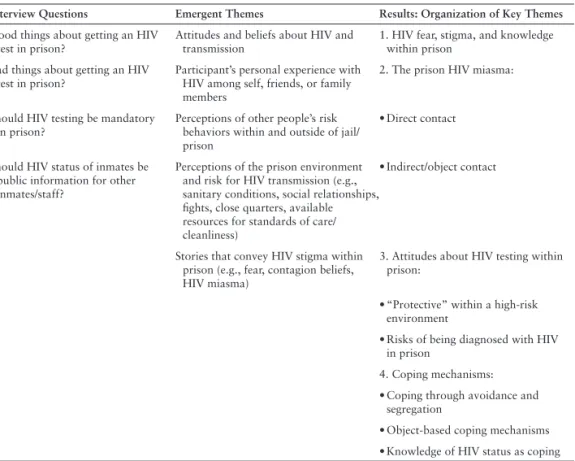
Interviews were transcribed and content analyzed for a priori and emergent themes. A priori themes were taken directly from the interview guide (Table 1, first column). Additional emergent themes (Table 1, second column) were identified by three researchers (DR, KM, and CF) through reading all transcripts using prelimi-nary coding. Two researchers (DR and KM) then designed an analysis guide using an Excel matrix where each row represented one participant and each column included a qualitative theme (Table 1) or a sociodemographic characteristic (Table 2). The analysis guide was refined by the full analysis team (DR, KM, and CF) and each transcript then coded by two team members. Discrepancies were discussed in the full group and resolved by consensus. Summary reports were created for each theme and discussed by all group members to identify relationships. This process resulted in four broad themes for presentation (Table 1, third column). Selected quotes are presented to illustrate the most commonly expressed ideas within each theme. This study was approved by the University of North Carolina Institutional Review Board
TABLE 1. Qualitative Analysis Themes
Interview Questions Emergent Themes Results: Organization of Key Themes
Good things about getting an HIV test in prison?
Attitudes and beliefs about HIV and transmission
1. HIV fear, stigma, and knowledge within prison
Bad things about getting an HIV test in prison?
Participant’s personal experience with HIV among self, friends, or family members
2. The prison HIV miasma:
Should HIV testing be mandatory in prison?
Perceptions of other people’s risk behaviors within and outside of jail/ prison
• Direct contact
Should HIV status of inmates be public information for other inmates/staff?
Perceptions of the prison environment and risk for HIV transmission (e.g., sanitary conditions, social relationships, fights, close quarters, available resources for standards of care/ cleanliness)
• Indirect/object contact
Stories that convey HIV stigma within prison (e.g., fear, contagion beliefs, HIV miasma)
3. Attitudes about HIV testing within prison:
• “Protective” within a high-risk environment
• Risks of being diagnosed with HIV in prison
4. Coping mechanisms:
• Coping through avoidance and segregation
• Object-based coping mechanisms
and the Human Subjects Committee of the North Carolina Department of Public Safety.
RESULTS
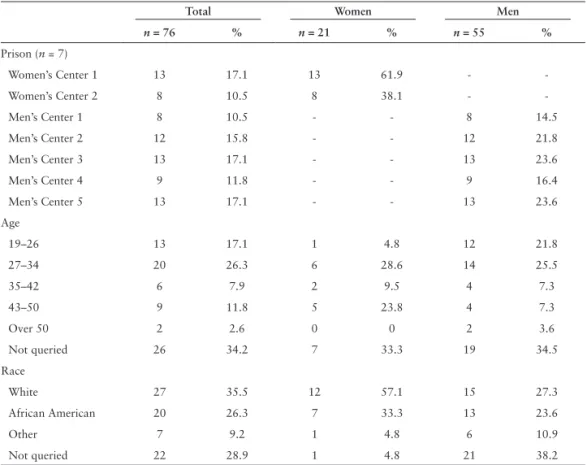
Table 2 presents self-reported demographics of 76 newly incarcerated interviewees. During earlier interviews, age and race were not systematically recorded and are reported as such in the table. Despite this missing information, demographics of our sample were generally similar to that of the entire population of new inmates within the North Carolina prison system with the notable exception that women were over-sampled to ensure that they would be sufficiently represented. (Women comprise 28% of our sample, but 12% of all incoming prisoners, Wohl et al., 2013). Our sample also contains a lower proportion of Black inmates (26% versus 54%, Wohl et al., 2013), although missing data on race precludes definitive comparisons.
HIV status was not asked. However, two female participants (#24 and #34) voluntarily disclosed their HIV-positive status, known to them prior to prison entry. Sixty-two (81.6%) participants said they thought they had been tested for HIV at intake. An additional 11 (14.5%) were unsure about their testing status but reported having had blood drawn; these individuals had likely been tested for HIV following North Carolina’s opt-out protocol. One person refused testing as he had recently been tested prior to incarceration and two others did not provide enough informa-tion to assess their testing status. The proporinforma-tion of tested inmates in our sample is
TABLE 2. Sociodemographic Characteristics of 76 Incarcerated Participants
Total Women Men
n = 76 % n = 21 % n = 55 %
Prison (n = 7)
Women’s Center 1 13 17.1 13 61.9 -
-Women’s Center 2 8 10.5 8 38.1 -
-Men’s Center 1 8 10.5 - - 8 14.5
Men’s Center 2 12 15.8 - - 12 21.8
Men’s Center 3 13 17.1 - - 13 23.6
Men’s Center 4 9 11.8 - - 9 16.4
Men’s Center 5 13 17.1 - - 13 23.6
Age
19–26 13 17.1 1 4.8 12 21.8
27–34 20 26.3 6 28.6 14 25.5
35–42 6 7.9 2 9.5 4 7.3
43–50 9 11.8 5 23.8 4 7.3
Over 50 2 2.6 0 0 2 3.6
Not queried 26 34.2 7 33.3 19 34.5
Race
White 27 35.5 12 57.1 15 27.3
African American 20 26.3 7 33.3 13 23.6
Other 7 9.2 1 4.8 6 10.9
comparable to state-wide rates during this same time period when approximately 95% of all North Carolina State prison system inmates were tested for HIV at entry (Rosen et al., 2015; Wohl et al., 2013).
HIV FEAR, STIGMA, AND KNOWLEDGE WITHIN PRISON
Many interviewees expressed a heightened fear of HIV and HIV-positive in-mates. HIV was viewed and described as a death sentence by some and generally perceived as a taboo subject. Participants consistently described expected conse-quences of being known HIV-positive in prison including being treated differently, avoided, isolated, labeled, gossiped about, judged, and discriminated against. These beliefs were also expressed by the two self-reported HIV-positive participants:
I’d be treated different . . . You’re just like an outcast or something then. No one would wanna be around you, or, you know, always be something bein’ said . . . you would have a harder time in here, ‘cause people be pickin’ on you . . . and it just would be more stressful. (Female, age 43, ID #24, HIV-positive)
Homophobia and stigmatizing views toward inmates who engaged in same sex be-haviors were expressed by both men and women. The perceived association between same-sex behavior and HIV fueled conflated stigmatizing beliefs. For example, one man noted that thinking someone was gay would make him “automatically catego-rize” the person as “probably hav[ing] AIDS” (Male, age 34, ID #50). While another stated, “Since I was growing up, gay people . . . guys messing with guys . . . it goes hand-in-hand with HIV and AIDS. So I just try to distance myself from all that stuff” (Male, age not queried, ID #14).
Some participants described concerns around HIV being spread by inmates who engaged in same sex behavior within prison. Among incarcerated women, this in-cluded beliefs that women were having consensual sex with multiple female part-ners, while among incarcerated men, this included both consensual male-male sex and rape.
Less than a quarter of participants articulated a clear knowledge of HIV trans-mission; the majority had incomplete knowledge and/or additional beliefs about how HIV is transmitted (e.g., sharing cigarettes, casual contact). Fourteen out of 76 participants (18%) mentioned a friend or family member with HIV/AIDS, includ-ing four participants who knew someone who had died of HIV/AIDS. In two clear cases, those who expressed knowledge of HIV transmission also expressed less HIV stigma, for example:
It’s a disease that has no prejudice over everybody . . . It can happen to anybody just like a car accident . . . I’ve been around people who have HIV and AIDS. You can get it through only the ways that are talked about . . . you follow the safety precautions and I think that’s the biggest thing. (Male, age not queried, ID #8)
However, for a number of participants, knowledge or experience with HIV was not sufficient to alleviate transmission fears and stigma within prison:
In another example, a respondent trained in nursing described HIV-infected inmates as “nasty” and women who were having sex in prison as “dirty” (Female, age 46, ID #40).
THE PRISON HIV MIASMA
The heightened fears and HIV-related stigmas contributed to an overall sense of an “HIV/disease miasma.” The miasma theory of disease predates germ theory and refers to beliefs that diseases were transmitted by vapors or bad air. In our analysis, we use this term to describe how participants seemed to extend their fear of an HIV-infected individual to everything that person might touch and the broader prison environment. Respondents’ connected these fears of HIV and transmission to characteristics of their physical and social environments within prison. In particular, fears centered around participants’ concerns about close quarters, tense social situa-tions, and environmental conditions. Participants were fearful of direct contact with HIV-infected persons and contact with objects they perceived to be “contaminated” with HIV.
Direct Contact
A number of participants expressed concern about exposure to HIV by direct contact with others while in prison through fights, sports, or rape. There was a specific fear of exposure to blood during fights and sports, “So if you’re like play-ing basketball or somethplay-ing and you had an open wound so no blood will leak on somebody else; and then they catch HIV” (Male, age not queried, ID #69).
Participants disagreed about whether public knowledge of an HIV-infected in-mate’s status would be harmful or protective for the HIV-positive person. Some felt the person would become a target, facing verbal and physical abuse—even to the extent of being killed. Others suggested inmates would avoid a known HIV-positive person, intentionally not fighting with them:
Having HIV might be good, ‘cause there’s less fighting. You hear guys all the time, they think before they jump on you because they’re afraid they’re gonna catch it just like that . . . I’ve heard stories of guys walking around saying that they had it, just to keep from people jumping on them. Kind of armor. (Male, age 30, ID #62)
Object Contact
Many participants also connected their perceived risk of HIV within prison to contact with objects thought to be contaminated. They expressed particular con-cern and/or disgust around bathrooms and eating facilities (e.g., sharing toilet seats, shower stalls, sinks, clothing, personal hygiene items, utensils).
I have to share a shower with other women who don’t have shower shoes and that makes me nervous. I don’t know what they got. They’ve been on the streets doin’ street drugs like needles and stuff and how do I know if they don’t got AIDS? (Female, age 34, ID #33)
Women specifically also mentioned a fear of being able to get HIV from a used sani-tary pad or bandage, or sharing a cigarette or a can of soda.
jobs in the cafeteria and that’s kinda scary thinking that they’re touching our food” (Female, age 34, ID #33).
ATTITUDES ABOUT HIV TESTING WITHIN PRISON
The HIV fears and stigma described above were often discussed in combination with the reduced control participants felt they had over their prison environments. This sense of heightened risk and loss of control seemed to fuel a generalized fear of HIV as pervasive within the prison environment (HIV miasma). Within this context, it is not surprising that the HIV testing provided during intake was viewed as mostly positive by all participants. Primary reasons for endorsing HIV testing included: availability of free testing and care, a sense that it was good to know one’s status for peace of mind and to prevent transmission to one’s family, and the protective nature of HIV testing within prison. Below we focus on this last theme and also discuss some of participants’ negative reactions to testing within prison.
HIV Testing as “Protective” Within a High-Risk Environment
Most participants cited protection against transmission to other inmates as a good reason to get HIV tested and as an argument in support of mandatory testing.
If you fall down, get a scrape, get a cut, fight, just anything, and a guard comes up, just ‘cause they have gloves on, that’s just your hands it protects. And if you got blood on you, it could get on anyone, so it’s there to protect everybody is how I feel. So honestly, I think [HIV test] ought to be mandatory. (Female, age not queried, ID #27)
Accordingly, there was a belief that testing was not primarily for the individual’s benefit but rather for the benefit of other inmates and the prison system.
Many inmates who supported mandatory HIV testing explained their approv-al in terms of circumstances created by prison environments. As described by one woman, “When you’re in a small group of people and confined to a small space, people need to know so that they can protect themselves and protect others” (Fe-male, age 24, ID #76).
The support of mandatory testing was connected with the sense that prison is a “dirty,” dangerous, and risky environment. These aspects of the environment were attributed to the physical spaces of prison, the social circumstances created by im-prisonment, and the people with whom one had to interact while in prison. Partici-pants described other inmates as “dirty,” “nasty,” “running the streets,” etc., citing these characteristics as reasons why everyone should be tested for HIV.
Negative Perceptions of Being Diagnosed With HIV in Prison
If you’re getting treated differently . . . what can the prison system do to secure your pri-vacy? They call you over the intercom, “Come get your meds.” And they [other inmates] like, “Why is she taking medicine every two hours?” (Female, age not queried, ID #31)
Two other respondents described how HIV treatment could raise confidentiality concerns because “everybody knows” that the HIV doctor comes to the prison on particular days or because inmates who take a large number of pills can be easily identified by other inmates and presumed to have HIV. In contrast, another par-ticipant described how everyone lines up for medications together but that no one knows what anyone else is taking.
The perception that HIV stigma is inevitable for those diagnosed in prison was grounded in the strong HIV-related stigma beliefs (described earlier in this manu-script) and magnified through the characteristics and social interactions of prison environments. Participants described the loss of control and privacy that was inher-ent to their life within prison:
You have nothing—no choices here, no freedoms here…you have to do what they tell you and when they tell you, and you have to be around people that you don’t necessar-ily wanna be around, whether they’re [HIV] positive or not. (Female, age 29, ID #26)
COPING MECHANISMS
Participants described behavioral reactions and coping mechanisms in response to their HIV fears and concerns which we grouped into three categories: interper-sonal avoidance, knowledge of HIV status, and object-based avoidance.
Coping Through Avoidance, Segregation, and Discrimination
Interpersonal coping mechanisms primarily focused on strict practices of keep-ing to oneself—includkeep-ing not touchkeep-ing other inmates, even in a jokkeep-ing or friendly context, and not having sex while in prison. Only three male participants expressed a concern about HIV transmission through rape, however this question was not directly asked of respondents. Interviewees described not wanting to have an HIV-positive cellmate and purposefully avoiding HIV-HIV-positive inmates. “It’s probably wrong or whatever, but I wouldn’t associate with a HIV positive or AIDS person. That’s probably a little prejudiced, but you know, I tried to keep my distance a little bit” (Male, age not queried, ID #13).
The desire to keep to oneself and avoid exposure, in the context of heightened fear, HIV stigma and the nature of the prison environment, manifested in a desire among some respondents for segregation within the prison by HIV status. “You want people to be separated if they have AIDS right? You don’t want to be sleeping in the same place. I mean not that it can be passed like that, but just—you don’t want to be exposed to people” (Male, age 32, ID #45).
A few interviewees mistakenly believed the prison already segregated HIV-pos-itive inmates or required PLHIV to wear different colored uniforms. Participants who were aware of the strong stigma against HIV but did not necessarily hold these beliefs themselves also supported segregation by status in order to protect those with HIV from harassment and maintain order within the prison.
Object-Based Coping Mechanisms
of the standard dining hall dishes, having additional bodily cleaning practices, not sharing personal items (e.g., cigarettes, clothing, food, drinks), and taking on re-sponsibilities of cleaning communal prison spaces.
When I go to lunch I don’t even drink out of them cups . . . because I ain’t trying to catch nothing. Salt shakers, pepper shakers, I use a napkin to pick them up because you never know what people are passing on in this prison . . . It’s easy to get. It’s easy to spread it [HIV], so many ways you can get it here. (Male, age 23, ID #17)
These object-based coping mechanisms approached a ritualized nature for some participants. Even when an interviewee stated that they knew a practice would not protect against HIV, it still provided a sense of safety and comfort for them.
Knowledge of HIV Status as Coping
While participants had concerns about the ability to keep their own HIV status confidential if diagnosed, a common theme expressed—especially among men—was the desire or right to know other inmates’ HIV-positive status. These sentiments were not contradictory in the context of high fear of HIV transmission risk and the high perceived stigma of HIV. Participants who thought that others inmates’ HIV status should be public information struggled to reconcile their desire for confiden-tiality with the perceived threat of HIV exposure:
My first gut instinct is that I would wanna know . . . [not] that I would discriminate against that, but for my well-being and my own health, to know that somebody is posi-tive for it . . . [but] then I would say no, because you wouldn’t want people picking on that one or saying things behind their back. (Female, age 38, ID #39)
Those who expressed concern (or nonsupport) of publicizing inmates’ HIV-positive status emphasized the extreme levels of stigma within prison and the potential for disclosure of status beyond prison. There was an additional belief in the importance of keeping HIV status confidential in order to reduce panic or disorder within the prison environment. Comparable sentiment was not expressed for an HIV-negative test result; most participants did not care if their HIV-negative status was public information.
DISCUSSION
Prior research among inmates and correctional staff found an inverse correla-tion between HIV knowledge and stigma (Albizu-Garcia et al., 2012; Derlega et al., 2008). In the current study, most participants expressed incomplete HIV knowl-edge and high HIV stigma (low knowlknowl-edge, high stigma) while a few had high HIV knowledge and low HIV-related stigma. Yet a number who knew the modes of HIV transmission maintained a heightened fear of HIV transmission within prison (high knowledge, high stigma).
Feelings of vulnerability to HIV were described in the context of prison environ-ments and focused on exposure to blood and bodies, perceived loss of control over one’s environment, and the perception that other inmates were dirty or diseased. In-terviewees’ fears of HIV were brought into stronger relief within prison where there were few outlets for dealing with these fears and stigmatizing beliefs. In this context, for some participants HIV testing took on a perceived protective role. At the time of the study interviews (2008–2009), HIV testing was provided in a voluntary, opt-out manner, but respondents were generally supportive of mandatory HIV testing within prison. This finding is consistent with larger prison surveys from Rhode Is-land (1997; Ramratnam et al., 1997) and North Carolina (2010–2011; Rosen et al., 2015). However, HIV-related stigma was also expressed in the context of support of mandatory testing, a desire to make known the status of those who test positive, and to segregate them.
At the same time, HIV-related stigma alongside a perceived lack of confiden-tiality within prison shaped participants’ responses about the implications of be-ing labeled as HIV-positive within the prison system (e.g., isolation, discrimination, abuse). Small samples of incarcerated PLHIV have found corroborating reports of discrimination, maltreatment by staff and inmates, and breaches of confidentiality (e.g., status revealed by medication distribution practices; Derlega et al., 2010; Rob-erson, White, & Fogel, 2009).
There are a few limitations to this study. First, standardized information on age, race, ethnicity, education, HIV knowledge, prior incarceration, and HIV status was not collected from all participants. Thus, we could not fully explore differences in the main themes among sub-groups of interviewees, such as those new to prison versus those with prior incarcerations. Our findings regarding high HIV stigma in spite of HIV knowledge suggest that this is a meaningful area for future exploration. A comparison of HIV fear and stigmatizing attitudes between previously incarcer-ated and newly incarcerincarcer-ated individuals could contribute to understanding whether and how time in prison intensifies or assuages HIV-related stigma and transmission fears. Second, our sample may not be inclusive of all perspectives regarding HIV and stigma within North Carolina prison settings. Concern for this limitation is reduced by the large qualitative sample, use of both random and convenience sampling, and selection from seven different facilities. Our findings may have broader application as suggested by similarities in themes comparing our results with those from other U.S. state prisons (Derlega et al., 2008; Derlega et al., 2010) as well as international settings (Andrinopoulos, Kerrigan, Figueroa, Reese, & Ellen, 2010).
prison intake process. Yet the persistent fears, stigma, and misperceptions about HIV among the majority of interviewees suggest that a single class is insufficient to fully counter inmates’ entrenched and situation-specific HIV-transmission fears. Among evidence-based HIV education programs in prison, most are multi-session (versus single session) and/or incorporate interactive and skills-building components (versus traditional lecture-style; DiClemente et al., 2014; Latham et al., 2012; Peres et al., 2002; Sifunda et al., 2008; Wolitski, 2006). HIV stigma reeducation interven-tions will likely need designs that reinforce the acquisition of new knowledge and skills over time. Furthermore, prison-based HIV education may also need to extend to inmates’ broader health concerns and anxieties related to confinement.
Second, HIV education and counseling efforts within prison settings need spe-cific components to reduce homophobia and HIV-related stigma. Based on findings from three systematic reviews, interventions to reduce HIV stigma (Brown, Ma-cintyre, & Trujillo, 2003; Sengupta, Banks, Jonas, Miles, & Smith, 2011; Stangl, Lloyd, Brady, Holland, & Baral, 2013), have not been administered in prison set-tings. Furthermore, among the reviewed interventions, only two explicitly addressed homophobia or gay-related stigma (Bean, Keller, Newburg, & Brown, 1989; Zacha-riah, 1998), and those found no impact. A review of community-level and structural level interventions focused on stigma and men who have sex with men presents promising interventions from schools and public social marketing campaigns where strength/resiliency-based messaging is emphasized over fear-based messaging (Ca-hill, Valadez, & Ibarrola, 2013). Lack of evaluation or dissemination of these inter-ventions to correctional populations is a missed opportunity to reverse HIV-related stigma. There is some evidence that overt expressions of both homophobia and of HIV-related stigma have declined in the U.S. general population (Herek et al., 2002). This social momentum could be leveraged by focusing intervention efforts in areas where stigma remains strong—including within prisons (Brown et al., 2003; Sen-gupta et al., 2011; Stangl et al., 2013).
Third, our findings reinforce the importance of including incarcerated or for-merly incarcerated individuals in intervention development and delivery (DiClemente et al., 2014; Latham et al., 2012; Peres et al., 2002; Sifunda et al., 2008). This could help identify the particular characteristics and social milieu of the prison environ-ment that need to be addressed in order to effectively reduce HIV-related fears and stigma. For example, our data suggest high levels of stigma and fear around sharing kitchen utensils and clothing—issues that may have particular salience among prison populations. Incorporating population-specific concerns may help develop more ef-fective interventions. The current study represents an important step in identifying prisoner-specific concerns, but broader efforts are needed.
CONCLUSION
the current elevated level of HIV-related stigma, concerns about the implications of being known HIV-infected within a prison setting are not surprising. The current need for lifetime treatment for HIV poses challenges for maintaining patient confi-dentiality in a prison environment. This research reveals that enhanced efforts are needed to ensure confidential engagement in prison-based HIV care while simultane-ously working to improve HIV knowledge and reduce HIV-related fears and stigma among those who test HIV-negative.
REFERENCES
Albizu-Garcia, C. E., Perez-Cardona, C., & Santi-ago-Negron, S. (2012). Correlates of HIV stigma in prison guards and case workers in a national prison system. Retrovirology, 9, S67. doi:10.1186/1742-4690-9-s1-p67 Andrinopoulos, K., Figueroa, J. P., Kerrigan, D.,
& Ellen, J. M. (2011). Homophobia, stig-ma and HIV in Jastig-maican prisons. Culture, Health & Sexuality, 13, 187–200. doi:10.1 080/13691058.2010.521575
Andrinopoulos, K., Kerrigan, D., Figueroa, J. P., Reese, R., & Ellen, J. M. (2010). HIV coping self-efficacy: A key to understanding stigma and HIV test acceptance among incarcer-ated men in Jamaica. AIDS Care, 22, 339– 347. doi:10.1080/09540120903193633 Ayala, G., Bingham, T., Kim, J., Wheeler, D. P.,
& Millett, G. A. (2012). Modeling the impact of social discrimination and finan-cial hardship on the sexual risk of HIV among Latino and Black men who have sex with men. American Journal of Pub-lic Health, 102, S242–S249. doi:10.2105/ ajph.2011.300641
Baillargeon, J. G., Giordano, T. P., Harzke, A. J., Baillargeon, G., Rich, J. D., & Paar, D. P. (2010). Enrollment in outpatient care among newly released prison inmates with HIV infection. Public Health Reports, 125, S64–S71.
Bean, J., Keller, L., Newburg, C., & Brown, M. (1989). Methods for the reduction of AIDS social anxiety and social stigma. AIDS Edu-cation and Prevention, 1, 194–221. Brewer, T. F., Vlahov, D., Taylor, E., Hall, D.,
Mu-noz, A., & Polk, B. F. (1988). Transmission of HIV-1 within a statewide prison system. AIDS, 2, 363–367.
Brown, L., Macintyre, K., & Trujillo, L. (2003). Interventions to reduce HIV/AIDS stigma: What have we learned? AIDS Education and Prevention, 15, 49–69.
Bureau of Justice Statistics. (2015a). Correctional populations in the United States, 2014 (Document # NCJ 249513). Office of Jus-tice Programs, U.S. Department of JusJus-tice. Retrieved February 29, 2016, from http:// www.bjs.gov/content/pub/pdf/cpus14.pdf
Bureau of Justice Statistics. (2015b). Medical problems of state and federal prisoners and jail inmates, 2011-12 (Document # NCJ 248491). Office of Justice Programs, U.S. Department of Justice. Retrieved May 10, 2015, from http://www.bjs.gov/content/ pub/pdf/mpsfpji1112.pdf
Cahill, S., Valadez, R., & Ibarrola, S. (2013). Com-munity-based HIV prevention interventions that combat anti-gay stigma for men who have sex with men and for transgender women. Journal of Public Health Policy, 34, 69–81. doi:10.1057/jphp.2012.59 Chesney, M. A., & Smith, A. W. (1999). Critical
delays in HIV testing and care: The poten-tial role of stigma. American Behavioral Scientist, 42, 1162–1174.
Culbert, G. J. (2014). Violence and the perceived risks of taking antiretroviral therapy in US jails and prisons. International Journal of Prison Health, 10, 94–110. doi:10.1108/ ijph-05-2013-0020
Derlega, V. J., Winstead, B. A., & Brockington, J. E., Jr. (2008). AIDS stigma among inmates and staff in a USA state prison. Internation-al JournInternation-al of STD & AIDS, 19, 259–263. doi:10.1258/ijsa.2007.007141
Derlega, V. J., Winstead, B. A., Gamble, K. A., Kelkar, K., & Khuanghlawn, P. (2010). Inmates with HIV, stigma, and disclosure decision-making. Journal of Health Psychology, 15, 258–268. doi:10.1177/1359105309348806
DiClemente, R. J., Davis, T. L., Swartzendruber, A., Fasula, A. M., Boyce, L., Gelaude, D., . . . Staples-Horne, M. (2014). Efficacy of an HIV/STI sexual risk-reduction interven-tion for African American adolescent girls in juvenile detention centers: A random-ized controlled trial. Women & Health, 54, 726–749. doi:10.1080/03630242.2014.93 2893
Goffman, E. (1963). Stigma: Notes on the manage-ment of spoiled identity. Englewood Cliffs, NJ: Prentice Hall.
Gough, E., Kempf, M. C., Graham, L., Manzanero, M., Hook, E. W., Bartolucci, A., & Cham-ot, E. (2010). HIV and hepatitis B and C in-cidence rates in US correctional populations and high risk groups: A systematic review and meta-analysis. BMC Public Health, 10, 777. doi:10.1186/1471-2458-10-777 Haley, D. F., Golin, C. E., Farel, C. E., Wohl, D. A.,
Scheyett, A. M., Garrett, J. J., . . . Parker, S. D. (2014). Multilevel challenges to engage-ment in HIV care after prison release: A theory-informed qualitative study compar-ing prisoners’ perspectives before and after community reentry. BMC Public Health, 14, 1253. doi:10.1186/1471-2458-14-1253 Hatzenbuehler, M. L., O’Cleirigh, C., Mayer, K.
H., Mimiaga, M. J., & Safren, S. A. (2011). Prospective associations between HIV-re-lated stigma, transmission risk behaviors, and adverse mental health outcomes in men who have sex with men. Annals of Behav-ioral Medicine, 42, 227–234. doi:10.1007/ s12160-011-9275-z
Herek, G. M., Capitanio, J. P., & Widaman, K. F. (2002). HIV-related stigma and knowledge in the United States: Prevalence and trends, 1991–1999. American Journal of Public Health, 92, 371–377.
Horsburgh, C. R., Jr., Jarvis, J. Q., McArther, T., Ignacio, T., & Stock, P. (1990). Seroconver-sion to human immunodeficiency virus in prison inmates. American Journal of Public Health, 80, 209–210.
Latham, T. P., Sales, J. M., Renfro, T. L., Boyce, L. S., Rose, E., Murray, C. C., . . . DiClemente, R. J. (2012). Employing a teen advisory board to adapt an evidence-based HIV/STD intervention for incarcerated African-Amer-ican adolescent women. Health Education Research, 27, 895–903. doi:10.1093/her/ cyr003
Lyons, T., Osunkoya, E., Anguh, I., Adefuye, A., & Balogun, J. (2014). HIV prevention and ed-ucation in state prison systems: An update. Journal of Correctional HealthCare, 20, 105–115. doi:10.1177/1078345813518630 Macalino, G. E., Vlahov, D., Sanford-Colby, S.,
Patel, S., Sabin, K., Salas, C., & Rich, J. D. (2004). Prevalence and incidence of HIV, hepatitis B virus, and hepatitis C virus in-fections among males in Rhode Island pris-ons. American Journal of Public Health, 94, 1218–1223.
Meyer, J. P., Cepeda, J., Wu, J., Trestman, R. L., Altice, F. L., & Springer, S. A. (2014). Op-timization of human immunodeficiency virus treatment during incarceration: Viral suppression at the prison gate. JAMA
Inter-nal Medicine, 174, 721–729. doi:10.1001/ jamainternmed.2014.601
Meyer, C. L., Tangney, J. P., Stuewig, J., & Moore, K. E. (2014). Why do some jail inmates not engage in treatment and services? Interna-tional Journal of Offender Therapy and Comparative Criminology, 58, 914–930. doi:10.1177/0306624x13489828
Peres, C. A., Peres, R. A., da Silveira, F., Paiva, V., Hudes, E. S., & Hearst, N. (2002). Develop-ing an AIDS prevention intervention for in-carcerated male adolescents in Brazil. AIDS Education and Prevention, 14, 36–44. Ramratnam, B., Rich, J. D., Parikh, A.,
Tsoul-fas, G., Vigilante, K. C., & Flanigan, T. P. (1997). Former prisoners’ views on manda-tory HIV testing during incarceration. Jour-nal of CorrectioJour-nal Health Care, 4, 155– 164. doi:10.1177/107834589700400205 Roberson, D. W., White, B. L., & Fogel, C. I.
(2009). Factors influencing adherence to antiretroviral therapy for HIV-infected female inmates. Journal of the Associa-tion of Nurses in Aids Care, 20, 50–61. doi:10.1016/j.jana.2008.05.008
Rosen, D. L., Golin, C. E., Grodensky, C. A., May, J., Bowling, J. M., DeVellis, R. F., . . . Wohl, D. A. (2015). Opt-out HIV testing in pris-on: Informed and voluntary? AIDS Care, 27, 545–554. doi:10.1080/09540121.201 4.989486
Rotily, M., Prudhomme, J., Pardal, M. S., Hariga, F., Iandolo, E., Papadourakis, A., & Moatti, J. P. (2001). Connaissances et attitudes du personnel de surveillance pénitentiaire face au VIH et/ou sida: Une enquête européenne [Knowledge and attitudes of prison staff to-wards HIV/AIDS: A European study]. Sante Publique, 13, 325–338.
Ruiz-Torres, Y., Cintron-Bou, F. N., & Varas-Diaz, N. (2007). AIDS-related stigma and health professionals in Puerto Rico. Interamerican Journal of Psychology, 41, 49–56.
Sengupta, S., Banks, B., Jonas, D., Miles, M. S., & Smith, G. C. (2011). HIV interventions to reduce HIV/AIDS stigma: A systematic re-view. AIDS and Behavior, 15, 1075–1087. doi:10.1007/s10461-010-9847-0
PLoS One, 4, e7558. doi:10.1371/journal. pone.0007558
Stangl, A. L., Lloyd, J. K., Brady, L. M., Holland, C. E., & Baral, S. (2013). A systematic re-view of interventions to reduce HIV-related stigma and discrimination from 2002 to 2013: How far have we come? Journal of the International AIDS Society, 16, 18734. doi:10.7448/ias.16.3.18734
Steward, W. T., Herek, G. M., Ramakrishna, J., Bharat, S., Chandy, S., Wrubel, J., & Ekstrand, M. L. (2008). HIV-related stig-ma: Adapting a theoretical framework for use in India. Social Science and Medi-cine, 67, 1225–1235. doi:10.1016/j.socs-cimed.2008.05.032
U.S. Centers for Disease Control and Prevention. (2006). HIV transmission among male in-mates in a state prison system—Georgia, 1992–2005. MMWR Morbidity and Mor-tality Weekly Report, 55, 421–426.
Wohl, D. A., Golin, C., Rosen, D. L., May, J. M., & White, B. L. (2013). Detection of undiagnosed HIV among state prison en-trants. Journal of the American Medical Association, 310, 2198–2199. doi:10.1001/ jama.2013.280740
Wolitski, R. J. (2006). Relative efficacy of a mul-tisession sexual risk-reduction interven-tion for young men released from prisons in 4 states. American Journal of Public Health, 96, 1854–1861. doi:10.2105/ ajph.2004.056044