TECHNICAL UNIVERSITY OF CLUJ-NAPOCA
ACTA TECHNICA NAPOCENSIS
Series: Applied Mathematics, Mechanics, and Engineering Vol. 60, Issue IV, November, 2017
STRAIN AMPLITUDE DEPENDENT INTERNAL FRICTION AND THE
YOUNG’S MODULUS DEFECT IN DAMAGED SOLIDS
Ligia MUNTEANU, Cornel BRIŞAN, Veturia CHIROIU, Rodica IOAN
Abstract: The paper investigates the nonlinear effects in the propagation of acoustic waves in damaged materials having the property that the distance between grains is comparable with the Burgers vector magnitude. The main ideea is to unify the explanation at the atomic level of the following properties of the damaged material:
- dependence of the strain amplitude on the internal friction (ADIF) and the Young’s modulus defect (YMD);
- the behavior of ADIF over the range of low, moderate and high strain amplitudes, in terms on temperature and frequency;
- the correlation between ADIF and YMD via the dislocation motion.
Key words: Damaged material, Burger vector, strain amplitude dependent internal friction, Young’s modulus defect;.
1. INTRODUCTION
Interaction of dislocations with defects are traditionally considered as basic to the ADIF and YMD [1]. The experimental investigations of ADIF are less well understood or analysed in the literature. For example, the origin of low strain amplitude internal friction background, existence of several stages in ADIF and YMD at different temperatures and in different frequency ranges in a two component array of point obstacles, are not very well understand and analysed [2, 3].
We consider a damaged material asociated with mesoscopic defects, such as dislocations, voids, and cracks. While dislocations and their mutual interactions determine the material strength in the absence of other internal defects, they tend to self-organize in the certain form, resulting into a heterogeneous field of strain at
the microscale although the overall
macroscopic field is thought to be
homogeneous. The main difficulty in modeling the nonlinearity lies in the fact that the length scale of these phenomena is not large enough to treat them within the classical continuum
mechanics framework not small enough to view these phenomena within the mechanics of dislocations [4-7].
In this paper, both thermally activated and
athermal contributions to dislocation
mesoplasticity in damaged materials are investigated. The theory is based of dislocation motion in a two component array of point defects. The change of the strength of one type of defect with temperature anf frequency lead to a change of the dislocation segment lengh.
2. BASIC THEORY
The effect of internal defects, such as dislocations, voids, microcracks, etc., on the material behavior and the manner they influence material properties is modeled through a set of internal variables and
corresponding phenomenological evolution
equations. The material response is measured in
terms the macroscopic strain rate tensor D and
its relation to the stress tensor σ.
divσ = ρv&, (1)
and the coupled heat equation
2 p
v
c T k T D
ρ &= ∇ + σ , (2)
where v=u& is the particle velocity, , ,u ρ cvand
k are the displacement vector field, mass
density, specific heat and thermal conductivity respectively, and Dp the plastic part of the rate
of strain tensorDwhich is defined as the
symmetric part of the velocity gradient
1( , ,)
2
ij i j j i
D = v +v . (3)
For elasto-viscoplastic behavior, D is
decomposed into an elastic part De and a
plastic part p
D such that
e p
D=D +D . (4)
The associated spin Wis defined as the
antisymmetric part of the velocity gradient, analogous to the vorticity in fluids
1( , ,)
2
ij i j j i
W = v −v . (5)
For elasto-viscoplastic behavior, W is
decomposed also into an elastic part We and a
plastic part Wp such that
W =We+Wp. (6) It is usufull to write also the strain field
, ,
1
( )
2
ij ui j uj i
ε = + as a sum between an elastic
part εe and a plastic part εp. For most damaged materials the elastic response is linear and can be expressed by the incremental form of Hooke’s law for large strain and material rotation such that
e
C D T
σ =% ⋅ − γ∆ , (7)
where γ is the temperature coefficient of stress
at constant strain, σ% is an objective rate of the Cauchy stress tensor σ, and C a fourth-order elastic constants tensor. There are several choises for σ% . The most common one is the rotational rate of Cauchy stress which is referred to as the Jaumann stress-rate tensor [7]
σ = σ + ω⋅ σ − σ ⋅ ω% & , (8)
where ω is the spin of the cell and is given as
the difference between the material spin W
and plastic spin Wp.
p
W W
ω = − . (9)
Combining (7) with (4) leads to
( e p)
C D D T
σ =% − − γ∆ . (10)
We need the constitutive laws for p
D and
p
W . The macroplastic strain and the plastic
spin are produced by the dislocation motion. These laws should be based on the underlying
microstructure, mainly dislocations, i.e.
bridging the continuum scale and the discrete dislocation scale.
Dislocations are discretized into pure screw and edge segments of length restricted to be integer multiples of a minimum size. The analysis is based on explicit evaluation of dislocation motion and its interaction with defects. Curved dislocations interact among themselves and with any applied stresses. The stress induced by an arbitrary dislocation loop
at an arbitrary field point P x( ) can be
computed by the Peach-Koehler equation given by the following line integral [8]
)
2
2
3
2
( ) d
8
d 8
4 (1 )
d
m im i C
m im i C
m imk i C
k i
P b R x
x
b R x
x
R b
x x x
R x
x
αβ α β
β α
α β
αβ
µ ∂
′ ′
σ = − ε ∇ −
′
π ∂
µ ∂
′ ′
− ε ∇ −
′
π ∂
µ ∂
− ε
′ ′ ′ π − ν ∂ ∂ ∂
∂
′ ′ −δ ∇
′ ∂
∫
∫
∫
(11)
where bi is the i-th component of the Burgers
vector, εimαis the permutation symbol, µ is the
shear modulus, ν is Poisson’s ratio and
|| ||
R= x−x′ is the radius vector norm between
(
)
1 1 2 1 1 2 1 3 2( ) [ d
8 d 8
4 (1 )
d ]
j m
k ik
loops j j i
j k ik i j j k ikl i j l i
P b R x
x
b R x
x
R b
x x x
R x
x
+ −
αβ α β
= + β α + α β αβ µ ∂ ′ ′
σ = − ε ∇ −
′
π ∂
µ ∂
′ ′
− ε ∇ −
′
π ∂
µ ∂
− ε
′ ′ ′
π − ν ∂ ∂ ∂
∂ ′ ′ −δ ∇ ′ ∂
∑ ∑
∫
∫
∫
(12)where m is the total number of nodal points in
a given loop or curve. Eq. (12) reduces to the approximate form , 1 1 ( ) N j j j P + =
σ =
∑
σ , (13)where N is the total number of nodes from all loops and curves and σj j, +1= σj+1− σj.
In order to compute the dynamics of the dislocation curve we evaluate the stress distribution and the driving force and velocity distribution along the entire curve. Using (13), the Peach-Kohler force can be computed directly on node i
1 , 1 1 [ ( ) ( )] N a
i j j i i
j
F P P b
−
+ =
=
∑
σ + σ × ξ , (14)where bi is the Burgers vector and ξi is the line sense. The governing equation of slide motion for each dislocation node combined with (14) leads to
m vi i 1 vi Fi M
+ =
& & , i=1, 2,...N, (15)
where vi are the slip velocities, m is the effective mass per unit dislocation length and
M is the dislocation mobility, Fi are given by
(14). For the effective mass m we use the
following expressions derived in [8, 9] for the screw dislocation 0 2 3 1 1 ( ) W m v = − +
γ γ , (16)
for the screw dislocation, and for the edge dislocation
(
)
2 0 4 3 3 5 40 8 1650 22 6
14 P l l l W v m v
= − γ − + +
γ γ
γ + − +
γ γ γ
(16) where 2 2 1 P l v v − = γ , 2 2 1 S v v − =
γ , vP is the
longitudinal sound velocity and vS the
transverse sound velociy, and W0 is the rest energy for the screw.
The set of equations (15) are coupled and
highly nonlinear. They were solved
simultaneously using the finite difference method which turns out to be stable provided that the integration time step is small enough, which is the case here as dictated by the short-range interaction.
The motion of each dislocation segment contributes to the overall macroscopic plastic
strain Dpand plastic spin Wp via the relations
1 ˆ ( ) 2 N p i i
i i i i i
l v
D n b b n
V =
=
∑
+ , (17)1 ˆ ( ) 2 N p i i
i i i i i
l v
W n b b n
V =
=
∑
− , ( 18)n&= ωn ,
where li is the segment length, ni is a unit normal to the slip plane, ˆvi is the magnitude of the slip velocity field solutions of the equations (15), V is the volume of the cell, and N is the total number of segments. The relations (17) and (18) provide the most rigorous connection between the dislocation motion and the macroscopic plastic strain, with its dependence on strength and applied stress being explicitly embedded in the calculation of the velocity of each dislocation.
3. RESULTS AND DISCUSSION
The visco-plastic model described in this paper give rise to energy dissipation or internal friction, as a loss of energy. The energy
2 /
d
o
E D t
π ω
∆ =%
∫
σ . The energy loss is expressedin terms of a loss factor Q−1
1
0
1
sin 2
E Q
E
− ∆
= = δ
π
%
% . (19)
Writing the constitutive law in term of the
complex modulus σ =M*ε we can calculate
the phase angle δ0 and the relaxation timeτ. The relaxation time depends on temperature
according to exp U
kT
τ = , where U is the
activation energy. The frequency at which maximum attenuation occurs is also dependent
0exp( ) U kT
ω = ω% % − , where ω%0 and ω% are the
resonant and applied angular frequencies. The decrement δ is defined as the ratio of the energy loss per cycle, ∆E%, to twice the total vibrational energy E%0 , stored in the structure,
that is
0
2
E E
∆ δ = %
% . We define the Young’s
modulus defect as
0 11
0 11 p e
E E E
E E
∆ − ε
= =
ε , (20)
whereE is the instantaneous value of Young’ modulus and E0 is its value at amplitudes less
than critical value of exceeded σcr, ε11p is the plastic strain amplitude, and ε11e the elastic strain amplitude in the direction x.
The critical stress σcr is frequency and temperature dependent, and for the stationary thermally activated dislocation motion over an array of short-range obstacles and is given by [9]
0 [1 ln 0] cr
F kT
Lb U
α
ω σ = −
ω
%
% , (21) where U0and F0 are the maximum values of the activation energy and interaction force between a dislocation and a short-range obstacle, L and b are the average dislocation segment length and the magnitude of the Burgers vector, and 1< α <2 is a constant [7].
In the following we consider 60 joints. We
analyze the dependence of the decrement δ on
the strain amplitude ε11. Fig. 1 shows the strain amplitude-dependent decrement at the low temperature 10 K and high frequency 100 kHz. The curve increases and decreases as indicated by arrows. At low temperature, the IF shows no amplitude-independent part. The dependence is
moderate at the lowest strain amplitudes ≈10−6
and strong at the moderate and high strain
amplitudes. At low strains dislocations
overcome only weak obstacles. The strong obstacles are not penetrable at low temperature but can be overcome at higher strain amplitudes.
Fig.1. Strain amplitude ε11dependence of the decrement δat low temperature 10 K and high
frequency 100 kHz.
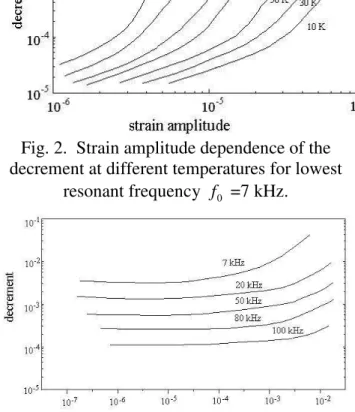
In Fig. 2 the strain amplitude-dependent decrement on temperature for lowest frequency
0
ω% =7 kHz I shown. This is the resonant
frequency at the lowest strain amplitude. We observe that the slope is likely to be the same in the range 10-300 K at the lowest strain
amplitudes≈10−6. Deviation from this
regularity is observed at the strain amplitude of
5
10−
≈ at elevated temperatures 100-300 K.
This is explained by the fact that the
decrement for lowest resonant frequency ω%0= 7
Fig. 2. Strain amplitude dependence of the decrement at different temperatures for lowest
resonant frequency f0 =7 kHz.
Fig. 3. Strain amplitude ε11dependence of the
decrement δ at 10 K for different frequencies.
Fig. 3 shows the influence of frequency on
the strain amplitude ε11 dependence of the
decrement δat 10 K. The decrement is higher
at a frequency around 7 kHz than in the 100 kHz range.
Fig. 4 Temperature dependence of the strain amplitude-independent component of internal
friction.
A comparison between the decrements at 7 kHz and at 100kHz shows that the internal friction is still higher in the sonic range than at ultrasonic frequencies.
Fig. 4 clarifies the nature of the strain
amplitude-independent component of the
internal friction. The amplitude-independent
component increases continuously with
temperature. A maximum is observed near 100 K. This is an indication of the dislocation nature of the amplitude-independent internal friction component.
Fig. 5. The dependence of the decrement and the Young’s modulus defect on the stress ratio
/ cr
σ σ
The dependence of the decrement and the Young’s modulus defect on the stress ratio
/ cr
σ σ is shown in Fig.5. The Young’s modulus
defect is increasing with increasing stress, and the decrement relaxes with increasing stress.
REFERENCES
[1] Sapozhnikov, K.V., Golyandin, S.N.,
Kustov, S.B., Amplitude dependence of the
internal friction and Young’s modulus defect
of polycrystalline indium, Physics of the
Solid State, 52(1), 43–48, 2010.
[2] Kustov, S.B., Gremaud, G., Benoit, W., Golyandin, S., Sapozhnikov, K., Nishino,
Y., Asano, S., J. Appl. Phys. 85, 1444
(1999).
[3] S. B. Kustov, J. Van Humbeeck, I. Hurtado, S. N. Golyandin, and R. De Batist, in
Damping, Ed. by A. Wolfenden and V. K. Kinra (The American Society for Testing and Materials, Philadelphia, PA, United States, 1997), p. 94.
[4] Tyapunina, N.A., Naimi, E.K.,
Zinenkova, G.M., Effect of Ultrasound on
Crystals with Defects, Moscow State
University, Moscow, 1999 [in Russian].
[5] S. B. Kustov, J. Van Humbeeck, I. Hurtado, S. N. Golyandin, and R. De Batist, in M3D III: Mechanics and Mechanisms of Material Damping, Ed. by A. Wolfenden and V. K. Kinra (The American Society for Testing and Materials, Philadelphia, PA, United States, 1997), p. 94.
[6] Mulyukov. R.R., Akhmadeev. N.A.,
Valiev, R.Z., Strain amplitude dependence
of internal friction and strength of
submicrometre-grained copper, Materials
Science and Engineering: A, 171(1-2), 143-149, 1993.
[7] Chiroiu, V., Scalerandi, M., Munteanu, L.,
Iordache, D., Strain amplitude dependent
internal friction and the Young’s modulus
defect in random solids, Private
communication, Torino, 2001.
[8] Teodosiu, C., Elastic Models of Crystal
Defects, Springer 1982.
[9] Hirth, J.P., Loethe, J., Theory of
dislocations, Krieger Publishing Company
Florida, 1982.
AMPLITUDINEA SOLICITARII DEPENDENTA DE FRECAREA INTERNA SI MODULUL LUI YOUNG DEFECT IN SOLIDE DETERIORATE
Abstract: Lucrarea investighează efectele neliniare ale propagarii undelor acustice in materiale deteriorate având proprietatea că distanța dintre granule este comparabilă cu magnitudinea vectorului Burgers. Ideea principală este a explica in mod unitary la nivel atomic următoarele proprietăți ale materialului deteriorat:
- dependenta amplitudinii deformatiei de frecarea interna (ADIF) și defectul modulului Young (YMD);
- comportamentul ADIF la amplitudini mici, moderate și inalte ale deformatiei, în functie de temperaturăși frecvență; - corelația dintre ADIF și YMD prin dislocatii.
Ligia MUNTEANU, PhD., Senior Researcher CS1, Institute of Solid Mechanics, Dept. of Deformable Media and Ultrasonics, E-mail: [email protected], Office Phone: +40213153810, Mobil: +40724701227.
Cornel BRIŞAN, PhD., Professor, Technical University of Cluj-Napoca, Dept. of Mechatronics and System Dynamics, E-mail: [email protected], Office Phone: +40264401680, Mobil: +40751393410.
Veturia CHIROIU, PhD., Senior Researcher CS1, Institute of Solid Mechanics, Dept. of Deformable Media and Ultrasonics, E-mail: [email protected], Office Phone: +40213153810, Home Mobil: +40745989267.